




Abstract
Previous findings on the relationship between smartphone use and well-being have been mixed. This may be partially due to a reliance on cross-sectional study designs and self-reported smartphone usage. In the current study, we collected screen time data by directly tracking participants’ (N = 325, ages 14−80 years, 58% women) smartphone usage over a period of 6 days. We combined this tracking with ecological momentary assessment, asking participants three times per day about their psychological well-being and feelings of social connectedness. Smartphone screen time was determined for the hour directly before each assessment. Results revealed that at times when participants used their smartphone more in the hour before an assessment, they reported lower psychological well-being and lower social connectedness. A bidirectional relationship emerged between smartphone screen time and social connectedness, suggesting a potential “vicious cycle” whereby smartphone usage leads to reduced social connectedness, which promotes more smartphone usage.
The ubiquity of smartphones makes it critical to determine whether and how they affect our social relationships and psychological well-being. There is an ongoing scholarly (and public) debate about the relationship between digital technology use and psychological well-being. For instance, while some authors have concluded that adolescents who reported higher levels of digital technology use were more likely to report mental health issues based on an analysis of data from more than half a million adolescents in the US (Twenge et al., 2018), others disagreed with this conclusion based on extensive re-analysis of the data (Orben & Przybylski, 2019a). Furthermore, analyses of almost 20,000 adolescents in total across four nationally representative large-scale data sets documented very small negative associations between self-reported habitual digital technology use and psychological well-being (George et al., 2020; Orben & Przybylski, 2019b), consistent with findings from a prior meta-analysis (Huang, 2010). A related construct, the subjective perception of problematic technology usage, appears to have a more pronounced relationship with lower emotional well-being (see Sohn et al., 2019 for a meta-analysis).
Some of the observed inconsistencies regarding the relationship between digital technology use and well-being may have arisen as a result of a critical methodological limitation that characterizes many of these studies: namely, reliance on self-report measures to assess digital technology use. The limited reliability of retrospective self-reports of behavior has been documented in multiple areas of psychology (reviewed in Baumeister et al., 2007). For digital technology use in particular, most people’s estimates of their screen time are inaccurate, with a recent meta-analysis indicating that people’s self-reported screen time shares — at best — only about 20% of variance with objectively measured screen time (Parry et al., 2021). Imprecise measurement of key variables (e.g., screen time) can yield biased estimates and incorrect inferences (e.g., Green et al., 1993; Shear & Zumbo, 2013). Therefore, it is imperative to measure digital screen time directly when examining its relationship with feelings of social connectedness and well-being.
Moreover, research using self-report measures has traditionally primarily focused on inter-individual comparisons (i.e., comparing different people to each other) between habitual digital technology use and well-being-related constructs (e.g., Orben & Przybylski, 2019a; Twenge et al., 2018; Valkenburg & Peter, 2007). A few studies have also examined long-term associations within individuals based on panel surveys (e.g., Schemer et al., 2021). While these methods provide some insight, it is essential to examine dynamic, momentary effects within individuals for several reasons: First, it is possible that changes in digital technology use systematically impact well-being and social connectedness on an individual level, but that these effects do not emerge when comparing across individuals because different individuals may have different thresholds for the amount of use that is beneficial or harmful to them. Second, assuming that there is, in fact, a systematic relationship between digital technology use and well-being and/or social connectedness, it is important to determine if digital technology use predicts these alterations, or vice versa. Examining dynamic effects within individuals is key to addressing questions about the directionality of observed effects. Measuring feelings of social connectedness and well-being separately and repeatedly over time also allows for examination of whether these two variables tend to change in parallel with patterns of digital technology use, or whether changes in one of these variables tends to predict changes in the other. Third, the effects of digital technology use on well-being and social connectedness might occur within minutes or hours, and not be detectable days, weeks, or months after use. Directly-measured digital screen time data allows for these more fine-grained analyses.
Past research often lumped screen time across various devices (e.g., computers, televisions, electronic games) together when investigating the relationship between digital technology use and well-being (e.g., Orben & Przybylski, 2019a; Twenge et al., 2018) even though scholars have argued that smartphones are theoretically different from other devices due to their pervasiveness throughout everyday life (Kushlev, Dwyer, & Dunn, 2019). They may therefore have both qualitatively and quantitatively different effects on social connectedness and well-being. Indeed, theoretical assumptions regarding the effects of smartphone use on social connectedness and well-being primarily revolve around the ideas that smartphone use may supplant other activities that could be more socially and emotionally rewarding (displacement hypothesis; reviewed in Kushlev & Leitao, 2020; for similar considerations regarding different technologies prior to the broad adoption of smartphones and empirical tests thereof, see e.g., Kraut et al., 1998, 2002; Valkenburg & Peter, 2007), or interfere with concurrent activities, thereby making them less enjoyable (interference hypothesis; reviewed in Kushlev, Dwyer, & Dunn, 2019; Kushlev & Leitao, 2020). Although smartphones may supplant and/or interfere with other activities, they can also provide access to various forms of potentially beneficial and otherwise unavailable information, entertainment, and resources, including online social interaction (complementarity hypothesis; reviewed in Kushlev, Dwyer, & Dunn, 2019; Kushlev & Leitao, 2020).
In line with the interference hypothesis, several studies, including some experimental work (e.g., Dwyer et al., 2018; Kushlev & Dunn, 2019), suggest that, specifically during social activities, smartphone use predicts lower feelings of social connectedness and fewer and less satisfying social interactions both with close social ties such as friends and family, and with weaker social ties such as neighbours and coworkers (reviewed in Kushlev, Dwyer, & Dunn, 2019; Kushlev & Leitao, 2020). However, other work provides support for the complementarity hypothesis by documenting a positive relationship between smartphone use and facets of well-being, especially when individuals used their smartphone as a tool to solve or cope with stressful or otherwise challenging situations (e.g., Hoffner & Lee, 2015; Kushlev et al., 2017; Melumad & Pham, 2020; Schneider et al., 2023). Evidence for the displacement hypothesis has so far been mixed. One study has found that within individuals, online social interactions are negatively correlated with offline social interactions on the same day (in line with displacement; Verduyn et al., 2021), whereas another study did not find any support for displacement within individuals over a 6-month period (Dienlin et al., 2017). Further complicating the picture, research examining the association between online and offline social interaction between persons has reported not only null but also positive relationships (e.g., Valkenburg & Peter, 2007; Verduyn et al., 2021).
In the present research, we collected smartphone screen time data by directly measuring smartphone usage with a tracking app for 6 days. We combined this tracking with ecological momentary assessment (EMA), asking participants three times per day about their momentary levels of psychological well-being and feelings of social connectedness, and whether/to what extent they had interacted with other people offline and online. The primary research aims we sought to address were (1) whether directly-measured smartphone screen time is associated with psychological well-being and feelings of social connectedness between individuals and (2) the temporal relationships between directly-measured smartphone screen time and both momentary psychological well-being and feelings of social connectedness within individuals. Moreover, to explore whether any observed negative effects of smartphone screen time on well-being and social connectedness are consistent with smartphone use supplanting offline social interactions (displacement hypothesis) and/or interfering with them (interference hypothesis), we controlled for offline social interaction and examined whether effects of smartphone screen time on well-being and social connectedness were moderated by the amount of offline social interaction the participant reported engaging in.
Methods
Participants
We recruited a convenience sample of n = 485 Android phone users from the University of British Columbia and the broader community in and around the city of Vancouver, from November 23, 2017 to March 13, 2020 (the beginning of the COVID-19 lockdown in Canada). The study (which was part of a larger project, see below for details) was advertised as “Smartphone and Sleep Study” using a variety of methods and channels, including the Department of Psychology’s participant pool, flyers, posters, short presentations at local public library branches and schools, a project-specific website, and paid social media ads. To retain as much useable data as possible while also ensuring sufficient data quality, we analyzed data from all participants who completed at least the study intake session and the in-app exit survey (which triggered the final data transfer from the participants’ phones to the study server, n = 325). The sample was demographically diverse: ages: 14−80 years; M = 24.87, SD = 12.59; 58% women; 39% East Asian, 28% Caucasian, 12% Southeast Asian, 9% South Asian, 3% Middle Eastern, 3% Hispanic, 1% Aboriginal, 1% African, 3% other; 64% students, 26% working at least part time; 5% unemployed; 4% retired). We excluded participants who did not complete the exit survey because we cannot determine whether those participants stopped using the data collection app or because the app was suppressed by their operating system (which would compromise data quality). With exception of ethnicity, excluded participants had very similar demographic characteristics (ages: 14−69 years; M = 22.46, SD = 9.52; 62% women; 59% East Asian, 15% Caucasian, 10% South Asian, 6% Southeast Asian, 3% Hispanic, 2% Middle Eastern, 1% Aboriginal, 1% African, 4% other). For transparency, we report the results for the full sample in the Online Supplemental Materials. Participants received either payment or course credit for their time in the study. The study was approved by the University of British Columbia’s Behavioural Research Ethics Board.
Procedure and Measures
During the study intake session, participants installed the BeTrack app, a research application for Android smartphones developed for this study. Participants also reported basic demographics and completed the first set of validated questionnaires to assess their global psychological well-being and social connectedness. Throughout the six EMA days of the study, participants were sent three notifications per day through the app, asking them to complete a brief (approximately 1 minute long) survey. Notifications were sent at random times within three time windows (Survey 1: 9:30am-1pm, Survey 2: 1:30pm–5pm, Survey 3: 5:30pm–9pm). On the last day of the study, participants were prompted to take a final in-app exit survey to assess their self-reported smartphone screen time and satisfaction with the app (approximately 5 minutes). Finally, participants returned for the study exit session, where they completed a second set of validated self-report questionnaires. The results presented here were part of a larger project primarily targeted at (1) predicting objectively-measured sleep from smartphone usage data, (2) investigating the effects of passive versus active social media use on well-being, and (3) addressing the present research questions (for the full list of measures see https://osf.io/b5ru8/; for additional analyses regarding other potentially relevant measures related to well-being and social connectedness, see Online Supplemental Materials).
Statistical Analyses
For all analyses, p-values <.05, two-sided, are considered significant. Our data and analysis script are available at https://osf.io/b5ru8/.
We examined the dynamic relationships within individuals between changes in smartphone screen time and momentary psychological well-being and social connectedness. To account for the nested structure of the data (time points at level 1 nested within individuals at level 2), temporal relationships between smartphone use with both momentary psychological well-being and feelings of social connectedness were investigated in multilevel models (MLMs). MLMs were estimated using the multilevel modeling package nlme (Pinheiro et al., 2018), allowing for random intercepts and random slopes. All level 1 predictor variables were cluster centered before being entered into the model. Additionally, the mean value across each participant’s 18 timepoints (3 surveys per day * 6 days) was computed for each predictor variable, grand mean centered, and entered at level 2 (except for lagged autocorrelations). Entering the mean score of all instances of a level 1 variable into the model at level 2 allowed us to distinguish between within-person and between-person effects.
We first tested whether smartphone screen time, assessed in the hour before the survey, would predict subsequent momentary psychological well-being. In this analysis, we controlled for lagged values of momentary well-being (i.e., momentary well-being in the previous survey), and between-participant variation in smartphone screen time. We then ran the analogous model predicting feelings of social connectedness instead of well-being. The models employed the following equations:
Level-1 model:
Level-2 model:

Next, in order to explore whether the effects of smartphone screen time on well-being [or feelings of social connectedness] could be driven by the screen time displacing offline social interaction (“displacement hypothesis”) and/or be a result of smartphone screen time interfering with social interactions (“interference hypothesis”), we subsequently entered offline social interaction since the preceding EMA survey (level 1), mean offline social interaction since the preceding EMA survey (level 2), and their same-level interactions with smartphone screen time as additional predictors into the respective model. Significant interaction effects were followed up by simple slopes analyses; if no significant interaction effects were found, interaction terms were removed in a third step, resulting in a simpler model only including main effects. We then added online social interaction since the preceding EMA survey (level 1) and mean online social interaction since the preceding EMA survey (level 2) as additional predictors into the respective model. Subsequently, to assess the reverse pathway (i.e., whether well-being [or feelings of social connectedness] predicted smartphone screen time), we tested whether changes in momentary psychological well-being [or feelings of social connectedness] would predict changes in smartphone screen time in the hour after the survey, controlling for smartphone screen time assessed in the hour before the survey and between-participant variation in psychological well-being [or feelings of social connectedness].
Finally, as an additional test to address whether the displacement hypothesis could explain the observed patterns of results, we ran an MLM in which we entered offline social interaction as outcome variable and smartphone screen time in the hour prior to the EMA survey (level 1) and mean smartphone screen time in the hour prior to the EMA survey (level 2), controlling for lagged values of offline social interaction (i.e., offline social interaction reported in the previous EMA survey).
Results
Descriptive Results for Directly-Measured and Self-Reported Smartphone Screen Time
Directly-measured and self-reported daily smartphone screen time were only moderately correlated (r = .33), consistent with the recent meta-analytical evidence by Parry et al. (2021). Moreover, only 37% of our participants reported an average daily smartphone screen time within 1 hour of their directly-measured smartphone screen time, while 19% of our participants underestimated and 24% overestimated their average daily smartphone screen time by 2 hours or more, underscoring the critical role of behavioral measures when investigating the impact of smartphone use.
Directly-Measured Screen Time Predicting Psychological Well-Being
Model 1: Results from multilevel models predicting well-being from directly-measured smartphone screen time in the hour preceding each EMA survey (level 1), average directly-measured smartphone screen time in the prior hour (mean of all 18 surveys; level 2), and well-being in previous EMA survey. Model 2: Same as Model 1, while additionally entering offline social interaction since the prior EMA survey (level 1), mean offline social interaction since the prior EMA survey (level 2), and their same-level interactions with smartphone screen time as additional predictors into the model. Model 3: Same as Model 2, after removing both interaction terms. Model 4: Same as Model 3, while entering online social interaction since the prior EMA survey (level 1) and mean online social interaction since the prior EMA survey (level 2) as additional predictors into the model.
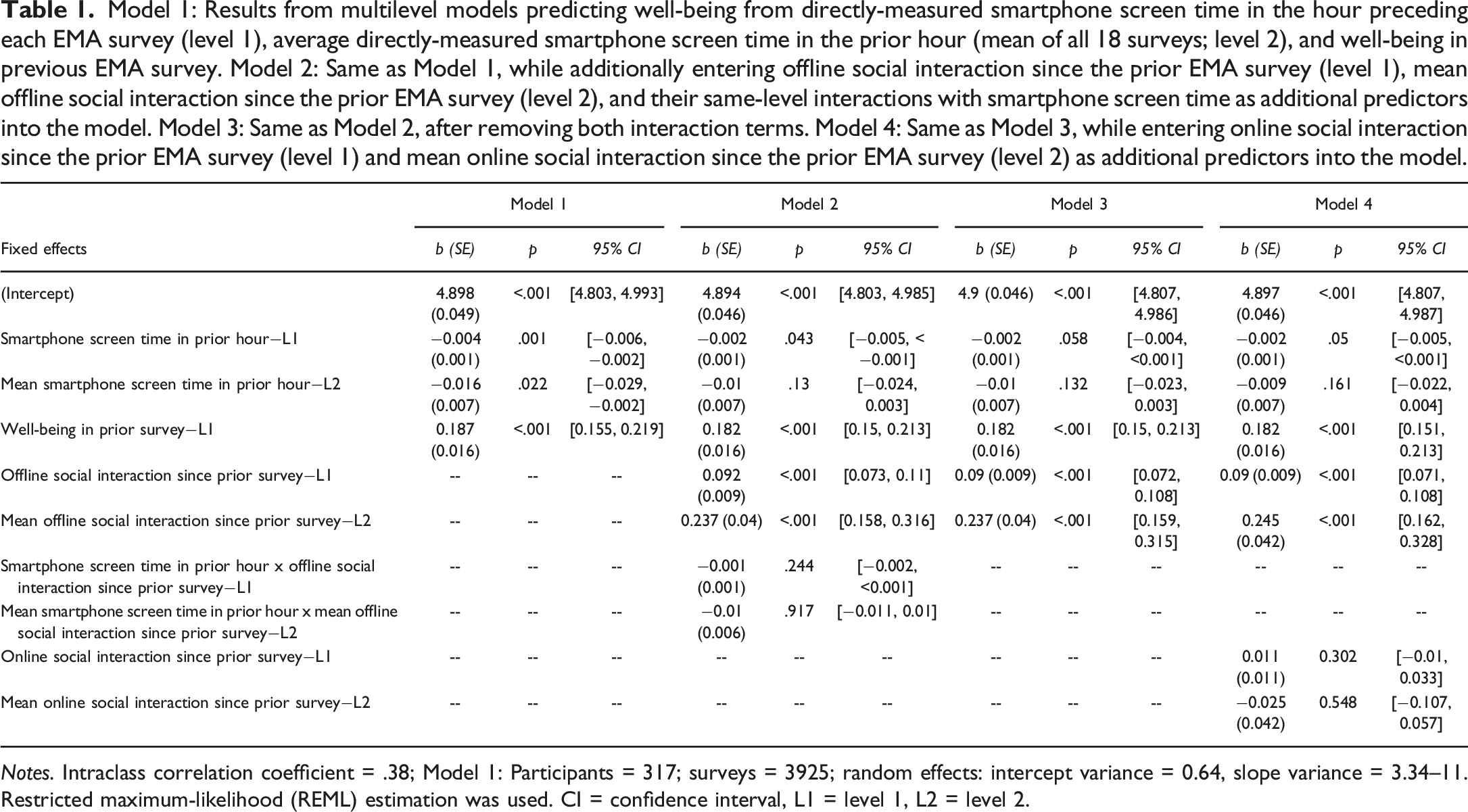
Notes. Intraclass correlation coefficient = .38; Model 1: Participants = 317; surveys = 3925; random effects: intercept variance = 0.64, slope variance = 3.34–11. Restricted maximum-likelihood (REML) estimation was used. CI = confidence interval, L1 = level 1, L2 = level 2.
Next, we entered offline social interaction since the preceding EMA survey (level 1), mean offline social interaction since the preceding EMA survey (level 2), and their same-level interactions with smartphone screen time as additional predictors into the model (see Table 1, Model 2). Results revealed that neither interaction was significant, so we removed both interaction terms in order to interpret the main effects (results shown in Table 1, Model 3). This model indicated that when controlling for (both within- and between-person) offline social interaction, the negative relationship between smartphone screen time and well-being between individuals was no longer significant, and the negative relationship between smartphone screen time and well-being within individuals was marginal (see Table 1, Model 3). In addition, both offline social interaction (level 1) and mean offline social interaction (level 2) were significant positive predictors of momentary well-being, suggesting that (1) when people interact with others more (vs. less) they feel better, and that (2) individuals who overall interact more with others have higher well-being overall. Finally, we entered online social interaction since the preceding EMA survey (level 1) and mean online social interaction since the preceding EMA survey (level 2) as additional predictors into the model (see Table 1, Model 4). Neither within nor between person online social interaction were significant predictors of well-being (results shown in Table 1, Model 4).
Results from multilevel models predicting directly measured smartphone screen time in the hour after each EMA survey from well-being at levels 1 and 2, and smartphone screen time in the prior hour.
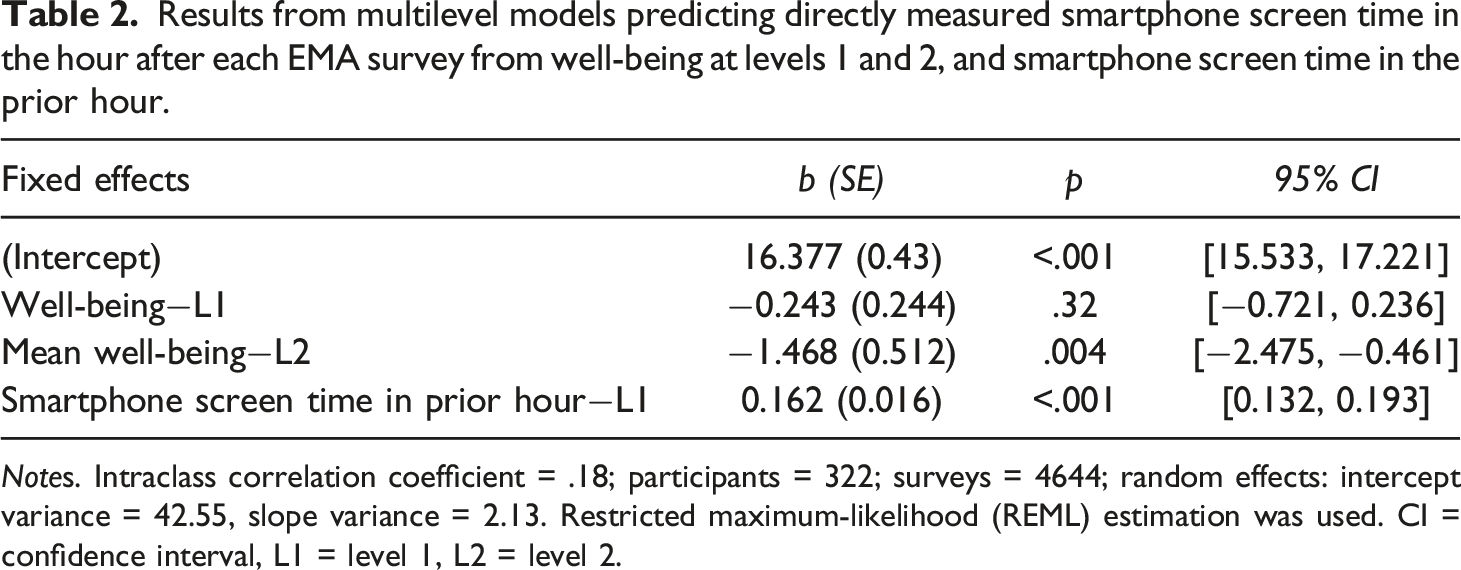
Notes. Intraclass correlation coefficient = .18; participants = 322; surveys = 4644; random effects: intercept variance = 42.55, slope variance = 2.13. Restricted maximum-likelihood (REML) estimation was used. CI = confidence interval, L1 = level 1, L2 = level 2.
Directly-Measured Screen Time Predicting Feelings of Social Connectedness
Model 1: Results from multilevel models predicting feelings of social connectedness from directly-measured smartphone use in the hour preceding each EMA survey (level 1), average directly-measured smartphone screen time in the hour preceding each EMA survey (mean across all 18 surveys; level 2), and social connectedness in the previous EMA survey. Model 2: Same as Model 1, while additionally entering offline social interaction since the preceding EMA survey (level 1), mean offline social interaction since the preceding EMA survey (level 2), and their same-level interactions with smartphone screen time as additional predictors into the model. Model 3: Same as Model 2, while entering online social interaction since the preceding EMA survey (level 1) and mean online social interaction since the preceding EMA survey (level 2) as additional predictors into the model.
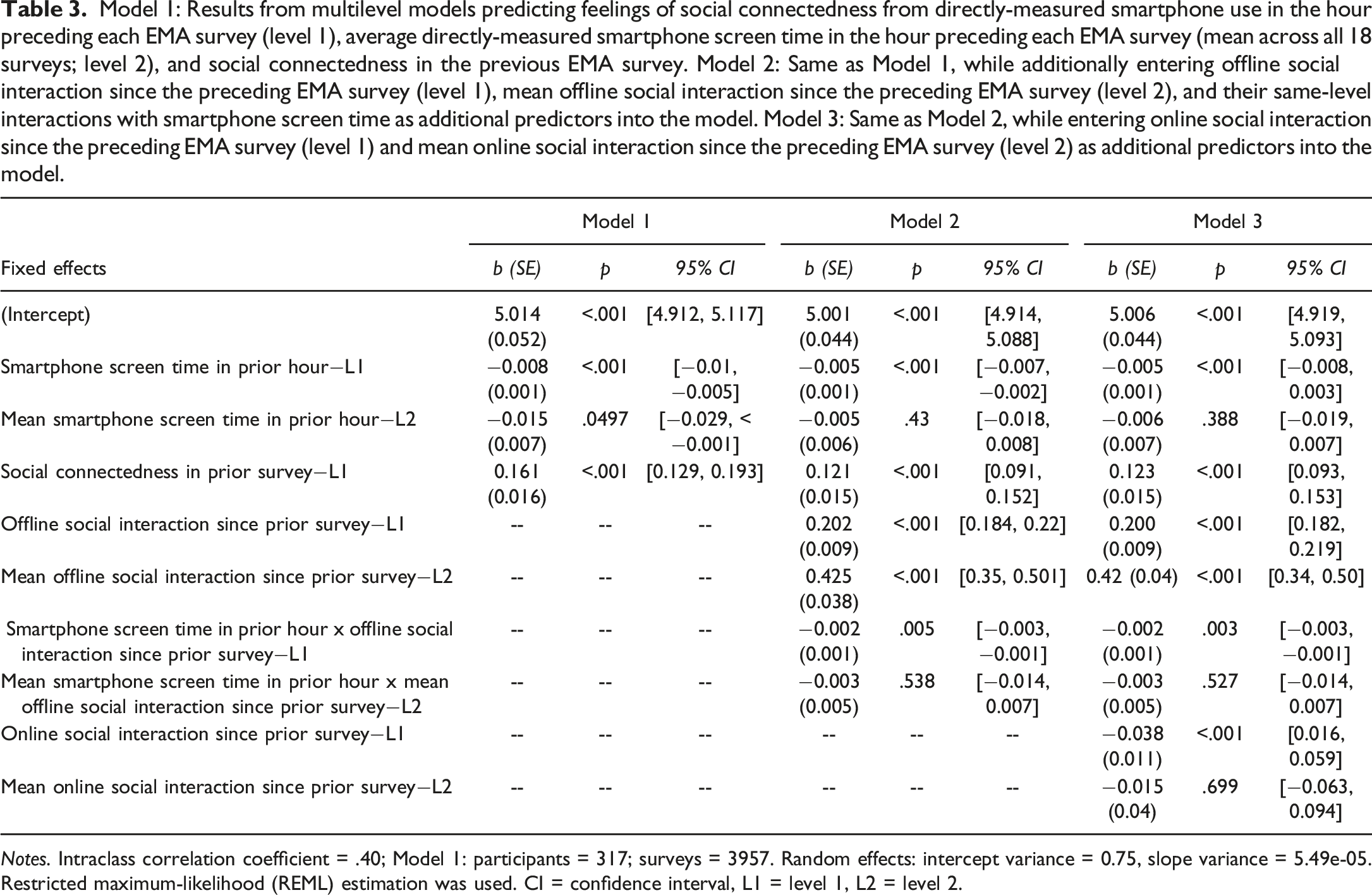
Notes. Intraclass correlation coefficient = .40; Model 1: participants = 317; surveys = 3957. Random effects: intercept variance = 0.75, slope variance = 5.49e-05. Restricted maximum-likelihood (REML) estimation was used. CI = confidence interval, L1 = level 1, L2 = level 2.
Next, we entered offline social interaction since the preceding EMA survey (level 1), mean offline social interaction since the preceding EMA survey (level 2), and their same-level interactions with smartphone screen time as additional predictors into the model (see Table 3, Model 2). Results revealed that the interaction term Smartphone screen time in the hour preceding the EMA survey x Offline social interaction since the preceding EMA survey (both at level 1) was a significant negative predictor of momentary feelings of social connectedness. Follow-up simple slopes analyses suggested that smartphone screen time negatively predicted feelings of social connectedness at times when individuals — relative to themselves — reported an average amount of offline social interaction (b = −0.005, SE = 0.001, 95% CI [−0.007, −0.002], p < .001) or a high amount of offline social interaction (mean +1 standard deviation; b = −0.008, SE = 0.002, 95% CI [−0.011, −0.005], p < .001), but this relationship was not significant at times when they reported a low amount of offline social interaction (mean – 1 standard deviation, again relative to themselves; b = −0.002, SE = 0.002, 95% CI [−0.005, 0.001], p = .261). Finally, we entered online social interaction since the preceding EMA survey (level 1) and mean online social interaction since the preceding EMA survey (level 2) as additional predictors into the model (see Table 3, Model 3). The final model indicated that within but not between individuals, more online social interaction in the hours before the survey was related to higher feelings of social connectedness.
Results from multilevel models predicting directly-measured smartphone screen time in the hour following each EMA survey from social connectedness at levels 1 and 2, and smartphone screen time in the prior hour.
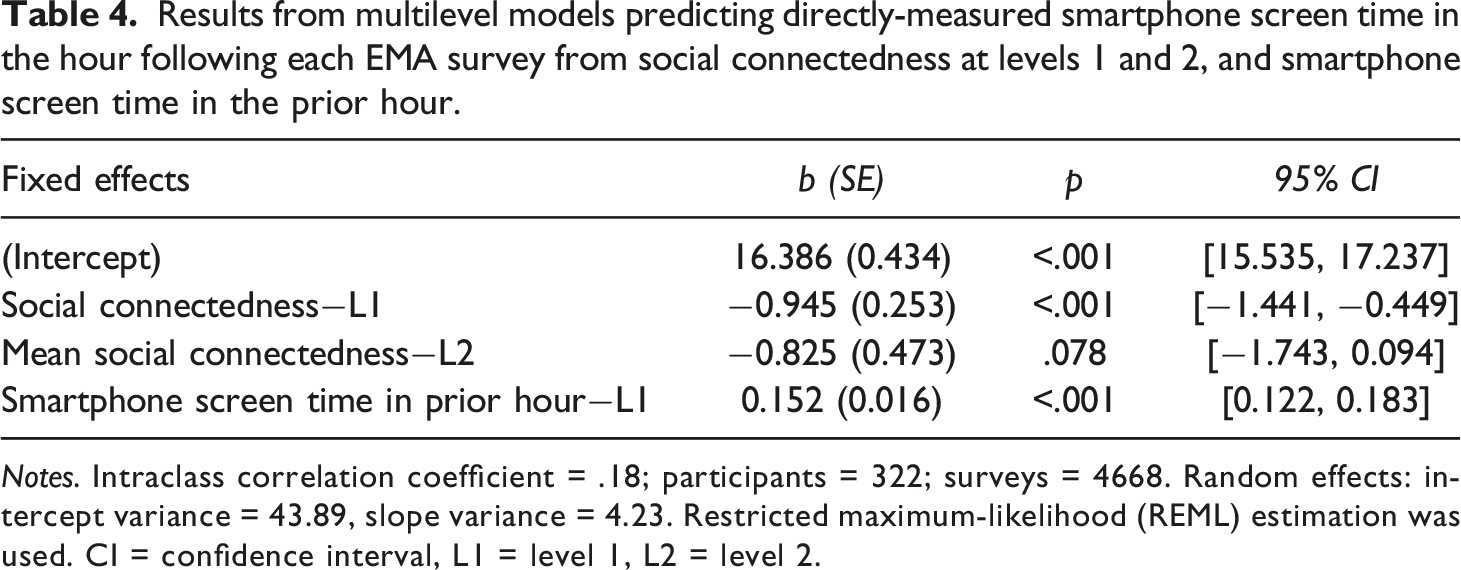
Notes. Intraclass correlation coefficient = .18; participants = 322; surveys = 4668. Random effects: intercept variance = 43.89, slope variance = 4.23. Restricted maximum-likelihood (REML) estimation was used. CI = confidence interval, L1 = level 1, L2 = level 2.
Directly-Measured Screen Time Predicting Offline Social Interaction
Finally, we ran an MLM in which we entered offline social interaction as outcome variable and smartphone screen time in the hour prior to the EMA survey (level 1) and mean smartphone screen time in the hour prior to the EMA survey (level 2), controlling for lagged values of offline social interaction (i.e., offline social interaction reported in the previous EMA survey). We found that smartphone screen time was a negative predictor of similarly timed offline social interaction both within individuals, b = −0.017, SE = 0.002, p < .001, 95% CI [−0.022; −0.013], and between individuals, b = −0.027, SE = 0.009, p = .006, 95% CI [−0.045; −0.008].
Discussion
In the present study, we set out to examine relationships between directly-measured smartphone use, psychological well-being, and feelings of social connectedness both between individuals and within individuals (dynamic changes over time) over the course of 6 days. Between individuals, we found that participants who on average used their phone longer in the hour preceding the survey (compared to other participants) reported lower momentary well-being across all surveys. Within individuals, we found that at times when an individual used their phone more in the hour preceding a survey, they reported lower levels of momentary well-being. We found no evidence of the reverse pathway: lower momentary well-being did not precede longer smartphone screen time, suggesting that smartphone use may lead to decreased well-being but not vice versa.
In addition to well-being, we were also interested in examining the impact of smartphone use on feelings of social connection. Dynamics over time suggested that within the same individual, increases in phone use duration predicted decreases in social connectedness, and these decreases in social connectedness in turn predicted increases in smartphone use. This bidirectional link suggests a complex relationship between social connectedness and smartphone use and may point to the risk of a vicious cycle whereby longer smartphone use leads to feeling less socially connected, which in turn lead to more smartphone use.
Our exploratory analyses lent some preliminary support to the notion that smartphone use may have detrimental effects on well-being at least partially by supplanting offline social interaction: Specifically, we found that when offline social interactions were controlled for, the relationship between directly-measured smartphone use and psychological well-being was no longer statistically significant. We also observed that people reported less offline social interaction around times when they used their smartphone more (within individuals) and that individuals who used their smartphone more overall reported less offline social interaction. Similar to findings from Verduyn et al. (2021), these patterns of results are in line with the displacement hypothesis, as they may indicate that smartphone use can entice people into missing out on offline social interaction opportunities available to them, with negative effects on well-being. It should be noted that, as with other research on this topic (Dienlin et al., 2017; Kraut et al., 1998; 2002; Valkenburg & Peter, 2007; Verduyn et al., 2021), these findings suffer from the limitation that causation can not be established. Indeed, the alternative (or additional) explanation that individuals are more likely to turn to their smartphones when offline social interaction opportunities are limited or even unavailable is likely to account for some of the shared variance between smartphone use and reported amount of offline social interaction. However, even if this is the case, once the smartphone is being used, opportunities for in-person interaction that arise may be more likely be missed, as prior experimental evidence suggests (Kushlev, Hunter, et al., 2019).
The exploratory findings additionally provide tentative support for the interference hypothesis as they revealed that smartphone screen time predicted lower feelings of social connectedness around times when individuals reported an average amount of offline social interaction or a high amount of offline social interaction, but not when they reported a low amount of offline social interaction. In line with the interference hypothesis, these findings suggest that when an individual uses their smartphone around the same time that they are engaging in offline social interactions, the offline social interaction may not have as positive of an effect on their feelings of social connectedness as it otherwise would have. Based on our findings alone, it is also feasible that individuals are more likely to take out their smartphones during less enjoyable social interactions, rather than smartphone use diminishing the social benefits people reap from their social interactions. However, prior experimental work supports the idea that smartphone use interferes with offline social interactions in a way that decreases feelings of social connection (Dwyer et al., 2018; Kushlev & Dunn, 2019).
Overall, our findings are consistent with some findings from previous research indicating that longer smartphone screen time is weakly but robustly associated with lower well-being and reduced feelings of social connectedness (Kushlev, Dwyer, & Dunn, 2019). Arguably, even subtle individual costs of smartphone use on well-being can in sum be practically relevant due to the pervasiveness of smartphones in daily life (Kushlev, Dwyer, & Dunn, 2019).
Putting findings in perspective, the positive effects of offline social interaction on well-being and social connectedness we observed were much stronger than the negative effects of smartphone screen time. Furthermore, our exploratory analyses provided tentative support for the theoretical predictions that the negative effects of smartphone screen time on well-being and social connectedness may be partially due to supplanting (displacement hypothesis) and/or interfering with (interference hypothesis) offline social interactions. Practically speaking, these results may indicate that smartphone use sometimes seems to replace other activities that could be more socially and emotionally rewarding, such as offline social interactions, and/or interfere with them, thereby making them less enjoyable. Thus, it may be better to advise people to pursue active social interactions and to avoid distractions while having them, rather than to specifically recommend that people reduce their smartphone use.
More generally, our findings highlight the importance of using directly-measured smartphone usage data when examining the effects of smartphone use on psychological outcomes: In accordance with previous reports on the relationship between directly-measured and self-reported digital media use (for a recent meta-analysis, see Parry et al., 2021), directly-measured and self-reported smartphone use were only moderately correlated in our study. Furthermore, almost half of our participants either over- or underestimated their daily smartphone use by at least 2 hours. Inaccurate self-reports of smartphone (or other digital media) use can have drastic effects on findings and interpretations of studies examining their effects.
Limitations
While our study is unique in relating directly-measured smartphone screen time to well-being and social connectedness over time, it should be acknowledged that even measuring smartphone screen time directly has its own limitations. For instance, settings regarding the duration of inactivity before the screen turns off differ between smartphones. This would not affect our within-person effects but might explain why we did not find as robust between-person effects. Overall, we consider it unlikely that phone settings are systematically biased as a function of the participants’ well-being or social connectedness. Rather, we would expect this variation to increase unsystematic error variance and in consequence reduce observed effect sizes of systematic covariations between constructs of interest. Similarly, our app only records actual screen time (i.e., times when the screen is on) but not times when the smartphone is used with the screen off, which can happen when listening to podcasts or music depending on individual phone settings.
Furthermore, it should be acknowledged that the time scales were different between the screen time measure (1 hour right before each EMA survey) and the exploratory social interaction measures (time between the last and the current EMA survey, which could be several hours apart). It is therefore possible that the reported social interactions did not overlap with the recorded screen time in all cases. In consequence, the exploratory findings should be interpreted with particular caution.
Because our study sample was limited to Android users, the degree to which our findings can be generalized to users of other types of smartphones cannot be established at present (although see David et al., 2018, for similar findings in iPhone users). Android users and iPhone users, who in combination represent 98% of all smartphone users worldwide, have been shown to differ on some demographic variables including gender, but not in well-being, and only little in personality traits (Götz et al., 2017). Moreover, by advertising our study as “Smartphone and Sleep Study” to potential participants, it is possible that individuals with certain preconceptions about how smartphone use may or may not impact sleep (and potentially well-being more generally) might have been more likely to join the study as participants. Also, while our sample was diverse in terms of ethnicity, unfortunately, we did not ask participants about their gender identity or possible disabilities. Finally, it should be acknowledged that the present findings are based on an urban, North American sample and may not be generalizable to individuals with different demographic, economic, political, and cultural backgrounds; these limitations should be addressed in future studies.
Because we built our study on the assumption that the pervasiveness of smartphone use itself (potentially due to the detrimental effects that it has on the quality and/or quantity of other, potentially more rewarding social activities) can bring about potential negative effects on well-being and social connectedness, we looked at net effects of smartphone screen time rather than effects of specific usage types (for an in-depth discussion of shortcomings of screen time measures, see e.g., Kaye et al., 2020). Thus, our findings do not allow for the conclusion that all types of use are detrimental to well-being and social connectedness. Instead, they suggest that most people use their smartphones in ways where negative effects on well-being and social connectedness dominate over positive effects. However, a potentially fruitful avenue for future research could be to separate smartphone usage by activity type (e.g., for direct communication with close others via video chat or instant messaging, versus use of social media, versus passive consumption of news) and determine whether different activities have differential effects on users’ well-being or social connectedness. Indeed, our own data provides preliminary evidence that online social interaction is a positive predictor of feelings of social connectedness at a within-person level.
Unfortunately, our study was not pre-registered, which may raise concerns in some readers about the robustness of the reported findings. At least two observations might provide some reassurance here: First, for the relationship between directly-measured and self-reported smartphone screen time, very similar effects sizes had been observed by other scholars when looking at patterns between individuals (for a meta-analysis, see Parry et al., 2021). Second, the (arguably most interesting) within-person effects reported here were very robust to sample specifications and selection of control variables.
Lastly, it is important to acknowledge that it is impossible to draw causal conclusions based on our correlational study. Even though we show that within individuals, relatively longer smartphone use precedes relatively lower psychological well-being while the reverse is not true (i.e., relatively lower psychological well-being does not systematically precede longer smartphone use), experiments manipulating smartphone use will ultimately be needed to establish causality.
Conclusion
The present study examined the relationship between directly-measured smartphone screen time and both well-being and feelings of social connectedness, tracking the same individuals over time. We found that within the same individuals, relatively longer smartphone use preceded relatively lower psychological well-being and feelings of social connectedness. For social connectedness, but not well-being, the reverse pathway was also significant (suggesting that the adverse relationship between smartphone screen time and social connectedness might be bidirectional). Although the sizes of our observed effects were relatively small, the pervasiveness of smartphone use in our daily lives implies that the scale and reach of these small individual effects—when considered globally and across our lifetimes—have the potential to be impactful, and certainly worthy of future study.
Supplemental Material
Supplemental Material - Directly-measured smartphone screen time predicts well-being and feelings of social connectedness
Supplemental Material for Directly-measured smartphone screen time predicts well-being and feelings of social connectedness by Christine Anderl, Marlise K. Hofer and Frances S. Chen in Journal of Social and Personal Relationships
Footnotes
Funding
The author(s) disclosed receipt of the following financial support for the research, authorship, and/or publication of this article: This work was supported by the SPSP Small Research Grant (18-1–0043), UBC Faculty of Arts Research Grant and Healthy Behaviour Data Challenge (partnered by Public Health Agency of Canada, Canadian Institutes of Health Research and MaRS Discovery District) (grant 156950).
Authors’ note
This project was supported by funding from the Public Health Agency of Canada and the Canadian Institutes of Health Research (156,950), with support from MaRS Discovery District, a UBC Faculty of Arts Research Grant awarded to F.S.C. and C.A, and an SPSP Small Research Grant awarded to C.A. (18-1–0043). C.A. was supported by a Feodor Lynen Research Fellowship from the Alexander von Humboldt-Foundation (DEU 1,187,856 FLF-P). Parts of this research have been presented at the 2019 Annual Convention of the Society for Personality and Social Psychology in Portland, Oregon, USA. Cédric Vincent programmed the BeTrack app and provided technical support.
Open research statement
As part of IARR’s encouragement of open research practices, the author(s) have provided the following information: This research was not pre-registered. The data used in the research are available. The data can be obtained at:  . The materials used in the research are available. The materials can be obtained at: https://osf.io/b5ru8/.
Supplemental Material
Supplemental material for this article is available online.
References
Supplementary Material
Please find the following supplemental material available below.
For Open Access articles published under a Creative Commons License, all supplemental material carries the same license as the article it is associated with.
For non-Open Access articles published, all supplemental material carries a non-exclusive license, and permission requests for re-use of supplemental material or any part of supplemental material shall be sent directly to the copyright owner as specified in the copyright notice associated with the article.
