




Abstract
The association between computer-mediated communication (CMC) and well-being is a complex, consequential, and hotly debated topic that has received significant attention from pundits, researchers, and the media. Conflicting research findings and fear over negative outcomes have spurred both moral panic and further research into these associations. To create a more comprehensive picture of trends, explanations, and future directions in this domain of research, we conducted a systematic meso-level review of 366 studies across 349 articles published since 2007 that report associations between CMC and well-being. Although most of this research is not explicitly theoretical, several potential theoretical mechanisms for positive and negative effects of CMC on well-being are utilized. The heterogeneity of effects in the studies we reviewed could be explained by the discipline in which the research is conducted, the methodology used, the types of CMC and well-being examined, and the population studied. Our evaluation of this body of research highlights the importance of attending to how we conceptualize communication and well-being, the questions we ask, and the populations and contexts we study when both reading and producing research on CMC and well-being.
Keywords
Frequency of disciplines and methods represented in CMC and well-being corpus.
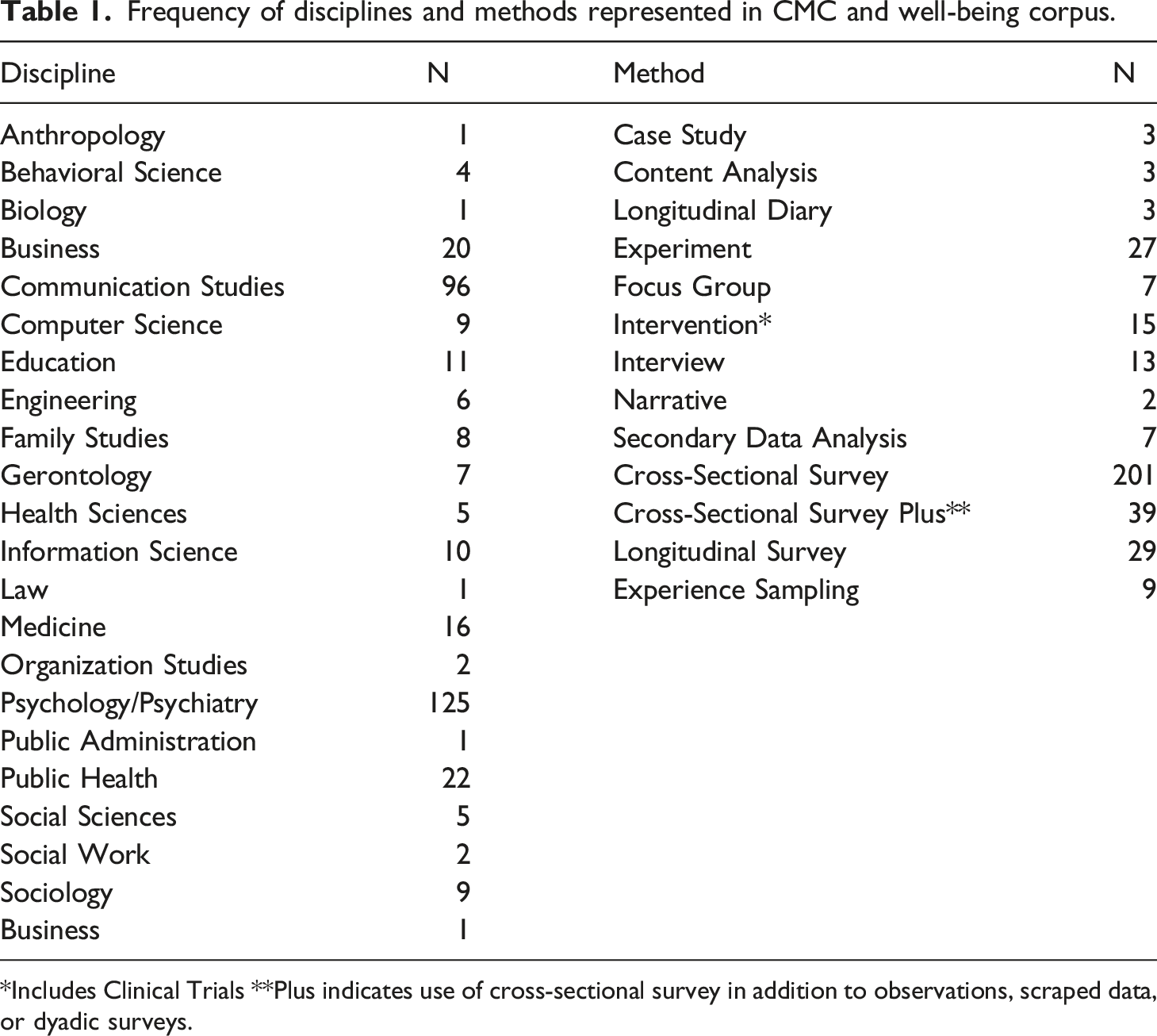
*Includes Clinical Trials **Plus indicates use of cross-sectional survey in addition to observations, scraped data, or dyadic surveys.
In contrast to the supposed negative effects, other studies espouse the benefits of CMC, including enhancing social capital, providing access to resources and forms of support that might be difficult to receive face-to-face, bolstering users’ esteem or life satisfaction, and connecting isolated users to a larger world. This research suggests that CMC enables easier connection with close and distant ties, thereby enhancing people’s social networks (i.e., stimulation) and well-being. Conflicting findings regarding CMC and well-being reflect users’ larger ambivalence toward technology. Misplacing a smartphone results in worries about a loss of contact (Hall, 2020), yet using that same phone might reduce in-person connection (Hoffner et al., 2016). Using Facebook might provide users with valuable forms of support from a diverse network (High & Buehler, 2019), but it can also lead to crippling social comparison (Reer et al., 2019). Mirroring these conflicting findings, interventions on this topic recommend people use technology less (Hinsch & Sheldon, 2013), use it more (Vanman et al., 2018), or use it differently (Hunt et al., 2018).
Although narrower in scope than our current project, several meta-analyses have examined the association between CMC and well-being (e.g., C. Huang, 2010; 2017; D. Liu et al., 2019). Liu et al. (2019) reported that type of technology (e.g., texting vs. social media) influences effects, as does how it is used (e.g., consumption vs. interaction with others). Another meta-analysis suggested that interventions involving CMC support groups lead to modest decreases in depression and increases in quality of life (Rains & Young, 2009). Appel et al. (2020) reviewed several meta-analyses and concluded there is likely a small negative association between social networking and well-being; however, they also noted, “despite claims made by journalists or authors of popular science books, meta-analytic summaries show no strong linear link between the overall intensity of [social network site] use and loneliness, self-esteem, life satisfaction, or self-reported depression.” (p. 64). In a review of longitudinal studies, Course-Choi and Hammond (2020) concluded, “the papers reviewed provide limited robust evidence that [frequency of social media use], in general, impacts adolescent well-being” (p. 233). Yet, Course-Choi and Hammond also suggested that social media use can increase peer competition and body dissatisfaction, which could indirectly diminish well-being. Further underscoring the small magnitude of effects, some analyses indicate that the negative effects of social media on well-being, at least among adolescents, are less than one-third the size of the salutary associations between well-being and both eating breakfast and getting sufficient sleep (Przybylski & Weinstein, 2017). Overall, these reviews provide evidence that effect sizes in this area are often small, but the limited scope and somewhat inconsistent conclusions of past reviews justifies a more comprehensive examination of the literature.
The cautious tone of the handful of empirical reviews is drowned out by public discourse and media headlines clamoring about the negative effects of CMC on well-being and by the continued proliferation of studies seeking to examine such effects. The moral panic and fervor over the negative effects of CMC is encapsulated in the October 2021 story of a whistleblower from Facebook claiming the company prioritizes profits over people. The Wall Street Journal first broke a story suggesting that Facebook believes that Instagram harms well-being, particularly for young women (Wells et al., 2021). This report then resulted in an uproar on social media about the implications of this supposed knowledge. In essence, social media users amplified concerns about the negative effects of social media beyond any data on the matter.
As Hall and colleagues noted, “The widespread adoption of social media in the last decade has been met with similar concerns about its deleterious effect on well-being, prompting a rigorous, but not wholly unfamiliar debate about the degree to which that concern is warranted” (p. 1). Warrants for existing studies, including recent scholarship, use the conflicting nature of findings as justification for continued study. In 2019, Lee and Cho observed that “It is known that uses of the internet for social purposes are related to positive health benefits” (p. 1043). Other researchers recently observed that, “There are growing concerns that increased time spent online could harm the well-being of adolescents. Yet,” they concluded, “answering this question has proven difficult” (Schemer et al., 2021, p. 1).
It is clear that despite some careful reviews on specific aspects of this topic (Appel et al., 2020; Liu et al., 2019; Rains & Young, 2009), the literature lacks a consensus about the state of evidence pertaining to CMC and well-being. Different beliefs about the evidence continue to co-exist, which may be partly a function of the narrow scope of previous reviews. Differences regarding the connection between CMC and well-being might also exist because scholars approach the connection between these variables from a variety of different disciplines, each with their own assumptions and backgrounds. Given the current state of the literature, scholars could easily find enough support for a warrant that contends social media and well-being should be studied due to negative outcomes or a similar amount of support for positive outcomes. Due to the diversity of findings and viewpoints encompassed within this domain of research, there is value to providing a thorough review of the state of the literature. There is clearly debate about this issue, and scholars have yet to consider a nuanced understanding of the broad factors that shape the linkages between CMC and well-being.
The current study provides a meso-level analysis that looks beyond the intricacies of individual studies but also provides more diversity—of perspectives, operationalizations, effects examined, and methodologies—than can be practicably captured by meta-analyses. By their nature, meta-analyses are less nimble at capturing the variations in operationalization or disciplinary perspectives that constitute this domain of research. Due to the wide variety of measured variables in the literature, the existing meta-analyses capture a far smaller subset of studies than those addressed in this systematic review. Even reviews of meta-analyses often focus on specific facets of well-being like mental health (Meier & Reinecke, 2021), but the current analysis includes a more exhaustive conceptualization involving different types of well-being. The current meso-level analysis captures a level of detail, including different measures, mediators and moderators, and even qualitative studies, that cannot be handled by a meta-analysis.
Our review can address heterogeneity in findings in ways that extant reviews have not. Some meta-analyses have reported small effects between social media use and well-being (Appel et al., 2020), in part because some individual studies report positive effects, while others report negative or null effects. Yet, such heterogeneity has not been fully considered, perhaps because the relatively narrow scope of previous reviews necessitated by meta-analyses did not provide sufficient numbers to identify potential differences in findings. In contrast, the current analysis attempts to document some sources of the heterogeneity in results by drawing on Laswell’s (1948) categorization of variables that impact communication. This review will thus serve as a comprehensive state-of-the-art review for readers less familiar with this literature while also serving as a heuristic generative piece for researchers wishing to advance scholarship in this area. Rather than staying within an isolated domain of research, which might report similar findings, we cast a wide net in terms of the studies included in our analysis to assess the extent of diversity within this body of research and investigate the nature of any effects. Whereas other reviews exclude topics involving problematic internet use, internet addiction, bullying, and clinical samples (Meier & Reinecke, 2021), we include research on all of those topics in our analysis to expand the scope of our review. In addition, the current manuscript considers several aspects of research, including the discipline that produced it, their samples, methods, topics, behaviors, and several forms of well-being that are rarely considered in one article. In our analysis, we followed PRISMA guidelines as closely as possible to conduct a systematic review of the literature, and we focused on several factors to explore variation in the association between social media and well-being to embrace the complexity across this large, diverse, and evolving body of literature.
Our overarching goal is to take a broad view of the literature in this domain to characterize the state of current research and provide avenues to improve future research. To do so, we reflect on our own positionality as it relates to this topic, then explain how we conceptualized well-being and CMC, which are the central constructs in our review. We then outline the methods used to systematically find and sort the pertinent studies. Our analysis explores the literature from the perspective of Lasswell’s consideration of who says what to whom in which channels of CMC with what associations with well-being. Other considerations include who is conducting the research, who is sampled in the studies, and the explanations provided by various theoretical frameworks. Our meso-level analysis avoids the technologically deterministic nature of early research in this area, recognizing that who is using technology to communicate with whom matters. After summarizing commonalities among studies that find predominantly positive or negative associations between CMC and well-being, we conclude our manuscript with implications for future work. Overall, our goal is to provide a summary of where the research currently stands and a less circuitous path forward to continue productive research in this area.
Positionality statement
Although the authors come from a variety of backgrounds, we share several salient characteristics. As a result of being WEIRD (living in a Western, Educated, Industrialized, Rich, and [mostly] Democratic society; Henrich et al., 2010), we all experienced childhoods and/or adolescences characterized by access to new communication technologies. Given our ages, we were all adults by the time popular social media such as Facebook and Twitter were widely adopted. Much of the design, functionality, and writing on the Internet is created for people like us. Consequently, our backgrounds may blind us to larger social effects of CMC on well-being that would not be apparent from individual-level studies such as the ones we review here.
In other ways, our experiences have highlighted some effects of CMC. One author became fascinated by questions of how or why the same messages or interactions in different channels can produce different effects, a question that still drives much of his current research. Another author has spent more than her fair share of time in online forums, where she has encountered many people who use those communities to help overcome barriers (e.g., stigmatized identities, social anxiety, and physical limitations) to developing offline relationships. One of us grew up in rural Northern Michigan and has been interested in who has access to computer-mediated technologies and how access can be limited by infrastructure (lack of Internet access or quality cell service), budget (lack of means to afford Internet connections or data plans), and literacy skills. Another author feels that having experience before the Web as we now know it gives useful perspective (he can remember the moral panic about Satanic cults and D&D from the early 1980s, so he knows moral panic when he sees it).
Conceptual issues
For this project, we began with the ostensibly straightforward goal of reviewing the social scientific literature on the connection between CMC and well-being. As we describe below, this question has been studied by at least several hundred—and potentially more than 2000—studies. What begins as a simple question quickly unravels to reveal more complex, nuanced, and circuitous rabbit holes, such as “What counts as computer-mediated communication (CMC)?” Recent work by Carr (2020) suggested the term “CMC” might be dead or at least has changed considerably since it was first introduced, thereby exemplifying the difficulty in answering this question. The research in this domain ranges from typical social media use to texting or smartphone use and from browsing websites to establishing Internet connections in previously isolated locations.
Along the same lines, what counts as well-being? The research in this area is perhaps even more diffuse than that on CMC. It potentially includes studies that assess stress hormones, affect, loneliness, quality of life, physical ability, anxiety, depression, and esteem. Further complicating matters, people’s perceptions of well-being do not always match their corresponding biological indicators (Vanman et al., 2018). We provide definitions of CMC and well-being and then describe how they are connected. The studies reviewed represent a varied and diverse literature, and how researchers conceptualize CMC and well-being might explain part of the diversity in their associations.
Defining computer-mediated communication
The term CMC originated in the early 1970s (see Hiltz & Kerr, 1982; Meeker et al., 1971; Mitzel et al., 1971) to describe interaction via text-based computer messaging systems. Although the focus of laypersons and scholars alike has generally moved away from specific computerized devices, CMC remains a superordinate term encapsulating many forms of mediated communication (Carr, 2020). A variety of channels fall under the umbrella of CMC. Some (e.g., texting, instant messaging, email) are used most often in dyads or small groups. Others are masspersonal, allowing for a blend of interpersonal and mass communication (O’Sullivan & Carr, 2018). Often, these masspersonal channels qualify as social media.
Social media are channels built upon user-generated social content. Typically, these channels allow for asynchronous yet persistent communication where users can interact with others and view interactions between other users (see Carr & Hayes, 2015). Social network sites are a type of social media with three primary characteristics: user profiles, publicly articulated network connections, and provision of content by other users (Ellison & boyd, 2013). Online communities are aggregates of users who communicate through mediated means, typically regarding a shared interest or need (McEwan, 2015). Online communities might form through social media (e.g., Facebook group or reddit board), other mediated means (e.g., email newsletter), or media tailored for a specific purpose. For example, a handful of studies in our review examined people using the Comprehensive Health Enhancement Support System (CHESS), an online support system that provides users with information, coaching, and access to online support groups for coping with breast cancer (Gustafson et al., 2008).
Another term in the literature is information communication technologies (ICTs). ICTs typically refer to the specific hardware and software that create channels that might store and/or transmit information, thereby allowing for communication to occur (Onn & Sorooshian, 2013). CMC generally refers to communicating via an ICT; however, this distinction is not ubiquitous across disciplines, and there is overlap between the two terms. Within our review, there were multiple studies focused on device usage rather than a specific channel. Often the focus was on ICTs in general (n = 54), but there were studies that referred specifically to mobile phone (n = 14) or tablet (n = 1) usage. Other researchers made it a point to assess the use of multiple channels in a single study (n = 15). Beyond general ICTs, CMC, or social media, the dataset used below encompasses a variety of specific platforms including Facebook, WeChat, Instagram, Twitter, Messenger, Snapchat, CHESS, Blogging platforms, StudiVZ, Tumblr, WhatsApp, LINE, Qzone, YouTube, Weibo, discussion boards, Renren, and QQ.
Defining well-being
Despite being a well-established domain of research, there is considerable heterogeneity regarding the conceptual boundaries of well-being. For instance, Ryff’s (1989) examination of psychological well-being included positive relations with others, whereas Diener’s (2009) conceptualization of subjective well-being focused on individuals’ experiences of happiness, positive affect, and satisfaction with life. Concepts like positive relations with others are often included in assessments of subjective well-being (e.g., Pera et al., 2020); therefore, we considered social well-being to be an aspect of subjective well-being for this review.
Additionally, studies varied in the extent to which they directly assessed well-being compared to making inferences about it based on other concepts. For example, Pétré et al. (2015) examined efforts to avoid stigmatization of obese individuals. They discussed their findings with respect to well-being because stigma has clear implications for subjective well-being. Nevertheless, the study did not directly assess well-being, so we eliminated it along with other articles that did not explicitly examine well-being. In most instances, the articles we included in our review used a quantitative measure, such as the satisfaction with life scale (Diener et al., 1985) or Ryff’s psychological well-being measure (Ryff & Keyes, 1995), but we also included qualitative studies if they reported explicitly on participants’ sense of well-being. We restricted our focus to studies of overall well-being, excluding articles on specific domains, such as satisfaction with college (Powless, 2012) or workplace well-being (Grawitch et al., 2018). The exception to this rule was physical well-being, which often included assessments tied to particular health contexts, such as glycemic control (e.g., Litchman, 2016).
Overall, three distinct types of well-being were represented in the literature: subjective, mental, and physical. Subjective well-being included measures of life satisfaction, quality of life, and happiness, as long as happiness referred to general life experience rather than a specific context or ephemeral mood. For example, happiness was included if it referred to a person’s life, but not if it referred to affect on one day. Similarly, general measures of social connection or isolation (e.g., loneliness) were considered to be facets of subjective well-being, but we excluded measures that pertained to a single relationship (e.g., relational satisfaction). Subjective well-being was by far the most common form of well-being included in our corpus, appearing in 71.86% of the studies.
Mental well-being encompassed measures that explicitly referred to mental health (e.g., mental well-being, psychological distress) or a specific mental health condition (e.g., depression, social phobia, anxiety). This was the second largest category, appearing in 44.81% of the studies we examined. Physical health, which was included in 9.29% of the studies, involved both direct assessments of health (e.g., strength and balance, cortisol, glycemic control) and self-assessments of health (e.g., reports of symptoms, perceived health quality). Additionally, six qualitative studies discussed well-being in terms that did not make it clear which form of well-being was the focus. We retained these studies for our general review, but did not classify them with respect to type of well-being.
Method
We collected articles through an unqualified search (i.e., abstracts, titles, subjects and keywords) in Communication & Mass Media and PsycInfo and searches of all fields in Journal of Social and Personal Relationships and Personal Relationships on February 23, 2021. The search queries were: (“well-being” OR “life satisfaction” OR “quality of life”) AND (“mediated communication” OR “social media” OR “communication technolog*” OR “mobile communication”). These terms were selected to be broadly inclusive, although obviously they could miss articles not using those terms. We limited the search to articles published in 2007 and later because that year represents a notable shift in CMC. Although there were some influential studies conducted prior to 2007 (e.g., Kraut et al., 1998), the emergence of social media as a predominant form of CMC altered the manner and meaning of how people engage in CMC (Ledbetter, 2021). Consequently, 2007 is a reasonable starting point because it is the year following Facebook’s decision to open its platform to anyone with an email address and the year of the first big surge in Twitter use. We excluded sources not published in English and conference papers due to their haphazard availability in databases.
This initial search returned 2219 records containing articles, book chapters, theses, and dissertations. After removing duplicate entries (including theses and dissertations when the study was also published in a journal), 2152 sources remained. Eligibility criteria for inclusion in the review were as follows. First, the source had to include CMC as a central concept or variable. We excluded sources that confounded CMC with face-to-face communication, examined communication with robots, or studied game play not focused on communication (but retained studies where the communication between players was of central interest). Second, the source had to report the results of an original empirical study. Sources that were purely literature or critical reviews were excluded. We also excluded meta-analyses based on the reasoning that the relevant studies in the meta-analyses would already be included in the review. Third, the assessment of well-being had to be central to the study and consistent with our aforementioned conceptualization, including subjective well-being (e.g., quality of life, life satisfaction, happiness), physical well-being (e.g., health, immune function, cortisol, health-related quality of life), or mental well-being (e.g., anxiety, depression or depressive symptoms, mental well-being, psychological well-being, psychological distress).
A research assistant first screened articles for the inclusion of CMC as a central concept or variable, then the authors reviewed and determined eligibility of the remaining articles. After our initial review of the articles, 433 articles appeared to meet all eligibility criteria. The majority of articles were screened out from the previous step because CMC (n = 1071) or well-being (n = 410) were not central concepts in the studies. As a final step, we closely examined the actual measures used in studies to ensure they were consistent with our conceptualizations of CMC and well-being. A number of articles used terms suggesting they could be included, but the actual measure or instructions differed significantly from our conceptualizations. For example, some studies referred to well-being, but the actual measure assessed short-term moods. After vetting the articles for appropriate measures, the final corpus included 349 articles. A small number of the papers described multiple studies, meaning that the total number of studies included in the final set of articles was 366. See Figure 1 for a funnel chart reflecting each step in the process and its associated number of sources. Idenfitifaction of studies via databases and registers.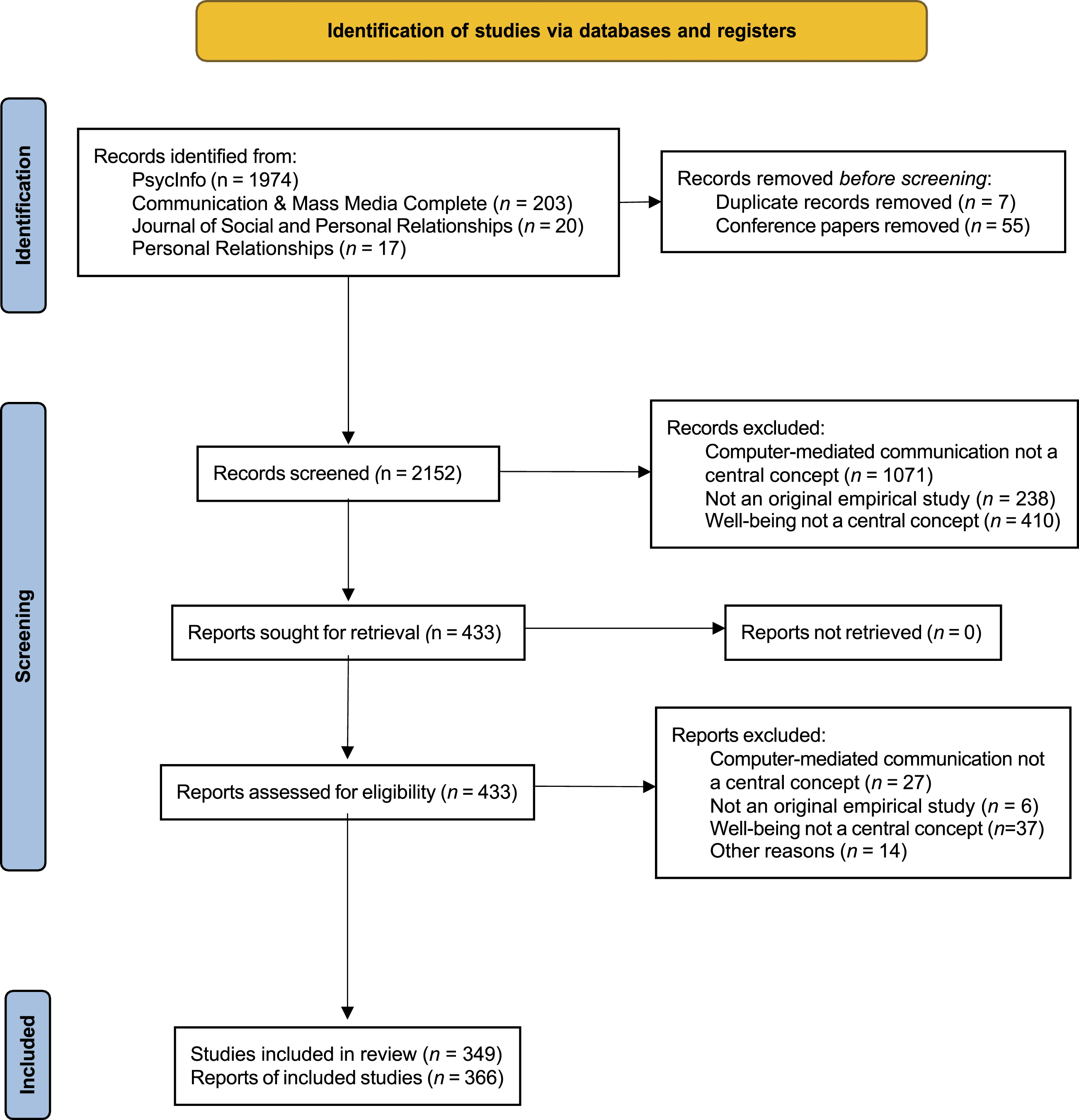
Our coding was modeled on Lasswell’s (1948) traditional model of communication that asks who says what to whom in which channel with what effect. In particular, we focused on who is involved with the research by coding what disciplines conducted the studies and what populations were studied. We considered where the studies were conducted according to the type of technology they focused on and the specific platform used in a study. We documented how the research was conducted by coding for common methodologies. We studied why the research was conducted by coding for the theories that ground these studies. What has been studied in this domain was considered by coding for different behaviors of interest and what types of well-being were measured in each study. Lastly, we considered the effects reported in each study by categorizing the reported effects in terms of magnitude. We inductively created the coding categories based on differences that emerged across the studies. All differences or questions related to coding were resolved through discussion. After coding was complete, the first author reviewed the codes, collapsing similar codes and differentiating divergent codes.
Characterizing the literature
Although coding a corpus of research this large is difficult and not always exhaustive because studies produce mixed results and concentrate on specialized topics or samples, our coding provided a general rubric to organize the existing research on CMC and well-being and provided some interesting points of departure between the studies reporting positive effects of CMC and those documenting negative effects. We review the results of our coding below and summarize any commonalities among the studies that document predominantly positive or negative associations between CMC and well-being. Again, our characterization of the literature follows the logic of Lasswell’s (1948) model of communication by focusing on who says what in which channel with what effect. We then summarize how and why these studies were conducted. Throughout our review, we highlight research that used diverse samples and elaborate whether their results present a departure from the larger body of research.
Who?
The question of who is involved in research can be approached by what discipline produced the research and who was sampled in a given study. The most common disciplines in our corpus of studies were psychology, communication studies, medicine, and business (Table 1). Other disciplines included computer science, education, family studies, gerontology, sociology, and engineering. Rather than producing similar effects, there were differences in the extent to which certain disciplines produced research that documented predominantly positive or negative associations between CMC and well-being. For example, studies in the communication discipline were more likely to report positive effects than negative effects, as were studies from computer science. Research from psychology, in contrast, produced the opposite pattern of results. In fact, about twice the number of studies conducted by psychologists reported mostly negative effects from using CMC compared to positive effects. Other disciplines, including medicine, education, and public health, were split more or less evenly between the studies that reported mostly negative and mostly positive effects. These differences might be based on disciplinary differences in the questions asked, the methods employed, or the populations studied.
In terms of who participated, we documented at least 16 different populations that occurred somewhat regularly across these studies. These populations included adolescents, adults, bloggers, children, college students, social media users (including Facebook users), older adults, and people coping with a variety of medical conditions. We also coded for more specialized samples, which occurred less frequently but involved purposefully sampling individuals with certain characteristics. These samples included LGBTQ+ users, soldiers, indigenous people, overweight adults, refugees, and people who live in rural areas.
Certain populations, such as LGTBQ+ users and patients, were more likely to be sampled in studies that reported positive associations between CMC and well-being than those that reported negative effects. In fact, there were no studies sampling from these populations that produced negative associations between well-being and CMC. These studies include Bond and Figueroa-Caballero (2016), who reported that more time spent on social media (but not instant messenger, email, or chatrooms) corresponded with greater well-being based on users’ commitment to their sexual identity. Likewise, using social media related positively to LGBTQ+ community members’ well-being via heightened perceived membership in groups related to their sexual identity and reduced stigma (Chong et al., 2015). In terms of people coping with medical issues, Litchman (2016) observed that more engagement in an online community corresponds with better glycemic control, an index of physical well-being. Several studies also reported the results of interventions that aided people’s ability to cope with specific medical conditions, especially the feelings of anxiety or depression surrounding those conditions (Garcia-Palacios et al., 2015; Hawkins et al., 2010; Li, 2017; P. Wang et al., 2017).
Older adults were also more likely to be in the group of studies reporting beneficial association between CMC and well-being. Sims et al. (2017) documented that adults age 80 and over experienced greater life satisfaction when they used ICTs to connect with friends. Also, using ICTs to gain information corresponded with better subjective health and fewer perceived limitations. Other research reported that older adults experience greater psychological well-being from using the Internet because it makes them feel a stronger sense of social integration (Berkowsky, 2015), or less loneliness (Sum et al., 2008), and better mental well-being (Jones et al., 2015). In a study of 150 older adult Korean immigrants in the U.S., Jun et al. (2020) found that smartphone use was positively associated with perceptions of a supportive family and that high social media use was associated with greater life satisfaction.
Additionally, a number of studies examined populations that are isolated from larger communities in some manner. Geia et al. (2017), for example, studied the narratives of Aboriginal and Torres Strait Islander Twitter users in Australia. Participants indicated that Twitter can help “break the isolation” (p. 282) by connecting to supportive communities, particularly with other Indigenous people internationally. Moreover, participants in Geia et al.’s study indicated that Twitter was helpful to their socio-emotional well-being, in part because it provided a means for them to challenge common narratives and perform valued anti-racism work.
Members of the military can experience a different type of community separation. Myers (2016) documented that soldiers deployed to Afghanistan experienced increased well-being when they engaged in greater Internet use. Also in the military context, Meek et al. (2019) documented that military wives experienced greater well-being when they communicated using asynchronous but not synchronous channels. In a different specialized sample composed of overweight adults, participating in a Facebook group corresponded with greater weight loss than a control group (Jane et al., 2018). Given the diversity of these samples, a range of outcomes is reported, but perhaps people who identify as LGBTQ+, patients, older adults, immigrant, isolated, members of the military, and overweight represent populations for whom CMC complements or supplements communication they lack in their face-to-face networks.
Adolescents, in contrast, were more likely to be found in the studies documenting negative effects between CMC and well-being. Although there are clearly benefits for adolescents from using CMC (see Lai et al., 2019; Valkenburg & Peter, 2007), studies of adolescents were about six times more likely to report predominantly negative than positive outcomes. They reported more depression and lower life satisfaction based on their use of CMC, though several of these studies examined problematic or compulsive Internet use (Dhir et al., 2016; H. H. Kim, 2017; van Rooij et al., 2017). More specifically, Marengo et al. (2021) recently reported that adolescents’ feelings of exclusion stemming from Internet use dampened their well-being both directly and indirectly via FOMO. Another study documented that instant messenger use predicted depression and compulsive use longitudinally, though email and chatting were unrelated to negative outcomes (van den Eijnden et al., 2008). Although the positive outcomes from using CMC for adolescents cannot be overlooked, the prevalence of negative outcomes is concerning. Overall, who conducts the research and who participates in it can help to understand when there are positive or negative associations between CMC and well-being.
What?
We considered what researchers study in this corpus by coding for the behavior of interest in each paper. There were several different behaviors commonly studied, and some of them were more common in the studies that documented predominantly positive or negative results, whereas other behaviors were split relatively evenly between positive and negative results. Amount of use, for example, was spread equally between the studies that reported positive and negative results. Some studies differentiated types of use by separating active versus passive use or distinguishing the use of different channels or behaviors within those channels. In the context of Facebook, having more status updates, albums, and likes corresponded with more happiness, and the number of friends in people’s networks was associated with lower depression (Brailovskaia & Margraf, 2019). Other research documented that lurkers on message boards report higher quality of life than people who actively post (Mo & Coulson, 2010). Additionally, certain motivations for engaging with CMC correspond with positive well-being. For instance, people who play online games for escape, entertainment, fantasy, and challenge reported greater life satisfaction (Jin, 2014), and people who had higher life satisfaction were generally motivated to use social media for self-expression and social benefits (D. Kim, 2016). Studies that differentiated types of motives for use of CMC often reported positive associations between CMC and well-being.
Studies examining communicative behaviors with prosocial orientations (e.g., disclosure, receiving social support) generally uncover positive outcomes. For example, disclosing about health conditions corresponded with engagement with healthy eating content on social media, which in turn related to quality of life (Krishnan & Zhou, 2019). Other research reported a positive association between disclosure on social media, often on Facebook, and life satisfaction and social well-being (H.-Y. Huang, 2016; G. Wang et al., 2018). These associations between disclosure and well-being were stronger than the association between check-ins on social media and well-being (S. S. Wang, 2013) and might be mediated by social capital (Ko & Kuo, 2009).
Although some research concluded that support received from offline sources maintained a stronger association with well-being than support received online (Trepte et al., 2015), other research suggested that receiving support online corresponded with both increased relational health (DiGiovanni, 2018) and decreased depression and anxiety (Enrique et al., 2018; Li, 2017). Along these lines, Lee and Cho (2019) reported that more use of social media corresponded with receiving more support, which in turn, corresponded with less depression. Social capital and supportive communication are often related (High & Buehler, 2019), and research documented that the association between self-disclosure on blogs and well-being was primarily mediated through bloggers’ perceptions of social capital (Ko & Kuo, 2009). Similarly, Pang (2018) reported that social media use improved psychological well-being via its influence on social capital. Thus, focusing on specific types of use, motivations, communicative behaviors, and the resources people garner from their online networks often produced a positive association with well-being. Several of these behaviors often elicit beneficial effects in the offline world, and they produce similar positive effects when they are enacted online.
In contrast to behaviors that commonly produced positive effects, other behaviors or experiences like bullying, compulsive or excessive use, or problematic Internet use (PIU) often elicited negative effects. Other negative behaviors included being ghosted (Timmermans et al., 2020), receiving hostile messages (Tsai et al., 2019), being a victim of sexual assault (Festl et al., 2019), or visiting pro-eating disorder websites (Turja et al., 2017). A study of Brazilian adults focused on the experience of technostress, which included fatigue and anxiety from constant use of ICTs (Eraseren, 2015). Not surprisingly, these experiences often corresponded with reduced mental health and lower well-being.
Cyberbullying corresponded with reduced emotional well-being for both the bully and the victim (Baxter, 2017). In particular, being a victim of cyberbullying or incivility online led to physical and affective distress, psychological distress, and reduced well-being (Baxter, 2017; Park et al., 2018). These negative effects might be particularly strong when people are highly involved with maintaining their identity on social media (Oksanen et al., 2020). Some research suggested that cyberbullying was not directly associated with negative outcomes; instead support for the bully from work colleagues explained lower well-being (Muhonen et al., 2017).
Compulsive and excessive Internet use corresponded with greater depression and loneliness along with reduced life satisfaction (van den Eijnden et al., 2008; Vangeel et al., 2016), and Internet addiction corresponded with psychological distress (Bergman et al., 2018). In contrast, people who maintain higher levels of well-being are less likely to engage in excessive Internet use (Martín-Perpiñá et al., 2019). Engaging in PIU is related to reduced well-being, including greater depression and anxiety along with lower life satisfaction (Capilla Garrido & Cubo Delgado, 2017; Dieter, 2017; Worsley et al., 2018). Horwood and Anglim (2019) argued, “Given the stable and dispositional nature of well-being, it seems likely that much of the relationship is driven by a common underlying tendency to experience anxiety, negative emotions, and a lack of control” (p. 44).
Although social comparison occurs in both upward and downward directions, most studies using a social comparison framework found negative associations with well-being. Several of these studies focused on the impact of consuming or viewing social media content. Seeing others’ positive self-presentation on WeChat, for instance, reduced well-being among a sample of undergraduate students in China (Fan et al., 2019). Viewing content posted by others likely decreases well-being because it instills feelings that others have a better life (Fan et al., 2019). Browsing content online also led to depression for users who have a strong social comparison orientation (Alfasi, 2019). Several studies positioned social comparison, along with perceptions of envy and FOMO, as explanations for why consuming content online, particularly on social media, lowered well-being (Krasnova et al., 2015; Reer et al., 2019, 2020). These studies highlight warning signs for potential negative outcomes of communicating online.
In what channel?
The studies included in our data corpus occurred across several different technologies, the most common of which were social media, particularly Facebook. Other common contexts included texting, ICTs, and a combination of multiple technologies. Social media and texting were balanced fairly equally across the studies that reported predominantly negative and positive outcomes. Facebook, in particular, was almost perfectly balanced between the groups of studies that report positive and negative results. Beyond that, there were no channels that disproportionally produced negative effects on well-being. That is, no channels appeared to be inherently negative.
Research using the concept of ICTs tended to evince positive associations with well-being. Many of these studies involved introducing or increasing Internet use among a specific population, such as older adults, people coping with various diseases or disorders, caregivers, and individuals living in rural areas. For instance, increasing ICT use among older adults increased health, subjective well-being, and even physical well-being (Elliot et al., 2014; Ferreira et al., 2015), while reducing loneliness (Blažun et al., 2012). Similarly, older adults who did not use ICTs experienced lower well-being than those who did (Jones et al., 2015). Overall, however, there was limited indication that particular channels were predominantly beneficial or harmful with respect to well-being. Such results suggest channels are relatively neutral entities in the process of communication. Although they may shape outcomes, what is communicated in those channels is likely more consequential than the channels themselves.
With what effect?
Studies varied in the types of well-being they examined and the magnitude of effects they found. Because well-being is an amorphous and multifaceted concept, we divided the types of well-being into subjective, physical, and mental well-being. These types of well-being encompass several distinct components of the broader construct of well-being, including life satisfaction, loneliness, quality of life, psychological or subjective well-being, cortisol, health quality of life, anxiety, depression, psychological distress, and generalized affect.
Whereas subjective and physical well-being were more commonly observed in the studies that reported predominantly positive outcomes, mental well-being was more commonly observed in studies that reported predominantly negative outcomes. In terms of subjective well-being, measures of quality of life and subjective well-being were commonly observed in studies that reported predominantly positive outcomes between CMC and well-being. For example, more acceptance of ICTs by persons living with dementia corresponded with greater quality of life (Hasan et al., 2017), and people undergoing hemodialysis who used Facebook, Twitter, or the Internet to research their disease reported higher quality of life along with less depression (Afsar, 2013). Among people with a speech impairment, ICT use positively corresponded with quality of life and mediated the effect of assistive technologies on quality of life (Ali et al., 2020). Similarly, Fuse and Lanham (2016) reported a positive association between social media use and quality of life, especially for people who had negative experiences from stuttering. In addition, connecting with strong ties and people who share similar interests online elicited greater subjective well-being (Rui et al., 2019) as did general Facebook use (Lai et al., 2019). Other research contended that the associations between CMC and subjective well-being might be explained by perceptions of social capital or supportive communication (Ko & Kuo, 2009; C.-Y. Liu & Yu, 2013).
Physical well-being was also more likely to be found in the studies that reported predominantly positive outcomes. Although it did not influence depression, a virtual reality intervention that integrated cognitive behavioral therapy for patients with Fibromyalgia corresponded with greater health quality of life and reduced perceptions of the disability compared to a control group (Garcia-Palacios et al., 2015). Greater access to technology predicted fewer health issues in a sample of Internet users (Umeh et al., 2016), and Litchman (2016) reported that greater engagement with an online community led to better glycemic control among people with diabetes. Internet-based interventions produced greater perceived health and more balance and strength among cancer patients and older adults, respectively (Ogonowski et al., 2016; P. Wang et al., 2017). Thus, CMC appears to be more likely to benefit than hurt subjective and physical well-being.
In contrast to subjective and physical well-being, studies of mental well-being were more likely to show negative than positive outcomes. Whereas psychological distress was evenly distributed between the studies that reported predominantly positive and negative outcomes, anxiety and depression were more commonly found in the studies that reported negative associations with CMC. More time on Facebook and Instagram corresponded with greater anxiety (Sherlock & Wagstaff, 2019; Steers et al., 2016), and Sabik et al. (2019) found that using social media corresponded with depression, especially for people whose self-worth was dependent on social media and status seeking. The use of Tumblr and Black-oriented blogs increased depression among a sample of Black women, a finding the authors suggested means that social media does not buffer Black women from the negative effects of a strong Black woman endorsement (Stanton et al., 2017). Among people who exhibit higher depression, using social media at bedtime produced lower sleep satisfaction and reduced affective well-being (Das-Friebel et al., 2020). In contrast, for people with high levels of depression, restricting their social media use elicited improvements (Hunt et al., 2018). Mental well-being might be especially likely to be hurt by CMC, and monitoring or abstaining from use can curb those negative effects. Overall, though, it is too simplistic to conclude that CMC has a negative (or positive) association with well-being because well-being is multi-faceted, and the nature of the association depends on the type of well-being under consideration.
The magnitude of effects was difficult to interpret because not all studies reported comparable estimates of effect sizes; therefore, the authors relied on their best professional judgement when categorizing the size of effects. With these caveats in mind, the vast majority of the studies appeared to show small effects. Medium-sized effects were distributed fairly evenly among the studies that predominantly reported positive and negative effects, and large effect sizes were too few to meaningfully distinguish. Small effects, in contrast, were more prominent in the studies that reported negative effects than those that reported positive effects.
How?
We observed a variety of methodologies, both quantitative and qualitative, across our corpus of studies. Cross-sectional surveys were by far the most common method, representing about two-thirds of the corpus, though we also observed longitudinal, diary, and experience sampling surveys. Other quantitative methods included experiments and content analyses. Qualitative methods were more infrequent and included case studies, interviews, and focus groups. Different methodologies were more likely to be included in the studies that reported predominantly positive or negative results. Qualitative methods often suggested beneficial associations between CMC and well-being. For example, Haimson (2018) interviewed transgender adults and reported that disclosure related to coming out on Tumblr and Facebook improved emotional well-being compared to coming out in person to family, which decreased emotional well-being at least in the short term. Studies testing interventions, often in the form of an experimental methodology, were also likely to report positive outcomes. Interventions involved instructing participants how to use ICTs (Jones et al., 2015), how to access certain websites, how to use a tablet (Nordheim et al., 2015), how to engage in a virtual reality intervention (Garcia-Palacios et al., 2015), and how to participate in a weight loss group on Facebook (Jane et al., 2018). These interventions predicted a diverse array of beneficial outcomes ranging from decreased loneliness (Blažun et al., 2012) and reduced depression or anxiety over time (Li, 2017) to greater quality of life (Ogonowski et al., 2016).
Longitudinal survey methods were more likely to be used in studies that reported predominantly negative rather than positive outcomes. For example, Scherr et al. (2019) documented that self-reported depression predicted envy, which in turn elicited Facebook surveillance over time. Longitudinal research also revealed that social networking engendered lower mental health (Twigg et al., 2020), and higher amounts of social media use corresponded with lower life satisfaction over time (Hall, 2017). Across two studies, Salmela-Aro et al. (2017) reported a reciprocal and longitudinal effect between excessive use of CMC and depression among adolescents. There were some longitudinal studies that reported positive outcomes (Dienlin et al., 2017; Hall et al., 2019), though the preponderance of studies using longitudinal methods reported negative effects between CMC and well-being.
Why?
Even in some the earliest writing on computer-mediated communication, we see concerns about well-being. Hiltz and Kerr’s report of a 1982 workshop on CMC systems included a chapter on impacts of CMC with sections labeled “potential for addiction,” “new sources of stress,” “creates isolation,” but also “strengthens support systems,” “increases affective ties,” and “increases connectedness” (Hiltz & Kerr, 1982). Yet, the question remains… why should researchers expect CMC to be related to well-being at all? The studies in this dataset proffer a variety of theoretical explanations for both negative and positive associations.
The addiction explanation argues a subset of users of CMC find it difficult to resist using mediated communication channels. There is controversy regarding whether excessive use of communication channels constitutes addiction (see Starcevic, 2013), but regardless of the label, some scholars argue that when people are unable to control use of CMC or engage in excessive use, it has negative personal consequences (e.g., J.L. Wang et al., 2016). A subcategory within addiction or dependency studies is FOMO, which is conceptualized as the desire to stay constantly connected to others via social media channels due to a person’s concern they are missing out on positive experiences others are posting (Przybylski et al., 2013). More FOMO, then, often corresponds with reduced well-being.
Related to the idea of addiction is problematic Internet use (PIU), which describes use of the Internet that results in difficulties or consequences across various facets of everyday life (Beard & Wolf, 2001; Caplan, 2005). Caplan (2005) defined PIU as “a multidimensional syndrome consisting of cognitive and behavioral symptoms that result in negative social, academic, or professional consequences” (p. 721). It can include addiction and excessive use but also Internet-affiliated relational transgressions, cyberbullying, stalking, and device related behaviors such as phubbing (Caplan, 2018). Thus, the research grounded in addiction and PIU contends that CMC influences users’ well-being by causing them to experience negative psychosocial outcomes or otherwise perceive they are missing out on experiences others enjoy.
Channels of CMC, in particular social media and social network sites, allow users a window into the activities and identities of others in a broad social network. This window allows for greater social comparison than face-to-face settings, and an explanation based on social comparison often explains negative associations between CMC and well-being. By creating networks of “friends,” CMC facilitates comparison to peers, which is the relevant group for comparison (Festinger, 1954). Though certainly not unique to CMC, users can engage in both upward and downward social comparison. In upward comparison, users compare themselves to individuals who are somehow better off than they are. Downward social comparison, in contrast, occurs when people compare themselves to others who are somehow in an inferior position. Scholars using social comparison as a theoretical explanation for the connection between CMC and well-being typically argue that engaging in upward social comparison might lead to negative feelings about oneself and overall well-being. In the context of CMC, social media often has a positivity bias (Bryant & Marmo, 2012; Reinecke & Trepte, 2014) in that people tend to post more or only positive information about their lives. Given the positivity bias, it may be that upward social comparisons are more likely as social media users compare their daily life to carefully curated positive experiences of others, which then causes users to feel bad about their own prospects in life.
Social capital refers to the resources network members perceive are available should they need them via their network of relationships (Coleman, 1988), and researchers use social capital to explain associations between CMC and well-being. Social capital is a reputational construct describing the resources that people accrue when other network members wish to be associated with them (Bourdieu & Wacquant, 1992). It also provides a theoretical explanation for behaviors and engagement on social network sites because those sites allow for the building of large networks with a great number of weak ties, resulting in increased and diverse social capital (Ellison et al., 2007). Scholars using social capital as an explanatory mechanism generally predict that using social media will be linked to greater well-being. There is some evidence for this, but the association is not always direct. For instance, although not explicitly taking a social capital perspective, Sarriera et al.’s (2012) study of 1589 Brazilian adolescents found that interactive ICTs (internet, computers, and cell phones) were positively associated with appraising one’s friends as supportive, which in turn was related to well-being. Sarriera et al. found no direct association between ICTs and well-being—only the indirect one through perceived supportiveness.
The ability of social media to increase social network size and social capital has also led researchers to theorize that use of social media may make resources related to social support more available, thereby providing a social support-based explanation for findings in this domain. Increases in perceived availability of social support might, in turn, lead to greater well-being. Along these lines, Lee and Cho (2019) reported that increased use of social network sites and online communities corresponded with greater perceptions of social support, which in turn corresponded with reduced depression among a sample of Koreans with mobility or movement impairments. Similarly, Li (2017) conducted an intervention related to support on the Chinese social media site QQ, which predicted less depression and anxiety compared to a control group within a Chinese sample of HIV positive men. Although many of the studies are cross-sectional, there is evidence that receiving supportive resources via online networks can enhance well-being.
Feelings of isolation or exclusion is another explanation that is generally thought to decrease well-being (e.g., Marengo et al., 2021), whereas social integration or connection is thought to correspond with increased well-being (e.g., Ishii, 2017). Social isolation could occur via problematic use that keeps users from integrating with other social network members or via social comparison if positive posts by others convince the user that the broader social network is more connected than they are. Social integration expands connections and generally enhances well-being (Morry et al., 2018). For example, Internet use among older adults has been found to increase psychological well-being via increases in social integration (Berkowsky, 2015). Similarly, urban migrants in China who post more on social media appear to experience greater subjective well-being due to increased social integration (Wei & Gao, 2017). In contrast, exclusion from school-focused groups on WhatsApp corresponded with negative emotions among adolescents both directly and indirectly via FOMO (Marengo et al., 2021).
Additional theoretical frames in the dataset included uses and gratification theory (e.g., Lu & Fan, 2018), theory of planned behavior (e.g., Krishnan & Zhou, 2019), self-determination theory (e.g., Berezan et al., 2020), objectification theory (e.g., Foster, 2017), and attachment (e.g., Lin, 2016). Other researchers created specific CMC interventions aimed at improving well-being. These studies included interventions to ensure greater compliance with health-related behaviors (e.g., P. Wang et al., 2017), provide health information (e.g., Madathil & Greenstein, 2018), or access to social support (e.g., E. Kim et al., 2017). Studies using a health intervention framework typically proposed theoretical mechanisms by which the intervention would have a positive effect on well-being.
Summary
Across the 366 studies within the 349 articles coded, those that report positive associations between CMC and well-being were more likely to be conducted by researchers in communication studies and computer science and sample potentially vulnerable populations, such as older adults, patients, and LGBTQ+ individuals than the studies that report negative associations. Interventions and qualitative studies are disproportionately more likely to produce positive associations between CMC and well-being, and research that documents benefits between CMC and well-being often focuses on topics like social capital and social support. This research is also likely to study CMC in the form of ICTs and focus on behaviors like distinct types of use, disclosure, social support, and motivations of users. In terms of well-being, the studies that report positive effects are more likely to focus on subjective and physical well-being than those that report negative associations between CMC and well-being.
Conversely, the studies conducted by psychologists and that focus on adolescents were more likely to report negative than positive associations between CMC and well-being. Research that utilizes longitudinal methods and focuses on topics like addiction, social comparison, and bullying is also more likely to document negative associations between CMC and well-being than positive associations. Similarly, certain behaviors like bullying, compulsive or excessive Internet use, and PIU are more likely to be found in studies that report negative compared to positive effects. Studies that focus on mental well-being, particularly anxiety and depression, were more likely than research that studied subjective or physical well-being to report negative associations with CMC. Although the characteristics of these studies certainly do not determine the results they produce, it is nonetheless interesting to observe trends across this body of research and highlight points of departure that might distinguish research that produced positive or negative associations between CMC and well-being.
Evaluation and implications
A review of any body of literature reveals several strengths and areas for improvement. The meso-level review we conducted, bolstered by PRISMA guidelines, provides a vantage point of the associations between CMC and well-being that is more nuanced than the general trends summarized by meta-analyses or reviews of meta-analyses (e.g., Meier and Reinecke (2021), while still aggregated across studies in this corpus of research. From our review, we offer recommendations for rethinking how samples are selected, what communication behaviors are examined, how CMC is understood in context, how well-being is conceptualized, what role theory plays in understanding the link between CMC and well-being, and what methods are used to study that link. We conclude this review by offering some concluding thoughts, directions for future research, and assessments about the nature of the association between CMC and well-being.
Samples and sampling
Given overall trends in social scientific research, it is perhaps not surprising that the majority of the studies exhibited at least some characteristics of WEIRD samples. For example, the majority of the articles were based on Western samples, including the United States (n = 141, 40.4%), Europe (n = 79, 22.6%), and Australia or New Zealand (n = 20, 5.7%). An additional (8.0%) were based on multiple regions or the region was unclear, and these likely included at least partially Western samples.
However, the number of studies from non-Western samples was not trivial. Indeed, a substantial number of articles (n = 77, 22.0%) were based on samples from Asia or the Pacific Islands; therefore, it is not precisely correct to characterize the studies as exclusively Western. Still, there were large regions of the world that were severely underrepresented. Although many studies were based on Asia overall, only four (1.1%) of those were from South Asia, where about a quarter of the world’s population resides. Also, only three (0.9%) articles were based in South America (all from Brazil), and only one article used a sample from Africa. The specific study from Africa utilized surveys and focus groups with people living in rural Uganda (Kivunike et al., 2011) and found that participants indicated that the availability of ICTs enhanced personal and community quality of life, primarily via the social/communicative aspects of the technologies (rather than economic or political opportunities). Overall, there were enough articles from non-Western countries to conclude that the findings are not restricted to only the West, but significant gaps also remain that preclude global conclusions about the connections between CMC and well-being. Of course, the underrepresentation of studies from South America and Africa could be partly a function of the databases we consulted and our restriction to English-language outlets.
The majority of the articles used convenience samples that likely overrepresented affluent individuals. Seventy (20.1%) papers used college student samples, and an additional 156 (44.7%) used general community convenience sampling. Participants who have the ability or luxury to volunteer for research may be more educated or richer than people who do not. In some additional instances (n = 41, 11.7%), purposive sampling was appropriately directed at a specific population that is difficult to reach in a representative manner, such as diabetes patients (Dobson et al., 2018), people who stutter (Rosenberg & Kohn, 2016), and Chinese students in Germany (Pang, 2018). Although the majority of articles were based on convenience samples, a number of articles (n = 82, 23.5%) included at least one strategy for enhancing representativeness, such as nationally representative sampling (e.g., Twenge et al., 2018) or stratified multistage random cluster sampling (e.g., Ang et al., 2015). The prevalence of such studies suggests that conclusions from the literature likely apply to the entire populations from which the samples were drawn.
The variety of sampling techniques on multiple continents gives credibility to the general conclusions drawn from this literature. Still, some notable gaps may leave our understanding of the overall impact of CMC incomplete. Although the studies were not exclusively Western, they still underrepresented South America and Africa. Moreover, the findings from these studies suggest that there may be differences in these regions. For instance, the aforementioned study based on the perceptions of rural Ugandans (Kivunike et al., 2011) suggested that the introduction of ICTs may have important positive impacts for social and personal well-being. The salience of the effects could be an artifact of measurement because participants reflected on the introduction of ICTs at least 4 years previously. Such differences could result from a circumstance in which the widespread introduction of ICTs is recent enough that participants were able to make comparisons of their lives before and after the introduction of the ICTs. This would differ from the experiences of people who have grown up not knowing any other ICT environment, such as contemporary college students in the U.S. Despite disparities in the quality of access among college students, most have grown up in a world with reasonably consistent access to ICTs. Assuming that is the case, such populations would be less likely to appreciate and report how their lives are better with ICTs. Put another way, there may not be enough variation in access to create the kind of effects reported by Kivunike et al. (2011). The current review suggests that among samples that have sufficient access to ICTs, there is not a large connection between using them and well-being, but such studies cannot really address whether the introduction of or access to CMC has a broader impact. Perhaps the ability to engage in CMC has a generally positive effect for people in a community, but as long as they have access, how much they use ICTs may not matter as much. Even the possibility that people sometimes undermine their well-being by engaging in too much CMC is a problem of privilege.
Communication behaviors and contextualizing computer-mediated communication
Many of the studies we reviewed conceptualized CMC as “use” of a particular technology (e.g., social media) or platform (e.g., Instagram). As noted, it is likely that use on its own is not the theoretical driver of variance in well-being. CMC is at least as much about what people say and do on a channel as it is about the channel on which they do it or the sheer amount of time spent on a channel. Any future research should carefully consider what communication is related to changes in well-being. Here we echo Parry et al.’s (2021, p. 7) argument that, “More nuanced measures focusing on how rather than how much social media are used are needed to better understand the existence of, and mechanisms driving, relationships between aspects of SMU [social media use] and well-being.” Use may be the “low-hanging fruit” variable, but it may not address the actual relationships between phenomena of interest to scholars concerned about well-being. Researchers should prioritize aspects of communication in their assessment of CMC.
The effects of our communication are often dependent, at least to some degree, on the channel in which that communication takes place. Thinking of CMC as an interaction between messages and channels allows us to better understand how people use CMC. For example, upward social comparison on social media is commonly associated with poorer well-being, but the same is often true of offline social comparison. To fully understand how upward social comparison on social media relates to well-being, we need to understand the underlying social comparison processes as well as how unique features of social media might play into those processes. Social media allows users to filter their self-presentation and appearance to create unrealistically positive representations of themselves, and it allows others to access those representations quickly and en masse.
A technology like texting has the potential to allow people to build and maintain bonds, but whether it actually does so depends on the messages exchanged and the sociocultural nature of the relationship in which they are exchanged. McEwan and Horn (2016), for example, found that texts with relational maintenance messages contributed to close relational bonds, but more non-maintenance texting was associated with less satisfaction and closeness, perhaps because excessive texting that is not specifically about maintaining the relationship may be viewed as being overly involved or an attempt to surveille the partner. Exchanging supportive messages is another way people maintain their relationships, and Youngvorst and High (2018) documented that the messages people use to indicate their distress on Facebook predict the quality of the supportive messages they receive. Understanding such findings requires theorizing about more than the technology part of CMC; it is also necessary to conceptualize distinctions in types of relational messages and to apply a broader understanding of cultural context and relational processes in a way that makes sense of different messaging behaviors across platforms.
Concluding that CMC should be conceptualized as a variety of channels of communication has profound implications. For one, it means CMC is best thought of as endemic to how 21st century people interact and relate—not as something apart from communication that has effects on the people who employ it. This is not a new idea; for example, Parks (2009) suggested the Internet and CMC were becoming essentially invisible as they became increasingly embedded in people’s daily lives. The sophistication and spread of mobile devices since Parks’s original proposition have made CMC even more inextricable from interpersonal communication, even when people are talking face-to-face (e.g., Ruppel, 2019). Given that CMC is now simply part of much communication, rather than posing questions about the impact of CMC on people, a better way to understand CMC is to “place the fundamental communicative processes involved in the foreground” (Parks, 2009, p. 725).
Foregrounding fundamental communication processes has a number of implications, but at the most basic level, thinking of CMC as communication implies there is little value in continuing to search for simple effects of CMC. In general, communication can be used to bring people together, to establish loving relationships, and to support others in times of need. It also can be used to mislead and divide, to control and abuse, and to hurt others. Because CMC is part of contemporary communication, people can use it to do all of the same things. Thus, it makes little sense to try lumping all the ways of engaging in CMC together in an analysis of overall effects on personal or relational well-being. Doing so is analgous to combining supportive interactions with conflicts as comparable instances of communication. Researchers would likely not consider these interactions equivalent when enacted offline, and they should also not be confounded in CMC. Moreover, when isolated from other elements of an interaction, we noted that few channels themselves reported predominantly positive or negative effects. More than the channels themselves, what and how people communication online matters. At the very least, researchers should consider the content and style of messages alongside aspects of the channels of communication (High, 2019; Ruppel, 2019) and avoid assuming that channels of communication directly shape well-being. Different messages and processes of communication have distinct effects, and it is the responsibility of researchers interested in technology to theorize and test how and why those effects vary across channels of communication.
Conceptualizing well-being
The heterogeneity in how well-being is conceptualized and operationalized may have implications for how this literature should be understood. The variety of findings with respect to the association between CMC and well-being may be partly due to the lack of consistent conceptualization. Scholars should take care going forward to specify how they are conceptualizing well-being, why that conceptualization is relevant to their study, and to be mindful about not assuming that all facets of well-being intersect with CMC in the same way. Although this is an important conceptual concern, we saw little evidence that the findings were radically different across different forms of well-being. Although there were some differences in how CMC related to subjective and physical well-being versus mental well-being, most of the associations with CMC were small, and there were numerous examples of both positive and negative associations. Still, the lack of consistency, even within the three types of well-being, makes it difficult to ascertain the extent to which different facets of well-being have different connections to CMC. More consistent and explicit conceptualization going forward would help scholars explore this possibility.
Theorizing computer-mediated communication and well-being
It is beyond the scope of the current review to fully articulate the implications of thinking about CMC as intertwined with human communication, but this fact does imply that theorizing about the role of CMC must involve incorporating what is known about both interpersonal communication and communication technologies. It is important to draw broadly from theories pertaining to interpersonal communication, message exchange, relational processes, and communication technologies and to synthesize their implications and points of mutual influence (High, 2019). Researchers will also need to thoughtfully integrate theories from these various domains because the technologies are important not just for their features but also for the relational and personal meanings that are socially constructed and individually construed.
The impact of CMC involves much more than the features of the technologies. New theorizing is needed to understand how the technological, interpersonal, message, relational, and cultural factors function together to shape well-being. Most work on CMC has not sought to explain how the technologies interconnect with other facets of the communicative process. One preliminary proposal for understanding various ways that CMC and face-to-face interpersonal communication can intersect is the communication interdependence perspective, which suggests that one crucial distinction is whether people use technologies and face-to-face communication in ways that facilitate each other or interfere with each other (Caughlin et al., 2016). Although work in this area is in its infancy, the theoretical perspective suggests that more seamless integration of CMC and face-to-face communication may amplify the effects of both, whereas interference may mitigate either. For instance, an adolescent experiencing both bullying at school and cyberbullying may be at particularly high risk of engaging in risky behaviors that can undermine personal well-being (Callaghan et al., 2015). Such effects may be more than additive. Bullying in person and via CMC may allow the perpetrators to inflict a more encompassing experience and magnify the impact of both types of bullying (e.g., a bully at school telling classmates about the embarrassing social media content they posted previously). Of course, amplification effects might also be positive if the interconnected behaviors are prosocial (e.g., an app used among social support group members could increase the impact of their support by providing more regular access to a group of known confidants). Because the vast majority of studies on CMC and well-being have attempted to isolate CMC, little is known about how it combines with the larger socio-communicative context in which technologies are used. Focused theoretical and empirical attention on how various forms of CMC combine with each other and with other communication processes in shaping well-being is warranted.
Methods and measurement
Although the majority of the literature reviewed is based on cross-sectional surveys (see also Parry et al., 2021), one of the strengths of the literature on CMC and well-being is the use of multiple methods. including experience sampling and diary studies, qualitative interviews and focus groups, along with longitudinal surveys and experiments. Multiple approaches investigating similar phenomenon can help scholars assess the impact of CMC on well-being.
There are also some consistent concerns throughout the literature. One issue revolves around slippage between measurement and what is actually theorized. Type of use variables (Internet use, Facebook use, social media use) are the most commonly used measures of behavior. It is questionable how well people can recall their own technology use (Boase & Ling, 2013; Junco, 2013), although the measurement error in self-reports of CMC use might be suppressing effects rather than magnifying them (Jones-Jang et al., 2020). In addition, methods and theory should be tightly intertwined. Hall (2020) noted that few social media and well-being studies use data or methods that can establish causal relationships. Many of the studies reviewed rested on the assumption that CMC use should somehow alter an individual’s well-being, yet they rarely incorporate methods that would allow for the establishment of a causal relationship.
Other concerns involve nuances of the associations under study. Social network sites rely on algorithms that are largely illegible to both the public and the average researcher. Thus, it is difficult to create experimental stimuli that mimic actual user experiences (Parry et al., 2021), and this difficulty introduces concerns regarding ecological validity. As more people begin to appreciate the role of algorithms in CMC, it will be important to assess the extent to which people are conscious of algorithmic influence and whether or how that shapes their communication (Sharabi, 2021). The relationship between CMC and well-being variables may not be linear, yet most studies hypothesized and tested for a linear relationship. In addition, different subgroups may experience both CMC and well-being in ways that are not captured by a general survey, and the affordances of different channels may have varying effects on social processes related to well-being.
Conclusions and implications
It is important that scholars follow the evidence rather than the moral panic of the moment. The goal of this review was to provide a broad picture of how the link between CMC and well-being has been studied and how researchers can use this information to most productively build on the current body of literature. Studies of CMC and well-being have been conducted across a range of disciplines, though primarily in psychology, communication studies, medicine, and business. Of note is our observation that disciplinary differences were reflected in divergent findings. The tendency for positive and negative effects to vary by discipline is probably related to the different types of questions researchers ask. For example, studies in communication often focused on positive behaviors such as social support, whereas studies in psychology often examined behaviors associated with poorer well-being, such as addiction and social comparison. We also found that populations that experience stigma or social isolation often benefit from the connection that CMC can provide. In contrast, studies on adolescents, tend to find negative effects, potentially due to their vulnerability to cyberbullying or social comparison. The bulk of what we know, however, relies on Western and Asian samples with good access to CMC, and the few studies that examine other populations suggest that effects might differ for them.
Throughout our meso-level review, we highlighted findings observed within underrepresented populations. In many ways, these findings can be divided into groups with easy access to technology (e.g., adolescents) compared to groups who have recently gained access (e.g., older individuals, people who live in isolated areas). Although some of these novel samples produce distinct findings, many of them fit within larger themes. People who have ready access to technology often exhibit varied but small effects. Immersed in social technologies, they may identify negative repercussions of using technology as particularly salient while positive or neutral effects fade into the background of their daily life. In contrast, people who are isolated, whether because of marginalization or physical locale, often perceive CMC to be beneficial, at least early in its reception.
Rather than focusing on single aspects of identity, future research can take intersectionality more seriously. Although there are many studies on adolescents and some studies on underrepresented cultures and ethnic groups, there are few studies on adolescents from minority groups that focus on the lived experiences of these groups (for exceptions, see Baxter, 2017; Stanton et al., 2017). Further considering multiple aspects of identity, particularly underrepresented or marginalized identities, allows scholars to extend research on topics like cyberbullying or exclusion to consider whether negative outcomes are particularly bad for certain groups (e.g., Black adolescents). Alternatively, perhaps the benefits of social capital or social support are especially valued by the same groups. Taken together, these trends point to the need to contextualize both positive and negative findings relative to each other, the populations within which they occur, the intersectionality inherent in people’s identities, and the wide range of other behaviors that contribute to or detract from well-being. Meier and Reinecke (2021) proposed a six-level hierarchical taxonomy to understand different levels through which CMC can be analyzed. The current meso-level review largely focused on what they labeled the application, branded application, and function levels, while also incorporating additional aspects of research that are not included in their taxonomy. Future research can enhance understanding of the connections between CMC and well-being by examining the intersections among different levels of Meier and Reinecke’s (2021) taxonomy alongside other influential aspects of this domain of research.
As we have outlined above, the link between CMC and well-being appears to be generally small and heterogeneous. This conclusion does not minimize the importance of studying that link. Some populations, such as those who are socially isolated, appear to benefit greatly from the ability to connect with others online. Conversely, some CMC behaviors (e.g., upward social comparison and cyberbullying) are consistently associated with poorer well-being. For people who experience less dramatic effects of CMC, its pervasiveness in everyday life means that even small effects can be consequential. As CMC becomes more embedded in how we relate to and communicate with others, it becomes increasingly important to understand when, how, and for whom CMC use is related to enhanced or impaired well-being. Moreover, it is paramount that researchers understand what people are saying and doing in these channels. Our examination of the literature suggests that we can more precisely account for the associations between CMC and well-being by more carefully considering the questions we ask, the populations in which we ask them, the communication that happens in CMC, its relational and cultural contexts, and the ways we conceptualize well-being.
Footnotes
Declaration of conflicting interests
The author(s) declared no potential conflicts of interest with respect to the research, authorship, and/or publication of this article.
Funding
The author(s) received no financial support for the research, authorship, and/or publication of this article.

Open research statement
As part of IARR’s encouragement of open research practices, the author(s) have provided the following information: This research was not pre-registered.
The materials used in the research are available. The materials can be obtained by emailing: