




Abstract
We examine bias in how people perceive their romantic relationship over time. Participants appraised their relationship 6 months and 1 year ago on average more negatively than they had done at the time (retrospective bias) but showed no significant mean-level forecasting bias. Higher relationship quality at the time of appraisal was linked to less negative retrospective bias but to more positive forecasting bias (Study 1). Similarly, participants who were experimentally manipulated to focus on the high relationship quality aspects in their relationship (vs. considering challenging aspects of their relationship) showed more forecasting bias and less retrospective bias (Study 2). This pattern occurred due to participants’ projecting positive current feelings onto predicted relationship quality in the future and remembered relationship quality in the past. This projection reduced the overall negative bias in recalled relationship quality for those currently perceiving higher relationship quality but increased positive bias in forecasted relationship quality.
The stories we tell about ourselves are often biased by a desire to see the self in a favorable light. This rose-colored view extends to judgments about close relationships: People overestimate their romantic partner’s attractiveness (Barelds et al., 2011), are optimistic about how long their relationship will last (MacDonald & Ross, 1999), and generally have a number of positive illusions about their relationship (for reviews, see Gagné & Lydon, 2004; Fletcher & Kerr, 2010). In the present paper we examine a specific type of positive illusion about relationships: the illusion of improvement over time. We examine the prevalence of retrospective bias (remembering the relationship as worse in the past than it really was) and forecasting bias (predicting the relationship to be better in the future than it really ends up being), as well as the role that perceived relationship quality at the time of recall or forecast plays for this perception of illusory improvement.
Illusory improvement
People like to see improvement over time and prefer to remember the past in a way that implies such improvement—even if this means remembering the past self as worse than it actually was. For example, students rating themselves 4 months apart showed similar ratings at each point in time. However, when reflecting on what they were like 4 months ago, students rated their past self more negatively than they had at that time, creating a sense of improvement over time (Wilson & Ross, 2001). In the realm of relationships, people similarly distort their memory of their relationship over time, creating a sense of relationship improvement (Frye & Karney, 2004; Karney & Coombs, 2000; Karney & Frye, 2002; Ogolsky & Surra, 2014; Sprecher, 1999; Zygar-Hoffman & Schönbrodt, 2020).
Retrospective bias
People can be motivated to see improvement in their relationships even where none exists. Such illusory improvement might be expressed in direct judgments of change (e.g., “My relationship has improved”) or might be expressed in how the relationship is judged at different points in time (e.g., “Last April my relationship was good, now my relationship is great”). Thus, in retrospective judgments, people might judge the relationship more negatively in the past than it really was, creating a sense of improvement.
Several studies have shown a memory bias when recalling how one’s relationship has changed over time (Frye & Karney, 2004; Ogolsky & Surra, 2014; Sprecher, 1999). For example, newly dating people reported retrospectively that their commitment had increased in the past 7 months, whereas concurrent rating actually stayed the same (Ogolsky & Surra, 2014), and newlyweds reported remembering an increase in relationship satisfaction in the past 6 months at each point of assessment over 2.5 years, even though actual ratings declined across time points (Frye & Karney, 2004). Thus, it appears that people want to believe that their relationship has been improving, despite actually stable or declining relationship appraisals over time.
While these studies looked at perceived retrospective trajectories rather than a comparison of how the relationship was rated at a given time and how it is rated retrospectively for that same time, there exists also evidence of such retrospective memory bias. In a study assessing marital satisfaction of the wives of university staff over two decades, retrospective reports of marital satisfaction 10 years ago were negatively biased, such that they reported remembering their relationship to have been worse 10 years ago than they had reported at the time (Karney & Coombs, 2000). This negative retrospective bias also extends to evaluating specific emotions rather than global relationship judgments: Two experience sampling studies comparing relationship partner’s online reports of annoyance at their partner over 2 weeks with their remembered annoyance at the partner at the end of the 2 weeks showed exaggerated annoyance in retrospect (Zygar-Hoffman & Schönbrodt, 2020). To sum up, people tend to perceive illusory improvement in their relationships by recalling their relationship as having been worse in the past than they actually thought at the time.
Forecasting bias
Do people also expect improvement for their relationship in the future? When asked to predict the future of their relationship, the tendency is to be optimistic (MacDonald & Ross, 1999; Murray & Holmes, 1997). Does this optimism extend to predicting how the relationship quality will develop in the future? Evidence on whether people expect their relationship to get better over time is mixed. In a large sample of newlywed spouses, the vast majority predicted their marriage would become better (82%) and less than 1% predicted that their relationship would get worse in the next years (Lavner et al., 2013). However, when actually tracking their marital satisfaction over the following 4 years, participants showed, on average, a decline in marital satisfaction (Lavner et al., 2013). This represents illusory improvement in forecasted trajectories, at least in newlyweds. However, in another study, married relationship partners rating their relationship problems expected these problems to be about as severe in 6 months as they were currently, suggesting no overall forecasting bias (Frye & Karney, 2002). Similarly, an experience sampling study tracking couple’s forecasts of their partners’ prorelational (responsive) behaviors for the next day found both positive and negative forecasting errors (Lemay et al., 2015). Instead of a general tendency toward forecasting positive change, Lemay and colleagues found that relationship partners exhibited a temporal projection bias, where forecasts were biased by current feelings. Participants who experienced more positive affect today or perceived more positive behaviors from their partner today predicted more positive affect and more responsive partner behaviors tomorrow, independent of actual feelings and behaviors the next day (Lemay et al., 2015).
The role of relationship quality
Positive illusions about relationships can be beneficial: for example, people who idealized their partner more reported more increases in relationship satisfaction after 1 year (Murray & Holmes, 1997). In a meta-analysis across 14 studies that assessed relationship quality and bias about various relationship-relevant outcomes, Fletcher and Kerr (2010) found that greater relationship quality was on average linked with perceiving the partner or the relationship overly positively. Furthermore, expectations about the future quality of a relationship tend to be a better predictor of relationship commitment than current relationship quality (Baker et al., 2017; Lemay, 2016), suggesting that perceiving illusory improvement may function as a relationship maintenance strategy (also see Rusbult et al., 2001). If illusory improvement serves a relationship maintenance function, higher current relationship quality should not only be linked to more positive forecasting bias (i.e., more improvement into the future), but it should also be linked to more negative retrospective bias (i.e., more improvement from the past).
On the other hand, it is possible that current relationship quality simply biases appraisals of past and future relationship quality to be more similar to current relationship quality—a temporal projection bias. The temporal projection bias has been shown to influence future affect and future behavior predictions in close relationships (Lemay et al., 2015). Outside of close relationships, similar projection biases have been shown to distort both memories about past loneliness and expectations about future loneliness (Teneva & Lemay, 2020) and past and future emotions more generally (Chang et al., 2018). Such a temporal projection bias would predict that higher current relationship quality should be linked to more positive forecasting bias in relationship quality—but linked to less negative retrospective bias. When projecting current feelings on past relationship appraisals, the more positive participants feel about their relationship in the present, the more positively they would see the relationship in the past (rather than seeing the relationship in the past more negatively to support illusory improvement perceptions).
Forecasting bias
Both illusory improvement and temporal projection patterns would predict that relationship quality at the time of forecast should increase the tendency to predict more change to the better in global relationship judgments for the future. Indeed, this has been borne out in past research (Baker et al., 2017; Frye, 2006; Lemay, 2016; Rusbult et al., 2001). In a study on temporal comparison, Frye (2006) found that the more satisfied participants reported being in their relationship, the more positive change in relationship problems they expected (although the extent to which this expected change might be illusory could not be determined in this particular study, since actual change was not assessed). In the present studies we examine the link of perceived relationship quality with the extent of bias in predicted future relationship quality (Study 1) and examine whether experimental manipulation of relationship quality at the time of forecast increases the extent of positive forecasting bias (Study 2).
Retrospective bias
On the other hand, when it comes to the link between relationship quality and retrospective bias about the relationship in the past, the conception of illusory improvement biases as relationship maintaining is at odds with temporal projection biases. How is relationship quality linked with retrospective biases about the relationship? When examining participants’ recollections of their marriage 10 years ago, those who were most satisfied with their marriage at the time of recall were least likely to bias their recollections of the relationship whereas those least satisfied with their relationship were most biased (Karney & Coombs, 2000). Similarly, those with better global relationship satisfaction at the time of recall showed less retrospective bias about their annoyed feelings toward their partner in the past 2 weeks (Zygar-Hoffmann & Schönbrodt, 2020). Thus, higher relationship quality at the time of recall appears to be associated with less, rather than more, retrospective bias about the relationship in the past. In the present studies we examine the link of perceived relationship quality on the extent of bias in recalled past relationship quality (Study 1) and examine whether experimental manipulation of relationship quality at the time of recall affect the extent of negative retrospective bias (Study 2).
The present research
In the present work we examine retrospective and forecasting biases in global relationship appraisals. While the existence of a negative mean-level bias in retrospective relationship appraisals is well-documented (Frye & Karney, 2004; Karney & Coombs, 2000; Karney & Frye, 2002; Ogolsky & Surra, 2014; Sprecher, 1999; Zygar-Hoffman & Schönbrodt, 2020), there is less evidence for a mean-level forecasting bias (Frye & Karney, 2002; Lavner et al., 2013; Lemay et al., 2015). If current relationship appraisals are projected on retrospective judgments about the relationship, greater current relationship quality might reduce this mean-level bias toward seeing the relationship as worse in the past than it really was. However, if illusory improvement is a sign of a high functioning relationship, greater current relationship quality might increase retrospective bias. In Study 1, we examine the link of relationship quality with retrospective bias and forecasting bias correlationally. In Study 2, we manipulate relationship quality at the time of forecast and recall, respectively, to examine the causal impact of feeling temporarily more or less positively about the relationship on biases about the past and future of one’s relationship.
Study 1
This study examined bias in retrospective and forecasting appraisals of ongoing romantic relationships across three points in time, each 6 months apart. To examine retrospective bias, we compared participants’ remembered relationship quality at a past point in time (6 months ago or a year ago) with their actual reported relationship quality at those points in time. We expected a negative retrospective bias, with participants remembering their past relationship as worse than they reported at the time. We also expected that greater relationship quality at the time of recall would be linked to less retrospective bias, evidencing a temporal projection bias. In addition, we also examined forecasting bias, by comparing expected relationship quality for 6 months in the future with actual reported relationship quality at that time.
The data collection plan and the retrospective bias hypotheses were preregistered before Time 3 data collection (https://aspredicted.org/QAH_OJR). We originally planned to examine these hypotheses using mean-level and absolute difference scores for each individual time period. To increase power and reduce the number of individual tests being conducted, we instead examined the data across time points in multilevel modeling. Thus, none of the analyses reported below were preregistered. However, note that the preregistered analyses are in line with the results of the analyses reported below and are reported in online supplements (https://osf.io/62kjc). The study was approved by the researchers’ university ethics board. The unabbreviated survey, the data and syntax used for analyses are available on OSF: https://osf.io/62kjc).
Methods
Participants
Descriptive statistics (Study 1).
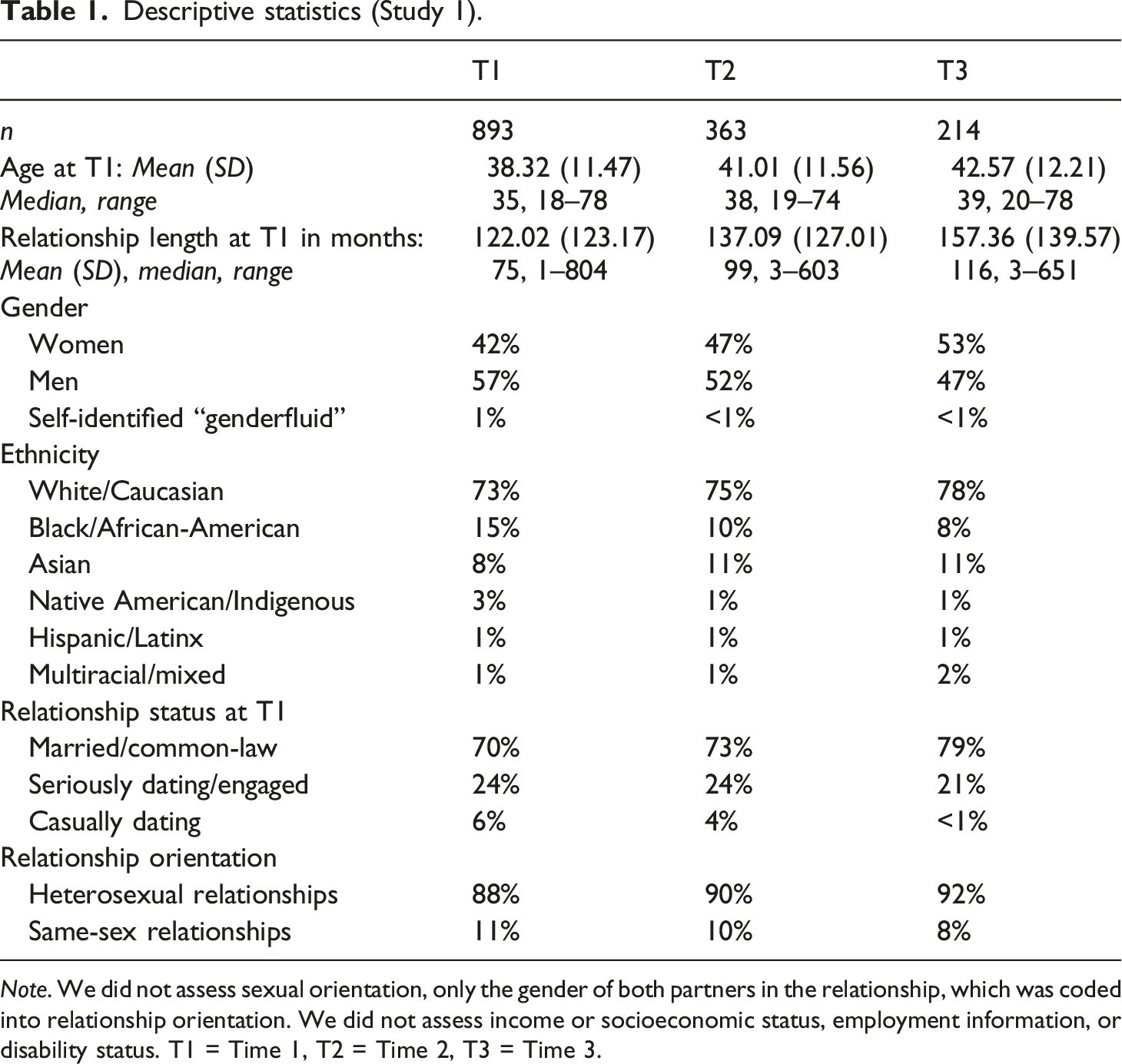
Note. We did not assess sexual orientation, only the gender of both partners in the relationship, which was coded into relationship orientation. We did not assess income or socioeconomic status, employment information, or disability status. T1 = Time 1, T2 = Time 2, T3 = Time 3.
Procedure
Time 1 (T1)
The first wave of data was collected in April 2020. After giving consent and completing demographic questions about themselves and their relationship, participants reported their current relationship quality using the Perceived Relationship Quality Components scale (PRQS; Fletcher et al., 2000). The short PRQS consists of six items assessing satisfaction, commitment, intimacy, trust, passion, and love for the partner (e.g., “I am satisfied with my relationship with my current romantic partner”), on scales ranging from not at all (1) to extremely (7). The six items were averaged (α = .89). Participants then completed the same scale for their expected relationship quality 6 months from now. Specifically, they were instructed “Now, please think about how you might feel about your partner in 6 months’ time (i.e., October 2020). Please rate what you think your relationship with your current romantic partner will be like then.” The PRQS items were adapted to be in the future tense (“How satisfied will you be with your relationship?”) and answered on scales ranging from not at all (1) to extremely (7). The six items were averaged (α = .91). 1
Time 2 (T2)
The second wave of data was collected in October 2020. After giving consent, participants first indicated whether they were in a relationship and entered their partner’s initials. Participants reported their current perceived relationship quality on the same Perceived Relationship Quality scale as in T1 (α = .91). They then reported their relationship quality 6 month ago, specifically they were instructed: “Now, please think about how you felt about your partner 6 months ago (i.e., late April 2020). Please rate what you think your relationship with your romantic partner was like then.” The PRQS items were adapted to be in the past tense (“How satisfied were you with your relationship six months ago?”) and answered on scales ranging from not at all (1) to extremely (7). The six items were averaged (α = .92). Finally, participants then reported their expected relationship quality six months from now (April 2021), on the same adapted scale as in T1 (α = .94).
Time 3 (T3)
The third wave of data was collected in April 2021. After giving consent, participants first indicated whether they were in a relationship and entered their partner’s initials. Participants then reported their current perceived relationship quality on the same scale as in T1 (α = .92). They also completed another indicator of relationship quality: the Relationship Assessment Scale (RAS, Hendrick, 1988) which includes seven items answered on 7-point scales (e.g., “How well does your partner meet your needs?”, α = .91). This additional scale was included to rule out that using the PRQS as predictor variable and as retrospective and forecasting bias components inflated the link between these variables. Participants then reported their perceived relationship quality 6 months ago (α = .94) and 1 year ago (α = .93) on the adapted PRQS as in T2.
Results
Retrospective judgments
Bias
We first examined whether people exhibited retrospective relationship appraisal biases. We conducted multilevel regression models where responses were nested within participants, using the MIXED commands in SPSS. This model allows us to examine retrospective appraisals for the three time periods simultaneously while accounting for within-participant variance. A variable designating time periods was not a significant covariate, did not change results reported below, and was not further considered. Participants recalled their relationship quality at the past point in time to have been, on average, 5.85 (SE = .05, 95%CI[5.74;5.95]) points on a 7-point scale. However, their actual reported relationship quality at the corresponding time was, on average, 5.96 (SE = .05, 95%CI[5.87;6.06]), which lies outside the 95% confidence interval for the retrospective relationship quality and thus can be considered significantly different at p < .05. In other words, participants recalled their relationship to have been less positive at the past point in time than they had reported at that time. This finding was supported when we computed difference scores for the recalled and actual at-the-time relationship quality. A multilevel model accounting for within participant variance showed an intercept for the difference score that was significantly different from zero, B = .12, SE = .03, 95%CI[.06;.18], t(298.11) = 3.86, p < .001.
The role of current feelings at the time of recall
We next examined whether relationship quality at the time of recall affected retrospective bias. In a multilevel regression model, we regressed the difference scores indicating retrospective bias on perceived relationship quality at the time of recall in the first step. Higher current relationship quality was linked to a lower difference score between retrospective and actual appraisal at the past time, suggesting less negative retrospective bias, B = −.21, SE = .03, 95%CI[−.27;−.15], t(379.18) = −7.35, p < .001. In a second step we also included the average of the two variables that formed the difference score (Iida et al., 2018). The link between current relationship quality and the difference score remained significant, B = −.33, SE = .05, 95%CI[−.43;−.23], t(746.95) = −6.54, p < .001. To rule out that the similarity of the scales contributed to this link, we also used an alternative predictor variable, the RAS, at the time of recall. Higher RAS scores at the time of recall were also linked to a lower PRQS difference score, B = −.14, SE = .03, 95%CI[−.20;−.08], t(196.02) = −4.34, p < .001. This link remained significant when controlling for the average of the components of the difference score, B = −.14, SE = .06, 95%CI[−.25;−.03], t(273.00) = −2.49, p = .013.
To tease apart the cause of the link between retrospective bias and relationship quality at the time of recall, we conducted an additional multilevel regression model regressing retrospective judgments of past relationship quality on relationship quality at the time of recall and on actual reported relationship at the past point in time. Higher relationship quality at the time of recall was positively linked with higher recalled relationship quality, B = .71, SE = .03, 95%CI[.65;.78], t(730.42) = 22.93, p <.001, independent of the variance explained by actual relationship quality at the past time, B = .28, SE = .03, 95%CI[.22;.35], t(731.94) = 9.08, p <.001. Similarly, higher RAS scores at the time of recall were positively linked with higher recalled relationship quality, B = .55, SE = .04, 95%CI[.46;.64], t(287.11) = 12.42, p <.001, independent of the variance explained by actual relationship quality at the past time, B = .41, SE = .05, 95%CI[.32;.50], t(379.71) = 8.95, p <.001. In other words, the lower retrospective bias among those higher in relationship quality at the time of recall appears to have been driven by projecting a rosy present onto a rosy past rather than being driven by differences in actual relationship quality in the past.
Forecasting judgments
Bias
We next examined forecasting bias. We conducted a multilevel regression model where responses were nested within participants, using the MIXED commands in SPSS. Participants forecasted their relationship quality at the future point in time to be, on average, 5.97 (SE = .05, 95% CI[5.87;6.08]. Their actual reported relationship quality at the corresponding time was, on average, 5.97 (SE = .05, 95% CI[5.87;6.07]), which lies within the 95% confidence interval for the average forecasted relationship quality. In sum, participants forecast their relationship to be about as positive at the future point in time as they ended up reporting at that time. This finding was also supported in an alternative analysis where we computed difference scores for the forecasted and actual relationship quality items. A multilevel model for the difference score also showed that the intercept of this difference score was not significantly different from zero, B = −.004, SE = .03, 95% CI[−.07; .06], t(535.00) = −0.11, p = .912.
The role of relationship feeling at the time of forecast
We next examined whether relationship quality at the time of forecast affected forecasting bias. A multilevel regression model where responses were nested within participants regressed the difference score for forecasted and actual relationship quality at the future time on relationship quality at the time of forecast. Greater current relationship quality was linked to a higher difference score between forecasted and actual quality at the corresponding future time, B = .24, SE = .03, 95% CI[.18;.30], t(534.00) = 8.09, p < .001. This link remained significant when controlling for the average of the components of the difference score, B = 1.14, SE = .07, 95% CI[1.00;1.27], t(488.20) = 16.45, p < .001.
This link between current relationship quality and greater forecasting bias appears to be driven by a projection of current appraisals onto future appraisals. A multilevel regression model showed that higher relationship quality at the time of forecast was positively linked with more positive forecasted relationship quality, B = 1.00, SE = .02, 95% CI[.95;1.04], t(502.28) = 41.51, p < .001, independent of the variance explained by actual relationship quality at the future time, B = .02, SE = .02, 95% CI[−.03;.07], t(515.91) = 0.85, p < .001.
Discussion
Participants showed retrospective biases for their relationship in the past, on average appraising their relationship as worse than it really was (although the mean-level difference was small). This negative retrospective bias is in line with previous work (Frye & Karney, 2004; Karney & Coombs, 2000; Karney & Frye, 2002; Lavner et al., 2013; Ogolsky & Surra, 2014; Sprecher, 1999; Zygar-Hoffman & Schönbrodt, 2020). Participants showed no systematic forecasting biases in appraising their relationship 6 months in the future; they both under and overestimated future relationship quality in equal degrees.
Perceiving better relationship quality at the time of recall was linked with being less negatively biased about the relationship in the past. In other words, participants perceiving currently high relationship quality reported less illusory improvement in their relationship from the past. The underlying reason for this link appears to be temporal projection. Since overall participants saw the relationship in the past as worse than it really was, those who projected higher relationship quality onto the past showed less retrospective bias. Given the lack of systematic forecasting bias overall, a similar projection of higher relationship quality onto the future drove an overall higher forecasting bias among those who perceived currently high relationship quality. Taken together, these findings suggest that the degree of bias about the past and future of a relationship may depend on current feelings about the relationship, as one’s current feelings affect retrospection and anticipation in a way that can amplify or cancel out illusory improvement perceptions.
Study 2
In the next study, we examined the role of current relationship quality experimentally. We randomly assigned participants to experience temporarily more or less relationship quality at the time of forecast or at the time of recall and examined how this induced relationship quality affected biases in appraising their relationship 6 months in the future or 6 months in the past.
We hypothesized that temporarily induced relationship quality would be linked to less negative retrospective bias but more positive forecasting bias. These hypotheses and the data collection plan were preregistered before Time 1 data collection: https://aspredicted.org/GIP_QPA. The study was approved by the researchers’ university ethics board and the unabbreviated survey, the data and syntax used for analyses are available on OSF: https://osf.io/62kjc.
Pilot study
Descriptive statistics (Study 2 and pilot test for Study 2).
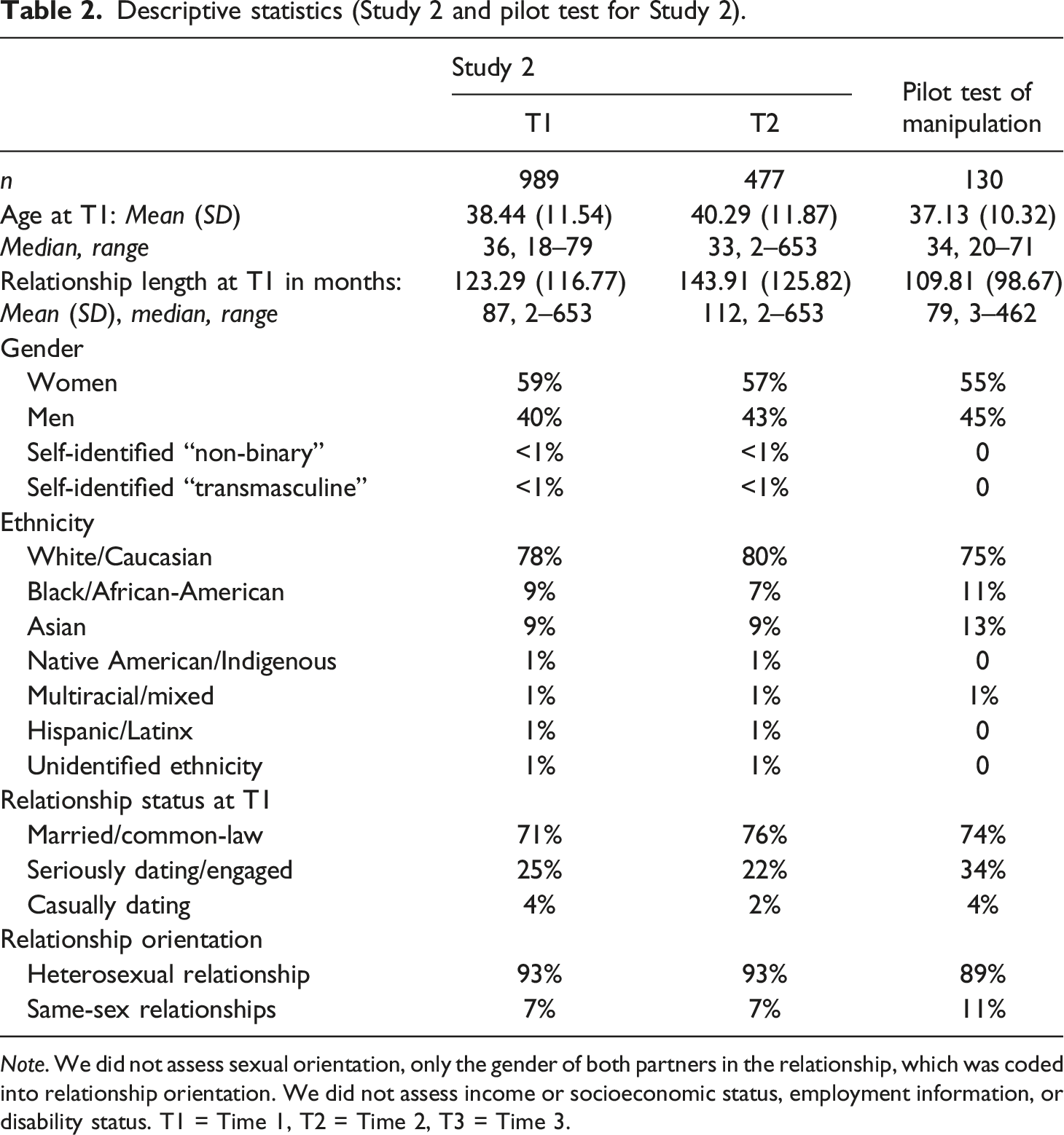
Note. We did not assess sexual orientation, only the gender of both partners in the relationship, which was coded into relationship orientation. We did not assess income or socioeconomic status, employment information, or disability status. T1 = Time 1, T2 = Time 2, T3 = Time 3.
Participants were randomly assigned to a relationship quality manipulation (adapted from Peetz & Kammrath, 2011). In the enhanced relationship quality condition (n = 69), participants were instructed to select an adjective from a list of positive adjectives that they thought is characteristic of their partner and that increases the quality of the relationship. They were then asked to “explain how this characteristic contributes to the quality of your relationship. For example, you could describe an event that illustrates this characteristic in your partner and tell us how you felt during this event.” In the reduced relationship quality condition (n = 61), participants were instructed to write down a characteristic of their partner that has been challenging in the relationship. They were then asked to “explain how this characteristic has challenged your relationship. For example, you could describe an event that illustrates this characteristic in your partner and tell us how you felt during this event.” Participants then completed only the six-item Perceived Relationship Quality Components scale (PRQS; Fletcher et al., 2000) and the single item pictorial assessment of closeness to partner, the Inclusion of Other in the Self Scale (IOS; Aron et al., 1992), both measured on 7-point scales. An independent t-test showed a significant effect of condition on perceived relationship quality, t(128) = 2.81, p = .006, d = .49, and on inclusion of the partner in the self, t(124) = 3.01, p = .003, d = .54. Participants in the enhanced relationship quality condition reported higher mean levels on the PRQS (M = 6.37, SD = 0.86) and on the IOS (M = 5.89, SD = 1.15) than participants in the reduced relationship quality condition (PRQS: M = 5.86, SD = 1.16, IOS: M = 5.19, SD = 1.44). Thus, the pilot test suggests that the relationship description tasks can indeed temporarily shift perceived relationship quality.
Methods
Participants
Data for Study 2 were collected from U.S. American MTurk workers, with the same quality control measures as in Study 1. At Time 1, we posted 1000 participation spots advertised as specifically for people in relationships. Only participants who indicated that they were in a relationship were considered (n = 998). Of these, 10 participants who entered invalid responses instead of partner initials were excluded, resulting in a final sample of 989. Of these, 477 participated again at Time 2 (48% retention rate). Everyone was still in a relationship, and no-one entered invalid responses instead of partner initials and so no-one was excluded at Time 2. The final sample size has 80% power to detect small effects of d = .26 between two independent groups. Table 2 presents demographic information.
Procedure
Time 1 (T1)
The first wave of data was collected in late March 2021. After giving consent and completing demographic questions about themselves and their relationship, participants reported their current perceived relationship quality (PRQS, Fletcher et al., 2000), on scales ranging from not at all (1) to extremely (7). The six items were averaged (α = .90). Participants were then randomly assigned to either the enhanced relationship quality condition (n = 241) or the reduced relationship quality condition (n = 236), completing the tasks outlined in the pilot test description.
Participants then completed the adapted PRQS for their expected relationship quality 6 months from now on scales ranging from not at all (1) to extremely (7). The six items were averaged (α = .92). At the end of T1, participants in the reduced relationship quality condition completed the activity from the other condition, to equalize their perceived relationship quality. 2
Time 2 (T2)
The second wave of data was collected in late September 2021 and was available for 2 weeks. After providing consent, participants first indicated whether they were in a relationship and entered their partner’s initials. Participants reported their current perceived relationship quality (α = .91). Participants were then randomly assigned to either an enhanced relationship quality condition (n = 245) or a reduced relationship quality condition (n = 232). This second assignment was independent of the assignment at T1.
Participants then reported their relationship quality 6 months ago on the adapted PRQS on scales ranging from not at all (1) to extremely (7). The six items were averaged (α = .93). Finally, participants in the reduced relationship quality condition completed the activity from the other condition to equalize their perceived relationship quality.
Results
Forecasting bias
We first examined the effect of condition on forecasting bias at T1 in paired t-tests comparing forecasted appraisal for a future point in time and actual appraisal at that time (preregistered). In the enhance condition, paired t-tests of the appraisal ratings showed a significant difference between forecasted quality at T1 and actual quality at T2, t(240) = 4.97, p < .001, d = .32, with participants forecasting better relationship quality in the future (M = 6.03, SD = 1.00) than they actually experienced at the future time (M = 5.77, SD = 1.08). In the reduce condition, paired t-tests of the appraisal ratings showed no significant difference between forecasted quality at T1 and actual quality at T2, t(235) = 1.76, p = .081, d = .11, with participants forecasting similar relationship quality in the future (M = 6.17, SD = 0.98) as they actually experienced at the future time (M = 6.09, SD = 0.97). 3
We also examined the effect of conditions on forecasting bias via the difference score (not preregistered). An ANOVA with Time 1 condition as predictor and the forecast bias difference score as dependent variable showed a significant effect of condition, F(1, 475) = 7.03, p = .008, partial η2 = .015, with a higher forecasting bias in the enhance condition (M = .26, SD = .81) than in the reduce condition (M = .08, SD = .26) (see Figure 1 for forecasting bias by condition). This effect was unchanged when controlling for the average of the components of the difference score (Iida et al., 2018; not preregistered): An ANOVA with Time 1 condition as predictor, the forecast bias difference score as dependent variable and the average of the difference score components as covariate showed a significant effect of condition, F(1, 474) = 6.19, p = .013, partial η2 = .013. Forecasting bias by condition (Study 2). Round points indicate estimated mean in condition, error bars indicate 95% confidence interval, and scatter dots represent individual values.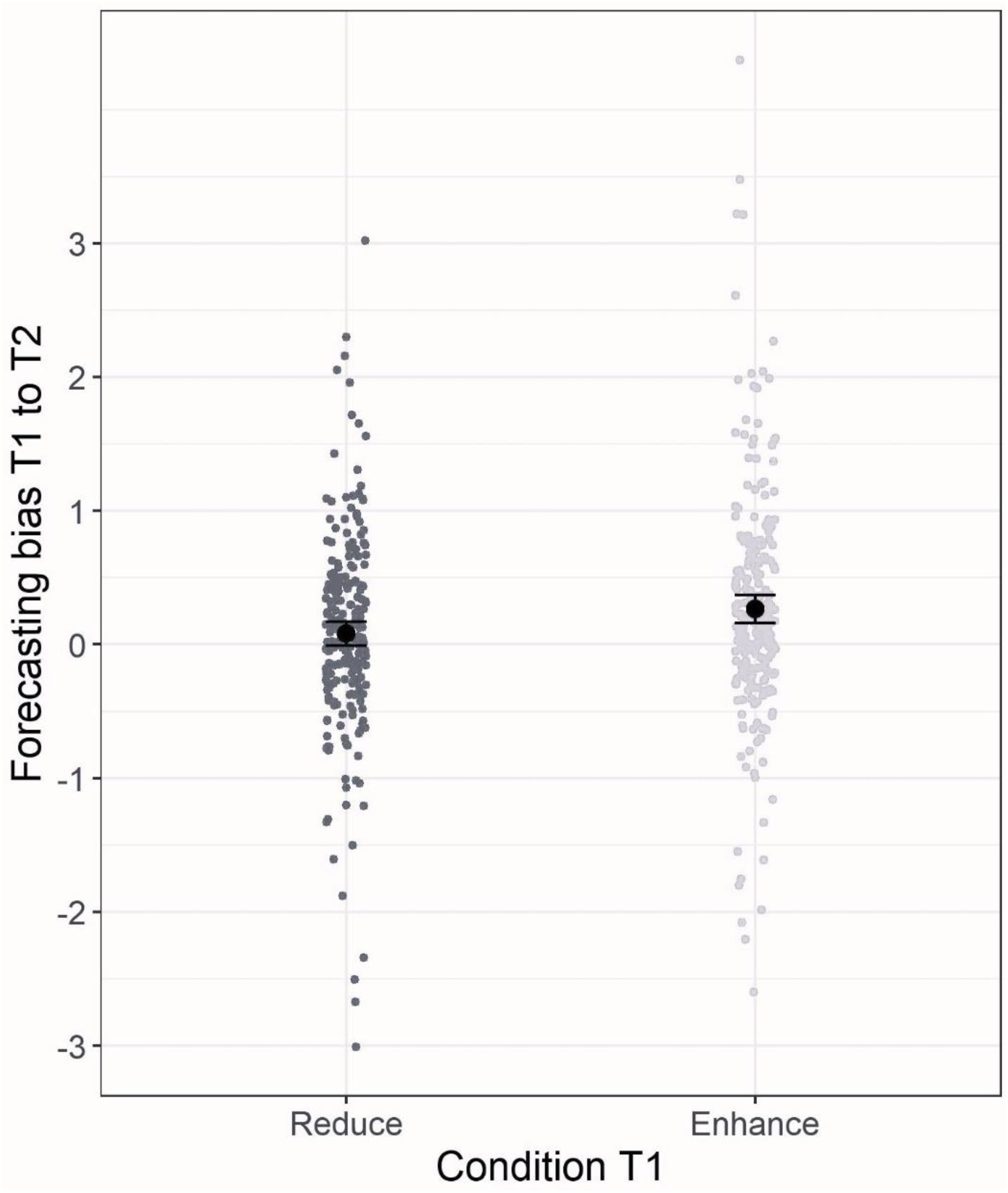
Next, we examined projection of current relationship quality onto forecasted relationship quality (not preregistered). We regressed forecasted relationship quality on Time 1 condition (1 = enhance, 0 = reduce), relationship quality at the time of forecast, and actual relationship quality reported at the future time. The relationship enhance condition increased forecasted relationship quality, B = .11, SE = .03, t(473) = 3.42, p = .001, β = .06, independent of the variance explained by actual relationship quality at the future time, B = .04, SE = .02, t(473) = 1.84, p = .067, β = .05, and current relationship quality at the time of forecast, B = .92, SE = .03, t(473) = 36.66, p < .001, β = .91.
Retrospective bias
We next examined the effect of condition on retrospective bias at T2 in paired t-tests comparing recalled appraisal for a past point in time and actual appraisal at that time (preregistered). In the reduce condition, paired t-tests of the appraisal ratings showed a significant difference between retrospective relationship quality and actual relationship quality at T1, t(231) = 5.07, p < .001, d = .33, with participants recalling worse relationship quality in the past (M = 5.72, SD = 1.21) than they actually experienced at the past time (M = 6.00, SD = 0.99). In the enhance condition, paired t-tests of the quality ratings showed a significant, but smaller, difference between retrospective and actual relationship quality at T2, t(240) = 2.06, p = .040, d = .13, with participants also recalling worse relationship quality in the past (M = 5.94, SD = 1.08) than they actually reported at the past time (M = 6.04, SD = 0.97).
We also examined the effect of conditions on retrospective bias via the difference score (not preregistered). An ANOVA with condition at T2 as predictor and the retrospective bias difference score as dependent variable showed a significant effect of condition, F(1, 475) = 5.65, p = .018, partial η2 = .012, with more negative retrospective bias in the reduce condition (M = .28, SD = .85) than in the enhance condition (M = .10, SD = .77) (see Figure 2 for retrospective bias by condition). This effect was unchanged when controlling for the average of the components of the difference score (Iida et al., 2018; not preregistered): An ANOVA with Time 2 condition as predictor, the retrospective bias difference score as dependent variable and the average of the difference score components as covariate also showed a significant effect of condition, F(1, 474) = 4.48, p = .035, partial η2 = .009. Retrospective bias by condition (Study 2). Round points indicate estimated mean in condition, error bars indicate 95% confidence interval around mean, scatter dots represent individual values.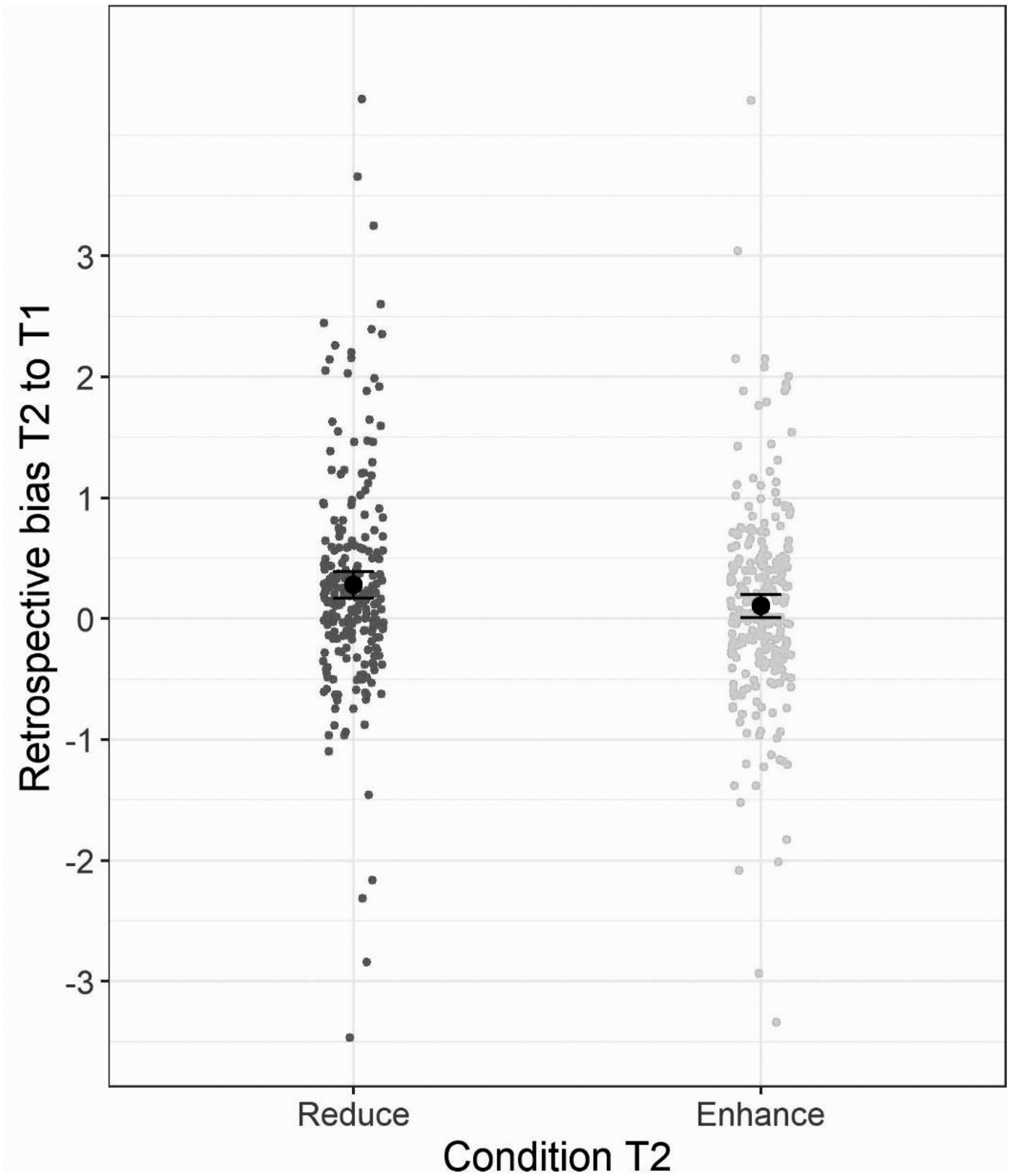
Next, we examined projection of current relationship quality onto recalled appraisals (not preregistered). We regressed retrospective relationship quality on Time 2 condition (1 = enhance, 0 = reduce), relationship quality at the time of recall, and actual relationship quality reported at the past time. Completing the relationship enhancing exercise increased retrospective relationship quality, B = .17, SE = .05, t(473) = 3.20, p = .001, β = .08, independent of the variance explained by actual relationship quality at the past time, B = .22, SE = .04, t(473) = 5.21, p < .001, β = .19, and perceived relationship quality at the time of recall, B = .78, SE = .04, t(473) = 19.94, p < .001, β = .71.
Discussion
This study replicated findings of Study 1 in an experimental design. Participants who reflected on the characteristics they value about their partner (i.e., who were in a state of temporarily increased relationship quality) exhibited more positive forecasting bias and less negative retrospective bias compared with participants who reflected on the characteristics they find challenging in their partner (i.e., who were in a state of temporarily reduced relationship quality). As in Study 1, the change in bias appears to be due to a projection of the current perceived relationship quality onto the future and past appraisal of the relationship. Greater induced relationship quality increased positive expectations of the relationship 6 months hence and thus amplified the positive forecasting bias—and also increased positivity of remembered relationship quality 6 months ago which reduced the tendency for a negative retrospective bias.
General discussion
These studies documented retrospective bias when people in established relationships appraised their relationships in the past, in line with other work that also showed negative bias in retrospective evaluations of relationship change (Frye & Karney, 2004; Karney & Frye, 2002; Ogolsky & Surra, 2014; Sprecher, 1999) or retrospective appraisals of relationship feelings at a certain point in time (Karney & Coombs, 2000; Zygar-Hoffman & Schönbrodt, 2020). In contrast, we found no evidence for a systematic forecasting bias, also in line with some previous work (Lemay et al., 2015) but contrary to others (Lavner et al., 2013). Higher current relationship quality reduced retrospective bias but increased forecasting bias when assessed correlationally (Study 1) and when participants were experimentally assigned to focus temporarily on high quality or challenging aspects of their relationship (Study 2). This pattern suggests that rather than amplifying the illusion of relationship improvement over time, current relationship quality is projected onto recalled and forecasted relationship quality. Since there was no mean-level forecasting bias, this projection creates a rosier-than-actual prognosis for those who have a rosy outlook on the present. Since there was a negative mean-level retrospective bias, this projection reduces the tendency to recall a darker-than-actual past for those who have a rosy outlook on the present. In sum, these studies extend existing research showing temporal projection bias (e.g., Chang et al., 2018; Lemay et al., 2015; Teneva & Lemay, 2020) to show projection biases for global relationship appraisals, over extended time frames (6 months’ time), showing projection into both the past and the future, and providing causal evidence for the role of current feelings.
Limitations
It is important to note that while there was, on average, a significant negative mean-level retrospective bias, participants remembered both more negative and more positive relationship quality compared to actual ratings at the time. Indeed, effect sizes for retrospective bias were very small and smaller than biases reported in previous work. This difference might be due to the time frame in this study (e.g., 6 months vs. 10 years, Karney & Coombs, 2000; although 6 months was the time frame most conducive to biased appraisal in another study, Frye & Karney, 2004). The present studies also used a global assessment of relationship quality via six components rather than specific relationship problems (Frye & Karney, 2002), specific emotions (Zygar-Hoffman & Schönbrodt, 2020), or responsive partner behaviors (Lemay et al., 2015). Global appraisals tend to be more positively biased than specific partner qualities (Neff & Karney, 2005), but the present data might be limited in the extent of detectable bias by high average appraisals (i.e., ceiling effects). In sum, we suggest that any conclusions about the extent of retrospective or forecasting bias be interpreted with caution: mean-level bias varied widely across participants and likely depends on the time frame and measures chosen by the researcher. More confidence might be placed on the correlates of the biases: both correlationally and experimentally induced relationship quality showed similar patterns with respect to how current quality was linked to bias about the past and the future of the relationship.
Another limitation of our method is the self-report method. Self-reported relationship quality at the current point in time might not necessarily be more “true” than recalled relationship quality—perhaps retrospective appraisals have the clarity of distance and are more accurate in an objective sense than the reports at the time. Note that we asked participants how they used to feel about their relationship rather than make a retrospective judgment about the objective quality of the relationship. Thus, participants’ retrospective bias is about mistaking how they used to feel at a past point in time rather than mistaking the actual quality of the relationship.
Generalizability of conclusions
Only a subset of those participants who completed the initial survey also completed the follow-up surveys (i.e., about half the initial samples was retained over 6 months). Attrition may be due to the recruitment platform where participants are less committed or might not be aware of the follow-up study unless they sign on to the platform during the time of data collection (i.e., there was no direct contact from the researchers to entreat them to participate again). We have no reason to believe that the retained sample differed from the rest of the initial sample in their relationship cognitions, though those who were retained in the samples tended to be older and in longer relationships (see online supplements for survivorship bias analyses: https://osf.io/62kjc). Thus, our results might only apply to those in established, longer-term relationships (on average, relationship length was about 10 years in both studies).
Retrospective and forecasting biases might be more or less common depending on relationship length and commitment level. For instance, newlyweds overestimated relationship improvement in the first years of their marriage (Lavner et al., 2013), and thus, forecasting bias might be relatively more common among new relationship partners. Relatedly, negative retrospective bias is magnitudes larger when reflecting on a past relationship after a break-up (Smyth et al., 2020), and might also be affected by other relationship events such as transition to parenthood or moving in together. Thus, results might not extend to samples of new relationships or to those experiencing relationship transitions.
The sample here consists, like samples in many relationship studies (especially coupled relationship study participants, Park et al., 2021), of already of very satisfied people. Thus, the results might reflect cognitions at the upper end of the spectrum of well-functioning relationships. The samples also consisted of U.S. American participants, who were primarily white. Cultural background matters to how people think about time (e.g., Guo et al., 2012), and matters to how people think about relationships (e.g., Endo et al., 2000). Thus, it is important to note that results in the studies presented are limited to relationships in North-American culture.
Future directions
Retrospective bias has been documented for self-appraisals (e.g., Wilson & Ross, 2001) as well as relationship appraisals. Future work might examine if the tendency to perceive illusory relationship improvement is linked with the tendency to perceive illusory improvement in the self. However, it is notable that current self-esteem was linked with more retrospective self-appraisal bias (Ross & Wilson, 2002) whereas current relationship quality was linked with less retrospective relationship bias (Study 1, Study 2; Karney & Coombs, 2000), suggesting that temporal self-appraisal biases might function differently than illusory relationship improvement. However, our studies examined emotional attitudes whereas temporal self-appraisal biases have focused on more factual information such as trait judgments (Ross & Wilson, 2002). Future research should examine temporal relationship appraisals and self-appraisals across similar characteristics to examine potential underlying interpersonal differences in biases.
Future studies may also examine whether looking toward the future for illusory improvement is more adaptive than looking toward the past. Since forecasted improvement appears to be a hallmark of high-quality relationships, there might be immediate or delayed benefits to having positive expectations. Optimism about the future can have a range of psychological benefits (e.g., Taylor & Brown, 1988; Lench et al., 2021). Thus, the link between relationship quality and greater forecasting bias might be one instance of beneficial optimism. However, there can be downsides to expecting change that does not come (Kammrath & Peetz, 2012), such as blaming the partner for not trying hard enough to better themselves or the relationship. Other variables, such as partner’s relationship skills may interact with their positive expectations (McNulty & Karney, 2004) to determine the benefits of forecasting biases.
Conclusions
Positive illusions are a common feature in relationships, and one such illusion is the sense of the relationship improving over time. Relationship partners’ feelings about their relationship (in general and in the moment) play a role in how much illusory improvement is perceived. Feeling more positive about one’s relationship is projected onto more positive memories and predictions. This projection of current feelings into the past and the future increases illusory improvement into the future but reduces illusory improvement from the past. In sum, current feelings about the relationship bias the way a relationship is remembered and projected. Romantic partners’ recalled and forecasted views about their relationship are colored by how they feel in the moment.
Footnotes
Funding
The author(s) disclosed receipt of the following financial support for the research, authorship, and/or publication of this article: The research was supported by a Social Sciences and Humanities Research Council of Canada grant (grant # 435-2012-1211) to the first author.
Open research statement
As part of IARR’s encouragement of open research practices, the authors have provided the following information: This research was preregistered.
The data used in the research are available. The data can be obtained at: https://osf.io/62kjc/?view_only=99e6c143d9164487824532e5ff68975f for Study 1 and  for Study 2.
The materials used in the research are available. The materials can be obtained at: https://osf.io/62kjc/?view_only=99e6c143d9164487824532e5ff68975f for Study 1 and for Study 2.