




Abstract
Passionate love (PL) is a central concept in romantic relationships, yet the process through which it enhances relationship maintenance remains unclear. The current research included two studies of daily relationship experiences among dating couples (N = 203) and newlyweds (N = 173). We examined the contribution of PL to greater daily prorelationship behavior and the role of idealized views of romantic partners in explaining this association. Furthermore, we examined the unique effect of PL on prorelationship behavior beyond relationship commitment. Results indicated that positivity bias mediated the association between PL and prorelationship behavior, and this effect was independent of commitment. Conversely, relationship commitment did not predict prorelationship behavior beyond PL. These findings highlight the role of positively biased perceptions in explaining how the motivational experience of PL translates into daily acts and suggest that daily behaviors shaped by PL may support long-term goals of relationship maintenance.
Passionate love (PL) is a powerful emotional state, defined as an “intense longing for union with another” (Berscheid & Walster, 1978, p. 9). PL is common in early relationship stages (e.g., Reis & Aron, 2008; Sternberg, 1986) and is considered a necessary feature of both dating and marriage in the Western world (e.g., Dion & Dion, 1991). Previous studies focusing on the functional significance of PL to the maintenance of long-term romantic relationships, have suggested that this emotional state motivates romantic intimates to focus attention on their love objects rather than alternative mates (Gonzaga et al., 2008; Maner et al., 2008, 2009), and engage in prorelationship behaviors that engender greater interdependence and trust (Gonzaga et al., 2001). However, the process through which PL promotes relationship maintenance in romantic couples remains unclear.
The current investigation tested novel predictions regarding a mechanism underlying the link between PL and prorelationship behavior (i.e., behaviors aimed to benefit one’s partner). PL is associated with idealized views of romantic partners (e.g., Fletcher & Kerr, 2010), which, like PL, have been associated with prorelationship responses, such as relationship persistence and positive revaluations of partners (e.g., Le et al., 2010; Murray et al., 1996b). We propose that positivity bias may help explain how PL fosters prorelationship behavior. People who feel passionately in love with their partners may actively seek to benefit their relationship because their PL motivates them to construe their partners in positive ways that encourage prorelationship attitudes and gestures.
Moreover, we sought to examine whether PL affects prorelationship behavior beyond the known effects of relationship commitment. Relationship commitment involves the intent to persist in relationships, and motivates various activities to benefit one’s partner (e.g., see review by Rusbult et al., 2004). Relationship commitment and PL are both important for relationship maintenance because they motivate people to enact relationship maintenance behaviors (Ogolsky & Bowers, 2013; Rusbult et al., 1991; Wieselquist et al., 1999), but it is not known whether PL has a unique effect on prorelationship behavior independent of relationship commitment.
The contribution of passionate love to romantic relationships maintenance
Passionate love involves feelings of affection, connectedness, and a strong desire to be near a beloved partner (e.g., Aron & Westbay, 1996; Berscheid & Walster, 1978; Hatfield, 1988). Previous studies have indicated that feelings of PL cultivate the development and maintenance of romantic relationships from early relationship stages into committed attachment bonds (e.g., Reis & Aron, 2008; Shaver et al., 1988). For instance, in early relationship stages, PL promotes the willingness to invest resources (e.g., time and attention) in the development of intimacy (Buss, 1988). As relationships progress, PL contributes to the way couples communicate and manage conflict (Fehr, 2013) and encourages their relationship satisfaction and interdependence (e.g., Hendrick & Hendrick, 1992; Murray & Holmes, 2011).
From an evolutionary perspective, PL may help humans to solve survival and reproduction problems (e.g., Fletcher et al., 2015). PL includes sexual desire, and arousing sexual urges may motivate the pursuit of desirable mating partners (e.g., Birnbaum et al., 2019; Buss & Kenrick, 1998). Beyond relationship initiation, romantic partners must remain together long enough to enable the survival of their offspring during infancy and thereby increase their reproductive success (e.g., Buss, 1988; Fisher, 1998). Feelings of PL may serve as a key factor that facilitates adjustments to the demands of committed relationships, by reward mechanisms that motivate partners to prefer their existing relationship over extra-dyadic alternatives, benefit their partners, and sustain the relationship over time (e.g., Gonzaga et al., 2001, 2006, 2008). These reward mechanisms include positive emotional states, from warm feelings and happiness to more ecstatic experiences (e.g., euphoria, heightened energy; see review by Acevedo & Aron, 2014), which are stimulated in response to the presence of beloved partners.
Supporting evidence for this perspective come from fMRI studies, which have identified reward systems activated when people are primed by concrete or abstract visualization of their intimate (e.g., Acevedo et al., 2011; Aron et al., 2005; Fisher et al., 2005). These studies suggest that some of the behavioral aspects of PL can resemble those of drug addiction, producing excitement and excessive energy in response to rewarding stimuli (e.g., Aron et al., 2005; Fisher, 1998). Other studies have demonstrated that people who are passionately in love tend to suppress thoughts of alternative mates and be less attentive to their presence (Gonzaga et al., 2008; Maner et al., 2008). Overall, previous findings suggest that PL fosters intimate relations by providing rewarding experiences that are associated with relationship partners, which promote a preference for this partner relative to alternative mates. The desire to recreate such experiences over time may motivate prorelationship acts to earn a partner’s affection and induce her or him to sustain the connection.
Passionate love, positivity bias, and prorelationship behavior
One reward mechanism that may promote a strong preference toward a certain partner over others is having an idealistic view of this partner (e.g., Murray et al., 1996a; Rusbult et al., 2004). Affectionate feelings together with sexual urges may bias perceptions of relationship partners, and motivate intimates to dismiss a partner’s faults and adopt an idealized perspective that corresponds with the desire to sustain the connection (e.g., Birnbaum et al., 2020; MacDonald & Ross, 1999; Miller et al., 2006; Murray et al., 1996b). Positively biased perceptions of relationship partners serve an important function for relationship maintenance over time, as it may mitigate relationship threats (e.g., alternative partners and conflicts) and enhance the relationship (e.g., see review by Ogolsky et al., 2017). Over-perceiving a partner’s desirable qualities and behaviors may aid intimates in reaching cognitive resolution between their hopes and fears regarding their relationship, and attain a leap of faith that is required in long-term committed relationships (e.g., Fletcher & Kerr, 2010; Miller et al., 2006; Murray et al., 1996a, 1996b). Therefore, positively biased perceptions serve important functions in reinforcing an evolutionarily significant bond between romantic lovers—one that may be resilient to everyday doubts and conflicts, and help protect family and offspring.
Previous studies have demonstrated the importance of positivity bias for relationship maintenance. For example, greater positivity bias in partner judgments predicted higher relationship satisfaction over time and lower rates of break-ups (Murray et al., 1996b, 2011). Other studies have indicated that people change their ideals in a way that allows them to sustain infatuated feelings over time (Fletcher et al., 2000). Positivity bias may help to explain how the rewarding experience of PL contributes to relationship maintenance over time, by encouraging intimates to construe beloved partners positively, and express their love in day-to-day prorelationship behavior while having congruence between their feelings and behaviors.
The present research
The present research sought to deepen the understanding of positivity bias as a mechanism underlying the association between PL and relationship maintenance behaviors in romantic couples. In two diary studies, we examined the contribution of PL to greater daily prorelationship behavior (e.g., sacrifice and support) and whether positivity bias explains this association. Furthermore, we aimed to examine the unique effect of PL on daily prorelationship acts beyond relationship commitment. Commitment is often conceptualized as the intent to persist in relationships despite potential challenges (e.g., Rusbult et al., 2004) and defined in terms of cognitive-affective processes (e.g., how people cognitively construe their relationship and emotionally attach to their partner; Agnew et al., 1998) and behavioral displays (e.g., intentions for future behaviors; Arriaga & Agnew, 2001). Similar to PL, it is considered a key building block of romantic relationships (e.g., Sternberg, 1986) and plays an important role in shaping prorelationship motivation (e.g., Rusbult et al., 1998). Like PL, relationship commitment is associated with positivity bias of romantic partners (e.g., Fletcher & Kerr, 2010; Rusbult et al., 2004).
Given that commitment and PL both motivate prorelationship attitudes, and also tend to be positively associated (e.g., Campbell & Loving, 2016; Murray & Holmes, 2011), we aimed to examine whether they have unique effects on daily prorelationship behavior. We expected that they would. Although people who experience PL may often feel committed to their partner (e.g., Campbell & Loving, 2016; Rusbult et al., 2004), the effect of PL and commitment on relationship maintenance may diverge. Specifically, PL is largely an emotional state characterized by intense feelings of longing and excitement (e.g., Acevedo & Aron, 2014; Berscheid & Walster, 1978) and may be associated with spontaneous daily gestures directed at gaining the affection of a desirable partner who is perceived as having high mate value (Birnbaum et al., 2016, 2019). Alternatively, commitment refers to the intent to sustain a relationship over time, regardless of its strengths and weaknesses, and seems to reflect more deliberate cognitive processes (e.g., perceived costs of relationship termination; Rusbult et al., 2004). Hence, we expected that PL would uniquely predict daily prorelationship behavior above and beyond the effects of commitment, and that this association would be mediated by positivity biases. Because people tend to be positively biased when they feel committed to their partner (e.g., Fletcher & Kerr, 2010; Rusbult et al., 2004), we also expected that positivity biases would mediate the association between relationship commitment and prorelationship behavior.
Study 1
In Study 1, we tested our predictions in a community sample of couples. We employed a daily-experiences methodology to examine the association between PL and daily prorelationship behavior, and the role of positivity bias of a partner’s qualities in mediating this association. Our sample included a majority of dating couples. In this early relationship stage, PL tends to be high (e.g., Fisher, 2006; Sternberg, 1986) and plays a significant role in shaping the motivation to connect (e.g., Birnbaum et al., 2019; Reis & Aron, 2008). Furthermore, in early relationship stages, people tend to focus on their partners’ virtues and downplay their potential disappointing aspects (e.g., Fletcher et al., 2000; Murray et al., 1996b). PL may thus have a significant effect on the extent to which dating partners are motivated to construe their new partner in a positive manner and inclined to act in prorelationship ways to benefit their emerging relationship. To test our predictions, we followed PL, positivity bias of a partner’s qualities, and prorelationship acts for 14 consecutive days.
Method
Participants
Two hundred and three couples residing in College Park, Maryland, were recruited using advertisements placed in newspapers, Internet bulletin boards, and a Psychology department subject pool. Couples were offered a financial incentive of up to US$100, depending on the number of completed diaries. Couples were offered another US$40 for completing later follow-up assessments, which are not relevant to the current paper. To be eligible, both partners had to be older than 18 years of age and fluent in English. At the beginning of the study, relationship duration ranged from 1 week to 156 months (M = 17.83 months, Md = 11, SD = 20.66). Relationships were primarily described as dating (92%), with a few others described as engaged or married (5%) or causal dating (2%). 1 On average, participants were 20.56 years of age (Md = 20, SD = 2.99). Most relationships (n = 182) were mixed sex, some relationships involved two men (n = 7) and two women (n = 14). In total, 51% of the participants were Caucasian, 12% were African American, 26% were Asian, and 11% were multiracial or other. Median annual income fell in the range between US$0 and US$20,000.
Measures and procedure
Participants arrived at the laboratory session with their romantic partners. After providing informed consent, they completed the PL and commitment measures described below (among measures relevant to other investigations). Starting the next day, participants were asked to complete the 2-week daily diary. Participants were asked to complete a survey each day between 7 p.m. and midnight. After data cleaning, 5154 daily records were available for analysis (an average of 12.7 daily records per person).
Passionate love
Passionate love was assessed using the shortened version of the Passionate Love Scale (Hatfield & Sprecher, 1986). The measure consisted of 15 items such as “Sometimes I feel I can’t control my thoughts; they are obsessively on this person,” “I would rather be with this person than anyone else,” and “I want this person physically, emotionally, mentally.” Items were completed using 7-point response scales (1: strongly disagree to 7: strongly agree). This measure exhibited good internal consistency (α = .91). Responses were averaged across items to create an index of PL. Higher scores represent higher PL.
Commitment
Commitment was assessed using seven items from the commitment subscale of the Investment Model Scale (Rusbult et al., 1998) (e.g., “I want our relationship to last for a very long time,” “I am committed to maintaining my relationship with him/her,” “I feel very attached to this relationship, very strongly linked to him/her”). Responses used 7-point response scales (1: strongly disagree to 7: strongly agree). This measure exhibited good internal consistency (α = .88). Responses were averaged across items to create an index of commitment. Higher scores represent higher commitment.
Daily prorelationship behavior
During each day, participants completed four items assessing their enactment of prorelationship behavior toward their partner (“Today, how considerate or thoughtful were you toward [partner name],” “Today, to what extent did you sacrifice for [partner name],” “Today, how warm and affectionate were you toward [partner name],” “Today, to what extent did you provide [partner name] with help or support”). Participants completed these items using 5-point response scales (1: not at all to 5: extremely). This measure exhibited good internal consistency (α = .81). Responses were averaged across items to create an index of daily prorelationship behavior. Higher scores represent greater prorelationship behavior.
Daily perception of partner
Each day, participants rated their partner on qualities relevant to warmth/trustworthiness (“understanding,” “supportive,” “considerate,” “kind”; α = .91), attractiveness/vitality (“adventurous,” “outgoing,” “sexy,” “attractive”; α = .80), and status/resources (“successful,” “dresses well”; α = .68). Items were adapted from prior research on perceptions of romantic partners (Fletcher et al., 1999) and completed using 5-point response scales (1: not at all descriptive of my partner today to 5: extremely descriptive of my partner today). Responses to these three scales were averaged to create a composite index of daily perceived partner qualities (α = .88). Higher values indicate more positive perceptions of partners. 2
Daily self-perception
Using 5-point response scales (1: not at all descriptive of me today to 5: extremely descriptive of me today), participants rated themselves on the same qualities (warmth/trustworthiness α = .90; attractiveness/vitality α = .84; status/resources α = .69). Responses to these three scales were averaged to create a composite index of self-perceptions (α = .87). Higher values indicate more positive daily self-perceptions.
Results and brief discussion
Analytic approach
We analyzed the data using multilevel modeling in SPSS 25. Within-person variability was represented at the lower level (Level 1) and between-persons and between-dyads variability was represented at the upper level (Level 2), following recommendations by Kashy and Donnellan (2008, 2012). We employed the Actor-Partner Interdependence Model (Kenny et al., 2006) in order to control for dependencies between partners nested within the same relationship. The analysis was designed to explain people’s tendencies to idealize their partner across the sample days, rather than fluctuations from 1 day to the next. Specifically, we employed a 2-2-1 model, such that the mediator represents between-person variance in the between-person predictors, as recommended by Zhang et al. (2009).
Preliminary analysis
Simple correlations of study variables (Study 1)
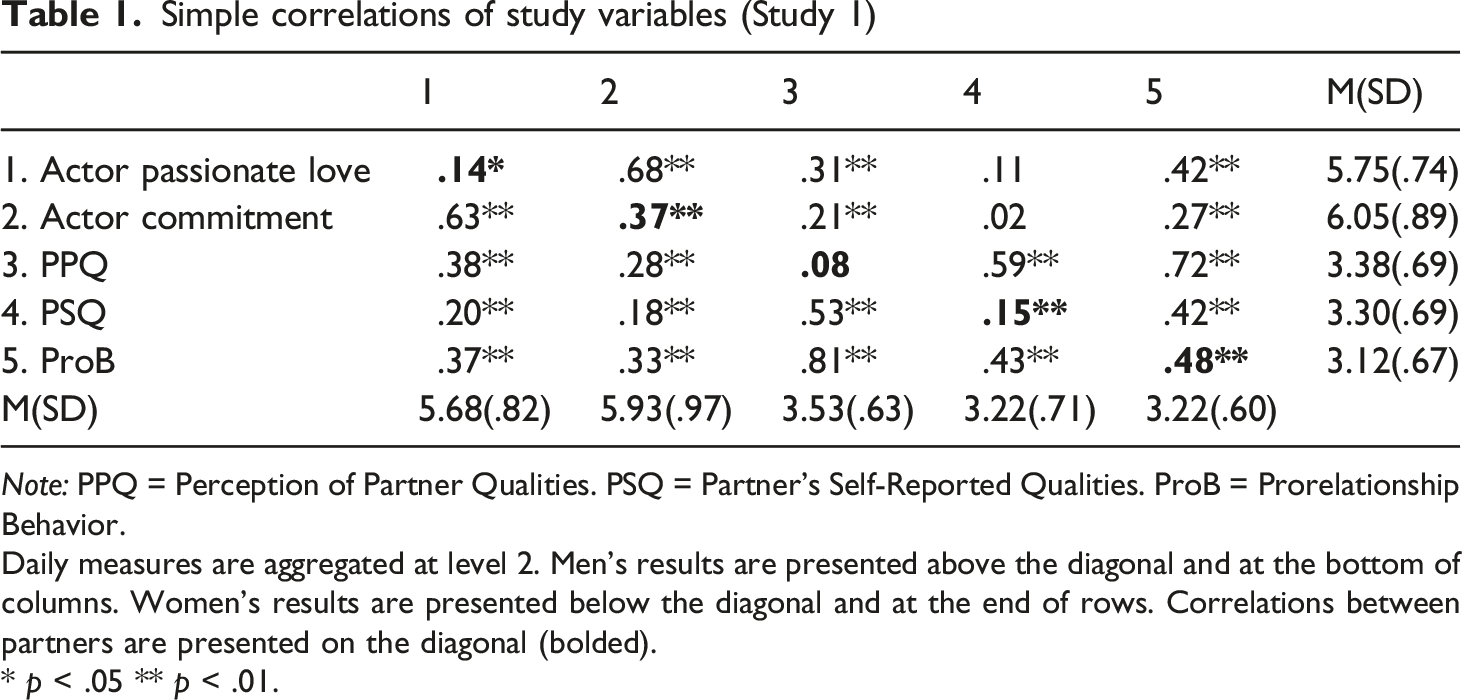
Note: PPQ = Perception of Partner Qualities. PSQ = Partner’s Self-Reported Qualities. ProB = Prorelationship Behavior.
Daily measures are aggregated at level 2. Men’s results are presented above the diagonal and at the bottom of columns. Women’s results are presented below the diagonal and at the end of rows. Correlations between partners are presented on the diagonal (bolded).
* p < .05 ** p < .01.
Main analysis
In order to ease interpretation of coefficients, prior to the analysis, all predictors were grand mean-centered. Intercepts were allowed to vary at random separately for the two partners (Kashy & Donnellan, 2012). To assess mediation, we used a procedure for testing mediation in a multilevel data structure recommended by Preacher et al. (2010). First, we estimated the link between PL and commitment (i.e., the predictors) and prorelationship daily acts (i.e., the outcome). Second, we tested the association between PL and commitment and positivity bias of partners’ qualities (i.e., the mediator). Third, we examined the link between the mediator and the outcome variable while controlling for the predictors.
Total and direct effects of passionate love and commitment at baseline on daily prorelationship behavior through positivity bias: A multilevel mediation analysis (Study 1)
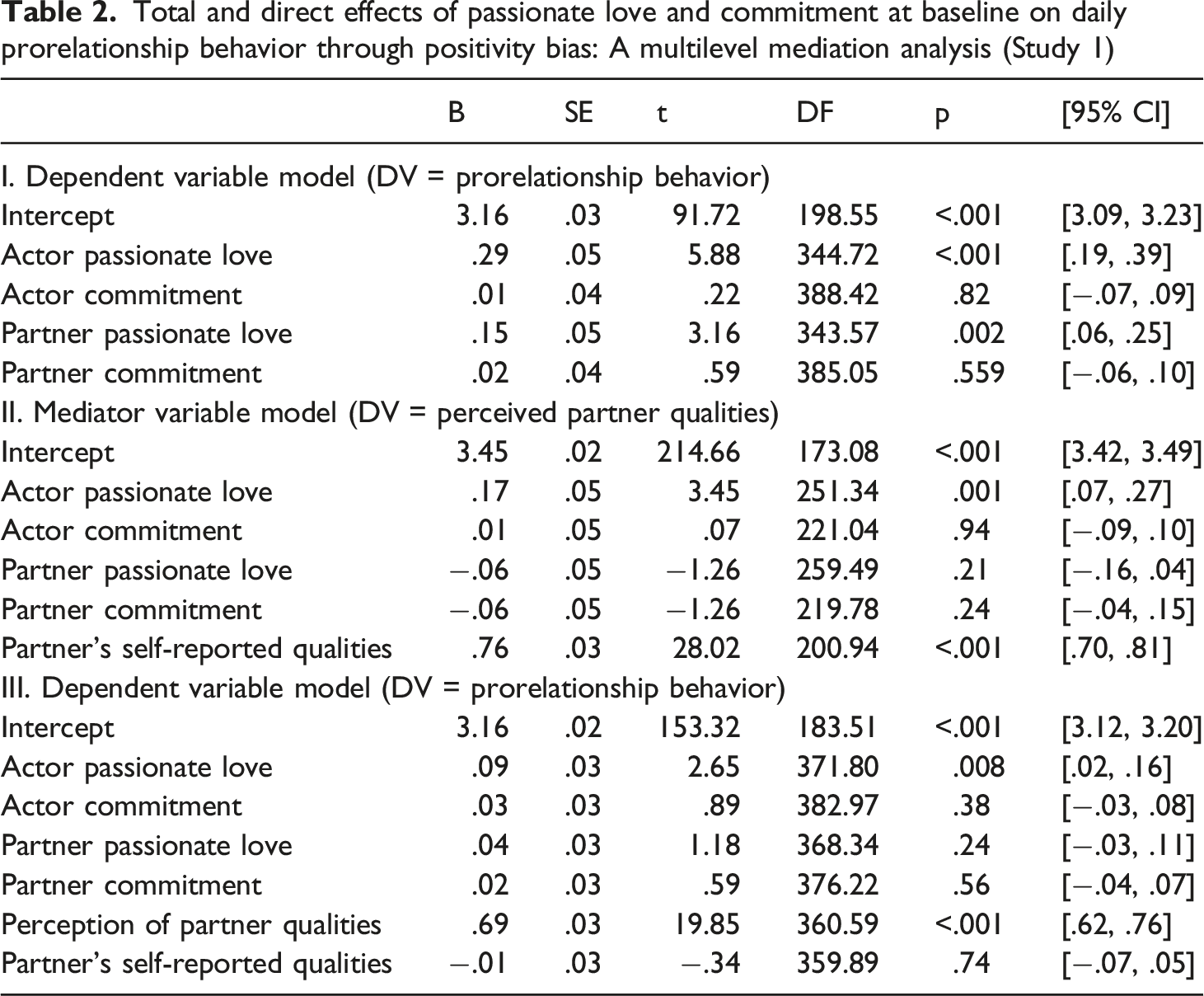
The middle section of Table 2 presents the effects of PL and commitment on the perception of partners’ qualities. In order to assess positivity bias, we controlled for partners’ self-reported qualities. This strategy allowed us to remove the effect of a partner’s perception out of the actor’s perception. The results indicated that PL predicted more positive perceptions of the partner’s qualities independently of the partner’s self-reported qualities, showing that PL was linked to positivity bias. Actors’ commitment and partners’ PL and commitment were not significant predictors of perceptions of partners’ qualities. Partners’ self-reported qualities also predicted participants’ perceptions of partners, suggesting some accuracy in participants’ perceptions of partners’ qualities.
In the bottom section of Table 2, we present associations between the mediator and the outcome variable while controlling for the predictors (i.e., actor and partner effects of PL and commitment). We also controlled for partners’ self-reported qualities. Perception of partners’ qualities predicted more daily prorelationship behavior independently of partners’ self-reported qualities, suggesting that those who exaggerated their partners’ qualities enacted more daily prorelationship behavior. Furthermore, after controlling for perceived partner qualities, the effect of PL on daily prorelationship behavior remained significant yet reduced in its magnitude.
To test the significance of the indirect effect, we used the Monte Carlo method (MCMAM; Selig & Preacher, 2008) with 20,000 resamples and 95% confidence intervals (CIs). Significant mediation is indicated when the confidence interval does not include zero. The results demonstrated that the 95% CI of this indirect effect did not include zero [.05, .19]. Sixty-nine percent of the total effect of PL on prorelationship acts was mediated by positivity bias (b = .11). This finding indicates that the association between feelings of PL toward a romantic partner and the enactment of prorelationship behavior toward that partner was mediated by positivity bias of the partner’s qualities. We also examined the indirect effect of positivity bias in mediating the association between actor’s commitment and own positive daily acts. This indirect effect was not significant; 95% CI was [−.06, .07]. 3
Ruling out alternative explanations
Because participants’ overall relationship satisfaction may color their perception of their partner and their relationship, to rule out its potential effect on the results, we reanalyzed the main analysis controlling for actor and partner effects of relationship satisfaction. The auxiliary analysis replicated findings of the main analysis, such that actor PL (but not commitment) was associated with prorelationship acts, (b = .22, p < .001), and this association was mediated by positivity bias; 95% CI for the indirect effect was [.01, .10]. 4
Taken together, findings of Study 1 demonstrated that actor effect of PL was positively associated with daily prorelationship behavior, and this association was explained by positivity bias of a partner’s qualities. People who reported high PL were more likely to idealize some of their partner’s qualities, which, in turn, predicted a higher frequency of daily prorelationship behaviors. However, relationship commitment was not associated with prorelationship acts beyond PL, nor was it mediated by positivity bias.
Study 2
In Study 2, we tested our predictions in newlyweds. The transition from dating to marriage is normally a major turning-point in couples’ lives, characterized by substantial increases in commitment and interdependence. Therefore, before this transition, people may deliberately consider the costs and benefits of increasing their interdependence, which might lead them to examine their partner’s shortcomings more carefully (Murray et al., 2006). However, once people have decided to wed, their motivation should be geared toward actions and beliefs that validate their decision. Positivity biases may then help newlyweds to feel relieved that they made the right decision, and encourage them to further consolidate their connection. We expected that PL may be an important source of positivity biases during the newlywed years and predicted an increase in prorelationship behavior through these motivated perceptions. In Study 2, we focused on positively biased perceptions of a partner’s behavior, which may be idealized similarly to a partner’s qualities and character (Fletcher & Kerr, 2010). We followed newlyweds' levels of PL, positivity bias about a partner’s behavior, and prorelationship acts for 14 consecutive days.
Method
Participants
One hundred and seventy-five North American newlywed couples were recruited from online sources and bridal show registries in Rochester, New-York. Couples were offered a financial incentive of up to US$100, depending on the number of completed diaries. To be eligible, both spouses had to be (a) less than 50 years of age, (b) not drug or alcohol abusers, and (c) cohabiting with no reported instances of domestic violence or hospitalization for emotional disorders. 5
Of 214 eligible couples who completed the screening procedure, 175 participated in the diary study on which the analysis was based. In two couples, at least one partner completed fewer than six daily surveys, and we did not include their data. At the beginning of the study, marriage length ranged from 1 to 16 months (M = 7.17, Md = 6.86, SD = 3.47). 6 Participants ranged in age from 18 to 50 years (M = 28.17, Md = 27, SD = 4.73). At the initial assessment, 18 couples (10.3%) had a child living with them and another 10 couples (5.7%) were expecting a child. Most of the couples (72%) were cohabiting before marriage. All couples were mixed sex. In total, 75% of the participants were Caucasian (5% Hispanic), 7% were African American, 12% were Asian, and 6% were multiracial or other. Median annual household income fell in the range between US$80,000 and US$89,999.
Measures and procedure
At study onset, a researcher contacted both spouses by telephone to establish their eligibility. All data were collected via the Internet. Couples who met inclusion criteria were first emailed a link to consent forms, and upon completion, were emailed another link to survey measures at baseline (i.e., background questionnaires, PL and commitment measures). Couples answered additional survey measures that are not relevant to the current paper. After the initial assessment, we scheduled couples to begin a 2-week daily diary procedure. At 7:00 p.m. each night of the daily diary period, all participants received an email with a link to that day’s survey. After data cleaning, participants completed 4674 daily reports, with an average of 13.2 out of the 14 daily diaries.
Passionate love
PL was assessed using a shortened version of the Passionate Love Scale (Hatfield & Sprecher, 1986). 7 The measure consisted of seven items (e.g., “I want this person physically, emotionally, mentally,” “My partner always seems to be on my mind”). Participants rated the extent to which each item described their feelings in their current relationship on a 7-point scale (1: not at all true to 7: definitely true). This measure exhibited good internal consistency (α = .86). One score of PL was computed for each participant by averaging items. Higher scores represent higher PL.
Commitment
Commitment was assessed using the Investment Model Scale (Rusbult et al., 1998). We used five items of the commitment scale (e.g., “I am committed to maintaining my relationship with my partner,” “I feel very attached to this relationship, very strongly linked to my partner”). Participants rated the extent to which each item described their feelings in their current relationship on a 7-point scale (1: strongly disagree to 7: strongly agree). Two items were reverse coded. Internal consistency of this measure was good (α = .83). One score for commitment was computed for each participant by averaging items, such that higher scores represent higher commitment.
Daily prorelationship behavior
During each day, participants reported their enactment of prorelationship behavior toward their partner. The list consisted of 10 prorelationship behaviors, following definitions offered by Fehr et al. (2009) and Underwood (2009) (e.g., “Today, I went out of my way to “be there” for my partner,” “Today, I said or did something to show that I value my partner”). For each day during the 14-day period, we summed the total number of acts for each participant. 5
Daily perception of partner
Each day, intimates reported perceptions of a partner’s daily activities that are directed toward pleasurable joint activities and affection displays. Both partners completed a checklist on which they indicated whether a partner’s behavior had or had not occurred on that day. Intimates rated three activities (e.g., “Today, my partner did something so we would enjoy spending time together,” “Today my partner showed physical affection to me,” and “Today, my partner did something to have fun with me”). We summed for each participant the total number of perceived acts each day.
Daily self-perception
Participants rated their own acts on the same items. For each participant, we summed the reported acts of own behavior each day.
Results and brief discussion
Preliminary analysis
Simple correlations of study variables (Study 2)
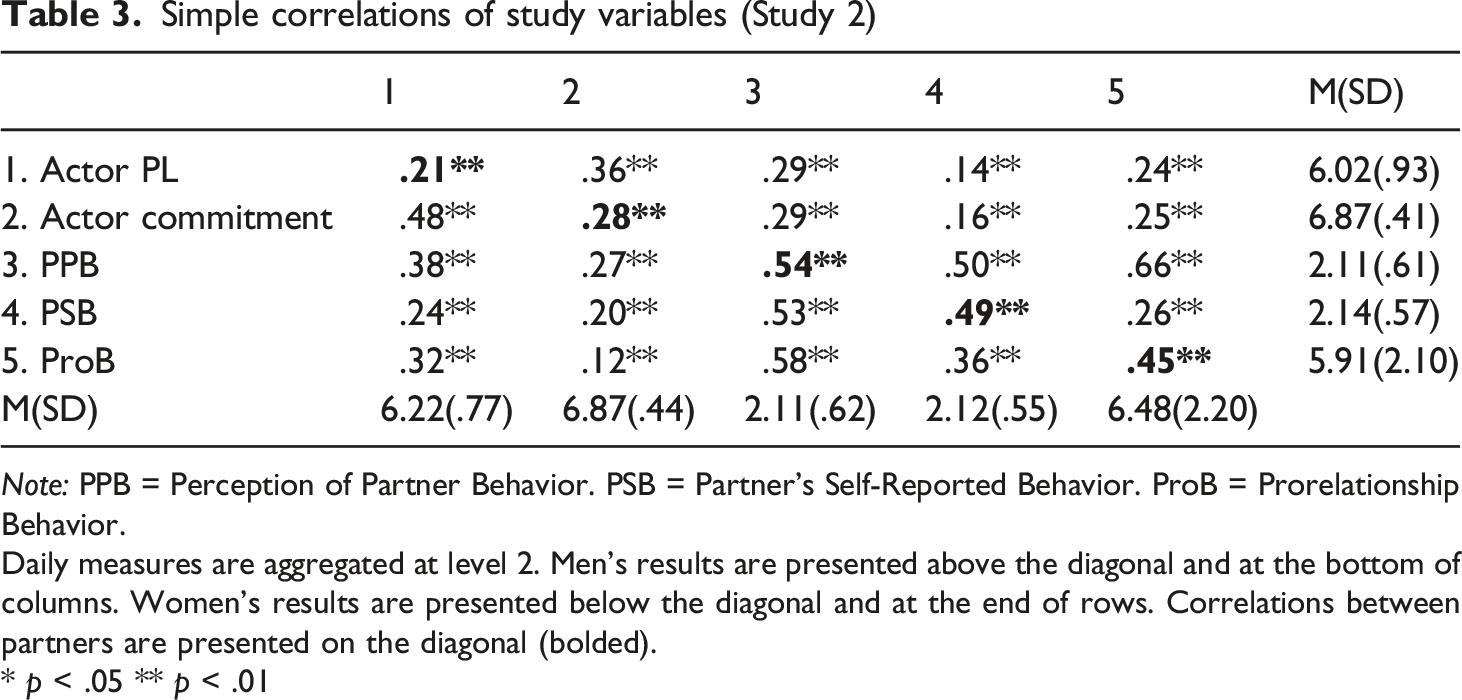
Note: PPB = Perception of Partner Behavior. PSB = Partner’s Self-Reported Behavior. ProB = Prorelationship Behavior.
Daily measures are aggregated at level 2. Men’s results are presented above the diagonal and at the bottom of columns. Women’s results are presented below the diagonal and at the end of rows. Correlations between partners are presented on the diagonal (bolded).
* p < .05 ** p < .01
Main analysis
Total and direct effects of passionate love and commitment at baseline on daily prorelationship behaviors through positivity bias: A multilevel mediation analysis (Study 2)
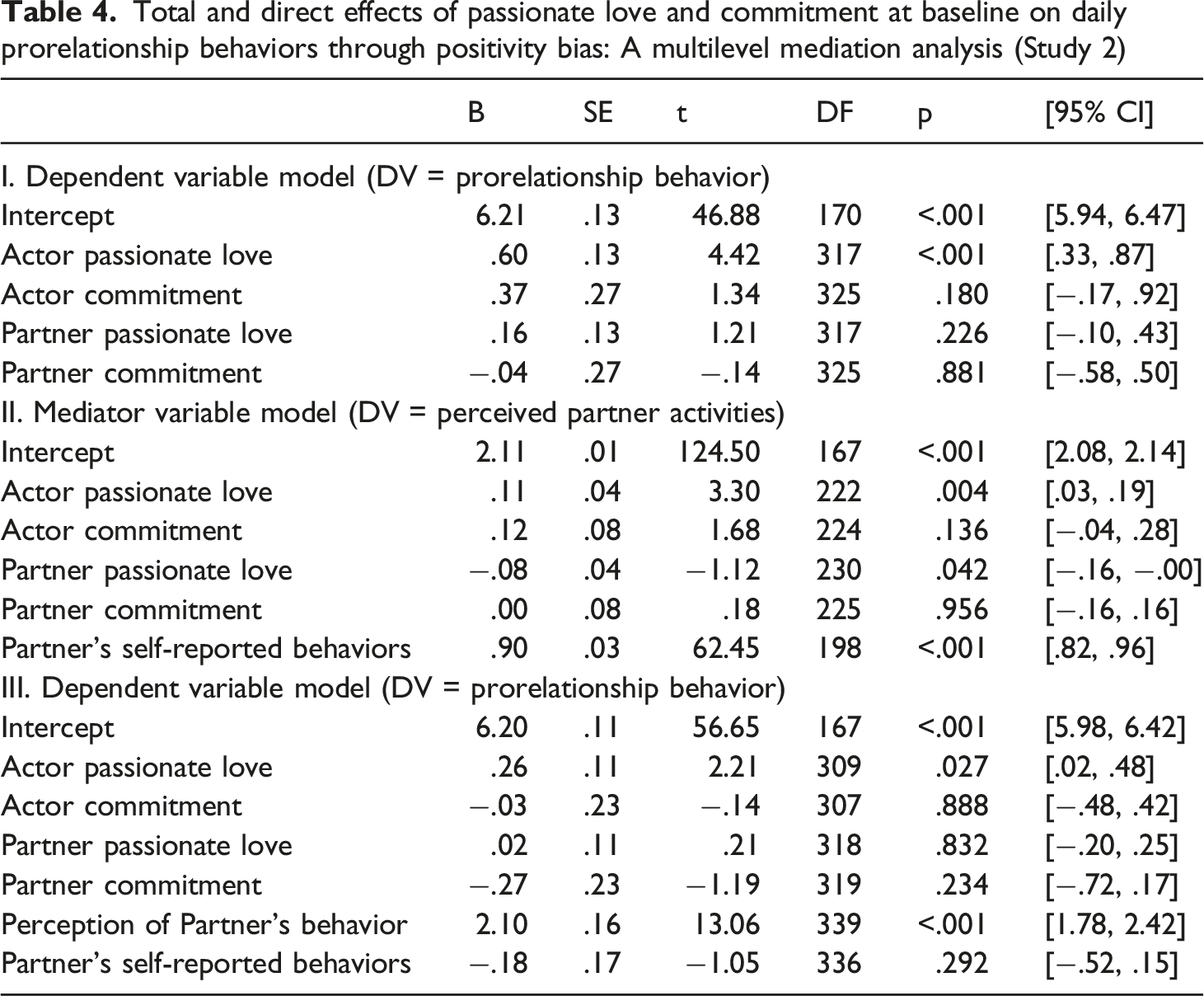
The middle section of Table 4 presents associations between PL and commitment and the perception of partners’ pleasure-related daily activities. To assess positivity bias of a partner’s behavior beyond their actual behavior, we controlled for partners’ reports of their behavior each day. The results indicated that actor PL predicted higher perception of a partner’s pleasure-related daily acts, and this effect was independent of the partner’s self-reported activities. Furthermore, similarly to Study 1, partners’ reports of their pleasure-related activities were positively associated with perceptions of their acts, suggesting some accuracy in partners’ perceptions.
The bottom section of Table 4 presents the association between the mediator and the outcome variable while controlling for the predictors (i.e., actor and partner effects of PL and commitment). We included the actual-acts control variable for partners’ positive daily acts. Perceptions of partners’ pleasure-related activities were positively linked to own prorelationship behavior, such that over-perceiving partners’ pleasure-related activity predicted higher frequency of daily prorelationship behavior in the relationship with this partner. Furthermore, after controlling for the perceptions of a partner’s acts, the effect of PL on daily prorelationship behavior remained significant yet reduced in its magnitude.
We followed the same Monte Carlo procedures described in Study 1 to test the indirect effect of actors’ PL on their prorelationship behavior through positivity bias. Results demonstrated that the 95% CI of the indirect effect for actor PL predicting prorelationship daily behavior through perceived partners’ pleasure-related activities did not include zero [.06, .40]. Fifty-six percent of the total effect of PL on daily prorelationship behavior was mediated by positivity bias (b = .23). This finding indicates that the association between feelings of PL and the tendency to demonstrate prorelationship behavior was mediated by positivity bias of partners’ efforts to express affection and initiate pleasurable activities. We also examined the indirect effect of perceived partners’ pleasure-related activities in mediating the association between actors’ commitment and own positive daily behavior. This effect was not significant; the 95% CI was [−.07, .58]. As in Study 1, these results replicated beyond relationship satisfaction, such that only PL was associated with prorelationship acts (b =.58, p < .001), and this association was mediated by positivity bias; 95% CI for the indirect effect was [.01, .35]. 4
Overall, results of Study 2 replicated Study 1’s findings in newlyweds, demonstrating that the motivational experience of PL is associated with prorelationship behavior through positivity bias of a partner’s pleasure-related gestures. Actor and partner effects of relationship commitment were not associated with daily prorelationship behavior beyond PL.
General discussion
Passionate love is a multifaceted experience, characterized by an intense desire to be physically and psychologically close to a beloved partner (e.g., Berscheid & Walster, 1978; Hatfield, 1988). The present research investigated its contribution to relationship maintenance behaviors in daily experiences of emerging interdependent couples, and demonstrated that dating partners and newlyweds who felt high PL were more likely to report providing daily benefits to their relationship partners. This association was explained by positivity biases about a partner’s qualities and behaviors, such that higher PL was associated with stronger positivity biases, which, in turn, predicted higher frequency of daily prorelationship acts. These results were found above and beyond the effects of relationship commitment, which did not predict daily prorelationship behavior when we controlled for PL.
Our findings add insight to previous work on the functional significance of PL in the maintenance of romantic relationships over time. Previous studies have demonstrated that PL is associated with prorelationship attitudes (e.g., Dainton et al., 1994; Gonzaga et al., 2001, 2008), suggesting that it promotes romantic relationships through the activation of reward systems that may motivate romantic lovers to sustain their relationship and jointly take care of their offspring (e.g., Acevedo & Aron, 2014; Fletcher et al., 2015; Gonzaga & Haselton, 2008). Our work elaborates this reasoning by demonstrating that motivated perceptions may serve as a reward mechanism that explains how the emotional experience of PL transforms into daily behaviors that support relationship maintenance in different relationship stages. Furthermore, controlling for commitment allowed us to examine the unique effect of PL on prorelationship acts, and our findings indicate that PL and relationship commitment promote relationship maintenance behaviors via different routes. Finally, our findings were replicated in two samples of dating couples and newlyweds, suggesting that this dynamic may operate in at least these two stages of romantic relationships, which differ in levels of commitment and interdependence.
Our findings point to distinct processes through which PL and commitment seem to enhance relationship maintenance. PL is a powerful emotional-motivational state, sometimes compared to addiction (e.g., Fisher, 1998; Fisher et al., 2010; Tennov, 1998). When this emotion is experienced, strong motives may drive partners to remain close to their love object, and being distant or feeling rejected may cause negative feelings and distress (e.g., Fisher et al., 2010). Our findings suggest that the emotional-motivational experience of PL encourages spontaneous everyday behaviors that fulfill implicit functions of maintenance in romantic relationships (e.g., Dainton & Stafford, 1993; Ogolsky & Bowers, 2013).
The desire to be close to a romantic partner promotes favorable perceptions of this partner’s qualities and good deeds—to color them with idealized views. Positivity biases may then help intimates to “view the glass as half full,” and pay less attention to potentially disappointing attributes or experiences. Keeping a positive perspective might encourage romantic partners to sacrifice for their relationship without experiencing a cognitive dissonance, and display their love in prorelationship acts. These findings fit well with studies that have demonstrated that affective states may be infused into interpersonal judgments and related behaviors (e.g., see review by Forgas, 2002).
In contrast to PL, relationship commitment is often defined in terms of cognitive-behavioral processes, such as weighing the benefits and costs of interdependence in terms of the decision to persist in relationships, and to prefer long-term goals over short-term hedonic gratifications (e.g., Arriaga & Agnew, 2001; Goodfriend & Agnew, 2008). Although commitment may also involve an affective component—for example, feelings of attachment—it relies more heavily on regulation of personal desires (Agnew et al., 1998; Rusbult et al., 1998). Moreover, relationship commitment typically does not involve euphoric feelings, which may be specifically important for the instigation of mood-congruent positivity biases (e.g., Forgas & Locke, 2005) and their transformation into spontaneous prorelationship acts. Alternatively, the motivational experience of PL is directed toward gratification of hedonic short-term goals, rather than efforts to self-regulate desired actions.
Our findings indicate that although commitment was associated with prorelationship behavior and positivity biases, it did not have a unique contribution beyond the effect of PL. Therefore, the rewarding experience of PL may be stronger in promoting daily behaviors of maintenance relative to how romantic intimates cognitively construe their future commitment. Relationship commitment may be more pertinent in explaining strategic maintenance behaviors (Dainton & Stafford, 1993), such as long-term goals and future intentions (Arriaga & Agnew, 2001; Goodfriend & Agnew, 2008); and support relationship maintenance beyond PL when intimates confront dilemmas between conflicting goals and desires (Rusbult et al., 2004).
Limitations and conclusion
The current findings should be interpreted in the context of several limitations. First, our samples included couples in relatively early stages of interdependence, which are typically characterized by high PL. PL typically declines during the first few years of marriage (e.g., Fisher, 2006) and future research is needed to examine associations between PL, motivated perceptions, and prorelationship behaviors in more established relationships. Second, although our theoretical model and findings suggest a sequential process initiated by PL, our correlational designs cannot rule out alternative causal pathways. 8 Longitudinal studies measuring PL and commitment over time may help clarify the direction of effects. Finally, our findings provide insight into the independent effects of PL and commitment, and suggest that these experiences uniquely foster relationship maintenance. However, more research is necessary to examine the conditions under which relationship commitment may independently promote prorelationship behavior beyond PL. Furthermore, future research may examine the interplay between PL and commitment in promoting short-term versus long-term behaviors, to jointly support relationship maintenance. Importantly, participants were not asked on their gender identity and whether they have a disability.
These limitations notwithstanding, our findings contribute novel insights about the operation of PL in relationship development. PL, associated with idealized perceptions, may encourage romantic intimates to express their love spontaneously in everyday prorelationship acts. These “small” gestures, when aggregated over time, may signify a partner’s emotional investment and responsiveness in an ongoing manner and thus indirectly support long-term relationship maintenance. Although PL is usually thought of as an early-stage emotion, in this way, it may help build a longer-lasting foundation for enduring relationships.
Footnotes
Acknowledgments
We would like to thank Rachel Venaglia for her assistance in data collection in Study 1. We would like to thank Marc McIntosh for his assistance in data collection in Study 2 and David de Jong, Stephanie O’Keefe, and Christine Walsh for their help in maintaining contact with participants in Study 2.
Authors’ note
This paper was presented at the International Association for Relationship Research Virtual Conference (August 2021).
Declaration of conflicting interests
The author(s) declared no potential conflicts of interest with respect to the research, authorship, and/or publication of this article.
Funding
The author(s) disclosed receipt of the following financial support for the research, authorship, and/or publication of this article: This study is supported by the Fetzer Institute.
Ethical approval
This research was conducted in accordance to APA ethical standards in the treatment of the samples and the data.
Open research statement
As part of IARR’s encouragement of open research practices, the authors have provided the following information: This research was not pre-registered. The data used in the research are available. The data can be obtained at  or by emailing: