




Abstract
Do cultural norms that allow individuals to choose their social relationships put them at risk for, or protect them from, loneliness? After all, more freedom to choose whom to relate to may promote that individuals can choose higher-quality relationships (which protects from loneliness), but it may also imply a higher risk of social isolation (which puts at risk for loneliness). We propose that the solution to this cultural loneliness paradox of choice is to distinguish whether more individual choice flows from cultural norms that provide more opportunities for new relationships (as implied by higher relational mobility; higher RMn), or from cultural norms that allow to leave established relationships (as implied by lower relational stability; lower RSn). Specifically, we suggest that more individual choice protects from loneliness when emerging from higher RMn (which allows to establish new higher-quality relationships), but puts at risk for loneliness when emerging from lower RSn (which increases the risk of social isolation by undermining the stability of established relationships). Findings from two cross-sectional survey studies in four European countries (Study 1: Finland, N = 237; Portugal, N = 261; Study 2: Poland, N = 242; Austria, N = 2 41) supported this line of thought: Higher RMn was consistently related to lower loneliness across all samples, and lower RSn was related to higher loneliness in two out of four samples (and either non-significantly related to higher loneliness or unrelated to it in the other two samples). We discuss the importance and implications of differentiating RMn and RSn to resolve the cultural loneliness paradox of choice.
Despite substantial gains in safety, wealth, and self-determination in many societies over the past decades, mental health and well-being do not seem to have improved accordingly (e.g., Bartolini & Sarracino, 2014). Importantly, research has linked such mental health problems to loneliness (Cacioppo et al., 2015)—the subjective experience of being socially isolated or separated from others (Hays & DiMatteo, 1987; VanderWeele et al., 2012). Indeed, many have argued that one of the main reasons for public health problems lies in cultural norms that undermine social relationships, such as norms that allow individuals to prioritize their own preferences over the maintenance of their relationships (e.g., Bartolini et al., 2013; Hortulanus et al., 2006). Through promoting social isolation, these norms are suggested to increase the risk for loneliness.
Against this backdrop, we focus on what we call the cultural loneliness paradox of choice—that cultural norms that encourage that individuals can freely choose their social relationships may increase the risk for and protect from loneliness at the same time. Specifically, more individual freedom to choose social relationships may protect individuals from loneliness because it allows them to select higher-quality relationships. However, it may also increase the risk for loneliness because it allows to leave relationships, thus undermining the stability of existing relationships and increasing the risk of social isolation.
In this article, we solve this paradox by conceptually and empirically differentiating between two sets of cultural norms: the norms implied by relational mobility and relational stability. We base our reasoning on the literature on relational mobility as socioecological notion, which describes the individual choice regarding social relationships that flows from opportunities to create new relationships in a social environment (Yuki & Schug, 2012). We suggest that norms implied by higher relational mobility (higher RMn for
The cultural loneliness paradox of choice
Loneliness describes perceived social isolation (VanderWeele et al., 2012) or the feeling of being cut-off or separated from others (Hays & DiMatteo, 1987). Loneliness is therefore a subjective experience, implying that objective indicators, such as a small social network, may increase the likelihood of experiencing loneliness but will not ultimately determine it. Accordingly, it has been suggested that individuals do not only feel lonely when embedded in networks that cannot meet universal human needs for social contact and emotional bonding, but also when networks cannot meet relationship ideals (Perlman & Peplau, 1981). Such ideals (and the social networks they shape) are importantly influenced by cultural norms about social relationships (i.e., part of the shared ideas that constitute culture according to an intersubjective view; Chiu et al., 2010). It is thus surprising how little we know yet about the role of cultural norms as protective or risk factors for loneliness.
For instance, cultural norms that allow individuals more freedom to choose their social relationships may have paradoxical effects on loneliness: On the one hand, more individual choice might allow individuals to select social relationships that suit their individual needs (and that would hence be of higher quality), which may protect from loneliness. At the same time, more choice may imply the existence of better alternatives (Schwartz, 2000), raising expectations of relationship quality. Similarly, more choice might suggest that it is in the hands of the individual to create fulfilling relationships, making individual “failure” in this area particularly painful. This could increase the risk for loneliness through a reduced stability and reliability of established social relationships (Erozkan, 2011; Rusbult, 1980), and/or through higher perceived discrepancies from ideal relationships (Perlman & Peplau, 1981).
We suggest that differentiating the cultural norms about relationship choice that are summarized in RMn and RSn 1 is key to resolving this cultural loneliness paradox of choice. Indeed, although both RMn and RSn have thus far implicitly been discussed as implications of the socioecological characteristic of relational mobility (Oishi et al., 2015), differentiating RSn and RMn conceptually and empirically offers a more nuanced understanding of which cultural norms about choice regarding social relationships increase the risk for, or protect from, loneliness.
RMn and RSn as potentially distinct cultural-psychological predictors of loneliness
We base this research on the literature on relational mobility, which is a socioecological variable that describes how many opportunities to establish new relationships and how much individual choice of whom to relate to there is in a social environment (Yuki & Schug, 2012). In cultures with higher relational mobility, such as in many Western or Latin-American communities (Thomson et al., 2018), forming new friendships, romantic relationships, or social groups (e.g., friendship circles, work teams) is more common than in cultures with lower relational mobility, such as in many East Asian, African, or Middle Eastern communities. We ground this line of thought in an intersubjective approach to culture (Chiu et al., 2010). That is, we focus on the cultural norms implied by relational mobility (RMn) rather than on other socioecological opportunities for, or restrictions to, individual choice regarding social relationships (e.g., community size or residential mobility). Specifically, we examine the cultural norms that individuals themselves perceive in their immediate social environments (i.e., among peers in their village or city) because such perceptions create the social realities that steer how individuals relate to others (Chiu et al., 2010; Perlman & Peplau, 1981), and that can, accordingly, influence whether they feel lonely. We thus examine cultural norms at the individual level.
Norms about whether it is common and valuable to establish new social relationships should entail differences in the amount of individual relationship choice (Kito et al., 2017; Yuki & Schug, 2012). Nevertheless, we suspect that such choice also depends on cultural norms about whether or not to hold on to established relationships (i.e., RSn). In cultures with higher RSn (e.g., presumably in more family-oriented or traditional collectivistic cultures; in politically more conservative communities; in more rural areas; in many Middle Eastern, South Asian, Southern or Eastern European cultures; Georgas et al., 2006), it is socially expected that cultural members maintain their family relationships or established friendships. Contrarily, in cultures with lower RSn (e.g., presumably in industrialized individualistic cultures; in politically more liberal communities; in more urban areas; in many Northern European or Northern American cultures), it is accepted to establish distance or abandon close relationships if they are not individually rewarding anymore (e.g., due to conflict or emotional distance). In cultures with higher RSn, individuals should hence have less freedom to leave certain relationships, and, accordingly, less individual choice of whom to relate to.
Lower RSn and the corresponding lower actual relationship stability have sometimes been viewed as implied by higher relational mobility (Kito et al., 2017; Oishi et al., 2015; Yuki & Schug, 2012; Yuki et al., 2007), with more options to establish new relationships (i.e., higher relational mobility) intertwined with less strict norms to hold on to established ones (i.e., lower RSn). However, we believe that distinguishing these cultural norms is useful because they are likely to have different implications for how individuals relate to others and thus for loneliness. 2 Higher RMn might protect from loneliness by offering opportunities to create more, and hence to compensate for existing low-quality, relationships: As illustrated in the upper part of Figure 1, higher RMn may, as such, imply larger social networks and higher-quality relationships. By contrast, lower RSn should create a higher risk of social isolation and may threaten individuals’ notion that relationships are stable and reliable (Erozkan, 2011; Weiss, 1973): As illustrated in the lower part of Figure 1, RSn may imply less long-lasting and persistent relationships, lower social network closure (i.e., that others in an individual’s social network also know each other), and less interaction with others. This is because more opportunities to leave established relationships (as entailed by lower RSn) might make individuals more likely to actually leave their relationships and might therefore undermine stable social networks. Notably, lower RSn might, however, also free individuals from lower-quality relationships. In sum, higher RMn should hence relate to relationship characteristics that usually relate to lower loneliness (Hawkley et al., 2008; Stokes, 1985; Stokes & Levin, 1986; Van Tilburg, 1990; von Soest et al., 2020), while lower RSn should mostly relate to relationship characteristics that usually relate to higher loneliness.
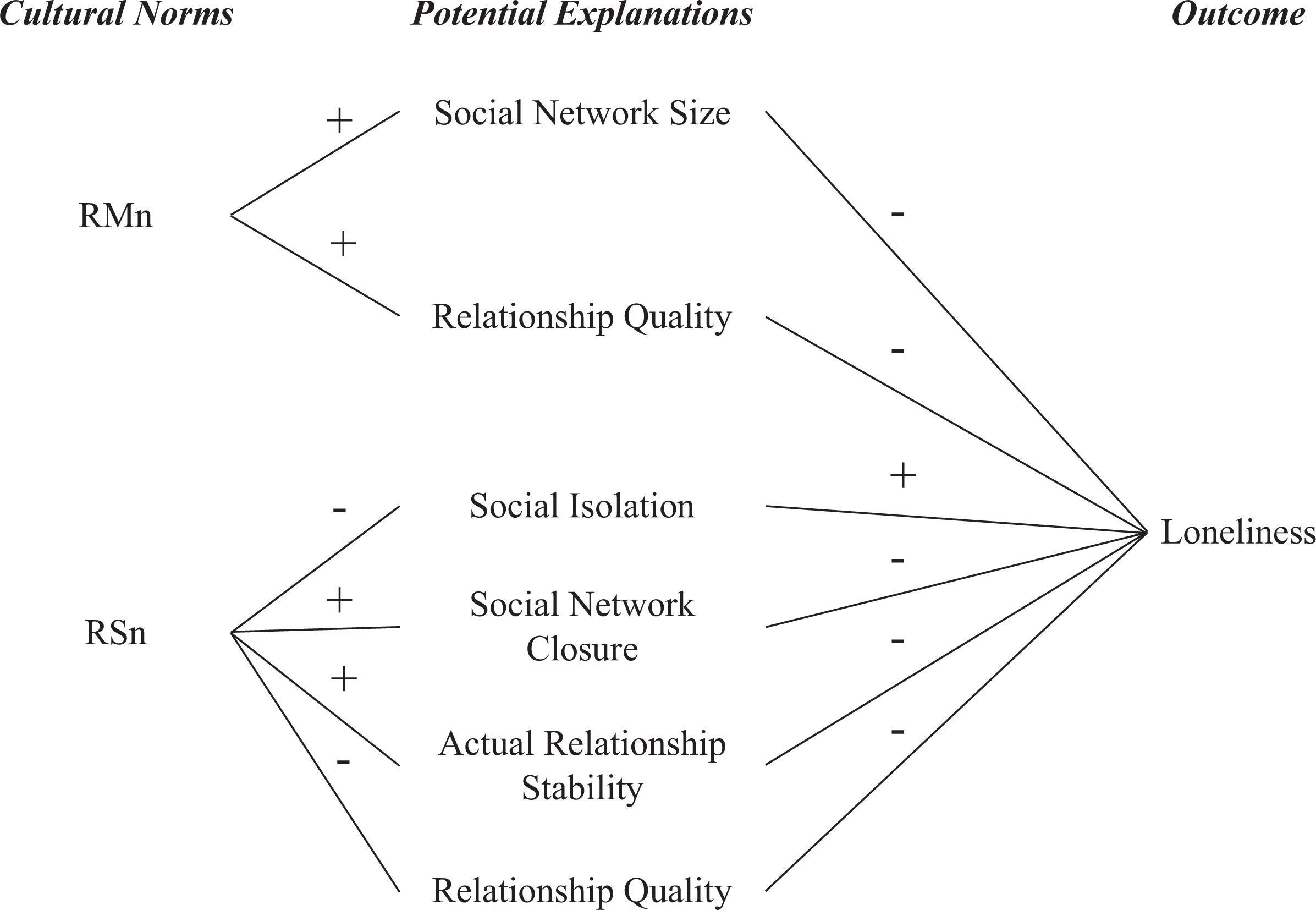
Conceptual model.
The current research
Cultural norms about individual choice regarding social relationships may protect individuals from loneliness, but also put them at risk. To solve this cultural loneliness paradox of choice, we differentiate and test the relationships between RMn/RSn and loneliness at the individual level (i.e., where individuals perceive social norms), and test whether differences in actual social relationship characteristics may explain these links. We conducted two survey studies in four European countries (Finland, Portugal, Austria, and Poland) to examine whether the individual-level associations we were interested in would replicate across different cultural contexts with different overall levels of RMn and RSn. This two-step approach helped us to learn from Study 1 (Finland, Portugal) to improve construct validity by a refinement of measures in Study 2 (Austria, Poland).
We sampled from a broad age range of 20 to 60 years because previous research has mostly focused on adolescents or the elderly who should be at an increased risk for loneliness (e.g., Yang & Victor, 2011). However, loneliness clearly is relevant to young and middle-aged adults as well (Heu et al., 2019), which requires more scientific attention (Luhmann & Hawkley, 2016). We selected countries based on an analysis of within- and between-country variation in proxies of RMn and RSn in the European Social Survey (Norwegian Centre for Research Data, 2014). We specifically looked for countries that would be comparable on characteristics such as their present level of democracy and industrialization (e.g., different European countries), yet differ in their overall levels of RMn and RSn (see supplemental materials S1). We hence conducted the survey in Finland (Study 1) and Austria (Study 2), where we assumed higher average RMn and lower average RSn, and Portugal (Study 1) and Poland (Study 2), where we assumed lower average RMn and higher average RSn. Note, however, that we tested our hypotheses within each cultural context and therefore at the individual level of analysis.
Study 1 and 2
Method
Design and sample
Our two survey studies were approved by the Ethical Committee of Psychology at the University of Groningen. Data for Study 1 was collected in February 2018 and data for Study 2 in April 2018. Sampling was carried out by the online sample provider Research Now with quota sampling for gender, age, and location of residence (i.e., participants residing in cities vs. in villages). Our final samples consisted of 237 Finnish and 261 Portuguese participants in Study 1, and 242 Polish and 241 Austrian participants in Study 2 (for sample characteristics; see Table 1 below and Table S1 in the supplemental materials).
Sample characteristics and means/standard deviations for most important measures.
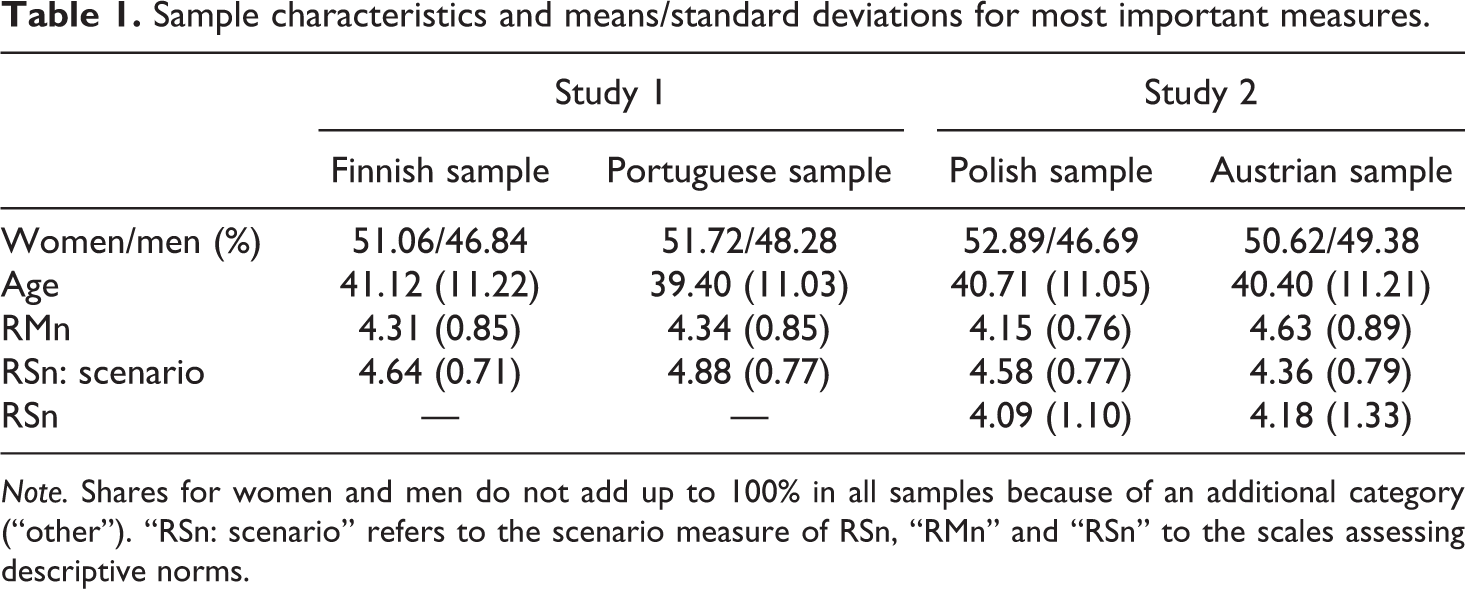
Note. Shares for women and men do not add up to 100% in all samples because of an additional category (“other”). “RSn: scenario” refers to the scenario measure of RSn, “RMn” and “RSn” to the scales assessing descriptive norms.
Before collecting data, we conducted a power analysis using the software package G*Power (Faul et al., 2009). In our main analysis, we conservatively planned to conduct regression analyses with at most three predictors of loneliness (to examine effects of RMn, RSn, and, for explorative reasons, their interaction) within each sample. To detect a small effect (f″ = .05) with a power of .80, we required a minimum of N = 222 per sample. Power in the achieved samples can thus be regarded as sufficient for the planned analyses.
Procedure
Participants were asked to complete an online survey framed as a study about social relationships and well-being. The survey included (1) demographic questions (to describe our samples; see Table 1 and Table S1 in the supplemental materials for specific variables), (2) scales to measure well-being and loneliness (as the core dependent variable), (3) an attention check (to assess the quality of the data), (4) measures of RMn and RSn (as core independent variables), and (5) social relationship characteristics (as potential explanatory variables).
The initial questionnaires were translated from English into Finnish, Portuguese, Polish, and German by professional translators, checked by bilingual psychologists, and pilot-tested in each country for cultural appropriateness. Questionnaires were displayed in the language that matched participants’ geo-location. Median completion times for included responses were 19.45 (Finnish sample) and 23.65 minutes (Portuguese sample) in Study 1 and 19.88 (Polish sample) and 20.15 minutes (Austrian sample) in Study 2. All participants were carefully debriefed and financially compensated by Research Now.
Materials
Because no previous research has differentiated RMn and RSn, we included different indicators of these norms and sampled in two steps to adjust measures after Study 1. This is why Study 1 and 2 slightly differ in terms of the specific scales for RMn and RSn. Specifically, Study 1 included the only existing scale to measure relational mobility (Thomson et al., 2018; Yuki et al., 2007), the items of which assess descriptive norms (and which may hence be viewed as a measure of RMn). In addition, we developed scenario measures of RMn and RSn, because we believed that lay people would have less difficulty reporting cultural norms when evaluating concrete situations than when rating abstract statements (which risk to be filled with different, culture-specific examples and meanings; König et al., 2007; Peng et al., 1997). Exploratory factor analyses, however, suggested that these scenario measures assessed multiple, rather than one single, construct. Therefore, for Study 2, we decided to develop an additional RSn measure on the basis of (and thus to parallel to) Yuki et al.’s scale to assess relational mobility. This approach helped us avoid reliance on single indicators when measuring the novel construct of RSn, and thus enabled a more robust and nuanced comparison of findings. We also excluded the scenario scale for RMn between Study 1 and Study 2 because of strong multidimensionality and space restrictions. This measure hence only contributes to our assessment of discriminant validity (as it was more directly comparable to the scenario scale of RSn in Study 1; see supplemental materials S3).
Across the board, the measures of RSn and RMn had very good reliabilities (all αs ≥ .76; see Table S2 in the supplemental materials). However, exploratory factor analyses suggested that the RMn scale (Thomson et al., 2018; Yuki et al., 2007) and the scenario measure for RSn may summarize more than a single construct (see Tables S3 and S4 in the supplemental materials). Based on results of confirmatory factor analyses, we thus created unidimensional subscales and compared correlations with loneliness for theory- and data-driven subscales (see Table S8 in the supplemental materials). Results converged, and, across the board, suggested the same conclusions as results for full scales (only in the Austrian sample, results for subscales of the same overall measure were quite different from each other, yet results for theory- and data-driven subscales converged). Given that this approach required the exclusion of a considerable number of items without a clear theoretical reason, we decided that it was most parsimonious to only report results for the full, theory-driven, scales.
Since both the RMn and RSn measures revolve around individual choice regarding relationships, we also assessed discriminant validity. For instance, some items about relationship choice in the scale to measure relational mobility (in the subscale freedom of choice in interpersonal relationships; Thomson et al., 2018; Yuki et al., 2007) may also measure RSn. However, as the reason for such choice is unspecified in these items while they are presented together with the subscale opportunities to meet new people, we suspected that they would usually be interpreted as the choice to leave or stay in relationships given opportunities for new social relationships (i.e., RMn). Results provided first support for this (for details, see supplemental materials S3): For example, in exploratory factor analyses, items for RSn loaded on a different factor than items for RMn, suggesting that they capture distinct constructs. Furthermore, although RMn and RSn scales should be strongly negatively correlated if they tapped into one underlying construct (because higher RMn should then imply lower RSn), correlations were weakly negative for the RSn as descriptive norms scale, and even positive for the scenario scale (see Table S6 in the supplemental materials). We also repeated our main analysis with opportunities to meet new people only, which does not contain items about individual choice regarding relationships and which was indeed uncorrelated to the RSn scale. As results converged, we believe that the full RMn scale can be validly used. Together, this is in line with the idea that RMn and RSn summarize distinct cultural norms about relationship choice.
RMn
We used Yuki et al.’s (2007) 12-item scale to measure RMn. This is the standard scale (Thomson et al., 2018) to measure the socioecological variable of relational mobility (i.e., an objective reality that can, thus far, only be assessed through a subjective measure). As it consists of descriptive norms about others’ opportunities to form new and choose relationships, it can also be interpreted as a measure of RMn. Items include “They have many chances to get to know other people.” or “They can choose who they interact with.” with answer categories ranging from 1 (totally disagree) to 7 (totally agree). Furthermore, it comprises two subscales, opportunities to meet new people (5 items) and freedom of choice in interpersonal relationships (7 items), which are usually pooled. As recommended in Yuki et al. (2007), we specified a reference group, asking about others of the participant’s age in his/her village or city (in line with Heu et al., 2019), which should describe the broader cultural context an individual comes from, but should still be specific enough to be meaningful to participants. We also slightly simplified some of the items (see Table S3b of the supplemental materials).
RSn
In line with the relational mobility scale (Thomson et al., 2018; Yuki et al., 2007), we developed a measure of RSn as descriptive norms. It consists of 3 items measuring descriptive norms about others in the village or city and age group of the participant (“It is common for them to hold on to their social relationships, even if these relationships are difficult.”, “Even if they feel distant from certain important people in their lives, they usually keep contact with them.”, and “If there is a severe conflict in a social relationship, they usually still keep this relationship.”) on a scale from 1 (totally disagree) to 7 (totally agree). Note that this scale was only developed in Study 2 to complement the scenario measure that we used to assess RSn in Study 1. This approach allowed us to examine consistencies and differences in results across different measures with their different strengths and shortcomings.
Indeed, at first, we chose to measure RSn with a scenario measure, because scenarios aim to capture how abstract psychological concepts are manifested in concrete situations, and this seemed like a more proximal predictor of loneliness than a rating scale with more general statements (in line with König et al., 2007). Additionally, since scenarios tend to be more concrete and closer to individuals’ daily experiences, they prevent that individuals fill in abstract statements with different, culturally specific, meaning and examples (implying higher criterion validity; Kitayama, 2002; König et al., 2007; Peng et al., 1997).
This measure included four scenarios describing situations in which individuals who fictively lived in participants’ city or village encountered a relational crisis or alienation in family relationships or friendships (two scenarios each). Participants were asked to indicate how much they agreed with five statements about how the described individuals should (injunctive norms) or would act in each scenario, as well as what likely outcomes were (descriptive norms). For instance, participants would read the following scenario: “[Name] does not feel close to his family. At family gatherings, he feels different from everyone else and has difficulty finding topics to talk about. He would wish for more support and affection in the family.” and would then rate statements such as “Although [Name] is not satisfied with the relationships in his family, he should foster these relationships.” or “Most people in [Name]’s situation would withdraw from their family.” on a scale from 1 = totally disagree to 7 = totally agree. For each translation, most popular names in the respective country and birth cohort were inserted (for all scenarios and items, see Table S3c in the supplemental materials).
Despite their advantages, scenario measures tend to have lower internal consistency than more general rating scales (König et al., 2007; Peng et al., 1997). Accordingly, exploratory factor analyses revealed that this scenario scale comprised five factors in all samples, indicating that it needs to be interpreted with some caution. By contrast, the RSn as descriptive norms scale loaded on a single factor in both samples of Study 2. In Study 2, we were hence able to observe that results for a unidimensional measure converged with those for a measure that allows less room for culturally different interpretations and is closer to participants’ daily experiences (implying higher construct validity; König et al., 2007). As each indicator balances out some of the other indicator’s shortcomings, their combination should strengthen the validity of our measurement of RSn, while their convergence suggests that we may validly interpret findings for each scale.
Loneliness
Loneliness was assessed using a short version of the UCLA loneliness scale, the ULS-6 scale (Neto, 2014), with items such as “People are around me but not with me” or “I feel isolated from others,” and ranging from 1 (never) to 4 (often). We added the item “There is no one I can turn to” from the ULS-8 scale (Hays & DiMatteo, 1987), because it captures the lack of supportive relationships in times of need, which is, in our view, a central aspect of loneliness (in line with Heu et al., 2019). As we conceive of loneliness as a subjective experience, we also added two items that directly assess loneliness (“How lonely do you feel in general?” and “How lonely did you feel during the last two weeks?”) on a scale ranging from 1 (not at all) to 4 (very much). One item from the initial ULS-6 scale (“I feel part of a group of friends”) was omitted from the scale as it loaded only weakly on the factor that emerged in exploratory factor analyses to assess construct validity (leading to a two-factor solution in the Finnish sample), and as it decreased reliabilities in all samples (in line with Heu et al., 2019). The final loneliness scale thus consisted of 8 items (α ≥ .87 in all countries, see Table S2 in the supplemental materials).
Potential explanations
We wanted to examine whether a larger social network and higher relationship quality would explain the expected relationship between higher RMn and lower loneliness, and whether a higher risk for social isolation (implying less interaction with others, lower actual relationship stability, and lower social network closure) would explain the expected relationship between lower RSn and higher loneliness (see Figure 1).
To assess social network size, we summed up the number of participants’ friends, the number of family members they were in contact with at least once a year, and also included whether they had a romantic partner. Relationship quality was, for one, measured through participants’ closeness to their best friend, to their closest family member, and, if applicable, to their partner (e.g., “How close do you feel to your best friend?” on an Inclusion of Other in the Self scale with seven pictorial anchors). Furthermore, we asked for participants’ satisfaction with their relationships in general, with their family relationships, and friendships (e.g., “I am satisfied with the social relationships I have.”) and, on the flip side of the coin, their wish for better relationships in each of these categories (e.g., “I wish I had better family relationships.”)—both on a scale from 1 (totally disagree) to 7 (totally agree).
Risk of social isolation included, for one, less interaction with others, measured through the frequency of contact with participants’ best friend, family member, and (if applicable) partner (e.g., “Over the course of two weeks, on how many days are you usually in contact [see, hear from or exchange messages] with your closest family member?” answered by moving a slider on a scale from 0 to 14), and the number of evenings spent alone in the preceding week (answered by moving a slider on a scale from 0 to 7). Furthermore, for relationship stability, we asked participants to indicate the length of their best friendship and partnership in years. We assessed social network closure (i.e., whether others in an individual’s social network know each other) by two items (“Are your friends also friends with each other?” and “Did the people who you interacted with in the last two days know each other?”) on a scale from 1 (none) to 7 (all of them) and a measure with seven pictorial anchors.
Study 1 and 2
Results
Preliminary analyses such as missing data analysis, assumption checks, balance tests, measurement invariance testing, and exclusion of cases are documented in the supplemental materials (S2). Most scales seemed to lack measurement invariance. As the degree of measurement invariance determines which statistical computations can validly be made across different groups, we refrain from directly comparing means across samples and compare results cautiously and in terms of broad patterns only (see also Heu et al., 2019; Vignoles, 2018). This is, however, not problematic because our hypotheses concern the individual level of analysis (i.e., within-culture). Notably, the unidimensional subscales we derived to assess consequences of multidimensionality in RMn and the RSn scenario scale also seemed measurement invariant up to, at least, metric invariance (allowing to compare correlations across cultural samples). As illustrated by Table S8 (supplemental materials), results for these subscales, however, widely converged with those for theory-driven scales.
Descriptive analysis
Means and standard deviations for key measures can be found in Table 1 (for all descriptive statistics, see Table S5 in the supplemental materials).
The loneliness scale did not reach a sufficient level of measurement invariance to allow for a direct comparison of means across samples. Still, we observed that means tended to be highest in the Finnish, M = 2.30, SD = 0.65, and lowest in the Austrian sample, M = 1.91, SD = 0.72, and somewhat higher in the Portuguese, M = 2.11, SD = 0.69, than in the Polish sample, M = 2.04, SD = 0.70. This was in line with self-report measures: Less than 30% of the Finnish and Portuguese participants explicitly indicated not to feel lonely at all (29.54% and 27.97%, respectively) compared to more than 40% of the Polish and Austrian participants (40.50% and 40.08%). Contrarily, similar shares of participants indicated to feel very lonely (ranging between 5.37% in the Polish and 8.05% in the Portuguese sample).
Hypothesis testing
To examine whether and how RMn and RSn would be associated with loneliness, we examined correlations and conducted multiple regression analyses with loneliness as dependent variable (within each sample). Since we wanted to test our assumption that RMn and RSn are distinct cultural variables that uniquely explain variation in loneliness, we report regressions where we included both RMn and RSn as predictors (see Table 2). Finally, as the loneliness scale was positively skewed in some samples (with responses concentrated at the lower end of the scale), we computed both general and generalized linear models (with gamma distribution of errors and log-link) for the main hypotheses. As results converged, we only present solutions for general linear models.
Multiple regressions with both RMn and RSn as predictors and loneliness as dependent variable.
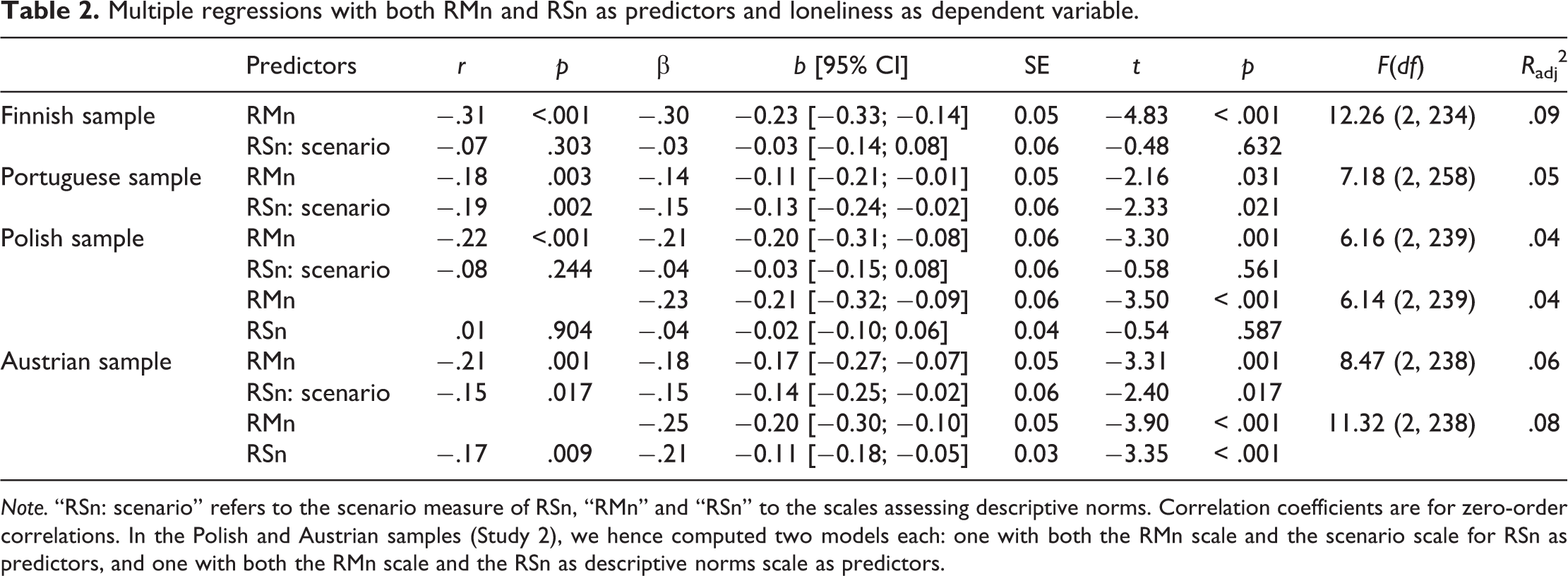
Note. “RSn: scenario” refers to the scenario measure of RSn, “RMn” and “RSn” to the scales assessing descriptive norms. Correlation coefficients are for zero-order correlations. In the Polish and Austrian samples (Study 2), we hence computed two models each: one with both the RMn scale and the scenario scale for RSn as predictors, and one with both the RMn scale and the RSn as descriptive norms scale as predictors.
Higher RMn was significantly related to lower loneliness in all four samples (with small to medium effect sizes; see Table 2). This is in line with the idea that higher RMn can protect from loneliness. Across all samples, we observed that lower RSn (scenario measure) was associated with higher loneliness. However, these negative correlations were significant only in the Portuguese and Austrian samples (with small effects). In line with that, RSn as descriptive norms (Study 2) was significantly negatively related to loneliness in the Austrian sample, but unrelated to it in the Polish sample. Findings for RSn were thus less consistent than findings for RMn, but are in line with the idea that lower RSn can increase the risk for loneliness. Although both allow for more individual choice regarding social relationships, cultural norms about opportunities to create new social relationships may hence protect from loneliness, whereas cultural norms promoting less stability in social relationships may (although less consistently so) increase the risk for loneliness.
Potential explanations
To investigate why RMn and RSn relate to loneliness, we examined correlations of RMn and RSn with relevant relationship characteristics (see Table 3; for partial correlations, see Table S10 in the supplemental materials). Across the board, higher RMn was related to relationship characteristics that were associated with lower loneliness (i.e., potential protective factors), whereas lower RSn was rather related to relationship characteristics that were associated with higher loneliness (i.e., potential risk factors).
Associations of RMn and RSn with social relationship characteristics.
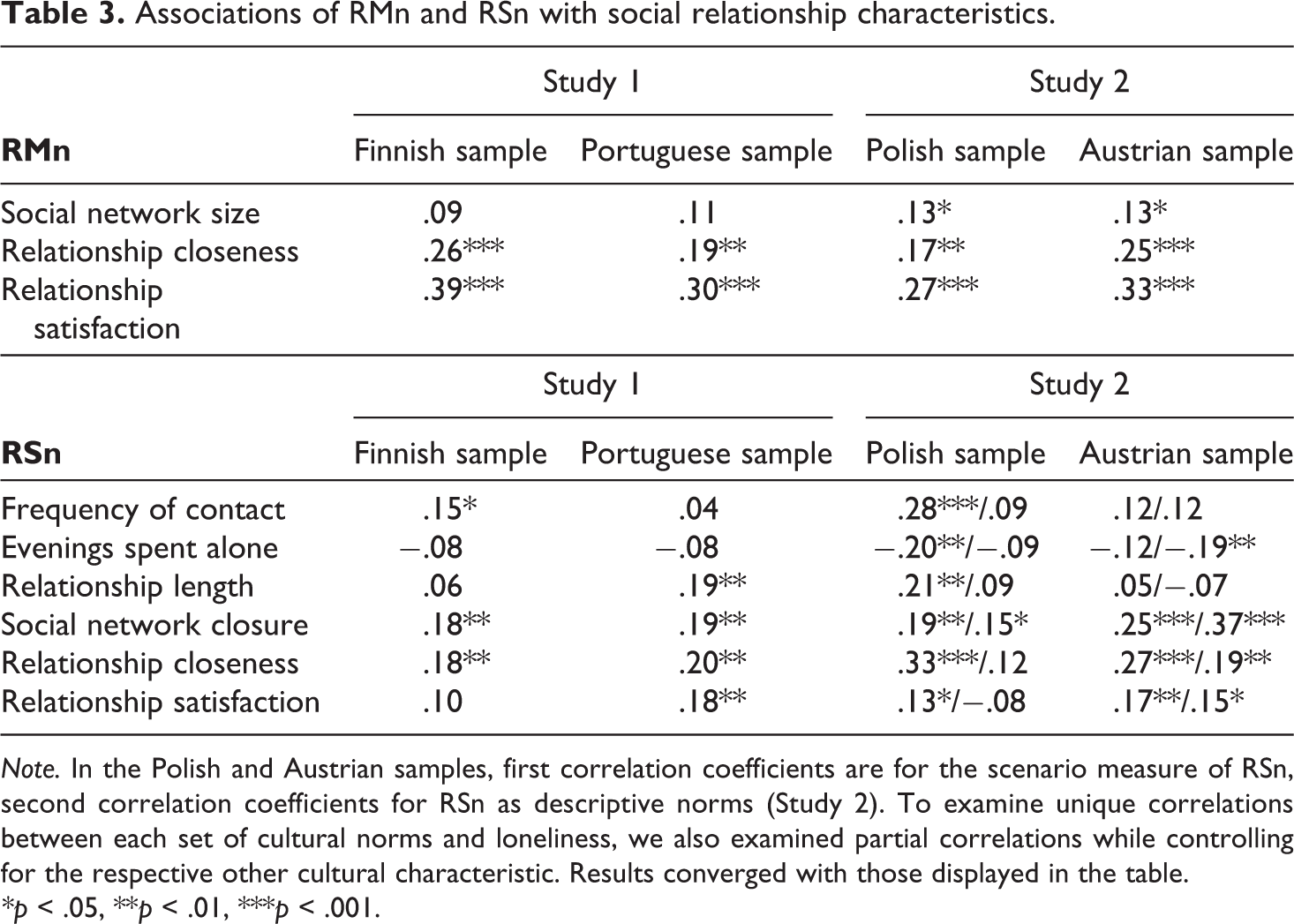
Note. In the Polish and Austrian samples, first correlation coefficients are for the scenario measure of RSn, second correlation coefficients for RSn as descriptive norms (Study 2). To examine unique correlations between each set of cultural norms and loneliness, we also examined partial correlations while controlling for the respective other cultural characteristic. Results converged with those displayed in the table.
*p < .05, **p < .01, ***p < .001.
We then examined their potential mediating role in mediation analyses (with different mediators in the same model as illustrated in Figure 1, and confidence intervals [CI] that were based on 5000 bootstrap samples) using the PROCESS macro (Hayes, 2018). Statistically, relationship satisfaction and closeness fully mediated the relationships between RMn and loneliness, with indirect effects for closeness in the Finnish sample: ab = −.06, 95% CI [−.10; −.02]; Portuguese sample: ab = −.03, 95% CI [−.06; −.00]; Polish sample: ab = −.03, 95% CI [−.06; −.00]; Austrian sample: ab = −.04, 95% CI [−.09; −.01]; indirect effects for relationship quality, Finnish sample: ab = −.12, 95% CI [−.16; −.07]; Portuguese sample: ab = −.10, 95% CI [−.16; −.05]; Polish sample: ab = −.09, 95% CI [−.16; −.03]; Austrian sample: ab = −.12, 95% CI [−.18; −.07]. Contrarily, social network size did, in most samples, not seem to mediate between RMn and loneliness, Finnish sample: ab = −.00, 95% CI [−.01; .00]; Portuguese sample: ab = −.01, 95% CI [−.03; .00]; Polish sample: ab = −.02, 95% CI [−.06; −.00]; Austrian sample: ab = −.01, 95% CI [−.03; −.00]. Thus, higher perceived relationship quality seemed like the better explanation for how RMn relates to loneliness.
Furthermore, the mediators we suggested for the association between lower RSn and higher loneliness (which was significant in the Portuguese and Austrian samples only), were, across the board, not supported by mediation analyses (except for the number of evenings spent alone, which seemed to mediate between RSn as descriptive norms and loneliness in the Austrian sample, ab = −.03, 95% CI [−.05; −.01]). Interestingly, closeness (in the Portuguese sample) and relationship satisfaction (in both the Portuguese and Austrian samples) also seemed to be significant mediators between the scenario measure of RSn and loneliness, fully mediating the relationship; indirect effect for closeness: e.g. Portuguese sample ab = −.03, 95% CI [−.07; −.01]; indirect effect for relationship satisfaction: Portuguese sample: ab = −.06, 95% CI [−.11; −.02], Austrian sample: −.07, 95% CI [−.13; −.01]. This suggests that, similar to lower RMn, lower RSn might increase the risk for loneliness due to lower (instead of the expected higher) perceived relationship quality.
Discussion
Two studies tested whether and why cultural norms summarized in RMn (e.g., that it is common and/or valued to establish new relationships) and RSn (e.g., that it is common and/or valued to foster and maintain family relationships or established friendships) relate to loneliness. As hypothesized, in samples from a broad age range in four European countries, we found that higher RMn was consistently related to lower loneliness, while lower RSn was related to higher loneliness in some samples (in the Austrian and Portuguese samples; and not significantly related to it in the Finnish and Polish samples). This is intriguing because higher RMn and lower RSn should both offer individuals more freedom to choose their social relationships. Our findings hence indicate the usefulness of distinguishing RMn and RSn when aiming to resolve the cultural loneliness paradox of choice.
We further found that higher RMn was positively, and lower RSn negatively associated with relationship characteristics that were related to lower loneliness (and that may thus protect from loneliness; in line with, e.g. Hawkley et al., 2008; Perlman & Peplau, 1981; Stokes, 1985; Van Tilburg, 1990; von Soest et al., 2020). This supports the notion that higher RMn could protect from, and lower RSn increase the risk for loneliness. More specifically, our finding that higher relationship quality explained associations between higher RMn and lower loneliness supports the idea that higher RMn may allow individuals to choose relationships that are individually more fulfilling. Interestingly, relationship quality also seemed to explain why lower RSn was related to higher loneliness (rather than the predicted higher risk of social isolation). Individuals perceived their relationships more negatively if they described their cultural surroundings as unsupportive of maintaining relationships (i.e., as lower in RSn). Despite more individual freedom to choose whether or not to remain in relationships, lower RSn hence did not seem to free individuals from low-quality relationships to the extent that this would improve their overall relationship quality. We suspect that the notion of less reliability of relationships implied by lower RSn might be perceived as discomforting and might, as such, negatively influence evaluations of relationship quality. Although this is not more than speculation yet, it might be a starting point for further investigations of how RSn relates to loneliness.
Taken together, both studies indicate that more individual choice regarding social relationships might protect from loneliness when emerging from cultural norms that provide more opportunities for new social relationships (i.e., higher RMn), but might not protect from or even increase the risk for loneliness when emerging from cultural norms that threaten established social relationships (i.e., lower RSn; in line with Mikulincer & Shaver, 2007; Weiss, 1973). These findings help resolve the cultural loneliness paradox of choice by suggesting that it is the specific underlying cultural norms that determine how individual choice regarding relationships influences loneliness.
Implications, limitations and future directions
Theoretically, our findings confirm the usefulness of zooming in onto specific cultural norms about choice regarding social relationships when predicting loneliness. Indeed, this can also promote a more nuanced understanding of how broader aspects of culture, such as individualism-collectivism, affect loneliness (Bartolini et al., 2013; Hortulanus et al., 2006): Since higher individualism allows individuals more freedom to choose (Swader, 2019), it is related to higher RMn (Thomson et al., 2018) and lower RSn. Past work found that descriptive norms implied by higher individualism were associated with higher loneliness (Heu et al., 2019), 3 which our findings for RSn were widely in line with (i.e., that lower RSn was, at least in half of our samples, related to higher loneliness). However, the finding that higher RMn was related to lower loneliness contradicts, and hence refines, this past finding regarding the broader notion of individualism-collectivism.
More practically, this research offers two starting points for interventions against loneliness in the four European countries we studied: (1) cultural norms that allow individuals to form new relationships (i.e., higher RMn) and (2) cultural norms that encourage individuals to hold on to existing relationships (i.e., higher RSn). As cultural norms should not only influence how individuals think, act, and organize their physical surroundings (Chiu et al., 2010), but physical surroundings, collective behavior, and shared ideas should also shape cultural norms (e.g., Yuki & Schug, 2012), higher RMn and RSn may be fostered by changes to built environments and public displays of behavior. Specifically, RMn might be increased by infrastructure that enables social interaction with unknown others (e.g., community cafés or public libraries), while RSn might be increased by stories in which individuals hold on to relationships despite relational problems (e.g., in advertisements, children’s books, or movies). However, more research is needed to derive concrete suggestions for practical applications.
Indeed, one limitation of our studies is that their correlational design does not allow for inferences about causal direction—that is, whether RMn and RSn impact on loneliness, whether loneliness impacts on the perception of RMn and RSn, or whether their association is due to a third variable (e.g., a tendency to respond in a socially desirable way). Theoretically, however, we concur with the notion that cultural norms about social relationships (such as those implied by RMn and RSn) influence the way that social relationships are enacted (e.g., Chiu et al., 2010), and that both (i.e., norms and ways of relating to each other) can influence loneliness (e.g., Johnson & Mullins, 1987; Perlman & Peplau, 1981; von Soest et al., 2020). Nevertheless, future studies may seek to replicate our findings with an experimental or longitudinal design.
We also encountered some statistical challenges in these studies. For one, most measures of culture seemed to be multidimensional, indicating that results for these scales need to be interpreted with some caution. Nevertheless, this does not seem to invalidate our findings: Associations between different unidimensional subscales to assess RMn or RSn and loneliness widely converged with those for the full, theory-driven scale (or their theory-driven subscales). At least with an eye to loneliness, these different facets hence do not seem to have strongly divergent meanings. Furthermore, results for the multidimensional scenario measure of RSn converged with those for the unidimensional RSn as descriptive norms scale, supporting that we can validly interpret findings regarding RSn from both our studies. Nevertheless, findings for these multidimensional scales should be backed up by future research with different operationalizations of RMn and RSn.
Second, most scales lacked measurement invariance, which is indicative of a larger and common issue in cross-cultural psychology (Chen, 2008). Indeed, standards for measurement invariance might be unrealistically demanding for a field like cross-cultural psychology (Vignoles, 2018; Welzel & Inglehart, 2016). Nevertheless, our hypotheses were about the individual level of analysis and were thus tested within each cultural sample. Future research should explore the comparability of the notions of RMn and RSn across cultures further, either through qualitative methods or by developing instruments that allow to validly compare statistical results at the cultural level of analysis (Hansen & Heu, 2020).
Conclusion
Through differentiating RMn and RSn as two distinct sets of cultural norms that influence the extent to which individuals can choose their social relationships themselves, this research offers an explanation for the cultural loneliness paradox of choice: In four European countries, more individual choice regarding social relationships seemed to potentially protect from loneliness when resulting from cultural norms that offer more opportunities to create new social relationships (i.e., higher RMn), but to rather increase the risk for loneliness when resulting from norms that threaten established relationships (i.e., lower RSn). This distinction may therefore not only explain why more freedom to choose social relationships can both increase the risk for and protect from loneliness, but can also offer novel starting points for culturally sensitive interventions to decrease loneliness.
Supplemental material
Supplemental Material, sj-doc-1-spr-10.1177_02654075211002663 - Resolving the cultural loneliness paradox of choice: The role of cultural norms about individual choice regarding relationships in explaining loneliness in four European countries
Supplemental Material, sj-doc-1-spr-10.1177_02654075211002663 for Resolving the cultural loneliness paradox of choice: The role of cultural norms about individual choice regarding relationships in explaining loneliness in four European countries by Luzia Cassis Heu, Nina Hansen and Martijn van Zomeren in Journal of Social and Personal Relationships
Footnotes
Authors’ note
Part of this research was presented at the International Association for Relationship Research (IARR) mini-conference on Applied Relationship Science, Brighton, UK, 18–21 July 2019, and at the ASPO Annual Meeting 2018, Nijmegen, the Netherlands, 13–14 December 2018. Luzia Cassis Heu is now at the Department of Interdisciplinary Social Science, Utrecht University, The Netherlands.
Funding
The author(s) disclosed receipt of the following financial support for the research, authorship, and/or publication of this article: Data collection for this research was funded by the University of Groningen Online Research Fund.

Open research statement
As part of IARR’s encouragement of open research practices, the authors have provided the following information: This research was not pre-registered. The data used in the research are available. The data can be obtained by emailing the corresponding author:
Supplemental material
Supplemental material for this article is available online.
Notes
References
Supplementary Material
Please find the following supplemental material available below.
For Open Access articles published under a Creative Commons License, all supplemental material carries the same license as the article it is associated with.
For non-Open Access articles published, all supplemental material carries a non-exclusive license, and permission requests for re-use of supplemental material or any part of supplemental material shall be sent directly to the copyright owner as specified in the copyright notice associated with the article.
