




Abstract
Knowledge recombination (KR) and technology innovation quality (TIQ) has received much attention. However, the mechanisms by which KR affects TIQ still lack further exploration. This study aims to explore the mediating role of relation dynamics (RDS) between KR and TIQ, and whether knowledge network decomposability (KND) moderates these relationships. Based on a panel data from 437 Chinese listed high-tech firms during 2000–2017, the hypotheses are tested using negative binomial regression in STATA 16.0. The results show that, first, knowledge recombination creation (KRC) not only directly improves TIQ, but also indirectly improves TIQ by promoting relation expansion (RE). Second, the relationship between knowledge recombination reuse (KRR) and TIQ is inverted U-shaped, which is partially mediated by relation stability (RS). Third, KND strengthens the influence of KRC or KRR on TIQ and the inverted U-shaped relationship between KRR and RS. This study enriches the research on the relationship between KR and TIQ, and provides theoretical support for technology management decisions in high-tech firms.
Introduction
Under the stimulus of innovation policies and fierce market competition, the technological innovation level of Chinese high-tech firms has improved significantly. According to the latest Global Innovation Index report, China’s innovation index ranked 11th. However, the status quo of “high quantity, low quality” and “big but not strong” in high-tech industry has not been thoroughly improved. Meanwhile, China is facing a new round of structural reform and transformation. Accelerating the switching of innovation focus from quantity to quality is not only a need for high-tech firms that depend on innovation for survival to seize the major opportunities in the new technological changes, but also the key to achieving high-quality economic development and constructing a new development pattern of China.
TIQ is the value that innovation initiates, safeguards and sustains for its originators and recipients (Luo et al., 2024), reflecting the influence of innovation outputs (Haner, 2002). As knowledge-intensive economic entities, high-tech firms’ improvement of TIQ is closely related with how they leverage knowledge resources. According to Schumpeter’s (1939, p. 88) observation that “innovation combines components in a new way, or that it consists in carrying out new combinations,” scholars widely acknowledge that recombining intra-firm and industry knowledge elements that make up innovation is a typical leveraging of knowledge base, which can profoundly affect the value of the resulting innovation (Galunic & Rodan, 1998; Nerkar, 2003).
Based on knowledge base theory, prior research has examined the important effect of KR in shaping high-quality firm innovation. For example, Fleming (2001) finds that the recombination of familiar knowledge increases the value of an invention; Rosenkopf and Nerkar (2001) point out that KR beyond either technological or organizational boundary can increase innovation impact; with the distinction between new and old knowledge, Yayavaram and Chen (2015) argue that the impact of different types of KR on TIQ also varies significantly. Following Kogut and Zander (1992), recent studies have further viewed KR as an important dynamic capability (Carnabuci & Operti, 2013). Several studies have claimed that firms with the capability to recombine their knowledge have high innovation potential, as KR allows firms to link different ideas, generate new knowledge, and profit from innovation (Dong & Yang, 2019; Ruiz-Jiménez et al., 2016). The above studies render KR an important lens for understanding how innovation iterates and evolves. However, this empirical evidence originating from developed economies may not be a guide for Chinese firms’ practices in emerging economy. Due to the relatively weak institutional frameworks, rapid economic growth and turbulent market environments (Sheng et al., 2013), Chinese high-tech firms face more uncertainty in innovation and recombination choices than their counterparts in developed countries (Luo et al., 2024). Therefore, the relationship between TIQ and KR in high-tech firms under the Chinese context needs to be further explored.
Another issue pertains to the fact that previous studies focus on analyzing the direct influence mechanisms of KR on TIQ. Although KR provides a universal approach and capability for innovation, due to a weak industrial S&T base in China, high-tech firms still cannot evade resource bottlenecks during recombinant R&D (Sonenshein, 2014; Ye & Liu, 2020). How to escape from the resource dilemma caused by KR and achieve high-quality innovation is a research gap. Social network theory suggests that inter-organizational network ties serve as important resource flow channels that can bring new knowledge and drive the generation and development of technological ideas (Ahuja, 2000). In the era of open innovation, high-tech firms are increasingly opening up their organizational boundaries and acquiring new resources via R&D collaboration to meet sustainable innovation development demands (Guan & Liu, 2016; Srivastava et al., 2015; C. Wang et al., 2014). This is particularly evident in the innovation activities of Chinese high-tech firms. Because, in China, doing business is a guanxi game (Su & Littlefield, 2001). Investing in building and sustaining guanxi or partnerships with various stakeholders significantly influences Chinese firms’ innovation (Zhang & Hartley, 2018). Recent network literature further suggests that RDS creates opportunities for continuous resource renewal, acting in the interests of firms in fast-growing industries (Ahuja et al., 2012), and bridging the information and knowledge shortfalls that cascade through the innovation process (Chen et al., 2022; Yan & Guan, 2018). RDS is the externalization of conscious search behavior (Katila & Ahuja, 2002) and, more specifically, the result of a firm’s dynamic orchestration of external networks to meet recombination resource needs. It enables the effective allocation of capabilities and resources, bridges the gap between KR and TIQ, whose investigation can contribute to deepening the understanding about how to achieve high-quality innovation in the perspective of recombination.
Furthermore, research integrating knowledge base theory and social network theory claims that innovation depends not only on knowledge scale but is influenced by knowledge network structure (Guan & Liu, 2016; C. Wang et al., 2014; M. C. Wang et al., 2018; Xu et al., 2019). However, it is not clear whether KND, one of the important structural features of weighted knowledge networks, strengthens or weakens the effect of KR. Although some studies mention that KND not only affects firms’ recombination choices, potential, and innovation efficiency (Marengo et al., 2000; Yayavaram & Ahuja, 2008), but may also influence their external knowledge search and collaboration tendencies (Yayavaram et al., 2018; Zakaryan, 2023), few have explored the contextual role of KND when examining the relationship between KR and TIQ.
This study seeks to answer the following three questions to fill the above research gaps:
RQ1: What is the direct impact of KR on the TIQ of Chinese high-tech firms?
RQ2: Whether KR indirectly influences the TIQ of Chinese high-tech firms through RDS?
RQ3: What is the impact of the interaction between KR and KND on RDS and the TIQ of Chinese high-tech firms?
Based on this, this study constructs a mechanism model of KR affecting TIQ. By empirically analyzing panel data of 437 listed Chinese high-tech firms from 2000 to 2017, we examine the hypothesis of the direct effect of KR on TIQ, the mediating effect of RDS in the relationship between KR and TIQ, and the moderating effect of KND in the context of a transition economy. The remainder of this paper is organized as follows: In the next section, theory background and hypotheses are introduced. Then the methodology and empirical results is described. Finally, the main findings, theoretical, and managerial implications are discussed, and future research directions are summarized.
Theory Background and Hypotheses Development
Theory Background
Technology Innovation Quality (TIQ)
Haner (2002) defines innovation quality as the sum of innovation performance across fields, which is a subjective and comprehensive definition focusing on quality. Based on this, many scholars have deepened the understanding of innovation quality in elaborating the relationship between innovation and quality (Lahiri, 2010; Lanjouw & Schankerman, 2004). Other scholars discuss innovation quality from a value perspective (Palm et al., 2016; Z. Wang & Wang, 2012). In recent years, the “value-creating” nature of innovation quality has been widely emphasized. For example, Higham et al. (2021) suggest that innovation quality represents the impact and effectiveness of innovations, that is, the technical value, and can bring economic application value to firms (Luo et al., 2024). This study mainly focuses on the technical value dimension of innovation quality, that is, TIQ. Therefore, drawing on relevant studies, this study defines TIQ as the degree of novelty and actual technological impact of innovations in high-tech firms. In practice, high-quality innovations not only help technology-originating firms improve their industry position, but also inspire recipients to generate new ideas and promote industry-wide technologies iteration and revolution.
Knowledge Recombination (KR)
Following Schumpeter (1939, p. 88), strategy scholars have widely utilized a recombination logic to illuminate the “inside” of innovation, arguing that most technological innovations either derive from creating novel knowledge combinations (Carnabuci & Bruggeman, 2009; Fleming, 2001) or from re-configuring existing knowledge combinations to make them available for new purposes and applications (Henderson & Clark, 1990; Yayavaram & Ahuja, 2008). Based on this, some scholars have classified the firms’ capability to recombine industry knowledge into two categories: knowledge recombination creation (KRC) and knowledge recombination reuse (KRR) to better explore the impact of KR on innovation (Carnabuci & Operti, 2013; Luo et al., 2024; Yayavaram & Chen, 2015). Specifically, KRC involves the capability to utilize knowledge combinations which have never been used before to create new ideas. For instance, Texas Instruments used the first combination of microelectronic and micromechanical components (MEMS) to create the spatial light modulator. KRR is the capability to repurpose known technology combinations to solve new problems and develop new applications. In the same example, after the advent of spatial light modulators, Texas Instruments deepened its understanding of the combination of microelectronic and micromechanical components and developed accelerometers based on this technology combination (Wolfe, 2008). KRC and KRR differ not only in description but also in theoretical relevance. KRC can assist firms to identify and explore potential technology portfolios, improve the knowledge base and solve non-routine problems through broader knowledge search, and create opportunities to enter new technology areas (Katila & Ahuja, 2002). KRR, on the other hand, emphasizes in-depth use of the existing technology base, maximizing the effectiveness of existing technology portfolios in solving routine or incremental problems with the help of local knowledge search (Carnabuci & Operti, 2013; Rosenkopf & Nerkar, 2001). Although KRC is more difficult and requires more new resources to withstand higher uncertainty than KRR, it is usually associated with high-quality outputs (Katila & Ahuja, 2002; Luo et al., 2024; Uzzi et al., 2013). Given the clear differences between KRC and KRR, a fine-grained classification of KR is necessary to systematically recognize its impact on TIQ.
Relation Dynamics (RDS)
Inspired by Salancik’s (1995) critique of the fact that the mechanisms of dynamic network evolution were yet to be revealed in organization network research, many scholars have undertaken a great deal of work around how networks develop and evolve over the past three decades (Hernandez & Menon, 2021; Madhavan et al., 1998; Powell et al., 2005; Yamanoi & Cao, 2014). Recent inter-organization network research systematically discusses the components, consequences, and influences of network dynamics (Ahuja et al., 2012; Jacobsen et al., 2022). Among them, RDS, as the basis of network evolution, not only reflects changes in the number of network relationships, but also captures the renewal of nodes, which has received widespread attention in the collaborative innovation research stream (Chen et al., 2022). Existing literature mainly categorizes RDS into relation expansion (RE) and relation stability (RS) (Dahlander & McFarland, 2013; Yan & Guan, 2018). RE is an external manifestation of firms’ non-local search, which renews knowledge acquisition channels, avoids network lock-in and over-embedding, and satisfies the needs for diversified knowledge; RS pertains to the efforts to extend the time to access valuable resources to strengthen the local search. Maintaining old relations increases trust, saves resources to learn complex external knowledge, and safeguards innovation efficiency (Ahuja et al., 2012; Kumar & Zaheer, 2019). Following this, scholars have examined the impact of RDS on firms’ micro-level performance, such as creativity (Soda et al., 2021), innovation (e.g., Kumar & Zaheer, 2019), and macro-level performance (e.g., acquisitive behavior, firm valuation, and market share) (Hernandez & Shaver, 2019; Knoben & Bakker, 2019; Uribe et al., 2020).
Knowledge Network Decomposability (KND)
In this study, KND refers to the level to which knowledge components inside an firm’s internal knowledge base are interdependent, or isolated from each other in individual knowledge clusters (Simon, 1962). The degree of KND may vary continuously from nondecomposable (or fully integrated) structures to fully decomposable ones. Nondecomposable structures have highly interwoven and coupled relationships among knowledge elements, with no distinguishable knowledge clusters; Instead, in nearly decomposable structures, there are distinct knowledge clusters, with dense linkages within each cluster and sparse integration linkages across the clusters (Yayavaram & Ahuja, 2008). As the level of KND increases, the integrative ties among knowledge domains weaken and it becomes less difficult to select appropriate components for substitution or to create new combinations (Fleming, 2001). Meanwhile, combinatorial opportunities across knowledge clusters will increase, helping firms to create useful and novel outcomes (Fleming, 2001; M. C. Wang et al., 2018; Yayavaram & Ahuja, 2008). One of the obvious benefits in nearly decomposable knowledge networks is that firms are able to categorize experiences, simplify problem search, and recombine knowledge components in different ways for various functions more easily (Yayavaram & Ahuja, 2008). However, cross-cluster search within decomposable internal knowledge networks may replace external knowledge search (Grigoriou & Rothaermel, 2017). Given the power of internal knowledge generation, a firm’s inventors may be biased against external knowledge sources (Hussinger & Wastyn, 2016), inhibiting the firm’s propensity for collaborative R&D (Yayavaram et al., 2018; Zakaryan, 2023).
Dynamic Capability Theory (DCT)
DCT has become one of the effective theoretical frameworks for analyzing how firms utilize the organization resources to address the challenges of the external environment and achieve competitive advantage (Schilke et al., 2018), where dynamic capability (DC) is defined as the competence to effectively deploy and reconfigure tactical knowledge and resources to accommodate, or even create, market changes. Further, knowledge-based DC research emphasizes knowledge and knowledge-related practices as fundamental to positive innovation performance (Kazadi et al., 2016). On the one hand, DCs can help firms update and expand their combinable knowledge base, facilitating faster and more effective innovation (Zheng et al., 2011). On the other hand, under the trend of open innovation and innovation networkization, firms must use DC to perceive innovation opportunities and create value in competitive environments through internal and external knowledge integration and reconstruction (Xiao et al., 2022). Based on DCT, firms can invoke KRC and KRR to reconfigure knowledge pools, realize perfect technical ideas, and enhance the novelty and impact of invention results by exploring potential knowledge combination opportunities and rationally deploying existing knowledge combinations (Luo et al., 2024; Yayavaram & Chen, 2015). This helps to reveal why KR is an effective tool to achieve high-quality innovation (Fleming, 2001). Meanwhile, relations, as an important external resource flow, are an essential component of DC, enabling the “resource management” emphasized in DCT (Blyler & Coff, 2003). Firms must be adept at making trade-offs in relation to different recombination capabilities to overcome the innovation dilemma in complementing capabilities with external resources (Ahuja et al., 2012; Emirbayer & Mische, 1998; Makadok, 2001). In addition, Eisenhardt and Martin (2000) argue that the effectiveness of DC depends heavily on prior knowledge structure. The knowledge base not only affects the creativity level of DCs, but also the capability to absorb external knowledge (C. L. Wang & Ahmed, 2007). This provides theoretical support for this study’s consideration that KND is an important contingent factor in the recombinant innovation process.
Hypotheses Development
KRC and TIQ
KRC can combine existing discrete knowledge to create creative knowledge portfolios that significantly influence subsequent technology iterations (Kneeland et al., 2020). New combinations of knowledge elements can challenge existing technical ways of thinking and lead to new ideas that subsequent developers can build upon (Fleming, 2001). Uzzi et al. (2013) found that the most far-reaching results are those ideas that combine new knowledge with traditional knowledge. In complex and dynamic environments, KRC can capture technological opportunities, encourage experimentation with new modes of reasoning, and implement innovative solutions (Yayavaram & Chen, 2015). Firms can also add previously unrecognized knowledge combinations to their solutions to improve the quality of innovation outcomes. The stronger a firm’s ability to explore new knowledge combinations, the more likely it is to break technology lock-in, enter new technology areas, and push the boundaries of innovation, creating distinct technological patterns or high-quality outputs that inspire subsequent innovation paths. On the one hand, establishing a new combination between two types of old knowledge enables firms to enhance their R&D capabilities in new technology areas with the original knowledge entry point, improving innovation novelty and technological impact while ensuring R&D efficiency (Jin et al., 2022). On the other hand, combinations between new (or old) and new knowledge enrich the diversity of the knowledge base, increase new combination options and opportunities, and improve the probability that firms will discover solutions on new technological tracks. The following hypothesis thus is proposed:
H1: KRC positively affects TIQ.
KRR and TIQ
High-tech firms need to consider high experimentation costs, increased uncertainty, and gaining advantage in rapid technology iteration during innovation. Reusing existing knowledge portfolios is a critical option that can improve the reliability of technical solutions, reduce innovation risks, and save R&D costs to improve TIQ. By leveraging extensive experience in using pre-existing knowledge combinations, firms can reduce the likelihood of R&D failures, shorten technology quality improvement cycles, balance the predictability of innovation outcomes (Clauss et al., 2021), and coordinate/reconfigure outdated portfolios to achieve higher quality innovation with greater utility. KRR improves firms’ understanding of complex linkages between knowledge bases, technical strengths or weaknesses, and applicable knowledge portfolio scenarios (Lennerts et al., 2020) to optimize technology development arrangements, expand applicability, and provide technical references for future innovation.
However, excessive KRR can hinder quality improvement, as outdated knowledge combinations have limited potential to achieve technological advances that improve TIQ. While a stronger KRR does aggregate knowledge from various fields, its main purpose is to maintain existing technological paradigms, and thus the gathered knowledge is relatively mature and not novel. Relying too heavily on KRR may not adequately facilitate updating industry technologies, achieving technological leadership, or providing direction for subsequent iterations. Moreover, repeated reuse of old technology portfolios will eventually exhaust their recombination value (Fleming, 2001). And high levels of KRR may rapidly compress the space of technological quality improvements, hindering long-term quality growth. Because it only requires a local search based on the existing knowledge and experience accumulated in the firm, which tends to lead to path dependency, triggering knowledge lock-in and myopia. From this perspective, excessive KRR fosters a “competency trap” (Theeke et al., 2018), making it difficult for firms to break out of an internal search mindset and miss opportunities to gain new insights. This lack of motivation to learn new knowledge leads to the “NIH (not-invented-here) syndrome” (Hussinger & Wastyn, 2016), resulting in poor quality innovation. Therefore, we hypothesize:
H2: There is a curvilinear (inverted-U shaped) relationship between KRR and TIQ.
Mediating Effect of RDS
According to Jacobsen et al. (2022), RE and RS result from different resource motivations and have a significant impact on TIQ. RE exposes firms to new information, and helps them acquire and assimilate diverse knowledge, conduct cross-boundary searches, solve technical problems, and produce influential innovations. Even if no new heterogeneous resources are acquired, RE can change the knowledge perceptions of internal developers (Shirado & Christakis, 2017), allowing firms to reshape and optimize their innovation processes and promote high-quality innovation output. Conversely, RS is critical for improving TIQ, as the formation of effective knowledge transfer in initial or short-term collaborations is challenging due to the complexity of the technical system, which can also lead to cognitive conflicts. Stable and continuous collaborative partnerships can enhance interorganizational consensus (Yan & Guan, 2018), shorten the cognitive gap, and promote more applicable innovation outcomes. Moreover, maintaining existing collaborative relationships fosters inter-organizational trust, promotes tacit knowledge diffusion, and facilitates innovation qualitatively. Therefore, both RE and RS have a positive impact on TIQ.
Network dynamics result from strategic alignment (Hernandez & Menon, 2021), and KRC drives RE. Firms with higher levels of new (or old) and new KR are more open to collaborative network knowledge, more motivated to search for knowledge resources externally or remotely, and more likely to acquire knowledge through R&D alliances. Higher KRC indicates a firm’s greater ability to accurately identify external knowledge and flexibly assimilate partner knowledge, which encourages it to link with more partners. KRC capability also gives firms a unique knowledge and technology base that is attractive to other participants in the network (Grigoriou & Rothaermel, 2017). Because firms that invest significant effort in exploring new knowledge combinations are perceived as trustworthy partners in finding innovative solutions to problems rather than opportunistic “free riders” (Srivastava et al., 2015), potential collaborators are more interested in working with them. KRC requires firms not only to create new combinations of old knowledge, but also to introduce new knowledge and create new combinations. New partnerships are important channels for acquiring external knowledge, continuously updating the knowledge base, avoiding the depletion of the value of the old knowledge portfolio, and promoting the continuous improvement of TIQ. A lack of new ties may reduce the opportunities for innovation breakthroughs by causing resource scarcity and technological lock-in effects. Therefore, we propose that RE is positively related to KRC and may facilitate the transmission between KRC and TIQ. Thus:
H3: RE meditates the positive linkage amongst KRC and TIQ.
The emphasis on exploiting prior knowledge portfolios affects a firm’s attitude toward old partnerships. When the level of KRR is low, firms focus on exploring new knowledge combinations; existing partnerships cannot effectively provide new knowledge elements, and they prefer to link with new partners, resulting in less stable partnerships. As the level of KRR increases, firms’ demand for improving existing technologies increases, and this know-how is usually external tacit knowledge that requires continuous communication with partners, which facilitates partnership stabilization. For example, Wu et al. (2019) argued that firms implementing exploitative innovation strategies prefer to maintain stable linkages with partners, while Hernandez and Menon (2021) pointed out that firms pursuing exploitation goals prioritize achieving high levels of communication with the old vertices in their ego-networks. Moreover, higher levels of KRR lead to greater willingness to maintain linkages with old partners to avoid additional uncertainty and collaborative costs. However, increasing KRR to a certain extent can have negative effects on alliance stability. Firms with higher KRR can quickly transfer implicit knowledge from existing joint R&D outcomes, temporarily devaluing partners, turning old cooperative relationships into redundant ones, and increasing the probability that firms will withdraw from cooperation (Yamanoi & Cao, 2014). Partners may also proactively terminate collaboration when they realize that a firm has strong knowledge transfer capabilities, in order to prevent further loss of core knowledge. Therefore, moderate levels of KRR are more conducive to relationship stability than low or high levels. KRR emphasizes improving technical processes, expanding the application scenarios of existing knowledge combinations, and reducing R&D uncertainty to accelerate TIQ improvement. This requires the acquisition of implicit knowledge through continuous cooperative communication, especially when reusing technology generated from past cooperative R&D, which is more dependent on effective knowledge transfer from old cooperation partners. KRR can be improved through RS, expansion of technical application scopes, and production of usable and applicable solutions. However, if KRR is too high and leads to the termination of old ties, the reduction of external implicit knowledge will hinder quality improvement. Hence, we propose:
H4: RS meditates the curvilinear linkage amongst KRR and TIQ.
Moderating Effect of KND
KND can promote the relationship between KRC and TIQ in two ways. On one side, due to the existence of numerous specialized technical modules such as knowledge clusters, R&D personnel only need to understand the overall meaning of each module during the innovation process (Fixson et al., 2017), enabling them to process and use multiple domain knowledge in parallel, which will accelerate the speed of KRC and improve the impact of technological innovation (M. C. Wang et al., 2018). On the other side, the sparse connections between knowledge clusters provide multiple exploration opportunities. With a deep understanding of the knowledge within each cluster, firms can identify which cross-cluster combination opportunities are worth exploring according to the technology dependencies, reduce the uncertainty of exploration, and obtain more high-quality innovation outputs. In contrast, weakly decomposable knowledge networks are not conducive to recombinant creation (Zakaryan, 2023). Weak KND implies that extensive connections have been formed between knowledge elements, and exploring new knowledge combinations becomes difficult and complex. When inventors consider adding new combinations, they not only have to study the possibility of coupling between the target elements, but also more closely consider a range of changes that will occur in other elements related to the target elements. This will greatly increase the search cost and reduce the effectiveness of creation (Yayavaram & Ahuja, 2008). Based on this, the following hypothesis is proposed:
H5: KND positively moderates the relationship between KRC and TIQ.
KND affects the innovation effect of KRR mainly through the provision of specialized and modularized knowledge. When KND is strong, the elements in knowledge clusters are closely and strongly linked. Researchers have a clear understanding of the specific technical functions and efficiencies represented by the linkages between knowledge in clusters. The risk of reusing such linkages is not high, which is conducive to their accurate decision-making on the combinations of reuse and reduce the difficulty of choosing more optimal combinations. It can ensure the orderly progress of the innovation process and improve the efficiency of innovation and the practicality of the results (Yayavaram & Ahuja, 2008). Nevertheless, the negative impact of KRR is also more obvious under the effect of strong KND for firms that rely too much on the existing knowledge portfolio. Usually, knowledge clusters belong to different internal R&D departments (Yayavaram & Chen, 2015). The lack of strong linkages between clusters in a strongly decomposed knowledge network means that there is less information flow across departments, which “encourages” myopic search behavior and undermines the quality of technological achievements (Katila & Ahuja, 2002; Zakaryan, 2023). In summary, KND will strengthen the relationship between KRR and TIQ. Therefore, the following hypothesis is proposed:
H6: KND positively moderates the inverted U-shaped relationship between KRR and TIQ.
As noted earlier, more decomposable knowledge networks are both specialized and exploratory, allowing firms to categorize problems independently to the extent that interdependent knowledge components are grouped into different knowledge clusters. Such networks provide a variety of combinatorial opportunities for KRC, allowing firms to satisfy their needs for creating novel technologies with their internal knowledge clusters alone, which to some extent reduces the value that firms can expect from external knowledge (Grigoriou & Rothaermel, 2017; Kim et al., 2021). And once these combinatorial opportunities are implemented, they may be endogenous technological advantages that the firm has spent a lot of resources on, and to prevent the leakage of such innovative know-how, the firm will adopt corresponding network defense strategies (Hernandez et al., 2015) and reduce collaborative R&D with new partners. On the contrary, the lower the KND, the more extensive and strong connections already exist between clusters, and the more difficult it is to find new combinations in the existing knowledge elements. Due to the inability to effectively deconstruct knowledge for new problems, firms are more likely to need to expand knowledge boundaries by establishing new collaborations and introducing new external knowledge to increase the potential for KRC. Therefore, KND may have an inhibitory effect on the positive correlation between KRC and RE. Based on this, the following hypothesis is proposed:
H7: KND negatively moderates the relationship between KRC and RE.
The inverted U-shaped relationship between KRR and RS may become steeper with strong KND. When the level of KRR is low, due to the low level of reuse of pre-existing knowledge links in clusters, firms will show a desire to accelerate the improvement of existing processes and upgrade their technology in order to quickly gain a competitive advantage. High knowledge network clusters represent firms with relatively independent technological modules, which can provide a clear idea of how to transfer knowledge in collaborative R&D and reduce the difficulty of communication (Xu et al., 2019). When the level of KRR is high, a focal firm is better at expanding the application context of its prior knowledge portfolio, but this type of technological advantage may rapidly lose its uniqueness under strong KND. Due to the wide distribution of knowledge clusters and the independence of their connotations, partners do not need to consider the relationship between modules, which reduces the difficulty of replication (Xiao et al., 2022), increases the risk of opportunism and the trend of technological homogenization in partnerships. Ultimately, it is not conducive to the maintenance of technological superiority and leads to more unstable cooperative relationships. In summary, KND will strengthen the relationship between KRR and RS. Therefore, the following hypothesis is proposed:
H8: KND positively moderates the inverted U-shaped relationship between KRR and RS.
Combined with the above discussion, we summarized all hypotheses and developed a research framework as shown in Figure 1.
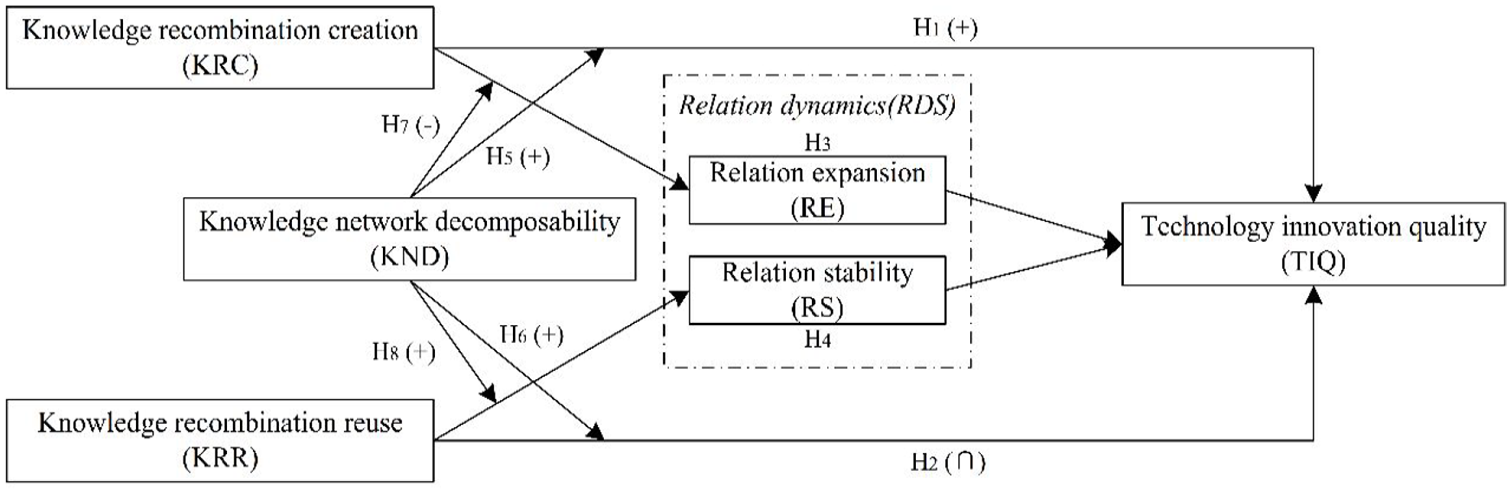
Research framework.
Methodology
To examine the research framework, taking Chinese high-tech manufacturers as research subjects, we collected information about firm operations and patents information to form an unbalanced longitudinal dataset. Among them, operation data is mainly used to measure firm-level control variables; patent citations are used to measure TIQ, while KR, RDS, KND, and other network-level control variables are measured by IPC and assignee co-occurrence relationships, and then constructing knowledge networks and interorganizational networks by igraph. It is noted that a five-year time window is commonly used in constructing networks to effectively circumvent the impact of industrial technology variation and track more interactions among inventors and firms. Finally, we conduct hypothesis testing using a panel negative binomial regression model.
Sample and Data Collection
This study takes Chinese high-tech firms listed in the China Stock Market & Accounting Research (CSMAR) database as the research object. This database synthesizes comprehensive statistics on listed firms in China and has been used extensively in previous studies focusing on Chinese firms (Krause et al., 2019). About 437 listed high-tech firms from 2000 to 2017 served as the sample for this study. The sampling process was as follows: (a) based on the “Classification of High-Tech Industries (Manufacturing) 2017 Edition” published by the National Bureau of Statistics of China, we retrieved the operational data and patent data of listed firms in the six types of industries (i.e., pharmaceuticals, aerospace equipment, electronics and communication equipment, electronic computers and office equipment, medical equipment and instruments, and information chemicals); (b) since R&D expenditures and patent data are not mandatory disclosure data, the firms that did not provide these data were excluded; (c) as the CSMAR database does not provide forward citations for each patent, in this regard, we retrieved relevant data from Google Patent database according to each patent application number; and (d) this study focuses on the impact of partnership changes, so we disregarded firms that have never filed a joint patent. Finally, we obtained a sample of 2,853 firm-year observations.
Variables
Dependent Variable
Existing studies generally agree that the value of a patent is that it provides a reference for subsequent technologies, and the higher the number of citations to the patent, the better the TIQ, but patents are rapidly depreciated within 5 years (Carnabuci & Operti, 2013). At the same time, in order to avoid the problem of “time truncation,” that is, the citation volume of newly filed patents may be lower, this study measures the total number of forward citations received by firms’ invention patents filed in year t + 1 within 5 years.
Independent Variable
Our approach draws on the methods of Carnabuci and Operti (2013) and Verhoeven et al. (2016), which use group-level codes of IPC as knowledge elements. We identify two types of KR by analyzing the co-occurrence of knowledge elements in patents filed by firms in year t. If a combination of two elements is newly emerged, it is classified as KRC. If the same combination has occurred between t − 5 and t − 1, it is classified as KRR. Therefore, for firms, the KRC and KRR scores represent the shares of these two types of KR in all combinations in year t.
Mediation Variables
Previous studies argue that RDS refer to changes in alters (Ahuja et al., 2012). For example, Yan and Guan (2018) measured RDS by examining changes in partnerships between two periods. Therefore, we calculate RDS by comparing the current period’s ego-network of a firm with the preceding period. To ensure variable measure validity, we construct the firm ego-network using a 5-year time window, given that collaboration between firms typically lasts 3 to 5 years (Guan & Liu, 2016). In this study, we calculate RE as the number of new direct collaborations for firm i in period 2 (year t − 4 to year t) compared to period 1 (year t − 5 to year t − 1), while we calculate RS as the number of direct collaborations present in both periods.
Moderation Variable
We adopt the method of Yayavaram and Ahuja (2008) for the measurement of KND. First, we determine the strong and weak connections between knowledge elements. A weighted undirected knowledge network is constructed based on the co-occurrence relationship and frequency of IPC in patents from year t − 5 to t − 1, and the median of the network ties’ weights is calculated and used as a criterion for judging whether the relationship was strong or weak. Second, to determine whether the focal knowledge element and the other element belong to the same cluster, the judgment criteria are as follows: (1) there is a strong tie between the two and at least one neighbor to which both are linked, (2) there is a strong tie between the two and they did not have any other neighbors at all, or (3) there is a weak tie between the two and at least one neighbor to which both are strongly linked. If one of the above criteria is satisfied, the two knowledge nodes are considered to belong to the same cluster. Third, the integration of the knowledge network is calculated as:

where Oclk is the knowledge tie outside the knowledge cluster to which node k belongs, and n(n − 1)/2 is the maximum possible number of ties in the knowledge network. As a result, the KND is calculated as:

where pk is the number of patents belonging to knowledge element k.
Control Variables
In high-tech sectors, start-ups and long-established firms have different internal environments that affect TIQ by influencing their ability and efficiency to learn, identify and apply knowledge (Gimenez-Fernandez et al., 2020). For instance, older firms have more practical experience than start-ups and have an advantage in internal resource allocation (Petruzzelli et al., 2018). According to existing studies, we take the number of years since firms’ founding as its age (Age).
Firm Ownership (Own)
Different constellations of firm ownership have different resources in accessing to technical, political and financial support (Xu et al., 2019). Therefore, we control for firms’ ownership with a dummy variable: state-owned or non-state-owned (Own = 1 or 0).
Firm Size (Size)
Firms with different sizes may have obvious differences in identifying and reorganizing knowledge value and recombination ability. In general, larger firms have a wider availability of human resources and a broader range of heterogeneous technologies they can combine than small (Petruzzelli et al., 2018). We compute the natural logarithm of the number of employees working in year t for each firm as Size.
R&D Intensity (RDI)
When a firm undertakes continuous R&D, it will not only promote knowledge accumulation, but will also enhance technology absorption (Kuo et al., 2019). In addition, Martínez-Noya and Garcia-Canal (2021) noted that R&D intensity also affects a firm’s collaboration propensity. In line with innovation literature, we introduce RDI calculated as firms’ R&D expenditures divided by sales in year t.
Knowledge Recombination Variety (KRV)
The variety of the knowledge base affects the potential for recombination. This study focuses on the opportunities for firms to effectively combine knowledge into new innovations, which is inextricably linked to the experience of combining knowledge. Therefore, we draw on the approach of Colombelli et al. (2013) to measure the variety of the combination of knowledge elements of firms by the IPC data from year t − 5 to t − 1:

where pkj denotes the number of patents covered by the combination of knowledge elements k and j as a proportion of the total number of patents.
Recombination Coordination Cost (RCC)
If firms face high internal knowledge production and coordination costs, then KR strategies are less effective for new knowledge generation because they only increase the existing coordination burden (Grigoriou & Rothaermel, 2017). Following prior research, we adopt a 5-year window (i.e., from t − 5 to t − 1) to calculate the variable. We use the ratio of the total number of inventor co-patenting partnerships to the total number of inventors involved in the knowledge production process (i.e., the size of the inventor network) as RCC.
Collaboration Network Centrality (CNC)
Collaborative network centrality affects a firm’s network position and access to information resources, jointly influences recombination and innovation outcomes (Xiao et al., 2022). We thus follow Freeman’s (1978) approach that CNC is measured as the standardized degree centrality of firms in the collaboration network from year t − 5 to year t − 1.
Average Strength of Collaborations (ASC)
Collaboration strength affects trust, reciprocity, and proximity interactions between partners in a network, thus acting on recombination choices (Demirkan & Demirkan, 2012). Also, it plays an important role in the stability of R&D alliances (Hu et al., 2021). We calculate the variable using the mean value of the strength of direct ties of firms in collaboration network from year t − 5 to t − 1 (i.e., the ratio of the total collaboration strength of i’s to the number of direct ties).
Innovation Uncertainty (IVU)
The uncertainty that surround innovation can affect the efficiency of resource allocation, which leads to higher demands on the value created by innovations and may also shape firms’ attitudes towards existing partnerships (Kumar & Zaheer, 2019; Luo et al., 2022). Following the prior study (Martin et al., 2015), We measure IVU by the standard deviation of 5-year patent count window until year t − 1.
Table 1 summarizes the descriptive statistics of variables. The minimum value of TIQ is 0, while the maximum value is 34,735, and its standard deviation is significantly larger than the mean. The dependent variable is over-discretely distributed. This may be that we use the non-negative integer of patent citations and the heterogeneity among different industries. The mean value of KND is 0.937 and the standard deviation is 0.093, indicating that the KND of the sample firms is generally strong, which suggests that for high-tech firms, the degree of modularization of technological knowledge is high. In addition, the mean value of RS is significantly larger than RE, suggesting that Chinese high-tech firms may attach more importance to maintaining collaboration with old partners. Thus, we use a dummy variable to control industrial effect.
Descriptive Statistics.

Model Specification
Since the explanatory and mediating variables are non-negative integers, a negative binomial regression model is required for the analysis to avoid over dispersion biasing the regression analysis. The results of the Hausman test based on Stata 16.0 (p > .1) indicate that all models do not reject the null hypotheses and that the random effects are more appropriate for estimation. In addition, both the quadratic and interaction terms of the variables in the regression models are centered to avoid the risk of multicollinearity.
Results
Table 2 presents the bivariate correlation matrix for dependent, independent and control variables. As shown in the matrix, all variables exhibit low-to moderate correlation (r < .6), and the Variance Inflation Factor (VIF) for each variable does not exceed 10, which demonstrates that multicollinearity problem is not a concern in this study.
Correlations and VIF.

p < .1. **p < .05. ***p < .01.
Table 3 shows the basic model and mediating effects results of random effects negative binomial regression. Model 1 in Table 3 only estimates the effects of control variables on TIQ. KRC, KRR and its quadratic terms enter in Model 2 to test basic effect of KR. Following the method of testing mediating effects (Baron & Kenny, 1986), RE is added in Model 3, 4, and 7, while RS is added in Model 5, 6, and 8. Moreover, Table 5 presents the moderating effects regression results. Model 1, 4, and 6 include only control and moderating variables. We simultaneously add KRC, KND and their interaction in Model 2 and 5. Models 3 and 7 contain KRR and its quadratic terms, as well as their interaction terms with the KND. Since the Wald χ2 of all models in Tables 3 and 5 pass significance tests, it indicates that negative binomial regression models fit well.
Regression Results of Basic and Mediating Effect Model.

Note. Standard errors in parentheses.
p < .1. **p < .05. ***p < .01.
Hypotheses Testing
Basic Model Regression Results
Consistent with H1, we find that TIQ improves with access to KRC. The coefficient of KRC in Model 2 is significantly positive. H2 states that KRR exerts a curvilinear (inverted U-shaped) impact on TIQ. The main effect of KRR is positive and significant (p < .01), and the quadratic term is significantly negative (p < .01). The U-test supports the existence of an inverted U-shaped relationship (p = .000). The slope on the left side of the inflection point is 0.723 and significant (p < .01), and the slope on the right side is −1.513 and significant (p < .01). Therefore, H2 is supported.
Mediating Effects Regression Results
Models 3 to 8 in Table 3 show the regression results for RE or RS as a mediating variable. Findings obtained from Models 3 and 5 point that RDS is significantly associated with TIQ. As is presented in Model 7, KRC emerges as significant predictor of RE. While in Model 8, we find that the effect of KRR on RS is significantly curvilinear, which passes the U-test. When RE and RS are introduced in Models 4 and 6, respectively, results indicate that the coefficients of KRC and KRR are still significant at the 1% level, which means RE (or RS) partly mediate the relationship between KRC (or KRR) and TIQ. The combined findings largely support H3 and H4.
Furthermore, based on the above results, we successively assessed the size and significance of the two indirect effects using the Sobel-Goodman test and the Bootstrap test. As displayed in Table 4, the Sobel Z and the indirect (or direct) effects for all independents variables are significant, which indicates that RE (or RS) plays an important role in the relationship between KRC (or KRR) and TIQ. However, the Sobel-Goodman test presupposes that the products distribution is normal, which maybe not satisfied in this study. Following recent research (Yan & Guan, 2018), we use an alternative approach (i.e., Bootstrap test) to calculate the significance of the indirect effects, and apply recommended 5,000 resamples and 95% confidence interval (CI) for further testing the hypotheses.
Sobel and Bootstrap Results of Mediating Effect Model.
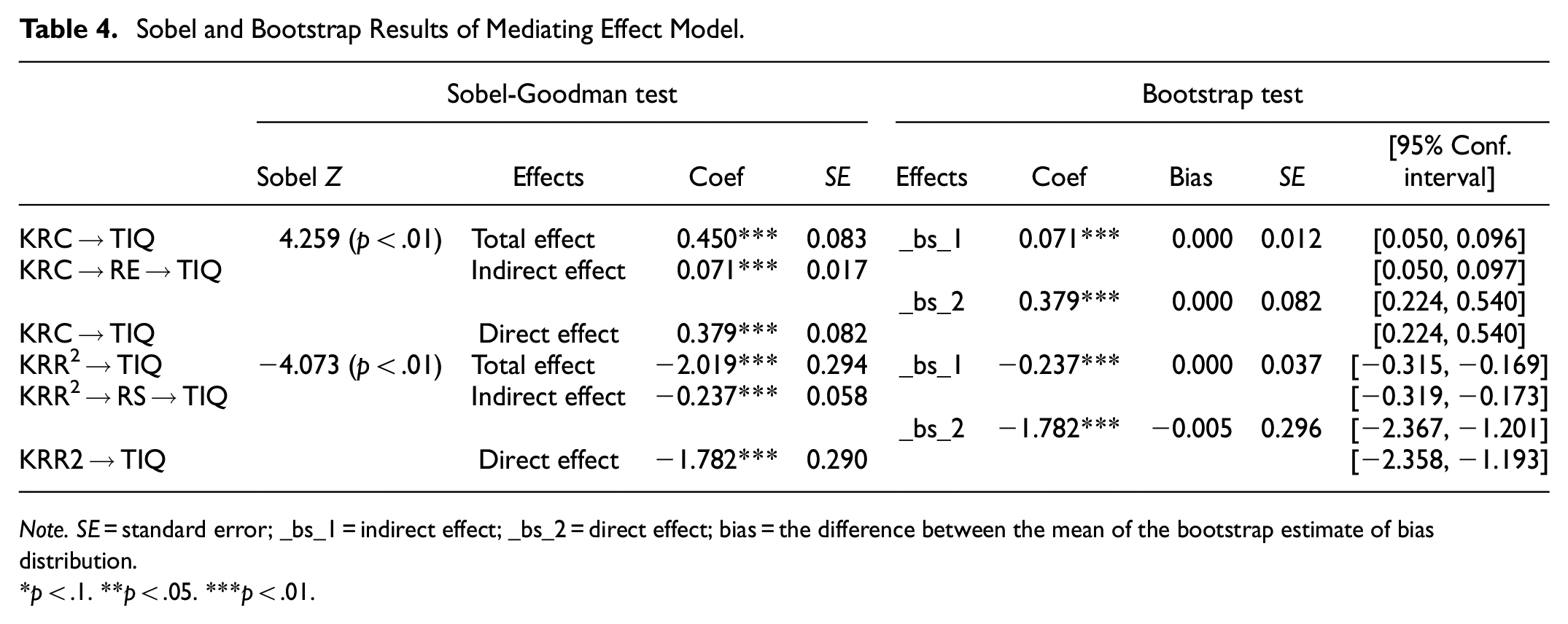
Note. SE = standard error; _bs_1 = indirect effect; _bs_2 = direct effect; bias = the difference between the mean of the bootstrap estimate of bias distribution.
p < .1. **p < .05. ***p < .01.
Table 4 presents that KRC has a significant and positive impact on TIQ, while the influence of KRR squared on TIQ is significantly negative. Besides, the 95% CIs of the two effects exclude zero, thus further supporting H1 and H2. Regarding of the mediating role of RDS, KRC (or KRR) has an indirect effect on TIQ via RE (or RS), with 95% CI doing not contain zero. Hence, H3 (or H4) is further verified. Overall, the results of the two tests are generally consistent. The total effect of KR on TIQ is significant, with RDS partially mediating and the direct effect of KR being greater than the indirect effect.
Moderating Effects Regression Results
As shown in Table 5, the coefficients of KND in Models 1 to 7 are positive and significant. This imply that modularization of the knowledge base not only facilitates the creation of impactful technical outcomes, but also enhances the dynamics of organizational partnerships. H5 states that the stronger the KND, the stronger the positive impact of KRC on TIQ. The coefficient of interaction between KRC and KND is significantly positive in Model 2. We plot this interaction in Figure 2a to get further insights. The graph displays that the positive impact of KRC on the predicted TIQ is more advantageous to a firm with high levels of KND than for a firm with low levels of KND. The results largely support H5.
Regression Results of Moderating Effect Model.

Note. Standard errors in parentheses.
p < .1. ***p < .01. **p < .05.

The moderating effect of KND: (a) KND’s moderating effect between KRC and TIQ, (b) KND’s moderating effect between KRR and TIQ, and (c) KND’s moderating effect between KRR and RS.
H6 proposes a positive moderation effect of KND on the curvilinear relationship between KRR and TIQ. The coefficient of interaction between KND and reuse squared in Model 3 is significantly negative. We plot this interaction in Figure 2b. As can be seen, the inverted U-shape relationship between KRR and the predicted value of TIQ becomes more steepened as a firm owns a more decomposable knowledge network, hence supporting H6.
H7 states that KND negative moderates the relationship between KRC and TIQ. Model 5 exposits that the coefficient of interaction between KRC and KND is negative but not significant, thus rejecting H7. We consider the technological complexity faced by a firm as a possible reason for this phenomenon. Technological complexity, which refers to the degree of interdependence of technological domains (Yayavaram & Chen, 2015), determines the difficulty of KR and leakage to a certain extent. Concretely, when the technology complexity is high, the strong dependency and high specialization between knowledge elements will increase the recombination cost and difficulty. The possibility of generating “variant” combinations by virtue of the original internal knowledge is reduced. The clusters in the strongly decomposable knowledge network only can be connected through the introduction of new domain knowledge or new architectural knowledge for exploratory recombination opportunities. And new partners will effectively meet such needs (Yayavaram et al., 2018). Furthermore, high technological complexity reduces the risk of transfer and leakage of superior knowledge. Facing new collaboration opportunities, a firm with strong decomposable knowledge base will have fewer concerns about the depreciation of internal know-how (Ganco et al., 2020). Thus, it will have a positive attitude towards establishing new R&D partnerships. In summary, the moderating effect of KND on the relationship between KRC and RE may shift from a negative to a positive impact as technological complexity increases.
H8 proposes that a positive moderating effect of KND on the link between KRR and RS. The coefficient of the interaction between the quadratic term of KRR and KND is negative at the conventional level. Figure 2c displays this interaction. The graph demonstrates that the more decomposable a firm’s knowledge network is, the steeper the curve of the relationship between KRR and TIQ is. Therefore, H8 is supported.
From the regression results of the control variables, size and KRV consistently contribute to TIQ and RDS at the 1% level of significance in all models in Tables 3 and 5. Consistent with prior studies (e.g., Jugend et al., 2018; Petruzzelli et al., 2018), the larger the size, the richer the resources that firms can mobilize. Specifically, with regard to knowledge resources, the more recombination options a firm has, the more conducive it is to engaging in activities to improve the quality of technological achievements and enhance the flexibility of its R&D cooperation.
Robustness Checks
This study also performs the following robustness tests to verify the reliability of the results. Considering the over-dispersion of some variables, we shrink the tails at the 1% level for TIQ, average strength of collaborations, and innovation uncertainty, respectively (see Model 1–7). In model selection, given the high number of zero values in RE, the model is reanalyzed using a zero-inflated negative binomial regression model (see Model 8–9). In addition, there may be an over-compartmentalization of knowledge clusters considering judgment criteria based on the strength of ties, whereas Zakaryan (2023) provides a more direct measure of decomposability. Therefore, we re-measured KND using weighted clustering coefficients and conducted robustness tests for moderating effects (see Models 10–13). All Wald χ2 and Vuong statistics in Table 6 pass the significance test, indicating that the model fit is acceptable. The results show that the direction and significance of the coefficients for the variables are similar to those in Tables 3 and 5, thus demonstrating that our previous findings are robust.
Results of Robustness Tests.

Note. Standard errors in parentheses.
p < .1. **p < .05. ***p < .01.
Conclusion and Implications
By investigating Chinese high-tech firms, this study seeks to reveal the mechanism and boundary conditions between KR and TIQ. Based on the generalized KR view, two different types of KR, namely KRC and KRR, which are positively and nonlinearly (inverted U-shaped) related to TIQ, respectively. Therefore, it is particularly important for technical managers to be alert to the dark side of KRR. Along with the resource dependence theory, we also found that two dimensions of RDS, that is, RE and RS, play partial mediating roles in KRC-TIQ and KRR-TIQ, respectively. Furthermore, the moderating role of KND, a feature of knowledge modularity within an organization, is fully considered in this study. These insightful findings would not only expand the boundaries of recombinant innovation and innovation network research, but also provide optimization logic and theoretical support for firms’ internal and external resource allocation.
Theoretical Implications
Based on the above conclusions and prior research, our study further provides several theoretical contributions. First, this study enriches the research on technology innovation under the recombination perspective by demonstrating the relationship between KRC & KRR and TIQ for high-tech firms in emerging countries, providing evidence and direction for the investigation on the relationship between KR and innovation of knowledge-intensive firms in the Chinese context. Previous literature on the nexus among different recombination capabilities and TIQ mostly come from developed economies, while few empirical studies focus on emerging countries like China. Given a weak industrial base and institutional framework, existing studies provide limited empirical evidence on whether Chinese high-tech firms can benefit from KR and thus improve TIQ. The findings in this study indicate that the effects of KRC and KRR on the TIQ of Chinese high-tech firms are quite different. Consistent with some of the studies (e.g., Katila & Ahuja, 2002; Yayavaram & Chen, 2015), we confirm that KRC has a pure contribution to TIQ. Even when switching the country context, the positive impact of actively exploring and creating new knowledge portfolios on TIQ is still evident. On the other hand, the relationship between KRR and TIQ is more complex. This study uncovers an inverted-U effect of KRR on TIQ, which is different from the previous literature that only considers the positive or negative relationship between the two (e.g., Fleming, 2001; Ruiz-Jiménez et al., 2016; Yayavaram & Chen, 2015). Although KRR guarantees innovation efficiency and usefulness, it creates technical lock-in and threatens innovation novelty. In the context of emerging economies, this result enlightens relevant studies to take a holistic view of the positive and negative impacts of reusing prior knowledge, and to avoid one-sided understandings.
Second, unlike the existing literature, which has focused excessively on the direct relationship between KR and TIQ (e.g., Katila & Ahuja, 2002; Schillebeeckx et al., 2021), we first introduce RDS as a mediator between the two, which provides a new perspective for a deeper insight into the relationship between KR and TIQ. Based on DCT, this study emphasizes that firms can adjust external relationships according to different types of KR to complement capabilities and resources, and bridge knowledge gaps more effectively thereby promoting innovation. In a networked innovation environment, rich network relations can provide ample opportunity resources (Guan & Liu, 2016). However, high-tech firms seeking to improve innovation quality must avoid ineffective partnerships and organization resource wastage (Ahuja et al., 2012; Dahlander & McFarland, 2013), which requires that they should dynamically adjust their R&D relationships to satisfy diverse knowledge needs in recombination activities and to secure creative technological R&D. Therefore, the investigation of the mediating role of RDS can help enrich the understanding of the intrinsic influence mechanism of KR on TIQ. In addition, this study found that different types of KR correspond to different dimensions of RDS, and the empirical results show that KRC (or KRR) is important for RE (or RS). From this perspective, we respond to the call for exploring the incentives of RDS in the study of organizational networks (Chen et al., 2022), and provide a theoretical basis for reference from the perspective of knowledge recombination.
Finally, by exploring the significance of KND, this study asserts the contingency of the relationship between KR and TIQ and RDS. This finding not only enriches the research on how high-tech firms derive recombination inspiration from knowledge bases and shape high-quality innovations (Yayavaram & Ahuja, 2008; Zakaryan, 2023; Zheng et al., 2011), but also informs recombinant innovations and RDS-related research by demonstrating the pros and cons of KND. Prior literature proposes that KND explains the capability of firms to create innovations via KR (Ganco et al., 2020; Simon, 1962) and influences attitudes towards external knowledge (Zakaryan, 2023). However, they do not provide sufficient empirical evidence regarding the topic of KND as a context in the process of KR influencing TIQ. Within the DCT framework, our findings indicate that KND has differential impacts on KRC and KRR efficacy, thus advancing this theme one step forward. Therefore, this study reveals the role of KND in recombinant innovation and collaborative R&D contexts, providing a useful perspective to explain the complex internal and external influences of KR.
Managerial Implications
Our findings also have important practical implications. First, although faced with a weak industrial base and a lack of mature industry knowledge, there is a Chinese proverb that says, “Good fortune follows upon disaster.” This means that in China, high-tech firms can be less constrained by mature industrial systems and technological paradigms, and are more conducive to the implementation of knowledge integration and recombination across technological fields. Specifically, high-tech firms should attach full attention to tapping the value of their own intellectual property rights as well as actively introducing new knowledge to get rid of excessive reliance on existing crafts, so as to maintain innovative vitality. When firms seek to enter a new technological track or wish to improve their industrial technology status, they can invest a large amount of resources in exploring cross-domain technological opportunities to effectively enhance innovation impact; when firms urgently need to improve TIQ in a short period of time, they can fully explore the untapped potentials in internal knowledge systems, and can appropriately invest innovation resources in technological reuse activities. Second, it is crucial to adjust external partnerships in accordance with different modes of knowledge recombination. Reconstruction of knowledge base is not the only way to realize innovation, high-tech firms also need to choose appropriate partners according to R&D needs. When confronted with bottlenecks in new technology development, firms can look for new partners through short-term strategic alliances or industry-university-research collaborations to import new information flow and thinking, thus quickly “breaking the game.” For firms which are focused on extending the application context of existing technologies, it is even more important to strengthen ongoing communication with old business or technology partners. Third, High-tech firms should proactively promote the decomposability or modularization of internal knowledge bases. While setting up multiple specialized R&D teams focusing on various innovation tasks, they should rely on digital technology to realize the rapid integration and interaction of knowledge flow and resource flow in the R&D system as a whole and among subunits. At the same time, it is necessary to actively facilitate the dynamic optimization of the organization structure, and the internal mobility of R&D employees, and to shape a business culture that emphasizes both intra-team and cross-team learning to enhance the agility of the R&D system and the flexibility of KR.
Limitations and Future Research Directions
Despite the contributions of this study, it still presents some limitations. Firstly, new combinations between old knowledge and combinations between new (old) knowledge are uniformly generalized as KRC, but there are differences in the risks and costs associated with various recombination styles, and the impacts on innovation and external cooperation may also be distinct. In this regard, future research could further investigate the mechanisms by which the segmented dimensions of KRC affect TIQ. Secondly, in the present study, we focus on the mediating role of the RDS between KR and TIQ and the moderating effect of KND. However, there may be other mediating pathways or internal and external moderating factors operating. Future studies could examine other related mechanisms in depth to more fully explain the complex relationship between KR and TIQ. Thirdly, since the sample is secondary panel data, our test for mediating effects relies somewhat on the three-step regression method, which may overlook underlying structural relationships. In the future, the mediation relationships in this study can be further validated using structural equation modeling based on the questionnaire data to enhance the robustness of the results. Finally, this study mainly examines high-technology firms in Chinese context, which limits the generalizability of the findings to other economies or industry environments. Future research could expand this topic to other socio-economic contexts to enhance the universality of our findings.
Footnotes
Acknowledgements
Thanks are due to Prof. Yu for his constructive comments and developmental feedback on multiple versions of this manuscript.
Declaration of Conflicting Interests
The author(s) declared no potential conflicts of interest with respect to the research, authorship, and/or publication of this article.
Funding
The author(s) received no financial support for the research, authorship, and/or publication of this article.

Data Availability Statement
Data sharing not applicable to this article as no datasets were generated or analyzed during the current study.