




Abstract
In light of common recommendations to connect with others through video chatting during the COVID-19 pandemic, this study examined how video chat apprehension relates to two health concerns: loneliness and adherence to CDC guidelines. We also examined how relational worry due to COVID-19 mediates these paths. Data were collected via MTurk from 467 people in the United States. The results showed that video chat apprehension related to increased worry about maintaining personal relationships, which in turn related to increased loneliness and decreased adherence to CDC guidelines. This investigation makes a contribution to understanding the links between personal relationships and both mental well-being and health behaviors during the COVID-19 pandemic.
In the wake of the World Health Organization declaring the outbreak of coronavirus disease 2019 (COVID-19) a pandemic, the absence of federal mandates on social distancing procedures in the United States meant that adherence to Centers for Disease Control and Prevention (CDC) guidelines was largely voluntary. This raised inevitable questions about individual differences in how people handle such crises. Critical concerns include people’s mental well-being and adherence to CDC guidelines for social distancing. Given that CDC protocols strongly encourage limiting face-to-face interactions, it seems that individuals who experience apprehension when communicating via video chats (i.e., face-to-face interactions online using webcams) may be especially prone to experiencing mental-health and relational problems during the pandemic. Thus, this study examines how video chat apprehension and relational worry due to COVID-19 associate with both loneliness and CDC adherence.
Direct effects: Apprehension to loneliness and CDC adherence
Figure 1 depicts our hypothesized model. We first posit that video chat apprehension should positively associate with loneliness, defined as “a distressing feeling that accompanies the perception that one’s social needs are not being met by the quantity or especially the quality of one’s social relationships” (Hawkley & Cacioppo, 2010, p. 218). This is consistent with the social skills deficit vulnerability model suggesting that people with lower social skills are at an increased risk for mental distress (Segrin, 2019). Feeling apprehensive using video chat media likely threatens both the quantity and quality of social relationships. Online communication apprehension—defined as “the extent to which an individual experiences fear and anxiety when communicating online” (Ledbetter, 2009, p. 479) may impede one’s ability to have quality interactions video chatting. Research indicates that apprehension in social interactions is related to increased loneliness, likely because it is difficult for people to connect to others when they feel nervous and anxious communicating (Zakahi & Duran, 1985). Although platforms such as Zoom are likely crucial for combating social isolation during the pandemic (Berg-Weger & Morley, 2020), it is likely that not all people feel comfortable using these platforms and therefore do not to benefit much from them.
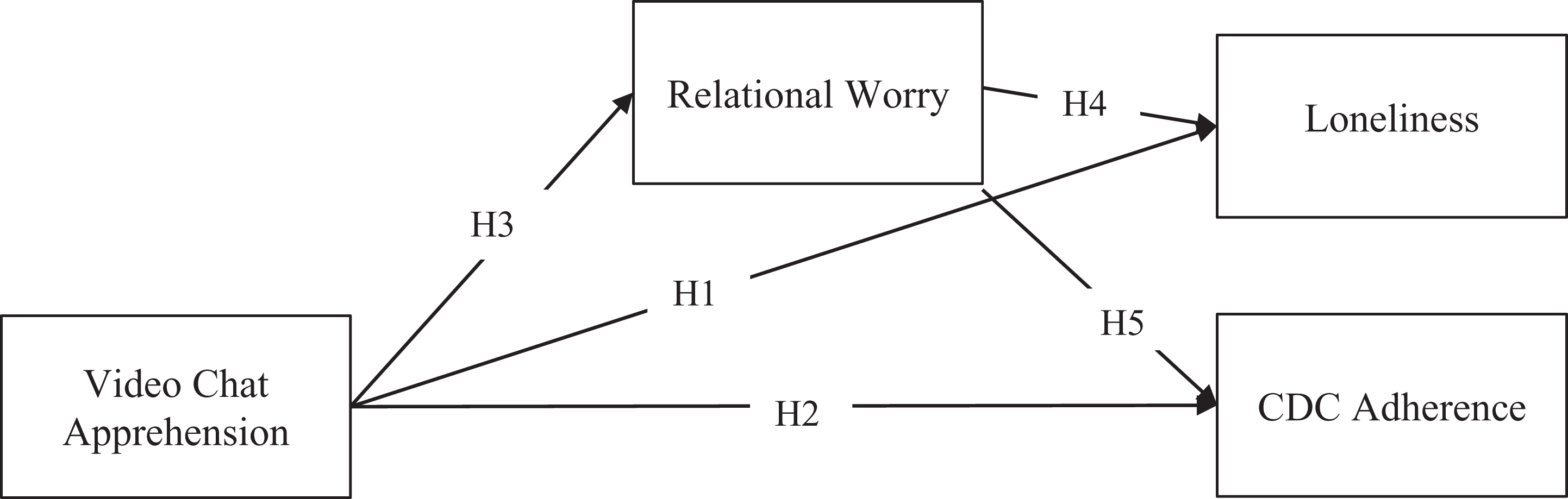
The hypothesized model. Note. The model also tests the indirect effects from video chat apprehension to both outcomes through the mediating variable.
Second, we hypothesize that video chat apprehension will negatively relate to CDC adherence. Theoretically, social skill deficits are linked to increased risky health behaviors (see Segrin, 2019). Moreover, communication apprehension is inversely related to resilience to stressful life events (Curran et al., 2020). It stands to reason that individuals who are apprehensive about communicating via video chat might risk neglecting CDC recommendations and seek to interact with others in person. Apprehension communicating online in general is related to less interpersonal interactions and self-expression online (Hunt et al., 2012). Thus, apprehensive people may find video chat forums inadequate for maintaining relationships and resort to more traditional modes of communication that violate CDC protocols.
The mediating role of relational worry
We also posit that more worrying about the state of personal relationships will mediate the posited direct effects. Worry is conceptualized as an unpleasant, intrusive, and relatively uncontrollable process involving emotions, thoughts, and images about outcomes that are uncertain and potentially negative (Borkovec et al., 1998). Given the inherent uncertainty and trauma associated with pandemics, it is not surprising to learn that there was a significant increase in database searches for “loneliness” and “worry” in the wake of pandemic lockdowns (Brodeur et al., 2020). Research indicates that people worry about their relationships with others (e.g., Kloep, 1999), and anecdotal accounts suggest that relational worries during the COVID-19 pandemic may be partly due to online communication issues (e.g., see Fallik, 2020). One person, for example, noted, “It just seemed like he wasn’t able to include me in his life if I wasn’t physically there…It felt like our friendship was being taken apart by something I really couldn’t control” (Fallik, 2020, para. 3). Therefore, although relationship maintenance is a central function of online communication (Ledbetter et al., 2011), people who are deprived opportunities to communicate face-to-face, and lack skills and motivation to use alternative media such as video chats, likely worry more about the state of their relationships.
Furthermore, we argue that relational worry should associate with higher levels of loneliness. Whereas worry is an emotion based on perceived negative outcomes in the future, loneliness is partly conceptualized by a current perception that one lacks relational quality (Hawkley & Cacioppo, 2010). Moreover, loneliness often stems from perceiving one’s social world as negative and threatening (Hawkley & Cacioppo, 2010). Recent research indicates that worry during the pandemic was associated with loneliness (Hoffart et al., 2020). Therefore, we reason that worrying about one’s relationships is likely linked to a concern with maintaining positive and high quality relationships. Given the unpleasant nature of worry, people should be motivated to behave in ways to resolve the worrisome situation (e.g., Arbel et al., 2017). Research shows that experiencing worry is related to behavior change (e.g., Seiter & Brophy, 2020). Thus, apprehensive people should be motivated to disregard social distancing recommendations, thereby enabling themselves to maintain relationships in ways they find more suitable (i.e., face-to-face interactions).
Methods
Participants and procedure
The data were collected in the second week of July 2020 as part of a larger research project on COVID-19 via Amazon’s Mechanical Turk (MTurk). Eligible participants were 18 years or older, living in the United States, and had engaged in social-distancing behavior due to COVID-19. Participants had completed at least 500 human intelligence tasks with a minimum 95% success rate as an MTurk worker. Participants received payment of $1.50. All procedures were approved by the Institutional Review Board.
In total, there were 467 participants. The sample ranged in age from 21 – 76 years (M = 36.98, SD = 10.62). The data was composed of 284 participants reporting male (60.9%), 180 reporting female (38.6%), and one reporting gender nonconforming. The race/ethnicity of the sample were as follows: 320 White/Caucasian, 76 Black or African American, 5 Native American or Alaska Native, 32 Asian, 3 Hawaiian or Pacific Islander, 19 Hispanic/Latinx, 8 other, and 3 who did not answer.
Measures
Video chat apprehension
To assess video chat apprehension we adapted the apprehension subscale of the Online Communication Attitudes Scale (Ledbetter, 2009). Two items were dropped because they focused on email. The 6 adapted items (e.g., “I feel apprehensive about communicating on video chats.”) were rated on a 5-point Likert-type scale (1 = strongly disagree to 5 = strongly agree) (α = .92, M = 3.09, SD = 1.07).
Relational worry due to COVID-19
We developed 3 items to measure relational worry due to COVID-19: “I worry about losing friendships as a result of the pandemic,” “Because of social distancing, I worry that my friendships will feel less close,” and “I feel less close to my loved ones whom I cannot see in person.” The items were measured on a 5-point Likert-type scale (1 = strongly disagree to 5 = strongly agree) (α = .83; M = 3.02; SD = 1.12).
Loneliness
Loneliness was measured using the 3-item version of the UCLA Loneliness scale (Russell et al., 1980). The items (e.g., “How often do you feel you lack companionship?”) were rated on a 5-point Likert-type scale (1 = never to 5 = always) (α = .90, M = 2.71, SD = 1.17).
Adherence to the CDC guidelines for COVID-19
We generated a comprehensive list of recommended actions to reduce the spread and contraction of COVID-19 based on the CDC’s public documents (Centers for Disease Control, 2020). Participants rated how often they currently engaged in each of 15 behaviors (e.g., “Stay at home as much as possible.”) on a 5-point Likert-type scale (1 = never to 5 = always) (α = .92, M = 4.02, SD = .72).
Results
Table 1 shows the zero-order correlations for the variables. We employed Model 4 of the Hayes’ (2013) PROCESS 3.0 for SPSS. The macro generates 95% bias corrected and adjusted confidence intervals (CI). Significant indirect effects are indicated by CIs that exclude zero. The results showed significant direct effects from video chat apprehension to both loneliness (B = .34, SE = .05, t = 7.40, p < .001), and adherence to CDC guidelines (B = −.16, SE = .03, t = −4.95, p < .001). Apprehension positively associated with relational worry due to COVID-19 (B = .52, SE = .04, t = 12.13, p < .001). Relational worry due to COVID-19 was positively associated with loneliness (B = .46, SE = .04, t = 10.46, p < .001) and negatively associated with adherence to CDC guidelines (B = −.08, SE = .03, t = −2.77, p < .05). The indirect effect from apprehension to loneliness through relational worry was significant (B = .23, SE = .03, 95% CI [.17 – .31]), R2 = .27. The indirect effect from apprehension to CDC adherence through relational worry was significant. (B = −.04, SE = .02, 95% CI [−.08 to −.004]) R2 = .05.
Correlations among study variables.
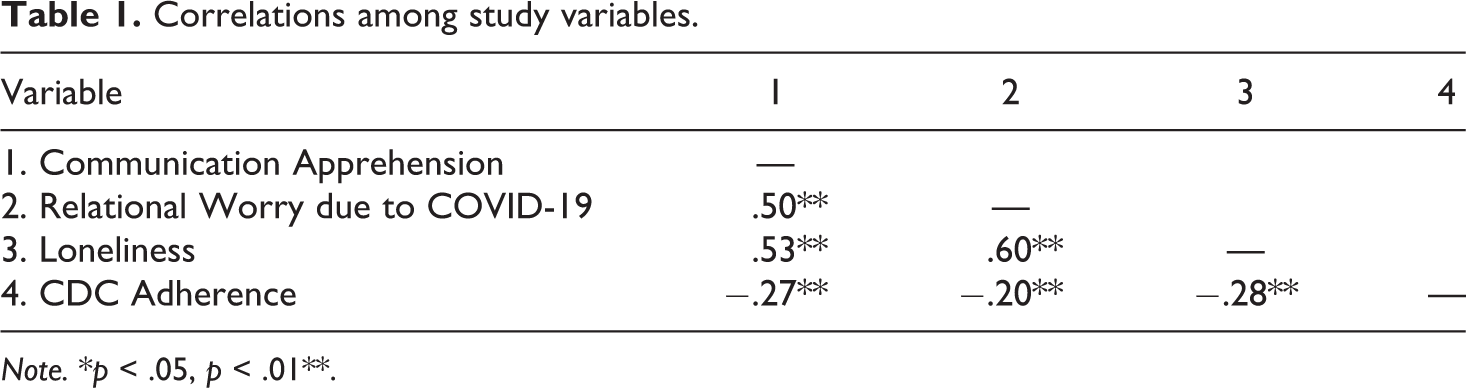
Note. *p < .05, p < .01**.
Discussion
We investigated the links between personal relationship factors and both mental well-being and social distancing behaviors during COVID-19. Given the emphasis on online media for social connection, we posited that video chat apprehension would positively relate positively to relational worries due to COVID-19, and in turn associate with increased loneliness and decreased adherence to CDC guidelines. The results supported these hypotheses, indicating that video chat apprehension and relational worry are two factors that link to less CDC adherence and increased loneliness.
Loneliness is a major health concern resulting from COVID-19 not only because health guidelines emphasize reduced face-to-face interactions (Berg-Weger & Morley, 2020), but also because loneliness is related to many negative health outcomes such as premature death (see Hawkley & Cacioppo, 2010). Our results show that video chat apprehension is a relevant social skill deficit during COVID-19, given that people who report increased apprehension report higher levels of loneliness. This study also showed that video chat apprehension was directly linked to reduced adherence to CDC guidelines, suggesting that it not only threatens individual well-being, but health on a global level as well. Theoretically, these results align with a social skills deficit perspective on health. Research shows that lacking social skills is related to worse mental and physical well-being (Segrin, 2019). The direct effects add to the body of research on social skill deficits by showing that video chat apprehensiveness is linked to both increased loneliness and less adherence to CDC guidelines. These results hold important implications for social workers and counselors. Specifically, programs and counseling sessions aimed at reducing video chat apprehension could potentially help alleviate feelings of loneliness, as well as increase CDC adherence behaviors in the United States. An enormous body of research examining the reduction of communication apprehension in other contexts (e.g., public speaking) could prove informative in this respect (e.g., see Ayres & Hopf, 1993).
Moreover, the results showed that relational worry due to COVID-19 mediated both direct effects. With changing guidelines for social interaction and related obstacles to maintaining personal relationships, it is understandable that people with apprehension toward video chats would worry about their relationships. Although video chat devices offer a medium for interacting, there seem to be negative factors associated with apprehensiveness toward using them. This is a vitally important outcome of this study, given the emphasis on communicating via video chats during COVID-19. Recommending that people use media in which they feel apprehensive could potentially be doing more harm than good for mental health and CDC adherence. Counseling sessions aimed at alleviating relational worry, and/or providing loved ones with advice for decreasing worry might be desirable. Assurances (e.g., stressing commitment, implying that the relationship has a future) from loved ones, for example, predict relational liking, commitment, and satisfaction (Stafford & Canary, 1991), and may prove useful for reducing relational worry.
Finally, a unique finding from this study is that relational worry due to COVID-19 negatively relates to CDC adherence. This aligns with research showing that individuals are motivated to adapt their behavior in order to reduce worry (Seiter & Brophy, 2020). Multiple goals theory in personal relationships (Caughlin, 2010) is a useful framework for understanding this finding. People with relational worry may be lax with CDC recommendations because they are juggling multiple goals (e.g., staying safe, and keeping quality relationships). As such, worrying about relationships may lead to risking one’s health (and the health of others) to interact with others in more intimate, face-to-face settings.
There are several limitations to note. The cross-sectional nature of this study limited our ability to make casual claims. Although it is vital to understand the role of individual differences in factors such as CDC adherence, it is problematic to conceptualize such adherence as an individual problem solely. This investigation into individual differences only results from the lack of governmental policies mandating CDC adherence. While understanding that these results hold importance, systems that hold power in the United States have the most ability to enforce safe behaviors responsibly. Future studies should explore other relational factors that associate with mental distress and CDC adherence, particularly in populations most affected by COVID-19. At their core, social distancing practices are relational behaviors and as such, relational scholars can unveil crucial information about health and safety in the context of COVID-19.
Footnotes
Authors’ note
This research was supported by a grant from the Mountain West Center for Regional Studies at Utah State University. A version of this manuscript was submitted to the 2021 International Communication Association Conference.
Acknowledgment
We would like to acknowledge and thank Barbara Warnes and Debora Seiter.
Funding
The author(s) received no financial support for the research, authorship, and/or publication of this article.

Open research statement
As part of IARR’s encouragement of open research practices, the author(s) have provided the following information: This research was not pre-registered. The data used in the research are not available. The materials used in the research are not available.