




Abstract
The ‘resource nexus’ has emerged over the past decade as an important new paradigm of environmental governance, which emphasises the interconnections, tensions and synergies between sectors that have traditionally been managed separately. Nexus thinking presents itself as a radically new approach to integrated governance in response to interconnected socio-environmental challenges and constraints. This paper provides a critical review of nexus thinking. The nexus paradigm, we contend, is part of a broader trend towards integrated environmental governance where previously externalised ‘bad’ nature is increasingly internalised by capital. In general, the nexus discourse has become techno-managerial in style, linear in its analysis and reductionist in its recommendations. Focussing particularly on urban water and energy infrastructure as important political sites in the (re)configuration of resource connectivities, we advance two principal arguments. Firstly, that the current nexus thinking inadequately conceptualises the scalar politics of interconnections between resource sectors. Secondly, we challenge the currently pervasive focus on technological and institutional ‘solutions’, efficiency-oriented ecological modernist vision and the presentation of ‘integration’ as a panacea for unsustainable resource practices.
Introduction
Accounts of 20th-century modernity tend to emphasise processes of resource compartmentalisation. Modernisation, in other words, is generally understood to have proceeded through the separation of material flows (water, energy, food) into discrete categories that perform specific social functions (illumination, heating, sanitation) and are governed by distinct technological, institutional and political configurations (see Melosi, 2000; Norgaard, 1994; Nye, 1990; Otter, 2004). In the era of planetary urbanisation, the Anthropocene and ecological crisis, however, relational approaches to environmental governance are on the rise. The material flows that constitute and sustain cities – water, electricity, gas, oil, food, information and a multitude of other commodities – that have traditionally been conceptualised and managed separately, are increasingly being understood as inexorably interconnected, contingent and co-producing. This shift is illuminated in a plethora of emerging concepts, including nexus thinking, diversification, the energy ‘trilemma’, integrated water resource management, resilience, virtual water and nature-based solutions, that, although differing in scope, all emphasise socio-ecological relationality and material interconnectivity.
This paper offers a critical review of nexus thinking. The concept of the resource nexus has emerged over the past 10–15 years as a powerful framework for understanding the relationships, and critiquing established distinctions between categories of environmental governance that have traditionally been managed in separation. Although broad in its methodological and geographical scope, nexus thinking represents an attempt to understand, categorise and reconfigure the connections between resources (Bazilian et al., 2011; Hussey and Pittock, 2012; Olsson, 2013, 2015; Verma, 2015). Now most commonly referred to as the water–energy–food – or WEF – nexus (Salam et al., 2017), its core concepts have been expanded to include other elements of resource relationality (Andrews-Speed et al., 2015). In this review, which is concerned particularly with the politics of infrastructural integration in cities, we focus our attention on the water–energy nexus. In doing so, we argue that the nexus discourse has so far developed along a technocratic and reductionist path. By conceptualising resource connections under the simple categories of tensions, trade-offs, maladaptations and synergies, this paper argues, nexus thinking reduces socio-material heterogeneity to a set of manageable and depoliticising relationships. Indeed, the processes and technologies through which resources become enrolled in nexus interactions – what we might call the political production of the nexus – are drastically overlooked in existing scholarship (Rees, 2013).
This paper, then, offers two core contributions. First, we argue that the politics of scale (Swyngedouw, 2000) have been insufficiently handled in nexus thinking so far. This represents a significant gap, given that questions about the interconnections between resources and material flows are inherently profoundly geographical. The paper focuses on the urban nexus, and in particular interfacing water and energy infrastructures, as a key geographical scale of existing, emerging and contested nexus interactions. Moreover, in the resource nexus literature, although some attention has been paid to cities (Kenway et al., 2011; Villarroel Walker et al., 2014), a comprehensive understanding of the urban dimensions of the WEF nexus is yet unformed (Moss et al., 2016). The aim of this paper, then, is both to urbanize nexus thinking, and to introduce nexus concepts into urban studies.
Second, we argue that the technocratic language and core concepts of nexus thinking are, in current form, profoundly depoliticising. In particular, we challenge an emerging consensus in the literature, which posits that integrated management of water and energy will necessarily lead to more sustainable management of both. Fundamentally, this is a call for purely efficiency-based techno-managerial solutions to tensions and trade-offs between energy and water, and one that is entirely consistent with market-based approaches to environmental governance. The concept of ‘integration’ has become a panacea for the negative aspects of the nexus, an ultimate solution that forestalls more politically informed discussions. This assumed logic ultimately implies that the serious challenges posed by the nexus framework do not in fact require real political change.
In offering a critical analysis of nexus thinking as an increasingly influential approach to environmental governance, we situate our argument in relation to a growing body of critical scholarship in urban studies and geography that theorises infrastructures as important sites of political and social change (Monstadt and Coutard, 2016). Broadly, this literature develops a relational understanding of infrastructure, which, because of the extent and inertia of these technologies, mediate material flows and the social relations that assemble around them. In other words, what Ranganathan (2015) calls the infrastructural dialectic between fixity and flow shapes the constantly shifting relations between human and nonhumans. Moreover, as sites of socio-material transformation, the relational visions embodied in infrastructural projects – for example, for integration of resource management or environmental sustainability – reflect particular political ideologies and economic structures (Loftus and March, 2016). As such, infrastructures are increasingly seen as the foci of contestation and for the foregrounding of alternative forms of resource politics (Anand, 2011).
In what follows, we first provide an overview of nexus thinking, considering the origins of the concept, its core dimensions and emerging principles. Then we consider the importance of urban infrastructure in (re)configuring the scalar politics of water–energy interconnections. Finally, we offer a critique of techno-managerial concepts of resource connectivity and argue for a more politicised notion of the nexus.
Nexus thinking
In essence, the literature reviewed in this paper concurs on the following point: the challenges facing our water, energy and food systems, that together provide the basic material flows upon which all human action is predicated, form a set of complex, and above all inter-related problems. The key governance challenge, then, is to mitigate negative interactions and optimise positive interactions (Kurian and Ardakanian, 2015). Notions around resource scarcity, limits to growth and planetary boundaries pervade the nexus discourse (Andrews-Speed et al., 2015). Nexus thinking, in a word, seeks to offer: …integrated approaches to resource use that emphasize longer-term social and ecological sustainability while offering operational means to internalize externalities, foresee and mitigate unintended consequences, and above all, strengthen resilience through outcome-oriented open learning and institutional change. (Scott et al., 2015: 16)
Also known as the ‘stress nexus’, the concept of a resource nexus emerged from techno-managerial environmental governance circles in response to tensions and competition between sectors. For example, one of the earliest systematic studies of nexus challenges was conducted in 2005 by the California Energy Commission. The purpose of the study was to quantify the demand for water in California’s energy sector and the demand for energy in its water sector, and to identify the “points of highest stress” between the two systems (Klein et al., 2005: 1). The main recommendation made by the report, which is still widely cited, was for better coordination between the water and energy sectors, and for joint infrastructure management. The first calls for greater attention to be paid to the nexus, therefore, came from environmental managers and regulators trying to reconcile competing demands for increasingly contested resources. In addition, discussions on the resource nexus have also emerged from, and share many conceptual, practical and ideological underpinnings with, older frameworks for integrated resource governance, particularly Integrated Water Resource Management (IWRM) (Benson et al., 2015).
The nexus has since grown to become the new buzzword of resource governance (Cairns and Krzywoszynska, 2016). Over the last few years, the number of academic publications specifically concerned with the nexus framework has burgeoned; a multitude of international conferences have been arranged on the topic; and a number of high-profile events have raised public awareness, notably the Bonn 2011 Conference and UN World Water Day 2014 and 2015. Nexus thinking has now become a central discourse for sustainability and is seen by many as a core concept for achieving the UN Sustainable Development Goals (Biggs et al., 2015; Yillia, 2016). Indeed, as we will argue later, nexus thinking is rapidly being assimilated into the logics of sustainable development, in part because the two discourses share important depoliticising and techno-managerial underpinnings (Swyngedouw, 2010). Proponents attempt to identify and eliminate tensions and trade-offs between resource sectors, and to highlight synergies and shared goals between them (Pittock, 2011; Scott and Pasqualetti, 2010; United Nations Educational, Scientific and Cultural Organization (UNESCO), 2014). Although some have questioned the true novelty of these ideas (Allouche et al., 2015; Muller, 2015; Rees, 2013), nexus thinking certainly presents itself as a radically new approach to integrated resource governance in response to interconnected socio-environmental challenges and constraints (Kurian and Ardakanian, 2015). Developing nexus approaches is now a key research agenda across multiple disciplines (Faeth and Hanson, 2016).
Dimensions of the water–energy nexus
Expressed in its simplest (and most simplistic) form, the water–energy nexus considers the embedded energy in water systems and the embedded water in energy systems, or succinctly “energy for water and water for energy” (Perrone et al., 2011: 4229). Moreover, it is when “water and energy rely on each other that the most complex challenges are posed” (Hussey and Pittock, 2012: 32). The water–energy nexus concerns the energy required to capture, treat, distribute, use and dispose of water and the water required to extract, produce, distribute and use energy. This physical, quantifiable, metric of the nexus has attracted most attention from scholars (Chang et al., 2016; Kahrl and Roland-Holst, 2008). As such, much of the literature is concerned with the technologies through which water and energy are brought together. It is these nexus technologies, then, that form the starting point of this discussion. Energy is required in every stage of water capture, production, extraction, transportation, treatment, distribution, consumption and disposal. Nexus interactions are implied in every aspect of the water system, from the type of shower head installed in your bathroom and the amount of tea you drink each day, to the specific water mix of a given region (i.e. the various sources of water and their respective energy intensities), and its distribution and treatment infrastructure. Kenway (2013) distinguishes between direct links, which describe the respective water–energy intensities of production, distribution and disposal, and indirect links, which concern the act of consumption. Although the former is generally given priority in the literature, often being assumed to be more important, end use is nevertheless highly significant (Cohen et al., 2004).
A common concern is the high energy intensity of alternative freshwater sources that are emerging as traditional sources deplete and competition between uses increase (Schnoor, 2011). For instance, the use of seawater desalination and long-distance inter-basin water transfer represent attempts to expand water consumption in the face of dwindling traditional sources and growing demand, but both technologies are associated with significantly higher embedded energy (Clayton et al., 2014 Scott and Pasqualetti, 2010; Siddiqi and Anadon, 2011). The central argument of the energy for water literature is that, because of the technological feats water-stressed communities are compelled to achieve, levels of embedded energy in water supply are rising, but, it is also precisely the scarcity of water, and competition for it, that places additional strain on energy supply (Klein et al., 2005).
Similarly, large amounts of water are required in the extraction, processing and conversion of energy, in almost all of its forms (Tan and Zhi, 2016). In the USA, for example, the energy sector is the fastest growing water user nationwide, with demand expected to increase by 50% between 2005 and 2030, and growth largely concentrated in areas already experiencing high levels of competition amongst water users (Carter, 2011). Water is consumed in the extraction, production and refining processes of combustible fuels. Demand is set to rise as alternative fuel types, including hydraulic fracturing and oil from tar sands, replace traditional sources (King et al., 2008). Biofuels, such as corn ethanol and palm oil, which have become a popular option for countries wishing to reduce greenhouse gas emissions and reduce reliance on imported fossil energy, are particularly water intense (Bazilian et al., 2011; Gheewala et al., 2011). Although embedded water in biofuel production varies according to context – Chiu et al. (2009) have calculated a range of 5 to more than 2000 litres of water per litre of fuel produced – the expansion of the biofuel industry nevertheless significantly increases energy-related water use (Damerau et al., 2016). Here then, an alternative energy option, praised for its ecological credentials, is likely to contribute to water stress over the coming decades.
Much of the nexus literature is concerned with the water requirements of electricity generation, both hydroelectric and thermoelectric. Thermoelectric power plants, the fuel inputs for which include coal, oil, gas, nuclear and to a lesser extent biomass, require vast quantities of water for cooling. Almost all thermoelectric plants use one of three types of cooling system: open-loop, close-loop or dry cooling (Feeley et al., 2008; Sovacool, 2009; Wolfe et al., 2009). In terms of mitigating the negative effects of the water–energy nexus, the type of cooling system in a power plant embodies many tensions and trade-offs. For example, by switching from open to close-loop, power plants can reduce their vulnerability to drought and water scarcity, but in doing so, increase their water consumption overall (Koch and Vögele, 2009). Overall, thermoelectric plants are responsible for around 40% of freshwater withdrawals in the USA – higher even than agriculture – but only 3% of freshwater consumption (Fthenakis and Kim, 2010; Wolfe et al., 2009). Hence, electrical power generation is severely affected by constraints on water supply, and as a sector, is amongst the most vulnerable to negative implications of the water–energy nexus.
The recent academic and policy interest in nexus thinking has been fuelled, in large part, by the confluence of two trends: the increasing concern over water and energy supply on the one hand, and the deepening of linkages between the two on the other. Alternative sources of water developed to mitigate inadequate or insecure supply, like sea and brackish water desalination, wastewater recycling and inter-basin transfer, tend to increase the water-sector’s energy consumption. At the same time, new sources of energy, particularly biofuels and hydraulic fracturing, are often associated with increased water demand from the energy sector. This may lead to a growth concatenation, a cycle of deepening nexus interactions.
The urban nexus: On scale and geography
The coupling of energy, water, food and other resources, as a physical and political phenomenon, is situated firmly in place. In other words, the nexus has a distinct geography, but one that is as-of-yet poorly understood. A comprehensive understanding of the resource nexus necessarily considers the interrelations at all spatial and political scales, from the technologies and practices of personal hygiene, through geographically and historically specific urban production and consumption infrastructures, to the geopolitics of supranational struggles for control of resources (Hussey and Pittock, 2012; Scott et al., 2011) (Table 1). Indeed, because “water and energy pervade every aspect of ecosystems, human systems and economic activity, the connections between water and energy are everywhere” (Kenway et al., 2011: 1984). Moreover, the physical interactions between water and energy are often separated geographically from the social and ecological effects of those interactions (Bartos and Chester, 2014). Scott et al. (2011: 6628) have, therefore, argued that there is not only a “dissonance between scales of water–energy coupling and levels of institutional decision-making,” but also a dislocation between energy and water use and negative impacts of the nexus.
The scales and technologies of the water–energy nexus.
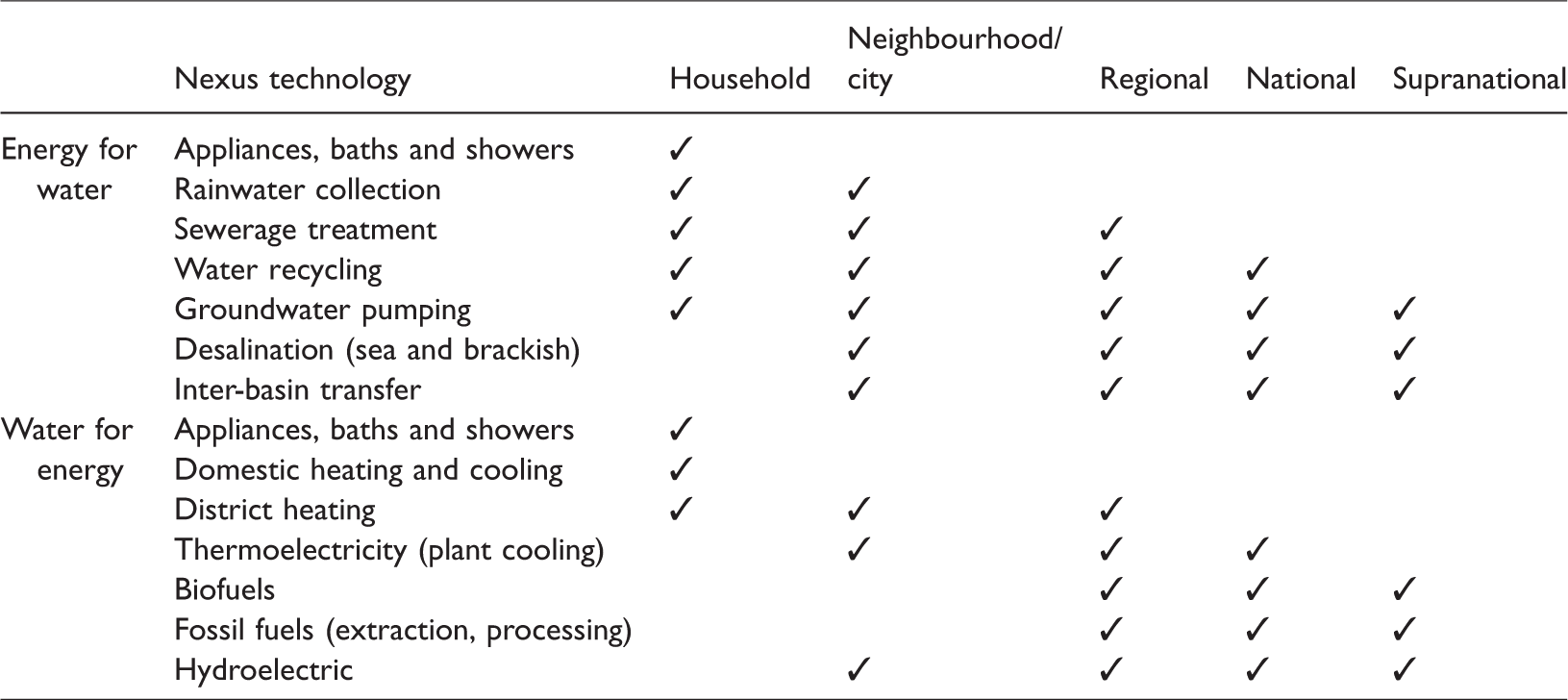
So far, substantive research on the resource nexus has focussed disproportionately on the national or state level: for example Spain (Hardy et al., 2012), Mexico (Sanders et al., 2013), Australia (Kenway et al., 2011), China (Kahrl and Roland-Holst, 2008), India (Malik, 2002), the Middle East and North Africa (Damerau et al., 2016; Siddiqi and Anadon, 2011). These issues have, however, received most attention in the United States, and particularly in semi-arid and rapidly urbanising states like California (Kenney and Wilkinson, 2011; Klein et al., 2005; Larson et al., 2007) and Texas (Clayton et al., 2014; Stillwell et al., 2011). Tan and Zhi (2016) have identified a US dominance in data on water and energy coupling, and call for a more international perspective. With the exception of a small number of research projects (Duan and Chen, 2016; Scott and Pasqualetti, 2010), very little attention has been paid to nexus interactions across national or administrative boundaries. A more thorough understanding of the scalar politics of the resource nexus is needed to address questions around the uneven geographies of the nexus and the just governance of resources.
This paper is concerned particularly with cities as an important scale of analysis for future nexus thinking research. This is both consistent with a growing interest in urban analysis within nexus thinking (Kenway, 2013; Scott et al., 2016), and echoes calls from critical urban scholarship for greater understanding of the interconnectivities and contingencies between urban material flows and associated infrastructures (Broto and Bulkeley, 2013; Moss et al., 2016). The social and political importance of urban infrastructures in structuring and shaping material flows, and their efficacy in re-producing urban space in particular and unequal forms, has of course, been well studied (Graham and Marvin, 2001; Graham and McFarlane, 2015; Guy et al., 2011). But the Science and Technology Studies (STS) literature has so far largely considered urban infrastructures as constituting distinct, albeit interacting systems. Put another way, infrastructures have generally been understood to be superficially connected, in that they might develop in parallel, be subject to similar governance restructuring processes, or concurrently produce social effects. In presenting a critical nexus framework, however, we argue for a conceptual understanding of urban infrastructures as being deeply connected, inherently interdependent, co-produced and co-producing, and politically and materially contingent.
The importance of the urban scale to the WEF nexus literature revolves around two key points. Firstly, as sites of high population density, and therefore of intense metabolic transformation, of production and consumption, and of the forging of new socio-material relationships, cities are where different material flows and resources are bound most tightly together. As Scott et al. (2016: 114) put it, “urbanization drives the nexus.” Interconnected resource pressures are concentrated in urban areas (Hake et al., 2016). As was noted earlier, many of the technological responses to resource insecurity merely transpose pressure into another sector. Seawater desalination is a good example of this, where the question of water scarcity effectively becomes one of energy security. Kenway et al. (2011) have argued, then, that studying cities as an important scale of nexus interactions can help to identify ‘root causes’ of resource tensions. Furthermore, the production of urban space is concomitant with the displacement of nexus burdens. The resource tensions and trade-offs driven by urbanisation are unevenly distributed, both within cities and beyond their geographical boundaries, creating new socio-ecological vulnerabilities. Urban analysis, therefore, is integral to understanding the uneven geographies of the resource nexus.
Secondly, the pace of urban change and the scale of resource flows through urban space, offer significant potential for the formation of new modes of resource governance (Kenway, 2013). Moreover, the technologies and infrastructures through which water and energy in particular are urbanised are central to the (re)shaping of the urban metabolism (Villarroel Walker et al., 2014). In other words, programmes for integrating water, energy and other resource management in cities may act as catalysts for broader change. Nevertheless, much of the literature so far that specifically handles the urban resource nexus conceptualise cities in fairly reductionist input and output terms, often using models that inevitably overlook complexity (for recent examples, see Chan, 2015; Chen and Chen, 2016; Fang and Chen, 2016; Kenway et al., 2015). Such formulations view water, energy and other resources as externally related. That is, cities are seen merely as black boxes; places where separate materials flow together, interact and are expelled. Input/output models of the resource nexus view water, energy and food as related, but distinct categories, and ultimately reinforce binary conceptualisations of cities, nature and society. We argue, however, for a more political understanding of urban infrastructural connectivities, one that emphasises the complex material and social hybrid relationality and contingency that characterises the contested development of the resource nexus.
More critical and theoretically rigorous interpretations of nexus thinking are, however, starting to emerge in urban scholarship. Most significant contributions are being made in the STS literature, which place urban infrastructure as the central ambit of analysis. Using particular infrastructural configurations as an analytical lens, or entry point, for teasing apart the contradictions and relations of the resource nexus is, of course, highly appropriate, and an exciting new area of research (Moss et al., 2016). Coutard (2014) and Derrible (2016), for instance, recognise a contemporary trend in urban water and energy provision towards decentralisation, integration and localisation through the deployment of alternative technologies. Coutard (2014: 92) calls this the “post-networked city,” to describe “the forms of organization of urban spaces associated with the hybrid assemblage of a myriad of emerging infrastructure configurations.” Infrastructures are the key conduits of resource flows through urban space, shaping behaviours of production and consumption, and as such are central to any debate resource sustainability or justice. Infrastructures are the technologies that draw together water, energy, food and so on, and (re)shape their interactions.
Governing the nexus concatenation
There is a tendency in many of the ongoing discussions about nexus thinking to conflate two distinct meanings of the word ‘nexus’. The first (‘nexus’ with a small ‘n’) is simply a byword for a connection, relation or interface. The second (‘nexus’ with a big ‘N’) describes the emerging discourse of Nexus Thinking, which is the focus of this paper. The vital distinction being that whereas the word ‘nexus’ can refer to any form of connection (and is therefore apolitical), the discourse ‘Nexus’ does not consider different elements of the environment (water, energy, food) to be infinitely connected, but rather categorises forms of relationality, prioritising some and obscuring others. Put another way, emerging from the concept of ‘the Nexus’ is a particular formulation of how things are connected, and moreover, how they should be connected. The nexus literature, although by no means coherent, conceptualises the multiple interactions between resource sectors and their respective infrastructures under four core categories.
Firstly, as tensions. The interdependencies between resource circulations are revealed as structural tensions when developments in one put increased pressure on others, and where stresses and insecurities in one simultaneously become stresses for others (King et al., 2013). The interactions and dependencies between sectors are “acutely articulated under conditions of resource scarcity” (Scott and Pasqualetti, 2010: 655). That is, as concern over supply intensifies and competition between each grows under conditions of real or perceived scarcity, the centrality of one to the other becomes starker (Malik, 2002). For instance, water availability is becoming an increasingly important consideration for thermoelectric power plant siting. Water constraints can translate into electricity constraints through reduced electricity output, plant closure or rising prices (Tan and Zhi, 2016). The combination and amplification of stresses is, moreover, leading what Beddington (2009) has called the ‘perfect storm’ of resource tensions.
Secondly, failure to adequately manage these tensions can lead to ‘questionable trade-offs’ between sectors (Hussey and Pittock, 2012). Trade-offs occur when changes in one sector carry negative implications for another sector. For instance, as discussed earlier, the promotion of biofuels as a sustainable alternative to fossil fuels may present benefits for energy security or reducing carbon emissions, but the conversion of agricultural production from food to energy may also be associated with rising food prices, accelerated land use conversion and increasing water demand for irrigation. The vicious cycle of resource governance trade-offs has led to what Webber (2008) has called a ‘catch-22 situation’ in decision making.
Third, maladaptations are similar to trade-offs. An adaptation to a particular problem becomes a maladaptation when it inadvertently increases vulnerability to that problem. The extraordinary emergence of seawater desalination as an alternative urban water supply provides a good example. Often touted as a climate-proof, drought-resistant and rainfall-independent source of freshwater, large-scale desalination is considered by many to be a viable adaptation strategy to climate change. Yet, by increasing reliance on industrialised energy inputs, often in the form of fossil fuels, desalination may actually exacerbate the problems it is intended to solve, and as such, represent a form of climate ‘maladaptation’ (Barnett and O’Neill, 2010; Cooley and Heberger, 2013).
Fourth, synergies may occur when adaptations benefit more than one sector. The overwhelming consensus of the nexus literature is that we should understand better the tensions between sectors, avoid negative trade-offs where possible and seek out and capitalise on synergies between them. As might be expected, synergies are found in both supply-side and demand-side solutions (Pittock, 2011). On the demand-side, emphasis is generally placed on efficiency, with numerous studies espousing the potential for synergies in conservation (see for instance, Bartos and Chester, 2014; Scott and Pasqualetti, 2010; Stillwell et al., 2011). Recommendations for conservation are almost exclusively efficiency based. Through the multiple linkages, it is argued, savings in one sector translate as savings in the other, thus counteracting tensions and trade-offs. On the supply side, a broad range of technological solutions has been proposed. Suggestions include the co-production (here used in a technical, rather than conceptual sense) of electricity, heat and water (Santhosh et al., 2014); the use of low-grade excess heat energy from power stations in District Heating (Morandin et al., 2014); energy recovery from wastewater treatment (Stillwell et al., 2010) and the use of off-peak wind energy for brackish water desalination (Clayton et al., 2014).
Policy and institutional reform, it is generally agreed, should be implemented to overcome what Waughray (2011) calls ‘structural problems’ in management. Indeed, the underlying narrative of the scholarship reviewed thus far is almost unanimous: that tensions and negative trade-offs should be avoided, and synergies amplified, through policy and institutional integration. Many of these authors, however, are fairly non-specific on what an integrated water–energy policy framework would actually look like. More detailed visions have been proposed by the likes of Goldstein et al. (2008), who have argued that institutional boundaries should be softened through data sharing and free movement of information between the two sectors; Scott et al. (2011), who call for greater recognition of the multi-scalar politics of the nexus; and Sovacool (2009) who has suggested the designation of ‘electricity-water crisis areas’ as a potential policy tool. Nevertheless, generally the idea of integration has become a catholicon for the negative aspects of nexus interaction, unquestioned and never problematized, but one that is consistently ill-defined.
Fundamentally, the call for integration through policy change and technological development is a call for the eradication of inefficiencies. The message that permeates the nexus discourse that integration will necessarily lead to greater sustainability – the implication being that inefficiency is the root of our water and energy problems – is no more than an assumption. It is moreover, an assumption that should be challenged. The few examples of historically integrated resource management tend to contradict the argument that such practices are more sustainable. For instance, the City of Los Angeles has for over a century been served by an agency that manages both water and energy supply (the Los Angeles Department of Water and Power (LADWP)). On the face of it, the LADWP should be well positioned to take advantage of the urban water–energy nexus. It is able, for example, to combine data from both sides of its operation, and can seek synergies in the water supply to its energy infrastructures and the energy supply to its water infrastructures. Yet, this institutional structure has certainly not helped to foster more sustainable practices. Indeed, the LADWP was formed precisely to promote expansionist consumption by delivering cheap and abundant water and power, thereby facilitating the techno-social entrenchment of unsustainable resource practices that now present barriers for energy and water transitions (MacKillop and Boudreau, 2008).
This really brings us onto the key point of this paper. The assumed logic resonating through the nexus literature, that the primary response to tensions and trade-offs should be to integrate, overlooks the deeper challenges and contradictions of water and energy consumption, and ultimately deflects some of the more difficult questions posed by the concept of the nexus. It has been argued by some that fundamentally, the nexus framework presents neither new or novel approaches to sustainability, nor does it imply any need for radical change (Allouche et al., 2015; Rees, 2013; Muller, 2015). Perhaps this point lies at the heart of the recent success of the nexus framework. The argument is, after all, compelling: water and energy are essential ingredients to the functioning of economies and societies; there are indeed multiple linkages between them, despite being managed separately; and these linkages do embody many tensions and trade-offs. The solution, ‘integration, integration, integration’ is, at first glance, an obvious one, and indeed difficult to disagree with. We are, then, presented with a set of severe challenges that seem to jeopardise our very security and quality of life, and at the same time a ready-made solution, which tells us that real change is not in fact needed. The important question is thus forestalled: what type of politics and imaginaries are being reproduced, if inadvertently, by the current nexus discourse? And how might the debate look if we were to challenge some of those prevalent assumptions and conclusions?
The panacea of integration and the new hegemony of ecological modernisation
Recent burgeoning interest in nexus issues has gone hand in hand with an emerging and overwhelming political consensus on how nexus interactions should be managed. This is expressed in the assumed logic of the panacea of integration. The consensus holds that efficiency is the key to sustainable management of the nexus. Integration has become a buzzword of the discourse, ostensibly uncontroversial, yet politically loaded nonetheless. Indeed, despite a veneer of scientific impartiality, the suggested mechanisms through which this should be achieved are saturated with political meaning. Yet, this distinct nexus politic is rarely acknowledged explicitly. We contend that the project of integration infers an underlying alignment with neoliberal modes of resource governance. In doing so, we make a distinct argument about the changing logics of ecological modernisation and capital accumulation. The process of neoliberalisation of urban resource governance, particularly in ‘networked’ North American and European cities, has typically been understood as one of infrastructural and institutional unbundling (Graham and Marvin, 2001; Rutherford, 2008). Albeit in a non-linear sense (Coutard, 2008), unbundling denotes a process whereby infrastructures are, broadly speaking, divided and transferred to private ownership in order to encourage the development of competition and market forces in resource allocation. This creates a fragmentation of uses across space, and a multiplication of contracts and ‘service providers’, which are key hallmarks of the neoliberal process. By contrast, the calls for integration are, in effect, a call for infrastructural re-bundling. Whether this be a physical bundling of urban infrastructures, as envisioned by Karaca et al. (2013), or coordinated governance between sectors, the term ‘integration’ expresses a distinct underlying political project.
The call for integration centres around two primary recommendations: one, the potential for greater efficiency through technological development; and two, need for institutional and policy reform. Such ‘solutions’, we argue, go hand in hand with calls for ecological modernisation through market-based mechanisms. In the first instance, the call for efficiency-driven technological ‘fixes’ represents a strongly market-led approach to managing the contradiction between, on the one hand the need to mitigate tensions between water and energy, and on the other the economic imperatives for sustained growth in both sectors (Castree, 2008). Proponents argue that innovations such as water-saving shower heads, the co-location of water desalination facilities with power plants, the use of renewable energy in water transportation, or the development of dry-cooling systems for thermoelectric generation, reduce the interdependencies between water and energy and therefore mitigate the negative implications of the nexus. The technological solution, however, does not resolve these contradictions, but rather diminishes them as an obstacle to continued growth. In other words, the application of technology becomes a method of governing the resource nexus based on the logics of the market.
In the second instance, the argument for integration through institutional and political restructuring does not necessarily denote neoliberal proclivity, but it does leave the policy door wide open to market-based reform. Far from representing an aspiration to simply manage water and energy resources more effectively, the concept of a nexus is becoming politically performative in changing the values and logics of resource governance. As Schmidt and Matthews (2018: 151) point out, the nexus “helped pivot global water governance discourse from state-oriented development models to the governance of globally interconnected economic and environmental systems.” The capacity of the neoliberal movement to restructure various social and natural relations, to subject them to the play of the markets, has been highly dynamic and adaptive (Brenner et al., 2010; Harvey, 2005; Peck and Tickell, 2002). The restructuring and rescaling of the institutions and practices of environmental governance has been an important frontier of this process (Heynen and Robbins, 2005; Himley, 2008). Indeed, the reconfiguration of human–environment relations lies at the heart of the neoliberal project (McCarthy and Prudham, 2004). The emphasis on efficiency-based restructuring that characterises the emerging nexus consensus, therefore, indicates a clear preference for the use of market proxies in the co-management of resources (Castree, 2008).
The fact that the current nexus literature presents its arguments in the very particular, and politically loaded language of efficiency-through-integration, suggests that the discourse is rapidly becoming assimilated into a market-environmentalist ideology. This carries two very significant implications. Firstly, if a consensus is allowed to form, which tells us that inefficiencies are the root problem and integration is the primary solution, then more critical interpretations are precluded, or easily ignored. By reducing social and environmental sustainability to the issue of technological and institutional efficiency, the complex challenges facing cities and societies are, to use Murray Li’s (2011) term, ‘rendered technical’. Political discussions on the deeper implications of resource connectivities are, then, effectively forestalled. Nexus thinking becomes a discursive tool for the de-politicisation of nature (Wilson and Swyngedouw, 2014). Secondly, the burgeoning popularity of the nexus concept illustrates a broader trend towards the increasing internalisation of environmental externalities into the processes of urbanisation and capital accumulation. In the 19th and 20th centuries cities were built on the logic of sharply delineated material flows, and economies functioned on the assumed separation between them (Melosi, 2000; Nye, 1990; Otter, 2004). The greenhouse gas emissions associated with urban water infrastructure, or the impact of power plant cooling systems on waterways, for instance, have historically been externalised. Under the nexus framework, and related concepts like IWRM, such elements are internalised by the practices of environmental governance and the parameters of economic activity.
Conclusions
The burgeoning popularity of the resource nexus concept should give us pause. After all, doesn’t nexus thinking tell us what we already know? Surely we don’t need a new discourse to tell us that it requires energy to move and treat water, water to transform and use energy and a lot of both to produce and consume food? Excavating and understanding socio-material relations and interdependencies have long been central to social science theories of materiality. Nor are these ideas particularly novel in techno-managerial environmental governance circles. Some of the success of the concept is due simply to the fact that the arguments put forward by proponents are, in many cases compelling. As concern over resource scarcity grows, and ideas of natural limits to growth resurface in the popular imaginary, understanding the tensions and contingencies between sectors, and not just within them, becomes ever more pertinent. In part, however, the popularisation of the nexus framework is enabled by, on the one hand, the universal appeal of its underlying message, and on the other hand, the uncontroversial nature of its recommendations. The principle of integration is presented as a panacea, but its effect has been, we have argued, to draw attention away from the more fundamental tensions at play. The question we must continuously ask is, therefore, what is the political performativity of nexus thinking? And whose interests are served by a movement towards infrastructural re-bundling implicit in growing calls for technological and institutional integration?
Nexus thinking should be understood in the context of a broader movement towards integrated environmental governance where connections are emphasised over categories, sustainability and security are contingent and resilience is diffused across multiple spheres. Nexus approaches are also inextricably linked with emerging paradigms of urban infrastructure reconfiguration towards ecological modernisation through alternative ‘bundled’ technologies and multi-benefit planning. These trends, we have argued, are consistent with a broadly neoliberal ideology, where the complex and multiple challenges of urban sustainability are reduced to the ‘solvable’ problem of technological and institutional inefficiencies. Fundamentally, then, in current form, efforts to operationalise nexus thinking to reduce tensions, trade-offs and maladaptations, and to optimise synergies between resource sectors, represent an attempt to circumvent resource and infrastructural barriers to accumulation, without calling for significant political change. Furthermore, the explicit focus on the connected flows between resource sectors suggests an emerging logic of capital accumulation where the linkages between traditional categories are increasingly internalised. This is not to suggest that socio-ecological connectivities are universally internalised by the nexus approach, but that through the project of integration and re-bundling, specific, and most importantly, measurable connections are quantified, valued and placed under the umbrella of ‘sustainable development’. Particular relationalities, in other words, become a new frontier of economic expansion.
A politicised and progressive concept of integration, therefore, is sorely needed. Just as notions of socio-material relationality are mobilised to call for more progressive dialogue on, for instance, genetic modification or animal welfare (Bakker and Bridge, 2006; Castree, 2003), so too might a politicised concept of the water–energy–food nexus be mobilised towards a more just and equitable distribution of resources. So far, dominant voices in discussions of the WEF nexus argue for more efficient management of resource connectivities while preserving the broad logics and structures of resource distribution and ownership. Conversely, we argue for an understanding of the nexus that recognises and mitigates the various forms of intersectional vulnerabilities, and the ways in which different forms of resource marginalisation reinforce each other. Given that 800 million people still suffer from malnutrition worldwide, around the same number do not have access to adequate clean water and 2.5 billion lack adequate sanitation, and 1.3 billion people live in homes without electricity, the intersecting and interconnected challenges of energy, water and food in the 21st century could hardly be more critical. This really comes down to questions about the politics of relationality, about how things are connected and with what consequences. Urban infrastructures, which structure and mediate the flows of essential resources to more than half the world’s population, are of course an essential part of this debate. In principle, increasing awareness of the importance of integrated governance should be the basis for greater appreciation of the social implications of interdependency and contingency.
Footnotes
Acknowledgements
The authors would like to thank all those who have provided valuable comments on earlier versions of this paper, particularly James Evans, Maria Kaika, Tim Moss, Rose Cairns, Jochen Monstadt, Olivier Coutard and Harriet Bulkeley. They would also like to thank the anonymous reviewers for their constructive comments.
Declaration of conflicting interests
The author(s) declared no potential conflicts of interest with respect to the research, authorship, and/or publication of this article.
Funding
The author(s) disclosed receipt of the following financial support for the research, authorship, and/or publication of this article: The initial funding and impetus for this research was provided through a small grant from the ESRC-funded Nexus Network.