




Abstract
Throughout the late 1980s and 1990s, the Barranquilla World Bank Project aimed to expand water supply to the southwestern sector of the city, populated mainly by low-income communities. Anticipating the duration of the works, the project included a short-term solution: it would install 50 public-standpipes during the first months of implementation. Through archival work, this article tells the story of the World Bank Project and the fifty public-standpipes —which were never built. Its purpose is to analyse how water/power distributions were reworked and consolidated, highlighting tensions triggered by the project. It evidences the messiness of formal politics and the complexity of political parties (their competing interests, and the fact that these changed over time). This is of interest as it focuses on professional politics, a subject rarely touched by the political ecology literature. I argue that when examining water’s urbanization and the implementation of policy reforms in the global South, political ecology should engage in reflections about local professional politicians and party life as one that is not homogeneous nor static, where different ideas concerning water and the city emerge, clash, and converge.
Introduction
In 1985, Barranquilla had a population of 927,233 inhabitants, of which approximately 400,000 were living in the city’s southwest. The sector was populated by internal migrants, smallholder and landless farmers that came to the city during the 1960s and 1970s in search of job opportunities (Torres, 2009; World Bank, 1985b). All 35 southwestern neighborhoods lacked water, sanitation, and drainage infrastructure. Two had built public standpipes, which were managed by communal organizations that charged about $0.91 1 per family/per month. All other neighborhoods in the area purchased water from vendors—for about $20.6 family/per month—spending around nine percent of their monthly income in water 2 (Escobar et al., 1985; World Bank, 1985b). In this context, the Barranquilla World Bank Project aimed at helping the Public Utilities of Barranquilla (EPMB) expand water services to southwestern neighborhoods (Word Bank, 1985; World Bank, 1985b). Anticipating the duration and possible delays of the works, the project included a short-term solution: installing 50 public standpipes during the first months of implementation to complement the two existing ones. The standpipes’ location and their management would depend on communal organizations, and EPMB would provide them with treated water at a subsidized price (World Bank, 1985b; Word Bank, 1985).
This article tells the story of the Barranquilla World Bank Project and the 50 public standpipes that were never built. It describes the water development project starting in 1985, when EPMB received the first allocation of funds, and finishes in the mid-1990s after the project was suspended due to EPMB’s non-compliance with the agreements. The World Bank Project stands as both an object of inquiry and a lens through which we can better understand Barranquilla’s water/power distribution. This analysis remains conscious of the tensions triggered by the water project at the national and local governments (Furlong, 2015). It also evidences the complexity of formal politics: the political parties, professional politicians, their competing ideas and interests, and the fact that these changed over time. This is of interest as it focuses on professional politics, a subject rarely touched by political ecology literature. This literature tends to pay little attention to the heterogeneity and messiness of formal politics when studying water/power distribution. The implementation of water policies is frequently portrayed as the enactment of a set of measures by rather uniform group of political and economic elites. I document how local professional politicians interacted with economic elites, the national government, and the EPMB union during the execution of the World Bank Project. Despite the fact that all politicians were in the pursuit of votes, different groups defended dissimilar versions and imaginaries of the city. It is important to mention that besides unpacking professional politics, in its relationship with urban water distribution, I also intend to nuance the role of the World Bank. In the case of Barranquilla, it was the failure, and not the implementation of the project, that triggered the privatization of the utility company. Thus, instead of a linear trajectory of intervention by the World Bank, followed by the enactment of new water policies, what we see is improvisation on the part of the local and central authorities and contention between different city plans.
Some professional politicians proposed ignoring the problems of the southwestern sector, as its neighborhoods were growing outside the official city boundary, and agreed to receive the World Bank funds to use them to improve water supply in the city’s northern and central neighborhoods. Others agreed to use the funds in the southwest, although in a very gradual way that privileged some neighborhoods over others. The industrial and commercial sectors resisted the project and put pressure on politicians to block its implementation, as it involved the installation of water meters on their property. Finally, a new political party was forged in the struggle for access to water services and the correct implementation of the World Bank Project in southwestern neighborhoods. I argue that when examining water’s urbanization and the implementation of policy reforms in the global South, political ecology should engage in reflections about local professional politicians and party life as one that is not homogeneous nor static, where different ideas concerning water and the city emerge, clash, and converge.
This paper draws on research conducted at the Archivo Histórico del Atlántico in Barranquilla. It focuses primarily on the analysis of local and national press from 1980 to 1995, drawing occasionally on other sources, such as World Bank documents and secondary sources.
Political ecology: where are the politicians?
Political ecology studies the production of urban natures as uneven and deeply political processes (Rademacher, 2015; Swyngedouw, 2004). Under these lenses, water reflects distinct connections between bodies and the city and a series of segregations responding to broader tensions in urban society (Gandy, 2004). While this article speaks to this literature, it also aims to tackle an angle that is seldom documented: the role of professional politicians in the consolidation and contestation of water distributions. This little interest in formal politics is perhaps related to the origins of political ecology. Drawing on Marxist analyses on the production of nature through technology and labor (Swyngedouw, 2004), political ecology has focused on capital accumulation processes and class differences.
Swyngedouw’s (2004, 2007) work on the urbanization of water in Guayaquil and the remaking of Spain’s hydro-social landscape during Francisco Franco’s rule, describes how the production of socio-natural waterscapes reflected and reinforced class power relations. Within the literature on development and water, Budds’s (2013) work on the Chilean case similarly argues that water reform in the midst of the Pinochet dictatorship constituted a means of consolidation of economic interests that linked the military, the technocrats (graduated from the Chicago School of Economics), and the country’s main business groups. These studies document the existence of rather consolidated and coherent elite networks. In the cases of Chile governed by Pinochet and Spain governed by Franco, both lengthy dictatorships, certain coherence is expected within elites and professional politicians. But even in the study of Guayaquil, Ecuador—a city and country characterized by political effervescence, electoral instability, and organized contestation 3 — professional politicians are portrayed as a homogeneous group without significant ideological differences, merged with economic elites, all of them composing what is somehow a single and autonomous actor.
Authors that question this exclusive focus on class and make calls (...) and make calls for a situated political ecology working on/in the Global South, examine power as “diffused and relational”, focusing on everyday practices and exploring power relations based on race/ethnicity and gender (Lawhon et al., 2014; Lawhon et al., 2020). These works have documented the production of heterogeneous infrastructural arrangements and the making of clientelist networks, through which communities encounter the state and negotiate access to infrastructure (Coates and Nygren, 2020; Furlong and Kooy, 2017; Lawhon et al., 2017). Gandy (2008: 125) analyses the emergence of Mumbai’s informal settlements as “microspheres of negotiation” where residents and state agencies have reached agreements to upgrade water services and provide greater security of tenure. While some settlers in this city can mobilize “electoral politics” to access water, others who are struggling against power asymmetries built on the basis of religion and ethnicity resort to pumps to gain access to water (Anand, 2012, 2017). Historic inequalities, as well as the reluctance of the state to extend quality water to much of the population in the urban South, has opened the door for negotiations between communities and different state and non-state actors over access to infrastructure (Truelove, 2011, 2020; Acevedo-Guerrero, 2019).
Still, these situated accounts do not tackle professional politics or the influence that its changing dynamics have on water distribution. These studies describe negotiations, recognizing the motivations and actions of different communities in low income and informal settlements. However, within these negotiations, politicians are described as a similar group, a somewhat opaque entity that, despite being divided among party lines, shares one primary motivation: exchanging infrastructural favors in exchange for votes. In his ethnography of a community organization in Mumbai, Anand (2017: 134–157) narrates the way in which, after a disagreement over water distribution in the settlement, the leaders of the organization decide to protest against the councilors whose bureaucratic support they had secured with votes over the years. In response to this defiance, the councilors threaten to break the promises made during the election season. While the author’s account of the community organization is rich in nuances and detail, his account on the city council makes no reference to perceptible differences in convictions or practices among its members.
This article tackles this issue as it aims to theorize the heterogeneity and messiness of professional politics. The study of Barranquilla’s water shows the ways in which conflicts within political and electoral local life influenced water governance. Here I remain conscious of the complexity of local government and the fact that when it comes to the study of water reforms, analyses risk misreading municipal governments as consistent “containers” or unitary actors (Furlong, 2016). Furthermore, I especially draw from Latin American scholars who have studied the craft of professional politicians focusing on their innovations and learning processes as fundamental sources of political change (Coronil, 1997; Gutierrez, 2007, 2014). More specifically, Gutierrez (2007) documents the process of democratization and professionalization of formal politics that took place in Colombia during the 1980s and 1990s, through which urban men and women from non-elite backgrounds got involved in politics as a path to upward social mobility. From a perspective that understands power as “relationally constructed and enacted” (Lawhon et al., 2014: 508) and focuses on everyday practices, it would be imprecise to think of southwest communities as separate from formal politics. In fact, many professional politicians came from southwestern neighborhoods. Furthermore, when studying urbanization in the global South, we would be mistaken to think that professional politics takes place in a kind of intellectual and identity vacuum (Gutierrez, 2007; Stroh, 2019). While in the context of infrastructural extension most electoral forces practiced patronage assiduously, there were real differences between professional politicians. These differences went from internal rules and life of the political parties to the ways in which they appealed to the population, their ideas about urban infrastructure, and their “aspirations, anticipations, and imaginations of the future” (Gupta, 2015: 1).
Colombia, barranquilla, and the World Bank Project
Colombia has faced chronic political violence since at least the mid-1940s. However, it remained a formal democracy, with regular democratic elections since 1849 4 (Gutierrez et al., 2007). The two traditional Colombian political parties, Liberal and Conservative, were founded in 1849 and ruled the country throughout the 20th century. While Liberals pushed forward an agenda of land, electoral and educational reform, Conservative discourse revolved around the defense of the catholic church, property, and order (Arias-Trujillo, 2011; Palacios, 2003). During the 1980s, Conservative president Belisario Betancur initiated a peace process with the leftist guerrillas that ended in 1985 with a ceasefire. By then, right-wing paramilitary armies 5 were growing even faster than guerrillas and were responsible for the murders of hundreds of thousands of rural farmers (Memoria Histórica, 2012). Massacres and confrontations continued and worsened during the government of Liberal president Virgilio Barco (1986–1990).
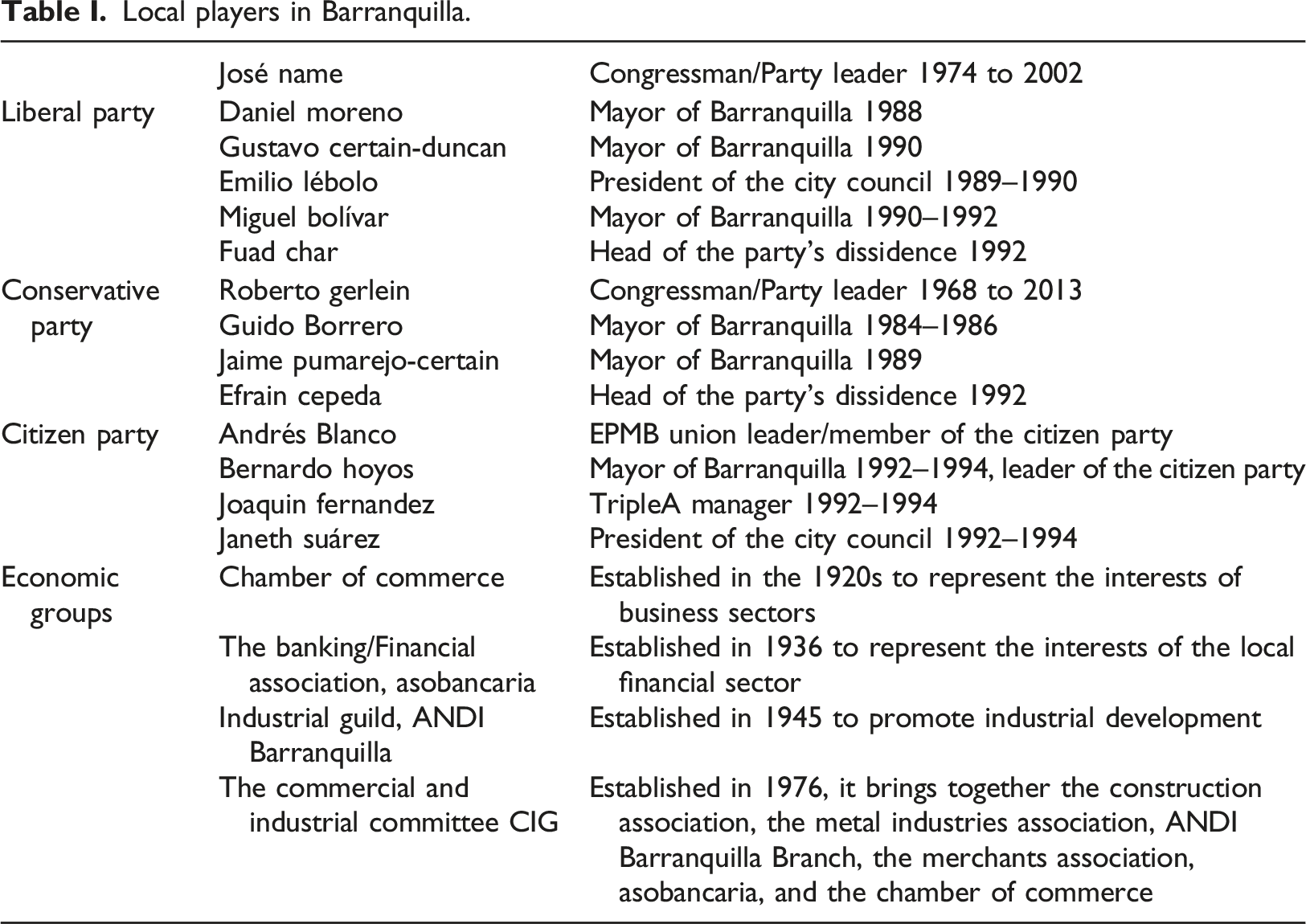
By the mid-1980s, cities were growing disorderly and unevenly as a result of mounting violence. These national processes had a local expression in Barranquilla, where Liberal and Conservative parties had prevailed as the major political forces since the early 20th century. In the 1980s, José Name, a congressman from 1974 to 2002, led the Liberals at the local level, and Roberto Gerlein, a congressman from 1968 to 2013, led the Conservatives (Villalon, 2003). Until the mid-1980s, the president of Colombia appointed all mayors for periods of 2 years. Since Name and Gerlain represented the region in the National Congress, they controlled the appointment of mayors in Barranquilla. The Caribbean coast of Colombia and its main city, Barranquilla (Figure 1), were deeply affected by the country’s armed conflict since the late 1980s and hundreds of families displaced by paramilitary armies began resettling in Barranquilla. From 1985 to 1995, 6709 displaced persons from small towns and rural areas settled in Barranquilla (Unidad de Víctimas, 2016). Most of these groups built informal settlements in the city’s southwest without access to public services (Escobar et al., 1985; Torres, 2009). By then, the utility EPMB was responsible for water, sanitation, and solid waste collection. The mayor of Barranquilla appointed the general manager and served as chairman of EPMB’s board, composed of representatives appointed by the mayor, the city council, the chamber of commerce, the banking association, and the industrial guild (Word Bank, 1985). City of barranquilla, department of atlántico, Colombia. Map: Author.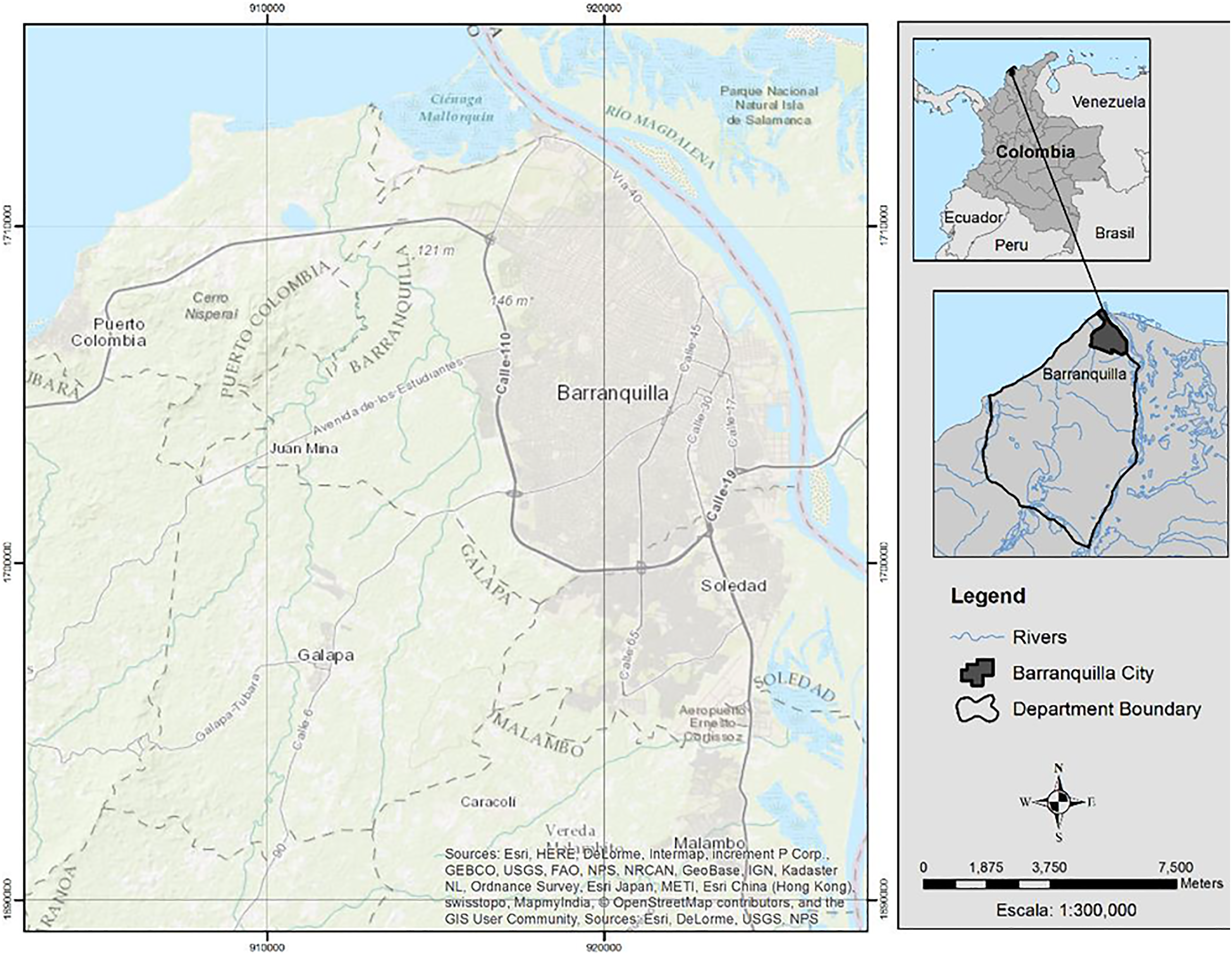
In 1985, the city had four water treatment plants, all located near the Magdalena River, the city’s only water source. Since both the river and the treatment plants are situated at a lower elevation than the city, water delivery is accomplished through a system of pumps and storage facilities. During the mid-1980s, treated water was pumped into four storage tanks, which in turn pumped water into the neighborhoods located in the city’s central and northern sections (INSFOPAL, 1975). In 1985, the city’s water system had major deficiencies as transmission capacity was insufficient to deliver treated water to the southwestern part of the city, which lacked household connections, and where most of the urban growth was taking place (Word Bank, 1985: 11). The result was that EPMB only served approximately half of the city’s total population through residential, industrial, and commercial water connections (Word Bank, 1985; World Bank, 1985b). The existing water system was in a state of disrepair: pumps for transmitting treated water failed frequently and EPMB’s attempts to better distribute the existing pumping capacity were hampered because many of the system’s key pressure valves were deteriorated (World Bank, 1985b). The city’s sanitation infrastructure was in a similar state, as only about half of the city’s population living in the northern and central neighborhoods had sewerage connections (Word Bank, 1985). Solid waste collection was also restricted to the northern and central neighborhoods (World Bank, 1985b).
The population living in the southwestern part of the city purchased water from private vendors in a speculative market (Escobar et al., 1985: 15). Apart from these private vendors, southwestern neighborhoods had two public standpipes. Community Action Boards (JACs), which have a long tradition in Colombia as basic units of social organization at the neighborhood level, managed the standpipes in both neighborhoods, and water was much cheaper than that sold by private vendors. JACs were elected on each neighborhood and were at the same time protected by the law and independent from the government (Escobar et al., 1985; World Bank, 1985b). At the time, EPMB derived its revenues from tariffs, and by mandate of the city council, it also received 100% of the property tax collected in the city. Although these funds were destined to the extension of water and sanitation services, they were used to pay down debts and cover operational expenses (Word Bank, 1985; World Bank, 1985b).
In 1984, EPMB had financial problems as billing and collection were irregular, and only 20% of existing connections had functioning water meters. Preventive maintenance was infrequent, and managers changed often, the staff was poorly remunerated and protested about job instability and lack of career prospects (Word Bank, 1985). The utility had neither construction nor engineering personnel and relied heavily on external consultants, at significant expense (World Bank, 1985b). Cash deficits were financed mainly by commercial bank overdrafts and by increases in debt to suppliers (Word Bank, 1985; World Bank, 1985b). Conservative president Betancur chose Guido Borrero as mayor of Barranquilla for the period from 1984–1986. Borrero was pressured by the city council to counter EPMB’s crisis. As the city council was elected by popular vote, many amongst its Liberal majority, coming from unprivileged backgrounds, asked for the extension of water supply to the south of the city (Escobar et al., 1985). Borrero requested funding from the World Bank for urgently needed investment in water supply, sewerage, and solid waste facilities (World Bank, 1985b). According to a World Bank report (1985: 12) local authorities were “prepared to support rehabilitation efforts as they have realized that drastic measures are necessary to reverse the deterioration of public services in the city.”
Negotiations between the Bank’s staff and mayor Borrero took place in Washington D.C. The guarantor of the loan was the Government of Colombia. Before the project was approved, both the central government and the mayor of Barranquilla agreed on six “conditions for the loan.” EPMB agreed to revise its tariffs and implement new ones. Local and national authorities promised to reduce the level of turnover in EPMB’s management to “isolate decisions about management from local politics”. EPMB agreed to have its accounts and financial statements audited; and not to take on any new loans without the approval of the World Bank. Also, the city agreed not to allow private sector participation and not to contract out any services to private companies, as this would “negatively affect the implementation of the project” (World Bank, 1985a: 4). Since World Bank officials were concerned about the lack of water access in poor southwestern neighborhoods, they aimed to provide them with a short-term solution. Therefore, 50 public standpipes were to be installed during the first months of the project to complement the two existing ones. As a result of pressure from the World Bank, EPMB agreed to build the public standpipe network in the southwestern part of the city in close coordination with the JACs and to sell water for the standpipes at a subsidized price (Word Bank, 1985: 15; Republic of Colombia and World Bank, 1985).
Besides the immediate expansion of water distribution in the southwestern part of the city through the construction of 50 public standpipes, the project’s first stage would also fund the expansion and improvement of water transmission, storage, pumping, and distribution facilities. The second stage concerned sewerage; the third part was focused on solid waste, and the fourth was an institutional improvement program. Project implementation was scheduled to take 6 years, with completion expected by mid-1992. Contracts to buy the most complex equipment had to be awarded to foreign manufacturers, while those for pipes, spare parts, chemicals, and civil works could be awarded to local firms (Word Bank, 1985). A World Bank memorandum stated that they expected the Colombian government to cover any debt that might result from the project’s potential failure. It highlighted that Colombia “has become a net petroleum exporter” with government policies focused on containing the fiscal deficit and that “Colombia’s growth prospects for the rest of the decade are good” (Word Bank, 1985: 3).
Two cousins, one fraud, and many spare parts
In the late 1980s, important legal reforms were made in Colombia to increase citizen participation and give greater autonomy to cities (Arias-Trujillo, 2011). The reforms introduced the popular election of mayors, which had a great impact on the functioning of EPMB. The law that introduced the popular election of mayors was passed in 1986, and the first elections were held 2 years later, in 1988. This 2-year period was marked by significant instability in municipal governments across Colombia, as parties focused on local electoral campaigns. In Barranquilla, several appointed mayors resigned in succession after the enactment of the law, to dedicate themselves to campaigning. From 1987 to 1988, Barranquilla had four different mayors. Moreover, the Barranquilla World Bank Project was negotiated with the Conservative mayor Borrero, but would need to be executed by Liberal mayors as the Liberal Party took power nationally in 1986. This had direct consequences on the project. First, the public standpipes program in the southwestern area of the city was never carried out. In 1988, the mayor’s office requested that the World Bank cancel it. Although the Liberal Party agreed with the extension of networks to the Southwest, they saw standpipes as a “backward” solution. Without consulting the city council, Liberal mayor Daniel Moreno, who spent less than 6 months in office, stated in a letter to the World Bank that “the public standpipes program is not necessary” and that “the city would rather focus on the rapid installation of modern residential connections” (World Bank, 1993: 7).
Works on a storage tank, one of the most ambitious infrastructural works, were already underway in mid-1986. However, none of the other infrastructure works were undertaken in the projected timeframe. EPMB used most project funds to purchase chemicals to treat water and to buy new pipes, valves, vents, hydrants, and water meters. Yet, instead of installing these materials and using the equipment, EPMB stored them (World Bank, 1993). They took them out of storage in 1988, during the final phase of the mayoral race. This election was contested between two cousins: Jaime Pumarejo-Certain, from the Conservative Party, and Gustavo Certain-Duncan, from the Liberal Party (Villalon, 2003). Members of southwestern JACs questioned the disorganized allocation of project resources by members of the Liberal Party who prioritized only some neighborhoods: They [Liberal Party politicians] put the money where they want, even if all southwestern neighborhoods were supposed to participate. Two neighborhoods, Siete de Agosto and Carrizal, got water pipes in exchange for votes because Liberal politicians went there and announced boldly, “I will bring the pipes, only if I collect all the votes of the block” (Bernal-Forero, 1991: 80).
Similarly, during election time, houses in neighborhood La Esmeralda received piles of pipes from members of the Liberal Party who had family connections in the neighborhood. People had to store these pipes on their patios and were told that they would get them installed once the Liberal candidate Certain-Duncan got elected. However, Certain-Duncan lost, and the pipes were never installed (Bernal-Forero, 1991: 87). Some years later, local police reported finding water pipes abandoned in the streets of the southwest (Dugand, 1990).
Pumarejo-Certain, the Conservative candidate who won the election, was less worried about extending infrastructure to the southwest. While the Liberal Party was for a gradual extension of infrastructure into the Southwest, the Conservative Party was opposed to extending networks as this could encourage the arrival of more inhabitants to the sector, in a context of accelerated urbanization due to forced displacement (Cantillo, 1997). Pumarejo-Certain was keen on using the loan’s funds to maintain/repair and even extend the existing network in the center and north of the city (Tagie, 1991). At his arrival in office, he named a new manager for EPMB. Stability, however, was temporary. Only months after taking office, the mayor was accused of electoral fraud. After a vote recount, his cousin, Liberal candidate Certain-Duncan, was declared the winner (Alvarado, 1989). Once in office, mayor Certain-Duncan appointed another manager. Amid uncertainty over the election, accusations of fraud and instability, many of the project’s conditions were breached. Fifty-thousand water meters were imported and simply put into storage. Thus, by 1990 not even big consumers —such as those in the industrial and commercial sector—were metered (Bernal-Forero, 1991: 41). It is important to note that not all materials and equipment were stored as part of a specific electoral plan. Many were stored and forgotten as a consequence of disorganization and managerial disorder. In 1992, equipment purchased by EPMB worth $5.13M was declared abandoned by the national customs. Hundreds of pipes and pumps were intended for water extension to the southwestern city. They were imported and arrived in Barranquilla in early 1988 but since EPMB never claimed them, customs declared them abandoned (Mariano, 1992a).
By 1990, the main newspaper in Barranquilla, informed that EPMB was spending most of the World Bank funds in repayment of debts and chemicals to treat water (Lébolo-Castellanos, 1990). Since EPMB had accumulated debts with the local companies that supplied these chemicals, it had to start buying from resellers who tended to increase the price of the chemicals (Lébolo-Castellanos, 1990). In August 1990, the whole city woke up without water due to the lack of sufficient aluminum sulfate, one of the chemicals used by EPMB in water treatment. This led to a general water shortage and street protests (Peñaloza, 1990). After these widespread water shortages, the so-called “water crisis in Barranquilla” became a priority and the city entered a stage of evaluation regarding the World Bank Project. In June 1990, the president of the City Council, Liberal Emilio Lébolo, warned about the breaches to the World Bank loan agreement (Lébolo-Castellanos, 1990). Because of the project’s negative balance sheet, an accountability debate took place and different actors began assigning blame. The first to make accusations were the city’s economic elites, who formed the Commercial and Industrial Committee CIG. 6 This committee accused the city council of leading EPMB to bankruptcy (Lemus-Navarro, 1990a; López-Vargas, 1990b).
Faced with these accusations, the Liberal Party accepted some responsibility for the crisis. They argued that, since both parties had such different ideas on what to do in the face of rapid urbanization (in the midst of displacement), they never came to an agreement. For years, the council has been a boxing ring where the majority coalition permanently boxed against the minority. Liberal Party against Conservative Party or vice versa. We fight among us. That is why we did not take care of EPMB. Therefore today, we have no pipes, no water, and no sanitation. (Sarmiento-Coley, 1990c)
Despite accepting responsibility, the Liberal Party believed that the economic elites were not blameless and that they were trying to “present themselves as victims” (Sarmiento-Coley, 1990b). Councilors pointed out that EPMB’s eight-member board had representation from the chamber of commerce, the Banking Association, and the creditor banks, thus four of the eight board members were “businessmen themselves” (Editorial Diario del Caribe, 1990). EPMB’s Union, in turn, was accused by Conservative councilors of contributing to the utility’s downfall and of having ties with leftist guerrillas. The union leader, Andrés Blanco, closer to the Liberal Party, denounced that by making such accusations, Conservative politicians were putting the lives of the union leaders at risk and went on to state that there were others to blame, such as the economic elites: “Commercial and industrial sectors have never paid their water bills or their property taxes” (Sarmiento-Coley, 1990c). After new local elections in 1990, Miguel Bolívar, representing the Liberal Party, came to power. He believed that the utility could be restructured, and the city council, with Liberal majorities, authorized him to start planning the restructuring (Lemus-Navarro, 1990b). The plan met with significant opposition from the Conservative Party and the CIG, which were against any restructuring and argued instead for the creation of a “new, efficient and technical entity”. Conservatives and the CIG proposed that EPMB’s assets be sold in order to cover its debts and create a new company with private sector participation (López-Vargas, 1990a). The union, in turn, occupied the city council to protest their proposal. The mayor promised that he “would not allow any layoffs” (Sarmiento-Coley, 1990a). As an alternative to privatization, the union proposed a strategy to recover unpaid property tax and improve the finances of EPMB. Specifically, they suggested that lists with the main defaulters be published in the local press (Sarmiento-Coley, 1990a). This was carried out by the Liberal local government in September 1990: the main defaulters belonged to the industrial and commercial sector (Rincón, 1990).
In 1990, the central government expressed concern about the significant breach of commitments made under the loan and requested that the World Bank stop disbursements (Granados, 1990; Granados and Puerta, 1990). Loan disbursements were suspended in November 1990. However, 91% of the loan had already been allocated (World Bank, 1993: 1). In its report on project closure, the World Bank concluded that the project was “a startling failure” (Latin America and the Caribbean Office, 1993). In December 1990, EPMB’s bank accounts were seized by one of its creditor banks (Mariano, 1990). EPMB’s general manager urged the central government to give them some financial support. Amidst pressure from the CIG, the Conservative Party, and the national government, the mayor and the city council agreed to liquidate EPMB and create a new water utility with private sector participation (Mariano and Tagie, 1991a). Union protests began immediately but were repressed by the national Army (Mariano and Tagie, 1991b). The new water and sanitation company, TripleA, was formed and its new staff hired. The City of Barranquilla retained 51% of the shares and all other shareholders came from the private sector (Mariano, 1991).
With the Liberals opting to gradually extend some networks and the Conservatives bent on privileging the central and northern neighborhoods of the city, we see here how the differences between the parties mattered. In this case, these differences were made greater by the advent of municipal elections and the phenomenon of forced displacement. Private sector participation was therefore not promoted by the World Bank, but rather a result of disagreements between parties, central authorities, and economic elites. Although the influence of the World Bank and the legacies of debt are palpable in the country and the Global South in general (Budds, 2013; Budds and Sultana, 2013; Furlong, 2020), in Barranquilla decisions related to water governance did not depend exclusively on this actor. By overlooking formal politics, political ecology literature may then overstate or take for granted the role of the World Bank.
Different imaginations of the city
We have seen how EPMB was liquidated and, with participation of the private sector, a new company TripleA, was created. Its board was composed of four representatives: one chosen by the CIG, one chosen by private shareholders, one nominated by the city council, and one nominated by the city mayor (Fernández, 1992a). Since the creation of TripleA, consensus between the Liberal mayor, Bolívar, the CIG, and the company board had been the norm. This changed during the 1992 mayoral elections. By then, the local traditional parties had become internally divided. In the Liberal Party, still led by the Name family, a dissident faction under the lead of Fuad Char, the owner of several chain stores and a media conglomerate, emerged. This dissident faction challenged the party’s traditional leadership and argued that public services should in fact be extended urgently to all southwestern neighborhoods. In the Conservative Party, a new faction, led by Efrain Cepeda, challenged the traditional leadership of the Gerlain family (Villalon, 2003). In the context of these divisions, and with many professional politicians who felt that the Liberal Party was no longer representing their ideas, a new political party (the Citizen Party), emerged from the city’s southwestern neighborhoods. Its leader was the activist and catholic priest Bernardo Hoyos.
The birth of the Citizen Party was a response to the living conditions in southwestern neighborhoods. A new storage tank, built in the sector with the World Bank funds, was inaugurated in 1988, but it was not connected to the treatment plants nor the neighborhoods. Although Liberal politicians offered water pipes during the 1988 election, most neighborhoods were not able to install them, as they were geographically distant from existing storage tanks (Bernal-Forero, 1991). In 1991 southwestern neighborhoods, home to approximately 500,000 people, bought expensive poor-quality water from vendors and suffered from overflows of raw sewage. The two public standpipes, installed in the early 1980s, had fallen into disuse due to the lack of support from EPMB (Bernal-Forero, 1991). By late 1991, southwestern neighborhoods were still waiting for the 50 public standpipes promised as part of the Barranquilla World Bank Project (Bernal-Forero, 1991). Their frustration and discontent began to be channeled by the movement led by catholic priest Hoyos.
Local players in Barranquilla.
A few days after the election, the new mayor visited southwestern neighborhoods in order to analyze their water problems with the help of the JACs. He announced that he was going to prioritize works on water, drainage, and sanitation. He gave TripleA 15 days to clean drainage channels and start collecting solid waste in the southern neighborhoods (Fernández, 1992d). From that moment on, the relationship between mayor Hoyos and TripleA’s board was tense and confrontational. Hoyos and his political party disagreed with the way in which the company had been created (Fernández, 1992b). Although the party agreed on many things with the Liberal Party, as both parties shared a vision of the city that fully included the southwest and its new inhabitants in the context of armed displacement, it criticized the Liberals for giving in to pressure from the CIG and accepting the liquidation of EPMB. For the Citizen Party, TripleA was the product of “in an irrational process, in which the municipality gave away everything it had, including all EPMB’s physical assets, and received very little in return from the private sector” (Cantillo, 1994). When the Conservative Party and the CIG asked the mayor to stay out of the utility’s managerial decisions, Hoyos replied: When communities have no access to water, they don’t go to the homes of businessmen, managers or owners of private companies to protest. But they protest in front of the mayor's house. For this reason, I have the right to demand that my views are taken into account in what concerns TripleA’s management. (Fernández, 1992c)
The new mayor called on the private sector to invest more in TripleA and stated that the municipality had been subsidizing the new company since its creation. The Citizen Party had majorities in the council, headed by the former union leader Janeth Suárez, one of the party’s leaders who was also one of the first women to preside a city council in Colombia. In December 1992, the mayor managed to put pressure on TripleA’s board to appoint one of his trusted advisers, Joaquin Fernandez, as manager of the utility. During his early days as a manager, Fernandez suspended water services to 234 companies that owed the city millions in unpaid water bills (Mariano, 1992b). The new manager declared that the wealthiest had accumulated the highest debts: “The wealthiest neighborhoods and commercial and industrial sectors have the highest rates of tax evasion, arrears in their water bills, and fraudulent connections. We are doing between 25 and 30 water service suspensions daily”. He also drew attention to the industries that made use of illegal dumpsites, reminding them that “TripleA spends billions a day collecting solid waste from unauthorized landfills” (Fernandez-Malabet, 1993). TripleA also started installing water meters in wealthier neighborhoods as well as in industries and places of commerce: the cost of the meter and the installation was to be paid by users in instalments (Rosales-González, 1993).
Mayor Hoyos called for greater allocation of central government resources and requested loans from two national private banks in order to extend water supply to the southwest, building infrastructure to connect the treatment plants with the new storage tank. The local government also planned to build a new pumping station, complementary mains, and residential connections (Mariano, 1993). TripleA was hired to carry out these extension works. Some of this infrastructure was put into service in April 1993 (Editorial el Heraldo, 1993). In mid-1993, mayor Hoyos requested a loan from Spain’s government to build a second pumping station in the south (Mouthón-Mejía, 1993). Anticipating the duration (and possible delays) of the works, the local government started buying potable water from TripleA and distributing it freely in southwestern neighborhoods three times a week (Cantillo, 1993b). While water supply works were being carried out, the local government received government funding to extend sanitation infrastructure (Rosales-González, 1994a).
As mentioned before, formal politics in Colombia experienced a process of democratization during the 1980s and 1990s and through this process, which coincided with the urbanization of the country, many found work and made a living from formal politics. However, this process was prominently experienced by the Liberal Party, that had internal rules based on consensus, whereas in the Conservative Party decision-making was more hierarchical (Gutierrez, 2007; Gutiérrez et al., 2008) Here it is necessary to highlight that the Liberal, Conservative, and Citizen parties had different visions for the future of Barranquilla, because in a way they had different visions of its present. More than a vision, this entailed a whole different sensory experience of the city. While the Conservative Party focused on the welfare and “progress” of the older, more stablished urban sectors even going so far as to propose the building of a separate municipality in which to relocate the region’s displaced populations (Cantillo, 1997), some members of the Liberal Party and most members of the Citizen Party lived and worked in the southwestern city. This is evident in one of mayor Hoyos’ speeches I ask TripleA managers and others to leave the north of the city and come to the mud.
8
Because they do not know the misery in which people are living in the Southwest. They may have graduate degrees, they may be wearing perfume, but (…) they have to take on the challenge that the city requires them to take: we are in the middle of a health emergency and we need to grasp the severity of the situation for southwestern communities. (Cantillo, 1993a)
The city government was closely monitoring the deadlines in the construction of infrastructural works. Local media reported that during the last days of 1994, city officials pressured contractors to work faster, “even calling engineers to their homes” (Rosales-González, 1994b). A few days before the end of the year, when mayor Hoyos finished his office period, TripleA finished the sewerage network in four of the neighborhoods in the southwest (Rosales-González, 1994c). In early 1995, more neighborhoods in the southwest gained access to residential water supply (DelaCruz, 1995). The utility also began collecting solid waste using equipment purchased with the World Bank loan. These works improved drainage services in the area (Betin-Freu, 1995).
Conclusions
The purpose of this article was to document the implementation of the Barranquilla World Bank Project in a context of armed conflict, population displacement, and city growth. Despite believing in the necessity for some water extension to the southwest of the city, Liberal Party politicians privileged campaigning with World Bank funds during the first mayoral elections. For the Conservative politicians both in office and in the city council, discussions focused on improving services in the city’s northern and central areas, already covered by the network. The parties had different ideas about who belonged in the city. As explained above, it was not until the government of mayor Hoyos and the emergence of the Citizen Party that effective measures were taken to extend water services to the southwest. Still, most infrastructure works were not completed until 1995, 10 years after the World Bank Project began, and 5 years after it ended.
Work on the political ecology of water development (...) has described how, in the midst of a “state failure” discourse, the World Bank focused on projects favoring private sector entry through cherry-picking (Bakker, 2013). However, the Barranquilla World Bank Project does not fit this description. With many of its components focused on southwestern Barranquilla, it was not a money-generating project. Drawing on previous experiences, the World Bank also foresaw delays in the infrastructure works and included the fifty public-water standpipes, a short-term subsidized solution for southwestern neighborhoods. Although the project tried to shield the utility from local governments’ influence, it did not promote private sector participation. The World Bank had successful experiences working on projects with other public utilities in Colombia’s major cities and was confident in the fact that, with the right investment, EPMB would follow the example of other municipal corporations such as EAAB in Bogotá and EPM in Medellin. Thus, it was not the World Bank intervention what introduced private sector to water governance in Barranquilla. It was the failure of the World Bank Project what prompted private sector involvement. Examining professional politicians as well as formal political contestation somehow places an actor like the World Bank, that has been often at the center of water governance analyses, on the sidelines.
While many studies of political ecology assume a certain cohesion among economic elites and elected officials (Budds, 2013; Swyngedouw, 2004) and document everyday life of communities as they negotiate with local politicians exchanging infrastructural favors for votes and loyalty (Anand, 2017; Gandy, 2008), this article unpacks local professional politics to better explain water distribution in the city. Political ecology studies the ways in which water becomes politicized to the extent that its distributions are always contested. However, rarely analyzes professional politicians as differentiated actors with different ideas, procedures, and positionalities. In the urban South, where professional politics has been a way of upward mobility in a context of extreme inequality, many of these professional politicians come from the same communities with which they negotiate for access to infrastructure. In doing this, I followed calls by Gutiérrez et al. (2007) to study the role of party politics in urbanization and to explore professional politics: how it works, how it has transformed, what its purposes and strategies are, and what observations and lessons it draws from. I also remain conscious of the need to broaden the range of cities that speak to theory (Lawhon et al., 2020) and to take seriously “the actually existing contexts and practices shaping southern cities” (Lawhon and Truelove, 2019: 4)
The implementation of the Barranquilla World Bank Project in 1985 unleashed a series of disagreements and alliances between the national and local governments, the city council, the Liberal, Conservative, and Citizen political parties, and the economic elites of Barranquilla. These alliances and disagreements were based on different positions and ideas about the distribution of water in the city, and about the future of the city more broadly. Instead of a straightforward implementation of the Bank’s recommendations, it was a highly contentious process that coincided with the advent of local elections and with the arrival of displaced populations to the city. A process that triggered the internal division of the traditional parties and disagreements between the economic elites and the local government. Moreover, it led to the emergence of a new electoral force that won the 1992 elections.
Footnotes
Acknowledgements
My tía Amparo Acevedo-Ordonez moved from Barrancabermeja to Barranquilla in the early 1980s and made a life there. I want to thank her for helping me know (and love) this city. I also want to thank Kathryn Furlong, Lina Pinto-García, and Diana Ojeda for providing insights into the analysis and arguments presented this article. I also thank the anonymous reviewers of this article for their constructive and generous feedback.
Declaration of conflicting interests
The author(s) declared no potential conflicts of interest with respect to the research, authorship, and/or publication of this article.
Funding
The author(s) disclosed receipt of the following financial support for the research, authorship, and/or publication of this article: This work was supported by the International Development Research Centre (Doctoral Award).
