




Abstract
Policy makers, academics, and conservationists often posit that poor coordination between different land use sectors, and between levels of governance, as an underlying challenge for reducing deforestation and forest degradation. This paper analyzes this argument using data from interviews with over 500 respondents from government, nongovernmental organizations, private companies, local and indigenous communities, activists, and individuals involved in 35 diverse land use initiatives in three countries: Peru, Indonesia, and Mexico. We find that while there is strong evidence of widespread coordination failures between sectors and levels, more fundamental political issues preclude effective coordination. We argue that political coalitions act to oppose environmental objectives and to impede their opponents from participating in land use governance. Moreover, we find that where coordination between actors does occur, it does not necessarily produce environmentally sustainable and socially just land use outcomes. Where we do find successful initiatives to reduce deforestation and benefit local people, effective coordination between well-informed actors is often present, but it does not occur spontaneously, and is instead driven by political organizing over time by activists, local people, nongovernmental organizations, and international donors. We suggest that the global environmental community must recognize explicitly these political dimensions of land use governance in order to successfully collaborate with local people to reduce deforestation.
Keywords
Introduction
As advocates for conservation struggle to reduce global deforestation and associated threats to human well-being, biodiversity, and the Earth’s climate system, a consensus seems to emerge: the failure of sectors, such as mining, forestry, environment, and agriculture to “coordinate” with each other, is a major barrier to sustainable and equitable land use.
This view has been expressed in international forums like the United Nations Framework Convention on Climate Change Conference of Parties (UNFCCC COP) (Becerra, n.d.; Egal, n.d.; Gregorio et al., 2013), the Global Landscapes Forum that has taken place alongside it since 2013 (Center for International Forestry Research (CIFOR), 2015; Freeman et al., 2015; Rantala et al., 2014; Ros-Tonen et al., 2014), and also in national and subnational policy (Brockhaus et al., 2014; Gallemore et al., 2014; Kowler et al., 2014; Ravikumar et al., 2015b). Researchers and policy advocates have pressed for more intersectoral coordination around land use planning in general, and as a key element of the international deforestation reduction scheme REDD+ (Reducing Emissions from Deforestation and forest Degradation) in particular.
Lack of coordination between sectors, the argument goes, leads government ministries to work at cross-purposes rather than collaborate. Agricultural and mining offices promote extraction and investment activities that lead to deforestation, while forestry and environmental offices struggle to keep natural resources intact for sustainable production, conservation, and climate change mitigation. If sectors that have historically worked at odds with, or at least in isolation from, one another were to finally coordinate—that is, deliberate, negotiate and plan—they could achieve equitable low-emissions development. This logic is increasingly applied at multiple levels, as coordination issues have been emphasized not only in national but also in sub-national and even international arenas.
The purpose of this paper is to contribute to the Integrative Governance (IG) literature (see Visseren-Hamakers, 2018a, 2018b) by taking a critical look at this emerging conventional wisdom, and to examine the degree to which “coordination” across multiple sectors and levels determines land use change outcomes. IG is defined as the theories and practices that focus on the relationships between governance instruments and/or systems (Visseren-Hamakers, 2015). We contribute to the IG literature by examining why the relationships between the environmental governance system and governance systems for other sectors (e.g., agriculture, mining) are the way they are. We aim to explain these relationships, something that has not been done very often in the IG literature so far (see Visseren-Hamakers, 2015).
We use data from interviews with hundreds of respondents from multiple sectoral offices of national and subnational governments, environmental nongovernmental organizations (NGOs), private companies, local and indigenous communities, activists, and individuals involved in 34 diverse land use initiatives in three countries: Peru, Indonesia, and Mexico. Interviews elucidated multilevel and multi-sector assemblages of actors that drive land use decision making, by exploring decision processes, their legitimacy, and actors’ relative power and influence.
While respondents commonly reported lack of coordination related to land use, we argue that a deeper analysis of the political dynamics reveals that “lack of coordination” is not by and large the underlying barrier to equitable and sustainable land use: rather, coalitions of actors who stand to gain from deforestation wield political power to systematically exclude coalitions for conservation and community land rights. Thus, the widespread “lack of coordination” discourse is problematic because it obfuscates historical and ongoing political contestations, suggesting that all stakeholders desire the same ends and could achieve them if they would merely come together to “coordinate” around these shared objectives. Our results suggest, rather, that there are distinct coalitions with genuinely divergent ideas about conservation and development, and mutually incompatible land use objectives.
We argue that the underlying factor that attenuates the influence of coalitions for environmental sustainability and local peoples’ rights is that opposing political coalitions actively subvert them. Moreover, we find that where coordination between actors does occur, it does not necessarily produce environmentally sustainable and socially just land use outcomes. In fact, coordination among actors such as agricultural and mining offices, private firms and elites with special interests is often instrumental in bringing about deforestation and its attendant social and environmental harms. On the other hand, where we do find successful initiatives to reduce deforestation and benefit local people, effective coordination between well-informed actors is often present, but it does not occur spontaneously, and is instead driven by political organizing over time by activists, local people, NGOs, and international donors. Furthermore, there are at least some cases in which conservation interests work strategically with government offices to protect forests and stop deforestation, but without local peoples’ participation (see also Brockington et al., 2008). Thus, coordination may or may not result in decisions that local actors consider legitimate, even when those decisions support conservation.
We suggest that the global environmental community must recognize explicitly these political dimensions of land use governance in order to effectively engage with coalitions for transformative change that reduce deforestation (see also Myers et al., 2018). We begin by briefly discussing key literature on multilevel and multi-sector governance, highlighting research on how coalitions interact, through collaboration and through more adversarial contestation. Then, after describing the study methods, we present key evidence from the comparative case study of land use change across the three countries. We conclude with a discussion of these findings in the context of emerging low-emissions development policies and international discourses, and especially the much discussed “landscape approach.”
The politics of landscape governance
Research on advocacy coalitions, landscape governance, polycentric governance, and political ecology addresses the relationship between coordination among actors and land use change. We use the term Integrative Governance (Visseren-Hamakers, 2015) to describe the intersection of some of this scholarship. IG studies not only provide room to examine the details of who makes decisions and how decisions are made, but also emphasize how different actors operating at different levels and across sectors exercise power to achieve their objectives (see, e.g., Agrawal and Ribot, 1999; Andersson and Ostrom, 2008; Larson, 2005; Ribot, 2002). In this section, we show how this literature provides tools for analyzing the politics of land use across levels and sectors, and highlight a tendency to focus on coordination problems. At the same time, we suggest that the literature does not adequately explain the reasons behind these coordination failures, and as a result does not adequately present political solutions.
In principle, effective coordination between actors can be very useful for reducing deforestation and forest degradation. It is commonly understood that the drivers of deforestation often originate outside of the forestry sector. This means that some kind of cross-sectoral coordination is required to address it, and when this has occurred effectively, the results have been notable. For example, deforestation in the Brazilian Amazon declined 70% from 2005 to 2013 at least in part due to the joint action of an interministerial working group (May et al., 2016; Nepstad et al., 2014). But such success is not common, and there has been a backlash in Brazil.
Although many fields of study go beyond de jure relationships between state agencies and non-state actors, the emphasis on the fundamentally political nature of land and natural resource decision-making emerges most directly from literature influenced by political ecology (Larson et al., 2013; Peluso and Lund, 2011; Ravikumar et al., 2015b; Ribot et al., 2010). Whether governance is legally centralized or decentralized, the politics of land use can be fraught with conflict (Palmer, 2011; Ravikumar et al., 2013; Yasmi et al., 2006), and differences are settled through contestation among actors with different interests (Ferguson, 1990).
The literature on policy advocacy coalitions suggests that there are multiple ways in which different actors come together to interact. Weible et al. (2009) contrast adversarial and collaborative policy systems. They posit that adversarial systems are characterized by highly competitive coalitions with polarized beliefs, minimal coordination, disparate access to authorities (with some government agencies strongly favoring some coalitions over others), and extensive venue shopping by actors who look for favorable partnerships to achieve their objectives to the exclusion of others. Conversely, collaborative systems involve coalitions with at least some shared or convergent beliefs, some coordination among coalitions, shared access to decision-making authorities without strong favoritism, and an emphasis on achieving “win–win” solutions through compromise. Barnes et al. (2016) argue that advocacy coalitions deploy diverse strategies depending on the political constraints that they encounter, finding for example that civil society coalitions organized around the forestry sector in India deployed both adversarial and collaborative strategies.
While the advocacy coalition literature often defines coalitions in terms of groups with shared beliefs (Barnes et al., 2016; Kumar, 2014; Schlager, 1995; Scholz and Pinney, 1995; Weible and Sabatier, 2006; Weible et al., 2009), Arts and Buizer (2009) argue that coalitions are not so much formed around shared beliefs—which are properties of individuals or organizations—but are instead shaped by discourses, which are external to actors. In a post-structuralist conceptualization of coalition building, then, coalitions are presumed to form not only around fixed beliefs, or even economic interests (Quaglia, 2010), but also by continuously shifting ideas about policy. In other words, governments, NGOs, and even indigenous organizations do not just have material interests; they have ideologies. These ideologies can be “neoliberal,” favoring market and privatization-oriented solutions to environmental issues, poverty, and even more obviously political problems, like how to allocate land rights. Conversely, “rights-based” ideologies can serve to bring together communities, producer organizations, and environmental NGOs.
Rudel (2007) identifies the limits of collaborative governance as a means for achieving conservation and social justice objectives. He argues that government policy constrains or magnifies the influence of these coalitions that seek to benefit from deforestation. For Rudel, growth coalitions broadly refer to highly capitalized development actors. He contrasts growth coalitions with smaller farmers, laborers, and others who benefit less, or less directly, from conventional economic growth. Rudel argues that contestations between these groups shape land use and socioeconomic outcomes.
Thus, literature from multiple disciplines highlights the role of power and political contestation in forming coalitions for action—stable or ephemeral, adversarial or collaborative. At the same time, literature on polycentric and multilevel governance emphasizes that these coalitions and looser constellations of actors operate at multiple levels and across sectors, including private firms, governments, individuals, and nonprofits. A newer and highly influential literature and associated policy discourse, on integrated “landscape approaches,” though, appears to address these issues of power much less explicitly.
Sayer et al. (2013) set out 10 principles for landscape approaches. Taken together, these principles advance multi-stakeholder dialogue coordination among actors from local to national levels, and strong mechanisms for transparency. These are laudable goals: all else equal, transparent decision processes are more democratic, fairer, and more inclusive. If representatives of different sectors are negotiating in good faith, then more and more transparent dialogue is surely a good thing. What is missing from this analysis, though, is an acknowledgment that different actors are also committed to their own agendas. Nonetheless, in a review of cases, Reed et al. (2016) find that bringing multiple sectors—like agriculture and environment—into dialogue is a predominant feature of landscape approaches.
Milder et al. (2012) suggest that multi-sector approaches can help to resolve structural poverty, and also call out single-sector approaches as historically problematic. Other studies echo their reproach of sectors operating in silos, calling for more social learning, data sharing, and indigenous representation (e.g., Bebbington et al., 2008; Berkes, 2009; Echeverri Perico and Pilar Ribero, 2002). Estrada-Carmona et al. (2014) advance a similar argument based on a broad empirical study, surveying over 100 “integrated landscape initiatives” across 21 Latin American and Caribbean countries. They find that more multi-sectoral coordination likely did improve outcomes, but lament the absence of “powerful” stakeholders, including private firms, in multi-stakeholder dialogues. Their analysis does not consider that coordinating with such actors might be unhelpful or compromising for conservation and environmental justice concerns, nor why these more powerful players did not come to the table. Bastos-Lima et al. (2017) also found that landscape approaches enable coordination among actors within the environmental community, but not between the environmental community and other sectors.
Thus, there is a tension between the political ecology and coalition literature, which emphasizes power and contestation as determinants of land use outcomes, and much of the literature on multilevel governance and “landscape approaches,” which sees coordination and dialogue as solutions. In the context of land use or REDD+, how coalitions work, whether adversarial or collaborative, remains poorly understood. Indeed, much of the discourse around landscape approaches fails to differentiate between these modes of engagement, instead assuming that mere coordination is paramount. The purpose of this research is to go beyond examining whether different actors coordinate to interrogate who coordinates with whom and why and with what results.
Methods
In order to answer these questions, we deployed grounded qualitative research to analyze the politics of land use, including who worked with whom and how, and who ultimately held power in decisions about land use. The approach is described more completely in Ravikumar et al. (2015a) and was influenced by Saito-Jensen (2015). We utilized a global nested comparative case study approach involving research in three countries: Peru, Indonesia, and Mexico. 1
In each country, we first used secondary data to identify two or three subnational jurisdictions or regions that had tropical forests and multiple REDD+ initiatives, contrasting governance regimes, and a variety of types of land use changes. In each subnational region, we selected approximately five sites of land use change to include, to the extent possible:
significant land use or land use management changes within the last 20 years; at least two sites with activities associated with broader regional deforestation and degradation drivers (sites with initiatives leading to more deforestation in Table 1); and at least two with initiatives aimed at conservation, sustainable forest management, reforestation, or other activities likely to reduce deforestation or forest degradation, with a particular emphasis on REDD+ (low-emissions initiative sites in Table 1).
To identify sites, we conducted interviews with key informants, generally in regional capitals, to understand the major drivers of deforestation and degradation, and also the major activities aiming to restore, conserve, or sustainably manage forests (see Table 1).
Sites by country, region, and type.
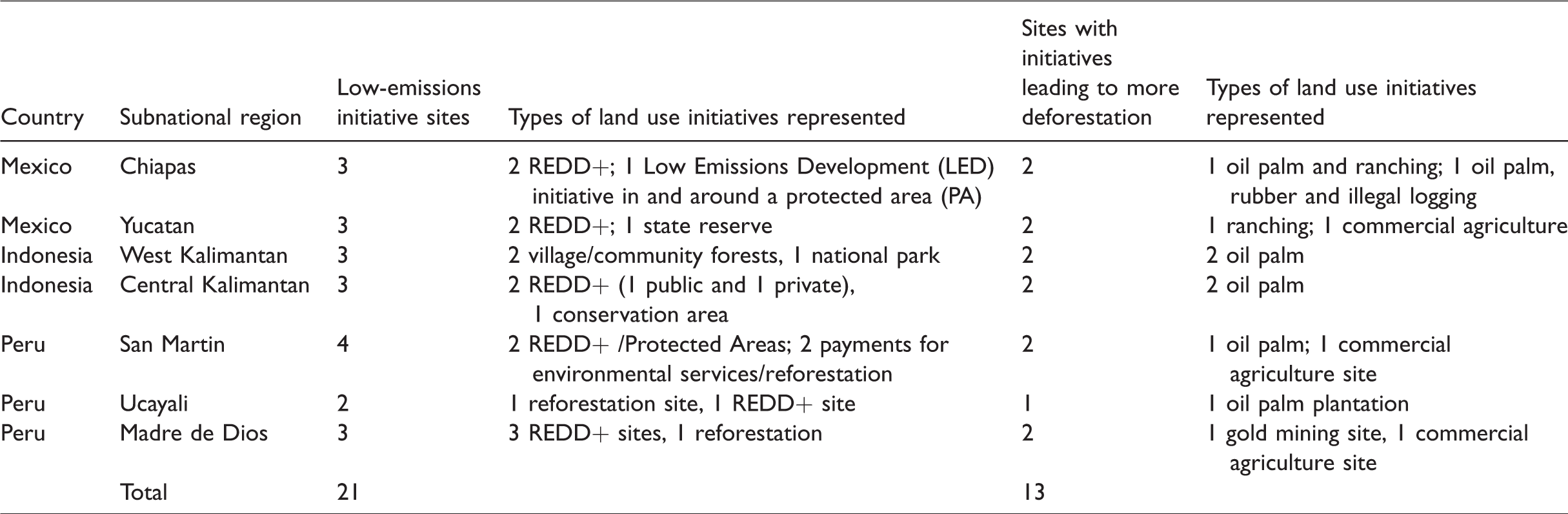
In total, we selected 34 distinct sites of land use change. At each site, we aimed to identify the range of actors with an interest in, or influence over, the land use change. We aimed to interview: respondents from all levels and sectoral offices of government that were likely involved, including agricultural, environmental, forestry, and mining offices; NGOs and private firms who promoted the land use change or had an interest in it; local communities driving, affected by, or involved in the change; researchers, activists, and key individuals with expert knowledge or unique perspectives.
We interviewed 8–20 informants at each site, as well as at the regional level, for a total of 576 interviews (149 in Indonesia, 275 in Peru, and 152 in Mexico) conducted between late 2013 and mid-2015. The semi-structured interviews explored the history of land use, the decision-making process that led to land use changes, relations among relevant actors, perceptions of the legitimacy of land use initiatives, and the distribution of any associated benefits (see CIFOR, 2015 for the interview guides).
Interview notes and selected transcripts were coded using QSR’s Nvivo qualitative research software. Case study and regional summaries were also produced, and the central findings were synthesized in national publications (full reports available: Kowler et al., 2016; Myers et al., 2016; Trench et al., 2018).
Results
Deforestation by exclusion: How extractive interests win
Our study sites covered a range of deforestation drivers. While small-scale subsistence agriculture has long been blamed for tropical deforestation, evidence suggests that larger scale agriculture, mining, and other activities with stronger links to global markets are more important (Lambin et al., 2001; Rudel et al., 2009). Across countries, diverse actors were directly responsible for deforestation and degradation. These included: highly capitalized oil palm companies in Indonesia; small-scale gold miners, farmers engaged in agricultural intensification, and oil palm companies in Peru; and mechanized agriculture and large-scale ranching in Mexico. The sites selected for this study aimed to capture these regionally important dynamics.
Indonesia
Oil palm is seen by many as a pathway to development and improved rural livelihoods (Casson, 2002; Obidzinski et al., 2012; Rist et al., 2010; Sirait, 2009), but concerns have been raised about the social, environmental, and justice implications. Despite these concerns, our research explored why investments continue.
In three of the four oil palm cases that we studied in Indonesia, local people viewed the companies unfavorably (PT GAL, PT CK1, and Landau Leban 2 ), and favorably only in one (PT PAS). Local people in Landau Leban felt deceived by the oil palm company because it did not deliver promised benefits like schools, health services, and higher wages. People reported losing their lands outright to PT GAL, who either signed deals with their leaders without their consent or simply occupied their lands and began plantation activities, despite laws requiring prior consultation (Sanders, unpublished data). Meanwhile, according to government and nongovernment officials, PT PAS went out of its way to consult local people, guarantee living wages, and even develop a conservation area within the concession. What explains these differences?
In the three more conflictive cases, officials from districts and subdistricts, community representatives, and NGOs reported that the national government supported oil palm, with policies allowing private ownership and forest conversion with limited social protections. By contrast, respondents from the national government said the district governments were responsible for forest conversion because district heads approve concessions and plantation licenses. In all four cases, the Ministry of Forestry (MoF) classified the lands as “non-forest” at some point prior to the establishment of the plantations, thus opening them to up for oil palm development. According to representatives of NGOs, the MoF is subject to strong pressure from other national government agencies to promote oil palm, while oil palm companies work directly to secure concessions through well-disposed district heads. Finally, community leaders must sign off on the Environmental Impact Assessments (AMDALs) in order to permit oil palm activity.
Despite complaints from NGOs and even government offices—especially the provincial government—that lack of coordination between different actors was the main obstacle to slowing oil palm proliferation, interviews revealed a substantial network of coordination and collaboration across levels and sectors. District governments, provincial government (which approves a land use plan consistent with concessions), national ministries, the private sector, and even community leaders all worked collaboratively to establish oil palm plantations. There could hardly be a clearer example of highly effective multilevel and multi-sector coordination. Nevertheless, this particular brand of coordination did not lead to environmentally sustainable or socially just outcomes.
While actors with a stake in oil palm worked collaboratively, they also worked against other coalitions in an adversarial fashion. Members of these other coalitions did not have a seat at the decision-making table and lacked meaningful avenues to participate in governance. Subdistrict officials across the three contested oil palm cases reported that they were never consulted by district officials despite being closer to local people and potentially in the best position to represent them. Likewise, environmental NGOs with close relationships to local communities did not have the power to affect outcomes. In these cases, local people were also largely excluded from decision making, with leaders sometimes signing agreements without their constituents’ consent, as reported in the case of PT GAL (Sanders, unpublished data).
In summary, local people and their environmental allies reported feeling disenfranchised, marginalized, deceived, or even robbed by oil palm firms, and the adversarial nature of their respective coalitions precluded collaboration. The oil palm coalitions were successful in finding government allies that were likely to support them, and achieved their objectives to the exclusion of opposing coalitions.
Peru
In Peru, two oil palm cases reveal processes comparable to Indonesia, showing how firms and government offices work together, despite facing different legal particularities. Because oil palm is legally treated like any other crop in Peru, lands that are formally classified as apt for agriculture, whether or not they contain forest cover, are eligible for private ownership by oil palm companies. Government agricultural offices at multiple levels sold lands to oil palm companies directly (as in Ucayali) or reclassified lands to open them up for private sale (as in San Martin), enabling the establishment and expansion of plantations along with attendant deforestation. In these cases, private firms with an interest in oil palm drove land use change with the support of certain government offices. In both Peruvian oil palm cases, as in Indonesia, we found strong evidence that coalitions for oil palm engaged in forum shopping, did not seek win–win solutions, and worked to exclude others from decision-making processes.
Local respondents who opposed oil palm in San Martin believe that the firm influenced the Ministry of Agriculture’s decision to reclassify the land, while the regional government was unable to influence the outcome despite supporting the local resistance. Conversely, in Ucayali, a pro-oil palm regional directorate of agriculture was able to sell land to the oil palm company directly without any external oversight. They also facilitated oil palm expansion by delaying land use permits for smallholders who actively farmed land, instead transferring land use rights to representatives of the oil palm company (Kowler et al. 2016).
In both regions, local people living in or around the lands that the oil palm companies sought to exploit had little say in the decision process. Some households in the Ucayali case willingly joined the plantations, motivated by promises of high profit margins and economic advancement, whereas activists and villagers who opposed oil palm argued that the amount of debt that such households took on was impossible to repay (see also Bennett et al., 2018). Subsequent interviews with local people suggested that their expectations of profit were unrealistic, and that the technical assistance they received from agricultural extension workers and the firm was woefully inadequate.
In both Peruvian cases, government environmental offices were not involved, as agricultural offices were legally empowered to promote oil palm without coordinating with other agencies. In this sense, there was indeed a “lack of coordination” between sectors and levels, as expressed by respondents from the Regional Environmental Authorities of both regions. However, the fact that the National Ministry of Agriculture and Irrigation and the regional directorate of agriculture in Ucayali were so empowered to promote oil palm in coordination with a firm over the objections of local people has two important implications.
First, the laws had been set down in such a way as to impede meaningful environmental regulation of oil palm—a fact that was well understood by respondents from government environment agencies and NGOs. Second, there is no reason to suppose that setting up a multi-sector committee with environment and agriculture sector involvement would have meaningfully altered outcomes in either case.
Rather, actors from the agriculture sector had considerable legal leverage to promote oil palm, and they used it. Even though legal challenges were raised in both cases, on environmental grounds in Ucayali and over procedural malpractice in San Martin, the decisions in favor of the oil palm companies ultimately stood. Peruvian land laws all but ensured that environmental interests would not influence the outcomes, and, as in Indonesia, safeguards for local people were easily circumvented. There were few safeguards in Peru, as local people lacked secure land tenure, and there is no Peruvian legislation comparable to Indonesia’s inti-plasma that requires oil palm firms to share land and revenues.
Mining and other agricultural expansion also drive deforestation in Peru. In Madre de Dios, mining is managed by the state offices of energy and mines along with artisanal miners themselves who make decisions that affect land use. While other actors, such as environmental offices and NGOs, have sought to conserve forests and slow the spread of mining, they have struggled to gain traction. In addition, the national government has intervened to destroy illegal mining equipment, spurring miners to organize and protest to demand formal recognition while leading the people of Madre de Dios to elect a pro-mining governor in 2014.
With the politics of the region shifting to a pro-mining and specifically pro-formalization posture, actors with an interest in gold mining seem to be winning. In this case, again, local respondents—including environment sector actors and individuals associated with the mining federation—reported insufficient coordination between the mining and environment sectors, and also between the national and regional governments. There was ample evidence that lack of coordination in a rather strict sense was problematic: different government agencies’ failure to share information, including land use maps, led to extensive areas with overlapping and conflicting land rights. However, interviews with environment and mining sector actors reveal mutually incompatible visions and positions on the future of land use in the region, and suggest that mining agencies could best advance their extractive agenda by withholding information from pro-conservation actors (see also Rodriguez-Ward et al., 2018).
Across these Peruvian cases, collaborative coalitions were rare. Respondents from Peruvian regional governments were acutely aware of this. An employee of the regional environmental authority of Madre de Dios explained, “native communities, farmers, brazil-nut collectors, loggers and miners all have land conflicts with one another due to the overlapping of concession rights,” suggesting that coordination failures lead to conflict and, ultimately, deforestation. Undergirding these conflicts, though, are fundamentally divergent land use objectives. The mining sector, for example, has no interest in ceding concessions to conservation, nor does the conservation sector plan to open up ecologically sensitive lands for extraction. While mining interests have been broadly successful in Madre de Dios, now through control of the regional government, oil palm coalitions have managed to secure victories through aggressive forum shopping at both the national and regional levels in the other regions, to the exclusion of environmental and local peoples’ rights coalitions. All of these suggest an adversarial relationship between coalitions, where coordination has been actively blocked by more powerful actors.
Mexico
In the two sites of increasing emissions in Mexico’s Chiapas state—Mapastepec and Benemérito de Las Américas—there was broad consensus among national and local government officials, ejido members,
3
and representatives of local producer organizations that government programs and market forces favoring cattle ranching have driven deforestation over the last 40 years. In the last decade, however, the state government, in collaboration with private palm oil processing companies, has promoted oil palm plantations among ejidos and private landowners. In these cases, private companies and government agricultural offices are in direct contact with local communities; other government agencies and NGOs that offer alternative development options are absent. Coordination, according to many respondents, was sorely lacking. As one federal environment sector employee explained: The Protected Areas Commission is interested in the protected areas, the Forestry Commission is interested in the forest, and the Water Commission is interested in water. We all share the same space, and invest large sums of money, but we don’t coordinate our efforts. Each institution sees what it wants to see.
As in other study countries, respondents from government and civil society organizations in Mexico insisted that lack of coordination between the forestry, environmental, and agricultural sectors was pervasive and problematic. Indeed, examining the actors involved in the study cases did reveal that different sectors were active in different regions—a sort of de facto carving out of areas of influence—perhaps to an even greater degree than in Peru and in Indonesia. Interviews with state and national environmental offices revealed that their activities (discussed further in the following section) were limited to particular ejidos with histories of working with them, usually within or adjacent to protected areas. Meanwhile, private agricultural firms are legally and practically free to negotiate with smallholders and ejidos. In a context of ever decreasing state support for smallholder agriculture, there was little room for farmers approached by these agricultural firms to seek other alternatives, despite the consequences in terms of increased environmental and socioeconomic vulnerability.
Nevertheless, ejido members were never categorically excluded from decision processes, and at least ostensible approval from ejidos was required for any activity that might affect common-use forest. Thus, there was some communication between coalitions for agriculture and ranching and ejido members, regardless of whether or not ejidos had viable alternatives. The coalitions for agricultural intensification and ranching were, therefore, collaborative to the degree that they engaged with and negotiated with local people, even if the terms of negotiation were not at all equal. Meanwhile, environmental coalitions could not easily access these spaces, as the agricultural sector dominated relationships with these communities. The under-minister of forestry from the state government of Chiapas aptly characterized the limitations of inter-sectoral coordination in the state: No, the agricultural sector doesn’t attend our meetings; in that sense, we don’t ‘coordinate’ with them—but look: even if we were to move forestry, environment, and agriculture into the same big-tent office, the fundamental tension between protecting the environment, creating jobs, and producing food would not simply vanish!
Successful contestations by environmental and local people’s coalitions
Indonesia
In the regions studied in Indonesia, integrated conservation and development programs, including REDD+ projects, and protected areas exist alongside oil palm plantations. Partnerships involving Indonesian government agencies such as the MoF, 4 foreign governments, and NGOs dominate this space in Central and West Kalimantan. In Central Kalimantan, by the 1990s, the Suharto regime’s policies had caused environmental devastation. Environmental and indigenous peoples’ groups had organized over time to secure support to restore the land and support local peoples’ livelihoods (Myers et al., 2016). International support from Australia alongside local organization led to the Kalimantan Forest Carbon Partnership initiative (Sanders et al., 2017). Despite this organized action, oil palm continued to proliferate in and around the project area. In other words, political will to halt deforestation was limited, but international pressure and growing popular opposition to the oil palm enabled coalitions for conservation to advance their agendas to some degree.
In some other cases in Indonesia, such as the community and village forest cases that we studied, NGOs and communities worked together to suggest alternatives to oil palm. Both village and community forest cases involved villagers taking advantage of opportunities provided by NGOs to gain formal management rights when faced with the threat of encroaching oil palm. In these cases, the presence of NGOs was critical, as was a particularly motivated district head who was willing to oppose oil palm proliferation—a rarity among Kalimantan district heads at the time that this research was conducted. In order to secure these lands for long-term local use, the district head refused to authorize further oil palm plantations near the communities while NGOs worked with local people to map their lands and carry out other procedures to establish village and community forests, legal designations that confer use and management rights to local people. In the same district, Ketapang, the district head worked with one oil palm company—PT PAS—to discuss sustainable production options and aggressive profit-sharing and job-creating activities with communities, including extensive workshops and outreach that, according to community members, clearly explained the costs, benefits, and risks of the initiative. In this way, individual champions in key positions were able to contest the dominant development paradigm of ever-expanding oil palm, and successfully push sustainable land use options.
Crucially, though, these champions did not come to power at random; rather, they were elected by supportive political coalitions. In the case of Ketapang, indigenous people, locals concerned with environmental issues, and those who wanted a larger share of oil palm profits to benefit the district rather than private firms won political power at the ballot box. Through electoral politics, constituents imposed costs on leaders who failed to deliver material and environmental benefits to them, and demanded that local leaders advocate for sustainability and indigenous peoples’ power.
In the case of a national park in West Kalimantan (see Myers and Muhajir, 2015), an NGO and the MoF supported the establishment and expansion of the park. However, failure to consult with local people about conservation objectives, and especially to integrate local objectives related to land tenure security into conservation strategies, has compromised the legitimacy and potential effectiveness of the initiative. Here, we see that how the national government classifies lands impacts who is actually able to exert influence, constraining political contestation. While the law required some degree of “collaboration” between the national park and local communities, the principal requirement was a signed agreement from local leaders, which was not tantamount to broad, meaningful consent in the eyes of most local people interviewed. The result was a somewhat tense relationship between the coalitions for local peoples’ rights, which included on the one hand the local communities themselves and their NGO allies, and the conservation coalition on the other hand, which included the MoF and the environmental NGO involved in the park. This relationship was not entirely adversarial, though. The environmental NGO and the MoF did offer monetary compensation to the local communities for lost access to land. However, local people rejected this offer, fearing that it would legitimize the park’s existence—in fact, they wanted complete recognition of their land rights by the state. Thus, while some actors made overtures toward collaboration, fundamentally incompatible objectives precluded it, leading instead to an adversarial dynamic. This conflict continues, and local people may or may not succeed in securing their objectives as they contest them through this adversarial process.
Peru
Peruvian conservation initiatives were shaped by historical contestations that have determined where environmental actors can operate, and where they cannot. Several of our study cases, and many more cases in Peru beyond the scope of this study, involve NGOs working with small communities to promote sustainable land use activities near protected areas (McShane et al., 2011; Shanee et al., 2014). Protected areas are managed by an agency of the Ministry of Environment and were created through political negotiations in the past (Larsen, 2015; Larson et al., 2016; Monterroso et al., 2017). Many NGOs working in Peru target indigenous communities with collective titles, or who are seeking such titles, for integrated conservation and development projects. Classifying lands as protected, or titling indigenous communities, provides a point of entry for environmental interests, and according to respondents from environmental offices and NGOs in Peru, most projects—including REDD+ initiatives—take place in such areas for these reasons. These cases were characterized by collaborative relationships among actors, with local communities, regional governments, the National Protected Areas Service, and NGOs working together to implement projects. While communicating the benefits associated with conservation initiatives to local people has been a persistent challenge for these initiatives, we did not find evidence of strictly adversarial relationships between actors, nor of any ongoing aggressive forum shopping or efforts to exclude particular actors from decision making. On the other hand, conservation activities do not necessarily exclude extractive industries from exploiting local resources and deforestation.
At the time of the research, the regional governments of Ucayali and Madre de Dios generally supported oil palm, agricultural intensification, and, in the latter, gold mining as development strategies. In this context, according to respondents from the regions, involving the regional governments in conservation, REDD+, and low-emissions development initiatives was difficult.
The Peruvian region of San Martin offers a notable contrast, in that its regional government had placed conservation and reducing deforestation close to the core of its broader development agenda. According to respondents from the regional government, the regional president was elected on a platform of conservation, and saw funding from international environmental agencies as a pathway to regional prosperity. As a result, San Martin was aggressive in consolidating a regional environmental authority, advancing policies to monitor deforestation, and deploying territorial planning in the service of avoiding deforestation. In San Martin, the principal contest was therefore electoral, and electoral politics played a central role in shaping the region’s land use policy agenda. Coalitions for agroforestry and coffee, which has been a major economic engine in the region, saw their activities as potentially compatible with conservation, which brought economic development and low-emissions development interests together in the region. Such initiatives included local governments, and also private sector actors that aimed to leverage policies that provided incentives for ecosystem services, including carbon sequestration, to support maintaining standing forests. According to proponents of these initiatives, the regional government’s support for low-emissions development enabled their activities.
The implication is that political coalitions for conservation, including agroforestry, produced a wide mandate for conservation activities that were also compatible with local peoples’ livelihoods and well-being. As one coffee farmer involved in the local government-led initiative that pays local people a small monetary compensation for planting trees to conserve a key watershed put it, “this project is our retirement.” This coalition was therefore collaborative, with efforts to bring virtually all stakeholders involved in coffee, from urban dwellers who depend on forests for their water supply to coffee producers and conservationists into the same political coalition. There was limited evidence of explicit efforts to exclude any major actors from participation in this decision process, although, implicitly, the initiative stopped large firms or landowners from consolidating land for unsustainable production.
Mexico
Mexican initiatives for low-emissions development—largely under the framework of REDD+—were led by both NGOs and government agencies, particularly the National Forestry Commission (CONAFOR). Many such initiatives were implemented around protected areas where environmental agencies had held influence for decades, after pushing to establish these areas through political negotiations. In these areas, such as the Sierra Madre in Chiapas state, NGOs worked with communities to develop sustainable coffee agroforestry projects, or fulfill prerequisites for participation in payments for environmental services programs. Elsewhere, as in Maravilla Tenejapa in Chiapas and El Puuc Biocultural Reserve in Yucatán state, CONAFOR invested its own resources (sometimes through matching funds schemes) to deliver payments for environmental services to ejidos, who had to bid competitively to participate in the program. In these cases, according to local respondents, agricultural offices were uninvolved. In both Yucatan and Chiapas states, NGOs and state forestry and environment offices have convened multi-stakeholder platforms, such as REDD+ Technical Consultative Committees, to organize and plan REDD+ and influence other land use policies, although the agricultural sector has hardly participated in these spaces. While environment sector actors perceived the agricultural sector’s absence as a problem, it was not clear what value the sector’s participation would bring.
Meanwhile, private entities have bought up lands for conservation in Yucatan state, and NGOs have worked independently to advance conservation programs within and near protected areas with local people. This suggests that integrated conservation and development initiatives, including those linked to REDD+, have advanced even in the absence of extensive multi-sector coordination. While some respondents argued that explicit coordination with the agricultural sector might improve and scale up these activities, our evidence from sites where deforestation is ongoing and the agricultural sector is active do not make this obvious. Interviews with personnel from NGOs, agricultural and forestry offices at the federal state levels, and farmers who have worked with agricultural offices all suggest that the goals of the agriculture sector are largely inconsistent with forest conservation, REDD+, and low-emissions development. Thus, it is not clear that “coordination” between these interested actors with divergent interests would resolve underlying issues. Rather, the greatest wins for coalitions favoring conservation were secured by establishing biosphere reserves in the past, and working with communities outside the reach of big agricultural interests—including, potentially, the state’s own agricultural offices. However, there was little evidence of explicitly adversarial politics in these spaces, and no signs of deliberate efforts by some actors to forum shop to exclude others from participating.
Discussion and conclusions
This paper set out to contribute to the IG debate by questioning the dominant assumption that environmental and social aims will be better achieved through more coordination across land use sectors and levels of governance. Our research shows that enhanced coordination does not necessarily improve governance relationships between actors from sectors, or yield better environmental and social outcomes. The relationship between the environmental sector and other sectors is highly political, as advocates for conservation and local people’s rights often have fundamentally different views on, and interests in, development versus conservation. Such divergent interests cannot be reconciled by mere coordination.
So why do actors sometimes collaborate to achieve certain land use objectives, and why do more oppositional relationships emerge at other times? Predictably, collaborative governance was less likely to emerge in situations where actors’ interests were fundamentally incompatible. Where deforestation was carried out by private companies, such as for oil palm, collaboration with environmental coalitions was severely limited, as firms often worked strategically with government agencies and leaders who shared their ideas and goals. The extent to which such actors collaborated with local people or worked to exclude them depended on the particulars of land tenure law, politics, and enforcement. For example, in Mexico, private companies often had to work with communities to operate at all because of the existing tenure structure, while Indonesian firms sometimes found ways to avoid working with local people altogether.
Rather, these initiatives that caused deforestation required considerable collaboration among different sectors, such as forestry, environment, and agricultural government offices in Indonesia, and across levels, involving national and local governments. Nevertheless, in these cases, coordination did not always lead to environmentally sustainable and socially just outcomes. Thus, our results suggest that “lack of coordination” among sectors per se is not the underlying driver of ongoing deforestation and forest degradation, or for unjust social outcomes, nor is collaboration by itself a solution.
Across our cases, there is strong evidence of divergent interests, which makes mere coordination between sectors and levels an unpromising solution to persistent land use governance problems. These divergent interests serve to promote the coordination of some actors at the expense of others. There are some coalitions of actors who genuinely seek to convert forests to other uses, and who find allies in government offices with a legal mandate to facilitate these ends. Conversely, coalitions that favor conservation can also find allies in government who advance their interests, although this is less common as laws and institutions were often created to prioritize economic development and over indigenous rights, environmental conservation, and equity.
Broadly, our results extend the literature on advocacy coalitions to show how state and non-state actors work together or oppose each other to achieve their goals. Our results extend and expand on Rudel’s seminal work on growth coalitions in an important sense: Rudel does not distinguish as sharply as we do between sectors of national and subnational governments. It is not just the case that policy limits the influence of growth coalitions; rather, the government itself has some elements within it that are part of growth coalitions, and others that oppose those coalitions. Our evidence suggests that it is not only important to understand the politics of traditional growth coalitions, including the dynamics of capital versus labor, but the ways that different agencies within the government itself support these different groups. In fact, finding strong supporters of sustainable alternatives within government sectors that traditionally drive deforestation and degradation may be an essential pathway toward sustainable solutions.
Deforestation and forest degradation, and their attendant consequences for social and economic justice, are fundamentally political problems. The solutions to such political issues are themselves political, requiring sustained pressure to change laws, such as to protect forests or indigenous rights, in addition to forming coalitions that can jointly take advantage of existing laws and institutions to advance environmentally and socially desirable agendas.
Overall, we found evidence of poor coordination among sectors and levels of government in a strict sense. Peruvian mining, agriculture, and environmental agencies did not always share land use maps among their offices, nor did national and regional governments necessarily share spatial data. This created overlapping concession information in some areas. Indonesian maps were also often contradictory. And in both Mexico and Peru, agriculture sector actors rarely participated in multi-stakeholder meetings to coordinate activities related to REDD+. Nevertheless, we argue that our cross-case and cross-country data regarding how land use decisions are made suggests coordination is ever present in land use change and is in fact often essential for driving deforestation. Lack of coordination among specific agencies is, more often than not, a symptom of political conflicts, and not an underlying factor that somehow compromises good governance.
Policy makers at all levels would do well to recognize these political realities. Persistent discourses at multiple levels emphasize the need for greater coordination among agriculture, environment, and mining sectors, for example. But analyzing the decision-making process across multiple levels, and examining which coalitions of actors ultimately succeed in securing their objectives, reveals two key realities that decision-makers, civil society, and researchers should take seriously.
First, the objectives of actors from different sectors differ, at times irreconcilably. That their objectives diverge so sharply should give us pause when presuming that better “coordination”—that is, communication, negotiation, and information sharing—will solve governance problems. Second, where low-emissions development initiatives have taken root, and activities that empower local people and also reduce deforestation and forest degradation have been successful, a history of political negotiations and contestations by coalitions of NGOs, government environmental offices, and local people have enabled them to do so. In other words, political organizing, generally from the ground up but sometimes with the support of international actors including donors, was by far the most successful pathway to successful low-emissions development initiatives among our extensive case studies.
This does not imply that coordination and information sharing are undesirable. On the contrary, all else equal, it might be essential, and one might expect it to enable coalitions for low-emissions development and local peoples’ rights to take advantage of better information to organize more effectively. We find that broader coordination among a wider range of actors promotes a higher degree of perceived legitimacy. This higher level of coordination includes the space for dissenting viewpoints to be heard. Ultimately, funding and initiatives that aim to seriously alter the global trajectory of land use change, reduce deforestation, and empower local people must engage strategically with political organizations and enable political contestations by these groups.
Finally, there are risks associated with an emphasis on better coordination, which include failure to recognize which actors are most responsible for environmental degradation and the ongoing marginalization of local people. To cast agricultural intensification advocates who extend irresponsible loans to smallholders, or even abusive oil palm companies that seek to grab land by any means available, as potential allies for environmental interests or smallholders is to misunderstand the political reality. In fact, such actors ought to be the targets of regulation, and their activities the object of organized political contestation. As “landscape approaches” and support for multi-sector coordination gain traction at multiple levels, donors may de-prioritize political organizing and lobbying for change, and instead invest in multi-stakeholder platforms; and there is mixed evidence concerning the role of multi-stakeholder platforms in generating sustainable change, as discussed in the literature review.
Despite the limitations of intervention focused simply on improving coordination, environmental organizations did succeed in improving land tenure security for local people, bolstering protected area management, fighting land grabs, and slowing extractivism. These successes were predicated on strategies for political contestation, taking advantage of existing laws to advance an environmentally sustainable and socially equitable agenda. Other types of political organizing are necessary to lobby to change laws and strengthen coordination among members of potential coalitions. Convening roundtables and holding participatory workshops to clarify shared visions and goals among actors, for example, constitute political organizing and coordination. To be successful, though, our results suggest that these types of activities must recognize who has interests that are diametrically opposed to coalitions for social and environmental justice, and organize accordingly.
Footnotes
Acknowledgements
We thank Laura Kowler, Carol Burga, Dawn Rodriguez-Ward, Martin Kijazi, Anastasia Yang, Jazmin Gonzales Tovar, Antoine Libert, Anna Sanders, Rut Dini, and Tim Offei-Addo for field work and/or important discussions that enabled this research. We thank Ingrid Visseren-Hamakers for helpful comments at multiple stages of this project.
Declaration of conflicting interests
The author(s) declared no potential conflicts of interest with respect to the research, authorship, and/or publication of this article.
Funding
The author(s) disclosed receipt of the following financial support for the research, authorship, and/or publication of this article: This research was funded by the Norwegian Agency for Development Cooperation, the European Commission, the German International Climate Initiative, and the CGIAR Research Program on Forest, Trees, and Agroforestry.