




Abstract
This article examines support for populist radical right (PRR) parties among people with ethno-religious minority backgrounds, who tend to be vilified by PRR. We explore a theoretical framework that underscores mechanisms that might be at play, including interplays between general (e.g. anti-immigration attitudes) and minority-specific mechanisms (e.g. discrimination). Drawing on 10 rounds of European Social Survey data (2004–2023), this study addresses (1) which ethno-religious minorities are more likely to support the PRR and (2) what explains their PRR voting. Our analyses show that minorities who are racialised (i.e. Muslims, people with roots in Muslim-majority and Global South countries) are less likely to vote for PRR parties than others. Second, although general explanations for PRR voting such as Euroscepticism, authoritarianism and anti-immigrant sentiments also hold for ethno-religious minorities, other socio-demographic indicators (i.e. education, employment status, political and social trust) show no similar effects among ethno-religious minorities. These findings reveal the need for a minority-specific lens when studying who among ethno-religious minorities vote for PRR and why.
Introduction
The rise of populist radical right 1 (PRR) parties across Europe has increasingly drawn scholarly attention, as researchers aim to understand what drives the success of these parties. A wealth of studies has examined the ideological frameworks of PRR parties, who among the majority population votes for PRR parties and why, and the political impact of PRR in European democracies (Arzheimer, 2018; Lubbers et al., 2002; Rydgren, 2018; Schulte-Cloos and Leininger, 2022; Stockemer et al., 2018). Correspondingly, we currently understand more and more about how these political parties, often characterised by a populist, nativist and anti-immigrant rhetoric, have garnered substantial support from majority populations who perceive globalisation and migration as threats to the national identity (Mudde, 2007; Rooduijn, 2015). But what about minority populations?
Whereas the leftist vote of minorities was considered an iron law for a long time (Bergh and Bjørklund, 2011), a recent development suggests that support for PRR parties could also be growing among ethno-religious minorities. For instance, a recent report suggests minority groups (i.e. Muslims) to be just as likely to vote for radical parties in France and Germany compared to majority voters (Van Oosten, 2025). Although these groups are often assumed to be at odds with and marginalised by the exclusionary, nationalist rhetoric of the PRR (Spies et al., 2023), scholars have noted how PRR parties have been aiming to appeal to new electorates (i.e. queer people, women), adopting seemingly contradictory positions (see for homonationalism Spierings, 2021, see for femonationalism Farris, 2017).
Despite the extensive body of research on majority populations, there are but a handful of studies that have investigated minorities’ support for PRR parties (Goerres et al., 2020; Roopram and Van Steenbergen, 2014; Soborski et al., in this issue; Spierings and Jacobs, in this issue; Spies et al., 2023; Van Oosten, 2025). While these studies provide valuable insights into an underexplored phenomenon, notably PRR-voting among minorities, they concern predominantly case studies of particular minority groups (such as Hindustani migrants in the Netherlands, Russians in Germany and Polish migrants in the UK) or focus on a few West-European countries (Van Oosten, 2025). Consequently, we know less about how PRR parties’ rapprochement to ethno-religious minorities has been successful across Europe.
This study seeks to address these gaps by focusing on two questions: (1) Which ethno-religious minorities vote for PRR parties in Europe? and (2) What explains this seemingly paradoxical voting behaviour among ethno-religious minorities? The group of ethno-religious minorities in Europe is a hyperdiverse and multifaceted group from expats with high-paying tech jobs to people whose father was born in a neighbouring country and from people who migrated from Syria fleeing a war to Muslims born and raised in the country of living. To this end, we provide a comprehensive analysis of support for PRR parties among a hyperdiverse group of ethno-religious minorities across 28 European countries over two decades. To our best knowledge, we are the first to provide such an extensive overview contributing to the broader understanding of minority engagement with PRR politics.
As such, this study makes four significant contributions to an emerging field of PRR studies and seemingly unexpected supporters. In doing so, we deepen theoretical understandings of counterintuitive political behaviour of ethno-religious minorities in a polarised political landscape (Gonthier and Guerra, 2023). First, we gain insights into whether we can identify a typical PRR voter among ethno-religious minorities. Second, we explore whether existing theoretical mechanisms explaining support for PRR parties among majority populations are also applicable to ethno-religious minorities. Third, we argue that to understand ethno-religious minorities’ support of PRR parties, we need to expand these general mechanisms with minority-specific mechanisms. Fourth, by focusing on different ethno-religious minorities, we provide a broad overview to what extent PRR parties’ rapprochement is successful to different ethno-religious groups who have historically been vilified by PRR parties to different extents. We thus explore and highlight ethno-religious minorities as a heterogeneous category (Brubaker, 2013). This heterogeneity is visible in the ESS data including people with different ethnic roots (i.e. West-Europe, Other Europe, Latin America, Sub-Saharan Africa), religious denominations (i.e. Muslim, Christian, nonreligious) and socio-economic status (i.e. education, employment status).
Theoretical framework
Extensive research has been published on demand-side factors shaping support for PPR parties (e.g. Arzheimer, 2018; Golder, 2016; Stockemer et al., 2018; Werts et al., 2013). As these parties are typically associated with anti-immigrant attitudes, these studies have shown how and why PRR parties appeal mainly to majority populations (Arzheimer, 2018; Lubbers et al., 2002; Rydgren, 2018), making PRR parties the fastest growing party family in Europe (Golder, 2016). However, ethno-religious minorities are unlikely to be fully exempt from such societal trends. Recent studies have revealed an unexpected phenomenon: ethnic minority voters supporting the PRR, despite often being vilified by PRR rhetoric (Spies et al., 2023; Umpierrez de Reguero et al., in this issue; Van Oosten, 2025). This seemingly paradoxical vote has received limited scholarly attention.
To investigate what these unlikely alliances entail and why minorities vote for PRR parties, we start by examining whether there is such a thing as a typical PRR voter among ethno-religious minorities in Europe. To assess who votes for the PRR, we first consider social categories, both those found to be related to support for PPR parties among the majority population (e.g. the lower educated) as well as specific characteristics of ethno-religious minorities (e.g. those who migrated versus those with migrant parents). Thereafter, we explore theoretical mechanisms that might explain why ethno-religious minorities vote for PRR parties. We do so by distinguishing two types of mechanisms. First, based on previously identified mechanisms in studies on voting among majority populations, we disentangle mechanisms that may drive ethno-religious minorities to vote PRR too. Second, we address a minority-specific mechanism that previous studies stress in minorities’ political participation and sense of national belonging and link this to support for PRR parties.
Who votes for the PRR?
Previous studies emphasised that the `losers of modernity` – those left behind by modernization, globalisation and increased migration are overrepresented among the electorate of the PRR (Bornschier and Kriesi, 2013; Golder, 2016) referring to people with lower educational attainment, the unemployed, the (manual) working class, and men (Coffé, 2018; Immerzeel et al., 2015; Werts et al., 2013, see also Stockemer et al., 2018). However, recent research found not only economic deprivation but also (perceived) loss of status driving PRR support (Ciccolini, 2025; Gugushvili et al., 2025; Mondon, 2025,). Unfortunately, owing to data limitations we can only test material dimensions. We therefore hypothesise that within ethno-religious minorities, those belonging to a vulnerable segment of society – the ‘modernization losers’ – may be more inclined to vote for PRR parties.
H1: Ethno-religious minorities who (1) have lower levels of educational attainment, (2) have a lower occupational status, (3) are unemployed, and/or (4) men, are more likely to vote for PRR parties compared to ethno-religious minorities who are relatively higher educated, have a middle or higher occupational status, are employed and/or women.
As mentioned before, the ethno-religious minority groups we study are hyperdiverse (Brubaker, 2013), and differences in those social categories might also shape support for the PRR, in part because some groups among ethno-religious minorities may be more vilified by PRR parties than others. Recent studies highlight cases where certain ethnic minorities do not feel attacked or excluded by anti-immigrant parties and are even drawn to their (nativist) messages, such as Hindustani migrants voting for the PVV in the Netherlands (Roopram and Van Steenbergen, 2014), Russian-Germans supporting the AfD in Germany (Spies et al., 2023; Van Oosten, 2025), Estonians voting for the Finn party (Jakobson et al., 2024) and Latin-American immigrants voting for Vox in Spain (Umpierrez de Reguero et al., in this issue). Similarly, PRR parties may perceive some migrantized groups as less threatening to the nation, such as people who migrated from a European country, whereas actively exclude others, such as people who fled Syria (Goerres et al., 2020; Soborski et al., in this issue).
While anti-immigrant rhetoric has been the core of PRR parties, the focus over time has shifted to an overwhelming hostility to Islam, with Muslims being the primary target (Zaslove, 2004). This dichotomy between ‘good’ migrants (e.g. being from a neighbouring western country) and ‘bad’ migrants (e.g. being Muslim and/or having roots in a Muslim-majority country) may shape feelings of national belonging and thus the likelihood of voting for PRR parties (Van Oosten 2025). We expect that particularly those who feel part of the country, are more likely to vote in favour of parties that protect this country from supposed threats like migration and Islam (Meeusen et al., 2019). We therefore hypothesise that Muslims and those who have their roots in Muslim-majority countries are less prone to vote for such parties due to this marginalisation. 2
H2: Ethno-religious minorities (1) who identify as Muslim and/or (2) who have their roots in Muslim-majority countries are less likely to vote for PRR parties than non-Muslims or those who have roots in Muslim-minority countries.
Similarly, we expect that ethno-religious minorities with ethnic roots that are more often marginalised and framed as ‘the Other’ (see Bracke and Hernández Aguilar, 2020; Meer and Modood, 2012) are less likely to vote for PRR than those with ethnic roots that are constructed as ‘more similar’ to the majority population. In line with previous research on ethnic hierarchies and boundary drawing (Simonsen, 2018; Wimmer, 2008), we expect that boundaries on who belongs and who does not are more rigid for those considered ‘more distant’ from the majority population. Although markers of difference, that is, skin-colour and religious dress invoke the so-called perceived distance (Schaeffer and Kas, 2024: 1391), we acknowledge that these markers of difference are not always visible (see also Van Oosten, 2025: 10). In the end, it is the perceived and thus attributed difference that is salient in boundary-drawing processes (Bracke and Hernández Aguilar, 2020). Thus, marginalised groups from the Global South are more likely to be vilified as different and excluded by PRR parties, which probably reduces their likelihood to vote for PRR parties due to mechanisms of self-interest and solidarity to other marginalised groups. Ethno-religious minorities who are considered closer to the majority population, such as those with roots in the Global North, may be more likely to vote for PRR parties, as they might also feel threatened by newcomers from the Global South and feel a greater sense of belonging to the majority population (e.g. Sarrasin et al., 2018; Van der Zwan et al., 2017; Van Oosten, 2025).
H2c: Ethno-religious minorities who have their roots in the Global South (Muslim-majority, Latin-American, sub-Saharan African, or Muslim-minority Asian countries) are less likely to vote for PRR parties than ethno-religious minorities who have their roots in the Global North (European or Anglo-Saxon countries).
Finally, we expect differences between people who migrated themselves or whose parents migrated. On the one hand, minorities born and socialised in Europe have been longer exposed to European public opinion and PRR parties’ anti-immigrant and anti-Islam rhetoric (Spies et al., 2023; Umpierrez de Reguero and Jakobson, 2023). Van der Zwan et al. (2017: 528) found that the longer migrants resided in the country of residence, the greater the threat they perceived from newcomers. Contrarily, people who themselves migrated could be more vulnerable to anti-immigrant policies that are spread by PRR parties, resulting in the expectation that so-called ‘first-generation migrants’ are less likely to vote for the PRR than those who are born in the country.
H2d: Ethno-religious minorities with migrant parents are more likely to vote for PRR parties than ethno-religious minorities who migrated themselves.
On the other hand, relying on literature of the integration paradox, feelings of relative deprivation are often higher among those born and socialised in the residence country compared to those who migrated themselves (Gurr, 1970; Schaeffer and Kas, 2024). Facing unequal treatment despite being born in the same country as the majority population leads to feelings of deprivation, disappointment and frustration (Verkuyten, 2016), which will hamper a sense of belonging to the residence country (Geurts and Phalet, 2024) and mobilise feelings of solidarity and challenging discriminatory practices (Van Zomeren et al., 2008; Verkuyten, 2017). Hence, in contrast with H2d, we hypothesise that:
H2e: Ethno-religious minorities with migrant parents are less likely to vote for PRR parties than ethno-religious minorities who migrated themselves.
Understanding PRR voting among ethno-religious minorities
In what follows, we move from who votes, that is, which ethno-religious minorities support PRR parties to why they would do so. We test existing and general explanations as to why (non-minority) people vote for PRR parties (e.g. anti-immigrant attitudes) and introduce an additional minority-specific explanation (e.g. experiences of discrimination). Although these mechanisms could explain differences between groups in their likelihood to vote for PRR parties (e.g. hypotheses 1 and 2), we do not formulate mediation hypotheses in this broad overview article but explore them empirically as a stepping stone for future research. We further address this issue in our Conclusion and discussion section.
General mechanisms
Previous demand-side research among majority populations has focused on a multitude of explanations for voting for PRR parties. These explanations are partly linked to the core tenets of PRR parties, as outlined by Mudde (2010): a nativist ideology, a focus on a strong, authoritative state in favour of a strictly ordered society and the populist rhetoric that divides society into two homogeneous and antagonistic groups, that is, the corrupt elite and the pure people. Previous research among majority populations showed that people who hold more negative attitudes towards immigrants (Arzheimer, 2018; Rydgren, 2018; Savelkoul and Scheepers, 2017 but see also Stockemer et al., 2018), those who are more in favour of authoritarian attitudes (Lubbers and Scheepers, 2000; Savelkoul and Scheepers, 2017; Tillman, 2021 but see also Werts et al., 2013), and people with low levels of political trust (Werts et al., 2013, but see also Savelkoul and Scheepers, 2017) are more likely to cast their vote for PRR parties.
Yet, previous demand-side studies among majority populations have also assessed the relevance of other explanations, showing that people with lower levels of social trust (e.g. Berning and Ziller, 2017; Rydgren, 2009), people who are more Eurosceptic (e.g. Savelkoul and Scheepers, 2017; Werts et al., 2013), those with higher levels of subjective economic deprivation (e.g. Stockemer et al., 2018; Werts et al., 2013) and people with lower support for gay rights (Gera, 2023; Korolczuk, 2020, see also Spierings, 2021; Spierings et al., 2020) are more likely to vote for PRR parties.
In this study, we will assess whether associations between explanatory mechanisms and support for PRR parties found among majority populations, also hold for ethno-religious minority groups. For most mechanisms, there is no indication to expect associations to be different between majority and minority populations. Yet, one mechanism calls for a more elaborate discussion as applying this to minority populations might be less straightforward. Therefore, we will briefly discuss anti-immigrant attitudes.
Anti-immigration attitudes
Previous demand-side research has shown that anti-immigrant attitudes are strong drivers of voting for PRR parties among majority populations (Arzheimer, 2018; Rydgren, 2018; Stockemer et al., 2018). Yet, so far less is known about whether anti-immigrant attitudes also play a part in why ethno-religious minorities vote PRR. Although anti-immigrant stances are generally found to be more widespread among the majority population than among ethno-religious minorities, also within the ethno-religious minority population such sentiments have been reported (Sarrasin et al., 2018; Van der Zwan et al., 2017; Velásquez, 2024), which might translate into PRR support. While ethno-religious minorities holding anti-immigrant stances might seem paradoxical at first, some ethno-religious minority groups might not perceive themselves as vilified immigrants (Spies et al., 2023; Umpierrez de Reguero et al., in this issue) and some are not vilified by PRR parties, either (Goerres et al., 2020; Soborski et al., in this issue). Accordingly, we test whether nativist sentiments also fuel support for the PRR among ethno-religious minorities. Building on theoretical notions and previous empirical evidence among majority populations as well as our discussion of the role of anti-immigrant attitudes, we hypothesise that:
H3: Ethno-religious minorities with (1) stronger anti-immigration sentiments, (2) stronger authoritarian attitudes, (3) lower political trust, (4) lower social trust, (5) higher levels of Euroscepticism, (6) higher levels of subjective economic deprivation and (7) lower support for gay rights are more likely to vote PRR than their counterparts.
Religiosity
Previous research on PRR voting among majority populations often underlines the role of social belonging, showing that membership in religious communities and visiting places of worship reduce the likelihood of voting for PRR, as such communities enhance integration and social ties (Immerzeel et al., 2013; Lubbers and Scheepers, 2000; Werts et al., 2013). Relatedly, those who do not consider themselves religious may lack such integration resulting in a higher likelihood to vote PRR as ‘substitute form of belonging’ (Arzheimer, 2018; Rydgren, 2018; Werts et al., 2013). Recently, scholars have pointed to how PRR parties mobilise religion (i.e. Christianity) as a way to define who belongs to the Judeo-Christian society, and who does not. This strategy tends to attract voters who identify as Christian, but do not practice, that is, do not attend religious worship places (Fekete, 2016; Marzouki et al., 2016; Werts et al., 2013).
For ethno-religious minorities, regular worship attendance can strengthen belonging and solidarity, particularly those who already face exclusion, while religious identification may emphasise compassion and tolerance towards marginalised groups, values that are not key to PRR parties (Marcinkiewicz and Dassonneville, 2022). Previous research has highlighted how different religiosity dimensions (e.g. religious identification and religious practice) influence political attitudes and participation differently (Bilali et al., 2018; Kranendonk et al., 2018). We thus hypothesise that:
H4: (1) The more frequent ethno-religious minorities attend worship places and/or (2) the more they identify themselves as religious, the less likely they are to vote for PRR parties.
Minority-specific mechanism
Discrimination
Ethno-religious minorities may experience exclusion on various grounds and in various frequency in their residence country. Experiences of discrimination imply unjust disadvantages and unfair treatment (Verkuyten, 2017) and can catalyse a sense of shared subordinate status which can enable collective action, such as voting for a specific party stressing or challenging specific issues (Abdelhadi and O’Brien, 2020; Berry et al., 2022). We argue that being faced with discrimination decreases the likelihood to vote PRR as their exclusionary discourse contradicts minorities’ interests and shows little understanding nor suitable action to prevent unequal treatment. Ethno-religious minorities who feel discriminated against could thus support PRR parties less from a solidarity and empathy perspective, notably to prevent exclusionary narratives to prevail which may hurt groups they consider themselves part of and other marginalised communities too (Meeusen et al., 2019). Hence, we hypothesise that:
H5: Ethno-religious minorities who experience discrimination are less likely to vote for PRR parties than those who do not experience discrimination.
Methods
We pool data from the European Social Survey (ESS), covering waves 2 to the most recent wave (wave 11). This dataset spans 28 European countries and includes questions on respondents’ voting choices and migration backgrounds. We exclude the first wave because it does not contain important data for our analysis such as time since migration and a measure of authoritarianism. The ESS data target general populations rather than minorities specifically, which probably means that minorities in general are underrepresented and particularly more marginalised minorities (e.g. recently arrived migrants from the Global South with lower levels of educational attainment). Moreover, some ethno-religious minorities, including the sizable Roma population in several countries (Buta and Gherghina, 2023), could not be distinguished and thus studied with the data at hand. We can therefore not generalise our results to all ethno-religious minorities. Simultaneously, among the groups not covered well by our data, the number of people who do not only vote but do so for a PRR party might be extremely limited.
Because we are interested in why which minoritised people choose to vote for a PRR party, from the original ESS data, we (1) select only contexts with PRR parties (details in Supplemental Appendix A); (2) de-select ethno-religious majorities; (3) select only people who reported they were eligible to vote (regardless of whether they actually did so). Our starting sample thus consists of 46,725 respondents. After data cleaning, 21,043 respondents (45%) in 28 countries (100%) remained who provided all core information, including for what particular party they voted; 3 this sample we analyse with our multivariate models and its descriptive statistics are shown in Table 1. We open our Results section by describing the electoral behaviour of minoritized people in general; there, we include the 10,823 minoritized respondents who did not vote, creating a sample of 31,866 minoritized people, to not bias our picture towards voters only.
Descriptive statistics (N = 21,043).
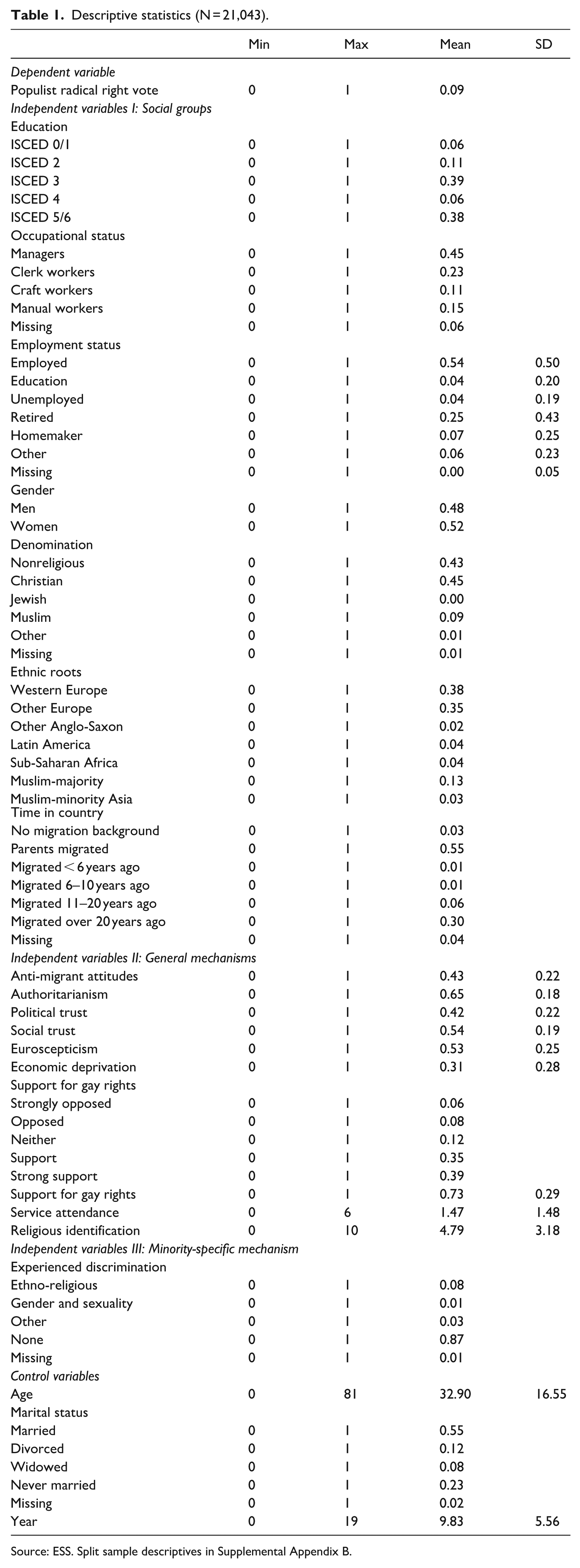
Source: ESS. Split sample descriptives in Supplemental Appendix B.
Dependent variable
Our dependent variable is measured by asking respondents whether they voted in their country’s last national election and, if so, for which party. We de-select 4732 respondents (10.1%) who reported having voted in the last elections but refused to report for which party. For the multivariate but not the descriptive analyses, we furthermore de-select 10,823 respondents (23.1%) who reported not voting. The remaining respondents, we code 0 if they reported voting for a party we do not consider PRR and 1 if they reported voting for a PRR party (as described in Supplemental Appendix A, we consider parties to be PRR if other experts did so as well (Gherghina et al., 2021; Meijers and Zaslove, 2021; Rooduijn et al., 2024)).
Independent variables: Social categories
We code the education respondents reported having completed in five categories: ISCED level 1 or below; ISCED level 2; ISCED level 3; ISCED level 4; ISCED levels 5 or 6. We distinguish between four occupational statuses, based on respondents’ ISCO: managers (ISCO 1–3); clerk workers (ISCO 4–5); craft workers (ISCO 6–7) and manual workers (ISCO 8–9) (following Cirillo et al., 2014) – and a missing values dummy. Employment status reflects respondents’ main activity during the week before the interview: paid employment; education; unemployed; retired; homemaker; and others (including non-employed and chronically ill people)–and a missing values dummy. Gender represents respondents’ binary gender, coded 0 for men and 1 for women. Religious denomination reflects respondents’ current religion, and we differentiate between nonreligious people; Christians; Jews; Muslims; people with other religions; and a missing values dummy.
Ethnic roots reflects the country respondents, their father, and their mother were born. We create seven categories based on UN categorizations: Western Europe (including the UK); Other Europe; Other Anglo-Saxon; Latin America; (Muslim-minority) sub-Saharan Africa; Muslim-majority countries; Muslim-minority Asia – Supplemental Appendix B provides a detailed list of countries. If respondents migrated themselves, their own countries of birth are used; if respondents’ parents migrated, their parents’ countries of birth are used.
Time in country reflects respondents’ answers to whether their father, mother, and they themselves were born in the country of residence [ ‘yes’ or ‘no’] and, if they themselves were not, when they arrived. We group respondents into six categories (besides a missing values dummy): people without a migration background; people whose parents migrated; people who migrated less than 6 years ago; people who migrated 6–10 years ago; people who migrated 11–20 years ago; people who migrated over 20 years ago. 4
Independent variables: General mechanisms
We captured anti-immigrant attitudes by averaging respondents’ opinion on three 11-point scales (the most pro-migrant position was scored 0 and the most anti-immigrant position was scored 1): (1) ‘immigration is bad or good for the economy’; (2) ‘this country’s cultural life is undermined or enriched by immigrants’; and (3) ‘immigrants make this country a worse or better place to live’.
Authoritarian personality traits are tapped using the extent to which respondents reported people with four authoritarian traits were like them on 6-point scales: (1) ‘It is important to [them] that the government ensures [their] safety against all threats. [They] wants the state to be strong so it can defend its citizens’; (2) ‘It is important to [them] to always behave properly. [They] wants to avoid doing anything people would say is wrong’; (3) ‘Tradition is important to [them]. [They] tries to follow the customs handed down by [their] religion or [their] family’; (4) ‘[They] believes that people should do what they’re told. [They] thinks people should follow rules at all times, even when no-one is watching’. We averaged respondents’ answers to one linear scale, running from 0 to 1 with higher scores indicating greater authoritarianism.
Political trust was measured using respondents’ average answers to ‘How much you personally trust’ (1) ‘[country’s] parliament’; (2) ‘politicians’; and (3) ‘political parties’ on 11-point scales, ranging from ‘no trust at all’ (scored 0) to ‘complete trust’ (scored 1).
Social trust was tapped using respondents’ self-reported feelings about ‘most people’ ‘in general’ on three 11-point scales: (1) ‘you can’t be too careful’ (scored 0) to ‘most people can be trusted’ (scored 1); (2) ‘most people would try to take advantage of me’ (0) to ‘most people would try to be fair’ (1); and (3) ‘people mostly look out for themselves’ (0) to ‘people mostly try to be helpful’ (1).
We proxy Euroscepticism using responses to ‘How much do you trust the European parliament?’ (cf. Werts et al., 2013). Respondents could position themselves on an 11-point scale, ranging from ‘no trust at all’ (coded 1) to ‘complete trust’ (coded 0).
Subjective economic deprivation was tapped using responses to: ‘which of the descriptions comes closest to how you feel about your household’s income nowadays?’ (cf. Werts et al., 2013), with four possibilities: ‘living comfortably on present income’ (scored 0); ‘coping on present income’ (scored 0.33); ‘finding it difficult on present income’ (scored 0.67), and ‘finding it very difficult on present income’ (scored 1). As a robustness test, we categorised economic deprivation, yielding similar results (see Supplemental Appendix C2).
Support for gay rights was measured using respondents’ agreement with ‘gay men and lesbians should be free to live their own life as they wish’, in five categories ranging from strongly opposed ( ‘disagree strongly’) to strong support ( ‘agree strongly’).
Religious service attendance was gauged through ‘Apart from special occasions such as weddings and funerals, about how often do you attend religious services nowadays?’, with 7 answer categories, ranging from ‘every day’ (scored 6) to ‘never’ (scored 0). As a robustness test, we categorised service attendance but this did not yield different results (see Supplemental Appendix C2).
Religious identification was measured asking respondents ‘How religious would you say you are?’, with 11 answer possibilities ranging from ‘not at all religious’ (scored 0) to ‘very religious’ (scored 10).
Independent variable: Minority-specific mechanism
We group respondents into four categories (and a missing values dummy) of experienced discrimination based on two questions: ‘Would you describe yourself as being a member of a group that is discriminated against in this country?’ [ ‘yes’ or ‘no’] and, if yes, ‘on what grounds is your group discriminated?’ [Colour or race; nationality; religion; language; ethnic group; age; gender; sexuality; disability – respondents could choose multiple options]. The first group we distinguish experiences ethno-religious discrimination; respondents in this category reported feeling discriminated on at least one of the following bases: colour or race; nationality; language; and ethnic group. We also include respondents who experience discrimination based on Islam (i.e. those who both identify as Muslim and experience discrimination on the basis of religion). Of the remaining respondents, we group people who reported feeling discriminated against based on gender and/or sexuality in a second category. The remaining respondents are considered as either discriminated against on other grounds (category 3) or not experiencing discrimination (category 4).
Control variables
We control for people’s age (in years, with 18 years old scored 0) and legal marital status (in four categories and a missing values dummy). We also control for year of survey, with 2004 (our first survey year) scored 0.
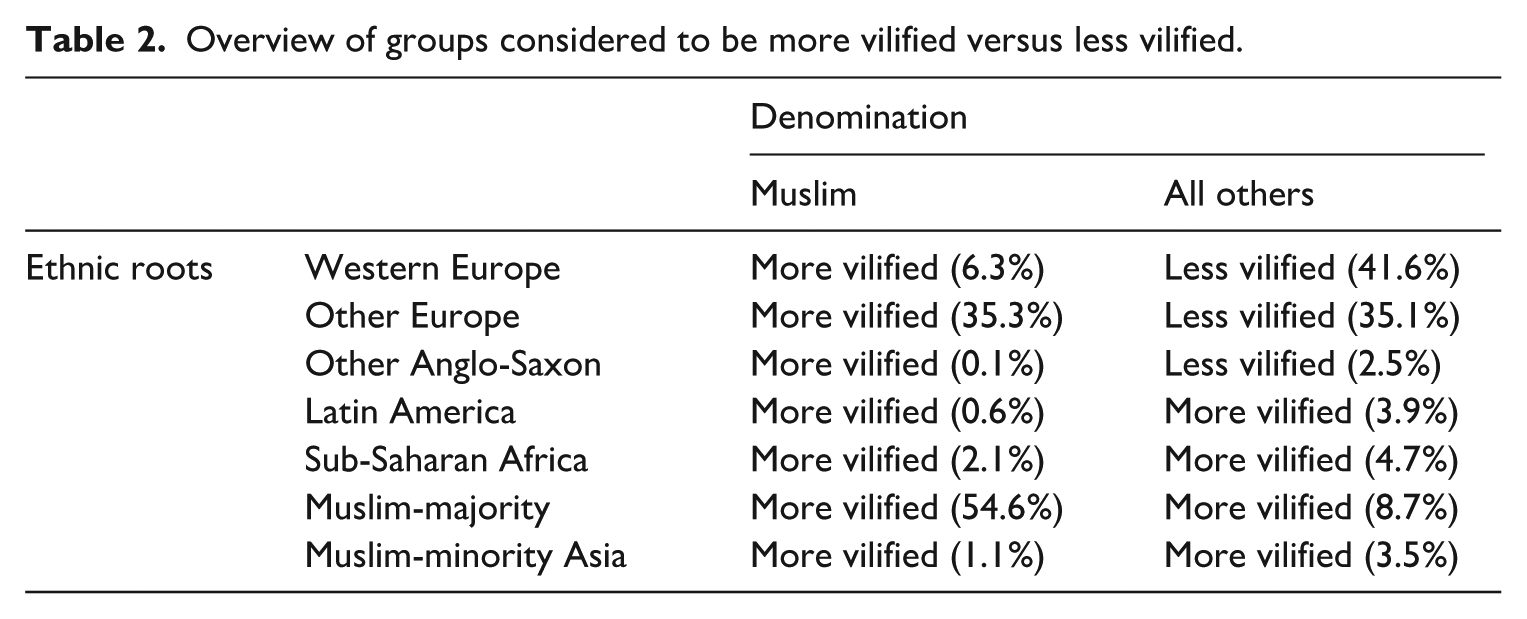
Analytic strategy
We analyse our data descriptively first on a sample of 31,866 minoritized respondents including non-voters. Next, we estimate controlled binary logit multilevel models predicting party choice among 21,043 minoritized voters, where respondents are nested in countries. We present our data for two groups separately, because PRR vilifies some minorities more than others, which could shape what causes people to support a PRR party. Therefore, we separate more vilified people who identify as Muslim and/or have Latin-American, Sub-Saharan African, or Asian backgrounds versus less vilified people who do not identify as Muslim and have European or Anglo-Saxon backgrounds (see Table 2). While this approach no doubt hides some nuances, it is preferable to ignore all differences. In addition, the two groups do seem to overlap with being more versus less vilified to some extent; for instance, anti-immigrant sentiments are stronger in the less vilified group while the more vilified group experiences far more ethno-religious discrimination (see Supplemental Appendix B).
Overview of groups considered to be more vilified versus less vilified.
Results
Tracing the minority vote for the PRR
Our data do not indicate that there are many minorities who support the PRR. Figure 1 shows only six percent of respondents report having voted for a PRR party. This number is dwarfed by votes for other parties (10x more) and even by non-voters (5x more). While other studies in this volume have detailed how PRR parties are certainly trying to reach minority voters (Özek, in this issue, Umpierrez de Reguero et al., in this issue, Soborski et al. in this issue), our findings indicate their efforts have not caused seismic shifts. Both public and academic voices should be careful to not overstate the minority support base of the PRR.
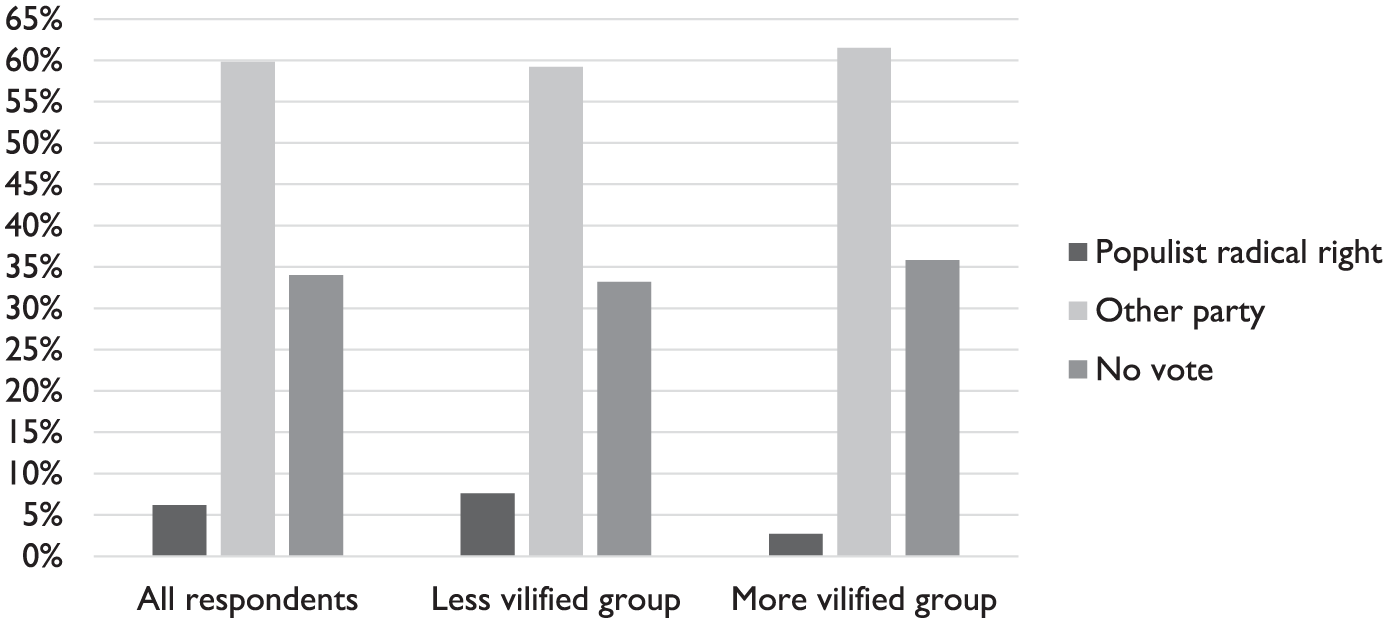
The vote choice of 31,866 ethno-religious minorities between 2004 and 2023.
At the same time, six percent is not negligible, especially considering that some older studies using ESS-data on general, non-minority samples report similar, limited vote shares (e.g. 7.6 percent in Kehrberg, 2015). More fundamentally, given that the PRR is defined, at their very core, by nativist exclusion of minorities, it is baffling why over one in twenty minorities would choose to cast their vote for them.
Part of the answer is reflected in Figure 1: support is far more common among minorities who are less excluded by the PRR. Eight percent of non-Muslim respondents with Global North backgrounds voted for the PRR. Among respondents with Islamic and/or Global South backgrounds, that number drops below three. Less vilified minorities are thus almost three times more likely to support the PRR than vilified ones.
The results in Figure 2 underline this picture; supporting PRR parties is less common the more racialised minorities are (see also Bracke and Hernández Aguilar, 2020; Meer and Modood, 2012). Votes are virtually absent among people who migrated from a sub-Saharan country (1 percent); slightly more common among migrants from Muslim-majority countries; followed by other Asian countries; Latin-American or Anglo-Saxon countries; Western European countries; and most common among migrants from Central or Eastern Europe (9 percent). What is more, in virtually all groups, people born in the country of residence support the PRR more than people who migrated there. The exception is people with Central or Eastern European backgrounds, among who support is high in general. These first descriptive results thus imply that part of the reason that minorities vote for PRR parties is that they might not feel excluded by these parties and feel no special identifications or cross-cutting solidarity with people who are (Burson and Godfrey, 2018; Meeusen et al., 2019).
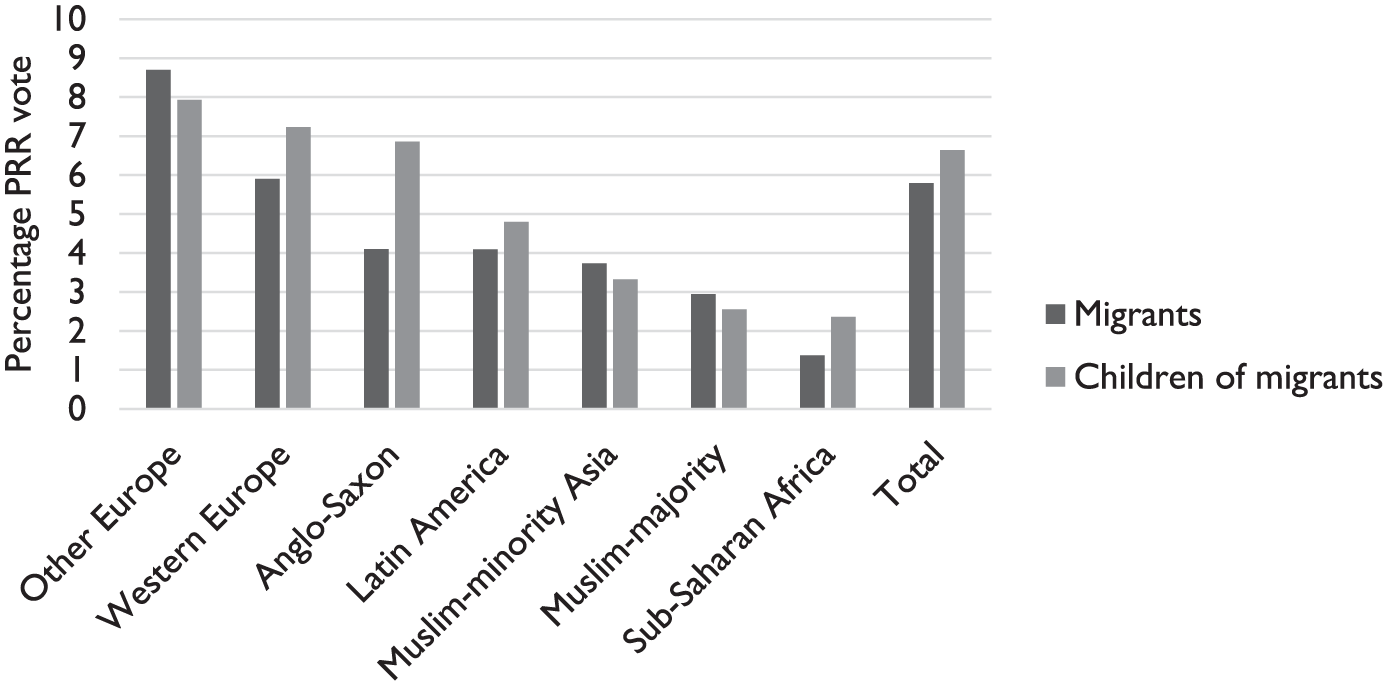
Support for the populist radical right among people with migration backgrounds by ethnic roots.
Our data show differences between years as well, but only for minorities not primarily vilified by the PRR. Among the most vilified group, support has remained relatively stable and virtually absent–hovering between 1.7 and 3.7 percent between 2004 and 2023 (see Figure 3). At the same time, support has increased among non-Muslim minorities with Global North backgrounds. While no consistent trend is discernible prior to 2012, support from this less vilified group has climbed ever since and has especially reached new heights from 2018 onwards (9.6 percent, climbing to 13.3 in 2023). While those who choose to cast their vote for a PRR party remain a minority among less vilified groups too, it is a minority that has almost tripled compared to 2004.
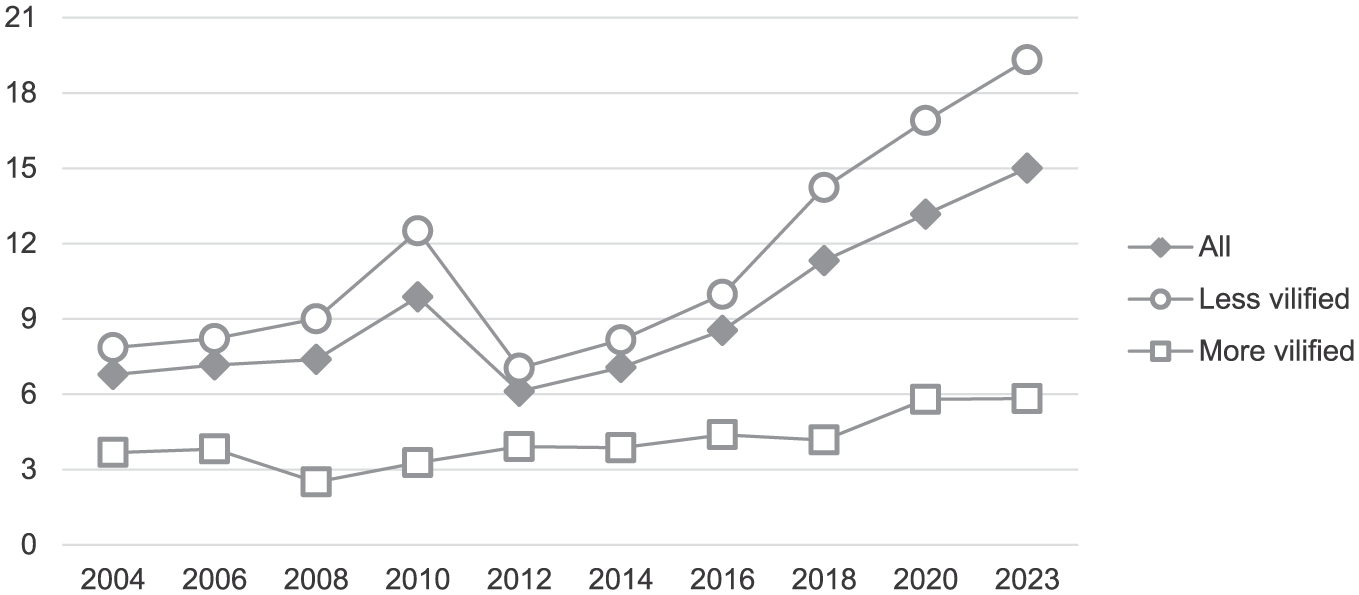
Support for the populist radical right among 31,866 ethno-religious minorities over time.
Evidently, this is a highly stylised picture that overlooks that our sample is made up of different countries in different years. In some countries, support among less vilified groups has decreased rather than increased (e.g. Belgium and Lithuania). In others, the 2012 uptick had already waned by 2018 (e.g. Finland and the UK). In others yet again, the years after 2012 only constitute an uptick compared to plummeted support in the late aughts (e.g. Bulgaria and France). Having said all that, in most countries, the average support for the PRR among less vilified minorities is higher since 2012 than before (14 out of 19) and since 2018 than before (16 out of 22). So, most PRR parties have succeeded in increasingly capturing the vote of non-Muslim Global North minorities, but not in that of Muslim people with Global South backgrounds.
Which minorities vote for the PRR?
Table 3 shows the results of multilevel logit models that predict PRR voting among 21,043 minoritized voters. Models 1a-c only include social categories and Models 2a-c include all predictors. Models separately including minority-specific mechanisms and general mechanisms are shown in Supplemental Appendix C1, because they hardly lead to substantially different conclusions. Models a refer to the whole sample; b to the less vilified group (i.e. non-Muslim people with Global North backgrounds); and c to the more vilified group (i.e. people with Islamic and/or Global South backgrounds). All models use voting for another, non-PRR party as the reference category.
Multilevel logit models predicting PRR voting among 21,043 minorities.
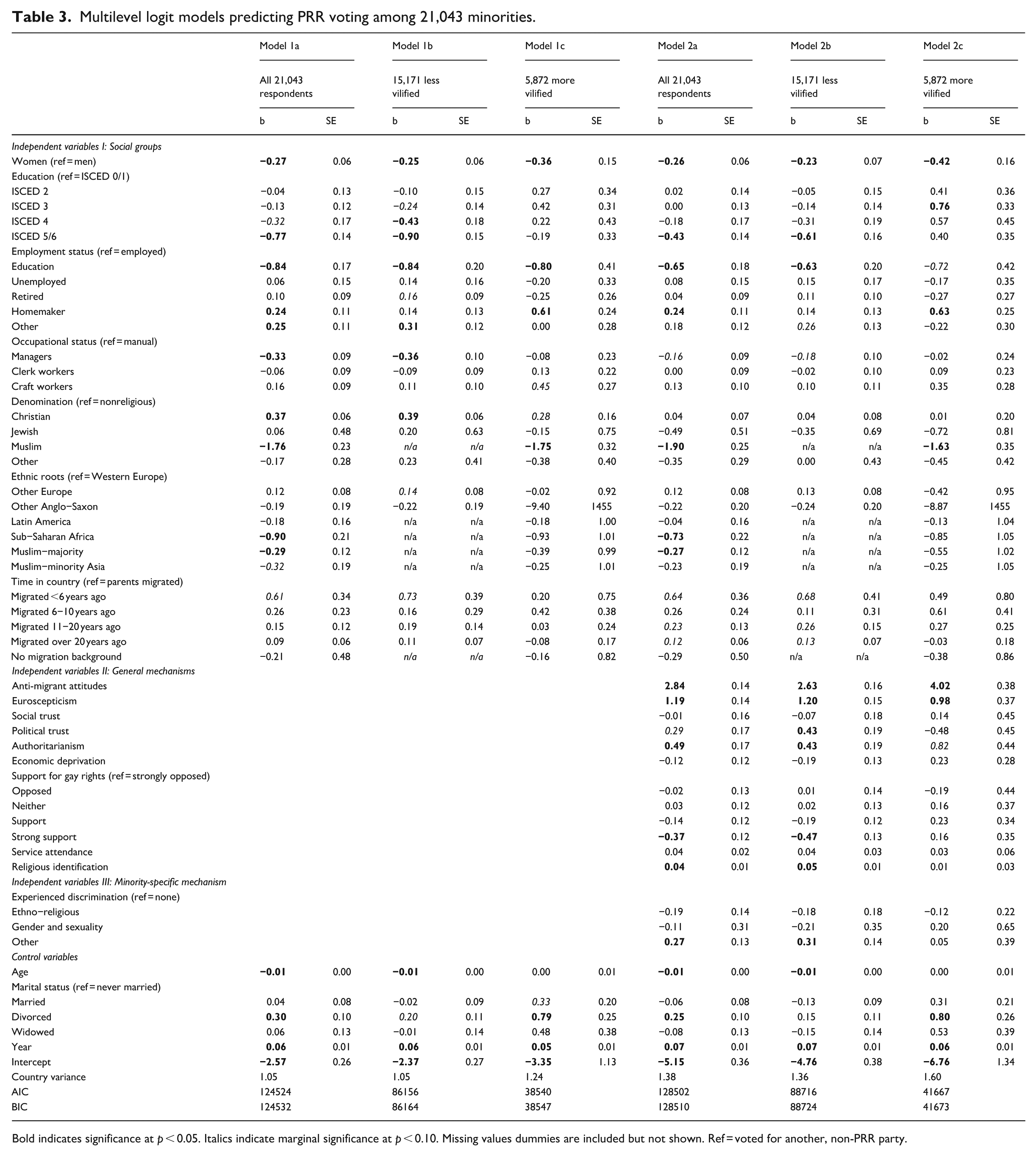
Bold indicates significance at p < 0.05. Italics indicate marginal significance at p < 0.10. Missing values dummies are included but not shown. Ref = voted for another, non-PRR party.
Moving onto answering our first research question on which ethno-religious minorities vote for the PRR, the models in Table 3 show that the clearest answers are ‘men’ and ‘non-Muslims’. Throughout our models, we find that men are significantly more likely to vote for PRR parties than women are–supporting Hypothesis 1d– and Muslim people significantly less than nonreligious people–supporting Hypothesis 2a. Our models also consistently show that people not currently in school are more likely to vote for PRR parties and the share of minoritized voters who opt for PRR parties has increased over the years – although we did not formulate any theoretical expectations here.
For all other social categories we consider, the picture is less clear-cut and differs depending on what groups we consider. Therefore, in general, we find limited support for our expectation that the social categories reported to be the most attracted to the PRR among majorities are the same ones among ethno-religious minorities (Hypothesis 1). More specifically, first, Model 1a shows that people who obtained academic degrees (i.e. ISCED 5/6) are significantly less likely to cast their ballot for PRR parties than people who at most only completed primary education (i.e. ISCED 0/1) – in line with Hypothesis 1a – but this is solely driven by the less vilified group (cf. Models c).
We find similar, opaque patterns in PRR voting according to ethno-religious minorities’ labour market positions. Managers seem significantly less likely to vote for PRR parties than manual workers (Models 1a and 1b) – in line with Hypothesis 1b – but this difference disappears among the more vilified group and no differences are found for other occupational statuses. This pattern may be explained by the socio-economic vulnerability of people of these groups, who feel targeted by PRR parties, often referred to as welfare chauvinism (Abts et al., 2021; Careja and Harris, 2022). Our models furthermore completely reject Hypothesis 1c, as unemployed people are never significantly more likely to opt for PRR parties than employed people. Altogether, among minorities, it only seems to hold that men are more likely than women to vote for PRR parties; socio-economic patterns are ambiguous or outright absent. This might reflect that women are more likely to have empathy with other vulnerable groups, while people in more vulnerable socio-economic positions might either have more reasons to feel threatened by other minorities or more cause for standing in solidarity with other vulnerable groups, creating ambiguous effects (Abdelhadi and O’Brien, 2020; Burson and Godfrey, 2018; Meeusen et al., 2019).
Our models show similar ambiguous patterns in PRR voting depending on where people came from and when they arrived. Model 1a shows that people with sub-Saharan African roots and people with their roots in Muslim-majority countries are significantly less likely to vote for PRR parties than people with West-European roots. None of the other ethnic roots show statistically significant differences and all patterns vanish once we consider whether people are vilified by PRR parties (cf. Models b and c – ‘n/as’ are because the more and less vilified group are defined by ethnicity so not all roots are in all subsamples). As expected in Hypotheses 2b and 2c, people with Global South and Muslim-majority backgrounds seem less attracted to PRR parties – and there are few ethnic divisions within these blocs.
Generally, our models preclude decisive conclusions on how timing of migration relates to PRR voting, but they hint at migrants opting for PRR parties more often than their children do. People who migrated themselves and especially people who did so recently might thus be more likely to cast their ballots for PRR parties. We should be careful in our conclusions, though, because although the patterns hold among everyone, they only reach marginal statistical significance in the less vilified group and are not significant at all in the more vilified group. These results directly counter Hypothesis 2d. Instead, they might signify that the children of migrants are more aware of their exclusion in host societies, pushing them away PRR parties, as proposed by Hypothesis 2e and the integration paradox. Simultaneously, as especially recently migrated people seem more attracted to PRR parties, our results might also reflect that people who recently migrated are especially trusting of their new country’s politics (Röder and Mühlau, 2012) or that recent arrivals are a highly specific group, for instance, those who have fled Islamist persecution (Azabar et al., 2025).
Why do minorities vote for the PRR?
To answer our second research question on why ethno-religious minorities would cast their ballots for PRR parties, we add explanatory mechanisms in Models 2a-c. First, considering attitudes that have been reported time and again to explain support for the PRR among majority populations (Hypothesis 3), our results reveal that anti-immigrant attitudes, Euroscepticism, and authoritarianism operate most similarly among minorities. Models 2a-c show that minorities who hold more anti-immigrant sentiments and minorities who are more Eurosceptic are significantly more attracted to the PRR, supporting Hypothesis 3a and 3e for both groups. These results imply that minorities perceive PRR parties as anti-immigrant and Eurosceptic and, if that overlaps with their own opinions, those positions are successful in securing their votes.
Similarly, our models show that authoritarianism increases PRR voting – in line with Hypothesis 3b – although these patterns only reach marginal significance in the more vilified group (where PRR voting is almost absent). Among ethno-religious minorities, as has been reported among general populations, authoritarian people thus seem more supportive of the PRR.
The other attitudes that have been reported to increase support for the PRR among general populations do not (consistently) do so among ethno-religious minorities. Subjective economic deprivation and social trust are unrelated to PRR voting, falsifying Hypothesis 3d and 3f. Interestingly, our models show that, among the less vilified group, political trust increases rather than decreases PRR support. Together with non-significant impacts among the less vilified, these results counter Hypothesis 3c. Finally, we find some evidence that members of less vilified groups who strongly support gay right are less likely to vote for PRR parties, but members of vilified groups more so. Although these findings are not consistent and thus provide no clear support for Hypothesis 3 g, they are in line with the PRR messages pitting Muslim migrants from the Global South against ‘Western values’ also being internalised by ethno-religious minorities themselves.
Counter to our expectations in Hypotheses 4a and 4b, if anything, more religious people are more likely to support the PRR. No significant religious differences are found in the more vilified group or for service attendance, and among non-Muslim people with Global North backgrounds, stronger religious identifications increase, rather than decrease, PRR support.
Finally, we move to the minority-specific mechanism of Hypothesis 5, which only matters among less vilified groups. Members of the more vilified group remain highly unlikely to vote for PRR parties and do not become significantly more likely to do so when they do not experience discrimination themselves 5 or are nonpracticing. This even holds for ethno-religious discrimination; people with Islamic and/or Global South backgrounds do not eschew the PRR more when they experience more ethno-religious discrimination. In the less vilified group, our findings also run counter to our expectations in Hypothesis 5; particularly people who experience discrimination on grounds other than ethnicity or gender are more likely to vote for PRR parties. These findings might signal patterns similar to those described in general theories on the ‘losers of modernization’, social disintegration, and deprivation; people who feel as if they are losing privileges might feel threatened and lash out by voting for the PRR at least when people feel threatened in domains that are not core to the PRR construction of the pure people (e.g. socio-economic status, ability, age). An overview of the main results per hypothesis is presented in Supplemental Appendix D.
Conclusion and discussion
In this study, we provide a broad overview of support for PRR parties among a hyper diverse group of ethno-religious minorities across 28 European countries over two decades. Specifically, we investigate 1) which ethno-religious minorities (including Muslims, migrants and the children of migrants with Global Northern and Global Southern roots) support PRR and 2) what explains this seemingly paradoxical voting behaviour.
Our findings indicate that – despite media attention suggesting otherwise – minorities’ support for PRR parties remains limited: only six percent reported having voted for a PRR party in the last elections. At the same time, any minority member choosing to cast their ballot for parties that spew nativist, anti-immigrant, and anti-Muslim messages warrants further exploration. To understand this behaviour, our results first stress the diversity among ethno-religious minorities – and particularly how they align with the PRR nativist constructions of who belongs to the ‘pure people’ and who does not. Our findings reveal that Muslim people and people with their roots in Muslim-majority and Global South countries are far less likely to vote for PRR parties than people who adhere to other denominations and people with Global Northern roots. Thus, minorities who are unambiguously othered are far less likely to support the PRR.
Conventional explanations for PRR support tend to implicitly pertain to non-Muslim-majority populations. In line with majority-focused studies, our results show that support is stronger among people who hold Eurosceptic or anti-immigrant sentiments and more authoritarian people. Other common explanations, including educational degrees, employment status, political trust, social trust, and subjective economic deprivation show limited or inconsistent effects among ethno-religious minorities. We thus should not simply copy-paste existing explanations – including the non-fruitful focus on the culture/economic dichotomy when studying explanations for PRR voting (see Scheiring et al., 2024) – but rather need to add a minority-specific lens.
To develop these explanations, our results provide two starting points, indicating that majority explanations should not be completely disregarded, but rather adapted for minority contexts. First, as reported among majorities, there might be a support base of the PRR among minorities perceived as ‘deprived losers of modernization’, but – unlike among majorities – this base is not structured along socio-economic lines. Instead, our results imply that men and those who experience discrimination due to age or ability tend to vote for PRR parties more often.
Second, and related, our results hint at the role of feeling threatened by migrantized others, but again, this might not necessarily be most common among economically deprived people. Instead, our results imply that recently arrived migrants from the Global North and strongly devout Christians are more likely to rebuff Muslims from the Global South. These findings align with insights that some migrants may perceive newcomers as threats to scarce resources (e.g. Van der Zwan et al., 2017). More generally, these results underscore how pivotal it is to understand minority PRR support against the backdrop of debates on who truly belongs to the European nation, which might include some white, Christian, migrants from the Global North but certainly does not include black Muslim migrants.
Although our findings shed light on the complex and multifaceted dynamics of PRR support among ethno-religious minorities, the novelty of this area means much is to be discovered. While present study provides a general overview, future work could focus, first, on how mechanisms affecting PRR support are interconnected and reinforce or rebuff one another among minorities, as has been shown among majorities (e.g. Savelkoul and Scheepers, 2017; Scheepers et al., 1990). Moreover, more recent studied mechanisms such as the (perceived) loss of social status could further be explored among minorities (Ciccolini, 2025; Gugushvili et al., 2025; Mondon, 2025). To present a more general portrayal, we abstained from testing mechanisms explaining why specific social categories (e.g. low educated, manual workers, men, non-Muslims, Western background) among the ethno-religious minority populations are more likely to vote for PRR parties. Future research should prioritise formal mediation testing to improve our understanding of what drives group differences, preferably including mechanisms unable to test here, like populist attitudes (Spierings and Jacobs, 2025). In addition, research shows that ethno-religious groups may support PRR parties in their country of origin, even when they do not in their country of residence (Umpierrez de Reguero and Jakobson, 2023). Hence, a future research avenue is to investigate this divergent voting pattern.
Second, the present study has shown that, thanks to the efforts of all those working on collecting European-wide data, we can compile a sample large and diverse enough to meaningfully address minority support for the PRR. The next step is to unravel the supply side of this story. We have started to uncover individual differences in minority support for the PRR, but seeing a sample of 30 European countries is now within reach, differences between countries and PRR can be unravelled. For instance, building on previous research among the majority population studying the size of the immigrant community or economic conditions (although it has yielded mixed results, e.g. Arzheimer, 2018; Golder, 2016). In addition, exactly which minority groups are constructed to be threats by what particular PRR party might be decisive in ethno-religious minorities’ support. Our approach, considering multiple parties in a large number of countries and political landscapes over two decades could be a valuable starting point for addressing supply-side factors as well. To our knowledge, this study is among the first to provide an extensive overview of which ethno-religious minorities vote for PRR parties and why, but much is to be uncovered to understand how parties that, at their core, hold nativist and exclusive messages, manage to capture the votes of minorities.
Supplemental Material
sj-docx-1-pol-10.1177_02633957251390685 – Supplemental material for Understanding unlikely alliances in Europe: Why ethno-religious minorities support populist radical right parties
Supplemental material, sj-docx-1-pol-10.1177_02633957251390685 for Understanding unlikely alliances in Europe: Why ethno-religious minorities support populist radical right parties by Samira Azabar, Saskia Glas, Nella Geurts and Michael Savelkoul in Politics
Footnotes
Declaration of conflicting interests
The authors declared no potential conflicts of interest with respect to the research, authorship, and/or publication of this article.
Funding
The authors received no financial support for the research, authorship, and/or publication of this article.
Supplemental material
Supplemental material for this article is available online.

Notes
Author biographies
References
Supplementary Material
Please find the following supplemental material available below.
For Open Access articles published under a Creative Commons License, all supplemental material carries the same license as the article it is associated with.
For non-Open Access articles published, all supplemental material carries a non-exclusive license, and permission requests for re-use of supplemental material or any part of supplemental material shall be sent directly to the copyright owner as specified in the copyright notice associated with the article.
