




Abstract
This article addresses three caveats in populist radical right (PRR) voter studies focusing on gender and sexuality: omission of potential voters, representing gender and sexuality as one undifferentiated category, and issue-specific rather than comparative analysis. We use a theory-grounded latent class analysis, based on the Dutch Parliamentary Election Study (2021), to identify voter profiles in terms of how nativism, populism, and gender identity and sexuality attitudes combine differently among citizens who are inclined to vote populist radical right. Empirically, we find distinct profiles in terms of populism, nativism and gender identity and sexuality attitudes: a small minority of gender-and-sexuality-conservatives and larger classes of more modern and moderate potential populist radical right voters; but all clearly nativist. Abstracting from the specific case of the Netherlands, we provide typological descriptions of populist radical right voters that are likely also relevant in other countries.
Introduction
In this study, we address how different attitudes on gender- and sexuality-related issues of populist radical right (PRR)-inclined voters cluster with values often considered central to PRR voting (cf. Mudde, 2007; see also Lubbers and Coenders, 2017; Rydgren, 2008). In doing so, we not only shed new light on the role of gender and sexuality in the appeal of (different, competing) PRR parties, but also develop a more general typological understanding of different sub-electorates that PRR parties are likely to appeal to, and present a challenge to PRR parties, as appealing to one electorate might estrange another.
Considering the recent surge in PRR parties’ popularity and the role of sexuality and gender identity in their framing and discourse, understanding more about the different sub-electorates that they appeal to is also instrumental in explaining the dynamics of contemporary democratic party politics more generally, as other parties have to deal with the success of the PRR. The appeal of some PRR parties to different clusters of voters warrants further exploration, also in view of the fact that some voters are likely to move back and forth between the PRR and other parties.
Until recently, PRR parties were assumed to have a conservative outlook on gender- and sexuality-related issues. However, a growing body of research has shown that this does not hold equally for all countries and parties (Akkerman, 2015; De Lange and Mügge, 2015; Lancaster, 2020; Spierings, 2020b). PRR parties present different ideological configurations concerning gender and sexuality (Akkerman, 2015), and some PRR parties actually profile themselves as progressive on one or more of these issues (e.g. Farris, 2017; Linders et al., 2023; Puar, 2007), attracting “sexually modern nativist voters” (Spierings et al., 2017). Accordingly, not all PRR voters have conservative attitudes when it comes to these issues (Coffé, 2019; Spierings, 2020a; Spierings and Zaslove, 2017). While the importance of gender and sexuality in diverging party support among PRR voters has thus been acknowledged, studies addressing this systematically are scarce and often very limited in scope. Particularly, studies usually underrepresent voters who move back and forth between PRR and other parties (and non-voting); they focus on gender and sexuality as one undifferentiated category, omitting topical issues as separate measures; and often have a singular focus on gender and sexuality attitudes in explaining PRR voting, rather than reflect on how these attitudes combine with other attitudes considered pivotal for voting for the PRR.
We address these lacunae by looking at gender and sexuality attitudes of PRR-inclined voters comparatively. We specifically zoom in on the Netherlands as a rather typical liberal democracy regarding the rise of the PRR, but a “diverse case” (analogous to Gerring, 2007) at the party level given the high variety of different populist parties that diverge on core PRR-values and on gender- and sexuality-related values (Linders et al., 2023). The Dutch public is more progressive on gender and sexuality than most other countries (see Spierings, 2020a), but is also experiencing a backlash on gender-progressive policies (Fiers and Muis, 2021). Both conservative and non-conservative positions on gender- and sexuality-related issues are thus likely to be found here in different configurations across PRR-inclined voters, with possibly different (PRR-) party preferences. Based on supply-side literature, however, we expect that the clusters of attitudes will be substantively similar in other liberal democracies, and only the relative prevalence of each cluster will significantly differ between countries. By looking at the Dutch case, we thus provide a blueprint for addressing different types of PRR voters also in other contexts.
Using data from the Dutch Parliamentary Election Study (DPES; Jacobs et al., 2021), we take a theory-informed bottom-up approach. We use latent class analysis (LCA), which is a method designed to identify groups who share similar responses on multiple survey items (here, PRR-inclined voters with similar attitudes on multiple questions that capture our main variables of interest). We add to existing literature by identifying voter profiles of PRR-inclined voters, in which we combine their outlook on detailed gender- and sexuality-related items (gay rights, trans-rights, and non-binarity) with other issues usually considered crucial to PRR voting (anti-immigration, nativism, and support for the EU). Lancaster (2020) pioneered such a comparative study using LCA, but focusing solely on those who clearly prefer the PRR over other parties, as well as using data where measures of attitudes on non-binarity or trans-rights were not included. These measures are, however, available in the data we use for the current study, and we are specifically interested in their comparative dynamics, as these topical issues are a crucial pivot point in the PRR (Dickey et al., 2021).
We thus address the following question: How do divergent combinations of core PRR values and gender identity and sexuality attitudes constitute different voter profiles and preferences among citizens who are inclined to vote PRR?
We find that variations on the gender identity- and sexuality-related issue attitudes coincide with variations on core PRR values like nativism. Matching the relatively sexually progressive reputation of the Netherlands, conservative attitudes on gender identity and sexuality items are scarce in PRR-inclined voters in the Dutch context. But where they appear, they do so among the most ethnocentric respondents, and in those respondents who are more likely to be religious.
These findings help explain the appeal of PRR parties to a disparate electorate and can be a tool to analyze PRR parties’ success (and behavior) in appealing to different types of voters. Moreover, while the conceptual relations between attitudes we provide might have different prevalence in other countries, this study offers a blueprint for analyzing the diversity of the PRR electorate. Thus, the unique context of the Dutch case notwithstanding, this work may serve as an entry point for further studies into the appeal of radical right politics across Western democracies.
State of the Art of Voter Studies on PRR and Gender/Sexuality
Before discussing the conceptual literature on the different core values of PRR ideology that guide our data selection, method, and analysis, we briefly discuss the recent voter studies on PRR voters and gender and sexuality closest to this study. We argue that our study offers an important addition to this work by looking at constellations of voter preferences, which these studies overlook in one to three interrelated ways.
First, studies addressing gender and sexuality in PRR support often focus on those who actually vote for these parties (e.g. Spierings and Glas, 2021), or those who clearly prefer PRR parties over others (e.g. Lancaster, 2020). However, even though PRR voters are not (or no longer) more volatile than other voters, there is likely overlap in party preference for PRR parties and parties from other blocs (Voogd and Dassonneville, 2020). Only looking at actual PRR voters thus underrepresents both habitual non-voters (who exclusively consider and sometimes vote for the PRR) and swing voters (who move back and forth between the PRR and other parties). This may result in an overestimation of the importance of some—and underestimation of other—ideological configurations relevant to these parties’ electoral success. By including all voters who seriously consider PRR parties, we gain more insight into the types of voters they receive their support from.
Second, studies addressing gender and sexuality in relation to electoral participation often exclusively focus on gender equality in education and the economy or on homosexuality. Topical and detailed issues like trans-rights and gender non-binarity have not often been included, even though some anti-gender PRR politicians rally on these issues (Paternotte and Kuhar, 2018; Spierings, 2020b). Similarly, most studies substantively addressing gender or sexuality do so by looking in-depth at one such topic, for example addressing the role of homonationalism in voting for these parties. Gender and sexuality are therefore often (unintentionally) represented as a single and undifferentiated category in terms of voting behavior. By including more detailed issues, and looking at these issues in comparison, variations in support across gender- and sexuality-related issues can be unpacked.
Third, when these more topical data are available, most studies addressing gender and sexuality in PRR voting focus on the gender/sexuality component (e.g. how voters’ gender/sexual identity explains voting behavior, see Off, 2023; Spierings and Zaslove, 2015), sometimes in combination with anti-immigrant sentiments (e.g. De Koster et al., 2014; Spierings, 2020a; Spierings et al., 2017), but overall failing to address how attitudes on different values that are deemed essential for PRR support are interrelated in shaping PRR support. Only by looking at a range of issues at the core of PRR ideology comparatively, and including gender- and sexuality-related attitudes, can research assess which issues seem connected to either a conservative or progressive outlook on (one or more) gender- and sexuality-related issues. This is why we use LCA in this study, which is uniquely qualified to address the latent clustering of policy preferences and values in survey respondents (cf. Lancaster, 2020).
PRR Ideology: Populism and Nativism
The main focus of this article is to address how gender and sexuality attitudes fit in with the core values that PRR-inclined voters are likely to adhere to. To develop concise theoretical expectations for this, we first need a clear overview of what we expect these core PRR-values to be. This section therefore serves as a first step in our theoretical framework, outlining important variations in what we consider to be likely attitudes for PRR voters. The second step, which follows after this section, connects these ideological variations to supply-side studies on the PRR and gender and sexuality. The second section thus contains our main expectations for the data analysis. The selection of variables for the LCA mapping (which is detailed in the methods section) follows from both sections.
Populism
Conceptually, we start from Mudde’s seminal categorization of populism as a thin-centered ideology which separates society into two antagonistic groups: the people versus (corrupt) elites (Mudde, 2007). This ideology necessitates further padding to define the substance of this antagonistic relationship and, for PRR parties, nativism is often considered to be the most defining feature (Mudde, 2007). According to Riedel (2018), nativism is deeply rooted in populism because it pits from the same homogenization of “the people” and defines others as anemic outgroups. Nativism, like populism (in this regard), creates two distinct groups: natives and non-natives—and this distinction includes not just people but also ideologies and ideas.
Nativism and Nationalism
Nativism is thus considered to be a defining feature of the ideology of PRR parties. However, some of the analytical clarity that this suggests is lost in studies on the PRR, which often use nativism and nationalism interchangeably, and use them as umbrella terms to refer to conceptually different ideas. As such, studies on PRR voting clearly show that nativism (and/or nationalism) is at the core of PRR party support (Lubbers and Coenders, 2017; Otjes, 2021; Spierings and Glas, 2021), but rarely address conceptual distinctions between nativism and nationalism. In nationalism studies, however, authors often distinguish between civic and ethnic nationalism (Piwoni and Mußotter, 2023; Reeskens and Hooghe, 2010). As we explain below, in the context of the PRR, this civic–ethnic distinction is therefore useful in distinguishing and specifying nativism and nationalism as separate and internally complex components of PRR ideology (see also Simonsen and Bonikowski, 2020).
Civic Nationalism and Ethno-Nativism
Reeskens and Hooghe (2010) show convincingly that nationalism (in public opinion) is divisible in two (and not three or more) distinct outlooks: civic and ethnic nationalism. 1 Their analysis unveils that there is a clear and consistent empirical distinction between conceiving of nationality as based on ancestry or as based on adhering to national law and culture. These are not mutually exclusive, and both sentiments can be present, within and across individuals, to different degrees at the same time.
In studies on the PRR, nationalism is often conflated with racism/xenophobia (cf. Kešić and Duyvendak, 2019). This outlook most closely resembles ethnic nationalism and is critically important, as PRR parties often explicitly profile on this (e.g. Bracke and Hernández Aguilar, 2020; Rahbari, 2021). Because, in the PRR, this rhetoric often revolves specifically around ethnicity (Bialasiewicz, 2006; Lubbers and Coenders, 2017), we refer to this outlook as ethno-nativism.
Another component of the success of (some) PRR parties, however, may be predicated less on ancestry and more on, for example, national language proficiency or support for national institutions (Bonikowski, 2017b), which is more in line with civic nationalism. Civic nationalism puts less stringent requirements on the nationality, as anyone (systemic challenges notwithstanding) can theoretically ascend to it—which is patently different from ethno-nativism.
Related Values
Depending on the logic of the nationalism or nativism they follow, voters are likely to have differing opinions also on related values. We therefore end this section on nativism and nationalism with two observations on how the distinction between civic nationalism and ethno-nativism also informs stances on other values that often feature in the debates on this part of the PRR ideology. This illustrates how this distinction is important also in our analysis of gender and sexuality that follows below.
Multiculturalism, first, rests on the belief that immigrant communities are best facilitated by allowing for, and protecting, distinctive minority identities (Kymlicka, 2010; Sniderman and Hagendoorn, 2007), so ethno-nativists are more likely to categorically dismiss multiculturalism (cf. Bonikowski, 2017b; Schinkel and Van Houdt, 2010). For civic nationalists, on the other hand, multiculturalism may be permissible to a certain degree, as long as minority communities live according to Dutch law, institutions, and culture, deviate from the latter only in “acceptable ways,” and are not experienced as a threat. Thus, for example, refugees may be (more) welcome from this perspective (compared to ethno-nativism) but demanding a public reassessment of Dutch colonial history and slavery instead of celebrating the Dutch Golden Age would be considered as such a threat.
Cosmopolitanism, second, is often posed as the polar opposite of nationalism (cf. Mudde, 2017; see also Bonikowski, 2017a). While PRR ideology is increasingly developed internationally (Doerr, 2017; Froio and Ganesh, 2019), its aim remains—perhaps paradoxically—to defend the nation from “unwanted” international influences that are deemed detrimental to national values (e.g. see Ekman, 2022). These “unwanted” influences always include (‘‘non-Western’’) immigration, but may also include progressive and decidedly Western ideas about sexuality and gender, depending on the position of the PRR party on these issues (Dietze and Roth, 2020; Spierings, 2020b). Some of the core PRR values, however, are decidedly Western, or European—as opposed to national—and specifically “non-Western” immigration is experienced as a threat. Accordingly, while cosmopolitanism may indeed be the polar opposite of the ethno-nativist conception of nationality based on ancestry, this is less clearly the case from the perspective of civic nationalism, as many PRR parties indeed “protect” similar “Western” values—often including at least some relatively progressive values, including on gender and sexuality.
We thus expect that these often-overlooked variations within nationalism/nativism may be important for, as well as covary with, different outlooks on gender- and sexuality-related issues. As argued above, voter studies have not often been able to take multiple gender- and sexuality-related issues into account, while PRR supply-side studies show that there is variation on these issues—which we expect will translate to voter preferences as well. Therefore, the next section discusses the intersections of gender and sexuality with these variations in core PRR ideology from a supply-side perspective and presents the main expectations for our data analysis.
PRR Ideology and Gender Identity and Sexuality
While some studies have addressed how gender- and sexuality-related attitudes cluster with other issues in PRR voter support (Coffé, 2019; Lancaster, 2020; Spierings, 2020a; Spierings and Glas, 2021; Spierings and Zaslove, 2015), this relationship has been studied particularly from a supply-side perspective. Many studies have shown that gender and sexuality are intertwined with the defining ideological elements of this party family (Agius et al., 2020; Akkerman, 2015; De Lange and Mügge, 2015; Spierings, 2020b; see also Dietze and Roth, 2020). Below, we summarize the main findings of this predominantly supply-side literature. We expect these covariations in ideological preference to translate at least partially to voter preferences, so the following summary provides a theory-informed grounding for our LCA. Generally, we thus expect to find a gender-conservative class, a rather gender-modern class, and one or more classes in between—and for each constellation, below we provide tentative expectations for covariation on the other variables included in our analysis.
Gender Conservatism and Ethno-Nativism
Studies show that many PRR parties often use anti-emancipatory discourse (Dietze and Roth, 2020), arguing, for example, against career women, in favor of traditional gender roles in the household. This outlook aligns with a nostalgic longing for traditional family values (Norocel, 2013), and is decidedly paternalistic and heteronormative. It also reflects the type of PRR ideology linked most strongly with the anti-gender mobilization that is currently seen across Europe (Paternotte and Kuhar, 2018), which is often connected with Christian conservative movements as well (Gorski et al., 2022; Rietveld, 2021). This ideology is linked to attacks on gender scholarship and feminists, and especially targets female professionals, including for their subversion of the “natural order,” and men who align with feminists, who are cast as “weak” for their complicity (Hemmings, 2020; Korolczuk, 2020)—and who are contrasted with the necessity for “strong” (male) leadership (Edenborg, 2018; Sauer, 2020). 2
In this discourse, gender role essentialism and ethno-nativism align closely, as can be seen, for example, in the electoral campaign slogan “Neue Deutsche? Machen wir Selber.” (New Germans? We make our own.) by the German PRR party Alternative für Deutschland (AfD), which was presented using a photograph of a faceless, anonymous, White, pregnant woman (see Bracke and Hernández Aguilar, 2020). An anti-miscegenetic and anti-immigrant sentiment here combines with the biological, ethno-nativist argument that population growth should come from procreation by native (White) citizens, and not from immigrants (who are habitually referred to as “Neue Deutsche” in the German context). Much like Christian conservative arguments against same-sex relationships, such relationships are also not wanted here because they preclude “natural” procreation—and so do women who are too independent.
Although notably largely absent from Dutch political campaigns, at least before 2022, we do expect a similar sentiment may be present in Dutch voters, as this discourse is spreading globally online, including through Dutch accounts (Ebner and Davey, 2019; Fiers and Muis, 2021; Molas, 2022). We thus expect gender-conservative attitudes to particularly align with ethno-nativism (and Christianity) in our analysis as well.
While we would have preferred to also include a measure for gender equality, the debate about gender roles is rather marginal and certainly not salient in the Dutch context, which is why this is also not included in our data, which comprises the DPES (Jacobs et al., 2021). Our study thus identifies conservative attitudes as those that are conservative on all three indicators that we do have (gay rights, non-binarity, and trans-rights). In addition, based on the observations outlined above, we include attitudes on religion in politics, authority, anti-immigration, and ethno-nativism.
Gender-Modern Nationalism
Identified by Mudde (2007) as gender modernists, there are also PRR parties who argue in favor of equal rights for women, without emphasizing traditional family values. More recent publications show that some PRR parties also include overtly pro-gay rights rhetoric as well as (conditional) support for trans-rights (De Koster et al., 2014; Linders et al., 2023) and some have argued that this position may (soon) become the majority of PRR voters in the Dutch context (e.g. Lancaster, 2020).
This relatively more progressive outlook on gender and sexuality usually coincides with references to individual freedom and the rise of liberal and Enlightenment values among European populations, and the rejection of strict religious doctrine. When positioned as a nationalist argument, rhetoric defending progressive sexual rights as an integral part of national identity resonates with civic nationalism, and has been observed in Dutch PRR parties since the 2000s (Dudink, 2017; Simonsen and Bonikowski, 2020). This constellation of nationalism with gay rights and/or women’s emancipation has been labeled homonationalism and femonationalism, respectively (Farris, 2017; Puar, 2007).
In Europe, such more progressive positions in the PRR have often been considered to be merely instrumental in anti-immigrant and especially anti-Islam attitudes. “Non-Western” immigrants, specifically Muslims, are depicted as a threat to European gender norms and liberal sexuality, and the rhetorical support for these values is thus weaponized against Muslim immigration (Puar, 2007; Rahbari, 2021; Zúquete, 2017). However, some PRR parties have internalized this modern outlook as part of national identity, beyond merely being instrumental in criticizing Islam. They can be seen to support gender- and sexuality-related issues also when not connected to immigration politics (Linders et al., 2023). This argument also better travels across national borders, as the argument is often framed as European versus non-European values, instead of solely based on national ancestry. It thus also modifies the relation between support for the PRR and anti-cosmopolitan attitudes at least to a degree.
Considering the Dutch sexually progressive context, and studies showing the Dutch PRR defending gay rights, we expect to find at least one gender-modern class in our analysis, which we expect to cluster with high support for civic nationalism, but less with ethno-nativism, and perhaps some more variation on the other attitudes. We thus include attitudes on civic nationalism in addition to ethno-nativism in our LCA, as well as a measure disentangling anti-Islam attitudes from a general anti-immigration stance, and proxies for cosmopolitanism (support for the EU and postcolonialism, matching our discussion in the section above on nationalism).
Moderate Positions on Gender and Sexuality; Populist Logic
There are also positions that fall somewhere in between the two polar positions on gender and sexuality as discussed in the two sections above. Some parties, for example, do emphasize the importance of family values, and also argue for equal pay for men and women, free (or cheap) childcare services and/or gay rights (Mudde, 2007).
Part of the explanation of where PRR parties land in terms of support for gender- and sexuality-related topics is closely tied to populist logic (the “people vs elite” distinction), like many of their positions. The Netherlands, for example, is relatively progressive when it comes to gender- and sexuality-related attitudes (see Kuyper, 2018). 3 In this context, it is more difficult for PRR parties to rail against gender equality, or to exclude sexual civil rights from their notion of “the people.” PRR voters, ideologues, and leaders also live their lives in this same context, so their opinions might also ideologically align with the national tendency to support gender (identity) and sexual rights. In other words, “the people” may thus be considered gender-modern by these parties. This also (partially) explains how in different contexts the lines may be drawn differently. Studies have indeed shown that some PRR voters support gay rights but are more skeptic of trans-rights, and particularly non-binarity, in some contexts (Dickey et al., 2021).
Because of the broad support for gay rights in the Dutch context, we expect our LCA will show most PRR-inclined voters to be in classes that are (tentatively) supportive of gay rights, except for the conservative class we describe above. We further expect that there may be one or more classes where we find support for gay rights but not (or less clearly) for trans-rights and/or (especially) non-binarity. Even though we expect all respondents to score high on populism, we also include a measure on populist attitudes because we are interested to see whether this covaries with the other variables included.
Data and Methodology
Because we are especially interested in the different voter profiles of PRR-inclined voters, we use LCA to answer our main question. This method can detect latent classes (here, voter profiles) from individual respondents (here, PRR-inclined voters), based on their similar scores on separate ordinal input variables (here, values and attitudes). We use data from the 2021 DPES (Jacobs et al., 2021), a large nationally representative voter study that collected such voter attitudes before and after the Dutch March 2021 parliamentary elections, including rich and unique data that are highly relevant to our main question.
Data
We selected all 735 respondents from the DPES who said they will likely (propensity 8 or higher out of 10) vote for any or multiple of the included PRR parties: Partij voor de Vrijheid (PVV), Forum voor Democratie (FVD), and Juiste Antwoord ʼ21 (JA21). 4 We ran the LCA only on those respondents, so all voter profiles discussed in the results exclusively include those respondents who indicated they were inclined to vote for one or more of the Dutch PRR parties. Based on the existing literature, as outlined above, we selected the variables to include in the LCA. In cases where multiple questions were asked that measure the same concept, we computed combined variable indices. This section presents a brief overview of how we coded the variables (see supplementary material for full descriptions of the questions we selected).
In Dutch political debates, gender identity-related topics, such as transgender rights and non-binarity, are more salient than gender equality. Our main variables of interest are therefore represented in this survey by questions asking about gay rights, trans-rights, and non-binarity. Noteworthy in this respect is that these three issues are not only pivot points in the current debate on gender and sexuality in Dutch politics, following recent research, the same issues are pivot points in other countries as well (Dickey et al., 2021), although attitudes may be distributed differently.
The three Dutch PRR parties competing in the 2021 national elections (PVV, 17 seats; FVD, 8 seats; and JA21, 3 seats) take rather similar stances with regard to non-binarity, but not trans-rights and homosexuality (De Lange and Mügge, 2015; Linders et al., 2023). Both FVD and PVV rail against gender fluidity (i.e. non-binarity), whereas PVV is consistently pro-gay rights and at least rhetorically sometimes pro-trans-rights, while FVD is not (Linders et al., 2023). JA21 is relatively new and a split off from FVD. So far, it has not particularly profiled on gender-related issues, except in favor of gay rights on occasion.
The questions were posed in the survey using a 5-point Likert-type scale (fully agree—fully disagree), and read, (1) “there is something wrong with people who neither feel like a man nor like a woman,” (2) “if someone has thought it through, a sex change can be a good idea,” and (3) “same-sex couples should have the same right to adopt children as heterosexual couples” (Jacobs et al., 2021). Keeping the five answers (fully agree—fully disagree), we redirected the answers, so a higher score means a more progressive attitude.
The other variables of interest represent issues identified as crucial to the PRR (see above). These encompass populism, ethno-nativism and civic nationalism, apologies for colonialism, the EU, anti-Islam, and anti-refugee sentiment as well as support for religion in politics and strong leadership. We combined items that are considered part of an existing scale, but conceptually distinct elements were kept separate, so that, potentially relevant differences on these items can be picked up by the LCA.
For populism, we used the validated scale developed by Akkerman et al. (2014) available in the DPES data set, which we combined into a single indicator for the most robust measurement of overall populist attitude, which we then made into an ordinal variable as required for LCA. We used a simple mean function to construct the combined indicator on a 5-point scale (Cronbach’s alpha = 0.839).
Similarly, we selected four issues that are representative (cf. Reeskens and Hooghe, 2010) for civic-nationalist attitudes (Cronbach’s alpha = 0.618), and four for ethno-nativist attitudes (Cronbach’s alpha = 0.769). We selected two items for anti-postcolonial attitudes (Cronbach’s alpha = 0.795) as a proxy on cosmopolitanism. Again, based on the similar means and correlations we combined them into three ordinal indices, using the simple means.
Finally, for anti-Islam attitudes, anti-refugee attitudes, attitudes toward religion in politics, strong leadership, and the EU, we found single issue indicators in the data set, which we included as-is, only changing their direction to point them in the direction we deemed logical for our analysis: higher implies a higher score on the respective label, as provided in Figure 1.
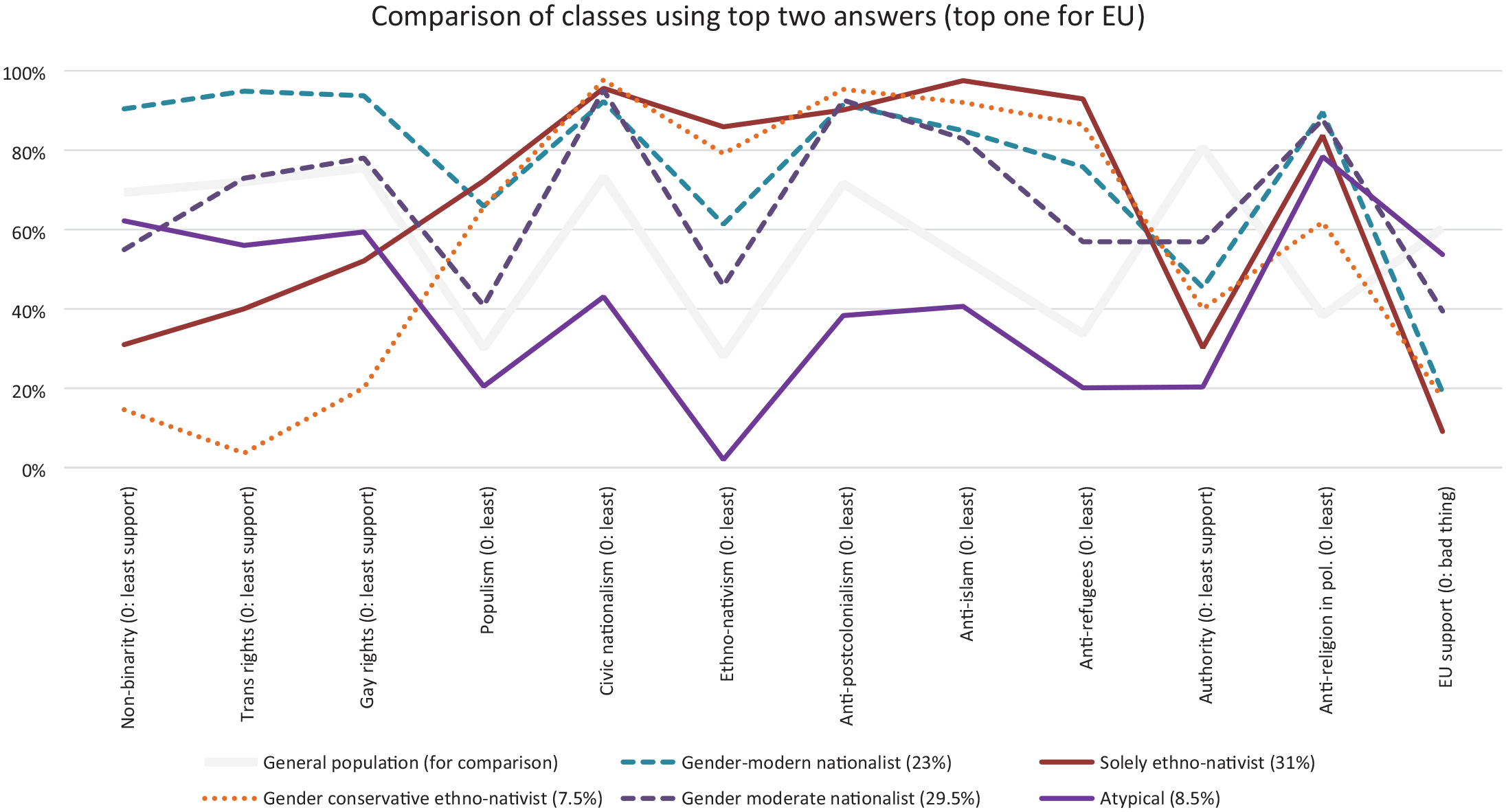
Comparison of Classes Using Top Two Answers (Top One for EU).
Methodology
We conducted LCA using the poLCA package for R. This package allows for including ordinal (vs binary) variables, providing more variation on our ideological indicators. We estimated models identifying 1 through 10 classes (after 8, no improvement was found). We estimated the models with 5000 iterations and 100 repetitions which withstood likeliness tests (maximum log-likelihood for all models). Bayesian information criterion (BIC) and Akaike information criterion (AIC) model fit indicators showed models with three to six classes to be the best empirical fit (see supplementary material for AIC/BIC tables and graph). We assessed these models from the theoretical perspective outlined above, focusing on whether meaningful classes were added in the models with more classes. Based on this, we selected the model with five classes as both a parsimonious model and one that represents the variations in configurations on the gender identity and sexuality indicators, the core of what we sought to address (see supplementary material for the complete model).
Results: PRR Voter Profiles
The full model on which our interpretation is based is found in the supplementary material. Figure 1 visualizes and summarizes these results for ease of discussion. The graph focuses on particularly convergent attitudes as it only presents the percentage of top answers for each category, whereas the tables in the supplementary material also provide a measure of indecisiveness where attitudes were more divergent. For example, in the gender-modern class, attitudes on non-binarity are spread out across different answer categories rather than concentrated around 55% agreement, as the graph might suggest. As this cannot be derived from the graph, we make this explicit in the text where relevant. Moreover, we focus on the larger more distinguishing differences between the classes, because small differences may not be meaningful considering the small size of some of the classes.
Below, we first provide the uniquely identifiable characteristics of each of the classes found by the LCA. Thereafter, we compare the classes more explicitly to identify interesting patterns that seem present across multiple classes and/or are interesting because they either clearly match or diverge from the theoretical expectations discussed above. In the last section, both to illustrate the relevance of these findings and to provide further solidification of the links we found in the LCA-identified voter profiles, we further explore how different attitudes available in the DPES data diverge or coalesce for respondents compared to which class they belong to.
Atypical (8.5%)
This class, denoted in Figure 1 by the solid purple line with square markers, stands out because it diverges most from the others and shows unexpected attitudes across most categories, considering which issues are normally deemed most crucial for PRR party support. This is particularly signified by the low scores on populism, nationalism, ethno-nativism, anti-Islam, and anti-refugee attitudes—all of which are contrary to our expectations for all classes.
At first, we considered that this relatively small class of voters could be those for whom opposition to COVID measures was likely the most important reason to seriously consider one of the PRR parties in 2021, as FVD was by far the most opposed to the COVID measures enacted by the Dutch government. While respondents placed in this class by the LCA indeed have a higher propensity to vote for FVD, additional data explorations show, however, that they are the least opposed to COVID regulations and the most in favor of taking the disease seriously out of all five classes (see supplementary material).
Additional analyses yielded the following more likely explanation: compared to the other PRR classes, these voters are often from a non-Dutch background, and many live in cities (versus rural areas). Moreover, they often respond “don’t know” or “don’t know this person/party” for other political parties. These respondents, thus, are rather likely to be politically disconnected in either interest, knowledge, or both. The fact that they still consider voting for one of the PRR parties may therefore follow from a more general anti-establishment sentiment.
Regarding our main question, there is apparently a class of voters who seem ideologically far removed from PRR parties, yet still (seriously) consider voting for them—even though these parties are often prominently (in the media) tied to racism and xenophobia. Since we are interested predominantly in the coalescence of gender identity and sexuality attitudes with other core PRR attitudes, however, we mostly leave this class out of our further analysis. Future research may shed light on this class by further examining which non-typical issues or attitudes may still lead to support for PRR parties.
Gender-Conservative Ethno-Nativist (7.5%)
Denoted by a round dotted green line with square markers in Figure 1, this class is clearly defined by very low support for gender identity- and sexuality-related issues, which combines with the highest support for almost all other traditional PRR attitudes. Their support for equal rights for gay couples is low, but still around 20% (agree, and strongly agree) whereas their support is much lower for trans-rights (7%). Surprisingly, and contrary to our expectations, their support for non-binarity seems higher (15%) compared to trans-rights (but compared to the overall population and other classes it is still extremely low).
A constellation with Christian conservatism seems also reflected in their relatively high support for religion as a guide in politics (lowest score on “anti-religion in politics”) and makes sense following the theoretical link between gender-conservative PRR parties and Christian conservative organizations. This also matches their anti-postcolonialism since this reflects the nostalgic construction of Dutch heritage theorized for this class. Ethno-nativism is central to this class’s attitudes, and they have relatively high support for ethno-nativism compared to other classes (79%).
Until recently, this gender-conservative outlook was thought to be representative for most of the PRR. In our case, however, this class consists of only about 7.5% of those inclined to vote for the PRR in the Netherlands. We thus show that the distinction between ethno-nativism and civic nationalism, and the comparatively high score for this class on ethno-nativism specifically, may be relevant in examining how gender and sexuality relate to other attitudes within this party family—and may help explain different degrees of conservatism in the PRR in different national contexts.
Another explanation for the relatively small size of this class can be found in populism itself as a political style. Populist parties usually follow national patterns at least to some degree. The gender-conservative ethno-nationalist outlook has remained marginal in the Dutch context, at least until the 2021 parliamentary elections. For example, decidedly biological ethno-nativist campaigns, like the example from the AfD in Germany discussed in the section on gender conservatism above, are much less salient in the Dutch PRR, which matches the relatively small size of this class. Both the absence of such campaigns and the small size of this class within the PRR voting block may thus simply be the result of the hegemonic, comparatively modern, Dutch outlook on gender and sexuality. Following Bonikowski (2017b), however, different outlooks on nationality, across different countries, are likely a matter of degree rather than of kind. Therefore, while this group may be (much) larger in other countries, the ideational links exposed here are likely to be found there as well.
Solely Ethno-Nativist (31%)
This class, denoted in Figure 1 by a solid red line with round markers, is like the gender-conservative ethno-nativist class on all topics except gender identity, sexuality, and religion in politics. They seem slightly less opposed, on average, to gay rights issues, but here the graph is somewhat misleading. The people belonging to this class are mostly highly divided on the gender identity and sexuality items, not consistently progressive or conservative (see tables in supplementary material).
While this class is otherwise rather similar to the gender-conservative class, another core difference is their lack of support for religion in politics. This implies that whereas the gender-conservative ethno-nativist class was partially defined by a possible constellation with conservative Christianity, this class does not seem to be aligned with conservative Christianity and is in that way more like the general Dutch population.
The fact that this class comprises 31% of the total sample is further evidence that the traditional view of PRR as (ethno-)nativist is still a defining feature of the PRR, even if not aligned with gender-conservatism and/or Christian organizations. The comparison with the mere 7.5% for the conservative class shows that in the Dutch context, (ethno-)nativism is much more relevant than (gender-)conservatism.
Gender-Modern Civic Nationalist (23%)
As expected for the Dutch context, the LCA also identified a relatively large class that is highly progressive on gender identity and sexuality items. This class is identified by the dashed turquoise line with round markers in Figure 1. Within this class, support for trans-rights is marginally lower than support for non-binarity and gay rights, but for all three indicators, over 90% agree or strongly agree with these issues, which is also decidedly above the national average of around 75% in this study (although previous studies have shown support to be around 90% in the general public as well, see Kuyper, 2018). This class is much larger than the gender-conservative ethno-nativist class, matching our expectations in the Dutch context.
Otherwise, this class is mostly in line with the other classes in terms of traditional PRR attitudes, a notable exception being a clearly lower score on the ethno-nativism indicator (also compared to civic nationalism). The relatively lower score on ethno-nativism (although at around 60% still much higher than the general electorate), compared to the gender-conservative ethno-nativist class, signifies that biological essentialism in terms of nationality coalesces more with (biological) gender essentialism than with gender-progressive attitudes. However, we also find further confirmation of the observation that nativism is core to PRR ideology in Western Europe—even for relatively gender-inclusive voters, as they still score high on both ethno-nativism and civic nationalism.
An element of the high support for gender identity and sexual modernity within this class may represent homonationalist sentiments. They score high on anti-Islam and anti-immigration indicators, matching this outlook, although they are comparatively slightly more divided and have slightly lower rates of agreement on these issues (see tables in supplementary material). Since these scores are both still above 75%, we argue that the marginal difference, while interesting, is not defining for this class.
Gender-Moderate Nationalist (29.5%)
Similar in most respects to the gender-modern nationalist class, this class is somewhat more tentative in its support for gender identity- and sexuality-related topics. Here, unlike for gender-modern nationalists, and more in line with our theoretical expectations, particularly the issue of non-binarity has less support (55%) compared to trans-rights (73%) and gay rights (78%). This may be due to what Dickey et al. (2021) have referred to as “limited iterations of queerness” within the dominant cis- and heteronormative frame, where those who do not adhere to the gender binary are seen to “take space” from “valid” gay, bi, and trans identities.
The gender-moderate class coincides with similar attitudes on most other topics with the gender-modern nationalist class except for three. First, this class is far less populist (40%) than the other three of the four core classes (all > 65%). This may be partially explained by the fact that this class is less clearly outspoken on most issues discussed here, but it may also be the other way around. Since they show far less populist inclination, their tendency to cast a clearly delineated and dichotomized in- and outgroup is also lower. This means that there is perhaps more room for nuance/moderation here than in the other classes, which also partially explains why this is the only core PRR class that shows clear variation within the gender identity and sexuality issues.
Second, this class is less ethno-nativist than the gender-modern nationalist class. Our expectation based on theory would have been the other way around since we tied the distinction between nationalism and ethno-nativism mostly to biological ethnocentrism—which implies a reverse linear correlation with gender-conservatism. However, their less ethno-nativist stance does match their less populist attitude since ethno-nativism makes a sharper distinction between who can and cannot “become Dutch” than does civic nationalism (which in theory allows Dutch identity for anyone who is willing to adopt Dutch civic values). This suggests that the ethnocentric distinction between those who can and cannot, in theory, become “Dutch” is thus less relevant for those with less populist inclinations (cf. Rydgren, 2008).
Third, this class scores lower for anti-refugee attitude, somewhat surprisingly but in line with this weaker inclination for populism and, especially, ethno-nativism. We expect the explanation may be twofold. First, as mentioned above, this class is less clearly outspoken on most of the topics addressed here, and their lesser populist disposition to cast in- and outgroups could partially explain why there is a more nuanced opinion on refugees here. This explanation, however, does not explain the difference between their clearly anti-Islam attitude (83%) and the relatively milder anti-refugee attitude (57%). Since this class does not score highly progressive on gender identity- and sexuality-related issues, we rule out homonationalism as the core identifier for this class. Instead, their support for gender modernity could come from a more positive stance toward civil rights in general (i.e. a much higher score for civic nationalism versus ethno-nativism). This would explain the difference in anti-Islam versus anti-refugee attitudes, especially as they are framed by the PRR, with Islam being cast as a violent ideology (and, matching their high score on civic nationalism, not compatible with Dutch values) whereas refugees are still seen as victims of violence in some cases.
Profiles: Supporting PRR Core Ideology, But Context-Dependent Variations
These per-class observations largely confirm the core dispositions found in studies addressing PRR ideology: all classes are highly civic-nationalist and ethno-nativist, and they are anti-immigration, opposed to postcolonial reparations, anti-EU, and strongly populist. However, our analysis also confirms that support for gender identity- and sexuality-related issues is comparatively high across the board for PRR-inclined voters in the Netherlands. Only two of the classes (for a combined 38.5% of respondents) are less than 60% supportive (agree or strongly agree) on these issues. In addition, 50% of respondents belong to either the gender-modern or gender-moderate class compared with 7.5% for the gender-conservative class.
Across all classes, support for gay rights is marginally higher than support for trans-rights and non-binarity, the latter of which has clearly less support within the gender-moderate class, matching our expectations based on research on this topic. Populist parties are also likely to adjust their ideologies to the context in which they operate (here, the Dutch electorate), which partially explains the contrast with the classic view of PRR politics as gender-conservative, ethno-nativist, and Christian-rooted—as these sentiments are relatively non-salient in the Dutch context.
In terms of constellations with the other PRR-related topics, first, civic nationalism and anti-postcolonialism seem equally high for all four core classes in the analysis (over 90% supportive). This, too, shows that issues often deemed salient for PRR electoral potential seem critical in terms of voter attitudes as well. All classes are also highly critical of Dutch EU membership. Our analysis adds the perspective that these issues also seem non-negotiable and barely covary with attitudes on any of the other attitudes, including (moderate) support for gender inclusivity.
Support for ethno-nativism, however, varies between the classes. This contrasts with civic nationalism, which is very high for all four PRR classes. Our analysis shows that ethno-nativist attitudes align most with conservative positions on gender and sexuality. Gender-conservative PRR-inclined voters are also more supportive of religion (likely, Christianity; see supplementary material) in politics, although this class is marginal in the Dutch case (only 7.5% of PRR-inclined respondents).
Both the gender-modern and gender-moderate classes are clearly less ethno-nativist (although still high at > 60%, compared to the national average of 28%), while just as civic-nationalist as the gender-conservative- and solely ethno-nativist classes. Thus, although marginal in the Dutch context, ethno-nativism clearly sets apart gender-conservatism from more modern attitudes on gender identity and sexuality. Furthermore, as expected, the most gender-modern of these classes is still highly civic-nationalist and anti-Islam, but less ethno-nativist, and more opposed to religion in politics.
Conclusion
In this study, we asked how divergent combinations of gender identity and sexuality attitudes and core PRR values constitute different voter profiles among citizens who are inclined to vote for the PRR. We argued there are three interrelated oversights in existing studies on voting for the PRR, which are (1) the underrepresentation of voters who move back and forth between voting for the PRR, and voting for other parties or non-voting, (2) a focus on gender and sexuality as one undifferentiated category, and (3) a singular focus on gender and sexuality attitudes in explaining PRR voting, rather than reflecting on how these attitudes combine with other attitudes considered pivotal for voting for the PRR, and explaining divergence within the PRR electorate. Our analysis, informed by studies addressing the supply side of PRR politics, addresses these three issues in tandem using a comparative configurational approach (LCA) which allowed us to cluster classes of PRR-inclined voters based on a combination of various attitudes. Those attitudes include pivotal items reflecting core PRR attitudes (civic-nationalism, ethno-nativism, and populism), as well as topical and distinctive gender identity and sexuality items.
Regarding the caveats described above, our study shows the following. First, addressing (1), the “gender-conservative” class has a relatively high likelihood of actually voting PRR, which might lead to overstressing conservatism as an explanation for being attracted to the PRR. Focusing on potential voters shows that the gender-modern and gender-moderate classes are larger but might be relatively overlooked because they are also ideologically closer to other party families and thus likely to be switching more between the PRR and (center-)right, showing up less in most PRR voter studies. A similar dynamic could be at play for the role of ethno-nativism versus civic-nationalism, as the first class is very highly ethno-nativist and the latter less so, while equally as civic-nationalist. These findings are also important for scholars addressing electoral politics in general, as we show these issues are instrumental in identifying which voters may be more inclined to switch to more radical parties.
Second, addressing (2), our detailed analysis of gender identity- and sexuality-related attitudes clearly shows variation and different cleavages on these issues, with particularly non-binarity standing out compared to trans- and gay rights. The first is only clearly supported in the gender-modern class, while gay rights are far more broadly supported among the Dutch PRR electorate.
Third, addressing (3), by analyzing how attitudes on the topical and detailed gender identity and sexuality attitudes coalesce with other attitudes considered pivotal to voting for PRR parties, we show that these attitudes indeed cluster in various ways (e.g. gender-conservatism, ethno-nativism, and orthodox Christianity), which furthers our understanding of different voter profiles within the PRR electorate.
In brief, discussing the potential PRR electorate and their gender identity and sexuality attitudes in terms of different voter profiles shows crucial heterogeneity and introduces nuances that significantly help to explain the role of such attitudes within the PRR voting bloc, the diffuse party competition, and how this might help understand their actual support in terms of votes. Crucially, by addressing these three lacunae in tandem, we provide additional insights to further disentangle different types of PRR voters, who may also be less or more inclined to switch between other parties and the PRR.
In addition, the distinction between civic nationalism and ethno-nativism indeed proved helpful in classifying PRR-inclined voters in terms of gender identity and sexuality: gender-conservative attitudes coalesce with an increased ethno-nativist sentiment, and these voters are also more likely to be religious (Christian orthodox/protestant), albeit a small minority of all PRR voters in the Dutch context. Future studies could look deeper into this distinction, also regarding the likelihood that voters from this and the other classes end up voting for the PRR—as well as consider variations in this class of PRR voters when comparing different countries. Such studies could also further compare the demographics of the different voter profiles (e.g. differences in gender or sexuality between the classes).
Generally, although the Dutch context is perhaps particularly likely to have relatively progressive PRR voters, and similar studies should thus be conducted in other contexts, this study’s insights are relevant in further understanding the PRR electorate—at least in terms of which issues are salient and which issues seem to cluster together. By looking at the Dutch case as a typical liberal democracy with various PRR parties, we thus provide a blueprint for addressing different types of PRR voters also in other contexts. Furthermore, the constellations of attitudes we found for Dutch PRR voters may also exist in other countries, for example, those sympathetic to Christian conservative parties that are much more influential in other countries than the Netherlands, or even some conservative left-wing parties in other contexts. Put differently, it is likely that the profiles identified here are present across Western Europe, but their relative prevalence might vary, which deserves future study, also in terms on how this impacts PRR parties’ behavior.
Considering the mainstay and increasing influence of PRR parties, we thus also encourage adding the questions used here from the DPES to other political survey studies—especially the civic/ethnic nationalism, populism, and topical gender identity- and sexuality-related items (in addition to a gender equality measure, if not included already). These questions provide a nuancing of PRR voter profiles that might help understand the competition of PRR parties with others, and they will also be relevant in other contexts, as they are likely to show similar constellations between at least some of the variables included in this study, even if they may yield different specific results.
Supplemental Material
sj-docx-1-psx-10.1177_00323217241254711 – Supplemental material for How Attitudes on Gender Identity, Sexuality, and Core Populist Radical Right Values Combine in Diverging Ideological Constellations Among Populist Radical Right-Inclined Voters
Supplemental material, sj-docx-1-psx-10.1177_00323217241254711 for How Attitudes on Gender Identity, Sexuality, and Core Populist Radical Right Values Combine in Diverging Ideological Constellations Among Populist Radical Right-Inclined Voters by Nik Linders, Niels Spierings and Stefan Dudink in Political Studies
Footnotes
Acknowledgements
An early version of this article was presented at the 2022 ECPR Joint Sessions panel: “Sexuality and political participation: expanding methodological and empirical frontiers” and at the 2023 Politicologenetmaal panel: “Diversity of Politics.” The authors would like to thank the organizers and participants of both panels for their helpful and insightful comments.
Data Availability Statement

Declaration of Conflicting Interests
The author(s) declared no potential conflicts of interest with respect to the research, authorship, and/or publication of this article.
Funding
The author(s) received no financial support for the research, authorship, and/or publication of this article.
Geolocation Information
This study uses data specifically focused on the Netherlands.
Supplemental Material
Additional Supplementary Information may be found with the online version of this article.
1. Full descriptions of variables used in latent class analysis. 2. AIC/BIC model fit table and graphs. 3. Full model of latent class analysis with 5 classes. 4. Additional analyses for atypical class. 5. Additional analyses for class comparison. 6. Comparison with different selections of respondents.
Notes
Author Biographies
References
Supplementary Material
Please find the following supplemental material available below.
For Open Access articles published under a Creative Commons License, all supplemental material carries the same license as the article it is associated with.
For non-Open Access articles published, all supplemental material carries a non-exclusive license, and permission requests for re-use of supplemental material or any part of supplemental material shall be sent directly to the copyright owner as specified in the copyright notice associated with the article.
