




Abstract
Does the populist radical right benefit from increased electoral mobilization? Integrating theories of political grievances with accounts of party competition in Western Europe, we contend that the populist right gains advantage from increased electoral mobilization, but that this effect is conditional on political disaffection. We draw on a novel panel dataset (2009–2019) of more than 10,000 German municipalities and city districts to study the implications of turnout surges as a function of pre-existing levels of political disaffection in a difference-in-differences design. The results demonstrate that turnout surges benefit the populist right “Alternative für Deutschland” (AfD) in contexts of widespread political distrust. In contrast, increased mobilization acts to depress its electoral fortunes in communities marked by low baseline levels of political disaffection. In shedding light on the interplay between political disaffection and electoral mobilization, this study has important implications for understanding the surge of the populist right in established democracies.
Introduction
Why has the populist radical right been rising across Europe? Previous explanations have highlighted two mechanisms to explain why populist right actors gain electoral strength: first, advantages that populist right actors enjoy vis-à-vis other party actors, and second, their capacity to mobilize politically disaffected citizens. As the rise of the radical right has been coupled with the electoral decline of mainstream parties across Western Europe, several studies address the first mechanism, studying the electoral shifts from conservative or social democratic parties to rising radical right competitors. These accounts provide extant empirical support that voters gravitate toward the radical right due to the increased public salience of anti-immigration proposals and the radical right’s “ownership” of this issue (Ivarsflaten, 2008; Mudde, 2007; Rydgren, 2008). Several studies, however, also document that an increasingly large share of the electorate harbors stable and deep-seated feelings of political distrust, which prevents them from being captured by any established party. They channel their discontent in electoral abstention or, when mobilized, vote for a populist party (Hooghe et al., 2011; Kriesi and Schulte-Cloos, 2020; Rooduijn et al., 2016). According to these theoretical accounts, the populist radical right is particularly likely to benefit from the mobilization of distrustful and politically disaffected voters. This second mechanism that potentially fuels the success of the populist right, however, has received much less scholarly attention, and existing accounts have provided inconclusive findings. This article posits that the populist radical right benefits from increased electoral participation, but that this effect is conditional upon voters’ political disaffection. Integrating theories of populist attitudes with accounts of party competition in Western Europe, we contend that populist right actors only draw electoral advantage from turnout surges when voters harbor deep-seated feelings of political distrust and alienation. When citizens do not harbor such populist sentiments or political grievances, in contrast, we posit that turnout surges act to decrease the prospects of the populist radical right by amplifying the representation of plural and diverse policy preferences.
To investigate these propositions empirically, we exploit the fact that the German party system, until recently, was lacking a populist radical right party. Previous research emphasizes the role of the populist right in inciting and fueling political discontent among the public (Hooghe and Dassonneville, 2018). Thus, to understand how political discontent conditions the relationship between electoral mobilization and the success of the radical right, we investigate the effect of electoral participation as a function of pre-existing levels of political disaffection that date to before the existence of the “Alternative für Deutschland” (AfD). Our analysis draws on a novel panel dataset of disaggregated election data, which covers the electoral results of more than 10,000 German municipalities and city districts in six nation-wide elections between 2009 and 2019. Building on the literature of political distrust and its implications for electoral behavior, we propose to measure pre-existing political disaffection by an index that considers the rates of abstention and invalid voting within a local community relative to the regional average. To identify the effect of turnout surges that are exogenous to the mobilization efforts of the party, we link the municipality panel to data on the geographical scope of the AfD’s local party branches and rely on a difference-in-differences design.
Our findings show that the populist right benefits from increased electoral participation in communities characterized by high levels of pre-existing political disaffection. The size of this effect is also substantively large. We predict that the electoral gains for the populist right are around 1.2 percentage points larger in response to a turnout surge than its average gains in equally strongly disaffected municipalities that do not see a turnout surge. This shows that the electoral mobilization of politically alienated parts of the electorate feeds into the success of the radical right. Our results, however, also demonstrate that increased popular participation acts to impede the success of the populist right whenever turnout surges do not reflect the mobilization of “anti-system citizens.” During European Parliament (EP) elections, which are marked by low electoral salience and widespread electoral abstention, even among voters who are otherwise not politically alienated, turnout surges appear to increase the representation of plural policy preferences. In communities without a history of political disaffection, the radical right stands to lose when large numbers of citizens get out to vote.
The results of this article contribute to our understanding of the populist radical right’s success by drawing attention to the interplay between political disaffection and electoral mobilization. In line with theories of political grievances and populist sentiments, our results highlight that the populist radical right benefits from increased participation among politically alienated parts of the electorate. In demonstrating, however, that citizens’ increased electoral engagement diminishes the prospects of the populist radical right under conditions of low political disaffection, the results of our study appear encouraging as they point to the potential limits of the rise of the radical right. Our study sheds light on the electoral prospects of the populist right in light of a recent trend toward increasing participation levels in some Western European democracies.
The article is organized as follows. We first discuss existing accounts concerned with the rise of the radical right across Europe, developing our central theoretical expectations. We then move to present the case of the German AfD and introduce our data and research design before turning to discuss the results of a difference-in-differences design. The final section concludes.
Cultural conservatism, political grievances, and support for the populist right
Populist radical right parties have gained ground in an increasing number of European party systems since the 1990s (Mudde, 2007; Stockemer, 2017; Van Kessel, 2015). In understanding support for the populist radical right, scholars have put forward two broad mechanisms that foster the electoral success of these actors. According to the first mechanism, populist right parties enjoy electoral advantages over other political actors because of their culturally conservative policy profile. According to the second mechanism, populist right parties gain advantage from increased participation among politically disaffected citizens who harbor deep-seated political grievances. We begin by offering a review of the first set of factors before moving to a discussion of the arguments related to the second type of mechanism fostering the success of the radical right across Europe: the return of politically disaffected voters to the ballot box.
Since the 1980s, accelerating processes of social change and globalization have substantially impacted European party competition. Processes related to intensified levels of international economic competition and the growing scope of political integration in the European Union have given rise to societal conflicts that are mobilized and politicized along a “new” cultural dimension of political conflict (De Wilde, 2019; Hooghe et al., 2002; Kriesi et al., 2008). Populist radical right actors across Europe occupy a staunch position on this cleavage, advocating for a stronger protection of national boundaries and decision-making authorities, and a reversal of any policies they perceive to pose a threat to the social status of native citizens. As mainstream parties, in contrast, have mostly neglected issues related to these new societal conflicts (Green-Pedersen, 2012; Steenbergen and Scott, 2004), voters who feel disadvantaged or threatened by processes of cultural and economic globalization turn to populist radical right parties. These actors undoubtedly “own” these issues and successfully articulate related concerns. A large body of literature documents that a vote for the radical right is motivated above all by anti-immigrant preferences (Cutts et al., 2011; Ivarsflaten, 2008), accounting for significant electoral shifts from mainstream parties to radical right challengers. Only to a limited extent can mainstream parties contain these electoral shifts by adopting tougher stances on the issue of immigration (Abou-Chadi and Krause, 2018).
The second type of mechanism that appears to fuel the success of the populist radical right across Europe is the mobilization of politically alienated voters who have a strong propensity to vote for the populist radical right as its populist discourse articulates their distrust toward the existing political mainstream (Gidron and Hall, 2017; Rooduijn et al., 2016). Feeling dissatisfied with the political system, the political supply offered by established parties, and the insufficient representation of their interests by the political elites, as a matter of fact, many citizens formally entitled to vote repeatedly prefer not to cast a ballot over supporting any of the mainstream parties. Such feelings of political distrust may further be aggravated by the nature of proportional representation systems across Western Europe that favor shared governmental rule. In the absence of a perceptible, tightly coupled link between the electoral outcome after an election on the one side and the policies implemented by the (coalition) governments in power on the other side, citizens who feel that their electoral choice does nothing to hold accountable the elites in power have little incentive to vote (Ashworth, 2012; Franklin, 2004). Part of the populist radical right discourse is devoted to pointing out these shortcomings of accountability in the representative democratic model: the lack of government responsiveness in an ever more technical and procedurally complex method of political decision-making and the failure of political elites to reach socio-economically underprivileged segments of the society (Inglehart and Norris, 2016). Scholars studying populism argue that populist parties bring back political conflict by strongly diverging from mainstream parties’ positions that may appear ideologically convergent in the eyes of voters. In doing so, they help to mobilize excluded segments of society and to improve their political integration (Gidron and Hall, 2020; Mudde and Kaltwasser, 2012: 21). Thus, populism fosters political participation by contributing to the mobilization of social groups who have previously felt unrepresented by the political establishment (Mudde and Kaltwasser, 2017: 83).
Recent studies concerned with understanding the relationship between electoral participation and populist radical right success have provided inconclusive evidence for average effects of both populist parties’ existence on turnout and of turnout on populist parties’ electoral fortunes. Leininger and Meijers (2020) do not find any average effects for increased electoral participation on the electoral fortune of populist parties in Western Europe relying on country-level aggregate data. In contrast, using individual-level cross-sectional data from Germany, De Vries and Hobolt (2020: 204–233) show that the presence of the AfD in German state elections increased individuals’ electoral participation. This effect is particularly pronounced among voters with strong right-wing attitudes. Applying a similar research design to data from the European Social Survey (ESS), Immerzeel and Pickup (2015), in turn, report a positive effect of populist right success on all citizens’ subsequent willingness to vote across Western European countries. They take this finding to suggest that liberal citizens are motivated to demonstrate their support for liberal democracy in the face of an emerging radical right actor. The existing literature, thus, has provided inconclusive evidence on the relationship between electoral mobilization and the success of the populist right.
We contend that these inconclusive results originate in variation of the effect of electoral participation upon the success of the populist radical right that relates to 1) the characteristics of voters who are mobilized during a given election, and 2) their pre-existing political disaffection. In the following, we develop our theoretical argument in detail.
First, the potential benefits of increased electoral participation for the populist right depend on the share of the electorate that is mobilized in a given election and the related underlying electoral potential in the respective group of voters (Finseraas and Vernby, 2014; Hodler et al., 2015). In high-salience elections like national elections, regular voters are systematically different from non-voters with respect to socioeconomic features like gender, income, education, or social class (Teorell et al., 2007). While habitual voters, on average, tend to be well educated and belong to the socio-economic middle class, the opposite is true for habitual non-voters. Regular abstention from voting within modern democracies carries a strong socio-economic dimension (Leighley and Nagler, 2013; Norris, 2007; Persson, 2015; Smets and Van Ham, 2013). Therefore, in elections that see a strong marginalization of voters with a high propensity to vote for the populist radical right (Cavaillé and Marshall, 2019; Häusermann and Kriesi, 2015; Knutsen, 2004), turnout surges should feed into the success of these party actors.
In being “second-order” elections, the EP elections, in contrast, are less salient than national elections, resulting in lower public interest in the contests and widespread electoral abstention (Reif and Schmitt, 1980). As the overall participation rates in the supranational elections are much lower than in high-stakes national elections, non-voting does not carry a strong partisan or socioeconomic dimension (Schmitt and Mannheimer, 1991). Thus, increases in popular participation should merely act to increase the representation of a range of heterogeneous policy preferences more than exclusively benefiting the populist radical right. The group of non-voters in these elections is large and diverse enough to express a broad range of different political preferences when mobilized to cast a ballot. In contrast to national elections, thus, we do not expect that the radical right benefits from increased electoral participation in EP elections. To summarize our arguments about the different effect of electoral participation on the success of the radical right depending on the salience of the election and related variation in the characteristics of mobilized voters, we propose the following two hypotheses: H1a: Increased electoral participation fosters the electoral success of the populist radical right in high-salience national elections. H1b: Increased electoral participation does not foster the electoral success of the populist radical right in low-salience European Parliament elections.
Second, we argue that pre-existing levels of political disaffection crucially moderate the effect of increased electoral participation on the success of the populist radical right. The literature on populist attitudes and the decline of political trust highlights the fact that voters’ political distrust reflects a general alienation from the political system, which has direct implications for their attitudes toward basic democratic procedures as much as for their actual electoral behavior (Bélanger and Nadeau, 2005; Hooghe et al., 2011). A number of studies demonstrate that citizens who view politics and government with displeasure, who are skeptical about the capacity and willingness of political elites to govern in the interest of citizens, and who believe that the established mainstream parties are not responsive to their policy preferences are more likely to support a populist party (Akkerman et al., 2014; Rooduijn et al., 2016; Zaslove et al., 2020).
Yet, there is also extensive evidence showing that highly politically disaffected voters might not participate at all on election day and simply choose the “easiest” option to exit, i.e. to abstain. In the absence of a populist party, this presents an even more likely consequence of their political disaffection: in such a situation, voters who harbor deep-seated political grievances are not left with the option to channel their discontent into a corresponding party choice (Kemmers, 2017). Only when given the opportunity to vote for a populist party do these dissatisfied parts of the electorate have an alternative channel to express their political discontent. In line with these arguments, Allen (2017) documents that non-voters and voters of the populist radical right share similar levels of political discontent, while Hooghe et al. (2011) provide evidence that politically distrusting Belgian voters have a high propensity to express their dissatisfaction by either casting a blank or invalid vote or by supporting the radical right.
These findings suggest that increased electoral mobilization should fuel the success of the populist radical right when voters’ prior political disaffection is high. Strong political disaffection at the local level indicates that there exists a pool of voters that cannot be captured by any established party. If this pool of politically disaffected voters is mobilized on election day, we should expect significant electoral gains for the populist right. If levels of disaffection, in contrast, are low and voters are not politically alienated, but instead committed to liberal-democratic norms, the electoral potential for the populist right should be much lower (Blinder et al., 2013; Immerzeel and Pickup, 2015). In such contexts, turnout surges may even act to decrease the prospects of the populist radical right. The findings of Immerzeel and Pickup (2015) show that, in response to the success of a populist right actor, politically moderate citizens tend to engage in greater electoral participation as a demonstration of their support for liberal democracy. Consequently, we should even expect a negative effect of increased electoral participation in contexts of low pre-existing political disaffection.
Summarizing our theoretical discussion above, we hypothesize that the effect of electoral mobilization is conditional on the level of pre-existing political disaffection: H2a: Increases in popular turnout foster the success of the populist radical right under conditions of high political disaffection. H2b: Increases in popular turnout depress the success of the populist radical right under conditions of low political disaffection.
The case of the AfD in Germany
To get empirical leverage on these theoretical propositions, we study variation in electoral participation and the success of the recently established populist right party AfD. The German case is particularly well suited to studying our theoretical propositions as there was no populist right party in the national party system before the emergence of the AfD in 2013. This allows us to measure pre-existing levels of political disaffection. Until recently, politically disaffected voters who demanded a representation of their substantive culturally conservative policy preferences could not express their discontent at the ballot box by voting for a viable populist radical right party. This changed with the electoral breakthrough of the AfD in the national elections of 2013, its subsequent entry into the EP a year later, and the following entry into the national parliament in 2017. The AfD became the first populist radical right party in Germany’s history after WWII to achieve electoral success at the national level.
While the party was initially founded as one critical of the common European currency and European financial solidarity (Franzmann, 2016), in the course of the party’s development and several internal transformation processes, it became more radical, classifying it as a typical populist radical right party (Arzheimer and Berning, 2019; Bremer and Schulte-Cloos, 2019). Soon after the 2014 European elections, the party turned its programmatic focus to an outspoken opposition of immigration and Islam, which boosted its electoral success in a number of Eastern German state elections (Weisskircher, 2020). The electoral constituency of the AfD closely resembles the electoral constituency of other populist radical right parties in Western Europe. AfD supporters hold strong and stable anti-immigration attitudes, and their level of political distrust exceeds by far the average distrust of partisan supporters of any other party in Germany (Chou et al., 2018: 19; Goerres et al., 2018).
Data and research design
We draw on a novel panel dataset of official municipal-level election results in Germany covering the period between 2009 and 2019. Relying on individual-level survey data to understand the effect of increased turnout on the electoral fortunes of the populist radical right comes with at least three critical shortcomings. First, individuals tend to over-report past electoral turnout, which is regarded as socially desirable in most Western democracies (Dahlgaard et al., 2018; Karp and Brockington, 2005). Second, in cross-sectional surveys, individuals tend to report a more consistent voting history when trying to recall their past electoral choices in previous elections (Belli et al., 1999). Finally, individuals tend to under-report voting for populist radical right parties, which is still regarded as socially undesirable in most Western democracies (Gschwend et al., 2018). Thus, survey data underestimate both the extent of (prior) electoral abstention and the support for the populist radical right, resulting in biased estimates.
Consequently, we depart from approaches relying on individual survey data to estimate the effect of electoral participation on the success of the radical right (e.g., Allen, 2017; Immerzeel and Pickup, 2015; Rovny and Rovny, 2017). Instead, we compile a novel dataset and exploit variation over time measured at the spatially small level of German municipalities (N = 10707). 1 We rely on official administrative data released by the federal returning officer. 2 At the time of writing, the AfD has contested four nation-wide elections: the 2013 and 2017 national elections, and the 2014 and 2019 EP elections. We create an integrated and fully balanced municipality panel dataset that takes geo-spatial administrative reforms and municipality mergers between 2009 and 2019 into account to reflect the most recent state of official territorial division in Germany (as of 26 May 2019, the date of the EP elections in Germany).
In line with the literature on political distrust, we measure the pre-existing political disaffection by drawing on data on 1) abstention levels, and 2) rates of invalid voting prior to the existence of the populist right AfD, i.e. in the national election of 2009 and in the EP elections of 2009, respectively. We create a political disaffection index out of both variables by relying on their state-specific quintiles. 3 Our resulting political disaffection index ranges from 0 (low level of political disaffection) to 4 (high level of political disaffection). If a municipality, during an election prior to the existence of the AfD, belonged to the 20 percent of municipalities with the smallest share of invalid voting and the lowest level of abstention among all municipalities within the same state, the index takes the value 0. If a municipality, in contrast, belongs to the 80 percent of municipalities with the highest share of invalid voting and the greatest level of abstention among all municipalities within the same state, the index takes the value 4. Given prior levels of our political disaffection index, we assess whether turnout surges have different effects for the success of the populist radical right to test our hypotheses H2a and H2b.
As highlighted in the theoretical discussion, electoral participation and the success of populist radical right parties may be mutually reinforcing each other (Hooghe and Dassonneville, 2018). While there is a positive association between turnout and the success of the radical right, it is hard to tell whether such correlational findings are indicative of a causal relationship. As can be seen in Figure 1, rising levels of electoral participation in national and EP elections, on average, are associated with electoral gains for the German AfD. This relationship is slightly more pronounced in national elections than in EP elections. Critically, however, increased participation rates have consequences not only for the electoral fortunes of the radical right, but instead also originate in the mobilization of these very actors. In other words, the positive relationship between turnout and the success of the radical right might be endogenous to party mobilization efforts.
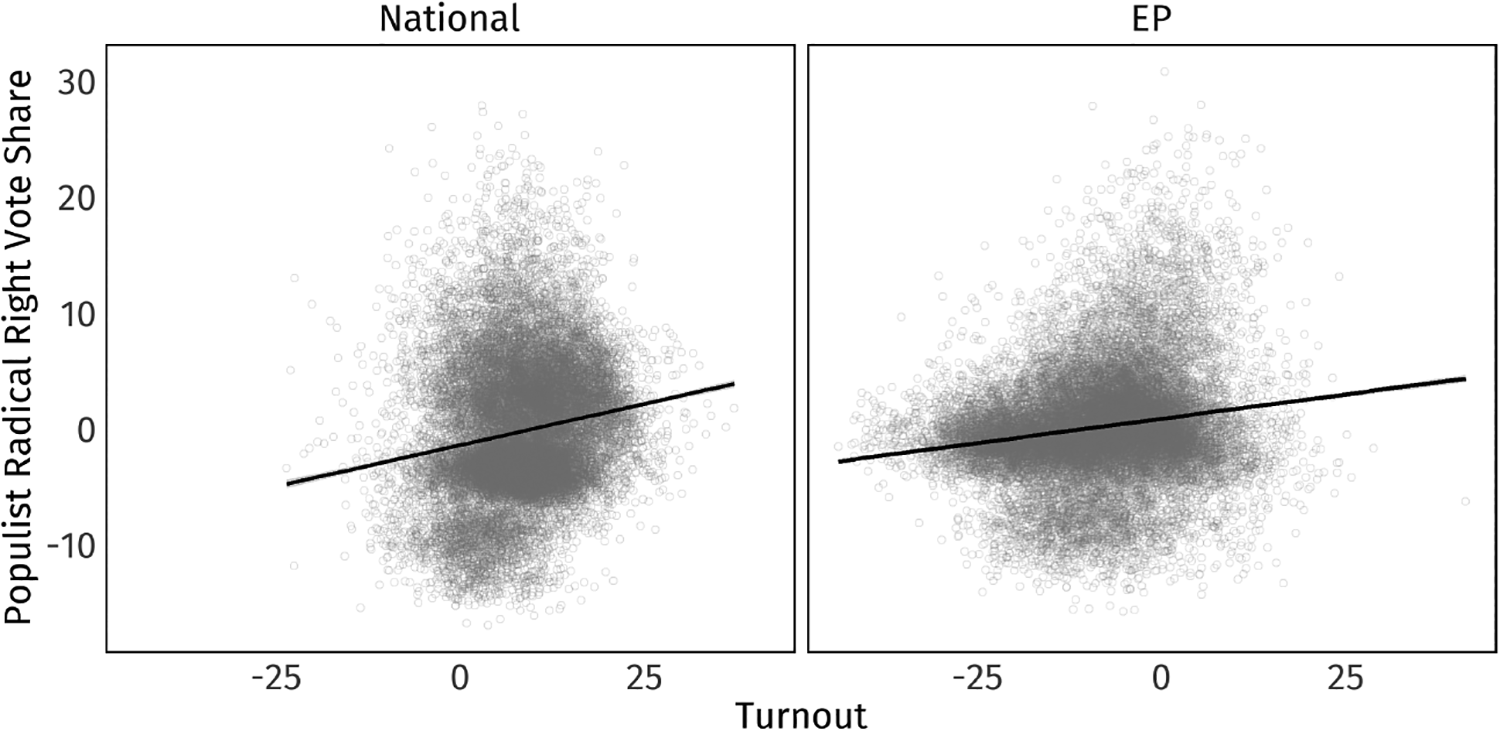
Bivariate relationship between turnout and the success of the AfD after residualizing both variables with respect to state-fixed effects.
We approach this identification problem by exploiting the nature of the local organization of party campaigns in Germany. While electoral campaigns in Germany are coordinated by the national and state headquarters of a party, they have to be carried out on the ground by the local party branches (“Kreisverbände”). These local party branches, in turn, operate independently in organizing political events or in distributing advertisements to voters. The variation in the intensity of the campaigns depends on the financial and human resources available to the different local party branches. We collect data on the geographical scope of all local party branches of the German AfD to estimate the impact of turnout surges that are exogenous to the party’s mobilization efforts. In total, there are 10707 municipalities and city districts, respectively, that fall under the geographical scope of a total of 270 local party branches. Within each geographical scope of a given local party branch in Germany, there is some variation in the turnout growth across municipalities, which we exploit to identify the effect of increased electoral mobilization.
Consider, for instance, the AfD’s local party branch “Kreisverband Miesbach,” responsible for organizing the election campaign within a total of 17 different municipalities. In the EP elections 2019, the average turnout within the territorial area of this AfD party branch “Kreisverband Miesbach” was 65.11%. While turnout in all municipalities was significantly larger than in the previous EP elections of 2014 (on average, by 23.04 percentage points), some municipalities experienced a turnout surge. The small municipality of Irschenberg experienced an increase of no less than 39.23 percentage points with more than 80.9 percent of the eligible population turning out to vote for the secondary EP elections (see Panel A in Figure 2). Usually, turnout levels in Irschenberg closely resemble the average participation rates of other municipalities located in Upper Bavaria. However, a few weeks ahead of the EP elections, the mayor of Irschenberg had surprisingly passed away, making it legally necessary to hold concurrent mayoral elections along with the EP elections in May 2019. This was an incentive for citizens to head to the polls in much larger numbers than usual, prompting a turnout surge in Irschenberg.
The case of Irschenberg illustrates the type of variation that we exploit in a systematic way to understand the effect of increased electoral participation for the electoral fortune of the populist right. Considering that we compare the surge in turnout with the average surge in turnout across all other municipalities that are exposed to the same local party mobilization efforts of the AfD, we can isolate the effect of turnout surges that are exogenous to the influence of the populist right as highlighted by the case of Irschenberg. Table A4 in the Online Appendix shows that municipalities that experienced a turnout surge in 2017 and 2019, respectively, did not experience a similar turnout surge in the national elections of 2013 and the EP elections of 2014 (with regards to the turnout level in the national elections of 2009 and the EP elections of 2009, respectively), making us confident that the turnout surges in our data do not relate to systematic differences between the municipalities but rather to quasi-random variation that we can exploit to estimate the effect on the success of the populist right.
Figure 2 visualizes the variation in turnout growth relative to the average turnout growth among all municipalities falling under a given populist right party branch for the aforementioned example. Panel C of Figure 2 also highlights that the local party branches of the AfD are small geographic entities, while the respective subordinated municipalities are even smaller. This is reflected in the number of eligible voters: the median municipality has 1568 eligible voters. To account for some differences in the size of the electorates across municipalities (see also Table A1 in the Online Appendix), we weight all observations for their respective size. 4
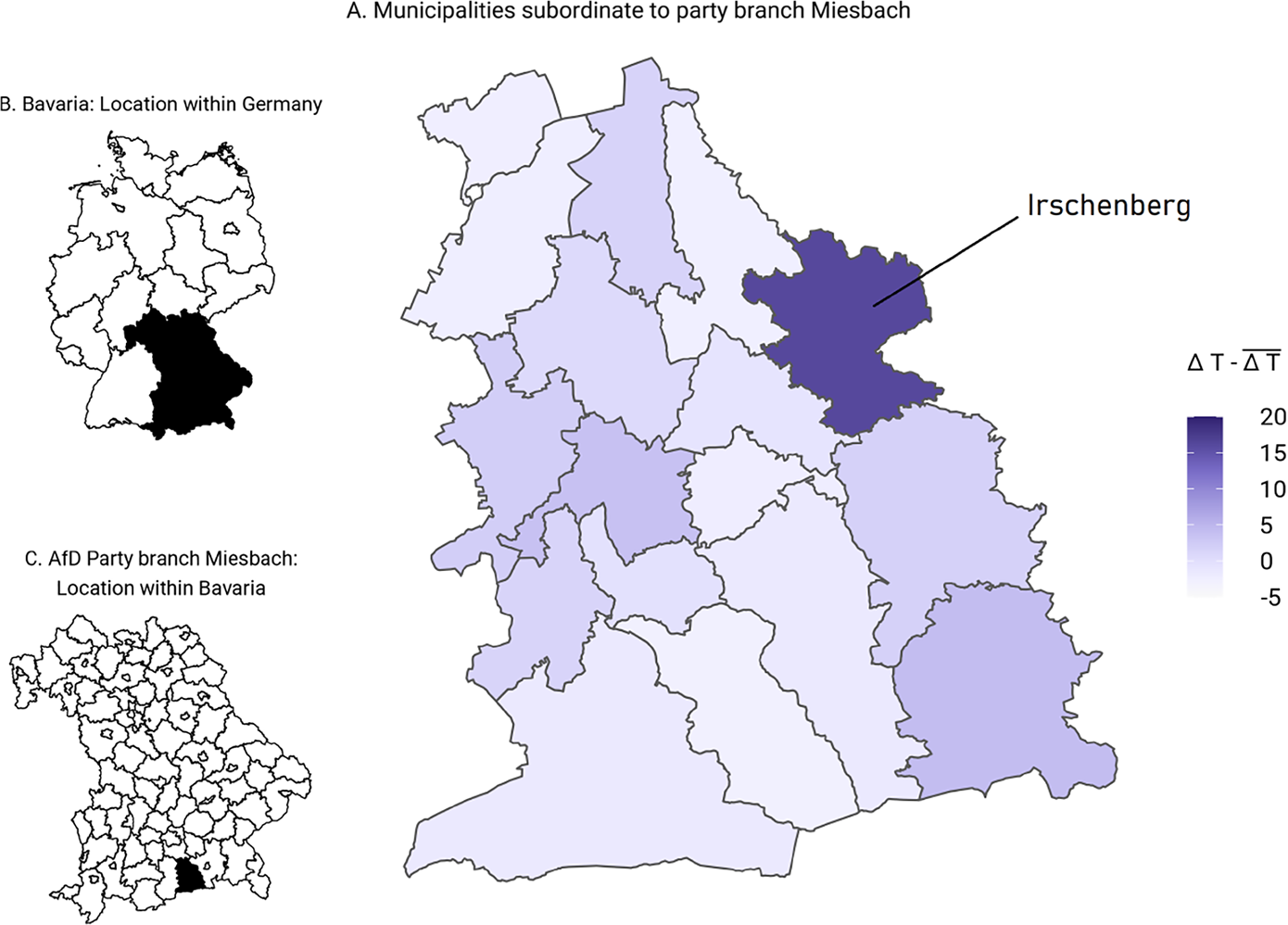
Municipal-level deviation from average turnout growth within the geographical scope of the party branch Miesbach during the EP elections of 2019. The strength of the shading in Panel A indicates the deviation of a municipality from the average change in turnout. The municipality Irschenberg experienced a large turnout surge: the growth in electoral participation was 16.19 percentage points higher than the average growth among all municipalities within the local AfD party branch.
Our central independent variable is an indicator variable measuring the presence or absence of local turnout surges
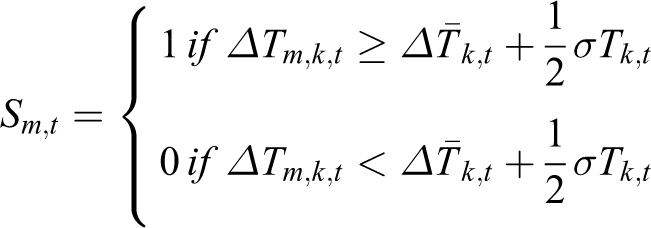
where

Here, t refers to the 2017 national election or the 2019 EP elections, and
We estimate the above model on all municipalities and city districts (N = 10707), but also separately for East and West Germany. Past elections have shown stark differences in electoral results for the populist right AfD across East and West Germany (see Figure A1 in the Online Appendix). The two regions also still display marked differences in average turnout levels, and even 30 years after German unification, feelings of societal marginalization are widespread in Eastern Germany (Weisskircher, 2020). In terms of our estimation, these differences may result in largely different residual variance between Eastern and Western German municipalities, thus, potentially biasing the point estimates of our independent variable of interest.
Results
The difference-in-differences design keeps constant changes between the elections that affect all municipalities equally (Angrist and Pischke, 2008: 227f). Such changes relate, for instance, to the different national campaigns or the salience of specific issues in a given election contest. Furthermore, state fixed effects control for heterogeneity across states. We estimate the effect of an increase in electoral participation within a given municipality (“turnout surge”) on the vote share of the populist right while accounting for variance in party mobilization efforts. All models report bootstrapped confidence intervals stratified by states. 5
The results show that, on average, the AfD vote share increased by 0.61 percentage points in municipalities that experienced a turnout surge in the national elections (see column 1 of Table 1). This effect is statistically significantly different from zero as seen in the corresponding confidence intervals ranging from 0.29 to 0.96. While the directions of the effects are similar in the models focusing only on West and East Germany, in the latter case the confidence interval is very large and includes zero (see column 5 of Table 1). This relationship is reversed when we turn to study the effect of turnout surges during the low-salience EP elections. In this electoral context, the AfD stands to lose from increased electoral participation. This negative effect is also substantively large. In municipalities that experience a turnout surge, the populist right party performs 0.38 percentage points worse than in comparable municipalities that did not experience a turnout surge. Relative to the AfD’s overall vote share in the 2014 EP elections, that is a decrease of about 5.35%. Thus, during the European elections, turnout surges have a negative effect on the electoral fortunes of the populist right, while they have a positive effect in national elections. These results are in line with our hypotheses H1a and H1b. While the directions of the effects are the same in Eastern and Western Germany, the effect sizes differ slightly between the two regions with larger magnitudes in Eastern Germany.
Effect of turnout surges on the electoral success of the populist right AfD.
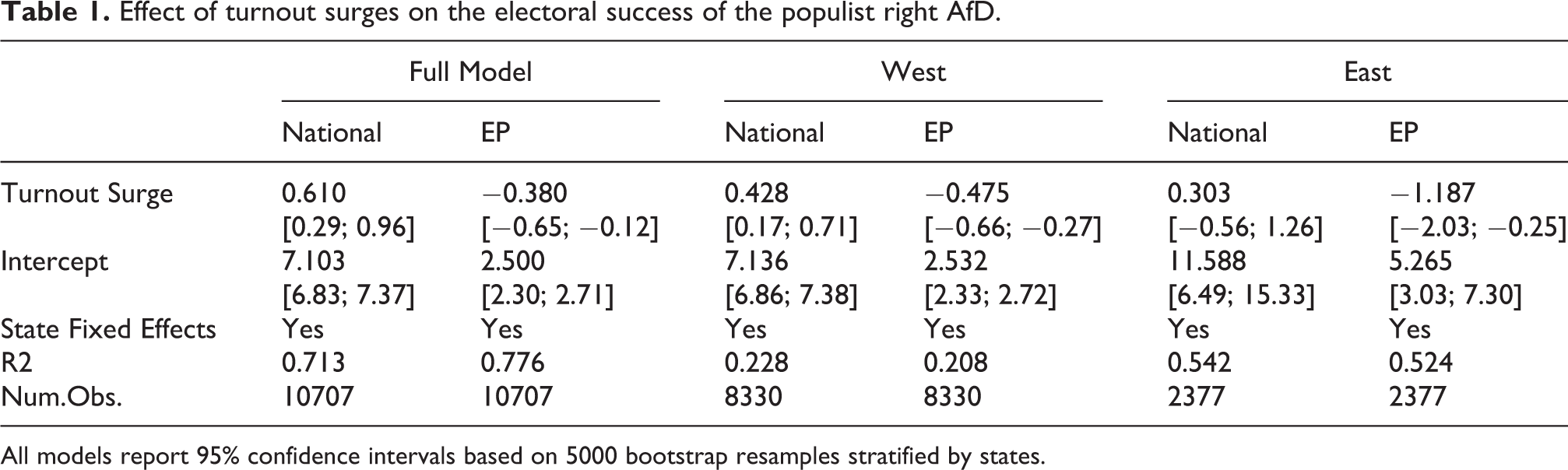
All models report 95% confidence intervals based on 5000 bootstrap resamples stratified by states.
These findings are critical as they suggest that increased mobilization in the “second-order” EP elections, which have a history of amplifying the prospects of radical challenger parties mobilizing against further European integration (Hix and Marsh, 2011; Schulte-Cloos, 2018), actually dampens the electoral success of the radical right. EP elections are typically assumed to be “second-order” to the national elections as the related electoral campaign is domestically less salient than a respective national electoral campaign, thereby attracting less public attention and inciting less political interest among the general public. Scholars argue that the European campaign is increasingly fought on questions of immigration, advancing levels of European integration, or the increasing authority transfer to the supranational level, all of which form a coherent set of issues, frequently referred to as “cultural” dimension of politics that cross-cuts the more traditional “left-right” dimension of political conflict (e.g., Kriesi et al., 2008). Though populist radical right parties mobilize the conservative pole of this cultural dimension, our results show that increased participation in the European contest acts to diminish the success of the populist right. If more voters get out to vote and participate in the European elections, the prospects of the populist radical right decline, suggesting that popular mobilization in the low-salience EP elections diversifies the representation of plural policy preferences more than accentuating the representation of extreme, radical right positions.
These findings support our hypotheses H1a and H1b. Turnout surges work to amplify the electoral fortunes of the populist radical right in national elections while this pattern does not hold in the EP contest. The latter is characterized by low salience and widespread public abstention and, thus, non-voting citizens, on average, are not highly political alienated and do not harbor deep-seated populist attitudes that could boost the electoral fortune of the radical right. The different effect of turnout surges in national and European elections appears to relate to the characteristics of mobilized voters and the related underlying electoral potential for the radical right. To further explore the mechanism accounting for this effect, we investigate heterogeneous effects of turnout surges conditional on prior levels of political disaffection in the following section.
The effect of turnout surges conditional on baseline levels of political disaffection
Theories of populist grievances expect that populist right actors benefit from mobilizing a particular share of the electorate, namely such voters who do not trust the political system, the established political parties, or the political elite (Akkerman et al., 2014; Gidron and Hall, 2020). Thus, in municipalities characterized by widespread political disaffection, turnout surges should amplify the fortunes of the radical right, whereas the same should not hold in municipalities characterized by low baseline levels of political disaffection. To analyze the potentially heterogeneous effects of turnout surges, we condition the effect of the central independent variable on the baseline level of prior political disaffection in a given municipality. Recall that we measure this baseline level of political disaffection in all observed municipalities prior to the existence of the populist right AfD, which is crucial as previous research shows that populist radical right parties both express voters’ discontent while also contributing to further amplifying it (Hooghe and Dassonneville, 2018). Our index thus measures pre-existing levels of political disaffection and ranges from 0 (low level of political disaffection) to 4 (high level of political disaffection). In the following, we assess whether the effect of turnout surges on the electoral success of the AfD depends on the level of pre-existing political disaffection in a given community.
Figure 3 shows the average predicted effect of turnout surges by contrasting changes in AfD vote share in municipalities with and without turnout surges at different baseline levels of political disaffection. 6 Prior levels of political disaffection clearly moderate the impact of turnout growth on AfD vote share both in national elections and in the EP elections. In the national elections, the populist radical right benefits from turnout surges at high levels of prior political disaffection. Among communities marked by widespread feelings of political grievances, the AfD benefits from increased electoral participation rates. Notably, we do not find the same effect when analyzing the effect of turnout surges among local communities that are characterized by low baseline levels of political disaffection. In such contexts, the populist radical right does not draw any advantage from increased electoral participation. Between municipalities that saw a turnout surge and those that did not, the difference in the predicted electoral gains for the AfD is insignificant or even negative at the lowest levels of the disaffection index (see Figure 3). In line with hypothesis H2a, turnout surges amplify the success of the radical right only in local contexts marked by high levels of pre-existing political disaffection.
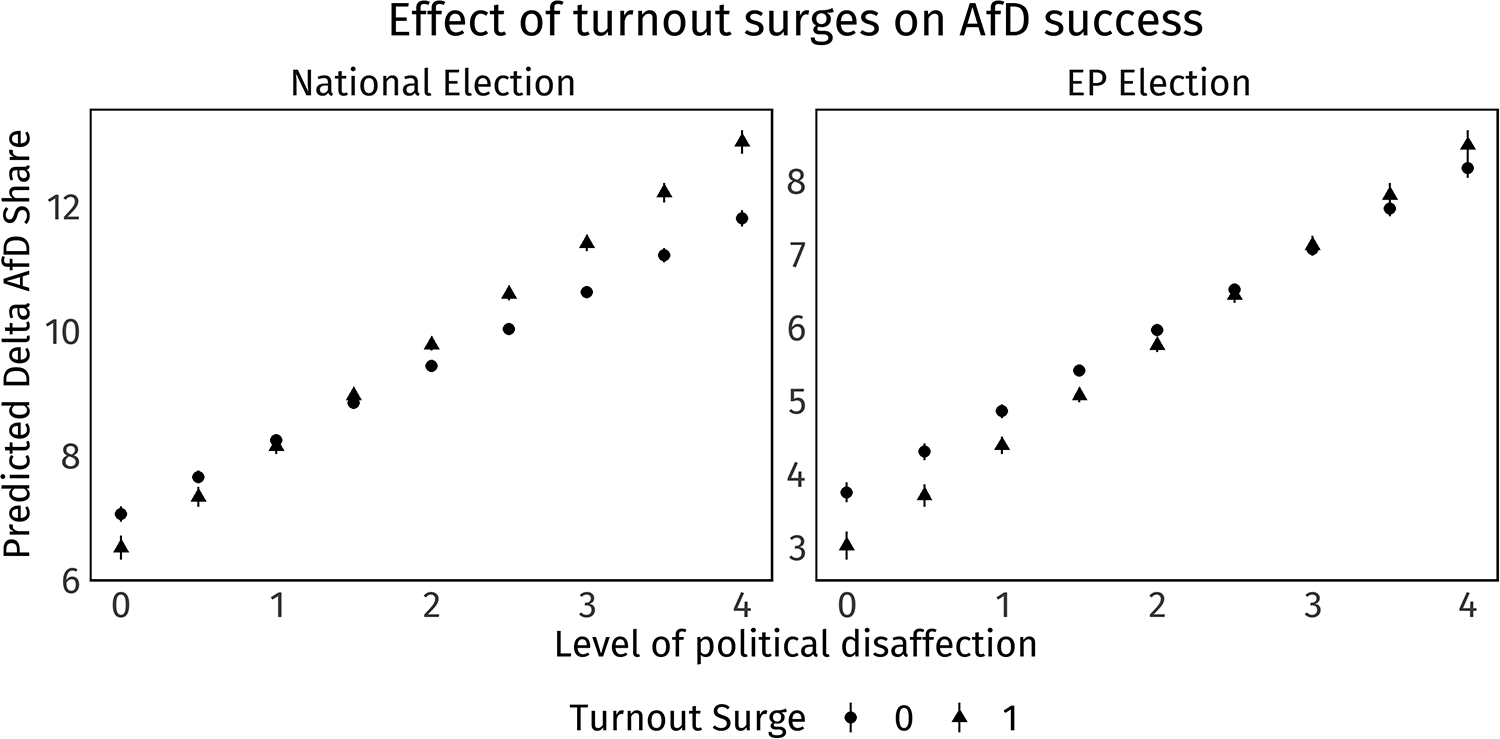
The effect of turnout surges on the success of the populist right: average changes in AfD vote share in municipalities with and without turnout surges along different baseline levels of political disaffection.
As expected, we see the opposite pattern when we study the EP elections. While we showed earlier that turnout surges in the EP elections, on average, impede the success of the populist right, we do not find such a negative effect any longer when focusing on communities with high baseline levels of political disaffection. As shown in Figure 3, within municipalities displaying the highest baseline level of political disaffection, the populist right AfD does not stand to lose in response to increased electoral mobilization. Instead, there is no significant effect of turnout surges on the success of the populist radical right. The confidence intervals of the predicted effects of municipalities that experience a turnout surge and those that do not experience a turnout surge clearly overlap. Thus, the overall negative effect of turnout surges on the success of the AfD reported in Table 1 appears to be driven by the large negative impact of turnout surges within local communities with low baseline levels of political disaffection. In these communities, turnout surges exert a substantive negative effect on the fortunes of the radical right, which supports hypothesis H2b. Our findings, thus, clearly indicate that the effect of increased electoral mobilization on the success of the radical right is conditional on the prevailing level of pre-existing political disaffection within a municipality. In the following, we discuss the implications of these results, pointing to relevant future research in this area, and conclude.
Discussion and conclusions
Do populist radical right parties benefit from increased electoral mobilization? Previous studies that tried to understand the relationship between electoral participation and the success of the populist right have provided inconclusive findings. Bridging theories of populist attitudes with accounts of party competition in Western Europe and latent demands for radical right policies, we argue that political disaffection moderates the relationship between electoral mobilization and the success of the radical right. Populist parties are both articulating and amplifying political distrust among citizens, which makes it difficult to disentangle the effect of voters’ political disaffection from the presence and electoral success of a populist right party. Focusing on the German context allows us to include a measure of pre-existing political disaffection since the populist radical right has only recently become successful in Germany. We draw on a novel panel dataset of disaggregated election data, which covers the electoral results of more than 10,000 German municipalities and city districts in six nation-wide elections between 2009 and 2019, and develop an index that measures the pre-existing political disaffection within a local community. We identify the effect of turnout surges in a difference-in-differences design while accounting for variation in the local mobilization capacities of the AfD. The results of our study demonstrate that turnout surges amplify the electoral prospects of the populist right. Yet, this effect holds only among municipalities displaying high levels of political disaffection that pre-date the existence of a populist radical right party.
The results of our study contribute to the rich literature on the populist right by highlighting that the mobilization of politically disaffected parts of the electorate plays an important role in fueling the success of the populist right in addition to voters’ shifts away from mainstream parties. By focusing on variation in electoral returns at the level of local communities, our article further contributes to an emerging literature on the contextual, local underpinnings of political behavior. Finally, our empirical strategy of relying on data on the geographical scope of local party branches can be adopted by scholars interested in the emergence and success of newcomer parties.
Comparative accounts show that even long-established populist right parties continue to benefit from voters’ dissatisfaction as long as they are excluded from government (Cohen, 2019; Kriesi and Schulte-Cloos, 2020). Thus, our findings might apply to a number of other Western European countries in which the populist radical right is not in government. Future research should explore these patterns while taking into account such variation in the supply-side context. Next to the variation in government participation, future research should also address whether the effect differs for long-standing extreme right parties, such as “Golden Dawn” in Greece, and more recently established populist radical right parties. Finally, future research should address the question of whether also populist radical left parties, such as “Podemos” in Spain, benefit from increased electoral mobilization when they are the ones to credibly articulate voters’ political disaffection.
In line with accounts of political grievances and social disintegration, the results of this article highlight that the populist radical right benefits from increased participation in local communities that are politically alienated. Under conditions of high political disaffection, the recent rise in electoral participation levels across some Western European countries may thus further fuel the success of the radical right. In local communities without a history of political disaffection, in contrast, there is hope for mitigating the rise of the radical right through greater electoral participation.
Supplemental material
Supplemental Material, sj-pdf-1-ppq-10.1177_1354068820985186 - Electoral participation, political disaffection, and the rise of the populist radical right
Supplemental Material, sj-pdf-1-ppq-10.1177_1354068820985186 for Electoral participation, political disaffection, and the rise of the populist radical right by Julia Schulte-Cloos and Arndt Leininger in Party Politics
Footnotes
Acknowledgments
We thank Peter Thisted Dinesen for his very helpful comments on an earlier version of this article. We also thank participants of the Nordic Political Behaviour Workshop, the Montréal Electoral Chairs’ Seminar Series, the Annual Conference of the German Political Science Association’s standing group Elections and Public Opinion, the workshop on political sociology at the University of Bern, and the MZES Mittelbau Colloquium, Department A. We are grateful for the very constructive feedback of three anonymous referees.
Declaration of conflicting interests
The author(s) declared no potential conflicts of interest with respect to the research, authorship, and/or publication of this article.
Funding
The author(s) disclosed receipt of the following financial support for the research, authorship, and/or publication of this article: This project has received funding from the European Union’s Framework Programme for Research and Innovation Horizon 2020 (2014–2020) under the Marie Skłodowska-Curie Grant Agreement No. 754388 (LMUResearchFellows) and from LMUexcellent, funded by the Federal Ministry of Education and Research (BMBF) and the Free State of Bavaria under the Excellence Strategy of the German Federal Government and the Länder.

Supplemental material
Notes
References
Supplementary Material
Please find the following supplemental material available below.
For Open Access articles published under a Creative Commons License, all supplemental material carries the same license as the article it is associated with.
For non-Open Access articles published, all supplemental material carries a non-exclusive license, and permission requests for re-use of supplemental material or any part of supplemental material shall be sent directly to the copyright owner as specified in the copyright notice associated with the article.
