



Abstract
In the context of the ongoing deinstitutionalisation of the Italian party system, Fratelli d’Italia (FdI) emerged as the most voted-for party in the 2022 general election. Although previous studies categorised FdI as a populist radical right (PRR) party, no research has so far been conducted on its voters. We examine whether the traditional explanations for the rise of PRR parties also apply to FdI. We develop a theoretical argument suggesting that in the context of over-crowded competition amongst populist parties, as seen in Italy, leadership evaluation trumps policy and ideological consideration in predicting vote switching. Our results reveal that positive evaluations of Giorgia Meloni emerge as the most significant predictor of voters switching to FdI in the 2022 election. This research sheds light on individual-level mainstreaming of PRR attitudes and preferences, in particular during an electorally expansive phase, emphasising the role of leadership evaluations in voting behaviour in a context characterised by intense populist competition.
Fratelli d’Italia (FdI, Brothers of Italy) emerged as the undisputed winner of the Italian general election held in September 2022. In the decade since its founding, the party has successfully garnered the support of a significant portion of Italian voters, ultimately securing leadership within the right-wing coalition. Existing studies generally view FdI’s connection to the Italian post-fascist tradition as symbolic. This link is often considered as being primarily connected to elite continuity with the Movimento Sociale Italiano and Alleanza Nazionale (Puleo and Piccolino, 2022), though an alternative perspective is presented by Broder (2023). While most studies classify FdI as a classic populist radical right (PRR) party based its programmatic stances and its leader’s rhetoric, which mostly adhere to the tòpoi of such a family (Baldini et al., 2022; Donà, 2022; Piccolino and Puleo, 2023; Puleo and Piccolino, 2022; Vampa, 2023), others have proposed different classifications. In particular, a stream of research depicts FdI as a ‘national conservative’ party, suggesting limited challenges against the liberal pillar of Italian democracy (Tarchi, 2023; Vassallo and Vignati, 2023; but see Newell, 2024 for a critical perspective). Despite extensive research on FdI’s political supply, there remains a gap in understanding the characteristics of its supporters. Additionally, the factors resulting in FdI securing almost 6 million more votes than those obtained in the 2018 general election remain unexplored.
This article aims to fill this gap by combining the literature on the support for PRRs (Muis and Immerzeel, 2017) with some insights on the motivations for vote switching in contexts affected by an increasingly undifferentiated political supply (Spoon and Kluver, 2019). In this respect, we advance a theoretical argument suggesting that given the increasingly important role played by political leaders as a heuristic shaping voting behaviour in a context of prolonged dealignment and deinstitutionalization (for a review, see Lobo, 2018), leader evaluations represent a crucial predictor, especially among those voters supporting similar parties in the previous election.
The literature on competition among populist parties suggests that when vying for similar constituencies, competition extends beyond ideological or issue-based considerations (Albertazzi et al., 2021a: 53). In this respect, the Italian case stands out due to the simultaneous presence of significant PRR parties (FdI and Lega) alongside a valence populist party (Movimento 5 Stelle, M5S). 1 Building on these theoretical considerations, we examine the substantial support for FdI in 2022 and the resulting vote switching from other populist parties. We consider the Italian case as a pathway case to determine whether the expectations regarding individual-level drivers for the success of PRR parties hold in a context characterised by a crowded populist and radical right supply (Gerring, 2007).
Against this backdrop, we first examine whether FdI’s nature as a PRR party is supported by its voters’ characteristics. Second, we examine whether voter shifts from 2018 to 2022 were motivated by ideological and policy considerations or were primarily influenced by their appreciation for FdI’s leader, Giorgia Meloni. We test these hypotheses using data from the latest wave of the Italian National Election Study (ITANES). Notably, the primary predictor for switching to FdI was a positive evaluation of Giorgia Meloni, which stands out as the sole factor explaining shifts from a PRR party (Lega), while switches from M5S were additionally influenced by issue preferences.
The article is organised as follows: In the next section, we provide contextual background regarding the Italian 2022 election. The second section reviews the literature on support for PRR parties, with a focus on the significance of leadership evaluations in bolstering support, and on the support of PRR parties in Italy specifically. The third section addresses our research hypotheses, developed by linking the literature on PRR with the key findings regarding the role of leaders in shaping vote choice. Subsequently, we discuss our hypotheses in the fourth section. We then present our dataset, examining the relevance of the Italian case in exploring PRR support in contexts characterised by intense PRR competition. Finally, in the fifth section we present our results and discuss their implications for the literature on PRR support, outlining potential avenues for further research.
One winner, many losers? The 2022 election in perspective
Since the seismic 1994 election (Bartolini and D’alimonte, 1996), main right-wing parties in Italy have run in the same coalition, with the sole exception occurring in 1996 when Lega ran independently. In the 2022 general election, the pre-electoral alliance adhered to its customary structure, anchored by four main components: Forza Italia (FI, Go Italy), led by Berlusconi; Lega, led by Matteo Salvini, which, despite being now a nationalised party originated from the former Lega Nord (Northern League); FdI, representing the post-fascist tradition; and a residual centrist list named Noi Moderati (We the Moderates).
In the 2022 general election, the right-wing coalition secured approximately 44% of the votes, attaining a comfortable majority in both chambers. This success was facilitated by a lack of coordination among the main competitors of the right-wing coalition. Their division in three blocks—the centre-left coalition; Movimento 5 Stelle (M5S, Five Star Movement); and a liberal-centrist list—paved the way for the substantial victory of the right-wing coalition in the single-member districts (Marini and Piccolino, 2023: 31–32).
Compared to the past, the balance of power among the coalition partners on the right underwent a profound restructuring (Figure 1). FdI dominated the coalition with 26%, a remarkable increase compared to the 4% of 4 years earlier and the even more modest 2% of its debut in 2013. This outcome paved the way for Giorgia Meloni to become Italy’s first woman prime minister. In contrast, Lega and FI experienced a sharp drop, aligning with the overall dynamic of high volatility in the Italian elections of the last decade (Chiaramonte et al., 2023: 349–352). Vote shares in national elections of the right-wing camp by Its main parties (1994-2021). Notes: Vote shares refer to the proportional part of the Chamber of Deputies and they do not consider the abroad and Aosta Valley constituencies. Source: Own elaboration on Italy’s Ministry of Interior data.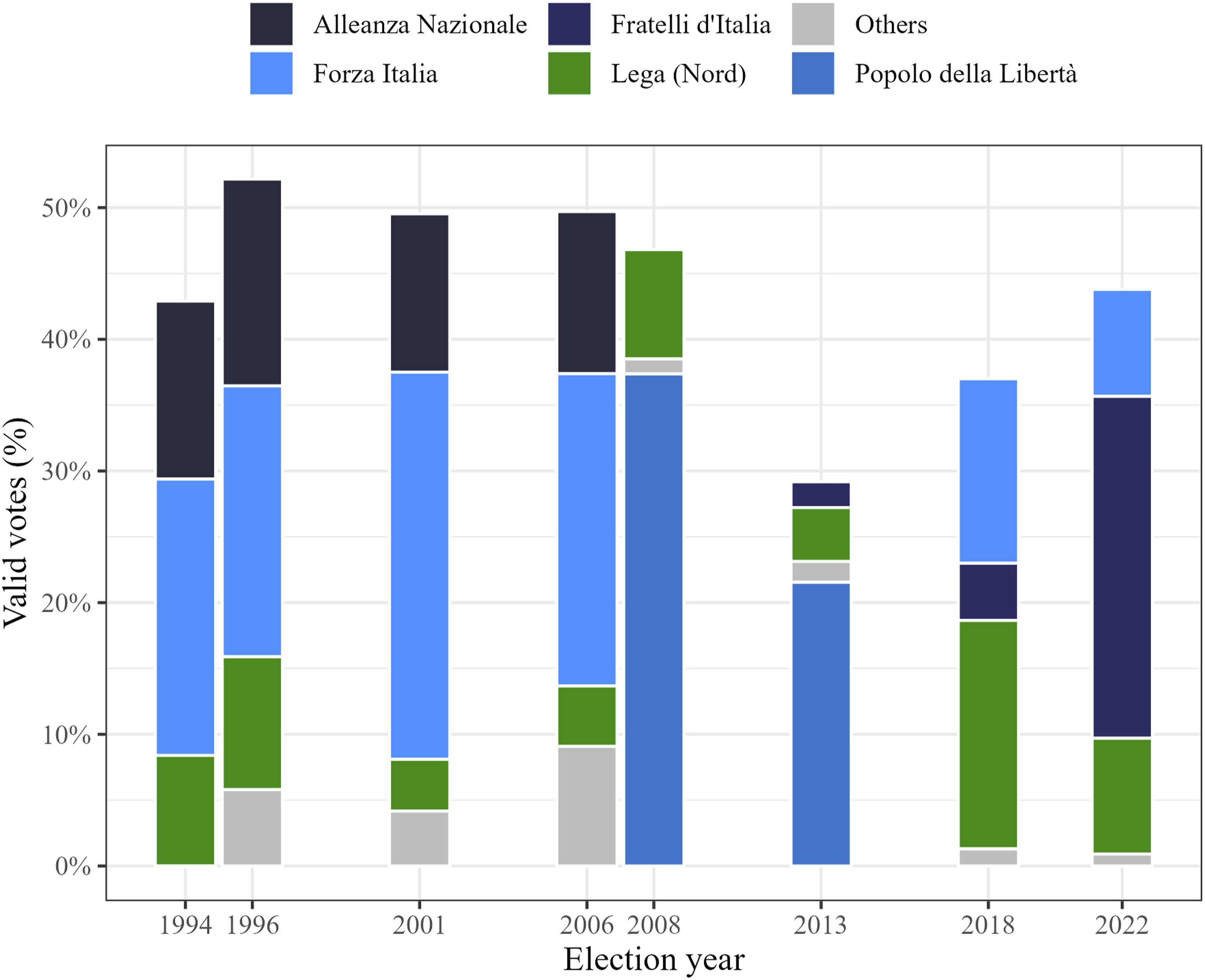
The 2022 election fits perfectly in the broader trend of pervasive de-institutionalisation of the Italian party system (Emanuele and Chiaramonte, 2020), to the point that ‘a sequence of three consecutive general elections [i.e. 2013, 2018, 2022] with such high levels of total volatility is unparalleled in any other Western European country since the end of World War II’ (Chiaramonte, 2023: 84). In 2022, FdI emerged as the first PRR to become the largest party in an Italian General Election. This marked the third instance in a row where a populist party achieved such primacy, following M5S in the 2013 and 2018 elections. 2 The trend of high volatility experienced by the country has largely been driven by the rise and fall of several different populist actors. After the 2018 election, a cabinet consisting of two different flavours of populism was formed: the first Conte cabinet, composed of M5S—a valence populist party (Zulianello, 2020)—and Salvini’s Lega, which under his leadership had already transitioned from a regional populist party to a nation-wide PRR party (Albertazzi et al., 2018). The cabinet resigned in 2019 after the European election, where the balance of power between the two parties dramatically reversed compared to the general election (Chiaramonte et al., 2020). Salvini attempted to capitalise on his popularity, hoping for a snap election, but such efforts instead led to the formation of a new cabinet between M5S and the Partito Democratico. This cabinet, still led by Giuseppe Conte, managed the initial phase of the Covid-19 pandemic before paving the way for the Draghi cabinet in early 2021. While M5S never returned to the electoral levels achieved between 2013 and 2018, starting roughly from 2020 the polls witnessed a dramatic restructuring of electoral strength among PRR parties (Albertazzi et al., 2021b). Salvini’s party steadily declined, countered by the consistent growth of FdI, which in the span of a couple of years became Italy’s main PRR party (Baldini et al., 2022; Puleo and Piccolino, 2022).
Despite being an experienced politician and a former minister during the last Berlusconi cabinet, Meloni played the role of the outsider during the electoral campaign. FdI was the only major party consistently in opposition during the 2018–2022 parliamentary term and, more broadly, had never been part of a national government since its foundation in 2012. In 2022, the party did not adopt a more radical platform compared to the past. On the contrary, it nuanced several stances in a clear attempt to present a more respectable profile, while maintaining an overall anti-immigration and Eurosceptic profile (Vassallo and Vignati, 2023: 180). Such a mix of radicalism and moderation likely played a pivotal role in boosting electoral support for FdI and making it not only a crucial actor within the right-wing coalition but also within the entire Italian political system. Meloni attracted voters from very different backgrounds, not only coming from FI and Lega, as one might expect, but also a non-negligible share of former M5S voters, while limited contributions came from centre-left parties (Chiaramonte et al., 2023; De Sio and Paparo, 2023).
Demand-side explanations for the success of the PRR parties
The literature on the main factors driving support for PRR parties in Western Europe has explored the role of both socio-demographic features and ideological preferences (see Golder, 2016; Muis and Immerzeel, 2017). Firstly, several scholars have suggested that PRR voters, often considered the ‘losers of globalisation’, struggle to adapt to abrupt societal changes (Betz, 1994; Kitschelt and McGann, 1995). These individuals lack the expertise to maintain past living standards in a transformed, flexible, and de-industrialised society, leading to frustration towards established political elites and the erosion of previous political loyalties. In terms of social predictors of support for PRR parties, low-skilled, low-educated, white male, manual workers are more likely to support a radical right party (Arzheimer, 2012; Evans, 2005). However, scholars have also shown that social class alone cannot fully explain the support for PRR parties, arguing that ‘cultural, not economic modernization losers’ are the core of PRR supporters (Bornschier and Kriesi, 2012). Additionally, other scholars emphasise that, in several respects, PRR voters are not different from supporters of other parties. Thus, they are motivated by the same set of ideological and pragmatic considerations, ultimately supporting parties that align closely with their preferences regarding what they consider to be the most important political issues (van Der Brug et al., 2000).
Along these lines, it has been argued that PRR supporters might hold distinct preferences regarding economic issues. Therefore, PRR parties tend to mobilise eminently cultural and identity issues over the economic ones (Loew and Faas, 2019; Rovny, 2013), since PRR voters typically express definite preferences regarding the former. The significance of anti-immigrant sentiment as a driver for PRR support is widely acknowledged (Lubbers and Coenders, 2017; Stockemer et al., 2018). While Eurosceptic positions vary within the PRR family (Vasilopoulou, 2009), individual-level Euroscepticism usually predicts support for PRR parties, even if its impact is generally considered less relevant than anti-immigrant sentiment (Werts et al., 2013; but see Vasilopoulou and Zur, 2022).
More recently, the success of populist parties across the continent has presented cases of coexistence of such actors within the same party system. Recent empirical research on competition among them on the demand-side has been limited. However, a recent contribution hypothesised that in the competition among populist parties, not only do issue and ideological preferences play a role, but attacks targeting rival leaders and delegitimisation strategies are also employed to differentiate party supply (Albertazzi et al., 2021b: 53).
The impact of leader evaluations in voting for PRR parties
A seminal analysis of populism has already suggested that ‘it relies on the seduction of a charismatic leader’ (Meny and Surel, 2002: 17). The link between voters and their charismatic leader emerges as a central topos in most of the central literature on populism (Laclau, 2005; Panizza, 2005), and it is assumed to influence the success of PRR parties (De Lange and Art, 2011). In this respect, empirical analyses have shown how leader evaluations are associated with support for PRR parties, and most importantly, the leader effect is stronger for PRR voters than for others (Michel et al., 2020). In a similar vein, Donovan (2021) has shown that PRR voters are characterised by a greater appreciation of strong leaders when compared with the voters of other party families. Generally, voters tend to assess leaders based on limited characteristics such as competence, leadership and empathy; thus, these traits play a role in influencing citizens’ voting behaviour (Garzia, 2014). In contexts where party affiliation and linkage are in decline and the personalisation of politics has altered party strategies in electoral campaigns, leadership evaluation may serve as a heuristic for partisanship (Dalton and Wattenberg, 2000; Garzia et al., 2022; Lobo, 2015). However, the impact of leaders is not expected to be constant across time and space (Barisione, 2009; Popa et al., 2023).
Voting for right and populist radical right parties in Italy
As previously indicated, studies on the demand side of FdI are still lacking, although some evidence has been presented concerning voter support for Lega. Starting from the early 2000s, Lega shifted towards the far right of the political spectrum (Ignazi, 2005). This radicalisation of party supply has been accompanied by a progressive radicalisation of its voters, who have been identified as those with the toughest far-right positions, including on migration and the EU (Passarelli and Tuorto, 2018). However, in the context of the Italian right, the exceptionalism of Lega in terms of radical and populist stances should not be overemphasised. Indeed, in terms of voter position along the left/right dimension, an analysis conducted on the 2013 and 2018 elections revealed that in terms of their voters, Italian right parties are virtually interchangeable (Schadee et al., 2019).
As testified by an edited volume by D’Arma (2015), in the Italian case the personalisation of politics has become a stable feature of party competition since the rise of Berlusconi in the 1990s and his proprietary control over the main private (and public when in government) national TV broadcasters. Furthermore, the impact of leaders on voting behaviour and partisanship in Italy has always been considered crucial in the post-1994 setting, and has been confirmed even when compared with the impact of issue proximity (Bellucci et al., 2015). In this context, the highly personalised leadership of Berlusconi was crucial in transforming the country’s politics, once strongly party-centric, with a contagion effect on other political parties (Donovan, 2015).
Research hypotheses
The current literature has not yet mapped the causes for the electoral success of FdI at the individual level. However, we know from decades of research on PRR parties that preferences regarding cultural issues (e.g. migration) and the EU stand as the main pull factors for radical right support. We expect that such a rationale will hold also when we consider FdI in the 2022 election: H1a: The vote for FdI can be predicted by voter issue preferences on migration. H1b: The vote for FdI can be predicted by voter issue preferences on the EU.
In analysing vote switching between mainstream and non-mainstream parties, Spoon and Kluver (2019) found that when mainstream parties converge and become increasingly undifferentiated, formerly mainstream voters are more likely to switch their vote to non-mainstream parties. The overarching logic of their comparative work lies in the degree of (un)differentiation among parties. This echoes the findings of Dalton et al. (2011:120), which revealed that voters tend to make clear choices based on policy preferences when they face clear distinct alternatives among parties. In analysing the reasons for switching to AfD in Germany, Wurthmann and colleagues (2021) found that sociodemographic factors had a lower impact than policy and ideological preferences, in line with classic insights from radical right literature discussed above. Despite some caution deriving from the limited sample size available, the authors found that left–right self-placement and some policy preferences on the cultural progressive/conservative axis impacted switching more for voters coming from SPD than for those coming from CDU/CSU, suggesting a greater impact of policy and ideological considerations when the distance from the party voted for in the previous election and that under investigation increases.
In the context of prolonged dealignment, leader effects on voting behaviour are expected to be stronger (Lobo, 2015). In a similar vein, Garzia (2014:19) has suggested that with the decline of ‘socio-ideological’ identities, voting behaviour is increasingly explained by ‘more visible partisan objects – and in particular their leader’. Furthermore, in a context where the (weighted) polarisation of populist rhetoric in a party system is high, then the effect of leader evaluation in predicting the vote for a populist party is stronger (Kotnarowsk et al., 2021: 223). This implies that when populist parties obtain a sizable number of votes, they increase the overall polarisation of populist rhetoric within a national party system.
Building on these insights, we argue that when voters with similar preferences have to choose among parties with a similar political supply (e.g. belonging to the same party family), then the power of the leader as a heuristic for vote choice should be greater. Conversely, in those cases where the degree of differentiation among parties is higher, we expect a stronger impact of policy preferences in determining vote switching. In this respect, we suggest that such an attachment to leaders is expected to be greater in contexts where the differentiation among parties is limited. Therefore, we expect that in the case of an overcrowded competition among populist parties, the impact of the leader is crucial in determining vote switching.
In the context of the massive vote switching registered in the 2022 election, FdI attracted both rightist and populist voters, providing an ideal test to analyse the dynamics of populist competition on the demand side. In the context of vote switching towards Lega and M5S between the 2013 and 2018 Italian general elections, a prominent role played by migration and EU issues in driving such shifts has been noted (Schadee et al., 2019). However, when analysing vote switching from Lega to FdI in the 2022 election, we do not expect to see a strong role of these issues, given that the two parties share the same nativist core. On the contrary, given the valance populist nature of the party (Zulianello, 2020) and its draining government participation with Lega (2018–2019), the centre-left (2019–2021) and Mario Draghi’s national unity cabinet (2021–2022), the defections from M5S might have been driven by voters dissatisfied by M5S’s moderation once in government. In other words, we expect that these issues played a role in the vote switching from M5S to FdI, and in particular, in having attracted the electorate most in tune with right-wing positions on immigration and the EU. Therefore, we expect that: H2a: Voter preferences on migration influence vote switching to FdI from M5S more than from Lega. H2b: Voter preferences on the EU influence vote switching to FdI from M5S more than from Lega.
However, building on the aforementioned literature on the leadership effect—especially relevant in terms of radical right support—we suggest that the appreciation of FdI’s leader, Giorgia Meloni, constitutes the strongest predictor of vote switching from both Lega and M5S. In this respect, descriptive analyses have already pointed to the fact that Italian right-wing voters in 2022 shared similar policy preferences but were divided by leader evaluations (Maggini, 2023). Additionally, the popularity of Giorgia Meloni emerged as uncontested among the leaders of the right-wing coalition (Garzia and Venturino, 2023). H3: Leadership evaluation constituted the most important factor for switching to FdI in the 2022 election.
Design, data and methods
This article considers Italy as a pathway case (Gerring, 2007) in analysing patterns of populist competition. Considering the overcrowded supply of populist actors, we argue that Italy represents an ideal case to re-assess the pivotal role of leadership in shaping support for PRR parties. Furthermore, the Italian case represents an opportunity to establish whether individual-level predictors of PRR support also hold in contexts with multiple PRR parties. When identifying the populist actors within the Italian party system, we included not only FdI but also Lega, as an instance of radical right populism, and M5S, as a form of eclectic or valence populism (Ivaldi et al., 2017: 357; Mosca and Tronconi, 2019).
To address the hypotheses outlined above, this study relies on a quantitative analysis of individual-level survey data from the Italian National Election Study (ITANES), a two-wave computer-assisted web interview (CAWI) panel study (Vezzoni et al., 2023). The ITANES 2022 study involves survey items measuring a wide range of politically relevant attitudes and behaviours, as well as the socio-demographic characteristics of respondents. Thus, it serves as an ideal database for probing into the research questions at hand. The study comprises two surveys, conducted both pre- and post-elections, with both samples stratified by age, gender and geographical area. The number of observations for our analyses varies between 2,380 for the analysis of vote choice in 2022 based on our first dependent variable (Model 1) and 354 for our Lega–FdI vote switching model (Model 2).
Our analyses are specifically centred on the post-electoral survey. However, to mitigate the frequency of missing observations, we leverage the data’s panel structure. Given that respondents from the post-electoral survey were also part of the pre-electoral one, we utilise the preceding survey for two purposes: (i) imputing missing values in crucial elements of the post-electoral survey, and (ii) incorporating variables that were not present in the latter. 3
In terms of measurement, we build three dependent variables (DVs) based on respondents’ recalled vote choices in the 2018 and 2022 Italian national elections. The DV for the analyses dedicated to FdI voter profiles consists of a nominal variable contrasting the vote for FdI, Lega and M5S, and all remaining vote choices in the 2022 election.
The remaining two DVs are dichotomous variables designed to analyse voting shifts to Meloni’s party. These variables are based on respondents’ recalled vote choices in both the 2018 and 2022 election. The first of these two variables is a dummy that contrasts two groups: (i) respondents who voted for Lega in the 2018 elections and subsequently voted for FdI in the 2022 election, and (ii) Lega voters who maintained their choice between 2018 and 2022. The second vote switching DV follows a similar logic to the first one but replaces Lega with M5S.
The main independent variables (IVs) in our analyses are evaluations of party leaders. In our vote-choice model (Model 1) and vote switching models (Models 2 and 3), we include respondent evaluations of Meloni (FdI). In our vote switching models we additionally include respondent evaluations of Salvini (Lega) and evaluations of Conte (M5S). These are quasi-interval measures on a scale from 0 to 10, where lower values indicate more negative evaluations and higher values indicate more positive assessments.
Beyond these variables, our model incorporates measures of attitudes towards immigration and EU membership. The former is a quasi-interval measure available in the pre-electoral survey, capturing respondent attitudes to the number of immigrants arriving in Italy. Higher values reflect more negative attitudes, while lower values denote more positive views. The EU-membership variable is dichotomous, indicating whether a respondent perceives Italy’s EU membership as ‘negative’ or ‘neither negative nor positive’ (1), or ‘positive’ (0).
To analyse the profiles of PRR party voters (Model 1), we include a long list of covariates. These include respondents’ left–right self-placement, closeness to a party, populist attitudes (Akkerman et al., 2014), authoritarian attitudes, institutional distrust, evaluations of Draghi’s government and retrospective sociotropic evaluations of the economy. The evaluation of Draghi’s government is of particular interest, with FdI being the only major Italian party in opposition to this national unity government. Such positioning has clearly propelled FdI’s impressive increase in support (Chiaramonte et al., 2023: 334), and it is therefore important to investigate the role played by this evaluation for this cabinet. Additionally, we incorporate standard control variables, namely sociodemographic characteristics such as education level, employment, age category, basic income and gender.
To enhance the comparability of regression coefficients, we rescale all quasi-interval measures following Gelman’s approach (2008). This involves centring the variables by subtracting their mean and standardising them by dividing each by two standard deviations of their distribution. Further details concerning the wording of the survey questions, the recoding procedure for the related items and descriptives concerning their distribution are available in the online supplemental information. 4 Considering the nature of the data at hand and our DV operationalisation, we rely on generalised linear models (GLMs) for categorical data with a logit link function, namely multinomial (Model 1) and binomial (Models 2 and 3) logistic regression models.
Our quantities of interest (QoIs) are the magnitude of regression β coefficients and, most importantly, predicted probabilities. To compute the latter, we rely on the simulation approach proposed by King and colleagues (2000) and the observed value approach suggested by Hanmer and Ozan Kalkan (2013). The first allows us to focus on inference rather than predictions, by estimating the inferential rather than the fundamental uncertainty of our QoIs. The second approach then allows us to obtain an estimate of the average effect of a variable in the population rather than the effect for the average case—a fundamental distinction for the models utilised in this study.
Results
Vote choice
Our initial empirical analysis explores the voter profiles associated with FdI, Lega and M5S, comparing them with voters who chose other alternatives, such as FI, the centre-left and smaller parties. 5 In particular, we analyse whether the vote for FdI was driven by (negative) attitudes towards immigrants and the EU. Specifically, we aim to ascertain whether these orientations strongly correlate with the vote for FdI, forming the crux of our first set of hypotheses.
When assessing attitudes towards immigration, the regression coefficients are positive and statistically significant at p < .01 (see Figure 2) for FdI and Lega but not for M5S. Stronger critical attitudes toward immigrants are associated with a higher probability of voting for PRR parties as compared to the reference category, i.e. FI,
6
centre-left and other minor parties. When considering predicted probabilities, negative attitudes towards immigration increase the probability of voting for FdI from 16.7% to 22.9%, and the confidence intervals of these predicted probabilities at the minimum and maximum value do not overlap (95% c.i. at the minimum: 13.1%, 20.3%; at the maximum: 21.2%, 24.8%). These results provide support for H1a. The covariates of vote choice in the 2022 national elections. Notes: Symbols represent regression coefficient estimates. Error bars represent 95% and 99% confidence intervals of the estimates. Controls are omitted from the figure. Legenda: Eco. = Economic: Ego = Respondent self- placement; Ev. = Evaluations; Gov. = Government; Neg. = Negative; Pos. = Positive; Ref. = Reference category; Retro. = Retrospective.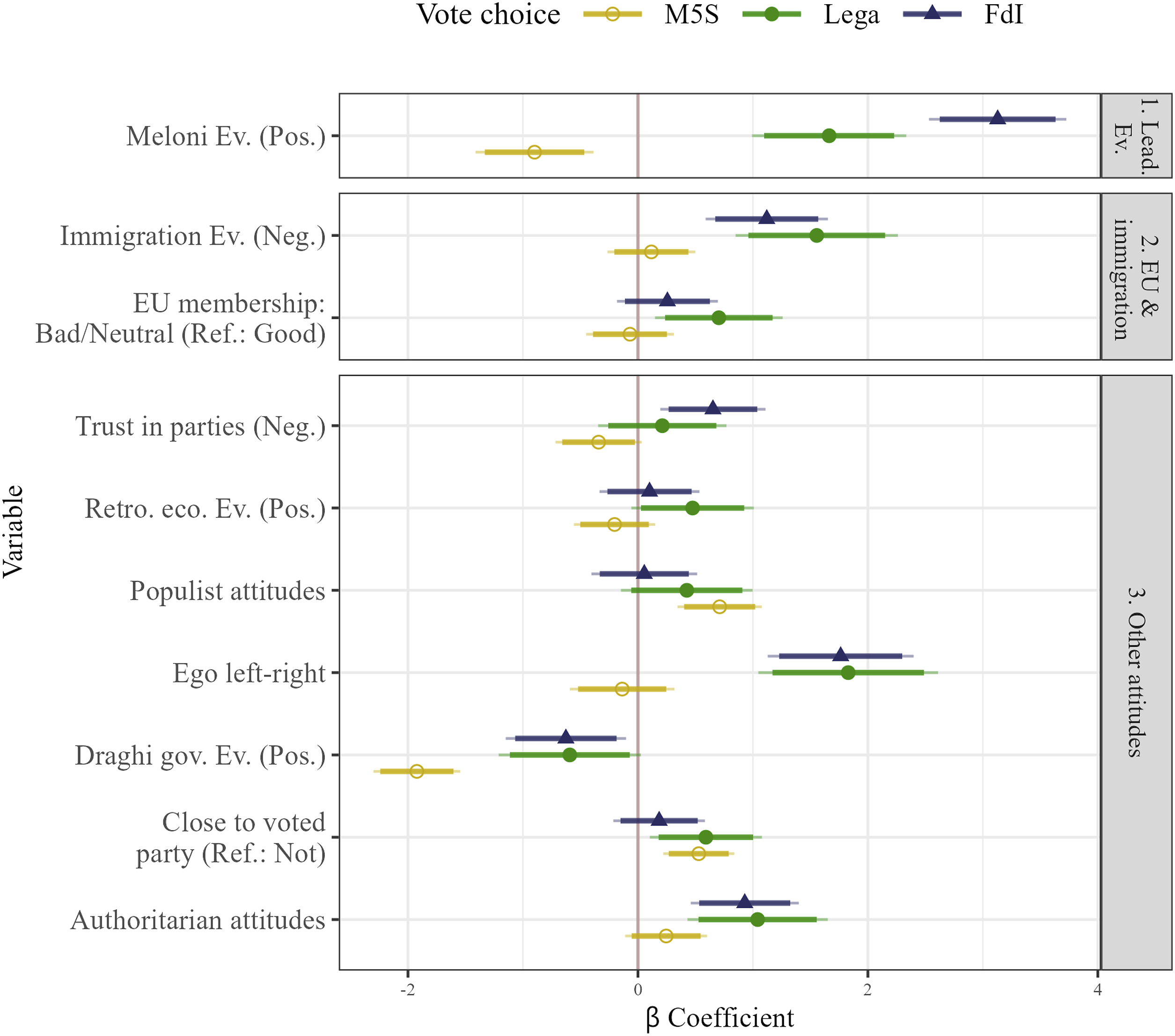
Turning to EU attitudes, we find that their relationship with vote choice is not consistent and is weak for FdI. In this case, the regression coefficient is not statistically significant at p < .05. This is reflected in the predicted probability of this factor. The probability of voting for FdI among voters with a positive opinion of Italy’s EU membership is 21.2% (95% c.i: 19.4%, 23.3%), whereas the probability of voting for the same party for voters with negative or neutral attitudes is 21.5% (95% c.i.: 20%, 23%). This suggests that H1b should be rejected.
When inspecting the coefficients of other factors, the attitudes or orientations most correlated with the probability of voting for FdI are (1) the evaluation of Meloni’s leadership, (2) voters’ left–right self-placement and (3) authoritarian orientations. The appraisal of Meloni’s leadership represents the most consistent and strongest covariate of support for FdI at the ballot box. At its minimum, the probability of voting for FdI was 3.1% (95% c.i.: 1.9%, 4.7%), and at its maximum it was 46.6% (95% c.i.: 40.3%, 53.4%). Voters’ ideological self-placement was the second-best covariate of FdI voting. The more rightist an individual is, the higher their probability of voting for FdI. The coefficient is highly significant, and the change in the predicted probability is substantial, i.e. from 9.2% (95% c.i.: 5.8%, 14.4%) to 28.3% (95% c.i.: 25.2%, 32.5%). Finally, authoritarian attitudes also play a role in predicting the vote for FdI. The more authoritarian an individual is, the higher their probability of voting for the party led by Meloni — from 16.8% (95% c.i.: 14.2%, 19.7%) to 24% (95% c.i.: 22.1%, 25.9%). Additionally, in line with much of the literature on PRR (Bornscheir and Kriesi, 2012; Wurthmann et al., 2021), we find a weak and inconsistent effect of socio-demographic variables in predicting support for FdI in our main model (see Online Appendixes B and D).
In short, our results support our first hypothesis (H1a) and lead us to reject the second one (H1b). The link between the vote for FdI and evaluations of Italy’s EU membership is weak and lacks consistency, whereas attitudes regarding immigration do play a role, albeit to a lesser extent than our original expectations. Also in this case, our findings echo previous research on PRR parties. Although a Eurosceptic attitude appears as a relevant predictor for PRR party support, its relevance is almost invariably less than anti-immigrant sentiment (Werts et al., 2013). These findings have led part of the scholarly community to claim that ‘Euroskepticism per se does not predispose voters to support the radical right’ (Arzheimer, 2018: 227).
Vote switching
As mentioned earlier, the 2022 Italian national election was likely characterised by a number of voters who changed their electoral choices from 2018, in particular voters in the centre-right camp. Our data reflect this phenomenon, showing how most of the votes for FdI in the 2022 election came from voters who opted for Lega in 2018 (see Figure 3). Furthermore, our data reveal how a sizable portion of 2018 M5S voters opted for FdI in 2022, a result in line with our expectations. Vote switching between 2018 and 2022 national elections. Notes: Bands represent the respondents’ shares. Legenda: FdI = Fratelli d’Italia; FI = Forza Italia; M5S = Movimento Cinque Stelle; PD = Partito Democratico; Other = other vote choices; No vote = Abstention/Invalid vote.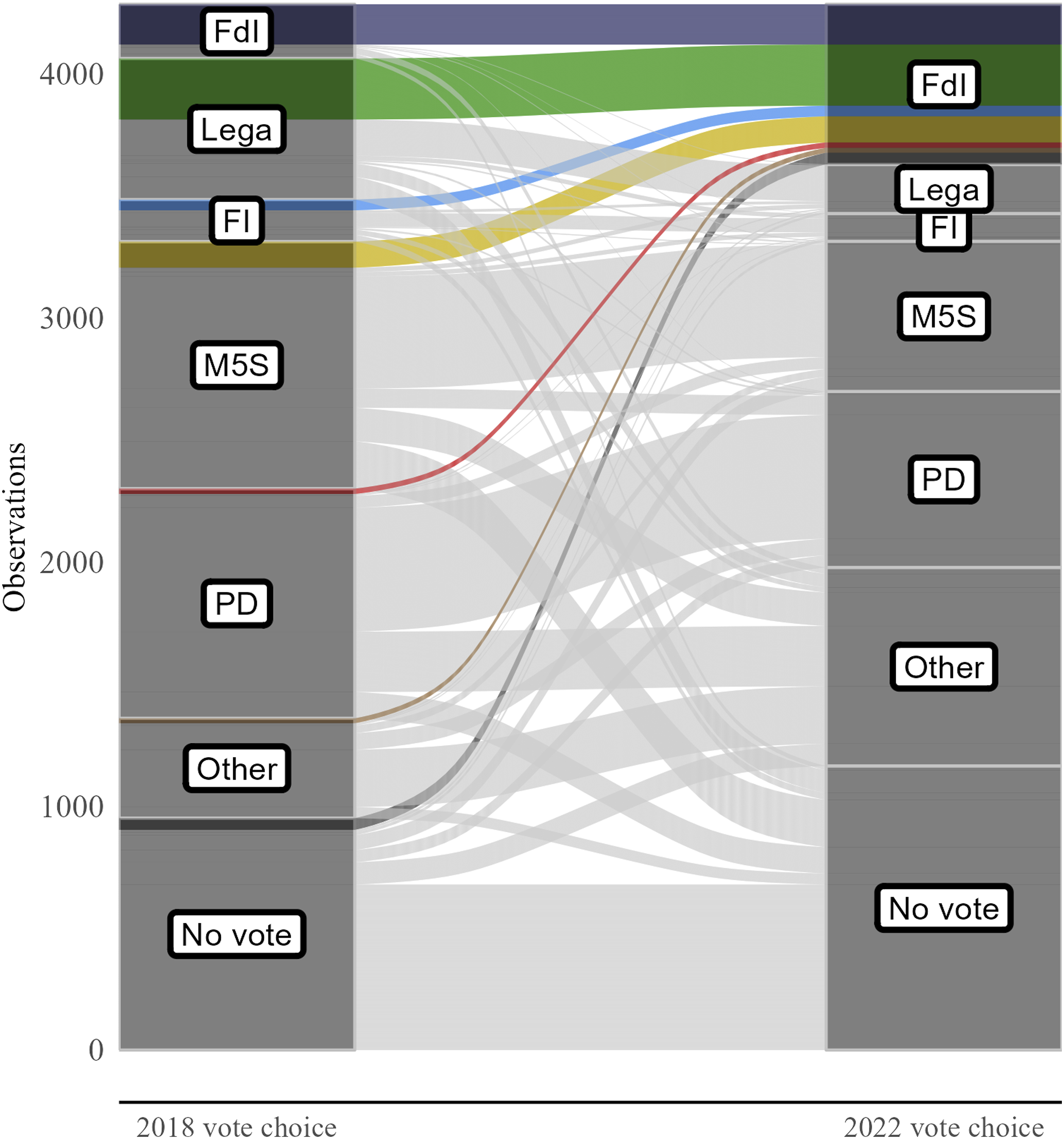
The multivariate analyses further substantiate our investigation by examining other key hypotheses, specifically H2a, H2b and H3. According to the latter, a positive evaluation of Meloni’s leadership is the individual attitude most strongly associated with vote switching towards FdI. Our multivariate analyses confirm this hypothesis (see Figure 4). The covariates of vote switching to FdI from Lega (Model 2) and from M5S (Model 3). Notes: Symbols represent regression coefficient estimates. Error bars represent 95% and 99% confidence intervals of the estimates. Controls are omitted from the figure. Legenda: Eco. = Economic: Ego = Respondent self-placement; Ev. = Evaluations; Gov. = Government; Neg. = Negative; Pos. = Positive; Ref. = Reference category; Retro. = Retrospective.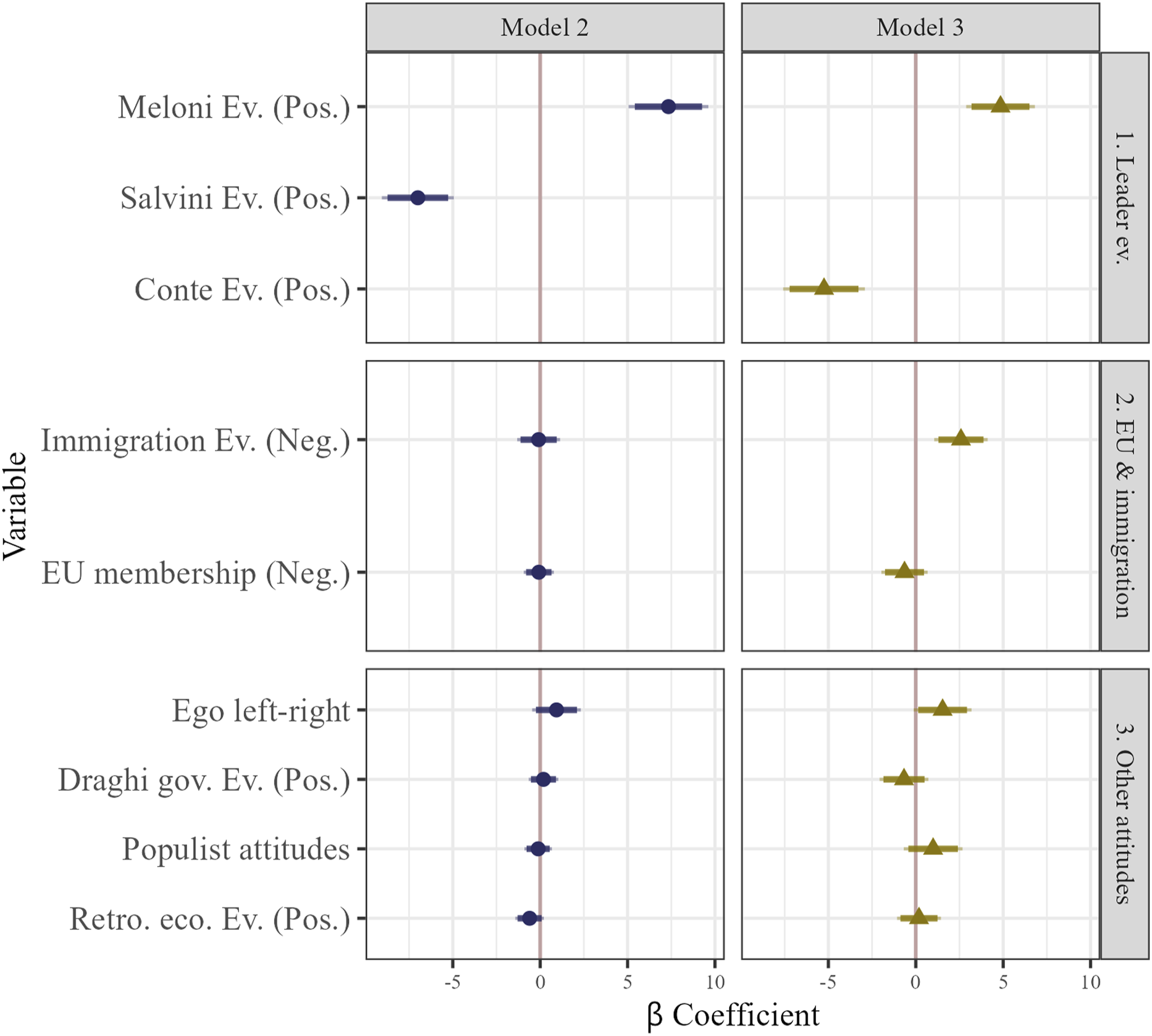
In examining the switch from Lega (Model 2), positive evaluations of Meloni emerge as the most prominent factor for switching to FdI. When exploring the shift from M5S (Model 3), Meloni’s leadership continues to be a robust predictor but ranks second after evaluations of Conte. Notably, the difference between the coefficients in this case is minimal. The regression β coefficients for Meloni’s evaluation in both models are positive, highly significant (p < .01) and substantial in terms of magnitude. When inspecting the predicted probability of switching to FdI, this result becomes even more apparent (see Figure 5). In the centre-right model, varying levels of appreciation for Meloni bring the predicted probability of switching votes from a minimum of 12.3% (95% c.i.: 9.2%, 16.5%) to a maximum of 86.9% (95% c.i.: 82.7%, 90.2%), an increase of 74.6 percentage points in the point estimate. In the M5S model, the association is weaker but still substantial. Indeed, the predicted probability goes from 15.3% (95% c.i.: 11.9%, 19.2%) to 57.9% (95% c.i.: 44.1%, 75.7%), an increase of 42.6 percentage points in the point estimate. Predicted probability of switching vote from M5S or centre-right parties to FdI. Notes: Bands represent the 95% confidence interval of the predicted probability.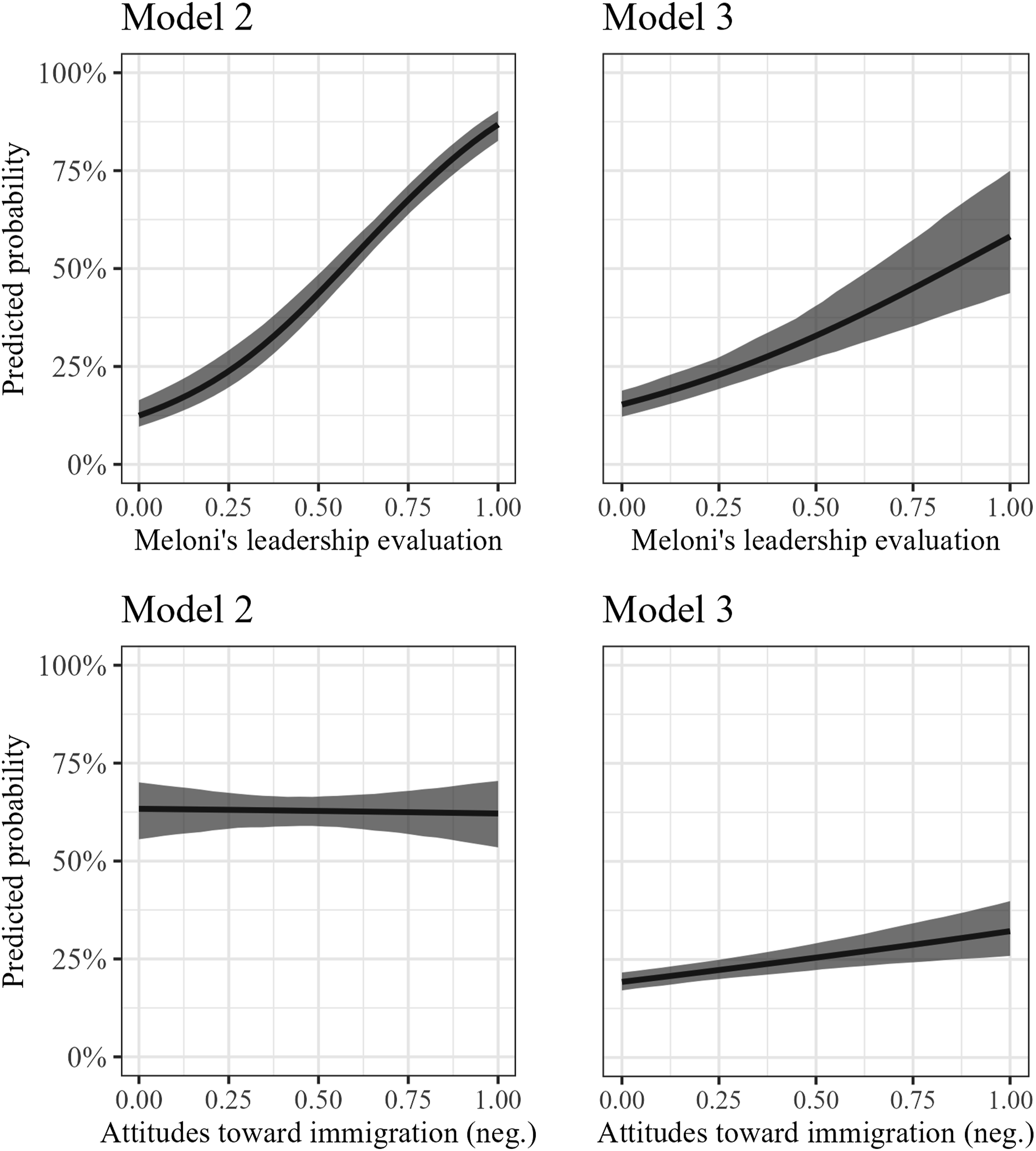
In addition to evaluations of Meloni, attitudes towards other party leaders bring insights about the role played by leader evaluations in competition between populist parties, and in particular radical right ones. In Model 2, Salvini’s leadership emerges as the second strongest covariate of vote switching. The (negative) coefficient is statistically significant at p < .01 and ranks second in terms of magnitude. The predicted probability of vote switching when Salvini’s appreciation is at the lowest level is 95% (95% c.i.: 93.5%, 96%), whereas at its peak it is 39.6% (95% c.i.: 34.8%, 44.7%), a decrease in the point estimate of 55.4 percentage points.
In Model 3, the evaluation of Conte’s leadership is the strongest (negative) covariate of vote switching. The predicted probability of switching votes stands at 32.1% (95% c.i.: 27.6%, 37.4%) when appreciation for the M5S leader is at its lowest level. However, at its maximum, the probability drops to 6.8% (95% c.i.: 3.8%, 10.6%), a decrease of 25.3 percentage points in the point estimate.
Moreover, our analyses (Figure 4) clearly show that issues consistently matter for vote switching only for M5S voters. Indeed, in the Lega–FdI switch model (Model 2) neither EU nor immigration attitude coefficients are statistically significant at p < .05, and the magnitude of these is overall negligible. 7 In the M5S switch model (Model 3), only the immigration attitudes coefficient is statistically significant at p < .05, and the magnitude of this effect is substantial. Yet, as in the previous model, the EU membership attitudes coefficient is not significant, with the correlation being negative and weak. 8
In sum, our vote switch analyses confirm our remaining hypotheses (H2a and H3, but not H2b). Issues matter more for switching from M5S to FdI than for switching from Lega. Yet, among these factors the only issue that is consistently and strongly correlated with vote switching is voters’ (negative) attitudes towards immigration. Hence, hypothesis H2a is confirmed, but not hypothesis H2b. Meloni’s leadership thus stands out as the strongest and most consistent covariate of vote switching from Lega to FdI. When considering vote switching from M5S, however, Meloni’s leadership evaluations are the second-best predictor in terms of coefficient magnitude. Upon considering predicted probabilities, Meloni’s leadership appreciation is slightly stronger than a dislike of Conte. Therefore, also in this case, we consider our third hypothesis confirmed.
Conclusion
In this article, we demonstrate the leader-centred nature of FdI support in the 2022 election. We show a limited influence of socio-demographic factors in supporting FdI (Online Appendix B). Yet, we found that individual-level preferences regarding migration, even if significant, are far from being the most important predictor of FdI support. Instead, we found that the impressive surge of the party was driven mostly by a rightist ideological orientation, preferences towards strong leaders and, most importantly, by positive opinions of Giorgia Meloni. In this respect, we also found that the appreciation of FdI’s leader is the most important factor explaining vote switching from 2018 to 2022. Briefly, for former Lega voters only an appreciation of Meloni was impactful in turning towards FdI. Looking at former M5S voters, we revealed how, in this case, ideological considerations did have an effect, and in particular those traditionally associated with a vote for a PRR party. Yet, the rating of Meloni remains the strongest explanatory factor for the vote switching.
The article constitutes the first analysis of the demand-side of FdI and, in this respect, complements previous supply-side works by showing how its constituency in 2022 shared some features with PRR voters. Yet, two caveats need to be mentioned. First, in 2022 FdI received a massive influx of votes from non-far-right parties (e.g. from FI and M5S). It is no surprise, then, that in the context of such an expansive electoral cycle, the PRR features of FdI’s voters are somewhat diluted. Second, as previously argued (Castelli di Gattinara and Froio, 2021), in terms of preferences Italian right-wing voters had already shown some patterns of radicalisation, beyond the voters of far-right parties. Our results make a substantial contribution to the literature on competition among populist parties and the mainstreaming of PRR issues and preferences. Firstly, our findings suggest that when populist parties with similar supplies compete, success often relies on the party leader and their evaluation, with ideological and issue preferences becoming prominent only when ideological differences among parties increase. Secondly, our results highlight that in contexts where PRR parties have been integrated for an extended period of time, issues and ideological preferences associated with the PRR have a limited impact on explaining switches from other right-wing parties.
Our findings suggest that where multiple and relevant radical right populist actors are present simultaneously, the characteristics of their leaders may constitute one of the most important factors in determining their odds of failure or success. Further comparative research on crowded populist supply is needed to disentangle this crucial role connecting leadership and PRR support.
Supplemental Material
Supplemental Material - Giorgia on their minds: Vote switching to Fratelli d’Italia in the Italian general election of 2022
Supplemental Material for Giorgia on their minds: Vote-switching to Fratelli d’Italia in the Italian general election of 2022 by Leonardo Puleo, Giuseppe Carteny, Gianluca Piccolino in Party Politics
Footnotes
Acknowledgements
A previous version of this manuscript was presented at a workshop organized by ITANES in Milan in July 2023. We thank all the participants and the ITANES team for their valuable comments. We also thank Ramona Coman for her support. Finally, we wish to thank the three anonymous reviewers for their excellent and generous feedback.
Declaration of conflicting interests
The author(s) declared no potential conflicts of interest with respect to the research, authorship, and/or publication of this article.
Funding
The author(s) received no financial support for the research, authorship, and/or publication of this article.

Supplemental Material
Supplemental material for this article is available online.
Notes
Author biographies
References
Supplementary Material
Please find the following supplemental material available below.
For Open Access articles published under a Creative Commons License, all supplemental material carries the same license as the article it is associated with.
For non-Open Access articles published, all supplemental material carries a non-exclusive license, and permission requests for re-use of supplemental material or any part of supplemental material shall be sent directly to the copyright owner as specified in the copyright notice associated with the article.
