




Abstract
While mainstream elite actors with the ability to shape public discourse (politicians, academics, and the media) generally oppose far-right politics, it is widely argued that such politics represent democratic populist grievances, whether cultural or economic: ‘this is what the people want’ and the mainstream should listen. Building on discourse theoretical approaches, this article uses opinion surveys on immigration to argue that rather than following ‘what the people want’, elite actors play an active part in shaping and constructing public opinion and legitimising reactionary politics. This article thus interrogates how public opinion is constructed through a process of mediation, how certain narratives are hyped and others obstructed. What this highlights is that rather than the result of a simple bottom-up ‘democratic’ demand, the rise of the far right must also be studied and understood as a top-down process: public opinion is not only a construction but also an agenda shaper, rather than a simple agenda tester. This article ultimately finds that ‘the people’ can be misrepresented in four principal ways: a people to be followed; a people to be blamed; a people to legitimise reactionary and elitist discourse and politics; and a circumscribed people.
In a democracy such as ours, to possess ‘objective’ evidence of the public will is to control a very valuable asset indeed. (Herbst, 1993: 153)
The shift towards anti-immigration issues in mainstream political discourse, and more broadly towards topics favourable to the right and the far right is hardly new (see, for example Hall, 1979). In fact, it is now common to witness centre-left parties pledge to tighten borders as they claim to listen to ‘the people’ and their ‘legitimate grievances’. 1 Such shifts are often justified, in part at least, by the use and misuse of public opinion surveys that claim that immigration is among the top concerns of many if not most people. This reaction against immigration, multiculturalism, and diversity has been legitimised by a number of academics and think-tanks, who have argued that it is the ‘left behind’ who tend most to such grievances, and that, therefore, social democratic parties have most to lose if they do not listen to these cultural demands (see, among others, Eatwell and Goodwin, 2018; Goodhart, 2017). This has at times gone even further, with some arguing that ‘racial self-interest’ should be taken more seriously by politicians (Kaufmann, 2017).
Such normative, ideological points are often made under the pretence of ‘data’, with accompanying graphs suggesting that the argument is objective, unbiased and/or scientific. Conservative academics involved in the culture wars have made particularly wide use of rather dubious data and opinion polls to advance their more ideological points about ‘national populism’, the ‘white working class’, or the ‘Somewheres’. The aim behind this (mis)use of polls is clearly not accuracy as demonstrated by the rebuttals they generally receive from colleagues, but impact on the public discourse and agenda through their access to many mainstream platforms. No matter how clearly and thoroughly a claim is debunked, the fact that it simply appears in the first place in legitimate publications, and from the mouth of apparently legitimate sources, means the damage is done, particularly to those who are already sympathetic or predisposed to the position. 2
What I would like to explore here goes somewhat further, as correcting the misuse of opinion polls is not enough to understand their impact: opinion polls, in and of themselves and whether used appropriately or not, are always political. This does not mean that they are necessarily inaccurate or have no use, but that ignoring their ideological purpose, foundation and nature as well as their impact is. The aim therefore is to interrogate the role ‘public opinion’, as a signifier and elite-driven construction, plays in the mainstreaming of far-right ideas in particular and on the hegemonic understanding and framing of democracy more generally. This article is not interested in whether polls are accurate or not, but in the role they play in shaping the agenda: how they frame and prime certain issues while obscuring others, what Herbst calls their ‘symbolic’ value.
As such, the focus here is not sophisticated data analysis, but rather the ‘symbolic’ ways polling data are used in mainstream public discourse to justify certain positions as democratic demands. Therefore, while the data analysis undertaken is original, the argument put forward does not require the collection of new data as it is not about the data per se, but its interpretation. Furthermore, the aim is not to get to the bottom of the ‘immigration question’ or develop a sophisticated quantitative analysis to gauge the prevalence of anti- or pro-immigration sentiment among the population. This is interesting but besides the point as we cannot realistically expect journalists in the current media landscape, for example, to have a sophisticated knowledge of quantitative analysis or the time to ‘crunch the data’. The aim is to engage with data at the level commonly used in our public discourse to show that even at this level, core issues of accuracy and consistency are ignored, while certain narratives are preferred over others, which would not necessitate any more expert knowledge to cover or uncover. By doing so, I aim to demonstrate that the apparently apolitical use of public opinion in our public discourse is based on political choices with political impacts. In summary, this article explores the impact of the negation of the well-documented fact that public opinion is not only a construction but also an agenda shaper rather than a simple agenda tester.
The first section provides an overview of the key debates in the field, highlighting warnings which have gone unheeded, despite the efforts of many to problematise the reality and role of public opinions in contemporary forms of democracy. I then turn to a case study to illustrate the importance of acknowledging the mediated environment in which the public form their opinion and how public opinion as a signifier plays a role in setting the agenda as much if not more than it does in measuring opinion. While the argument in this article has some wider theoretical implications, the focus of the case study chosen to illustrate it is primarily based on the United Kingdom. Finally, I explore the consequences of the denial of the political logics behind public opinion and its use in media and public discourse. Overall, I aim to demonstrate that the use of public opinion in public discourse is based on political choices with political impacts, while parading as data-driven, scientific, and objective snapshots of ‘what the people think and want’.
Public opinion as a construction and agenda setter
Before we turn to an overview of some of the debates that have taken place about the value of public opinion, it is first essential to understand what is meant in this article by ‘democracy’. The interest here is not so much in democracy in practice, but in the meaning that is assumed when one refers to democracy in the public arena. In this article, discussions of democracy generally refer to the hegemonic understanding usually equated to liberal and/or electoral democracy (Glynos and Mondon 2016). However, this equation often goes unsaid and these meanings have increasingly become the democratic horizon and thus democracy as such. In turn, it restrains the space for democratic imagination to what are relatively recent and narrow understandings of democracy and the role of ‘the people’ (see Brown, 2011; Ober, 2008; Rancière, 2005).
It is also worth noting early that the conception of ‘the people’ in this article is based on critical approaches to populism which understand it as ‘constitutively ambiguous and polysemic’ (Katsambekis, 2020: 3–4; see also Walters and D’Aoust, 2015):
What we see is rather partial and often institutionally mediated – sometimes even contradictory – incarnations of ‘the people’, in the form of electoral arithmetic, referendum results, partisan blocs in national assemblies or that of massive movements in the streets.
As such, this moves away from the imagination of ‘the people’ as innately pure and democratic, towards the people as constructed:
Populist politics do not only actively appeal to ‘the people’, ‘the elite’ and ‘the crises’. They also actively interpret each of these elements, articulating them with specific understandings of particular social, economic and cultural aspects of a conjuncture. (De Cleen et al., 2018)
It is also crucial to note that my interest here is not to engage with methodological issues regarding the collection of data, which have been well covered already (see, among others, Bernstein et al., 2001; Bethlehem, 2010; Bon et al., 2018; Harbaugh, 1996; Karp and Brockington, 2005; Morton et al., 2015). Instead, I discuss the wider context and the role played by the conception and construction of public opinion on democracy (see also Phull, 2019). This issue is also regularly discussed in the mainstream media and even by pollsters themselves, even though it has not led to a real radical rethink in the ways polls are used. While this section builds on scholarly work critical of public opinion, it must be stressed that pioneers and those supportive of such methods of data collection, such as Walter Lippmann (2012 [1922]) and Susan Herbst (1993), were also wary of the potential dangers behind the misuse or careless use of polls. The aim therefore is to highlight what should be basic caveats and yet goes widely ignored in our public debate (and at times in academia). As such, in its critical approach, this article builds on and is indebted to Tukufu Zuberi and Eduardo Bonilla-Silva’s (2008) work on white logics and white methods.
As Pierre Bourdieu noted, opinion polls are not simply here to record public opinion, but also play a significant political role in shaping opinion and the agenda. The most important function of opinion polls
is perhaps to impose the illusion that a public opinion exists, and that it is simply the sum of a number of individual opinions. It imposes the idea for instance that in any given assembly of people there can be found a public opinion which would be something like the average of all the opinions or the average opinion. The ‘public opinion’ which is stated on the front page of newspapers in terms of percentages (60% of the French are in favour of . . .) is a pure and simple artefact whose function is to conceal the fact that the state of opinion at any given moment is a system of forces, of tensions, and that there is nothing more inadequate than a percentage to represent the state of opinion. (Bourdieu, 1973: 125)
Building on his insights, Ruppert et al. (2017: 2) suggest that ‘data politics’ should be interpreted as ‘a field of power and knowledge’:
data does not happen through unstructured social practices but through structured and structuring fields in and through which various agents and their interests generate forms of expertise, interpretation, concepts, and methods that collectively function as fields of power and knowledge.
Yet the centrality of power is often conveniently ignored when it comes to public opinion, both in the collection process and in the dissemination of the results. As Susan Herbst (1993: 39) noted, ‘much of the texture and complexity of political attitudes is lost in the polling process, yet much is gained in the way of public discourse, since poll data are so easily communicated’. As a result:
pollsters have no qualms claiming that they have found the public to have a particular opinion, that the public is of a certain mind, and has spoken, judged, or decided an issue, and present quantitative measures in support of their claims. (Krippendorff, 2005: 133)
As Klaus Krippendorff (2005) noted, the use of opinion polls in public discourse often tends to anthropomorphise public opinion, thereby rendering it more real with pollsters claiming ‘that they have found the public to have a particular opinion, that the public is of a certain mind, and has spoken, judged, or decided an issue, and present quantitative measures in support of their claims’. For Krippendorff (2005: 130), ‘personification grants the public an independent mind whose capricious and often unreasonable nature can be dangerous for those who mess with it’. Whether it is anthropomorphised, nationalised, or even racialised, public opinion is portrayed as a simple, factual, scientific, and accurate way to understand and weigh democratic urges, demands, and grievances, making even elections at times appear rather secondary.
The necessity to claim the people’s support for particular policy choices has been core to the rise of liberal democracy and its surviving ties with the old order (see, for example, Bernays, 2007; Le Bon, 1963). Far from a radical shift towards the equal power of all individual citizens, hegemonic forms of democracy often developed as a way to control the urges of the masses through an illusion of choice in a well-contained and policed political landscaped (Losurdo, 2014; Rancière, 2005). This was key to the early rise of public opinion with Lippmann himself highlighting its mediated and mediating quality as the ‘representation of the environment which is in lesser or greater degree made by man himself . . . For the real environment is altogether too big, too complex, and too fleeting for direct acquaintance’. Lippmann (2012 [1922]: 10–11) warned that ‘the analyst of public opinion must begin then, by recognising the triangular relationship between the scene of action, the human picture of that scene, and the human response to that picture working itself out upon the scene of action’.
This links to the concept of mediation which Silverstone (2002) sees as ‘the fundamentally, but unevenly, dialectical process in which institutionalized media of communication . . . are involved in the general circulation of symbols in social life’ (see also Brown et al., 2021). This does not mean that the media tells us what to think, but it can certainly impact on what we think about. As Maxwell McCombs (2004) noted in his ground-breaking work on agenda-setting, ‘journalists focus our attention and influence our perceptions of what are the most important issues of the day’:
The public uses these salient cues from the media to organize their own agendas and decide which issues are more important. Over time, the issues emphasized in news reports become the issues regarded as most important by the public. The agenda of the news media becomes, to a considerable degree, the agenda of the public.
This is echoed by Elena Block (2013: 260) who argues, building on Antonio Gramsci, Pierre Bourdieu, and Nick Couldry, that ‘the media’s capacity to accumulate large concentrations of symbolic power – “media power” – renders their representations of events “seem so natural, that they are misrecognized,” and hence capable of prevailing over “the whole social landscape”’. As Couldry (2003: 39) put it, this ‘affects not just what we do, but our ability to describe the social life itself’ (see also Mazzoleni, 2003). This ties in to broader constructions and imagined communities such as the nation or the people qua demos which have become increasingly uncontested, banal, and hegemonic (see Anderson, 2006; Billig, 1995).
For Benjamin Ginsberg (1986), it is therefore essential to understand that the rise of public opinion in public discourse is not just a bottom-up process but a top-down one too: it is ‘an artificial phenomenon that national governments themselves helped to create and that their efforts continue to sustain’ (1986: 32). This is not to say that ‘the people’, however, defined have no power to influence their government or media discourse. It simply acknowledges that in advanced democracies, power and the ability to shape the agenda and public discourse are unevenly distributed. Furthermore, it emphasises the capacity to claim that the political elite act on behalf of the people as core to the democratic settlement which demands that the demos regularly transfer their cratos to some institutions (elected or not). In this setting, opinion surveys act on the surface as a reassuring mechanism, but really as one of control whereby political decisions taken at the elite level appear to be made on behalf of a constructed people.
Blaming the reactionary turn on ‘the people’: Immigration as a legitimate grievance
To illustrate the role played by the construction and dissemination of public opinion in the mainstreaming of far-right ideas, I present below some data taken from the Eurobarometer. I use the ‘issues’ questions, which provide consistent measures across time and are also easily accessible both in terms of availability of data and its basic interpretation.
Figure 1 shows the ‘immigration’ rate of response to the question ‘What do you think are the two most important issues facing (OUR COUNTRY) at the moment?’ for both the United Kingdom and the European Union (EU). When taking a longer view and comparing immigration to other issues offered to respondents across the most recent 10-year period (2009–2019) (Figure 2), it would appear rational to conclude that immigration is the issue of most concern to ‘the people’ qua representative sample in the United Kingdom. Other issues such as crime and terrorism often linked to immigration, particularly through far-right discourse, are also prominent in the results, with crime coming fifth and terrorism seventh. However, such averages only show us part of the picture and do not tell us much about whether this issue is indeed constant or not. Here, the EU was added to highlight some interesting trends. As we can see, there is a rise in concern regarding immigration in both the United Kingdom and EU in 2014. This corresponds with the EU elections which witnessed the ‘rise’ of far-right parties who campaigned on anti-immigration platforms, as well as these parties’ widespread coverage.
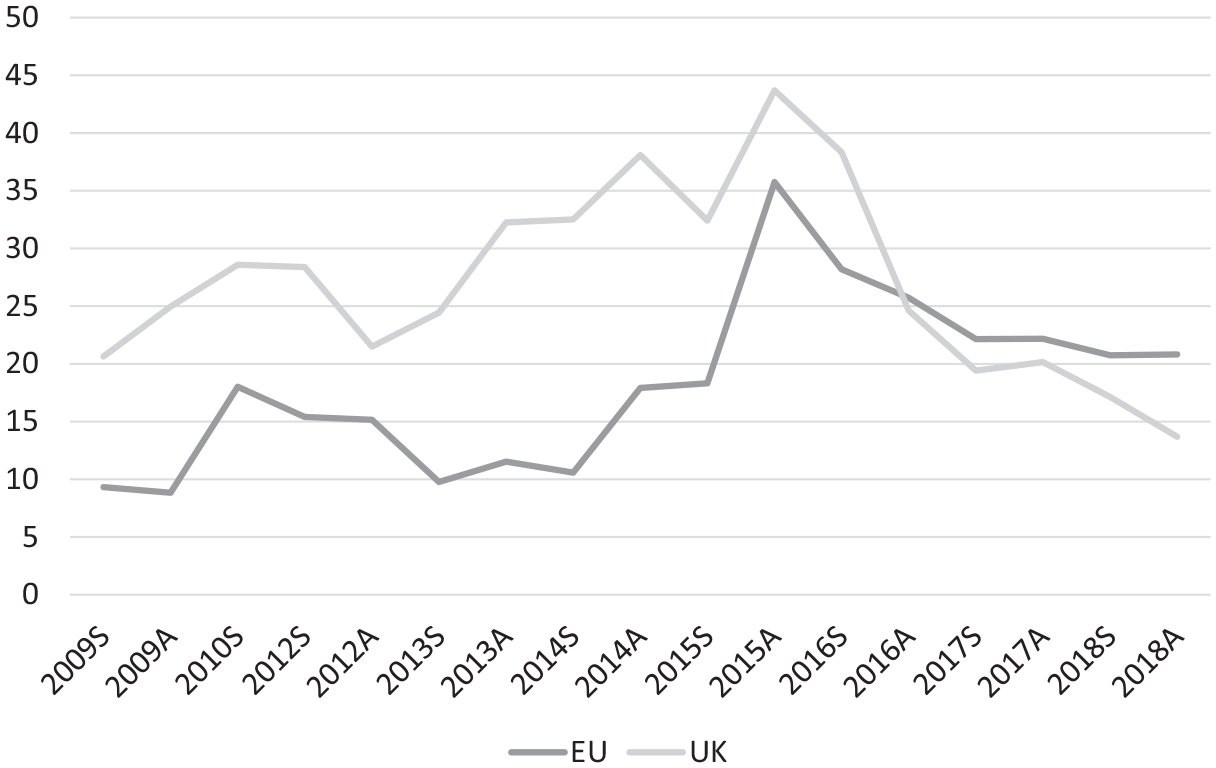
What do you think are the two most important issues facing (OUR COUNTRY) at the moment?
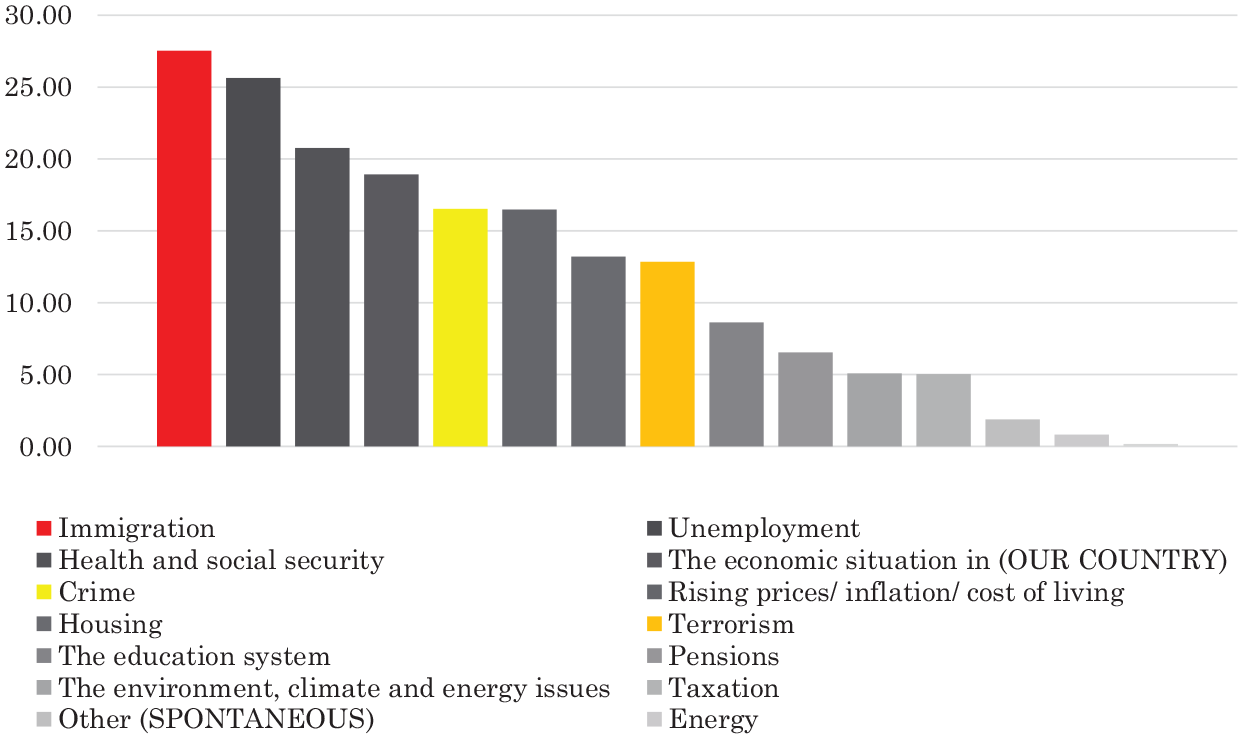
The United Kingdom: 10-year average (2009–2019) – your country.
The success of parties, such as the French Front National (now Rassemblement National), the Danish People’s Party, and UK Independence Party (UKIP) could infer that they responded best to what were rising concerns in the population. However, just as easily, rising concerns about immigration could follow a rise in their discussion in the public arena, as these parties and their pet issues are often given disproportionate coverage, something I will return to in the analysis. The peak happens in 2015 and 2016. Here, this matches the so-called ‘refugee crisis’ which saw an influx of refugees into the EU following the Syrian conflict. While this influx was shared unevenly across EU countries, with Germany taking in far more refugees, it was widely covered and became core to many far-right parties’ discourse and propaganda, as exemplified by the infamous Leave.eu ‘Breaking point’ poster in the Brexit campaign. In the EU, and in France in particular, although this country was not added to the graph, terrorist attacks conducted in the name of Islam, such as that against Charlie Hebdo, and their widespread and often racialised coverage, have also participated in fostering anti-immigrant sentiment (see Titley et al., 2017). In the United Kingdom, these developments also coincided with the referendum campaign which had been promised by then Prime Minister David Cameron following the 2014 European election, despite UKIP being the only party running on such an issue, demonstrating their ability to set the agenda through their performance at a second-order election with massive abstention and despite a lack of representation at the national level. As demonstrated by Martin Moore and Gordon Ramsay’s (2017: 7–8) extensive survey of the media coverage of the referendum, while the economy was the most covered issue, ‘coverage of immigration more than tripled over the course of the campaign, rising faster than any other political issue’, and became ‘the most prominent referendum issue, based on the number of times it led newspaper print front pages’. Added to this priming of immigration itself, ‘coverage of the effects of immigration was overwhelmingly negative. Migrants were blamed for many of Britain’s economic and social problems – most notably for putting unsustainable pressure on public services’. This is corroborated by research done by Elizabeth Dekeyser and Michael Freedman (2021: 13) which demonstrates that ‘individuals hold more negative attitudes toward immigration during electoral periods’ and that ‘this change is most significant in elections where anti-immigration sentiment is part of the political discourse, and among individuals across the political spectrum’. It is therefore no surprise that immigration as a major concern appears to recede dramatically after 2016 both in the United Kingdom and in the EU. While Brexit had won and the ‘refugee crisis’ abated, freedom of movement remained in place in the United Kingdom and refugees continued to arrive, demonstrating a disconnect between the reality and perception of immigration, something which has been well documented and again points to the mediated effects discussed earlier (Duffy, 2018).
It is not just the Eurobarometer that appears to paint a picture in which immigration is indeed a central concern. A similar question asked by Ipsos Mori (2021) returns very similar results over the same period. Yet, this picture is nuanced by an added question in the Eurobarometer, where the same respondents are asked what the two most important issues they are personally facing are. While the difference in wording would seem minimal at first thought and it would seem logical to expect similar answers, the reality differs markedly.
Figure 3 shows the respondents who put immigration as one of their top two issues of concern when they thought about themselves personally rather than their country. While for the latter in the United Kingdom, immigration only dips below 20% after 2017 and reaches a high of 43.69% in the Autumn survey of 2015, it only reaches 10% once when respondents think of their own personal situation (in the Summer survey of 2016, at the height of the referendum campaign). A similar trend can be witnessed for the EU where immigration is never one of the top two issues of concern for more than 10% of the respondents.
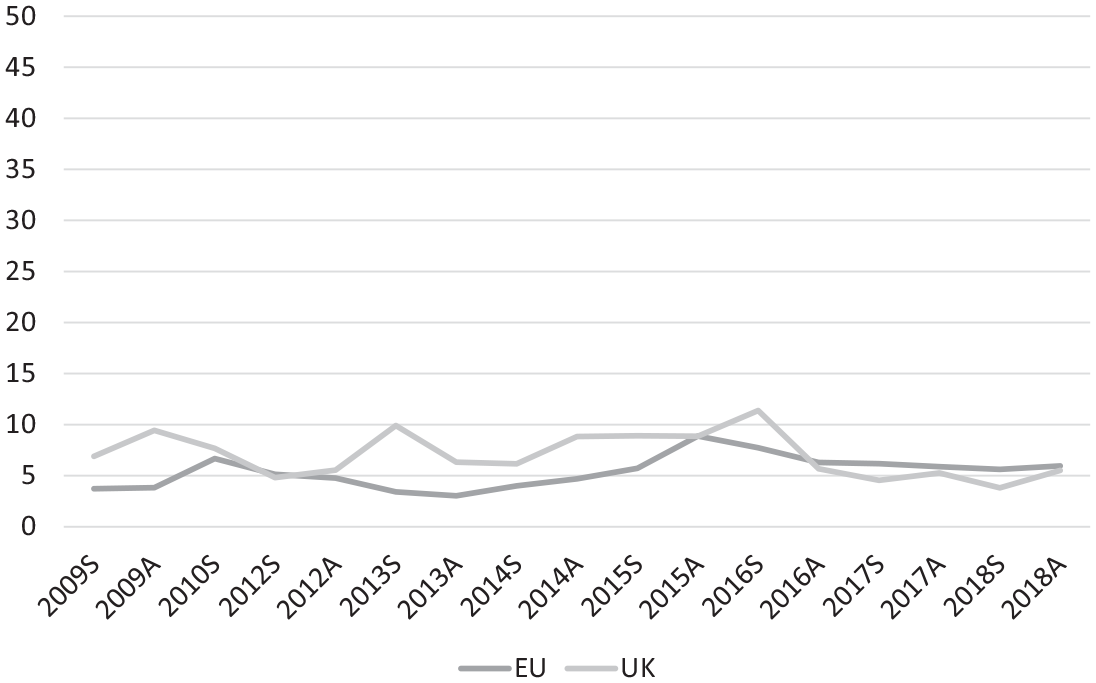
And personally, what are the two most important issues you are facing at the moment? Source: Eurobarometer.
When we look at a 10-year average (Figure 4), a similar pattern appears. While immigration was the top issue when respondents were primed to think about their country, and while other related issues in the media such as crime and terrorism were also prominent, all three fall off the radar when the same respondents are asked about their own lives (with crime, immigration, and terrorism, respectively, 10th, 14th, and 17th). Issues that appear as top concerns are based on the economic and social situation of respondents rather than on their more ‘cultural’ concerns, something I return to in the following section.
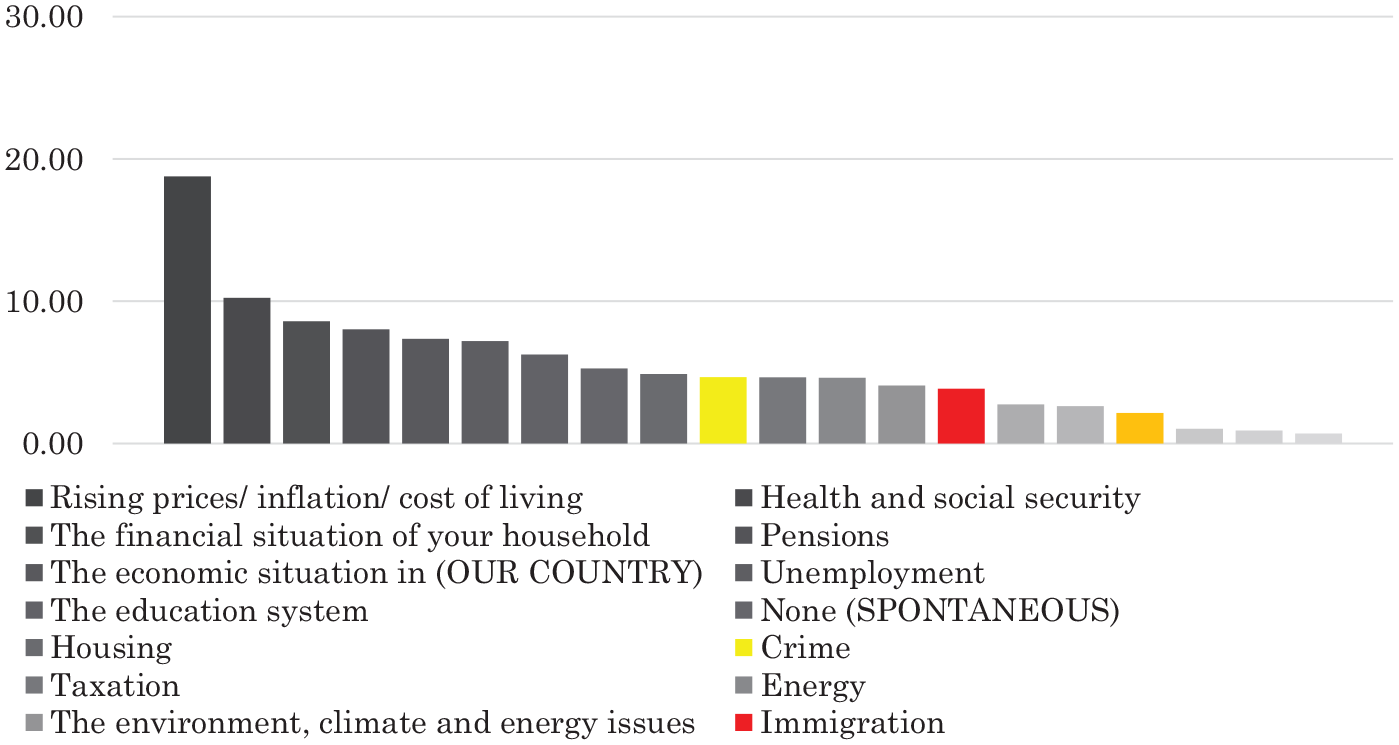
The United Kingdom: 10-year average (2009–2019) – You, personally.
To add a further degree of precision, Figure 5 shows the evolution of all the key issues over the period, demonstrating that immigration is consistently low on the scale compared to others when people think of their own day-to-day situation.
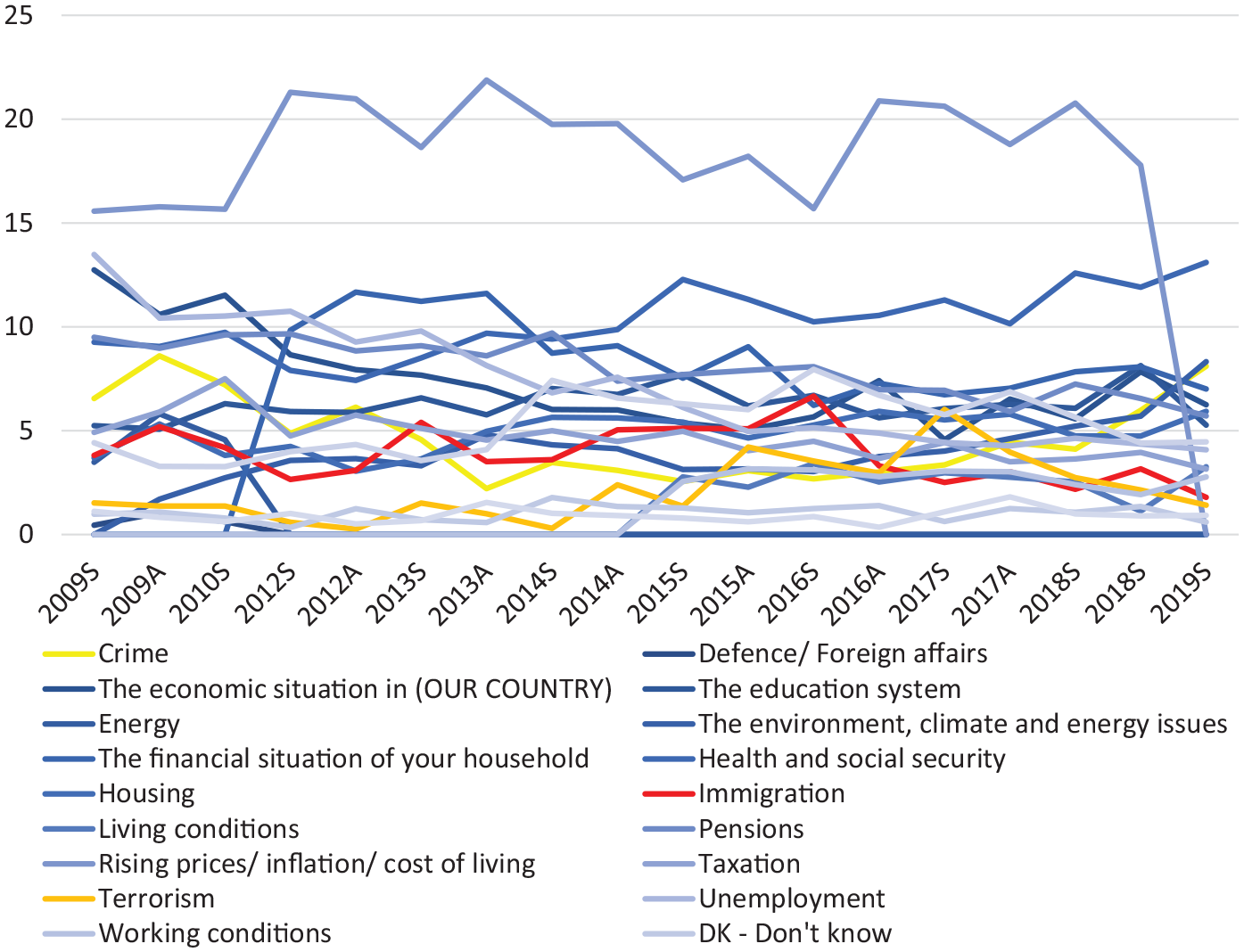
All issues between 2009 and 2019 – You, personally.
Following, blaming, and circumscribing ‘the people’
The aim is not to say that one poll is correct and the other is not, or that people are not necessarily concerned about immigration. Instead, I seek to interrogate in which setting people appear to be concerned with immigration, which interests it serves, and what that can tell us in terms of mediation processes and democratic legitimisation of certain issues and in this case those that directly benefit the far right. As previously discussed, public opinion is often used to justify and excuse certain political and editorial choices and tendencies: journalists and mainstream politicians may not like to talk about these issues (e.g. they may think that immigration is broadly positive in our society), but it is what ‘the people’ want to hear, read, and see promised.
This forces us to consider a chicken-or-egg situation and two key questions in understanding the normalisation of far-right politics:
Is the process far-right-driven or mainstream-driven?
Is the process people-driven or elite-driven?
Building on Brown et al. (2021: 9), mainstreaming is defined as a ‘process by which parties/actors, discourses and/or attitudes move from marginal positions on the political spectrum or public sphere to more central ones, shifting what is deemed to be acceptable or legitimate in political, media and public circles and contexts’. This framework
underscores the value of engaging with the interconnectedness of different elements and acknowledging the power structures at play. Critically, this illuminates the role of mainstream elite actors in shaping public discourse, with strategic effects for elections and a mediatory role with the electorate, but also entailing a cyclical process of normalisation which changes what is and is not acceptable in the ‘mainstream’. (Brown et al., 2021: 14–15)
The study above demonstrates the importance of discourse and mediation, not just in the way people make their decisions about issues broader than themselves and their immediate surroundings (see Anderson, 2006; Billig, 1995), but also how issues which are primed to occupy a particular place in opinion polls and serve to justify and reinforce certain kinds of discourse and political choices on behalf of ‘the people’.
Figures 6 and 7 are an attempt to illustrate this process: instead of a linear process as per Figure 6, which implies that ‘the people’ think something that is translated by opinion surveys and addressed by democratic elites (media, politicians and academics to an extent), this process is rendered more complex by mediating powers and agenda-setting. In Figure 7, the thinner arrows pointing from ‘the people’ to elite discourse and opinion polls highlight the uneven relationship in shaping the agenda as public opinion is shaped to different extents by the content of public discourse, and also by polling companies that themselves play a part in shaping said discourse. Throughout, ‘the people’ is thought of as ‘the People’ qua demos. Even though it is always limited and its opinions always mediated, it serves to legitimise certain positions as democratic: an illusion of the power to the people. As Block (2013: 274) notes:
although the mediatization of politics may make politics, governance, and citizens more visible, this visibility does not necessarily translate into more citizens’ participation in decision-making processes: To the contrary, it might reinforce existing power asymmetries in a group or society.
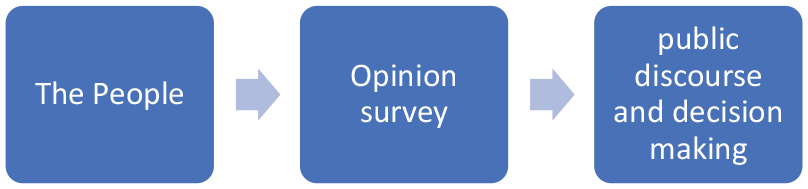
Linear model.
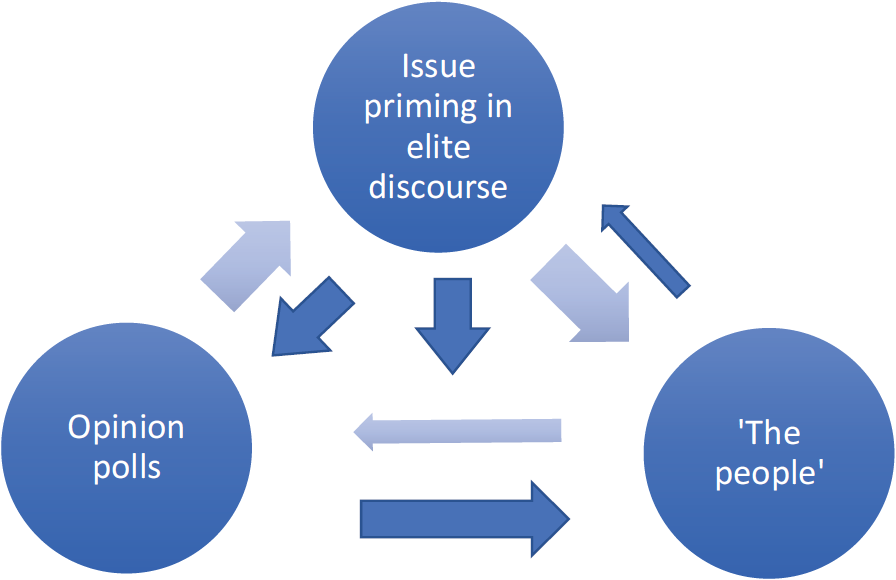
Circular model of mediation.
It is thus essential to see ‘the People’ qua demos as constructed rather than some oracle to be listened to as is too often the case in the use of opinion polls in public discourse and broader mainstream discourses about populism. This is what Herbst (1993: 29, her emphasis) referred to when she stressed the symbolic purpose of opinion polls and that ‘the symbolic value of public opinion data emerges during the public debate’.
Respondents to polls do not hold beliefs in a vacuum, particularly when thinking about aspects pertaining to what can only be ‘imagined communities’ (Anderson, 2006) with a far wider scope than their own limited perceptions. While it would be naïve to argue that the media is solely responsible for what people believe (magic bullet or hypodermic needle theories), it would be just as naïve to think that it has no effect. The same goes for opinion polls which are far too often used as ‘apolitical’ and ‘objective’ measures, rather than as biased in their construction and political in their use. This bias and political nature of opinion polling does not automatically mean they are a negative influence on the democratic discussion, but ignoring it hides unequal power relationships and thus is a threat to a process that requires transparency.
In their current setting, this widespread (mis)use of opinion polls can have a severe impact on the rise of the far right. Rather than reflecting ‘the people’, their misuse risks legitimising so-called ‘populist’ politics which are not only dangerous to minorities and more emancipatory forms of democracy, but also divert attention away from other democratic crises. This study finds that ‘the people’ can be misrepresented in four principal ways, which can unfortunately only be touched upon briefly in this format.
A people to be followed
The first and obvious construction is a people to be followed. The ubiquity of opinion polls today in the news and social media, and also in party strategies and policy-making bodies, creates the impression that anyone can listen to what ‘the people’ want at any time, but also that anyone listening to polls is thus listening to the people and following their lead, rather than pushing a particular political agenda. This is not entirely distinct from the criticism of elections as undemocratic in their very nature: due to the lack of a level playing field in access to communication and education about political matters, the imperfection in measuring votes, the limited choice on offer, among other potentially unavoidable downsides in large contemporary democracies (see Rancière, 2005). Opinion polls are particularly problematic as they are unofficial, based on limited samples (no matter how representative) and generally conducted to suit particular interests. This does not mean these interests are necessarily nefarious, simply that opinion polls and their use are always political, for good or bad, as are editorial choices in newsrooms or policy orientation in party headquarters: there is no such thing as the simple, unadulterated pulse of the nation. Furthermore, it is not simply about how polls are conducted and why, but also how they are used. As demonstrated in the previous section, some slightly different wording can lead to very different responses and thus create widely diverging political meanings depending on what is reported: from ‘immigration is the top issue for British people’ to ‘immigration is of no real concern to British people’ or even immigration not being mentioned at all. The fact the former is far more common than the other two is not surprising if we pay attention to the processes of mediation and agenda-setting, but could be concealed if we report opinion polls uncritically, as is too often the case. Ignoring this thus risks creating the impression that whoever follows certain polls follows ‘the people’ and their democratic wish.
A people to be blamed
The misuse of opinion polls also risks creating a people to be blamed for the rise of politics the elite pretends to oppose. Despite its normalisation, the far right generally remains marginalised in public discourse and widely considered a threat to democracy by public actors, whether it is the media or mainstream politicians. This was clear in the campaign for the EU referendum in 2016 where Vote Leave, the official campaign led by the Conservatives, strived to separate itself officially from the Leave.EU campaign led by Nigel Farage (even though the lines were often blurred) (Brown, 2022). While this article is predominantly focused on the United Kingdom, similar trends apply to other contexts: in France, for example, the Republican Front led most parties to support Jacques Chirac in 2002 and Emmanuel Macron in 2017 and even 2022 against the Le Pens and despite clear ideological differences. Similarly, the mainstream media regularly denounces the far right and warns of the threat these parties pose to democracy – think of the Washington Post’s opposition to Donald Trump.
Yet, whether it is politicians or the mainstream media, there has been a tendency to give disproportionate coverage to the issues core to the far-right agenda, and this focus is often blamed on ‘the people’ and their ‘grievances’ – think of the hype around the ‘white working class’ in both the United Kingdom and the United States in 2016 despite clear evidence that both the Brexit vote and Trump’s election were not predominantly driven by this section of the population (Mondon and Winter, 2019, 2020). ‘The people’ in various forms are regularly blamed for reactionary turns enacted by media and political elite who not only appear to have no choice in their coverage, campaigning, or policy-making, but also no control on what is discussed at the national level. This process can be illuminated by borrowing from psychoanalytic theory: ‘the people’ (often understood as the poor, uneducated or working class) are stealing our (the elite, the middle, and upper classes, liberals) enjoyment of liberal democracy. If it wasn’t for them (or the young voting for the radical left), we would have rational, ‘sensible’ politics (see Allen, 2020), but democracy forces ‘us’ to listen and cave to their demands (Glynos and Mondon, 2016). This construction of ‘the people’ serves to excuse who is really at the reins, something I come back to later.
A people to legitimise reactionary and elitist discourse and politics
‘The people’, through the (mis)use of public opinion, is not simply blamed for the rise of reactionary politics, but it is also used to legitimise such reactionary and often elitist stances, whether inadvertently or not. For example, opinion polls have been used to argue that the vote for Brexit followed ‘legitimate grievances’, justifying this stance by the ‘fact’ that concerns over immigration dropped once Brexit was voted (see, for example, Adam and Booth, 2018; Goodwin, 2020). Such drops point to fascinating trends which confirm the core argument put forward in this article regarding the construction of public opinion since rules did not change in terms of freedom of movement until the exit of the United Kingdom from the EU. What changed, though, was the focus on this particular issue.
Yet it has become common to see reactionary politics being legitimised this way, even though they regularly prove not only to have a limited appeal and to be against the very interests of ‘the people’. This populist hype was clear in the case of Brexit, which was widely although wrongly heralded as a revolt of the ‘left behind’, and which is likely to impact these communities far more than the wealthier parts of society (who in fact provided the bulk of the Brexit vote) (see Bhambra, 2017 and Dorling, 2016). The same is true in other contexts whether it is the support of the Front/Rassemblement National in France which is often argued to be a ‘popular’ vote, or the vote for Donald Trump, even though the politics pushed by far-right parties would benefit the wealthy most. These narratives are often pushed based on an ignorance of the importance of turnout and its unevenness across the electorate (Mondon and Winter, 2020).
With regard to the data above, it is clear that the use of certain polls can legitimise reactionary politics over other concerns and alternatives. For example, while the national question would indeed suggest that immigration should be the focus of media coverage and political campaigning in much of the 2010s in the United Kingdom, the personal question would paint a very different picture where more tangible economic issues (more propitious to the left) would appear central to the public’s concerns. This would also debunk reactionary myths about cultural insecurities replacing economic concerns and the replacement of the left/right divide by a global/national one (or the spurious ‘anywhere’ versus ‘somewhere’ framework) (see Goodhart, 2017; Kaufmann, 2017).
Polls are not only used to legitimise certain reactionary positions such as a focus on immigration and the exaggeration of ‘cultural’ grievances most propitious to the (far) right over economic concerns, but they can also be used to downplay more progressive ones or the impact of reactionary politics on minorities and democracy more generally. This has become core to the culture wars, whereby ‘authentocrats’ (Kennedy, 2018) have created a division between the woke ‘anywhere’ (read young middle-class multicultural Remainer) and ‘somewhere’ (read Brexiter, salt of the earth ‘left behind’ ‘white working class’ with ‘legitimate concerns’) (see Goodhart, 2017). These arguments attempt to create a neat separation between race and class, as if these were not generally intertwined in broader systems of oppression (Begum, 2020; Begum et al., 2021). As Gurminder Bhambra (2017: 226) notes, ‘what is being described is a relative loss of privilege rather than any real account of serious and systemic economic decline that is uniquely affecting white citizens’.
A circumscribed people
Finally, ‘the people’ constructed through opinion polling creates the impression of a limited demos, in a similar manner to that which is widely reported on after elections. While it is not core to the argument developed here, the widespread ignorance of abstention in the reporting of electoral results participates in the circumscription of the demos to those who vote and, in the case of opinion polls, to those who respond (Mondon, 2017). This is problematic for elections as not only is the right and ability to vote not evenly spread, but there are also real political reasons not to vote, particularly in democracies where political parties and actors are deeply distrusted. The active ignorance of abstention is fascinating in the context of this article, since it is clearly those most left behind who tend to abstain, while it has been argued that those who turn up to vote (including for the far right) remain connected to the current democratic system. Ignoring abstention in reporting electoral results is not problematic in terms of results per se – the winner remains the winner according to the rules of the game – but it is problematic in terms of the narratives which can be subsequently constructed. For example, the discussion post-Brexit would have been very different if instead of the 52/48 narrative constructing a majoritarian movement, we had one of 37% for Brexit, 36% for Remain, and 27% who did not vote.
Such issues are magnified with opinion polls for a number of reasons, some of which were discussed in the first section. Suffice to say here that research has shown that respondents to opinion polls, even in the most serious settings, are rarely fully representative as it takes a particular predisposition to answer long opinion polls about politics, which can lead to bias in terms of pleasing attitudes, class taboos, and protest reactions considering that less is at stake than in elections, for example (see Garrigou and Brousse, 2011). This is also impacted by the nature of the questions asked, how leading they are and how much they engage respondents to answer on issues they may never have considered (Bourdieu, 1973). Therefore, ‘the people’ is not just limited in terms of numbers, but also in terms of their ability to reflect and make decisions based on an appropriate amount of information, something which democracy should strive for. As Herbst (1993: 66) noted, ‘by structuring individual expression and by turning public opinion expression into a private process, the sample survey may distance us from classical democratic notions of participation’. It is also in direct opposition to more emancipatory understandings of ‘the people’, as this interpretation refers to what Jacques Rancière (1995) would have termed ‘the police’, that is the strengthening of the status quo, rather than ‘politics’, that is its disruption through the counting of those who have no part.
Conclusion: A skewed democratic discussion and some serious consequences
What this article illustrates through the use of Eurobarometer data should be obvious and yet whose ignorance has shaped our political landscape dramatically: opinion data are never unbiased, objective, or impartial. Its uncritical use and sometimes clear and wilful misuse have created narratives that have guided public discourse by priming certain issues over others, and justified their prominence in said public discourse by attributing them to ‘the people’ and ‘populist’ politicians. This does not mean that ‘the people’ however defined have no agency, of course, and cannot impose certain issues onto their elite, whether in the media, politics or academia. However, it would be naïve at best to think that in a society like the United Kingdom, which has deeply unequal access to public discourse, certain interests do not have more power than others to shape the agenda. To put it simply, we are faced with a vicious cycle which primes issues while obscuring others in what can be considered a democratic simulacrum.
This has a number of consequences which I can only explore briefly here to conclude and could be avenues of further research. First, it leads to the legitimisation of elitist and far-right politics, as these are often wrongly described as ‘populist’ and thus ‘popular’. This legitimises not only far-right parties, but also perhaps more importantly their ideas, as mainstream parties act as if forced to address what are constructed as ‘legitimate grievances’: if ‘the people’ think immigration is a concern, then it must be addressed, whether we want it or not. Second, it reinforces the invisibilisation and silencing of minorities and those truly left behind by creating an image of ‘the people’, which does not take into account power relationships, but also ignores that participation in political life, whether through voting or opinion surveys, is profoundly uneven. This adds to the inherent issues raised by majoritarian decision-making and what this may mean for minorities. As explored elsewhere, pushing reactionary agendas by constructing, for example, a ‘white working class’ also racialises certain sections of the population, whitewashing the most diverse section of society (and obscuring the very clear fact that it is this section which has mostly switched off and thus remains unheard) (Mondon and Winter, 2019, 2020). Third, it serves to exculpate the political, but also media and to some extent academic, elite from their responsibility in the reactionary turn we are witnessing and the dire consequences this has imposed on many – these small sections have far wider access to shaping public discourse than the general population. The focus on certain issues during campaigning or even governing is blamed on ‘the people’ rather than owned by those who benefit most from them, whether economically or ideologically. Finally, and linked to the previous points, it obscures the uneven power relationships at the core of societies like the United Kingdom, which have come increasingly to resemble oligarchic states rather than democratic ones (Dean, 2009; Rancière, 2005). This does not mean that they have become fully authoritarian, and ‘the people’ can still play an active part in shaping the agenda, as demonstrated by recent events such as the Black Lives Matter movement which has forced significant, albeit limited, discussion of systemic racism into the spotlight. It simply means that there is an urgent need to take the limits of democratic decision-making seriously as these are increasingly under threat. This has been a long time coming and under the noses of those who claim a responsibility in the working of democratic institutions.
Footnotes
Acknowledgements
I would like to thank Katy Brown, George Newth, and Aaron Winter for their invaluable feedback on early versions. I would also like to thank the reviewers and editors for their engagement with the piece and helpful suggestions.
Funding
The author(s) received no financial support for the research, authorship, and/or publication of this article.
