




Abstract
Populism seems to define our current political age. The term is splashed across the headlines, brandished in political speeches and commentaries, and applied extensively in numerous academic publications and conferences. This pervasive usage, or populist hype, has serious implications for our understanding of the meaning of populism itself and for our interpretation of the phenomena to which it is applied. In particular, we argue that its common conflation with far-right politics, as well as its breadth of application to other phenomena, has contributed to the mainstreaming of the far right in three main ways: (1) agenda-setting power and deflection, (2) euphemisation and trivialisation, and (3) amplification. Through a mixed-methods approach to discourse analysis, this article uses The Guardian newspaper as a case study to explore the development of the populist hype and the detrimental effects of the logics that it has pushed in public discourse.
Populism seems to define our current political age. The term is splashed across the headlines, brandished in political speeches and commentaries, and applied extensively in numerous academic publications and conferences. In fact, it has become so ubiquitous that The Cambridge Dictionary made it ‘word of the year’ in 2017, since it represented ‘a phenomenon that’s both truly local and truly global, as populations and their leaders across the world wrestle with issues of immigration and trade, resurgent nationalism, and economic discontent’. 1 This trend can also be witnessed in academia, where the volume of studies on populism has skyrocketed. For example, searching the Web of Science database reveals that the number of publications containing populis* in the title, abstract, or keywords has risen sharply, from 310 between 1970 and 1979, to 1498 between 2000 and 2009, before more than quadrupling to 6482 from 2010 to 2019 (see Graph 1).
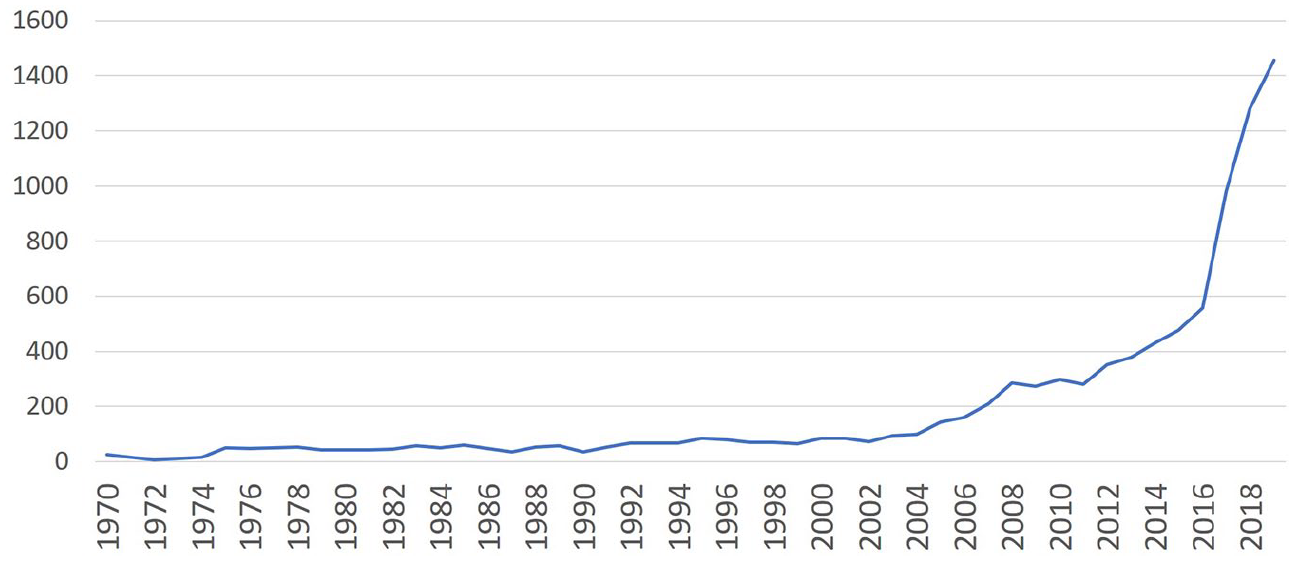
Number of publications containing populis* in the title, abstract, or keywords on the Web of Science database per year.
Some scholars were quick to point to the potential problems presented by the concept. Back in 2004, Annie Collovald (2004) warned of the dangers of the term as a less stigmatising mode of referring to the extreme right. Cas Mudde (2007) stressed early on that such parties should be called ‘populist radical right’ as opposed to ‘radical right populist’, as the latter would put the emphasis on populism (a secondary characteristic) away from radical right (which Mudde argued was the core of the ideology). Unfortunately, this nuance appears to have often been lost, feeding what some have termed a ‘populist hype’ (Glynos and Mondon, 2019) and avoiding the careful work undertaken on typology and terminology over the years. Therefore, it is common to see the term applied to a multitude of disparate movements from the left to the right, and increasingly in contexts outside of politics. However, in general, it tends to be used in a derogatory manner to describe a threat to the status quo, usually understood in liberal democratic terms. While not central to this article, it is nonetheless important to note that, building on poststructuralist discourse theory, we see populism as a discursive strategy through which ‘the people’ is constructed against an elite (see Katsambekis, 2016; Laclau, 2005; Stavrakakis and Katsambekis, 2014; see also Stavrakakis et al., 2017, on whether far-right parties should be considered populist at all).
Through a combination of Discourse Theory (DT), Critical Discourse Studies (CDS), and Corpus Linguistics (CL), the aim of this article is to explore the way in which the concept of populism has been hyped in elite discourse and the consequences this has had. Building on the growing body of literature that provides a critical account of populism and ‘populist studies’, with particular attention paid to anti-populist trends and the populist hype (see among others De Cleen et al., 2018; Dean and Maiguashca, 2020; Moffitt, 2018), this article uses The Guardian newspaper as a case study to explore the ways in which the populist hype has not only been constructed and developed, but also the logics it has pushed and imposed in public discourse. More precisely, the discussion of the article centres on three impacts we see as core to populist hype: (1) an ignorance of agenda-setting by elite actors and processes of deflection; (2) a process of euphemisation and trivialisation, where the signifier ‘populism’ tends to replace not only more accurate descriptors but also more stigmatising ones such as ‘racism’ or ‘far right’; and (3) a process of amplification, where otherwise minor groups, movements, and political actors are given disproportionate coverage. This, we argue, participates in an overall process of legitimisation and mainstreaming of the far right where ‘populist’ politics are awarded democratic value as the alternative to the status quo.
Case study and methodology
In November 2018, The Guardian launched ‘The new populism’, ‘a six-month investigative series to explore who the new populists are, what factors brought them to power, and what they are doing once in office’. This, readers were told, was to respond to a new moment in politics where ‘populist leaders now govern countries with a combined population of almost two billion people, while populist parties are gaining ground in more than a dozen other democracies, many of them in Europe’ (The Guardian, 2018c). For the purposes of selecting our case study, this 6-month series signalled a very conscious editorial focus and provided a clear timeline to structure our analysis. Furthermore, The Guardian’s liberal, centre-left approach to politics makes it an interesting case, as it cannot be argued that, through its coverage of populism and the far right in general, the newspaper pushes an ideology its editorial line consciously and openly supports. In a media landscape already tilted to the right through unequal access to ownership, this positioning is of particular importance for the democratic debate and the opportunity for the public to engage with a broad range of alternatives. Our study includes all articles published by The Guardian between 20 November 2018, the start of the series on populism, and 20 November 2019 which contain populis*. While the series only officially lasted 6 months, we decided to gather data for the whole year given that the coverage of populism continued fairly consistently afterwards (see Graph 2).
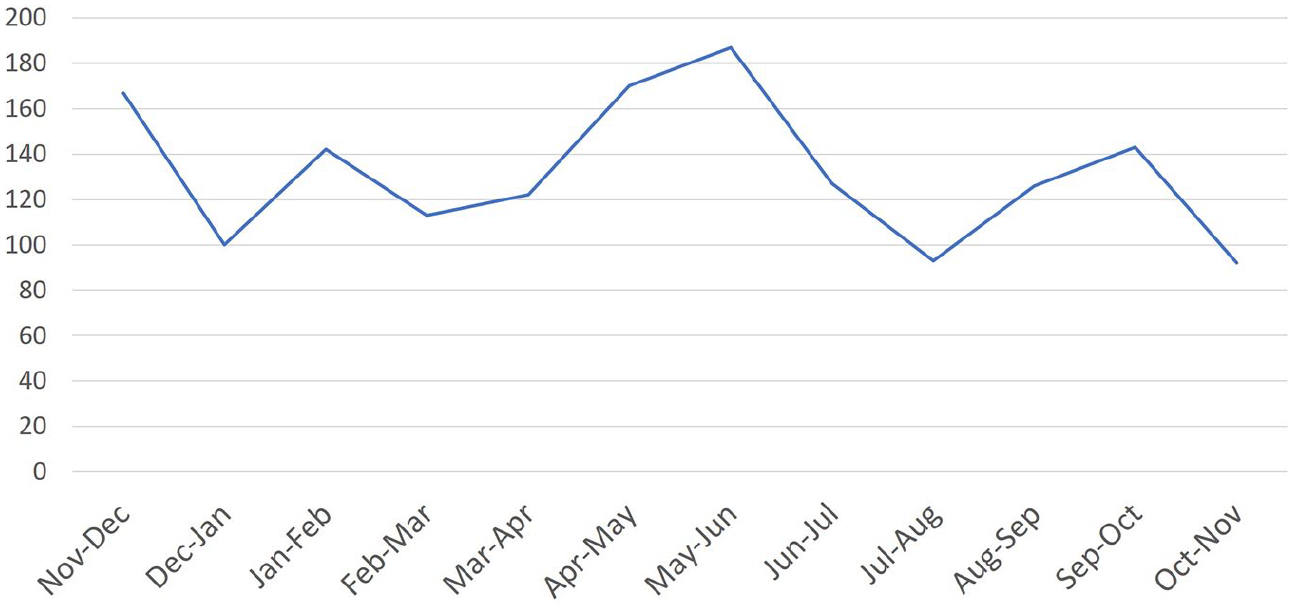
Number of articles published in The Guardian containing populis* each month from 20 November 2018 to 20 November 2019.
During the series, an average of 136 articles were published per month, and this reduced only by eight to 128 for the following 6 months. In total, we found 1548 distinct articles with the mention of populis* in their title and/or content and 3996 single uses of the term populis*.
To analyse this coverage and its implications, we adopt a mixed-methods approach, building on the work of Katy Brown (2019), which is composed of three levels of analysis: DT, CDS, and CL. Although rarely amalgamated as one, their respective strengths in terms of philosophical grounding, analytical depth, and breadth of insight mean that they can be combined to form a cohesive whole (Jørgensen and Phillips, 2002: 4). DT is the broader level of analysis and allows us to ‘investigate the way in which social practices articulate and contest the discourses that constitute social reality’ (Howarth and Stavrakakis, 2000: 3). Our framework aims to facilitate the ‘understanding and explaining [of] the emergence and logics of discourse, and the socially constructed identities they confer upon social agents’ (Howarth and Stavrakakis, 2000: 7). DT is especially useful in our analysis as it allows us to make sense of the findings generated through CDS and CL, uncovering hegemonic practices and displacement through discursive articulations.
To date, there have been very few works that combine DT and CDS, perhaps based on concerns over philosophical differences and in particular, their opposing views on discursivity. Indeed, while CDS distinguishes between the discursive and non-discursive, placing discourse as ‘a subset of a broader range of social practices’ (Torfing, 2005: 7), DT rejects such a division as arbitrary, regarding it as impossible to step outside of discursive context to interpret meaning (Eleveld, 2016: 76). Although a significant point of contention, the two approaches share enough common ground and complementary features to enable them to work well together (Montessori, 2011: 174; Rear, 2013: 22). Thus, while we conceptualise discourse construction and reconstruction (therefore contingency) through poststructuralist DT, we draw significantly on concepts and processes developed in CDS to contextualise and operationalise our approach. The objective of CDS is ‘to shed light on the ways through which discourse helps to sustain social and political inequalities, abuses of power, and domination patterns’ (Gavriely-Nuri, 2018: 121), thereby naturally aligning with the aims of DT. In addition, its orientation towards applying theory to real-world situations while formulating a wider critique situated in various levels of context (Reisigl, 2018: 53) means that it extends and complements DT’s concern with broader theory development (Sjölander, 2011: 21). Indeed, with its integration of various theoretical approaches allowing multifaceted analysis, CDS has proved influential in the study of both populism and far-right politics, as cross-national case studies have highlighted key features of these discourses (Richardson and Colombo, 2017; Wodak, 2015; Wodak and Richardson, 2013) and also underscored the role of the media in their propagation (Forchtner et al., 2013; Krzyżanowski, 2018). Given our focus on theorising the impact of the populist hype and exploring its manifestation through a concrete case study, DT and CDS work well in unison. In particular, we adopt the Discourse-Historical Approach to CDS (Reisigl and Wodak, 2009) because of its emphasis on various levels of context, openness to triangulatory approaches, and clear analytical framework.
Finally, CL can be defined as ‘a collection of methods that use specialist computer programmes to study large collections of machine-readable text’ (Wright and Brookes, 2019: 62). A growing body of literature has highlighted the benefits of combining CDS with CL (Baker et al., 2008; Baker and Levon, 2015; Mautner, 2009), noting the capacity of each approach to mitigate some of the limitations associated with the other, and there have been some excellent examples of such analysis (see Gabrielatos and Baker, 2008; Hunt, 2015). Some works combining DT and CL have also recently started to emerge (Nikisianis et al., 2019: 280), indicating great potential for a mutually beneficial fusion. Critically, with its capacity for automated analysis on large corpora, CL is able to offer greater breadth than is possible with in-depth, qualitative discourse studies. With our interest in exploring the use of populism as a signifier (De Cleen et al., 2018) across a significant number of texts, CL offers essential tools enabling us to track its usage and emerging patterns across the entire corpus.
Thus, DT, CDS, and CL can be harmonised into a coherent approach to discourse-analytic work, allowing us to explore the wider implications of the populist hype and conduct detailed and extensive empirical analysis into the way it is articulated. In this study, the first phase involved analysis of prominent articles released during The Guardian populism series, developing initial perspectives on the form the populist hype takes. Next, CL concordance and collocation analysis on all instances of populis* allowed us to establish the usage of the term and its immediate co-occurrence and context. We applied concepts from DT to understand its construction as a signifier and its articulation with certain ideas/groups/actors, and from CDS to establish how it was used as a predication strategy, the way in which it was predicated itself, and the various levels of context in which it was embedded. This enabled us to identify particularly salient articles for further in-depth qualitative analysis and then explore additional signifiers of interest through CL techniques (and therefore constantly move between methodological perspectives), before finally organising our findings around the effects of the populist hype.
Findings
Agenda-setting power and deflection
Agenda-setting theory was developed over 50 years ago to add nuance to previous media theories which tended to exaggerate the impact the media has on its audience (such as the magic bullet and hypodermic needle theories; see McQuail, 2010). As Maxwell McCombs (2014) notes, the media does not tell the public what to think but can influence what they think about: ‘journalists focus our attention and influence our perceptions of what are the most important issues of the day’. This can take place through two particular processes: priming and framing. By priming certain issues over others, in our case populism over other issues such as racism, we argue that The Guardian drew attention to the ‘populist’ element at the expense of others. It does not mean that the audience necessarily started liking or disliking populists, or even necessarily agreed with the editorial line of the newspaper, but simply that it occupied a certain amount of space as well as a particular position in what is a finite and hierarchised ability to produce and consume news and analysis. Framing here reflects the editorial choices made to centre the audience’s attention on the ‘populist’ attribute of certain political actors and ideas, rather than on alternative signifiers such as racist, socialist, far right, or far left.
More precisely, one of the first articles published in The Guardian series on populism was by prominent political sociologist Matthijs Rooduijn (2018), who had been a core member of the academic team collaborating with the newspaper. While Rooduijn’s research is rightly praised as outstanding (see Rooduijn, 2019), this article was clearly aimed to set the scene: it was punchy, sharp, and somewhat provocative. Adapting what can often seem like heavy, tortuous, and nuanced academic arguments for broader public reach is often seen as a necessary evil, something the authors of this article have had to grapple with themselves. However, we argue that the style and content of such a core piece introducing a significant project created a counterproductive environment. The headline and standfirst, possibly chosen by the editors rather than the author as is commonplace, demonstrated a lack of self-reflection on the part of The Guardian. The headline, ‘Why is populism suddenly all the rage?’, already indicates an assumption that populism is both easy to define and ‘all the rage’. The standfirst, ‘In 1998, about 300 Guardian articles mentioned populism. In 2016, 2,000 did. What happened?’, was meant to substantiate this claim and set the scene for this expansive project and coverage. Critically, The Guardian failed here to acknowledge the fact that the increase in coverage of populism in its own pages was at least partly due to editorial choices, rather than simply the response to growing external demand or supply. If the newspaper turned to populism, it was assumed without any self-reflection that it was because (a) ‘populist’ parties and politics were on the rise, (b) their readership wanted to read about ‘populism’, and (c) the said coverage had no impact on populist parties and politics and their potential rise or fall. While basic media studies would have suggested that editorial choices firmly rest with editorial boards, and that the power to set the agenda also remains within such spheres, The Guardian acted as if it were an objective and removed actor, whose practice could not be subject to a critical appraisal, as if removed from power relationships. This denial of agency allowed the series to pretend to be an objective survey of a political phenomenon, as if the journalists, academics, and political actors who developed it were not embedded in power structures, with considerable influence over the development of public discourse.
Closely linked to this, we identify a process of deflection deriving from the use of ‘populism’ as a descriptor, with implications in terms of agency and ideas. Like agenda-setting denial, the term and focus on ‘populism’ have commonly been used to deflect attention away from the responsibility of elite actors, instead pinning blame on certain sections of the population, notably the working class. In our corpus, collocations of ‘class’ or ‘classes’ were dominated by this construction, with ‘working’ constituting 226 of the 650 instances of co-occurrence (35%). This compares to 98 (15%) for ‘middle’ and 80 (12%) for ‘political’, ‘ruling’, ‘governing’, and so on. While the simplistic association of the working class and the far right has been prevalent in sections of academia for a long time now, 2 such narratives have been reinvigorated with the success of Brexit and the election of Trump in 2016. Although it has since been convincingly demonstrated by various scholars and journalists that the roots of these electoral ‘shocks’ were not to be found within a fantasised (white) working class, but that the middle and upper classes shared much of blame, such narratives have continued to grip the political imagination (Bhambra, 2017; Dorling, 2016; Mondon and Winter, 2019). In this process, the term populism has created a link between elitist politics and politicians such as Donald Trump and Nigel Farage and ‘the people’, however understood. The inaccurate focus on the ‘white working class’ as responsible for the ‘populist wave’ in particular has not only shifted the blame away from where the support for such politics really comes, but also divided the working class along racialised identities, as if those who are defined in this construction as white would ‘naturally’ privilege race over class in their political decision-making. This coverage therefore distracts further from addressing structural problems and inequalities, including racism.
Deflection around such topics is further entrenched through the association of populism with illiberalism or opposition to the status quo. In the corpus, predication strategies placing populism as outside the norms of liberal democracy, such as ‘extremist’, ‘authoritarian’, and ‘anti-liberal’, are prominent. This means that so-called ‘populists’ are situated as an outgroup, following Van Dijk’s (2015) ‘ideological square’, which signifies that their politics is not our politics. This relates to what Yannis Stavrakakis (2017: 3) has termed an anti-populist approach: ‘the discursive sequence in question (reference to popular demands and “the people” = populism = radical evil) has been sedimented in many public spheres to such an extent that one could argue that it has been naturalised’. In so doing, themes with which ‘populism’ is associated are placed at the margins, offering little scope for internal reflection on their presence within mainstream circles. For instance, examples of racism, whether labelled as such or euphemised through ‘populism’ (discussed in the subsequent section), are constructed as acts of an other rather than embedded in institutions, structures, and discourse. In one of the rare examples of explicit co-occurrence between ‘populist’ and ‘racist’ in the data, the terms are used to describe the gilets jaunes movement in France: ‘containing elements that are violent, racist, populist, undemocratic’ (Van Renterghem, 2019). The group is juxtaposed somewhat to Emmanuel Macron through questions regarding how the president should respond to this expression of illiberalism, thereby ignoring and erasing Macron’s own track record of racism (McQueen, 2017) and the wider structural racism embedded in French society. Indeed, it is common in the media to see references to racism only in the most egregious cases, strengthening the grip of the post-racial narrative (see Mondon and Winter, 2020).
Euphemisation and trivialisation
This leads on to the second key effect of the populist hype, which relates to the overuse of populism either to replace more accurate and derogatory qualifiers (euphemisation) or to describe a wide range of unrelated phenomena which devalue its meaning (trivialisation). Indeed, as populism has become almost ubiquitous in political coverage, we have witnessed in the media, but also in parts of academia and political science in particular, a reluctance to use terms such as ‘racism’, despite the detailed work which has been done on this topic, particularly in sociology. This may be through fear of litigation, even though such threats would not withstand scrutiny given the robustness of the definitions developed for these concepts. The result of this avoidance is that the politics behind such reactionary movements and ideologies is concealed under less clear, accurate but also justifiably stigmatising qualifiers. A very good example of such euphemisation is an article published in October 2019 about the election in Thuringia, where the far-right AfD (Alternative für Deutschland) finished second (Connolly, 2019). The party is described as ‘anti-immigrant populists’, with the choice of nomination serving a euphemising function: the aspect of populism is centralised as opposed to anti-immigration (or more accurately racism), thereby placing populism at the core of the party’s ideology. This also downplays the well-covered fact that the AfD Thuringia leader, Björn Höcke, is clearly on the more extreme right of the party (see Chazan, 2019).
In addition to labels for parties, the practice of euphemisation extends to the depiction of certain actions, ideas, or people. For instance, examples of Islamophobia are regularly referred to as ‘populist’ rather than racist in the corpus: Which will we get in No 10: nice Dr Jekyll, the supposedly liberal Johnson who won the London mayoralty by posturing as a friend of immigration, diversity and pluralism? Or nasty Mr Hyde: the burqa-bashing populist who has led the charge for Brexit, says ‘fuck business’ (and, presumably, the jobs that go with it) and treated the case of an imprisoned British-Iranian woman with indefensible sloppiness? (D’Ancona, 2019)
In this quote, we see the opposition between liberalism and ‘illiberal populism’, as highlighted earlier, but also the way in which Boris Johnson’s comparison of Muslim women in burqas to letterboxes is downplayed through the chosen nomination strategy and trivialised (discussed below) through snappy, alliterative predication. In addition, the United Kingdom’s decision to strip Shamima Begum of British citizenship is labelled ‘Sajid Javid’s populist bid’ (Ahmad, 2019), and despite his virulent Islamophobia, the Dutch far-right politician Pim Fortuyn is described in one article as a ‘flamboyant populist’ (Henley, 2019), while other far-right figures such as Marine Le Pen of the French Rassemblement National are frequently referred to simply as ‘rightwing populists’. With the common association between ‘populism’ and popular support, both lexically and through the simplistic narratives discussed earlier, these nomination strategies lend greater legitimacy to such ideas and figures, constituting a more palatable depiction of dangerous trends.
Beyond these persistent patterns of euphemisation, ‘populist’ is used more broadly to label a vast array of phenomena and is itself described in a huge variety of ways, a process which has a trivialising effect. Not only within politics are dangerous false equivalences formed between movements as different as UK Independence Party (UKIP) and Podemos, for example, ‘populism’ is also attributed to things as diverse as theatre, football, health fears over vehicle exhaust emissions, art, Facebook, and even the film Sweet Home Alabama. In one article, it is used to describe a jazz musician (‘a fervent jazz populist’) with no other mention of the term and no explanation as to what the word referred (Fordham, 2018). Another musician is referred to as being ‘in a sweet spot between Ed Sheeran populists and the indie faithful’ (Beaumont-Thomas et al., 2018). The issue is not so much the use of the term ‘populist’ in such contexts, but the lack of care in their usage and contextualisation, particularly at a time when the newspaper itself dedicated vast amount of space and resources to the topic, constantly stressing its significance for society. This decontextualised application is prevalent in the data: despite roughly averaging three occurrences per text, 1037 articles (more than two-thirds of the corpus) only use populis* once across the whole piece, including 11 examples where it only occurs in the headline. This sprinkling of populism, which garnishes such varied phenomena, contributes to muddying its meaning and trivialising it as a concept.
This trivialisation is further exemplified in the way ‘populism’ or ideas labelled ‘populist’ are described in the series. By linguistically categorising direct collocations within their context to identify moderating adjectives and adverbs, we identified the enormous range of qualities attributed to the signifier (see Figure 1).
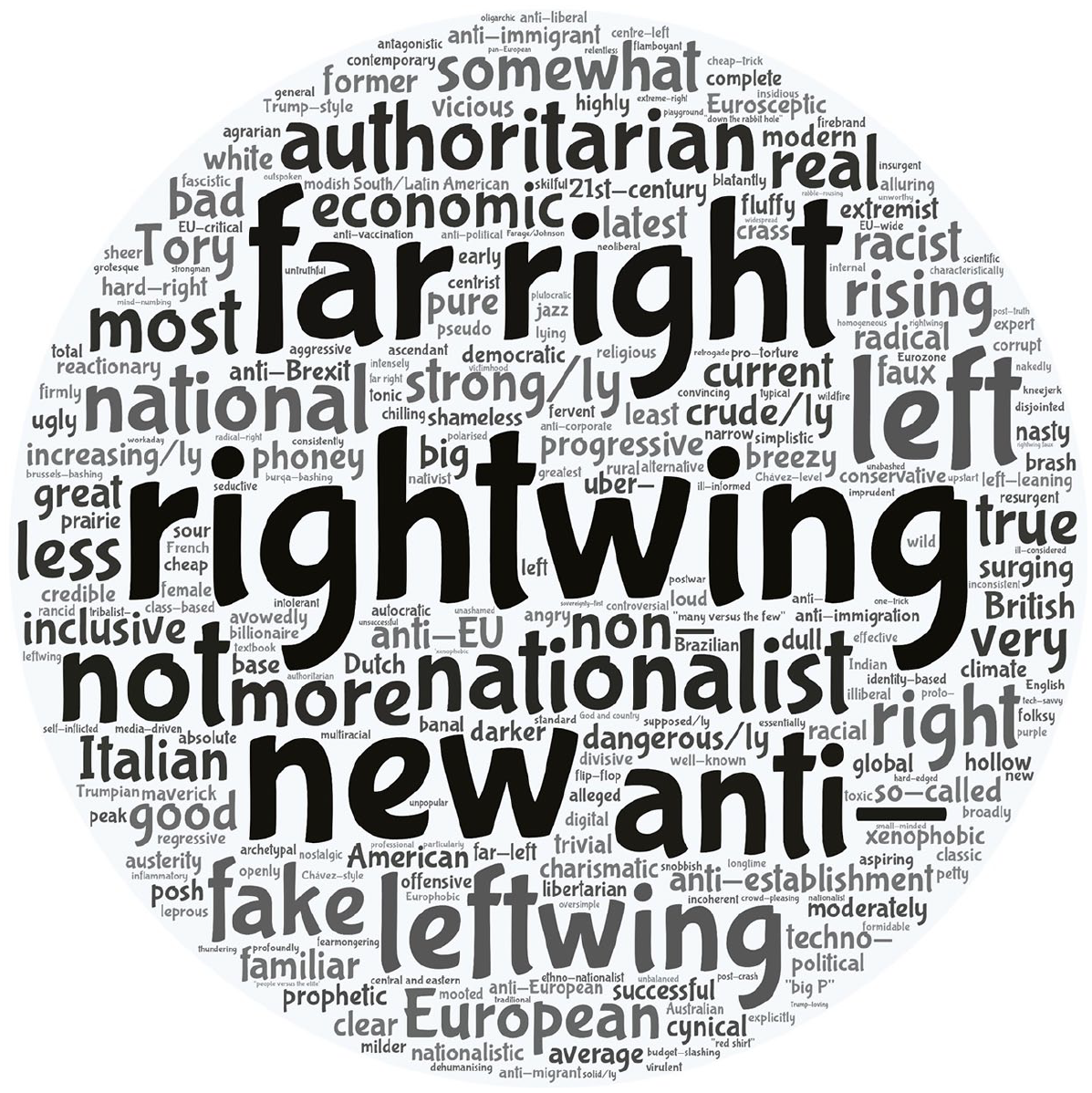
Word cloud of all adjectives/adverbs moderating populis* in the corpus, sized according to their frequency.
Classifying these descriptors according to themes revealed a range of common associations, whether it be their position on the political spectrum, geographical location, illiberal quality, genuineness, brashness, positivity, unpleasantness, or inconsistency. While overall predication is characterised by a generally negative slant, some adjectives present it in a more positive or ambiguous light. The contrast is exemplified in how populism can at once be ‘rancid’ (Murphy, 2018), ‘progressive’ (Gambino, 2019), and ‘fluffy’ (Sparrow, 2019). Often, these descriptions are not qualified or contextualised further, leaving it to the reader to derive their own interpretation. The issue here is that the heterogeneity of populism’s application and qualification combines with its common association with the far right, bestowing a sense of banality and harmlessness on such parties or ideas. If anything and everything can be populist, why should we worry about the far right? Alternatively, if the far right and populism are interchangeable and populism is everywhere, then so is the far right.
As a combination, euphemisation and trivialisation are particularly potent. It is no surprise that this trend from stigmatising to less loaded terms (facilitated by unrestricted and decontextualised usage) has been welcomed by actors within the far right themselves. While Marine Le Pen had once threatened to sue anyone calling her party extreme right, she openly embraced the populist signifier, stating that ‘If it means a government of the people, by the people and for the people, well then, I am a populist’ (Le Pen, 2013). Similarly, Matteo Salvini, the leader of the Italian Lega, proudly wore a t-shirt stating ‘I am a populist’ at a rally in 2018. The populist label also facilitated claims by former stockbroker Nigel Farage that he was leading ‘the people’s army’ during the Brexit referendum campaign, a topic covered in The Guardian series: ‘We’re reactivating the people’s army’: inside the battle for a hard Brexit (Hattenstone, 2019), allowing him thus to set the agenda. In the same article, a UKIP member is asked: Is he Britain’s greatest populist politician? ‘Yes, I think he is’. What does it mean to be a great populist? ‘It means he’s a good leader. He’s very outspoken, and he tells the truth. He is popular and he is populist, in that he’s a leader of the people’.
The leading question, already framed positively, is followed by an invitation to define populism on their own terms, invoking the common association between popular support and populist. Despite ambiguity over using the term to describe himself (Lewis, 2019 – another article dedicated to him in the series), Farage (2020) has since explicitly embraced it, stating in his final speech to the European Parliament: there’s an historic battle going on now across the West: in Europe, America and elsewhere. It is globalism against populism. And you may loathe populism, but I’ll tell you a funny thing, it’s becoming very popular, and it has great benefits.
Other terms have also been used to euphemise far-right politics, as well as the use of quotation marks around ‘racist’, adding a sense of debatability as to whether what was said was indeed racist. For example, Tommy Robinson was defined on a number of occasions as an ‘anti-Islam activist’. In such articles, when other terms such as ‘Islamophobic’ or ‘racist’ are used, it is usually as part of quotes either to denounce false accusations or to make the case, despite this being supported by vast amounts of academic literature (Townsend, 2019). In an article published as part of the series, titled ‘Revealed: the hidden global network behind Tommy Robinson’, the term ‘racist’ appeared only once in a context which took its lead from Robinson himself: ‘[Robinson] frequently complains of being smeared as a racist, insisting he does not care about skin colour and that his objection is to Islamist political ideology rather than people’ (Halliday et al., 2018). Thus, euphemisation and trivialisation facilitate the far right’s pursuit of a reconstructed and destigmatised image.
Amplification
In addition to this, The Guardian has participated in the amplification of the far right, thus giving them further credence as well as the necessary space to be heard. The predominant focus on right-wing politics through the series is highlighted in the adjectival/adverbial analysis outlined above and illustrated through Figure 1. Of the categories identified, modes of describing populis* were dominated by those referring to the right (right wing, far right, hard right, extreme right, etc.), with 490 of the 1353 preceding descriptors (36%) referring explicitly to this form of politics. 3 This can be contrasted to those establishing an association with the left (left wing, far left, left-leaning, etc.), comprising only 74 (5%) references. Again, that this takes place in a newspaper which is otherwise opposed to such ideas is fascinating. While one would expect media with closer ideological alignment such as the right-wing tabloid press in the United Kingdom to give coverage to such politics, its main opponents within the mainstream media landscape also fail to offer a balanced view.
This has taken place through the amplification of the popularity of the far right and the prominence of populism, with countless articles warning of its impending rise, even when this did not manifest in electoral results. This was particularly clear, for example, during the 2018 Swedish elections where the Sweden Democrats (SD) received disproportionate and exaggerated coverage in the lead-up to the election, even though Swedish politics rarely make the news in the United Kingdom. While the election took place in September 2018 or 2 months before the start of the series, the headlines were telling: ‘Sweden’s far right has flourished because the elite lost touch with the people’, ‘Anti-migrant feeling fuels Swedish far right as election looms’, and ‘The Guardian view on the Swedish elections: danger ahead’. Interestingly, while the first two articles clearly placed the SD within the far right, with populism hardly mentioned, The Guardian editorial euphemised the threat by referring to an ‘anti-immigrant party’ in its standfirst and as ‘the populist and anti-immigrant Sweden Democrats’ and more broadly to a trend of ‘ethno-nationalist populism’, with the term ‘far right’ absent in the article (The Guardian, 2018b). Once the elections passed with the SD performing below expectations, the news cycle moved on and little was said about their failure, leaving instead a narrative of upsurge.
Across the whole corpus, 1520 words deriving from the lemma ‘rise’ are present, almost averaging one occurrence per article. Although its context varies, this focus on rising waves is prominent in reference to populism within the data, with ‘the rise of’ constituting the most frequent cluster around the populis* concordance. This emphasis can be seen in the opening paragraph of one article, stating, ‘An exciting new research project by The Guardian and Team Populism shows empirically what many have asserted and felt: the world is getting more populist’ (Mudde, 2019). Again, this association between populism and popular support is critical. Public opinion and its reification have also played a key role in the amplification of the importance of the far right with many headlines recounting the importance of immigration as a major concern. Here again, the failure to account for the media’s role in creating such demand is glaring – for example, Martin Moore and Gordon Ramsay (2017) demonstrated clearly that immigration was core to the coverage of the Brexit campaign, particularly in terms of headline and frontpages. Just as significantly, the negative coverage of these particular issues played right into the hands of far-right parties, who in turn received undue coverage for saying out loud what the media was placing on the agenda.
One particularly clear example of amplification in The Guardian’s populism series was coverage of Steve Bannon’s attempt to enter European politics after his downfall in the United States. While his enterprise had already proven a failure, the second day of the series dedicated no less than four articles to Bannon, with an interview which allowed him to platform his ideas, something his opponents are rarely given the opportunity to do. Furthermore, an editorial published on the same day stated alarmingly and yet equivocally: ‘Europe watches in alarm as Steve Bannon, a Trump ally, attempts to mobilise a hard right network in next year’s European parliamentary elections. His campaign is faltering but there is no doubting the threat Mr Bannon poses’ (The Guardian, 2018a). The articles dedicated to Bannon similarly reflect this contradictory message, with two hyping his role and influence and the other two demonstrating that European legislation had already undermined his ‘operation’ (Lewis and Rankin, 2018; Rankin and Lewis, 2018). The articles themselves were filled with similar inconsistencies, with one titled ‘The Mayfair dinner that brought Europe’s far right together’, suggesting a grand success in Bannon’s enterprise, while the standfirst pointed to a failure: ‘Steve Bannon kicked off his grand European project with a sumptuous spread in Brown’s Hotel; but indigestion soon set in’ (Lewis, 2018a). Hindsight has since demonstrated that the most likely outcome did eventuate, with Bannon’s European enterprise indeed a failure. Yet again, this appeared to be contradicted by a 2649-word report titled ‘Steve Bannon: I want to drive a stake through the Brussels vampire’ (Lewis, 2018b). Not only did the title offer the opportunity for the far-right actor to set the agenda, but the report itself may have been created at his behest, as suggested by the standfirst which reads, ‘Former Trump adviser invites The Guardian to shadow him as he sets about his plan to forge a new populist “super-group” in Europe’. The headlines are once more contradicted by the body of the article which states early that: Bannon’s plan is colliding with the realities of European politics, where rightwing populist parties have turned down his approaches, and electoral laws that mean he is barred or restricted from campaigning in most of the countries he wants to intervene in.
Yet the article goes on to describe ‘the Movement’ at length, on Bannon’s terms. The amplification and platforming of such figures have serious implications for the legitimisation of the groups with which they are associated, the actors themselves, and critically, the ideas or discourse they espouse.
Conclusion: The populist hype and the mainstreaming of the far right
Overall, we argue that the populist hype and the various processes aforementioned have facilitated a process of legitimisation. As the coverage of far-right politics has been both euphemised and amplified through its coverage as populist, and its origins deflected onto the people qua working class, we have witnessed a move towards accepting the diagnosis offered by the far right not only as inevitable but in fact democratic.
In our corpus, this was particularly clear in a number of interviews by prominent political actors, who often held positions of power allowing them influence on such issues, in which they demanded a move rightwards. One of the most prominent examples in The Guardian coverage was an interview with Hillary Clinton titled ‘Europe must curb immigration to stop right-wing populists’ (Wintour, 2018b). The title clearly set the right, and more precisely the far right, as the biggest threat for Europe, something which was supported by the amplification of its real performance across the continent but made easier to argue because of the euphemisation of its otherwise racist politics. This in turn made ‘rightwing populists’ a homogeneous, transcontinental threat, rather than a collection of disparate and often contradictory interests. Perhaps more starkly, Clinton’s advice to ‘the centre left’ to stop this imagined, or at least exaggerated, threat was not to develop different narratives, but instead to accept their ideas. This was a very powerful statement which demonstrated the extent to which far-right actors had been (or were allowed to be) successful at making their ideas hegemonic. Even though Clinton had not lost to Trump so much as she had lost to herself (Trump received fewer votes than her, but critically she performed far worse than Obama in both his successful campaigns), she had clearly internalised the narrative that her defeat was at the hands of the people who had been seduced by Trump’s racist outbursts, or the ‘basket of deplorables’ (Jacobs, 2016) as she famously labelled them. Clinton’s take was supported by Tony Blair and former Italian Prime Minister Matteo Renzi who called for similar measures (Wintour, 2018a). Linked to the issue of agenda-setting here is the fact that each of these politicians had held significant political power over the decades that did most to erode political trust and to mainstream far-right discourse.
In conclusion, it must be stressed that The Guardian is by no means an outlier in the misuse of the term and concept of populism, and was chosen because it ran a 6-month series, ‘the new populism’, which provided us with ample data. It should also be reiterated that our aim is not either to argue that the whole coverage of populism in The Guardian is problematic. In fact, many excellent academics and journalists provided extremely useful insights into ideas, processes, and movements throughout the year. However, we argue that the sheer volume of articles and some editorial choices in terms of headlines and designs, the choice of topics, and coverage led to the dilution of the better research at best and at times to direct contradictions in the coverage for the sake of shock value (see the series on Bannon). One of the clearest examples in our sample of such problematic coverage, highlighting a clash between careful analysis and editorial pressure, is a series of articles over 2 years spanning the start of the series. Two days after the launch, Cas Mudde (2018) published an article titled ‘How populism became the concept that defines our age’. Regardless of the content of said article and keeping in mind that the title may be an editorial choice rather than the author’s, Mudde (2017) had written an article 12 months before the start of the series, criticising the Cambridge Dictionary choice for its word of the year, rightly calling for more care and nuance and pointing to the risk of conflating very different concepts, namely, populism and nativism. A year after the launch of the series, in November 2019, Mudde (2019) would insist again that it is nativism that is driving ‘the far-right surge’, stressing that ‘While populism is a crucial part of the story, the real king is nationalism, or better put nativism, and [it] is here to stay’.
The aim of this article has been to outline some of the main issues and dangers deriving from the uncritical use of populism, both as a term and as a concept. As stressed earlier, we do not argue for the complete withdrawal of the term, but rather for its more critical and careful use, particularly in public discourse. Through the use of a mixed-methods approach combining DT, CDS, and CL, we have tried to outline that the careless and uncritical use of the term or concept can have a number of detrimental effects, namely:
The denial of agenda-setting power and the process of deflection, whereby media actors, but also politicians, are allowed to shirk their responsibility and power to influence public discourse, placing responsibility on communities such as the working class;
Euphemisation and trivialisation, whereby politics traditionally and academically defined as racist, nativist, or far right are either described through the less stigmatising ‘populism’ or associated with all manner of things, thus blurring their meaning;
Amplification, whereby certain movements, actors, and ideas are given disproportionate coverage at the expense of others.
Through the clear conceptualisation of detrimental effects and their illustration, we hope to have contributed towards a more critical and thoughtful use of this term in the media and public discourse more generally.
Footnotes
Acknowledgements
We would like to thank the three reviewers who have engaged openly and critically with the article and helped us sharpen it, as well as Dr James Strong and the Politics journal for their brilliant communication. Special thanks to Drs Aaron Winter and George Newth and Prof. Hilde Coffé for their feedback on our first draft.
Funding
The author(s) received no financial support for the research, authorship, and/or publication of this article.
