




Abstract
The “Great Replacement Theory” (GRT) is an extremist narrative that has gained increased prominence within anti-immigration and conspiratorial discourses in Western societies, yet remains understudied. We first conceptualize the GRT as a narrative that typically claims that white majorities are being deliberately replaced by non-white immigrants in a secretive attempt by malevolent elites to undermine Western nations. Second, we devise measures of agreement with the GRT's several incremental components. Third, using original representative survey data from Germany, we explore and demonstrate widespread belief in even the most extreme propositions of the GRT and examine how these beliefs vary according to sociodemographics, conspiratorial tendencies, and political preferences. While further research is needed, our descriptive findings provide insight into the perhaps underestimated extremism of anti-immigration attitudes among some citizens and highlight the need for more nuanced assessments of immigration attitudes—and attitudes in general—beyond simple spectral measures.
Introduction
In recent years, a wide range of political actors have promoted the conspiratorial narrative that elites are purposely “replacing” white majorities in Western countries with other ethnicities. In the English language, this narrative is typically called the “Great Replacement” by its proponents (and the “Great Replacement Theory” or GRT by observers), likely derived from French writer Renaud Camus’s 2011 book Le Grand Remplacement (Zúquete 2018). Echoing earlier and contemporary narratives of “Eurabia,” “white genocide” and beyond (Davey and Ebner 2019), Camus argued that this “replacement” was the result not only of immigration, low fertility rates, and “misguided elites,” but also deliberate violence against whites. Accordingly, the major political struggle henceforth was between liberal, pro-immigration “replacists” and the “anti-replacist” “defenders of Europe.” Advocates of the Great Replacement argue that it is not a theory but rather an empirical reality (Zúquete 2018: 153).
Moreover, the GRT's demographic concerns allow it to easily dovetail with belief that “LGBT ideology”, abortion, and feminism are all officially promoted to diminish and weaken white populations, with a view to their eventual replacement (e.g., Svatoňová and Doerr, 2024). Aside from its racial underpinnings, the GRT's other extremist pillar is that the “replacement” is beyond democratic control—variously being secretive, global, and elitist, if not explicitly a Jewish conspiracy—pushing it beyond the radical yet democratic arguments of the populist radical right towards anti-democratic and/or extra-parliamentary extremism (Mudde 2007; Davey and Ebner 2019). The substantive importance of the GRT, relative to broader and perhaps more moderate opposition to immigration, partially lays in its more obvious ability to excite political violence, leading to international news coverage of the GRT and its supposed culpability for white nationalist violence (Obaidi et al. 2022).
Despite its extremist components, the GRT has, to varying extents, been expressed by journalists, academics, and politicians in most Western countries, with Hungarian Prime Minister Viktor Orbán and Italian Prime Minister Giorgia Meloni being perhaps its most famous advocates. 1 This narrative has been argued to be “central to the Identitarian worldview” and its prevalence was arguably fueled by terrorist attacks in Europe during the early 2010s and the so-called migration crisis of 2015–16 (Ahmed and Pisoiu 2019: 70). Commercial polling 2 from the United States demonstrates that when asked whether they believe that “a group of people is trying to replace white Americans with immigrants and people of color who share the group's views,” 28 per cent of Americans agreed compared to 49 per cent who disagreed. 3 Furthermore, 33 per cent of respondents had heard of the GRT, compared to 46 per cent who had not. In another recent poll in France, 61 per cent of respondents agreed that “European, white and Christian populations are being threatened with extinction following Muslim immigration from the Maghreb and black Africa.” 4
The emergence and spread of the GRT among the far right in recent years presents a paradox when considered alongside public opinion trends on immigration, which have remained largely stable over the past two decades in Western countries (Dennison and Geddes 2019; Kustov, Laaker and Reller 2021). In contrast, the salience of immigration as a public issue has been far more volatile and partially driven by rising immigration flows and specific events (Dennison 2020; Dennison and Kriesi 2023). One explanation for this apparent contradiction is that the spread of the GRT narrative—promoted by populist radical right actors, granted legitimacy by actual increases in immigration, and facilitated by the spread of conspiratorial thinking regarding Covid-19—may be increasing the salience of immigration and activating pre-existing anti-immigration and authoritarian dispositions among segments of the population (Claassen and McLaren 2021).
Despite the GRT's potential to shape public debates and political outcomes, there have been few systematic attempts to empirically study belief in this narrative (though see Jedinger, Masch and Burger 2023). This gap is notable given the extensive research on conspiracy mentality in political psychology, which has linked conspiracy beliefs to various political attitudes and behaviors, including those related to immigration (Douglas, Sutton and Cichocka 2017; Pellegrini, Leone and Giacomantonio 2019; Walter and Drochon 2022). To address this gap, our explicitly descriptive and exploratory study (see Gerring 2012) provides the first nationally representative empirical investigation of public belief in the GRT and its associated factors in Germany. To that end, we also provide an original conceptualization and operationalization of the GRT as a narrative with incremental components, ranging from a weak version focused on observed demographic changes to a strong version invoking elite conspiracies and calls for extra-parliamentary action.
Overall, our findings reveal substantial endorsement of key tenets of the GRT, with varying levels of support for weak and strong versions of the narrative. We demonstrate that belief in the GRT is widespread, particularly among certain sociodemographic groups and supporters of the far-right Alternative für Deutschland (AfD) party. Notably, we find that grievances and conspiracy thinking are the primary correlates of GRT beliefs, while partisanship plays a significant but less influential role. Finally, we discuss the implications of our findings for understanding the GRT, their potential consequences for political behavior, and the need for future research to develop more nuanced assessments of immigration attitudes.
Conceptualizing and operationalizing the “Great Replacement”
The academic literature on the GRT remains nascent though is accompanied by significant interest from policymakers and NGOs. For example, Ekman (2022: 1127) succinctly defines the GRT as “the idea that ethnically homogenous populations in European nations are being ‘replaced’ by people of non-European origin” (see also Davey and Ebner 2019). Among these studies, the identified foundational contents of the GRT are similar—(1) an understanding of demographic change based on ethnicities as coherent and immutable blocs, (2) an assertion that such change is both normatively bad for the indigenous group and stems from a conscious policy of replacement, and (3) that the replacement is being done secretly and/or beyond democratic control. Whether a call for extra-democratic action is explicit or implicit thereafter varies. In contrast to such similarity in supposed contents, initial studies have been more divergent in conceptualization. Ekman (2022: 1127, 1128, 1130) conceptualizes the GRT as a “discourse” (as does Bracke and Hernández Aguilar 2024) but also a “flexible political strategy,” and a “systemic conspiracy theory” whereas Svatoňová and Doerr (2024; also Goetz 2021, De Keulenaar and Tuters, 2023) conceptualize it as a “narrative.”
Empirical examination of the GRT has been mostly limited to a handful of qualitative and small-N studies. There is some recent research exploring the online expressions of the GRT through social media and online communities (e.g., De Keulenaar and Tuters, 2023; Svatoňová and Doerr, 2024). Ekman (2022: 1139) analyses online content produced in Sweden, stating that “future research should… quantitatively assess the spread and impact of such claim.” Obaidi et al. (2022) used non-representative samples in Denmark and Norway to show that agreement, respectively, with the statements “[b]ecause of a rapidly growing population of Muslims in Denmark, I feel alienated in my own country” and “[t]he population replacement in Denmark will make Muslims a majority in the near future” are both associated with perceived threat, Islamophobia, and violent intentions.
We argue that the GRT can be best conceptualized as a narrative and that, like other narratives, its function is primarily to serve inner psychological needs (and only thereafter can be instrumentalized as a strategy). Narratives can be defined as “selective depictions of reality across at least two points in time that … include one or more causal claims” (Dennison and Kriesi 2023, for review), which “groups together and integrates into one whole and complete story multiple and scattered events” (Ricoeur 1984: x). Indeed, the power of narratives lay in their selectivity and the assumptions behind that selection so that the empirical elements can “paint a picture of moving through logical steps from a problematic past, through a transforming present, towards a better future” (Dudley 2013: 1142) and thereby act as “vehicles of implicit normative presupposition” (Sconfienza 2017: 22). It is both the cognitive, empirical element and the dynamic, story-like component that separate narratives from the looser assemblage of ideas that make up discourses (Hajer and Versteeg 2005: 175) and the static selectivity of frames (Dudley 2013: 1143).
The GRT represents an archetypal political narrative: highly selective, implicit in its assumptions, internally coherent, and with clear forward-looking “lessons” (Dennison 2021). In this sense, proponents of the GRT (see Zúquete 2018: 153) are correct to say that it is not a theory though neither is it a non-motivated empirical description of reality. Camus's description of Le Grand Remplacement entirely fits the archetype of a narrative, while the online visual expression of the GRT via memes also reflects its narrative essence (Hernandez Aguilar 2023). 5 Notably for scholars of public opinion, it is therefore far more complex than the usual objects of attitudes, such as support for policies or approval of leaders.
The anti-pluralist and anti-elitist aspects of the GRT narrative also closely align with the broader category of populist narratives. Particularly in its nationalist variety, populism depicts society as divided into two homogeneous and antagonistic groups—the “pure” people and the “corrupt” elites (Mudde and Rovira Kaltwasser, 2018). The GRT narrative is a more specific manifestation of this outlook that frames and makes sense of demographic changes as an elite betrayal and a threat from non-white minorities to the homogeneity of the white majority, who are implied to be the authentic and relevant “people” being “replaced.” Consequently, like other populist narratives, the GRT can also be understood as an opportunistic political strategy that relatively unpopular politicians may employ, hoping to gain support of some voters by tapping into pre-existing prejudices (Dai and Kustov 2022). However, although conspiratorial and anti-elitist beliefs are present in many populist narratives (Erisen et al. 2021), the GRT introduces an explicit racial component and a specific conspiracy about demographic replacement that sets it apart as an extreme narrative.
Like in the case of populism, many academics have thus far primarily considered the GRT in malevolent, supply-side terms as a rhetorical instrument (e.g., Ekman 2022: 1128). Doing so places the means by which the GRT is spread as inherent to the narrative; Ekman (2022: 1127; Linders 2023) states that it “negatively politicises demographic change … through the use of pseudoscientific sources, historic narratives of ethnic homogeneity, threat frames, visual fear appeals.” However, there are likely to be internal and contextual drivers of its popularity that are typical of narratives generally such as the need to make sense of and feel control over seemingly important, uncertain, complex, risky, and novel issues. Other related drivers may also include the interests, identities, and values of the individual, and characteristics of the narrative such as internal coherence (Dennison 2021).
Overall, based on the discussion above, we conceptualize the GRT narrative as the following five incremental core elements, all of which must be present for the narrative to be fully internally coherent (also see Wuttke, Schimpf and Schoen 2020).
An A A An, either implicit or explicit,
In other words, according to our definition, if one does not believe that demographic change is happening or that it is happening but it is actually a good thing, then they do not believe in the GRT narrative. The above represents the broad pillars of the narrative, which is likely to be made considerably more specific in each context.
To account for the variation in GRT narratives, we believe it is also useful to distinguish between two versions: “weak” and “strong,” according to belief that the “replacement” can be stopped by democratic means. In short, because the “strong” version sees the cause of the “replacement” as conspiratorial, rather than a result of democratically elected government policy, it does not suggest change can be achieved at the ballot box. This mirrors the conceptual distinction between populist radical right parties and extremist radical right parties, whereby the two groups may share many substantive concerns and preferences, yet the former largely respect existing democratic systems while the latter believe that their radical preferences can only be met via the overthrow of democracy (Mudde 2007). The weak version is open to subjective interpretation and can be partially justified by actual demographic trends in some contexts (see Gest 2022; Kaufmann 2018). Importantly, while the strong GRT is unambiguously conspiratorial and extremist, the weak GRT is debatably so—though does require the belief in immutable racial categories. GRT proponents among populist politicians may often resort to the motte-and-bailey strategy (Shackel 2005) by promoting a strong version of the narrative to mobilize their voters but retreating to its less controversial weak version when challenged on the reality of the strong one.
Data and Methods
To investigate the prevalence of belief in the GRT among the public and its associated characteristics, we analyse data from a survey of a nationally representative sample from Germany, collected by and designed in conjunction with the International Centre for Policy Advocacy in Berlin. As the most populous country in the European Union, Germany represents an ideal case for several reasons. First, it has experienced significant immigration in recent years, particularly during the 2015–2016 refugee crisis, which has been a key theme of the GRT narrative. Second, Germany has witnessed a post-Covid resurgence of populist radical right parties, such as the Alternative for Germany (AfD), which have actively promoted anti-immigration and ethno-nationalist narratives, including the GRT (Davey and Ebner 2019; Erisen and Vasilopoulou 2022). The survey was conducted between August 29 and August 30, 2023, by the polling company Ipsos, using a stratified sample of 1,000 respondents designed to be representative of the national population in terms of age, gender, and Germany's seven Nielsen regions.
This survey was developed as part of the mapping stage of “Proactive Protection,” a narrative change project aiming to curb narrative threats to civic space in Germany and reduce online attacks on NGOs 6 . The aim in this first project stage in 2023 was to build attitude profiles for two target movable middle segments (the so-called “Detached” and “Disillusioned” 7 ) around their level of conspiracy mindedness and attitudes to the common frames in debates on civil society in Germany that may act as pathways to “NGOs as Traitors” accusations, one potential component of the GRT. These profiles were the foundation for a messaging strategy built, tested, and released in 2024. 8
The survey consisted of several batteries of questions. First, belief in the GRT is operationalized according to the incremental component beliefs as conceptualized above and defined in Table 1, below, before explicitly asking if respondents have heard of the GRT and about their belief in the accuracy of it. The components are based on conversations with the International Centre for Policy Advocacy in Berlin specifically, the above literature on the GRT in general, and literature on concern about immigration as a threat to social order and cause of conflict moreover (Dennison and Geddes 2021).
Operationalization of Public Belief in the GRT and Descriptive Statistics.
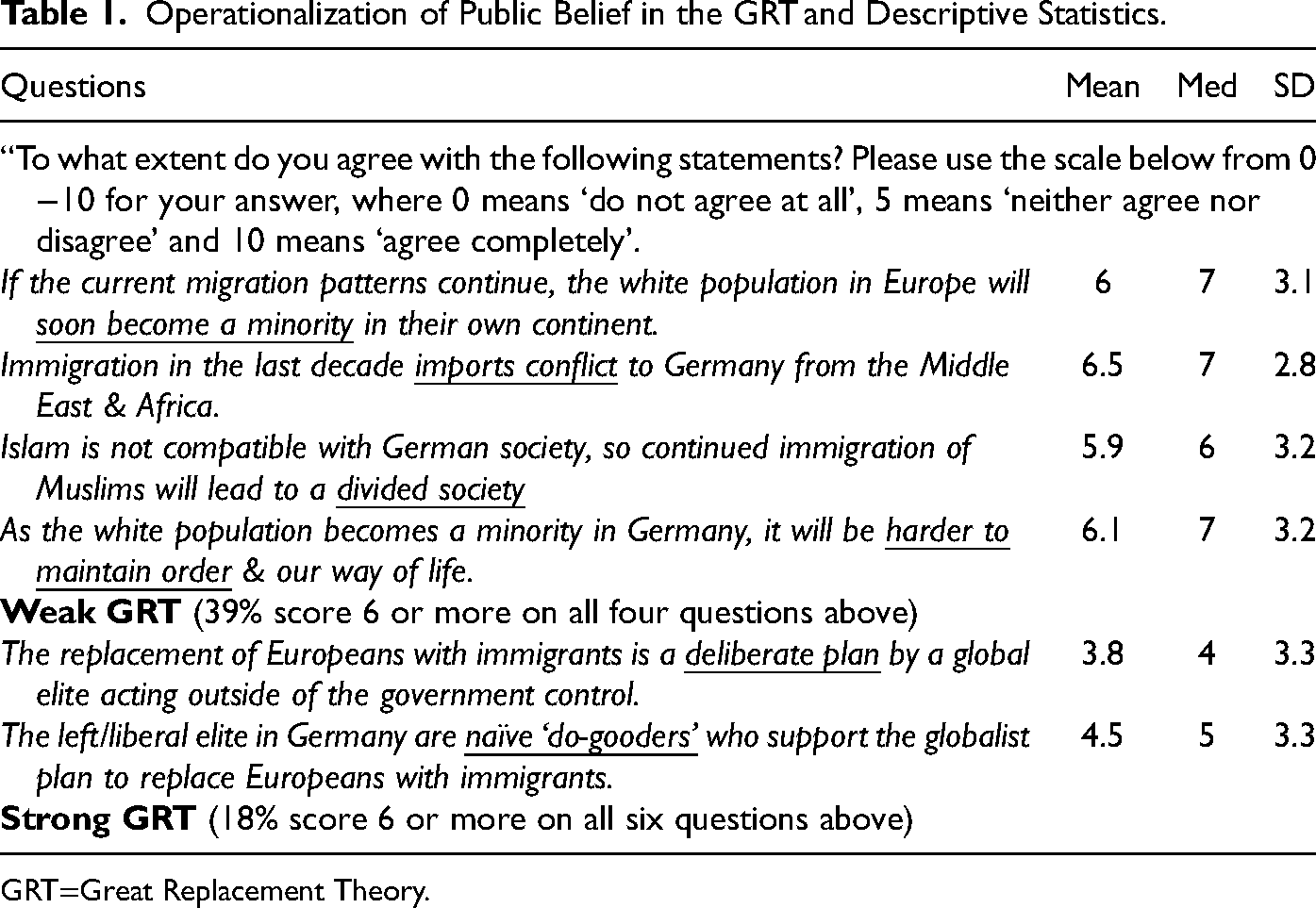
GRT=Great Replacement Theory.
To estimate the prevalence and correlates of public belief in weak and strong GRT respectively, we follow Wuttke, Schimpf and Schoen (2020) and create two binary variables. We consider respondents to believe in “weak GRT” when they agree (i.e., score 6 or more) with the first three components (first four statements in Table 1); and we consider them to believe in “strong GRT” when they agree (i.e., score 6 or more) with all five components (first six questions in Table 1). As a simpler continuous measure, we also create an overall average GRT index summarizing all six items with the relatively high reliability score of 0.91 (see Figure A1 for the correlation matrix).
Figure A1 also allows us to observe the six correlations between the four respective “weak” GRT components—in every case between 0.67 and 0.71—and the one correlation between the two respective “strong” GRT components—0.72. Notably, these correlations are all significantly higher than the eight correlations between the “weak” and “strong” components, all of which are between 0.46 and 0.61. This empirically justifies our theoretical distinction based on the extra-democratic roots of the “replacement” and thus an extra-democratic, extremist solution to it.
Due to the centrality of conspiracy to the GRT and the broader literature on conspiracy theories (e.g., Douglas, Sutton and Cichocka 2017; Walter and Drochon 2022), we also include Bruder et al. (2013: 5)'s five question Conspiracy Mindedness Block from their Conspiracy Mentality Questionnaire. We also include a battery of questions measuring grievances regarding societal change, economics, political expression, and historical narratives. Sociodemographic and political measures were also included: age, gender, education, region, income, migration background, and 2021 federal election vote choice (see supplementary materials for details and German language wording).
Descriptive Results: the Prevalence of Public Belief in the GRT
The results reveal substantial and polarizing public belief in key tenets of the GRT among the German population, with varying levels of endorsement for the weak and strong versions of the narrative. Most respondents agree to some extent with the core components of the weak GRT: that immigration from the Middle East and Africa will soon make white Europeans a minority in “their” countries (mean = 6.5 on the 0–10 scale), and that as whites become a minority in Germany, it will be harder to maintain order and the German way of life (mean = 6.1). Additionally, a plurality agrees that Islam is incompatible with German society, so continued Muslim immigration will lead to a divided society (mean = 5.9).
Overall, 39 per cent of German respondents score 6 or more on the first four questions, indicating their effective endorsement of the weak GRT narrative. Belief in the strong GRT, which includes conspiratorial explanations and implicit calls for action, is less prevalent but still significant. A plurality agrees that the demographic changes are part of a deliberate plan by elites to replace Europeans (mean = 3.8), and 18 per cent of the sample score 6 or more on all six narrative component questions. However, only 4 per cent of the sample give the maximum score of 10 on all six questions (although this could also be a result of “speeders” and the 3% margin of error).
Importantly, the distributions of responses across the various GRT belief items exhibit a roughly bimodal pattern, with respondents clustering at the low and high ends of the scale, indicating polarized views on both. This polarization in responses is present despite the common tendency among survey respondents to pick a middle option. When explicitly asked about their belief in the GRT, 29 per cent respond 6 or more, suggesting a substantial minority is aware of and supports the strong GRT narrative at least to some extent. Indeed, similar to the number of people who can be categorized as endorsing the strong GRT narrative, 18 per cent say that they both have heard of the term and that it describes the current reality of ethnic change Figure 1.
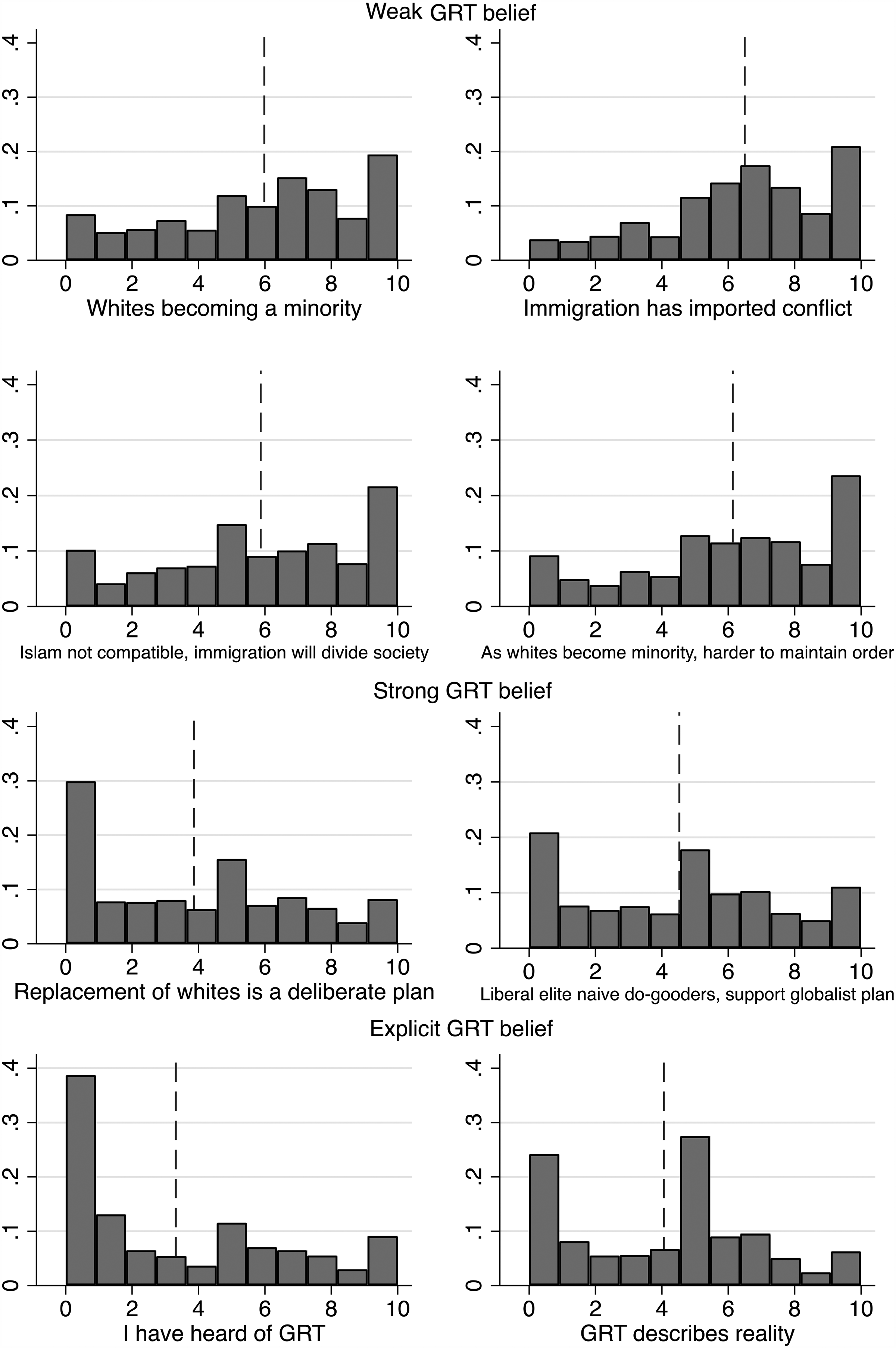
Distribution of Public Belief in GRT Components. Note: The figures display the proportion of respondents who can be categorized as believing (i.e., Respond 6 or higher) in weak (top), strong (middle), or explicit (bottom) components of the GRT. GRT=Great Replacement Theory.
Descriptive Results II: Sociodemographic Correlates of Public Belief in the GRT
The analysis of GRT beliefs across sociodemographic categories reveals notable patterns and differences (see Figure 2). As expected, less educated respondents from the former East Germany with no migration background show higher endorsement of both weak and strong GRT narratives compared to those with more education, a migration background, and from the former West Germany. Interestingly, gender and income gaps in GRT beliefs are less pronounced than might be expected, with poorer men exhibiting only slightly higher levels of agreement compared to richer women. This suggests that susceptibility to the GRT is not primarily driven by gender-based or income-based factors.
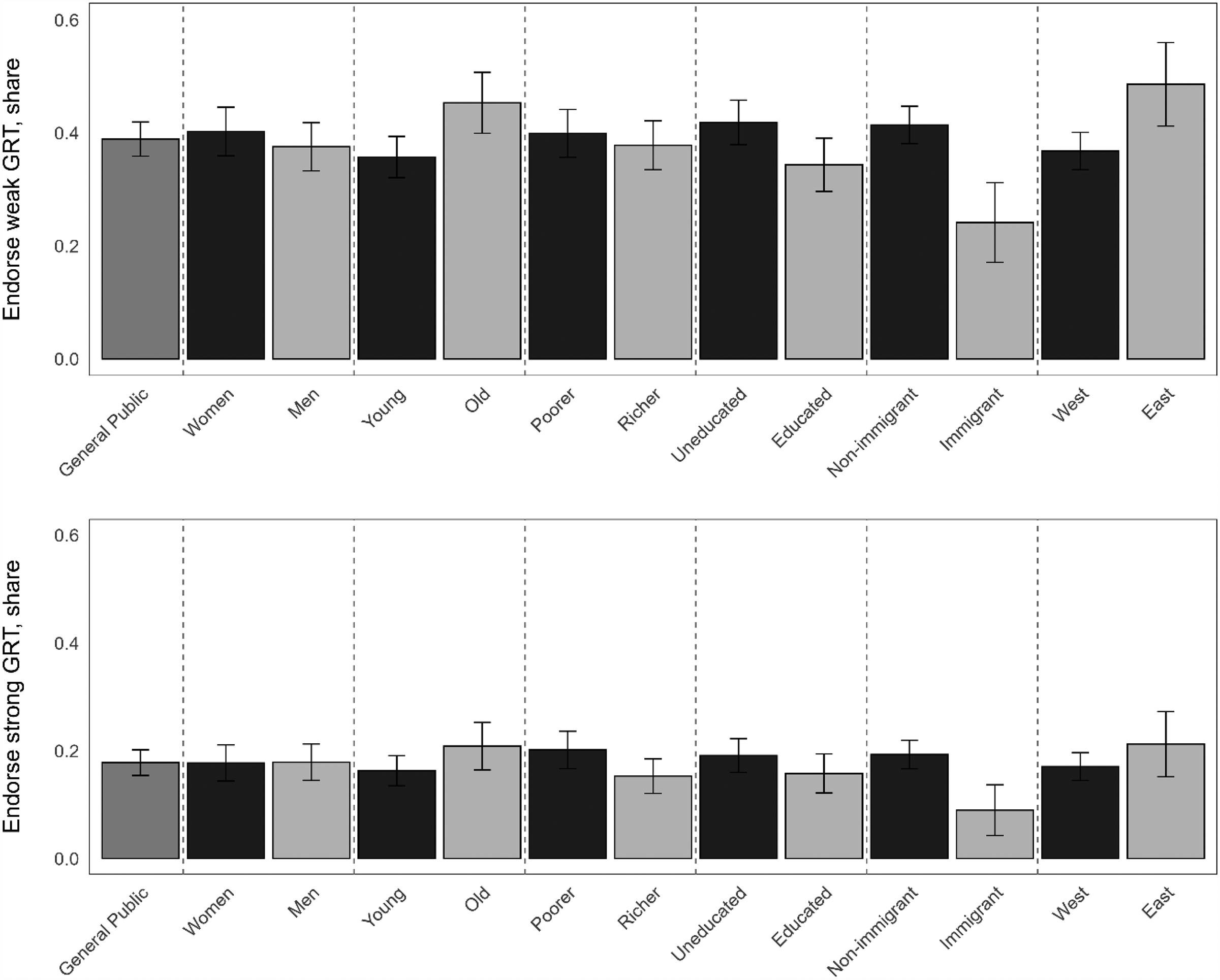
Public Belief in the GRT by Sociodemographic Categories. Note: the figures display the proportion of respondents who can be categorized as believing in (responding 6 or above on each GRT component item) either weak (top) or strong (bottom) GRT across various sociodemographic binary categories. Bars indicate 95 per cent confidence intervals. GRT=Great Replacement Theory.
Regarding partisanship, the results reveal a more striking pattern of differences (see Figure 3). Supporters of the far-right Alternative für Deutschland (AfD) party display exceptionally high levels of agreement with both weak (75%) and strong (55%) GRT narratives, with a large majority endorsing even the most extreme conspiratorial propositions. This finding reflects the central role of the GRT in the AfD's ideology and rhetoric, and the party's success in mobilizing support around anti-immigrant and ethno-nationalist sentiments. In contrast, voters of other major parties exhibit lower levels of agreement with GRT beliefs, although the precise patterns vary depending on the party and the strength of the GRT narrative.
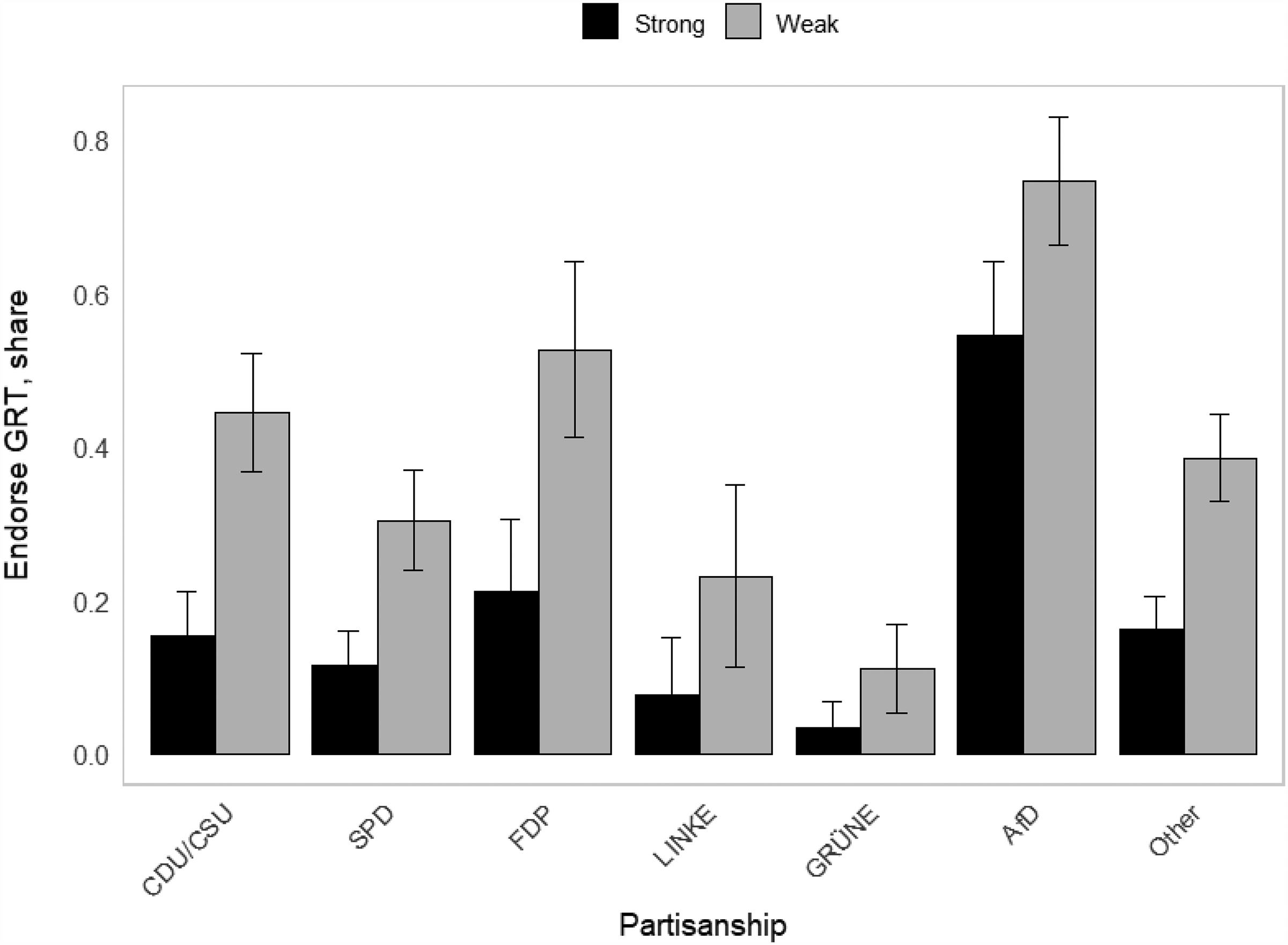
Public Belief in the GRT by Partisanship. Note: The figure displays the proportion of respondents who can be categorized as believing in (responding 6 or above on each GRT component item) either weak or strong GRT across various partisanship categories. Bars indicate 95 per cent confidence intervals. GRT=Great Replacement Theory.
Another noteworthy pattern is the relatively high level of support for the weak version of the GRT among FDP voters (52%), which is similar to that of conservative CDU voters. While this requires further research, one possible explanation is that FDP voters, despite their liberal economic stances, may still harbor cultural concerns about immigration. This suggests that apprehensions about demographic changes are not limited to conservative and radical right-wing populist voters and may be present among otherwise liberal voters who prioritize economic freedom but are wary of rapid societal shifts.
Further insights into the factors associated with public belief in the GRT—measured as a six-unit index variable—can be gleaned from the regression analyses presented in Table 2. The results suggest that the primary correlates of GRT beliefs are grievances and conspiracy thinking, as evidenced by the substantial increase in R-squared when these factors are included in the model in addition to sociodemographic factors (columns 2 and 3). The grievance variable captures respondents’ agreement with statements expressing discontent about rapid societal change, perceived unfairness in the distribution of economic benefits, and a sense of being unable to express political opinions freely without facing attacks. While some of these grievance and conspiracy perceptions may be attributable to sociodemographic characteristics, particularly education and age, these latter variables alone account for a relatively small proportion of the variance in GRT beliefs. In Table A2 and A3, we perform the same analyses but use the binary measures of, respectively, belief in the weak form of the GRT and belief the strong form of the GRT (as coded for Figures 2 and 3). Tables A2 and A3 display similar findings to those of Table 2. The major exception is that, when it comes to predicting beliefs in the strong GRT, AfD support becomes the only significant party-based predictor, with conspiracy mindedness expectedly becoming relatively more important compared to other models.
Regression Analyses of Public Belief in the Strong GRT.
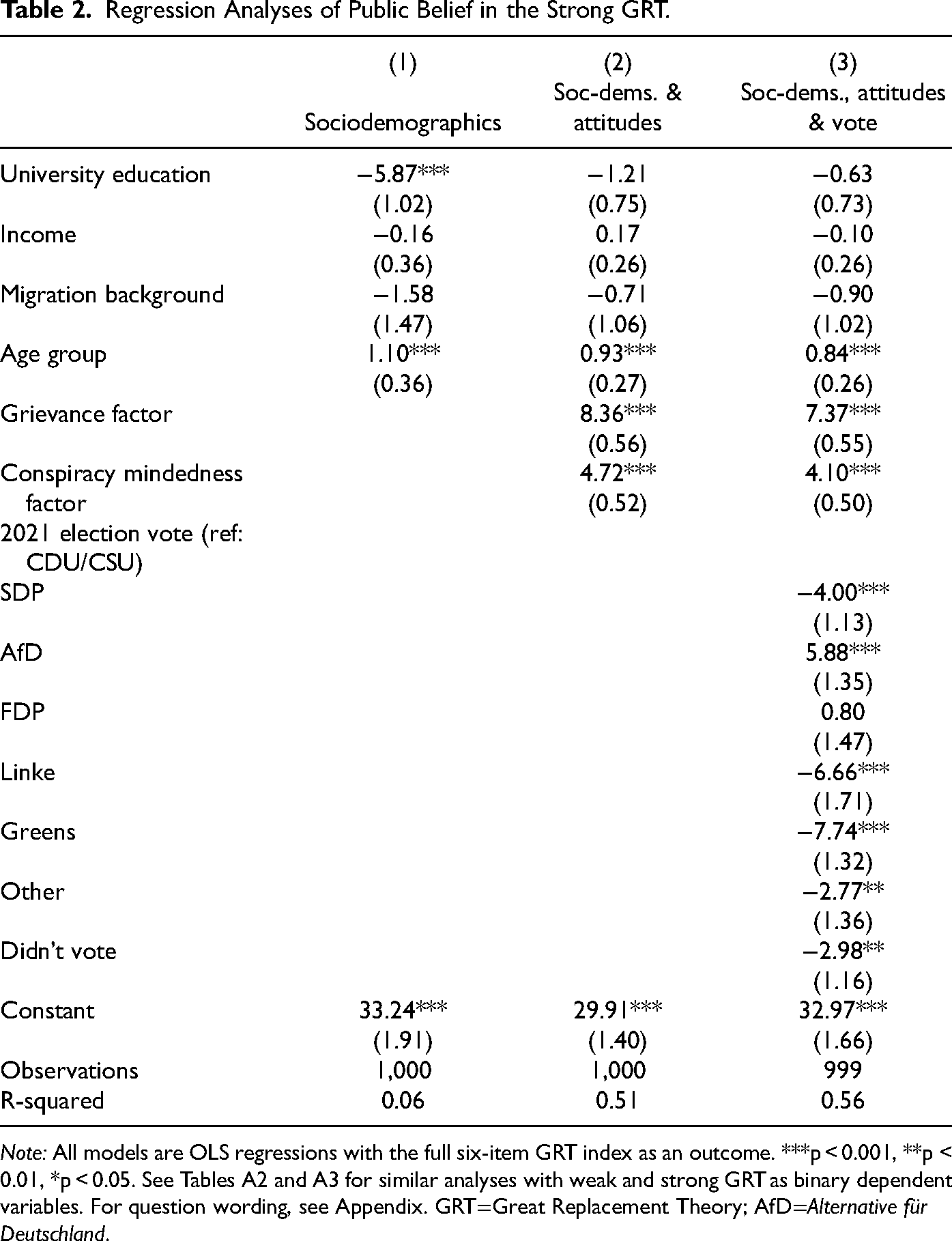
Note: All models are OLS regressions with the full six-item GRT index as an outcome. ***p < 0.001, **p < 0.01, *p < 0.05. See Tables A2 and A3 for similar analyses with weak and strong GRT as binary dependent variables. For question wording, see Appendix. GRT=Great Replacement Theory; AfD=Alternative für Deutschland.
Discussion
This study provides the first nationally representative empirical investigation of public belief in the GRT and its associated factors in Germany. By conceptualizing the GRT as a narrative with incremental components and operationalizing belief through agreement with these components, we demonstrate widespread endorsement of even the most extreme propositions of the GRT, varying significantly across sociodemographic categories and political preferences.
Our findings suggest that the GRT has gained significant traction among certain segments of the German population, underscoring the need for further research into the factors driving its acceptance and spread, as well as its potential consequences for social cohesion, political discourse, and behavior. The conceptualization of the GRT as a narrative with weak and strong versions provides a valuable framework for understanding the complex nature of these beliefs and can inform future studies exploring the psychological and sociological mechanisms underlying the adoption of extremist narratives.
Notably, we find that partisanship, despite being a significant predictor, may add little explanatory power beyond grievances and conspiracy thinking (compare columns 2 and 3 in Table 2). This finding, along with the reduced magnitude of the grievance and conspiracy coefficients in the full model, suggests that there may be a complex interplay between these psychological factors and party choice. For instance, it is plausible that individuals with higher levels of grievances and conspiracy mindedness are more likely to be attracted to parties like the AfD, which in turn reinforces their belief in the GRT narrative.
Moreover, our findings highlight the importance of considering the intensity and complexity of attitudes towards immigration, as standard measures may underestimate the extremity of opposition and the narratives behind it among certain groups. There is a fundamental difference between supporting restrictive immigration policies due to one's skepticism about the merits of increasing immigration for either economic or cultural reasons, and supporting these policies due to one's firm belief that the government is deliberately trying to replace native-born citizens with foreigners. While both types of individuals may respond similarly to a standard battery of immigration policy questions, it is likely that the former belief is more amenable to persuasion and open to factual evidence than the latter. It is also likely that the behavioral consequences of the two beliefs would be different.
While our study provides a theoretically informed approach to measuring beliefs in the GRT narrative, further research is needed to establish the reliability and validity of our measures compared to possible alternatives, and to clarify the empirical relationship between GRT beliefs and general anti-immigration attitudes. Future research should develop more nuanced assessments to better capture the full spectrum of public opinion on immigration, building on our approach and validating measures across different contexts. Additionally, scholars could benefit from exploring and comparing the prevalence and correlates of GRT beliefs across different countries and time periods.
Finally, our study did not directly assess the potential behavioral consequences of these beliefs. Without further experimental analysis, we cannot determine the direction of causality between public belief in the GRT, conspiracy thinking, and partisanship. Future research can build on our conceptualization of the GRT and explore the malleability and consequences of these beliefs for political behavior, providing insights into the real-world implications of the GRT narrative and informing strategies to counter its influence.
All in all, our exploratory study provided novel insights into the prevalence and correlates of public belief in the “Great Replacement” in Germany, highlighting the surprisingly widespread endorsement of this extremist narrative in general and some of its components in particular. By conceptualizing the GRT as a complex narrative and identifying its sociodemographic and political correlates, this research lays the groundwork for future studies and interventions aimed at understanding and countering the influence of this potentially harmful conspiracy theory.
Supplemental Material
sj-docx-1-mrx-10.1177_01979183251343877 - Supplemental material for Public Belief in the “Great Replacement Theory”
Supplemental material, sj-docx-1-mrx-10.1177_01979183251343877 for Public Belief in the “Great Replacement Theory” by James Dennison and Alexander Kustov in International Migration Review
Footnotes
Acknowledgements
The survey data used in this paper was commissioned as part of a narrative change project aiming to curb narrative threats to civic space in Germany, run by the International Centre for Policy Advocacy 9 and funded by the Innovation Fund of the Living Democracy Programme of the Ministry of Family Affairs, Senior Citizens, Women and Youth 10 . The project, entitled Proactive Protection: Inoculating against Extremist Conspiracy Narratives towards NGOs 11 , mapped out the public attitude opportunities and challenges in the civic space debate and on that basis, developed a tested messaging guide aimed to rebuild trust in the NGO sector among those at the more authoritatian end of the movable middle, seen as more prone to conspiracy thinking. We would like to thank Eoin Young of the ICPA, who jointly designed the study and survey, for his permission to use this data for this article.
Declaration of Conflicting Interests
The authors declared no potential conflicts of interest with respect to the research, authorship, and/or publication of this article.
Funding
The authors disclosed receipt of the following financial support for the research, authorship, and/or publication of this article: This work was supported by the Leverhulme Trust, (grant number ECF-2021-342).

Supplemental Material
Supplemental material for this article is available online.
Notes
References
Supplementary Material
Please find the following supplemental material available below.
For Open Access articles published under a Creative Commons License, all supplemental material carries the same license as the article it is associated with.
For non-Open Access articles published, all supplemental material carries a non-exclusive license, and permission requests for re-use of supplemental material or any part of supplemental material shall be sent directly to the copyright owner as specified in the copyright notice associated with the article.
