




Abstract
The concept of ‘young radicals’ is gaining ground in a context of generalized discontent – often, this is due to the fact that young people engage increasingly in unconventional forms of political activism. Much less is known about young people holding radical political attitudes. This article advances our understanding of those young people who place themselves on the extremes of the ideological scale and investigates how those with radical right attitudes differ from those with radical left ones. Drawing on a survey that gathers data from nine European countries, with a sample of young people aged 18–35, we test those factors that have been used to explain why people use violent repertoires of action: social background, gender, political values, and prior experience in protest activism. The results relate ‘radicalness’ to experienced economic difficulties and the more contentious political activism. The difference between the young ‘radicals’ in right and left are, however, defined by gender and adherence to authoritarian values.
Keywords
Introduction
Existing research on young people predominantly focuses on two things: young people’s political alienation and their lack of interest in politics (Blais et al., 2004), and the fact that youth has opted for unconventional forms of political activism rather than the more common, electoral type of politics (Norris, 2002). Scholars have paid far less attention to the political attitudes of young people. Some consider the latter as not well equipped to make informed political decisions (Everett, 2013), and we hardly know what young people mean when they make reference to the ‘left’ or the ‘right’ (Mieriņa, 2018). Political orientation, in relation to the general population, has been considered important for the sustainability of representative democracy (Gomez et al., 2016; Rooduijn et al., 2017; Visser et al., 2014). Given that political attitudes developed at a young age tend to persist into adulthood (Siedler, 2011), and in view of the fact that radical political attitudes reside not at the pathological margins but must be considered ‘mainstream’ (Miller-Idriss, 2018a), it is particularly important to learn more about young people holding radical political attitudes.
Before 9/11, the term ‘radical’ was often used to designate those people on either end of the political spectrum who wished to alter the social order. The term had more commonly been applied to the left, in particular, during the 19th century, when it denoted a progressive liberal ideology inspired by the French Revolution (Gordon and Kinna, 2019), but the expression ‘radical right’ was also used after the Second World War. In the aftermath of the four coordinated violent attacks by Al-Qaeda against the United States in September 2009, the term ‘radical’ increasingly began to be used to distinguish people based on their violent repertoires of action, rather than on their attitudes (Bosi, 2012). In the field of political violence and terrorism, ‘radicalization came to be understood predominantly as the gradual adoption of “extremist” ideas that promote and eventually lead to acts of terrorism’ (Malthaner, 2017: 370). Scholars in this field of studies have mostly implied that attitudes are a proxy for violent behaviour, conflating the ‘radical’ concept with that of ‘radicalization’ (Moghaddam, 2005; Schils and Verhage, 2017). However, ‘[m]ost people who hold radical ideas do not engage in terrorism, and many terrorists – even those who claim to a “cause” – are not deeply ideological and may not “radicalize” in any traditional sense’ (Bjørgo and Horgan, 2009; Borum, 2011: 8; Bosi and O’Dochartaigh, 2018).
We acknowledge that it is difficult to define the concept of being ‘radical’, since it mostly depends on the equally problematic notion of its point of reference – being ‘moderate’. Both concepts are also context-dependent, as a person, attitudes, or an action that is radical in comparison to a person, attitudes, or action that is moderate at one time or in one space, might not be radical or moderate in another period or space (Beck, 2015; Mieriņa, 2018). At the same time, it is important to remember that those who label people decide who is moderate and who is radical depending on his or her values, political position, moral scope and the nature of his or her relationship with radical and moderate people. Hence, the labelling is often ideologically laden and heavily contested. In order to avoid the problem of defining the context-related concept of ‘radicalism’, we will rely on classics. In an old study, Lipset and Raab (1970: 4) noted the following: ‘in terms of specific issues, extremism mostly means the tendency to go to the poles of the ideological scale’. We will, therefore, focus exclusively on individuals’ self-placement on the ideological scale, which counts 11 steps and ranges from left to right, the poles being labelled with the numbers 0 for the left, and 10 for the right.
Despite emerging studies in youth political attitudes (Mieriņa, 2018; Mitrea et al., 2020), we still have very limited knowledge of young people holding radical political attitudes. While the overall general research question driving this article is, who are these young ‘radicals’, we specifically ask two main questions: first, how do young ‘radicals’ differ from those young people who place themselves anywhere else than at the edges of the scales? Second, in contrast to the uniform understanding of radicals often conveyed in the literature, we seek to answer, what are the differences between the young ‘radicals’ at both ends of the scales? Contrary to a recent study on a similar topic (Mieriņa, 2018), which investigated the meaning of left and right for young people, we focus on factors that have been used to explain why people use violent repertoires of action (social background, gender, political values, and prior experience in radical forms of political activism), and investigate whether these also hold for explaining the radical attitudes among young people.
Our empirical analysis draws on representative cross-sectional survey data featuring over-sampled (or boosted) groups of young people in nine European countries (France, Germany, Greece, Italy, Poland, Spain, Sweden, Switzerland, and the United Kingdom), gathered during 2018. We are interested not so much in a country comparison, as we are in the general characteristics of the young people aged 18–35. The results demonstrate that ‘radicalness’ is very much related to the experienced economic difficulties and the participation in contentious political activism, and less to lower education. The difference between the young ‘radicals’ in left and right is rather defined by factors such as gender and adherence to authoritarian values.
In the next section, we will provide an overview of current literatures on why people use violent repertoires of action. In the light of this review, we will also formulate our own hypotheses on young people holding radical political attitudes. We will then present the gathered data, before conducting our descriptive analysis and discussing the results in reference to a prospective, future analysis.
Existing scholarship and expectations
We focus now on those factors that are often used to explain why people use violent repertoires of action: social background, gender, specific values, and prior experience in radical forms of political activism. Where in the past, these factors were presented as competing factors, today they are each part of the ‘puzzle’ towards the use of violent repertoires of action. Our interest is to investigate if those factors hold as well for our young radicals, which are young people with radical attitudes, despite of their violent behaviour or not.
Social background
Relative deprivation theory at its roots supports the idea that people from discriminated social backgrounds are more willing to embrace violent behaviour (Gurr, 1970). People are driven in to violent repertoires of action given the discrepancy between expectations and capabilities, between what individuals are entitled to and what they can in fact achieve, or are allowed to achieve (Webber et al., 2018).
Following a similar reading, the literature on electoral behaviour and political parties has traditionally highlighted that people who hold radical leftist attitudes come from lower socio-economic constituencies, because they want income differences to be reduced (Nieuwbeerta, 1995). At the same time, studies on the radical right have also suggested that socially disintegrated people in the lower socio-economic constituencies hold radical right attitudes (Lubbers and Scheepers, 2007; Mudde, 2007; Norris, 2005). Indeed, it has been suggested that young people who ‘express economic worries’ are more likely to identify with the extreme right (Miller-Idriss, 2018a: 502). Thus, we expect to find that young people facing economic difficulties are more likely to place themselves on the extreme edges of the ideological scales, regardless of their ideology (H1). However, in case there are ideological differences, we hypothesize, building on social disintegration theory, that those young people who have faced economic difficulties are likely to identify with the right (Sitzer and Heitmeyer, 2008), rather than with the left (H2).
Education has been suggested as well as being another social background factor that may influence political action as well as political orientations. Studies have shown that those who possess more and diverse information, that is, more educated people, are less likely to be attracted to either the extreme left or right (Meyer, 2017). Dropping out of school, or performing badly, seems to be correlated with radical attitudes (Pedersen et al., 2017). Consequently, young people with lower levels of education would be more likely to choose the extreme ends of the scales regardless of their ideological leaning (H3). Drawing on studies that mostly locate radical left movements in schools and universities (Johnston, 2019), we expect that ‘radicals’ with higher education degrees are more likely to be found in left- rather than right-wing movements (H4). 1
Gender
In the literature on political violence and terrorism women are more often portrayed as civilians living in war zones, so as possible peaceful victims rather than militant activists adopting violent means (Sjoberg and Gentry, 2007). This because they are widely considered to be more peaceful than men, given the ‘deeply entrenched notions of masculinity and femininity’ that pervades our societies (Viterna, 2013). As Miranda Alison (2004: 448) suggests, the expectation that women are ‘less aggressive or warlike than men is a familiar one to most of us’. Young women often disappear from the media representation and the official reports, as it was, for example, the case in the riots events of August 2011 in England (Cooper, 2012), with the result of strengthening the equation between ‘young men’ and ‘radicalism’. Furthermore, while making reference to socialisation theory, Harteveld et al. (2019) has argued that for women social harmony and social cues are more important than for men, and that men are therefore more likely to be attracted to extreme and stigmatized parties. Thus, in reference to a popular perception of ‘radical young men’, we also expect that young men are more likely to be at the extreme edges, regardless of their ideology (H5).
More attention has been paid to youth and the radical right (Miller-Idriss, 2018b), although only a few studies particularly analyse the role of gender and the radical right in the context of young people (Miller-Idriss and Pilkington, 2017; Sitzer and Heitmeyer, 2008). Women are known to give more priority to social welfare, to be more sceptical of the virtues of free enterprises, and to be reluctant to endorse market solutions (Gidengil et al., 2003). Moreover, Caughey et al. (2019) found that young men are more conservative than their female counterparts. Since studies on women’s movements have also shown that there are young radical activists (Melzer, 2017; Pavan and Mainardi, 2018), and that, however, women feel uncomfortable in the predominantly male chauvinist or homosocial spaces of the radical right (Blee and Linden, 2012; Miller-Idriss and Pilkington, 2017), we expect that young women place themselves more on the extreme end of the left than of the right (H6).
Specific values
Among scholars of political violence, policy-makers, and the general public, it is quite common to consider that individuals’ engagement in political violence is related to authoritarian tendencies that are rooted in certain communities or are indoctrinated from charismatic leaders (Bosi, 2012). Similarly, the general attitudes towards democracy and pluralism, as well as to political dogmatism, are related to an ‘extreme’ attitude (March and Mudde, 2005); other scholars attribute these attitudes to left radicalism (Jungkunz, 2019). Still, there is no conclusive evidence that left and right are equally authoritarian (Altemeyer, 1996), 2 although they probably have different approaches to the concept of equality (Bobbio, 1994), and share a similar political style and readiness to violate democratic norms (Lipset and Raab, 1970). There is, however, evidence, of little satisfaction with the way democracy works, among the supporters of the radical left (Gomez et al., 2016) as well as of the radical right (Norris, 2005). It has also been argued that ‘conservatives attach more importance to a firm punitiveness toward those people who do not abide by authority’s rules’ (Passini and Villano, 2018: 1133). Moreover, in France, Chirumbolo et al. (2006) found that those who placed themselves at the right end of the ideological scale were the most authoritarian and ethnocentric of all.
Thus, we expect that young people placing themselves at the right extreme edge of ideological scale will generally adhere to authoritarian rather than liberal values (H8).
Radical forms of political activism
Scholars within the political violence and terrorism field have spoken of the following ‘gradual steps’ towards radicalization: ‘Pre-Radicalization’ (attitudinal crisis), ‘Self-Identification’ (seeking like-minded individuals or violence-prone ideologies), ‘Indoctrination’ (group dynamics in small cliques), and ‘Jihadization’ (adoption of violent behaviour) (Silber and Bhatt, 2007: 6–7). This suggests that those who have already opted for radical political behaviour would also be more likely to hold more extreme ideological views. Thus, we will test whether young people who have participated in the more radical forms of political action, namely those of occupying buildings or participating in blockades or sit-ins, are also more likely to place themselves in an extreme position on the left-right scale (H9). Participation in riots and violent forms of political action would undoubtedly be even more ‘extreme’, but we lack such data. We should also stress that the more radical forms of political action we focus on – namely occupations or blockages – are more familiar among left-wing movements (Wennerhag et al., 2017) as opposed to right-wing ones (Rydgren, 2018). Hence, those ‘radicals’ who have participated in the more radical forms of political action are expected to be on the left rather than on the right (H10).
Testing our hypotheses with boosted data
We used a unique, web-based survey in order to test our 10 hypotheses regarding the differences and similarities between young ‘radicals’ and moderate youth, and with regard to the differences among the ‘radicals’. The survey was developed within the framework of the project EURYKA, and an established UK-based online survey agency – Deltapoll conducted the survey in nine European countries: France, Germany, Greece, Italy, Poland, Spain, Sweden, Switzerland, and the United Kingdom (fieldwork April to December 2018). 3 It is a population-representative online survey with a boosted number of young people aged 18–34. This means that the survey includes many respondents under the age of 35 – about 2200 per country, for a total of 20,000.
In order to identify the ‘radicals’, we used the responses to the following question: ‘People sometimes talk about the Left and the Right in politics. Where would you place yourself on the following scale, where 0 means “Left” and 10 means “Right”?’ Similar questions are widely used in literature on party choice or voting preferences, although it is used more frequently as an independent rather than a dependent variable (see Visser et al., 2014). We are particularly interested in those activists who placed themselves at the margins or extreme edges of the scales, that is, at numbers 0 and 10. Although we have labelled these as ‘radical left’ and ‘radical right’ respectively, the question we asked respondents avoids using terms like ‘extreme’ or ‘radical’, as such wording might influence the self-placement of some respondents (Jordan and Ferguson, 2016).
Our approach, which focuses on those activists responding 0 or 10, differs from the method used in a recent study by Mitrea et al. (2020), who labelled all young people choosing the range of 0–2 as belonging to the ‘extreme left’, and those who opted for 8–10 as adhering to the ‘extreme right’. We do not aim at conducting a purely methodological analysis of those activists who consequently, and perhaps, not in line with their true attitudes, provide ‘extreme’ answers to survey questions – the well-known extreme response style (ERS). Rather, we assume that the majority of young people with radical ideological views deliberately place themselves at either side of the left-right scale, because they consider this scale as an orienting device for political attitudes (Rico and Jennings, 2016).
One could argue that the respondents opting for 1 and 9, rather than 0 and 10, might not be very different from those placing themselves at the very edges of the scales. For instance, Visser et al. (2014) and Mitrea et al. (2020) measure the radical left and right by combining scores of 0, 1, and 2 for the left, and 8, 9, and 10 for the right. While these authors do not discuss in detail the consequences of choosing specific values on the scales, this choice might be related to the relatively low number of respondents in the most extreme categories. We will focus exclusively on the most extreme responses, but also use robustness checks that use different measures. Our data also reveal that there are more respondents who place themselves at the real extremes, that is, numbers 0 and 10, than they do in the neighbouring positions of 1 and 9 (see Figure 1). We will also conduct a robustness test of our results for this enlarged group, but we will exclude positions 2 and 8 in order to increase the certainty that we do indeed capture the ‘radicals’ within the sample, rather than those with relatively ‘radical’ views.
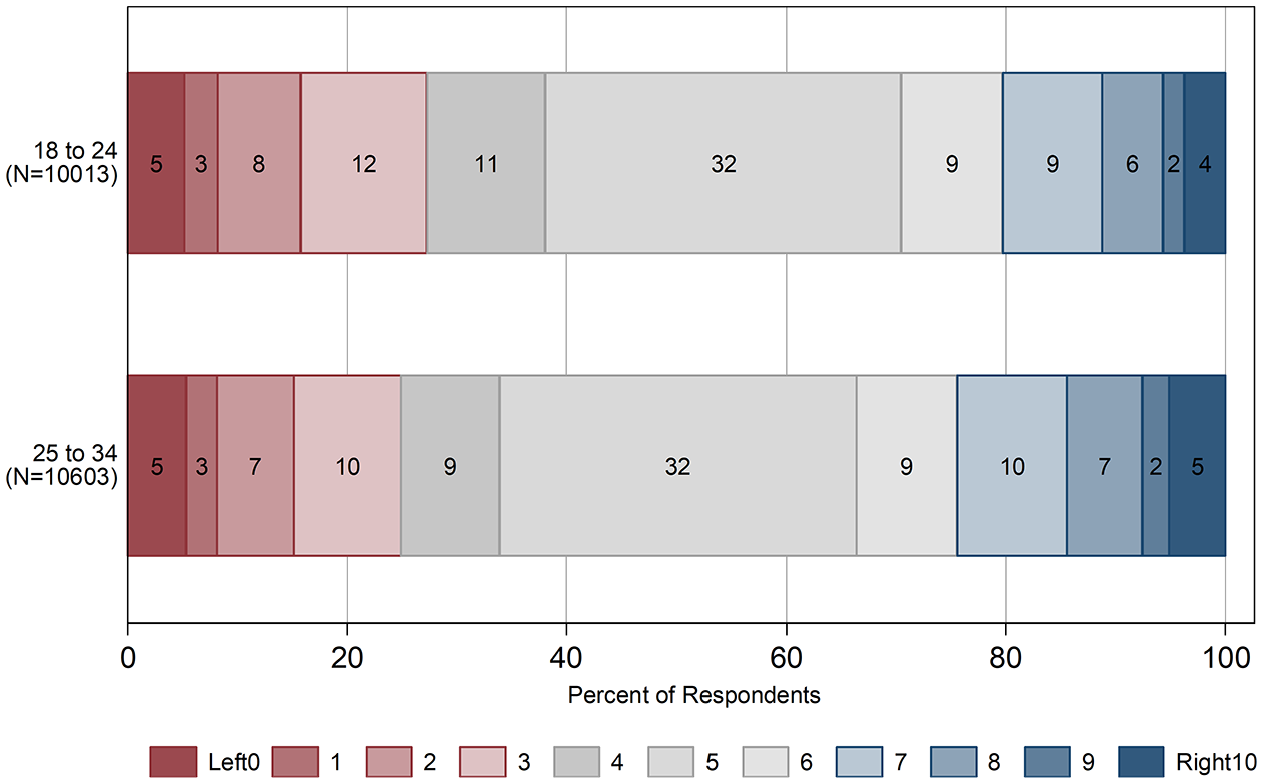
The distribution of young Europeans on the left-right scale.
About 5.2% of our 20,616 respondents aged 18–34 placed themselves at the left end of the scale, while 4.4% chose the right end of the scale – in total, 9.7% or 1994 respondents. About a third (32.4%) of the respondents are located in the middle; they thus demonstrate an unwillingness to place themselves at any ideological side or to choose an option because they do not know what to choose. As our response options did not include ‘do not know’ or ‘do not want to answer’, and there were no missing responses, it is very likely that many different respondents gave ‘middle’ responses. For example, Mitrea et al. (2020) reported that about 18% of the respondents, aged 18–34, in their study, did not place themselves on a similar left-right scale. In the following analysis, we will therefore conduct a robustness test, which excludes those respondents giving ‘middle’ responses from the group of ‘moderates’.
Finally, the question on self-placement at the left-right scale has been widely used in existing research, although some recent studies have questioned its suitability for measuring political attitudes. Thus, Bauer et al. (2017) argue that people associate different ideas to the concepts of ‘left’ and ‘right’, and therefore, place themselves differently at the left-right scale. Moreover, Zuell and Scholz (2019) suggest that the self-placement question is particularly unsuitable for country comparisons, as party systems and the main political issues that affect people’s interpretation of left and right are context-dependent. For example, what is considered as extreme left in Italy might not mean the same in Sweden, and there are surely cross-national differences (see Figure 2).
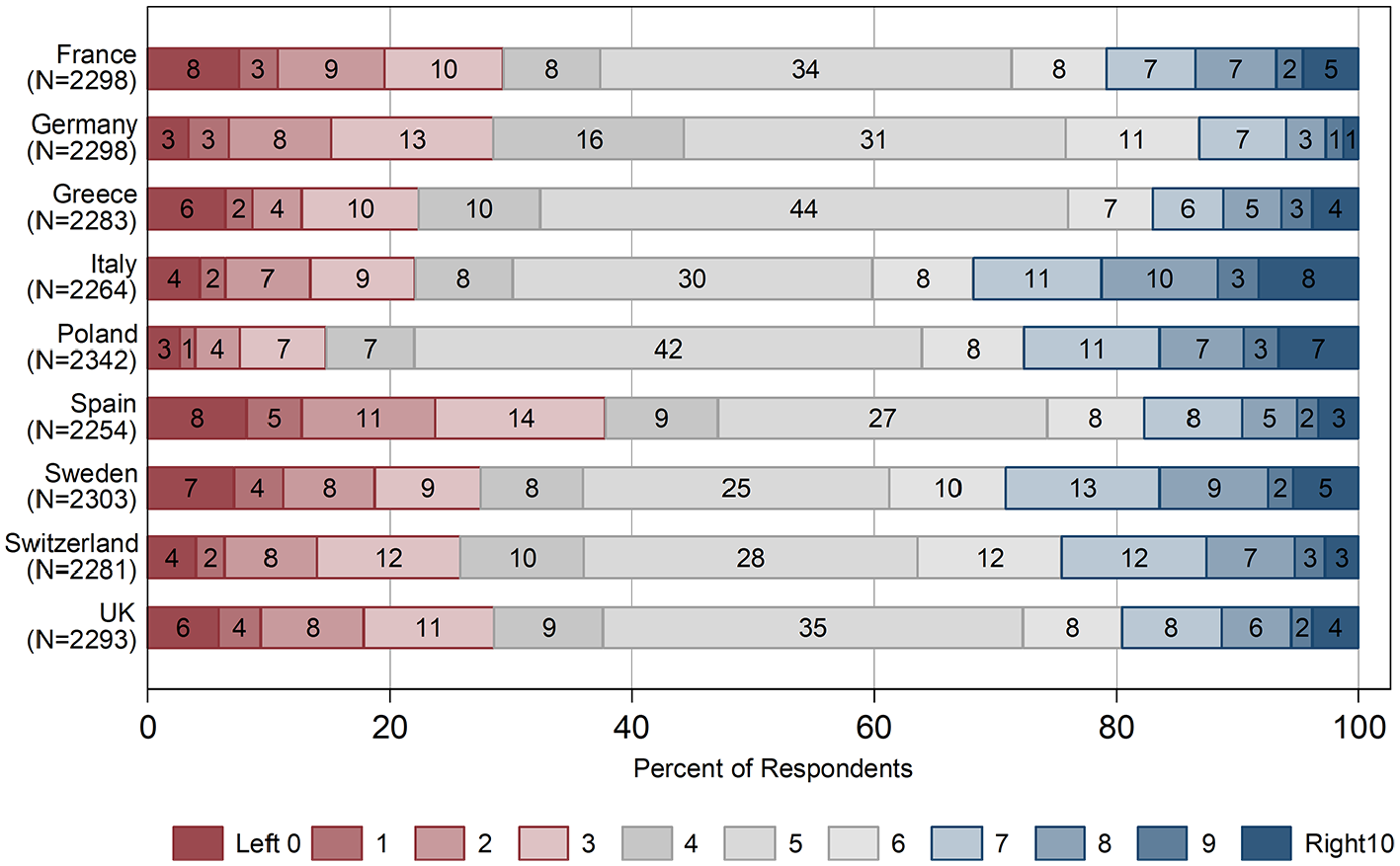
The distribution of young Europeans on the ideological scale.
While 8% of the young French and Spanish respondents place themselves on the extreme left end, 8% of the Italian young respondents place themselves on the extreme right. There are a significantly small (3%) proportion of left-wing radicals in Poland and Germany, and a very low proportion of young people in Germany also place themselves on the right end of the scale (1%). These results are not very surprising if we consider the country’s political contexts: the legacy of the Second World War in Germany probably has a different effect on people than in Italy, whereas Poland’s post-communist past relates to a smaller proportion of left-radicals, and the rise of the Spanish Indignados could explain the high numbers of left-wing radicals in Spain. Our numbers are also quite similar to those reported in existing studies; for example, Chirumbolo et al. (2006: 250) found that 6% of the respondents in a French survey of 1996 placed themselves at the extreme left end of the scale, against 5% at the right. While we acknowledge the problems caused by different definitions existing across countries, and account for these both by using country fixed effects – the so-called country dummies – in our main analysis and by conducting a robustness test for each separate country, we must stress that we are interested neither in country comparisons. Rather, our aim is to investigate the characteristics of young European ‘radicals’ and their potential similarities and differences.
One might argue that there is an additional methodological problem, in that, respondents tend to place themselves on the margins of the scales in a survey – the abovementioned ‘extreme response style’ (ERS) – where the placement might not actually reflect the true value of the response (Cheung and Rensvold, 2000). In order to indirectly control this potential inconsistency in our analysis, in the robustness test we examined how many among the ‘radicals’ we interviewed reported that they are intolerant towards similar radicals. We did so with the help of questions that ask the respondent if he or she minds, or does not mind, having ‘left-wing extremists (e.g. Communists)’ or ‘right-wing extremists (Fascists or Neo-Nazis)’ for neighbours. It is likely that the person who truly feels to be on either of the extreme ends of our proposed scales would not mind the respective neighbours. 4 Our test showed that almost half of our 755 radical right respondents stated that they would mind having Fascists or Neo-Nazis as neighbours, while 21% of the left radicals claimed that they would mind having left-wing radicals (e.g. Communists) as neighbours. 5 Thus, for increasing the robustness of the analysis, one of the analysed models uses the sample where we select only those ‘radicals’ that do not say to be intolerant towards similar radicals.
Independent variables and controls
We have developed four sets of independent variables, all described in the Appendix. The first set relates to the social background of the respondents: any reported experience of financial difficulties during the last 12 months, frequency of meeting friends, and personal education. Second, there is a variable indicating the gender identity of the respondent. Third group of variables focus on the authoritarian values which were measured on the basis of two questions: whether children should be taught obedience to authority, and if people who break the law should get stiffer sentences. This differs from the traditional studies on authoritarian values which use more questions (e.g. Evans et al., 1996), but together with the question about the support for democracy, we consider it sufficient for indicating the general trend of interest. Finally, we also measured political participation, which told us whether the respondent had participated in any occupation, sit-in, or blockage during the last 12 months. It must be noted that only 4% of the respondents had performed such an action.
The tested models also included a set of control variables: age, education of respondent’s father, whether the respondent lived in a more urban or rural area, respondent’s interest in politics and trust in politicians, some measures of personality and the country dummies for accounting for cross-national variations. 6 We have included trust in politicians among the variable as it might correlate with our proposed independent variables and with the likelihood that respondents position themselves on the extreme margins of the left-right scale. Those not trusting the politicians might not want to position themselves at all, or just choose the most middle position.
Who are the young radicals?
We used several models to analyse which kinds of young people are more likely to place themselves on the extreme ends of the left-right ideological scale. First, we do not make any difference between the right- and left-wing radicals and keep respondents who chose the middle response (i.e. 5 on the scale of 0–10). The results of the logistic analysis of a model which include all the independent and control variables are shown in Figure 3 (see also Table A2 in Appendix). The figure also shows the results of two robustness tests for the Model 1, by excluding the ones choosing the option 5 and by excluding the ones who were intolerant towards ‘Communists’ or ‘Fascist, Neo-Nazi’.
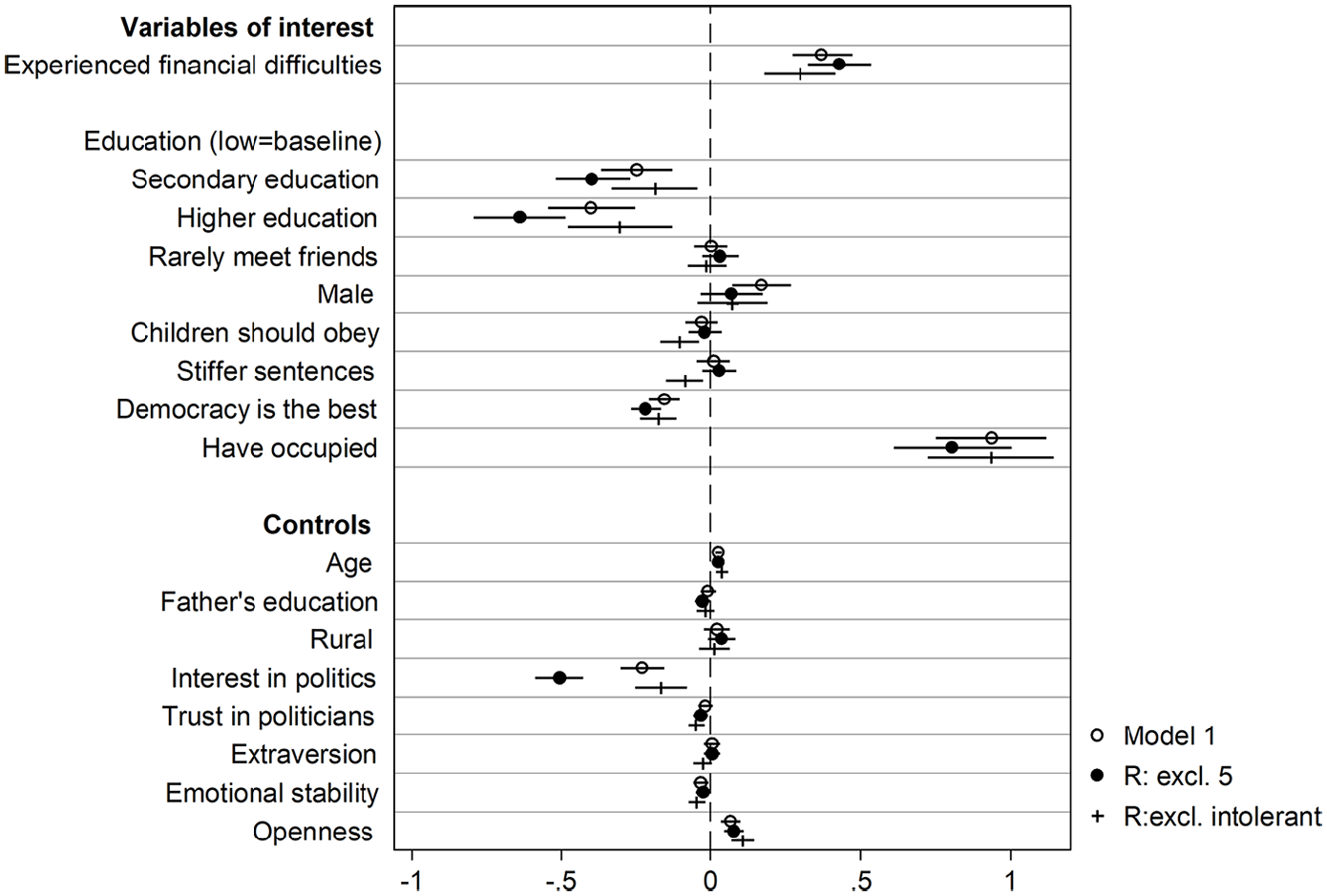
Factors relating to the probability of being ‘radical’ with different robustness checks.
First, social background has a significant relationship with measures of ‘radicalness’. There is a robust support to H1, as the experience of financial difficulties during the last 12 months has a strong and robust effect on the likelihood of being ‘radical’. Educational background has a small and robust relationship with the choice of the extreme ends of the ideological scales. In general, the respondents with higher and secondary education are less likely to be ‘radical’ than the respondents with lower education. The results provide support for H3.
Second, our results do not fully support the hypothesis (H5) of ‘radical young men’, as gender identity has only a very small, and not robust, effect. When we exclude the respondents that opt for the most middle position on the scale, or those who provide inconsistent answers (e.g. not tolerating the extreme right or left when placing oneself in these positions), the gender effect disappears. Hence, young people with a male gender identity are not more likely to place themselves at the extreme ideological position than respondents with the female (or other) gender identity. This is an important result, as there has been a clear tendency in the political violence and terrorism, as well as, political party literature to consider young men as more likely to be ‘radicals’.
Third, while respondents who agree with the idea that children should be taught to obey, or that those who commit crimes should face stiffer sentences, are generally not more likely to be ‘radicals’, the respondents who tend to agree that democracy may have its problems, but is still the best form of government, are clearly less likely to be ‘radicals’. The result does not necessarily mean that ‘radicals’ are non-democrats, as McClosky and Chong (1985) have argued for the case of the United States, for when we replace the question about democratic systems with one about the major principles of democracy, namely freedom of speech, there appears to be no relationship with placing oneself on either margin of the left-right scale. 7
Finally, we also suggested that those active in more radical forms of political activism are more likely to place themselves on the extreme edges of the ideological scales (H9). The causal chain here could undoubtedly be reversed, and those with radical attitudes may also be more likely to participate in violent or illegal political actions. The relationship, regardless of the direction, is a very robust one – those who report that they have occupied a building or joined a sit-in during the last 12 months are very likely to be those who place themselves on the extreme edges of the ideological scale. Hence, among our sample of young people, the ‘radical’ attitude correlates strongly with radical political behaviour. The effect is also similar, when we look the participation in demonstrations (Table A2 in Appendix), suggesting that ‘radicals’ in general use more contentious political action repertoire.
Differences between the radical left and right
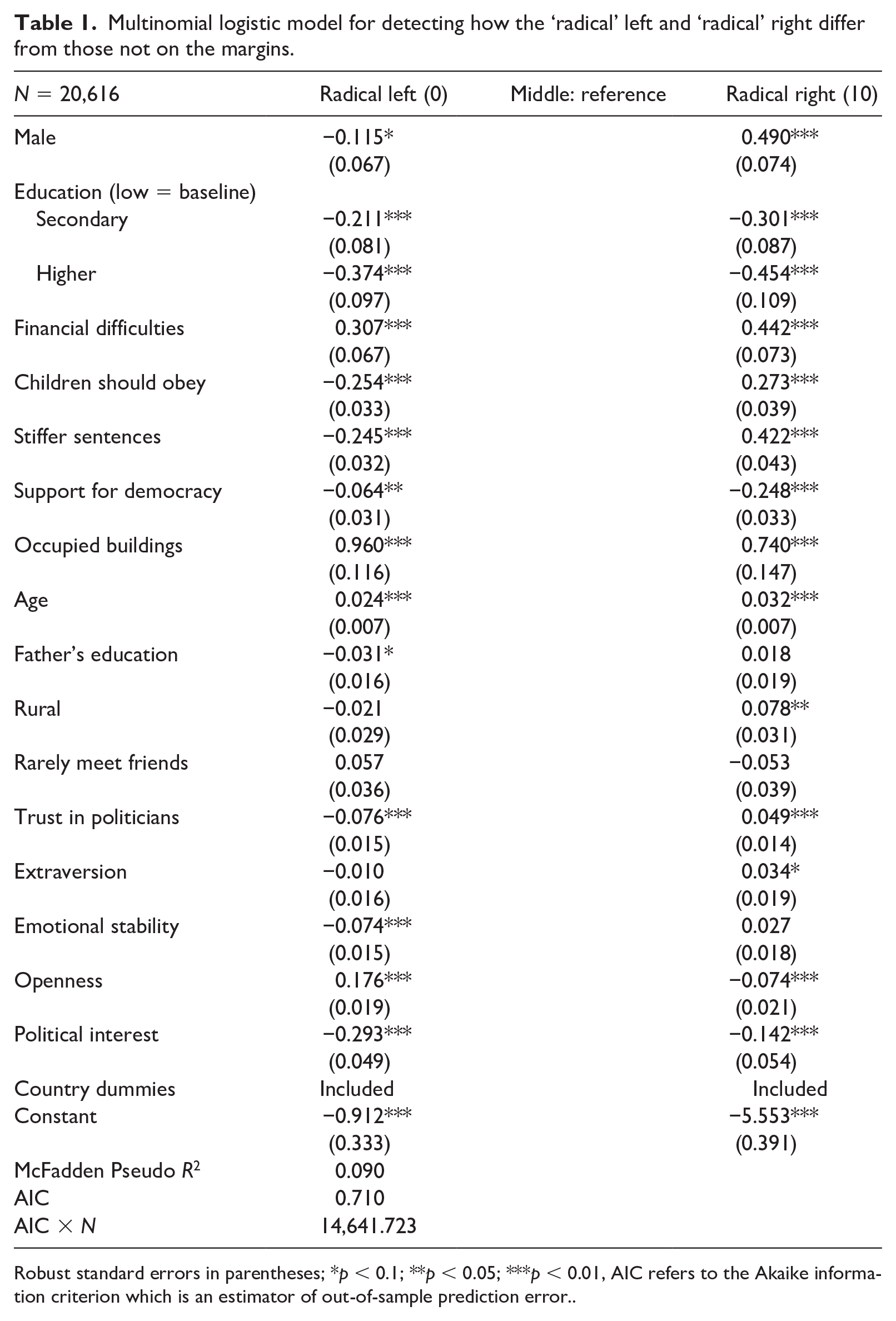
When analysing the differences between the ‘radicals’ we used two options: first, the sample of 1994 respondents, and the same independent and control variables as earlier in the logistic analysis, with the ‘radical’ right as the dependent variable (Figure 4). Second, the multinomial analysis showing the difference between ‘radical’ left and the moderates on one hand, and the ‘radical’ right and the moderates on the other hand (Table 1).
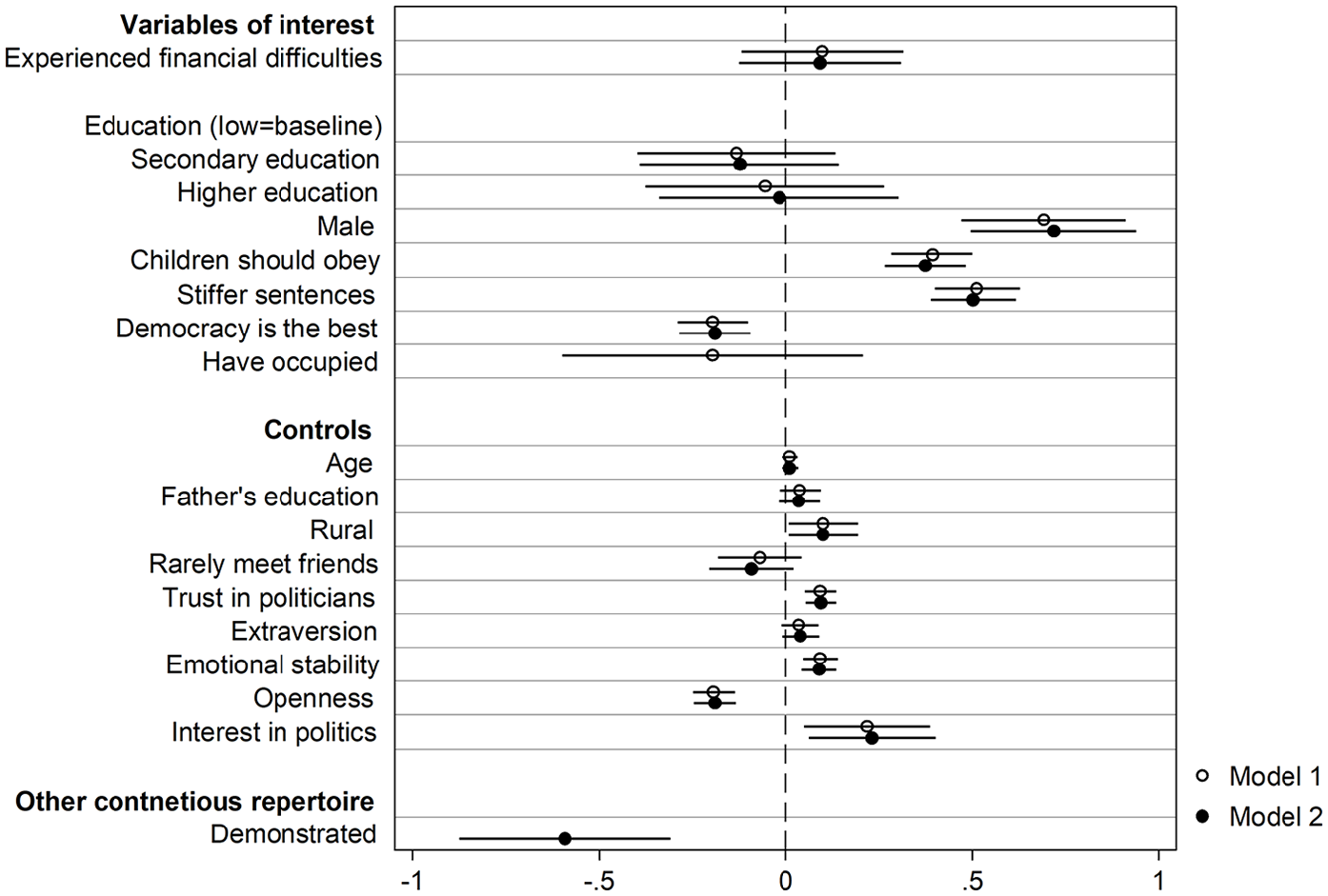
Factors indicating the probability of being radical right-wing rather than radical left-wing (N = 1994).
Multinomial logistic model for detecting how the ‘radical’ left and ‘radical’ right differ from those not on the margins.
Robust standard errors in parentheses; *p < 0.1; **p < 0.05; ***p < 0.01, AIC refers to the Akaike information criterion which is an estimator of out-of-sample prediction error..
These results demonstrate that social background factors, such as education or financial difficulties, play no role in the differentiation between the young ‘radical’ left and right. There is no support for the expectations that social disintegration and economic difficulties would relate to the identification with right rather than left (H2). The education also has no effect, refuting thereby the hypothesis about more highly educated ‘radical’ left (H4).
The gender effect, however, is now very strong: young men are much more likely to be in the radical right than in the radical left; supporting H6. It is likely that ‘radicals’ with a female gender identity are left-wing, as radical feminist movements, in the past as today, also tend to be left- rather than right-wing.
As one would expect, the authoritarian values are strongly related to the radical self-placement on the right, rather than on the left (H8). This applies to the ideas of teaching children to obey authorities and opting for stiffer sentences. Hence, the young ‘radical right’ tends to have more authoritarian values than the young ‘radical left’, and they also tend to support the principles of democracy less than the left. In this respect, the coefficient for ‘radical’ right in Table 1 is also larger and more significant, suggesting that the relationship is more certain. The support for authorities is also evident in the positive link between trust in politicians and likelihood to be a right-wing radical. Thus, while there is no difference in social backgrounds, the young ‘radicals’ clearly differ from each with regard to gender identity, values, and support for democracy.
Finally, contrary to our expectations, there is no significant difference between the ‘radicals’ when it comes to reported participation in the most radical forms of political activism – occupations, sit-ins, and blockages (H10). This type of political repertoire is usually considered to be typical of left-wing movements, and the fact that we found young ‘radicals’ on the right also using these forms of actions is noteworthy. We also tested if there is a difference in other protest repertoire, namely participating in demonstrations, and in this case the results (Figure 4) show that left ‘radicals’ use this repertoire more than the ones on ‘radical right’. These findings are calling for further research into the similarities and differences of the repertoire used by ‘radical’ youth.
Discussion and conclusion
Existing scholarship on ‘young radicals’ usually focuses on the subjects’ radical behaviour or a profile of young people holding radical attitudes, often equating ‘radical’ with ‘violent’. It rarely pays attention to the broader spectre of political attitudes of young people. This article has taken a different approach to the subject matter, examining those young people aged 18–34 who place themselves on the margins of the ideological left-right scale in nine European countries. We labelled those respondents who placed themselves on these extreme ends of the scale as ‘radicals’ because of their political attitudes, and we asked what differences there were between young ‘radicals’ and other young people, as well as among the young ‘radicals’ themselves. In doing so, we did not aim to detect the true components of young people’s ideological beliefs, but rather, to test whether different factors that have been used to explain why people use violent repertoires also fit for explaining ‘radical’ attitudes in young people.
Out of the proposed 10 hypotheses, there was robust support for only some – those relating ‘radicalness’ to experienced economic difficulties, lower education, and the more contentious political activism. The fact that we found only weak correlation between education level and radical political attitudes among young people, whereas we identified financial difficulties as producing an important effect, supports the findings of those who argue that life-events – rather than socialisation – impact on young adults’ political attitudes (e.g. Andretta and Della Porta, 2020). The experienced economic strain or financial difficulties is a very strong predictor of ‘radical’ political attitudes, although not in combination with other factors such as gender or social contact. These results support well the classical argument of relative deprivation theory (Gurr, 1970), even though it was mainly used for explaining violent protests and highlight the possible effects of the economic crisis; usually working on precarious contracts, young people are particularly likely to be affected by the crisis. Although our general analysis showed that there were no differences here in terms of ideological leaning, the robustness check revealed some country differences. Young people who experience economic difficulties in France tend to belong to the ‘radical’ left, while they are more likely to adhere to the ‘radical’ right in Italy, Switzerland, and the United Kingdom. Even if left and right might mean different things for young people in these countries, it is also possible that the different ways in which political movements and parties react to economic changes may affect the tendency, among youth, to choose either margin of the ideological scale.
Our findings also demonstrate that, when we look at the young Europeans surveyed in 2018, there is no evidence for the popular perception of generally ‘radical’ young men. There is, however, a clear tendency that young men place themselves on the extreme right end of the left-right ideological scale. In this respect, our results are similar to those presented by Mitrea et al. (2020), and justify the argument about ‘radical’ young men in the right. As these findings support the idea that ‘radical’ political attitudes are not always gender-based, we suggest that scholars should focus not only on young men of the radical right, but also pay attention also to young women with radical, left-wing political attitudes.
Finally, we also examined the attitudes and political activism of the young ‘radicals’. In this respect, we anticipated the ‘radical’ right’s general endorsement of authoritarian values and low support for democratic principles, which therefore confirms the findings of existing studies. While the idea that young ‘radicals’ – regardless of their ideological leaning – have experience of radical political activism might not seem so surprising, our results show that the typical ‘leftist’ repertoire of actions, that is occupations, sit-ins, and blockages, are used by the young adults on both ends of the ideological scale. Although this does not apply to all examined countries (e.g. France, Italy, Poland, and Sweden), these findings fit well with the picture of counter-mobilizing, left-wing, and right-wing movements. The cross-national variations have not been our major interest here, but one could suggest that the differences in respect of the protest repertoire of the ‘radicals’ are related to relatively small mobilization of such actions in general (Poland, Sweden) or the fact that the repertoires are so common that these are also used by more moderate young people (Italy, France).
In conclusion, our results demonstrate that, when it comes to economic experiences, support for democracy, and political activism, young people with ‘radical’ political attitudes may be comparable, but must not be treated as a coherent group of ‘young radicals’ as it is sometimes common in the media. The differences between those opting for the ‘radical’ left and those who adhere to the right, for example, with regard to gender identities, certainly merit future investigation.
Footnotes
Appendix 1
Appendix 2
Funding
The author(s) disclosed receipt of the following financial support for the research, authorship, and/or publication of this article: This project was funded by the European Commission under H2020 (grant agreement no. 727025). The Swiss part of the project was supported by the Swiss State Secretariat for Education, Research and Innovation (SERI) under contract number 16.0103. The opinions expressed and arguments employed herein do not necessarily reflect the official views of the Swiss Government.
