




Abstract
Studies have investigated many beliefs and values associated with voting for radical right populist (RRP) parties in Europe, but it remains unclear which values uniquely distinguish supporters of RRPs from supporters of other parties. This article analyzes the distribution of several values across the support bases of radical left, center-left, and center-right parties to assess how they compare to RRP parties, devoting particular attention to the role of political authoritarianism and anti-democratic views. Employing survey data from six western European countries (n = 3554), the results suggest several values commonly thought to characterize radical right citizens, such as socially conservative beliefs, national pride, materialism, and social authoritarianism are not much more prevalent among RRP party supporters than supporters of moderate center-right parties. The findings instead point to the importance of political authoritarianism as a key feature distinguishing RRP supporters from supporters of other parties, along with anti-immigration and political grievances. Supporters of the radical left sharply diverge from supporters of RRP parties on nearly all issues, contradicting the notion that radicals on both sides of the spectrum share beliefs or worldviews.
Introduction
The rise of radical right-wing populist parties to prominence in Europe has aroused alarm among scholars and pundits who believe these parties are not fully committed to maintaining liberal democracy. In a particularly conspicuous example from Germany, the radical right Alternative for Germany (AfD) party has come under federal investigation as a potential threat to democracy. AfD party officials often evoke controversy with their public statements, in some cases favoring violence toward immigrants and engaging in revisionism of the country’s Nazi history. The party’s own chairman resigned in 2022 citing the increasing dominance of the party’s extreme right faction, describing its beliefs as “cult-like,” and warning of intra-party “totalitarian echoes.” These and other troubling signs have prompted authorities to designate its youth wing and multiple regional branches of the party as extremist organizations. Although other parties in Germany’s legislature pledge that the AfD will not be allowed into a government coalition despite its growing popularity, elsewhere the radical right has broken out of political exile and entered mainstream relevance. In some countries, including Austria, Belgium, Estonia, Finland, Italy, the Netherlands, Norway, Poland, and Switzerland, the radical right has either joined or led government coalitions in the twenty-first century.
Radical right populist (RRP) parties are gaining political leverage and power through democratic elections. They are not seizing power through coups or extra-constitutional means—they are coasting off popular support, winning seats in national and regional legislatures, positions in national cabinets, and sometimes becoming heads of government. For this reason, a great deal of recent scholarship on RRPs has sought to ascertain the type of voter that is fueling their success, but this research is relatively new and continues to develop. This emergent body of survey-based research has considered several political, economic, and cultural values that provide clues to what drives their support. Many of these include beliefs explicitly espoused by RRP parties themselves: opposition to immigration, nativism, disaffection with ruling politicians, social conservatism, and the conservation of national values. Other studies look for “latent” factors, such as personality traits, psychological dispositions, emotions, and so on. While we know a lot more about contemporary RRP supporters compared to a decade ago, there are remaining questions.
First, despite widespread suspicions that RRP parties have troubled relationships with democracy, this matter does not receive a great deal of empirical attention, especially on the mass level. Theorists have proposed that right-wing populist ideology entails a tendency to de-legitimize political opponents and thus clashes with pluralist values that undergird liberal democracy. But whether anti-democratic or pro-authoritarian views constitute a key value associated with support for these parties remains underexplored. In this study, I devote greater attention to understanding the role of political authoritarianism, its importance as an individual-level explanatory factor, and briefly touch on the recent history of political authoritarianism in some European electorates.
Second, existing literature has produced a dizzying array of associations between certain individual values and attraction to RRP parties, but it is often difficult to discern whether these values are truly unique to the base of RRP parties, or if they can be found among supporters of other parties as well. I attempt to identify the most important, as well as the more peripheral, ideological components of the RRP base. To this end, I provide a more extensive comparison of radical right supporters to the supporters of other prominent parties in western European countries’ political landscapes. Namely, I compare radical right-wing populists to moderate right-wing parties, center-left parties, as well as radicals on the far-left of the political spectrum.
What Is Radical Right-Wing Populism and Who Supports It?
We are currently in the fourth, and by far largest, wave of radical right growth following World War II (Mudde, 2022). Radical right ideology consists of ethno-nationalism that imagines the national identity to be under severe threat due to demographic diversification brought on by invasions of immigrants (Rydgren, 2007). Emphasis on the past greatness of the nation and a reclamation of historical glory frequently characterizes radical right ideology, in addition to the preservation of native privileges and traditions. While colonial racism was based on subordination, radical right nationalism is based on aspirations of non-native expulsion (Fennema, 2005). Sociocultural conservatism, such as support for strict law and order and family values, also manifests in radical right ideology (Minkenberg, 2001; Rydgren, 2005).
Radical right parties’ express fierce criticism of elites and contrast elite interests with those of the common people—an ideological feature known as populism (Mudde, 2004). As we will see later (Figure 1), radical right parties are overwhelmingly populist (Betz, 1994 [1993]; Taggart, 2000), but not all populists are radical right—radical leftists and occasionally centrist parties can exhibit anti-elite, pro-people rhetoric too. Arguably the most common approach to populism sees it as one ideological component (or a “thin” ideology) that can be accompanied by or attached to other more comprehensive ideologies (i.e. “thicker” ideologies) (Mudde, 2017). Populism emphasizes divisions between a “pure” and “noble” common people and an elite portrayed as corrupt and uninterested in the well-being of the people. It sees this divide as irreconcilable and perpetual. The antagonism between the two, thus, can rarely be lessened with political compromise (Mudde, 2015).
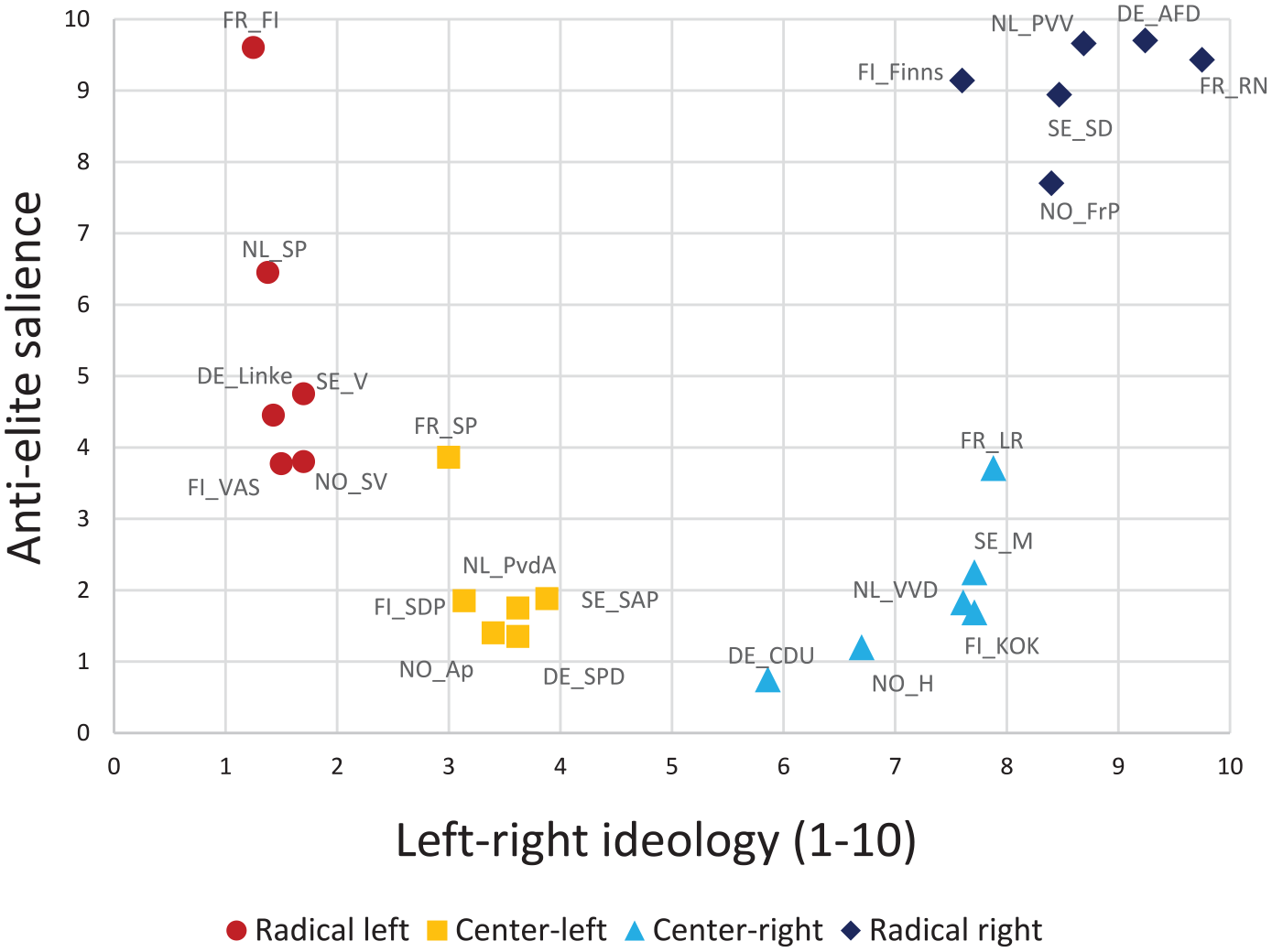
Parties by Left-Right Ideology and Anti-Elite Salience.
For contemporary RRPs in western Europe, elites are understood as cosmopolitan liberal politicians that have enabled mass immigration against the will of “the people,” usually thinly coded as the native, white population. European bureaucratic elites such as those in the European Union are also common subjects of right populist ire. The project of European integration is not only seen as robbing countries of national sovereignty but also enabling mass migration, as the EU’s Schengen area policies facilitate migration across borders. Elites are portrayed as pushing multiculturalism and acceptance of LGBT communities, phenomena metabolized by RRP parties as signs of social decay. Conserving traditional national values and resisting movement toward liberalization at all costs thus becomes a central objective for RRPs. Economic elites that hold these values are occasionally singled out (e.g. George Soros), but more often the elite is abstractly understood as the politicians and bureaucrats steering established political institutions. As Geert Wilders, leader of the main RRP party in the Netherlands, once put it, “there is an enormous gap between this fake parliament—because that is what it is, a fake parliament—and people at home.” Donald Trump’s “drain the swamp” slogan, broadly referring to the mass removal of “deep state” operatives from government bureaucracy, also exemplifies the ambiguity of right-wing anti-elitism.
Empirical work has increasingly investigated the demographics, values, and attitudes that characterize ordinary people who support RRP parties. The sheer volume of studies and number of individual-level indicators examined in existing research suggests a wide array of factors may explain why people turn to radical right populists. Some studies suggest RRP supporters align with the policies and rhetoric espoused by party leaders, such as anti-immigration. Other approaches focus not on explicitly political attitudes, but latent emotional or psychological traits that predispose people to sympathize with RRP forces. Studies in this vein focus not on political motivations for individuals’ party selection, but emphasize child-rearing values, materialist worldviews, authoritarian “personalities,” and feelings of anger (Rico et al., 2020; Smith and Hanley, 2018). Below, I review key strands of literature on the values and traits thought to characterize RRP supporters, then discuss a couple areas in which this study intends to advance the literature, including by carefully considering political authoritarianism.
Anti-Immigration and Xenophobia
Anti-immigration is perhaps the most consistently validated feature of RRP supporters (Arzheimer and Berning, 2019; Oesch, 2008; Rooduijn, 2018; Rooduijn et al., 2018; Taggart, 2017). Nativism and disdain for foreigners has been seen as the central driver of right-wing populism (Mudde and Rovira Kaltwasser, 2018: 13). Ivarsflaten (2008: 3) finds in an analysis of seven Western European countries from 2002 to 2003 that mobilizing around immigration grievances “unites all successful populist right parties.” Those who perceive immigration as a threat to their way of life tend to be more inclined to support radical right challengers to established mainstream parties (Hobolt and Tilley, 2016).
Political Grievances
As parties that invoke anti-elite rhetoric, RRPs position themselves antagonistically toward established political power. The “supply-side” approach to understanding RRPs focuses on problems with democracy itself and politicians that have become unwilling or unable to solve pressing issues (Berman, 2021). Contemporary populist discourse relies on portraying existing political forces and systems as failing to represent the will of the people. This is reflected in their base: several studies show that distrust of the political elite is a key factor influencing voting for radical right populists (Bowler et al., 2016; Oesch, 2008; Rooduijn, 2018; inter alia). They also externalize political grievances to the continental level, opposing the project of European integration spearheaded by the European Union, also known as “euroscepticism” (Werts et al., 2012).
Economic Values
Economic values related to wealth distribution and state-sponsored transfers represent another important axis of ideological beliefs in modern politics. Radical left parties’ messages are overwhelmingly based around economics: for them, the “elite-people” cleavage is defined by socioeconomic status and social class. But radical right populists, too, sometimes deride economic elites but with more emphasis on their supposedly cosmopolitan values. Regarding cultural issues RRP parties are farther right on the political spectrum than moderate right-wing parties but are more centrist and occasionally left-leaning in their economic policies (Dalton and Berning, 2022). Right-wing populist voters support higher degrees of social transfers than mainstream right with regard to healthcare and pension spending, but reject spending on the unemployed (Busemeyer et al., 2022).
Authoritarianisms
The term “authoritarian” frequently appears in discussions of the attitudinal inclinations of RRP supporters, but there are several different conceptualizations of the term (Aguilar and Carlin, 2018). The authoritarianism of the radical right has been characterized as “the belief in a strictly ordered society, in which infringements of authority are to be punished severely” (Mudde, 2017: 4). Historically, classical thinkers have proposed that people with “authoritarian personalities” who are submissive to and admire authority figures, are prone to backing right-wing autocrats (Adorno et al., 1951 [1950]; Arendt, 1973). However, in modern empirical studies which mostly rely on survey data, scholars have experimented with other definitions of the term. Most existing work has drawn upon psychology literature and sees authoritarianism as a psychological disposition involving items such as deference to traditional norms, submission to authority, or strict child-rearing practices that cultivate obedience in children. Others understand it in sociological or political terms, such as one’s preference for conservative social norms, and, in rarer cases, one’s support for authoritarian political systems.
Psychology studies that employ the term are often influenced by the work of Bob Altemeyer (1981), who developed the “right-wing authoritarianism” (RWA) scale, a composite index of traits including submissiveness to established authorities, aggression against deviants and outsiders, and moral traditionalism. The scale was initially developed as a refinement of Theodor Adorno’s earlier F-scale meant to detect fascist sympathizers, and has been associated with opposition to civil rights and governmental abuse of power (Duckitt et al., 2010). Studies have contended that RWA or some simplified version of it predicted support for Trump (Choma and Hanoch, 2017; Pettigrew, 2017). Batteries of questions similar to RWA show associations with supporting far-right populists in Belgium and France (Billiet and De Witte, 1995; Mayer and Perrineau, 1992). Others say authoritarianism of this kind did not separate GOP primary voters that voted for Trump over other candidates, such as Ted Cruz (Oliver and Rahn, 2016; Wood, 2017), proposing instead that Trump supporters are characterized by their willingness to endorse aggression and violence (Womick et al., 2018). A similar conception was created by Smith and Hanley (2018), who argue for a conception of authoritarianism characterized by aggressive prejudice, a desire to “crush evil,” and support for a domineering leader.
While Altemeyer’s RWA scale is still widely used, other scholars claim child-rearing values are a better way to capture authoritarianism and that the RWA scale conflates authoritarianism with moral conservatism (Duckitt et al., 2010; Feldman, 2003; Hetherington and Weiler, 2009). For instance, the original RWA scale contains components that could be construed as social or political conservatism, such as hostility toward homosexuality, atheism and protesters. Critics argue child-rearing principles represent more deeply-held fundamental inclinations to submit to authority figures (Feldman, 2003; Feldman and Stenner, 1997; Hetherington and Weiler, 2009; Stenner, 2005). Thus, many have preferred investigating whether RRP supporters hold child-rearing values which prioritize obedience and submission over creativity and individuality (Cohen and Smith, 2016; Dunn, 2015; MacWilliams, 2016; Vasilopoulos and Lachat, 2017).
A theme in literature on RRPs that overlaps with discussions of authoritarianism is the “cultural backlash” argument, which suggests older, white, conservative-minded segments of the population have become increasingly anxious about the proliferation of ethnic diversity and liberal, multicultural values (Norris and Inglehart, 2019). In this view, RRP parties attract these demographics by promising to aggressively defend their traditional privileges and ethnic homogeneity. Inglehart’s (1977) seminal book The Silent Revolution suggests that as societies become more affluent, their constituents gradually shift away from materialist values concerned with physical security and economic stability toward post-materialist values that emphasize self-expression and autonomy. Norris and Inglehart (2019) employ a similar concept in Europe, finding a link between right populist voting and the Schwartz scale, which measures preference for tradition, living in secure surroundings, and social obedience, among other items (which they define as “authoritarian values”). They also note materialists played a strong role in electing Trump in 2016 (Norris and Inglehart, 2019: 342–344).
In a similar vein, Alexander and Welzel (2017) consider the prevalence of conservative social values toward abortion, divorce, and homosexuality to be of a country’s proclivity to right-wing populism. They do not employ the term authoritarianism, but rather “illiberalism” to define such beliefs. Inglehart and Welzel (2005) previously argued that the most important ideational shift contributing to democratic stability is a shift from restrictive social values to those that promote individual autonomy.
Finally, authoritarianism can be understood in a political sense; as an individual’s rejection of democracy and embrace of autocratic governance (Gorman et al., 2019; Svolik et al., 2023). With few exceptions, other studies have not considered this as a possible factor in RRP party voting (Donovan, 2021). Other clues in the literature have indicated RRP may not be committed to political inclusion and tolerance, at least compared to radicals on the left. Studying the Netherlands, Akkerman et al. (2014) find that left-wing populist voters are more willing to listen to others on political issues than right-wing populist voters. Using surveys of political candidates in Greece, Stavrakakis et al. (2017) found that left populists in the Syriza party were more tolerant of political opponents than right-wing populist politicians in the ANEL party.
Remaining Questions
In this section, I review three remaining questions in the literature that this article seeks to address. First, existing research rarely considers authoritarianism in the political sense: that is, as anti-democratic orientations or preferences for an autocratic political system (Gorman et al., 2019). While other variables referred to as “authoritarianism” often refer to underlying sociocultural beliefs, political authoritarianism refers to a style of politics that citizens prefer their leaders to enact, representing a trait distinguishable from other authoritarian variables. Previous studies have examined support for democratic or authoritarian politics as a dependent variable, especially in various Global Southern contexts (Cassell et al., 2018; Seligson and Carrión, 2002; Tezcür et al., 2012)—but less often is political authoritarianism considered a value that can influence party support in the West. Although Western European radical right parties have adjusted their discourse in the twenty-first century to reflect greater compatibility with democracy and tolerance (Halikiopoulou et al., 2012a), there is still a greater proclivity among radical right populist supporters to prefer autocratic political systems (Donovan, 2021).
The relative lack of attention to political authoritarianism among the radical right base is surprising considering the ubiquitous discussion among scholars, journalists and pundits regarding the threat RRPs pose to democratic stability. Several authors posit that populist ideology is inherently contradictory to the norms and values necessary to maintain liberal democracy (Galston, 2018; Mudde, 2015; Mudde and Rovira Kaltwasser, 2017: 80; Müller, 2016). In this view, populists are excessively divisive and de-legitimize political opponents, who are portrayed as representatives of the corrupt elite and undeserving of a place in government. Given the overlapping discussion on populism, democracy, and authoritarianism, it begs the question whether a demand for political authoritarianism is emanating from the popular base of RRPs. Existing literature has explored underlying, latent psychological authoritarianism, but the supporters of RRPs may also overtly embrace political authoritarianism.
Second, previous studies usually compare the values of RRP supporters to all other citizens. But by grouping all non-RRP citizens into the same group, this strategy does not reveal how supporters of specific parties compare to RRP supporters. RRP parties, especially in Europe, compete with a wide array of other parties in multi-party electoral systems. They rival and often seek to displace mainstream center-right parties and may also compete with radical parties on the left for voters disaffected with mainstream centrist parties. Some beliefs held by RRP supporters may be prevalent among supporters of other parties, perhaps at even greater rates than among RRP supporters. Values like nationalism, anti-immigration, social conservatism, materialism, authoritarian child-rearing, and so on, may simply be values that right-wing citizens hold generally, and may not be truly outstanding among RRP supporters.
On the other hand, supporters of radical left and radical right parties may overlap with regard to a variety of beliefs (Rooduijn, 2018). People that vote for populist parties on both ends of the spectrum are more likely to hold populist attitudes (Van Hauwaert and Van Kessel, 2018). Radical left and right parties tend to share varying degrees of Euroscepticism (Hooghe et al., 2002; Otjes and Louwerse, 2013) and one study suggests left populists may also attract those with anti-immigration attitudes (Rama and Santana, 2020).
To identify what makes RRP party supporters stand out from others, I comparatively analyze citizens that support radical left parties and centrist parties, rather than analyzing supporters of all other parties as a single group. This approach will provide a more holistic understanding of how attitudes and other demographic features are distributed across the spectrum of political parties and how they compare with RRP supporters.
Third, there are numerous conceptualizations of individual-level “authoritarianism” in the literature (as discussed above). Each conceptualization of authoritarianism has, to different extents, been used in studies to show associations with RRP support, but these variables are not commonly tested against each other. Given that these variables are likely correlated, it remains difficult to discern how relatively important each “authoritarianism” variable truly is in predicting RRP support based on existing literature. It is imperative to disentangle the relationship between not only the various forms of authoritarianism explored in the literature, but how important they are in relation to other demographic and ideological factors that predict RRP support. Are any of these forms of authoritarianism central, indispensable components of RPP support, or just peripheral factors?
Data and Method
To assess the factors that are associated with support for RRPs in western Europe, I rely on survey data from Wave 5 (2017–2020) of the European Values Study (EVS). The EVS, which was conceived in the late 1970s, has administered nationally representative surveys via face-to-face interviews in 47 European countries across five waves of research, with the most recent wave (wave 5) beginning in 2017 (EVS 2022). The EVS asks respondents a comprehensive range of questions that relate to political beliefs, sociocultural values, demographic characteristics, and which political party the respondent supports, making the data appropriate for this study.
Case Selection
Most European countries have multi-party political landscapes that afford voters several party options. RRP parties often occupy positions in political arenas alongside mainstream centrist parties as well as other radical parties. A central goal of this study is to better understand the values that separate RRP supporters from other citizens—including supporters of other right-wing non-populist parties, as well as radical parties on the left end of the political spectrum. To classify party cases, I borrow classification criteria developed by cross-national party research on “party families,” which group parties across borders based on isomorphic similarities between them, such as rhetoric, beliefs, and policies (Mair and Mudde, 1998).
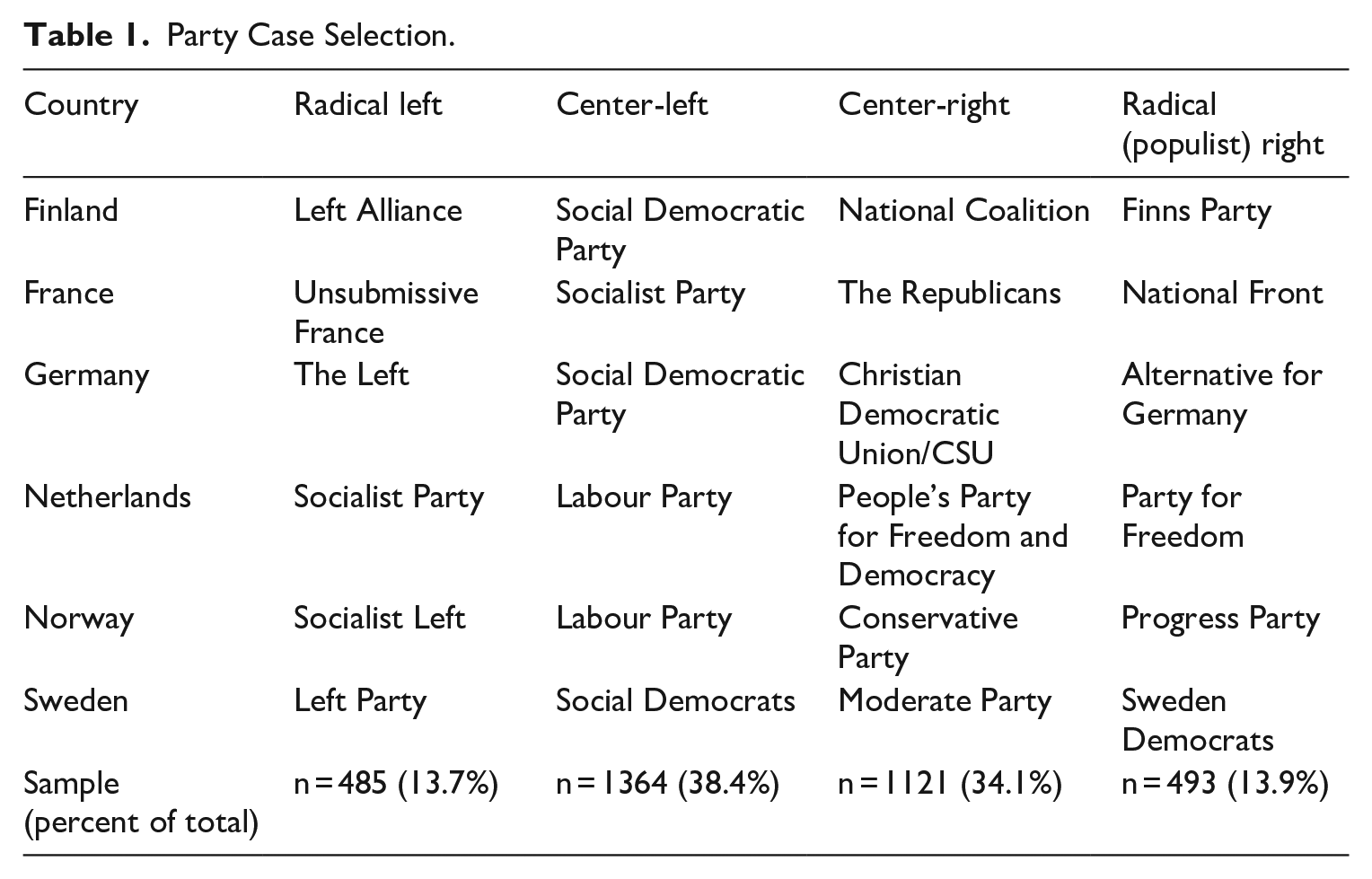
Thus, I choose six country cases to focus on in this study: Finland, France, Germany, the Netherlands, Norway, and Sweden. Each of these countries contains relevant party examples with which to compare RRP supporters. Each has a “mainstream” party on the right-wing of the political spectrum that is not populist or radical and has a well-established presence in the country’s politics. Party family research classifies five of these parties as belonging to the “conservative” party family, with the sixth case (in Germany) being classified as “Christian democrat.” For the sake of simplicity, I combine these groups and refer to them as “center-right” parties (Ennser, 2010). Each of these countries also has a moderate, established center-left party, for which all six belong to the “socialist” party family, as well as a party in the “radical left” party family.
These countries are particularly useful to analyze because each radical left, center-left, center-right, and radical right party in the six countries received at least 5% of the vote in the general or legislative election most recent to the administration of the EVS survey (the only exception is the German AfD, which received 4.7%). Each party grouping, in other words, is well represented in their party systems and has a notable share of popular support. Some countries included in EVS surveys have examples of radical right populist parties, but they either do not have this balanced array of party families that allows for easy comparison, or do not have parties from these families with sufficient popular support to meaningfully analyze using survey data.
In the United Kingdom, for example, there are two main parties, one center-left (Labour) and one center-right (the Conservatives). The only radical left parties to win seats in the 2017 general election was the Irish nationalist Sinn Féin, which achieved 0.7% of the vote, and the Welsh nationalist Plaid Cymru, which achieved 0.5%. The main radical right party at the time (UKIP), won only 1.8% of the vote. The UK party system, therefore, is not suitable. In many eastern Europe countries, there are rising radical right populist parties, but rarer cases of center-left or radical left parties that have non-negligible shares of popular support. In Poland, for instance, the right-wing populist Law and Justice party won national elections in 2015 (the election most recent to the administration of the EVS survey), but the three next runner-up parties were all centrist or center-right. In the EVS data, no center-left or radical left party in Poland had more than 5% support from survey respondents. In sum, while the six cases chosen here do not represent the full universe of right-wing populism across Europe or the world, they provide empirically useful examples of multi-party democracies in which supporters of multiple party families can be easily compared.
Table 1 displays the party cases that qualify as “radical left,” “center-left,” “center-right,” and “radical populist right” in each country. Figure 1 displays the distribution of these parties along two criteria, using data from the 2019 Chapel Hill Expert Survey: their general left-right ideology, as seen on the x-axis, and the extent to which anti-elite rhetoric is salient to the party platform. The latter is considered a strong indication of, if not synonymous with, the party’s populism.
Party Case Selection.
In all six cases of radical right parties, the party is also strongly populist. This is a theme scholars have previously noted across Europe (Betz, 1994 [1993]; Taggart, 2000). Of 28 radical right parties that appear in the Chapel Hill Expert Survey, 27 are above 5.0 on the 0 to 10 anti-elite salience score. This is not the case on the radical left, where in our sample of six parties, only one party (Unsubmissive France) makes anti-elite criticism an extremely prominent part of its platform, and another (Socialist Party from the Netherlands) is moderately anti-elite. The four other radical left parties score lower than a 5.0 on anti-elite salience.
Dependent Variable
EVS researchers asked respondents “which party appeals to you most?” and displayed a list of parties within the respondent’s country for them to choose from. The dependent variable is derived from responses to this question, where those that chose the country’s radical right populist party were coded “1” and those that chose any other party were coded “0.” The variable thus denotes supporters of radical right populist parties.
Independent Variables
Political Authoritarianism
The EVS contains questions related to citizens’ inclinations toward political authoritarianism and feelings toward democracy. The first series of questions describes several types of government to the respondent and asks if they believe it would be “very bad,” “fairly bad,” “fairly good,” or “very good” to have that type of government in their country. One question asks about “having a strong leader who does not have to bother with parliament and elections.” Responses were coded 1 to 4 in the order listed above to represent increasing favorability toward authoritarian governance.
Democratic Valuation
The EVS next asks respondents’ their extent to which it is important for them to live in a country that is governed democratically. This was measured on a 1 to 10 scale, where higher scores indicate a respondent more strongly values living in a democracy. The score of “10” corresponds to an answer of “absolutely important” and “1” corresponds to “not at all important.”
Answers on the democratic valuation question are extremely skewed toward positive responses. In all six countries, no more than 10% of respondents indicated a score on the lower half of the scale (i.e. 1–5), which indicates that they do not strongly value democracy. In all six countries, at least 50% of respondents also gave the highest answer of “10,” indicating that living in a democracy is “absolutely important” to them. This is likely because in mature democracies like those of western Europe, the institution of democracy is accepted as positive by most citizens, at least nominally. Few citizens are willing to explicitly admit that they are not supportive of democracy or do not value it. This represents one limitation of the variable.
On the other hand, an advantage of the political authoritarianism variable is that it asks about a system where a strong leader is unaccountable to democratic elections or a legislative body—functionally a dictatorship—without explicitly asking about a dictatorship. It thus probes favorable inclinations toward authoritarianism that may go undetected by the democratic valuation variable. Nevertheless, the variable is limited in that it does not specify further details other than the lack of elections and parliament in the hypothetical political system, leaving open the possibility that respondents may imagine different forms of governance when asked about this system. Between the countries, as few as 11.2% of respondents were favorable toward this system in Norway while as many as 31.6% were favorable in the Netherlands, suggesting some cross-national variation in the prevalence of political authoritarianism.
Political Grievance
Two variables will be drawn from the EVS to represent political discontent. A variable representing domestic political dissatisfaction asks about respondents’ satisfaction with the national political system on a 1 to 10 scale. Second, dissatisfaction with European governance is proxied using a question that asks respondents how much confidence they have in the EU on a 1 to 4 scale with possible answers none at all, not very much, quite a lot, and a great deal. Both variables were reverse-coded to give more discontented individuals higher values.
Nationalism
The EVS questionnaire asks respondents how proud they are to be a citizen of their country where possible answers are “not at all proud,” “not very proud,” “quite proud,” and “very proud.” I code a nationalism variable from 1 to 4 in this order.
Conservative Social Values
To create a variable for conservative social values, I follow Alexander and Welzel (2017) to combine items representing attitudes on abortion, homosexuality, and divorce. The EVS questionnaire asks respondents how justifiable they believe homosexuality, divorce, and abortion are on a 1 to 10 scale, where an answer of “1” meant “never justifiable” and “10” was “always justifiable.” I take the average of three answers the respondent gave to create an index. I reverse code this measure so it represents anti-liberal, or conservative, answers.
Materialism
Materialism is measured in the EVS by asking respondents to prioritize two of four items: “maintaining order in the nation,” “fighting rising prices,” “giving people more say in important government decisions,” and “protecting freedom of speech.” The former two items are considered to represent materialist values, and the latter two represent post-materialist values. EVS researchers labeled those who chose both former options as materialists, those who chose both of the latter options as post-materialists, and those who chose one of each as mixed. I code these in the following order: post-materialists = 1, mixed = 2, and materialists = 3.
Authoritarian Child-Rearing
The EVS questionnaire shows respondents a list of qualities and asks them to pick some qualities they think are important in a child. I code preference for authoritarian child-rearing with a dichotomous (0–1) variable capturing this who chose “obedience” as a desirable quality.
Affinity for Authority
The questionnaire asks respondents how they would feel if in the future there was “greater respect for authority” in society and given the choice to say it would be a “good thing,” “bad thing,” or they “don’t mind.” Although this question is broad, this could be beneficial. Established psychological conceptualizations of authoritarianism (e.g. Adorno’s definition, Altemeyer’s RWA) emphasize a general affinity for authority as important to an authoritarian personality. Moreover, this represents a pro-authority sentiment distinct from child-rearing values. I code a variable “1” if they believe greater respect for authority would be a bad thing, “2” if they wouldn’t mind, and “3” if they think it would be a good thing.
Economic Values
I use two variables to measure economic values. The ESS questionnaire asks respondents to place themselves on a 1 to 10 scale whereby 1 represents the view that “incomes should be made more equal” and 10 represents “there should be greater incentives for individual effort.” I reverse-code this such that those favorable to income equality were given greater scores. A second question asks the extent to which they believe private or government ownership of industry should be increased on a 1 to 10 scale, where 1 represents much more private ownership and 10 represents much more government ownership.
Method
The results are presented in two parts. First, graphs are displayed exhibiting the extent to which the above values are present among supporters of each party grouping, allowing for a simple, initial visual comparison of party differences. The y-axis of these variables represents the extent to which party supporters deviate from the mean, measured in standard deviations from the mean. The x-axis represents the party grouping themselves.
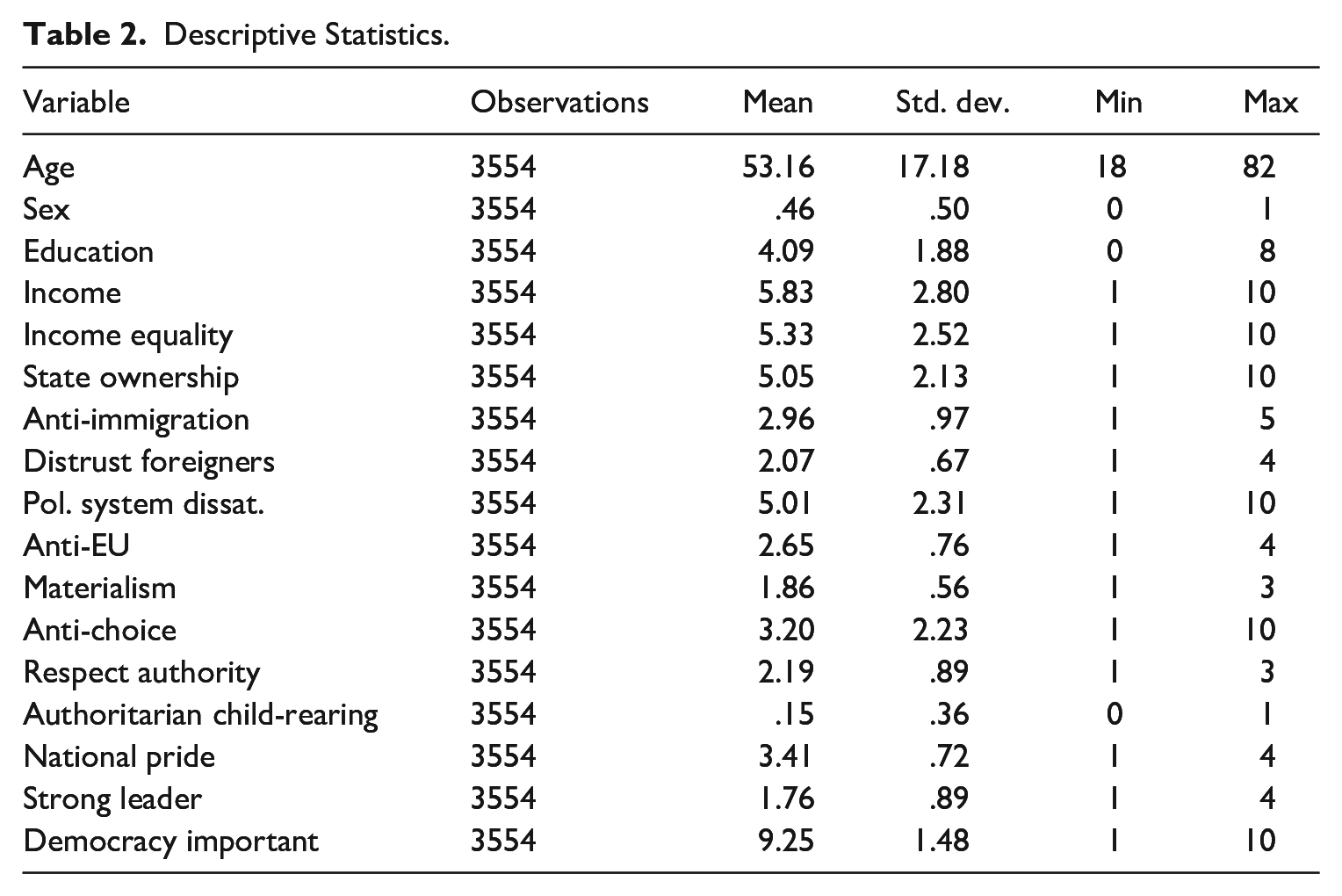
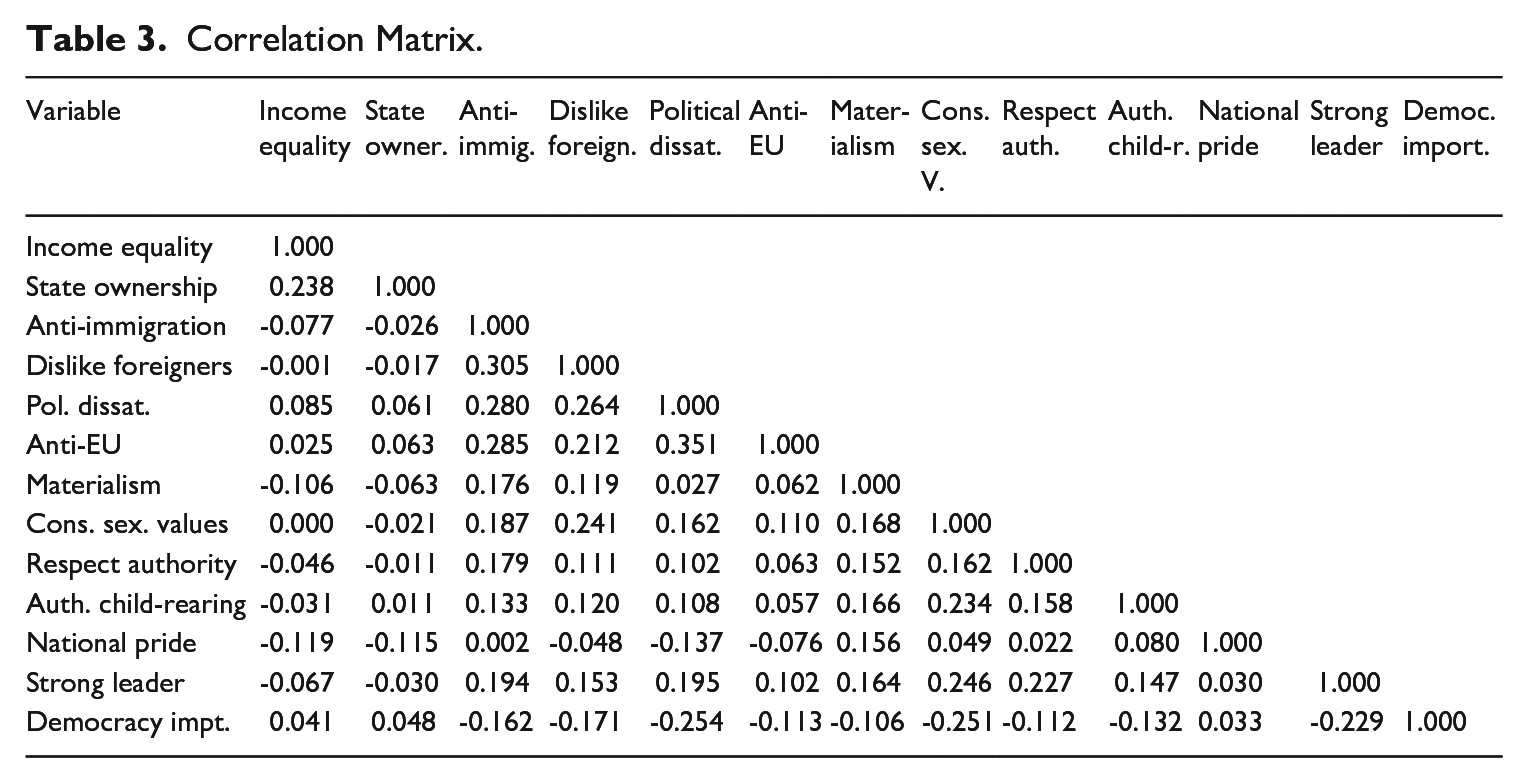
The findings reveal remarkable consistency in the shape of the graphs for each individual country indicating a similar distribution of values across the six countries. This informed the decision to aggregate the cases in figures and multivariate analyses given that outliers do not drastically confound the results. Full graphs and a table that display standard deviations from the mean for supporters of each party on every value are available as Supplemental Materials. Descriptive statistics for all variables are displayed in Table 2 and pairwise correlations are presented in Table 3.
Descriptive Statistics.
Correlation Matrix.
Second, because the objective is to compare supporters of RRP parties to supporters of other parties simultaneously, I rely on multinomial logistic regressions where supporters of RRPs are the reference category. Multinomial logistic regressions are also used because the dependent variable is binary (“0” if they do not support a RRP party or “1” if they did). Supporters of radical left, center-left, and center-right parties each comprise their own categories. The models thus compare RRP supporters to three separate samples of other citizens, allowing a deeper understanding of how the beliefs of RRP supporters compare to others.
The cross-sectional nature of the data entails that the findings are correlational and do not establish causation. Thus, there remains the possibility that citizens acquire certain political or social values, such as political authoritarianism, after becoming a follower of a party. In this case, citizens may initially identify with a party for their alignment with one or more values but become favorable toward other values after taking cues from party leaders or other party members. Exposure to Trump’s rhetoric, for instance, weakened commitments to democracy among Americans (Clayton et al., 2021). By virtue of using cross-sectional data, this study does not identify whether values were acquired before or after one’s party affiliation began.
Results
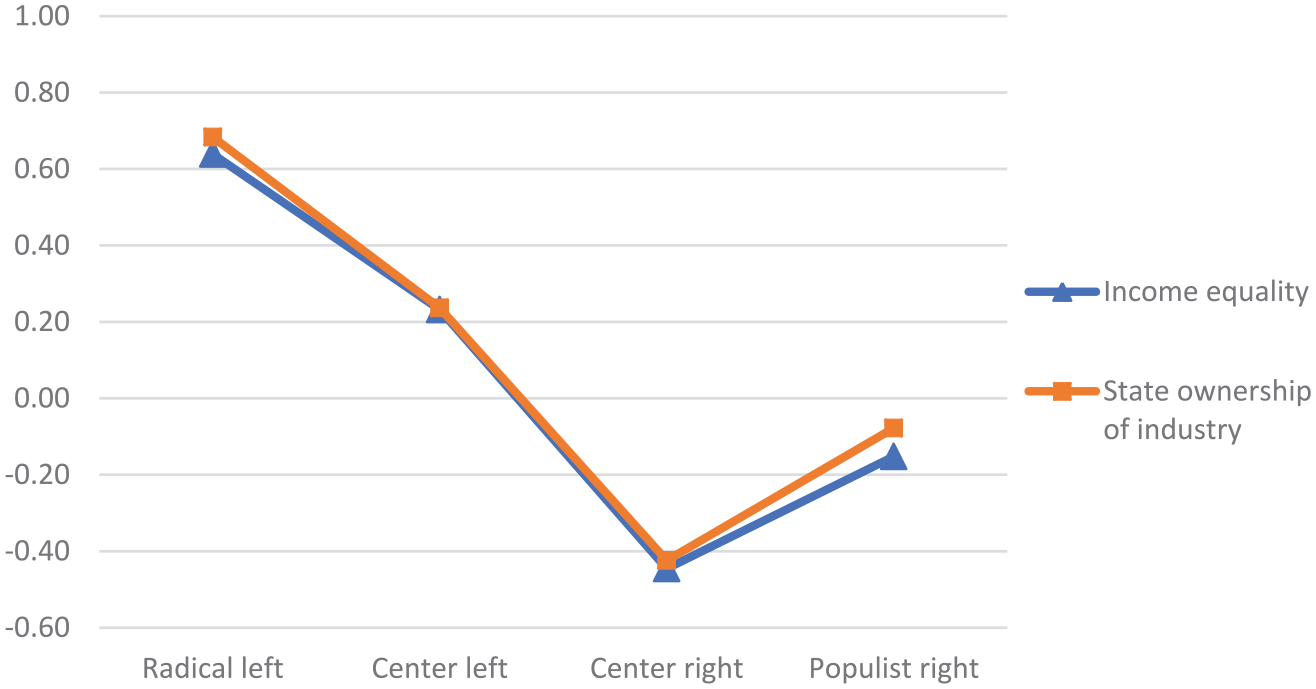
In Figures 2–7, patterns in the distribution of values and beliefs across the political spectrum are displayed. The y-axis is measured in the number of standard deviations to which supporters of each party family deviate from the national average on each value. All graphs have the same y-axis scale, from 1.0 to −0.6, so the magnitude of differences across each graph can be more easily interpreted. In the first (Figure 2), the orange line with square data points exhibits how prevalent lack of confidence in the European Union is among supporters of radical left, center-left, center-right, and radical right parties. Supporters of radical right parties score the highest, .69, indicating that on average they are .69 standard deviations more opposed to the EU than the average citizen.
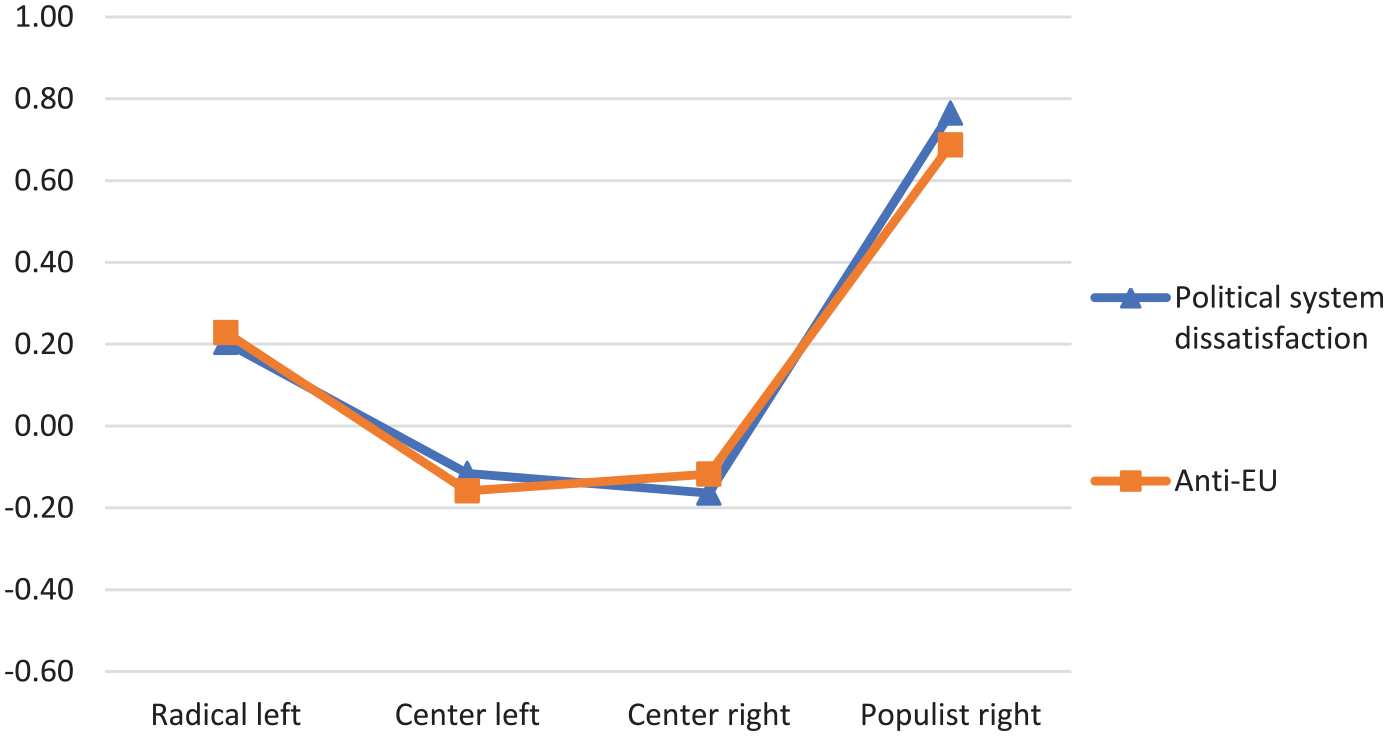
Political Grievances.
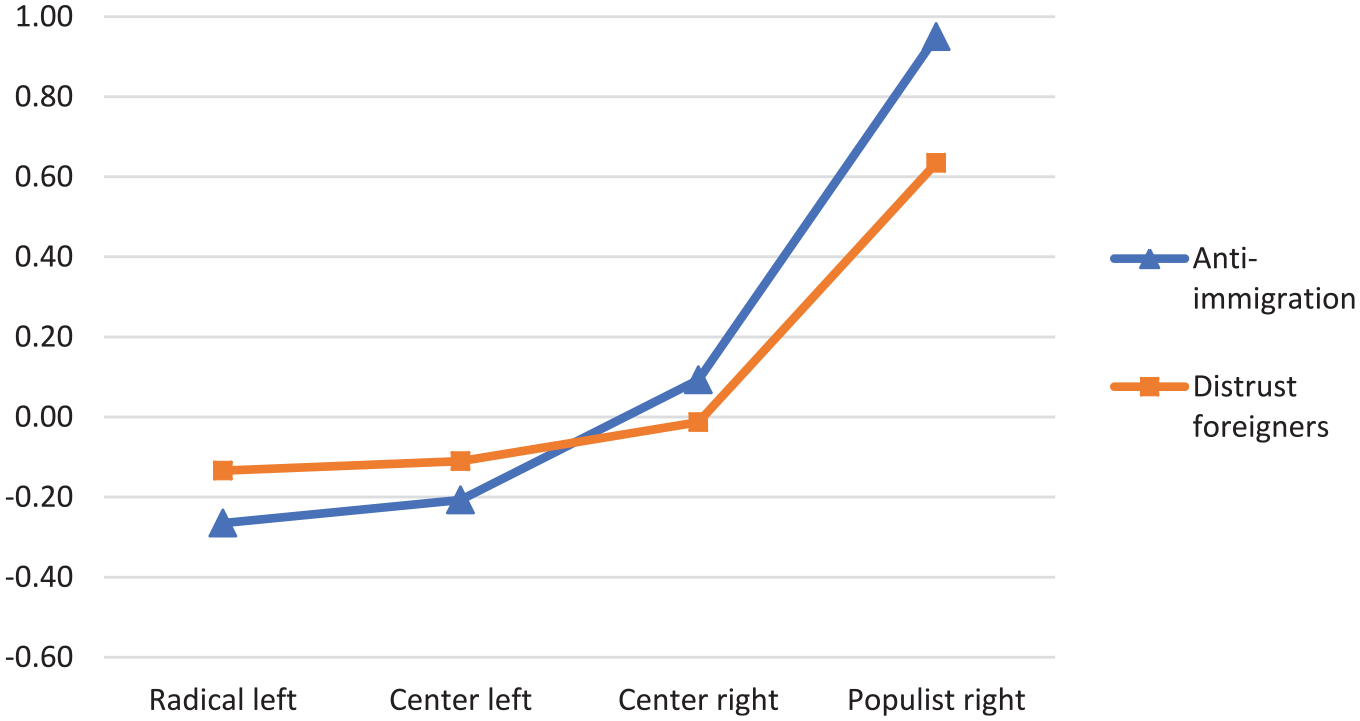
Anti-Immigration and Distrust of Foreigners.
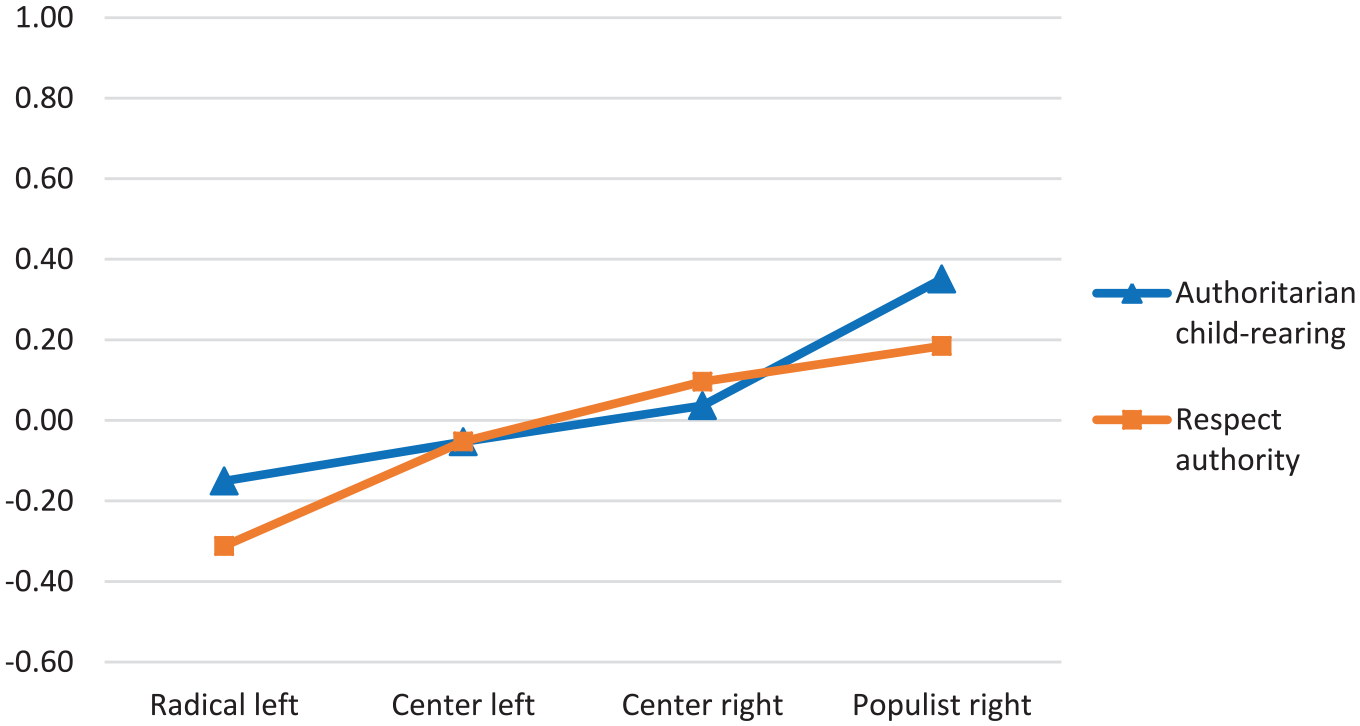
Social Authoritarianism.
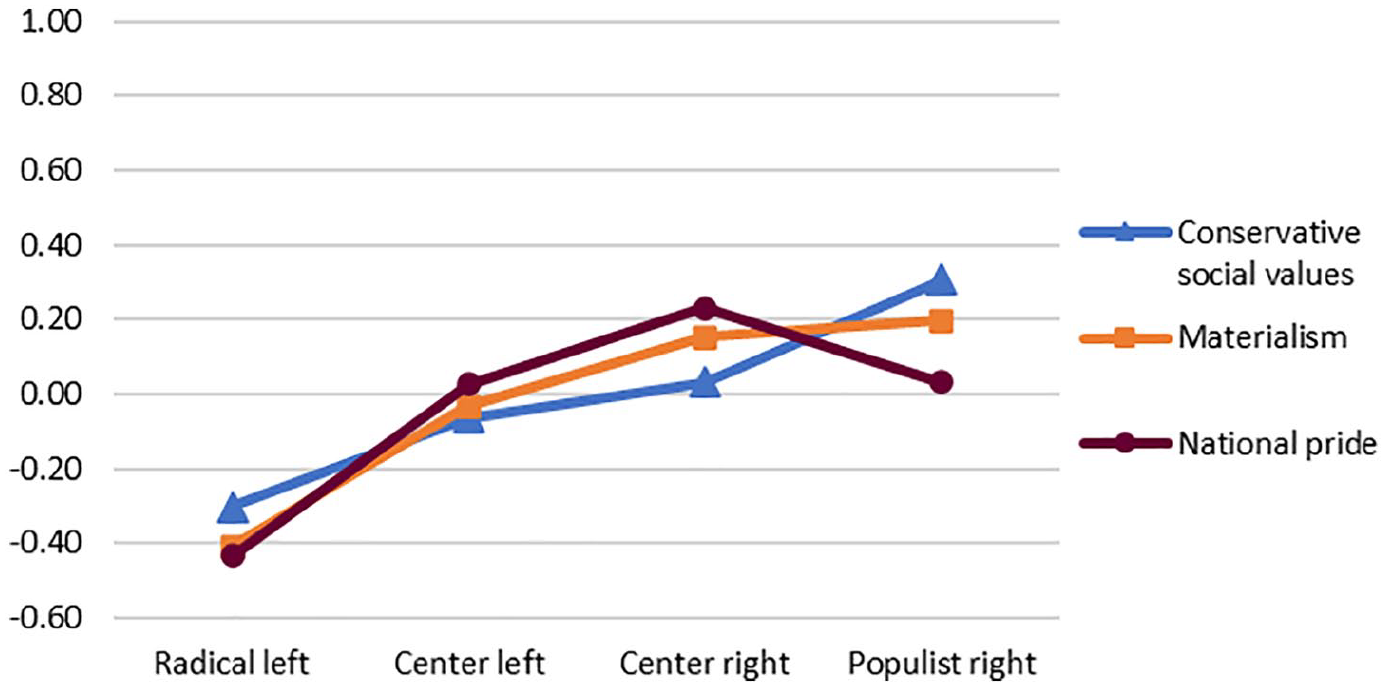
Traditionalism.
Economic Values.
Political Authoritarianism and Democracy.
Figure 2 displays levels of political grievances. Radicals on the left and right are more dissatisfied with existing political institutions than centrists, but the dissatisfaction is still highest on the radical right. Indeed, in all six countries supporters of the radical right feel most negatively toward both the EU and the domestic political system. Radicals on both sides are aggrieved, but the graph signals that political grievances still constitute an important component of the RRP ideological repertoire that distinguishes them from other citizens.
The next category relates to negative feelings about immigration and foreigners, seen in Figure 3. The graph shows spikes on the far-right on both values, whereas there are not large differences between radical left, center-left and center-right supporters. This indicates RRP supporters are far more opposed to immigration and negative toward foreigners than supporters of any other party, registering as .95 standard deviations (SDs) above the mean. Many center-right parties across Europe also favor restricting immigration, but the graph indicates that the sharpest divide on this issue is between RRP supporters and everyone else. In short, negative feelings about immigration and foreigners instead constitute a value for which RRP supporters strongly differ from supporters of other major party families, including from their peers on the center-right.
Figure 4 displays divergences on orientations toward authority. With a general question asking whether the respondent would like to see more respect for authority in society, supporters of RRPs are not much different from the center-right. RRP supporters were on average .18 SDs from the mean compared to .10 for the center-right. On authoritarian child-rearing, the populist right does appear more distinguished, but there are still not sharp divergences as seen previously with anti-immigration and political grievances. RRP supporters were .35 SDs from the mean on this value. Social authoritarianism thus may be a value that modestly distinguishes RRP supporters from other citizens.
Figure 5 shows how traditionalist values are spread across the spectrum. These values, which include conservative social values, materialism and national pride are least commonly held by radical leftists, but there is notable variation among the other parties’ supporters. With regard to materialism, the differences between RRP supporters and the center-right appear to be almost negligible, and neither are distant from the national mean. The populist right is somewhat more conservative, registering as .31 SDs from the national average compared to only .03 for the center-right. The result for national pride is perhaps the most unexpected. The RRP is often thought of as highly nationalistic (Burgoon, 2013; Halikiopoulou et al., 2012b), but the figure suggests they are less prideful in their nation than those who support mainstream center-right parties. 1
Figure 6 shows differences in economic values. Supporters of the radical left are strongly distinguished by their disproportionately high support for progressive economics compared to members of all other parties. Center-left supporters are the next highest. Interestingly, RRP supporters appear slightly more sympathetic to state-led economies than center-right supporters. 2 They are also more supportive of income equality than those on the center-right. This reflects party policies: radical right parties do not necessarily espouse intensely pro-market, neoliberal economic platforms, but are often centrist economically (Dalton and Berning, 2022). Overall, the graphs suggest economic values could represent a minor point of divergence between RRP and center-right supporters, but RRP supporters are still more conservative in their economic orientations than those on the left.
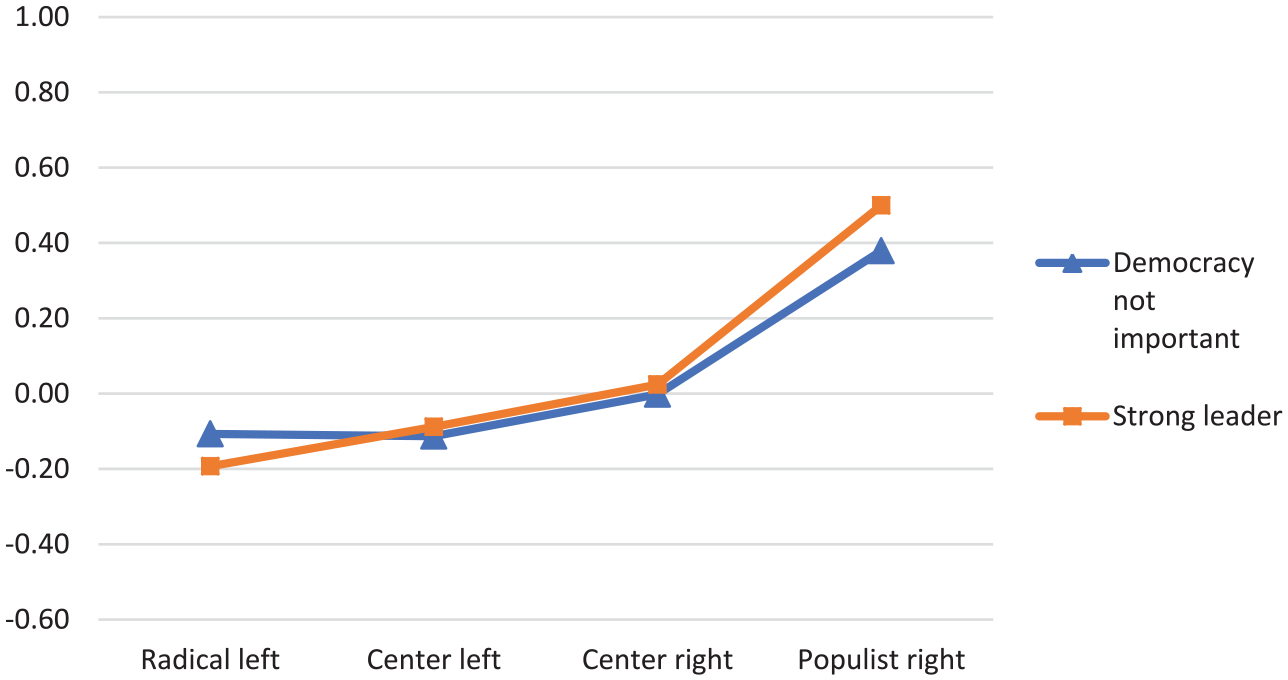
Figures 7 displays orientations toward political authoritarianism and democracy. 3 While there is relative similarity between radical left, center-left, and center-right supporters, supporters of RRP parties are both more sympathetic to the prospect of political authoritarianism and value democracy less than supporters of any other party. This held true in all six countries. RRP supporters are on average .50 SDs more politically authoritarian than average compared to .02 for the center-right. RRP supporters also valued democracy less than supporters of any other party, but the gaps are smaller, on average registering .38 SDs away from the mean. Overall, orientations toward democracy and authoritarianism represent a notable point of deviation between RPP supporters and other party supporters, but it remains to be seen if the differences are statistically significant in multivariate analyses.
Multivariate Analyses
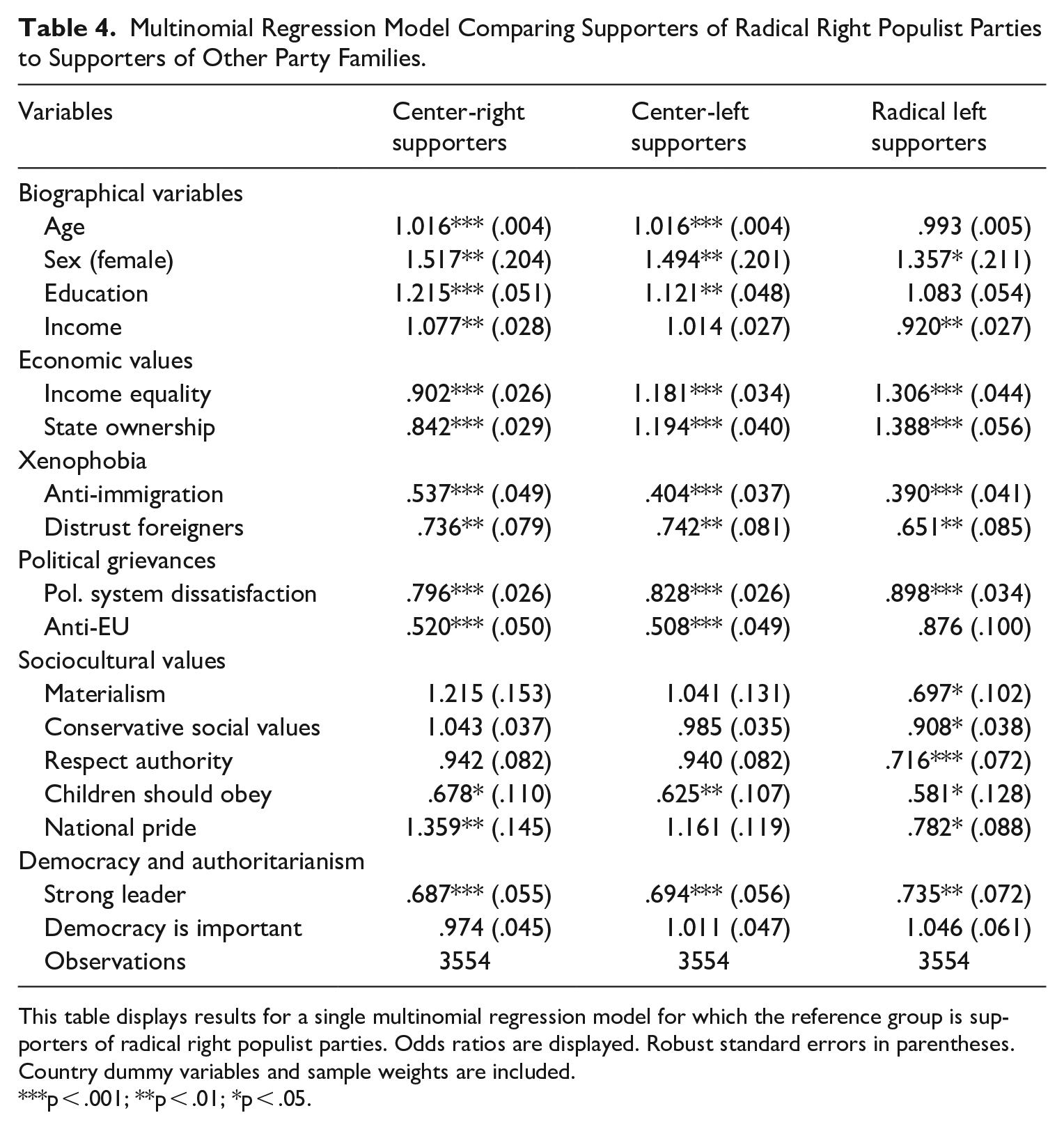
By virtue of controlling for multiple factors simultaneously, multivariate regression analyses produce predictive estimations of whether the differences in values between party supporters are statistically significant. Table 4 displays a multinomial logistic regression, reported as odds ratios, comparing support for RRP parties compared to all other citizens. The results from the table largely reflect those seen in the figures above. The first column of the model compares center-right party supporters to RRP supporters and suggests that citizens who are older, women, more educated, and richer are significantly more likely to support more moderate right-wing parties than RRP parties.
Multinomial Regression Model Comparing Supporters of Radical Right Populist Parties to Supporters of Other Party Families.
This table displays results for a single multinomial regression model for which the reference group is supporters of radical right populist parties. Odds ratios are displayed. Robust standard errors in parentheses. Country dummy variables and sample weights are included.
p < .001; **p < .01; *p < .05.
Ideologically, supporters of center-right parties were more moderate than RRP supporters. Political grievances constituted a major point of division, whereby harsh feelings toward the domestic political system (p = .000) and the European union (p = .000) were much less common on the center-right. Center-right supporters were far less anti-immigration (p = .000) and distrustful of foreigners than RRP supporters (p = .004), suggesting that although center-right parties are sometimes restrictive toward immigration, RRP supporters still harbor much more severe sentiments toward immigrants than moderate rightists. The two camps also disagree somewhat on economic values, whereby RRP supporters were significantly more favorable toward state ownership of industry (p = .000) and the government doing more to enhance income equality (p = .000). This result indicates that despite being more right-wing in their social views toward immigrants, RRP are slightly more favorable toward government intervention in the economy than center-right supporters (Dalton and Berning, 2022).
On other sociocultural values, the center-right and radical right had fewer differences. The model detected no statistically significant differences between center-right and RRP supporters on materialism, conservative social values, and the belief that there ought to be greater respect for authority. With regard to favoring obedience as a quality to cultivate in children, a variable often associated with psychological affinity for authority, there is a significant difference, but it only reaches the p < .05 level. Although nationalism is frequently a prominent component of radical right ideology, center-right supporters are found to be more nationally prideful than RRP supporters. Political authoritarianism emerged as another strong distinction between center-right and RRP supporters. The odds ratio is .687 (p = .000), indicating that for every unit decrease in the political authoritarianism variable, there is a 31.3% decrease in the odds of someone supporting a RRP party over a center-right party.
Comparing the demographics of the center-left to RRPs, the center-left is similar to the center-right in that it attracts more older people, more women, and more highly educated people compared to RRPs. Radical left parties also attract more women supporters than RRP parties, and its supporters are significantly poorer than those on radical right. Overall, the results suggest men are most disproportionately attracted to RRP parties, while women often avoid them. Compared to RRP supporters, those on the center-left and radical left are far more supportive of government intervention in the economy, far more favorable toward immigration and foreigners, and less dissatisfied with the political system. Interestingly, supporters of RRPs are also not much different from those on the center-left on sociocultural issues. Materialism, socially conservative values, respect for authority, and national pride were all non-significant. Valuing obedience in children, however, was significant (p = .006), whereby center-leftists were less favorable toward raising children to be obedient. There is also a highly significant difference between center-leftists and RRP supporters on the political authoritarianism variable, for which the odds ratio is .694 (p = .000).
The radical left has consistent sociocultural differences with RRPs. Materialism, conservative social values, respect for authority, authoritarian child-rearing, and national pride were all significantly lower on the radical left than among RRPs, but the significance levels for all but respect for authority only reached the p < .05 level. The model also suggested radical leftists share RRP supporters’ disdain for the European Union, detecting no significant difference in their sentiment toward it. Although both occupy radical positions in the political spectrum, negative feelings toward the EU is the only value the radical left and RRPs share, while they differ on all other political and sociocultural values. Political authoritarianism also constitutes a very significant difference between them, exhibiting an odds ratio of .735 for radical leftists (p = .000), or a 26.5% decline in the odds of supporting the radical left for every unit increase in political authoritarianism.
Notably, there were no significant differences between RRP supporters and any other party supporters on believing it is important to live in a democracy. If RRP supporters were systematically disinterested in democracy, we could expect this variable to have been significant. The lack of significance for democratic valuation was also not due to multicollinearity with the political authoritarianism variable, as democratic valuation variable remains non-significant when political authoritarianism is excluded from the model.
However, Figure 7 still indicated that RRP supporters were on average more likely to indicate that democracy is not important to them. Despite political authoritarianism and democratic valuation both assessing one’s orientation toward political systems, the model nevertheless appears to have interpreted them as quite distinct. Their correlation, after all, is not large (r =-.23). As mentioned earlier, fewer citizens are willing to overtly declare that they do not value democracy but are more favorable to the prospect of authoritarianism. As discussed further in the section below, supporters of RRPs were in some cases double or nearly triple as likely to endorse political authoritarianism as other citizens. Only 48.6% of RRP supporters gave the highest answer of “10” on the democratic valuation scale, which compared to the sample average of 65.9%. However, still only 9.3% of RRP supporters gave a response on the lower half (i.e. 1–5) of the scale, compared to the sample average of 4.1%. The significance of the political authoritarianism scale and lack of significance for the democratic valuation scale may be partially due to the greater variation in responses to the political authoritarianism question. In any case, expressed willingness to favor an alternative, authoritarian form of governance, rather than explicit disinterest in democracy itself, appears to be the more important indicator distinguishing supporters of RRP parties from other citizens.
Finally, to assess whether specific countries may have disproportionately influenced the results, I run six separate models, each with one of the six countries respectively excluded. The key variable of interest, political authoritarianism, never falls to non-significance in any model for any group of party supporters. In the majority of cases, it remains significant at the p < .001 level. This suggests RRP supporters are consistently the most favorable toward political authoritarianism across the six countries.
Political Authoritarianism in Historical Perspective
Some scholars have warned that Western publics are losing commitment to democracy (Mounk and Foa, 2016, 2017), while others call this a myth (Alexander and Welzel, 2017). The analyses above showed that those who endorse non-democratic rule are more sympathetic to RRP parties, replicating a finding from Donovan (2021). But given the possibility that democratic commitments may be deteriorating, the findings beg the question: are RRPs benefiting from a widening pool of citizens that endorse authoritarianism and reject democracy? Moreover, is it unique in historical context for any party family in Europe to see outsized support from political authoritarians, as RRPs currently do?
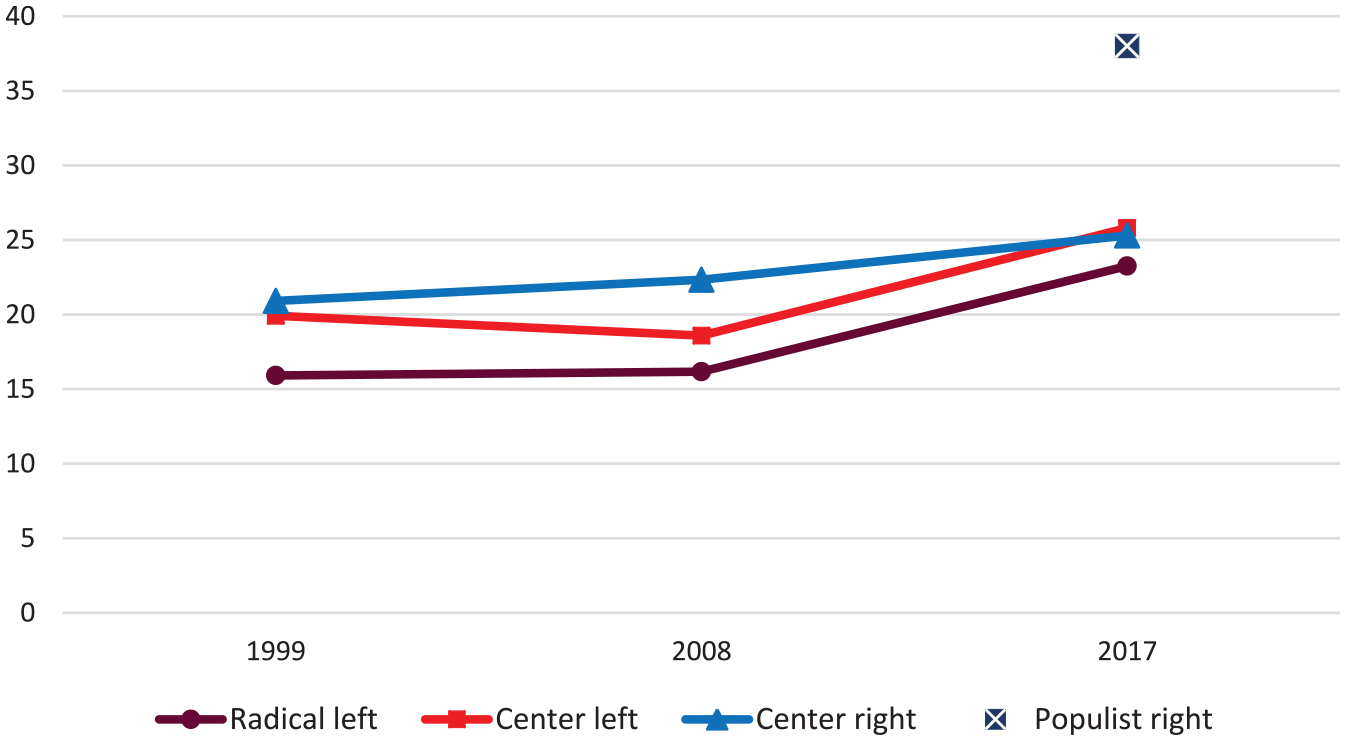
Judging from previous waves of the EVS data, commitments to democracy appear to be holding strong and interest in political authoritarianism is slightly declining. In 1999, 25.3% of Europeans in the six selected countries endorsed political authoritarianism (i.e. a system with a strong leader and no elections or parliament) compared to slightly lower figures of 22.9% in 2008 and 21.6% in 2017. Support for democracy has risen despite expanding enthusiasm for the radical populist right during the same period. Those that believed it was “fairly good” or “very good” to have a democratic political system increased from 2008 to 2017 from 92.1% to 96.7%. Thus, we cannot attribute the recent growth of RRPs to growing interest in authoritarianism or declining commitments to democracy.
Figure 8 displays how support for political authoritarianism has trended within the bases of major parties over three waves of EVS data. In five of the six countries, the RRP party appears only in the year 2017 as a dark blue point in the upper right of these graphs. This was because the RRP party either did not exist during previous waves of EVS surveys or did not acquire sufficient support to be represented in the survey data.
Percent Support for Political Authoritarianism Among Supporters of Radical Left, Center-Left, Center-Right, and Populist Right Parties Across Time.
In most parties, political authoritarians are a minority. However, Figure 8 indicates that political authoritarianism is not only abnormally popular among the base of RRP parties, but it is historically unprecedented for political authoritarians to agree so strongly with any one party family. Country-specific data (provided as Supplemental Materials) further shows that in France, Germany, the Netherlands, Norway and Sweden, no party at any point recorded in the EVS had as many political authoritarians populating its ranks as each country’s RRP party did in 2017. Supporters of the RRP party in France are nearly twice as likely to endorse authoritarianism (40.3%) as a non-RRP supporter (22.3%). The same is true for the Netherlands, where a sizable 55.2% of RRP supporters endorse authoritarianism, compared to 30.1% of those backing other parties.
In Nordic countries, the average favorability among all citizens toward authoritarianism is lower, but the magnitude of differences is no less extreme. In Sweden, RRP supporters are twice as likely to endorse authoritarianism (32.9% to a 16.2% national average), and in Norway, RRP supporters are nearly triple the distance from non-RRP supporters (31.1% compared to a national average of 11.1%). In Finland, authoritarians appear to have gravitated toward the RRP Finns Party only recently. In 2008, 18.1% of Finns Party supporters were authoritarian, not far from the national average of 14.7%. In 2017, the difference expanded as 30.0% of Finns Party supporters were authoritarian, much higher than the national average of 13.9%. In short, despite the outsized support for authoritarianism among the populist right, no such trend is discernible among the popular base of other party families.
Discussion and Conclusion
This article studies radical right-wing populist supporters by comparatively analyzing the views of their own supporters and supporters of other parties. Western European political landscapes contain multiple party families whose supporters often share overlapping political, economic, and social worldviews. A key objective was to deepen our understanding of the views that make radical right populist (RRP) supporters stand out from other members of the electorate. Specifically, I examine how RRP supporters differ from right-wing citizens that chose mainstream, moderate parties instead of their radical alternatives, and from citizens that support radical parties on the left. Given the wide range of values that previous research has suggested could be prevalent among the populist right base, my intention in studying political authoritarianism is not to throw one more variable into the mix, but to properly understand its place in relation to other values. In doing so, I reaffirm some findings produced in previous literature and contribute novel insights.
First, this study offers evidence that many factors frequently assumed to be important to the puzzle of RRP support are similarly prevalent among supporters of RRP parties and moderate center-right parties. The findings call into question whether these factors, which include both sociocultural views and latent dispositions, can sufficiently explain why citizens choose RRP parties over alternatives. It has been common, for instance, to associate the growth of RRP parties in Europe with a conservative “cultural backlash” against expanding liberal values that emphasize diversity, multiculturalism and LGBT rights (Norris and Inglehart, 2019). I find that socially conservative beliefs were not significant factors separating supporters of center-right parties and RRP parties. Materialist beliefs that emphasize security over self-expression, another common proxy for traditionalist values (Inglehart, 1977; Norris and Inglehart, 2019), were also not significantly higher among RRP supporters. RRP supporters are also thought to be motivated by intense nationalism (Halikiopoulou et al., 2012b), levels of national pride were found to be highest among supporters of center-right parties.
Individuals with “authoritarian” dispositions, such as strict approaches to child-rearing, have also been considered susceptible to backing the populist right (Cohen and Smith, 2016; Dunn, 2015; MacWilliams, 2016; Vasilopoulos and Lachat, 2017). I find that authoritarian child-rearing was somewhat higher among RRP supporters than center-right party supporters, but the gap paled in comparison to the gaps between these groups on explicitly political values. Classic explanations for the rise of mid-century fascism also emphasized affinity for authority generally (Adorno et al., 1951 [1950]), but I find RRP supporters have no outstanding desire to see greater respect for authority in society compared to center-right party supporters.
All five of the values described above are more common among people on the right-wing of the political spectrum generally—they are proverbial “conservative” or “traditional” values. Thus, when studies compare the presence of these values among supporters of a right-wing party to the entire population, differences may often be found because the entire population includes many liberal or left-leaning citizens who reject conservative beliefs. In this study, I compare RRP supporters to supporters of other right-wing parties, thus yielding different results. I argue this comparison helps isolate and identify values prominent among right-wing citizens generally from values prominent specifically among those that back radical right-wing populists.
Second, this study adds to our understanding of political authoritarian attitudes among the RRP base. In a previous study, Donovan (2021) found political authoritarianism is high among RPP supporters generally and compared to center-right party supporters. The present study adds some nuances. First, this article offers models that consider many political or sociocultural variables and found that the importance of political authoritarianism holds when controlling for a host of other “authoritarian” beliefs. Among many competing “authoritarianism” explanations, this study ultimately suggests political authoritarianism is consistently a factor unique to the RRPs across multiple countries, as was also the case with anti-immigration views and political grievances. Although radical right parties in recent decades have tried to make their discourse more compatible with tolerance and democracy (Halikiopoulou et al., 2012a), this result suggests their base is still more prone to endorsing anti-democratic alternatives.
Third, the temporal component of the analysis signals emerging danger to European democracies. RRP parties in Europe typically do not explicitly propose abolishing elections and parliament. Yet, endorsement of this autocratic vision was much more common among supporters of the RRP party family than any other. Those that endorse political authoritarianism have clearly found a home in RRP parties in recent years. Previously, political authoritarians were small minorities in the bases of other parties and likely had difficulty influencing party programs or policies, but they now constitute sizable constituencies among RRP parties and in some cases majorities.
Parties are often responsive to the demands of their followers (Dalton, 2017). If authoritarians become influential factions within a party, demands for practical measures to marginalize political opponents or sidestep democratic norms may factor more prominently into the party’s political practices. In five of six countries examined in this study, no other party had ever seen such an extraordinarily high proportion of its base overtly endorsing a non-democratic system than RRP parties had in 2017. A large portion of the electorate remains averse to the populist radical right (Meléndez and Rovira Kaltwasser, 2021). But, by virtue of attracting a historically unprecedented share of political authoritarians, the base of RRP parties may offer party leaders greater leeway, and perhaps even the incentive, to disregard liberal democratic norms if given political power.
Fourth, this article re-attests the importance of political grievances and anti-immigration to RRP support found in previous studies, indicating citizens who support RRP parties mirror the ideology and public rhetoric of party leaders who lambast establishment politicians and fiercely oppose immigration. Although center-right parties often have conservative stances on immigration, RRP supporters displayed extraordinarily strong opposition to immigration that was distinguished from all other citizens. Political grievances were also most common among RRP supporters, but radicals on the left shared their dissatisfaction with the political system and the European Union. Considering these factors alongside political authoritarianism indicates that the most crucial factors for RRP supporters are explicitly political in nature as opposed to latent dispositions.
Finally, this study demonstrates drastic differences between radical left and radical right supporters on nearly all beliefs and values. Horseshoe theory has suggested that radicals on the left and right share belief systems (Faye, 2004), and some studies indicate limited similarities on issues such as euroscepticism (Otjes and Louwerse, 2013; Rama and Santana, 2020). However, findings from the present article parallel the majority of work which suggests extremely sharp sociocultural, political, and economic disagreements between left and right radicals (Oliver and Rahn, 2016; Otjes and Louwerse, 2013; Rooduijn, 2018; Rooduijn et al., 2018; Salmela and Von Scheve, 2018; Spierings and Zaslove, 2017; Visser et al., 2014). Radical leftists were found in this study to reject political authoritarianism, reflecting previous work indicating a favorable orientation toward democracy and political tolerance on the left (Akkerman et al., 2014; Stavrakakis et al., 2017; Svolik et al., 2023). The present study also suggested that the political overlap between left and right radicals is limited only to their disdain for the European Union, but even on this issue it should be noted that the reasons for their disdain are very different. Radical leftists typically criticize the EU for its facilitation of austerity, while the radical right takes issue with the EU’s immigration policies.
The research design and findings offered here must be understood as uniquely addressing the politics of western Europe but are not generalizable across the region, particularly to eastern or southern Europe. As parties belonging to the western European variety of right-wing populism, these parties share some characteristics, such as centering anti-immigration, corruption, and euroscepticism in their platforms (Taggart, 2017). It remains an endeavor for future research to assess whether a separate amalgamation of values and beliefs predict support for radical right populist parties in eastern European countries, where the party landscapes often differ from those studied here.
Supplemental Material
sj-docx-1-psx-10.1177_00323217241310083 – Supplemental material for Which Values Distinguish Supporters of Radical Right Populist Parties From Their Rivals? Political Authoritarianism As a Key Ideological Feature
Supplemental material, sj-docx-1-psx-10.1177_00323217241310083 for Which Values Distinguish Supporters of Radical Right Populist Parties From Their Rivals? Political Authoritarianism As a Key Ideological Feature by Arman Azedi in Political Studies
Footnotes
Declaration of Conflicting Interests
The author(s) declared no potential conflicts of interest with respect to the research, authorship, and/or publication of this article.
Funding
The author(s) received no financial support for the research, authorship, and/or publication of this article.

Supplemental Material
Additional Supplementary Information may be found with the online version of this article.
Figures 9a-9b. Anti-immigration and xenophobia. Figures 10a-10b. Political grievances. Figures 11a-11e. Sociocultural values. Figures 12a-12b. Economic values. Figures 13a-13b. Democracy and authoritarianism. Figures 14a-14f. Support for political authoritarianism by party, across time. Table 4. Standard deviations on values across six Western European countries.
Notes
Author Biography
References
Supplementary Material
Please find the following supplemental material available below.
For Open Access articles published under a Creative Commons License, all supplemental material carries the same license as the article it is associated with.
For non-Open Access articles published, all supplemental material carries a non-exclusive license, and permission requests for re-use of supplemental material or any part of supplemental material shall be sent directly to the copyright owner as specified in the copyright notice associated with the article.
