




Abstract
Despite the dramatic voter turnout increase in 2019, the participation level in European Parliament elections is still considerably lower than in national elections. How can we explain this persistent ‘Euro gap’? This article analyses the motivations of citizens who participate in national but not in European electoral contests, the so-called ‘EU-only abstainers’. The empirical analysis based on the EES 2019 voter study reveals that EU-only abstention is driven by low levels of general political interest and EU-specific political sophistication, as well as by distrust towards EU institutions. Therefore, the Euro gap results from the widespread perception that there is ‘less at stake’ during EP elections, but it is also an aggregate-level consequence of individual Eurosceptic attitudes. These findings have important implications for our understanding of present-day European elections and the debate between the two most common theoretical approaches in EP election research.
Keywords
Introduction
The European Parliament (EP) election in 2019 surprised many observers and analysts. For the first time since 1979, overall voter turnout increased compared to the previous election, yielding the highest rate (50.66%) in the past 25 years. Even more strikingly, 20 out of 28 EU member states experienced a rise in turnout compared to 2014 – an overall increase of around eight percentage points. While the European Parliament itself called the increase in turnout ‘a symbol of the democratic EU’s good health’ (EP, 2019), 1 some scholars described this dramatic boost in electoral participation as ‘an indication of strength for the legitimacy of the EU’ (Tallberg, 2019: 13). However, it must be noted that the turnout difference between national and European parliamentary elections – sometimes called the ‘Euro gap’ (Rose, 2004) – is still considerable (see Figure 1). The persistent discrepancy between the two political levels is often seen as problematic for the EU’s legitimacy. After all, ‘the legitimacy of democracy in general and the outcomes of elections, in particular, are undermined when many citizens do not vote’ (Lutz and Marsh, 2007: 539). 2 In the face of such grave implications, we should ask why a substantial number of citizens consistently participate in elections on the national but not on the European level.
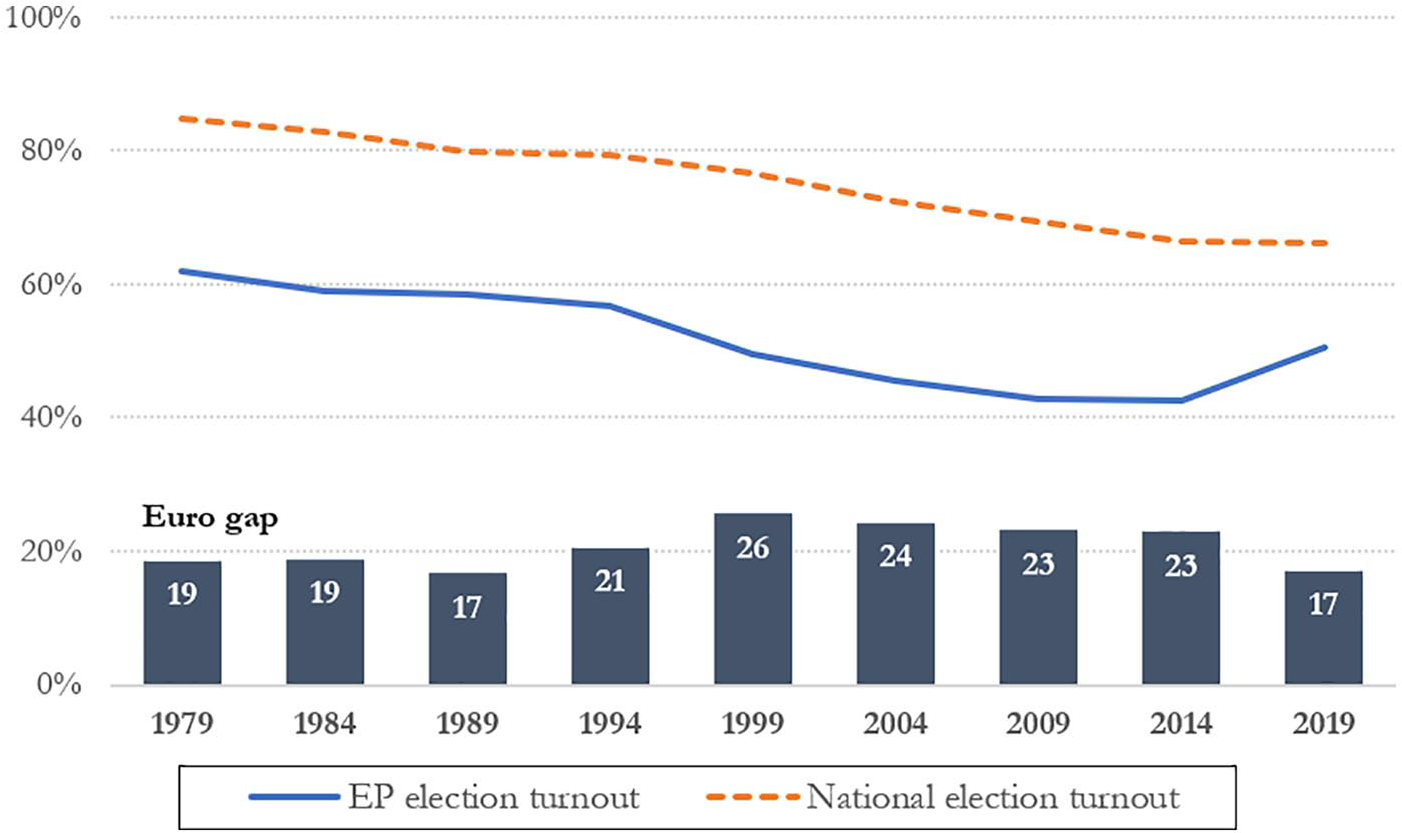
Turnout difference between European and national parliamentary elections over time (‘Euro gap’). Note: Turnout figures are taken from the ‘IDEA voter turnout database’. The ‘Euro gap’ (expressed in percentage points) is calculated as the (unweighted) mean of the EU member states’ differences in turnout rates between an EP election and the previous parliamentary election (or the subsequent elections when both took place in the same year).
A central assumption is that a certain group of people change their behaviour between national and European elections: ‘EU-only abstainers’. While they go to the polls in national elections, they decide to abstain in EP elections, thereby creating the ‘Euro gap’ on the aggregate level. In doing so, they are at the focal point of the debate between two approaches commonly used to explain EP election behaviour. On one hand, the ‘second-order elections’ (SOE) model postulates that these people stay at home during EP elections because they perceive these contests as less important and subordinate to national first-order elections (FOE; Reif and Schmitt, 1980). On the other hand, the ‘Europe matters’ (EM) model suggests that voters regard EP elections as having an independent ‘sui generis’ character and make their electoral behaviour dependent on their preferences towards European integration (Hix and Marsh, 2007; Hobolt et al., 2009). From this perspective, ‘EU-only abstention’ can be understood as a form of Eurosceptic electoral behaviour, that is, an expression of Eurosceptic attitudes. By contrasting the two approaches, this article’s underlying question is whether EU-only abstainers are motivated by indifference towards European politics or negative attitudes towards the EU.
It is crucial to assert that the two approaches are not mutually exclusive. However, they disagree about the extent to which European elections can fulfil their legitimizing function. For Blondel et al. (1998), the main question is whether or to what extent EP elections are conducted ‘independently from other elections’ (Blondel et al., 1998: 14). The SOE model implies that EP elections carry few European elements and should have ‘no effect whatsoever on the legitimacy of the Union’ (Blondel et al., 1998: 14). In contrast, the EM literature offers vital insights into the various ways that European factors matter for voters during EP elections and, consequently, provide legitimacy to these elections. Hence, it seems essential for our understanding of present-day EP elections to analyse whether a person’s choice to turn out in national elections but to stay at home during European electoral contests is motivated by indifference or Euroscepticism.
Therefore, it is more than surprising that little scholarly attention has so far been paid to EU-only abstainers, even though the difference in turnout between national and European elections is widely noticed. 3 Moreover, the particular conduct of EU-only abstention has rarely been studied on the individual level, that is, by analysing voter data (Boomgaarden et al., 2016: 132). Albeit, this situation appears to be caused by a lack of appropriate data sources, it is highly problematic. The reason is that analysing individual electoral behaviour with aggregate-level data bears the risk of ecological fallacy (Giebler and Wagner, 2015: 47). Overall, our lack of knowledge regarding EU-only abstainers remains a critical blind spot in the EP election literature.
In this article, I aim to bridge this research gap by analysing individual-level determinants of EU-only abstention behaviour. In doing so, I test central propositions relating to the theoretical debate over the character of EP elections: is EU-only abstaining related to a lack of political awareness (SOE model), or is it rather connected to a lack of political support for the EU (EM model)? The empirical analysis is based on the voter surveys of the 2019 European Election Studies (Schmitt et al., 2019), which include questions regarding past behaviour in the recent EP election and the previous national elections. The results show that both approaches have their merits in explaining individual EU-only abstention, which bears important implications for the debate on the nature of present-day European elections and their ability to provide democratic legitimacy to the EU’s political system.
Theoretical framework
The SOE model and EU-only abstention
For 40 years, the dominant paradigm in European election research has been the ‘second-order (national) elections’ approach developed by Reif and Schmitt (1980) in their seminal work on the first direct EP elections. 4 The SOE model has become the ‘standard theory of European Parliament elections’ (Hix and Marsh, 2007: 495), as it consistently contributes to explain electoral outcomes across EU member states (Hix and Marsh, 2011; Reif, 1984; Schmitt, 2005; Schmitt et al., 2020). Among several patterns that characterise SOE, one central feature is the comparably low level of voter turnout. 5 In the case of EP elections, the turnout difference between European and national elections lies, on average, between 15 and 25 percentage points. This persistent aggregate-level difference has been coined the ‘Euro gap’ by Rose (2004).
The individual-level explanation behind the Euro gap is the lower relevance of European elections in the eyes of the people. Reif (1984: 246–247) prominently remarked that many citizens are less interested in (European) SOE because they perceive that ‘there is less at stake’ than in (national) FOE. His reasoning implies that lower participation rates are mainly caused by abstainers’ personal indifference or lack of ‘political awareness’ (Zaller, 1992), 6 especially regarding European affairs. The argument is intuitively plausible, as several studies show that many citizens are relatively poorly informed about the EU, its politics, and its policies (Hobolt, 2007; Pannico, 2017).
More importantly, the impact of general and EU-specific political awareness for individual participation in EP elections is empirically confirmed (Blondel et al., 1998; Clark, 2014). Bhatti (2010) calculated in a simulation study that even moderate increases in political knowledge would lead to substantially higher turnout rates in EP elections. Adding to that, Hogh and Larsen (2016) found that first-time voters show a significantly higher willingness to participate after receiving information about the EU. Finally, Schmitt et al. (2015) demonstrated that citizens who recognise the lead candidates for the European Commission presidency are significantly more likely to turn out.
Hence, it can reasonably be assumed that people who are indifferent towards politics in general and towards European politics in particular should have an increased tendency to stay at home during EP elections, even though they usually take part in national elections. Therefore, I hypothesise that two individual-level dispositions can explain the choice to participate in national elections but to abstain in European elections from the SOE model’s perspective. Individual EU-only abstention should be explained by a lack of general political interest (H1a) and a low level of EU-specific political sophistication (H1b). Therefore, the SOE hypotheses are the following:
H1a. The less politically interested citizens are, the higher their likelihood of EU-only abstention is.
H1b. The less sophisticated in European political affairs citizens are, the higher their likelihood of EU-only abstention is.
The EM model and EU-only abstention
Although the ‘Europe matters’ literature does not fully repudiate the SOE model, it discusses the extent to which EP elections have become ‘less “second-order national elections” and more truly European contests’ (Hobolt, 2015: 8). As European integration has become an increasingly important issue in EP elections (Braun et al., 2016; De Vries et al., 2011; Hobolt, 2015), arena-specific European considerations matter for citizens in their decision whether or not to vote in present-day European elections and whom to vote for (Hernández and Kriesi, 2016; Hobolt and Spoon, 2012; Schäfer and Debus, 2018). In particular, positive attitudes towards European integration and the EU affect the likelihood of taking part in EP elections (Blondel et al., 1998; Hernández and Kriesi, 2016; Hobolt and Spoon, 2012; Kentmen-Cin, 2017). 7 Adding to these findings, Schäfer (2017, 2019) shows that distrust in the European Parliament is a strong predictor of EU-only abstention in EP elections.
Behind these findings often lies the implicit theoretical assumption that citizens’ electoral participation can be regarded as an expression of individual political support – or the lack thereof in case of abstention. Hence, non-voting in EP elections is sometimes regarded as ‘one way of expressing opposition to the European political system and the integration process’ (Steinbrecher and Rattinger, 2012: 171, see also Schmitt et al., 2020). Bauer (2020) labels the mere participation in an EP election a form of ‘system-supporting behavior’, whereas abstaining is seen as ‘system-critical behavior’. From this perspective, EU-only abstention can be seen as an expressive act. However, it can also be understood as an instrumental choice because it should be evident to many people that large-scale abstention in EP elections contributes to a legitimacy deficit in the EU.
In her book on Euroscepticism, De Vries (2018) argues that attitudes towards the EU cannot be understood in absolute terms only. Instead, people weigh their evaluation of European politics and institutions against their closest point of reference, that is, the domestic political system. It seems plausible that this differential understanding of Euroscepticism should go along with a ‘differential abstention’ (Schmitt et al., 2020) behaviour in EP elections, that is, EU-only abstention. The less positive citizens perceive the functioning of the EU political system compared to their national democracy, the more they should be inclined to behave like EU-only abstainers.
Taken together, I hypothesise that distrust in the European Parliament (H2a) as well as differential Euroscepticism, that is, distrust towards EU institutions compared to national institutions (H2b), should lead people to engage in EU-only abstention behaviour. Thus, the EM hypotheses are the following:
H2a. The less trust in EU institutions citizens have, the higher their likelihood of EU-only abstention is.
H2b. The less support for the EU compared to their national political system citizens have, the higher their likelihood of EU-only abstention is.
Taken together, the theoretical framework of the article asks whether EU-only abstainers are motivated rather by personal indifference or by Eurosceptic attitudes. While providing arguments for both motivations, I do not claim that the two theoretical approaches are mutually exclusive. In the empirical analysis that follows, I test the explanatory power of the two approaches and compare their effects with two residual groups of citizens: those who vote in EP elections (‘voters’) and those who abstain both in national and European elections (‘habitual abstainers’). This comparative juxtaposition should provide us with a better understanding of who these EU-only abstainers are and why they do what they do.
Empirical analysis
The theoretical expectations are empirically tested, relying on the post-electoral voter survey of the European Election Studies (EES) 2019 (Schmitt et al., 2019). The cross-national polls were conducted between 14 June and 11 July 2019, and targeted residents in all 28 EU member states aged 18 years and above (16 in Austria and Malta). Around 1000 people were surveyed in each country, which yields a total sample size of 26,548 respondents (in Cyprus, Luxembourg, and Malta, only about 500 persons were interviewed). 8 The data were collected online, and the sampling was stratified by gender, age, region, and type of locality. 9 Respondents were selected randomly from the access panel databases based on the stratification variables. 10
Operationalisation
The dependent variable is the self-reported electoral participation in the 2019 EP elections and the previous national election. For this purpose, two different survey items are combined. The first one asked the respondents whether they voted in the recent EP elections, 11 whereas the second item posed a similar question regarding the last general election in the respondent’s country. 12 This combination yields an overall share of 16.3% EU-only abstainers (n = 3961), a number that approximates the officially certified Euro gap in the 2019 EP election of 17.5%. The correlation between these two aggregate measures among the 28 EU member states is fairly strong (r = 0.69), which indicates a proper reporting of EU-only abstentions.
In addition, the sample contains 2,939 ‘habitual abstainers’ (12.1%) who indicated not having participated in either of the two elections. This group is useful for comparative analyses, as it seems of crucial importance to understand what distinguishes EU-only abstainers from ordinary non-voters. Adding the two groups together means that roughly 28.4% of the sample has self-reportedly abstained in the 2019 EP election. 13 In contrast, 17,421 respondents claimed to have participated in the 2019 EP election, meaning that the overall participation in the EES 2019 (71.6%) is drastically over-reported compared to the official turnout rate (50.7%). This high level of over-reporting might result from the under-representation of low-educated citizens who are traditionally the least likely to participate in politics. Nonetheless, the mean self-reported participation per country correlates strongly with the actual turnout rates (r = 0.85), implying that over-reporting is distributed equally across countries and not systematically biased. 14
To test the theoretical hypotheses, I specify four central independent variables that explain EU-only abstention behaviour. The SOE model’s impact is measured by two indicators related to indifference and a lack of political awareness regarding EP elections. The first, general political interest (H1a), is measured through a subjective assessment of one’s interest in politics. 15 The variable is rescaled to a range from 0 (‘not at all interested’) to 1 (‘very interested’). Second, EU-specific political sophistication (H1b) is operationalised by a factual knowledge question in which respondents were asked to assign three top candidates for the European Commission presidency to their respective political parties on the European or national level. 16 The correct answers are summated, yielding an additive index ranging from 0 (no correct answer) to 1 (all three answers correct) with medium-strong internal consistency (alpha = 0.57).
The influence of the EM model is operationalised by two different EU-level considerations that matter to voters during EP elections. First, a person’s EU institutional trust (H2a) is measured through trust in the European Parliament. 17 Again, the variable is rescaled to a range from 0 (‘no trust at all’) to 1 (‘total trust’). Second, the EU regime differential (H2b) is operationalised in accordance with the benchmark theory by De Vries (2018: 47), which implies calculating the difference in satisfaction between the way democracy works in the EU and the way democracy works in one’s own country. 18 The variable ranges from 0 (total satisfaction with national democracy and total dissatisfaction with EU democracy) to 1 (total satisfaction with EU democracy and total dissatisfaction with national democracy).
In line with previous research on the determinants of electoral participation (see, for example, Blais, 2006; Geys, 2006; Smets and Van Ham, 2013), I include several control variables. First, these are respondents’ support for the current national incumbent and their retrospective perception of their country’s macro-economic situation, which both can affect the tendency to participate in EP elections. Second, I include partisanship and voter-party congruence on the ideological left-right dimension, 19 which have been shown to influence participation in EP elections (Schäfer and Debus, 2018). Third, I control for the socio-demographic variables age, education, and perceived social class. 20 Finally, I also include country dummies to control for any confounding factors on the national level, such as features of the electoral system (e.g. compulsory voting, concurrent elections, electoral cycle) or the country-specific politicisation of EU issues. The inclusion of these ‘country fixed effects’ allows me to focus on the impact of individual-level determinants of EU-only abstention behaviour.
Results
If we first descriptively compare the mean values of the central independent variables for EU-only abstainers with the other respondents in the EES sample (see Table A-4 in the Supplemental Appendix), several observations are worth noting. First, EU-only abstainers are, on average, less interested and sophisticated in political matters than citizens who took part in the 2019 EP election. However, they are still more politically interested and sophisticated than habitual abstainers who do not participate in any election. Second, their level of trust in the European Parliament is lower than for voters but not significantly different from the institutional trust of habitual abstainers. Finally, the EU regime differential is similar for all respondent groups.
To identify the effects of the main explanatory variables on EU-only abstention more clearly, I estimate multinomial logistic regression models. 21 The reason is that the dependent variable consists of three nominal categories without any hierarchical order: EU-only abstainers, habitual abstainers, and voters in the EP election 2019. The findings are presented in three steps. First, Table 1 contains the results from three different regression models and shows the coefficients of all independent variables on the outcome category EU-only abstention versus the two other groups. After that, Figure 2 graphically displays average marginal effects (AMEs) of the four main independent variables on the three outcome categories from the full regression model. Finally, Figure 3 illustrates the predicted probabilities of EU-only abstention versus habitual abstention as a function of the central independent variables.
Predictors of EU-only abstention in the 2019 EP elections (multinomial logistic regression models).
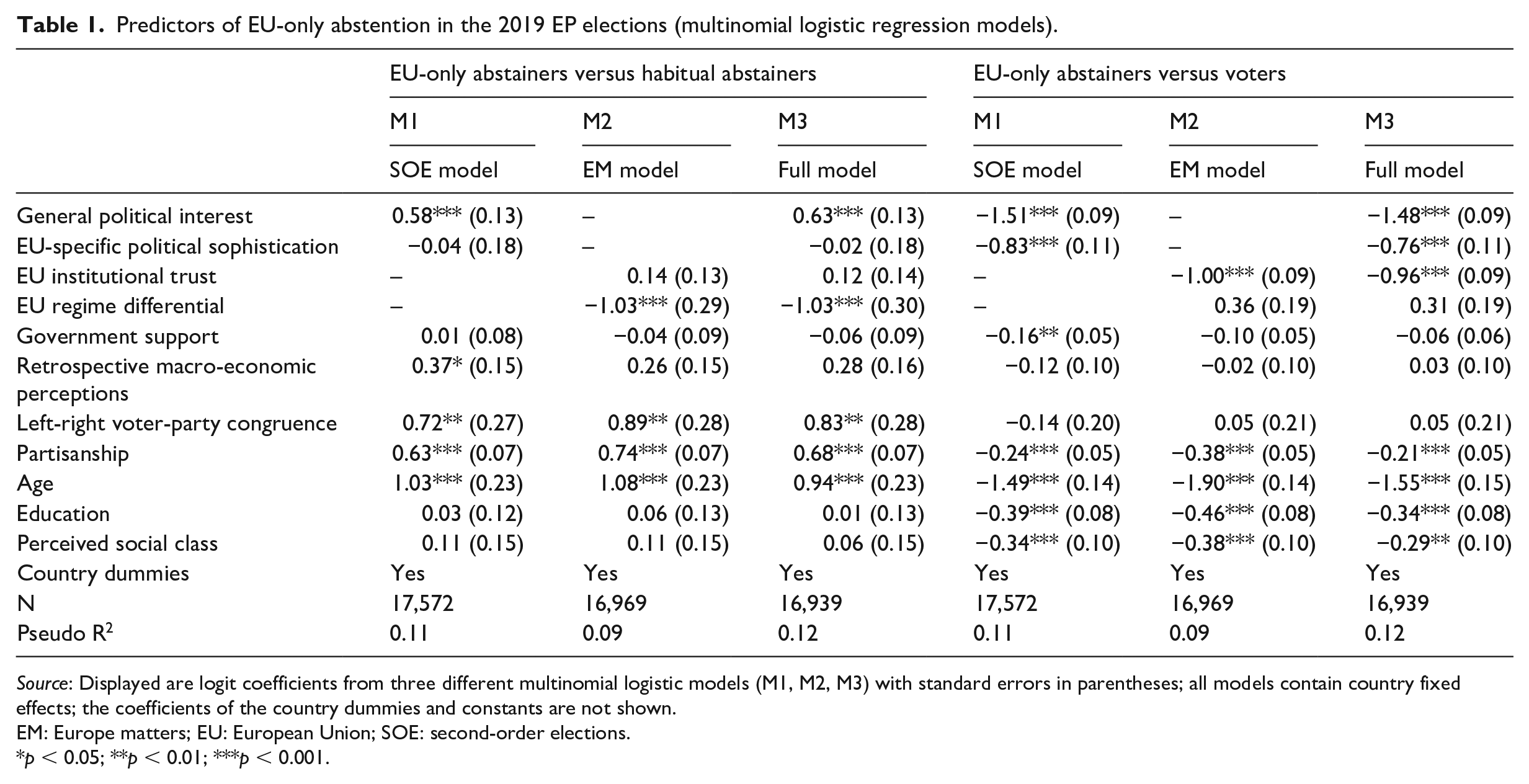
Source: Displayed are logit coefficients from three different multinomial logistic models (M1, M2, M3) with standard errors in parentheses; all models contain country fixed effects; the coefficients of the country dummies and constants are not shown.
EM: Europe matters; EU: European Union; SOE: second-order elections.
p < 0.05; **p < 0.01; ***p < 0.001.
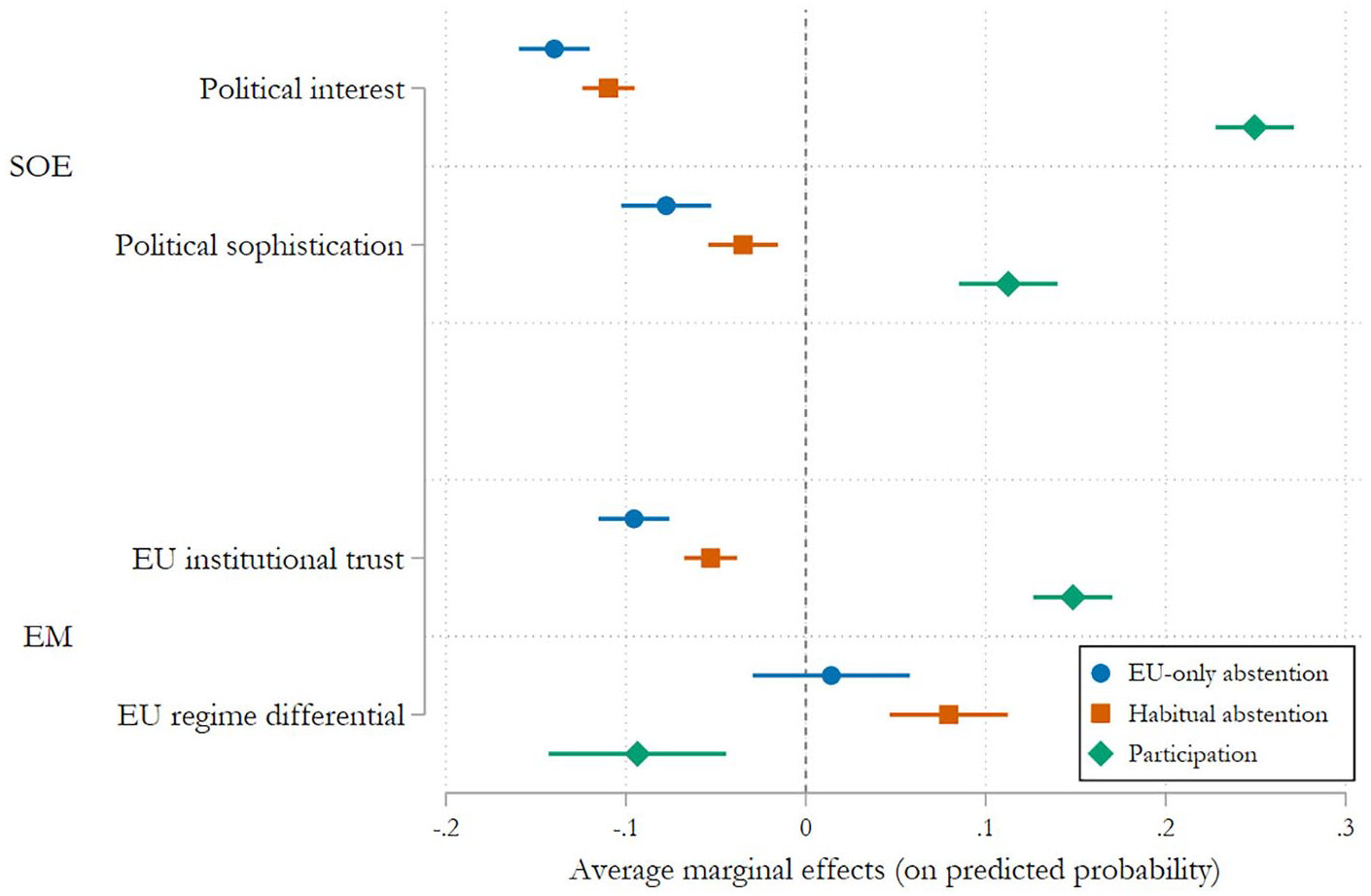
Average marginal effects of the main independent variables on electoral participation in the 2019 EP elections. Note: Displayed are average marginal effects (AMEs) computed from the full multinomial regression model (M3) with 95% confidence intervals.
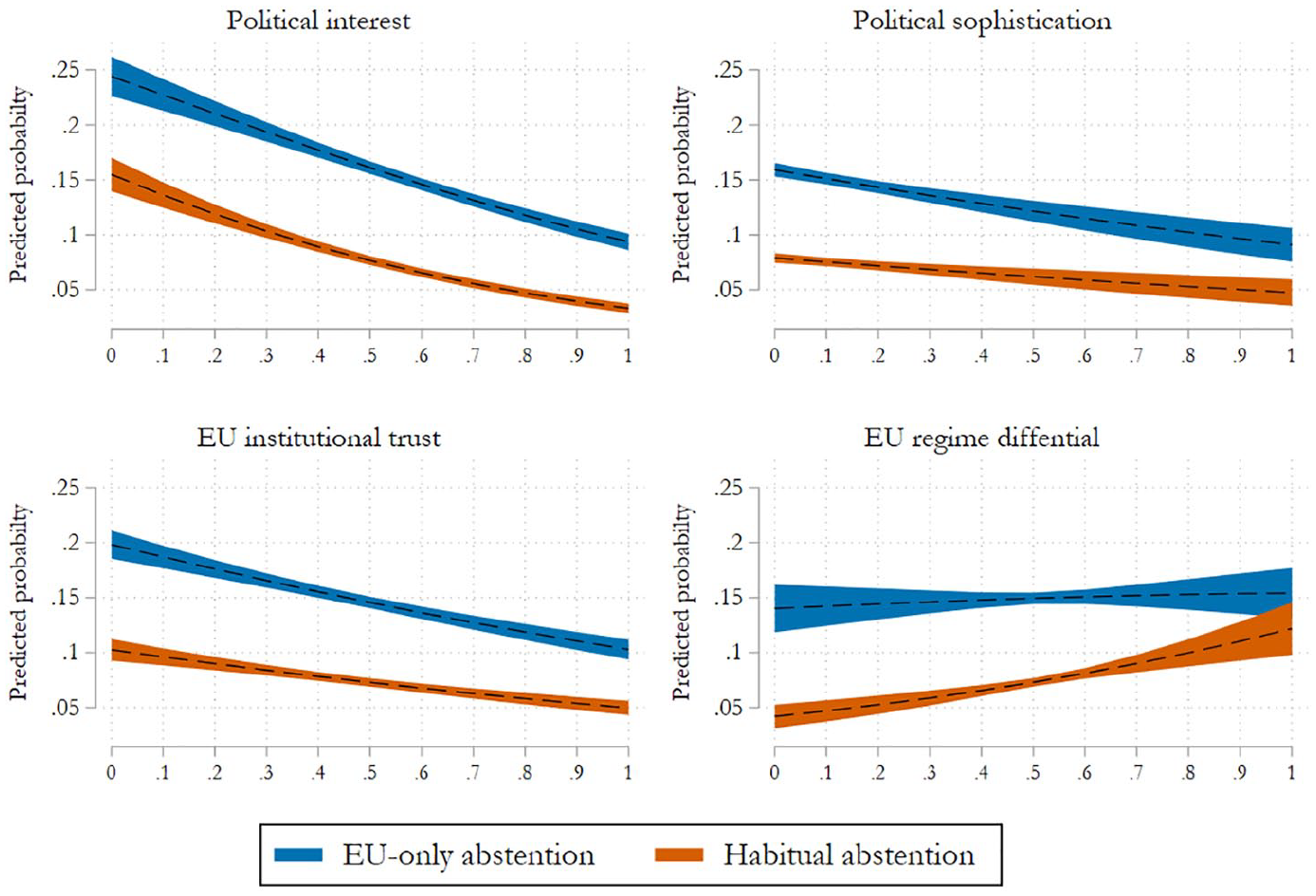
Predicted probabilities of ‘EU-only abstention’ and ‘habitual abstention’ in function of the main independent variables. Note: Displayed are adjusted predictions computed from the full multinomial regression model (M3) for two of the three outcome categories of the dependent variable; the shaded areas are 95% confidence intervals.
The regression results in Table 1 confirm that political interest significantly distinguishes EU-only abstainers from the other respondent groups, whereas EU-specific political sophistication is similarly low for both groups of non-voters. This observation implies that the typical EU-only non-voter is generally more aware of political matters than the ordinary abstainer, but not so much when it comes to specific EU affairs. The indifference to European politics seems to contribute to their particular behaviour, which supports the assumptions of the SOE model. However, the EM approach seems to be supported less by the data. Although trust in EU institutions is a significant predictor of abstaining versus participating in EP elections, it apparently does not distinguish between the two kinds of non-voters. This is different for the EU regime differential: the more positively the EU is evaluated compared to one’s national democracy, the less likely EU-only abstention becomes compared to habitual abstention.
However, logit coefficients are only a first approximation of the effects employed by explanatory variables in a non-linear model. One limitation is that they are hard to interpret in a meaningful way. Moreover, they only apply to the average case and merely indicate an independent variable’s discriminatory power between two outcome categories of the dependent variable. Therefore, it is more informative to display AMEs of the main explanatory variables for all observed values (Hanmer and Ozan Kalkan, 2013). This is done in Figure 2 for results from the full regression model (M3).
Interestingly, three of the four central variables – general political interest, EU-specific political sophistication, and trust in the European Parliament – exert stronger negative effects on EU-only abstention than on ordinary abstention. So, the less politically interested and sophisticated in EU affairs people are, the higher is their tendency to abstain in EP elections only. These findings confirm the SOE hypotheses 1a and 1b. Similarly, the negative effect of EU institutional trust is stronger than for habitual abstainers. Hence, it can be concluded that the less trust people have in the European Parliament, the higher is their likelihood to engage in EU-only abstaining, which confirms the EM hypothesis 2a. Contrary to that, EU-only abstaining is not significantly affected by a person’s EU regime differential, which means that stronger favouritism of the national democracy over the EU does not relate to a higher tendency to only participate in national elections and not in EP elections. Therefore, the second EM hypothesis 2b needs to be rejected.
The effects become even clearer and more easily interpretable when plotting ‘adjusted predictions’ from the full model (M3) regarding the two types of abstention as a function of the main independent variables (see Figure 3). 22 First, political interest exerts similarly strong effects on both non-voter groups. Citizens who are not at all interested in politics display a 24.4% chance for EU-only abstention and a 15.5% chance for habitual abstention, but these predicted probabilities decrease strongly with higher political interest. A highly interested individual has a model prediction of 9.4% EU-only abstention and 3.4% habitual abstention. This implies that the decrease in probabilities is stronger for EU-only non-voting (−15.0 points) than for habitual abstention (−12.1 points). The pattern is similar for arena-specific political sophistication but a bit less pronounced. Here, the likelihood of EU-only abstention decreases from 15.9% (low sophistication) to 9.1% (high sophistication), which again is a greater difference (−6.8 points) than the decrease in probabilities for habitual abstention (−3.1 points).
Regarding EU institutional trust, the predicted probability of abstaining only in EP elections decreases from 19.8% (low trust) to 10.3% (high trust). Here as well, the negative effect is more substantial (−9.5 points) than for habitual abstention, where the predicted probability changes from 10.3% to 5.0% (−5.3 points). Finally, Figure 3 confirms there is no statistically significant variation in the predicted probabilities of EU-only abstention for the EU regime differential. However, the model predicts that habitual abstention becomes more likely when citizens are much more satisfied with the EU democracy than with their national democracy. Even though this observation might not seem intuitive, it could imply that an extremely negative evaluation of the domestic political system alienates people from politics and democratic institutions in general. All in all, it has become evident that EU-only abstention is both the result of personal indifference towards politics and EU affairs, but that it is also a behavioural consequence of individual Eurosceptic attitudes.
Conclusion
In this article, I investigated individual EU-only abstention determinants in European Parliament elections by testing central propositions derived from the two most common approaches in EP election research: the ‘second-order election’ model and the ‘Europe matters’ model. The empirical analysis based on the voter surveys of the 2019 European Election Studies (Schmitt et al., 2019) underline the continuing relevance of the SOE framework but also show the increased importance of the EM approach.
On one hand, non-voters in European elections are, to a large degree, people who are not greatly interested or sophisticated in political matters. That is why many of them stay at home during EP elections, even though some still participate in national elections. In line with the SOE approach’s assumptions, the comparably lower turnout in European elections can, therefore, be explained by people’s perception that there is ‘less at stake’ in European elections. On the other hand, it has been demonstrated that ‘Europe’ really does matter in European elections. Individual-level Euroscepticism made people stay at home in the 2019 EP election who had previously participated in national elections. The fact that both approaches contribute to explaining EU-only abstention indicates that they are neither mutually exclusive nor fully substitutable.
The findings have implications for our theoretical understanding of present-day European elections and their role in legitimising governance on the supranational level. Although the SOE model’s continuing importance indicates that the legitimising ability of EP elections is still considerably limited, the importance of the EM approach shows that European elections can, at least partly, fulfil their central function. However, it is important to mention that increasing rates of Euroscepticism-based abstention could ultimately also hamper the EU’s political legitimacy. From the perspective of democratic theory, it would be better if citizens expressed their preferences on EU issues at the ballot boxes instead of staying at home. The reason is that the act of voting ensures that political preferences are introduced into political action by political parties and representatives. Hence, if Eurosceptic citizens do not partake in EP elections, their interests are systematically under-represented in the EP and, thus, in the EU policy-making process, which could worsen the EU’s alleged democratic deficit.
Therefore, further research needs to be conducted to investigate the consequences of Eurosceptic EU-only abstention for the legitimacy of the European Union. Moreover, scholars should also uncover the various ways in which ‘Europe matters’ in European elections and how these mechanisms vary between electoral contexts and with certain contextual features, for example, the degree of EU issue politicisation in a country (Schäfer, 2019). This could be done by analysing panel survey data for single countries, which do not rely on the long-term memory of respondents, as was the case here. The reason is that self-reported behaviour in surveys is often biased and prone to errors (Van Elsas et al., 2014). Taken together, a more in-depth cross-national analysis or a longitudinal analysis (e.g. a time-series cross-section analysis of previous EES data) could provide valuable extensions to this article.
Supplemental Material
sj-pdf-1-pol-10.1177_0263395720981359.pdf – Supplemental material for Indifferent and Eurosceptic: The motivations of EU-only abstainers in the 2019 European Parliament election
Supplemental material, sj-pdf-1-pol-10.1177_0263395720981359.pdf for Indifferent and Eurosceptic: The motivations of EU-only abstainers in the 2019 European Parliament election by Constantin Schäfer in Politics
Footnotes
Funding
The author has received financial support from the European Union’s Horizon 2020 research and innovation programme under Grant Agreement no 770142.

Supplementary Information
Additional supplementary information may be found with the online version of this article.
Table A-1. Self-reported electoral behavior in the EES 2019 voter survey.
Table A-2. Reported and official participation in the 2019 EP election.
Table A-3. Summary statistics of the independent variables.
Table A-4. Mean values of the independent variables for three groups of respondents in the EES 2019 survey sample.
Table A-5. Correlations between all independent variables.
Table A-6. Predictors of EU-only abstention in the 2019 EP elections (robustness check with individual-level control variables on ordinal-scale level).
Figure A-1. Relationship between reported EU-only abstention and Euro gap.
Figure A-2. Relationship between reported electoral participation and actual turnout rates.
Figure A-3. Reported and observed participation rates per country.
Figure A-4. Average marginal effects of all independent variables on electoral participation in the 2019 EP elections (results of the full multinomial logistic regression model).
Figure A-5. Predictors of EU-only abstention in Western and Central-Eastern Europe (separate multinomial logistic regression models).
Figure A-6. Predicted probabilities of all three outcome categories of electoral participation in the 2019 EP elections in function of the four main independent variables.
Notes
Author biography
References
Supplementary Material
Please find the following supplemental material available below.
For Open Access articles published under a Creative Commons License, all supplemental material carries the same license as the article it is associated with.
For non-Open Access articles published, all supplemental material carries a non-exclusive license, and permission requests for re-use of supplemental material or any part of supplemental material shall be sent directly to the copyright owner as specified in the copyright notice associated with the article.
