




Abstract
Less researched than the second-order character of elections to the European Parliament (EP) is the ‘Europeanness’ of European elections and its implications for voter participation in these elections. This article aims to fill this gap by studying the Europeanness of the public debate in the run-up to the 2019 EP elections and the mobilising power of European issues in these electoral contests. In doing this, we draw on a new data set covering intriguing aspects of the 2019 EP elections. The findings of the empirical analysis of media and survey data indicate that the elections to the EP were more European contests than ever before in the history of these elections – yet this is not true in the same way for all of the countries under consideration. Moreover, the Europeanness of electorates, measured as genuine orientations towards EU politics, matters for electoral participation and thus has the power to mobilise citizens. Nonetheless, national factors still play an important role in these elections. These findings are insightful for the future assessment of EP elections and the scholarly debate over multi-level electoral politics in Europe.
Introduction
The second-order character (Reif and Schmitt, 1980) of elections to the European Parliament (EP) is uncontested throughout the scholarly literature. Numerous studies are unambiguously able to confirm this for every single EP election as well as for the aggregate and the individual level (for an overview see Schmitt et al., 2020). The 2019 EP election is not expected to make a difference in this regard. Consequently, EP elections have been, are at present and possibly always will be viewed as less important than national elections. In contrast to this assessment, the EP has become more powerful with the Maastricht Treaty and subsequent treaty changes (Brack and Costa, 2018), and with the introduction of the Spitzenkandidaten (‘lead candidate’) system in 2014, elections to the EP were supposed to become more consequential (Hobolt, 2014; Schmitt et al., 2015). Moreover, recent empirical studies provide evidence that EP elections matter in themselves by having considerable impact on domestic politics. EP elections, for example, facilitate the success of smaller and more radical parties at the national level by inculcating voting habits (Dinas and Riera, 2018) or by simply increasing the public visibility of these parties (Schulte-Cloos, 2018). In addition, they have a long-lasting socialisation effect on the European citizenry (Schulte-Cloos, 2019).
In a nutshell, the European Union (EU) has transformed in the course of the past two decades, and with it the EP elections. Accordingly, one can straightforwardly advocate the study of EP elections for its own sake. One important question to investigate is the ‘Europeanness’ of these contests at the European level of governance. In particular, in light of the recent literature evidencing an increasing politicisation of Europe (Hutter et al., 2016; Hutter and Grande, 2014; Kriesi, 2016), the aim of this article is to study precisely this growing relevance of Europe and European issues – we modestly call this phenomenon ‘Europeanness’ – for the case of the only elections at the European level of governance: the EP elections. Such an enquiry is even more interesting in view of the fact that the 2019 EP electoral contests were widely framed as ‘a battle over Europe’s future’ (Treib, 2020: 1). Against this backdrop, we presume that these elections were even more about European issues since, after all, Europe’s future was at stake, and the electorate is supposed to be mobilised by European issues likewise. Altogether, we should proceed on the assumption that the 2019 EP elections were characterised by a certain level of Europeanness. The latter is conceptualised in this article via a dual perspective considering the public debate and the electorate.
The ultimate aim of this article is thus to investigate the Europeanness of the 2019 EP elections from the perspective of the demand and supply side of political competition. In doing this, we draw on a new data set covering intriguing aspects of the 2019 EP elections. These data enable us to study both aspects – the election campaigns and the mobilisation potential of Europeanness – in closer detail. The data set on European election campaigns (EEC) maps European issues in relation to other topics to study the Europeanness of the public debate in the run-up to the 2019 EP elections. The related EEC online survey of voters enables us to study in appropriate detail the Europeanness of the electorate via their attitudes towards European integration in the 2019 EP elections. One of the key advantages of this study is certainly the dual conceptualisation of Europeanness via the public debate over European issues as well as voters’ mobilisation through European issues. This innovation entailed a strong effort in terms of data collection and therefore comes with the restriction of a limited country selection of five north-west European countries. Nonetheless, it is important to note that the selected countries (Austria, France, Germany, Sweden, and the United Kingdom) are (a) representative for this macro-region and (b) insightful from a comparative point of view.
The remainder of this article is structured as follows. In the subsequent section, we discuss the different strands of literature that will give us additional hints surrounding the idea of the role of European issues in EP elections as well as a sense of Europeanness felt by some of the continent’s electorates. Next, we explicate the research design and the data that enable us to test three theoretical hypotheses derived from this literature. This will be followed by the empirical analyses and the article’s conclusions. In sum, our findings indicate that the elections to the EP were more European contests than ever before in the history of these elections – yet this is not true in the same way for all of the countries under consideration. Moreover, the Europeanness of electorates matters for electoral participation. Altogether, the article illustrates that while Europeanness is unequivocally relevant in EP elections – European issues shape the public debate around these contests and genuine European orientations have the power to mobilise citizens – national factors still play an important role in these elections. These findings have important implications both for the future assessment of EP elections and for scholarly debate over multi-level electoral politics.
The Europeanness of European elections
Different strands of literature argue that European issues and conflicts over Europe have taken on more importance over time. The end of the ‘permissive consensus’ (Lindberg and Scheingold, 1970) has led to a politicization of European issues (De Wilde, 2011; Hoeglinger, 2016; Hutter et al., 2016; Hutter and Grande, 2014; Statham and Trenz, 2013). This increasing scholarly work on the politicisation of Europe has contributed to an important degree to the recent ‘politics turn’ in European studies (Braun et al., 2020). However, the main insights of this literature have been gained through the study of national-level politics, whereas EP elections have largely been ignored in this field. Thus, we are less aware about the specific question of the Europeanness of European elections and the European electorate. Therefore, the conventional wisdom holds that EP elections are characterised by their non-European nature: ‘EP elections are fought not as “European elections” but [. . .] are in fact about national political issues [. . .]’ (Hix and Høyland, 2011: 157, emphasis added; see also Steenbergen and Scott, 2004; Van Der Eijk and Franklin, 2004). This is also strengthened by empirical studies investigating EP election campaigns through the lenses of the media showing that the public debate around European elections can initially be described as indeed domestic – although with some slight trends towards greater emphasis on EU issues in more recent EP elections (Boomgaarden and De Vreese, 2016; Boomgaarden et al., 2013; De Vreese, 2007; Schuck et al., 2011).
Nonetheless, researchers investigating EU-issue voting (De Vries, 2010; De Vries and Hobolt, 2016) and political conflict over Europe (Dolezal, 2012) have been able to show that European issues are not as irrelevant as widely assumed. Moreover, from recent empirical studies on party competition, we know that EP elections as measured via official party documents even have a clear-cut European shape, that is, more European issues are at stake in these elections (Braun and Schmitt, 2020; Spoon, 2012), particularly when we define EU issues not only as solely EU polity issues but also as EU policy issues (Braun et al., 2016). Altogether, EP elections seem to refer more closely to European issues than has long been presumed by scholars. This should be particularly true for more recent elections and for the special case of the 2019 EP elections, which were characterised in the run-up to the elections as ‘a battle over Europe’s future’ (Treib, 2020: 1). Against this background, we can formulate the first hypothesis in the following way:
H1. Later EP elections and in particular the 2019 EP elections are shaped by a stronger focus on European issues than previous EP elections.
The Europeanness of EP elections and its implications for the European electorate
As pointed out in the ‘Introduction’ section, we are interested not only in the Europeanness of the EP elections but also in the Europeanness of the electorate. In theory, the increasing politicisation of Europe together with higher levels of EU issue salience in EP elections should be equally reflected at the voter level and ultimately lead to higher levels of participation in these elections. The general idea is that the more European issues play a role in the run-up to EP elections and the more politicisation over European issues is prevalent, the more interested in and knowledgeable about European politics the voters become. This idea is strengthened by an experimental study on Danish first-time voters: Hogh and Larsen (2016) are able to show that the higher the individuals’ knowledge about EU politics, the more they tend to participate in EP elections (but see also Braun and Tausendpfund, 2019). In addition, this is buttressed to some degree by the conventional literature on the individual’s voting behaviour in EP elections (Boomgaarden et al., 2016; De Vries and Hobolt, 2016; Hobolt et al., 2009; Hobolt and Spoon, 2012; Hobolt and Wittrock, 2011; Schmitt et al., 2020; Schmitt and Teperoglou, 2015). The bottom line here is that – besides the characterisation of EP elections as second-order elections in most cases – attitudes towards Europe play a non-negligible role in EP elections. Hence, EU issues are not only salient in election manifestos or during election campaigns, but EU politics are (to a certain degree) relevant for electoral participation, too.
To get an even firmer grip on this theoretical reasoning, we briefly review the empirical studies that cover motivations to vote in EP elections and try to understand whether Europeanness at the voter level could be a determinant for the decision to vote in European elections. In their seminal article, Reif and Schmitt (1980) argue that citizens do not cast their ballot in EP elections because of a lack of mobilisation. This is mainly because there is less at stake compared to national first-order elections. Thus, although abstention is usually used as a form of protest against national politics (Franklin and Hobolt, 2011; Schmitt and Mannheimer, 1991; Schmitt and Van Der Eijk, 2007, 2008; Van, Der Eijk and Schmitt, 2009), individuals with low political interest and weak party identification tend to participate less in EP elections. Additional findings suggest that abstention is also strongly motivated by Eurosceptic attitudes (Blondel et al., 1998; Clark, 2014; Wessels and Franklin, 2009). In a recent comprehensive study, Schmitt et al. (2020) have shown that the overall difference in rates of abstention in national and EP elections – besides the dissatisfaction with national politics – is due to a lack of mobilisation of voters and, interestingly in 2014, anti-EU attitudes. To sum up, although some other factors might be in play in particular circumstances, at the individual level 1 citizens mainly chose to abstain in EP elections as a result of three different motivations (which are clearly interlinked): they are generally not interested in politics, they hold anti-European stances, or wish to signal discontent with national politics.
Hence, participation in EP elections is supposed to be determined to an important degree by voters’ general interest in European politics and pro-European attitudes – but attitudes towards national politics certainly play a role, too. To grasp this complex pattern, previous studies lack one important differentiation. On the one hand, political interest has been mainly studied with reference to politics in general and not to EU politics. On the other hand, attitudes towards the EU are usually conceptualised without any reference to national politics. Neither way is appropriate appropriate when dealing with the complexity of multi-level systems (for more details, see, for example, Braun and Schmitt, 2020; Golder et al., 2017) wherein EP elections take place. The very nature of multi-level systems necessitates dealing appropriately with the complex interrelationship between each of these levels. Accordingly, we need to consider each of the two levels and relate them to each other. This is even more important in times of increasing levels of politicisation over Europe, where European citizens are expected to perceive differences between politics at the national and European level. To test this presumption empirically, we need to explore in an initial step whether citizens in times of a decidedly politicised Europe can distinguish politics at the national and EU levels. This leads to our second hypothesis:
H2. In the 2019 EP elections, the European electorate has the capacity to distinguish the main features of national and EU politics.
The subsequent question in this line of argument is whether citizens are more likely to vote in EP elections if they have a stronger interest in or stronger preferences vis-a-vis specifically European politics. From previous research, we know, for instance, that the more individuals are politically interested and informed, the more they tend to participate in elections (Delli Carpini and Keeter, 2000; Lassen, 2005). The latter is also true with regard to EP elections: that is, the more informed or knowledgeable citizens are about EU politics, the higher their propensity to vote in these elections (Bhatti, 2010; Braun and Tausendpfund, 2019; Hogh and Larsen, 2016). Accordingly, we assume not only that a higher interest in European politics but also that positive attitudes towards EU politics can be a mobilising factor for participation in EP elections (as illustrated at length above). The question is how to grasp the idea of interest in European politics and attitudes vis-a-vis EU politics, keeping in mind the complexity of the multi-level system. Or, in other words, what constitutes a genuine interest in EU politics or genuine European orientations? The latter are defined as orientations which are unbiased from national political orientations. From the perspective of multi-level politics, genuine European orientations are as noteworthy as ‘a genuine European party system’ (Mair, 2000: 28) or as a ‘genuine multi-level Union administration’ (Egebert, 2006: 9). De Vries’ (2018) benchmark theory of public opinion is greatly insightful here as it offers a well-founded theoretical approach on how to conceptualise the idea of genuine European orientations. This theory suggests that the way people evaluate the EU is crucially dependent on the national context in which people find themselves. Support and scepticism depend on a comparison of the benefits of the status quo of EU membership with those associated with the alternative state, one’s country being outside the EU. This comparison is what I have coined the EU differential. (De Vries, 2018: 205)
Genuine European orientations can therefore be conceptualised as the differential between national political attitudes and European attitudes. All of this leads to the final hypothesis:
H3. In the 2019 EP elections, the more the voters are interested in genuine European politics and are equipped with (genuine) European orientations, the higher the probability that they cast their ballot in EP elections.
Data and operationalisation
In the following, we outline how to test the hypotheses and present an innovative data source that maps both the public debate in the run-up to the EP elections in the media (to study H1) and the electorate via opinion surveys (to study H2 and H3). Both the survey and the media data cover five north-west European countries: Austria, France, Germany, Sweden, and the United Kingdom. The country selection is guided by two main considerations: first, these countries were analysed in previous research on the restructuring of political conflict in western Europe (Kriesi et al., 2008, 2012) and on the politicisation of the European integration process (Hutter et al., 2016), and can be considered as being representative for this macro-region (Hutter and Kriesi, 2019). Second, our selection of countries takes into account variations within this group. Although they all represent established Western democracies, they diverge regarding key EU-specific variables such as duration of EU membership, level of integration, public opinion towards the EU, and strength of Eurosceptic parties. Even if this country sample does not allow generalisation across all EU member states, we expect the comparative study to provide important insights into the Europeanness of EP elections.
The public debate in the run-up to the EP elections as covered by mass media properly maps the Europeanness of EP elections between 1994 and 2019, and is thus suitable to test H1, which requires a longitudinal perspective. 2 To study the Europeanness of the electorate (H2), we draw on a representative cross-national online survey of voters which took place in the weeks after the 2019 EP elections. 3 Although public opinion over Europe has important implications for the process of European integration, appropriate conceptualisations are still underdeveloped: ‘despite decades of academic scholarship on public opinion about European integration, institutions, and policies, important conceptual and empirical questions remain’ (Anderson and Hecht, 2018: 2). Against this background and due to the multi-dimensional character of Europe (Anderson and Hecht, 2018; Boomgaarden et al., 2011; Braun and Tausendpfund, 2014; Tausendpfund, 2013), the concept of Europeanness is not easy to grasp. Instead of using a single question only, we thus opted for using a set of six indicators to measure the different facets of EU orientations (i.e. the voters’ sense of Europeanness), namely, satisfaction with EU democracy, political trust in the EP, attachment to the EU, interest in EU politics, the assessment of the complexity of EU politics, and finally, the question of whether political parties offer alternatives on EU issues. This diverse set of orientations towards the EU is close to the mapping of the identified dimensions of EU attitudes by Boomgaarden et al. (2011) and is perfectly in line with Easton’s (1975) conceptualisation of diffuse and specific political support. In addition, it takes into account three indicators which are particularly insightful for the investigation of the electoral consequences of EU orientations, such as interest in or the complexity of EU politics as well as the perceived alternatives offered by political parties on EU issues. Finally, to conceptualise the idea of genuine European orientations, we use the differential between national political orientations and European orientations, that is, orientations towards the EU with regard to the respective national political system. These differentials, that is, the genuine orientations towards European politics, are calculated on the basis of the difference between the national and EU levels. 4
Since we are interested in explaining turnout in the 2019 EP elections at the individual level through the Europeanness of the electorate (H3), we ran logistic regression models in a final step. The dependent variable in these models takes the value of ‘0’ if the individual abstained and ‘1’ if the individual participated in the 2019 EP elections. There are significant differences across countries – we observe especially low reported turnout in the United Kingdom for the EP elections and higher levels of reported turnout in Germany, Austria, and Sweden (see Table A.2.1 in the Supplemental Appendix). With the exception of the latter case, these findings at the individual level correlate with official turnout numbers in each of the countries. Nonetheless, since reported turnout in opinion surveys is always subject to such over-reporting issues (Dahlgaard et al., 2019), the findings for all countries and in particular for the Swedish case need to be interpreted with care (for further details, see the conclusion). 5 We include a series of socio-demographic and economic controls in the regression models which include age, gender, education, type of city/town, and feeling about present income. These variables are typically used to determine electoral participation (Smets and Van Ham, 2013). For several reasons, we further integrate the effects of participation in national elections as one major control variable in our model. In doing this, we follow the general recommendation ‘to model variations taking into account the territorial scope of the election’ (Cancela and Geys, 2016: 271). Since we know that EP elections are at least to some degree shaped by national issues, we study whether genuine European orientations have an effect on participation in EP elections even when controlled for national politics. This control variable can be also interpreted as a proxy for the socialised habit of voting (Franklin and Hobolt, 2011; Schulte-Cloos, 2019), which is closely related to the acceptance of the democratic norm to participate in elections, that is, the duty to vote (Blais, 2000: 92–114).
Results
We present the results in two main steps. First, we map European issues in relation to other topics discussed during an election campaign to study the Europeanness of the public debate in the run-up to the 2019 EP elections (H1). Second, we explore the Europeanness of voters (H2) and its consequences for electoral participation in the 2019 EP elections (H3).
Figure 1 shows the Europeanness of the public debate in the run-up to the 2019 EP elections compared to previous EP elections. In line with many observers who ‘stylized the electoral contest as a battle over Europe’s future’ (Treib, 2020: 1), these findings clearly illustrate that European issues in fact play a non-negligible role in the 2019 EP elections. But the analysis also reveals remarkable variation across countries. In some countries European issues clearly shaped these elections to an important degree. This was the case in France, where more than half of the public debate in the run-up to the elections was about European issues, and in the United Kingdom with more than 40% of EU issue salience. In these two countries, the Europeanness of the 2019 EP elections is apparent, and with it a marked increase compared to previous elections. Although we cannot speak of such an obvious shift, slight increases are observable in Austria and Sweden. In contrast, the salience of EU issues in the German 2019 EP elections is almost as low as in previous ones. This pattern leads to the tentative conclusion that country-specific dynamics are mainly responsible for the Europeanness of these elections. Europeanness was prevalent especially in those countries where European issues dominated the general political debate independently of the EP election campaign: in France, where the pro-European party ‘La République en Marche!’ became successful within the national party system and thus dominated the election campaign with their European issues; and in the United Kingdom, where the Brexit debate was dominating public discourse in the run-up to the elections. Nevertheless, we can state that – with the exception of Germany – the 2019 EP elections were indeed shaped by a stronger focus on European issues than previous EP elections (H1).
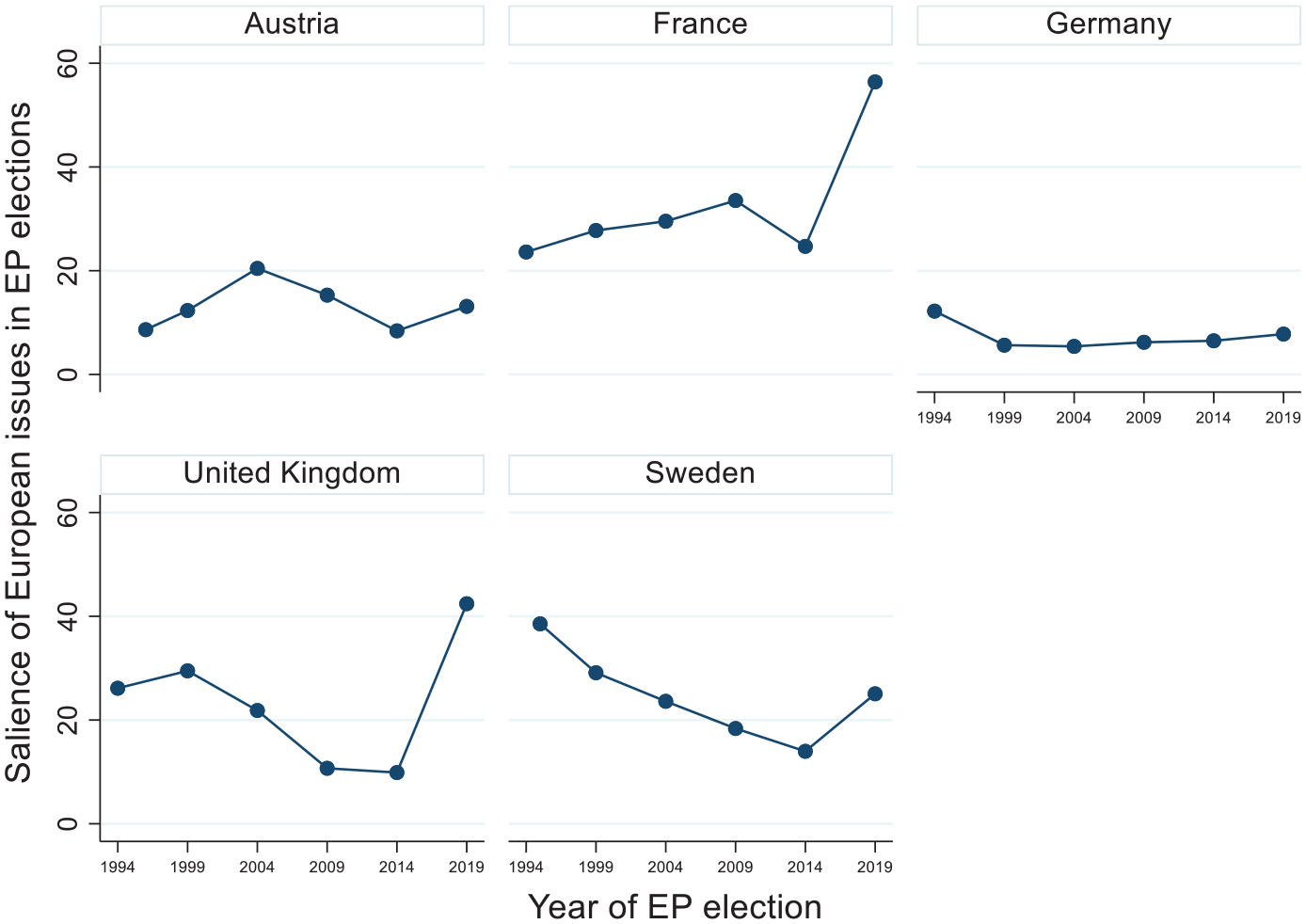
The salience of European issues in the 2019 EP elections.
In the next step, we devote our attention to the Europeanness of the electorate. In theory, the increasing politicisation of Europe together with higher levels of EU issue salience in EP elections should be equally reflected at the voter level and ultimately lead to higher levels of participation in these elections. Therefore, the European electorate should have the capacity to distinguish the main features of national and EU politics. To explore this question, we look at the distribution and correlations of our indicators for Europeanness. Figure 2 presents the mean values for each of the six attitudinal variables per country at both the national and EU level together with confidence intervals at a 95% level to be able to assess their difference. 6 At least three important results are worth highlighting from this figure. The first is that with very few exceptions, the national and EU variables for all countries are significantly different. In this regard, citizens seem to clearly distinguish politics at the national and EU level, attributing clearly different weights to the same question depending on the type of ‘polity’ the questions are referring to. Second, it is important to note that, for most of the variables and most especially for political trust, interest in politics, attachment, and complexity of politics, the values for the national levels are consistently higher than for the EU. This means that, overall, citizens tend to display higher trust towards national institutions (by an average of 1 point on an 11-point scale) than in European institutions; they feel more attached to their own nation than to the EU (by a more than 3-point average, notably in the United Kingdom); and they also find national politics more interesting and EU politics more complex. It would seem that on average national politics, in the minds of citizens, plays a more crucial role than EU politics. Third, it should also be pointed out that the directions of these differences (despite some variation in magnitude) are consistent across countries, which suggests that the observed patterns are not contingent upon national politics or average national support for the EU (think, for instance, of Germany as against the United Kingdom) but that these patterns of attitude are stable and possibly representative of the north-west European macro-region. Altogether, we can summarise that the European electorate has the capacity to distinguish the main features of national and EU politics (H2).
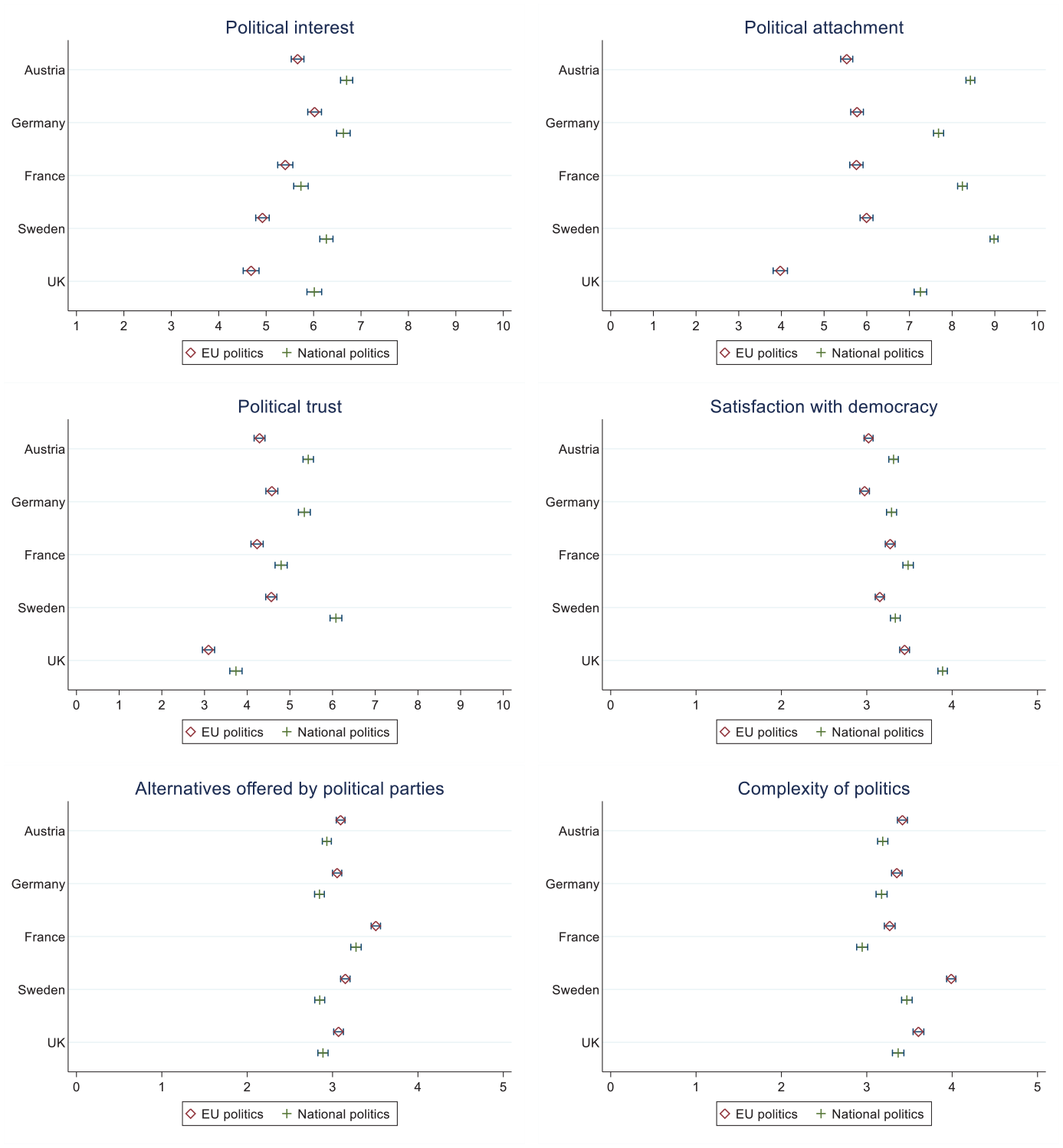
Mean values of national and EU attitudes per country.
While our data reveal that national politics remain more crucial than EU politics to the large majority of the population, there is nevertheless a not insignificant number of citizens who display what we call Europeanness, meaning that, contrary to the majority of their compatriots, they attribute more value to the European polity as opposed to the national one (see also descriptive values for differentials in Table A.2.1 in the Supplemental Appendix). As previously discussed, we expect that it is precisely the variation in this Europeanness that is an important factor in explaining why some citizens participate in EP elections. In a final step, we thus look at the results of our multivariate logistic models and discuss how these genuine European orientations ultimately explain electoral turnout. We present the results of our multivariate analysis to explain electoral participation in EP elections with the differential measures between national political orientations and European orientations for each country. Each of the presented models includes a series of socio-demographic and economic controls in the regression models which include age, gender, education, type of city/town, and feeling about present income. These variables should help to isolate the effect of the attitudinal variables on turnout. Figure 3(a) presents the coefficient plots of differential orientations on turnout, while Figure 3(b) includes participation in national elections, which helps to pinpoint the basic mobilising character of genuine orientations towards European politics (see also Tables A.2.3 and A.2.4 in the Supplemental Appendix).
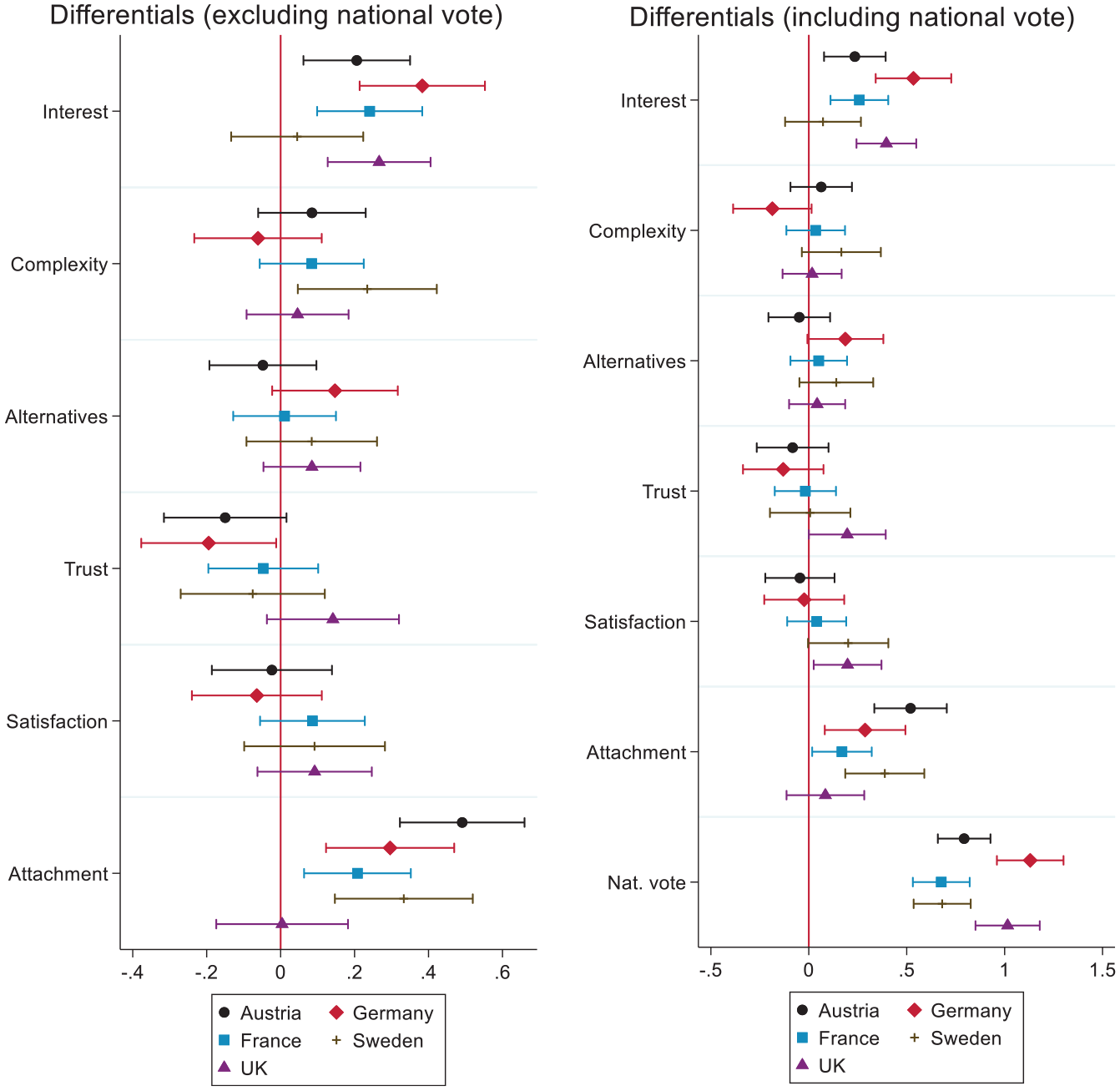
Coefficient plots of differential orientations on turnout by country.
When including all of the attitudinal variables (i.e. the differentials between national and European orientations) in the same model, there are two variables that capture most of the effect on electoral participation in EP elections. 7 On one hand, a genuine interest in European politics is obviously a strong indicator for capturing the motivation of an individual for participating in EP elections. We can observe a statistically significant effect for all countries except Sweden. On the other hand, genuine attachment to the EU shows a statistically significant effect on electoral participation for all countries except the United Kingdom. As in the case of genuine interest in EU politics, our model predicts that the more respondents feel attached to the EU with respect to their country, the higher their probability of voting in EP elections. Hence, the findings clearly show that at least two types of orientation vis-a-vis EU politics had significant consequences for electoral participation in the 2019 EP elections. One key question, however, is whether these findings still hold true if we consider participation in national elections. Therefore, Figure 3(b) illustrates the coefficients under the additional control of electoral participation in national elections. The findings clearly illustrate that on the one side citizens’ participation in national elections is by far the most relevant explanatory determinant for electoral participation in EP elections. On the other side, genuine interest in EU politics and attachment to the EU (in relation to the national attachment) still affects turnout in EP elections significantly. Accordingly, we can assert that European politics plays a role in electoral participation in EP elections: a respondent who has a strong interest in EU politics and who truly feels attached to the EU has a higher propensity to cast her ballot in EP elections than one who is less interested and feels less attached. 8
Conclusion
Both the EU and the EP have transformed over the past two decades, as have EP elections and European electorates. In view of such transformations leading eventually to an increasing politicisation of Europe, the aim of this article was to study the Europeanness of the 2019 EP elections. We investigated this phenomenon in terms of the public debate in the run-up to the elections and voters’ mobilisation through European issues. In sum, the findings of this study indicate that the elections to the EP were more European contests than ever before in the history of these elections – yet this is not true for all countries in the same way. A clear sense of Europeanness especially exists in those countries where European issues dominated the general political debate and not only the EP election campaign (H1). The latter is in line with a recent article highlighting the crucial role of mainstream parties for the politicisation of Europe in EP elections (Braun and Grande, 2021). Moreover, our findings illustrate that the European electorate has the capacity to distinguish the main features of national and EU politics (H2), and that the European electorate’s orientations towards EU politics have an impact on people’s decision to cast a ballot in EP elections (H3). We can thus clearly show that the ‘Europeanness’ of the electorate matters for electoral participation in EP elections. In particular, genuine interest in European politics and genuine attachment to Europe were crucial for individuals’ participation in the 2019 EP elections. This is even true under the control of participation in national elections – an indicator for the socialised habit of voting, which is primarily anchored at the national level of politics.
What do these findings tell us and what are the main contributions of our study? First, it is important to note that all findings need to be interpreted in the light of the two main limitations of this study, the country selection and the issue of over-reporting which is related to the fact that respondents were selected from an online access panel, which led to a significant over-representation of well-educated citizens. As a consequence, our findings should not be simply transferred to the full set of all EU member states but rather be seen as representative of the north-west European macro-region. Moreover, the findings are expected to show some bias towards well-educated citizens and should be interpreted with care for the overall population (in particular in the case of Sweden). Bearing in mind the limitations, in terms of its conceptual contribution, this study was able to show that it is important to differentiate between various types of EU orientations and to relate these to national political attitudes. This strengthens the insights provided by previous approaches in this regard (Anderson and Hecht, 2018; Boomgaarden et al., 2011; De Vries, 2018). The findings of this study have brought to light that a genuine interest in EU politics and an attachment to the EU are predictors for turnout, while the other orientations towards EU politics are not. European-wide public opinion studies should thus try to incorporate a larger set of orientations vis-a-vis the EU. This would enable researchers to test these and related research questions for a wider or even full country selection and under the further control of contextual-level variables.
Second, we can illustrate that both aspects of Europeanness, the supply and the demand side, are relevant in themselves. For the particular case of the supply-side analysis, we were able to show that a clear sense of Europeanness was existent especially in those countries where European issues dominated the general political debate – a finding which should be further investigated in the light of the research on the politicisation of Europe in national (Hutter et al., 2016) and in EP elections (Braun and Grande, 2021). If European issues become more contested within the national context (Hobolt and Rodon, 2020), this will, according to our findings, contribute to more Europeanised EP elections. Moreover, this double perspective brought to light that in the two countries, where the debate over European issues was extensive (France and the United Kingdom), genuine interest in EU politics was also a mobilising factor for respondents – but, interestingly, this was also the case in the two countries that saw less (Austria) or even very little significant debate over European issues (Germany). Nonetheless, we did not investigate the specific interrelations between the supply and the demand side in this article, but future scholarly work should certainly deal with this issue and study the links between election campaigns, electoral outcomes, and electoral behaviour in more detail.
Finally, our findings show that Europeanness was pertinent in the 2019 EP elections: European issues shaped the public debate around these elections and genuine European orientations have the power to mobilise citizens. Nonetheless, the role of national politics cannot be neglected in these elections. These findings have important implications both for the future assessment of EP elections and for the scholarly debate over multi-level electoral politics. In the same way, as the personalisation of the election campaign at the EU level of governance by introducing the so-called Spitzenkandidaten system did not result in significantly higher turnout rates as (national) political parties did not push ‘their’ lead candidates in their election campaigns and did not even have any incentives to do so (Braun and Popa, 2018; Braun and Schwarzbözl, 2019), orientations vis-a-vis EU politics are not meant to be the only means of mobilising citizens to vote in EP elections. In the EU multi-level system, we always have to bear in mind both national and EU-level factors. But in view of the fact that European issues have the power to mobilise voters, future scholarly work should build on these insights to arrive at a more comprehensive picture of the contemporary state of multi-level electoral democracy in Europe.
Supplemental Material
sj-pdf-1-pol-10.1177_0263395721992930 – Supplemental material for The Europeanness of the 2019 EP elections and the mobilizing power of European issues
Supplemental material, sj-pdf-1-pol-10.1177_0263395721992930 for The Europeanness of the 2019 EP elections and the mobilizing power of European issues by Daniela Braun in Politics
Footnotes
Acknowledgements
The author thanks Guillem Vidal who has run the EEC online survey as well as Jan Einhoff, Paul Pöhlmann, David Schweizer, and Tuba Nur Yilmaz for their invaluable research assistance.
Declaration of conflicting interests
The author(s) declared no potential conflicts of interest with respect to the research, authorship, and/or publication of this article.
Funding
The author(s) disclosed receipt of the following financial support for the research, authorship, and/or publication of this article: This study was conducted on behalf of the project ‘Conflict structuring in European Elections’ funded by the German Research Foundation (DFG) between 2016 and 2020. The project is directed by Daniela Braun and Edgar Grande at the LMU Munich and the WZB Berlin.

Supplemental information
Additional supplementary information may be found with the online version of this article.
Notes
Author biography
References
Supplementary Material
Please find the following supplemental material available below.
For Open Access articles published under a Creative Commons License, all supplemental material carries the same license as the article it is associated with.
For non-Open Access articles published, all supplemental material carries a non-exclusive license, and permission requests for re-use of supplemental material or any part of supplemental material shall be sent directly to the copyright owner as specified in the copyright notice associated with the article.
