




Abstract
Though intended to refer to everyone, generically intended masculine role nouns are often interpreted as referring (primarily) to men. While the use of more inclusive forms counters this bias, previous studies have largely focused on languages with a salient masculine/feminine grammatical gender distinction and used measures that focus participants’ attention on gender. The present study uses an indirect measure and investigates Dutch, a grammatical gender language that has largely lost the distinction between masculine and feminine gender, but still uses gender-specific marking for role nouns. A total of 130 participants named the first three people they could think of when presented with either a word pair (e.g., zangers/zangeressen–“singersmasculine/singersfeminine”) or a generically intended masculine (zangers). Compared to the generically intended masculine form, word pairs increased the mental availability of nonmen, suggesting that a more inclusive form facilitates activation of nonmasculine exemplars for speakers of Dutch as well.
Keywords
Introduction
It is the start of the new semester, and you are composing an email for your new students to provide them with some information on your course. “Dear students,” you start your email. Nothing too exceptional about this if you happen to be emailing them in English. After all, regardless of their specific gender identification, all students can feel perfectly included by this, given that English, bar a few exceptions like actor-actress and prince-princess, does not generally morphologically gender-mark role nouns (i.e., nouns that identify the position, function, or occupation of a person). However, if you happen to be a German lecturer, there are some choices for you to make on this front. You could go for the masculine form of the noun (Studenten, “students”) and use it in a generic sense, regardless of the actual gender composition of the group, specify male and female students explicitly (Studenten/Studentinnen, with the—innen suffix reflecting the feminine plural form) or go for a nominalized form (Studierenden, “those who study”). Alternatively, you could use one of the various linguistic innovations that have been developed for German in order to allow speakers to refer to (groups of) people without explicitly specifying the nature of their gender or assuming that the masculine form can be used as a stand-in for all genders. You thus might choose, for instance, the gender star (Student*innen), the capital I (StudentInnen), or the gender gap (Student_innen), forms that are also recognizable in spoken language (a glottal stop is inserted before the start of the gender-specific ending, see Körner et al., 2024). Indeed, German is not the only language that gender-marks role nouns that has developed this kind of innovation. For instance, French has the interpoint (étudiant·e·s, “students,” where étudiants represents the masculine plural form of the noun and étudiantes is the plural feminine form) and for Spanish and Portuguese it is possible to use an -@, an –e, or an -x to refer to all genders instead of the -o suffix that is associated with the masculine gender (and thus with the generic masculine (GM) form) or the -a suffix that is associated with the feminine gender (e.g., Spanish alumnes or Portuguese alun@s, “students,” where masculine plural forms would be alumnos and alunos, respectively).
However, not all languages that have gender-marking for role nouns have developed new forms to allow more inclusive reference. For Dutch, the language that the present study focuses on, no novel form has been developed. Use of the masculine form to refer to mixed gender groups (e.g., studenten, “students,” with the plural -en suffix added to the masculine singular form student) is very common; use of the female plural form (studentes, with the plural -s suffix added to the feminine form studente) would only be deemed appropriate for an all-female group. Forms such as studenten/studentes, studenten(es), or studenten (m/v) (in which m stands for man, “male,” and v stands for vrouw, “female”) can also be used (although perhaps less commonly, 1 see also Zenner et al., 2019), but these forms only specify the male and female gender and do not, or at least not explicitly, refer to any other genders. Use of the form [m/v/x] (e.g., zanger [m/v/x] to indicate that the noun can refer to a male, female or nonbinary singer) is attested in some places (e.g., from 2022 onward, the Dutch dictionary Dikke Van Dale has added this to all words that refer to humans 2 and it can occasionally be found in job adverts), but this form is not used in spoken language and only rarely in written language, suggesting that it has not (yet) gained much traction. For Dutch, then, there is currently no generally recognized role noun form that can be used in both spoken and written language to refer to (groups of) people in a more inclusive way (see also Zenner et al., 2019, for an overview).
So, does it matter that, for Dutch, the masculine form of the role noun is the standard way to refer to people, regardless of the actual gender identifications of the individuals involved? Outcomes of previous studies on languages other than Dutch suggest that this may indeed be problematic. A broad study investigating gender perception of role nouns for speakers of various languages (Misersky et al., 2014) found that male stereotyping is strong for role nouns: regardless of the particular linguistic and cultural background of those in the sample, across the board, people consider groups denoted by role nouns to consist of more men than women. Furthermore, as compared to more inclusive forms, use of masculine forms (in role nouns, but also in other linguistic contexts, such as the third person singular masculine pronoun) has consistently been found to lead to a male bias. That is, language users are more inclined to interpret a generically intended masculine form as referring to men than to nonmen, whereas more inclusive terms counter this effect (see, for instance, Braun et al., 2005). This effect has been found for speakers of languages such as German (Braun et al., 1998, 2005; Brohmer et al., 2024; Glim et al., 2023; Kurz & De Mulder, 2023; Stahlberg et al., 2001), French (Gygax et al., 2012, 2019b; Spinelli et al., 2023; Xiao et al., 2022), Spanish (Anaya-Ramírez et al., 2022), and English (Hamilton, 1988; Moulton et al., 1978), using various methodologies (which will be elaborated on in the following section). Furthermore, this bias towards a male interpretation seems to have real-life effects in terms of the perceptions and evaluations of those who do not identify as men (see Sczesny et al., 2016, for a review). For instance, studies conducted in German (Horvath & Sczesny, 2016), English (Stout & Dasgupta, 2011), and Hebrew (Vainapel et al., 2015) tested the use of generically intended masculine forms in comparison to more inclusive forms in the context of careers and found that women considered themselves and other women to be less suited to a job, and were less willing to do the job, when information was presented using a generically intended masculine form as compared to more inclusive forms.
Findings like these thus suggest that the type of language used does affect people's perceptions and that the dominant use of masculine role nouns in Dutch may have negative consequences for the visibility and evaluation of people who do not identify as men. However, in comparison to the languages investigated in the studies discussed above, Dutch has somewhat different linguistic characteristics (see Gygax et al., 2019a). English has a natural gender system in which role nouns tend to be gender-neutral (e.g., student), only allowing gender to be made specific by adding an adjective (e.g., female student). Some gender-marked forms still exist (e.g., actor-actress), but morphological marking of gender on role nouns is not productive. In these systems, referential gender is expressed using pronouns such as he and she. In contrast, Dutch is a language that has grammatical gender. Each noun is thus assigned a particular grammatical gender, and role nouns tend to express the masculine or feminine gender of the referent (e.g., student vs. studente). However, while languages like German, French, Spanish, Portuguese, and Hebrew make a distinction between masculine and feminine grammatical gender (with languages like German also recognizing a neuter gender category), this distinction has largely disappeared in Dutch, with masculine and feminine nouns being subsumed in one common gender category (Gerritsen, 2002; Mortelmans, 2008). Speakers of Dutch thus distinguish “de”-nouns (common gender nouns that occur with the definite article “de”) from “het”-nouns, but would have to consult a dictionary to determine whether a particular “de”-noun is masculine or feminine in order to use its pronominal form (which has retained a three-way masculine/feminine/neuter distinction). In most cases, this entails speakers just opt for the masculine pronominal form (see Gerritsen, 2002; Mortelmans, 2008; Semplicini, 2012). 3
In practice, then, Dutch, as spoken in the Netherlands, does not make an explicit distinction between masculine and feminine grammatical gender for nouns (for an overview of the Dutch gender system, see Gerritsen, 2002; Gygax et al., 2019a). Dutch is not unique in this respect, as modern Danish (Gomard & Kunøe, 2003), Swedish (Fraurud, 2000), and some dialects of Norwegian (Bull & Swan, 2002, but see Opsahl, 2021) similarly only distinguish between common and neuter gender (for a broader overview of the gender systems of many different languages, see Hellinger & Bußmann, 2015). However, Dutch is like other grammatical gender languages that distinguish masculine and feminine gender, but unlike natural gender languages and grammatical gender languages that make a common/neuter gender distinction, in that it does generally morphologically mark role nouns as masculine or feminine. While there are terms like arts (“doctor”), or notaris (“notary”) that are gender-neutral, many role nouns receive a gender-specific suffix to clarify whether the noun refers to a man or a woman. Quite a number of suffixes are used for this purpose, for instance, -e, as in student-studente (“student”); -ice, for acteur-actrice (“actor”), -ster, for schrijver-schrijfster (“writer”), or -euse, in chaffeur-chaffeuse (“driver”). Even though nouns as a general class are thus only distinguished in terms of common versus neuter gender, when it comes to role nouns, Dutch acts like grammatical gender languages that make a masculine/feminine distinction. This may have consequences for how these nouns are interpreted: the gender of role nouns may be a less salient characteristic for speakers of Dutch, given that the linguistic system as a whole may be less focused on gender than is the case for speakers of languages that do make masculine/feminine grammatical gender distinctions throughout the system. Alternatively, perhaps it is more salient, given that it is one of the few instances in which the masculine/feminine distinction is still maintained.
Indeed, previous studies suggest that generically intended masculine forms are interpreted differently by speakers of masculine/feminine grammatical gender languages as compared to natural gender languages, with speakers of grammatical gender languages generally interpreting them as male-dominant, whereas natural gender language speakers tend to base processing on gender stereotypes (Carreiras, 1996; Gabriel et al., 2008; Gygax et al., 2008). For a language like Norwegian, that no longer gender-marks role nouns and which seems to be moving toward a common gender system for at least some varieties, role nouns that are associated with gender stereotypes are interpreted in line with the stereotype, but speakers demonstrate a male bias when the role noun is perceived as neutral (Gabriel & Gygax, 2008).
Given that the gender system of a language thus seems to matter for role noun interpretation, this suggests that speakers of Dutch may process generically intended masculine role nouns differently as compared to speakers of natural gender languages, speakers of masculine/feminine grammatical gender languages, and speakers of languages with common/neuter gender that do not gender-mark role nouns. If this is indeed the case, it could perhaps also explain why more inclusive forms are largely lacking for Dutch: if generically intended masculine forms are actually interpreted inclusively, linguistic innovations on this front may simply not be necessary.
The Influence of Generically Intended Masculine Role Nouns on Mental Representations
A substantial body of previous work on the interpretation of generically intended masculine forms has suggested that they lead to a male bias. This has been demonstrated using various methods, including sentence evaluation (De Backer & De Cuypere, 2012; Gabriel & Gygax, 2008; Gygax et al., 2008; Körner et al., 2022; Misersky et al., 2014), ERP studies (Glim et al., 2023, 2025; Misersky et al., 2019), self-paced reading (Carreiras, 1996; Irmen & Roßberg, 2004), eye-tracking (Irmen & Schumann, 2011), and exemplar naming (Brohmer et al., 2024; Gabriel & Mellenberger, 2004; Kurz & De Mulder, 2023; Schunack & Binanzer, 2022; Stahlberg et al., 2001).
In sentence evaluation studies, participants are, for instance, presented with two sentences and asked whether they consider the second sentence to be a logical continuation of the first sentence. The first sentence then contains a reference to a group of people, using either a masculine role noun or a more inclusive form, and the second sentence contains a reference to some men or women within that initial group of people. For instance, “The concert attendees were already on site. One could see that some of the men/women were bored” (example from Körner et al., 2022, original stimulus presented in German). In the first sentence, “concert attendees” would be rendered as a masculine form, a word pair (WP), or as a novel gender-inclusive form, and the second sentence would contain either the noun “men” or “women.” For these kinds of studies, both the responses and the response times demonstrate that participants consider continuations referring to women as less logical than those referring to men, suggesting that the masculine role noun is not interpreted generically in these contexts in which it is intended as such. When a similar set-up is used in an ERP context (Misersky et al., 2019), comparable findings are reported (if a masculine role noun is used to introduce a group of people, and these people turn out to be women, the ERPs suggest that this leads to processing difficulties). In other evaluation paradigms, participants are asked to reflect on which gender (or genders) a role noun refers to (e.g., De Backer & De Cuypere, 2012; Misersky et al., 2014), with findings generally suggesting that masculine role nouns are interpreted as referring primarily to men.
In the self-paced reading paradigm, sentence pairs are also used, but the reading time for each sentence is investigated separately, and participants are not asked to judge the sentence pairs. Generally, studies using this methodology find that sentences in which masculine role nouns are used to refer to women lead to slower processing than when these forms are used to refer to men, again suggesting a nongeneric interpretation of the masculine role noun. Eye-tracking studies also demonstrate differences in terms of processing role nouns dependent on whether they are predicated of a masculine or a feminine referent (Irmen & Schumann, 2011).
A third common methodology, exemplar naming, which is the methodology that is applied in the present study, specifically investigates the mental availability of nonmasculine exemplars depending on the linguistic form of the role noun that is presented to participants. For instance, participants may be asked to “name three singers,” in which the noun is rendered in its masculine form or as a more inclusive form. This means that even though speakers may recognize the generic intent of the masculine form (which is the focus of studies that require participants to read sentences in which the masculine form is used to refer to nonmen), use of this form could still lead to masculine exemplars being more available and thus more likely to be named. This methodology thereby provides insight into how generically intended masculine forms affect how people represent the situation that a linguistic contribution sketches. As it does not focus participants’ attention on gender, this methodology minimizes the chance of obtaining socially desirable responses. Furthermore, it is informative in terms of interpreting real-life situations in which it may be very relevant to know if the use of a particular linguistic form will lead to some people feeling more addressed than others (e.g., in the context of potential applicants for job adverts) or being more likely to spring to mind than others (e.g., coming up with people to be considered for a promotion, see also Brohmer et al., 2024). At this point in time, all but one of the studies that have used this methodology have been conducted in German, a language that makes a three-way grammatical gender distinction (masculine/feminine/neuter) and that morphologically gender-marks role nouns. These studies demonstrate that if the masculine role noun is used, fewer nonmen are mentioned than when a more inclusive form is used, and, for most studies, this finding is regardless of which specific other form is used (Gabriel & Mellenberger, 2004; Keith et al., 2022; Kurz & De Mulder, 2023; Schunack & Binanzer, 2022; Stahlberg et al., 2001; Stahlberg & Sczesny, 2001). For instance, Stahlberg et al. (2001) assessed three conditions: masculine (Politiker, “politicians”), WP (Politikerinnen und Politiker, “politiciansfeminine and politiciansmasculine”), and a novel inclusive form (in this case, capital I, PolitikerInnen, “politicians”). Fewer nonmen were named in response to the masculine role noun, as compared to both other forms, and the most inclusive form, the capital I, led to the highest number of nonmen being mentioned, a result that was also reported by Stahlberg and Sczesny (2001). It should be noted that Schunack and Binanzer (2022) demonstrate that this result cannot be explained by participants being confused by the resemblance of the capital I form to the female plural form (PolitikerInnen vs. Politikerinnen, respectively), as the feminine plural form led to over 80% of the named exemplars in this condition being women, whereas this value was much lower for the capital I condition (45%).
In a large-scale (N = 2,697) replication of Stahlberg et al. (2001), Brohmer et al. (2024) demonstrate findings very similar to those reported above. That is, more than 20 years after these original findings were reported, they too demonstrated that inclusive forms lead to higher mental availability of nonmen as compared to generically intended masculine forms. Indeed, these results even remained when the perceived base rate (i.e., the expected proportion of women for a particular category) was controlled for, suggesting that linguistic form affects responses even when social expectations regarding gender distributions for professional roles are taken into account.
However, there is some inconsistency in the findings regarding the effectivity of the WP form. In the majority of studies of this type, use of the WP does lead to male bias reduction as compared to the masculine role noun (e.g., Brohmer et al., 2024; Gabriel & Mellenberger, 2004; Keith et al., 2022; Stahlberg & Sczesny, 2001), but some studies suggest that it is not associated with a reduction in male bias. In Experiment 2 by Stahlberg et al. (2001), for instance, the WP form was not found to lead to a higher cognitive availability of female exemplars. Similarly, Schunack and Binanzer (2022) found only the capital I-form and the feminine plural, and not the pair-form, to lead to more female exemplars being named, compared to the masculine form. Thus, while naming studies generally find the generically intended masculine role noun to lead to a male bias in comparison to more inclusive forms, they do not all find that the WP form increases the availability of nonmale exemplars, while this does seem to be the case for novel inclusive forms.
While naming studies provide relevant data in terms of the mental availability of nonmen, by far the most of these studies have focused on German. Only one study seems to have been conducted on a different language: Gabriel (2008), which investigated Norwegian (the Bokmål variety), which makes a three-way (masculine/feminine/neuter) grammatical gender distinction (Bull & Swan, 2002) and which officially abolished gender-marking from role nouns in the 1970s. While the results of this study largely correspond with the findings for German (i.e., a prompt with the, currently obsolete, WP form leads to more nonmen being named as compared to a generically intended masculine form), this study asked participants for their most and least liked exemplars of various categories (e.g., “Which actor do you like most?”) instead of asking for exemplars that spring to mind first. This set-up entails that personal preferences play a large role in concept activation (and thus the mental availability of exemplars), and the linguistic form of the prompt likely plays a more secondary role. Furthermore, while the Norwegian study used a WP form, the female version of the role noun is no longer used. While participants presumably did recognize this form, it was a very marked linguistic choice and thus may have acted as an obvious prompt for participants to mention women in their responses. While there is thus some suggestion in the literature that the findings regarding effects of more inclusive forms on the mental availability of gendered concepts extend beyond speakers with a German cultural and linguistic background, firmer conclusions on this front can only be drawn with more research on speakers of other languages.
The Interpretation of Generically Intended Masculine Forms in Dutch
The present research investigates whether the findings reported above also hold for speakers of Dutch, as not many studies have focused specifically on Dutch role noun interpretation, and the linguistic characteristics of Dutch differ in relevant respects from those of languages that have received more intensive study on this front. Indeed, the few studies that have investigated Dutch role noun interpretation investigate Belgian Dutch and have reported somewhat conflicting results. In their study comparing German and Belgian Dutch children, Vervecken et al. (2013) and Vervecken and Hannover (2015), for instance, found that Belgian Dutch children displayed a stronger tendency to gender-stereotype than German children when faced with jobs described using a generically intended masculine form and that all children reported more positive ideas about women's skills and status when the occupations were described using a more inclusive WP form. However, findings by De Backer and De Cuypere (2012) paint a different picture. This study asked Belgian Dutch and German participants to read simple sentences with a masculine role noun, and then state whether they expected this sentence to be about a man, a woman, or either gender. In this case, the results demonstrated that masculine singular nouns were interpreted as neutral almost twice as often by the Belgian Dutch participants as compared to the German ones. Thereby suggesting that Belgian Dutch speakers may actually interpret masculine role nouns generically in contexts in which this is intended (or, at least, more so than their German counterparts). Finally, Redl et al. (2018, 2021, 2022) reported findings of studies conducted in the Netherlands (and thus, presumably, involving speakers of Netherlands Dutch) that are in line with what De Backer and De Cuypere (2012) suggest. Redl et al. (2018) tested the interpretation of the Dutch third-person singular possessive pronoun zijn (“his”) in the context of masculine, feminine, and neutral stereotypes in order to assess whether it would evoke a masculine bias in readers. Participants were asked to read sentence pairs, where the first sentence contained an activity embedded in one of these stereotype contexts, and the second sentence contained a masculine or feminine first name (e.g., “Everyone was brushing his [zijn] teeth. Daphne, too, was getting ready to go to bed,” as an example of a neutral stereotype context followed by a feminine first name). They were then asked to judge whether these sentences were correct. If participants interpreted zijn (“his”) nongenerically, the processing of a feminine first name in the second sentence was expected to lead to slower reading times. However, whereas the study found no evidence for this (i.e., processing was not impeded by the presence of a feminine first name as a referent for the third person singular masculine pronoun), it did find an effect of stereotype context. When a stereotypically female endeavor (e.g., practicing yoga) was followed by a masculine name, reading times were longer than when reading a feminine name in the same position. This finding was replicated by Redl et al. (2021). However, this latter study also included a sentence evaluation experiment which did find evidence of a male bias, but only in a very specific context: for male participants when reading sentences in a stereotypically neutral context (e.g., “Everyone was tying his [zijn] shoelaces, among whom a few men who would have had to leave ten minutes ago, but had overslept”). A similar difference in responses between male and female participants was also reported by Redl et al. (2022).
Overall, the findings from studies investigating (Belgian) Dutch masculine forms that are intended generically point in somewhat different directions. De Backer and De Cuypere (2012) report that Belgian Dutch participants were much more likely to consider a masculine role noun to be applicable to people of both genders than German participants were. Furthermore, Redl et al. (2018, 2021, 2022) suggest that generic use of the third person singular possessive pronoun zijn is generally interpreted as such (with evidence for a male bias only found in a very limited context). This thus suggests that (Belgian) Dutch speakers may be inclined to interpret generically intended masculine forms as such. However, other studies find that Belgian Dutch children's perceptions are strongly gender-stereotyped when confronted with a masculine role noun (much more so than those of German children) and that the use of a WP form does reduce the extent of this male bias (Vervecken et al., 2013; Vervecken & Hannover, 2015). In general, then, more information is needed in order to determine how generically intended masculine role nouns are interpreted by speakers of Dutch. Given that role noun interpretation studies have focused on Belgian Dutch speakers and Belgian Dutch differs from Netherlands Dutch in terms of its grammatical gender system (with a masculine/feminine gender distinction retained for nouns for speakers of Belgian Dutch, but not for Netherlands Dutch speakers, see Gerritsen, 2002), it is not clear how speakers interpret role nouns when there is no general masculine/feminine distinction for nouns, but role nouns do receive gender-specific marking.
Nonlinguistic Factors in the Interpretation of Masculine Versus Inclusive Forms
The specific linguistic form that is used is not the only factor that seems to affect the extent of the male bias in the interpretation of generically intended masculine forms. Various studies have suggested that the gender of the participant also plays a role, with female participants naming more feminine exemplars in various German naming studies (e.g., Brohmer et al., 2024; Gabriel & Mellenberger, 2004; Keith et al., 2022; Kurz & De Mulder, 2023; Stahlberg et al., 2001; Stahlberg & Sczesny, 2001). Similarly, studies using methodologies other than exemplar naming have also found that women exhibit less of a male bias than men (e.g., none of the studies by Redl et al., 2018, 2021, 2022 report a male bias for female participants). However, the one Norwegian naming study that was conducted (Gabriel, 2008) only found an effect of participant gender in their positive context (with women naming more women in the “most liked” category), but not in the negative context (i.e., the “least liked” category). The current study thus includes participant gender as a potentially relevant factor in order to further illuminate this issue.
Another factor that may influence participants’ interpretations of generically intended masculine forms is their attitude towards gender-inclusive language (GIL). Hansen et al. (2016) suggest that the use of GIL can make one think in more gender-inclusive ways. This thus entails that participants who are GIL users themselves may be less likely to display a male bias, potentially even in their interpretation of masculine forms. This is also seen in previous naming studies, as Stahlberg and Sczesny (2001) report that participants with positive attitudes towards GIL were more affected by the different linguistic forms in the study (naming more women in response to the inclusive forms), and Brohmer et al. (2024) found that participants who viewed GIL positively generally named more women. Not all studies report these effects of attitudes to GIL, though, as, for instance, Körner et al. (2022) did not find that participants’ GIL attitudes affected their responses to the different linguistic forms that they were presented with. The current study thus includes a brief self-report measure of GIL attitudes and use, such that potential effects of this factor can be considered.
The Present Study
The aim of the present study is to investigate whether masculine role nouns that are used generically are associated with a male bias in speakers of Dutch and whether the WP form, a gender-inclusive form that explicitly spells out a nonmasculine form and that is attested with some frequency in Dutch, is associated with a more inclusive interpretation. Given that previous studies investigating this matter have largely focused on grammatical gender languages with a masculine/feminine distinction, investigating Dutch, as a grammatical gender language that does not distinguish between masculine and feminine nouns, but which does morphologically gender-mark role nouns, provides an interesting addition to the current state of knowledge. If similar effects in the interpretation of generically intended masculine role nouns as compared to more inclusive forms are observed for speakers of Dutch as for speakers of languages that do make an explicit masculine/feminine grammatical gender distinction, it would seem reasonable to suggest that this characteristic of the grammatical gender system is not driving the results. Furthermore, although some previous work has been done on the interpretation of generically intended masculine forms in (Belgian) Dutch, more research is needed on this front, as studies that have investigated role nouns have focused on Belgian Dutch and not Netherlands Dutch (and the two varieties differ in terms of their gender system) and some studies do find evidence for the presence of a male bias whereas others seem to suggest that generically intended forms may indeed be interpreted generically.
In order to illuminate these issues, the current study used a design very similar to previous naming studies (e.g., Brohmer et al., 2024; Kurz & De Mulder, 2023; Stahlberg & Sczesny, 2001; Schunack & Binanzer, 2022), but with speakers of (Netherlands) Dutch, rather than German or Norwegian. Participants were thus asked to name the first three people that came to mind from various different role noun categories related to the public domain. This method was chosen as it is informative regarding the cognitive availability of exemplars (i.e., to what extent do people think of nonmen when they see a masculine or a more inclusive form?), rather than just testing whether Dutch speakers accept that generically intended masculine forms can also refer to those who do not identify as men. Furthermore, it provides an indirect measure of the cognitive availability of nonmasculine exemplars, instead of directly focusing participants’ attention on gender as a relevant category and thereby thus potentially nudging them in a specific direction. The current study compared generically intended masculine role nouns with the WP form, as this form (created by using both the morphologically masculine and feminine versions of a role noun and separating them by a forward slash) will be recognizable to participants and explicitly mentions both forms, instead of presenting the feminine form as a derivative of the masculine form. In this way, our aim was to make the presence of nonmasculine exemplars as salient as possible within the confines of the linguistic forms that our participants were likely to be exposed to in their daily lives. Participants were thus asked to name, for instance, three zangers/zangeressen (“singersmasculine/singersfeminine”) or three zangers, and the number of nonmasculine exemplars that were provided across all the categories is compared across these two conditions. In order to assess whether participant gender would affect the outcome, this factor was also included in the design of the study. GIL use and attitude questions were included to assess whether our experimental groups differed on this front and to investigate whether these measures would be related to the gender distribution of the exemplars our participants came up with, independent of the linguistic prompt that participants were exposed to.
Method
Participants
A total of 158 participants responded to an online survey. As 28 responses had to be excluded due to data issues (e.g., incomplete responses), a total of 130 participants remained, all of whom were adults and native speakers of Dutch 4 (see the Supplemental Material for more information on the reasons for exclusion). As a power analysis using G*Power (Version 3.1.9.7, Faul et al., 2007) suggested that a sample size of 128 would be sufficient for detecting a medium-size effect (as obtained for the comparison between WPs and the masculine form in speakers of German reported by Brohmer et al. (2024), a study with a very similar design) with an ANOVA (f = 0.25, with 80% power and α = .05) this was deemed to be a sufficiently large sample. However, as participant gender was skewed (42 participants identified themselves as men, 87 as women, and one as nonbinary), analyses including participant gender as a factor need to be interpreted with caution and are only reported as a secondary analysis in the Results section below. Table 1 contains a full overview of the gender and age-related characteristics of the participants, as well as information on the division over the GM and WP conditions.
Demographic Characteristics of the Participants.
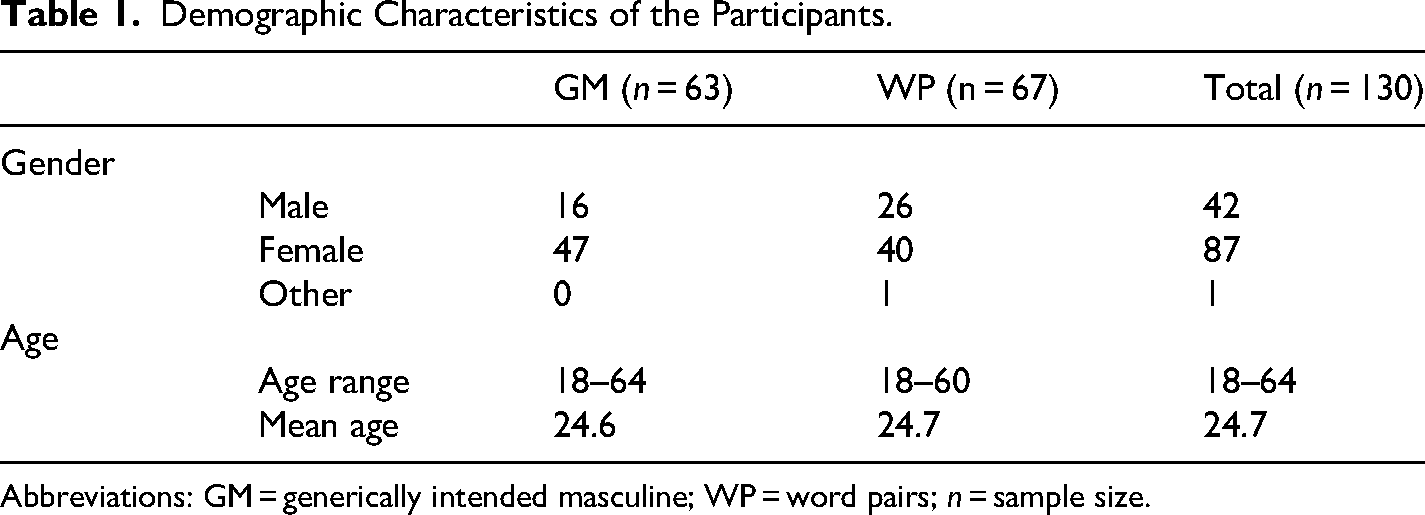
Abbreviations: GM = generically intended masculine; WP = word pairs; n = sample size.
The majority of the participants had either completed secondary school or had received a bachelor's degree. Overall, the educational backgrounds of the participants in both groups are quite similar (see the Supplemental Material for full data on the participants’ educational background).
Design and Materials
The design of this study is a slightly modified version of previous naming studies, most closely resembling Keith et al. (2022) and Kurz and De Mulder (2023) in terms of set-up and analysis. However, whereas these studies compared the GM form to either one specific novel inclusive form (the gender star by Kurz & De Mulder, 2023) or multiple inclusive forms (Keith et al., 2022), the present study compares the GM to the WP form, the only more inclusive form that seems to be regularly attested in Netherlands Dutch and that renders the female form in full (instead of adding the female suffix in brackets). Furthermore, the category “politician” was replaced by “comedian,” as the Dutch word for politician has an irregular plural and thus was not suitable for the current design. The category “comedian” (cabaretiers/cabaretières–“comediansmasculine/comediansfeminine”) was chosen as a replacement, as it was assumed to be a category for which participants would be able to come up with exemplars across genders.
The dependent variable in this study was the percentage of nonmasculine exemplars that participants named out of the total usable answers given. This entails that if participants could not think of three individuals for a category, or provided uninterpretable answers (e.g., responses that did not allow identification of the person that was being referred to), only those answers that could be analyzed were considered. The independent variable in this study was the condition that participants were assigned to: GM or WP. Participant gender was intended as an additional independent variable in the design, but, in practice, the interpretation of this factor was complicated by the unequal gender distribution. Participants’ attitudes to GIL and their own use of GIL were considered in separate analyses. 5 The question regarding the attitude towards GIL (“How do you feel about the use of gender-inclusive language?”) was scored on a 5-point scale ranging from 1 (very negative) to 5 (very positive); the question regarding own use of GIL (“How often do you use gender-inclusive language?”) was scored on a 4-point scale from 1 (never) to 4 (always).
In the GM condition, only the generic form was used (e.g., zangers–“singersmasculine”), while in the WP condition, masculine-feminine WPs, separated with a forward slash (zangers/zangeressen–“singersmasculine/singersfeminine”), were shown. Both versions of the survey contained the same six categories: singers (zangers/zangeressen), presenters (presentatoren/presentatrices), athletes (atleten/atletes), actors (acteurs/actrices), writers (schrijvers/schrijfsters), and comedians (cabaretiers/cabaretières). Participants were asked to name the first three individuals that sprang to mind for each category (e.g., “name three singers”). The order in which the categories were shown was randomized for each participant.
Procedure
The participants of this study were recruited via various forms of social media and the online platform SurveyCircle. Participants were not monetarily compensated for their participation in the study, though if they came from SurveyCircle, they could gain points on the platform itself. 6 The survey was conducted in Dutch using Qualtrics online survey software. Participants were explicitly told that they could name both Dutch and non-Dutch people (the entire survey, with both the original survey and an English translation, can be found in the Supplemental Material). Participants were informed that the survey was intended to investigate how well-known people from various different categories in the public domain were. Most participants completed the survey in around 5–10 min, although some participants took somewhat longer. Responses that exceeded 30 min to be completed were discarded, as the assumption was that if participants took this long, they were likely to have been distracted while filling out the survey or had looked up names instead of listing the first three that came to mind.
When participants opened the survey, they saw a short text with information about what was expected of them and practical information about the study, along with a question asking them to consent to the use of their data. After confirming their consent, they were asked about their demographic background (age, whether Dutch was their native language, their gender, and their educational background). If participants did not consent to participation, stated they were under 18 years old, or did not have Dutch as their native language, the survey ended automatically.
After answering the demographic questions, participants were randomly assigned to either the GM or WP condition and proceeded to type in names for each of the six categories. After this, participants were given a short explanation of what was meant by gender-inclusive language (with two examples of this kind of language) and were then asked how they felt about it and how often they used it themselves. In the final section, participants were informed about the exact aim of the study and asked to reconfirm their consent regarding the use of their data.
Results
In total, 2,340 exemplars were provided in the responses. A total of 1,134 of these were in the GM condition and 1,206 were in the WP condition. However, 154 responses, making up 6.6% of the total number of responses, were unusable for the analysis. Responses were considered unusable when the participant indicated not knowing any (more) people from that category, but also when their answer concerned more than one person (such as a band), or when they did provide a name, but it was unclear who they were referring to (e.g., because it could refer to multiple people, such as “Li” or “Russo” or because there did not seem to be any people in the public domain with that name). In these cases, exemplar gender could not be determined, and thus these results were not included in the analyses (further information on unusable responses per category and condition can be found in the Supplemental Material).
Cognitive Availability of Nonmen
Table 2 shows the means and standard deviations of the scores of both conditions, for each category individually, and for all categories combined. The mean scores represent the percentage of nonmasculine exemplars named, out of all usable answers given. While participants were free to name any exemplar that sprang to mind, in practice, responses referred to either male or female individuals. In total, only four responses were categorized as nonbinary/neither masculine nor feminine, and only one of those referred to someone who has publicly come out as nonbinary 7 (Sam Smith), while the other three were placed in this category on account of their gender being somewhat ambiguous. These three exemplars were RuPaul, a drag queen who goes by the pronouns he/him when not in drag but she/her when in drag, Merel Pauw, who performs in drag, identifies as a woman, and has expressed acceptance of any personal pronoun, and Judeska, a female comedic character portrayed by a male comedian. While the analysis thus differentiates between responses referring to men versus nonmen, in practice, the division is between men and women (a point that will be discussed further in the “Discussion” section).
Summary of Analyzed Data for Individual Categories and Total Score.
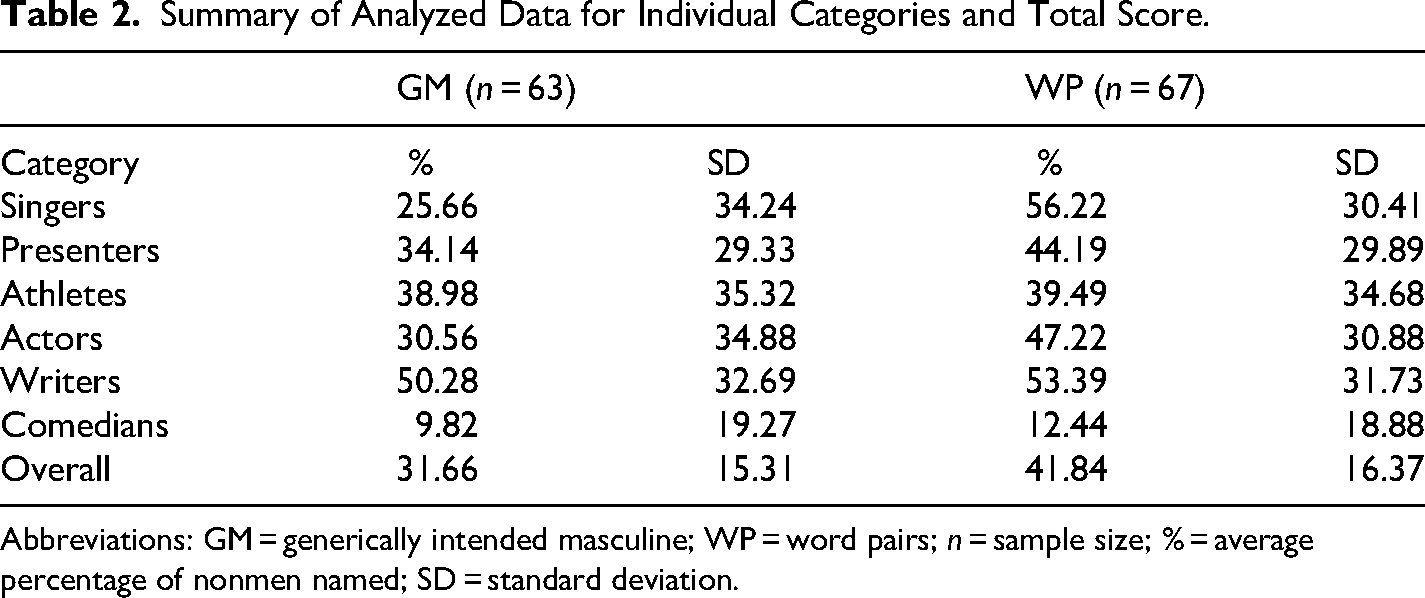
Abbreviations: GM = generically intended masculine; WP = word pairs; n = sample size; % = average percentage of nonmen named; SD = standard deviation.
It should be noted that each participant named at least one nonmale exemplar in their responses. Thus, none of the participants interpreted the generically intended masculine form as something that can only refer to men, or interpreted the questions as only warranting male exemplars in response. For the overall score and all of the individual categories, the percentage of nonmasculine exemplars named is higher for the WP condition than for the GM condition. However, the number of nonmen named fluctuates quite a bit between categories. Even in the GM condition, the category “writers” reaches 50%, while the category “comedians” only reaches 12% in the WP condition (and not even 10% in the GM condition, likely because the same three male comedians were mentioned by many participants). Furthermore, for the WP condition, only in the categories “singers” and “writers” did nonmasculine exemplars make up at least half of the exemplars named. It should be noted that the total percentage of nonmen named within this condition is just under 42%. This means that even though more nonmen were named when participants were exposed to the WP form as compared to the GM form, it still did not lead to gender-balanced mental representations.
In order to assess whether this numerical difference between the conditions would reach statistical significance, an ANOVA was conducted to compare the overall scores for the two conditions (differences between the individual categories were not assessed, as the focus was on the representation of men vs. nonmen in a more general sense, not for any of the categories in particular). This analysis demonstrates that there is a statistically significant difference between the GM and the WP condition regarding the percentage of nonmasculine exemplars that are provided, F(1, 130) = 13.36, p < .001, η2 p = 0.10, f = 0.33. Overall, participants thus provided more nonmasculine exemplars in the WP condition (M = 41.84, SD = 16.37) as compared to the GM condition (M = 31.66, SD = 15.31).
While the initial intention was to investigate the role of participant gender as well as linguistic form, this analysis needs to be interpreted with caution, as there were many more female participants in the dataset than male participants. Table 3 shows how male and female participants scored across the two conditions and overall (note that the data of the study's one nonbinary participant has been excluded from this particular analysis, as insufficient data was obtained to consider this as a separate analytical category).
Average Percentage of Nonmasculine Exemplars Named per Category and in Total (Standard Deviations Reported in Brackets) by Participant Gender.
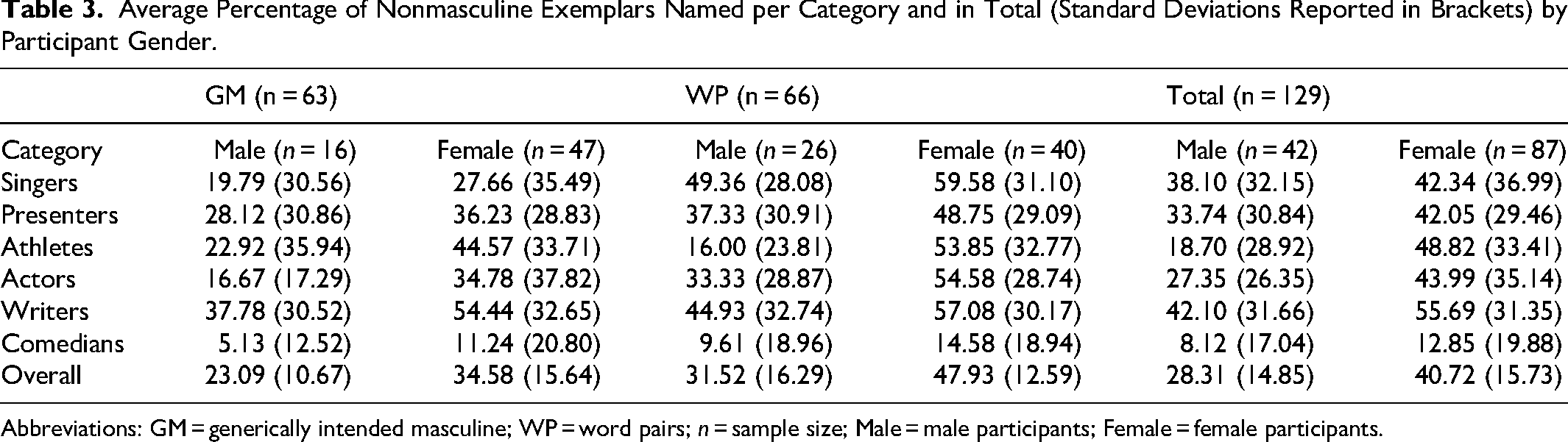
Abbreviations: GM = generically intended masculine; WP = word pairs; n = sample size; Male = male participants; Female = female participants.
This table shows that the female participants named more nonmasculine exemplars in every category, both separated out per condition and overall. These data also suggest that for most categories (comedians being the only clear exception) being prompted with the WP form does actually lead to gender parity (or even over-representation of nonmen) for female participants (i.e., nonmale exemplars make up around half of the responses). While male participants in the WP condition named nearly as many male as nonmale exemplars for the “singers” category, for all other categories and conditions, (substantially) fewer than half of the names provided referred to nonmen for male participants.
In order to assess whether this numerical difference associated with participant gender was significant, the originally intended two-way ANOVA (assessing the role of both participant gender and linguistic form) is also presented here. This analysis did not provide evidence for an interaction effect between participant gender and linguistic form, F(1, 129) = 0.80, p = .37, η2 p = 0.006, f = 0.08, but there are main effects of both the independent variables, linguistic form: F(1, 129) = 15.62, p < .001; η2 p = 0.11, f = 0.35; participant gender: F(1, 129) = 25.65, p < .001, η2 p = 0.17, f = 0.45, in the expected direction. That is, more nonmasculine exemplars were provided in the WP as compared to the GM condition, regardless of participant gender, and female participants provided more nonmasculine exemplars than male participants, regardless of the condition they were in.
A final analysis investigated the role of participants’ attitudes regarding GIL and their own use of this kind of language. The two groups had very similar attitudes towards GIL, both regarding their general attitude (M = 3.41, SD = 1.09 for the GM group and M = 3.55, SD = 1.09 for the WP group, with a maximum score of 5 indicating very positive attitudes) and their own usage (M = 2.16, SD = 0.88 for the GM group and M = 2.30, SD = 0.85 for the WP group, with a maximum score of 4 indicating participants reported always using this kind of language). These findings suggest that participants in this study displayed neutral to positive attitudes towards GIL and used this type of language themselves at least some of the time (which is in line with a recent report by The Netherlands Institute for Social Research (Huijnk, 2022), which suggests that Dutch attitudes towards gender diversity are becoming increasingly positive).
A Pearson correlation coefficient was computed to assess the relationship between the percentage of nonmasculine exemplars that were named and attitudes to GIL and own use of GIL. Both of these analyses suggested that there is a positive relationship between the GIL measures and the likelihood of naming nonmasculine exemplars, r(128) = .33, p < .001 for the correlation between GIL attitude and nonmasculine exemplar naming and r(128) = .29, p < .001 for own use of GIL. As the two groups (GM and WP) did not differ statistically in either aspect of GIL, t(128) = −0.73; p = .47, regarding their general attitude to GIL, and t(128) = −0.92; p = .36 regarding their own use of GIL, this factor was not considered in further analyses.
Discussion
This study investigated whether native speakers of Dutch have a higher mental availability of nonmasculine exemplars for people in the public domain when prompted to name exemplars with a WP (e.g., zangers/zangeressen, “singersmasculine/singersfeminine”) as compared to a generically intended masculine role noun (zangers, “singersmasculine”). Participants in the WP condition named significantly more nonmasculine exemplars than participants in the GM condition, thereby supporting the idea that more inclusive role nouns enhance the mental availability of nonmasculine exemplars in speakers of Dutch. There was also evidence to suggest that participant gender plays a role in the effect, as female participants were more likely to mention nonmasculine exemplars than male participants, regardless of the specific word form that they were exposed to. However, this finding needs to be interpreted with caution, as there were many more female than male participants in the dataset. Finally, a correlation analysis suggested that there is a positive relationship between the gender-inclusive language measures and the likelihood of naming nonmasculine exemplars. That is, both participants’ attitudes and their reported use of this kind of language were positively related to the percentage of nonmasculine exemplars that were named.
Overall, these findings for speakers of Dutch are in line with what many previous studies, using various languages and different methodologies, have found (e.g., Carreiras, 1996; Gygax et al., 2012; Körner et al., 2022; Spinelli et al., 2023): generically intended masculine role nouns are associated with a male bias, as compared to more inclusive forms. These results, as well as the tentative finding that female participants are more inclined to name nonmen than male participants, also clearly mirror the outcomes of previous naming studies with very similar designs that have been conducted with speakers of German (e.g., Gabriel & Mellenberger, 2004; Keith et al., 2022; Kurz & De Mulder, 2023; Schunack & Binanzer, 2022; Stahlberg et al., 2001; Stahlberg & Sczesny, 2001). When participants are explicitly prompted with a nonmasculine form, this is associated with a less prominent activation of male exemplars, as compared to a prompt with a generically intended masculine form. This finding is thus not specifically induced by a particular aspect of the German linguistic system (with its explicit masculine/feminine grammatical gender distinction) or cultural background. Given that speakers of Dutch show very similar patterns, it seems to extend to speakers of a language with a different grammatical gender system and cultural background as well. Combined with the fact that the only other exemplar naming study to be conducted on a language other than German reported similar findings (i.e., Gabriel, 2008 found that Norwegian speakers report more women than men amongst their most and least favorite celebrities when prompted with a WP form as compared to a generically intended masculine), these findings suggest that it may be a broader cognitive feature that use of more inclusive role nouns enhances the mental availability of nonmen, as compared to generically intended masculine forms, and not an effect of the presence of masculine and feminine grammatical gender or exposure to gender-specific role nouns.
Two processes could be responsible for this finding: the more inclusive prompt may enhance the activation of nonmasculine concepts and thus make it easier for these to be retrieved from memory. Alternatively, or in addition to this, the generically intended masculine prompt may inhibit the activation of nonmasculine concepts and thus make it harder for these to be retrieved from memory. While the data from the current study cannot speak to this issue directly, we note that all participants who were exposed to a masculine prompt mentioned female exemplars in their responses. This entails that exposure to the masculine form did not completely impede the retrieval of nonmasculine exemplars. While this does not preclude some amount of inhibition in this direction, it was clearly not enough to rule out conceptual access completely. Furthermore, in their very similar study for speakers of German, Brohmer et al. (2024) also included a neutralized control category (“name three people in the domain of politics”) and found a highly similar proportion of male exemplars for this prompt as compared to the generically intended masculine form (“name three politicians”). In addition, perceived base rates for all the categories in this study (which overlapped with ours for all categories but one, given that the characteristics of Dutch entailed that politicians could not be used as a category) suggested that men were deemed to be more representative of the category for all included categories. More broadly, and for speakers of a range of different languages, Misersky et al. (2014) report that, across the board, role nouns are thought to apply to men more than to women. Together, these findings suggest that, in general, people are inclined to retrieve male exemplars from memory when provided with a role noun prompt, but if the prompt explicitly mentions nonmen, this facilitates retrieval of exemplars from this category. Assuming that inclusive forms enhance activation of nonmasculine exemplars, thus seems to be a more likely explanation of the findings than the suggestion that it is something specific about the generically intended masculine form that leads to the inhibition of nonmasculine concepts or the facilitation of masculine concepts. Instead, any linguistic form that does not specifically recognize nonmasculine concepts seems to lead to more limited mental availability of nonmasculine exemplars, whereas prompts that specifically focus attention on the presence of another gender (or genders) seem to facilitate activation of associated concepts.
Furthermore, the findings regarding participant gender, even though in need of cautious interpretation, are in line with various previous studies (Keith et al., 2022; Stahlberg & Sczesny, 2001; Stahlberg et al., 2001). They can be seen as supporting Stahlberg and Sczesny's (2001) notion of gender centrism (a participant's own gender category may be salient to them in coming up with names) and in-group favoritism (recipients interpret ambiguous stimuli in a self-related way, with gender being an important feature in this decision) as suggested by Gabriel (2008). Along these lines, women would thus be more inclined than men to come up with female exemplars, regardless of the specific linguistic form they are exposed to, because their own feminine gender identity entails that female exemplars are more salient and, thus, more easily activated (and this would hold both in a situation in which a female form is mentioned explicitly in the prompt and when there is ambiguity regarding whether female exemplars are included, as in the generically intended masculine prompt). Finally, the findings regarding participants’ attitudes to and use of gender-inclusive language are in line with Hansen et al. (2016) in that they support the notion that using gender-inclusive language oneself (and having positive attitudes towards its use) can make one think in more gender-inclusive ways.
While the findings of the present study are thus very similar to those of previous studies on the topic, in the first instance, they may seem to be at odds with some of the studies on the interpretation of generically intended masculine forms that have focused on (Belgian) Dutch. After all, De Backer and De Cuypere (2012) found that Belgian Dutch speakers interpreted masculine role nouns as neutral significantly more often than German speakers and the studies conducted by Redl et al. (2018, 2021, 2022) only found evidence of a male bias in generically intended masculine pronoun processing in one specific context, in all other cases, zijn (“his”) was interpreted as referring to any gender. These studies thus seem to suggest that speakers of (Belgian) Dutch do interpret generically intended forms (more or less) generically (at least as compared to speakers of German, as per De Backer & Cuypere, 2012). However, it should be noted that they consider a somewhat different issue than the current study, as these studies were focused on whether (Belgian) Dutch speakers would accept a generic interpretation of the masculine form if explicitly prompted to do so by the context and not on whether a generic interpretation is the default if the context does not steer readers in a particular direction. That is, these studies ask the question “Can a masculine form refer to women when intended generically?” whereas the present study considers which exemplars come to mind first. The question in the current study is thus not so much whether, for instance, Celine Dion is considered to be a potential referent for the category “singers,” but whether the most prominent exemplars of this mental category include nonmales (Celine Dion potentially being one of them) if a generically intended masculine role noun is the prompt. Indeed, all of the participants assigned to our GM condition named at least one nonmasculine exemplar, entailing that none of the participants assumed that the masculine form could only be used to refer to men. In this sense, then, the findings of the current study align with those reported by De Backer and De Cuypere (2012) for Belgian Dutch and Redl et al. (2018, 2021, 2022) for Netherlands Dutch in that they support the idea that generically intended masculine forms can refer to nonmen in the minds of speakers of Dutch. At the same time, this finding is not at odds with the claim that use of the masculine form leads speakers of (Belgian) Dutch to be more likely to think of male as compared to nonmale exemplars. Indeed, this is exactly what the findings of the present study show: speakers of Dutch accept that masculine role nouns can refer to other genders as well, but find it easier to come up with nonmasculine exemplars when they are prompted with a more inclusive form.
How Inclusive Are WPs?
The goal of the WP form is to increase women's visibility by explicitly including them in language (Gabriel et al., 2018), and thus, if this goal is met, its use should lead to a higher mental availability of feminine exemplars. This was indeed found, although it should be noted that, in line with previous naming studies, it did not lead to balanced mental representations. After all, in the WP condition, just under 42% of the responses consisted of female exemplars being provided. In previous studies, it has also been observed that people generally have a male bias when it comes to role nouns. Brohmer et al. (2024) found that participants perceived there to be more men in all categories tested, and Gabriel and Gygax (2008) found that participants exhibited a male bias even when exposed to supposedly neutral role nouns. Misersky et al. (2014) similarly show the presence of male gender stereotyping for role nouns in their study of many different role nouns in speakers of seven different languages. Furthermore, while the WP form could perhaps remind people of the fact that the world consists of more genders than just male and female, this does not seem to have been the effect it had in the current dataset. Only four responses out of 2,186 usable responses in total (all from individuals in the GM condition) referred to those with a gender that was not clearly male or female, meaning that only 0.2% of the data represented those with gender identities outside of the gender binary. Given that a recent global survey by Statista Research Department 8 suggests that 3% of people in the world and 2% of inhabitants of the Netherlands identify as outside the gender binary, nonbinary exemplars would seem to be underrepresented in the current study (although it is possible that this difference is due to participants simply not being familiar with nonbinary celebrities in the given categories). Future research could consider whether using a form that does explicitly mention genders outside of the gender binary (e.g., the addition of [m/v/x] to role nouns as attested in some job adverts) would lead to more inclusive representations.
As compared to masculine role nouns, the WP form thus does lead to a higher level of male-female parity. However, on average, masculine exemplars still make up the majority of the exemplars, and exemplars outside the gender binary are underrepresented. Given that previous naming studies have tended to find that fully inclusive forms (referring to all genders instead of just male and female) are more effective than the WP form in facilitating the mental availability of nonmasculine exemplars and that these forms allow speakers to refer to individuals who may not feel included when a WP form is used, the outcomes of this study could be seen as a motivation to create a fully inclusive form for Dutch as well.
Limitations
One major limitation of the current study regards the representativeness of the sample. With an average age of just under 25, the participants in this study are younger as compared to the average age of inhabitants of the Netherlands (which is around 42 years old according to a 2020 report by the Dutch central statistics agency, Centraal Bureau voor de Statistiek 9 ). In combination with the fact that only a third of the sample consisted of male participants, this suggests that the generalizability of the current findings is potentially problematic. At the same time, when Keith et al. (2022) conducted a replication of Stahlberg et al. (2001) with a more representative sample (with an average age of 39 and only 14% of the sample consisting of students), the findings were very similar (more inclusive forms were still associated with higher mental availability of nonmasculine exemplars). Future studies with a more representative sample will have to show whether a similar conclusion holds for speakers of Dutch as well.
The decision to replace the category “politicians” with the “comedians” category (cabaretiers) proved to be problematic. Participants struggled with coming up with exemplars for this category, and, when they did come up with a sufficient number, it resulted in the same male individuals being named by many participants, even though there are various prominent female comedic performers in the Netherlands (and beyond). Potentially, in Dutch culture, the role noun cabaretiers (which refers to a specific type of stand-up comedy that is popular in the Netherlands and roughly translates to “comedians”) is more strongly associated with male figures or masculinity than the other categories used. This suggestion is supported by the findings from Misersky et al. (2014) that reported a high level of male gender stereotypicality for the broader “comedians” category for speakers of various different languages (not including Dutch). Future studies conducted on Dutch should thus perhaps consider replacing the “politicians” category with another role noun or including additional categories to offset this issue for this particular category. Indeed, perhaps using the role nouns comedians/comédiennes (comediansmasculine/comediansfeminine), which can be used to refer to a broader range of people engaged in comedically intended performances than cabaretiers, at least solves the issue of participants not being able to retrieve enough exemplars.
Future studies could also consider the stereotypicality of the role nouns that are included. The role nouns in the present study were chosen in order to enable comparability with previous naming studies conducted for German, but it is possible that gender stereotypes associated with these role nouns (either in a general sense, or as pertaining specifically to participants with a Dutch cultural background) affected the responses. At the same time, Misersky et al. (2014) and Gabriel et al. (2008) demonstrate that the role nouns that were chosen in our study were quite neutral in this respect, at least for speakers of the languages they investigated (not including Dutch). More specifically, for five out of our six categories, gender stereotypes were not particularly skewed. Only the role noun “comedians” is noteworthy in this respect, with participants considering the proportion of male representation of the category to be ∼63% across the two studies (again suggesting that inclusion of this role noun potentially complicates interpretation of the findings).
Specific events that occurred during the period of data collection are likely responsible for another unexpected finding in the data: the “athletes” category was the only category in which the percentage of nonmasculine exemplars named was nearly identical in the two conditions (although it was still, ever so slightly, higher in the WP condition). This is largely down to the Dutch female athlete, Femke Bol, being mentioned very often, given that she had just attained two world records and was frequently in the news. While it is to be expected that current events at the time of data collection will influence the findings (and this has in fact been demonstrated to affect responses in earlier naming studies, see, for instance, Schunack & Binanzer, 2022), this can be seen as a weakness of the methodology in that coincidental prominence of a person of a particular gender can exert a large effect on the gender composition of a specific category. Ensuring that a relatively broad array of categories is chosen is important in order to be able to deal with these effects, as the differences between categories show that associated stereotypes or the salience of a particular personality can affect the results. While the current study tried to minimize these influences by only analyzing all categories together, it further demonstrates the importance of either selecting balanced categories (for which participants are likely to be able to come up with exemplars of different genders) or for selecting a large array of categories.
Conclusion
The findings of the present study suggest that the mental availability of nonmasculine exemplars is higher when speakers of Dutch are prompted with a more inclusive form as compared to a generically intended masculine role noun. Furthermore, while WP prompts increase the availability of nonmasculine exemplars, they do not lead to gender parity in terms of the gender of the exemplars that are named. Generically intended masculine role nouns thus do not seem to be interpreted as such, given that, at least as compared to a prompt that explicitly recognizes a nonmasculine form, they are associated with a lower mental availability of nonmasculine concepts. Findings from this study, and previous studies that have employed a similar design, suggest that the specifics of the grammatical gender system do not play a major role in this finding. After all, while it has previously been demonstrated for speakers of German, a language that makes a masculine/feminine grammatical gender distinction for all nouns, including role nouns (e.g., Stahlberg et al., 2001), and for Norwegian, a language in which gender-marking for role nouns is obsolete and the grammatical gender system is in flux (with a three-way gender system that seems to be moving towards a two-way common/neuter gender system, Gabriel, 2008), the present study demonstrates it for Dutch, a language that has a common/neuter grammatical gender system for nouns, combined with a productive system for gender-specific marking for role nouns. A more inclusive form thus seems to enhance the mental availability of nonmasculine exemplars, as compared to a generically intended masculine form, regardless of whether gender-specific linguistic elements are a prominent characteristic of a speaker's language.
This thus suggests that the creation of a more inclusive form than the WP could be considered for Dutch, such that its speakers are provided with additional linguistic means to enable the recognition and enhance the visibility of those who do not identify as men. So, to end with a concrete suggestion: Why not take a page from the books of countries neighboring the Netherlands? The German gender star or the French interpunct could also work for Dutch, with acteur (“actor”) rendered as acteur*ice or acteur·ice and zanger (“singer”) becoming zanger*es or zanger·es. The availability of a form like this will not make Dutch society more gender inclusive overnight (broader social stereotypes and attitudes also have a clear role to play in this process), but the now quite substantial body of work on the matter (see Sczesny et al., 2016 for a review) suggests it could be a step in that direction at least.
Footnotes
Acknowledgments
The authors would like to express their gratitude to those who were willing to donate their time in taking the survey and to Leiden University's BA International Studies program for enabling the first author to present this research at various conferences. We also wish to thank the anonymous reviewers for their helpful feedback on an earlier version of this article.

Ethical Approval and Informed Consent Statements
Institutional ethical approval for the study was granted by the Leiden University Centre for Linguistics. The research was conducted in concordance with the APA Ethical Principles and Code of Conduct. All data were obtained via an anonymous online survey; only basic demographic information was collected. Participants were asked to provide their consent at the start of the study and were asked to reaffirm their consent when they had reached the end of the study. Data from participants who did not provide consent at both the beginning and the end of the study was immediately discarded.
Consent to Participate
Written.
Consent for Publication
Not applicable.
Authors’ Contributions
Femke Roos: research concept and design, collection of data, data analysis and interpretation, and writing the article. Hannah De Mulder: research concept and design, data analysis and interpretation, and writing the article.
Funding
The authors received no financial support for the research, authorship, and/or publication of this article.
Declaration of Conflicting Interests
The authors declared no potential conflicts of interest with respect to the research, authorship, and/or publication of this article.