



Abstract
Nonbinary people face invisibility and misrecognition. This research investigated how the use of the Swedish gender-inclusive neopronoun hen influenced the gender categorization of faces beyond the binary. In a between-subjects design, participants (N = 368) were instructed to use the gender-inclusive neopronoun hen, the binary masculine pronoun han (he), or no pronoun in a writing task. Then, they categorized androgynous morphed faces by selecting one of four response options (“woman,” “man,” “nonbinary,” or “I don't know”). Altogether, the results indicated that few participants responded “I don't know,” indicating that categorizing gender by appearance is common. As expected, the use of the gender-inclusive pronoun increased nonbinary categorizations, whereas the use of the masculine pronoun did not increase man categorizations, documenting that gender-inclusive pronouns increase the visibility of nonbinary people. Gender binary beliefs were associated with less nonbinary categorization. The discussion outlines how these findings can inform social policymaking.
Keywords
In everyday encounters, people are attentive to gender when forming impressions of others (Bodenhausen & Macrae, 2006; Freeman & Ambady, 2009) These impressions are often formed within a binary gender framework wherein gender consists of women and men only (Hyde et al., 2019). However, many people identify with other, nonbinary, gender identities, such as genderqueer, gender-fluid, and agender (Richards et al., 2016; Whitley et al., 2022). People often miscategorize nonbinary individuals, leading to their invisibility and marginalization. Recently, many languages have implemented words that acknowledge the experiences of gender diversity (Truszczynski et al., 2022). Such words enable nonbinary people to express their identities, a positive outcome. This research, therefore aimed to test whether such words can also increase the visibility of nonbinary in gender categorization.
Gender is a multifaceted term encompassing personal, social, and biological aspects (Hyde et al., 2019; Lonergan & Palomares, 2020). The personal aspects of gender include an individual's gender identity. For example, a person may identify as a woman, a man, or a nonbinary person (Lindqvist et al., 2020). The social aspects of gender include a set of norms and stereotypes that govern gendered appearance, behavior, and shape social interactions (Lonergan & Palomares, 2020). For example, current gender norms treat gender as an important category and ascribe communally oriented traits and behaviors to women, and agentic traits and behaviors to men (Fiske, 2018). Norms are also embedded in language; for example, they prescribe that women should be addressed with feminine pronouns (Renström et al., 2023). The physiological aspects of gender include the consequences of hormones and chromosomes (i.e., sex) that are not directly visible but often influence outward appearance, such as face shape, chest size, and hip width. For example, people are generally assigned a gender at birth based on sex characteristics (Hyde et al., 2019) and intersex people—whose sex characteristics do not fit traditional conceptions of female and male bodies—are sometimes surgically treated to align their bodies with gender norms (Monro, 2019). The facets of gender are interlinked; for example, it may be hard to understand nonbinary gender experiences if they are not contained within the social norms of gender (Cordoba, 2020). That said, the personal, social, and biological facets may also diverge; a person may have a different gender identity than the norm for someone with that body, as is most often the case for nonbinary people (Matsuno & Budge, 2017).
The dominant gender norms construct gender as a binary, consisting of women or men, visible from appearance (Ansara & Berger, 2016). Consequently, people often miscategorize nonbinary people, whose gender identity lies outside this binary and is not visible from appearance. Miscategorization is a cognitive process based on perceivers’ first impressions and norms about gender. Miscategorization often leads to behavioral outcomes like misgendering—referring to someone using gendered words or labels with which they do not identify with, for example referring to a nonbinary person as “she” or “he.” Such misgendering constitutes identity denial and can lead to minority stress (Meyer, 2003) and negative health consequences (McLemore, 2018).
Gender and Language
Norms and stereotypes of gender are communicated through language because words evoke gendered associations and facilitate the understanding of gendered experiences (Sczesny et al., 2016; Zimman, 2017). For example, when there are no words to describe nonbinary gender identity, the experiences of nonbinary people may be inaccessible (Truszczynski et al., 2022), both from a personal and a social perspective. Indeed, many western languages lacked words for nonbinary gender until quite recently (Hekanaho, 2021), contributing to the invisibility of nonbinary people as a gender category.
Certain words enable individuals to express and connect with their gender identity, but a gender category may still be invisible to others if those words are not used (Sczesny et al., 2016). For example, many languages display androcentrism, a linguistic bias where male forms are used more often than female forms to represent all people (Bailey & LaFrance, 2017; Bailey et al., 2022). Androcentric language also makes men more visible than women (e.g., chairman, fireman), and masculine generic terms are used for mixed gender groups or people of unknown or irrelevant gender. Masculine generics are especially common in languages with grammatical gender (e.g., German, French). Participants named more men than women as their favorite musicians when the question was expressed in the masculine form compared to gender-inclusive forms (Stahlberg et al., 2001). When occupations were written in masculine forms, readers associated those positions with more typically masculine traits (McConnell & Fazio, 1996) and were more likely to overestimate the prevalence of men in those positions (Braun et al., 1998) than when gender-inclusive language was used. Gender-fair language use can therefore contribute to the reduction of androcentrism as it increases the cognitive availability of female exemplars (Fatfouta & Sczesny, 2023; Sczesny et al., 2016). For example, forms that linguistically include women enabled women to imagine themselves in stereotypically masculine occupations (Gygax et al., 2008) and reduced women's feelings of ostracism (Stout & Dasgupta, 2011).
Recent language initiatives, such as the Swedish neopronoun hen, the English singular they (Saguy & Williams, 2022), the Dutch die/den (Decock et al., 2024), and the German gender star (Zacharski & Ferstl, 2023), aimed to broaden the scope of previous gender-fair language to allow it to include people of all genders. As a gender-neutral third-person pronoun, the Swedish neopronoun hen has three meanings: (a) to refer to a specific person with nonbinary gender; (b) to refer to a specific person whose gender the speaker does not know or wishes to deemphasize; or (c) to refer to an unspecific person of any gender (i.e., as a generic pronoun; SAOL, 2015). Hen represents one of the first gender-inclusive reforms to reach national prominence, having been included in a national dictionary in 2015 (SAOL, 2015). Currently, 99.5% of the Swedish population is aware of this neo-pronoun (Gustafsson Sendén et al., 2021) but many people seldom use it, especially not as a specific nonbinary pronoun (Renström et al., 2022).
Research suggests that hen and other newly introduced nonbinary pronouns increase the cognitive availability of gender diversity. For example, Swedish readers were more likely to associate pictures of a gender-nonconforming person (as opposed to a gender-conforming person) with character descriptions that included hen than character descriptions that included she/he (Renström et al., 2023). Similarly, German readers were more likely to associate pictures of nonbinary people with role nouns (e.g., teacher) that included the gender star—a form of nonbinary inclusive language in German—than words that included binary gender (feminine or masculine generics; Zacharski & Ferstl, 2023). Moreover, Swedish participants instructed to use hen in a writing task were more likely to generate androgynous and feminine names in a subsequent task than participants instructed to use masculine pronouns. These studies together indicate that new gender-inclusive language forms increase the cognitive availability of nonbinary people. So far, studies have investigated how hen influences mental representations but not how hen may influence face perception and gender categorization.
Gender and Face Perception
When people encounter a face, they automatically categorize it in terms of gender (Cloutier et al., 2005; Freeman & Ambady, 2011). Most often, this categorization is based on the appearance of the face but can also be influenced by both physical context and the perceiver's motivational state. The dynamic interactive theory of person construal (Freeman and Ambady, 2011) describes face categorization as a spreading activation of concepts resulting in an interplay between sensory inputs and top-down influences such as mental representations, activated stereotypes, and motivational states. As a connectionist theory, the dynamic interactive theory describes cognition as nodes in a network, with nodes for facial features, social categories, and stereotypes. Exposure to facial stimuli activates the facial-encoding nodes, which trigger category nodes that then activate stereotype nodes. The dynamic nature of the theory implies that activation also flows the opposite way, where parallel stereotype activation can affect category activation, which in turn shapes interpretation.
Following this theory, a face might be categorized as feminine because of facial structures (sensory input) but as more masculine if the category man is cognitively available (mental representation). For example, when androgynous faces were paired with women's or men's first names, participants’ gender ratings aligned with the associated name; an androgynous face labeled “John” was perceived as more masculine compared to when it was labeled “Mary” (Huart et al., 2005). In a similar vein, labels such as “transgender” or “cisgender” affected participants’ gender ratings consistent with the sex assigned at birth; a face described as a “trans woman” was seen as more masculine than when described as a “cis woman” (Wittlin et al., 2018). This phenomenon has also been documented for gender-stereotypical traits; for example, the word “aggression” increased the likelihood of a face being categorized as male (Freeman & Ambady, 2009). Moreover, morphed androgynous faces were more often categorized as nonbinary when combined with gender-neutral occupational titles (e.g., restaurant manager) compared to gender-stereotypical occupational titles (e.g., beautician; Weißflog & Grigoryan, 2024).
The dynamic interactive theory of person construal also predicts that perceivers’ motivation affects categorization (Freeman & Ambady, 2011). For example, a person with a race-inclusive motivation may update an initial automatic racial categorization from one category to another to avoid prejudice (Bodenhausen et al., 2012). Analogously, a person with a gender-inclusive motivation may reconsider an initial gender categorization to avoid misgendering. Past studies have indicated that gender-inclusive pronouns can trigger gender-inclusivity; participants who were instructed to use hen reported more positive attitudes toward LGBTQ+ people, and participants expressed more positive attitudes toward LGBTQ+ individuals than participants who were instructed to use masculine pronouns (Tavits & Pérez, 2019). Moreover, exposure to gender-fair language forms in German increased the motivation to use gender-fair language (Koeser & Sczesny, 2014; Koeser et al., 2015). Together, these studies suggest that exposure to gender-fair language can facilitate gender-inclusivity.
Additionally, the generic meaning of hen, wherein the speaker expresses uncertainty or wishes to deemphasize gender, implies that gender can be uncertain. In one study, when participants were presented with a face referred to as hen, nearly half of the participants did not gender categorize that face (Vergoossen, 2021). When presented with a face referred to using binary pronouns, most participants categorized gender according to the pronoun. This implies that some of the gender uncertainty implied by hen can motivate people to abstain from gender categorization.
Gender Beliefs
Some norms and beliefs about gender, however, may be strongly held and not influenced by linguistic changes (Hyde et al., 2019). The introduction of hen, for example, provoked a considerable backlash, demonstrating strong beliefs in gender as binary and motivations to maintain language preserving that system (Vergoossen et al., 2020). Such gender binary beliefs are rooted in a broader system of beliefs that construct gender as equivalent to biological sex and that biological sex is binary (Ansara & Berger, 2016).
Indeed, gender binary beliefs significantly influence various attitudinal and behavioral outcomes related to transgender and nonbinary issues. People with strong gender binary beliefs showed less support for trans rights (Tee & Hegarty, 2006) and gender-fair pronouns (Patev et al., 2019) and were more likely to stereotype trans people according to their sex assigned at birth (Gallagher & Bodenhausen, 2021). Consequently, individuals with strong binary beliefs are less likely to categorize nonbinary gender in faces. Moreover, because sex characteristics are visible in faces, individuals who believe that gender is binary and equivalent to sex should be motivated to categorize everyone by gender (i.e., they should be reluctant to abstain from categorization).
The Present Research
This study builds upon and synthesizes research on gender-inclusive pronouns (Lindqvist et al., 2018; Renström et al., 2023; Tavits & Pérez, 2019) and the interactive theory of face perception (Freeman & Ambady, 2011). Pronouns have been shown to increase the cognitive availability of associated gender categories (Fasoli et al., 2023; Renström et al., 2023; Tavits & Pérez, 2019). The dynamic interactive theory implies that increased availability of a certain gender category facilitates a corresponding gender categorization of faces. Consequently, using the Swedish gender-inclusive hen should increase the categorization of androgynous faces as nonbinary compared to using masculine pronouns or no pronouns (H1a), and using the Swedish masculine pronoun han should increase the categorization of androgynous faces as men compared to using gender-inclusive pronouns or no pronouns (H1b).
Gender-inclusive language forms have been shown to trigger a motivation of gender inclusivity and these forms are semantically linked to an expression of uncertainty and deemphasis of gender. Therefore, using the Swedish gender-inclusive pronoun hen should motivate people to be more gender-inclusive, increasing the likelihood of abstaining from gender categorization, compared to using a masculine pronoun or no pronoun at all (H2).
Lastly, people's gender binary beliefs are likely to reduce the willingness to categorize faces beyond the binary. Thus, gender binary beliefs should be associated with fewer categorizations of androgynous faces as nonbinary categorizations (H3a) and fewer abstentions from categorizing gender (H3b).
Method
The methods and hypotheses were preregistered and all scripts and data are available online at OSF (https://osf.io/j69a2/?view_only=7dea3dc7a2af4ba89e14aa0197663a35). Any deviations from the preregistered analyses are noted in the Supplementary Information.
Participants and Design
This study is based on a one factorial between-subjects design with three pronoun conditions, namely gender-inclusive pronoun, masculine pronoun, or no-pronoun. Before data collection, we calculated the sample size by using the software R to simulate a population based on the results of a pilot study (see Supplementary Information). The power calculation suggested that 315 participants—105 per condition—and 30 trials would be necessary to achieve conclusive results (BF < 1/3 or BF > 3, power = 0.9) for the main effect of condition. To ensure that enough data were collected to protect against participant dropout and noncompliance, we aimed to collect data from 400 participants.
Participants comprised a representative sample of the Swedish population recruited by the Swedish survey company Enkätfabriken, which was diverse in terms of age, gender, and geographical location (age and geographical region did not differ across the pronoun conditions‚ see Supplementary Information for more details). A total of 406 Swedish-speaking participants between 18 and 88 years completed the experiment (Mage = 48.21, SD = 17.55; 196 women, 207 men, 1 nonbinary person, 1 did not know, 2 did not indicate their gender). Participants were compensated 15 SEK for their participation (appr. 1 Euro). We excluded 58 participants who used an incorrect pronoun in the writing task or any pronoun in the no-pronoun condition (26 participants were excluded in the gender-inclusive condition, 19 in the masculine condition, and 13 in the no-pronoun condition). A Bayes Factor test showed that the nonbinary and masculine conditions did not differ in terms of exclusions (odds ratio [OR] = 1.40, confidence interval [CI] = 0.74, 2.71, BF01 = 7.83), the nonbinary and no-pronoun may have differed slightly (OR = 0.44, CI = 0.21, 0.88, BF10 = 1.15; BF was inconclusive), and masculine and no-pronoun did not differ in terms of exclusions (OR = 0.62, CI = 0.29, 1.29, BF01 = 4.99). The final sample comprised 348 participants (Ngender-inclusive = 110, Nmasculine = 113, Nno-pronoun = 125; analyses on the full sample are available in Supplementary Materials). We also tested whether noncompliance was associated with stronger gender binary beliefs and again, this difference was inconclusive (d = 0.31, BF01 = 2.04). Most importantly, gender binary beliefs did not differ across conditions (all d < 0.2 all BF01 > 11), indicating no systematic differences across conditions.
Procedure and Material
Participants were randomly assigned to one of the three experimental conditions (gender-inclusive pronoun, masculine pronoun, and no-pronoun). They first completed a writing task (adapted from Tavits & Pérez, 2019), in which they were instructed to describe a picture of a human silhouette (see Figure 1). The instructions read as follows: “Please use the text boxes below to describe in three sentences what the person in the image is doing. Please be as specific as possible and provide as much detail as you can. In your description of this individual, it is important that you use [use the pronoun ‘[hen/he]’/refer to the figure as ‘the person’]. This will help to standardize the accounts provided by all participants in this survey, which will make them easier to interpret.”

The human silhouette used as stimulus in the writing task.
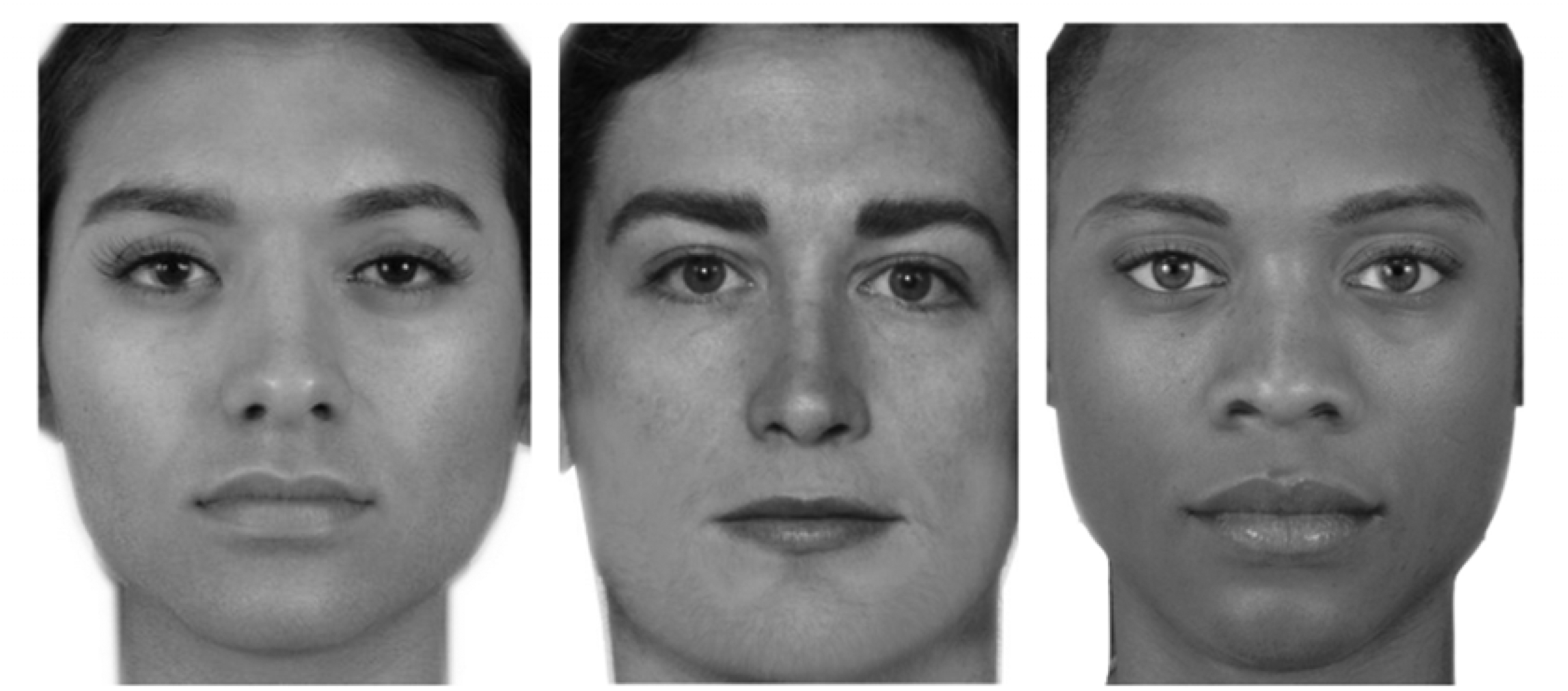
Examples of androgynous faces used in the study.
The instructions implied participants were describing a specific person. All participants who were included in the final analyses produced sentences beginning with a pronoun and a verb (e.g., “Hen pushes off,” “He leans forward,” “The person is struggling”), suggesting they did indeed interpret the task as describing the person pictured.
After the writing task, participants categorized 30 androgynous faces. For each face, participants responded to the question, “How would you gender categorize this person?” In response, participants selected one of four alternatives: “woman,” “man,” “nonbinary,” or “I don't know” (fixed order of responses). Nonbinary gender categorizations were operationalized as the selection of the response option nonbinary. Man categorizations were operationalized as the selection of the response option man. Abstention from gender categorizations was operationalized as the selection of the option “I don't know.” These outcomes were dichotomized (1 = presence of categorization; 0 = absence of categorization).
Gender binary beliefs were measured by six items from the gender beliefs scale (Tee & Hegarty, 2006). The scale consists of statements such as “There are only two genders: man and woman,” and “Ascribing gender to new-born babies based on how their bodies look is just a social norm” (from 1 = completely disagree to 7 = completely agree; α = 0.84).
The androgynous face stimuli were created with the software Psychomorph (Tiddeman et al., 2001). Pictures of Black, Asian, and White women and men were morphed to create a set of 276 faces that varied by genderedness. All faces were morphed within the racial categories that models identified with. The face stimuli were rated by a separate sample of 100 Swedish participants as “man,” “woman,” “other,” or “unknown.” This sample rated a total of 276 faces, which varied in terms of femininity and masculinity. Of these 276 faces, the 30 faces (10 Black, 10 Asian, and 10 White, see Figure 2 for examples) with the most equal distribution of woman and man categorization were selected.
Statistical Analyses
All analyses were carried out using R (R Core Team, 2022), and tidyverse (Wickham & Girlich, 2022) with Bayesian models handled using the brms package (Bürkner, 2017; Kurz, 2023). As preregistered, we fit Bayesian linear mixed-effects models to each of the main outcomes. We specified the models based on recommendations for repeated measures data with subjects and trials modeled as random effects (random slopes for subjects and random slopes for faces), pronoun condition, and gender binary beliefs modeled as fixed effects (see Supplementary Information for the full model specification including priors). In other words, the data were analyzed at the trial level, with the outcomes providing estimates for how likely the categorization was to occur.
To test the hypotheses, we relied on two inference criteria: Bayes Factors and Credible Intervals. We calculated the Bayes Factors for the relevant contrasts, using the Savage–Dickey Density Ratio, and Jeffrey's scheme to interpret the Bayes Factors in relation to the strength of the evidence (1/3–3 = inconclusive/anecdotal, 3–10 = moderate, 10–30 = strong, 30–100 = very strong, >100 = extreme; Ly et al., 2016). Given the data and model, BF10 represents the strength of evidence in favor of the alternative hypothesis over the null hypothesis, and BF01. For example, BF10 = 20 implies that the alternative hypothesis is 20 times as likely as the null hypothesis given the data and the priors. BF01 represents the inverse of BF10 (i.e., 1/BF10) and represents the evidence in favor of the null hypothesis. We reported whichever of BF01 and BF10 is larger, as Bayes Factors smaller than 1 are not very intuitive. Because of the sensitivity of Bayes factors to priors, we also considered the credible intervals as an additional conservative check on the conclusions. Credible intervals are derived from the posterior distribution and represent the range of possible outcomes given both the data and the models. Bayesian Credible Intervals are analogous to frequentist confidence intervals in that they quantify the precision of the estimates.
Effect sizes are reported in terms of ORs. When used to compare conditions, the odds ratio can be understood as the relative likelihood that an outcome will occur in one condition over the other. For example, an OR of 2 implies that the outcome is twice as likely in the reference condition than in the comparison condition, and an OR of 1 implies that the outcome is equally likely in both conditions. For continuous predictors, the OR can be interpreted as the change in the likelihood of the outcome associated with each 1-unit change in the predictors.
Results
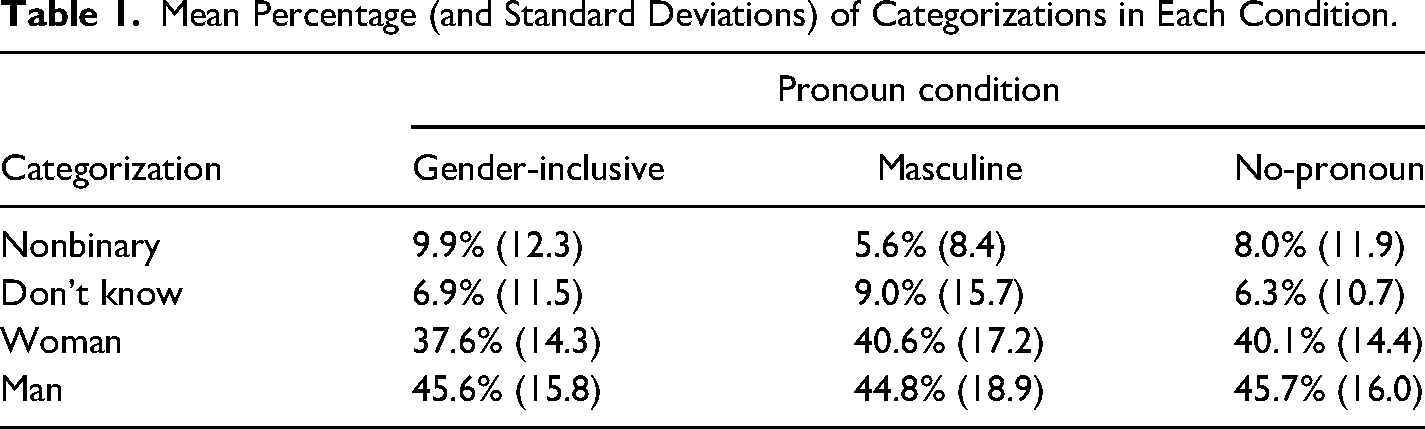
In support of Hypothesis 1a, participants made the most “nonbinary” categorizations in the gender-inclusive pronoun condition (see Table 1). The Bayes Factor indicated strong support (>10) for the conclusion that “nonbinary” categorizations were more common in the gender-inclusive pronoun condition than in the masculine pronoun condition (OR = 1.97, CI = [1.18, 3.32], BF10 = 67.8) and the no-pronoun condition (OR = 1.39, CI = [0.82, 2.29], BF10 = 6.12). In contrast to Hypothesis 1b, participants made virtually the same amount of “man” categorizations in all conditions (see Table 1). Although the Bayes Factors (<3) were inconclusive, the credible intervals were very narrow, suggesting that man categorizations were not more common in the masculine pronoun condition than in the gender-inclusive pronoun condition (OR = 0.94, CI = [0.73, 1.19], BF01 = 2.07) or the no-pronoun condition (OR = 0.92, CI = [0.72, 1.17], BF01 = 2.53). These somewhat mixed results for Hypothesis 1b rule out large and medium-sized effects of masculine pronoun use on the categorization of men.
Mean Percentage (and Standard Deviations) of Categorizations in Each Condition.
In testing Hypothesis 2, the Bayes Factors for abstention from categorization indicated inconclusive results for the difference between the gender-inclusive pronoun condition and masculine pronoun condition (OR = 0.86, CI = [0.48, 1.55], BF01 = 1.96). The barely significant Bayes Factors in conjunction with the wide credible intervals indicated inconclusive results for the difference between gender-inclusive and no-pronoun conditions (OR = 1.29, CI = [0.73, 2.25], BF10 = 3.31).
As predicted in Hypothesis 3a, participants with stronger gender binary beliefs made fewer nonbinary categorizations (OR = 0.54, CI = [0.41, 0.68], BF10 > 1.000). The odds ratio implies that on average, each one-unit increase on the gender binary beliefs scale is associated with a 46% decrease in the probability of a face being categorized as nonbinary. In other words, the negative effect of gender binary beliefs on nonbinary categorizations was both large and reliable. Contrary to Hypothesis 3b, participants with stronger gender binary beliefs did not make fewer abstentions from categorizations (OR = 0.81, CI = [0.61, 1.06], BF01 = 7.05).
Discussion
The results of the present study documented that pronoun use affects gender categorization. Participants were twice as likely to categorize faces as nonbinary after they had used the gender-inclusive pronoun compared to the masculine pronoun, and 1.5 times more likely than in the no-pronoun condition. Surprisingly, participants were not more likely to categorize faces as men after they had used the masculine pronoun compared to the gender-inclusive pronoun and no pronouns. In all three pronoun conditions, almost half of the participants categorized the faces as men. The overall incidence of abstention from categorizing gender was low, as few participants selected the “I don't know” response. Furthermore, strong gender binary beliefs were associated with fewer nonbinary categorizations, but not fewer abstentions from gender categorization.
Theoretical and Conceptual Implications
This study highlights how gender is a multifaceted construct with identity and social consequences. The results of this study illustrate how language in terms of labels and pronouns are important tools for increasing the visibility of nonbinary gender. One aspect of this involved including response options beyond the binary. This approach granted a more accurate measurement of the existing diversity of sex/gender than binary response options (Lindqvist et al., 2020; Morgenroth & Ryan, 2021). That people used the nonbinary options indicates that gender is like many other categories, constrained and shaped by the words available to express it. Furthermore, by increasing the likelihood of categorizing a face as nonbinary, gender-inclusive forms made more people aware of gender beyond the binary, thereby likely reducing the misgendering of nonbinary people.
We derived the mechanism through which gender-inclusive language forms increase nonbinary gender categorization from the dynamic interactive theory of face perception (Freeman & Ambady, 2011). The theory suggests that contextual cues, such as language, activate specific gender categories in a connectionist network. However, the theory was only partially supported, as the gender-inclusive pronoun increased nonbinary categorizations, but the masculine pronoun did not increase man categorizations. Our explanation for this unexpected outcome is that the effect of the masculine pronoun on man categorization was limited by a preexisting male bias in which men are viewed as the default humans (Bailey et al., 2022) which leads people to categorize androgynous faces as men more often than any other category (Armann & Bülthoff, 2012). Indeed, our results showed that man was the most common response (almost half of the categorizations in all pronoun conditions). Therefore, we suggest a ceiling effect that prevented the masculine pronoun from noticeably increasing man categorizations. For nonbinary categorization in contrast, there was more room for more variation, such that nonbinary categorizations were most common after using the gender-inclusive pronoun, and least common after using the masculine pronoun.
We proposed that the generic meaning of hen—that gender is unknown or irrelevant—may motivate people to abstain from gender categorization (see Hypothesis 2). Based on our findings, the effect of pronouns on abstaining from gender categorization remains unclear. Participants rarely abstained from categorizing gender, even though the faces and the stimuli were perceptually ambiguous. This is in line with research on the automaticity of gender categorization (Cloutier et al., 2005) and the centrality of gender in person perception (Bodenhausen & Macrae, 2006). Thus, gender-inclusive language forms may be more effective for introducing new gender categories than for disrupting gender categorization.
Our findings also illustrate another facet of the gender construct—binary norms. Binary norms were measured at the individual level as gender binary beliefs and were found to obstruct nonbinary categorizations. This result reflects previous work, which showed that gender binary beliefs influence several outcomes related to attitudes and behaviors toward both trans and nonbinary people (Jones et al., 2023; Morgenroth et al., 2021; Patev et al., 2019). Moreover, the effect of gender binary beliefs on nonbinary categorization was stronger than the effect of language. This suggests a limit to the influence of language on conceptions of gender. Specifically, language or at least gender-inclusive language forms such as hen may be less impactful than beliefs about gender.
Practical Implications and Recommendations
As pronouns are some of the most frequently used words in language (Chung & Pennebaker, 2011), the present findings suggest that policymaking that promotes the use of gender-inclusive pronouns can reduce the marginalization and misgendering of nonbinary people. For example, misgendering is a form of discrimination against trans- and nonbinary people (McLemore, 2018). One straightforward strategy for promoting the use of language-inclusive forms is emphasizing the importance of respecting people's preferred pronouns (Jiang et al., 2023). Another approach is to encourage the practice of pronoun disclosure; when nonbinary people disclose their pronouns. This increases the visibility of both nonbinary pronouns and identities. For example, pronouns can be efficiently appended to email signatures, social media profiles, and name tags. Studies show that pronoun disclosures of binary allies such as managers and people in power are especially helpful in providing a safe environment for nonbinary people to come out (Johnson et al., 2021). Gender equality policies of organizations and government agencies should therefore encourage employees to use correct pronouns when referring to nonbinary colleagues, facilitate pronoun disclosures, and inform employees about how gender-inclusive language can reduce social discrimination.
Additionally, news media can increase the adoption of gender-inclusive forms by using them as generic and singular pronouns. News media strongly influences social norms (Arias, 2019), indeed, the use of hen by Swedish news media played an important role in the spread and acceptance of that word (Milles, 2011). Therefore, we recommend that media organizations formulate their style guidelines to support gender-inclusive language forms as generic pronouns and that individual journalists use gender-inclusive language forms whenever possible.
Limitations and Future Directions
One limiting factor of this study is the ecological validity of the faces. We used artificially generated images cropped to exclude hair and body. In real life, gender categorization relies on multiple social cues such as hair and clothing (Freeman & Ambady, 2011; von Stockhausen et al., 2013). We did include faces of different skin colors, indicating that the effect generalizes beyond white faces. Another limitation is the exclusive use of androgynous faces, which could reinforce the stereotype that only people with androgynous appearances are nonbinary. Previous research shows that androgynous faces are categorized as nonbinary more often than feminine or masculine faces (Fasoli et al., 2023; Weißflog & Grigoryan, 2024). Thus, our study likely overestimated the rate at which prototypically gendered faces are categorized as nonbinary. Future studies should include faces with a wider range of features to explore how social cues influence perceptions of nonbinary identities and include more gender identities.
The “I don't know” response option was ambiguous, as it may reflect uncertainty about which binary gender to assign rather than any deliberate attempt to abstain from categorizing gender. We assumed that, despite the ambiguity, any observed increase in “I don't know” responses in the gender-inclusive pronoun condition would reflect an increase in abstention from gender categorization. As this effect was not observed, and as “I don't know” responses were not influenced by gender binary beliefs, it seems that “I don't know” responses primarily reflected participants’ uncertainty. Future studies therefore need more sophisticated measures to distinguish between uncertainty and principled abstention from gender categorization, such as options like “impossible to know” or measuring uncertainty using Likert-type scales.
This study also compared gender-inclusive to masculine pronouns only. Masculine pronouns were chosen because masculine language forms have a history of use as ostensibly generic pronouns and such forms have been shown to evoke a male bias (Braun et al., 2005; Cheryan & Markus, 2020). However, resource constraints limited the number of conditions to three in the present study and we chose masculine language as a comparison. This decision reinforced androcentrism and future studies need to overcome this limitation by also examining feminine pronouns.
We have explored the potential of gender-inclusive pronouns to reduce misgendering. While we believe this research is a significant step toward demonstrating such an effect, it is crucial to note that this study captured categorization rather than misgendering. Since the faces were generated using computer software, there was no correct answer to the face categorization task. This study, therefore, assessed the cognitive availability of gender categories but did not directly capture misgendering.
This study also highlights the importance of future research to include gender-inclusive response options. We found that when respondents were given gender-inclusive response options, they used them. Moreover, including only the options woman/female and man/male, delegitimizes nonbinary respondents’ gender identity (Frohard-Dourlent et al., 2017; Saperstein & Westbrook, 2021). Additionally, including nonbinary response options increases the visibility of nonbinary gender. Therefore, we recommend researchers, companies, agencies, and policymakers to include diverse response options when collecting data.
Future research should also examine the effects of gender-inclusive language forms on gender categorization outside of the Swedish context. As a natural gender language, Swedish includes gendered pronouns and gendered terms for professions and familial roles similar to English (Hekanaho, 2021). In contrast, grammatical gender languages, such as German, French, and Arabic, feature gender much more prominently, (Gygax et al., 2008; Hekanaho, 2021). Such languages require more extensive changes, such as the German gender-inclusive star, which needs to be added to every noun (Zacharski & Ferstl, 2023). Future studies should therefore test the effects of gendered language on gender categorization in other languages.
Conclusions
This experimental study revealed important insights about the categorization of gender beyond the binary: using the Swedish gender-inclusive pronoun hen increased the categorization of ambiguous faces as nonbinary, and using the masculine pronoun hen circumvented the categorization of faces as nonbinary. Furthermore, strong gender-binary beliefs were associated with less nonbinary categorization. These findings have several implications, the most important of which is that the use of gender-inclusive pronouns in everyday language has the potential to make nonbinary gender more visible and recognized, thereby promoting a more inclusive and diverse society.
Supplemental Material
sj-docx-1-jls-10.1177_0261927X241289914 - Supplemental material for Toward Visibility: Using the Swedish Gender-Inclusive Pronoun Hen Increases Gender Categorization of Androgynous Faces as Nonbinary
Supplemental material, sj-docx-1-jls-10.1177_0261927X241289914 for Toward Visibility: Using the Swedish Gender-Inclusive Pronoun Hen Increases Gender Categorization of Androgynous Faces as Nonbinary by Elli van Berlekom, Sabine Sczesny and Marie Gustafsson Sendén in Journal of Language and Social Psychology
Footnotes
Acknowledgments
The authors thank Nicholas Palomares and two anonymous reviewers for their helpful feedback, and Serena Haynes for her helpful comments.
Data Availability Statement

Declaration of Conflicting Interests
The author(s) declared no potential conflicts of interest with respect to the research, authorship, and/or publication of this article.
Funding
The author(s) disclosed receipt of the following financial support for the research, authorship, and/or publication of this article: This work was supported by the Ax:on Johnsson Foundation, Riksbankens Jubileumsfond, (grant number F20-0502, P16-0058:1).
Supplemental Material
Supplemental material for this article is available online.
Author Biographies
References
Supplementary Material
Please find the following supplemental material available below.
For Open Access articles published under a Creative Commons License, all supplemental material carries the same license as the article it is associated with.
For non-Open Access articles published, all supplemental material carries a non-exclusive license, and permission requests for re-use of supplemental material or any part of supplemental material shall be sent directly to the copyright owner as specified in the copyright notice associated with the article.
