



Abstract
The use of gender-inclusive pronouns aims to make language more inclusive and to reduce biases and prejudices based on gender. Previous research shows that men tend to resist gender-inclusive pronouns more strongly than other individuals. The aim of the current study is to contribute to the understanding of this stronger resistance among men. We hypothesize that men are more negative toward gender-inclusive pronouns and use them less and that this is associated with higher levels of sexism among men. To test this, we analyze cross-sectional survey data from Sweden, which in 2015 was the first country to officially implement a gender-inclusive pronoun—hen. The study is based on three large-scale representative surveys collected in 2015, 2018, and 2021 (total N = 4,987), analyzing Swedish native speakers’ attitudes toward hen and use of hen. The results show that across all time points, men were more likely to hold negative attitudes toward hen and used hen less; men were also higher in sexism, and sexism was associated with stronger resistance toward gender-inclusive pronouns. These findings contribute to the understanding of (men's) persistent resistance toward gender-inclusive pronouns and specifically the role of sexism in such resistance.
Introduction
Gender-inclusive pronouns are a relatively recent linguistic development aimed at making language more inclusive and reducing biases and prejudices related to gender. In many languages, pronouns have traditionally only recognized women and men, but gender-inclusive pronouns introduce a third option (Renström, 2025). The use of these pronouns can serve two primary functions: reducing the emphasis on gender in language, for instance, when gender is irrelevant (a de-gendering strategy), or explicitly recognizing nonbinary individuals in language (a multi-gendering strategy) (Morgenroth & Ryan, 2021; Renström et al., 2022). Both strategies can contribute to inclusion and visibility in language, which can benefit women, sexual minorities, transgender people, nonbinary and gender-nonconforming individuals (Klysing et al., 2022; van Berlekom et al., 2024).
Considering that language plays an important role in how people understand and think about the world (Beukeboom & Burgers, 2019; Fiedler, 2008; Lucy, 1992; Samuel et al., 2019), including gender (Sczesny et al., 2016), the use of gender-inclusive pronouns may challenge traditional gender norms and structures (Morgenroth et al., 2021). Consequently, the use of such pronouns often faces resistance (Hekanaho, 2020; Renström & Klysing, 2024; Vergoossen et al., 2020).
Previous research shows that men are more resistant toward gender-inclusive pronouns compared to women (Gustafsson Sendén et al., 2015, 2021; Lindqvist et al., 2016). The aim of the current study is to contribute to the understanding of men's stronger resistance toward gender-inclusive pronouns by focusing on the role of sexism.
Sexism can be defined as discrimination or prejudice based on gender and/or sex (e.g. Swim et al., 1995), and the target of sexism is not necessarily women, although that is most common. As gender-inclusive pronouns in language are used to make gender less salient or to highlight other gender identities than women and men, such practices most likely stand in contrast to sexist attitudes. Research has shown for a long time that men are higher in sexism compared to women (e.g. Ekehammar et al., 2000; Swim & Cohen, 1997; Swim et al., 1995). We therefore hypothesize that men have more negative attitudes toward gender-inclusive pronouns and use them less, which is associated with higher levels of sexism among men.
We test the hypothesis by focusing on the Swedish gender-inclusive pronoun hen. Hen was implemented in the Swedish language in 2015 (SAOL, 2015), although the discussion about hen in Sweden started already in 2011 (Milles, 2011). We examine self-reported attitudes toward hen and use of hen by analyzing cross-sectional survey data spanning 6 years, collected in 2015, 2018, and 2021 (total N = 4,987).
Gender Differences in Resistance Toward Gender-Inclusive Pronouns
Gender-inclusive language reforms, including gender-inclusive pronouns, often face public resistance (Blaubergs, 1980; Bradley, 2020; Bradley et al., 2019; Hekanaho, 2020; Parks & Roberton, 1998; Vergoossen et al., 2020). This resistance is partly rooted in the belief that gender is a fixed, binary, and essential category and a desire to keep traditional gendered power structures intact in society (Douglas & Sutton, 2014; Hekanaho, 2022; Parks & Roberton, 2005).
Traditionally, gender has been conceptualized as binary, consisting of the two mutually exclusive categories women and men. This conceptualization assumes a direct alignment between one's sex assigned at birth (female or male) and one's gender identity (self-defined) (Lindqvist et al., 2020). As a result, gender is sometimes referred to as gender/sex to emphasize the perception that these two constructs are inherently intertwined (Butler, 1990; Hyde et al., 2019; Morgenroth & Ryan, 2021). This binary conceptualization of gender functions prescriptively to specify what is desired of women and men and proscriptively by specifying what is not (Morgenroth & Ryan, 2021; Morgenroth et al., 2021; Prentice & Carranza, 2002). Individuals who violate these expectations are often socially penalized (Rudman et al., 2012), which contributes to the marginalization of gender and sexual minority groups (Thoma et al., 2021).
However, in many Western societies, the traditional binary view of gender, based on the assumption of alignment between sex assigned at birth and gender identity, is gradually shifting, and there seems to be a growing awareness of gender diversity (Hekahanho, 2020). Two strategies have been suggested to challenge the binary conceptualization of gender. De-gendering strategies aim to remove or minimize the salience of gender altogether, while multi-gendering strategies aim to draw attention to the fact that gender is not binary (Morgenroth & Ryan, 2021).
The use of gender-inclusive pronouns, such as hen in Swedish and singular they in English, corresponds to these two strategies (Renström, 2025; Renström & Klysing, 2024). When using gender-inclusive pronouns as a de-gendering strategy, the aim is to remove gender markers in language and thereby reduce the salience of gender in contexts where gender specification is unnecessary/unwanted. When using gender-inclusive pronouns as a multi-gendering strategy, the aim is to explicitly recognize and include nonbinary individuals in the language.
These shifts in gender systems in many Western societies, as reflected in language, may be perceived as threatening among those who enjoy the privileges of a hierarchical gender structure in society (Morgenroth & Ryan, 2021). According to the theory of precarious manhood, masculinity, and being a “real man,” is not an inherent trait but a socially constructed status that must be continuously proven and validated by others (Bosson & Vandello, 2011; Bosson et al., 2021;Vandello et al., 2008). As a result, men are particularly susceptible to experiencing gender identity threats, especially those that challenge the dominance of masculinity and/or associate men with femininity (Hunt et al., 2016; Mesler et al., 2022). The theory of masculine overcompensation (Bosson et al., 2009; Willer et al., 2013) further suggests that when men feel that their masculinity is threatened, they may respond by amplifying traditionally masculine behaviors/traits as a way to reassert and protect their gender identity.
This reasoning aligns with Judith Butler's (1990) theory of gender performativity, which argues that gender is not an inherent characteristic but rather a social construct reinforced through repeated performances of gendered appearances, behaviors, and roles. Butler's concept of gender trouble describes situations in which these performances are disrupted, thereby challenging the binary framework of gender (Butler, 1990; Morgenroth & Ryan, 2021). Such disruptions can arise when an individual's gender expression does not conform to societal expectations or when language itself, such as gender-inclusive pronouns, challenges the traditional gender binary. These disruptions may create discomfort and resistance among those who uphold binary gender norms.
From an intergroup perspective, this discomfort can be understood as a form of intergroup threat (Stephan et al., 2015; Tajfel & Turner, 2004). When individuals perceive a challenge to the own group's position or status, they may reinforce existing beliefs and emphasize distinctions between groups, sometimes leading to hostility toward those perceived as the outgroup (Renström et al., 2023a). This could partly explain why some men exhibit stronger resistance toward gender-inclusive pronouns, as these pronouns disrupt traditional understandings of gender and challenge the social position of men within the hierarchy.
Empirical research supports this, showing that men are more resistant toward gender-inclusive language compared to individuals with other gender identities (Douglas & Sutton, 2014; Parks & Roberton, 2005; Prentice, 1994; Sarrasin et al., 2012; Stahlberg et al., 2007). Research on gender-inclusive pronouns specifically has found that men report more negative attitudes, are less likely to use them, and react more negatively when encountering such pronouns in a sentence (Gustafsson Sendén et al., 2015, 2021; Renström et al., 2022). For example, research on the Swedish gender-inclusive pronoun hen has shown that men express greater resistance compared to other groups (Renström et al., 2022), which also has been found for the English pronoun singular they (Hekanaho, 2020).
The Role of Sexism in Men's Resistance Toward Gender-Inclusive Pronouns
Our theoretical argument focuses on the role of sexism in resistance toward gender-inclusive pronouns. Sexism can be broadly defined as discrimination and prejudice based on gender and/or sex (e.g. Swim et al., 1995). While some definitions of sexism focus specifically on negative attitudes toward women (Crawford & Unger, 2004), others, such as ambivalent sexism, include both negative and seemingly positive stereotypes about women, which can be seen as a strategy to hold individuals to certain behaviors and roles (Glick & Fiske, 1996). Sexism can also manifest as denial of gender-based discrimination or opposition to policies aimed at promoting gender equality (Ekehammar et al., 2000; Swim et al., 1995). Overall, sexism serves as a justification for maintaining gender hierarchies in societies (Manne, 2017).
Resistance toward gender-inclusive language is associated with sexist attitudes (Norton & Herek, 2013; Sarrasin et al., 2012), and individuals with stronger sexist attitudes tend to be less sensitive to sexist language (Swim et al., 2004), use more gender-biased words (Cralley & Ruscher, 2005), and are more negative toward and less likely to use gender-inclusive language (Sczesny et al., 2015). Opposition to the Swedish gender-inclusive pronoun hen has been shown to be associated with the belief that sexist language and its impacts are inconsequential (Vergoossen et al., 2020).
If someone believes sexism is not a real or pressing issue, they are unlikely to see a need for more inclusive language. As sexist attitudes primarily function to maintain a societal structure where gender is hierarchical with men at the apex, it follows that men, the group that benefits the most from the existing gender hierarchy, would exhibit the highest levels of sexism. This is also what has been found in research, such that men as a group, on average, express significantly more sexist attitudes compared to women as a group (Ekehammar et al., 2000; Swim & Cohen, 1997; Swim et al., 1995).
Current Study
The aim of the current study is to contribute to the understanding of men's stronger resistance toward gender-inclusive pronouns by focusing on the role of sexism. Gender-inclusive pronouns challenge the binary conceptualization of gender, and the binary conceptualization of gender is tied to hierarchical gender structures. Given that men typically benefit from these structures, they are likely to be more resistant to changes that threaten their societal position. Additionally, sexist attitudes, which function to sustain hierarchical gender structures, are associated with lower acceptance of gender-inclusive language. Thus, we hypothesize that men are more negative toward gender-inclusive pronouns and use them less and that this is associated with higher levels of sexism among men. Our theoretical model is shown in Figure 1.
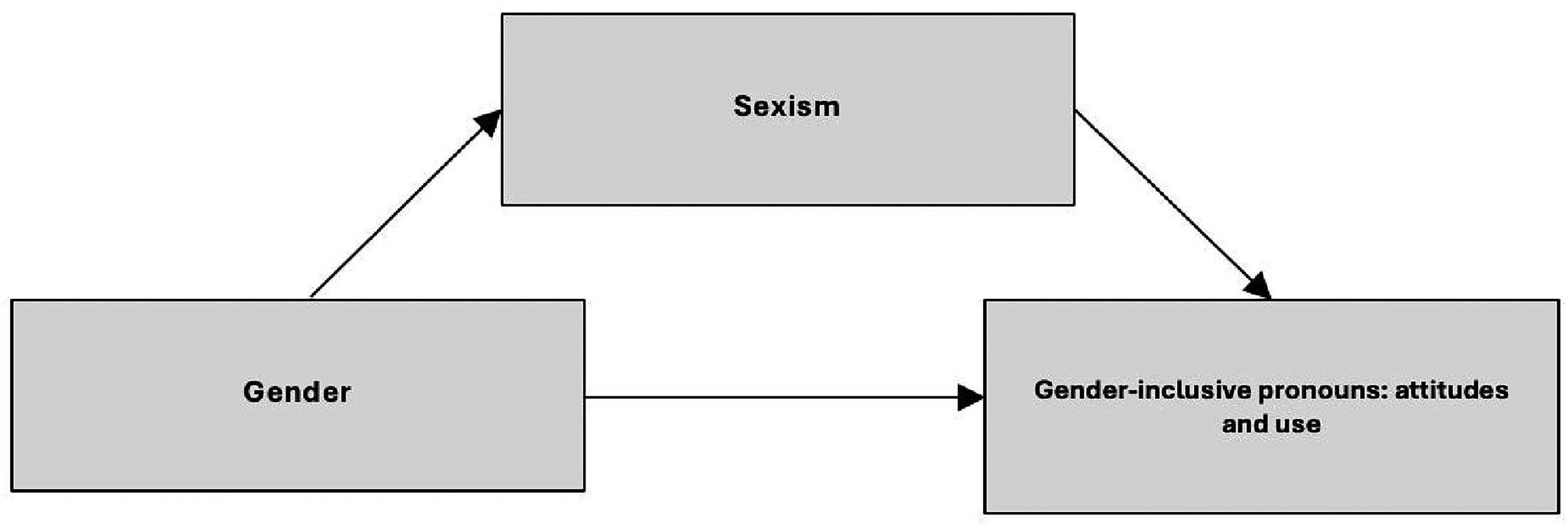
Theoretical model.
We focus on the Swedish gender-inclusive pronoun hen. While many gender-inclusive pronouns have been initiated relatively recently (e.g. hen/die in Dutch; Decock et al., 2024; iel in French; Wagener, 2022; hen and singular they/de in Danish; Hjorth-Nebel Miltersen et al., 2022), the Swedish gender-inclusive pronoun hen was officially implemented 10 years ago in 2015 (SAOL, 2015). Similarly to many other gender-inclusive language reforms (Blaubergs, 1980; Parks & Roberton, 1998), the implementation of hen was met with resistance from the public (Bäck et al., 2018; Vergoossen et al., 2020).
However, over the years, hen has become more prevalent in Swedish media (Ledin & Lyngfelt, 2013; Svensson, 2021), and the Swedish authorities’ writing guidelines recommend using gender-inclusive language in public texts, including the pronoun hen, when contextually appropriate (Språkrådet, 2014). This likely leads to increased familiarity with hen among the public, which in turn may contribute to more positive attitudes and more use among individuals who were not positive toward the pronoun or did not use it at the outset (Gustafsson Sendén et al., 2015, 2021). Therefore, we adjust for time in our analyses.
Additionally, previous research has shown that older individuals and individuals who more strongly identify with their gender (i.e. those who see their gender identity as central to their self-concept) are more likely to hold negative attitudes toward gender-inclusive pronouns and use them less (Gustafsson Sendén et al., 2015, 2021; Lindqvist et al., 2016, Morgenroth et al., 2021; Renström & Klysing, 2024). Hence, we also adjust for age and gender identification in our analyses.
Methods
Participants
This research is based on three cross-sectional surveys of representative samples from Sweden collected in 2015, 2018, and 2021. The data are openly available on the Open Science Framework (link). All data was collected through Enkätfabriken, a Swedish survey company. The surveys were conducted in Swedish, and all participants were native Swedish speakers. Participants provided informed consent before enrolling in the survey and were informed about ethical considerations, including voluntary participation, the right to withdraw, and data handling. Data collection and research procedures were carried out in accordance with Swedish national ethical standards and the Swedish Research Council, which adheres to the European Code of Conduct for research integrity (ALLEA, 2023; Swedish Research Council, 2017) and were approved by the Swedish Ethical Review Authority. 1
In the collapsed data from 2015, 2018, and 2021, there were a total of 4,987 participants, and the average age was 50.56 (SD = 17.28), ranging from 18 to 95. Participants’ legal gender was obtained from the survey company: 2358 (47.3%) women, 2321 (46.5%) men, and 308 (6.2%) were not specified. Participants also indicated their preferred pronoun; 2299 (46.1%) preferred she, 2261 (45.3%) preferred he, 74 (1.5%) preferred hen, 9 (0.2%) preferred it, 79 (1.6%) preferred other pronouns, and 265 (5.3%) did not indicate any pronoun. Sample characteristics by year are reported in the Supplementary Materials.
Measures
We analyze two outcome variables: self-reported attitudes toward hen and self-reported use of hen, which were strongly correlated in the collapsed data (r = .70, p < .001). Attitudes toward hen were measured with the item “What is your attitude toward hen as a gender-inclusive pronoun?”, with responses scored from 1 (very negative) to 5 (very positive). To measure participants’ use of hen, we included two items: using hen in writing (“Do you use hen in writing?”) and using hen in speaking (“Do you use hen in speaking?”). Responses were given on a 5-point scale, from 1 (never) to 5 (daily). Using hen in writing and using hen in speaking were strongly correlated (r = .76, p < .001); thus we collapsed the two items into a mean index.
For analyzing gender, we use participants’ legal gender as woman or man (i.e. gender assigned at birth; Lindqvist et al., 2020), which was provided by the survey company. Legal gender was chosen over participants’ preferred pronouns because the pronoun options varied across years, making direct comparisons between pronoun groups ambiguous. 2
Sexism was operationalized with six items from the Swedish version of the modern sexism scale (Ekehammar et al., 2000). Two example items are “Discrimination against women is no longer a problem in Sweden,” and “Feminism serves no purpose and should be abolished” with responses given from 1 (strongly disagree) to 5 (strongly agree). The items were combined into a mean index (see Supplementary Materials for reliability measures for all scales).
In addition, we included gender identification in the main analyses. Gender identification has been shown to be related to attitudes toward hen as hen challenges the binary gender structure, and those highly invested in their (binary) gender identity may thus perceive this as threatening to the clear distinctions between the groups women and men (Morgenroth et al., 2021). Gender identification was measured with four items from Luhtanen and Crocker (1992) adapted to measure gender identification (see Lindqvist et al., 2020). One example item is: “My gender identity is an important part of my self-image,” scored on a 5-point scale from 1 (strongly disagree) to 5 (strongly agree). The items were combined into a mean index.
Lastly, age was given by participants in a free-text response, and participants who indicated an age below 18 or older than 100 were coded as missing (n = 2). Descriptive statistics for all variables are reported in the Supplementary Materials.
Results
Descriptive Results
First, we present descriptive results on participants’ attitudes toward hen and use of hen. In the collapsed dataset, 47.7% of the participants reported the most negative attitudes toward hen (ratings of 1 or 2 on the scale), 25.2% held fairly neutral attitudes (ratings of 3), and 26.5% reported the most positive attitudes (ratings of 4 or 5). For the use of hen, 63.9% of participants indicated they never used hen in either writing or speaking (rating of 1 on writing and speaking), whereas 30.7% reported using hen at least occasionally in writing and/or speaking (ratings of 2 to 5).
Figure 2 shows the percentage distribution of negative, neutral, and positive attitudes toward hen over the years. As can be seen, the percentage of participants reporting the most negative attitudes toward hen was 54.4% in 2015, 47.4% in 2018, and 42.2% in 2021. The percentage of participants with fairly neutral attitudes toward hen was in 2015 at 22.6%, in 2018 at 25.1%, and in 2021 at 27.6%. The percentage of participants with the most positive attitudes was 21.5% in 2015, 26.9% in 2018, and 30.2% in 2021.
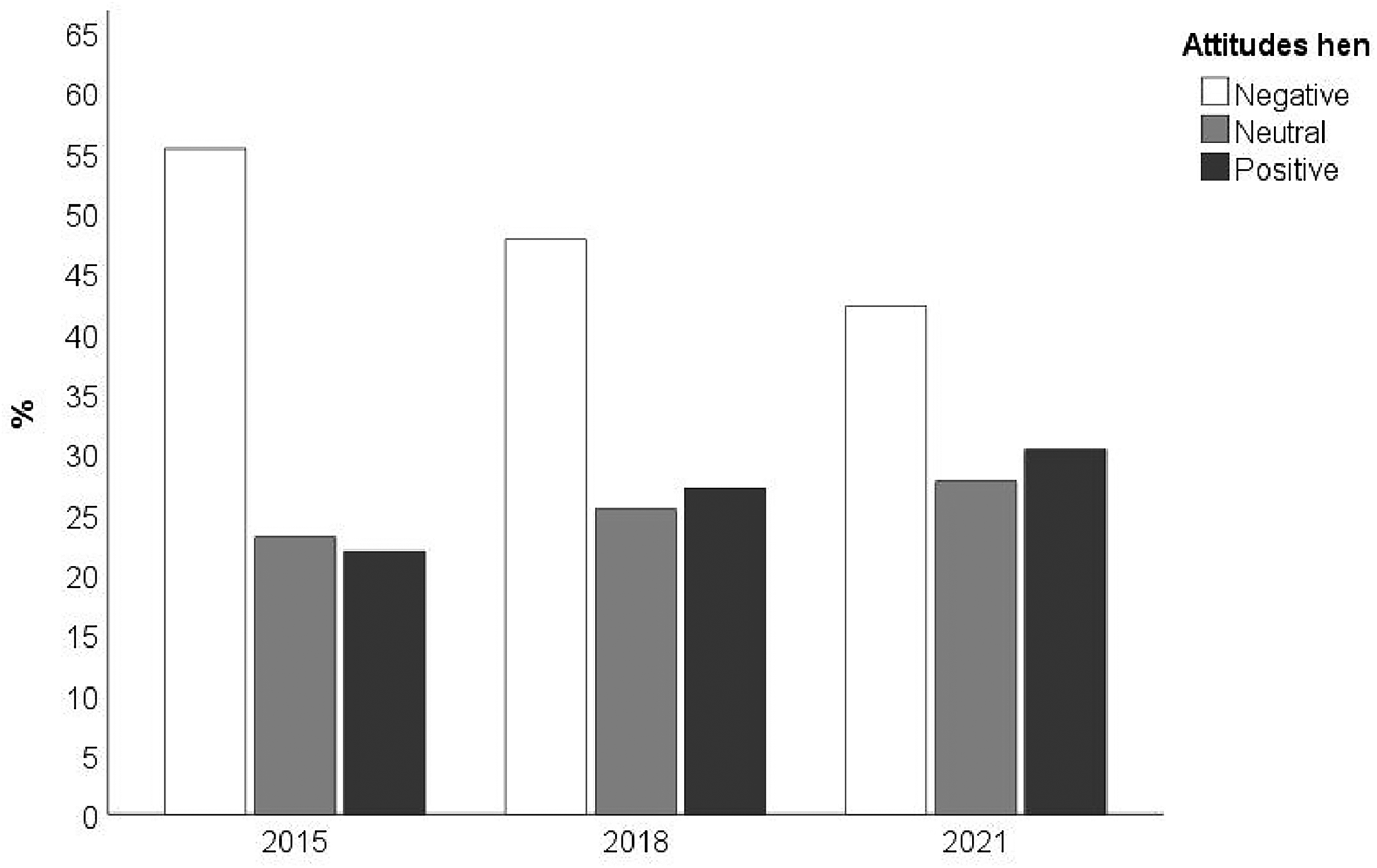
Distribution of negative, neutral, and positive attitudes toward hen by year.
Figure 3 shows the distribution in the use of hen over the years. The percentage of participants who reported never using hen in either writing or speaking was 77.2% in 2015, 68.8% in 2018, and 63.1% in 2021. The proportion of participants who used hen at least occasionally was 22.8% in 2015, 31.2% in 2018, and 36.9% in 2021.
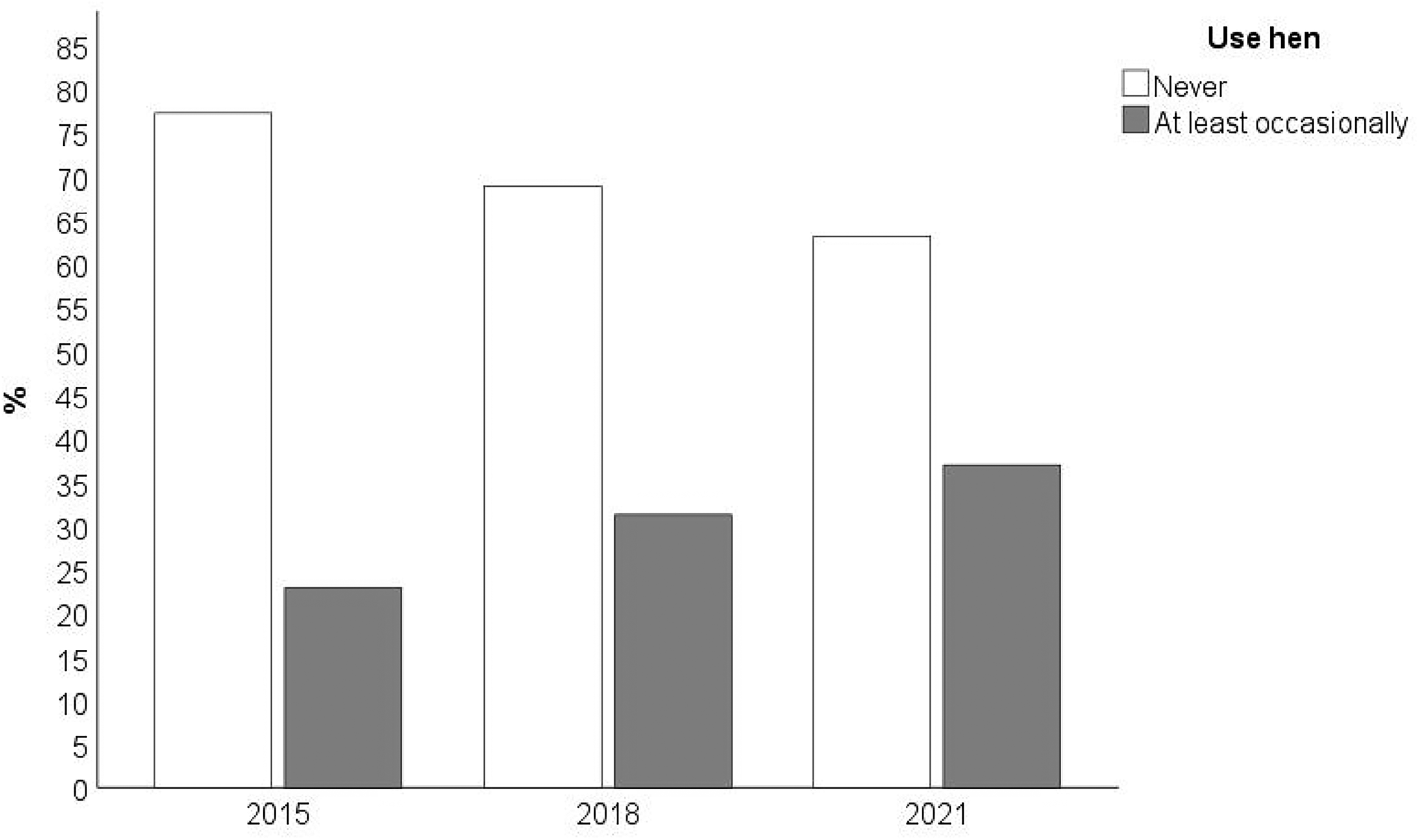
Distribution of the use of hen by year.
Figure 4 shows the mean values of attitudes toward hen and use of hen by gender in the collapsed data. As can be seen, women were on average more positive toward hen and reported slightly more use of hen, compared to men. Overall, the mean attitudes were relatively neutral, close to the midpoint of the scale (i.e. 3), while use was low in general.
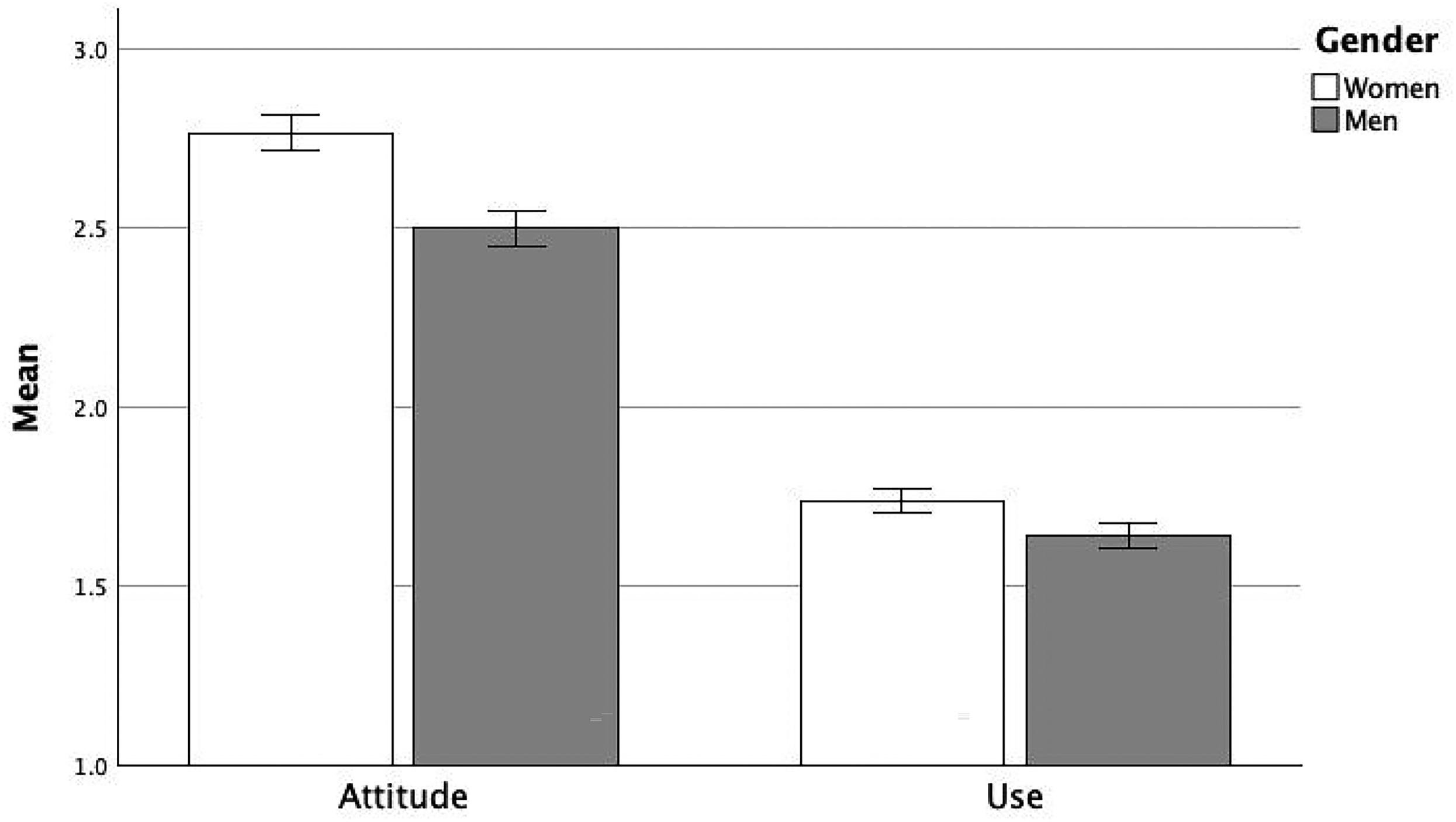
Mean attitudes toward hen and use of hen by gender. Note. The y-axis has been cut to convey the results more clearly. The full scale ranges from 1 (most negative) to 5 (most positive). Error bars represent 95% confidence intervals.
Hypothesis Testing
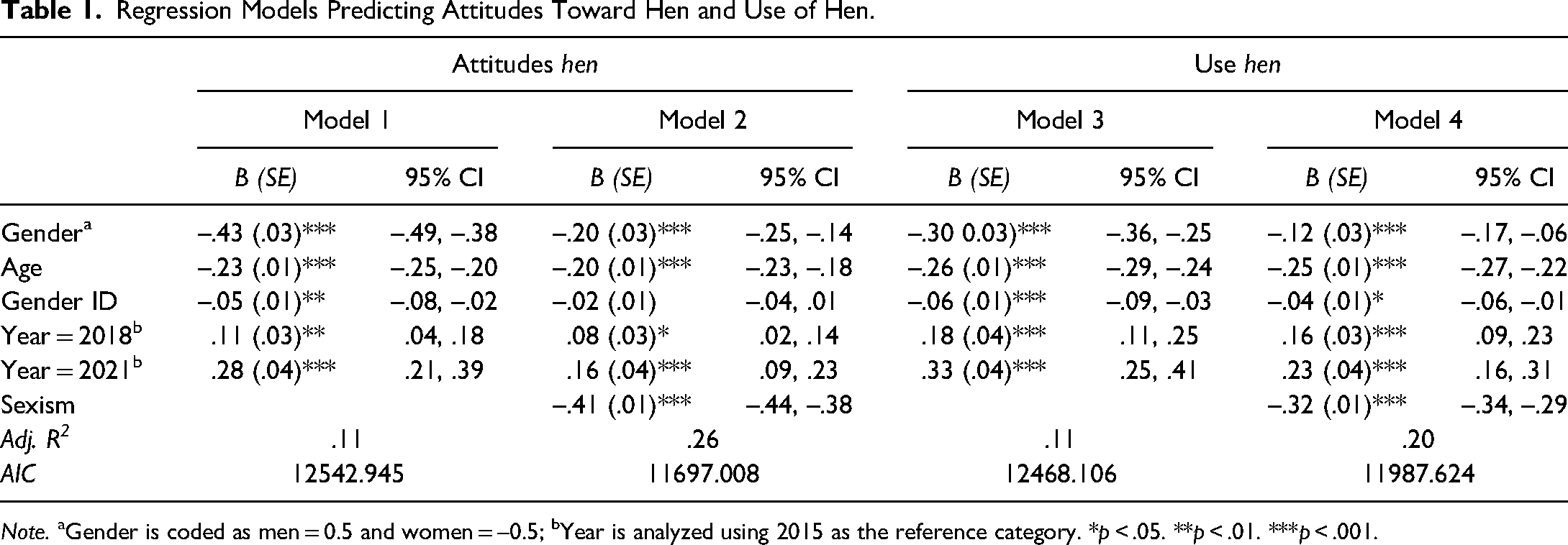
We hypothesized that men (vs. women) are more negative toward gender-inclusive pronouns and use them less, and that this would be associated with higher levels of sexism among men. First, we test the part of the hypothesis found in previous research that men report more negative attitudes, and less use of hen compared to women (Gustafsson Sendén et al., 2015, 2021; Renström et al., 2022). We conducted two hierarchical linear regression models 3 (see Models 1 and 3 in Table 1) using attitudes and the combined use index as outcome variables, separately, while adjusting for age, gender identification (Gender ID), and year. The outcome variables and predictor variables (except for gender and year) were treated as continuous and standardized by subtracting the mean and dividing by the standard deviation.
Regression Models Predicting Attitudes Toward Hen and Use of Hen.
Note. aGender is coded as men = 0.5 and women = –0.5; bYear is analyzed using 2015 as the reference category. *p < .05. **p < .01. ***p < .001.
As can be seen in Table 1, gender predicted both attitudes and use while adjusting for other relevant variables (Models 1 and 3). Men were more negative toward hen and used hen less compared to women. The coefficients for gender were among the strongest. Specifically, for attitudes, gender was the strongest predictor, and for use, the coefficient for gender was slightly weaker than the coefficient for year. Older participants and those with a stronger gender identification were less positive and used hen less. Both positive attitudes and use of hen increased over time.
Second, we test whether sexism is associated with more negative attitudes toward gender-inclusive pronouns and less use of such pronouns. To test this, we included a second step in the models presented in Table 1, where we included sexism. The results are presented in Table 1 (Models 2 and 4). As can be seen, when adding sexism, the explained variance substantially increases, and the predictive power of gender decreases. The substantive role of sexism shows that for each increased standard deviation in sexism, attitudes toward hen decrease 0.41 standard deviations, and use decreases 0.32 standard deviations. The AIC model selection indices for both attitudes and use suggest that the model including sexism is a better fit than the model without it (ΔAIC > 10). Taken together, these results show that there is a relationship between sexism and attitudes toward hen and use of hen, and the change in the coefficients for gender suggests that men and women differ in level of sexism, which we formally test in the following section.
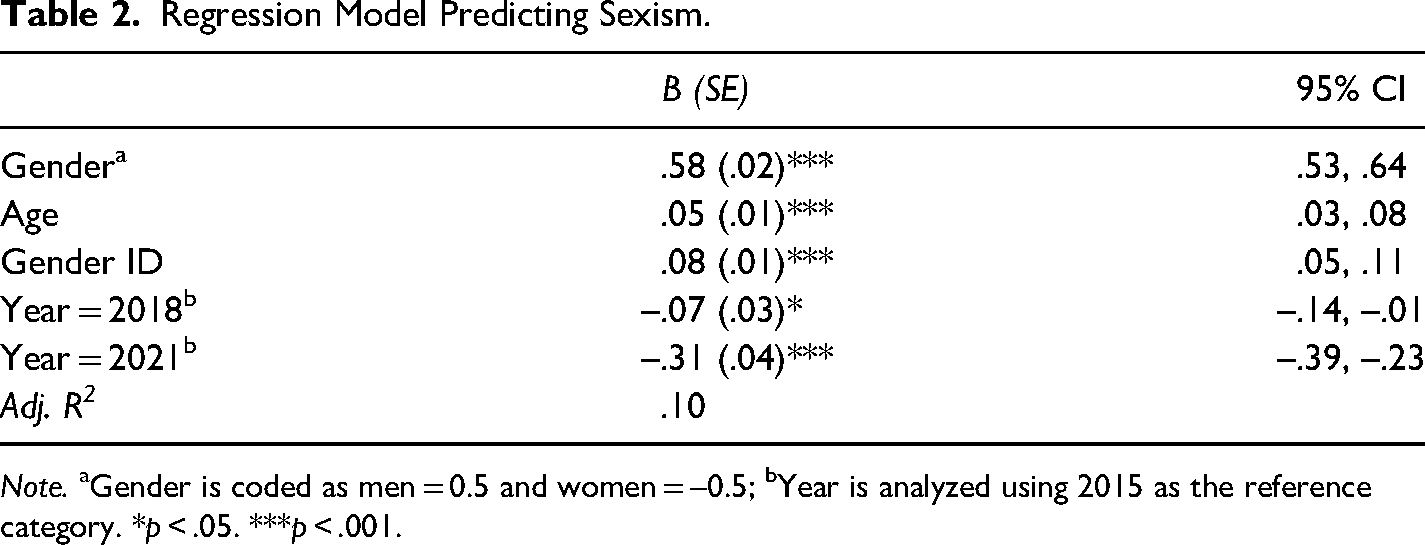
Our hypothesis states that men hold more negative attitudes toward gender-inclusive pronouns and use them less, which is associated with higher levels of sexism among men. This assumes that men are higher in sexism compared to women. We test this relationship with a linear regression model using sexism as the outcome variable and gender as the focal predictor, adjusting for age, gender identification, and year. The results are presented in Table 2. 4
Regression Model Predicting Sexism.
Note. aGender is coded as men = 0.5 and women = –0.5; bYear is analyzed using 2015 as the reference category. *p < .05. ***p < .001.
As can be seen in Table 2, older participants and those who more strongly identify with their gender score higher in sexism. Sexism was lower in 2018 and 2021 compared to 2015—that is, there was a general trend that sexism decreased over the years, especially from 2015 to 2021. Gender was the strongest predictor of sexism, where men were higher than women in sexism. The coefficient for gender was 0.58, indicating that on average, men scored more than half a standard deviation higher on sexism compared to women.
Figure 5 illustrates the results from testing our hypothesis that men are more negative toward gender-inclusive pronouns and use them less, which is associated with higher levels of sexism among men 5 . As can be seen, men are more negative toward gender-inclusive pronouns and use them less compared to women. Men are also higher in sexism compared to women, and sexism predicts more negative attitudes and less use of gender-inclusive pronouns. These relationships were found while adjusting for age, gender identification, and year.
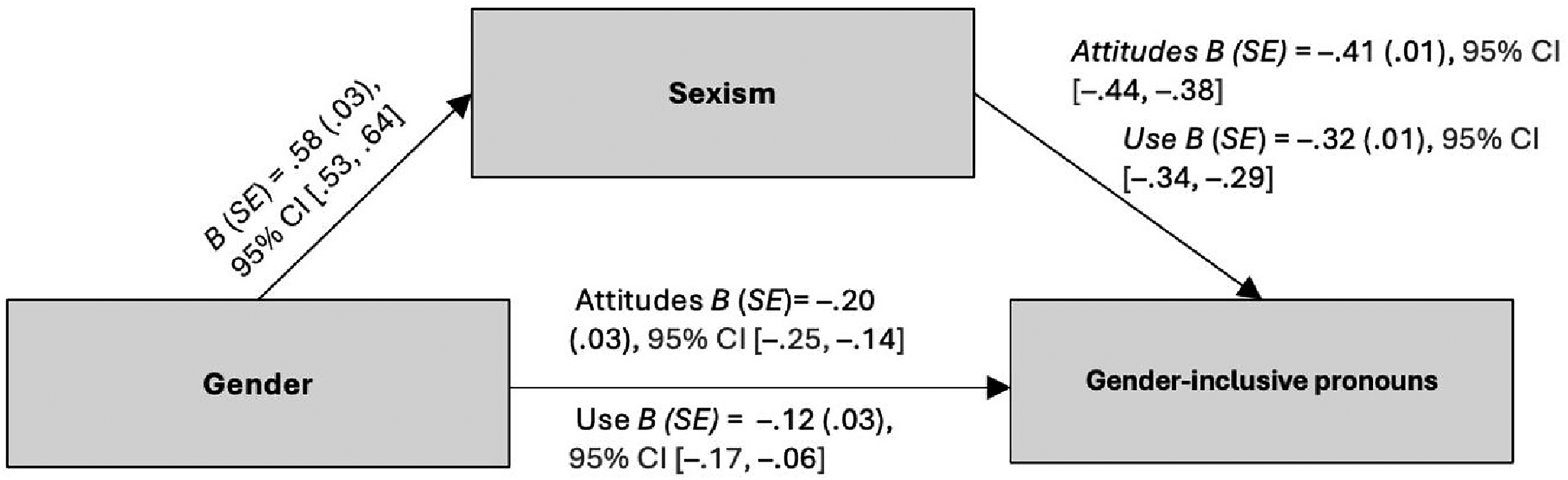
Hypothesis testing results. Note. For gender, the reported coefficients apply to men with women as the reference category.
Discussion
The use of gender-inclusive pronouns can provide a venue for more inclusion and less bias and prejudice in language, which could benefit linguistically invisible groups, including women, sexual and gender minority groups, such as transgender, nonbinary, and gender-nonconforming individuals. However, because gender-inclusive pronouns challenge the binary conceptualization of gender and, in turn, the hierarchical gender structure in society (Morgenroth et al., 2021; Renström & Klysing, 2024), those who benefit the most from these structures are expected to be more resistant. This was also what we found in the current study by analyzing cross-sectional data across three time points—2015, 2018, and 2021—on attitudes toward and use of the Swedish gender-inclusive pronoun hen. The results showed that men, regardless of the time of measurement, were more negative toward hen and used hen less compared to women, which aligns with previous research in Sweden (e.g. Gustafsson Sendén et al., 2015, 2021; Renström et al., 2022). However, despite this resistance, our results also show a gradual shift over time in the whole sample, such that attitudes toward hen have become more positive, and use has increased.
Yet, although hen has become more accepted and used, the average values, especially for use of hen, are relatively low. The majority of participants throughout the years report never using hen, despite the fact that the pronoun was first discussed in 2011 and thus had been part of the language for 10 years at the time of the 2021 survey. This suggests that integrating gender-inclusive pronouns in languages is possible despite strong initial resistance, but it is a slow process nonetheless. Given that Swedish was the first language to officially add a gender-inclusive pronoun, these findings provide valuable insights for the implementation of similar reforms in other languages, such as iel in French (Wagener, 2022), and hen in Danish and Dutch (DeCock et al., 2024; Hjorth-Nebel Miltersen et al., 2022).
Our findings further highlight the role of sexist attitudes in resistance toward gender-inclusive pronouns. Participants, who scored higher on sexism (Ekehammar et al., 2000; Swim et al., 1995), were more likely to be negative toward hen and less likely to use it. Men as a group scored higher on sexism than women as a group. A regression analysis showed that sexism accounted for some of the gender differences in attitudes and use of hen, though not all, indicating that additional factors, not measured in this study, also play a role. While the cross-sectional data we analyzed here cannot establish causality, the results have important theoretical contributions and practical implications.
Theoretically, these findings support the idea that those who benefit from traditional gender structures are more inclined to resist changes that challenge them (Morgenroth & Ryan, 2021; Renström & Klysing, 2024). Our study contributes to theories of precarious manhood and masculine overcompensation (Bosson et al., 2009, 2021; Bosson & Vandello, 2011; Vandello et al., 2008; Willer et al., 2013), which suggest that masculinity must be performed and is therefore vulnerable to perceived threats (Hunt et al., 2016; Mesler et al., 2022). Given that gender-inclusive pronouns undermine the binary conceptualization of gender, the use of such pronouns may be seen as a threat to traditional masculine identity, which is largely defined as abstaining from everything that is feminine. Our findings indicate that linguistic shifts as part of broader social change may activate gender identity threats, which lead to compensatory attitudes or behaviors aimed at preserving traditional gender roles and hierarchies.
This reasoning also aligns with theoretical predictions based on the intergroup threat theory (Stephan et al., 2015). Based on social identity theory (Tajfel & Turner, 2004), the intergroup threat theory states that when a group perceives that another group is in a position to threaten the ingroup, such as by threatening their status or position, a common reaction is intergroup distancing (Renström et al., 2024). Thus, resistance toward gender-inclusive pronouns can be understood as a reaction to a perceived threat to one's group. Since men are historically in a privileged position within the gender hierarchy, challenges to binary gender structures may be perceived as a challenge to their group's status and privileges (Hekanaho, 2020). This reasoning aligns with the findings of a recent meta-analysis (Rossi & Caricati, 2025), which examined 51 studies on the correlation between justifying current gender inequalities and beliefs about gender as biologically fixed and unchangeable.
Our findings also align with predictions based on Butler's (1990) theory of gender performativity, such that disruptions to established gender norms (here the introduction of gender-inclusive pronouns) are met with resistance from those who uphold binary gender norms. Butler's concept of gender trouble suggests that disrupting normative gender performances exposes gender as a social construct, making the fluidity and contingency of gender more apparent. Our findings suggest that men's resistance toward gender-inclusive pronouns may reflect an effort to reinforce traditional gender roles in response to this disruption.
Importantly, in the current research, we did not distinguish between resistance toward gender-inclusive pronouns used as a de-gendering strategy versus used as a multi-gendering strategy. That is, when a gender-inclusive pronoun is used generically to remove linguistic gender cues or when it is used to refer to individuals with potentially nonbinary gender identities (Morgenroth et al., 2021; Renström, 2025). Previous research suggests that the ideological underpinnings of resistance may differ depending on the strategy and that individuals who prefer a traditional, binary view of gender may be more concerned with the multi-gendering strategy of gender-inclusive pronouns (Renström, 2025; Renström & Klysing, 2024). However, both strategies seem to conflict with worldviews that deny gender-based discrimination and oppose gender equality. Hence, we suggest that future research explore the interrelations between attitudes and use of gender-inclusive pronouns as used in these two strategies, sexism, and one's own gender.
Sexist attitudes and overall system-justifying beliefs could pose a barrier to the integration of gender-inclusive pronouns in languages, as well as other initiatives that challenge the binary construction of gender. A growing body of research has highlighted a relatively recent backlash in some Western countries toward gender equality and modern sexism, in particular among younger men (e.g. Off et al., 2022). Given our finding that sexist attitudes predict resistance toward gender-inclusive pronouns, understanding and addressing such attitudes is critical for the implementation of gender-inclusive pronouns in Swedish and beyond. Extending this reasoning to apply to other types of actions to increase gender equality and inclusion, such initiatives may be currently facing a major obstacle in this backlash.
In sum, while gender has traditionally been understood as binary, scholars and activists have suggested that it is rather fluid, performative, and socially constructed, which is reflected in initiatives to implement gender-inclusive pronouns in languages with existing personal pronouns denoting only women and men. Our findings show that there is tension in this shift as gender-inclusive pronouns challenge established gender categories, likely leading to resistance from those committed to maintaining binary and hierarchical gender structures. Nevertheless, the growing acceptance of the pronoun hen in Sweden indicates that gender norms can still be evolving even in the face of opposition.
Limitations and Future Research
While the findings in the current study are based on large and representative samples and the measures are assessed over several years, we acknowledge some limitations. Given that the data is cross-sectional and collected from different participants over the years, we cannot establish a causal relationship between gender, sexism, and attitudes toward hen and use of hen. While we can be certain that legal gender predates both sexist attitudes and attitudes toward and use of gender-inclusive pronouns, and it makes sense that general sexist attitudes form the foundation for more specific attitudes toward and use of gender-inclusive pronouns, we cannot rule out reversed causation between sexism and attitudes toward hen and use of hen. That is, it is possible that individuals’ attitudes and use of gender-inclusive pronouns influence their attitudes related to sexism. It could be the case that being exposed to gender-inclusive pronouns may contribute to a less binary understanding of gender and/or decrease the salience of gender in one's language, which could, in turn, affect perceptions of gender norms and hierarchies. One example is that research has shown that in some countries with genderless language, individuals show more support for gender equality and opposition to domestic violence toward the wife compared to those in predominantly non-genderless language-speaking countries (Tanabe et al., 2025). In other words, the language that is used can reflect both how the world is perceived and how the world is constructed (Fiedler, 2008; Lucy, 1992; Whorf, 1956). Hence, to gain better insight into the causal relationship, future research should ideally make use of experimental or panel designs to manipulate sexist attitudes and/or follow the same individuals over time in other languages that are adopting gender-inclusive pronouns, such as Dutch, given that hen is already well-integrated into Swedish.
An important consideration in this regard is also whether the same predictors of negative attitudes and less use of gender-inclusive pronouns that we have identified here also apply to the adoption of gender-inclusive pronouns in grammatically genderless languages (e.g. Finnish and Turkish). Research suggests that even languages with genderless pronouns tend to be male-biased (Renström et al., 2023b); hence, there is a need for implementing new personal pronouns that explicitly include all genders also in grammatically genderless languages. Examining the predictors of resistance toward new gender-inclusive pronouns in grammatically genderless languages could provide valuable insights into how existing linguistic structures relate to resistance.
Furthermore, we recognize that there are some limitations associated with using self-reported data and single-item measures to assess attitudes and use of gender-inclusive pronouns. With self-reported use, there is the factor that individuals may fail to recall or be unaware of how often they use a particular pronoun. In terms of attitudes, since they are measured only at a single point in time, it is possible that they may not be stable or reflective of long-term attitudes. To address some of these issues, future research could use more unobtrusive measures, such as fill-in-the-blank tasks, where participants select which pronouns they use in different contexts (see, e.g. Renström et al., 2022). Regarding the use of single-item measures, while they are convenient, they can be limited in that measuring positive or negative attitudes toward something can be interpreted in various ways and does not clarify the specific reasons behind participants’ attitudes toward the pronoun. Nevertheless, single-item measures can still be valuable, particularly when comparing data across years, as they simplify the measurement process and help maintain some consistency across time.
In the current research, we found that men are more negative toward hen and use hen less. We also found that men are higher in sexism, and that sexism predicts negative attitudes toward hen and less use of hen. These results suggest that a potential explanation to why men resist gender-inclusive pronouns is their stronger endorsement of sexist attitudes However, there was also variance related to gender that was not accounted for by sexist attitudes. Hence, other factors not measured in the current study may have additional influence that should be studied in future research. We used modern sexism, as this is a relatively broad indicator of endorsement of traditional gender arrangements and not specifically related to language. While we see that this is beneficial, as gender-inclusive pronouns and language in general are one way to achieve gender equality, these are also just indications of a broader societal movement towards more gender equality and inclusion of minority groups. We acknowledge that it would be wise for future research to examine both such broad attitudes and attitudes more specifically related to language (e.g. attitudes to sexist/non-sexist language; Parks & Roberton, 2005).
Finally, considering that the sample size in the current study was large, even small statistical effects can become statistically significant. However, for the main predictors, gender and sexism when predicting attitudes and use of hen, the effect sizes are not negligible. Most importantly, the large sample size in the current study likely enhances the precision of the estimates, regardless of the effect sizes, and it is worth noting that smaller effect sizes are often more accurately measured in research (Funder & Ozer, 2019). Additionally, even effect sizes classified as small can be of practical relevance when considered in aggregate or over time, especially when they reflect societal-level change. As third-person pronouns are among the most frequently used words in many languages (e.g. Pennebaker, 2011), even small changes in pronoun attitudes and use might have a substantial impact for individuals and/or for society at large (Lindqvist et al., 2018; Renström et al., 2024).
Conclusion
This study shows that men as a group, compared to women as a group, are over time more negative toward the Swedish gender-inclusive pronoun hen and use it less. Men also scored higher on sexism, which, as hypothesized, predicts more negative attitudes and less use of hen. These findings suggest that legal gender alone may not be the best predictor of resistance toward gender-inclusive pronouns. Instead, attitudinal and ideological factors, such as sexism, could be better predictors (see also Lindqvist et al., 2020). While men generally report more sexist attitudes, women with higher levels of sexism—though less common—were also more likely to report negative attitudes and less use of hen. In sum, sexist attitudes seem to be a contributing factor across time as to why some groups in society express stronger resistance toward gender-inclusive pronouns.
Supplemental Material
sj-docx-1-jls-10.1177_0261927X251335305 - Supplemental material for A Sexist Language? Gender Differences in Attitudes and Use of Gender-Inclusive Pronouns
Supplemental material, sj-docx-1-jls-10.1177_0261927X251335305 for A Sexist Language? Gender Differences in Attitudes and Use of Gender-Inclusive Pronouns by Amanda Remsö, Hanna Bäck and Emma A. Renström in Journal of Language and Social Psychology
Footnotes

Declaration of Conflicting Interests
The authors declared no potential conflicts of interest with respect to the research, authorship, and/or publication of this article.
Ethics Statement
Data collection was reviewed by the Swedish Ethical Review Authority (nr. 2015/208-31/5 and nr. 2018/719). The studies were conducted in accordance with the local legislation and institutional requirements. The participants provided their written informed consent to participate.
Funding
The authors disclosed receipt of the following financial support for the research, authorship, and/or publication of this article: This work was supported by the Swedish Research Council (grant no. 421-2014-1150 and 2023-00731), and the Swedish Research Council for Working Life and Welfare (grant no. 253099-131526).
Supplemental Material
Supplemental material for this article is available online.
Notes
Author Biographies
References
Supplementary Material
Please find the following supplemental material available below.
For Open Access articles published under a Creative Commons License, all supplemental material carries the same license as the article it is associated with.
For non-Open Access articles published, all supplemental material carries a non-exclusive license, and permission requests for re-use of supplemental material or any part of supplemental material shall be sent directly to the copyright owner as specified in the copyright notice associated with the article.
