



Abstract
This study examines the relationship between the gender status of spoken languages and attitudes toward gender equality. Studies show that gendered languages subconsciously contribute to a masculine–feminine dichotomy, favoring men, while genderless languages minimize the reinforcement of gender stereotypes. Using data from the World Value Survey Wave 7, we analyzed if speaking a genderless language at home and living in a predominantly genderless-language-speaking country is associated with gender ideologies across four subcultural groups. Ordered logistic regression results show that genderless languages have mixed relationships with gender ideology. Whereas the use and exposure to genderless languages most significantly increase the odds of opposing domestic violence in Orthodox Europe, West, and South Asia, and the African Islamic subgroups, genderless language has the highest positive association with support for income equality in marriage in Latin America. Our findings highlight the relationship between genderless languages and gender ideology, particularly as the importance of gendered pronouns gains visibility.
Keywords
Introduction
Cultural and individual differences in attitudes toward gender equality are a widely studied topic across disciplines (Belingheri et al., 2021; Davis & Greenstein, 2009; Inglehart et al., 2003; Ortner, 1972; Rosaldo et al., 1974). For instance, gender structure theory specifically highlights how gender roles are shaped by the interconnected influences of cultural norms, institutional factors, and individual interactions (Begall et al., 2023). The perception of gender and gender roles, also known as gender ideology, includes complex attitudes toward the traits and responsibilities of men and women in work, caregiving roles, and the notion of dominance. Traditional gender stereotypes attribute agentic traits such as power, and competitiveness to men, while simultaneously assigning communal traits such as nurturing, and empathy to women (Stewart et al., 2021). Previous cross-cultural studies found that the economic development of the country and some demographic factors such as gender and educational attainment influence gender ideology (Blumberg, 2004; Bolzendahl & Myers, 2004; Ciabattari, 2001).
While we acknowledge the importance of these economic and demographic factors on gender (in)equality and gender roles, we argue that a linguistic approach is necessary for conceptualizing gender views in the global context. Language plays a central role in forming perception through symbolic interactions, discourse, and cognitions which influence individuals’ realities and cultural patterns (Lucy, 1997, 2001; Martin & Nakayama, 2010). Despite the emphasis on language use in discourse in the cross-cultural analysis of gender equality perception, no study has yet examined the association between language use and gender equality perceptions at a large scale.
In this paper, we specifically focus on the use of linguistic gender in grammar. Every language can be organized into one of three categories: grammatical gender languages (i.e., Spanish and Arabic), natural gender languages (i.e., English and Swedish), and genderless languages (i.e., Estonian and Persian). Contrary to the first two groups, genderless languages are entirely bereft of any markings for genders, including a gender-neutral third-person pronoun. This study investigates how gender equality is perceived across genderless language speakers compared to gendered language speakers through cross-national analyses in four regions of the world with 54 countries.
Background
Gender in Linguistic Grammar and Language Construction
All languages can be separated into three groups: “language with natural gender where pronouns but not nouns are gendered, grammatically gendered languages where both nouns and pronouns are gendered, and grammatically genderless languages where neither nouns nor pronouns are gendered” (Renström et al., 2023, p.2). Genderless languages are languages that do not differentiate between masculine and feminine pronouns, which are most evident in the third person pronouns such as he, she, or they. For example, in Persian, “او” /u/ (he/she) and “آنها” /anha/ (they) are used to refer to both male and female individuals and groups, respectively. Romance languages such as Italian and Germanic languages such as English are gendered languages, as seen in the different third-person pronouns based on gender (he or she). While English has a gender-neutral third-person plural pronoun (they), some grammatically gendered languages such as French and Spanish will also differentiate the third-person plural pronouns based on gender (elles/ils).
Grammatical gender not only clearly divides gender into two categories, men and women, but also reinforces men's dominance over women especially in the form of plural third-person pronouns. In grammatically gendered languages, which have a masculine form and a feminine form for the pronoun “they,” the lack of gender equality is especially noticeable in the plurals because it favors the masculine pronoun. For example, a group of men will be referred to by the masculine they (ils), and a group of women will be referred to by the feminine they (elles). However, if it is a mixed-gender group, even if there is only one man and three women (or even thousands of women), the group will be referred to by the masculine they (ils), showing that a single male can outnumber every woman in the group. Although there are exceptions to this rule, most natural gender languages tend to use masculine terms as the default. It subconsciously exemplifies the idea of androcentrism, showing that men are typically representative of society (Hellinger & Bußmann 2015; Körner et al. 2022; Stahlberg et al. 2011; Lindqvist et al. 2019). Genderless languages do not allow the reinforcement of an androcentric worldview because the third-person genderless pronouns, singular and plural, remain the same for male, female, and mixed groups, possibly contributing to fewer gender role stereotypes.
Unlike gendered languages, genderless languages, such as Finnish, Persian, or Turkish, only have one version of the third-person pronoun. Turkish refers to he/she/it as “o” and “onlar” is used as the pronoun “they” for males, females, or mixed groups, indicating that gender does not have a significant impact on the language. To note, genderless languages are also different from languages that contain grammatical genders such as Arabic, which differentiate not only pronouns such as he and she but also every noun as masculine and feminine (such as the word for moon is masculine “قمر” /qamar/ and the word for sun is feminine “شمس” /shams/. Similar to Arabic, many Romance languages such as French and Spanish also have grammatical genders. For example, in French, a chair is a feminine noun (la chaise) as opposed to a book (le livre), which is a masculine noun. In these languages that contain grammatical genders, the adjectives and the adverbs that modify the noun will change according to the gender of the noun, making gender not only a part of pronouns but also the most basic foundation blocks of the entire language. Table 1 presents some examples of grammatical gendered languages.
Construction of Languages in Terms of Gender.
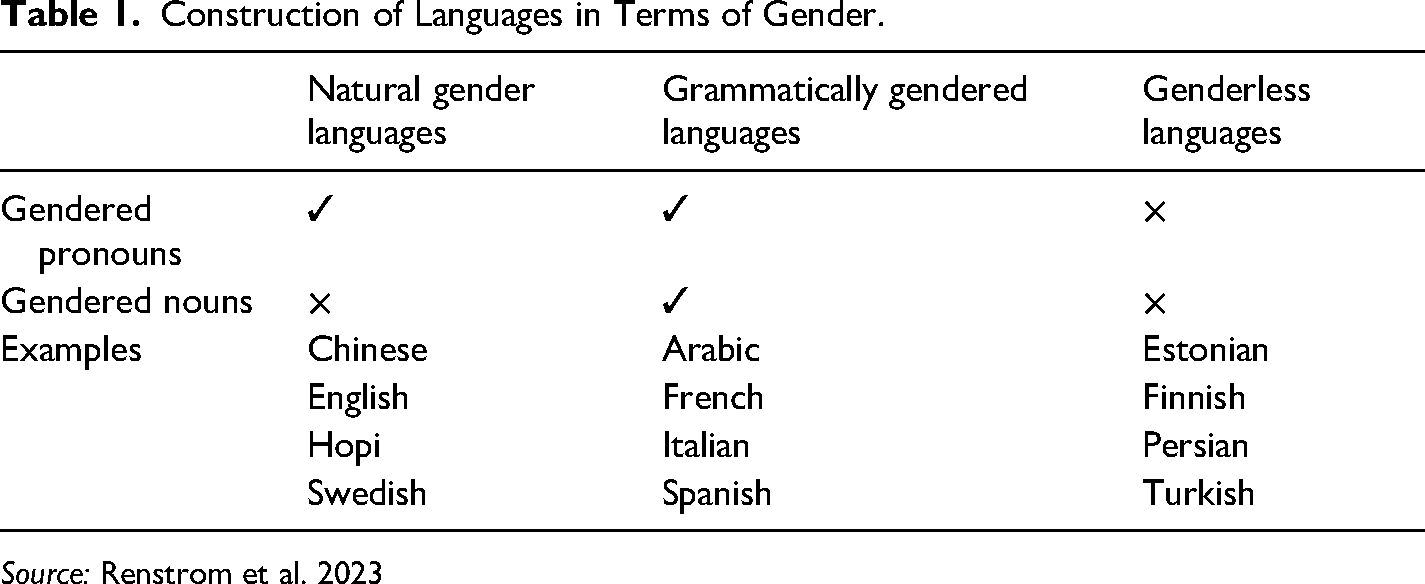
Source: Renstrom et al. 2023
In contrast to grammatically gendered languages, such as French or Spanish, genderless languages do not group all nouns into either a masculine or feminine category. There is no gender associated with the words book or chair in genderless languages (as is also the case with natural gender languages). This absence of gendered nouns, however, should not be confused with the concept of gender neutrality, which refers to words that can apply to all genders. Genderless languages can still contain gender-specific nouns such as mother and father, although, mother and father will be referred to by the same third-person pronouns. To give an example, in the genderless language, Finnish, the word for mother is “äiti,” and the word for father is “isä,” but the genderless pronoun “hän” is used to refer to both. There are some words that are gender-neutral even in natural gender languages (such as “doctor” as a term that can be a man or woman), and there has been a movement toward gender inclusivity and reformation toward including more gender-neutral nouns such as firefighter instead of firemen.
While there are pragmatic factors for language changes, there are also cognitive and social aspects to language change. While Tagalog is considered a genderless language, due to the Spanish influence, it has retained masculine and feminine endings in Spanish loan words. In many languages that contain natural gender words, people have consciously begun implementing or inventing new words to represent females and improve the visibility of females in society (da Silva, 2010). Some grammatically gendered languages have begun creating new terms, some of which are gender neutral, to create more inclusivity such as Spanish creating the gender-neutral -e ending instead of the masculine -o and the feminine -a ending or Swedish adding the gender-neutral singular pronoun “hen” to the Swedish Academy's Dictionary in 2015 or veering away from treating the collective noun as masculine in French or increasingly using the gender-neutral “they” as a singular pronoun in English (Gustafsson Sendén et al., 2021).
In English, people have begun using “he/she” instead of “he” to represent the undefined person to counteract against the male-oriented bias. However, there are also drawbacks to this balancing act because “he/she” unconsciously reinforces the assumption that gender is a binary social concept (Renström et al. 2024), and that the undefined person is heterosexual and cisgender (Klysing, 2023). While newly included gender-neutral pronouns have more associations with negative attitudes, an extended period of usage may be the driving force behind acceptance toward gender-neutral pronouns (Gustafsson Sendén et al., 2015). Furthermore, mutation of less-androcentric terms by the use of gender-neutral language and adaptation of gender-neutral pronouns may not completely eliminate gender or race-based favoritism (Bailey & LaFrance 2017). From these inventions and the integration of new terms in societies that innately contain a gender bias in the language, we can clearly see the important role words and linguistic visibility play in each culture and society.
Linguistic Relativity Hypothesis
The linguistic relativity hypothesis, alternatively known as the Sapir–Whorf Hypothesis, suggests that the language an individual speaks influences their cognition, and by extension, has a significant impact on the individual's perception of the world (Lucy, 2001). The hypothesis centers on the structural distinctions (i.e., sentence structure, meaning, contextual use) found in natural languages such as Hopi, Chinese, and English (Lucy, 1997, 2001). Research shows that two notable trends are unfolding in the cognitive and psychological sciences. First, there is a growing awareness within these fields regarding the nature and extent of language differences. This heightened awareness has resulted in an increased focus on studying the potential cognitive implications associated with language differences, and previous research has exemplified how different languages not only provide phonological or morphological forms but different conceptualizations of our realities (Durst, 2003; Levinson, 2003; Niemeier & Dirven, 2000).
Second, the integration of neologism and linguistic inclusivity are explored on how language influences thinking on semiotic, structural, and functional levels (Lucy, 2001). Much of the linguistic relativity literature focuses on the semiotic level of language, meaning the relationship between language and thought in development is progressively influencing and being influenced by investigations into linguistic relativity and failed to recognize structural differences (Bowerman & Levinson, 2001), often viewing them solely as general psycholinguistic processes or as means for adopting particular local discourse styles and formats including grammar (Lucy, 1997). Some studies have found that language affects aspects of cognition including color perception (Kay & Kempton, 1984), and conceptual processing (Simmons et al., 2008). Therefore, language may influence thought patterns regarding gender and other socially constructed categories.
Furthermore, the connection between language and gender equality has only been explored previously based on the premise that “nuances in gender markings across languages might partly account for individual differences in attitudes about gender equality” (Pérez & Tavitz, 2019, p. 81). Although a bias toward males is still observed among Turkish and Finnish speakers (Renström et al. 2023), previous case studies have shown that gendered language speakers are more aware of gender differences, more likely to acquire a strong connection to their gender identity, and more likely to categorize the world into masculine and feminine (Boroditsky et al., 2003; Cubelli et al., 2011; Guiora et al., 1982; Konishi, 1993; Phillips & Boroditsky, 2013; Sera et al., 1994). The linguistic relativity hypothesis would suggest that the three groups of gendered language users possess different thought patterns and different perceptions of reality regarding gender because of how language usage patterns can influence thought processes.
The Interconnection of Language, Culture, and Gender in Sociolinguistic Contexts
Researchers have criticized the Sapir–Whorf hypothesis for undermining the idea of a universal foundation for human cognition, albeit not always consistently in subsequent studies (Cibelli et al., 2016; Hussein, 2012). In addition to language's influence on cognition suggested by the linguistic relativity approach, the cultural factors associated with language are also essential dimensions in studying discourse and culture (Quinn, 1991). Social cognition is influenced by structural differences in vocabulary, syntax, and grammar, as well as linguistic choices made by the speakers (Maass et al., 2022). These structural differences and linguistic choices play a critical role in understanding the relationship between language and culture (Enfield, 2013). Additionally, as language influences culture, languages are also constantly influenced by a region's social, political, and economic changes. These changes have also been observed in other linguistic fields such as linguistic anthropology, with anthropologists observing that “language shift[s] must be understood as a ‘symptom of social interaction,’ inseparable from its sociocultural context” (Edwards, 2010, p. 4).
Considering that language is used as a “conduit of tradition, culture, and shared narrative” (Edwards, 2013, p. 19) and serves as a marker of personal and collective identities, it also undoubtedly shapes how individuals perceive themselves and others within their cultural, gender, or group affiliations (Romaine, 2000). The language and the culture that is associated with it are not only individuals’ perceptions of language use or attitudes toward language users but are also related to collective perceptions and cultural hegemonies (Lanza & Woldemariam, 2008; Gal, 2005). The conscious use of language reflects and reinforces these identities, highlighting the complex relationship between language and self-perception. Thus, language serves as a symbolic source of cultural identity and individual identity, and language ideologies can be seen in the linguistic choices of the speaker. People may choose specific words, phrases, and nuances to express their identity; when speakers consciously choose and adapt linguistic features, it is important to recognize how these choices can impact their cultural expression (Makihara & Schieffelin, 2007).
Although cognitive linguists acknowledge the linguistic relativity hypothesis, which suggests that language shapes how we perceive reality, they have largely overlooked the cultural factors that influence word choices and their associated perceptions (Hill & Mannheim, 1992). Perception of gender is largely influenced by culture, economy, and individual demographic characteristics. The analysis of attitudes toward gender equality must integrate these societal factors in addition to language use, especially in multicultural comparisons.
Gender Ideology in the Cross-Cultural Aspects
Gender ideologies refer to “cross-cultural similarities and differences in human views on women, men, and alternative gender identities” (Philips, 2001, p. 6017). It is often measured by the level of support for the gendered division of financial contribution to the household and unpaid labor at home, where men are believed to be the breadwinner of the household and women stay at home and take care of the family (Davis & Greenstein, 2009). The term “gender ideologies” has been used semi-interchangeably with other related terms such as gender role attitudes, gender-related attitudes, and gender egalitarianism (Davis & Greenstein, 2009; Duerst-Lahti, 2008). Broadly conceptualized, gender ideologies are “structured beliefs and ideas about ways power should be arranged according to social constructs associated with sexed bodies” (Duerst-Lahti, 2008, p. 2–3). This view is also supported in a cross-cultural examination of anthropological gender ideology based on a structuralist analysis of nature versus culture, with women being considered closer to nature due to their reproductive role, and with men being considered closer to culture and extension, more highly valued in society (Ortner, 1972; Rosaldo et al., 1974).
As gender is socially constructed, so is gender ideology (Barrett, 2013). While many cultures adopt the dichotomous understanding of gender, there is no universal definition of what “male” and “female” fields are in terms of gender roles (Duerst-Lahti, 2008; Philips, 2001, 2014). Gender ideology is a multidimensional concept where preference for work and family and the idea of independence intertwine, rather than an unifaceted observation only in labor force participation or family dynamics (Grunow et al., 2018; Knight & Brinton, 2017). Other studies emphasizing cross-cultural aspects approach gender roles in “public” and “private” social domains instead of work–family dynamics (Philips, 2001, 2014). Although it should not be reduced to generalization through the suggestion that public/private spheres have identical separation across all cultures, “there is some conceptual differentiation of social domains that are closely related to the public/private distinction” (Philips, 2014, p. 302). Linguistic anthropologists have noted how the separation and belief of male superiority in cross-cultural gender ideology can be seen in the language patterns and the connection between gender ideology and how language is used (Sherzer, 1987). For example, the Malagasy women were limited to everyday speech while the men were able to perform rituals, giving men higher access to the public domain, showing how culture and language contribute to maintaining gender inequality (Philips, 2014).
While cross-cultural studies present how gender ideologies are expressed in a variety of ways, especially in discourse, literature using quantitative data from a single country or region also notes gender ideology differences across gender, educational attainment, region of residence (rurality), and social class within the same culture or country. Previous studies highlight several important patterns regarding gender role views. Men, for instance, tend to transition more slowly than women from traditional to egalitarian perspectives (Ciabattari, 2001; Sidanius et al., 1995). More egalitarian views are generally associated with higher levels of education, particularly college education in industrialized nations (Bolzendahl & Myers, 2004; Ciabattari, 2001; Usdansky, 2011) and in urban residents compared to their rural counterparts (Bolzendahl & Myers, 2004), while individuals who identify as working-class are more inclined to adhere to traditional gender roles compared to those from other socioeconomic groups (Ciabattari, 2001; Usdansky, 2011). Studies have also pointed out the economic and political factors associated with global gender equality such as division of labor, economic control, the economic foundation of the society (i.e., agrarian vs. industrial), and level of democracy as principal determinants shaping the degree of gender stratification within a society (Blumberg, 2004; Inglehart et al., 2003; Seguino, 2016).
While linguistic and cultural research emphasizes that gender ideology cannot be separated from discourses (Philips, 2001, 2014; Sherzer, 1987), many of the existing studies using quantitative cross-cultural analyses only focus on demographic characteristics and their associations with egalitarian attitudes. Research on cross-cultural gender ideology calls for the integration of both discourses and quantitative analysis. It is crucial to mindfully operationalize the term gender ideology by investigating multiple dimensions of gender roles in this global context.
Current Study
Building on the previous research, this paper further extrapolates whether grammatical genders in the culture's language contribute to these gender ideologies by assessing individuals’ attitudes toward gender equality and gender roles. We hypothesize that people who primarily speak a genderless language have less gender-based biased attitudes compared to people who primarily speak a nongenderless language. Similarly, we hypothesize that people who live in a predominantly genderless language-speaking country have more egalitarian attitudes toward gender ideologies compared to those who live in a country where the predominant language is nongenderless. We utilize an international survey to analyze the effect of speaking genderless languages cross-culturally. For the attitudes toward gender equality and gender ideology, we focus on six aspects covering women's rights, male privilege, and the breadwinner role: considering gender equality as an essential part of democracy, domestic violence toward women, the importance of higher education in boys and girls, the priority right to jobs, income equality in marriage, and women's political participation as political leaders.
Data and Methods
The 7th wave of the World Values Survey (WVS; 2017–2022) is used to test our hypotheses (Haerpfer et al., 2022). The survey used stratified sampling in each participating country with a region subset and urbanicity unique to the country to determine the primary sampling unit, and all participating countries have statistically representative adult samples. The number of strata varies by country. The responses were collected through pen-and-paper personal interviews, computer-assisted personal interviews, computer-assisted web interviews, video interviews, or mail depending on the security of the country. The WVS includes large samples within each country with numerous psychometric measures that enable valid cross-cultural and in-group comparisons (Welzel et al., 2023).
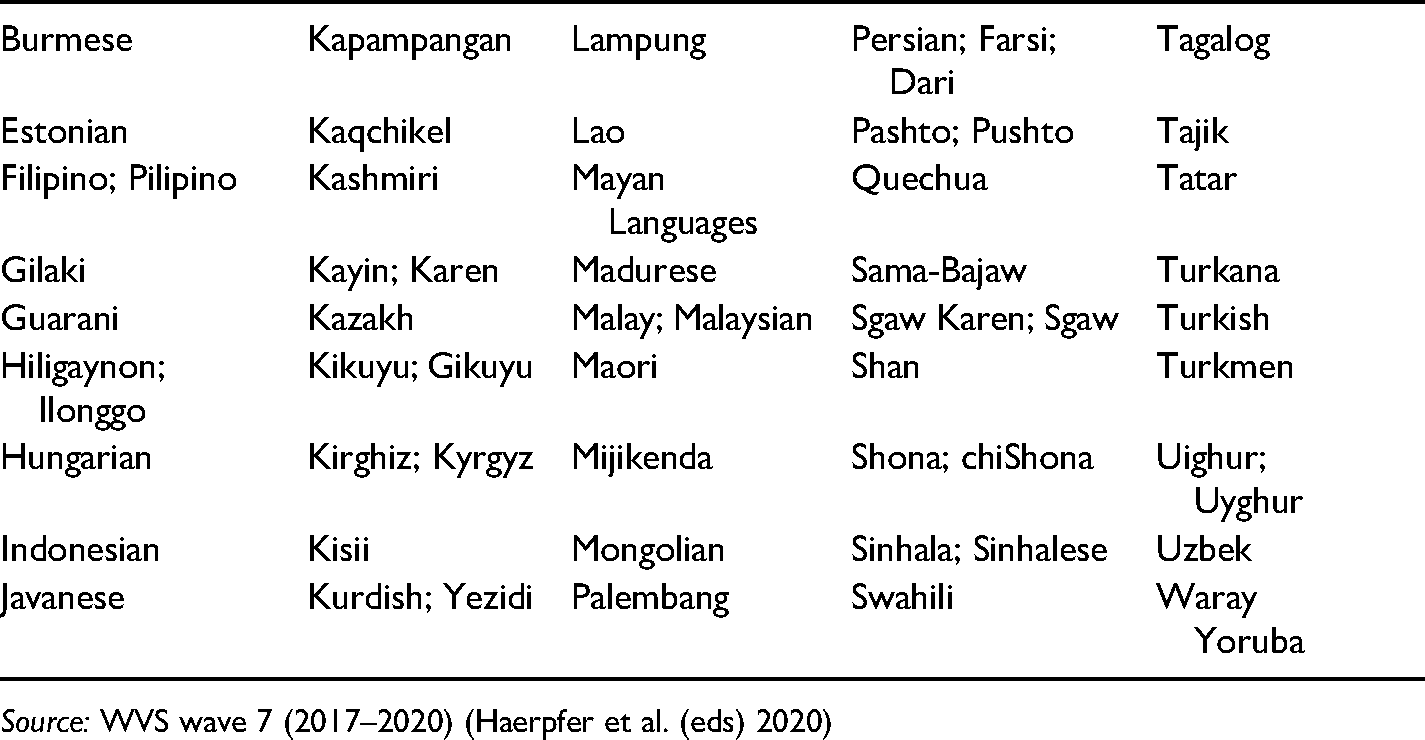
The standardized questions of the dataset allow cross-national comparisons of people's attitudes and opinions. The dataset includes responses from a total of 64 countries and over 168 languages and local dialects spoken by the respondents at home. Of the 168 languages recorded in the survey, we identified 50 genderless languages. The list of genderless languages is shown in Appendix 1. In addition, we identified 13 countries in the dataset where more than 70% of the population speaks a genderless language 1 . The dataset includes variables regarding people's values and attitudes toward various social issues including gender equality. All statistical analyses were performed using Stata SE version 18.0 (StataCorp 2023).
Primary Independent Variables
The independent variables are the gender status of the language spoken at home (0 = nongenderless language, 1 = genderless language) and the gender status of the predominantly spoken language in the country (0 = predominantly nongenderless language, 1 = predominantly genderless language). The first model includes the language spoken at home, and the second model employs the dominant language spoken at the country level to investigate the relationship separately. To distinguish the effect of language utilization and exposure to the language, we created a categorical variable with four mutually exclusive categories based on the genderless language use at home and the nature of the predominant language of the residing country (0 = speak nongenderless language at home and live in a predominantly nongenderless language-speaking country, 1 = speak nongenderless language at home and live in a predominantly genderless language-speaking country, 2 = speak genderless language at home and live in a predominantly nongenderless language-speaking country, 3 = speak genderless language at home and live in a predominantly genderless language-speaking country).
Dependent Variables
Considering the cross-cultural nature of this study, we include the notion of men's dominance over women, particularly the inclusion of gender equality in democracy and intimate partner violence, in addition to the breadwinner role and male privilege when operationalizing gender ideology. The dependent variables are six measures of expressed agreement with the following gender ideology statements: (1) equal rights as a part of democracy (“how essential you think it is as a characteristic of democracy” that “women have the same rights as men” on a Likert scale of 1–10), (2) attitude toward domestic violence (“it is justifiable for a man to beat his wife” on a Likert scale of 1–10), (3) importance of education (“university is more important for a boy than for a girl” on a Likert scale of 1–4), (4) right to jobs (“men should have more right to a job than women” on a Likert scale of 1–5), (5) income equality in marriage (“it is a problem if women have more income than husband” on a Likert scale of 1–5), and (6) women's political leadership (“men make better political leaders than women do”) (on a Likert scale of 1–4). We reversed the order of the scale for attitude toward domestic violence to match the order of the rest of the questions. In all six measures of gender ideology, larger numbers indicate less agreement with the statements, suggesting more egalitarian attitudes toward gender.
We use uncompiled measures of gender ideology as separate dependent variables to capture the multifaceted and often contrasting nature of gender role attitudes across various domains in different cultural, political, and religious contexts. For instance, while countries like Pakistan rank low on several indicators of gender equality, including attitudes toward domestic violence (Raza & Pals 2024), they have nevertheless had female heads of government—a milestone some more developed nations such as the United States have yet to achieve. Analyzing each measure of gender ideology provides sensible and interpretable results in the cross-cultural context rather than aggregating all measures into a single index.
Covariates
The covariates were selected based on previous cross-cultural studies that show the economic development of the country, gender, educational attainment, social class, rurality of the residence, and the country's level of democracy are associated with one's gender ideology. Relevant demographic variables include respondent's gender (0 = male, 1 = female), age, highest education attained (1 = lower (no education to lower secondary education), 2 = middle (upper secondary education and postsecondary nontertiary education), 3 = higher (short-cycle tertiary education or higher), income level (1 = low, 2 = middle, 3 = high), and settlement type (1 = capital city, 2 = regional center, 3 = district center, 4 = another city or a town, 5 = village). Individual's cultural values were measured by using Welzel overall secular value index provided in the WVS dataset (composed of skepticism, relativism, disbelief, and defiance) and an index of self-expression based on the unweighted mean score of autonomy, choice, and voice subindices of Welzel emancipative values to also account for political ideology 2 . The Welzel Overall Secular Value measures one's values for authority, national pride, religiosity, conformity with laws and norms, and trust in legal institutions or the government. The Welzel Overall Emancipative Value is also provided in the dataset and includes measurements in children's autonomy, gender equality, acceptance of others’ sexuality and life choices (i.e., abortion and divorce), and voice. We did not include the equality subindex from the emancipative value in our index to prevent multicollinearity as some of the variables used to create the index are the dependent variables in this project. Finally, mean Gross Domestic Product (GDP) per capita in the US dollar from 2017 to 2022 is included as a covariate to account for the variation in economic development across countries.
Analysis Method
The Inglehart–Welzel World Cultural Map, established based on this survey, groups countries into eight subcategories by geographic region, language, and common religion. The subcategories include African-Islamic, Catholic Europe, Confucian, English-speaking, Latin America, Orthodox Europe, Protestant Europe, and West and South Asia. We utilize these subcategories of countries as subpopulations to ensure the analyses are done within a similar group of countries. Of the subcategories, we focused on “African-Islamic,” “Latin America,” “Orthodox Europe,” 3 and “West and South Asia” as they are the only groups with enough respondents who speak a genderless language at home (n = 10,153, n = 891, n = 1,133, and n = 2,161, respectively).
We used ordered logistic regression analyses by cultural subcategories with the clustered standard error by country to examine the association between genderless language use and attitudes toward six measures of gender equality (gender equality in democracy; the attitude toward domestic violence, the importance of education, the right to jobs, income equality in marriage, and women's political leadership). Analyzing the effects for each subgroup allowed us to assess the effects of demographic and cultural factors in addition to the impact of genderless language use by displaying each covariate's coefficient estimate while limiting the comparison within somewhat similar groups and avoiding introducing great cross-national disparities in responses. In addition, this analysis strategy simplified the interpretation of the results through limiting the independent variables to genderless language use at home and living in predominantly genderless language-speaking country categories without introducing an additional interaction term.
A total of three models were run for each cultural subgroup; the first model used the genderless language use at home (genderless speaking) as an independent variable, the second model used the genderless language use in the respondent's country of residence (genderless language country), and the final model used mutually exclusive categories created based on genderless language use at home and in the country. With each model predicting six measures of gender ideology, we ran a total of 72 models. The sampling weight provided in the dataset which aims to adjust the sample population to the distribution of the target population by computing the distribution of age, sex, education, and region, is used in each regression model.
Results
Descriptive Analysis
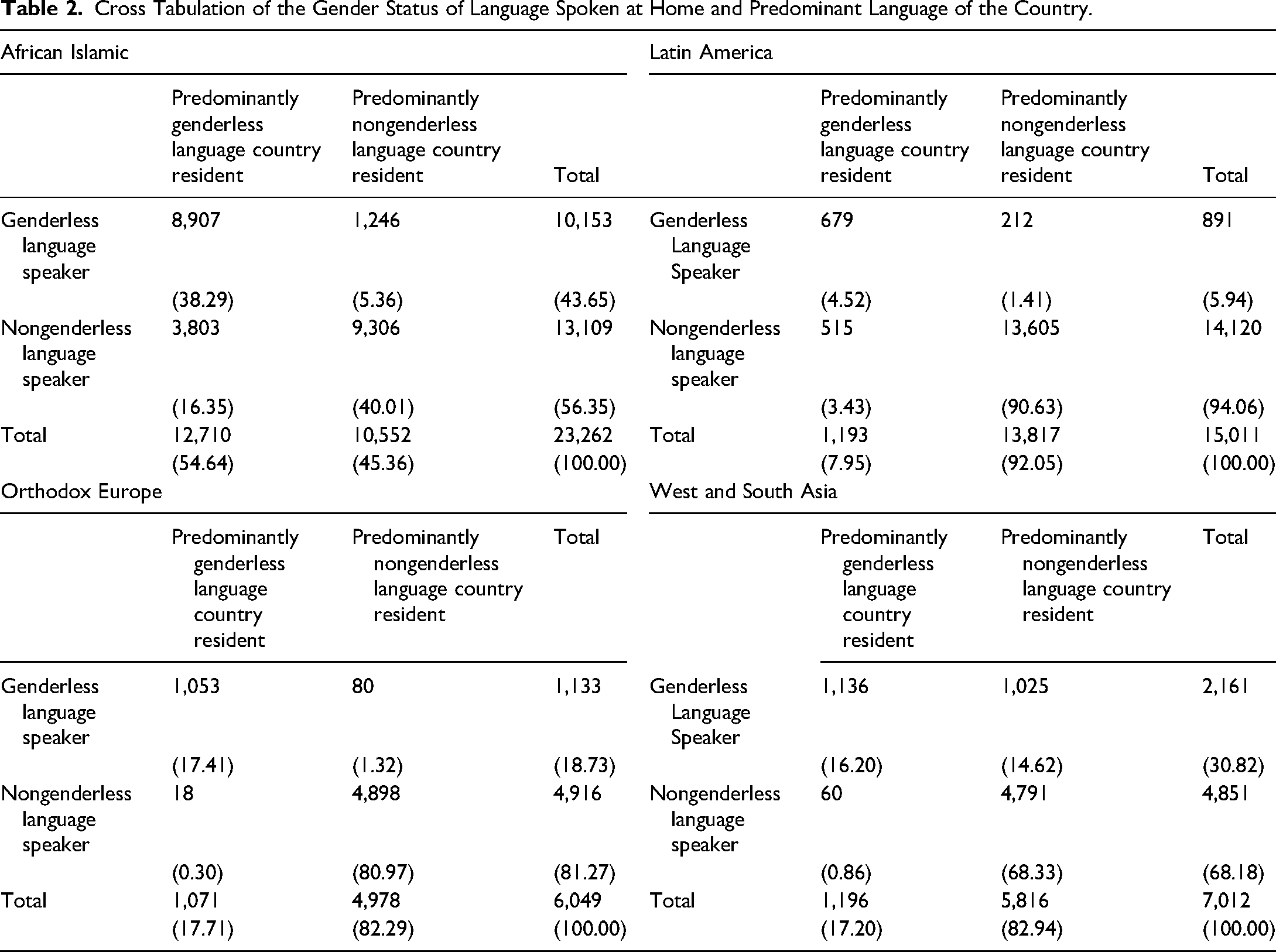
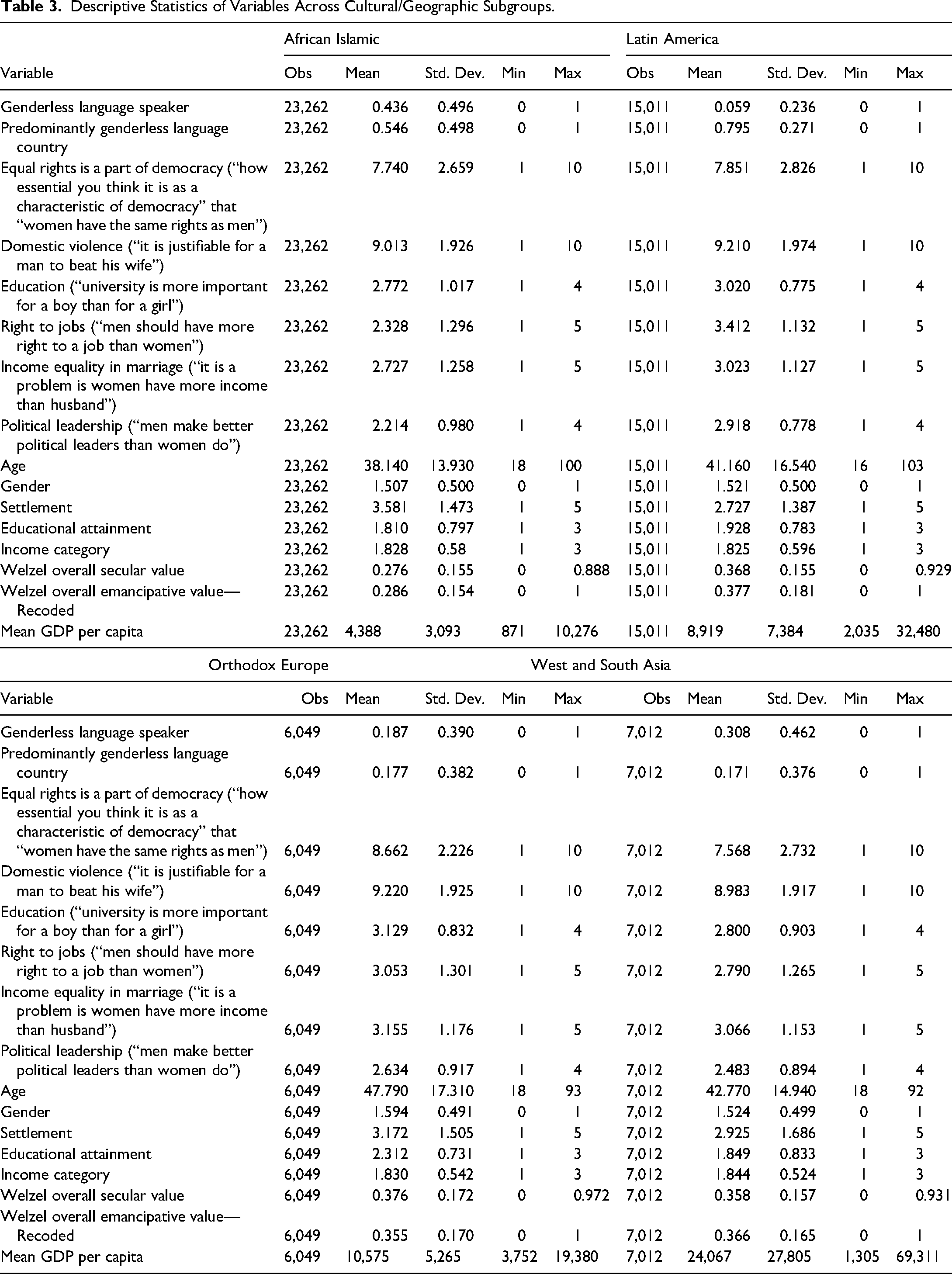
Table 2 provides frequencies and percentages of respondents by the type of language spoken at home (nongenderless and genderless language) and the predominant language spoken in the country (predominantly nongenderless language and predominantly genderless language). The cross-tabulation (Table 2) shows that the African-Islamic subgroup has the highest concentration of genderless language speakers at 43.55%, followed by West and South Asia (31.08%), Orthodox Europe (18.76%), and Latin America (6.04%). The summary statistics (Table 3) show descriptive statistics of all variables included in the analyses. Although there are some variations across cultural subcategories, all subcategories consist of generally heterogenic respondents in terms of area of residence, gender, educational level, income, age, and values. Consistent with the summary statistics, the African Islamic subgroup has the largest population of genderless language speakers and residents of predominantly genderless language-speaking countries, followed by Orthodox Europe, West and South Asia, and Latin America subgroups.
Cross Tabulation of the Gender Status of Language Spoken at Home and Predominant Language of the Country.
Descriptive Statistics of Variables Across Cultural/Geographic Subgroups.
“African Islamic” Subgroup
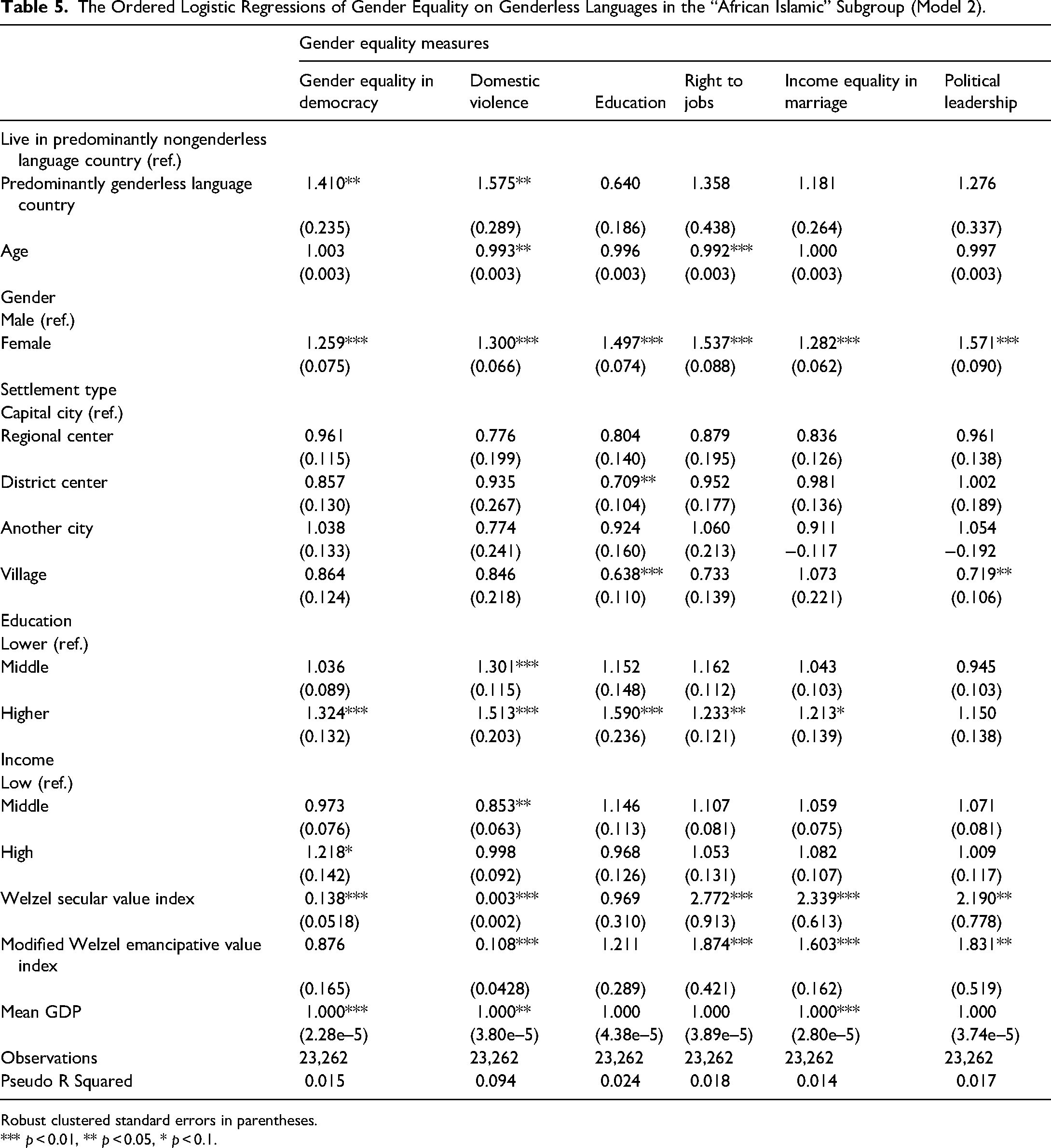
Tables 4 to 6 present the results of the ordered logistic regressions of the six measures of gender equality on two measures of genderless languages (i.e., speaking genderless languages at home and living in a predominantly genderless language country) and the four mutually exclusive language use categories in the African Islamic cultural and geographic subgroups. Living in a predominantly genderless-language-speaking country increases the odds of considering gender equality as a part of democracy, and finding domestic violence unjustifiable (odds ratios of 1.4 and 1.58, respectively). However, it does not have a statistically significant effect (p < 0.05) on the other measures of attitudes toward gender equality. Speaking a genderless language does not have a significant effect in the expected direction on any of the measures of gender equality.
The Ordered Logistic Regressions of Gender Equality on Genderless Languages in the “African Islamic” Subgroup (Model 1).
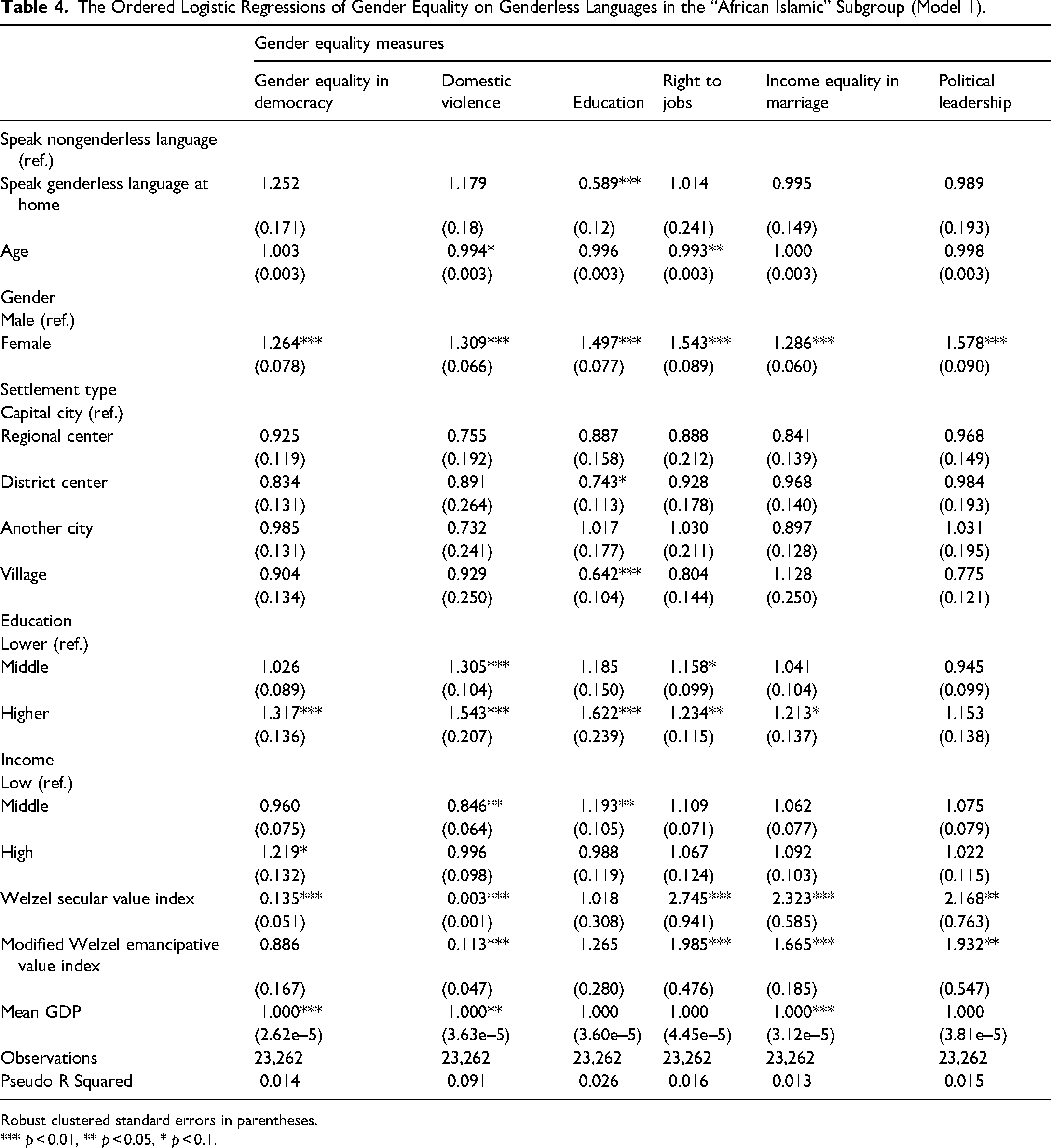
Robust clustered standard errors in parentheses.
*** p < 0.01, ** p < 0.05, * p < 0.1.
The Ordered Logistic Regressions of Gender Equality on Genderless Languages in the “African Islamic” Subgroup (Model 2).
Robust clustered standard errors in parentheses.
*** p < 0.01, ** p < 0.05, * p < 0.1.
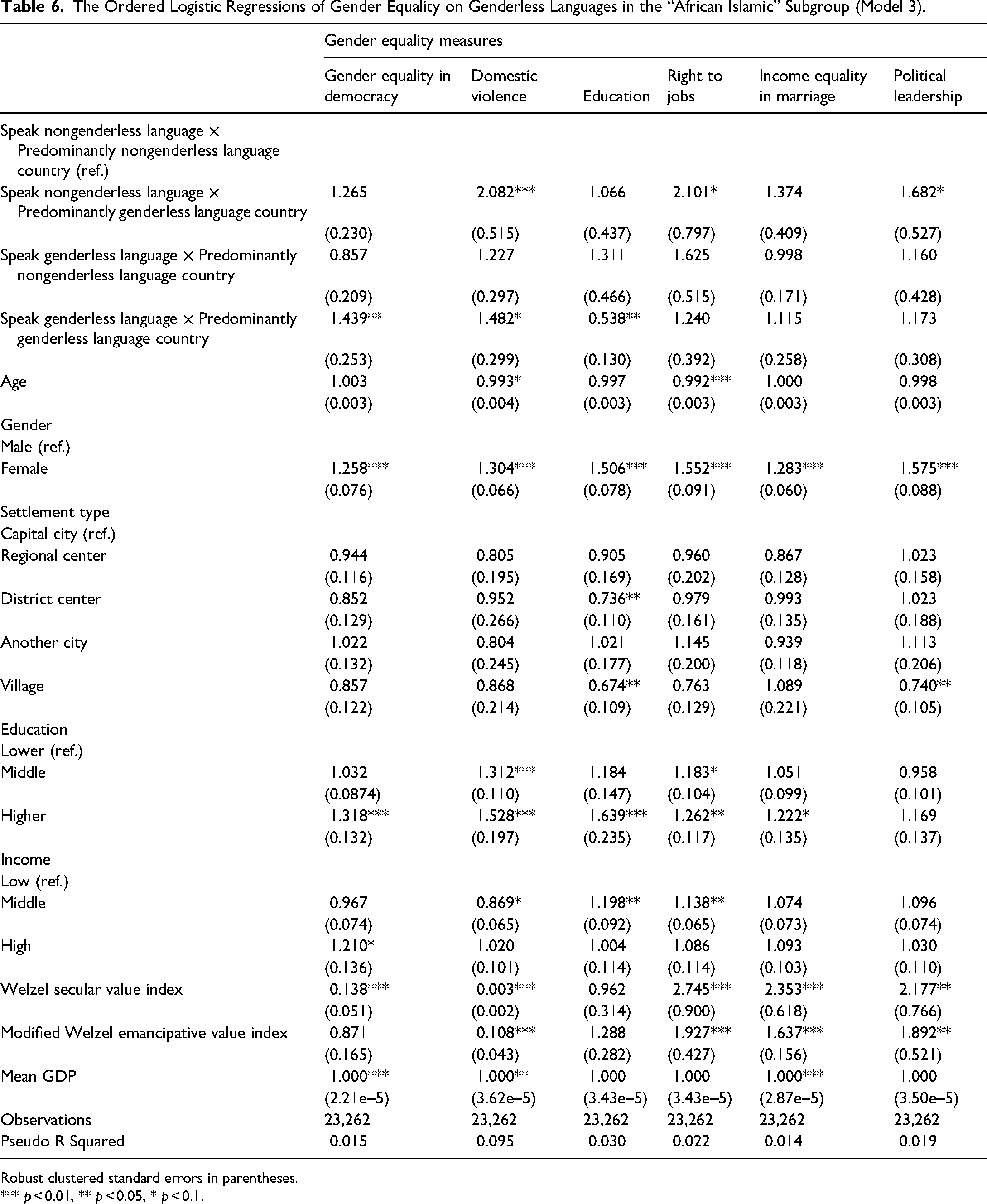
The Ordered Logistic Regressions of Gender Equality on Genderless Languages in the “African Islamic” Subgroup (Model 3).
Robust clustered standard errors in parentheses.
*** p < 0.01, ** p < 0.05, * p < 0.1.
Table 6 presents the effects of genderless language use at home and exposure from living in a predominantly genderless language-speaking country. The odds of considering gender equality as a part of democracy are almost 1.5 times greater (odds ratio of 1.43) among those who both speak a genderless language and live in such a country compared to the reference group. The odds of finding domestic violence unjustifiable are more than twice (odds ratio of 2.09) for those who do not speak a genderless language at home but live in a predominantly genderless language country compared to those who neither speak a genderless language nor live in a country where the majority does. Similarly, the odds ratio of expressing gender-egalitarian attitudes regarding the right to job is about twice (odds ratio of 2.10) for those who do not speak a genderless language at home but live in a predominantly genderless language country compared to those who live in such countries. We observed a similar pattern for attitudes toward women's political leadership. The odds of expressing egalitarian attitudes regarding the capabilities of men and women in political leadership are 1.68 times as large for those who speak a nongenderless language at home but live in an “African-Islamic” country where a genderless language is spoken by the majority of the population compared to the reference group.
“Latin America” Subgroup
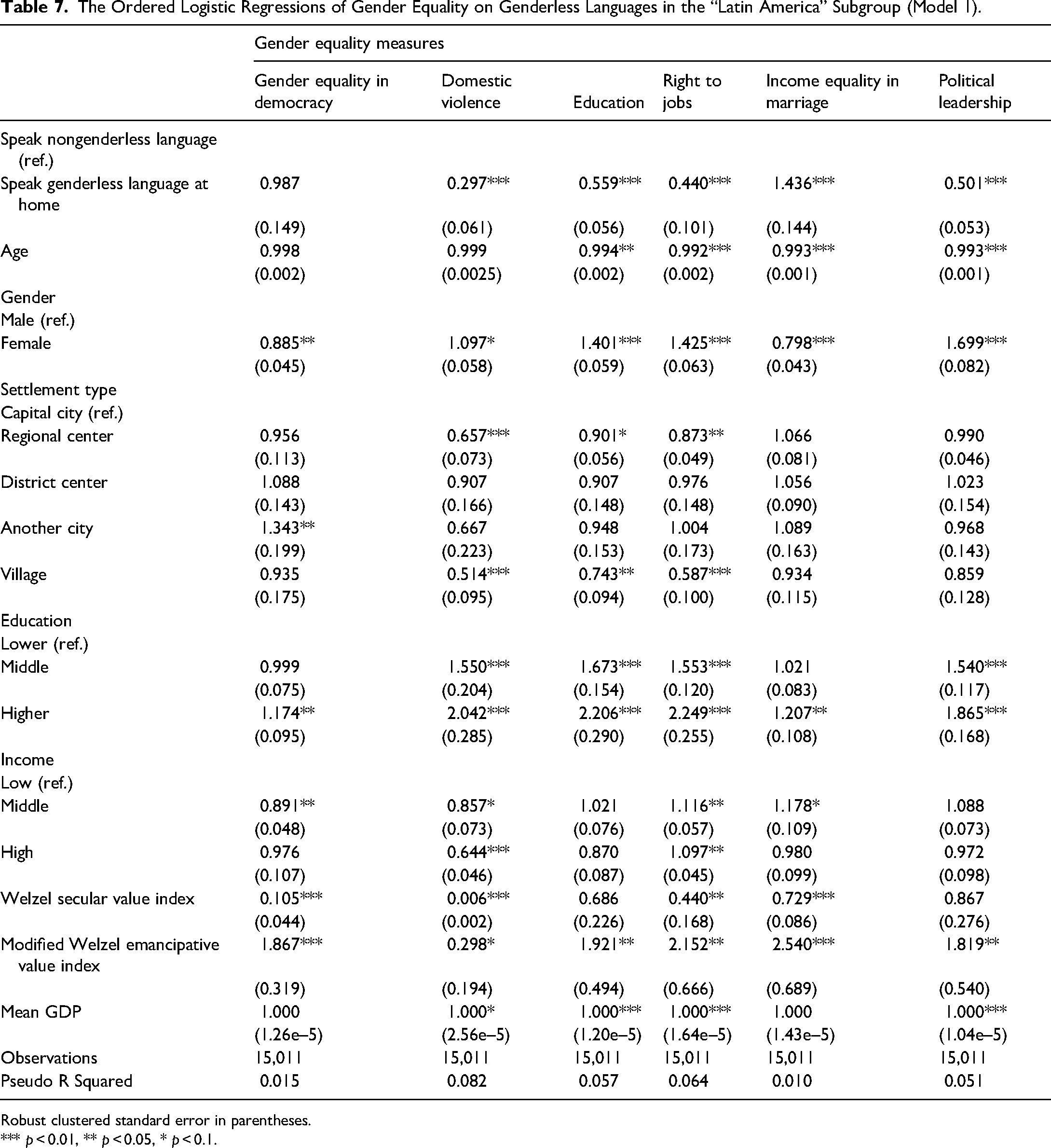
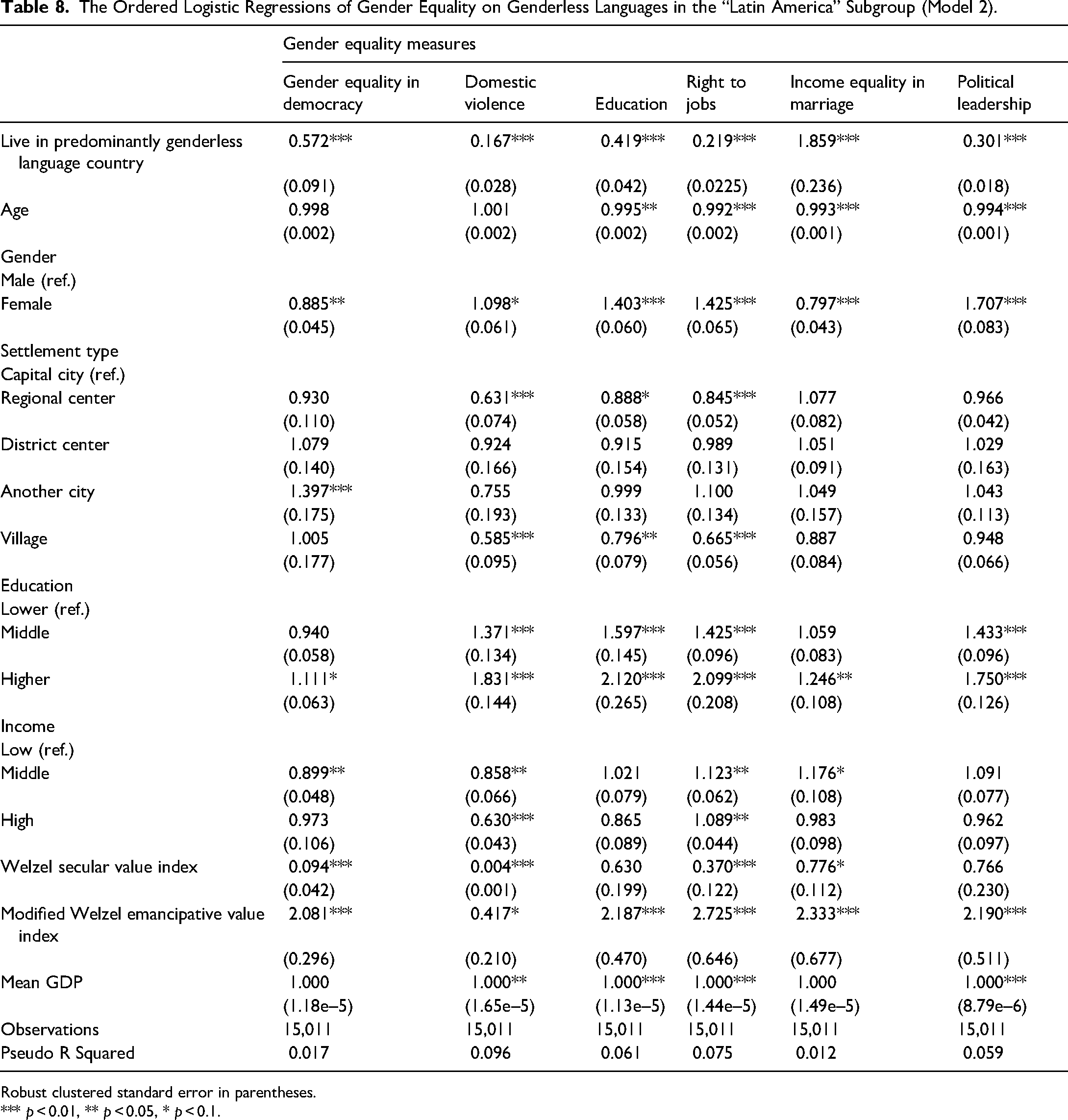
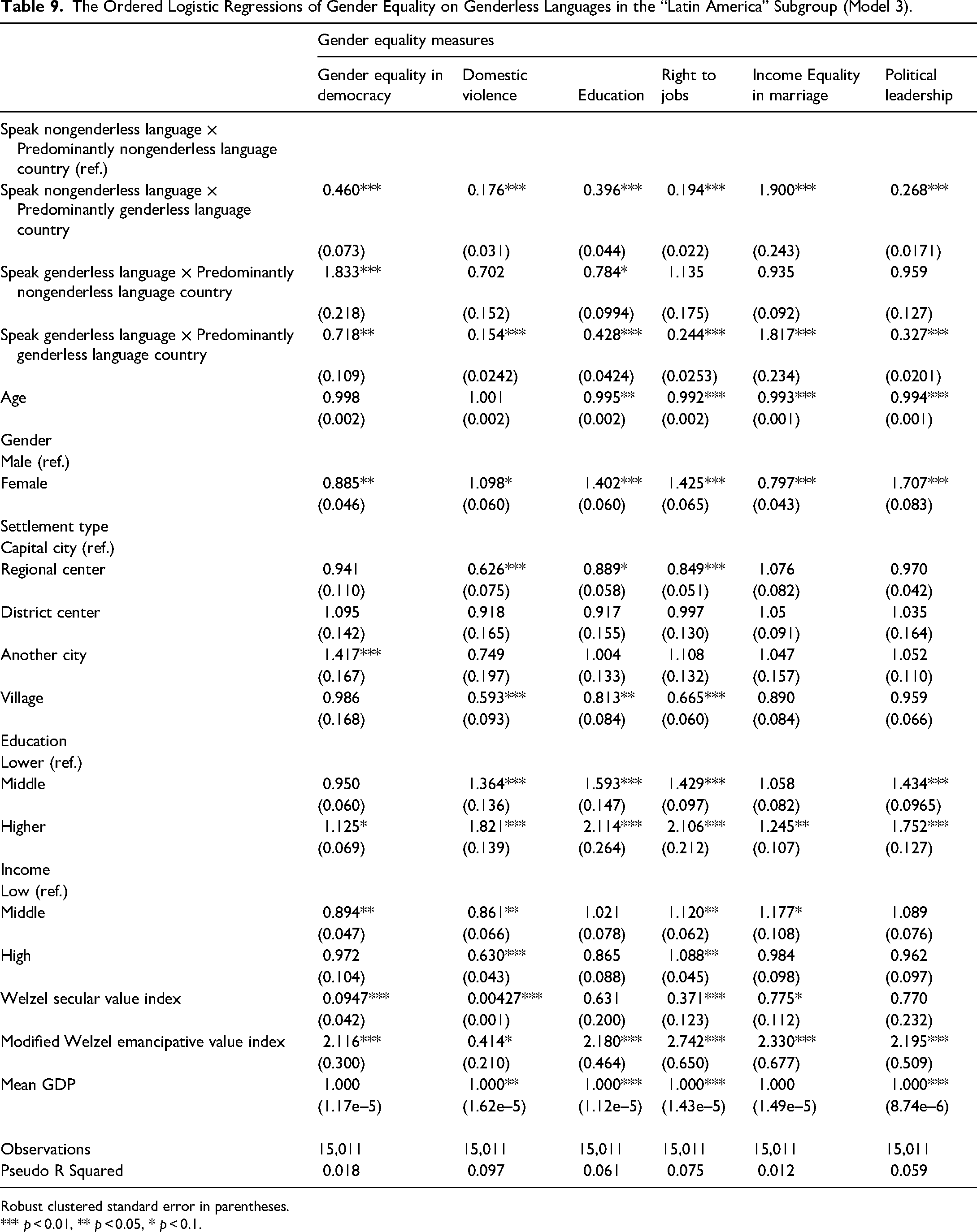
The results of the ordered logistic regressions of the various measures of gender equality on genderless languages in the Latin American cultural and geographic subgroup are presented in Tables 7–9. The findings suggest that the odds of considering gender equality as a part of democracy is 1.8 times as large among those who speak a genderless language but live in a predominantly nongenderless language country compared to those who live in such countries but do not speak a genderless language.
The Ordered Logistic Regressions of Gender Equality on Genderless Languages in the “Latin America” Subgroup (Model 1).
Robust clustered standard error in parentheses.
*** p < 0.01, ** p < 0.05, * p < 0.1.
The Ordered Logistic Regressions of Gender Equality on Genderless Languages in the “Latin America” Subgroup (Model 2).
Robust clustered standard error in parentheses.
*** p < 0.01, ** p < 0.05, * p < 0.1.
The Ordered Logistic Regressions of Gender Equality on Genderless Languages in the “Latin America” Subgroup (Model 3).
Robust clustered standard error in parentheses.
*** p < 0.01, ** p < 0.05, * p < 0.1.
The odds of expressing egalitarian attitudes regarding income equality in marriage are almost twice (odds ratio of 1.92, and robust standard error of 0.24) for those who speak a nongenderless language at home but live in a “Latin American” country where a genderless language is spoken by the majority of the population compared to the reference group. On the contrary, the odds of finding domestic violence unjustifiable are quite lower (odds ratio of 0.176 with robust standard error of 0.030) for those who do not speak a genderless language at home but live in a predominantly genderless language country compared to those who neither speak a genderless language nor live in a country where the majority does. Similarly, the odds of expressing gender-egalitarian attitudes regarding education, right to job, and political leadership are smaller (with odds ratios of 0.399, 0.192, and 0.269, respectively) for those who do not speak a genderless language at home but live in a predominantly genderless language country compared to the reference group.
Those who speak a genderless language at home and live in such countries are more likely to support income equality in marriage (odds ratios of 1.83) compared to those who neither speak a genderless language nor live in a predominantly genderless language country. For all other measures of gender equality, the odds of support from those who both speak a genderless language and live in such a country are lower compared to the reference group. The findings are similar for those who speak a genderless language but live in a country where the majority do not.
“Orthodox Europe” Subgroup
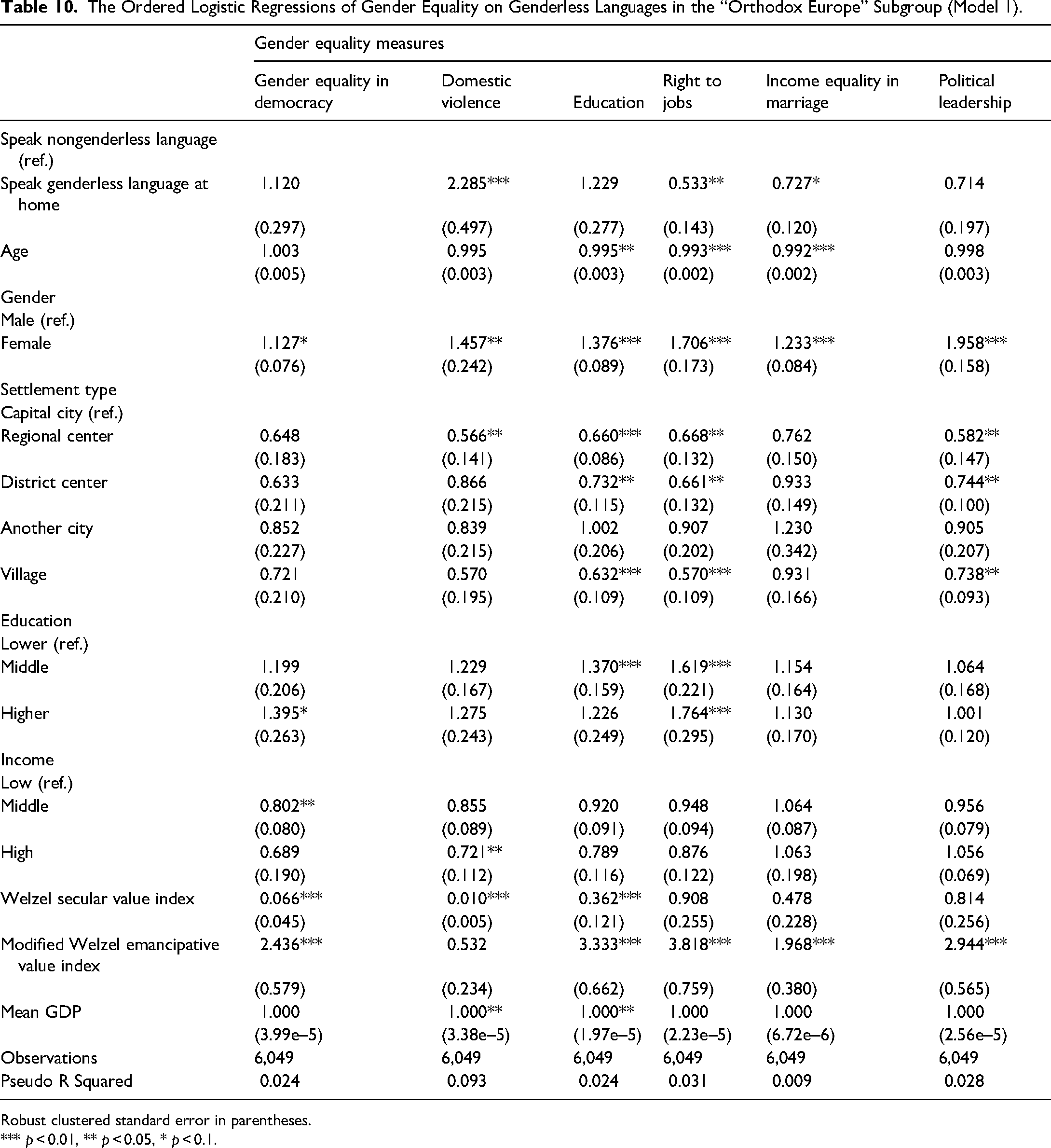
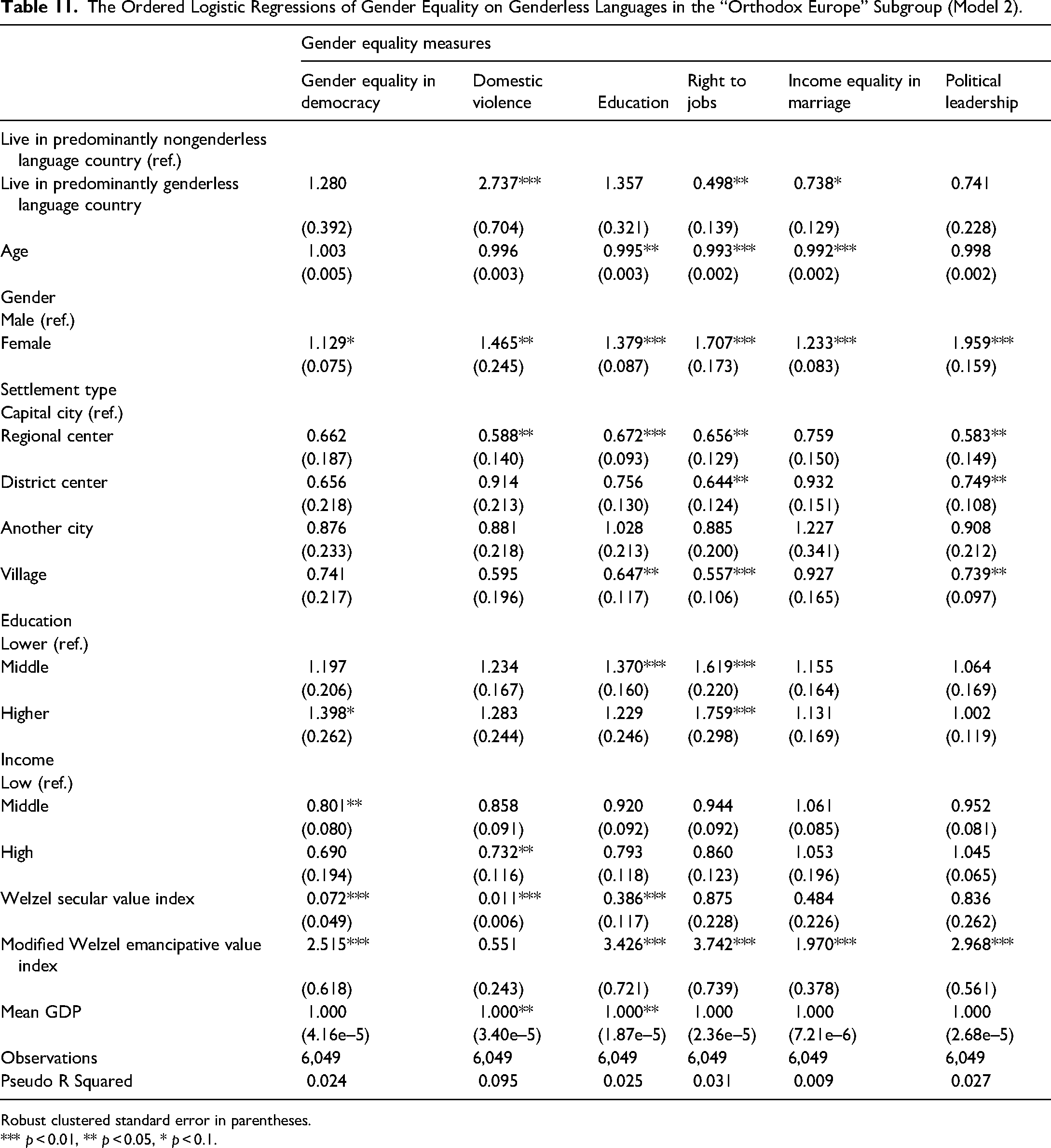
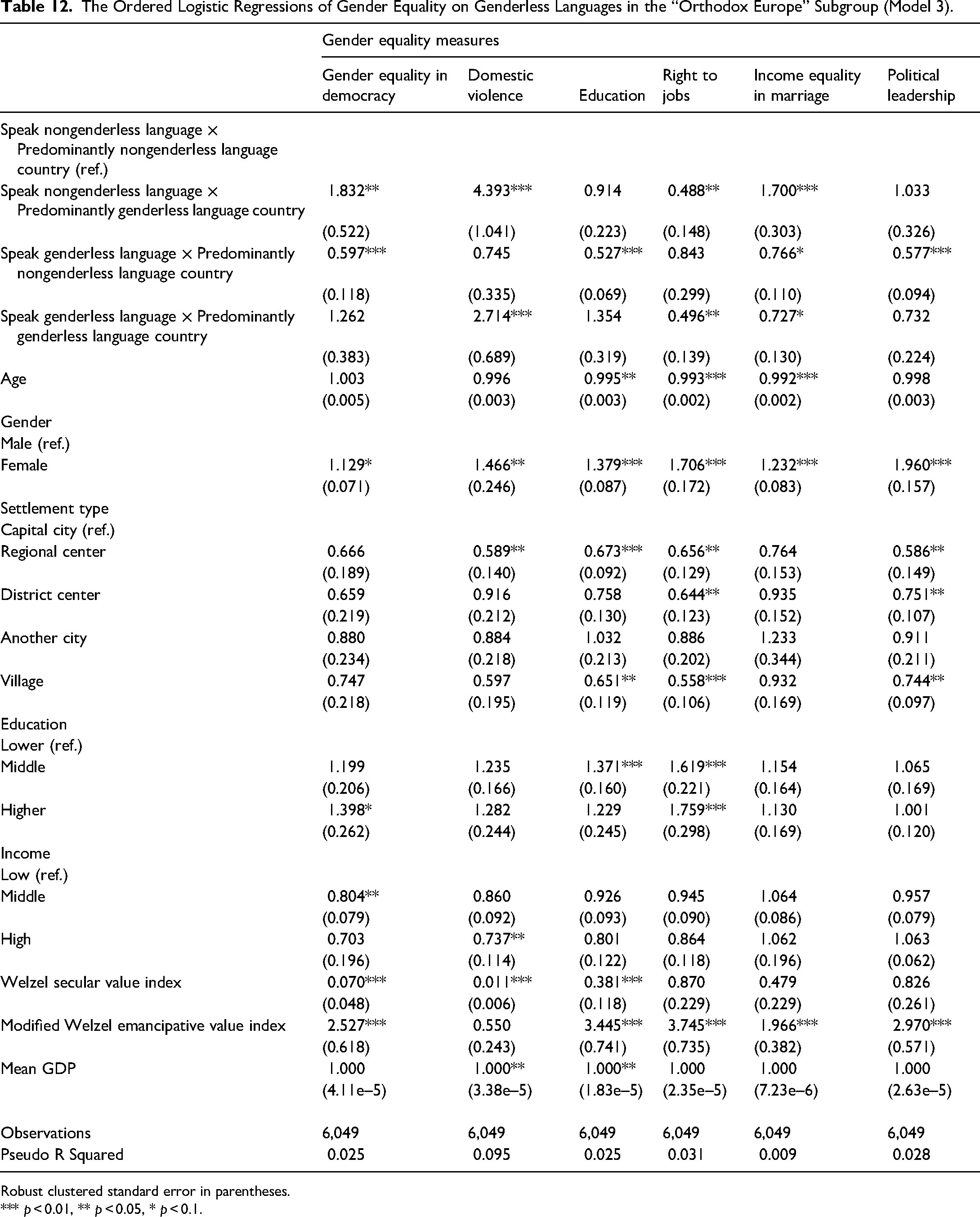
Tables 10–12 present the results in the “Orthodox Europe” cultural and geographic subgroup. Based on the results, the odds of finding domestic violence unjustifiable are over twice (odds ratio of 2.28) among those who speak a genderless language compared to those who do not. The effect is even higher for the other measure of the explanatory variable; Living in a predominantly genderless language country even further increases the odds of finding domestic violence unjustifiable (odds ratio of 2.73). The results in Table 12 suggest that the odds of finding domestic violence unjustifiable are more than four times (odds ratio of 4.39) for those who do not speak a genderless language but live in a genderless language country compared to those who neither speak a genderless language nor live in a country where the majority of the population does speak a genderless language. It also shows that those who both speak a genderless language and live in a genderless language country are almost three times (odds ratio of 2.71) as likely to disapprove of domestic violence compared to the reference group.
The Ordered Logistic Regressions of Gender Equality on Genderless Languages in the “Orthodox Europe” Subgroup (Model 1).
Robust clustered standard error in parentheses.
*** p < 0.01, ** p < 0.05, * p < 0.1.
The Ordered Logistic Regressions of Gender Equality on Genderless Languages in the “Orthodox Europe” Subgroup (Model 2).
Robust clustered standard error in parentheses.
*** p < 0.01, ** p < 0.05, * p < 0.1.
The Ordered Logistic Regressions of Gender Equality on Genderless Languages in the “Orthodox Europe” Subgroup (Model 3).
Robust clustered standard error in parentheses.
*** p < 0.01, ** p < 0.05, * p < 0.1.
In terms of considering gender equality as a part of democracy, the coefficient estimates in Tables 10 and 11 are in the expected direction but are not statistically significant. The findings are also mixed based on the final model in Table 12. The results suggest that the odds of considering gender equality as a part of democracy are almost twice (odds ratio of 1.8) for those who do not speak a genderless language but live in a genderless language country compared to those who neither speak a genderless language nor live in a country where the majority of the population does. On the other hand, those who speak a genderless language and live in a nongenderless language country are less likely to consider gender equality as a part of democracy (odds ratio of 0.59) compared to those who neither speak a genderless language nor live in an “Orthodox Europe” country where the majority does not speak a genderless language.
The odds of support for income equality in marriage are almost 1.7 times higher for those who do not speak a genderless language at home but live in a predominantly genderless language country compared to the reference group. The relationship is either nonsignificant or reversed for the three other measures of attitudes toward gender equality, as is for the other combinations of the genderless language use and exposure.
“West and South Asia” Subgroup
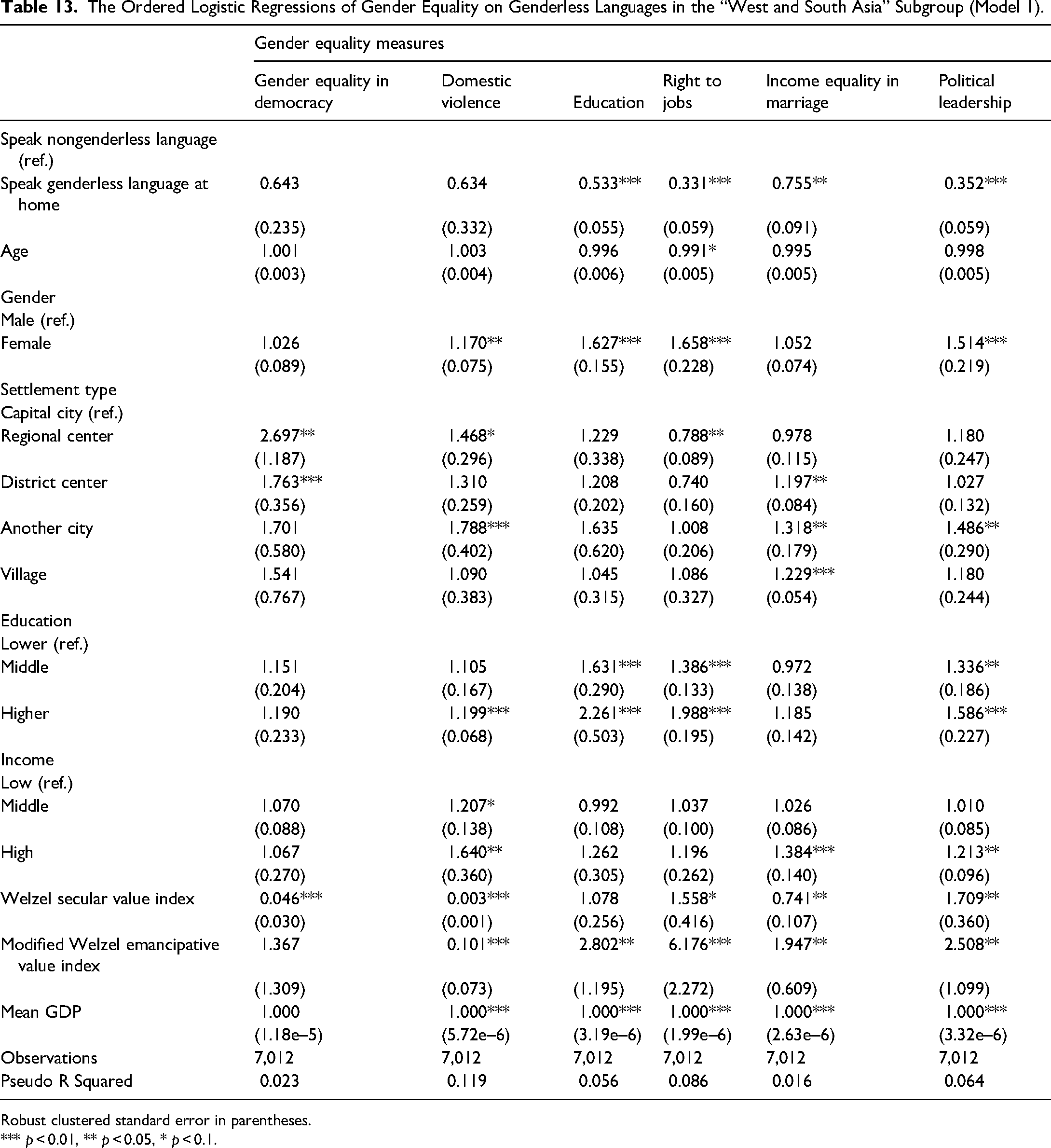
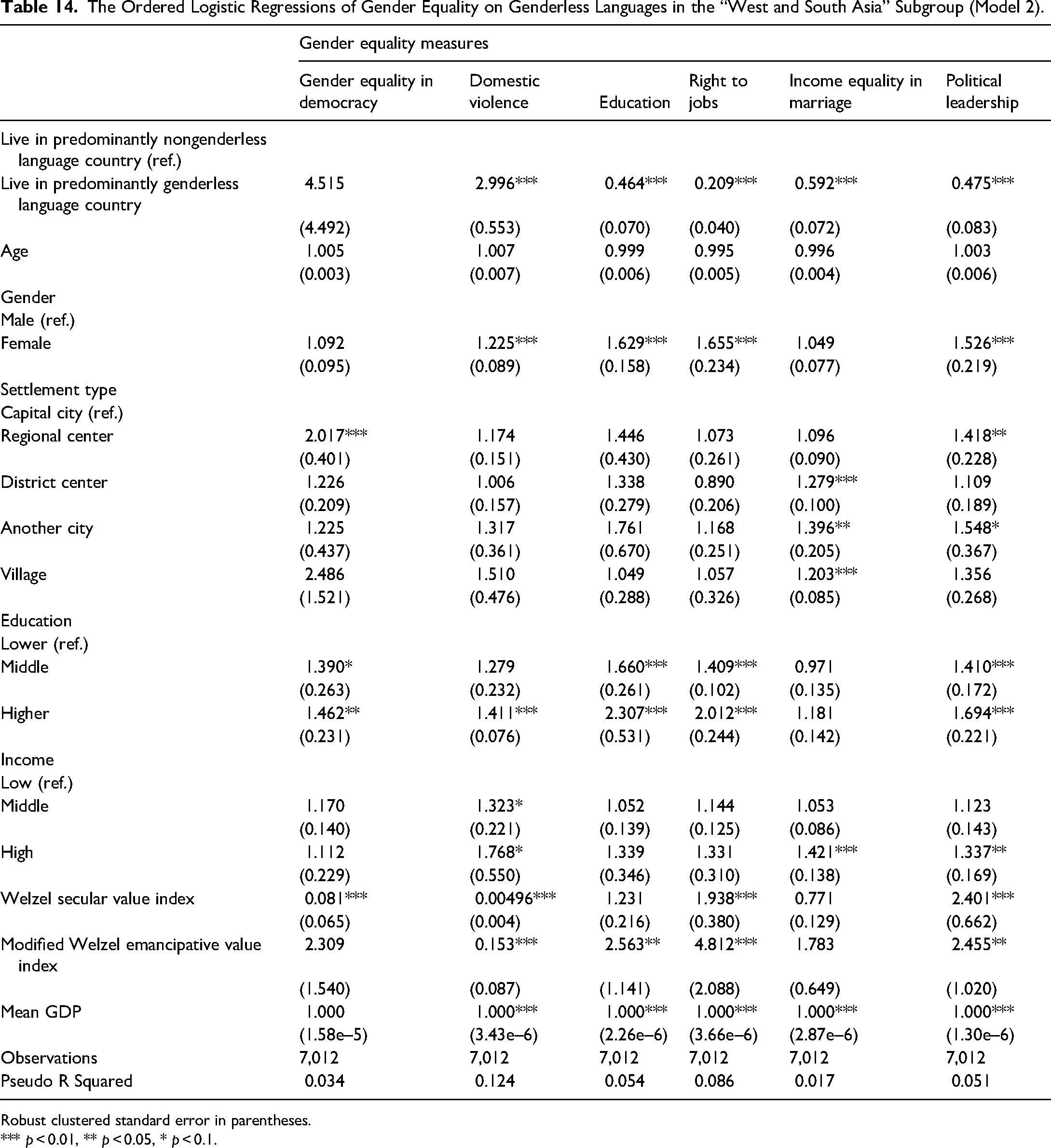
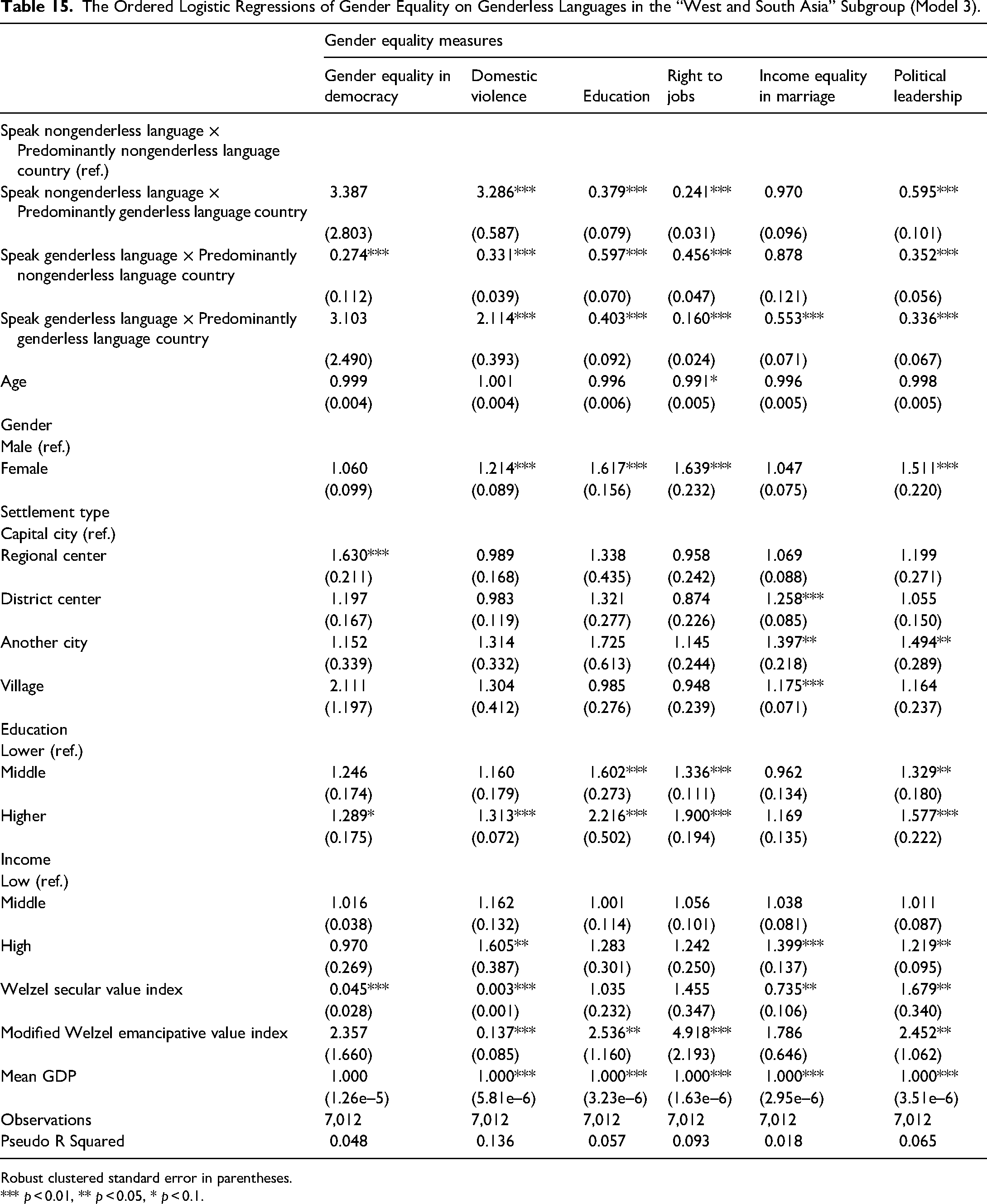
As shown in Table 13–15, in the “West and South Asian” subgroup, those who live in a country where people predominantly speak a genderless language are almost three times as likely (odds ratio of 2.99) to disapprove of domestic violence compared to those who do not live in a predominantly genderless language country. The odds of finding domestic violence unjustifiable are over three times (odds ratio of 3.28) for those who do not speak a genderless language at home but live in a predominantly genderless language country compared to those who neither speak a genderless language nor live in a country where the majority does. Those who both speak a genderless language and live in a predominantly genderless language country are also over two times as likely to disapprove of domestic violence compared to those who neither speak a genderless language at home nor live in such a country (odds ratio of 2.11). The relationship is either nonsignificant or reversed for the three other measures of attitudes toward gender equality, as is for the other combinations of the genderless language use and exposure.
The Ordered Logistic Regressions of Gender Equality on Genderless Languages in the “West and South Asia” Subgroup (Model 1).
Robust clustered standard error in parentheses.
*** p < 0.01, ** p < 0.05, * p < 0.1.
The Ordered Logistic Regressions of Gender Equality on Genderless Languages in the “West and South Asia” Subgroup (Model 2).
Robust clustered standard error in parentheses.
*** p < 0.01, ** p < 0.05, * p < 0.1.
The Ordered Logistic Regressions of Gender Equality on Genderless Languages in the “West and South Asia” Subgroup (Model 3).
Robust clustered standard error in parentheses.
*** p < 0.01, ** p < 0.05, * p < 0.1.
Discussion and Conclusion
This paper investigated the effects of genderless language use on gender ideology. We operationalized gender ideology as behaviors and ideas that maintain men's control over women. In addition to the common measurements of gender ideology such as the breadwinner role and male privilege, we included gender equality in democracy and intimate partner violence. Previous research shows that both culture and language influence people's cognition, including people's perception of gender ideology. Using data from a worldwide survey, we analyzed the relationship between the utilization and exposure to genderless language and gender ideology.
The perception of gender equality as a part of democracy (“how essential you think it is as a characteristic of democracy” that “women have the same rights as men”), attitudes toward domestic violence (“it is justifiable for a man to beat his wife”), education (“university is more important for a boy than for a girl”), job opportunities (“men should have more right to a job than women”), income equality in marriage (“it is a problem if women have more income than husband”), and women's political leadership (“men make better political leaders than women do”) were used as the measures of gender ideology. Based on the survey respondents’ language spoken at home and the predominantly spoken language of their country of residence, we created four mutually exclusive categories of their genderless language status for the independent variables.
Using African/Islamic, Latin America, Orthodox Europe, and West and South Asia as subgroups, the results of the ordered logistic regressions were mixed across the subgroups and gender ideology measurements. After controlling for relevant demographic variables, people who live in predominantly genderless language-speaking countries in the African/Islamic subgroup showed more support for gender equality and opposition to domestic violence toward the wife compared to those in predominantly nongenderless language-speaking countries. However, the genderless language use and exposure showed no statistically significant relationship with other measures of gender ideology, except for women's right to jobs and political leadership for people who speak a nongenderless language but live in a predominantly genderless language country.
In the Latin American subgroup, the genderless language status and gender ideologies mostly had negative relationships in all models except income equality in marriage. Both genderless language use and exposure positively affect the attitude toward income equality in marriage in all models. The Orthodox Europe subgroup showed positive effects on genderless language use and exposure for attitudes toward domestic violence especially when people live in a predominantly genderless language-speaking country, however, genderless language use and exposure have a negative association with attitudes toward women's right to jobs. In this subgroup, speaking a nongenderless language at home and living in a predominantly genderless language-speaking country has a statistically positive relation with other gender equality and ideologies measures such as the view on gender equality and income equality in marriage. The analyses for the West and South Asia subgroup show similar results to the Orthodox Europe subgroup, where living in a predominantly genderless language-speaking country has a positive association with disapproval of domestic violence, but the language status has either no relationship or a negative relationship with other measures of gender equality and ideology. The results highlighted how different cultures perceive gender roles, especially in regard to breadwinner role in marriage.
Although this project provides new perspectives on gender equality and ideology in an international context, there are some limitations that must be discussed. First, the use of Inglehart–Welzel subgroups might have skewed the results. Scholars have raised concerns regarding the hierarchical connotation, cultural essentialism, and potential racism of the Inglehart–Welzel World Cultural Map and have criticized unilinear interpretations of modernization (Dervin, 2016, 2020; Fourie, 2012). While we intend to group countries based on similar religions and cultures to avoid “comparing apples to oranges,” we acknowledge the limitations of the Inglehart–Welzel approach in grouping diverse countries together into distinct subcategories and caution against any primordial and essentialist interpretation of the cultural differences.
Second, the models used in this study do not fully capture the legal and political differences in the countries in the sample. For example, Pakistan first introduced the Bill for Domestic Violence (Prevention and Protection) Act in 2020, which infers that prior to this bill, there was no legal protection for women against domestic violence (Ministry of Human Rights Government of Pakistan, 2024). Moreover, there is a large variation in the progress of women's political participation across world regions. Only 22 countries have more than 40% of women in parliament in the single or lower house, whereas 36% of parliament members in Latin American countries are women, and Central and South Asia and North Africa only have 18% of women in the parliament (United Nations, 2024). There is a possibility that there may not be an unequivocal consensus on domestic violence or women's political participation even within the subgroups or countries, due to variations in legal protections and significant differences in social norms. Considering the first and second limitations, future research can employ alternative subgroups to distinguish the effect of language more effectively as an interrelated yet distinct variable from culture in shaping attitudes toward gender equality.
Lastly, some previous research has found that gender ideology differs within the same country, especially for ethnic/racial minorities (Bolzendahl & Myers, 2004; Ciabattari, 2001). While this study considers the respondent's country of residence and their predominant language status, it does not capture ethnicity or other minority statuses within the country. It may be worthwhile to investigate the relationship between genderless language use and minority status especially in regions where only a small portion of the population speaks a genderless language at home, such as Latin America and West and South Asia.
Despite the limitations, this study brings a new perspective on gender ideology research. Progress on egalitarian views on gender is documented worldwide; however, the mechanisms and factors that contribute to the transition are not yet clear. Macro-level perspectives have pointed out the role of economic and political factors, and country-level studies have shown the association between gender ideology and demographic characteristics such as gender, education, place of residence, and social class. It is worthwhile to integrate interpersonal perspectives into quantitative study, especially in the global context where attention to discourse is emphasized. Language is one of the prominent aspects of cognitive development and symbolic interaction. Over time, many scholars have discussed how gender biases in languages have contributed to gender favoritism. Recently there have been many conscious choices to counteract centuries of biases by actively changing parts of the languages or adding more inclusive nouns and pronouns into daily speech. For this reason, genderless language use will remain an important part of gender studies as more languages consciously adopt genderless third-person terms for inclusivity and visibility. This research bridges gender study and linguistic study of previous scholars while highlighting the role of culture and discourse in cross-cultural aspects.
Footnotes
Acknowledgments
The authors would like to thank our colleagues, Ernesto Amaral, Ziqiao Chen, Kelsey Kramer, and Arthur H. Sakamoto for their helpful comments. In addition, the authors would like to extend our gratitude to anonymous reviewers who took their time to provide feedback.
Declaration of Conflicting Interests
The authors declared no potential conflicts of interest with respect to the research, authorship, and/or publication of this article.
Funding
The authors received no financial support for the research, authorship, and/or publication of this article.

Notes
Appendix 1. Identified Genderless Languages in WVS Wave 7
| Burmese | Kapampangan | Lampung | Persian; Farsi; Dari | Tagalog | |
| Estonian | Kaqchikel | Lao | Pashto; Pushto | Tajik | |
| Filipino; Pilipino | Kashmiri | Mayan Languages | Quechua | Tatar | |
| Gilaki | Kayin; Karen | Madurese | Sama-Bajaw | Turkana | |
| Guarani | Kazakh | Malay; Malaysian | Sgaw Karen; Sgaw | Turkish | |
| Hiligaynon; Ilonggo | Kikuyu; Gikuyu | Maori | Shan | Turkmen | |
| Hungarian | Kirghiz; Kyrgyz | Mijikenda | Shona; chiShona | Uighur; Uyghur | |
| Indonesian | Kisii | Mongolian | Sinhala; Sinhalese | Uzbek | |
| Javanese | Kurdish; Yezidi | Palembang | Swahili | Waray Yoruba |
Source: WVS wave 7 (2017–2020) (Haerpfer et al. (eds) 2020)
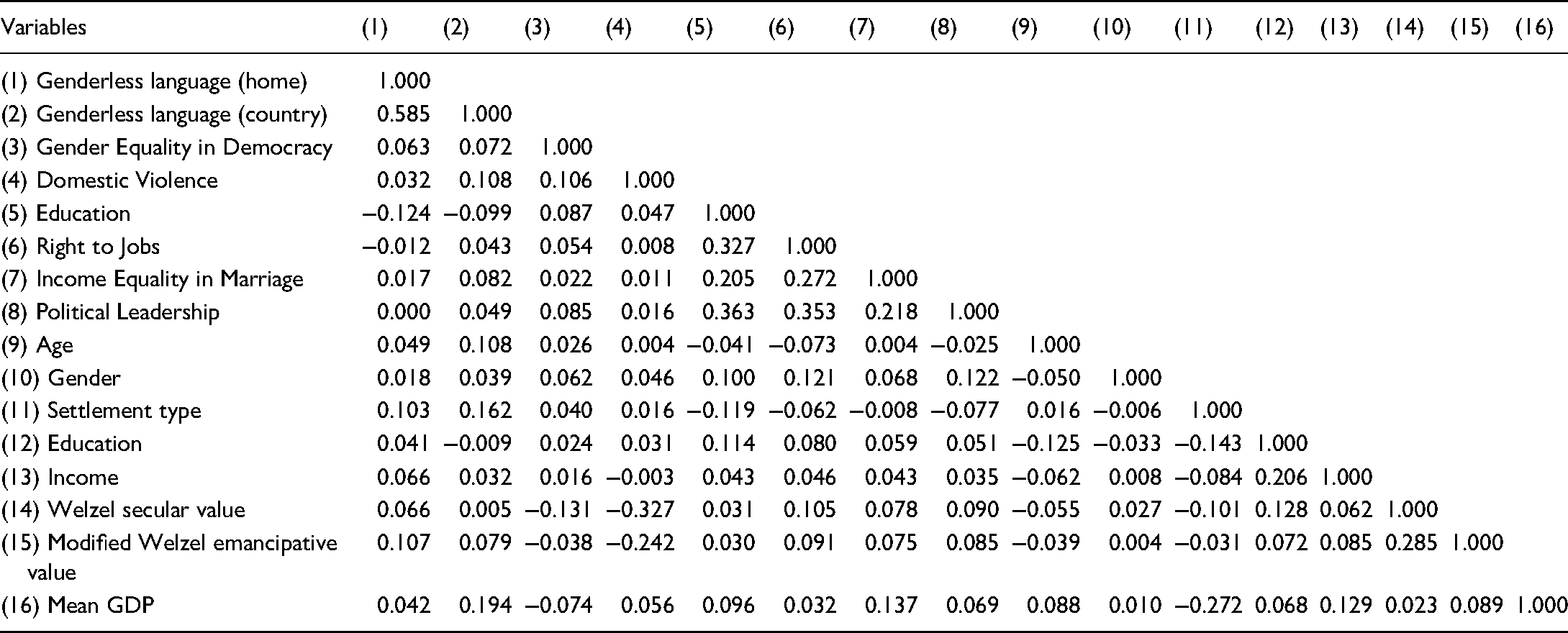
Appendix 2. Pairwise Correlation Table for “African Islamic” Subgroup.
| Variables | (1) | (2) | (3) | (4) | (5) | (6) | (7) | (8) | (9) | (10) | (11) | (12) | (13) | (14) | (15) | (16) |
|---|---|---|---|---|---|---|---|---|---|---|---|---|---|---|---|---|
| (1) Genderless language (home) | 1.000 | |||||||||||||||
| (2) Genderless language (country) | 0.585 | 1.000 | ||||||||||||||
| (3) Gender Equality in Democracy | 0.063 | 0.072 | 1.000 | |||||||||||||
| (4) Domestic Violence | 0.032 | 0.108 | 0.106 | 1.000 | ||||||||||||
| (5) Education | −0.124 | −0.099 | 0.087 | 0.047 | 1.000 | |||||||||||
| (6) Right to Jobs | −0.012 | 0.043 | 0.054 | 0.008 | 0.327 | 1.000 | ||||||||||
| (7) Income Equality in Marriage | 0.017 | 0.082 | 0.022 | 0.011 | 0.205 | 0.272 | 1.000 | |||||||||
| (8) Political Leadership | 0.000 | 0.049 | 0.085 | 0.016 | 0.363 | 0.353 | 0.218 | 1.000 | ||||||||
| (9) Age | 0.049 | 0.108 | 0.026 | 0.004 | −0.041 | −0.073 | 0.004 | −0.025 | 1.000 | |||||||
| (10) Gender | 0.018 | 0.039 | 0.062 | 0.046 | 0.100 | 0.121 | 0.068 | 0.122 | −0.050 | 1.000 | ||||||
| (11) Settlement type | 0.103 | 0.162 | 0.040 | 0.016 | −0.119 | −0.062 | −0.008 | −0.077 | 0.016 | −0.006 | 1.000 | |||||
| (12) Education | 0.041 | −0.009 | 0.024 | 0.031 | 0.114 | 0.080 | 0.059 | 0.051 | −0.125 | −0.033 | −0.143 | 1.000 | ||||
| (13) Income | 0.066 | 0.032 | 0.016 | −0.003 | 0.043 | 0.046 | 0.043 | 0.035 | −0.062 | 0.008 | −0.084 | 0.206 | 1.000 | |||
| (14) Welzel secular value | 0.066 | 0.005 | −0.131 | −0.327 | 0.031 | 0.105 | 0.078 | 0.090 | −0.055 | 0.027 | −0.101 | 0.128 | 0.062 | 1.000 | ||
| (15) Modified Welzel emancipative value | 0.107 | 0.079 | −0.038 | −0.242 | 0.030 | 0.091 | 0.075 | 0.085 | −0.039 | 0.004 | −0.031 | 0.072 | 0.085 | 0.285 | 1.000 | |
| (16) Mean GDP | 0.042 | 0.194 | −0.074 | 0.056 | 0.096 | 0.032 | 0.137 | 0.069 | 0.088 | 0.010 | −0.272 | 0.068 | 0.129 | 0.023 | 0.089 | 1.000 |
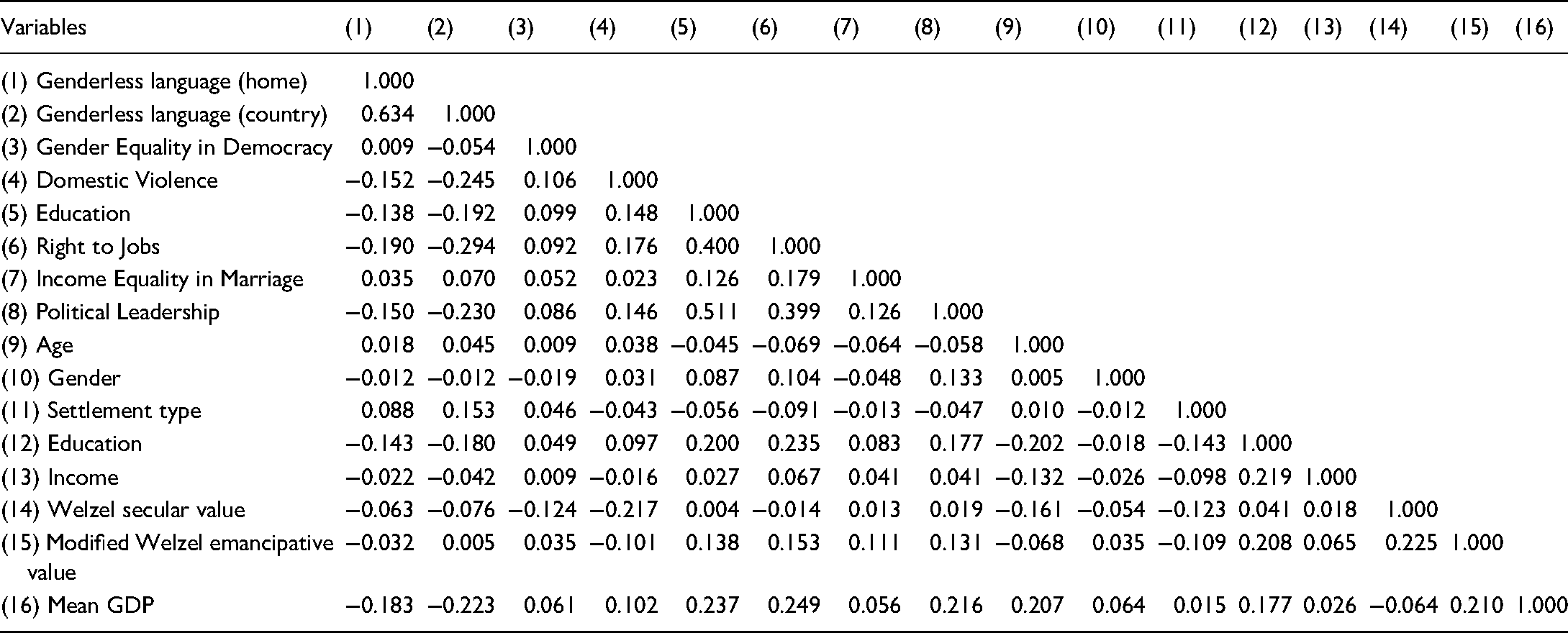
Appendix 3. Pairwise Correlation Table for “Latin America” Subgroup.
| Variables | (1) | (2) | (3) | (4) | (5) | (6) | (7) | (8) | (9) | (10) | (11) | (12) | (13) | (14) | (15) | (16) |
|---|---|---|---|---|---|---|---|---|---|---|---|---|---|---|---|---|
| (1) Genderless language (home) | 1.000 | |||||||||||||||
| (2) Genderless language (country) | 0.634 | 1.000 | ||||||||||||||
| (3) Gender Equality in Democracy | 0.009 | −0.054 | 1.000 | |||||||||||||
| (4) Domestic Violence | −0.152 | −0.245 | 0.106 | 1.000 | ||||||||||||
| (5) Education | −0.138 | −0.192 | 0.099 | 0.148 | 1.000 | |||||||||||
| (6) Right to Jobs | −0.190 | −0.294 | 0.092 | 0.176 | 0.400 | 1.000 | ||||||||||
| (7) Income Equality in Marriage | 0.035 | 0.070 | 0.052 | 0.023 | 0.126 | 0.179 | 1.000 | |||||||||
| (8) Political Leadership | −0.150 | −0.230 | 0.086 | 0.146 | 0.511 | 0.399 | 0.126 | 1.000 | ||||||||
| (9) Age | 0.018 | 0.045 | 0.009 | 0.038 | −0.045 | −0.069 | −0.064 | −0.058 | 1.000 | |||||||
| (10) Gender | −0.012 | −0.012 | −0.019 | 0.031 | 0.087 | 0.104 | −0.048 | 0.133 | 0.005 | 1.000 | ||||||
| (11) Settlement type | 0.088 | 0.153 | 0.046 | −0.043 | −0.056 | −0.091 | −0.013 | −0.047 | 0.010 | −0.012 | 1.000 | |||||
| (12) Education | −0.143 | −0.180 | 0.049 | 0.097 | 0.200 | 0.235 | 0.083 | 0.177 | −0.202 | −0.018 | −0.143 | 1.000 | ||||
| (13) Income | −0.022 | −0.042 | 0.009 | −0.016 | 0.027 | 0.067 | 0.041 | 0.041 | −0.132 | −0.026 | −0.098 | 0.219 | 1.000 | |||
| (14) Welzel secular value | −0.063 | −0.076 | −0.124 | −0.217 | 0.004 | −0.014 | 0.013 | 0.019 | −0.161 | −0.054 | −0.123 | 0.041 | 0.018 | 1.000 | ||
| (15) Modified Welzel emancipative value | −0.032 | 0.005 | 0.035 | −0.101 | 0.138 | 0.153 | 0.111 | 0.131 | −0.068 | 0.035 | −0.109 | 0.208 | 0.065 | 0.225 | 1.000 | |
| (16) Mean GDP | −0.183 | −0.223 | 0.061 | 0.102 | 0.237 | 0.249 | 0.056 | 0.216 | 0.207 | 0.064 | 0.015 | 0.177 | 0.026 | −0.064 | 0.210 | 1.000 |
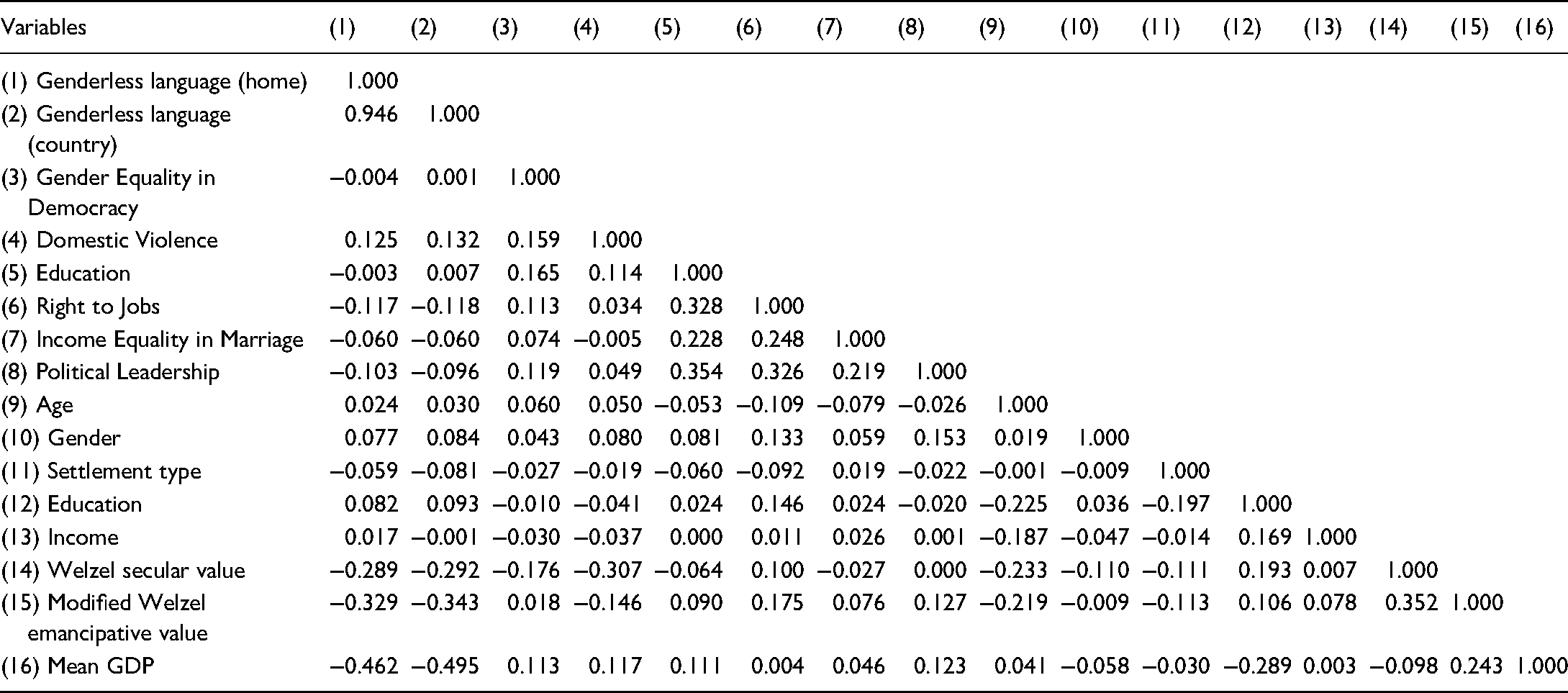
Appendix 4. Pairwise Correlation Table for “Orthodox Europe” Subgroup.
| Variables | (1) | (2) | (3) | (4) | (5) | (6) | (7) | (8) | (9) | (10) | (11) | (12) | (13) | (14) | (15) | (16) |
|---|---|---|---|---|---|---|---|---|---|---|---|---|---|---|---|---|
| (1) Genderless language (home) | 1.000 | |||||||||||||||
| (2) Genderless language (country) | 0.946 | 1.000 | ||||||||||||||
| (3) Gender Equality in Democracy | −0.004 | 0.001 | 1.000 | |||||||||||||
| (4) Domestic Violence | 0.125 | 0.132 | 0.159 | 1.000 | ||||||||||||
| (5) Education | −0.003 | 0.007 | 0.165 | 0.114 | 1.000 | |||||||||||
| (6) Right to Jobs | −0.117 | −0.118 | 0.113 | 0.034 | 0.328 | 1.000 | ||||||||||
| (7) Income Equality in Marriage | −0.060 | −0.060 | 0.074 | −0.005 | 0.228 | 0.248 | 1.000 | |||||||||
| (8) Political Leadership | −0.103 | −0.096 | 0.119 | 0.049 | 0.354 | 0.326 | 0.219 | 1.000 | ||||||||
| (9) Age | 0.024 | 0.030 | 0.060 | 0.050 | −0.053 | −0.109 | −0.079 | −0.026 | 1.000 | |||||||
| (10) Gender | 0.077 | 0.084 | 0.043 | 0.080 | 0.081 | 0.133 | 0.059 | 0.153 | 0.019 | 1.000 | ||||||
| (11) Settlement type | −0.059 | −0.081 | −0.027 | −0.019 | −0.060 | −0.092 | 0.019 | −0.022 | −0.001 | −0.009 | 1.000 | |||||
| (12) Education | 0.082 | 0.093 | −0.010 | −0.041 | 0.024 | 0.146 | 0.024 | −0.020 | −0.225 | 0.036 | −0.197 | 1.000 | ||||
| (13) Income | 0.017 | −0.001 | −0.030 | −0.037 | 0.000 | 0.011 | 0.026 | 0.001 | −0.187 | −0.047 | −0.014 | 0.169 | 1.000 | |||
| (14) Welzel secular value | −0.289 | −0.292 | −0.176 | −0.307 | −0.064 | 0.100 | −0.027 | 0.000 | −0.233 | −0.110 | −0.111 | 0.193 | 0.007 | 1.000 | ||
| (15) Modified Welzel emancipative value | −0.329 | −0.343 | 0.018 | −0.146 | 0.090 | 0.175 | 0.076 | 0.127 | −0.219 | −0.009 | −0.113 | 0.106 | 0.078 | 0.352 | 1.000 | |
| (16) Mean GDP | −0.462 | −0.495 | 0.113 | 0.117 | 0.111 | 0.004 | 0.046 | 0.123 | 0.041 | −0.058 | −0.030 | −0.289 | 0.003 | −0.098 | 0.243 | 1.000 |
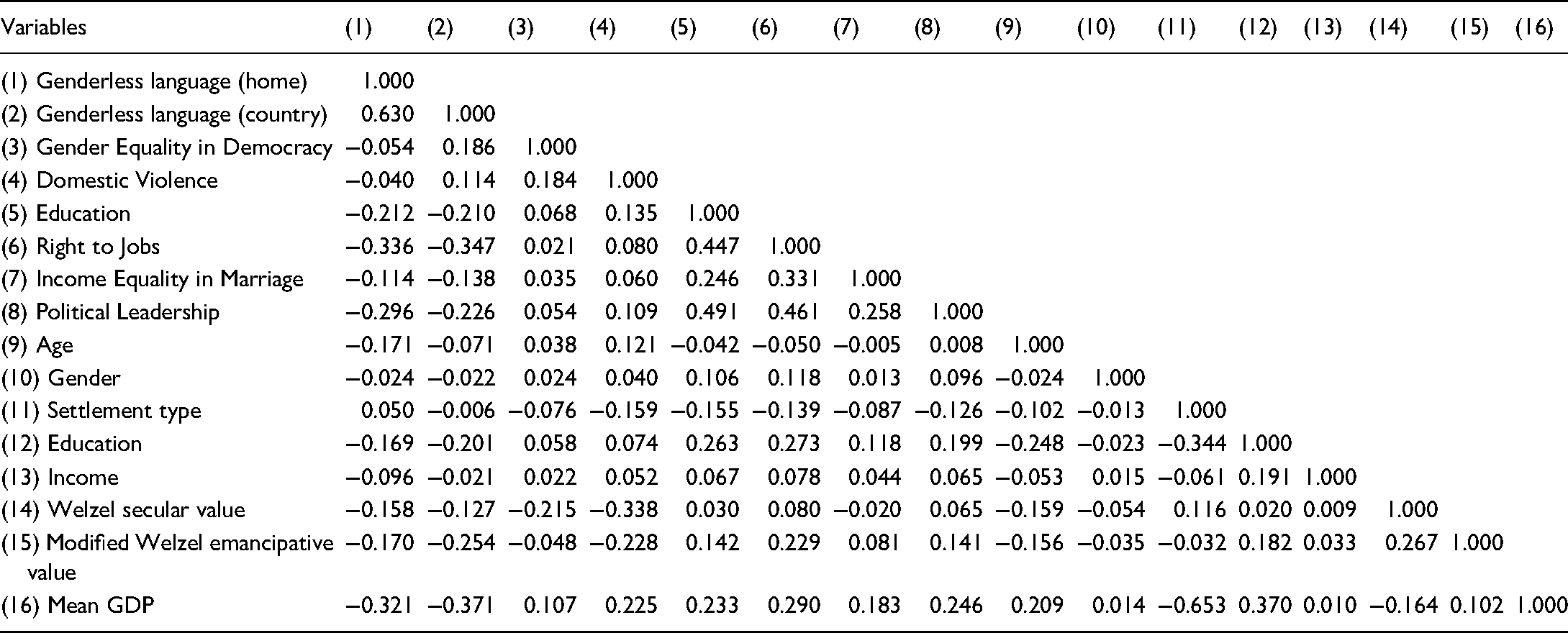
Appendix 5. Pairwise Correlation Table for “West and South Asia” Subgroup.
| Variables | (1) | (2) | (3) | (4) | (5) | (6) | (7) | (8) | (9) | (10) | (11) | (12) | (13) | (14) | (15) | (16) |
|---|---|---|---|---|---|---|---|---|---|---|---|---|---|---|---|---|
| (1) Genderless language (home) | 1.000 | |||||||||||||||
| (2) Genderless language (country) | 0.630 | 1.000 | ||||||||||||||
| (3) Gender Equality in Democracy | −0.054 | 0.186 | 1.000 | |||||||||||||
| (4) Domestic Violence | −0.040 | 0.114 | 0.184 | 1.000 | ||||||||||||
| (5) Education | −0.212 | −0.210 | 0.068 | 0.135 | 1.000 | |||||||||||
| (6) Right to Jobs | −0.336 | −0.347 | 0.021 | 0.080 | 0.447 | 1.000 | ||||||||||
| (7) Income Equality in Marriage | −0.114 | −0.138 | 0.035 | 0.060 | 0.246 | 0.331 | 1.000 | |||||||||
| (8) Political Leadership | −0.296 | −0.226 | 0.054 | 0.109 | 0.491 | 0.461 | 0.258 | 1.000 | ||||||||
| (9) Age | −0.171 | −0.071 | 0.038 | 0.121 | −0.042 | −0.050 | −0.005 | 0.008 | 1.000 | |||||||
| (10) Gender | −0.024 | −0.022 | 0.024 | 0.040 | 0.106 | 0.118 | 0.013 | 0.096 | −0.024 | 1.000 | ||||||
| (11) Settlement type | 0.050 | −0.006 | −0.076 | −0.159 | −0.155 | −0.139 | −0.087 | −0.126 | −0.102 | −0.013 | 1.000 | |||||
| (12) Education | −0.169 | −0.201 | 0.058 | 0.074 | 0.263 | 0.273 | 0.118 | 0.199 | −0.248 | −0.023 | −0.344 | 1.000 | ||||
| (13) Income | −0.096 | −0.021 | 0.022 | 0.052 | 0.067 | 0.078 | 0.044 | 0.065 | −0.053 | 0.015 | −0.061 | 0.191 | 1.000 | |||
| (14) Welzel secular value | −0.158 | −0.127 | −0.215 | −0.338 | 0.030 | 0.080 | −0.020 | 0.065 | −0.159 | −0.054 | 0.116 | 0.020 | 0.009 | 1.000 | ||
| (15) Modified Welzel emancipative value | −0.170 | −0.254 | −0.048 | −0.228 | 0.142 | 0.229 | 0.081 | 0.141 | −0.156 | −0.035 | −0.032 | 0.182 | 0.033 | 0.267 | 1.000 | |
| (16) Mean GDP | −0.321 | −0.371 | 0.107 | 0.225 | 0.233 | 0.290 | 0.183 | 0.246 | 0.209 | 0.014 | −0.653 | 0.370 | 0.010 | −0.164 | 0.102 | 1.000 |