



Abstract
In gender-marked languages, masculine and feminine grammatical forms are distinct, with the masculine form also used for gender-mixed groups (generic masculine). Previous research indicates that the generic masculine elicits male-biased representations. Psychologically, this may be due to a misunderstanding of the communicative intention, an automatic activation of male associations, or both. In two preregistered experiments, we tested whether the male bias is affected by emphasizing the generic intention. Adding contextual information that conveyed a group's gender-mixed composition eliminated the male bias (Study 1). However, the male bias remained robust when continuously reminding participants of the generic intention via a novel grammatical marker (Study 2). These results suggest that the male bias is partly driven by associative processes that are immune against a purely explicit disambiguation of the generic intention.
In gender-marked languages (e.g., German), distinctly feminine and masculine grammatical forms are available to refer to women and men. However, these forms are used asymmetrically, as the masculine variant is additionally used to refer to persons whose gender is irrelevant or unknown, or to gender-mixed groups. For example, while the German term die Lehrerinnen [the teachersfeminine] exclusively refers to female teachers, the term die Lehrer [the teachersmasculine] is not only used to refer to male teachers but also to groups consisting of male, female, and nonbinary exemplars, or to the professional category of teachers in general. In the ongoing debate on gender fairness, this generic usage of the masculine grammar form (GM) has been criticized for privileging men by making women and nonbinary persons “invisible” (Gygax et al., 2021; Hellinger & Bußmann, 2015; Kotthoff & Nübling, 2018). Indeed, a substantial amount of empirical evidence in various languages with different degrees of gender-markedness (e.g., French, German, Norwegian, Spanish, Russian) suggests that the GM elicits representations of gender that are biased toward men. For example, after being exposed to the relevant GM terms, participants gave predominantly male responses when asked to come up with exemplars of occupational groups (Keith et al., 2022; Stahlberg et al., 2001; Vervecken et al., 2013) or to name protagonists of short stories (Kaufmann & Bohner, 2014). Similar results were obtained for gender ratio estimations (Blake & Klimmt, 2010; Braun et al., 1998) and correctness judgments of person-profession assignments (Irmen & Kurovskaja, 2010; Lévy et al., 2014). Participants were also faster and more accurate in comprehending or reacting to male than female continuations after reading sentences about groups in the GM (Gabriel & Gygax, 2008; Garnham & Yakovlev, 2015; Gygax et al., 2008; Irmen & Roßberg, 2004; Körner et al., 2022). In sum, the GM has been shown to bias gender representations toward men reliably across various languages and various experimental paradigms.
Misunderstanding the Generic Intention
Where does the male bias come from? An obvious explanation is that a recipient might misunderstand the meaning intended by the communicator. More precisely, a GM might be erroneously interpreted as specifically intended, that is, as referring exclusively to men. Braun et al. (1998) give the example of an ad that offers Jobs für Studenten [jobs for studentsmasculine]. The ambiguity of the word Studenten might deter women from applying, as it is unclear whether the advertiser looks exclusively for men or for workers of any gender. This example illustrates that a recipient of the masculine grammar form has to disambiguate whether it is meant generically or specifically. To do so, explicit information or contextual cues are required but not always provided. 1
Empirical evidence confirms that the male bias is affected by contextual information that conveys how the grammatically masculine form is meant. For instance, Gygax and Gabriel (2008) hypothesized that the grammatically masculine form was more likely understood in its specific (vs. generic) meaning when being contrasted with the grammatically feminine form, which is always specific. In their experiments, participants had to judge whether a person described by a male or female kinship term (e.g., brother or sister) could be part of a group referred to by role nouns (e.g., swimmer). In the first phase of the procedure, the role nouns were presented only in the grammatically masculine form. In the second phase, however, they were either masculine or feminine. In general, a male bias was found, that is, participants were less likely to accept female than male referents in masculine role nouns. Importantly, and as expected, this effect was even more pronounced in the second phase when participants were also exposed to female role nouns. Apparently, a different meaning of the masculine form is conveyed by the presence or absence of the feminine form, such that gender representations are adjusted accordingly. For instance, as soon as the feminine form is used to refer to a female teacher (die Lehrerin [the teacherfeminine]), the masculine form (der Lehrer [the teachermasculine]) is interpreted as symmetrically referring to a male teacher.
Automatic Activation
While a failure to communicate or understand the GM's generic intention may bias gender representations toward men, this cannot account for all empirical findings. Most notably, a male bias persists even when recipients are explicitly informed about the generic meaning intended by using the GM. For instance, Körner, Abraham, Rummer and Strack (2022) had participants react to German sentences describing a male or female subgroup of a previously described larger group that was mentioned with the GM (Gygax et al., 2008 originally used this paradigm in French, German, and English). Even though participants were explicitly informed that the GM refers to women and men equally before the experiment, a male bias emerged, as participants were faster and more accurate in reacting to a second sentence describing men rather than women. Analogous results were found by Gygax et al. (2012) for French. They employed a word pair paradigm similar to the one used in Gygax and Gabriel (2008), with participants judging whether male or female referents could fulfill a role mentioned in the GM. Deviating from the original study, participants were stopped in the middle of the procedure to be explicitly reminded that the masculine grammar form is also used for generic purposes and were asked to take this into account during the rest of the experiment. Prior to this intervention, participants were less likely to assign females than males to a role mentioned in the GM. After the explicit reminder of the generic intention, the judgmental effect disappeared. Crucially, however, a male bias was still found in the response times. Even after the instructions, participants took longer to acknowledge female referents as compared to male referents.
These results indicate that an explicit disclosure of the GM's generic intention does not fully balance gender representations. Instead, part of the bias might originate in an early, automatic stage of processing that is immune against an explicit communication of the intended meaning. This explanation builds on the assumption that the grammatically masculine form evolves in being predominantly associated with its specific meaning relative to its generic meaning. Such an asymmetry might be due to various cognitive and developmental factors, for instance, the specific meaning might be learned, understood, and applied earlier by children, and it is the more prevalent meaning especially for singular forms (Gygax et al., 2009, see 2021, for an integration of these ideas into linguistic theory). Once an association between the masculine grammar form and its specific meaning is established, the specific meaning can be cognitively activated when encountering masculine forms, even when being ruled out via explicit communication. This mechanism, known as semantic priming, may facilitate the subsequent processing of congruent information (Banaji & Hardin, 1996). Text comprehension also elicits situation models (Van Dijk & Kintsch, 1983) that might be similarly biased and thus, in case of the GM, include predominantly men. In sum, gender representations elicited by the GM might be biased toward men by two distinct mechanisms (see Strack & Deutsch, 2004 for a theoretical framework): First, the generic intention might be insufficiently communicated or understood, and second, automatic activation might facilitate male representations.
The Present Research
While previous research suggests that the male bias is partly robust against explicit attempts to disambiguate the generic intention as automatic associations contribute to the effect (Gygax et al., 2012; Körner et al., 2022), we aimed to extend these findings. Specifically, we further examined the robustness of the male bias under two novel manipulations that emphasized the GM's generic intention (employed in Studies 1 and 2, respectively). We used a sentence-completion paradigm adopted from previous studies (Gygax et al., 2008; Körner et al., 2022). Participants read a first sentence describing a group using the GM. Afterward, they read a second sentence describing a purely male or female subgroup and had to indicate whether the second sentence is a sensible continuation of the first one. In this paradigm, potential male-biased gender representations result in a higher acceptance of, and faster responses to, second sentences describing male rather than female subgroups. Similar to other studies employing the same paradigm (Körner et al., 2022; Tibblin et al., 2023), we used group nouns that are roughly balanced regarding gender stereotypicality. By controlling for stereotypicality, we eliminated a factor that likely influences gender representations via similar routes that have been discussed previously (i.e., gender-stereotyped nouns might trigger both associative activation and explicit inferences about gender ratios, Banaji & Hardin, 1996).
In Study 1, we tested the influence of contextual cues that disambiguate a group's gender-mixed composition. Specifically, we designed sentences which described a group using the GM and varied additional information (e.g., gender-stereotypical clothing) in the sentence suggesting that both women and men were included or not. We expected a male bias in the control condition (no contextual disambiguation), and tested whether this bias would be reduced, eliminated, or unaffected in the disambiguation condition. In Study 2, we tested whether the male bias is affected by an even more direct way of disambiguating the generic intention. We introduced a grammatical marker to signal that the GM was meant to refer to both women and men. This marker was then used with every instance of the GM, thus serving as a chronic reminder of the generic intention. Again, we expected a male bias in the control condition (no reminder) and tested whether this bias would be reduced, eliminated, or unaffected in the reminder condition.
Study 1
Method
Participants
The experiment was preregistered (see https://aspredicted.org/1MX_KJ7). 2 We recruited 200 participants whose native language was German and who were currently living in Germany via Prolific. We excluded six participants for not completing the experiment, resulting in a final sample of 194 participants (67 women, 125 men, 2 diverse; Mage = 32.87, SDage = 10.45).
Design
The experiment employed a 2 (gender continuation: women vs. men) × 2 (contextual disambiguation: yes vs. no) design, both factors manipulated within-subject.
Materials
The sentence pair paradigm used in the present experiment was conceptually adopted from previous studies (Gygax et al., 2008; Körner et al., 2022). All materials and instructions were presented in German. Participants evaluated 64 sentence pairs; 32 of these were filler pairs, 32 were target pairs. The target pairs consisted of a first sentence describing a social group using the GM and a second sentence describing a male or female subset of the previously mentioned group. All 32 groups were adopted from Körner et al. (2022), including occupational (e.g., Autoren [authors]) or nonoccupational (e.g., Zuschauer [spectators]) groups. Importantly, these groups were pretested in previous studies to be neither stereotypically male- nor female-dominated (Gygax et al., 2008; Kennison & Trofe, 2003; as cited in Körner et al., 2022). For each social group, two versions of a first sentence were formulated. One version suggested that the group consisted of both women and men (stereotypically or factually), thereby providing a context which disambiguated the generic intention of the masculine grammar form. Specifically, disambiguation was implemented in one of four ways: (a) gender-stereotypic clothing (e.g., Die Nachrichtensprecher trugen schicke Anzüge und Kleider. [The newscasters wore fancy suits and dresses.]), (b) existence of romantic couples in the group (e.g., Einige der Musiker flirteten miteinander. [Some of the musicians flirted with each other.]), (c) gender-dependent nomination rules (e.g., Die Athleten traten in geschlechtergetrennten Klassen an. [The athletes competed in gender-segregated classes.]), or (d) direct mentioning of gender proportion whereby women and men were used equally often across stimuli (e.g., 70% der Kinderärzte waren männlich. [70% of the pediatricians were male.]). Each version was implemented in eight sentence continuations. The other version of each first sentence did not contain any gender-related information but was otherwise formulated in resemblance to the respective disambiguated version (e.g., Die Nachrichtensprecher trugen schicke Kleidung. [The newscasters wore fancy clothes.] instead of Die Nachrichtensprecher trugen schicke Anzüge und Kleider. [The newscasters wore fancy suits and dresses.]). For each of the 32 first sentences of the target pairs, a semantically coherent continuation was formulated, describing a gender subset of the first group (e.g., Zur Vorbereitung lasen sich alle Frauen/Männer die Nachrichten durch. [In preparation, all women/men read through the news.]). Similar to previous studies employing this paradigm (Gygax et al., 2008; Körner et al., 2022), the continuations varied in how exactly the subset was expressed (e.g., manche [some], die meisten [most], alle [all] women/men). For each participant, the 32 target pairs were randomly assigned to one of the four conditions (gender continuation: women vs. men, contextual disambiguation: yes vs. no), resulting in eight target pairs in each condition. The filler pairs were directly adopted from Körner et al. (2022). All 32 filler pairs were formulated in only one version. The second sentence was always semantically incoherent with the first sentence, for example, because the mood or occupation of the described persons did not match. The filler pairs were only included to balance the number of yes/no responses and were irrelevant for analyses.
Procedure
After giving consent, participants provided demographic information before starting the experiment. Participants were informed that they would read two sentences, the first describing a group and the second describing a subset of this group. They were instructed that their task was to judge whether the second sentence is a sensible continuation of the first one. Participants were asked to reach their decision as quickly as possible. It was further explained that some sensible continuations might be uncommon, but still semantically coherent. Before the main task started, participants went through a short practice block containing four trials. In the main task, the 64 sentence pairs chosen in line with the structure described above (32 target pairs and 32 filler pairs) were presented in randomized order. After participants went through the first half of the experiment, a slide was presented inviting the participants to take a short break. Each sentence pair trial consisted of three slides. The first slide displayed “Next sentence pair!,” and participants proceeded with the space bar. The second slide displayed the first sentence, where participants again proceeded with the space bar after reading the sentence. The third slide displayed the second sentence. Participants indicated their decision by pressing either “j” (sensible continuation) or “f” (nonsensible continuation). Before the first slide, an intertrial interval of 300 ms was implemented. Before the second and third slide, a blank interval of 200 ms each was implemented. After all sentence pairs were presented, participants were thanked and linked back to Prolific to complete the experiment.
Dependent Variables
Two dependent variables were measured, which were the proportion of “yes” responses and the response times when judging the sentence continuations as sensible or not. We only included target trials (i.e., sentence pairs in which the continuation was indeed sensible) in all analyses. For response time analyses, we further excluded “no” responses as well as responses that were more than three standard deviations above the participant's individual mean.
Results
Response Proportions
Descriptive response proportion results are summarized in Figure 1. To analyze response proportions, we employed a generalized mixed effects model using the glmer function in the R package lme4 (Bates et al., 2015). Single responses (1: “yes”; 0: “no”) were predicted by the variables gender continuation (women vs. men) and contextual disambiguation (yes vs. no) as well as their interaction as fixed effects. We further included participant intercepts and item intercepts as random effects. Model parameters and statistical results are summarized in Table 1. The mixed-model analysis was followed-up with pairwise contrast tests to examine potential differences between gender continuations (women vs. men) separated by disambiguation conditions. Indicating an overall male bias, the proportion of “yes” responses was higher when the second sentence described men as compared to women, which was evident in a significant effect of gender continuation. This effect was qualified by a significant interaction between gender continuation and disambiguation. Contrast tests (two-tailed) revealed that the male bias occurred when the generic intention was not disambiguated, z = 6.93, p < .001, but did not reach significance when the generic intention was disambiguated, z = 1.94, p = .052.
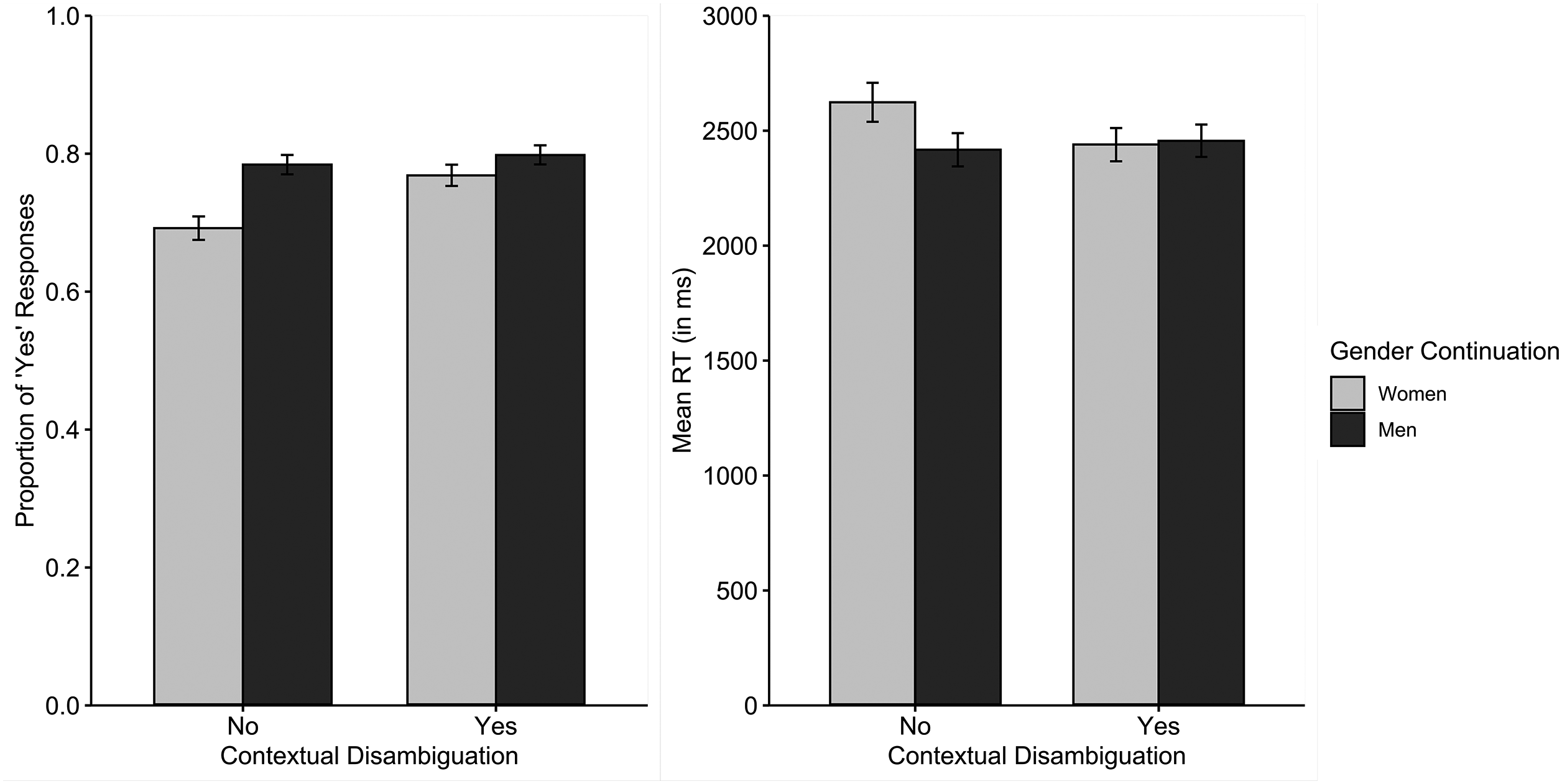
Study 1 results.
Multilevel Analyses of Study 1.
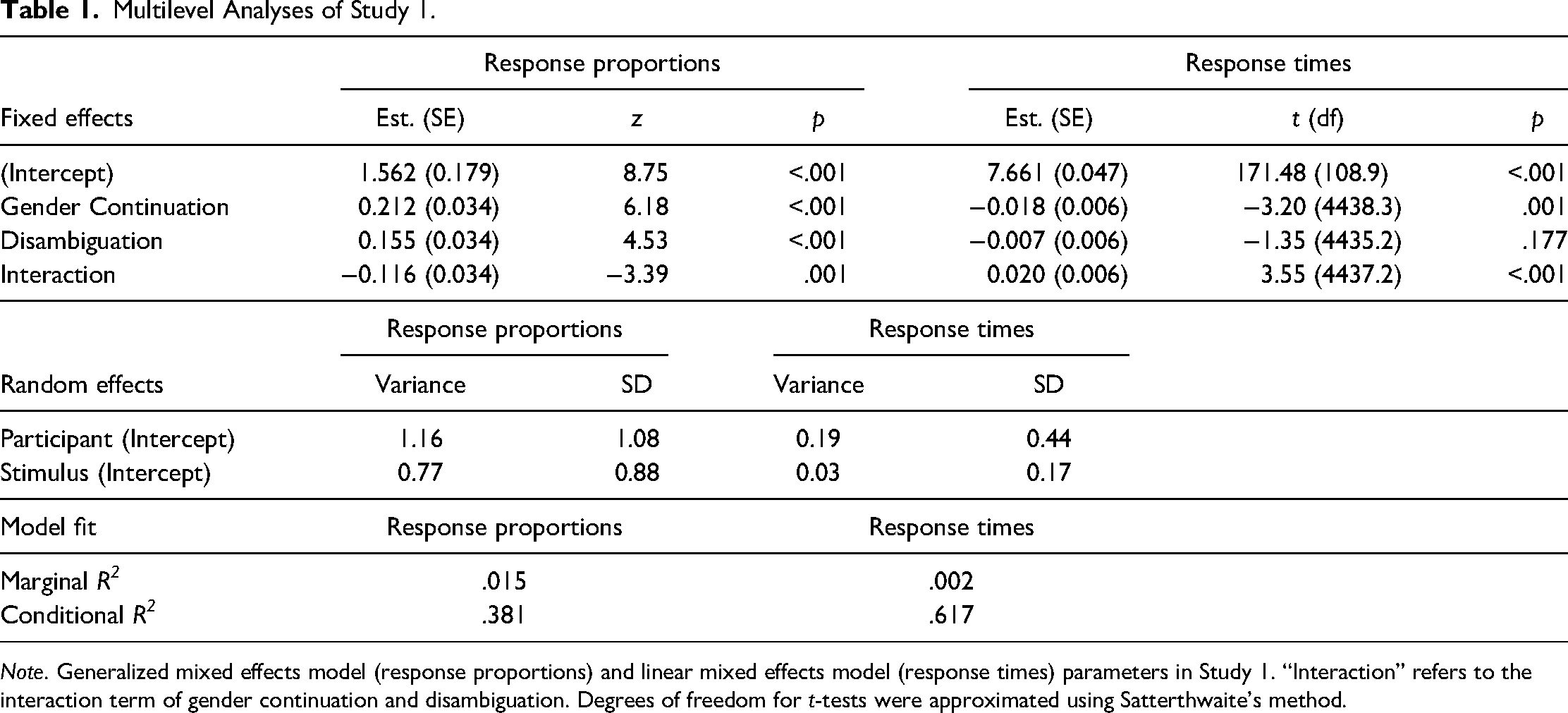
Note. Generalized mixed effects model (response proportions) and linear mixed effects model (response times) parameters in Study 1. “Interaction” refers to the interaction term of gender continuation and disambiguation. Degrees of freedom for t-tests were approximated using Satterthwaite's method.
Response Times
Descriptive response time results are summarized in Figure 1. To analyze response times, we employed a linear mixed effects model using the lmer function in the R package lme4 (Bates et al., 2015). Single response times were predicted by the variables gender continuation (women vs. men) and contextual disambiguation (yes vs. no) as well as their interaction as fixed effects. We further included participant intercepts and item intercepts as random effects. Model parameters and statistical results are summarized in Table 1. The mixed-model analysis was followed-up with pairwise contrast tests to examine potential differences between gender continuations (women vs. men) separated by disambiguation conditions. Before analysis, all RTs were log-transformed to reduce skewness in their distribution. Indicating an overall male bias, responses were faster when the second sentence described men as compared to women, which was evident in a significant effect of gender continuation. This effect was qualified by a significant interaction between gender continuation and disambiguation. Contrast tests (two-tailed) revealed that the male bias occurred when the generic intention was not disambiguated, z = 4.69, p < .001, but not when the generic intention was disambiguated, z = 0.25, p = .802.
Discussion
In Study 1, we tested whether gender representations elicited by nonstereotyped generic masculine plural forms remain male-biased when contextual information suggests that the groups are gender-mixed. In both dependent measures, we found a male bias when the generic intention was not disambiguated by the context, that is, sentence continuations describing men were accepted faster and more often in comparison to sentence continuations describing women. In contrast, we did not find a male bias when the generic intention was disambiguated. Specifically, in response times, there was no difference at all between male and female gender continuations, while in response proportions, we observed a nonsignificant descriptive tendency toward a male bias. Although we cannot rule out the possibility of a small effect in response proportions that our data were not sensitive enough to detect, the male bias is absent in response times in any case. Overall, we conclude that the male bias was eliminated in the disambiguation condition. At first sight, these results suggest that the male bias is foremostly driven by the perceived communicative intention: when contextual cues facilitated the understanding of the GM's generic intention, gender representations became balanced. However, the contextual cues might also have shaped gender representations in another way. Not only did they allow the recipient to better comprehend the GM's intended meaning but they also might have triggered own automatic responses which balanced gender representations. For example, the sentence “The newscasters wore fancy suits and dresses” might have primed both male and female elements with the terms “suits” and “dresses,” respectively. Thus, the results of Study 1 allow two divergent conclusions about the psychological processes by which contextual disambiguation eliminated the male bias: First, gender representations might have been balanced by clarifying the intended generic meaning of the GM, or second, gender representations might have been balanced by priming both male and female elements automatically. We aimed to disentangle both possibilities with a second experiment. Specifically, we implemented a chronic reminder of the GM's generic intention via an artificial grammatical marker. We chose the circumflex (“^”) as we aimed for a typographical form to which most of our participants (i.e., native German speakers living in Germany) had only minor exposure prior to the experiment. With appropriate instructions, this marker allows to clearly communicate the generic intention, but, in contrast to the contextual cues used in Study 1, it does not additionally prime both male and female elements. If gender representations can be balanced by repeatedly conveying the generic intention, no male bias should emerge in the reminder condition. If, however, gender representations are also shaped by automatic processes, a male bias should emerge, even in the reminder condition.
Study 2
Method
Participants
The experiment was preregistered (see https://aspredicted.org/3YS_YNZ). As in Study 1, we recruited 200 participants whose native language was German and who currently lived in Germany via Prolific. We excluded three participants for not completing the experiment, resulting in a final sample of 197 participants (89 women, 106 men, 2 diverse; Mage = 28.74, SDage = 9.17).
Design
The experiment employed a 2 (gender continuation: women vs. men) × 2 (generic intention reminder: yes vs. no) design. Gender continuation was manipulated within-subject, generic intention reminder was manipulated between-subjects.
Materials
The sentence pairs were adopted from Study 1. Specifically, the filler pairs were identical to the ones used in Study 1, and the target pairs were identical to the ones used in the nondisambiguated context condition in Study 1 (e.g., Die Nachrichtensprecher trugen schicke Kleidung. [The newscasters wore fancy clothes.]). To implement the factor generic intention reminder, a modification of each sentence pair (target and filler) was generated. In this version, a circumflex character (“^”) was added after each generically intended masculine group description (e.g., Die Nachrichtensprecher^ trugen schicke Kleidung. [The newscasters^ wore fancy clothes.]). This served as a reminder of the generic intention (see Procedure). Depending on the between-subjects factor generic intention reminder, one of both versions was chosen for all sentence pairs presented to a participant. For each participant, the 32 target pairs were randomly divided in 16 sentences having a female gender continuation and 16 sentences having a male gender continuation.
Procedure
The procedure was identical to the procedure of Study 1. Again, the 64 sentence pairs chosen in accordance with the structure described above were presented in randomized order. Deviating from Study 1, another slide was included after the initial task instruction, informing the participants about the employed grammatical gender form. In the reminder condition, this information was: “The groups are often gender-mixed. In such cases, we use a variation of the generic masculine that is followed by a circumflex character to indicate that men and women are included in the group (e.g., ‘the participants^’).” In the no-reminder condition, this information was: “The groups are often gender-mixed. In such cases, we use the generic masculine. This refers to both male and female group members.”
Dependent Variables
Both dependent variables (proportion of “yes” responses and response times) were measured and analyzed in identical fashion as in Study 1.
Results
Response Proportions
Descriptive response proportion results are summarized in Figure 2. Repeating the analysis of Study 1, we employed a generalized mixed effects model using the glmer function in the R package lme4 (Bates et al., 2015). Single responses (1: “yes”; 0: “no”) were predicted by the variables gender continuation (women vs. men) and generic intention reminder (yes vs. no) as well as their interaction as fixed effects. We further included participant intercepts and item intercepts as random effects. Model parameters and statistical results are summarized in Table 2. The mixed-model analysis was followed-up with pairwise contrast tests to examine potential differences between gender continuations (women vs. men) separated by reminder conditions. Indicating an overall male bias, the proportion of “yes” responses was higher when the second sentence described men as compared to women, which was evident in a significant effect of gender continuation. There was no interaction between gender continuation and generic intention reminder. Contrast tests (two-tailed) revealed that the male bias occurred when the generic intention reminder was absent, z = 5.87, p < .001, and similarly, when the reminder was present, z = 3.60, p < .001.
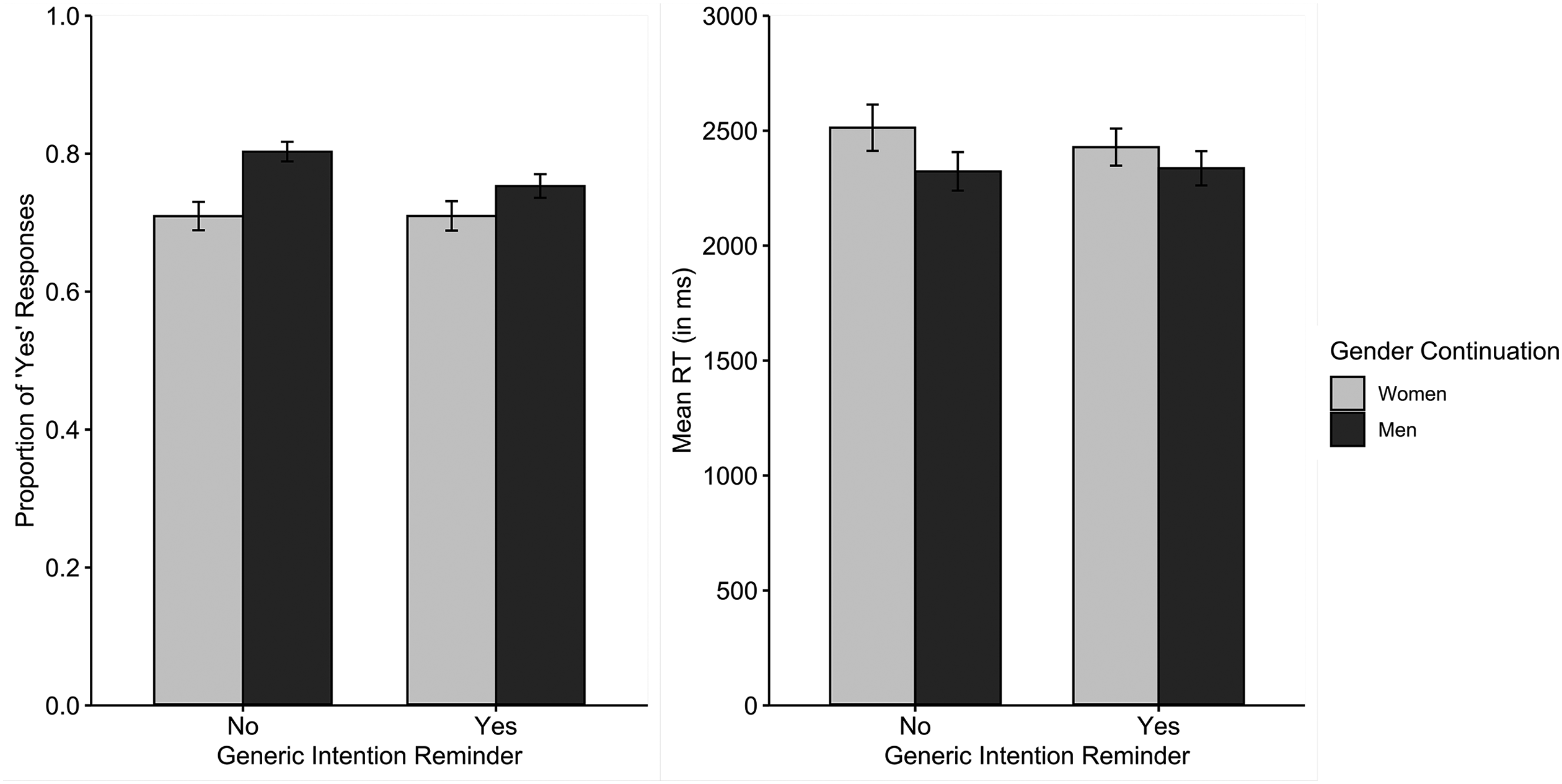
Study 2 results.
Multilevel Analyses of Study 2.
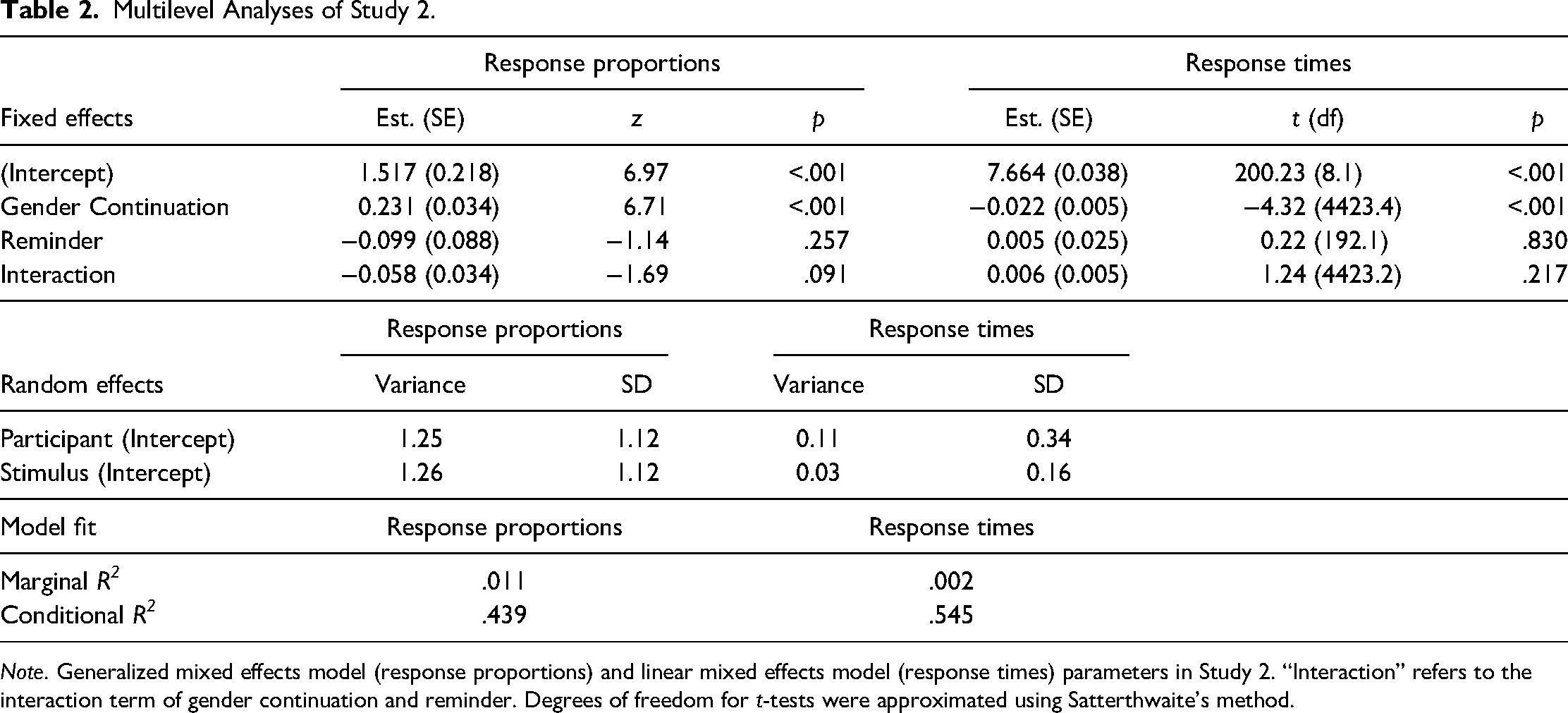
Note. Generalized mixed effects model (response proportions) and linear mixed effects model (response times) parameters in Study 2. “Interaction” refers to the interaction term of gender continuation and reminder. Degrees of freedom for t-tests were approximated using Satterthwaite's method.
Response Times
Descriptive response time results are summarized in Figure 2. Repeating the analysis of Study 1, we employed a linear mixed effects model using the lmer function in the R package lme4 (Bates et al., 2015). Single response times were predicted by the variables gender continuation (women vs. men) and generic intention reminder (yes vs. no) as well as their interaction as fixed effects. We further included participant intercepts and item intercepts as random effects. Model parameters and statistical results are summarized in Table 2. The mixed-model analysis was followed-up with pairwise contrast tests to examine potential differences between gender continuations (women vs. men) separated by reminder conditions. Before analysis, all RTs were log-transformed to reduce skewness in their distribution. Indicating an overall male bias, responses were faster when the second sentence described men as compared to women, which was evident in a significant effect of gender continuation. There was no interaction between gender continuation and generic intention reminder. Contrast tests (two-tailed) revealed that the male bias occurred when the generic intention reminder was absent, z = 3.97, p < .001, and similarly, when the reminder was present, z = 2.16, p = .031.
Discussion
In Study 2, we tested whether gender representations elicited by nonstereotyped generic masculine plural forms remain male-biased when a grammatical marker conveys the GM's generic intention. For both response proportions and response times, a male bias occurred, both in the standard condition and when participants were chronically reminded of the generic intention. This suggests that gender representations are not only male-biased because the recipient misunderstands the GM's intended meaning but also because the masculine grammar form automatically primes male elements.
General Discussion
The present research aimed to test whether gender representations elicited by the GM remain male-biased under two novel manipulations that emphasized the GM's generic intention. In the first experiment, we found no evidence for male-biased representations when contextual information suggested that nonstereotyped GM plural forms referred to gender-mixed groups. However, in the second experiment, a male bias occurred even when participants were instructed and continuously reminded of the GM's intended generic meaning by a novel grammatical marker. These results are well-explained by the theoretical assumption that gender representations are not only fully determined by the conveyed meaning of a grammatical form but also influenced by automatically activated associations. In the first experiment, the associative content was gender-balanced, as the contextual cues contained both male and female elements. In the second experiment, however, participants were reminded of the generic intention without activating any concomitant semantic contents.
Our studies extend previous findings demonstrating the robustness of the male bias to an explicit communication of the generic meaning (Gygax et al., 2012; Körner et al., 2022). We argue that the present manipulations go beyond the ones used in previous studies for two reasons. First, our manipulations ensured that the generic intention was emphasized within each sentence in which a GM was presented. This suggests the male biases found in previous studies were not only due to the participants forgetting the previously instructed generic intention. Given these rigorous conditions, the results of Study 2 provide strong evidence against the assumption that gender representations are entirely determined by the communicated meaning of the masculine grammar form. Second, our manipulations introduce the relevant distinction between meaning cues that can activate gender-relevant associations on their own (i.e., contextual cues in Study 1) and meaning cues that cannot (i.e., the grammatical marker in Study 2). Our results suggest that only the former can succeed in overcoming the male bias. More broadly, this is in line with research indicating that unwanted associative activation (e.g., automatic stereotyping) can be tackled by counter-activation, but not by inhibition attempts (Gawronski et al., 2008; see also Deutsch et al., 2006; Strack & Deutsch, 2004). Of course, in the domain of gendered language, more research is needed to test the interplay of explicit meaning cues and their associative implications. For example, explicit information and associative activation might be manipulated orthogonally to test which affects gender representation more (and does so under which conditions).
An interesting parallel can be drawn between the present Study 2 and the study by Körner et al. (2022). These authors compared gender representations elicited by the GM with those elicited by the gender-star form, which is considered the predominant gender-inclusive alternative to the GM in German. It corresponds to the feminine form, where an asterisk conveys the inclusive intention by separating the word stem from the female suffix (e.g., die Lehrer*innen). While we found that merely reminding readers of the GM's intended inclusivity did not eliminate a male bias, Körner et al. (2022) observed a female bias for the gender-star form such that sentence continuations describing women as compared to men were accepted faster and more often than those describing men. Thus, both studies suggest a dominance of the semantic priming (male or female) that is difficult to overcome by mere flagging (“^” or “*”) to remind recipients of the intended generic meaning. However, it should be noted that in the Körner et al. (2022) study, the female bias elicited by the gender star form was somewhat weaker than the male bias elicited by the GM and was not replicated in a different experimental paradigm (Zacharski & Ferstl, 2023). In a recent linguistic analysis, the gender-star form's suffix has even been suggested to operate as an independent semantic prime (Völkening, 2022). In any case, more research is needed to better understand the operation of associative and propositional mechanisms when processing gender-inclusive forms.
Finally, we believe that our results are informative for the societal debate on the (lack of) gender-fairness of the GM. Defendants of the GM against feminist critics argue that the GM is unproblematic because the generic intention is supposedly conveyed well by the conversational context in real-life communication. Similarly, psycholinguistic paradigms in general have been criticized for lacking a realistic communicative context that conveys the generic meaning of masculine grammar forms (e.g., Eisenberg, 2022). Our research partly confirms these concerns, as a disambiguating context eliminated the male bias elicited by nonstereotyped group nouns in Study 1. However, this is limited to situations in which the conversational context provides additional gender-balanced elements. Study 2 indicates that male-biased gender representations are to be expected when no additional male and female semantics are activated, despite the generic meaning being similarly clear. Note that explicit communication is a commonly used attempt in real-life scenarios to make the GM more gender fair. For instance, German articles sometimes include a justifying note in the beginning, explaining how the GM will be used throughout the text to refer to persons of all genders. While these efforts might help in communicating the author's intentions, we conclude that they do not necessarily balance the reader's gender representations. Taken together, the present results suggest that the mere knowledge about the generic meaning does not suffice in resolving asymmetrical gender representations, neither in psycholinguistic experiments nor in real-life communication.
A limitation of the present study is that our conclusions are limited to GM forms with roughly balanced gender stereotypes, which is a minority of group nouns. As described in the introduction, stereotyped terms might independently operate as semantic primes that associatively activate congruent elements (Banaji & Hardin, 1996). Thus, the male bias might be accentuated or attenuated depending on gender stereotypes. On the other hand, Gygax et al. (2008) observed a consistent male bias across role nouns that are male-stereotyped, female-stereotyped, and nonstereotyped in French and German. Perhaps more critically, we can only speculate whether the elimination of the male bias by a disambiguating context (found in Study 1) would have also occurred when using stereotyped group nouns. Since the disambiguation strategies themselves made use of strong gender stereotypes (e.g., stereotypical clothing), it is unclear how disambiguation would have interacted with stereotyped role nouns. A related limitation is that our disambiguation strategies relied on the assumption that participants endorsed certain gender stereotypes (stereotypical clothing) and a heteronormative perspective (existence of romantic couples in the group). Although we did not measure or control for individual differences in this regard, we consider this assumption verified due to the balanced gender representations these sentences elicited. Nevertheless, an interesting avenue for future research might be to investigate whether gender-related contextual cues affect gender representations differently depending on their type (e.g., whether they make use of stereotypes or not), by whom they are read (e.g., degree of stereotype endorsement by reader), or how they are read (e.g., thoroughly vs. superficially).
Conclusion
The generic masculine elicits male-biased gender representations. For nonstereotyped group nouns, this effect is eliminated by providing contextual cues containing both male and female elements, but not by informing and continuously reminding recipients of the generic intention. These results are well explained by assuming two distinct psychological routes underlying biased gender representations. First, the generic masculine might be misunderstood as specifically intended, and second, it might automatically prime male elements. We advocate that a deeper understanding of these processes is crucial to advance the ongoing scientific and societal debate.
Footnotes
Acknowledgments

Declaration of Conflicting Interests
The author(s) declared no potential conflicts of interest with respect to the research, authorship, and/or publication of this article.
Funding
The author(s) received no financial support for the research, authorship, and/or publication of this article.