



Abstract
In many languages, masculine language forms are not only used to designate the male gender but also to operate in a generic fashion. This dual function has been found to lead to male biased representations when people encounter the generic masculine. In German, the now predominant substitute is the gender star form (e.g., Athlet*innen). In two experiments, we examined gender representations elicited when reading the gender star form (vs. generic masculine vs. pair forms). We found that, following the generic masculine, continuations about men (vs. women) were more frequently and more quickly judged to be compatible, replicating the male bias, even though participants were informed about the generic intention. Following the gender star form, a female bias in judgments (both Studies) and speed (only Study 2) occurred, which was somewhat smaller. Representations were most balanced when both male and female forms were mentioned.
Thinking does not only influence language, but conversely and less intuitively, language has also been argued to influence thinking (Sapir, 1921; von Humboldt, 1836; Whorf, 1956). While the stronger hypothesis of linguistic determinism (language determines what can be thought) is by now widely discarded, the weaker hypothesis of linguistic relativity has regained support (for reviews see Hardin and Banaji, 1993; Lucy, 2016; Wolff and Holmes, 2011; for grammatical gender, see Boroditsky et al., 2003). Moreover, language shapes what speakers and listeners attend to (Slobin, 2003). Rather than examining the former, stable kind of influences of language on thought, the present research examines the latter, situational kind of influences; specifically, we examine how reading grammatical gender forms influences readers’ current thinking.
Concerning the relation between gender and the representation of persons, the salience of the female (vs. male) linguistic form influences to what degree readers’ representations include women. In German, a recent alternative to the traditional generic form (which is the male form), is the gender star form (e.g., Athlet*innen). As yet, however, it is unclear whether the gender star form leads to a more balanced representation of men and women compared to the traditional from. The present research fills this gap by examining mental representations of women compared to men when reading about people in the gender star form (vs. the traditional generic masculine form vs. pair forms).
The Generic Masculine
The amount of gender marking varies across languages (Corbett, 1991; Gygax et al., 2019; Stahlberg et al., 2007). In genderless languages (e.g., Persian), gender is not inherent in words; in natural gender languages (e.g., English), some words referring to people (e.g., pronouns) are gender marked; and in grammatical gender languages (e.g., Russian), all nouns and dependent words are necessarily gender marked. Natural and grammatical gender languages typically have a generic form for referring to mixed groups or when gender is irrelevant. However, in almost all languages, this generic form is identical with the masculine form (Hellinger & Bußmann, 2015). Most feminist linguists argue that, by being identical with the male form, 1 this generic form hides females, thereby cementing androcentrism (Bailey et al., 2019; Bem, 1993).
Empirical studies clearly confirm that generic masculine forms fail to elicit balanced gender representations. Instead, reading or hearing generic masculine forms causes men to be more strongly represented than women (for reviews, see Gabriel et al., 2018; Stahlberg et al., 2007). For example, after reading generic masculine forms, participants were faster and more accurate to react to male compared to female exemplars and subgroups (e.g., Gabriel and Gygax, 2008; Garnham and Yakovlev, 2015; Gygax et al., 2008, 2012; Irmen and Roßberg, 2004). Analogue results have been observed when participants estimated the proportion of women compared to men in a group (Braun et al., 1998; Hansen et al., 2016), named exemplars from occupational groups (Stahlberg et al., 2001; see also Gabriel & Mellenberger, 2004), reported the gender of previously imagined people (Hamilton, 1988; Gastil, 1990), decided on first names (Heise, 2000; Kaufmann & Bohner, 2014; Vervecken et al., 2013) or selected pictures (Bailey & LaFrance, 2017; Schneider & Hacker, 1973). In sum, in a substantial number of studies—using, for example, English, French, German, Norwegian, Russian, and Spanish—generic masculine forms did not lead to balanced gender representations but yielded a male bias.
Different psychological processes can account for this bias. First, it may be due to an ambiguity about the intention of the masculine form. That is, the recipient may have interpreted the masculine form as gender specific when it was intended to be generic. For example, the preponderance of male exemplars in tasks requiring participants to list members of occupational groups may be due to this non-intended interpretation of the masculine form. An alternative influence may be that of semantic priming and its cognitive consequences (e.g., Meyer and Schvaneveldt, 1971). Specifically, the activation of concepts may increase their accessibility and facilitate or inhibit subsequent processing. Banaji and Hardin (1996) applied this reasoning to the domain of gender in language processing and found that the use of gender-related nouns (e.g., mother, waitress, father, fireman) affected the subsequent processing of pronouns (e.g., he, she) such that gender inconsistent pronouns were processed slower than gender consistent pronouns. Applied to the generic masculine, the grammatical gender may equally activate consistent contents and influence subsequent cognitive operations, so that masculine forms facilitate faster responses to male compared to female continuations. Thus, even if the ambiguity is resolved, automatic mechanisms may still be operating in favor of male representations (for similar reasoning, see Gabriel et al., 2018; Gygax et al., 2021; for a conceptual integration, see Strack and Deutsch, 2004).
A complementary mechanism can be derived from situation models that are elaborated when participants read texts. These situation models represent the described situation, events, and people, and include information that participants fill in from their background knowledge (e.g., van Dijk and Kintsch, 1983; Graesser et al., 1994). Thus, situational models are very concrete and contain many details. Crucially, these representations include concrete people whose gender can be influenced by the language form. Thus, reading a form that is associated with men can lead to the situation model containing men even when the gender has not been mentioned in the text yet. These representations remain activated during later text processing and can therefore influence interpretations of new text. Moreover, when later information in the text contradicts some aspect of the previously formed representation, the representation gets revised, which takes time. This can explain why incongruent (vs. congruent) gender information—for example, the information that a group, which was previously mentioned in the generic masculine form, is composed of women (vs. men)—leads to longer text processing times (for more detailed explanations, see Gygax et al., 2021; Irmen and Linner, 2005). Therefore, both mechanisms imply that grammatical gender information can influence gender representations.
Gender Inclusive Forms
To facilitate more balanced gender representations, various alternatives to the generic masculine form have been suggested in different languages. In German, for example, the capital I form has been proposed, which employs the fact that the German female plural ending is frequently –innen. To signal inclusion of both men and women, the female form is used, but the small i is replaced by a capital I, for example, LehrerInnen (masculine: Lehrer; feminine: Lehrerinnen). Both associative processes and situation models predict a reduction of the male bias when the female form is salient.
Empirically, however, only few of these alternative forms have been examined. First, the pair form, where both the female and the male word are named, either with slash or a coordinating conjunction (e.g., los/las doctores/doctoras), has been generally found to lead to equal representations of women and men (e.g., Bailey and LaFrance, 2017; Lindqvist et al., 2019; Rothmund and Scheele, 2004; Stahlberg and Sczesny, 2001). Second, neutralizations, that is, the replacement of gender marked terms by neutral terms (e.g., chairperson instead of chairman), have been typically found to lead to a reduced male bias compared to the generic masculine (Irmen, 2007; Sato et al., 2016) but to elicit more bias than the pair form (Bailey & LaFrance, 2017; Braun et al., 1998; Lindqvist et al., 2019). Third, the German capital I form has been found to lead to stronger representations of women than men (Heise, 2000; Rothmund & Scheele, 2004). A female bias resulting from the captial I form is not surprising because visually, it is very similar to the female form and auditorily, it is even indistinguishable from the female form. This similarity is probably one of the reasons why usage of the capital I form, once the most frequently employed gender inclusive form in German, has lately been declining.
In German, the gender star form has by now evolved to be the most prominent gender inclusive form (Duden, 2021) and is used in a variety of contexts, such as job announcements, political statements, news anchorage, and governmental communications. In writing, this form requires an asterisk between the word stem and the longer (typically the female) gender-specific suffix (e.g., Lehrer*innen). The asterisk after the word stem is intended to symbolize non-binary genders (Duden, 2021). For many words, the gender star form consists of the masculine form, followed by an asterisk, followed by the feminine ending. 2 Accordingly, the gender star form can be seen as an enhanced, contracted pair form; contracted, because it avoids doubling the word stem; and enhanced, because it explicitly symbolizes non-binary genders. When speaking, a voiceless glottal plosive is inserted instead of the asterisk (Stefanowitsch, 2018). Thus, the gender star form can be distinguished from both the masculine and the feminine form in written and in spoken language, and might therefore (in contrast to the capital I form) lead to more balanced gender representations.
The Present Research
As the gender star form has largely replaced previously prevalent language forms, most notably the capital I form, an investigation of gender representations elicited by this form is expedient. Therefore, we examined gender representations activated when reading sentences in the gender star form compared to the generic masculine and to pair forms. For this, we modified the experimental paradigm used by Gygax and colleagues (2008) where participants read two sentences and are asked to decide whether the second sentence is a plausible continuation of the first sentence. In the first sentence, a group of people is mentioned (in the gender star form, generic masculine, or pair form) and in the second sentence a reference to either some men or some women in the group is made. In this paradigm, gender biased representations can be assessed by an unequal acceptance (of the second sentence as continuation of the first) depending on gender and by unequal latencies when making these judgments.
We predicted that the present experiments would replicate previous findings. That is, for the generic masculine form, we expected a male bias, whereas, for the pair forms, we predicted balanced gender representations. For the gender star form, there exists no previous research. Based on automatic activation of conceptual gender information caused by the female form, one could also expect a female bias. However, as the asterisk in the gender star form is visually more salient than the capital I, this form could be easier to distinguish from the female form. Consequently, the gender star form could activate women and men equally.
Study 1
Study 1 examined gender representations resulting from reading about people in the gender star form. The gender star form was compared with the generic masculine as well as two pair forms (male form first and female form first).
Method
Participants and Design. 177 participants (71 female, 102 male, 4 other gender; aged 18–67 years with a median of ca. 30 years) whose native language was German and who currently lived in a German-speaking country were recruited in 2021 through Prolific Academic and compensated by receiving £1.10. They participated online and were randomly assigned to a gender form. The design was a 4 × 2 factorial design, where gender form (generic masculine, gender star, pair form male first, and pair form female first) was manipulated between participants, whereas gender continuation (male and female) was manipulated within participants. This yields a power of .80 (with α = .05) for finding f = .126 in the two-way interaction and for finding dz = 0.43 for the within-effects of gender continuation; for the between-participants comparison of bias strength, the power is only sufficient for d = 0.6.
Materials. All materials, data, and analyses for both experiments are available at https://osf.io/xeq9u/. The study employed a modified version of the materials used by Gygax et al. (2008). Specifically, participants evaluated 72 sentence pairs, 36 target pairs and 36 filler pairs. In the target pairs, the first sentence described a group of people using a category with a roughly balanced gender stereotype (taken from Gygax et al., 2008; Kennison and Trofe, 2003). The categories were occupational (e.g., pharmacists) or non-occupational (e.g., neighbors). The linguistic form (which was manipulated between participants) was either the generic masculine (e.g., Die Apotheker), the gender star form (e.g., Die Apotheker*innen), the pair form with males first (e.g., Die Apotheker und Apothekerinnen), or the pair form with females first (e.g., Die Apothekerinnen und Apotheker). 3 In each sentence, the group was described as doing something or being somewhere; for example, Die Konzert-Zuhörer*innen waren schon vor Ort. (The concert attendees were already on site).
The second sentence provided additional information about either a female or a male subset of the group; for example, Man konnte sehen, dass ein Teil der Männer/Frauen gelangweilt war. (One could see that some of the men/women were bored). Participants were asked to evaluate whether the second sentence was a sensible continuation of its precursor. Each participant evaluated 18 sentences with male subgroups and 18 sentences with female subgroups. Sentence–gender mapping was balanced across participants.
The filler sentence pairs were similar to the target sentence pairs. However, some information in the second sentence was incompatible with information from the first sentence. For example, the weather, occupation, or implied gender did not match. These fillers were included to necessitate semantic processing and to encourage a similar number of yes and no responses.
Procedure. After providing informed consent, participants were told that their task consisted of reading sentence pairs and judging whether or not the second sentence is a sensible continuation of the first sentence. Participants in the gender star and generic masculine condition were additionally informed about the employed gender form, and, to avoid ambiguities concerning the generic intention, participants were explicitly informed that this form refers to both men and women. Participants in the pair form conditions received no such additional information because the pair form explicitly mentions women and men.
To familiarize participants with the task, the experiment started with a short practice block. Then the main task ensued, consisting of 72 sentence pairs (36 target trials and 36 filler trials) in random order, randomized anew for each participant. At the beginning of each trial, the first sentence was displayed and participants were asked to press the space bar after reading it. Then, the first sentence was replaced by the second sentence. Participants were asked to indicate whether they considered the second sentence a sensible (not a sensible) continuation of the first sentence by pressing the right (left) response key. Participants were asked to respond quickly but to prioritize accuracy of responding. Upon key press, an inter-trial interval of 500 ms ensued, followed by the next sentence pair.
After evaluating all sentence pairs, participants provided demographic information, rated their familiarity with gender fair language forms and their attitudes towards gender fair language. Finally, they were thanked, debriefed, and compensated for their time.
Results and Discussion
The proportion of yes answers (affirming that the second sentence is a sensible continuation of the first sentence) in the target trials were calculated separately for each condition and were entered into a 4 (gender form: generic masculine vs. gender star vs. pair form male first vs. pair form female first; between) x 2 (gender continuation: male vs. female; within) mixed ANOVA. Neither the main effect of gender form, F(3, 173) = 1.55, p = .203,
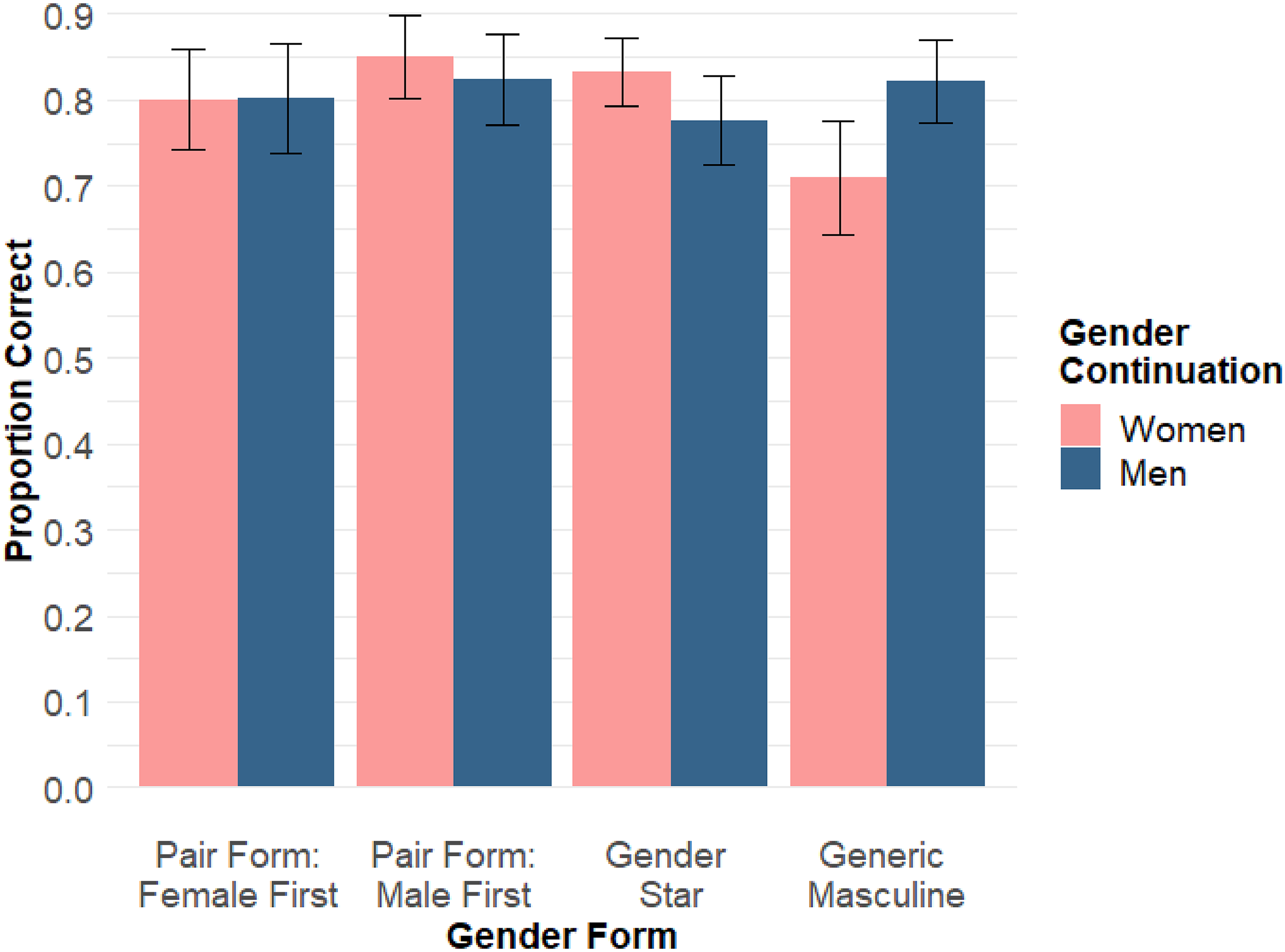
Mean correct responses in study 1.
Comparing the acceptance of female compared to male continuations yielded significant differences for two gender forms. Specifically, after the generic masculine form, participants more frequently considered sentences about men to make sense (M = 82.2%, SE = 2.4%) than sentences about women (M = 70.9%, SE = 3.3%), t(47) = 4.17, p < .001, dz = 0.60, 95% CI [0.29, 0.92]. This result replicates the finding that generic masculine forms lead to stronger representations of men than women, that is, a male bias. Following the gender star form, participants more frequently considered sentences about women to make sense (M = 83.3%, SE = 2.0%) than sentences about men (M = 77.7%, SE = 2.6%), t(43) = 2.29, p = .027, dz = 0.35, 95% CI [0.04, 0.66]. This finding indicates that, rather than being neutral, the gender star form leads to stronger representations of women compared to men. Comparing the size of the male bias after the generic masculine form with the size of the female bias after the gender star form yielded a non-significant difference, t(90) = 1.51, p = .133, dz = 0.31, 95% CI [-0.10, 0.73]).
The two pair forms elicited about equally strong representations of men and women. Specifically for male first pair forms, sentences about women received about the same acceptance (M = 85.0%, SE = 2.4%) as sentences about men (M = 82.5%, SE = 2.6%), t(45) = 1.44, p = .158, dz = 0.21, 95% CI [-0.08, 0.51]. Likewise, for female first pair forms, sentences about women yielded about the same acceptance (M = 80.2%, SE = 3.1%) as sentences about men (M = 80.1%, SE = 2.9%), t(38) = 0.07, p = .942, dz = 0.01, 95% CI [-0.33, 0.31]).
The same analysis was performed on response times for yes answers. We excluded incorrect responses (19.8% of trials) as well as response times that exceeded the limit of three standard deviations above each participant's mean response time (1.1% of trials) and then computed the mean response times separately for each condition. Response times were entered into a 4 (gender form: generic masculine vs. gender star vs. pair form male first vs. pair form female first) x 2 (gender continuation: male vs. female) mixed ANOVA. Neither the main effect of gender form, F(3, 173) = 0.37, p = .777,
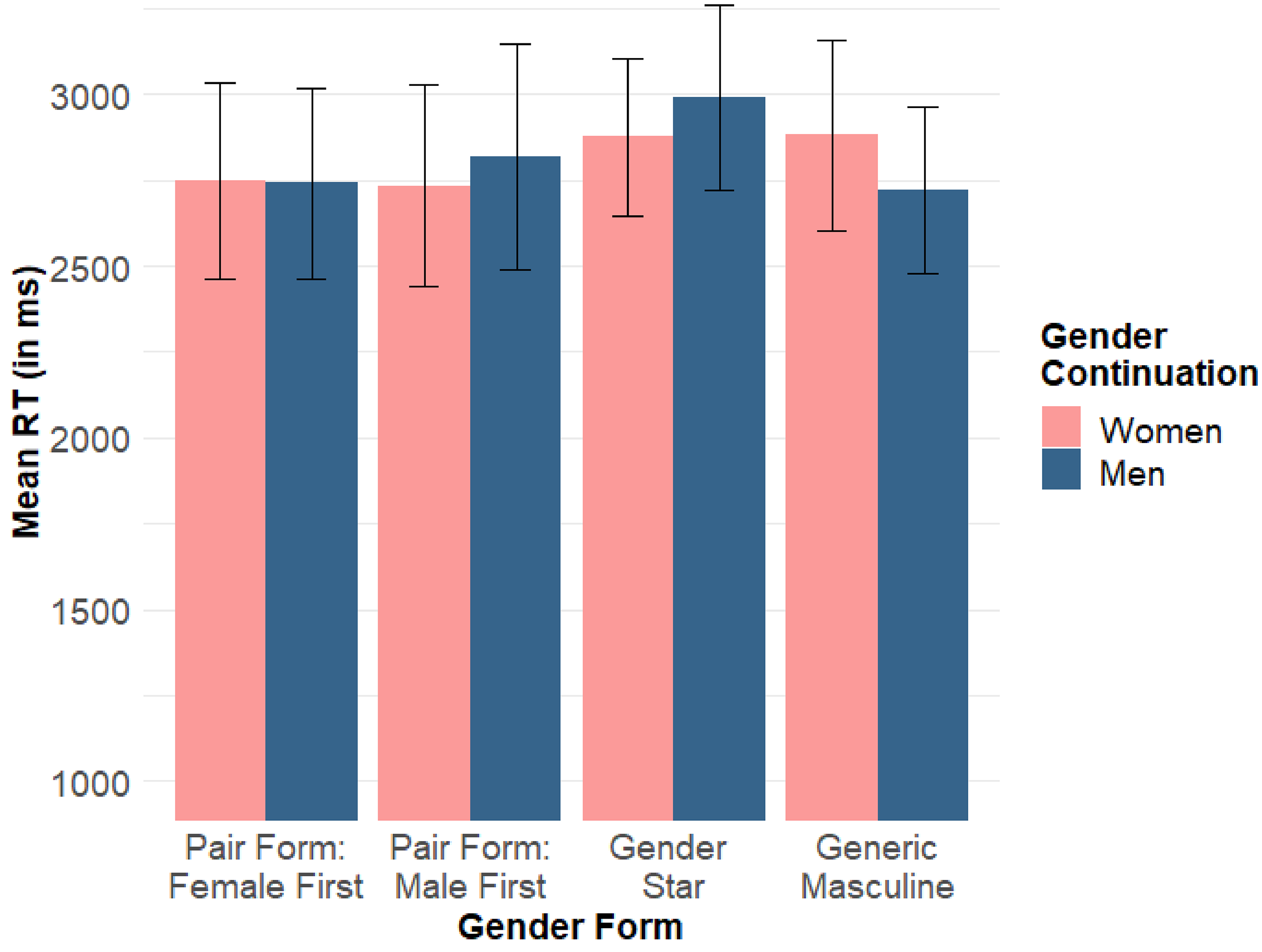
Mean response times in study 1.
For the generic masculine form, participants more rapidly considered sentences about men to make sense (M = 2724 ms, SE = 120 ms) than sentences about women (M = 2882 ms, SE = 138 ms), t(47) = 3.02, p = .004, dz = 0.44, 95% CI [0.14, 0.74], replicating the male bias. After the gender star form, the difference in response times was not significant, t(43) = 1.58, p = .122, dz = 0.24, 95% CI [-0.06, 0.54]; that is, participants were about as fast to indicate that sentences about women (M = 2875 ms, SE = 113 ms) and about men (M = 2991 ms, SE = 134 ms) make sense. Likewise, the two pair forms elicited about equally strong representations of men and women. Specifically, male first pair forms yielded similar response times for sentences about women (M = 2734 ms, SE = 146 ms) and men (M = 2820 ms, SE = 163 ms), t(45) = 1.47, p = .149, dz = 0.22, 95% CI [-0.08, 0.51]; and female first pair forms also yielded similar response times for sentences about women (M = 2742 ms, SE = 137 ms) and men (M = 2748 ms, SE = 141 ms), t(38) = 0.11, p = .916, dz = 0.02, 95% CI [-0.30, 0.34]).
(Logistic) linear mixed model analyses, including a full random effects structure, yield similar results as the ANOVAs reported here. Moreover, ancillary exploratory analyses indicate that none of the reported effects was moderated by participant gender or their attitude towards or familiarity with gender fair language. For details on these analyses, see https://osf.io/xeq9u/.
Thus, Study 1 replicated previous findings concerning generic masculine and pair forms. Pair forms, both when the female and the male form were mentioned first, lead to a balanced representation of men and women (see also Lindqvist et al., 2019; Rothmund and Scheele, 2004). Previously, some research observed that when both forms were mentioned, relative positioning of the female compared to the male form influenced answers (Gabriel et al., 2008; Kesebir, 2017; for general order effects, see Hegarty, et al., 2016, Oeberst & Matschke, 2017), while other research did not observe an influence of word order when examining pair forms (e.g., Bailey and LaFrance, 2017). In contrast, the generic masculine form lead to a bias toward male representations (e.g., Gygax et al., 2008). Specifically, for the generic masculine form, we observed more acceptance and faster responses to male compared to female continuations. For the gender star form, we found an inconsistent female bias, that is, more acceptance but not significantly faster responses to female compared to male sentences.
It is important to note that these biases occurred despite participants being explicitly informed that these gender forms were used generically, meant to represent all genders (see also Gygax et al., 2012; Rothmund and Scheele, 2004). Thus, the observed biases do not result from interpreting the generic masculine and gender star forms as referring to one gender. Instead, even when participants knew that a grammatical form referred to men and women equally, their responses were biased toward the gender emphasized by the grammatical form. This suggests that automatic associations contributed to the observed effects.
However, the variance in our data, especially for response times, was rather large. To increase power, we decided to simplify the design of Study 1 and run a second study that was pre-registered.
Study 2
Study 2 compared gender representations for the gender star form and the generic masculine form. We expected that, with increased power, not only the generic masculine but also the gender star form would yield significant biases in both answers and response times. Additionally, we hypothesized that the male bias of the generic masculine would be larger than the female bias of the gender star form. Study 2 was pre-registered https://osf.io/gmktz/.
Method
Participants. 384 participants who had not participated in Study 1 (208 female, 171 male, 5 other gender, aged 18 and older with a median age of ca. 27 years) were recruited in 2021 through Prolific Academic (in exchange for a reward of £1.40) and through the local participant pool (in exchange for partial course credit). This yields 90% power to find a one-tailed effect size difference of d = 0.3 for the between-participants comparison whether the generic masculine produces a larger bias than the gender star form; for the within-participants comparison of gender continuations, the sample sizes yield 90% power to find one-tailed effects of dz = 0.21.
Participants were randomly assigned to a gender form in a 2 × 2 factorial design, where gender form (generic masculine and gender star) was manipulated between participants, and gender continuation (male and female) was manipulated within participants.
Procedure. The materials (available at https://osf.io/xeq9u/) and procedure were identical to Study 1 with three exceptions. First, following a recommendation from participants in Study 1, we introduced a break halfway through the experiment. Second, as a methodological variation, half of the first sentences used the quantifier alle (German for all) instead of the definite article, die, when introducing the group. Third, changes were made in the questions about participants’ familiarity with and attitude towards gender fair language and a question about their highest educational degree was added to the demographic questions.
Results and Discussion
As in Study 1 and as specified in the pre-registration, the proportion of yes answers (affirming that the second sentence is a sensible continuation of the first sentence) in the target trials were entered into a 2 (gender form: generic masculine vs. gender star; between) x 2 (gender continuation: male vs. female; within) mixed ANOVA. The main effect of gender continuation was not significant, F(1, 382) = 0.89, p = .346,
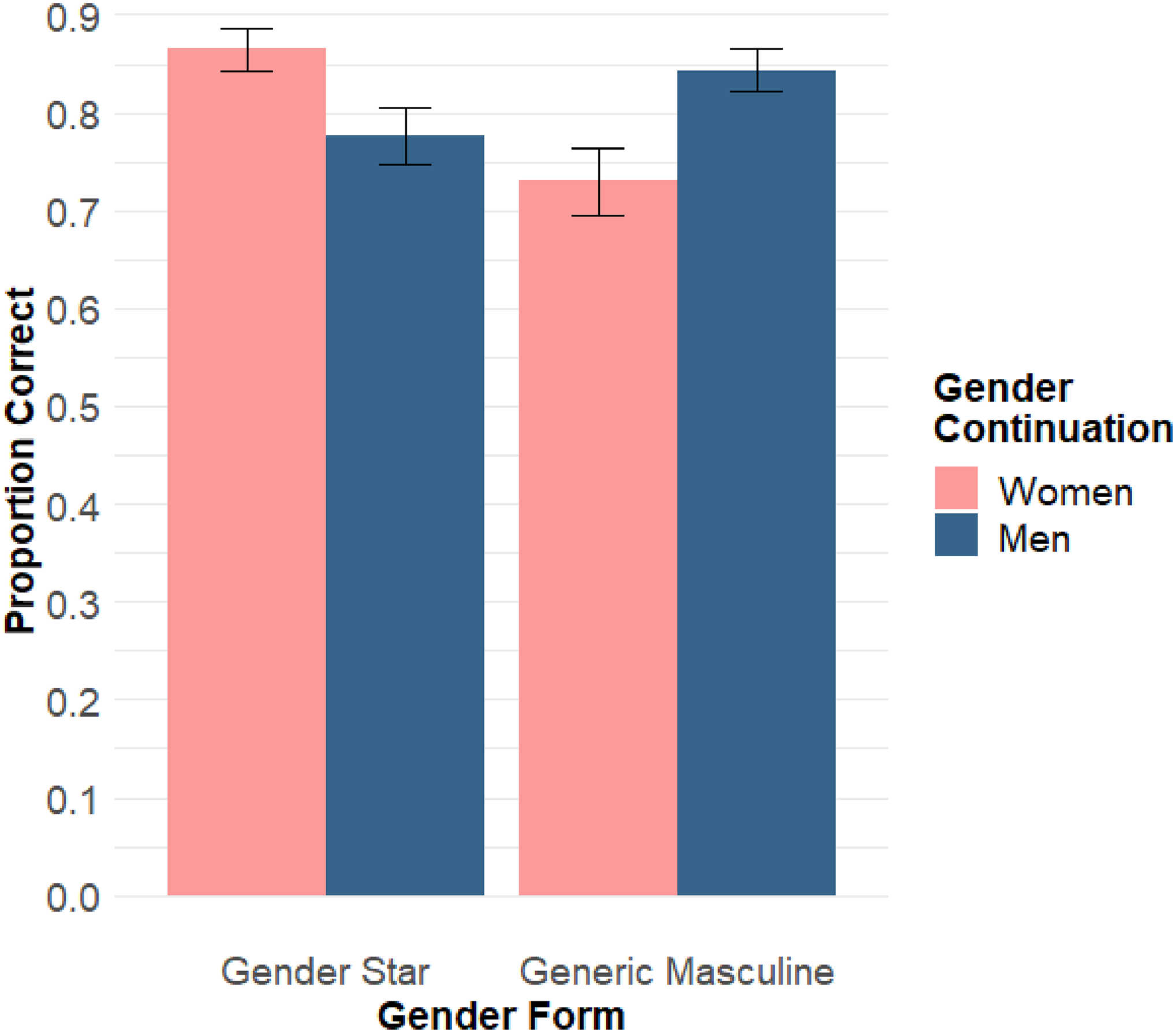
Mean correct responses in study 2.
After the generic masculine form, participants more frequently considered sentences about men to make sense (M = 84.4%, SE = 1.1%) than sentences about women (M = 73.0%, SE = 1.7%), t(185) = 7.46, p < .001, dz = 0.55, 95% CI [0.39, 0.70]. After the gender star form, participants more frequently considered sentences about women to make sense (M = 86.5%, SE = 1.1%) than sentences about men (M = 77.6%, SE = 1.5%), t(197) = 6.78, p < .001, dz = 0.48, 95% CI [0.34, 0.63]. Comparing the size of the male bias after the generic masculine form with the size of the female bias after the gender star form yielded a non-significant difference, t(369) = 1.25, p = .105, dz = 0.13, 90% CI [-0.04, 0.30]).
The same analysis was performed on latencies. As pre-registered, we again excluded incorrect answers (19.6% of trials) and response times more than 3 standard deviations above each participant's mean response time (1.1% of trials). Three participants had no correct trials left in one cell and could therefore not be included in the analyses. Mean response times were entered into a 2 (gender form: generic masculine vs. gender star) x 2 (gender continuation: male vs. female) mixed ANOVA. Neither the main effect of gender form, F(1, 378) = 2.67, p = .103,
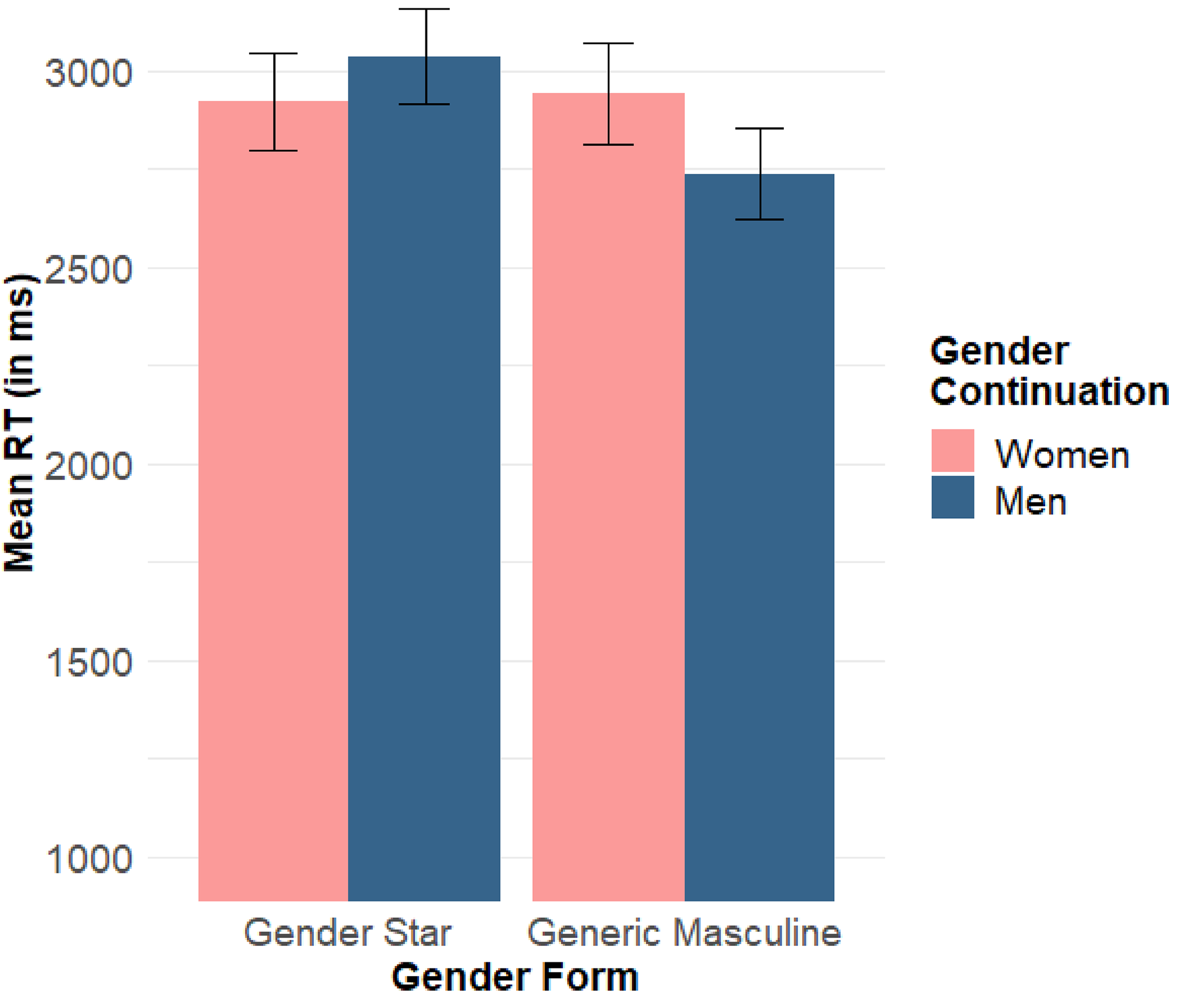
Mean response times in study 1.
Both simple comparisons yielded significant differences. After the generic masculine form, participants more rapidly considered sentences about men to make sense (M = 2738 ms, SE = 60 ms) than sentences about women (M = 2944 ms, SE = 66 ms), t(184) = 5.10, p < .001, dz = 0.38, 95% CI [0.23, 0.53]. After the gender star form, participants more rapidly considered sentences about women to make sense (M = 2923 ms, SE = 63 ms) than sentences about men (M = 3038 ms, SE = 62 ms), t(194) = 3.59, p < .001, dz = 0.26, 95% CI [0.11, 0.40]. Comparing the size of the male bias after the generic masculine form with the size of the female bias after the gender star form yielded a significant difference, t(354) = 1.78, p = .038, dz = 0.18, 90% CI [0.01, 0.35]), indicating that the male bias of the generic masculine form was larger than the female bias of the gender star form.
Exploratory (non-preregistered) analyses whether the present interactions are moderated by the quantifier (all instead of the) of the first sentence yielded no three-way interactions, that is, no moderation of the interaction of gender form and gender continuation; however, lower order effects were significant. Moreover, there were no significant three-way interactions with participants’ attitude towards gender fair language or their familiarity with the gender star form, nor with participant gender or any other demographic measure. (Logistic) linear mixed model analyses yield similar results as the ANOVAs reported here. The main difference is that for response times, the female bias for the gender star form was not significant. For details on these analyses, see https://osf.io/xeq9u/.
General Discussion
Suggested as an alternative to the generic masculine, the gender star form is by now the dominant gender inclusive language form in German (Krome, 2020). In spite of this prominence, however, it is unclear whether both men and women are equally represented when people read the gender star form. In the present research, we examined mental gender representations that were elicited by the gender star form compared to other frequently employed language forms.
In two experiments, we observed a male bias for the generic masculine form and a female bias for the gender star form. Thus, the present research was able to replicate the frequently observed finding that the generic masculine form leads to a male bias (e.g., Braun et al., 1998; Gygax et al., 2008) even though its generic intention was made explicit (see also Gygax et al., 2012; Rothmund and Scheele, 2004). Therefore, our findings suggest that the activation of gender specific information may occur automatically and operate against the generic intention. More specifically, masculine forms led to both faster responses and higher judgments of compatibility for information about men compared to women. Moreover, for the first time, we found a female bias for the gender star form. That is, after the gender star from, responses were faster and sentences were more frequently judged to be compatible when they referred to women compared to men. Only the two pair forms—regardless of which gender was mentioned first—yielded no significant bias, indicating equal representations of women and men.
The male bias for the generic masculine was both, more robust (obtained for both answers and response times in both experiments) than the female bias for the gender star (which did not obtain for reaction times in Study 1) 4 and also larger (in Study 2, for response times but not answers). One explanation for this difference between the female bias resulting from the gender star form compared to the male bias resulting from the generic masculine form could be differing effect sizes. That is, if the female bias is indeed smaller, we would expect the effect to occur less consistently, unless the experimental power is very high. This smaller effect size may be due to the possibility that the gender star served as a constant reminder of the generic intention, which was not the case for the generic masculine. Alternatively, the more balanced representations of the gender star form might be caused by both male and female forms being salient because of the star.
A limitation of the present research is that we concentrated only on mental representations of women compared to men. As the gender star form is also meant to represent non-binary gender identities, an examination whether this is indeed the case is indicated. Specifically, as yet it is unclear whether the gender star form activates mental representations of non-binary gender identities more strongly than other gender forms. A second limitation is that we examined only one of several new gender forms, the so-called gender star. Other forms are used in a similar way, replacing the asterisk by a colon (e.g., Athlet:innen) or by an underscore (e.g., Athlet_innen). We examined the gender star form as it is the most frequently employed form of the three (Krome, 2020). Future research should examine whether gender representations for these alternative forms are similar to the gender star form. Third, we presented all material visually. Written text is a convenient method of information presentation; however, in natural settings, much linguistic information is encountered auditorily. Thus, to fully examine implications of gender forms, more studies using aural presentation (e.g., Gabriel et al., 2017) should be conducted.
In the present research, we examined German language forms. However, the finding that the generic masculine elicits male biased representations has been replicated in several languages (see introduction). Accordingly, alternative forms have also been proposed in several languages. While neutralized forms (replacing gender-specific word parts by gender-neutral alternatives) have been especially popular in natural gender languages such as English (Bigler & Leaper, 2015), grammatical gender languages typically also use different feminized forms (i.e., forms that increase the salience of the female form). In Spanish, for instance, the slash form, consisting of the female and the male term separated by a ‘/’, is the dominant form (Banegas & López, 2021). In French, different forms subsumed as Écriture inclusive are widely used (though generally not endorsed by the government); in the most prominent contracted form, a median point is inserted after the word stem followed by the feminine -ne. For plural words, another median point is added followed by -s (e.g., citoyen・ne・s; masculine: citoyens, feminine: citoyennes; Burnett and Pozniak, 2021). Future research needs to examine whether this form leads to a gender balanced representation. Based on the present findings, however, and given that the Écriture inclusive is structurally similar to the gender star form, we would also expect rather a female bias.
Finally, research on the long-term consequences of encountering different gender forms is scarce (Sczesny et al., 2016). Gender balanced language forms are often promoted as a means to contribute to the reduction of gender inequality (for an in-depth discussion, see Gabriel et al., 2018). However, as there is little research examining long-term consequences of language forms, the results for gender inequality are as yet unclear. Some studies examined a somewhat longer time scale than the present research. For example, for 3–5 year old children, the usage of gender terms (instead of gender neutral alternatives) in the classroom over the course of two weeks has been found to increase gender stereotypical attitudes (Hilliard & Liben, 2010). Moreover, a field study observed that, a few years after (vs. before) Yale replaced a generic masculine by a gender neutral title for its heads of college, memory biases favoring male (vs. female) heads disappeared (Bailey et al., 2021). Note that these studies typically focus on gender neutralizing forms. Thus, especially for research on feminization forms, to contribute more to societal debates, future research should examine more far-reaching and long-term consequences.
Footnotes
Author Note
Data, analysis scripts, and materials can be found at https://osf.io/xeq9u. Experiment 2 was pre-registered, see  .
.
We would like to thank Pascal Gygax for providing stimuli.
We would like to thank the reviewers for their constructive and helpful feedback.
Declaration of Conflicting Interests
The author(s) declared no potential conflicts of interest with respect to the research, authorship, and/or publication of this article.
Funding
The author(s) received no financial support for the research, authorship and/or publication of this article.