




Abstract
Background
Good nutrition, regular physical activity, and adequate sleep are important for promoting health. However, it is not well characterized how these lifestyle behaviours are associated with mood at the start of school days.
Aim
To identify the weekday health-related behaviours (breakfast intake, physical activity, and sleep) of Singaporean adolescents and explore their associations with mood at the beginning of the school morning.
Methods
365 adolescents (52.3% boys, 47.7% girls) aged 14–19 years (M = 16.9, SD = 1.3 years) completed a survey set on breakfast habits, physical activity participation, sleep duration, and mood.
Results
More than one-third (38.6%) of participants never (15.0%) or irregularly (23.6%) consumed breakfast on weekdays. Adolescents consuming breakfast irregularly reported significantly higher negative mood scores than regular breakfast consumers (p = .002; d = .404). Almost two-thirds (64.1%) of adolescents did <60 min of moderate-to-vigorous physical activity (MVPA) on weekdays and reported lower positive morning mood scores than those who ≥60 min of MVPA (p = .014; d = .284). Although most (88.3%) adolescents slept <8 h each night, sleep duration was not related to either positive mood or negative mood.
Conclusion
The present study suggests that eating breakfast on a regular basis and completing for ≥60 min of weekday MVPA are useful behaviours to start school days in a better mood. Parents and health educators should recognise the importance of establishing these habits and support students by instigating practical approaches so they can achieve a regular breakfast intake and physical activity engagement.
Introduction
According to the World Health Organization (WHO, 1986), health is a) not the objective of living but “a resource for everyday life”, and b) “a positive concept emphasizing social and personal resources, as well as physical capacities.” The WHO considers that health promotion goes beyond healthy lifestyle to well-being. To promote health, it is important for children and adolescents to develop a healthy lifestyle and habits (Singapore Ministry of Education, n.d.). Three factors in pursuit of a healthy lifestyle are a regular breakfast intake – part of a healthy diet –, regular physical activity, and sufficient sleep. Whilst these three factors are important for a range of physical health outcomes, evidence suggests that their influence also extends into other areas of child development. For instance, regular breakfast intake in children and adolescents not only improves nutrient intake, decreases hunger and promotes healthy body weight (Klimesova et al., 2016), but has been shown to improve academic performance and cognitive functioning (Grantham-McGregor, 2005; Hoyland et al., 2009). Sleep quantity and quality are also associated with academic performance and cognitive functions (Astill et al., 2012). Sleep deprivation can lead to decrements in a vigilance task whilst sleep extension or improvement of sleep quality is associated with the improvement of working memory (de Bruin et al., 2017).
Whilst regular breakfast and physical activity, and adequate sleep may all be independently associated with child health outcomes, examining their influence collectively on child development and well-being is important as it is possible habits in these areas cluster together. O’Dea and Mugridge (2012) explored the concurrent relationships between literacy and numeracy scores of Australian children and adolescents and their health-related behaviours (sleep, breakfast, and physical activity). Although sleep was not significantly associated with either literacy or numeracy score, the nutritional quality of breakfast and volume of physical activity completed were independently associated with children's literacy and numeracy scores after adjusting for parental socioeconomic status. However, whilst sleep may not directly be associated with indicators of academic achievement, there may be indirect associations because of its influence on the other lifestyle habits. For example, Bhurosy and Thiagarajah (2020) recently reported that US high school students who slept more than 8 h were more likely to eat breakfast and consume more vegetables and milk, compared with those who slept less than 8 h. Al-Hazzaa et al. (2019) also reported that longer sleep time was positively associated with daily breakfast intake in Saudi School children.
Several mechanisms have been proposed to explain the association of breakfast and physical activity with academic and cognitive performance. Included among these are behavioural explanations that both breakfast and physical activity can alleviate negative as well as enhance positive mood states. For example, Jose et al. (2020) conducted a qualitative study and reported that breakfast intake contributes to positive learning behaviours such as improved concentration, better emotional regulation, and improved behavioural choices. Similarly, a systematic review by Adolphus and colleagues (2016) suggested that changes in feelings or subjective mood may influence cognition in children and adolescents by improving concentration and motivation on tasks. Hoyland et al. (2009) also reported in a systematic review that breakfast consumption is positively associated with feelings of well-being, potentially through reduction of hunger. They argued for the importance of measuring appetite and mood to understand the behavioural mechanisms of the effects of breakfast on the cognitive performance of children and adolescents.
Present study
Health-related behaviours such as nutrition, physical activity, and sleep are often promoted together as part of a holistic lifestyle (de Bruin et al., 2017; O’Dea & Mugridge, 2012; Singapore Health Promotion Board, 2021). These behaviours can influence an individual's potential and well-being. However, the behavioural patterns of Singaporean adolescents and their association with mood have not been well characterized. To understand the underlying mechanisms of these three health-related behaviours on student potential and well-being, it is critical to understand how these behaviours are associated with student's mood at the beginning of the school day. We are unaware of any studies that have addressed this important research question. Thus, the purpose of the present cross-sectional study was to identify the breakfast habits, physical activity, and sleep patterns of Singaporean adolescents and examine their association with reported mood at the beginning of the school morning. It was hypothesized that adolescents consuming breakfast regularly and engaging in sufficient physical activity would have better mood states on weekday mornings than those not/irregularly consuming breakfast or engaging in insufficient physical activity, respectively. We also hypothesized that sleep duration would be directly associated with both breakfast and physical activity habits as well as mood states.
Methods
Participants
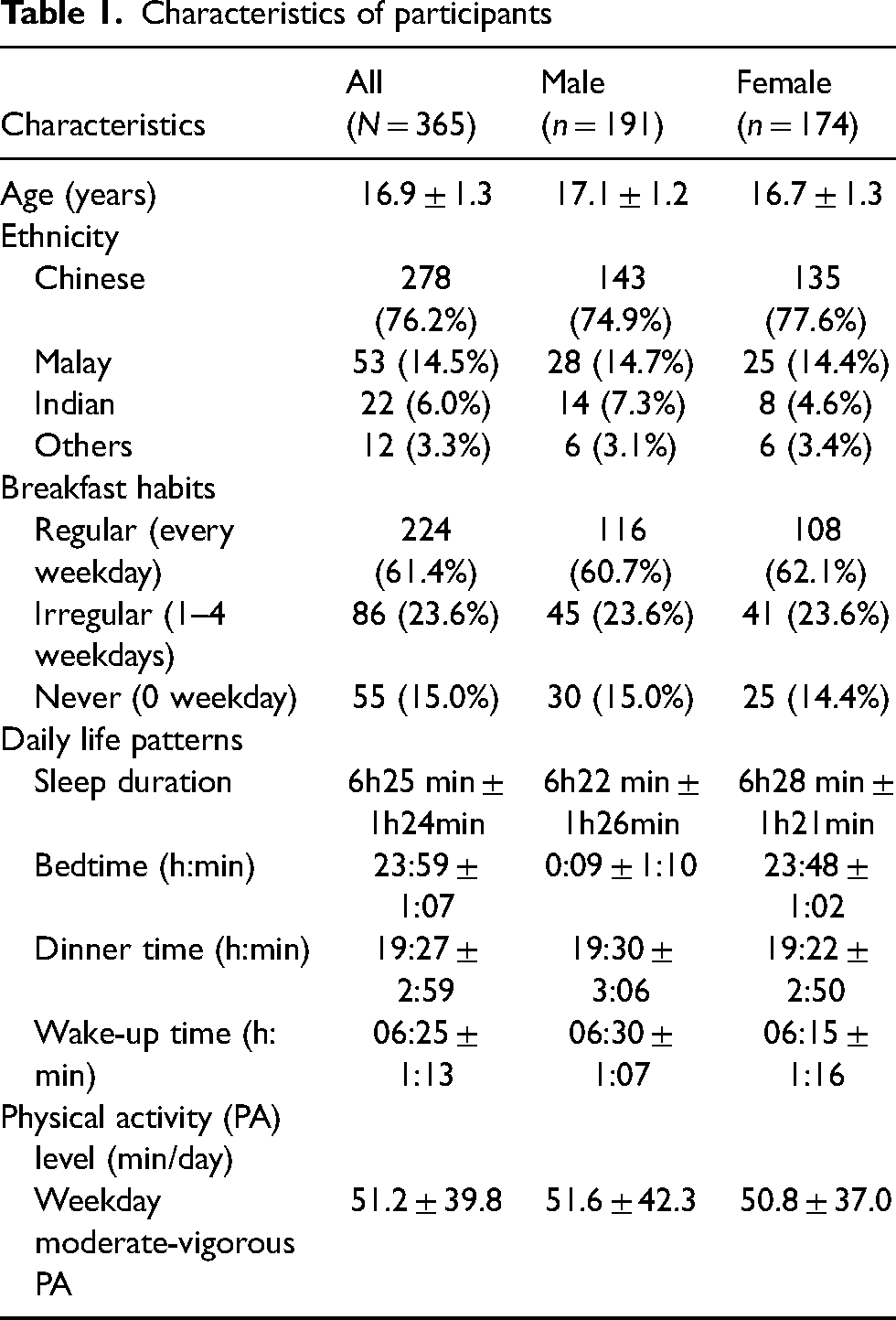
Participants were 365 adolescents (52.3% boys, 47.7% girls) aged 14–19 years (M = 16.9, SD = 1.3 years) from five secondary schools (i.e. high schools), and post-secondary schools (e.g. junior colleges, vocational schools) in Singapore. The ethnicity of participants was 76.2% Chinese, 14.5% Malay, 6.0% Indian and 3.3% of other ethnic or mixed-ethnic identification. These numbers are reflective of the general background population in Singapore (Singapore Government, 2021). Table 1
Characteristics of participants
Measures
Breakfast Habits and Daily Life Patterns
A questionnaire was adapted from the Breakfast Survey for Students (North Carolina Department of Health and Human Services, 2014) to investigate Singaporean adolescents’ breakfast habits on weekdays (e.g. frequency of eating breakfast on weekdays) and their daily life patterns (e.g. dinner time, bedtime, and wake-up time). Participants were requested to recall their breakfast habits and daily life patterns for the last 5 weekdays. This retrospective approach was employed to limit the stress and participant burden in completing the questionnaire, as opposed to a prospective daily gathering of information. For daily life patterns, participants were asked to identify their typical wake-up time and bedtime as well as their dinner time (i.e. last meal before going to bed). Frequency of breakfast intake was categorized into (1) consuming breakfast every weekday morning, (2) consuming breakfast on weekday mornings irregularly (1–4 weekdays), and (3) never consuming breakfast on a weekday morning.
Physical Activity Level
Participant's physical activity levels were measured with the Youth Physical Activity Questionnaire (YPAQ: Corder et al., 2009). It includes 47 different activities segmented into contextual domains: sporting, leisure, school and free-time. Participants were asked to report the frequency and duration of each activity for both weekdays and weekend days over the past 7 days. Corder et al. reported that the YPAQ was the most reliable questionnaire among popular self-report instruments to assess free-living physical activity and energy expenditure in young people. Moderate-to-vigorous physical activity (MVPA) level on weekdays were calculated based on the YPAQ data as stated in Corder et al. (2009).
Moods
The Positive and Negative Affect Schedule (PANAS: Watson et al., 1988) was used to measure participant's positive and negative affects. The PANAS consists of two 10-item sub-scales. Participants were instructed to answer the PANAS by indicating their feelings at the start of the first lesson over the last five weekdays and requested to respond to each item on a 5-point Likert scale, ranging from 1 (very slightly or not at all) to 5 (extremely). Total score ranged from 10 to 50 for each subscale. The PANAS is a widely used measure of self-reported affect. However, factorial validity for PANAS responses has not been established in Singaporean adolescents and was therefore examined as a preliminary analysis here.
Procedures
Research ethics approval was obtained from Nanyang Technological University Institutional Review Board (IRB-2014-01-030) and data collection in schools was approved by Singapore Ministry of Education (RP23-14(06)). Participants were recruited from five secondary schools and post-secondary schools after contacting school principals for permission to advertise the study to students and their parents. All study participation was voluntarily and all participants and their parents gave written informed assent and consent, respectively. Participants were asked to complete an anonymous survey set consisting of a demographic sheet and the measures listed earlier. The survey was conducted on a suitable scheduled weekday within each school. Participant's responses were checked for accuracy according to logical criteria (e.g. reported bedtime was later than the last reported mealtime in the evening; time of reported daily activities [min/day] was less than 1440 min [i.e. 24 h]). All participants’ responses were considered valid for data analysis.
Data analysis
For breakfast habits, a chi-square test of independence was conducted as a preliminary analysis to examine the relationship between categorized breakfast frequency and gender as well as among ethnic groups. A one-way ANOVA was conducted on sleep duration among the three breakfast frequency groups. A t-test was conducted on sleep duration between active and inactive groups. Pearson's correlation analysis was used to investigate whether participant's bedtime and sleep duration were associated with frequency of eating breakfast.
For moods, confirmatory factor analysis (CFA) was conducted as a preliminary analysis to examine factorial validity of the PANAS responses with Mplus (Version 8.5: Muthén and Muthén, 1998–2019) based on Mplus robust maximum likelihood estimation (MLR). In the 2-factor CFA model, each item was allowed to load on only one target factor (i.e. either Positive or Negative Affect) and all non-target cross-loadings were restricted to be zero. Overall fit of the CFA model was evaluated based on several criteria: the MLR chi-square statistic (Muthén and Muthén, 1998–2019), the comparative fit index (CFI: Bentler, 1990), the Tucker–Lewis index (TLI: Tucker and Lewis, 1973), the root mean square error of approximation (RMSEA: Steiger, 1990), and the standard root mean square residual (SRMR: Hu and Bentler, 1998). Conventional multiple cut-off values (i.e. CFI and TLI ≥ 0.90,RMSEA ≤ 0.08, SRMR ≤ 0.08) were considered minimum thresholds for accepting overall model fit (Marsh et al., 2004). Fit of individual items was evaluated based on standardized factor loadings and the correlation between the two factors. Internal consistency of responses to the PANAS subscales were examined using Cronbach’s (1951) coefficient alpha. Subsequently, Pearson's correlation analysis was conducted to investigate whether participant's sleep duration was associated with PANAS scores. Two multivariate analysis of variance (MANOVAs) were conducted on PANAS scores to examine if breakfast consumption frequency or MVPA level during weekdays was associated with positive and negative moods at the beginning of school day (i.e. when the first lesson starts). The independent variables in the first and second MANOVA were weekday breakfast consumption frequency and MVPA level, respectively. Post-hoc tests were conducted with Bonferroni adjusted p-values.
Results
Breakfast Habits
Whilst many adolescents surveyed (61.4%, n = 224) consumed breakfast each weekday morning, more than one-third (38.6%) of participants never (15.0%, n = 55) or irregularly (23.6%, n = 86) consumed breakfast on weekdays (Figure 1). A chi-square test of independence indicated that breakfast frequency was not associated with gender, χ2 (2, N = 365) = 0.14, p = .935, but significantly related to ethnic group, χ2 (6, N = 365) = 22.56, p <.001. Percentage of Malay (34%) adolescents who regular consumed breakfast was less than their Chinese (66%) and Indian (68%) counterparts. Of the participants who reported consuming breakfast, most (61.9%) ate breakfast at home, whereas some ate breakfast in their parent's car (11.6%) or at the school canteen (14.8%) before starting school. Of participants who reported never eating breakfast in the last five weekdays, a lack of time (37.8%) and not hungry (31.1%) were cited as the most common reasons. Although they skipped breakfast every weekday, 63.6% of breakfast skippers considered that eating breakfast is helpful for them and well recognized the benefits of eating breakfast (Gives me energy: 30.8%; helps me to be healthy: 15.4%; helps me pay attention: 14.4%). More than 90% of regular breakfast takers (91.4%) considered that eating breakfast was helpful for them and recognized the benefits of eating breakfast (Gives me energy: 32.6%; helps me to be healthy: 16.6%; helps me to be in a better mood: 15.0%). Thus, interestingly, both regular breakfast takers and skippers recognized that eating breakfast was beneficial to a similar extent.
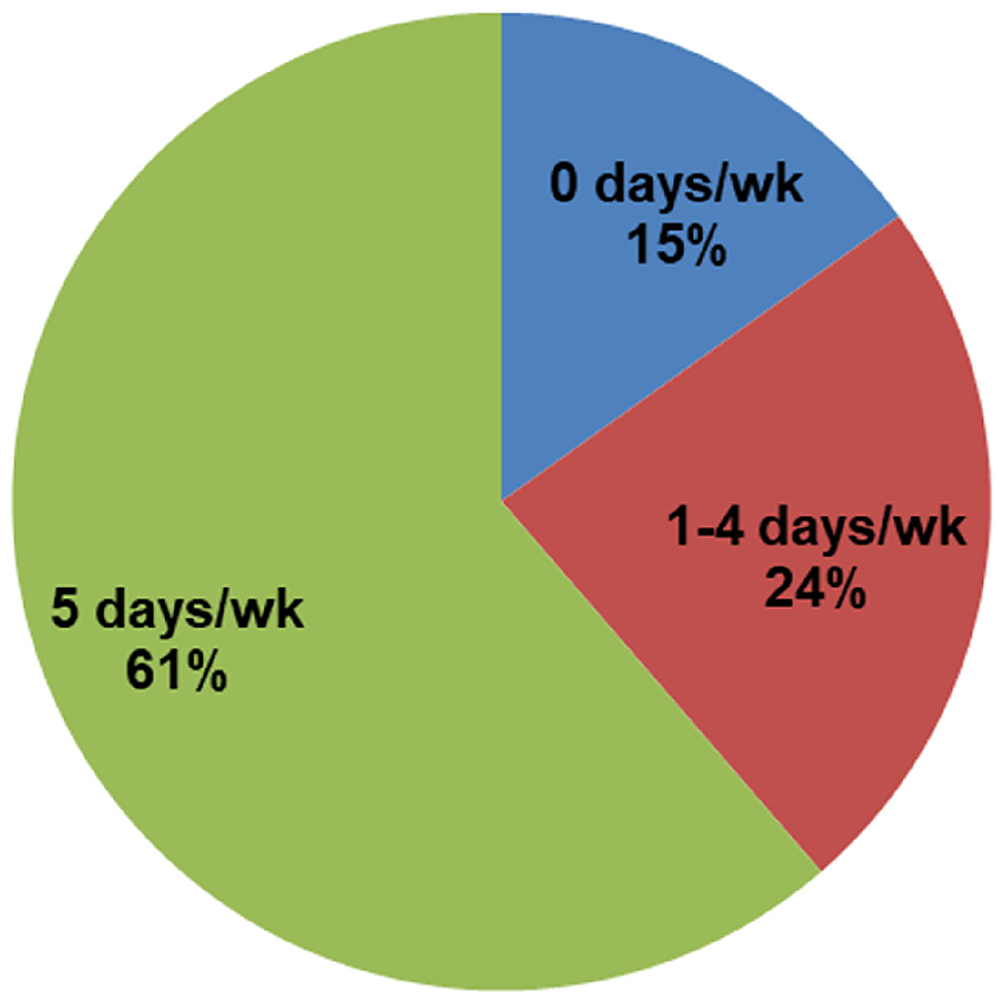
Percentage of 365 Singaporean adolescents, aged 14–19 years, attending junior college, high school and institutes of further education consuming breakfast 0 days, 1–4 days and 5 days per weekday during term time
Daily Life Patterns
Results of daily life patterns revealed that most Singaporean adolescents (88.3%) participating in this study slept less than 8 h (M = 6h25 min, SD = 1h24 min) each weekday (see Figure 2). Reported bedtime for the regular breakfast takers was earlier than irregular and non-breakfast takers. Modal bedtime was 23:00, 0:00, and 01:00 for regular, irregular, and non-breakfast takers, respectively. Most regular breakfast takers (77.4%) went to bed before midnight (0:00), whereas around half of irregular (51.2%) and non (46.3%) breakfast takers went to bed after midnight. Correlation analysis revealed that the frequency of consuming breakfast was negatively associated with participant's bedtime (r = -.22, p <.001), but not related to sleep duration (r = .03, p = .59). Indeed, differences in bedtime was related to differences in waking time. Most regular breakfast takers (85.0%) woke up by 06:30, whereas a lower proportion of irregular (62.4%) and non (67.3%) breakfast takers woke up by 06:30. These differences in sleep and waking time meant that sleep duration was quite similar across regular (M = 6h25 min, SD = 1h15 min), irregular (M = 6h29 min, SD = 1h43 min), and non-breakfast (M = 6h18 min, SD = 1h25 min) taking groups. A one-way ANOVA confirmed no significant difference in sleep duration among the three groups (F [2, 359] = 0.27, p = .766; ηp2 = .001). The mode of dinner time was 19:00, 20:00, 20:00 for regular, irregular and non-breakfast takers, respectively. However, most regular, irregular, and non-breakfast takers ate dinner by 20:30 (74.7%, 64.7%, and 71.2% for regular, irregular, and non-breakfast takers, respectively).
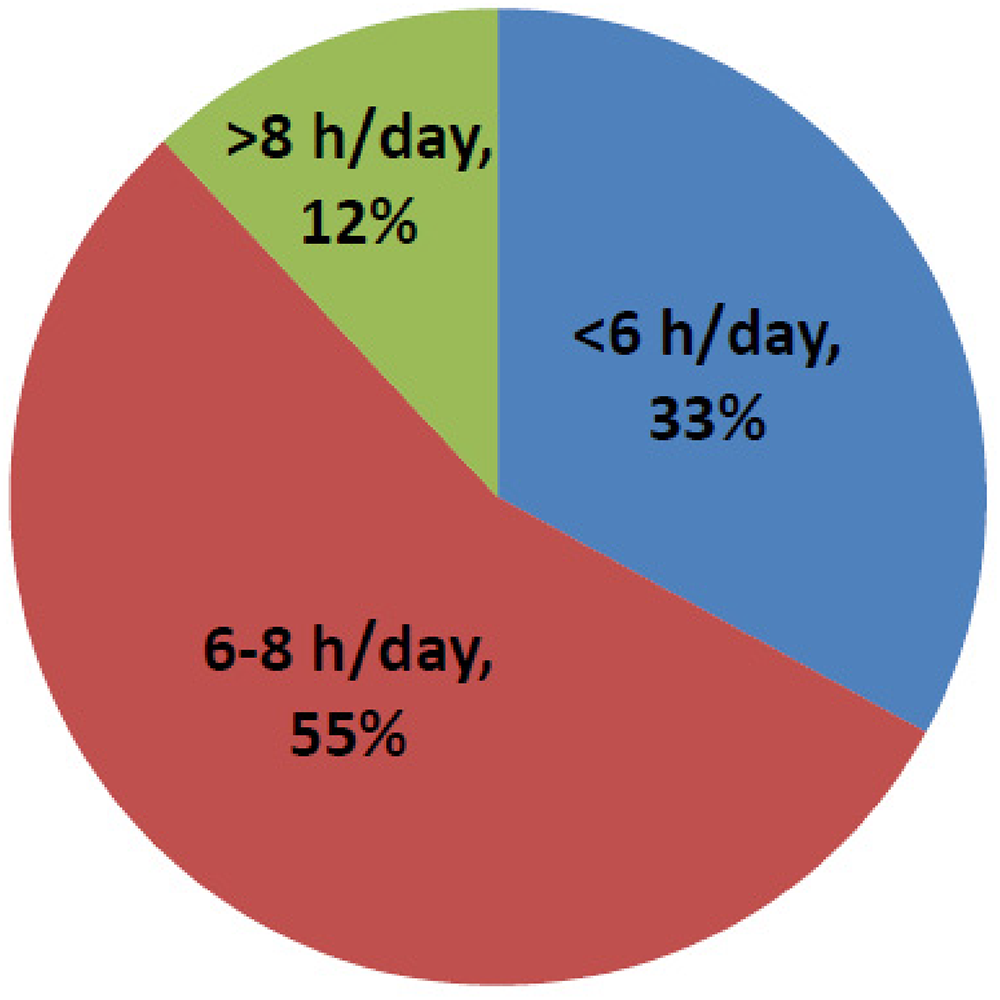
Percentage of 365 Singaporean adolescents, aged 14–19 years, attending junior college, high school and institutes of further education engaging in <6 h, ≤6–8 < hours and ≤8 h of sleep per weekday during term time
Moods
The 2-factor CFA model fit the data adequately (MLRχ2 [162, N = 365] = 357.63, p <.001; CFI = .920, TLI = .907, SRMR = .059, RMSEA = .060). All factor loadings were substantial and statistically significant for each scale (Positive Affect: Range = 0.50–0.83; Negative Affect: Range = 0.50–0.87). Correlation between the two factors was 0.03 and statistically non-significant. These CFA results indicated that the hypothesized two factor structure of PANAS responses was valid for Singaporean adolescents. Cronbach's alpha coefficients were.88 and.89 for Positive and Negative Affects respectively, and subscale scores were considered internally consistent.
Correlation analysis indicated that sleep duration was not related to either positive mood (r = .06, p = .26) or negative mood (r = .02, p = .76). A MANOVA was conducted on the PANAS scores to examine if there were differences in participants’ mood between regular, irregular, and non-breakfast taking groups. Breakfast consumption was not associated with positive mood score among the three groups (F [2, 337] = 0.49, p = .612; ηp2 = .003). Conversely, there was a significant difference in negative mood score among groups (F [2, 337] = 5.22, p = .006; ηp2 = .030). Post-hoc tests revealed that adolescents consuming breakfast on an irregular basis showed significantly higher negative mood scores (M = 21.3, SD = 7.9) than those who consumed breakfast regularly on 5 weekdays (M = 18.3, SD = 6.9) (p = .002; d = .404). However, there was no difference in negative mood score between non-breakfast takers (M = 19.6, SD = 7.2) and regular breakfast takers (M = 18.3, SD = 6.9) (p = .232; d = .184) or those who never consumed breakfast with irregular breakfast consumers (p = .191; d = .224).
Physical Activity Level
Percentage of time participants spent engaging in MVPA each weekday is summarized in Figure 3. 64.1% of participants reported an insufficient quantity of MVPA on weekdays (<60 min/day) with the mean amount reported as 51.2 min per weekday. 8.5% of participants reported no MVPA on weekdays and more than one third of adolescents <30 min activity per day. No difference in sleep duration was observed between active adolescents engaging in MVPA more than 60 min per day (M = 6h22 min, SD = 1h19 min) and those engaging in MVPA less than 60 min per day (M = 6h27 min, SD = 1h26 min), t(358) = 0.53, p = .599, d = 0.041.
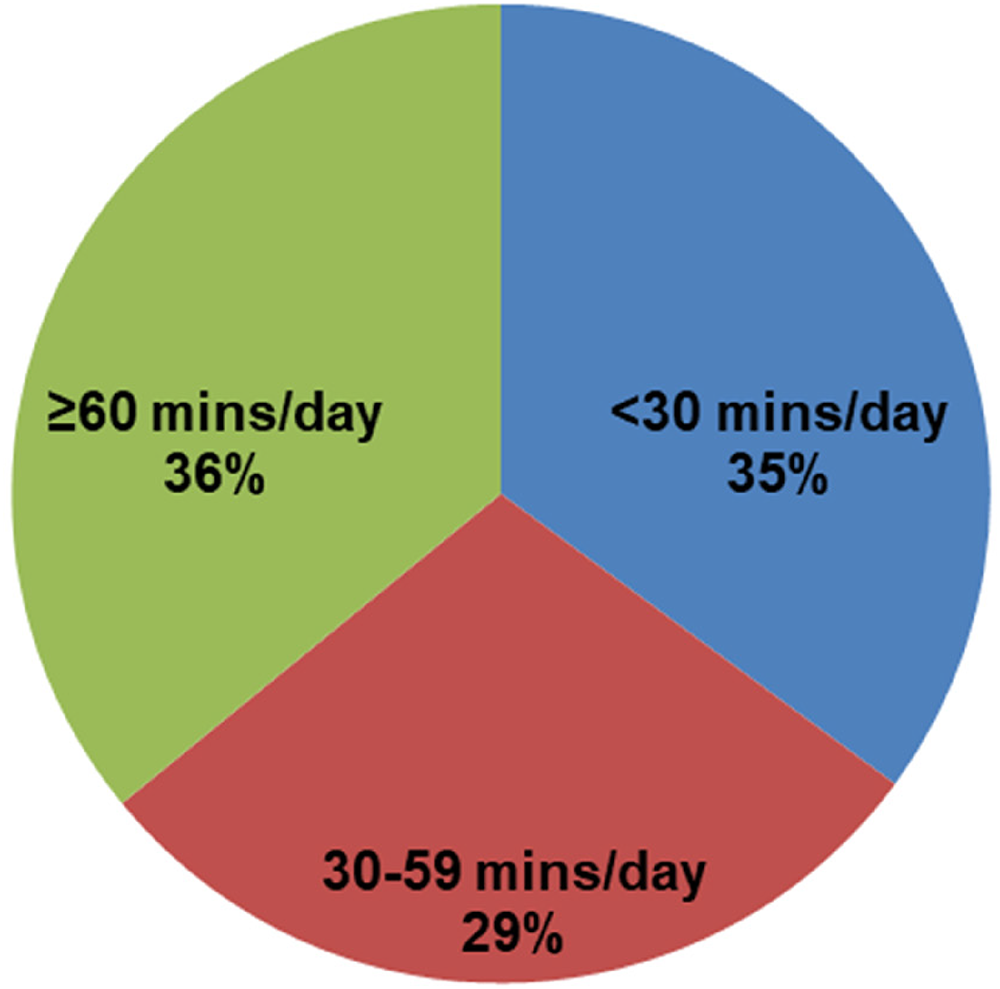
Percentage 365 Singaporean adolescents, aged 14–19 years, attending junior college, high school and institutes of further education, engaging in <30 min, 30–59 min and ≥60 min of moderate-to-vigorous physical activity per weekday during term time
A MANOVA was conducted on the PANAS scores to examine if there were differences in participants’ mood between groups. The MVPA level was not associated with the negative mood score between the two groups (F [1, 338] = 0.16, p = .898; ηp2 = .000). Conversely, there was a significant difference in positive mood score between groups (F [1, 338] = 6.07, p = .014; ηp2 = .018). The more active group's positive mood score (M = 29.4, SD = 6.8) was higher than those who were less active (M = 27.4, SD = 7.3) (p = .014; d = .284).
Discussion
The purpose of the current study was to identify breakfast habits, physical activity levels, and sleep patterns of Singaporean adolescents and examine their association with reported moods at the beginning of a school morning. Although many adolescents (61.4%) consumed breakfast each weekday morning, more than one-third (38.6%) never (15.0%) or irregularly (23.6%) consumed breakfast on weekdays. If these data are representative of the wider picture for Singaporean adolescents, it suggests many adolescents enter schools in an inadequate state of nutrition to benefit their potential and well-being. Regular breakfast intake in children and adolescents has been shown to not only improve nutrient intake, decrease hunger and promote healthy body weight but also to improve academic performance and cognitive functioning in many studies (Grantham-McGregor, 2005; Hoyland et al., 2009). Furthermore, through a randomized control trial, Kawabata et al. (2021) recently reported that morning breakfast and exercise combine to improve short-term mathmatical task performance and speed in adolescents. The school day in Singapore starts at 07:30, with many children waking up early to travel a long time/distance to reach school. These findings indicate many adolescents may skip breakfast before school. A reason for this could be a lack of opportunity to eat before leaving home or reaching school because they leave at an early hour. Alternatively, they may not feel like eating when having to wake early. Nevertheless, the first opportunity to eat thereafter often does not occur until mid-morning break time (around 10:00). This skipping of breakfast could, therefore, have implications beyond that of physical health impacting student's potential and well-being as discussed below.
Most Singaporean adolescents participating in this study slept less than 8 h each weekday which is considered an insufficient duration according to the US National Sleep Foundation's guidelines (Hirshkowitz et al., 2015). Bhurosy and Thiagarajah (2020) reported 42.1% of 14 year old students and 23.1% of 18 year old students slept 8 h or more on average school days based on US national school-based survey data (N = 13,583). The US National Sleep Foundation's expert panel recommended that adolescents (14–17 years old) and young adults (18–25 years old) sleep 8–10 and 7–9 h daily, respectively, and cautioned that individuals who sleep outside the appropriate range (7–9 h) over a prolonged period may compromise their health and well-being (Hirshkowitz et al., 2015). Certainly, if the current study data are representative of Singaporean adolescents, their sleep duration is a concern.
Comparisons of PANAS scores revealed that adolescents consuming breakfast irregularly reported significantly higher negative mood scores than those who consumed breakfast regularly. This finding suggests that adolescents who consume breakfast on an irregular basis may enter the classroom in an irritable state compared with their counterparts who consume breakfast each day. As reported earlier, most regular breakfast takers (77.4%) went to bed before midnight (0:00). However, more than half of irregular breakfast takers (51.2%) went to bed after midnight like the non-breakfast takers (46.3%). Adolescents going to bed late consumed breakfast less frequently. However, the frequency of breakfast consumption was not related to sleep duration and there was no significant difference in sleep duration between regular, irregular, and non-breakfast taking groups. Thus, sleep duration per se was not related to breakfast but potentially sleep patterns are. Irregular and non-breakfast takers might be too rushed to consume breakfast in the morning because they rise later and there is then a necessity to leave for school. Thus, although our hypothesis that sleep duration would be associated with breakfast intake was incorrect, sleep patterns themselves appear to be an important factor to consider in relation to breakfast ingestion in adolescents. Furthermore, as hypothesized, participants consuming breakfast on an irregular basis showed significantly higher negative mood sores, compared to those who consumed breakfast regularly. Hunger from skipping breakfast is one explanation for the significantly higher negative mood in adolescents who consumed breakfast irregularly. Potential knock-on effects could carry across into academic performance or cognition. Unexpectedly, adolescents who never consumed breakfast did not display increased negative mood scores compared with those who ate breakfast daily. Possible explanations are that they may have adapted to not consuming food early in the morning, that they consume their final evening meal later to stem early morning hunger or simply a behavioural explanation of not missing what they never have. However, we would suggest that consistent breakfast skippers are still encouraged to change their behaviour, considering that persistent breakfast skipping can adversely affect cognitive performance (Hoyland et al., 2009) and health in the long term (Kito et al., 2019).
Based on the WHO’s (2010) recommendation, many Singaporean adolescents surveyed here failed to engage in a sufficient volume of physical activity to optimally benefit their health. Attainment of ≥60 min of MVPA each weekday in adolescents was not associated with the negative mood score assessed using the PANAS in comparison with those who did not achieve the recommended volume of activity. However, adolescents who achieved ≥60 min of MVPA had higher positive mood scores on the PANAS compared with those who did not achieve the same volume of activity. Thus, more active adolescents were entering classrooms in a better mood with potential carry over effects to academic or cognitive performance. However, there was no association of MVPA levels with sleep duration. Collectively, these survey data indicated that a large proportion of Singaporean adolescents attending secondary (i.e. high schools) or post-secondary schools (e.g. junior colleges, vocational schools) do not or irregularly consume breakfast on weekday mornings and do insufficient amounts of physical activity. O’Dea and Mugridge (2012) reported that the nutritional quality of breakfast and physical activity are independently associated with Australian children's literacy and numeracy scores after adjusting for their parents’ socioeconomic status. However, they did not measure participant's mood. Following Hoyland et al.'s (2009) recommendation, participant's mood was measured in this study to understand how it associates with the three health-related behaviours measured at the beginning of the school day. Adolescents who consumed breakfast regularly had the lowest negative mood score whilst meeting recommended physical activity levels produced the highest positive mood score. Thus, adolescents who achieve both habits may potentially gain greater benefits from these mood changes. Though sleep duration did not appear to be associated with either habit, our data suggest that sleep pattern (earlier bedtimes) itself is related to breakfast consumption, although the direction of this relationship needs to be established.
In this study, the data were cross-sectional and collected recall for the last 5 weekdays to not overly burden participants completing the survey set. The cross-sectional nature of this recall along with the fact that the 5-day recall period differed among schools are the major methodological study limitations. However, we did not ask students to recall specific food items (food frequency questionnaire) which may be more difficult and although intra-individual variability precludes the use of a single recall as an accurate representation of individual dietary intake, it can provide a valid assessment of group-level intake among school-aged children (Mushtaq et al., 2011). Finally, older adolescents were employed in the present study and validity of meal recall is positively associated with age in children (McPherson et al., 2000). Moreover, our findings are an important piece of empirical evidence to understand the mediating role of mood on the associations between the health-related behaviours and student's academic and cognitive performance. Behavioural explanations for an effect of breakfast on mood may be involved as short-term breakfast consumption can heighten subjective feelings of alertness and motivation to concentrate and learn (Grantham-McGregor, 2005; Klimesova et al., 2016). A single bout of 15 min of aerobic exercise can contribute to significant increases in positive mood and significant decreases in negative mood in children aged 9-10 years (Williamson et al., 2001). Moreover, a meta-analysis of 158 studies examining the effect of short-term (acute) aerobic exercise on positive mood states found a moderate effect size for exercise of 0.47 (Reed and Ones, 2006). This supports a role of physical activity to elicit positive mood states in adolescents as found in the present survey data. Whilst these data are promising, it is strongly acknowledged that this survey was limited in size and scope and that these data are affected by sampling bias.
In conclusion, the present study aimed to identify the breakfast habits, physical activity levels, and sleep patterns of Singaporean adolescents. The findings highlight the importance of breakfast and physical activity as behaviours associated with mood at the beginning of a school morning.
Implications for practice
Interventions are needed to increase breakfast consumption and ensure that all adolescents undertake recommended amounts of physical activity and sleep. The present findings suggest that a more practical approach surrounding health-related behaviours such as breakfast intake, physical activity participation, and sleep time should be provided through reflection and enhancing self-awareness programmes of behaviours. To this end, it is useful for adolescents to record lifestyle patterns empirically and associate them with their subjective feeling such as moods and to develop workable methods on how they can easily have breakfast (e.g. quick and easy breakfast, prepared the night before). Adolescents might underestimate the adverse effects of skipping breakfast on their physical and mental health. However, it is critical for them to understand how to manage their time and choose appropriate behaviours for their potential and to achieve better well-being. Certainly, these results suggest that eating breakfast and being physically active are useful behaviours to enter classrooms in a better mood.
A primary challenge for parents and teachers is how to facilitate adolescent behaviour changes. It is recommended to develop health education materials and approaches for adolescents to enhance their knowledge and practical skills to change their lifestyle patterns. First, teaching consistent breakfast skippers the benefits of eating breakfast would not be enough to change their behaviour. It is critical for parents and health educators to identify reasons why adolescents do not have time to eat breakfast or why they do not feel hungry in the morning and to make individualized action plans to overcome these. These plans must be practical and develop consistent habits. Second, as breakfast may not be prepared by adolescents themselves, it is important for parents to be involved in any intervention programme. For instance, health educators can ask adolescents to share with their parents the identified issues to better tackle them together. Finally, parents and health educators can encourage students to undertake active transport (i.e. walking) to school and help lobby policymakers to create safe environments for this to occur.
Footnotes
Ethical approval
The survey was approved by the Nanyang Technological University Institutional Review Board [IRB-2014-01-030]. Data collection in schools was approved by Singapore Ministry of Education [Request: RP23-14(06), Approved 16th June, 2014]. Consent for publication was obtained from all participants and their parents.
Data availability statement

Authors’ contributions
Conceptualization, M.K. and S.F.B.; methodology, M.K., K.L., H.-C.C. and S.F.B.; formal analysis, M.K.; resources, M.K., S.F.B.; writing—original draft preparation, M.K. and S.F.B.; writing—review and editing, M.K., K.L., H.-C.C. and S.F.B.; project administration, M.K. and S.F.B.; funding acquisition, M.K. and S.F.B. All authors have read and agreed to the published version of the manuscript.
Declaration of conflicting interests
The author(s) declared no potential conflicts of interest with respect to the research, authorship, and/or publication of this article.
Funding
This research was funded by the Education Research Funding Programme, National Institute of Education (NIE), Nanyang Technological University (NTU), Singapore (Grant number:OER 1/13 SFB).The views expressed in this paper are the authors’ and do not necessarily represent the views of the funder.