




Abstract
Bangladeshi migrant farmers in Jalpaiguri, West Bengal, India, have been playing a pioneering role in small-scale tea cultivation in the region.The study 'based on focused group interviews, attempts to identify the influence of small-scale tea cultivation on the earnings of Bangladeshi migrant farmers and the importance of Bangladeshi migrant farmers in the study region. The study reveals that Bangladeshi migrants brought the idea of small-scale tea cultivation on agricultural land with their innovative and risk-taking behaviour. They produce and earn more than the indigenous small-scale tea cultivators in the same region.
Executive Summary
The poverty-driven economy of Jalpaiguri in West Bengal, India, has changed over the last few years due to the changes in the cultivation patterns. Small-scale tea cultivation (STC) has now been widely adopted in the region. Bangladeshi migrant farmers in this region have played a pioneering role in STC. STC has brought dramatic changes in the lifestyle of the indigenous and migrant people by revamping the economy of the entire Jalpaiguri region of Bengal. The present study highlights three focal issues. Firstly, the importance of STC in the Jalpaiguri region of West Bengal. Secondly, the extent of the influence of STC on the earnings of the Bangladeshi migrant farmers in the Jalpaiguri region of West Bengal. And, finally, the importance of the Bangladeshi migrants. The study is based on primary data and focus group interviews conducted among 31 Bangladeshi migrant small-scale tea cultivators and 31 non-migrant small-scale tea cultivators. Wilcoxon signed ranks test and independent sample t-test has been applied in the study. The study has shown that Bangladeshi migrant small-scale tea cultivators played a positive role in economic development by initiating STC. The study shows that Bangladeshi migrants have established unique agricultural practices in the Jalpaiguri region of West Bengal. They adopted tea cultivation at a small-scale in agricultural lands with their innovative and risk-taking behaviour. They produce and earn more than the indigenous small-scale tea cultivators in the same region. However, as of now, these small-scale tea cultivators are facing many challenges. Many of them are unable to access central and state government assistance since they do not possess ‘no objection certificate’ (NOC) issued by the state government. The poor price realization and fluctuation in green tea leaves has made small-scale tea cultivators vulnerable.
Migration has been around for centuries. In the past, many people have travelled great distances in search of food and safe residential places. Migration occurs for several reasons; social, economic, political, climatic, and natural within the geographical periphery of states and beyond (Panda, 2010). When people move collectively from one place to another, maybe a country or a territory, for better livelihood, it is known as migration and such people are known as migrants (Roy, 2022b). On the other hand, those people who leave their nation owing to communal riots, civil wars, ethnic conflicts, and so on, are known as refugees or political refugees (Hazarika, 2000). While many people of a particular community or nation move or dislocate collectively, it is termed migration. It may take two forms: voluntary or involuntary. In voluntary migration, the migrants choose movement; in involuntary migration, they do not have a choice. Involuntary migration is also called forced migration (Nandy, 2019). Generally, international migration occurs from the poorer countries to the richer countries. In the South-Asian continent, massive migration occurred during 1947–1948; about 15 million Muslim–Hindu India–Pakistan refugees were involved. Further, nearly 10 million refugees from East Pakistan (now Bangladesh) moved to India in 1971 (Naujoks, 2009). Undoubtedly, these have left impressions on us. It is imperative to note that this process is still ongoing. However, scholars have recognized certain links associated with historical, geographical, ethnic–cultural and physical proximity as the cause for the flow of people from Bangladesh (Behera, 2011; Godbole, 2006).
However, till now, there has been no survey of immigrants. As per the estimates by academic and research organizations, about 15–20 million migrants have crossed the border from Bangladesh to India in the last six decades (Carnegie India, 2016). The India–Bangladesh migration corridor is the ‘fourth-largest’. Such huge-scale immigration has entirely altered the demographic shape of the border states, especially West Bengal (Das & Ansary, 2017). In West Bengal, almost every district has Bangladeshi migrants. The maximum concentration is in the districts of North 24 Parganas, Jalpaiguri, Murshidabad, Uttar, Dakshin Dinajpur, Nadia, Malda and Cooch Behar (Ghosh, 2015). However, migration has caused a growth in the population of India creating huge pressure on natural resources and the state’s economy (Goswami, 2009). The impacts of migration are both positive and negative (Weiner, 1995).
Migration has affected the land use pattern of the Jalpaiguri region (Saikia, 2002). Traditionally, a limited variety of crops was cultivated in some portions of the land in this region. In contrast, the rest of the land is used for grazing cattle. However, migration has brought a positive change in the socio-economy of the region. Multiple cropping practices have been started by the migrants. They introduced the cultivation of a new variety of pulses, vegetables, fruits, and so forth, which were not grown previously in the region (Guha, 2006).
The Jalpaiguri region is also known for tea cultivation. Over the last few decades, the Indian tea industry has been going through a major crisis. The root cause of this crisis is the implementation of liberalization, privatization and globalization policy in 1991 (Mitra, 2010). Due to the removal of the tariff barrier on export, the situation worsened. The export of tea has reduced, and the import of low-quality tea has increased (Roy, 2020). The domestic consumption over the years has also increased, resulting in a decline in exports (Roy, 2022a). Cheaper and low-quality tea imports from Sri Lanka and Bangladesh used for blending and re-export purposes have affected the market share (Bhowmik, 2002). On the other hand, few countries importing Indian tea have stopped importing tea from India due to quality issues (Roy & Biswas, 2018). Ultimately, the export share of Indian tea in the global market has declined significantly (Roy, 2020). Tea estates of this region have been facing challenges, and labour is being economized to cut down costs. Due to cost reduction, tea-producing companies in this region have not been able to fulfil their responsibilities to the workers on health, safety, welfare, working conditions, regular payment of wages, bonuses, and so forth, as per the Plantation Labor Act (PLA), 1951 (Patil, 1998). All these have led to labour unrest in the forms of strikes, gheraos, lockouts, and others, and the industrial relations have become vulnerable (Mitra, 2010). Their families also suffer (Sarkar & Reji, 2019). The workers are losing faith in the plantation management (Roy, 2017). Thus, tea planters in this region have started small-scale tea cultivation (STC) to avoid social costs and reap more profits (Roy & Biswas, 2021). Bangladeshi migrants of the region too have started STC. There may be two reasons why they have resorted to STC in the Jalpaiguri district. One, is the demonstrated effect of organized tea estates adjacent to the Jalpaiguri district. The experience of low profitability in crop cultivation is another reason to switch to STC (Roy & Biswas, 2016).
The present study will highlight the following three focal issues:
To study the importance of STC (synonymously tea cultivation in small form, small tea, etc.) in the Jalpaiguri region of West Bengal.
To unveil the extent of influence of STC on the earnings of the Bangladeshi migrant farmers in the Jalpaiguri region of West Bengal.
To study the importance of the Bangladeshi migrants that are part of the study.
The remaining sections of this article proceed as follows. The next section delineates the background of STC and the tea industry in India. The section that follows provides brief notes about the field survey including details like the sample, sampling techniques, identification of the sample, data and empirical strategies. The discussions and the empirical results are discussed. The last section presents the conclusions of the study.
BACKGROUND
The Jalpaiguri district of West Bengal is located at the foothills of the Himalaya Mountains. Geographically, the district lies between latitude 27°00’N to 26°16’N and longitude 89°53’E to 88°25’E.
Jalpaiguri located in the northern region of West Bengal is one of the backward districts in the state. This district possesses a distinct feature. The economy of this district primarily depends upon tea, timber and tourism (Roy, 2022a). It has two international borders, that is, Bhutan and Bangladesh. Ethnically, most of the residents of Jalpaiguri are dissimilar from core stream Bengali people. In this district, the majority of the residents belong to scheduled castes (37.65%) and scheduled tribes (18.89%) category (Census of India, 2011).
Tea is the cheapest and most widely consumed beverage worldwide after water. India is one of the leading producers as well as consumers of tea in the world. Indian tea industry employs around 5 million people (Tea Board of India, 2017). The tea industry in India is one of the primitive agro-based organized industries. It is also a significant industry that contributes a big part to the national income (Roy & Biswas, 2018).
Set tea estates (big tea gardens) and small-scale tea growers (STGs) are part of the Indian tea industry. Set tea estates are characterized as organized and small tea growers are unorganized. Set tea estates are tea gardens with plantation areas above 10.12 hectares. They have manufacturing factories within or outside the plantation areas (Roy & Biswas, 2016). STGs, on the other hand, possess tea plantations under 10.12 hectares. They supply their tea leaves to different manufacturing factories for processing since they do not own manufacturing factories. As of now, the share of STGs in the total tea production of India is around 48.83% (ITA, 2019).
STC has been regarded as a major source of employment and income generation for the rural inhabitants in the northern part of West Bengal. In this region, STC was initiated by the pineapple cultivators of the Islampur subdivision of the North Dinajpur district during the 1990s (Hannan, 2006). However, the South Indian states of Kerala, Tamil Nadu and Karnataka were the early adopters of STC in India. The Nilgiris region of Tamil Nadu was the first locale in India where STC was taken up around the 1930s (Goswami, 2006). In West Bengal, STC was adopted in the northern rural backward regions of Jalpaiguri, Aliporeduar, Cooch Behar, Darjeeling and North Dinajpur. The economy of these regions was primarily based on primitive agricultural activities. However, tea was cultivated in utilized and unutilized land. The farmers of this region faced problems regarding the pricing of their product. Hence, they were willing to shift their agricultural practices. STC was easy to adopt. Thus, they started the cultivation of tea on an experimental basis in small areas besides their regular agricultural practice. They came to realize that tea cultivation is more profitable than other crops. Thus, they converted the remaining agricultural land into tea plantation. The high profitability of STC caught the attention of the farmers since it allowed utilization of unutilized fallow land, grazing land, wasteland and high land. The kitchen gardens too have been converted into small tea gardens in this locale. .
The origin of STC is a new concept in Bengal (Hannan, 2006) dating back to the 1980s (Chakraborty, 2005). Tea cultivation in small form is family-owned and confined to 1.51 hectares of land. Usually, the cultivated land is scattered in different places. The tea leaves are sold to the bought leave factories (BLFs) and cooperative factories (Ponniy, 1979). During the 1950s, it was observed that small tea cultivators contributed 1.34% to the production of tea in India (Madhava, 1956). STC was started first in the Southern part of India. However, outdated cultivation techniques led to low yields. The BLFs were also ill-equipped, that is, lack of modern machinery and requirements for producing good quality tea (Boruah, 1968). These problems prevailed with the STGs because their capacities were extremely small, and they had limited access to resources (Halayya, 1969). Tea Board of India (1979) studied the various problems of STG. The major findings of the study were that tea plantations in the northern region of India had a meagre yield (177 kilograms per hectare), and tea gardens mostly comprised of old tea bushes. The upgraded technology was unfavourable for STG. They also lacked skilled labour (Sharma & Moorti, 1990). However, tea cultivation in small form provides ample self-employment opportunities to the educated youth (Neog, 1993) and was more profitable than any other crop cultivation (Bhuyan, 2004). The sector is now well established, and for the sustenance of this sector, huge capital investment is required. STC is an outcome of the entrepreneurial skills of the rural unemployed youths (Goswami, 2006). An STG creates ample opportunities for rural youth and new economic avenues that significantly change the economy(Biswas & Roy, 2013). The average earnings of the farmers of this region have improved after initiating STC.
In this region, STC was initiated during the early 1990s. It is imperative to note that farmers in this region resorted to STC due to the absence of a market and the low price of their products (Hannan, 2013). Initially, tea cultivation on agricultural land started in the outskirts of Jalpaiguri by businessmen from the Siliguri and Jalpaiguri cities. They procured land from the Rajbongsi (indigenous farmers of Jalpaiguri) farmers on special contracts. The deed involved a nominal amount for the land along with a guaranteed job as a labourer. Once sufficient land was available, the Rajbongsi farmers lacked initiative and did not experiment or try innovative farming. Few portions of land were sold to the Bangladeshi migrants. However, from 1998 to 2000 onwards, few migrant farmers initiated tea cultivation.
The migrant farmers adopted the idea of STC from the big organized tea gardens (Hannan, 2006). Bangladeshi migrant farmers are the pioneers of STC in the Jalpaiguri region. Surprisingly, within a few years, STC gained popularity among other indigenous farmers of the region. However, the number of small-scale tea cultivators in Jalpaiguri is yet to be confirmed. As per the estimation of the president of Confederation of Indian Small Tea Growers Association (CISTA), there are around 35,000 small tea cultivators in Jalpaiguri (Personal Communication, 6 August 6, 2021). In comparison, there are only 89 organized tea estates in the district (Labour Department, Government of West Bengal, 2013). One-time investment, huge demand market, availability of cheap labour, profitability, and so forth, motivate migrant farmers to start STC.
METHODOLOGY
As per the statistics of the CISTA, there are 27 self-help groups (SHGs) of the STGs recognized by the Tea Board of India in the study region. Each SHG has about 150–200 members, including indigenous Rajbongshi and Bangladeshi migrant farmers. There are 276 Bangladeshi migrant small-scale tea cultivators (as on 31 December 2017) in the Jalpaiguri region. These 276 Bangladeshi migrant small-scale tea cultivators are the target population for the study.
The Raosoft sample size calculator has been used to determine the appropriate sample size.
Where, population size (N) = 276; margin of error (e) = 10%; confidence level = 95%; and response distribution = 90%.
Therefore, the required sample is 31.
A stratified random sampling technique has been adopted in the study. Strata have been chosen based on the size of the tea plantations (refer Table 1). Since each category of tea plantations is heterogeneous and the number of STGs within a specific category is homogeneous, the logic of stratified random sampling has been satisfied.
Sample Tea Plantations for the Study.

Identification of the Sample (Bangladeshi Migrant Small-scale Tea Cultivators)
A list of all Bangladeshi migrant tea cultivators of the study region was prepared. Then based on homogeneity, that is, the size of cultivated land, the tea cultivators were separated. Random number table was generated to draw the appropriate sample.
For the purpose of the study, 31 non-migrant small-scale tea cultivators were selected randomly. The exact number of non-migrant small-scale tea cultivators were considered for a comparative measurement of earnings.
In the study, from each STC, one respondent was interviewed. The respondents are the owners of the tea plantations. The study was carried out from June 2019 to March 2020.
The primary data were acquired from 31 Bangladeshi migrant small-scale tea cultivators through a semi-structured feedback form. In the study, the overall average earnings of the tea cultivators has been considered. Similarly, primary data were collected from 31 non-migrant small-scale tea cultivators of the neighbourhood.
Calculations of the average income of the Bangladeshi migrant tea cultivators have been made based on the available records (notes in the diary, etc.). It was found that the average net earnings per acre of mature tea plantations is around ₹60,000 to ₹65,000. To understand the impact of STC on the earnings of Bangladeshi migrant farmers, a comparison has been made with the average earnings before and after STC.
The study also attempts a comparative analysis of the earnings of Bangladeshi migrant small-scale tea cultivators with the earnings of non-migrant small-scale tea cultivators in the study region.
ANALYSIS AND DISCUSSIONS
Importance of STC in the Study Region
STC provides employment in rural areas. A huge quantum of labour is required for nurturing tea plants, plucking, pruning, and so forth. Besides these, the people are also involved and act as facilitators, that is, they collect green leaves from the cultivators and supply them to the BLFs. Generally, these middlemen are educated unemployed youths from the same region. STC offers several business including supply of garden implements, manure and pesticides, green leaf transportation, and so forth. In all these cases, the primary employer is the STG. STC encourages BLFs. Every BLF requires on average, 35–45 skilled and unskilled employees depending upon the production capacity. The required workforce is procured locally. There was a significant expansion of STC in Jalpaiguri between 2001 and 2017 due to the utilization of barren and fallow land by small cultivators.
Brief Profile of the Bangladeshi Migrant Small-scale Tea Cultivators
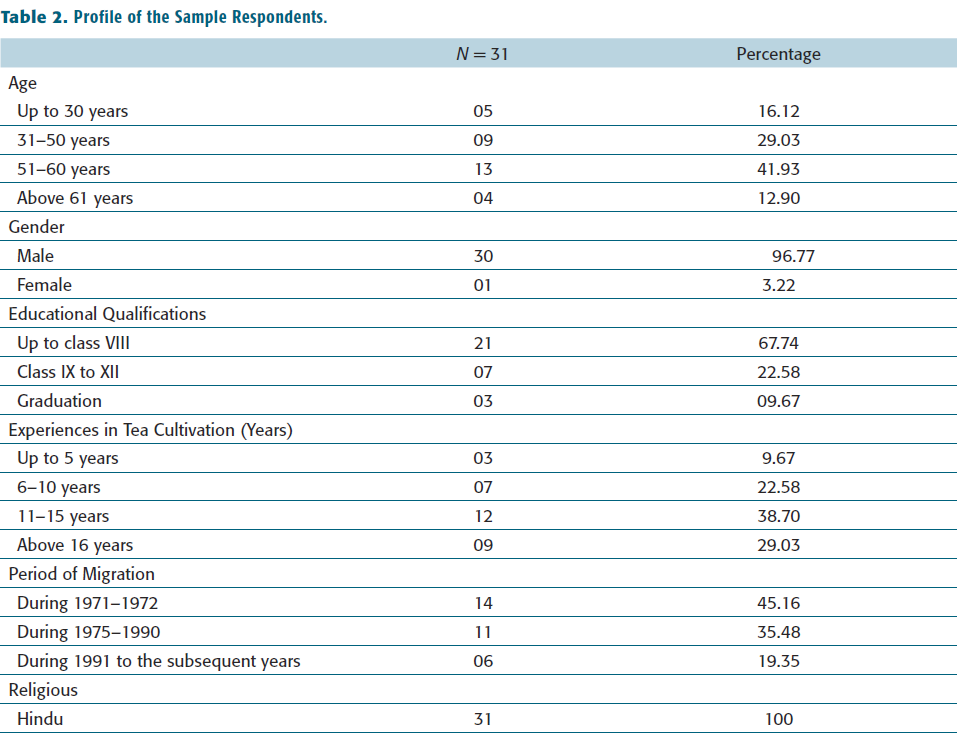
A vast majority of the respondents were male cultivators (97%). The majority (68%) had studied up to the VIII standard, with hardly 10% reaching graduation. Most of the respondents (29%) possess more than 16 years of experience in STC. It was observed that all the respondents had migrated either during 1971–1972 or after, hence are Bangladeshi immigrants. 1 However, most of them (45.16%) had migrated to India in 1971–1972. Surprisingly, all the respondents were Hindus. The detailed profile of the respondents is listed in Table 2.
Profile of the Sample Respondents.
Reasons for Migration
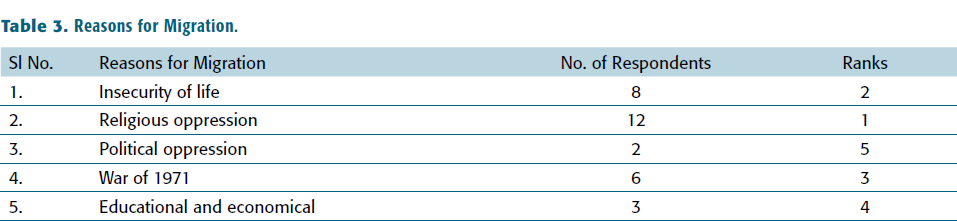
Through open-ended questions, the reasons behind migration to India and specifically, Jalpaiguri were ascertained. The responses were varied, with 39% stating that they migrated due to religious oppression, followed by insecurity/threat to life (26%). The details are listed in Table 3.
Reasons for Migration.
In Bangladesh, most of the religious oppression was recorded in 1971–1972 (during independence from Pakistan) and also in1992 due to the demolition of the Babri Masjid in India. These ultimately led to insecurity/threat to life. Few respondents migrated for better education and jobs in India and never returned to their native place. Instead, they brought their remaining family members to India. These migrants share no ties with Bangladesh, anymore. None of the respondents had directly migrated to Jalpaiguri from Bangladesh. Initially, they migrated to cities in West Bengal and Assam. Subsequently, through help from the social network of migrants, they settled in Jalpaiguri. An example is illustrated in Box 1.
Mr Nikhil Chandra Roy, a 64-year-old respondent from Kumar Para, Maynaguri in Jalpaiguri migrated to India with his family when he was 14. His family faced political threats in 1971 since his father, the late Jatindra Nath Roy, was a Bengali nationalist and an intelligentsia. The entire family fled to India and lived in a refugee camp in Murshidabad, West Bengal. However, they returned to Bangladesh in early 1972. But when they returned to their town—the house and farmlands were gone. In the meantime, economic crises started in Bangladesh, and his father lost his job. A few months later, his father sent the few family members to a relatives’ house in India. Mr. Nikhil Chandra Roy and a few others initially migrated to Kolkata and stayed there for a few months. The family then shifted to another relative’s house in Jalpaiguri. Subsequently, they settled in Jalpaiguri. Eventually, the remaining family members also migrated to Jalpaiguri from Bangladesh.
Reason for Settling in the Jalpaiguri Region
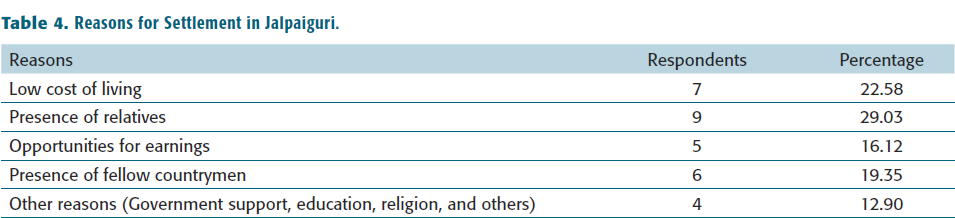
Table 4 shows that the majority of the migrants (29%) settled in Jalpaiguri due their relatives. Another 19% of the respondents chose Jalpaiguri due to the presence of their social network of known people and fellow Bangladeshi migrants. Low cost of living, availability of land at cheap rates, the prospect of earning by selling vegetables and other products at the haat (rural market) and to the labourers in the colonies of big tea gardens were the prime reasons to settle in Jalpaiguri.
Reasons for Settlement in Jalpaiguri.
Influences of STC on the Earnings of Bangladeshi Migrant Farmer.
To investigate the influence of STC on the earnings of Bangladeshi migrant farmers, a comparison has been made of their present earnings from STC with their past earnings from traditional agricultural activities. For this purpose, average earnings per acre of land before and after STC have been considered. The data were checked for normalcy. The normality test suggested that the paired sample t-test may not be appropriate and, hence, the Wilcoxon signed ranks test was applied.
Wilcoxon Signed Ranks Test
Table 5 depicts the earnings of the migrant farmers before and after STC. The table provides that the mean values of the same set of data are different in respect of time. The mean value for the same sample set varies at 57.000 and 31.4242 before STC and after STC, respectively. Standard deviation is also found to be different. Thus STC has a positive impact on the earnings of STGs, that is, the average earnings have improved after STC.
Descriptive Statistics of Earnings (in Thousands, in Rupees).

However, the Z value (sig.) of the Wilcoxon signed ranks test is 0.000, which is less than 0.05 (5% level of significance). The result explains that the disparity between negative and positive ranks of earning is statistically momentous from each other.
Thus, there is significant dissimilarity between the earnings of theBangladeshi migrant farmers after and before STC.
Importance of Migration in the Study
The people who had migrated from Bangladesh were hard workers. They had experience in cultivating crops, like sugarcane and jute, which required specific skills. They cultivated conventional crops grown by local farmers. Subsequently, the migrants started cultivating crops like pulses, sugarcane, wheat, jute, and others, since they had some experience in cultivating these varieties. However, these practices were not profitable. They switched to the commercial cultivation of potatoes, that is, they cultivated their land along with land leased from the local farmers. Due to the uncertainty of the market, erratic weather and huge capital requirement, the cultivation of potatoes was discontinued. Finally, they found that tea cultivation on their agricultural land was most feasible, despite the high initial investment.
Every facet of tea cultivation, especially during the initial stages requires heavy capital. The initial cost components in tea cultivation are the preparation of land, cost of the sapling, cost of labour, cost of pesticides, cost of nurturing, and others. Also, for three consecutive years, tea sapling need tending and nurturing. During this period there is no revenue generated from it. However, the Bangladeshi migrants created a unique agricultural practice, that is, mixed farming (Roy & Biswas, 2016) wherein for the three initial years they cultivated radish, ladies finger, chilli, bay-leaf and other varieties on the same land as the tea saplings. This practice offered dual benefits of an alternate revenue source while caring for the tea saplings. The bay-leaf trees provide shade, an essential for tea plantation. These innovative farming practices were initiated only by the migrant farmers.
It has been observed that Bangladeshi migrant farmers associated with STC possess risk-taking attitudes and innovative traits. For instance, the migrant farmers initiated the cultivation of sugarcane, sesame, and others, in this region. Also, on facing financial loss due to crop cultivation, they initiated new patterns of cultivation like STC. These migrant small-scale tea cultivators have a higher per acre productivity than the local farmers. It is evident that the risk-taking attitude and innovative behaviour of the Bangladeshi migrants have brought vibrant reform in agricultural practices. We have attempted to investigate the earnings of the migrant and non-migrant farmers in the Jalpaiguri region. The average earnings per acre of tea plantation of the last three years has been considered. For this purpose, 31 migrant and 31 non-migrant small tea cultivators were identified and sampled. Data were gathered from the records maintained by the cultivators. Based on the nature of the collected data, an independent sample t-test was applied after fulfilling the stipulated assumptions. Table 6 reveals a difference between the mean earnings of migrant and non-migrant small tea cultivators.
Group Statistics.

The results show that Bangladeshi migrant small-scale tea cultivators are earning more that of the local cultivators in Jalpaiguri.
Improvement in the Livelihood of Migrants Through STC
The livelihood of the Bangladeshi migrants has improved to a large extent through STC in the Jalpaiguri region of India. The respondents were asked to list improvements due to STC. Three major areas identified are (a) living standards, (b) children’s education and (c) overall socio-economic advancement. As observed from Table 7, the majority (12 out of 31) reported an overall socio-economic advancement due to increased earnings from STC.
Impact of Earnings from STC on the Migrant Households.

CONCLUSION
Bangladeshi migrant farmers who were once under survival crises, as of now, are doing well in the Jalpaiguri region. The Bangladeshi migrants have brought a positive change in the overall socio-economic scenario. From the present study, it is evident that the earnings of the migrant cultivators have improved through STC. It was also observed that Bangladeshi migrant cultivators associated with STC possess a risk-taking attitude and innovative traits. They produce and earn more than the indigenous small-scale tea cultivators in the same region.
The high profitability has also enabled the migrants to explore other entrepreneurial opportunities like tea leaf collection agents, render transportation support, become suppliers of garden equipment, pesticides, chemicals, manures, and others. STC has brought dramatic changes in the lifestyle of the indigenous and migrant people by revamping the economy of the entire Jalpaiguri region of Bengal. At present, the income of the people of this region is directly or indirectly dependent on STC.
However, in the recent years, small-scale tea cultivators of the Jalpaiguri region are facing acute challenges. Many small-scale tea cultivators of this region are unable to access central and state government assistance since they do not possess a NOC issued by the state government. This official recognition is required for bank loan applications and also for availing state and central government schemes. The poor price realization and fluctuation in green tea leaves has made the small-scale tea cultivators vulnerable. The price-fixing mechanism needs to be adequately implemented and controlled. A minimum support price should be provided as per the rising cost of production. Due to an absence of branding, buyers are unaware of the existence and taste of the product from small-scale tea cultivators. Hence, branding is required along with initiatives to promote the brand. There is a need for product diversification to open-up the market. During peak season, tea leaf producers struggle to sell their green leaves. There is a need to establish more BLFs. Due to insufficient tea factories and the huge distance between tea cultivators and factories, green tea leaves get wasted. There is a need to provide logistic support and training on green tea leave management. Small-scale tea cultivators in these regions are not covered under any crop insurance scheme. These suggestions, if implemented by the state and central government, will provide the necessary boost to the small-scale tea cultivators.
Footnotes
DECLARATION OF CONFLICTING INTERESTS
The authors declared no potential conflicts of interest with respect to the research, authorship, and/or publication of this article.
FUNDING
The authors received no financial support for the research, authorship, and/or publication of this article.

NOTE
e-mail:
e-mail:
e-mail: