




Abstract
India, the most populated country, faces the challenges of providing jobs to eligible candidates. Therefore, the promotion of entrepreneurship and the development of an ecosystem of start-ups are highly required. For any country, start-ups and new business ventures are important pillars of economic development. Therefore, college students must be encouraged and trained to become job-givers rather than job-seekers by venturing into a new business. Keeping the present scenario of India as a pivotal point, the study aims to examine the entrepreneurial intention (EI) of college students towards venturing into new businesses. The current study utilizes Ajzen’s (1991) theory of planned behaviour (TPB model), which is a widely used theoretical framework in entrepreneurship research. The study mainly investigates the role of entrepreneurial self-efficacy and risk-taking propensity in developing EIs among college students. A quantitative research design was used to achieve the stated objective of the study. An extensive literature review has been conducted to formulate the questionnaire. All variables were measured using the five-point Likert scale. Moreover, age, gender and exposure to family business were taken as control variables. Three hundred seventy-four responses were collected and analysed using structural equation modelling with Amos 22.0. The results demonstrated that all three variables concerning the TPB model, i.e., attitude, subjective norms and perceived feasibility, positively influence EIs. In addition, entrepreneurial self-efficacy affects EIs both directly and indirectly through perceived feasibility, while the effect of risk-taking propensity is fully mediated by attitude. The study produced meaningful theoretical and practical implications. Theoretically, the study contributes to entrepreneurial literature by signifying the role of self-efficacy and risk-taking propensity in forming EIs. The study also provides insights that may benefit policymakers and governments in formulating appropriate plans to boost EIs among students.
Keywords
As per the survey of the Entrepreneurship Development Institute of India (EDII), out of the 11% population of India, which is engaged in entrepreneurial activities, only 5% are successful in establishing their business (PTI, 2018). In comparison to the world average, this rate is the lowest. In addition, the business cessation rate in India is one of the highest among other countries, i.e., 26.4% (PTI, 2018). An entrepreneur is an individual who utilizes scarce resources with innovative and creative ideas for value generation in society (Gartner, 1988; McKenzie et al., 2007). They bear the risk of uncertain futuristic outcomes linked with the new venture’s success. The role of business venturing cannot be ignored for the growth of any economy. It is an important economic activity for value addition, job creation, income generation and social upliftment (Guerrero et al., 2008). However, institutional, legal, political and social support are required to incubate and germinate the seeds of new start-ups. A lot of entrepreneurial potential among individuals may go into vain due to the lack of an adequate support system.
Being one of the youngest economies, India seeks job providers more than job seekers. Thus, for India, where business ventures are one of the thrust areas, research on EI becomes quite essential. Additionally, the creation and development of new businesses in any economy affect employment generation and technological development, leading to economic growth (Birch, 1979; Parker, 2004; Shukla, 2020; Storey, 1994; Wennekers & Thurik, 1999). Educational institutions, policy-making bodies and the government have realized the role of entrepreneurs in economic and social development. Entrepreneurial growth is one of the major objectives of the country’s developmental plans (Østergaard, 2019; Østergaard & Marinova, 2018; Shukla, 2020).
Similarly, the role of each entrepreneurial programme and education is to develop a positive attitude among the participants (Jonathan, 2008). Recent government efforts also emphasize the development of positive attitudes among individuals through promotional schemes and programmes to realize the untapped entrepreneurial potential. All these educational, vocational and promotional programmes and their success largely depend on the effective implementation of these plans. Thus, identifying the innate factors affecting the entrepreneurial process becomes relevant in the present context.
As per Global Entrepreneurship Monitor (2019), ‘Innovation among entrepreneurs is most prevalent in India, i.e., 47 percent…’, and India is one of the top five economies in the National Entrepreneurial Context Index. The report further elaborated that people opt for entrepreneurship in India not to improve their lives but for the non-availability of better career options (GEM, 2019). Despite having entrepreneurial potential, people in India generally opt for business ventures when they do not have suitable work options, indicating less risk-taking propensity to venture into new business. Thus, identifying and nurturing EI becomes crucial for the government, policymakers and supporters.
Scholars across the globe (Douglas et al., 2021; Turker & Selcuk, 2009; Younis et al., 2021) are using different models and approaches to identify the contextual, cognitive and social factors in the development of intention to venture into new business. Researchers have proposed several models and theories to explain EIs and behaviour, such as ‘entrepreneurial event model’ (Shapero & Sokol, 1982); Davidsson model (Davidsson, 1991); ‘theory of planned behaviour’ (Ajzen, 1991); ‘entrepreneurial attitude orientation’ (Robinson et al., 1991); ‘intentional basic model’ (Krueger & Carsrud, 1993); ‘self-determination theory’ (Deci & Ryan, 1985; Ryan & Deci, 2017). Many entrepreneurial scholars (Anjum et al., 2021; Doanh, 2021; Shahzad et al., 2021; Tajpour & Hosseini, 2021) are still working on the validation of models and interaction of different intervening variables.
The TPB is widely applied due to its applicability and predictive ability in a myriad of areas (Al-Jubari, 2019; Shukla et al., 2021). The TPB model is a popular theoretical model that predicts and explains EI in different contextual settings. Many studies (Fayolle & Liñán, 2014; Fayolle et al., 2014; Shukla & Kumar, 2021) have acknowledged the superiority of the TPB model because it considers social, personal and environmental factors surrounding individuals for intention-based behaviour. The extant literature demonstrates that an individual’s self-confidence is one of the major determinants of EI. Additionally, a positive attitude towards entrepreneurship will translate into business venturing intentions if the individual has a high propensity to bear risk. Therefore, the role of an individual’s self-confidence (self-efficacy) and risk-taking propensity in stimulating favourable EI must be investigated. This study suggested that the difference in risk-taking behaviour and self-efficacy could be considered factors while drafting and implementing entrepreneurial educational and promotional programmes. Such knowledge would enhance the understanding of why entrepreneurs differ from non-entrepreneurs and how they process external stimuli while making important venturing decisions.
THEORETICAL BACKGROUND AND HYPOTHESES DEVELOPMENT
Entrepreneurship is a widely researched area in the field of management (Baumol, 1996; Bandura 1986; Bird 1988; Esfandiar et al., 2019; Kautonen et al., 2015; Krueger et al., 2000; Katz & Gartner 1988; Low & MacMillan, 1988; Moriano et al., 2012; Østergaard & Marinova, 2018; Schlaegel & Koenig, 2014; Seligman, 1990). Even with the randomness of entrepreneurial research, it can be divided into two different domains (Østergaard, 2019; Østergaard & Marinova, 2018). Some scholars (Anjum et al., 2021; Doanh, 2021; Shahzad et al., 2021; Tajpour & Hosseini, 2021) conceptualized entrepreneurship as an academic field. In contrast, others consider it a theoretical discipline that borrows concepts and applications from finance, marketing, behavioural and managerial fields (Østergaard & Marinova, 2018). Most of these studies (Douglas et al., 2021; Hameed et al., 2021; Miralles et al., 2017; Pidduck et al., 2021; Rai et al., 2017; Turker & Selcuk, 2009; Younis et al., 2021) recognized entrepreneurship as a planned activity. Therefore, it can be predicted and explained using cognitive and environmental determinants that shape EI (Fini et al., 2012).
In the case of emerging economies such as India, the intention to new business venturing holds significant value in current economic settings. However, there is a wealth of research (Pandit et al., 2018; Roy et al., 2017; Saraf, 2015; Trivedi, 2016, 2017) on EI, especially in developing economies. With government support, an increasing number of graduates prefer to start their businesses rather than seek wage-based employment in large corporate entities (Trivedi, 2016, 2017). The focus of governments and policymakers has also shifted from creating job seekers to job providers. Many scholars (Pandit et al., 2018; Roy et al., 2017; Trivedi, 2016, 2017) have studied the need for a dynamic and sound entrepreneurial culture in India. These studies were focused mainly on the process and determinants of entrepreneurship development. However, personal characteristics such as risk-taking propensity and self-efficacy have been relatively less explored, particularly in the Indian context. The risk-taking propensity holds much significance in emerging economies due to the scarcity of opportunities and resources.
Venturing into business is an intention-based activity; an individual makes career choices based on intention (Al-Qadasi et al., 2021). Several intention-based and process-oriented models (Hameed et al., 2021; Miralles et al., 2017; Pidduck et al., 2021; Rai et al., 2017) have been developed to predict the EI for different demographic settings. The TPB model is a popular behavioural model successfully used to explain EI (Ajzen, 1991; Kautonen et al., 2015; Schlaegel & Koenig, 2014; Shukla & Kumar, 2021). This model describes how one would decide to venture into a new business after analysing the situation in the surroundings (Esfandiar et al., 2017; Low & MacMillan, 1988). The TPB model postulates that intentions can successfully predict behaviour (Ajzen, 1991, 2011; Kautonen et al., 2015; Schlaegel & Koenig, 2014). Even if any behaviour is atypical and difficult to observe, the intention-based models offer a great opportunity to predict action (Ajzen, 1991; Krueger & Carsrud, 1993). The intention is critical in understanding the impact of different antecedents, moderators and final consequences of a particular behaviour. The intention towards a behaviour is influenced and shaped by various personal and social factors. These factors offer numerous opportunities to understand the enablers and deterrents that directly and indirectly influence business venturing.
THE TPB AND ENTREPRENEURIAL INTENTION
The TPB model has been used in a myriad of areas to predict the intention of individuals towards targeted behaviour, such as smoking behaviour (Godin et al., 1992), food choice (Dennison & Shepherd, 1995), health-related behaviour (Godin & Kok, 1996), change intervention (Hardeman et al., 2002), blood donations (Giles et al., 2004), evidence-based management (Guo et al., 2019) and alcohol consumption (Caudwell et al., 2019) including EI.
EI can be defined as ‘the conscious state of mind that precedes action and directs attention toward entrepreneurial behaviours such as starting a new business and becoming an entrepreneur’ (Moriano et al., 2012, p. 165). Many studies (Bird, 1988; Katz & Gartner 1988; Krueger et al., 2000; Moriano et al., 2012; Seligman 1990; Shukla & Kumar, 2021) have considered intention as the best measure to predict entrepreneurial behaviour. Thus, the intention to become an entrepreneur can be used as one of the important determinants for predicting the actual business venturing. However, many individual and environmental factors affect the intention to open a new business. These factors may intervene in the entrepreneurial process directly or indirectly by attitude formation.
Attitude and EI
Attitude is one of the important determinants in TPB. Ajzen (1988, p. 4) defined attitude as ‘a disposition to respond favourably or unfavourably to an object, person, institution or event’. Attitude was one of the important and first determinants of intention to perform any behaviour (Ajzen, 1991). A number of studies (Armitage & Conner, 2001; Carr & Sequeira, 2007; Shukla & Kumar, 2019) have confirmed that a positive attitude towards behaviour leads to a strong intention to perform that behaviour. However, attitude is subjected to the many factors influencing its formation (Carr & Sequeira, 2007; Dick & Rallis, 1991). Dick and Rallis (1991) found the influence of ‘important once’ in the students’ career choices. Carr and Sequeira (2007) explored the effect of prior business exposure on students’ attitude formation towards business venturing. Researchers all over the globe have found several variables affecting an individual’s attitude towards start-ups (Hatten & Ruhland, 1995; Lee & Wong, 2003; Robinson et al., 1991). Thus, the attitude has emerged as one of the important antecedents of EI.
H1: Attitude towards entrepreneurship significantly influences EI.
Subjective Norms and EI
One of the important motives for pursuing entrepreneurship as a profession is to get a favourable response from important individuals and surroundings. Past research on EI showed that subjective norms were one of the extraneous variables that impact EI indirectly through attitude. Chang (1998) found a significant correlation between subjective norms and entrepreneurial attitude. He further stated that this relationship could be explained by exploring the impact of the social environment on attitude formation. Subjective norms are defined as the perception of ‘important individuals’ towards the performance of targeted behaviour (Tarkiainen & Sundqvist, 2005). It also includes the perception of the family on the selection of entrepreneurship as a career choice (Krueger et al., 2000). Few studies included network members (Shapero & Sokol, 1982), role models, teachers and partners (Krueger et al., 2000) as decisive elements. However, the analysis of 16 empirical studies by Azjen (1991) showed that social norms exhibit less impact on intention. However, several studies (Kautonen et al., 2013; Roy et al., 2017) agree on the significant impact of subjective norms on EI. In a collectivist country like India, subjective norms are very influential in determining career choice or EI. Thus, the following hypothesis has been formulated:
H2: Subjective norms significantly influence EI.
Perceived Feasibility
Perceived feasibility is the extent to which an individual thinks that performing a particular behaviour is practical and easy for him/her (Krueger, 1993). However, perceived feasibility was not conceptualized as a determinant of intention in the TPB model. Later, researchers (Krueger, 1993; Liñán et al., 2011; Shapero & Sokol, 1982) suggested perceived feasibility as one of the important variables that coincide with self-efficacy. Krueger et al. (2000) found that self-efficacy overlapped with perceived feasibility. However, it was opined that the scope of self-efficacy is internal in nature, and perceived feasibility encompassed external factors. If the individual has the skills and capabilities to perform a particular behaviour, then perception towards that behaviour is more favourable, and they perceive it as feasible. A slew of studies (Liñán et al., 2011; Shapero & Sokol, 1982) have opined that perceived feasibility coincides with some contextual factors (Environmental support), indicating the broader scope of perceived feasibility. Many studies (Feather, 1988; Krueger, 1993; Liñán et al., 2011; Shapero & Sokol, 1982) have found the impact of perceived feasibility on EI. If students feel that venturing into business is one of the possible options among all available career choices, their pursuit of entrepreneurship will increase. Thus, the following hypothesis has been proposed:
H3: Perceived feasibility significantly influences EI.
Self-Efficacy Versus Perceived Feasibility
Self-efficacy is one of the important and significant variables in different entrepreneurial theories and models (Bandura, 1982; Kumar & Shukla, 2022; Pajares, 1996). While extending the TPB model in predicting entrepreneurial behaviour, perceived behavioural control was replaced with self-efficacy. Entrepreneurial self-efficacy is the degree to which an individual feels that she possesses the skills and abilities required to venture into a new business (Bandura, 1982, 1986; Pajares, 1996). It overlapped with Bandura’s (1986) perceived ability to execute the target behaviour. It is an attribution of personal control in a given situation. Thus, attribution theory connects with this notion and is successfully applied in predicting EI (Meyer et al., 1993). Self-efficacy has been theoretically and empirically linked with EI in a number of intention-based models (Krueger et al., 2000; Moriano et al., 2012; Shukla & Kumar, 2020). In Krueger’s model of EI, self-efficacy overlapped with perceived feasibility. It is argued that if an individual possesses the ability and skill to perform a target behaviour, they might perceive that behaviour as ‘feasible’. However, several researchers opined (Liñán et al., 2011; Shapero & Sokol, 1982) that perceived feasibility also includes the ‘environmental support’ for executing targeted behaviour. In the case of EI, support from the government and other external environmental factors may affect the perceived feasibility. In this study, self-efficacy has been taken as one of the determinants of perceived feasibility for venturing into new business (see Figure 1).
Conceptual Framework of the Study.
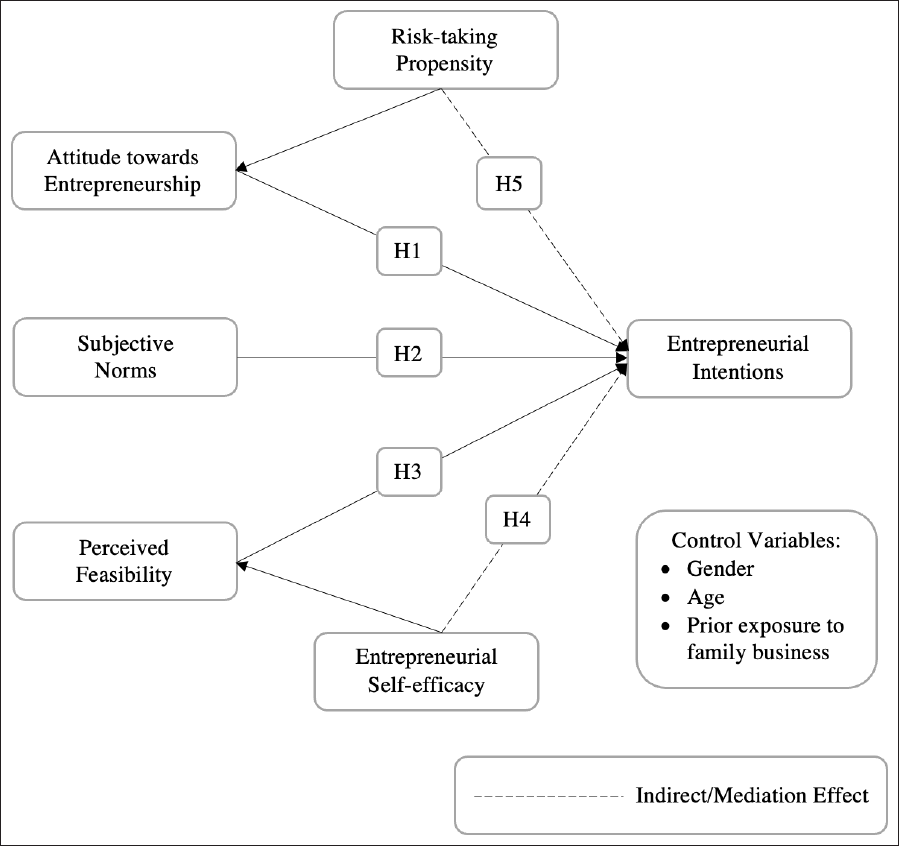
H4: Perceived feasibility significantly mediates the relationship between entrepreneurial self-efficacy and EI.
Risk-taking Propensity
Extensive literature supports the concept that entrepreneurs are risk-takers. Some studies are with the notion that the difference in risk-bearing behaviour between entrepreneurs and non-entrepreneurs may be because of the differences in their cognitive processes. In addition, a slew of studies (Cooper et al., 1988; Palich & Bagby, 1995) has opined that entrepreneurs are more optimistic in analysing opportunities. Uniquely, potential entrepreneurs tend to put more business situations into the opportunity category than threats, and non-entrepreneurs are less likely to do that. However, in both cases, concomitant decision-making may be the same for entrepreneurs and non-entrepreneurs (Palich & Bagby, 1995). Researchers (Weick, 1979) also opined that individuals process any information based on their preconceived notions. Several scholars (Fiske & Taylor, 1984; Wofford, 1994) have described this phenomenon as ‘schema accessibility’ and ‘available heuristics’. This schema or cognitive structure affects the way individuals process particular information. Overall, there is a difference in information processing among individuals based on their cognitive structure at a given time (Palich & Bagby, 1995). Thus, entrepreneurs and non-entrepreneurs can be differentiated based on their cognitive process towards acceptance and non-acceptance of risk-taking ventures. However, a person may be a risk-taker, but it may not necessarily lead to venturing into a new business. A favourable attitude is an important antecedent for EI to be precipitated. Thus, the propensity to take risks alone does not lead to new business ventures. Based on the above discussion, the following hypothesis has been formulated:
H5: Attitude significantly mediates the relationship between risk-taking propensity and EI.
Rationale of the Study
Research on entrepreneurs is not a novel concept. Many studies have already been piled up on entrepreneurial definition, characteristics, behaviour and intention. Researchers have suggested several models across the globe to predict EI. Several researchers discussed the difference in risk-taking propensity between entrepreneurs and non-entrepreneurs. In behavioural research, risk-taking is one characteristic that is supposed to be present in the personality of potential entrepreneurs or business people. Few studies opined that entrepreneurs are more optimistic in scanning the opportunities than others (managers, non-entrepreneurs, etc.). Some believe that entrepreneurs perceive every situation from a different schema or cognitive framework, leading to a more favourable attitude and response. That is why they tend to tap the environmental situations with positive responses such as investments and risk-taking for financial and social gains. Thus, a study on students’ risk-taking propensity may lead to an improved understanding of its impact and the mediating role of attitude. Such an understanding holds the potential to help formulate more comprehensive entrepreneurial programmes and increase the effectiveness of those programmes. Perceived feasibility has been taken as a new variable in the TPB model to improve the predictability of the model. In India, the government is continuously trying to develop positive apprehension about institutional and administrative support to incubate nascent and potential entrepreneurs. Several veterans have indicated that India needs job-led, sustainable and equitable growth. Furthermore, an entrepreneur is the person who manages the resources, generates employment and creates social and economic value by bearing the risk. Entrepreneurship contributes significantly to the economic development of a country. Thus, study becomes apt and required in India’s current business and political scenario. Study on self-efficacy may be more prudent to increase behavioural control among students so that they can pursue entrepreneurship as a career option. Importantly, every potential entrepreneur can be turned into a successful business owner.
RESEARCH QUESTIONS AND OBJECTIVE OF THE STUDY
According to the literature, factors affecting university students’ EI can be divided into individual and environmental factors. Individual factors may include personality-induced factors, psychological traits, experience and knowledge, whereas environmental factors are legal, social, technological, and political that affect the formation of EI (Garavan & O’ Cinneide, 1994; Hou et al., 2019). The present study tried to analyse the impact of subjective norms, attitude, perceived feasibility, risk-taking propensity and self-efficacy on the students’ EI. The study also explored the mediating role of attitude between risk-taking propensity and EI. An attempt has been made to study the mediating role of perceived feasibility between entrepreneurial self-efficacy and intention to venture into business. The study aimed to answer the following research questions:
RQ1: How does risk-taking propensity impact EI, and does attitude work as a mediator between risk-taking propensity and EI?
RQ2: Does perceived feasibility mediate the relationship between self-efficacy and EI?
RQ3: How do age, gender and family business exposure impact the formation of EI?
METHOD
Respondent, Sampling and Procedure
Subjects in this study were the students of different universities and institutions pursuing management and engineering courses. Students have been taken as sample units because they are on the verge of choosing their careers in the next one or two years. The questionnaire method of data collection has been used to elicit the student responses. After missing data treatment, 374 responses have been found suitable for further analysis. Out of the total sample, 65.2% were male students, whereas 34.8% were female. The age of the respondents ranged between 17 and 26 years. When asked whether parents had ever started any business, 47.3% of the respondents said ‘Yes’; the rest, 52.3% said ‘No’.
Measures
The questionnaire was prepared through an extensive literature review. Previously developed scales have been used and adapted to suit the requirements of the present study. The questionnaire was broadly divided into two major sections. The first section consists of the respondents’ basic demographic information, including gender, age, education, etc., and a question asking whether their parents had ever started a business. The second section of the questionnaire asks respondents to provide their opinions on different scale items. Respondents were asked to rate their responses on a five-point Likert scale: ‘1 = strongly disagree; 2 = disagree; 3 = neutral; 4 = agree; 5 = strongly agree’. Attitude towards entrepreneurship was measured with a four-item scale taken from Liñán and Chen (2009). A three-item scale to measure subjective norms was adapted from Krueger et al. (2000). Further, two items to measure perceived feasibility were taken from Shook and Bratianu (2010). In contrast, one item was taken from Zhang et al. (2014). Entrepreneurial self-efficacy (six items) and risk-raking propensity (three items) were adapted from Shook and Bratianu (2010) and ChyeKoh (1996), respectively. Finally, EI was measured with a four-item scale adapted from Liñán and Chen (2009).
Control Variables
Along with attitude, subjective norms, perceived feasibility, entrepreneurial self-efficacy and risk-taking propensity, EI has been influenced by several other factors such as gender, age, and business exposure (demographic variables). Therefore, to avoid and reduce the possible confounding effect of these variables, the present study includes gender, age (Iakovleva et al., 2011; Kautonen et al., 2013) and prior exposure to the family business (Carr & Sequeira, 2007) as control variables.
DATA ANALYSIS
Structural equation modelling was applied to test the proposed theoretical model using maximum likelihood estimation. As advocated by Anderson and Gerbing (1988), a two-step modelling approach was used to assess the model fitness and causal relations among the latent constructs. At first, a confirmatory factor analysis (CFA) was applied to the measurement model, specifying the relationship between observed variables to the corresponding constructs. Subsequently, the hypothesized causal relationships among the constructs (structural model) were assessed in the next step. The measurement model and the structural model provide a complete confirmatory assessment of the construct validity (Anderson & Gerbing, 1988; Bentler, 1978).
MEASUREMENT MODEL
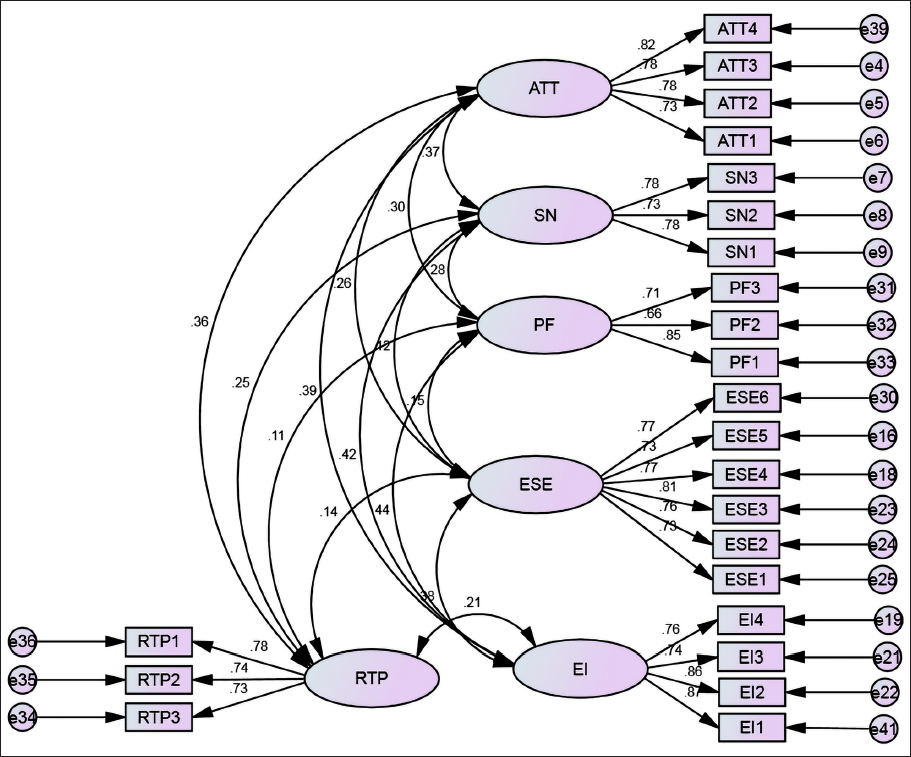
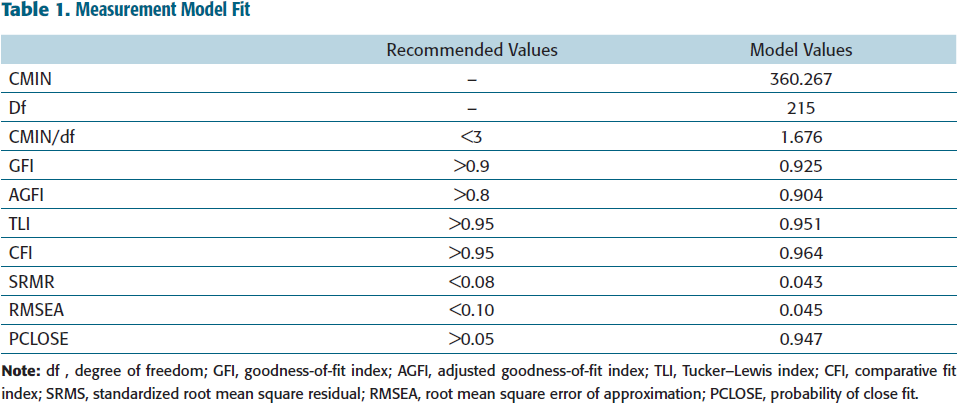
To assess the goodness of the measurement model, CFA was applied using Amos 22.0 (see Figure 2). The results produced an acceptable model fit with a chi-square (CMIN) value of 364.521 with a degree of freedom of 215 (p< 0.001). A significant p-value of chi-square is likely as chi-square statistics is highly susceptible to the sample size (Anderson & Gerbing, 1988). Therefore, Hair et al. (2010) suggested using at least one model fit index from each category of fit indices, i.e., absolute, parsimony and incremental. Hence, using GFI or RMSEA, or SRMR (absolute fit measure) with CFI (incremental fit measure) and AGFI (parsimony fit measure) would be considered sufficient to report model fitness. The results (see Table 1) indicated that the entire model fit indices including GFI = 0.926 (>0.9); RMSEA = 0.042 (<0.06); SRMR = 0.042 (<0.08); CFI = 0.0964 (>0.95); TLI = 0.957 (>0.95); PCLOSE = 0.955 (>0.05) and AGFI = 0.906 (>0.9) were as per the acceptable thresholds as suggested by Hu and Bentler (1999).
Measurement Model (CFA).
Measurement Model Fit.
Construct Validity and Reliability
Along with the model fit evaluation, CFA also gave results to assess construct validity, including reliability. Hair et al. (2010) define construct validity as the degree to which the observed variables corresponding to a given construct truly reflect the construct. Construct validity can be assessed using the following:
Convergent Validity
Convergent validity indicates whether the observed variables truly congregate to the corresponding construct or not (Hair et al., 2010). Several methods are available to estimate convergent validity; however, the most commonly used statistical method to assess convergent validity is using either factor loadings or average variance extracted (AVE). AVE is given by the following formula:

Here, Li denote standardized factor loadings and i is number of items/observed variables in a given latent construct.
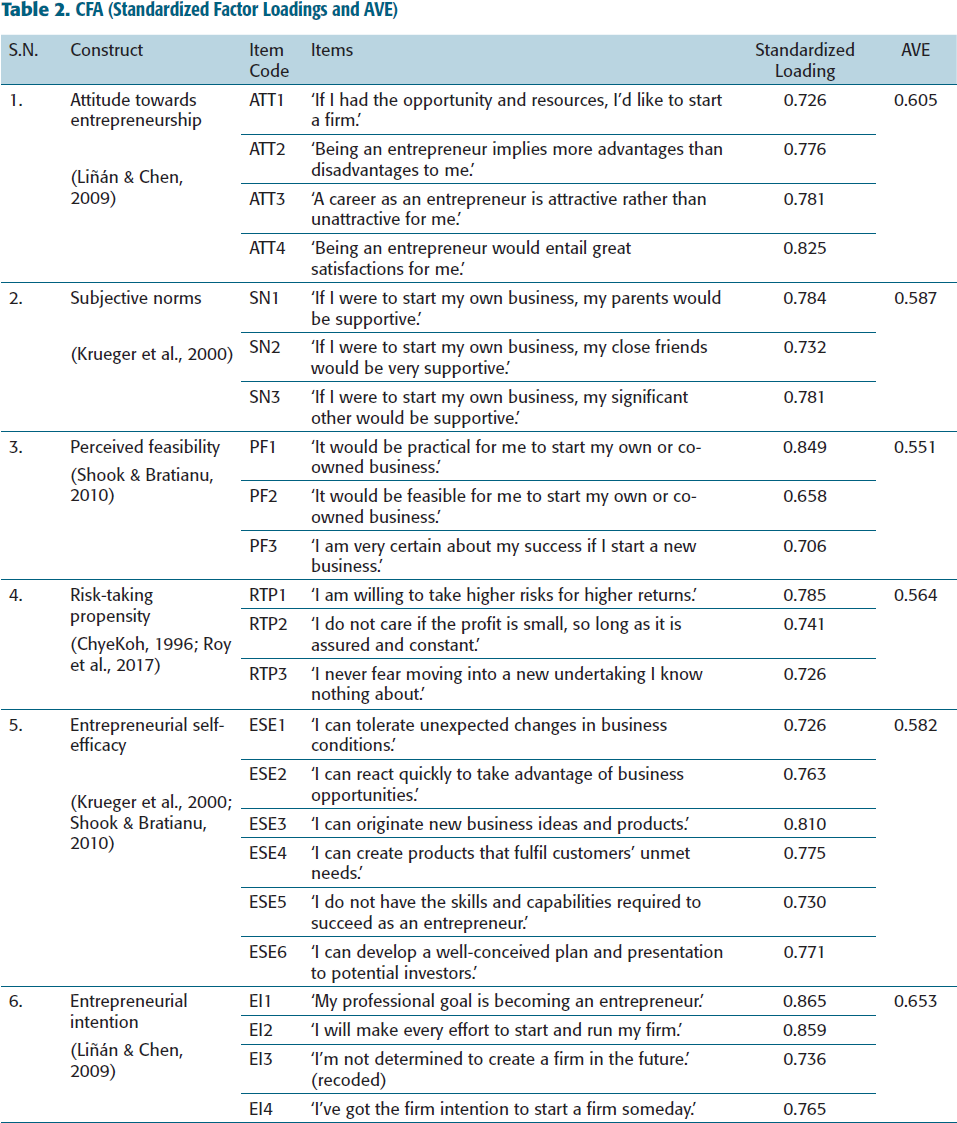
To hold convergent validity, AVE value for a given construct should be more than the critical value of 0.5 (Fornell & Larcker, 1981; Hair et al., 2010). Also, the corresponding factor loadings greater than 0.7 or higher suggest convergent validity (Hair et al., 2010). As shown in Table 2, AVE values for all the constructs are more than 0.5, which conforms to convergent validity (Fornell & Larcker, 1981). Thus, the statistical results of CFA confirm and ensure convergent validity in all latent constructs under study.
CFA (Standardized Factor Loadings and AVE).
Reliability
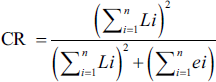
The reliability of a construct refers to the internal consistency of the measure, i.e., how well the observed variables are internally consistent with the corresponding construct. Moreover, it is also an indicator of convergent validity (Hair et al., 2010). There are several statistical estimates available to assess the reliability of a given construct. Cronbach’s alpha is one of the commonly used measures to assess internal consistency. However, composite reliability (CR) is considered a better alternative to the alpha coefficient (Chin, 2010). CR is computed with the following formula:
Structural Model.
where Li is the standardized factor loading and ei is the sum of the error variance.
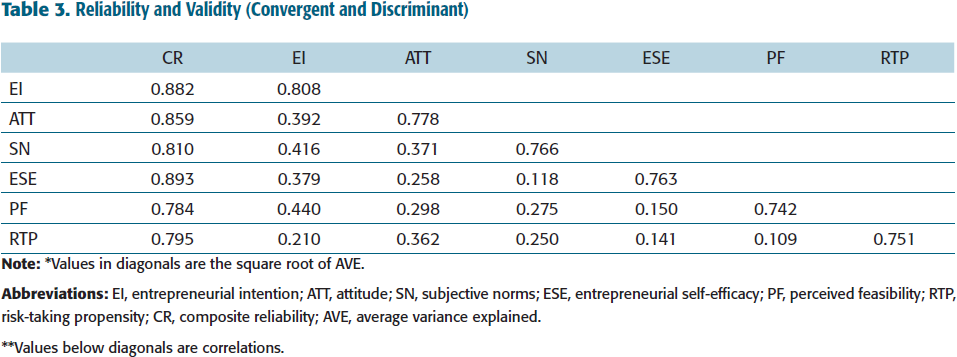
The results (Table 3) show that CR values range between 0.784 and 0.893, confirming internal consistency for all the constructs as these values are greater than the minimum acceptable threshold value of 0.7 (Nunnally, 1978).
Reliability and Validity (Convergent and Discriminant).
**Values below diagonals are correlations.
Discriminant Validity
Discriminant validity indicates how well the two constructs are distinct from each other (Hair et al., 2010). It is a measure of the uniqueness of a construct and establishes that the construct captures unique and different concepts which other constructs do not (Hair et al., 2010). To assess discriminant validity, a widely used statistical method is to compare the square root of AVE with the correlation between two constructs (Fornell & Larcker, 1981; Hair et al., 2010). Table 3 gives values of the square root of AVE in diagonals (values which are bold) and correlation values below the diagonals. It is clear from Table 3 that the square root of AVE for any two constructs is greater than the correlation value between those constructs, thus ensuring discriminant validity among constructs under study.
Common Method Bias
Common method bias arises when variance in the data is caused by the measurement method instead of the constructs themselves (Podsakoff et al., 2003). Method bias may occur because of various reasons such as (a) Social desirability: an individual may respond positively regardless of what they feel and think about the issue (Chang et al., 2010; Ganster et al., 1982; Podsakoff et al., 2003); (b) Common rater: person responding to dependent and independent construct is same which may cause artefactual variance between the dependent and independent variable (Podsakoff et al., 2003); (c) Acquiescence biases (yea-saying or nay-saying): it occurs when respondent agree or disagree with the scale items irrespective of what the content of the item is (Podsakoff et al., 2003; Winkler et al., 1982). Podsakoff et al. (2003) detailed procedural and statistical remedies to avoid method bias. Harman’s (1976) test was used to evaluate the method bias in the present study. Consequently, exploratory factor analysis was conducted in SPSS, and single factor accounted for 21.98% of the variance, which confirms that common method bias is not a concern in the present study. Harman’s single factor test was also applied using CFA with Amos (also used by Andersson & Bateman, 1997; Biraglia & Kadile, 2017; Iverson & McGuire, 2000) which resulted a very poor model fit χ2min/df = 11.417; GFI = 0.527; AGFI = 0.433; TLI = 0.339; CFI = 0.399; SRMR = 0.156; RMSEA = 0.167 and PCLOSE = 0.000), confirming low level of variance attributed to common method.
Structural Model
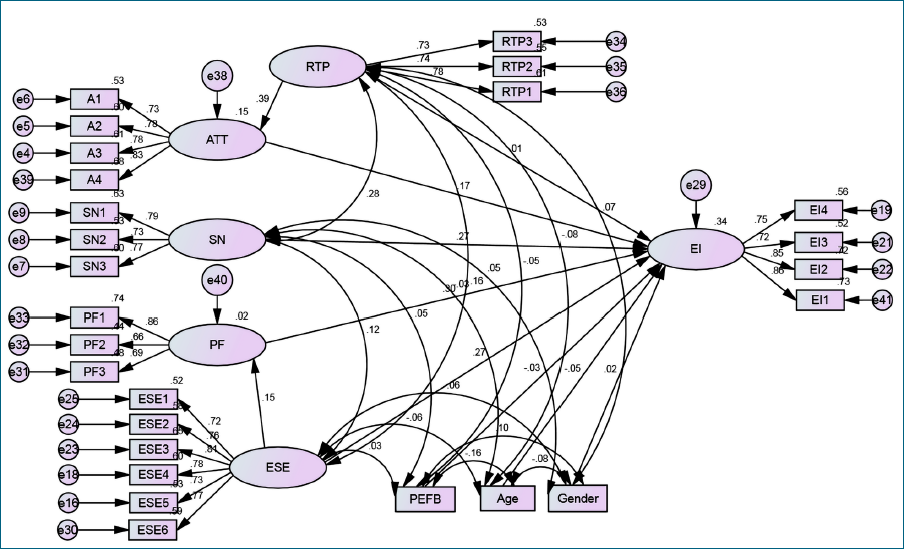
Once the validity and reliability of each construct were ensured in CFA, in the next step, the structural model was tested, which included the measurement model and structural model with specified causal paths among constructs (see Figure 3). Structural model produced a good model fit as all the fit indices: CMIN/df = 1.812 (<3); GFI = 0.909 (<0.9); AGFI = 0.884 (<0.8); TLI = 0.934 (<0.90); CFI = 0.944 (>0.90); SRMR = 0.079 (<0.08); RMSEA = 0.047 (<0.06) and PCLOSE = 0.796 (>0.05) were within the acceptable ranges as suggested by Hair et al. (2010).
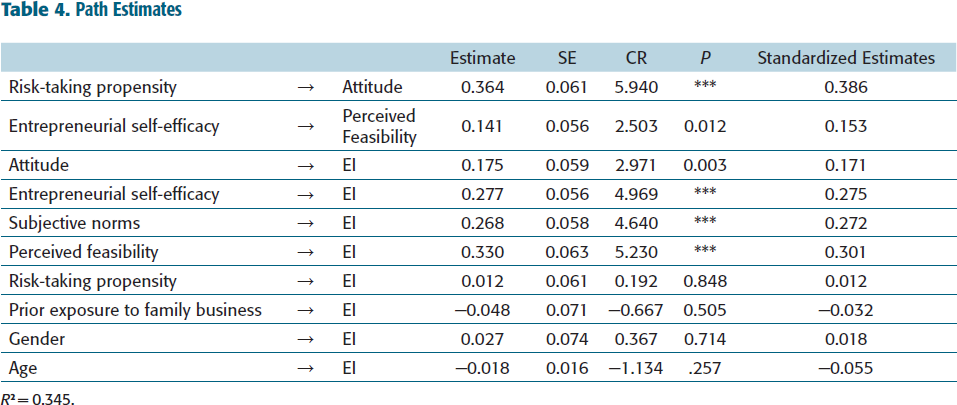
Results of path analysis (structural model) are summarized in Table 4. The results showed that attitude, which was one of the most important determinants of EI, had a significant positive impact on EI (estimates = 0.175, SE = 0.059, t = 2.971; p< 0.05). Further, subjective norms were also found to influence EI significantly (estimates = 0.268, SE = 0.058, t = 4.640; p< 0.001). Moreover, the third major determinant of EI in the TPB model, perceived feasibility, was also found significant (estimate = 0.330, SE = 0.063, t = 5.230; p < 0.001). Risk-taking propensity, which was conceptualized in the proposed model to influence both attitude as well as EI, was found to have a significant positive impact on attitude only (estimate = 0.364, SE = 0.061, t = 5.940; p< 0.001). No relationship was found between risk-taking propensity and EI (estimate = 0.012, SE = 0.061, t = 0.192, p > 0.05). Furthermore, the second construct added to the TPB model, i.e., entrepreneurial self-efficacy was positively related to perceived feasibility (estimate = 0.141, SE = 0.056, t = 2.503; p< 0.05) as well as with EI (estimate = 0.277, SE = 0.056, t = 4.969; p< 0.001). All the control variables, i.e., gender, age and prior exposure to the family business, were found non-significant. Among all the proposed determinants of EI, perceived feasibility (standardized estimate = 0.301) was found to be the most important, followed by entrepreneurial self-efficacy (standardized estimate = 0.275), subjective norms (standardized estimate = 0.272) and attitude towards entrepreneurship (standardized estimate = 0.171). All the determinants together explained 34.5% of the variance in EI.
Path Estimates.
Mediation Analysis
To examine the presence of mediation, indirect effects were estimated utilizing the bootstrapping procedure as suggested by Preacher and Hayes (2004). Bootstrapping was conducted on the given data with 5,000 subsamples and a 95% bias-corrected confidence interval. In the present study, two mediation models were examined, including attitude as a mediator between risk-taking propensity and EI and perceived feasibility as a mediator between entrepreneurial self-efficacy and EI were examined. The results of the mediation analysis are detailed in Table 5. The results showed that in the first model, which included attitude as a mediator between risk-taking propensity and EI, the indirect effect of risk-taking propensity on EI through attitude was 0.066 and the direct effect (in the presence of the mediator) was 0.012, whereas the total effect was 0.078. The indirect effect was found significant at a 95% confidence interval (as the corresponding lower and upper bounds were 0.005 and 0.160), indicating that attitude mediated the relationship between risk-taking propensity and EI. Moreover, the effect of risk-taking propensity on EI completely vanished in the presence of attitude, as the direct effect was found to be non-significant (lower bound = −0.147 and upper bound = 0.172). Thus, attitude fully mediated the path of risk-taking propensity to EI.
Mediation Analysis (Bootstrapping Procedure).
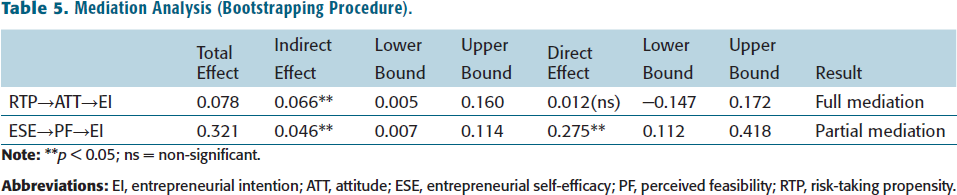
Furthermore, in the second mediation model, which comprised perceived feasibility as a mediator between entrepreneurial self-efficacy and EI, the indirect effect was 0.046, whereas the direct effect was 0.275 (total effect = 0.321). The indirect effect of entrepreneurial self-efficacy on EI through perceived feasibility was found significant (lower bound = 0.007 and upper bound = 0.114), confirming perceived feasibility as a mediator. However, the direct effect was also significant (lower bound = 0.112 and upper bound = 0.418), which confirmed that perceived feasibility partially mediated the relationship between entrepreneurial self-efficacy and intention. Thus, results supported mediation in both models.
RESULTS AND DISCUSSION
The present study aimed to analyse the impact of certain variables on EI and explore the mediating role of attitude and perceived feasibility. Results showed that the relationship between risk-taking propensity and the EI was not significant, whereas attitude, self-efficacy, perceived feasibility and subjective norms were found to have significant relationships with EI (Douglas et al., 2021; Hameed et al., 2021; Miralles et al., 2017; Pidduck et al., 2021; Rai et al., 2017; Turker & Selcuk, 2009; Younis et al., 2021). The analysis further indicated that the relation between self-efficacy and EI was partially mediated through perceived feasibility. Attitude has fully mediated the relationship between risk-taking propensity and EI.
The study brings forth some important findings to nurture students’ EI. First, attitude was found to be one of the significant determinants of the EI of Indian students. Students, by their education and other socialization processes, tend to develop favourable or unfavourable feelings towards business venturing (Dioneo-Adetayo, 2006; Shariff & Saud, 2009) which later affects their intention towards start-ups. Therefore, if the promotion of entrepreneurship is one of the objectives of the curriculum and government programmes, the first and far most important step should be the development of a positive attitude among beneficiaries. Interaction with successful entrepreneurs and exposure to start-ups can be some of the ways students can inculcate positive attitudes to pursue business venturing as career options. In the present study, attitude, positively affected by risk-taking propensity, mediated its relation with EI. As discussed in the literature review (Gartner, 1988; Guerrero et al., 2008; McKenzie et al., 2007; Pandit et al., 2018; Roy et al., 2017; Saraf, 2015; Trivedi, 2016, 2017) entrepreneurs are the individuals who analyse the opportunities from different cognitive framework that later influence their intention to behave in a particular manner. Thus, education and other learning mediums for modifying the cognitive structure of students can be used to develop a positive attitude and lead to the intention of business venturing. However, the direct relationship between risk-taking propensity and EI was not found to be significant in this study. Indicating that students may have a risk-taking propensity, but that propensity does not necessarily translate into business venturing unless a favourable attitude towards business venturing is present. The relationship between subjective norms and EI was reported to be significant. However, many past research studies (Krueger et al., 2000; Shapero & Sokol, 1982; Tarkiainen & Sundqvist, 2005) on EI suggested an indirect relation between subjective norms and intention that was mediated through attitude or personal attributes. Whereas the present study was conducted in the context of a developing country, i.e., India; therefore, cultural dominance, norms and perception of society strongly influence a person’s judgement on selecting a career (Krithika & Venkatachalam, 2014). Subjective norms include the perception of an individual’s family, friends and other important ones about the targeted behaviour (Souitaris et al., 2007). It is a type of support students seek from people in their social surroundings who may affect/influence their decisions when they venture into a new business (Shukla & Kumar, 2021). Sometimes, support from near and dear ones (normative beliefs) motivates the student to pursue business venturing as a career option. Thus, family business exposure, high regard (respect from loved ones and society), and a positive image associated with entrepreneurship can help students to pursue their intention of business venturing (Heuer & Liñán, 2013). Mentorship and role modelling in educational institutions can help develop a positive support system (Solesvik, 2013). The degree of feasibility in performing targeted behaviour is one of the important determinants of EI (Feather, 1988; Krueger, 1993; Liñán et al., 2011; Shapero & Sokol, 1982). Until students feel that venturing into business is easy and practical, it will not be selected as a career option. Here, the role of government, educators, mentors and institutions come into play. By providing appropriate information about the country’s law, business environment and support system, teachers and mentors can inculcate a sense of feasibility for start-ups among students. Assignments, outreach programmes, business plans, simulation training, etc., can be provided to increase the students’ efficacy, sense of feasibility and intention to start a business. The curriculum for business and management students can be drafted to expose students to real business conditions.
LIMITATIONS AND DIRECTIONS FOR FUTURE RESEARCH
The study is limited to several parameters. Limited variables were considered for exploring the best model due to the limited focus of the study. First, it was not a comprehensive list of variables considered for exploring the best model. This study only measures the intention to become an entrepreneur, not the actual behaviour and the translation of intention into actual behaviour may be subjected to many situational factors. Thus, using actual behaviour as the outcome variable in the model could bring better insights. The study used students as a sampling unit; there may be some scepticism among policymakers and researchers about the characteristics of the sample. Management and engineering students may differ from students pursuing other streams. However, in previous research, students have been taken as valid samples (Krueger et al., 2000) to capture the EI. The study is limited to developing nations like India; there are chances that the result may differ in developed and least developed nations. So, testing the same model will increase the validity and reliability of the model and bring forth the differences between the two worlds in terms of business venturing intention.
IMPLICATIONS
The study presents a number of research implications, educational and institutional implications, public policy and general implications.
Public Policy and General Implications
Intention-based models offer a great opportunity to predict and explain future entrepreneurial behaviour. The heterogeneity of entrepreneurship development programmes and efforts of the present government to infuse the spirit of business ownership led to the need for research studies in this direction. EI is one of the cognitive variables that is affected by a number of known and unknown variables (personal and situational variables). Identifying those variables could bring new insights into the development and evaluation framework of entrepreneurial programmes. Furthermore, the study concluded that attitude fully mediates the effect of risk-taking propensity on EI. Thus, before the implementation of the capacity development programme, the identification of targeted beneficiaries can be carried out based on their risk-taking propensity. The environment can be modified to develop a positive attitude among identified participants. This exercise may lead to efficient and effective utilization of exchequer money and the country’s resources. Thus, the findings of this study may be highly useful in targeted intervention for the skilling/ re-skilling of potential entrepreneurs.
Educational and Institutional Implications
In a developing nation like India, where resources are limited, lack of risk-taking propensity works as a hindrance for the start-up to germinate. Understanding the role of risk-taking propensity and self-efficacy can increase the effectiveness of entrepreneurship development programmes of NGOs and educational institutions. In an economy, entrepreneurs can play a variety of roles. Some are productive (innovation, efficiency enhancement), and some are destructive (such as organized crime) (Baumol, 1996). Thus, identifying potential productive entrepreneurs can be a more effective and efficient step for successfully implementing the programmes. Educational institutions and universities can develop curricula as per the requirements of students. Infrastructure can be enhanced and designed to complement the needs of students, so that they can pursue entrepreneurship as a career option. One of the apt examples in India is the EDII, established to nurture students’ EI.
Research Implications and Theoretical Contribution
From the theoretical point of view, the present study validates the TPB model and its predictability in the context of developing countries (Anwar et al., 2021; Hossain, 2021; Hussain et al., 2021; Poolsawat, 2021; Samydevan et al., 2021). Risk-taking propensity, subjective norms and self-efficacy have emerged as contributory factors leading to the formation of EI directly or mediation through attitude and perceived feasibility (Anwar et al., 2021; Poolsawat, 2021). The findings of the study are in line with earlier studies (Deliana et al., 2019; Saeed et al., 2015) and support the notion that self-efficacy leads to greater EI in the presence of perceived feasibility. However, few studies have also found a direct association between self-efficacy and EI (Samydevan et al., 2021). So, it would be interesting to see if it is peculiar to developing countries like India, where the feasibility to start a business is vital to utilize the skills of business venturing. Thus, the difference of ecosystem and contextual settings on new business venturing intention requires further investigation.
The study contributes to the wealth of theoretical knowledge in the development of the entrepreneurial research domain, especially in the case of emerging economies. A greater focus on risk-taking propensity fills the existing literature gap in entrepreneurial research feasibility (Anwar et al., 2021; Poolsawat, 2021). A direct association between risk-taking propensity and intention to new business venturing seems logical, but the present study suggested an insignificant relationship between these variables. This opens a new frontier in entrepreneurial research that identifies antecedents that mediates or moderate risk-taking propensity into new business venturing as risk-taking behaviour has been identified as an important behavioural imperative for entrepreneurs in a number of studies (Cooper et al., 1988; Deliana et al., 2019; Palich & Bagby, 1995).
CONCLUSIONS
This article concluded that risk-taking propensity and self-efficacy are two critical variables affecting the students’ EI. The TPB is successfully applied in the context of a developing country, i.e., India. The study confirmed the mediating role of perceived feasibility between self-efficacy and EI. This indicates that if students think they have the capabilities to start a business venture, then it is also perceived as feasible and easy for them. The study also concluded the influential impact of subjective norms, attitude and perceived feasibility in the development of EI of the students.
Footnotes
DECLARATION OF CONFLICTING INTERESTS
The authors declared no potential conflicts of interest with respect to the research, authorship and/or publication of this article.
FUNDING
The authors received no financial support for the research, authorship and/or publication of this article.
email:
email: