




Abstract
Entrepreneurial behaviour involves challenging the status quo. Similarly, adolescent deviants break rules and act against established norms. While adolescent deviance is seen as a strain on society, it can also be related to characteristics of entrepreneurial intentions. We draw upon prior literature to demonstrate that deviance during adolescence can promote the development of and reliance upon relational capital, and that these characteristics are associated with innovativeness, proactiveness, and risk-taking as adults. We test hypotheses using a sample of 375 participants and highlight the role of relational capital in the lives of adolescent deviants and how it contributes to entrepreneurial behaviour.
Introduction
Both research and society acknowledge that entrepreneurs differ from the general population (Holland and Shepherd, 2011). According to scholars, entrepreneurs often think and make decisions differently (Baron, 1998). They find a way to overcome obstacles, uncertainty, and persist as they develop their entrepreneurial identities (Holland and Shepherd, 2011; Jones, Klapper, Ratten, and Fayolle, 2018; Werthes, Mauer, and Brettel, 2018). Though scholars continue to focus on the behaviour and decision-making of current entrepreneurs, prior research gives little attention to these individuals before they became entrepreneurs (Stewart et al., 1999; Zhang and Arvey, 2009).
Typically, an adolescent who breaks rules and laws is quickly labelled “deviant” by society generally overlooking the fact that deviance often involves creative risk-taking and action; attributes often associated with successful entrepreneurs (Zhang and Arvey, 2009). For example, as an adolescent, Richard Branson was told that he would either “end up in prison or become a millionaire” (Schwartz, 2012). Though he dropped out of school at the age of sixteen, his creativity and strategic thinking and willingness to take risks helped him become a successful entrepreneur (Shavinina, 2006).
Deviance or rule breaking behaviours reflect “fail(ure) to conform to the applicable normative expectations of the group” (Kaplan, 1980: 5); and adolescent deviants begin to develop tendencies to bend or break rules in their existing social setting including schools and neighbourhood (Kaplan, 1980: 5). Consistent with prior literature (e.g. Zhang and Arvey, 2009), we focus on the deviants and not on the hardened, violent criminals who choose a life of crime. A key reason for our drawing this distinct boundary is that such criminals are very different from most deviants and are not a part of this commonly utilized construct (e.g. Zhang and Arvey, 2009). Further, prior research shows that only a small minority of adolescent deviants choose to become adult criminals (Ardelt and Day, 2002; Scholte, 1999). As such, we limit ourselves to understand how adolescent deviant behaviours are associated with entrepreneurship later in life, building on the premise that deviance could be a manifestation of motivations and social factors through the relationships they develop that may induce entrepreneurship (Douglas and Shepherd, 2002).
Though “drop-outs” are often negatively labelled, we believe that not all is lost for such adolescents. Indeed, the literature has yet to focus its attention on these dropouts and their impact in general (see Zhang and Arvey, 2009 for an exception). This study identifies behavioural characteristics of adolescent deviants and examines whether these characteristics are associated with specific, desirable entrepreneurial traits; namely innovativeness, proactiveness and risk-taking. Specifically, we examine how their behaviour allows them to leverage their social capital, particularly the relational dimension (relational capital, henceforth) and orient them toward innovativeness, proactiveness and risk-taking, which reflects a propensity for entrepreneurship (Stewart et al., 1999; Zhang and Arvey, 2009). We highlight the relationship between adolescents’ deviant behaviour and their ability to leverage diverse relational capital, which in turn, motivates innovativeness, proactiveness and risk-taking. We draw on social network theory and adolescent deviance to develop a more complete picture of how deviance at an early age can promote broader network ties that may motivate new venture formation at a later stage.
Theory and hypotheses
Adolescent deviance
Rules are formally shared beliefs about accepted behaviours and normative expectations (norms) regarding patterns of behaviour expected within social groups (Morrison, 2006; Neale et al., 2020). Deviance is associated with breaking these rules, or disturbing a sense of equilibrium within a society (Thornberry et al., 1991). Deviants, by nature consciously choose not to closely follow societal norms (O'Fallon and Butterfield, 2011) and look for opportunities to improve processes and procedures (Zhang and Arvey, 2009). Deviance in the form of breaking rules is examined within the entrepreneurship literature because it could promote out-of-the box thinking, affirms cultural norms and values and develops relational capital that may lead to change and innovation (Newbery and Jinman, 2021; Pals, 2006).These behaviours may be referred to as positive or constructive deviance; however, all deviance, whether labelled as positive or negative violates conventional expectations of behaviour within a society (De Vries, 1977; O'Fallon and Butterfield, 2011; Spreitzer and Sonenshein, 2004).
Behavioural deviance among adolescents often develops in early through peer influence (Baumrind, 2006), varying levels of parental affection, school involvement, and personality traits (Rowe and Flannery, 1994). While some ‘deviants’ come from troubled backgrounds, most simply seek self-definition (Compas et al., 1995). When compared with the adults they will become, these adolescents are more susceptible to negative influences, behavioural misconduct and peer pressure (Compas et al., 1995; Steinberg and Monahan, 2007). Over time, and during early adulthood, some deviant individuals consider the future, mature, and move away from these behaviours as well-adjusted adults (Ardelt and Day, 2002; Levine and Rubinstein, 2013; Scholte, 1999; Scott and Steinberg, 2008). In fact, only a small minority “persist in a life of crime” and negative outcomes (Henning, 2013: 385). We argue that those who choose positive outcomes simply channel this energy from activities that detract from society to those that contribute (Compas et al., 1995).
Relational capital
Relational capital provides informational, physical and emotional support from personal relationships via interactions and connections between two or more parties, and involves trust, which is created through shared norms and social interactions (Carmeli and Azeroual, 2009; De Clercq and Sapienza, 2006; Granovetter, 1992). Relational capital forms the structure of relational networks and facilitates the operation of such networks (Anderson and Jack, 2002; Ince et al., 2021). Social interaction, trust, shared norms, and goals provide entrepreneurs relationship-sustaining benefits and resources (Carbonara, 2021). It leverages older relationships, while encouraging new relationships (Anderson et al., 2007). These provide access to countless skills, experiences, and resources in the pursuit of discovering and capitalizing on novel ideas (Baron, 2007). Relational capital develops through interactions and avenues for future returns on prior investments of time, attention and resources (Anderson et al., 2007; De Carolis et al., 2009).
Kandel and Davies (1991) found that adolescent deviants often have stronger peer relationships than their traditional rule-following counterparts. Further, deviants often develop greater loyalty and support for one another (Giordano et al., 1986). However, adolescent deviants begin to rely upon, and listen to those within relational networks more than individuals belonging to a normal hierarchy or authority figures in the society (Aseltine, 1995). In fact, the majority of adolescent deviance and delinquency literature demonstrates that peer relationships influence behaviours (e.g. Haynie, 2001; Kandel and Davies, 1991). Therefore, adolescent deviants may possess broader relational networks because these individuals are active in diverse areas (e.g. sport teams, jobs, unstructured socialization with friends) and are known to reach out to different sub-groups; groups which many of their rule-following contemporaries would not (Eccles et al., 2003; Haynie, 2001; Safron, Schulenberg et al., 2001). Thus, the indirect ties of adolescent deviants are likely to be more numerous, much stronger, and many will be the centre of diverse networks, as compared to their peers who adhere to norms and are limited within boundaries of activities (Eccles et al., 2003).
Adolescent deviants are often engaged in diverse activities through various friendship networks outside of routine school work, which both contribute to and allow them to leverage these relationships in order to reach their goals (Haynie, 2001) through relational capital. They develop more complex relationships with a wide variety of individuals, many of which are from various social groups (Cullingford and Morrison, 1997). Often, being at the centres of diverse networks provide them benefits of centrality in terms of connectivity and power (Haynie, 2001). This positioning provides opportunities for interacting with and building relationships with a wide social network, where they will face and choose between allegiances and preferences for their future (Haynie, 2001). This places adolescent deviants on various “trajectories of personal development” into adulthood (Compas et al., 1995: 271). As most of these individuals begin to conform to most of societal norms, they begin to develop and strengthen social bonds into adulthood (Ardelt and Day, 2002). These bonds reinforce social networks and lead to higher wages and professional success as adults (Kreager et al., 2011). Summarizing, these relationships (relational capital) that have been accumulated over the years are readily available for use by adolescent deviants when they need support for later opportunities.
Drawing on the relational capital and entrepreneurship literature, we propose that relational capital motivates individuals towards innovativeness, proactiveness, and risk-taking (Urban, 2019). Indirect ties improve opportunity recognition and facilitate the exchange of information, knowledge, and resources (Kruger and Steyn, 2021). Such capital often enables entrepreneurs to obtain resources for a lower cost than their competitors; resources which are rarely available to all competitors (Witt, 2004). Further, indirect and direct ties provide referrals that signal legitimacy and reduce the perception of risk to potential investors, investors, and suppliers (Hoang and Antoncic, 2003).
Overall, relational ties enable potential entrepreneurs with deviant backgrounds to obtain resources, knowledge, skills, and legitimacy which facilitate both opportunity recognition and exploitation of resources. As discussed, adolescent deviants have the skills and experience to develop relational networks by reaching out to different sub-groups and these capabilities can be leveraged as an entrepreneur (Haynie, 2001). Such deviance also reflects their engagement in diverse activities which cultivates relationships with a wide variety of individuals from various social groups—often, adolescent deviants are at the centre of networks and leverage relational capital to achieve goals (Cullingford and Morrison, 1997). Thus, we predict: H1: Adolescent deviance is positively associated with the use of relational capital, later as adults.
Innovativeness, proactiveness, and risk-taking
Prior research shows that that innovativeness, risk-taking and proactiveness increase propensity to engage in and be successful at entrepreneurial activities (e.g. Urban, 2019)
We build on this research and propose that deviant behaviour encourages “out of the box” thinking to introduce new products and services (Rauch et al. 2009). They disrupt the status quo and this is consistent with the description of deviants (Thornberry et al., 1991) as well as entrepreneurs (Schumpeter, 1934). Indeed, entrepreneurs have been designated as being extremely similar to juvenile delinquents (Gould, 1969), and these three factors are related to entrepreneurial intentions and orientations (Corrêa et al., 2021; Urban, 2019)
Innovativeness
Innovative characteristics encourage thinking “out of the box” in the pursuit of novel ideas (Goss, 2005). We believe that rule breaking or deviance among adolescents could be reflective of this creativity that can positively impact efficiency, responsiveness, adaptability, and innovation later in life (Nemeth, 1997). Adolescent deviance often symbolizes independence, non-conformity and autonomy from the norms of the reference group (Erickson et al., 2000), that is, school and extant society in our context—these are some of the key traits of an entrepreneur being a ‘creative destructor’ (De Vries, 1977; Schumpeter, 1934). Previous research demonstrates that innovative behaviours are found more often in adolescent deviants than non-delinquents (e.g. Chassin et al., 1988; Piergrossi, 1968).
Given that innovative behaviour mirrors individuals’ propensity to engage in experimentation and creativity through introducing new products and services (Rauch et al., 2009), prior instances of rule breaking can prompt ‘deviants’ to engage in innovative entrepreneurial activities (Goss, 2005; Schumpeter, 1934). Such individuals also have flexibility to pursue new ideas in response to an ever-changing, competitive environment (Kemelgor, 2002). Thus, we predict:
Risk-Taking
Risk-taking involves bold actions and venturing into unknown territories and committing to developing new ventures; deviants using their own discretion and take chances within uncertain environments (Davidsson and Honig, 2003; Lumpkin and Dess, 1996; Rauch et al., 2009; Zhang and Arvey, 2009). Research demonstrates that entrepreneurs have a greater risk propensity and may be “predisposed” towards risk-taking than others. Risk taking is also credited to an ability to deal with less-structured environments, in addition to uncertain environments (Hitt et al., 2011) and adolescent deviants often embrace risk in the face of uncertainty and adversity (Compas et al., 1995). Therefore, we propose:
Proactiveness
Similarly, proactiveness involves forward-thinking, where those that break the status quo introduce new products and services to the market and exploit activities for higher returns (Crant, 2000; Lumpkin and Dess, 1996). While proactive individuals are often more likely to have entrepreneurial intentions, they also tolerate job-related stress, are effective leaders, and take charge (Alferaih, 2017; Seibert et al., 2001).
Proactiveness is defined as an “opportunity-seeking, forward-looking perspective involving [the introduction of] new products or services ahead of the competition and acting in anticipation of future demand to create change and shape the environment.” (Lumpkin and Dess, 2001: 431). Knight (1997) argued that this “aggressive” pursuit involved one reaching objectives “by whatever reasonable means are necessary” (214). Adolescent deviants are proactive in their desire to take charge of the situations, have a need for achievement, and are open-minded to new experiences (Bolton and Lane, 2012). Thus, we predict:
Mediating role of relationship capital
So far, we have hypothesized that relational capital is positively related to innovativeness, proactiveness, and risk-taking. To complete our theoretical model, we draw on social capital and entrepreneurship literatures to propose that relational capital partially mediates the relationship between adolescent deviance and innovativeness, proactiveness, and risk-taking. We propose that the effects of adolescent deviance should be related to each of these constructs through its development of relational capital. A key reason for hypothesizing a mediating effect is that relational capital is seen as an enabling mechanism that has been developed gradually over time, often many years, through multiple interactions (Granovetter, 1992; Tsai, 2001). Therefore, these vital relationships and skills developed in adolescence may provide benefits later in adulthood (Compas et al., 1995).
When relational capital has not been developed, the benefits gained as an adolescent deviant may or may not influence an entrepreneur’s innovativeness because innovations involve the recombination of knowledge gained from diverse sources (Whelan et al., 2011). Similarly, deviance alone is not expected to further individual proactive behaviour because proactiveness often stems from social interactions and openness to experience (Bolton and Lane, 2012; Lumpkin and Dess, 2001). Relational capital builds on these characteristics and helps in both opportunity seeking and recognition, thus explaining the link between adolescent deviance and proactiveness.
Further, we argue that relational capital partially mediates the relationship between deviance and risk-taking. When relational capital is undeveloped, adolescent deviance in and of itself may or may not motivate risk-taking. A mediating effect suggests that relational capital provides relevant information and knowledge elements from diverse sources and brings in an element of ‘calculation’ or ‘information’ in the risk. Though chance cannot be fully mitigated while venturing into unknown, informed individuals gain self-assurance and confidence for bold actions and taking chances (Davidsson and Honig, 2003; Zhang and Arvey, 2009).
While it is plausible that past deviance may provide negative or mixed signals to stakeholders, referrals by various ties in the existing networks may mitigate negativity. Such referrals often signal legitimacy and integrity (Kautonen et al., 2010) and reduce the perception of risk to potential investors, suppliers, and other stakeholders (Hoang and Antoncic, 2003). They help entrepreneurs recruit employees, vendors, and partners capitalize on innovative ideas (Chell and Baines, 2000). As such, relational capital shapes subsequent strategic relationships and promotes entrepreneurship (Singh et al., 1999).
We propose that adolescent deviance alone is not expected to fully relate to innovativeness, proactiveness, and risk taking independently, but rather, the manifestation of its effect occurs through relational capital.
Specifically, we hypothesize:
Research methodology
Sample and data collection
We obtained approval for the survey through a university Institutional Review Board before collecting responses. To obtain a demographically diverse sample, we obtained participants through Amazon Mechanical Turk (M-Turk). This is an online market that enables researchers to have respondents complete “Human Intelligence Tasks” or “HIT’s”’ (Horton et al., 2011 7). M-Turk provides scholars with an excellent social research, provides anonymity for respondents and provides data comparable to other reputable sources (e.g. experiments via lab settings) (Lu et al., 2021; Noack et al., 2018).
When recruiting participants, we required “M-Turkers” to have a 95 percent approval rating from Amazon before working on our HITs to help eliminate lower quality responses. This higher approval rating demonstrates that these workers followed directions given by other requestors, or researchers. We only allowed those that lived in the U.S. to view the HIT and paid each respondent $.35. To further protect data quality, we employed numerous attention checks throughout the sample. These included reverse-coded questions and prompts such as “Choose agree when answering this question” (Lu et al., 2021:). 442 surveys were completed and we were left with 375 (84.84%) usable responses after removing those that missed one or more of the four attention check questions or those with missing entries.
Dependent variables
To measure innovativeness, proactiveness and risk-taking, we adopted the 5-point Likert-type Individual Entrepreneurship Orientation scale (Bolton and Lane, 2012). Scores ranged from 1, ‘strongly disagree’ and 5, ‘strongly agree’. Innovativeness, risk-taking, and proactiveness constructs contain four, three, and three items, respectively. Examples of prompts include, “I often like to try new and unusual activities that are not typical but not necessarily risky (innovation)”, “I tend to plan ahead on projects (proactiveness)”, or “I am willing to invest a lot of time and/or money on something that might yield a high return (Risk-taking)”.
Independent variables
We utilized items from the Multidimensional Personality Questionnaire (MPQ) (Tellegen, 1982) and operationalized rule breaking in adolescence as “negative forms of deviance that an individual engaged in before graduating from high school” (Zhang and Arvey, 2009: 1). This included 33 survey items that addressed behaviours including delinquencies, alcohol and drug use (e.g. How often did you buy marijuana or some other illegal drug?), school (e.g. How often were you placed on school probation or expelled?), family offences (e.g. While living with your parents, how often did you defy your parents’ authority (to their face) before leaving home?), official contact with authorities (How many times were you picked up by the police?), and serious crimes (e.g. How many times did you take a car without permission of the owner, whether or not you later returned it?), which were used to operationalize this construct (Tellegan and Wallar, 2001; Tellegen, 1982; Zhang and Arvey, 2009). Examples of questions include “Before High School Graduation (or age 18)”: “How many traffic citations, other than for parking, did you receive?” and “How often did you take something small and not very valuable (candy, cigarettes, and cosmetics) from a store without paying for it?”.
We recognize that utilizing retrospective accounts may be prone to self-justification, recall bias, and even survivorship bias and that these biases may impact the validity of similar studies. However, though responses from self-reported measures of adolescent deviance may be seen as incriminating or embarrassing, they still demonstrate validity. We emphasize the fact that our study is not concerned with violent and other major crimes against others as this is not a part of this commonly utilized construct (e.g. Zhang and Arvey, 2009). Rather than focusing on the minority of adolescent deviants that turn to a life of crime, we desired to understand how these adolescent behaviours were related to our other constructs within this study (e.g. the utilization or reliance on relational capital).
Mediating variables
Following De Carolis et al. (2009), we asked respondents about the nature of personal relationships that develop over time through repeated dealings and connections within relational networks. Our coding and the resulting analysis was adopted from Davidsson and Honig (2003). When operationalizing relational capital, we sought to understand how information is obtained from a network and how this may influence individuals when considering new venture creation (De Carolis et al., 2009; Norman et al., 2010). For example, we asked respondents what extent involvement with members encourages the start of new ventures, and the extent that members provide a forum to discuss new business ideas (Norman et al., 2010). We employed a 5-point Likert-type scale, ranging from 1 for not at all to 5, a very great extent (De Carolis et al., 2009).
Control variables
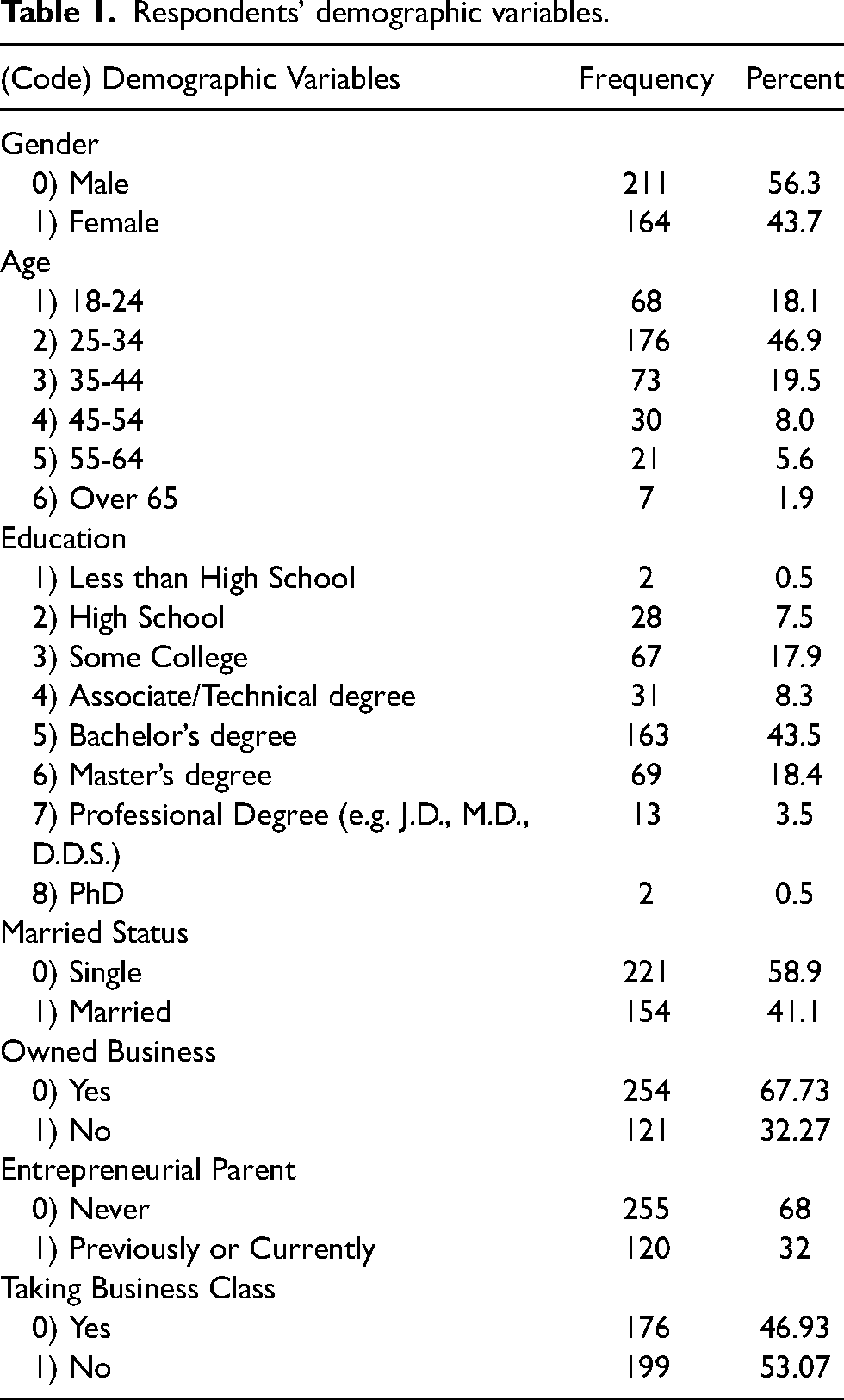
We coded several control variables to account for other systematic determinants of dependent variables including innovativeness, risk-taking and proactiveness as well as our mediator. Our control variables include gender, education, and age, business ownership, entrepreneurial parent, taking business classes, work experience and marital status. We asked respondents how many years of work experience they had. Table 1 illustrates the demographics and control variables.
Respondents’ demographic variables.
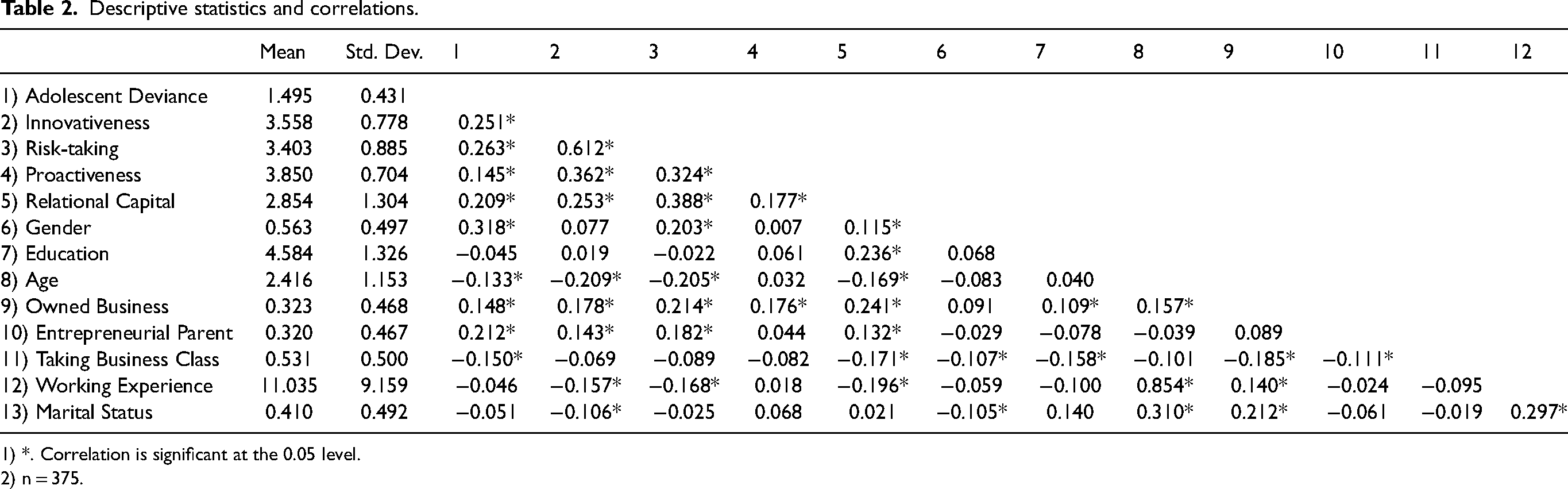
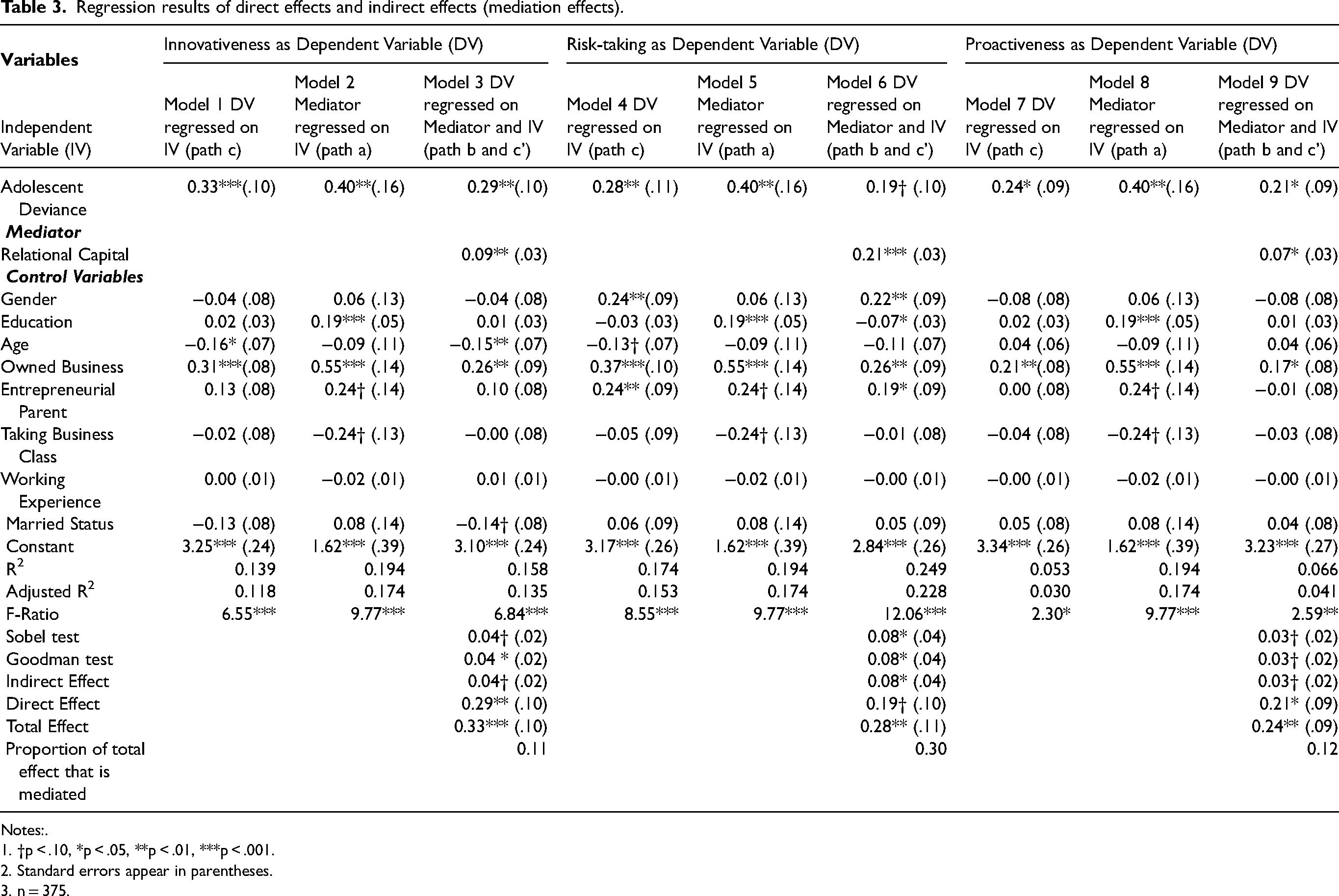
Though we utilized existing scales, we conducted a factor analysis for all measurement items and obtained discriminant and convergent validity. Then, we employed STATA to run the multiple regression models (Cohen et al., 2014)and followed Preacher and Hayes (2004) for mediation effect analysis. There are nine total models. Models 1, 4 and 7 show the direct effect of adolescent deviance (as independent variable) on each dependent variable including innovativeness, risk-taking and proactiveness, respectively. Models 2, 5 and 8 examined a mediator regressed on the independent variable. Lastly, models 3, 6 and 9 examined the mediation effect and through the Sobel-Goodman test, indirect and direct effects as well as the proportion of total effect that is mediated. Given the relatively high correlation among variables, especially working experience and age, we ran collinearity diagnostics to test for problems of multicollinearity. None of the variance inflation factor (VIF) scores were over the threshold of 5. The mean value of VIF is 1.77 while the maximum of VIF is 4.18. As the result, multicollinearity was not problematic. The descriptive statistics and correlations are shown in Table 2.
Descriptive statistics and correlations.
1) *. Correlation is significant at the 0.05 level.
2) n = 375.
Results
Table 3 includes the models for testing hypotheses and the result of multiple regressions, including both main and mediation effects. Generally, models 2, 5 and 8 tested relational capital as a mediator regressed on adolescent deviance as independent variable, which also examined the main effect on our first hypothesis. As we hypothesize that adolescent deviance is positively related to relational capital, the coefficient for adolescent deviance is positive and significant (β = 0.40, p <.01), providing support for Hypothesis 1. Models 1, 4 and 7 separately examined the main effect for innovativeness, risk-taking and proactiveness as dependent variables, respectively. The coefficient for adolescent deviance on innovativeness is positive and significant (β = 0.33, p <.001), providing support for Hypothesis 2a. We found support for Hypothesis 3a and 4a. The coefficient for adolescent deviance on risk-taking and the coefficient for adolescent deviance on proactiveness are positive and significant (β = 0.28, p <.01 and β = 0.24, p <.05, respectively). For Hypothesis 2b, 3b and 4b, we found that relational capital is significantly positive related to innovativeness, risk-taking and proactiveness as shown in models 3, 6 and 9, respectively.
Regression results of direct effects and indirect effects (mediation effects).
Notes:.
1. †p < .10, *p < .05, **p < .01, ***p < .001.
2. Standard errors appear in parentheses.
3. n = 375.
As recommended by Preacher and Hayes (2004), we examined the mediation effect of adolescent deviance to innovativeness, proactiveness, and risk-taking, through relational capital as a mediating variable, and conducted a Sobel and Goodman test We found that the results were positive and significant as shown in Table 3. The most proportion of total effect that is mediated is 0.30 when the dependent variable is risk-taking while the proportion is around 0.10 when the dependent variable is innovativeness or proactiveness. Therefore, relational capital partially mediates the influence between adolescent deviance and innovativeness, risk-taking, and proactiveness. This supports hypothesis H5a, H5b, and H5c. This noteworthy finding suggests that adults who were adolescent deviants depend on and draw upon their social networks through the utilization of relational capital at higher rates than non-deviants. This finding has important implications for both practitioners and researchers, which will be discussed in detail within the following section. Figure 1.
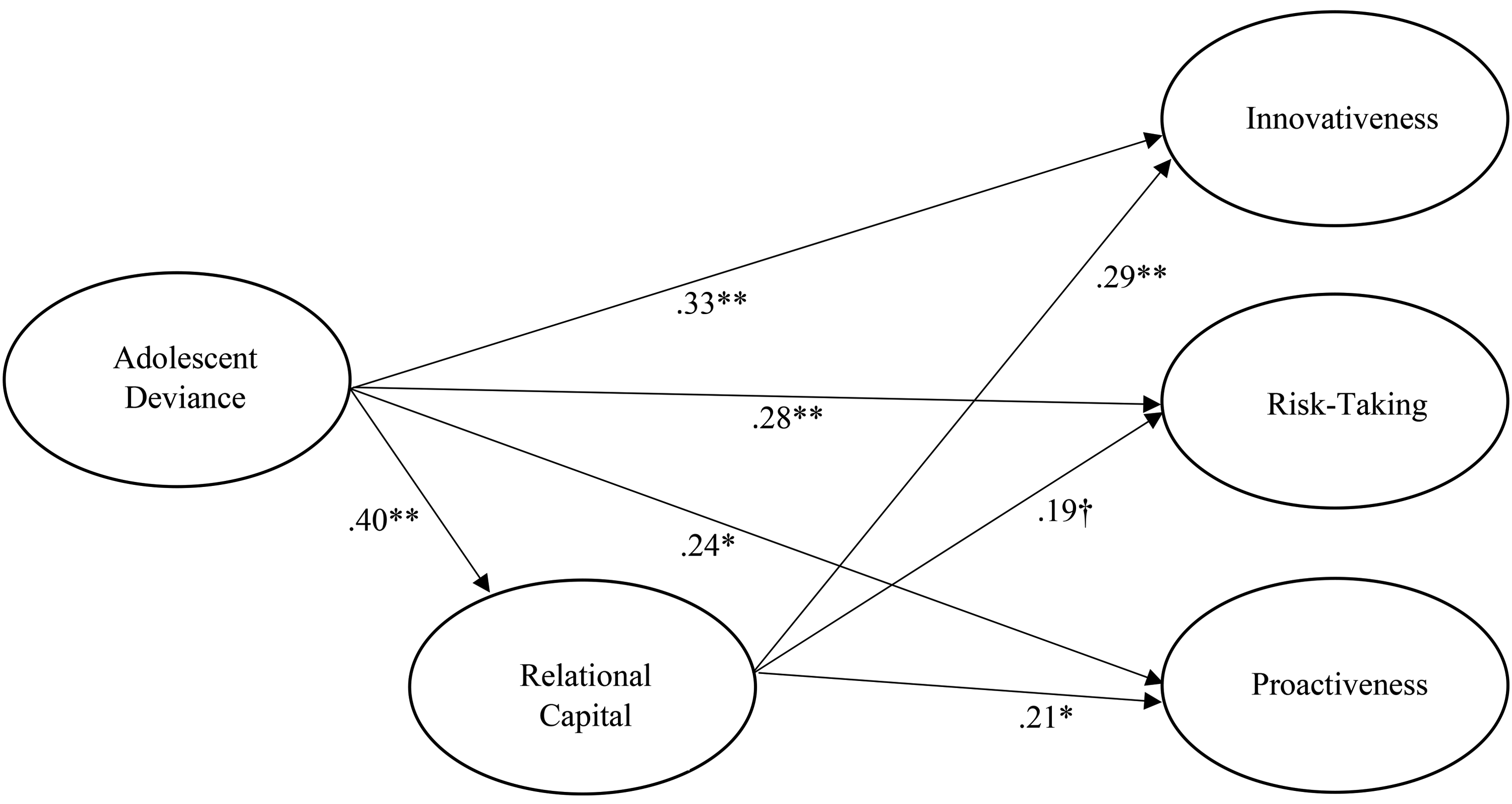
Theoretical framework.
Conclusion
The empirical results of our study provide valuable contributions to extant entrepreneurship and social network literatures. Specifically, this examination provides valuable insight into the role of deviants’ social networks and potential for entrepreneurship in the following ways. First, we demonstrate that adolescent deviance is critically related to determining entrepreneurial behaviours, including innovativeness, proactiveness and risk-taking. As such, we extend the earlier work by Levine and Rubinstein (2013), which demonstrated that adolescent deviants “have a higher propensity to become self-employed” (p. 19) and of Zhang and Arvey (2009) by bringing attention to the importance of relational capital and social networks within the framework of entrepreneurial deviance. While Zhang and Arvey (2009) demonstrate that adolescent deviants are more likely to become entrepreneurs, our results show that adolescent deviants are more likely to be both more innovative, and higher in risk propensity than other adults.
Second, our research also contributes to how entrepreneurship scholars have treated relational capital and social network theories. Davidsson and Honig (2003) showed that the pursuit, development, and maintenance of social network relationships is vital to nascent entrepreneurs. Anderson et al. (2007) suggested that entrepreneurship occurs within social interactions, social relationships, and social networks. Liao and Welsch (2005) demonstrated that entrepreneurs receive emotional, physical, and informational support through the utilization of relational capital within their networks. By adding the variable of adolescent deviance to prior conversations, this study can provide rich context to help scholars further understand the value of social networks and individuals’ relational capital in entrepreneurial intentions. Earlier research contends that a strong and significant relationship exists between social networks and relational capital (e.g. De Carolis et al., 2009). Our findings support this prior work by demonstrating that adults, who were adolescent deviants, will rely upon relational capital in considering new venture creation. This is not surprising as peers from their social networks become more important to adolescent deviants than non-deviants (Osgood et al., 1988).
In addition, the mediating effect of relational capital between adolescent deviance and innovativeness, proactiveness, and risk taking, is much more evident. While all three were positive, innovativeness and risk-taking were significant. This finding explains that relational capital may provide numerous advantages in promoting innovativeness and risk-taking among adults who were adolescent deviants. These individuals likely garner support through their relational networks in deciding to take risks and move towards innovative developments.
From a practitioner perspective, these findings can provide benefits for investors and others providing support to entrepreneurs. Angel investors and venture capital firms consider copious factors when deciding to support specific entrepreneurs and their new ventures. Investors often weigh various factors of an entrepreneur’s network prior to making a decision to invest (Witt, 2004).
From a social perspective, our findings may have implications to influence policy, assist institutions, government leaders, and parents in improving curriculum designed to capture adolescent deviants’ attention and to direct their focus towards positive outcomes. Developing curriculum, which improves entrepreneurship education, has been shown to improve a nation’s economy (Jack and Anderson, 1999). Current avocation programmes have demonstrated mixed results, working for some while being ineffective for others (Skorikov and Vondracek, 2007). To make improvements, various entrepreneurship educational programmes should be concerned with improving awareness while encouraging and even supporting innovation, supporting proactivness and understanding risk (Fayolle et al., 2006). Adding entrepreneurship education may have a positive impact on these programmes and the adolescent deviants they support. These programmes may serve as invaluable educational vehicles for these deviants looking for outlets in which to display their creativity and need for individuality.
Future research
This study leads to other important directions for future research. One such avenue is to explore the relationship between innovativeness, proactiveness, and risk taking with rates of entrepreneurship within adolescent deviance. Though these traits are related to entrepreneurship, this does not ensure individuals create new ventures (Bolton and Lane, 2012). Our study demonstrates that as adults, those who were adolescent deviants are more likely to use relational capital to increase innovativeness, proactiveness, but it does not address actual rates of entrepreneurship within this demographic. Therefore future research may help explain the manner and rate that this group begin new ventures and how they may or may not succeed.
Another direction for further research is the manner that adolescent deviance impacts legitimacy. As this study is not concerned with gaining or maintaining legitimacy, this may be a worthwhile question. However, we expect that institutional effects will moderate any such relationship. For instance, informal institutions may use bonding networks and ascribed trust to exclude outsiders (Tonoyan et al., 2010). Surely, adolescent deviants and others with broad networks may be better suited for environments where informal networks are prevalent.
We also suggest a research study designed to examine the manner that human capital is impacted by adolescent deviance, relational capital and social networks. Recent studies emphasize the importance of social networks and human capital to explain the importance of these in early entrepreneurship activities (e.g. Duan, Sandhu & Kotey, 2021); Shabsough, Semerci & Ergeneli, 2021). While there is limited existent theory to explain these relationships, we suggest a qualitative research study focused on building theory. This will assist researchers in further explaining the relationships between innovativeness and proactiveness.
Understanding how adolescent deviance, entrepreneurship intentions and the relational capital they use has not been a primary focus of the literature. Our study strengthens this literature while demonstrating that importance of measuring innovativeness, proactiveness and risk-taking at the individual level. The findings also demonstrate that the relational capital available to those that were adolescent deviants differs from non-deviants. Adolescent deviants are not “as lost” as previously thought as they may be able to leverage relational capital to succeed as adults.
Footnotes
Declaration of conflicting interests
The author(s) declared no potential conflicts of interest with respect to the research, authorship, and/or publication of this article.
Funding
The author(s) received no financial support for the research, authorship, and/or publication of this article.
