



Abstract
Music education provides well-documented classroom benefits, yet generalist teachers often report a lack of readiness to integrate it into their lessons. Using Castells’ theory of identity formation (legitimising, resistance, and project identities) this study investigates teaching confidence among trainee generalist primary teachers in British international schools in the United Arab Emirates (UAE). Using an explanatory sequential mixed-methods design, 18 trainee teachers at a British university branch campus were surveyed about their musical experiences and teaching confidence, with 11 participating in follow-up interviews. Findings revealed that music was ranked lowest among subjects they felt confident teaching, despite most having previous music experience. Analysis showed how dominant Western musical paradigms influenced participants’ self-perception, creating tensions between their diverse musical experiences and perceived professional requirements. These perceptions affected confidence, particularly when teaching older primary students. Despite these challenges, an emergence of teaching methods that offered pathways towards a more inclusive pedagogy was observed in the data. This research contributes to understanding how cultural conceptions of musicality affect teacher confidence and has implications for international teacher education programmes. It recommends developing approaches that help trainee teachers reconceptualise musical knowledge and practice, to embrace more inclusive pedagogical strategies that validate diverse musical experiences.
Keywords
Introduction
The United Arab Emirates (UAE), established in 1971, is a country with an 85% expatriate population (Marquez et al., 2022). As with countries such as Qatar, Kuwait, Singapore, and Hong Kong, schools that serve this population are predominantly private fee-paying schools offering a range of international curricula (Hayden, 2006). These schools are also popular with local Emirati families who want globally recognised qualifications such as the American Advanced Placement, British A Levels and the International Baccalaureate (IB; Matsumoto, 2019). This study takes place at a recently established international campus of a British university in the UAE, running the Initial Teacher Education (ITE) framework to prepare graduates to work in any British curriculum school worldwide. At the time of writing, 450 schools are registered as British Schools Overseas (BSO) in 79 member countries, of which 69 are in the UAE (Department for Education [DfE], 2024).
ITE training delegates time between Maths, English and Science, referred to as the “core,” and the remaining “foundation” subjects (Barnes & Scoffham, 2017). Studies in the UK have shown that foundation subjects, including music, are often marginalised in training and take a back seat in school placements (Caldwell et al., 2021). In the context of global education reform efforts, there has been growing interest in the potential of music education to enhance academic achievement and overall school efficiency. The framework for Culture Arts and Education, endorsed at the World Conference on Culture and Arts Education in Abu Dhabi (UNESCO, 2024) emphasises the importance of broadening arts education experiences by integrating them into policies, strategies, curricula, and programmes. Studies focused on music and arts provision at primary (aged 4–11) age report improved academic achievement and self-expression, but note that the extent of these benefits may be influenced by factors including parental and societal appreciation, exposure, and availability to such activities.
Discussions around the delegation of teaching in the primary classroom often involve the roles of “generalists” and “specialists” (Russell-Bowie, 2010). Generalist teachers are so-called because they are expected to have the skills to deliver the 10 required subjects in the British curriculum (DfE, 2013). Arts subjects are often delegated to “specialist” teachers (Buldu & Shaban, 2010), and when it comes to music, many challenges are highlighted regarding the subject’s integration into the broader curriculum (De Vries, 2013). Researchers have found a wide range of musical experiences amongst generalist teachers (Henley, 2017) and those who advocate more cross-curricular musical integration from generalists believe it is important to dispel the myth that music is a “special” subject for fewer people (Mills, 1989). However, a lot of the musical experience of generalist teachers falls outside the “Western Classical” tradition that many specialists are trained in Lamont et al. (2003). These different views of music instruction are what Bowman (2012, p. 32) describes as educating “in” and “through” music. Educating “in” music focuses on skills with predictable outcomes, while educating “through” music focuses on broader aims and educational growth. As a result, generalist teachers cite a lack of these “traditional” musical skills as a reason for their lack of confidence in delivering the subject (Hallam et al., 2009; Hennessy, 2017; Russell-Bowie, 2010; Seddon & Biasutti, 2008).
This study explores the perceptions and musical confidence of trainee primary teachers regarding the integration of music into their lessons. Research suggests that perceptions of what constitutes “musicality” may create barriers to effective music integration (Hennessy, 2000; Russell-Bowie, 2010; Seddon & Biasutti, 2008; Westerlund et al., 2017). It is therefore important to understand how teachers navigate tensions between their personal music experiences and classroom requirements. To contextualise these complex issues, how teachers perceive their musicality and confidence will be discussed through the lens of Castells’ (2010) theory of identity formation processes. This framework identifies three modes of identity construction:
Legitimising identities, introduced by dominant institutions such as Western Classical musical establishments and traditions, to extend and rationalise their position within social hierarchies.
Resistance identities emerge when individuals are positioned outside the dominant paradigm.
Project identities, which represent new positions that redefine roles and practices, moving beyond restrictive categories.
These processes provide a valuable lens for examining how trainee teachers develop their musical self-concepts and how these influence teaching confidence for a diverse student population.
Legitimising Musical Identities
Castells’ (2010, p. 8) notion of “legitimising identities,” helps explain how musical traditions establish normative standards that shape people’s musical self-perceptions. Perceptions of musicality are often constructed through intersecting cultural, historical, and disciplinary lenses. Rather than representing fixed or universal qualities, it is argued that what counts as “musical” has been through sociocultural processes reflecting broader power structures and value systems (Westerlund et al., 2017). Western classical conceptions of musicality have often emphasised skills such as the ability to read staff notation and to have technical proficiency on an instrument (Bate, 2020; Hennessy, 2000). Staff notation, a musical requirement for children aged 7 to 9 in the British curriculum (DfE, 2013), is often perceived by generalists to be an indicator of musicality (Biasutti, 2010). Cox (2018) argues that the Western Classical canon is frequently mythologised by policymakers and is given the highest priority in the musical hierarchy (Daubney, 2017; Hess, 2015). Perpetuating this hierarchy is the fact that many specialist music teachers are trained in the Western Classical tradition, with little experience elsewhere (Hallam et al., 2011; Hargreaves et al., 2007).
Resistance Identities in Music Education
Bond (2017) argues that when one type of musical knowledge is held in higher regard, it marginalises traditions that shape the identities of increasingly international student populations. These “resistance identities” (Castells, 2010, p. 8) can emerge among culturally diverse populations, and whenever individuals are positioned outside dominant musical paradigms. Westerlund et al. (2017, p. 78) highlight that musical identity is dynamic, hybrid and intersectional, warning against “ocularcentrism” that views diversity through established ethnic or geographical categorisations. The recognition of these dynamics has led to calls for a more culturally responsive musical pedagogy where this contemporary context of musical identification is recognised and celebrated (Lamont & Hargreaves, 2021).
Many studies recommend singing in the classroom to engage all students with musical activities (Johnstone, 2015; Whidden, 2010). Singing is also promoted as the direct entry into the musical experience (Music Manifesto, 2006). However, the tension between legitimising and resistance identities leads to generalist teachers perceiving themselves as insufficiently musical by specialist standards, reporting a lack of either innate or poorly developed singing skills, often citing being “tone deaf” (Lamont, 2011) and being unable to sing in the correct pitch (Holden & Button, 2006). This self-perception leads to binary self-categorisations as either singers or non-singers, often comparing themselves unfavourably to highly skilled musicians (Welch et al., 2011). Similarly, proficiency with a musical instrument is often perceived as the primary marker of being a good musician (Randles, 2011). However, a drop in instrument lessons occurs between primary and secondary ages, often attributed to a reported dissonance between what students want and specialist teacher perceptions of what is correct (Lamont et al., 2003). In addition, the high cost of instruments and private lessons creates barriers to musical participation, particularly for those from lower socioeconomic backgrounds (Bath et al., 2020; Burland, 2020).
Project Identities in Music Education
The development of “project identities” (Castells, 2010, p. 8) represents a shift in how teachers construct approaches to music education, challenging traditional hierarchies and redefining what counts as musical competence. Constructivist concepts of musicality recognise that generalists with the potential to deliver a high standard of informal pedagogy that is relevant to the lives of students with a diverse range of musical experiences (Green, 2008; Mills, 1989; Paynter, 1982). This perspective shifts focus from predetermined skills to the agency of both teachers and students in navigating their perceived and actual ability to act musically (Westerlund et al., 2017). Garrett (2019) recommends that generalist teachers be educated in how obtainable musical learning can be in the classroom, collaborating with specialists across disciplines and reflecting the common ground they share (Rogers, 2016).
Research Context
With a wide range of curricula offered, there are currently eight British university branch campuses in the United Arab Emirates (UAE; British Council, 2024). Those offering the Initial Teacher Education (ITE) model supply British Schools Overseas (BSO) international schools with newly qualified teachers, helping deliver the government’s promise of a “First Rate Education” to its competitive knowledge economy (UAE, 2017). A broad demographic of the majority expat population attends these private schools, with children often referred to as “third culture kids,” whose primary sense of belongingness is in this internationalised transcultural environment (Lijadi & van Schalkwyk, 2018). The majority of these schools support music, and while there is no specific reference in the school inspection framework, “creativity,” “critical thinking,” and “innovation,” often associated with art and music (Baker, 2013), are key criteria (KHDA, 2016; Ministry of Education, 2017). This study contributes unique insight into previous literature on teacher musical confidence in Western contexts by examining this phenomenon in the UAE’s international education landscape, where teachers and students navigate complex identities shaped by expatriate experiences and third-culture dynamics (Lijadi & van Schalkwyk, 2018).
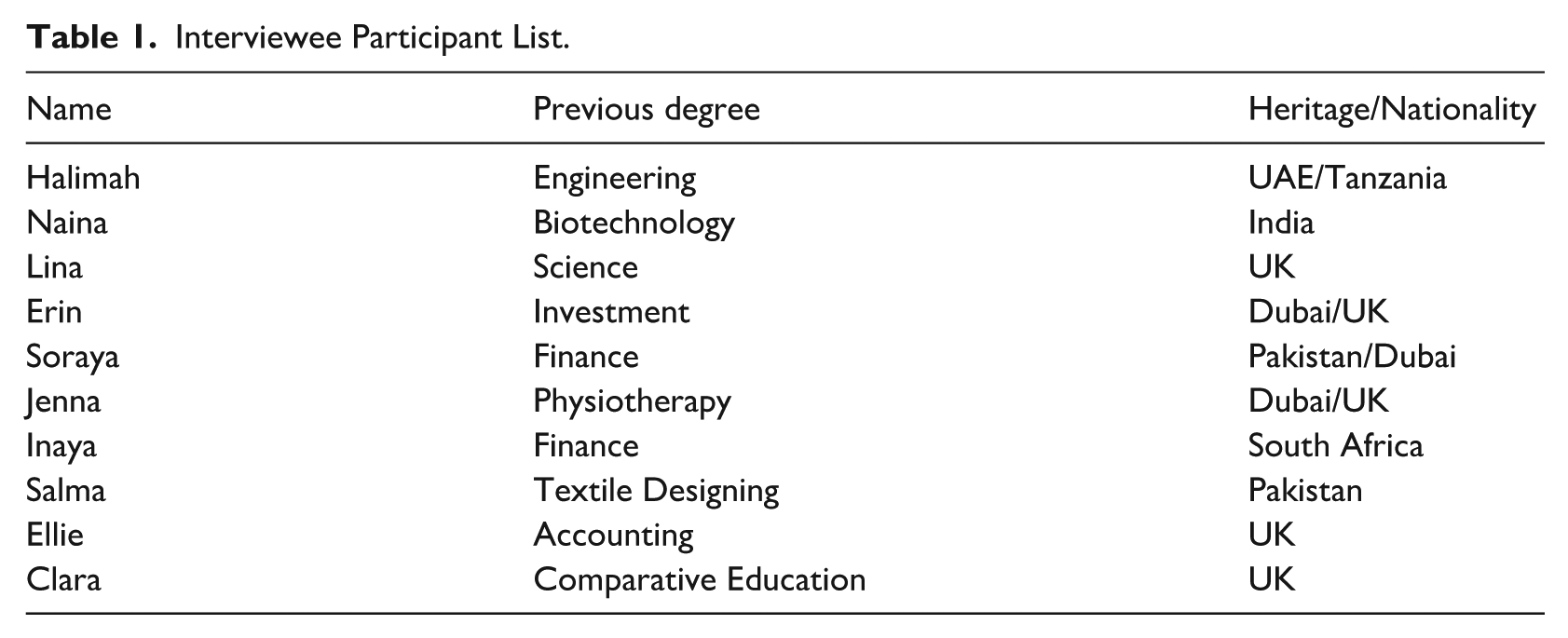
This research examined factors influencing musical identities, confidence, and preparedness to integrate musical activities—practical engagement with music (singing, playing, listening) in conjunction with other subjects. It involved primary school trainee teachers from diverse backgrounds (Table 1). The study aims to contribute to developing inclusive pedagogies, approaches that acknowledge and validate diverse musical backgrounds, regardless of experience in music making (Henley, 2017). The research looks to address the questions:
What are the perceptions of musicality amongst trainee international primary school teachers studying at a British branch campus in the UAE?
How confident are the UAE’s trainee international primary school teachers in their potential to integrate music into their lessons, and what factors influence these confidence levels?
How can trainee teachers’ perceptions of musicality and music confidence be understood through Castells (2010) identity formation processes?
Interviewee Participant List.
Data Collection
Data were collected at the beginning of the 2022–23 academic year at a British university offering ITE in the UAE. Participants had just begun their induction at their placement school and were due to begin teaching. The University’s Ethics Committee ethically approved the study under guidelines laid out by the British Ethical Research Association (BERA, 2024). Participants were given an information sheet that contained all relevant details, including the voluntary nature of their participation. They were also given a consent form and debrief forms. Participant names have been replaced with pseudonyms.
As an external researcher not affiliated with the ITE institution, combined with the intensive nature of the programme schedule, access to the university’s cohort was limited. A mixed methods design was chosen in an explanatory sequential design (Denscombe, 2021), where a survey was conducted, with follow-up interviews to gain further insight and explain the survey answers. This approach was seen as appropriate given the nature of the research questions and the practical constraints of accessing participants on campus. It meant the researcher only needed to arrange one visit to the campus to carry out the survey and recruit for the interviews, which could be conducted online at the participants’ own convenience.
Of the 19 participants enrolled in the course, 18 took the survey. This is a small but representative sample of the complete cohort of trainee teachers, especially considering no other institutions in the UAE are delivering this specific trainee programme. The survey instrument was developed based on the theoretical framework presented in the literature review, with a primary focus on perceptions of musicality and teacher confidence in delivering music. Eleven participants agreed to participate in 30-min follow-up interviews via Microsoft Teams, triangulating to provide sufficient qualitative data to explain the survey findings while maintaining methodological rigour within these constraints (Denscombe, 2021). Questions targeted survey results that gained a deeper insight into their perception of musicality (e.g., Why do you think music was ranked ninth?). They were asked further questions on their musical confidence (e.g., Can you describe how you would feel singing in front of someone?) and what skills a so-called “non-specialist” would need when teaching music in the classroom. Descriptive statistics were calculated using SPSS 25. Interview data were thematically analysed using NVivo 12. Reflexive Thematic Analysis was applied (Braun & Clarke, 2022, p. 13), chosen because of its flexibility and fluidity in replicating the multifaceted nature of participants’ lived experiences. In this case, interviews discussing musical experiences within diverse contexts mimic the “messy” nature of real-world conversation. The researcher began with deductive coding, using a priori themes derived from literature on musical confidence and teacher identity. Inductive coding was then employed to explore additional meaning and nuances within participant experiences that extended beyond the initial framework. Finally, Castells’ (2010) identity formation framework was applied deductively as an overarching analytical lens to categorise and interpret both the literature-derived and emergent themes within the concepts of legitimising, resistance, and project identities. The integration of methods primarily occurred at the data interpretation stage, where interview findings were explained and elaborated upon in relation to the survey results.
Validity and Reliability
The survey employed measures designed to capture aspects of musical identity, experience, and confidence across the cohort. Items were developed using established theoretical frameworks (Holden & Button, 2006; Seddon & Biasutti, 2008) and refined through pilot testing with a cohort of 25 teachers on a postgraduate course in the same institution. The instrument included demographic questions, ranking tasks, and individual rating scales that served specific analytical purposes rather than forming unified constructs suitable for reliability analysis. The pilot led to refinements in question phrasing and clarification of the distinction between teaching music as a subject and integrating musical activities. Three teachers who were either newly qualified or in their second year of teaching were interviewed, resulting in terminology refinements for potential interviewees who had not been educated in a British curriculum.
The sequential explanatory design provided convergent validity through the triangulation of quantitative and qualitative data, with interview findings systematically exploring and validating the patterns identified in the survey. Limitations include the absence of formal reliability statistics and inter-rater reliability testing, though established theoretical frameworks ensured analytical consistency.
Results
The findings are organised according to Castells’ (2010) identity formation processes. This framework allows for an integrated analysis of survey and interview data, revealing how trainee teachers navigate tensions between dominant musical paradigms and their own musical experiences.
Legitimising Identities—Dominant Musical Paradigms
Using a five-point scale, with 1 meaning “Not at all,” 2 “Not Really,” 3 “Somewhat,” 4 “Quite a lot,” and 5 “Very much so,” participants in the survey were asked if they considered themselves musicians. Nobody answered above 3, with the majority (n = 12) of participants opting for 1, “Not at all.” Reasons given for this perceived lack of musicality ranged from a lack of engagement with instruments (n = 4) to an inability to sing (n = 6). Participants who used to play instruments ( n = 3) either “struggled,” had “forgotten,” or “only got to Grade 1.”
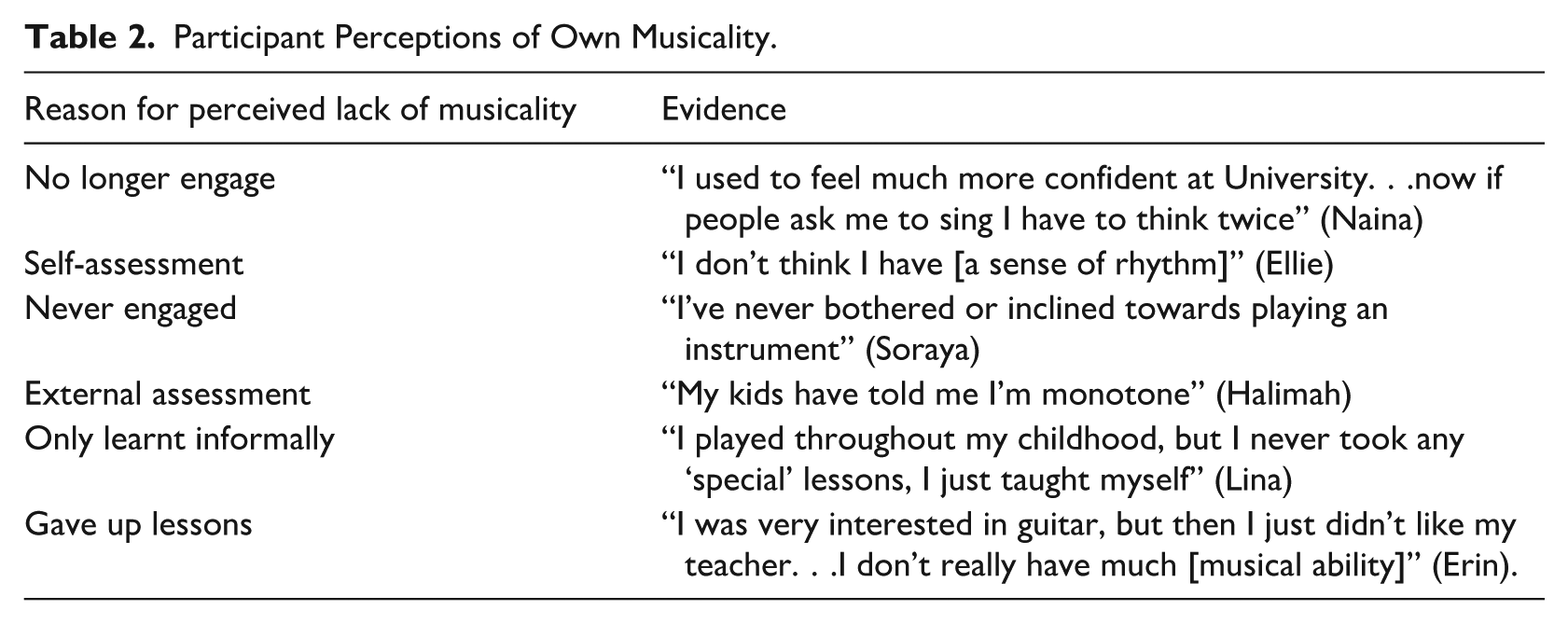
Themes of perceptions of musicality were followed up in the interview questions. The individual narratives illustrated in Table 2 show a trend among the trainee teachers: perception of inadequate musicality influenced by personal experiences, external feedback, and self-assessment. Naina’s experience encapsulates a theme of diminishing confidence after school, suggesting a transition from a supportive educational environment to somehow feeling underprepared and hesitant to demonstrate musical skills. Ellie’s self-assessment points to a deep-seated belief in lacking fundamental musical qualities, highlighting internal barriers that prevent individuals from perceiving themselves as musically adept. Soraya’s detachment from active music-making contributes to her perceived lack of musicality. Halima’s reflection on her children’s feedback illustrates how external assessments can profoundly impact one’s self-perception of musicality. Lina’s experience suggests that informal self-directed learning experiences, while valuable, may not always translate into internally recognised musical competence or confidence, especially in a formal educational setting. Erin’s negative experience with a music teacher discouraged her from pursuing an interest in guitar, leading to a long-lasting belief in her lack of musical ability.
Participant Perceptions of Own Musicality.
Interview data revealed how legitimising identities manifest through perceptions of what constitutes “knowledge” for music teaching. This specialist knowledge that they believed they lacked has been broken down into:
Analytical knowledge—“I can tell you this song is nice. . . just because I like listening to it. If you’ve done a course in music or something then you have a backing for why it is what it is” (Halimah).
Experiential knowledge—“You’ve got to have experience and have played or taught previously” (Lina).
Technical knowledge—“With PE (Physical Education) it’s still easier to tell a child to run and jump. . . but because music. . . sort of has more technical stuff to it” (Soraya)
Expert knowledge—“To teach something to someone you have to be an expert in it” (Inaya).
Instrumental knowledge—“A lot of people think music is down to, like, you have to teach an instrument, how to play an instrument or how to play music, and that’s kind of scary for people.” (Erin)
To triangulate this, n = 6 of the interviewees also believe that musicality is innate (Table 3), with n = 4 believing that environmental factors are also important. Jenna and Erin were the only ones aligned with the principle that if someone is engaging in music, they are musical. Halimah hints at an intuitive appreciation for rhythm, suggesting that musical engagement starts with a basic affinity for beat. Clara and Inaya express a common sentiment that musicality, particularly being in tune, is innate. This belief is echoed by Naina and Ellie, who suggest that genetic predisposition plays a crucial role in musical talent.
Perceptions of Musicality.
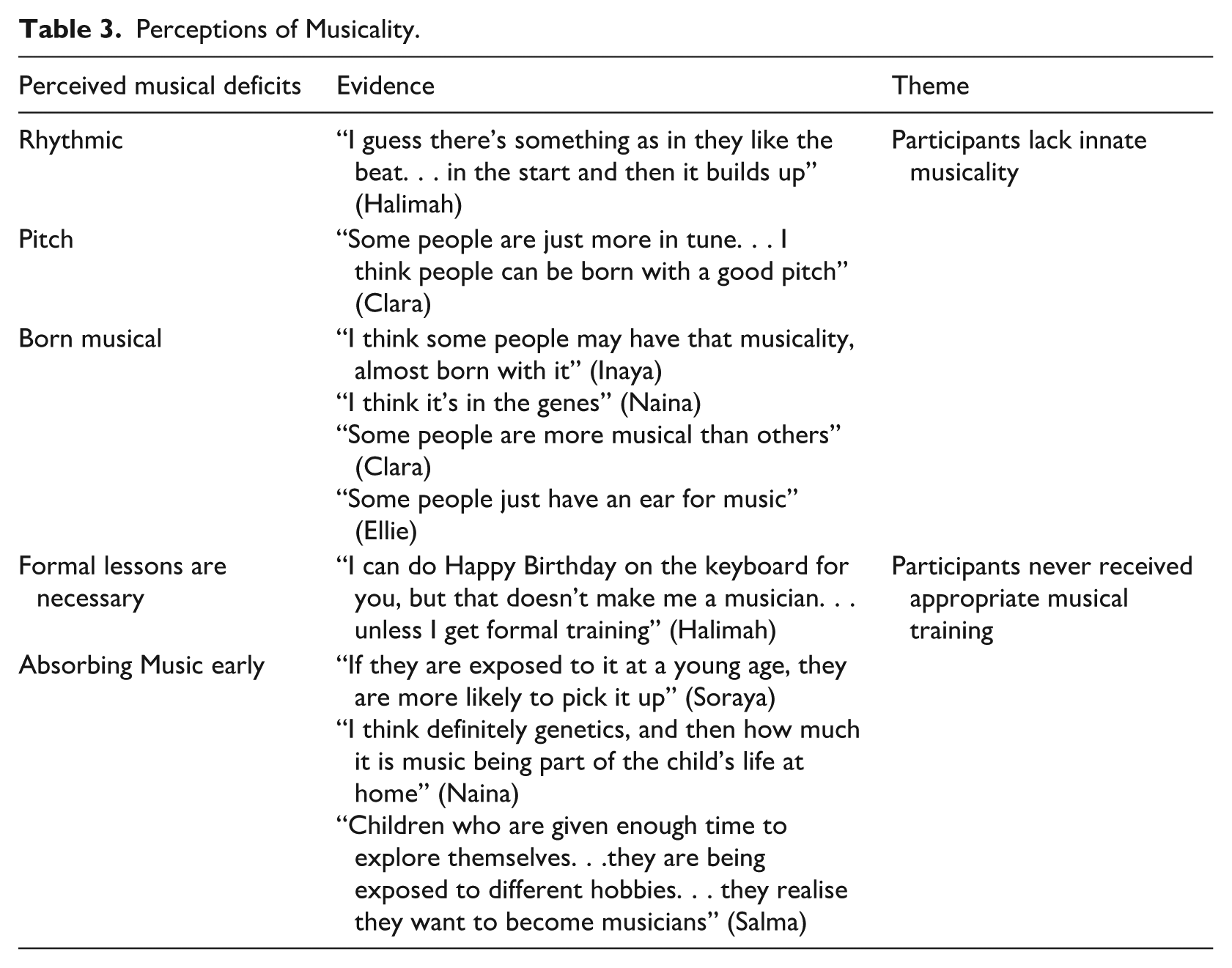
Conversely, there’s an acknowledgement of the value of formal music education. Halimah’s statement underscores a belief that true musicianship requires formal education, supported by Soraya and Naina’s comments on the importance of early musical exposure. Salma also suggests that early and diverse experiences can foster a path to musicianship. This tension between the belief in inherent musicality and the need for formal training reflects how legitimising identities have shaped participants’ self-assessment against what they believe are “formal” musical standards.
Resistance Identities—Musical Marginalisation
Despite perceiving themselves as non-musical, all participants grew up with some form of music education. Those who had learnt an instrument, either informally or through lessons, declared to have since given up. The most popular musical activity was singing, with n = 5 singing or having sung in a choir and n = 7 enjoying singing karaoke. Clara grew up in Wales, where they would “naturally sing in four-part harmonies” in school assemblies and participate in national singing competitions. Extra-curricular activities were popular among the participants and included house singing competitions (Naina), the school production (Soraya), keyboard club (Jenna), recorder (Inaya), and violin via peripatetic teachers (Clara). Participants had guitar (Erin), and violin (Jenna) lessons outside of school.
For some, these musical experiences were marked by negative interactions that produced feelings of inadequacy. Salma and Erin shared experiences of teachers who would negatively reinforce them if mistakes were made. When describing her fear of making mistakes in her guitar class, Erin recalls: “He used to get like ‘oh my gosh, why can’t you just do this?’ And I was like ‘oh because I’m still learning’”.
When asked how they would feel singing in front of people, participants declared a lack of confidence, claiming they either could not sing at all (Soraya, Ellie, Halimah, Erin) or were “terrified” (Jenna). Some labelled themselves as “tone-deaf” (Halimah) or simply “atrocious” (Erin). Some were happy singing when younger but “lost” either their confidence (Naina) or overall ability (Salma).
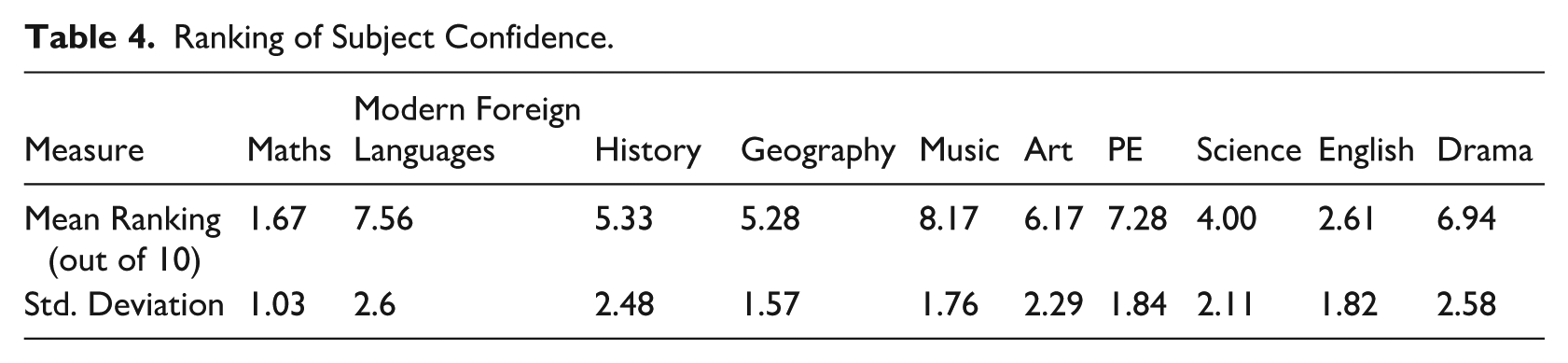
Their subject confidence further reflected this interplay between musical experience and self-perception. On a six-point scale between “strongly disagree” and “strongly agree,” 83% (n = 15) of trainee teachers stated they were confident in their teaching potential. However, when asked to rank the 10 Primary subjects in order of how confident they would feel teaching (Table 4) music was the lowest, with an average ranking of 8.17 out of 10 and SD of 1.76.
Ranking of Subject Confidence.
The survey and interview data revealed age-related confidence boundaries. As the age group increased, through Early Years aged 3 to 5, Key Stage 1 aged 5 to 7, Key Stage 2 aged 7 to 11, and Key Stage 3 aged 11 to 14, participant confidence in music teaching decreased. Interview data revealed that participants perceived older students as being more judgemental of their musical abilities, especially in the case of singing. When probed, Inaya, Halimah, Clara, and Lina believed older students would be more judgemental of their singing.
“If I was singing in front of a class of year 1 or 2 children then I think I would be ok. But then everyone else?. . .No I think I’d be very very intimidated”. (Inaya). “Maybe to a class of five, six seven-year-olds maximum”. (Halimah) “I think definitely less confident incorporating it into Year 6” (Clara). “I used to be a nursery teacher. . . so I used to sing to my class all the time. Now my placement is with year 3s, so they’re like 7-8 years old. They’ll probably laugh”. (Lina).
These age based teaching boundaries represent resistance identities that emerge as participants navigate between dominant musical paradigms and their desire to engage with music integration, shown in the project identities below.
Project Identities: Alternative Approaches to Music Teaching
Despite the constraints of legitimising musical identities and the defensive positions of resistance identities, evidence of emerging project identities was also apparent in the data. A promising finding revealed that while participants lacked musical confidence, n = 16 declared in the survey data that they agreed or strongly agreed that they would feel confident linking music with other subjects, with the remaining declaring they would be neutral. Participants discussed alternative approaches to incorporating music, such as playing and teaching songs for memory retention or to de-stress students, as well as hands-off approaches that ensured music was an integral part of the learning process.
Clara explained that in the case of incorporating music means using it as a “tool” to learn something else rather than as the primary focus. Lina agreed, characterising music integration as a more informal “jokey” way of delivering the lesson; “you’re obviously teaching them something, but it’s not about the music.”
These coping strategies represent resistance identities that emerge as participants navigate the tension between dominant musical paradigms and their desire to engage with music integration.
Discussion
This study examined trainee teachers’ perceptions of their musicality, their confidence in music integration, and how these phenomena can be understood through identity formation processes. Applying Castells (2010) theory of identity formation reveals how trainee teachers’ musical confidence emerges through interactions between legitimising, resistance, and project identities. This theoretical lens shows that participants’ lack of self-confidence comes from a positioning against dominant musical paradigms rather than a simple absence of musical skills. Before discussing these findings in detail, it is also necessary to acknowledge the current study’s limitations. The small sample size of British international school trainees and potential response bias due to awareness of the researcher’s background may impact generalisability. The survey instrument employed brief measures designed for comprehensive cohort coverage rather than multi-item scales, which precluded traditional reliability analysis while enabling full participation from the target population. However, methodological triangulation through interviews provided convergent validity. The limited evidence of project identities likely represents participants’ developmental stage as trainee teachers, as transformative pedagogical approaches require sustained professional experience to emerge (Castells, 2010).
Applying Castells’ (2010) framework to the findings reveals how Western classical conceptions of musicality function as legitimising identities, shaping trainee teachers’ musical self-perception and teaching confidence. Music was ranked the lowest subject to teach, with the core representing the top three, perhaps as a reflection of the allocation of teaching time to these subjects (Barnes & Scoffham, 2017). This resulting confidence pattern reflects how teachers are prepared for English, Maths and Science, with little time to navigate foundational subjects. The large standard deviations (SD) for other arts and humanities subjects (Art, Drama, History, and Modern Foreign Languages) reflect greater individual variability than the core. However, Music’s relatively low SD (1.76) reveals uniformly low confidence across participants, suggesting consensus about a lack of pedagogical competence. Interview data revealed a fixed concept of musicality that requires specific skills or knowledge (Hennessy, 2000) that participants have never pursued, cannot acquire or have “lost.” Anxieties about music teaching centred around a perceived deficiency of the technical skills associated with educating “in” music, while overlooking their capacity to educate “through” music (Bowman, 2012, p. 32). Lina’s belief that her piano skills, informally “learned” rather than “taught,” made her less of a musician aligns with findings from Seddon and Biasutti (2008) and observations by Mills (2006). The perception that lacking “special lessons” in Western Classical skills like reading staff notation diminished her musicality demonstrates how institutional legitimising identities can marginalise diverse musical experiences (Westerlund et al., 2017). Inability to afford to rent instruments caused feelings of separation from the “different kind of group” who took paid lessons outside the classroom and developed Western Classical skills that were rewarded inside the classroom (Westerlund et al., 2017). Erin discussed her guitar teacher persuading her to learn classical over rock music, perpetuating the dissonance between what she wanted to know and what was being taught (Lamont et al., 2003). These examples show that these skills are still highly valued (Bond, 2017; Daubney, 2017; Hargreaves et al., 2007; Hess, 2015), permeating “professional ocularcentrism” (Westerlund & Karlsen, 2017, p. 78) limiting the ability to recognise and value diverse expressions of musicality that fall outside dominant paradigms. This positioning is particularly problematic in the UAE’s international schools, where students come from diverse backgrounds with complex cultural identities and educational needs (Lijadi & van Schalkwyk, 2018).
The survey and interview data highlighted trends found in previous literature on musical confidence (Hallam et al., 2009; Holden & Button, 2006; Seddon & Biasutti, 2008). These trends revealed patterns consistent with Castells’ (2010) concept of resistance identities, participants developing self-protective positions in response to the dominant paradigm. Despite a diverse range of musical experiences, all participants declared they were not confident in teaching music because they believed they did not have the necessary skills and knowledge. This perceived deficit was illustrated in the ranking of primary subjects (Table 4). Music was seen as “daunting” and “scary” to some, and beyond the capabilities of others (Hennessy, 2000). By defining musicality through Western Classical frameworks such as analytical (Bate, 2020), technical (Hennessy, 2000), experiential (Seddon & Biasutti, 2008) and expert (Lamont et al., 2003), participants internalised legitimising identities (Westerlund et al., 2017) and positioned themselves outside recognised music practice without challenging its fundamental assumptions. Bate (2020) emphasises how the skill of analysing and appraising is often only elevated if it accepts the pre-existing construct of Western Classical as the gold standard in the canon of existing music. Hennessy’s (2000) study illustrates similar elevation of these standards where the participants are afraid that if they cannot recognise certain musical elements, they “might not know whether what they are playing is any good” (p. 9). On a broader note, Table 4 also highlights the lack of confidence teachers feel in other “foundational” subjects (Caldwell et al., 2021).
As with previous findings, a lack of innate traits like rhythm and pitch was an indicator of a lack of perceived musicality (Biasutti et al., 2015; Daubney, 2017; Lamont, 2011), with participants describing themselves as “tone-deaf” (Lamont, 2011). Evidence of a straightforward “right” and “wrong” way of being musical emerged, whether it was grounded in the Western Classical tradition, the opinion of a previous music teacher, or someone else’s assessment. The interviews showed that this self-perception fed into their confidence in leading and delivering music. They reported to be more confident singing in front of Key Stage 1 (aged 4–7) than Key Stage 2 (aged 7–11), thinking older students were likely to judge them more, aligning with research from (Holden & Button, 2006).
Despite internalised legitimising identities, participants showed awareness of the benefits of integrating music to enhance classroom practice, suggesting potential to redefine the concept of their musical position in the class and introduce “project identities” (Castells, 2010). Some had experienced more inclusive informal pedagogies, as Garrett (2019) recommended, demonstrating a co-constructed vision of music practice (Westerlund & Karlsen, 2017). However, these identities did not present themselves as much as legitimising and resistance identities, possibly reflecting the participants’ developmental stage as beginning trainee teachers. This indicates that increasing the musical confidence of primary teachers in the UAE is crucial for improving the experience for both students and teachers, and should begin at the trainee level. This will move beyond the one-size-fits-all approach to music education and embrace strategies that validate and include students from an internationalised setting (Lijadi & van Schalkwyk, 2018). Training institutions should facilitate continuing professional development on inclusive, informal pedagogies that validate diverse musical experiences (Bond, 2017; Green, 2008; Hess, 2015). Promoting these teaching methods will empower those with existing musical skills and allow them to reflect critically on their perception of musicality and the underlying reasons for lacking musical confidence. Singing, in particular, is a resource-light activity that has the potential to connect to the broad identities of the student cohort (Johnstone, 2015; Whidden, 2010). Reflection on teacher singing confidence, particularly the fear of judgement from older children, could be helpful for future inquiry.
Conclusion and Implications
These findings show how the interplay of identity formation processes shapes trainee teachers’ musical confidence across diverse educational contexts. Using Castells (2010) identity formation processes as a lens, this study reveals that teachers’ musical confidence reflects an ongoing negotiation between competing identity positions. The problem may not be teachers’ lack of musical skills, but how music education systems construct and maintain boundaries around musical legitimacy. Legitimising identities create barriers when internalised by participants who then perceive themselves as musically inadequate, despite varied musical experiences. Resistance identities emerge as self-protective responses, evident in age-specific teaching boundaries and self-deprecating musical labels. The development of project identities through cross-curricular music integration suggests potential pathways towards more inclusive music pedagogy. These findings challenge music education systems that may inadvertently create barriers to inclusive musical participation. This study proposes a shift in teacher education towards approaches that validates trainees’ existing musical experiences by critically examining dominant musical paradigms, while fostering project identities that redefine meaningful music integration. Rather than ask “How can we make teachers more musical” we should ask “How can we help teachers recognise they are musical?.”
To further develop these recommendations and test their effectiveness, the next phase of this research will implement and evaluate specific pedagogical approaches within the UAE’s international teacher education context (Anderson & Benson, 2025). Future longitudinal research can investigate how project identities develop as teachers gain classroom experience and navigate the tensions between dominant musical paradigms and diverse student needs, examining these dynamics across more diverse curricula and educational contexts. Comparative research exploring how similar issues manifest in international school settings would further contribute to understanding how musical confidence develops in globalised educational landscapes.
Footnotes
Author Note
Research was conducted at the University of Birmingham Dubai before the researcher worked there.

Ethical Consideration
Ethical approval was given by the Ethics committee of Durham University. Informed consent was given by all participants through information sheets, consent forms, and debriefing sheets.
Author Contributions
Philip Anderson: Conceptualisation, Data curation, Formal analysis, Methodology, Project administration, Writing—original draft, Writing—review & editing.
Funding
The author received no financial support for the research, authorship, and/or publication of this article.
Declaration of Conflicting Interests
The author declared no potential conflicts of interest with respect to the research, authorship, and/or publication of this article.
Data Availability Statement
The datasets generated during and/or analysed during the current study are available from the corresponding author upon reasonable request.