




Abstract
Purpose of the Review:
Death by suicide among young people is a growing issue worldwide. Every year, 46000 children (10–19 years old) take their lives. Lack of social support is one of the causes of suicide in young people. This narrative review aims to highlight the impact of teachers’ support in the prevention of death by suicide among young people.
Collection and Analysis of Data:
A literature search was conducted in Scopus, PubMed, Embase, and Web of Science to find out the relevant studies using the keywords and synonyms of “social support,” “young,” “suicide,” and “teacher.” The original articles published in indexed and peer-reviewed English language journals in the last 10 years (2014–2023) were included in this review. The included articles were focused on teachers’ support in terms of the prevention of suicide among young people. After screening the title-abstract and full-text articles, the review findings revealed that support from teachers has a positive impact on the prevention of suicide among young people. Young people who have higher teachers’ support show lower suicidal behaviors. Hence, teachers’ support acts as a protective factor against suicide in young people.
Conclusion:
The review concludes that teachers’ support has shown a positive impact on reducing suicidal behaviors among young people. Teachers are important sources of support in understanding suicidal behaviors in young people. Holistic support from each one of us is the enormous need to reduce the number of suicides. Studies have recommended that teachers’ support should be the focus of intervention, for example, school-based psychoeducation on young people’s suicide.
Worldwide, death by suicide is a growing issue among young people. Every year, more than 7,00,000 people take their lives, and it is the fourth major cause of death in people aged between 15 and 29 years. 1 In Bangladesh, death by suicide among students is more common than in the general population. 2
There are many social and cultural risk factors for suicide among adolescents in Asia. 3 Involving teachers in school-based programs on suicide prevention along with life skills training and problem-solving techniques has created a positive awareness among students in other countries. 4 Adolescence is a significant phase for acquiring emotional and social behaviors that contribute to mental well-being.
A protective and supportive environment in the family, school, and community is very important. Due to a lack of quality support from significant others, many adolescents are at risk for developing mental health issues. The existing study reported that the number of suicides in girls who were between the ages of fifteen and nineteen doubled from 2007 to 2015, while among boys who were between the ages of fifteen and nineteen, it increased by 30% during the same period. 5 According to the National Crime Records Bureau (NCRB) of India, every hour one student dies by suicide, and from 2013 to 2016, Maharashtra, Madhya Pradesh, Tamil Nadu, and Karnataka had the highest number of student deaths by suicide. 6 The United Nations Sustainable Development Goal, SDG3.4.2, talks about the suicide mortality rate. 7
Since ancient times, it has been believed that social support has an important role in suicide risk. 8 The interpersonal theory of suicide and the sociological theory of suicide describe a lack of social support that increases the risk of suicide.9,10 The interpersonal theory of suicide also explains that social support strengthens feelings of belongingness in reducing the risk of suicide. 11 Studies have shown that social support is associated with reducing the risk of suicidal ideation and suicidal attempts in adolescents,12,13 and adults. 14
Existing systematic review,15,16 and meta-analysis 17 showed that individuals who have higher social support show lesser depressive symptoms. Social support acts as a protective factor in students’ lives. Social support lessens the negative impact of stressful situations by improving coping abilities. 18 Students spend most of their time at school with teachers and peers. Teachers are the people who can identify the symptoms of suicide among students at an early stage and support them. Earlier literature has demonstrated that social support from teachers has a profound impact on mental health. It has been co-related negatively with depression, suicidal ideation, and suicidal attempts.19–22 The National Suicide Prevention Strategy, 2022 (NSPS) introduced by the Government of India has focused on suicide prevention among students.23,24 The NSPS also focused on stress management training for students by teachers.23,24 By reviewing existing literature, it is understandable that training teachers, students, 24 and school staff 25 may be helpful in the prevention of suicide.
Many studies have been done on the impact of family support, peer support, or many sources of social support (parents, close friends, community leaders, teachers, etc.) together on young suicide, but very few cross-sectional studies have been conducted, mainly focusing on teachers’ support. The authors could not locate any review on this topic, so this will be the first narrative review of its kind. Thus, the authors intend to highlight the impact of teachers’ support in the prevention of death by suicide among youth.
Review Question
Does the teachers’ support have an impact on the prevention of death by suicide among youth?
Methods
Search Strategy
A comprehensive literature search was conducted in Scopus, PubMed, Web of Science, and EMBASE to find relevant studies using the MESH terms and keywords and synonyms “social support,” “young,” “suicide,” and “teacher.” The Boolean operators (OR, AND) were used to create the search strategy.
Study Selection
The inclusion criteria for the present reviews are as follows:
The full-text articles are published in an indexed and peer-reviewed journal. The articles were published in the English language in the last 10 years (2014–2023). The articles focused on the impact of teachers’ support in terms of young suicide. Young people: Age 10–24 years
The exclusion criteria for the present reviews are as follows:
Conference proceedings, reviews, commentary, letters to the editor, and study protocols are excluded from the present review. Published articles on the impact of social support from other sources, for example, parents, family members, and peers, are excluded in the present review.
Data Extraction
The initial search yielded 145 articles (PubMed = 18, Embase = 30, Scopus = 33, Web of Science = 64). Retrieved articles were screened on RAYYAN software, and thirteen articles were included in the preset narrative review based on the inclusion criteria.
Results
After screening the title-abstract and full-text articles, 13 cross-sectional articles were analyzed, and study details are explained in Table 1. The results are analyzed in the context of the geographical location (setting), income category, and sample characteristics. All the studies assessed teachers’ support as an outcome variable. Out of 13 reviewed articles, nine articles concluded that support from teachers could reduce suicidal behaviors among young people.
Summary of Articles Included on the Impact of Teachers’ Support in the Prevention of Death by Suicide Among Young People.
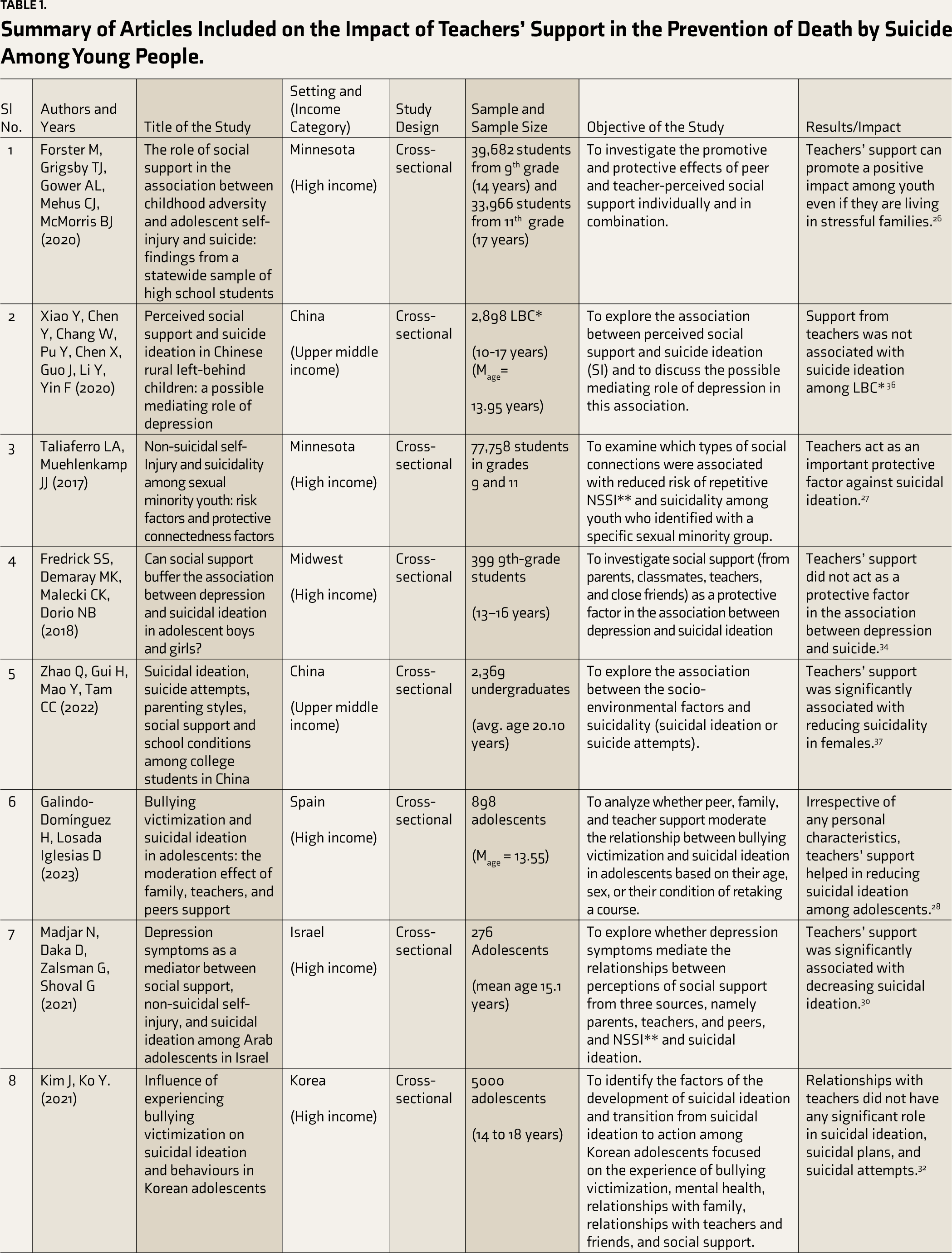
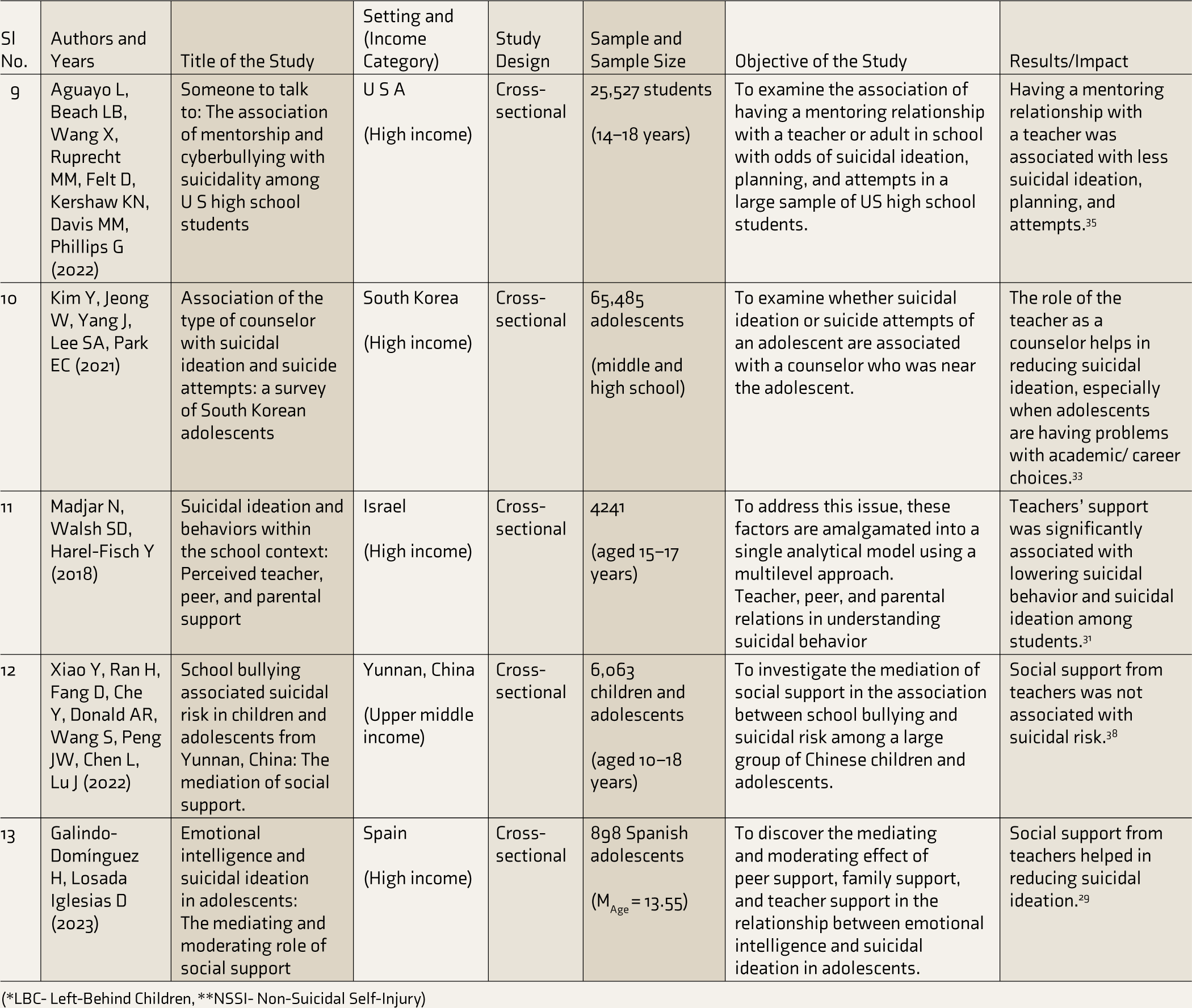
(*LBC- Left-Behind Children, **NSSI- Non-Suicidal Self-Injury)
The review findings revealed that support from teachers has a positive impact on young people’s suicide. Young people who have higher social support show lower suicidal behaviors. Hence, social support acts as a protective factor against suicide in young people.
Geographical Location and Economic Setting
A greater number of the studies (n = 10) were from high-income countries, including two studies each from Minnesota, Spain, Israel, the United States, and Korea.26-35 Three studies are from China, an upper-middle-income country.36–38
Characteristics of Study Participants
Out of 254,258 participants (in 13 included studies), two studies were done among both 9th graders and 11th graders,26,27 and one study was done only among 9th-grade students. 34 One study was among undergraduate students, 37 and another was conducted among middle and high school students. 33 Left-behind children (LBC) 36 participated as well. The minimum age of the study participants was 10 years, and males, females, and sexual minority youth participated in the included studies.
Tools/ Instruments Used to Assess Teachers Support
Teachers’ support was measured by the Teacher–Student Relationships Scale from the Student Engagement Instrument developed by Appleton et al., 2006. 26 Yes/No questions35,36 and Likert scale type question were given to measure the support from teachers.27,37,32 The interpersonal social climate dimension was also used to measure the support received from teachers. 29 Among the included articles in this review, most of the articles used different Likert scales to assess the teachers’ support, such as different versions of the Child and Adolescent Social Support Scale (CASSS) developed by Malecki, Demaray, & Elliott, 2000,34,38 the Scale of Positive Support developed by Richards & Branch, 2012, 30 and the Teacher Support Scale developed by Torsheim et al., 2000. 31
Impact of Teachers’ Support
Teachers’ support can promote a positive impact among youth even if they are living in stressful families 26 or with achievements/ career choice-related problems. 33 Higher support from teachers was associated with a lower level of suicidal behaviors among students.26,28,29,30,31,35 Literature also showed that teachers’ support was not associated with suicidal ideation34,36 and was not associated with bullying victimization and the risk of suicide among adolescents. 38 Teachers’ support acts as a protective factor against suicidal ideation among youth. 27 A higher level of teacher support was associated with a lower level of suicidality in females. 37 Another study revealed that support from teachers helps in reducing suicidal ideation irrespective of sex and age. 28 A study also showed that relationships with teachers did not have a protective role in suicidal plans, suicidal ideation, and suicidal attempts. 32
Discussion
From the results of the current review, it is highlighted that very limited studies have focused on teachers’ support against suicidal behaviors among young people. Though the support from teachers helps in reducing suicidal behaviors among students, it varies across grades. Once the students adjust to the classes, the protective effect increases with the number of sources of support. 26 Support from teachers was not associated with suicide ideation among left-behind children. It may be due to the smaller number of items used to assess the outcome variable. 36 Another study also highlighted that teachers’ support did not act as a protective factor. This may be due to the lower number of classes taken by a teacher, which may limit the building of a strong relationship between student and teacher, 34 different school cultures, and system. 32 Females are more inclined to accept the support that is available to them. It may act as a protective against suicidality. 37 Adolescents spend most of their time at school with teachers; therefore, counseling by teachers was helpful to lessen career-related issues, which helped to prevent death by suicide. 33 The teacher supports students through active listening, empathy, encouragement, and respect, which act as a key factor in reducing suicidal ideation among students. 29
Limitation
This narrative review was restricted to articles published only in English between 2014 and 2023 and aged between 10 and 24, which may need to be revised to generalize the study’s findings.
Conclusion
The review concludes that support from teachers has shown a positive impact on reducing suicidal behaviors among young people. Teachers are important sources of support in understanding suicidal behaviors in young people. Holistic support from each one of us is the enormous need to reduce the number of suicides among young people. Studies have recommended that teachers’ support should be the focus of intervention, for example, school-based psychoeducation on adolescent suicide. More research studies and clinical work need to be conducted on the same topic to strengthen the evidence for awareness among students, sexual minority youth, as well as in the community.
Footnotes
Acknowledgements
The authors express their gratitude to all the authors of the original article that have been found useful in writing this review.
Declaration of Conflicting Interests
The authors declared no potential conflicts of interest with respect to the research, authorship, and/or publication of this article.
Declaration Regarding the Use of Generative AI
None used.
Funding
The authors received no financial support for the research, authorship, and/or publication of this article.