




Abstract
Background:
Witch-hunting is an evil practice and part of the culture of many marginalized groups in India and globally. The unethical ways of barbarity against women happening in the name of the witch-hunting practice is another face of gender-based discrimination against women who are denied basic living rights. This study aims to understand the psychosocial consequences experienced by witch-hunting survivors.
Methods:
This study applied phenomenological research design and collected data using in-depth interviews through purposive sampling, which include ten witch-hunting survivors from seven rural and tribal districts of Jharkhand, who were identified at least one year before by the Jharkhand State Livelihood Promotion Society (JSLPS). In-depth interviews were analyzed based on thematic analysis steps by Braun and Clarke, 2006.
Results:
The themes of this study findings comprise the various ways in which a woman is being branded as a witch and how they are intended to go through shame, stigma, and discrimination; in addition to that, this study also explores the mental health issues faced by the witch-hunting survivors and the protective factors which lend a hand for them to fight back against the sociocultural drawbacks.
Conclusion:
It is evident from this study results that the survivors experience mental health issues. This study suggests the urgent need to strengthen the civic system to enhance better support for survivors. In the meantime, addressing their challenges, including mental health needs, will contribute to a better quality of life.
The emergent themes from in-depth interviews not only provide a comprehensive understanding but also underscore the significant importance of the multifaceted nature of the survivor experience. This article significantly contributes to the limited literature by not just bridging gaps in knowledge, but by amplifying the voices of a community that has long been unheard, thereby making a substantial impact. The study highlighted the need for potential implications for mental health interventions and policy changes that will enhance the survivors’ well-being.Key Messages:
Sociocultural issues prevail across all nations, affecting all sections of society. One such evil practice is carried out in the name of witch-hunting, which persists in modern times. Witch-hunting is an evil practice prevalent in a few parts of India and certain Western countries. Witch-hunting has been more prevalent among many European countries since the sixteenth century and has spread across other countries. 1 In most cases, poor working-class, widowed, and older women were considered witches. 2 According to a UN report, between 1987 and 2003, almost 25,000 cases related to witch-hunting were recorded in India. 3 Also, the National Crime Records Bureau (NCRB) data shows that more than 2,500 people were murdered on alleged charges of practicing in witchcraft in India from 2000 to 2020. 4 The practice of witch-hunting was very much in vogue in the mid-nineteenth century in Assam. It is argued that the Santals believe in witches and that the world comprises disembodied spirits. 5 In India, hundreds of unreported incidents occur every year in the name of witch-hunting. Most such cases were reported in Jharkhand, Madhya Pradesh, Rajasthan, Uttar Pradesh, Bihar, Chhattisgarh, Odisha, and Assam. 6 Once a woman was declared a witch, she tended to undergo severe physical and mental torture, ostracization, harassment, and isolation from her community, and she was even forced to consume human excreta. 7
As per the NCRB-2020 in India, 4 88 murders were recorded in the name of witch-hunting, of which 15 alone were in Jharkhand. However, these are only reported figures; there cannot be any denial of the cases which might have gone unreported. As per civil societies, there have been over 1,800 murders in Jharkhand in the past 18 years. 8 A survey initiated under the GARIMA project in 2017 reveals that, in Jharkhand, over 1 lakh women have survived witch-hunting across 32,000 villages. 8 This data implies that, on average, each village in Jharkhand is home to three women who have been labeled as witches and are living their lives in humiliation, isolation, and under constant threat. Furthermore, every third woman faces the extreme danger of being lynched or murdered due to witch-hunting.
Even in this twenty-first century, the majority of the communities living in the state of Jharkhand are guided by a strong belief in the existence of witches and their practices, which are blamed for all kinds of unpleasant happenings, including ill health and poor mental health and that act as the primary reason behind the witch-hunting.7,9 Even though much research was carried out based on the hysterical and phenomenological factors associated with the practice of witchcraft or witch-hunting, physical violence appears to be a precondition for any case living in the criminal justice system. 2 However, the psychological violence associated with those evil practices is not even discussed; this study looked into unexplored areas of psychosocial consequences. Also, this study was carried out mainly to elicit the impact of psychosocial consequences among the survivors of witch-hunting and to understand the various associated challenges. This study findings will help to address the consequences of witch-hunting and the promotion of mental health aspects.
Methods and Materials
This study was reviewed and approved by the Institute’s Ethics Committee (letter no. IEC/CIP/2021-22/987 dated: 28 January, 2022).
This study used phenomenological research design, as it helps explore a phenomenon within some particular context through various data sources and enables the exploration through various lenses to reveal multiple facets of the phenomenon. 10 It also helped the researcher explore the real-time phenomenon within its naturally occurring context. 11 This study followed purposive sampling technique and included ten survivors of witch-hunting from seven rural and tribal districts of Jharkhand such as Bokaro, Gumla, Kunti, Lohardaga, Latehar, Simdega, and West Singhbhum, who were identified at least before one year under Jharkhand State Livelihood Promotion Society (JSLPS) with either any one of the languages like Hindi, Sadri, and Mundari as their medium of communication. Those survivors who are already undergoing psychiatric, medical, and neurological conditions and those who are receiving mental health services were not included in this study. Data was collected from May 2022 to December 2022, recruited ten samples. The researcher stopped in-depth interviews with the survivors until the new themes did not emerge in the following interview; data saturated with ten samples. As part of the data collection proceedings, an in-depth interview guide was prepared based on the subject knowledge, reflections on personal and professional experience in the field, review of the literature, and discussions with the guide and other experts in the field. The interview guide was designed in such a way as to explore the various psychosocial factors associated with witch-hunting, and it was also finalized after conducting two pretested interviews, which were not included as part of the final analysis. The In-depth interviews were conducted in the State Institute of Rural Development (SIRD) training center, where the JSLPS used to organize welfare programs for the witch-hunting survivors and other stakeholders along with the other partnering institutions, such as a Central Institute of Psychiatry, Ranchi. The JSLPS arranged all the logistics at their training center. Before the mental health promotional programs, interviews were conducted with the help of the JSLPS staff. Prior to the scheduled program, witch-hunting survivors were explained about this study individually; those who anonymously agreed to this study were considered, based on the inclusion criteria, purposefully chosen the sample carefully for the in-depth interviews, and confidentiality was ensured. At the beginning of each interview, the purpose of this study and potential risks involved in discussing emotional issues were explained. Additionally, information was provided to the research team, and available psychosocial help services, if required, were provided, followed by informed consent from the participants. Then, an in-depth interview was conducted using a semistructured questionnaire.
Data Analysis
The collected data from the in-depth interviews were analyzed using thematic analysis steps given by Braun and Clarke using QDA Miner Lite 2.0.1, a qualitative data analysis software developed by Provalis Research. 12 The audio-recorded interviews were transcribed after the interviews. Initially, initial codes were generated with QDA Miner software for all the datasets and entered in separate code sheets. In a collaborative effort, the research team used QDA minor to work collaboratively on the same dataset to ensure transparency and inclusivity in the coding process. All three authors then meticulously verified the coding sheet individually and prepared a master coding sheet, ensuring the highest accuracy and reliability in data. Later, codes were identified as meaningful themes. After the initial coding, we revisited the data and revised the themes based on further analysis and discussion. These codes, subthemes, and themes were checked by an expert in the field of qualitative research, who is not part of the research study, with the help of expert suggestions, and three authors’ consensus reached broader themes—coded data and themes reviewed by the expert to ensure accuracy and reliability. When disagreements arose, I reached out on the most appropriate coding decisions. These themes were critically analyzed, the research team resolved discrepancies, and the final themes were named appropriately. The survivor’s most expressive and complete quotes were chosen and presented in the result section to depict the main themes. Basic sociodemographic details of the survivors were calculated and presented as mean, median, standard deviation, and frequency distribution with Statistical Package for Social Sciences (SPSS) software version 25.
Results
Case Descriptions of the Survivors Who Participated in Qualitative Study
The average age of the in-depth interview survivors was 43 years old (standard deviation (SD) = 9.08) with an age range of (30-56 years), and they were from 7 districts of Jharkhand. The majority of the survivors were married, illiterate, and also fell under lower socioeconomic status. They belonged to a nuclear family with an average of five members (SD = 2.54) in each family. The majority of the survivors were working as farmers and daily wagers. All the survivors were exposed to branding as a witch and its associated issues for an average of seven years (SD = 1.49).
Discussion
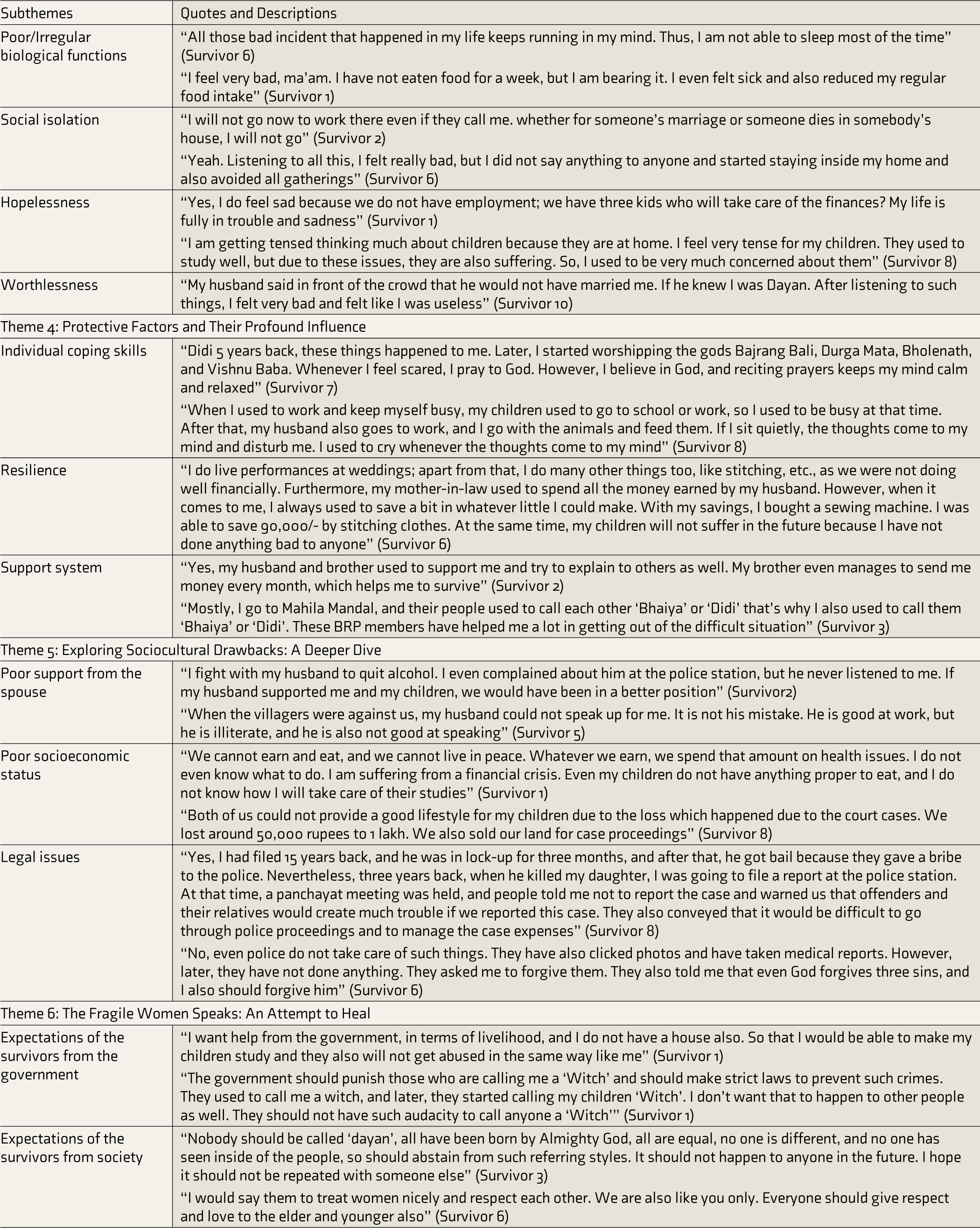
This study, which involved ten qualitative interviews on the psychosocial consequences of witch-hunting survivors, emerged with five themes: 1. Being a Witch: An Interaction of Power, Family, and Rural Beliefs; 2. Social Symbols: Feelings of Shame, Stigma, and Womanhood; 3. Impact on Mental Health: The Mind and Body; 4. Protective Factors and Their Profound Influence; 5. Exploring Sociocultural Drawbacks: A Deeper Dive; 6. The Fragile Women Speak: An Attempt to Heal (Table 1).
In-depth Interview Findings of the Study.
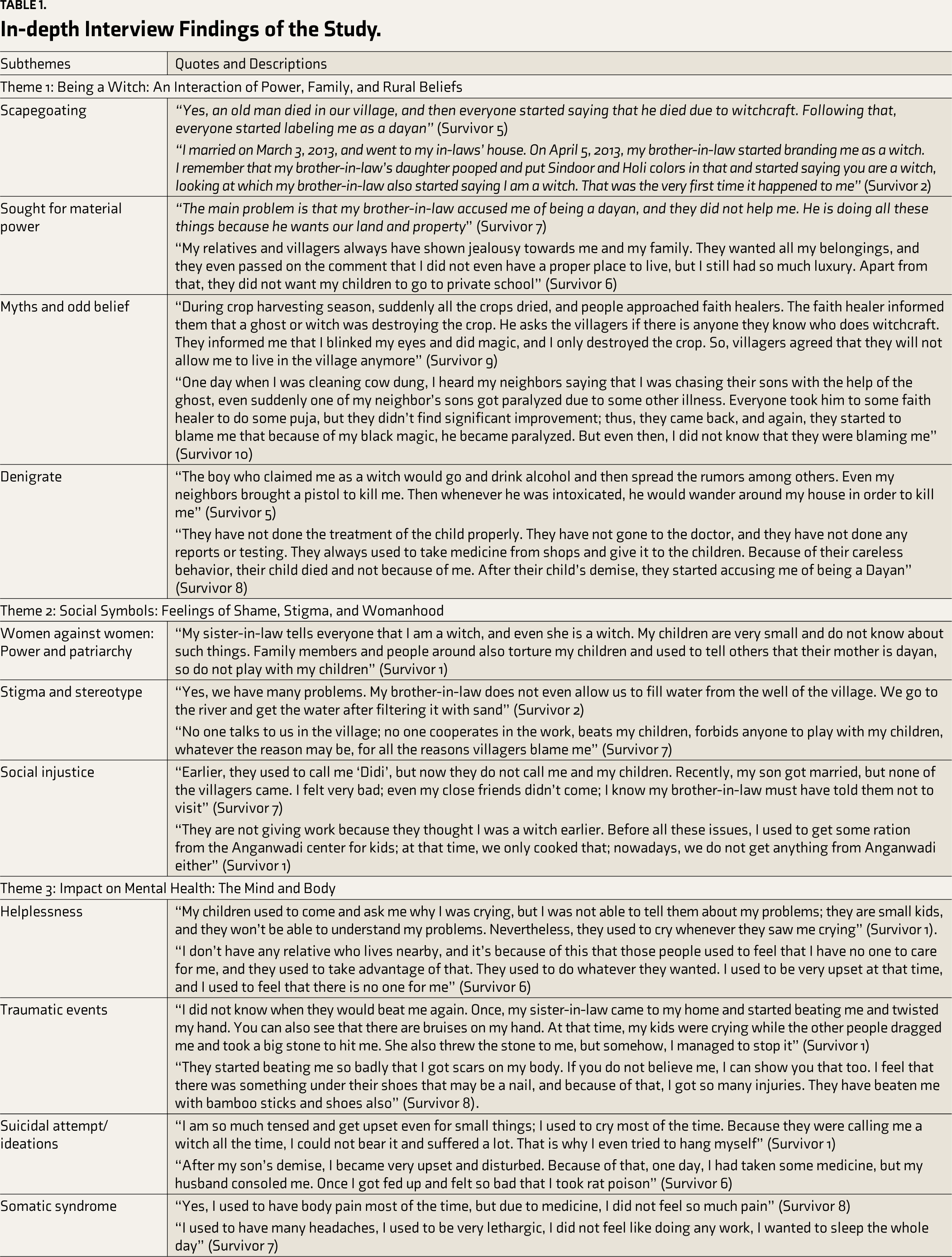
The majority of witch-hunting survivors were from Scheduled Castes, who are blamed for all societal disasters and misfortune. 13 Despite the numerous reasons given for labeling someone a witch, 7 out of 10 survivors highlighted that any death or illness that happened in the village was the primary reason. Labeling and branding someone as a witch and persecuting them with harsh punishments turn out to be a huge hunch. This finding aligns with a previous study, which revealed that members of the tribal community lack the financial resources for medical care, face transportation challenges, and have limited access to health infrastructure. As a result, they turn to faith healers, who often have a stronger belief in Ojhas. As part of this study, they have also discovered that witch branding is most common during the rainy season, which causes diseases like diarrhea, jaundice, and malaria, all of which have negative implications and can be fatal. 9 This study survivors also reported similar circumstances, as they have mentioned that villagers do not take care of their health and do not carry out proper treatment for their illness, leading to death. On the other hand, the number of educational institutions and hospitals was comparatively less than the number of religious institutions, which reflects people’s inclination toward supernatural beliefs and fantasies. 7 In support of the above scenario, certain survivors in this study were accused of being witches for engaging in religious activities such as praying as part of their daily rituals, while in another case, Holi powder mixed in a child’s (excreta) poop was claimed as part of witchcraft practices. A strong belief in faith healers led the villagers to believe that crops going bad were seen as a witch’s act. Even in Assam, the local people tend to believe that witches are responsible for the destruction of their crops and other livestock, etc. 14 This clearly states that the patrilineal agricultural communities (such as Hos, Mundas, and Santals) and Adivasis in Jharkhand tend to have deep-rooted traditional beliefs in bongas (Spirits, godlings) and dayans (witches), as they tend to celebrate festivals and practice rituals especially to win over the “bongas” and “witches” and to neutralize their harmful intentions. They also believe in black magic and often attribute misfortunes or illnesses to the influence of supernatural powers. Furthermore, they firmly believe that they must identify and eliminate witches, viewing them as detrimental to society. They do not consider witch-hunting as a social evil or sin.15,16 Lack of accessibility to mainstream society, health care, gender-based issues, illiteracy, and belief systems could be the reasons for all these misfortunes. In addition, people in Assam believe that there are three conditions: (a) they attribute all the issues around them to human beings; (b) they mainly believe these issues are caused by human beings who have acquired supernatural means; (c) the persecution of witches or witch hunts is considered a form of collective community acceptance. 17 Consequently, numerous victims and their relatives have not only lost their lives but also experienced traumatic circumstances in their lives. 15 On the other hand, previous studies reported that jealousy was prominent in witch accusation scenarios as early as the 1850s. Accordingly, envy and the desire for material or financial gain often motivated the accusers. These factors worked in tandem, particularly when the aim was to exploit single women and seize their property.18,19 However, the surviving women in this study who were not widows and living with their family members reported similar problems. As a result, the act of witch-hunting aimed at stealing property cannot be limited to childless widows. Survivors have reported that perpetrators who were under the influence of drugs and alcohol would often wander around the village, blaming the target person’s alleged witchcraft practices for any negative occurrences happening in and around the community. Thus, it is clear that the relationship between power, family, and rural belief significantly affects witch-branding. To remedy this measures to reduce strong and evil practices and increase cooperative living must be found.
Women’s subjection and subordination were generally regarded as structural conditions that were practiced throughout many social institutions and practices. Feminists refer to such institutional oppression of women as patriarchy. 20 In addition, witchcraft accusations are often associated with power dynamics as they act as another tool to suppress and subordinate women by declaring them as a vulnerable population.7,21 This forces women to live their lives in the fear that they will be harmed at any time to seek revenge or impose dominance. However, the majority of the survivors in this study indicate that they were labeled as witches by their family members and relatives as an act of social control to enforce conformity or punish deviant behavior. On top of that, most of the women survivors were branded and accused as witches by the women in their neighborhood who lived in and around their houses. This reflects the pitiful situation of women who are both perpetrators and victims. When a woman is labeled a witch, she faces discrimination from her family members as well as the entire community, which results in unemployment and their household properties being destroyed in the name of witch-hunting. The offender, along with the mob, also threatens and terrorizes individuals identified as witches, prompting them to flee to their homes. The survivors also stated that they were asked not to attend social functions, and their items from Anganwadi were withheld from them. According to studies, survivors were forced to undergo public humiliation in the name of witch hunts, with their heads shaved, faces painted black, stripped, and paraded about the village by the mob. They also chase and viciously beat the survivors with iron rods. All of this occurs under the guise of vigilantism in order to cleanse their community of the wicked soul who supposedly causes suffering.22,23 Similar findings were reported in a previous study, where individuals underwent comparable traumatic experiences. These unethical practices occurred in the presence of the village head, members of the Gramasabha, and various police officials. However, no one stood up to support the victim, indicating a lack of knowledge and a dismissive attitude towards these stereotyped superstitious beliefs. 9
The mental health impact of witch-hunting survivors was one of the key themes derived, which added to the findings of the other investigations. Studies have indicated that tribal women work more than their male counterparts in managing houses, raising children, and carrying out economically useful tasks in marketing and agriculture.24,25 However, in this study, survivors tend to remain inside their own houses and restrict themselves in and around their household areas due to the intense shame and stigma that they have faced from their relatives and community people. Accordingly, the theoretical models of shame and stigma also suggest that powerful social emotions can significantly impact an individual’s social relationships and self-esteem, which further lead to a range of negative outcomes such as social isolation and psychological distress.26,27 From a neuroscience perspective, the fear and stigma experienced by the survivors who were labeled as witches can trigger a stress response in the brain, affecting areas such as the orbital, insula amygdala, striatum, and ventromedial frontal cortex. That can lead to changes in behavior and physical health. 28 Similarly, this study survivors reported psychological distress and depressive symptoms such as helplessness, hopelessness, worthlessness, suicidal ideation, and physical complaints. In addition to the community they belong to, the cultural practice of witch-hunting has increased the chances of having more cases with such mental health issues, the symptoms of loneliness, bodily complaints, and sustained negative anticipating thoughts of the present and future life, where the results of traumatic events that occurred in the survivor’s life, such as witch-branding, threats of murder, subjecting them to euthanasia. All of these atrocities against women blamed as witches in tribal populations have been thoroughly investigated in prior studies, and the findings show that such women are raped and murdered, and at times their family members themselves perpetrate the crimes.8,14 Surprisingly, those who murder women do so openly, as it is embarrassing for anyone to be around a lady who is accused of witchcraft. They would rather conduct crimes and face legal punishments. 29 Furthermore, the pressures appeared to come from all directions because few had emotional assistance from family members to cope, few received no protection from the government, and few lost family members just because they were labeled as witches. 30 Furthermore, all of this violence is mostly directed against women or girl children because of the old Indian belief that being born as a female is a misfortune. Mistreating women is considered proud in many cultures, which is why so many crimes against women are committed. 31 As a result, all of these reasons combine to explain why witch-hunting survivors are more vulnerable to mental health disorders and require prompt assistance at all levels. Supporting this, a previous study has highlighted that the tribal community falls behind the national average in health metrics, with tribal women and children being particularly susceptible. 32 They bear a triple burden of diseases since it is difficult to bridge the healthcare divide between tribal and nontribal people. This is due to their low socioeconomic status; people in the tribal community struggle to meet their basic survival needs, the literacy rate is meager, and they do not prioritize their healthcare needs because they believe that any illness is the result of evil possessions/hostile spirits, the consequences of their ancestor’s sins, or a curse from God. 33 Therefore, they seek remedies from religious practices rather than the modern systems of medicine. 34 To drive progress on lagging indicators, it is essential to establish a mental healthcare delivery system that is more suitable, acceptable, accessible, and affordable for marginal communities, especially for survivors of such practices. Along with the qualitative needs assessment, a pilot study is needed to measure the psychosocial impacts using standardized tools like the psychological distress scale, trauma based on the discrimination scale, Hamilton depression and anxiety scale, which need to be used for in-depth understanding. Culturally appropriate interventions should focus on creating a mental healthcare system that prioritizes indigenous populations and emphasizes equity over equality. Perpetrators, survivors, family members, and community members should participate. The goal is not just to provide modern and high-quality mental healthcare but also to foster behavioral change. This can be achieved by strengthening the resilience and coping mechanisms of survivors through psychosocial interventions, such as psychological first aid, supportive psychotherapy, trauma-focused therapy, solution-focused therapy, individual and group counseling sessions, and family therapy. This strategy is further enhanced by implementing community-based mental health programs that adhere to a systematic methodology, including a current situational analysis, development of a shared vision, and strategic design. 35 These comprehensive intervention strategies aim to boost the essential emotional support, practical assistance, and advocacy that survivors receive from their families, friends, and community. This collective effort plays a crucial role in combating the detrimental effects of witch-hunting. Apart from that, sensitization programs can be implemented to encourage parents to enroll their children in government schools so that they receive a minimum high school education, enabling them to work for their community development.32,36
Few of the survivors claimed that they began to isolate themselves within their homes and restricted themselves from conversing with community members as they were in constant fear of being attacked anytime. It is also clear that the police department has played a passive role in handling witch hunt cases; even when survivors went to make a complaint against the perpetrators, police officials refused to file an FIR against the perpetrators and demanded appropriate evidence. Survivors also stated that police officers took bribes from the perpetrators and then released them without prosecution. In corroboration, a study reported that one-third of 48 cases never reached the police due to insufficient community support and lack of legal information. Survivors who attempted to file lawsuits against the perpetrators reported losing substantial amounts of money in court, as they came from lower socioeconomic backgrounds. While certain protective variables play a significant role in enabling an individual to have better day-to-day functioning, certain sociocultural aspects serve as significant barriers, impeding the individual’s ability to combat such malpractices. 37
Survivors of witch hunts who have faced difficulty have asked the government to expand projects and schemes to improve livelihood, as well as to take legal action against those responsible for the atrocities. They also mentioned that more job opportunities will help them improve their standard of living. This has been corroborated by previous studies, which have identified an urgent need to enact stringent legislation that severely penalizes offenders through antiwitchcraft laws.7,36 Allocation of special or judicial police officers should be done to ensure effective surveillance and follow-up on reported events. Witch-hunting survivors must receive comprehensive rehabilitation services as part of long-term management. Survivors from this study also voiced their desire that no one else be subjected to such humiliating events in their lives. Most witch-hunt survivors anticipate mutual respect from the community since it allows them to live their lives with dignity and integrity. All of the survivors’ hopes are a vociferation for protecting their fundamental human rights.
This is one of the first studies that investigated the mental health aspects of witch-hunting survivors in order to identify and address the psychosocial issues at various levels. This study has limitations, such as purposive sampling, only considering female survivors’ perspectives, the absence of triangulation, and participant validation. Thus, further studies can be conducted using a quantitative approach and a larger sample size to increase generalizability. The participant’s validation will help to rigorously explore the various psychosocial issues faced by the survivors and their family members. It also paved the way to explore the level of mental health issues and psychosocial interventions further.
Conclusion
This study findings suggest that survivors experience mental health issues due to a lack of awareness, prejudice, and stigma among people about mental health and illness, which have resulted in unattended basic human needs of good health and well-being. Therefore, this study has put forth the possible impacts and reasons for poor mental health. Hence, utmost importance is to be given to bridge the gap between such underdeveloped communities and their mental health requirements. Now more than ever, further specific interventions need to be developed for addressing their mental health issues; this study findings will help in framing interventions for their rehabilitation and reintegration into mainstream society.
Footnotes
Declaration of Conflicting Interests
The authors declared no potential conflicts of interest with respect to the research, authorship, and/or publication of this article.
Ethical Approval
This study was reviewed and approved by the Institute’s Ethics Committee of Central Institute of Psychiatry, Ranchi, Jharkhand, India (letter no: IEC/CIP/2021-2022/987, dated: 28 January 2022).
Funding
The authors received no financial support for the research, authorship and/or publication of this article.
Informed Consent
Informed consent was obtained from all the participants before the study.