




Abstract
Background:
Little is empirically known about how young children understand death or how this perception is affected by their attachment to parents.
Method:
One hundred and ten children between the ages of 5 and 10 years participated in this study, which assessed both children’s understanding of death and their fear of death. Parental attachment style was measured using parental self-report.
Results:
A correlation analysis found that a greater understanding of death was associated with lower levels of death anxiety when the children were securely attached. These results provide some empirical support for the widespread belief that discussing death and dying in biological terms is the best way to alleviate the fear of death in young children when parents have a strong bond with their children.
Conclusion:
Understanding of death and fear of death in children are associated with an insecure parental attachment style.
This article explores how a child’s understanding of death develops through the lens of attachment theory. It highlights the potential impact of attachment style on a child’s experience with death.Key Message:
Attachment theory examines how a child’s understanding of death is shaped by their early relationships with caregivers. This theory highlights the importance of early relationships in shaping an individual’s emotional and social development. It examines how a child’s attachment bond with primary caregivers influences their comprehension and emotional responses to death. The theory also explores how attachment separation, grief responses, cognitive development, and attachment figures can influence a child’s understanding of death. It also examines how parents and caregivers influence a child’s understanding of death through responsiveness and support. Death is a difficult concept to understand, particularly for young people who experience loss with different emotions and cognitive processes than adults. 1 Insight into children’s representations of death is needed to improve clinical understanding of their symptomatic responses to loss, as well as clinical interventions in children and educational interventions with parents and teachers who are regularly confronted with children’s spontaneous questions about death. 2
Children’s understanding of death depends both on age and previous experience. Children with experience of death appear to understand death more realistically than their inexperienced peers. Regarding the influence of age, our results support the idea that the different components of death develop through different processes. 3 Adults sometimes seem to believe that young children have no awareness of loss; however, they should be prepared to help children understand loss and death-related events. 4 Adults need to let them know that it is okay to talk about it, 5 and it may be key in reducing their death phobia. 6
Historically, children’s view of death may be influenced by the basic idea that death is a sleep-like state, such as in fairy tales (Sleeping Beauty). Many children also believe that dead people have thoughts and feelings, again through family and television (e.g., ghosts). 7 Children’s conception of death is from biological to spiritual; the end of the lifecycle implies the end of vital processes, and then they construct a conception of the afterlife that involves God and Heaven in the case of Christian children, or the word of ancestors in the case of Vezo children. 8
Several studies have explored the relationship between parents’ attachment styles and children’s understanding of death. Insecure attachment styles are frequently developed by children who do not have early positive experiences with their caregivers. 9 While insecurely attached people turn to less effective coping strategies when their anxieties arise, securely attached people can use their stronger interpersonal bonds and sense of self-worth as a shield.9,10 Children with a secure attachment were more likely to understand death as a natural and inevitable part of life. 11 Moreover, children with an avoidant attachment style were more likely to deny or avoid the topic of death altogether. 12 According to Krepia et al., 2 confusion in understanding death’s subconcepts results from children’s current cognitive and perceptual stage and external factors such as the environment, their parents’ and teachers’ opinions, attitudes, and religious views, and their broader cultural background.
A significant death triggers a response much like that which a child feels upon separation from his or her mother. First, the child protests, then despair, and finally, he loses interest in the mother. 13 Attachment is an instinctual behavior with survival value because it keeps the child near the mother for protection from predators. From research, we know that children develop different attachment styles depending on the caregiver’s bond with the child. When parents are emotionally available, the children feel valuable and positive, and they easily comprehend the finality of death. 14 Quality of parental attachment may continue the attachment bond they have experienced in their childhood. 15 This intergenerational transmission of attachment patterns has significant implications for both parents and children, 16 these studies suggest a clear link between parental attachment security and children’s mental health; however, empirical research is lacking; therefore, this study aims to explore the understanding of death in children, the level of death anxiety they experience, and the role of parental attachment in shaping their attitudes toward death. Understanding how children perceive and react to death can provide insights for parents, educators, and mental health professionals to support them during challenging times.
Aims and Objectives
Following are the aims and objective of this chapter:
To explore the depth of understanding and death anxiety in children To relate child age and parental attachment with death understanding and death anxiety in children
Research Hypotheses
Children’s understanding of death is negatively related to their level of death anxiety.
The child’s age is significantly related to the understanding of death and death anxiety.
Children who have parents with an avoidant/anxious attachment style may exhibit a limited understanding of death and may be more prone to experiencing heightened levels of death anxiety.
Method
Design
A cross-sectional correlational questionnaire-based design was employed, involving children and parents to understand how children perceive death and how the parental attachment style and age influence their understanding of death.
Participants and Procedure
Because of the sensitive nature of this subject, the entire research procedure was carried out with considerable caution. Permission was obtained from the Institutional Review Board. The sample included about 110 children aged between 5 and 10 years using snowball sampling techniques from Rawalpindi and Abbottabad regions of Pakistan. The participants’ assent and parents’ consent were obtained by writing letters to them. It was expected that most children would have no bereavement experience at all, but they would have an understanding of death generally. Some of them had some experience with death; some had lost a pet; some had the bereavement of grandparents or wider relatives, and very few had lost parents or siblings. Each child was tested and asked questions individually. The child’s responses were recorded. Parents also completed several questionnaires.
Measures
The questionnaires that were used in this investigation are as follows:
Death Interview for Children17,18,19
This measure has been widely used in research with this age range to measure children’s understanding of death. Specific questions addressed the following aspects of the death concept: (a) inevitability, which was examined with items 1 and 2; (b) applicability, which was evaluated with item 3; (c) irreversibility, which was evaluated with items 4 and 5; (d) cessation, which was evaluated with item 6; and (d) causation, which was evaluated with item 7.
These interview questions and score criteria have been frequently utilized in the developmental psychology literature to assess the development of death conceptions in children aged 4 to 10.17,20,18,19 Test–retest reliability for the interview was r = 0.61 in a sample of 30 preschoolers investigated over two weeks as part of a larger training project. 21
As is common in the research, a score for each of the five death subcomponents was calculated by patterns of responses to the many questions on the death. Each component of the death concept was scored as 0, 1, or 2. When the children’s scores on the five subcomponents were added together, they received a total score of 10 for the overall death idea. Cohen’s Kappas was calculated as follows for each subcomponent: inevitability = 0.98, application = 0.95, irreversibility = 0.95, cessation = 0.95, and causality = 0.88. To ensure consistency, the first (senior) author’s score was used in the analysis in cases of disagreement.
Death Anxiety Scale for Children 22
The Death Anxiety Scale for Children (DASC) was created by Schell and Seefeldt 22 to measure anxiety over death. The original scale assessed children’s reactions to three death-related words and ten neutral words. To provide a conceptual antithesis to the death-related phrases, the scale is expanded to include 6 death-related words (two from the original scale plus four new terms) and 12 neutral words (eight from the original scale plus four new terms). On a Likert scale, children were asked whether each term made them feel “not scared at all” (ranked as 0), “very scared” (scoring as 1), or “very scared” (rated as 2).
Death fear scores were computed by averaging responses on six different death-related tasks. The Cronbach’s alpha for the six death-related questions was.79, indicating that this measure of fear of death has strong internal consistency. This is also largely identical to the findings of Slaughter and Lyons 21 regarding the original DASC internal reliability. Children’s responses to neutral items were also consistent, with a Cronbach’s alpha of 0.71.
Experiences in Close Relationship Scale-short Form (ECR-S) 23
The result comprises two ratings for two independent factors: attachment anxiety and avoidance. Each scale has a minimum of 7 points and a maximum of 42. Furthermore, in Slaughter and Lyons’ 21 undergraduate samples, scores are expressed as percentile ranks, with higher percentiles indicating greater difficulty with adult attachment relative to peers. Attachment avoidance is characterized by a fear of dependence and interpersonal connection, an excessive demand for self-reliance, and a reluctance to reveal oneself. Attachment anxiety is defined as a fear of interpersonal rejection or abandonment, a strong desire for acceptance from others, and distress when one’s partner is absent or inattentive.
Individuals who score highly on any or both of these variables are thought to have an unstable adult attachment orientation. People who have low degrees of attachment anxiety and avoidance, on the other hand, have a secure adult attachment orientation. 24 Furthermore, greater scores are linked to sadness, anxiety, interpersonal conflict, or loneliness.
The parent did a background questionnaire to gather information about family bereavements or traumatic occurrences.
Ethical Issues
The Institutional Ethics Committee’s approval was obtained before the start of the study. There was no harm to the participants or risk to the researcher. Participants gave assent/consent to participate voluntarily before research commenced at no cost. The researcher gave information on the nature of the study to monitor unforeseen negative effects or misconceptions. Only the researcher stored data after the research data was destroyed.
Results
Data was analyzed using Statistical Packages for Social Sciences (SPSS), and frequencies and percentages were computed for demographic variables. Ages ranged from 5 to 10 in grades 1–6, respectively. Sixty-seven percent participants had experience with the loss of a parent (11%), a sibling (7%), other relatives (12%), and a family friend (43%), and 33% had no death experience. Parents’ demographic variables showed that 33% were male and 77% were female; 90% were married, 6% were divorced, and 4% were separated; 19% were masters, 68% were bachelors, 10% were intermediate, and 3% were matriculants.
The reliability of the scales was 94 for death interview, 79 for death anxiety, 78 for attachment anxiety, and 52 for attachment avoidance. Bivariate correlation analysis addressed hypotheses 1, 2, and 3. The results showed that, as predicted, the child’s understanding of death was negatively correlated to the child’s death anxiety (Table 1). The results also showed that, as predicted, a child’s age is positively correlated with an understanding of death and negatively correlated with a child’s death anxiety (Table 2). Moreover, children who had parents with an avoidant/anxious attachment style exhibited a limited understanding of death and higher death anxiety (Tables 3 and 4).
Correlations Between Study Variables, Child’s Understanding of Death, and Child’s Death Anxiety.
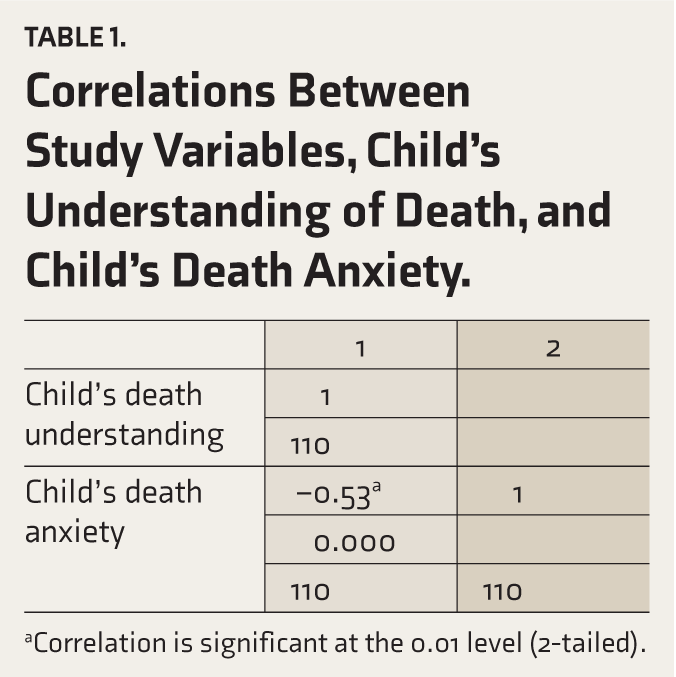
aCorrelation is significant at the 0.01 level (2-tailed).
Correlations Between Study Variables, Child Age, Child’s Understanding of Death, and Child’s Anxiety.
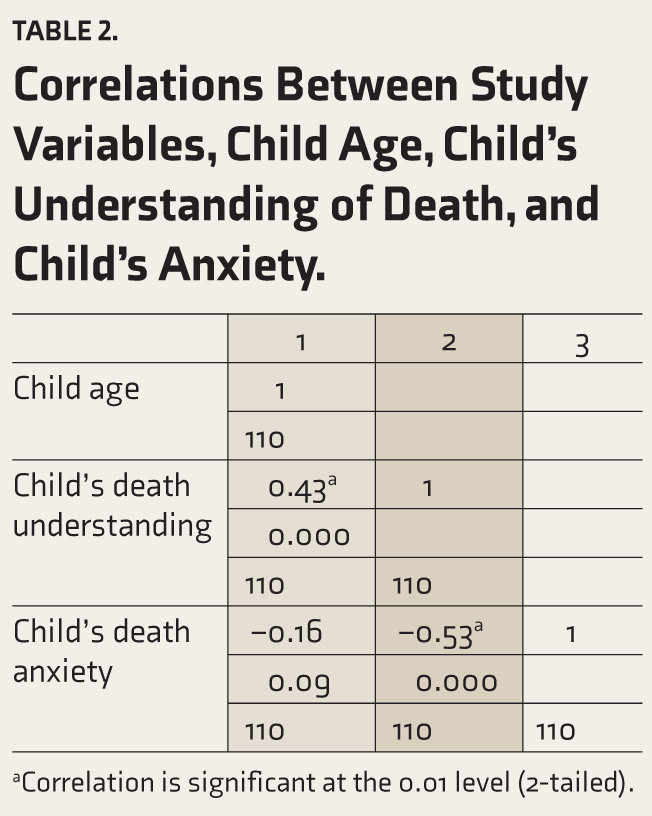
aCorrelation is significant at the 0.01 level (2-tailed).
Correlations Between Study Variables, Child’s Understanding of Death, Parental Attachment Anxiety, and Parental Attachment Avoidance.
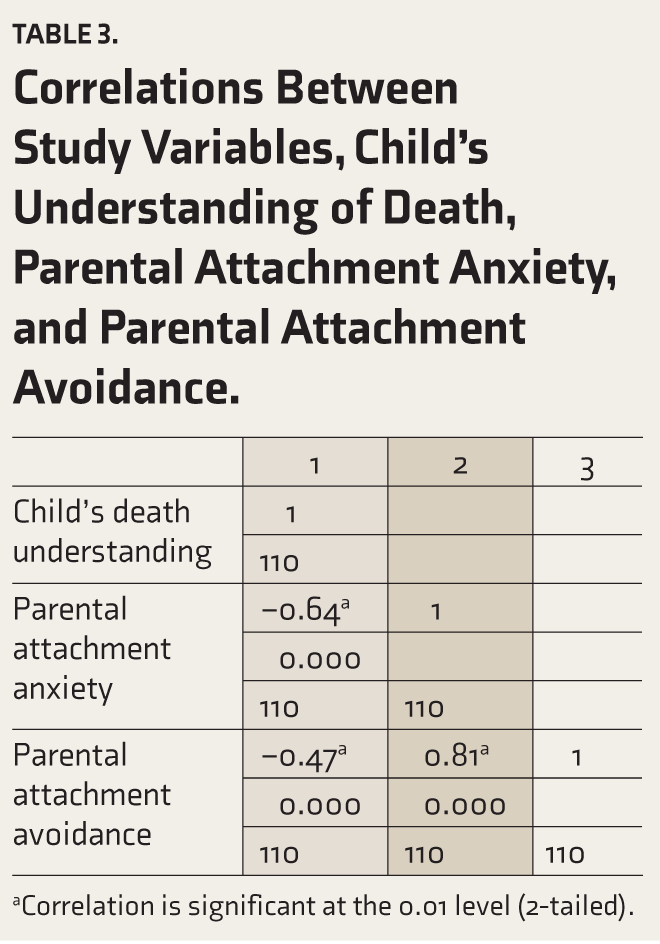
aCorrelation is significant at the 0.01 level (2-tailed).
Correlations Between Study Variables, Child’s Anxiety, Parental Attachment Anxiety, and Parental Attachment Avoidance.
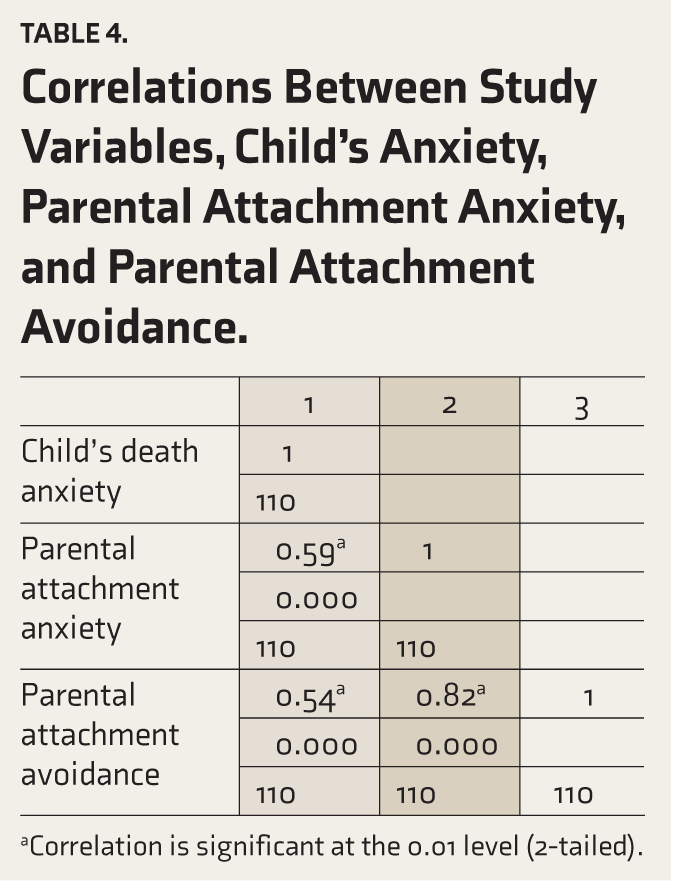
aCorrelation is significant at the 0.01 level (2-tailed).
Discussion
The results show that their age and parental attachment influence children’s understanding of death and fear. It is difficult for children to understand death fully. The main reason for this difficulty is that death is not an easy subject to understand. Typical early-life phobias are separation from parents, darkness, animals, and imaginary entities such as monsters. 25 Understanding death and experiencing fear of death are two interrelated aspects that play an important role in a child’s psychological development. Death fear is associated with death understanding in 5- to 10-year-old children when the death concept matures.26,27 We examined the relationship between understanding of death and fear of death in children aged between 5 and 16 years.
The results showed that children with a greater awareness of death had less fear of death than children with a lower level of understanding. The study found that cognitive development and acquiring knowledge about death help reduce fear of death. Parents should keep in mind that how they communicate about death influences both their children’s emerging understanding and how they approach the topic. 28 Furthermore, Venn et al. 29 found a relationship between children’s understanding of death at age nine and their fear of death at the age of 12. The study found that a better understanding of death at the age of 9 was associated with lower levels of death anxiety at the age 12. This is a longitudinal study that lends credence to the idea that greater awareness of death and long work hours can make children less afraid of death.
Fear of death has been observed in children as young as 5 years old. 30 According to Fear Survey Plan research, death and danger are the most commonly endorsed fear factors and remain so throughout adolescence. 31 In a previous study, 32 dying understandings were positively related to age, and the pattern of acquisition of certain subcomponents of the dying concept was as expected. The results showed that the adolescents in their sample began to develop a biological understanding of death and that their ideas about death became more mature as they grew older.
They also found that children in the sample were more afraid of death-related words than neutral words presented on the modified DASC, consistent with previous research on death fear in preschool and school-aged children. 30 Research shows there is a negative relationship between children’s understanding of death and their level of fear of death. Children’s fear of death decreases as they develop a fuller understanding of it. However, individual, societal, and contextual influences can shape a child’s perspective and emotional response to death. Gullone 31 defines it as “social and cultural beliefs, personal and emotional problems, religious assumptions, and conceptual understandings.” According to the literature by Cunha et al. and Neimeyer et al.,34,35 children form their representations of the life and death processes based on their experiences. Their developmental stage, family, and social meanings influence the characteristics they attach to death and their feelings toward it.
Children’s cognitive abilities and emotional understanding develop as they grow and develop, influencing their understanding of death and the way they experience fear of death. Several studies have been conducted to examine the relationship between a child’s age and their understanding of and fear of death.33,36,37 Young children can suffer varying degrees of death anxiety, which often manifests as separation anxiety or abandonment anxiety. When confronted with death issues, they may express fear or uncertainty. 15 Previous narrative research has found that age and maturity are related to the ability to adequately articulate one’s representations vocally. 38 The older we get, the more complex and coherent our ability to imagine death and dying becomes. Older children often present longer narratives that they organize chronologically and causally; they show a stronger ability to perceive causality. Emotional competence also improves with age: older children show positive and negative emotions, indicating a greater ability to focus on themselves. Furthermore, as they age, their perception of death becomes similar to that of adults. Previous research 3 shows that adults perceive death primarily as a biological process and that this understanding shapes their entire view of it.
The influence of parents’ attachment styles on children’s perceptions of death is an interesting topic that has already been researched. Current evidence suggests that attachment security plays a protective role in coping with death and that fear and avoidance may interfere with grief processing. Our results show that a secure connection can help adolescents understand the meaning of loss.39,40 We examined the relationship between parental attachment and children’s understanding of death. They found that children with avoidant attachment styles have limited awareness of death because avoidant parents try to minimize or avoid discussion of death, which could limit children’s access to and understanding of this complicated topic.
Attachment types and fear of death have been linked in studies of both children and adults. For example, Mikulincer and Florian 41 examined the relationship between attachment types and fear of death in Israeli teenagers. According to the results, adolescents with an anxious attachment style showed higher levels of death anxiety than adolescents with a secure attachment style. This shows that a lack of ongoing emotional support and reassurance from caregivers can contribute to children’s increased fear of death. Although there is limited research on the connection between parents’ attachment styles and their children’s fear of death, it can be assumed that children with avoidant or anxious attachment styles are more likely to experience fear of death. According to clinical theory, 42 the primary role of family systems in making sense of loss is very important. Studies show that mourners who can gradually integrate the experience into their meaning system experience fewer severe grief symptoms. 43
Secure children also have more developed reflective skills to mentally process their loss successfully. Secured children fluctuate flexibly between sadness and reparation during a happy period of grief. 44 In contrast, people with insecure attachment are more likely to experience prolonged grief because they have unresolved guilt, anger, and worry that they must process before they can adequately reorganize and resume their lives. 43 This study confirms previous findings in young adults that attachment avoidance and anxiety hinder the process of coping with loss 45 and suggests that further research on grieving children is warranted. Although our data were collected in a nonclinical group, they support several explanatory theories in the grief literature. For example, Bowlby 13 suggested reasons for the grief reactions of individuals with anxious–ambivalent and avoidant attachment styles. Anxious, ambivalent people fear being misunderstood and undervalued, lack self-confidence, and view significant others as untrustworthy, unfit, or unable to commit to long-term, intimate relationships. It is, therefore, believed that their attachment mechanism is easily and intensely activated during difficult times, so they desperately search for the attachment figure during the separation. According to Main and Goldwyn, 46 Bowlby hypothesized that such people would exhibit a more chronic pattern of grief with high levels of stress that do not subside over time. Other researchers have referred to this type of grief reaction as chronic or “complex” grief, distinguishing it from other negative consequences of grief, such as depression or post- traumatic stress disorder (PTSD). 47
On the other hand, adults with an avoidant attachment style often report being aloof, emotionally distant, and skeptical, and they view important people as untrustworthy or desiring too much intimacy. Bowlby associated this type of attachment with so-called “delayed” or “delayed” attachment. While avoidant individuals may not outwardly show typical signs of grief, recent research suggests they still experience emotional distress. However, their coping mechanism involves disengaging their attachment systems, which can create the illusion of a lack of emotional response. 48 However, avoidance is associated with increased levels of grief and somatic complaints over time, 49 particularly when the losses are very distressing, as in violent deaths. 45
Finally, these results can be understood in light of Terror Management Theory, 50 which states that people must mentally cope with the troubling consequences that arise from the knowledge that death is not only inevitable but also that it is unavoidable and could occur at any time. They achieve this by connecting with cultural belief systems (or worldviews) that allow individuals to see themselves as valuable members (reflecting their self-esteem) of a cultural reality that will survive their physical demise. 51 In terms of clinical implications, these results confirm the influence of attachment style on death ideation in school-age children and highlight the importance of understanding the connections between the two constructs, which may explain why some people cope with their loss successfully, while others experience it more persistently. Stress leads to behavioral and affective disorders as well as psychological and psychiatric problems. Following previous authors, 51 it is suggested that the assessment of attachment can help influence treatment in general. Therapists working with severe loss, in particular, will increasingly find that it is beneficial to understand early adult attachment patterns and attachment styles. These findings, if supported by future research, should alert therapists to the limitations of avoidance tactics in coping with grief, as well as the need to distinguish between avoidance and genuine resilience in the context of loss. 52
Limitations of Study and Future Research
The main limitations of this study include its correlational design, use of self-report measures, and convenience sampling. The causal relationship is unclear in a correlational study because a stressful and painful loss could affect parental bonding, separation, and grief. Because different socioeconomic and ethnic groups may differ in key characteristics, the generalizability of the results in convenience samples is limited. Furthermore, self-report assessments are always susceptible to social desirability bias, even when the questionnaires have been properly verified. This study should be considered exploratory, and prospective and longitudinal studies should be conducted in the future, particularly in children who have lost a significant other. Finally, children’s attachment styles are not directly measured. Future research could examine the implications of these more severe effects.
Conclusions
This study indicates that parents' attachment styles shape their children's understanding and fear of death. Securely attached parents promote a realistic view of death and lower anxiety, while insecurely attached parents lead to limited understanding and heightened fear. Age also influences children's awareness of death. The findings emphasize the need for secure parent-child relationships and open discussions about death to alleviate anxiety and build resilience. Clinicians, educators, and parents can leverage these insights to support children facing loss.
Footnotes
Declaration of Conflicting Interests
The author declared no potential conflicts of interest with respect to the research, authorship, and/or publication of this article.
Declaration Regarding the Use of Generative AI
None used.
Ethical Approval
This study was approved by Ethics Committee Fatima Jinnah Women University.
Funding
The author received no financial support for the research, authorship, and/or publication of this article.
Informed Consent
Informed assent/consent was been taken form the participants.