



Abstract
Background:
Graphophonological semantic flexibility (GSF) is a reading-specific cognitive flexibility that allows an individual to process a print’s phonological and semantic elements simultaneously. The study aimed to explore the developmental profile of GSF in typical readers.
Method:
Ninety typically developing children, ages 8 to 11 years, were recruited and divided into three age groups: 8, 9, and 10. They were given a web-based GSF task that required them to arrange 12-word cards in a 2 × 2 matrix according to their initial phoneme and meaning. Several GSF components were computed, such as sorting speed, accuracy, and index. Furthermore, word reading, non-word reading, and passage comprehension were used to assess their reading profile.
Results:
The Kruskal-Wallis analysis revealed significant differences in sorting accuracy (H (2) = 32.67, p < .001), speed (H (2) = 20.25, p < .001), and index (H (2) = 26.97, p < .001) across all ages. According to Dunn’s post hoc analysis, accuracy improved across all age groups (p < .01) and in the index between 8 and 10 (p < .001). The Mann–Whitney U test showed gender differences in sorting speed (U = 717, p = .03). Additionally, Spearman’s rank correlation showed a significant positive association between GSF and word reading (r = 0.47, p < .001) and text comprehension (r = 0.55, p < .001).
Conclusion:
The findings demonstrated that GSF components are developmental and do not significantly impact gender other than sorting speed. Furthermore, a relationship between GSF and word reading and passage comprehension emerged.
Keywords
The GSF’s accuracy, speed, and index offer useful information suitable for reading. Sorting speed enables one to understand the amount of time required to sort the cards, while sorting accuracy provides insights into the thought process that underpins word sorting. Together, they aid in understanding an individual’s flexibility specific to reading, which aids clinicians in planning interventions for children who struggle with reading.Key Messages:
Children frequently need to use cognitive flexibility to adapt their thoughts and behavior patterns to changing situations that arise in their daily lives. Cognitive flexibility is one of the executive processes that has recently drawn attention among researchers. It is defined as goal-directed behavior that requires people to change their focus from one aspect of a task to another aspect of the same activity.1, 2 Other terms used for cognitive flexibility are attentional shifting and set-shifting/task switching. 3 These terms are used based on the task to measure cognitive flexibility. Recent research has broadened our understanding of cognitive flexibility to include the ability to maintain two dual representations simultaneously and switch between them as necessary while doing a task. The majority of earlier studies on cognitive flexibility were conducted on this premise.4, 5
Research has shown that children as young as three to four can switch between two simple response sets effectively if the rules are presented within the context of a narrative6, 7 or if the demands on inhibition are reduced. 8 A significant increase in cognitive flexibility has been reported between the ages of three and six years. 9 According to other studies, there is a significant rise between the ages of seven and nine. 10 Compared to inhibition, which has been observed to experience a strikingly strong increase in the pre-school years and reduced growth at later ages, 11 the development of cognitive flexibility occurs more gradually. Executive functions in general and cognitive flexibility in particular influence several significant life outcomes, including academic success. 12 In the recent past, there have been studies indicating the importance of cognitive flexibility in reading.13, 14
Reading, being a complex process, requires multiple levels of mental representation. Thus, a skilled reader relies on various aspects of print, such as phonological, semantic, lexical, and orthographic information.15–17 To effectively manage these aspects, the reader should possess adequate executive functions in general, and cognitive flexibility is one of the important executive functions required for reading. Past research 14 demonstrated that cognitive flexibility predicts second-grade students’ reading skills. Similarly, a subsequent study 18 showed that cognitive flexibility was a strong predictor of math and reading skills in children between the ages of 4 and 13. Numerous studies have focused on teaching flexibility to improve children’s performance in the classroom due to the strong correlation between flexibility and achievement. 12
A wide range of tasks, including conservation, appearance reality, and theory of mind tasks, 19 have been used to measure cognitive flexibility in reading. Classification tasks, which ask participants to classify items on multiple dimensions, either sequentially or simultaneously, are commonly used for this purpose.16, 20, 21, 22 Sequential classification tasks, like the Wisconsin Card-Sorting Task 23 or the Dimensional Change Card-sorting Task, 24 allow researchers to examine shifting by requiring participants to change their sorting rules mid-task (e.g., from sorting by color to sorting by shape). Simultaneous sorting tasks assess the child’s ability to sort picture cards along two or more dimensions. 25 All of these tasks require participants to attend to multiple dimensions. However, domain specificity is absent, especially when used to establish a link between flexibility and reading. Work in recent decades has indicated that cognitive development relies on domain-specific experiences. Accordingly, Cartwright 16 coined yet another type of flexibility, graphophonological semantic flexibility (GSF), which is a reading flexibility that enables a skilled reader to manage multiple elements of print simultaneously. Thus, the general classification task was adapted to assess the reading-specific flexibility, GSF. 16 In this task, the participants are instructed to sort cards based on their initial phoneme and meaning. This task taps the ability of a person to focus simultaneously on the sounds and meanings of the printed words. To provide evidence, multiple studies were conducted in English to examine the reading specificity of the GSF task.13, 26
Cross-sectional research was conducted on GSF in second grade, fourth grade, and college students using word-sorting and picture-sorting tasks. 26 Results revealed a developmental pattern in GSF across the participants examined. Their findings also revealed that the reading-specific task (GSF) contributed to a greater variance in reading comprehension than the general (picture) flexibility task. Similar studies were conducted, and all the studies concluded that the reading-specific measure (GSF) could be a robust measure of cognitive flexibility in reading ability. 13, 27 These results have also been verified in French. 14 In addition, the GSF task was used to train children who were poor comprehenders, and a significant improvement in their reading comprehension was reported. 27 Therefore, the earlier research suggested using a reading-specific rather than a domain-general task to evaluate cognitive flexibility in reading. In summary, earlier research concentrated on the GSF index and its connection to reading comprehension.
A child’s cognitive experiences can be examined by evaluating the GSF components. In addition, reading is influenced by other factors such as the socioeconomic status of the participants, the type of school, and the syllabus followed in schools. This led to the study’s conceptualization by incorporating a few additional factors that should have been considered in the previous studies. It will be possible to gain some understanding of children’s cognitive experiences by utilizing a reading-specific task like GSF to create a cognitive flexibility profile tailored to reading. It offers a new perspective on cognitive flexibility and provides a reliable measurement for the reading-flexibility index. A notable increase in overall cognitive flexibility occurs between the ages of seven and nine. 10 For this reason, a range of 8–11 years was chosen. In addition, this age group minimizes task bias, that is, the differences in participants’ word attack skills. The GSF depends largely on a child’s ability to read and understand the meaning of the words. Language and reading difficulties among children have become much more common in India in recent years, as has telepractice. The GSF task needed to be developed on a digital platform for assessment and intervention during telepractice. Therefore, the current study was designed to explore children’s GSF profiles using a reading-specific cognitive flexibility task.
Aims and Objectives
The present study aimed to profile the development of GSF in children aged 8–11 who are typical readers. The study’s objectives are: (a) to determine whether there is a development trend in GSF, specifically in sorting speed, accuracy, and index, using a web-based program developed based on previous work; (b) to determine whether there is a difference in GSF regarding sorting speed, accuracy, and index about gender; and (c) to determine the reading factors associated with the GSF index.
Methods
Study Approval
The Institutional Review Board approved the study. Written consent was obtained from the heads of the institutions, and participants gave assent to collect data from them.
Participants
Ninety children aged 8–11 years comprised the cross-sectional study sample (36 boys and 54 girls). Based on their age, they were divided into three groups of 30 participants each: 8-year-olds, 9-year-olds, and 10-year-olds. The sample size was calculated using power analysis, which took into account a significance level of 5%, a power of 95%, and an effect size of 0.5, assumed to be moderate. Therefore, a minimum sample size of 22 participants was required in each group. The children participating in the study were selected using purposive sampling from the same urban area. All children were bilingual and bi-literate, speaking Kannada as their first language (L1) and English as their second language (L2). Every child spoke English at school and their native language at home. These children were from middle-class families 28 and attended private schools regulated by the Indian Certificate of Secondary Education (ICSE). They exhibited no signs of developmental delay 29 or language 30 or reading deficits. 31 Additionally, we ensured that children with above-average academic performance were selected for the study.
Materials and Task Adaptation
GSF Task
This study used GSF task from Cartwright's research. 13 The GSF task consists of sets of word cards that must be sorted into a 2 × 2 matrix along two dimensions simultaneously by initial phoneme and word meaning. The words for the GSF task were taken from the pre-school children’s curriculum. Eight test plates with 96 words in English were created. The words thus generated were validated by two speech-language pathologists and three teachers with the required professional experience. They were given a list of 96 words and asked to rate their familiarity and appropriateness based on the ability of an eight-year-old child to read and provide the meaning of the words on the list. The list was eventually reduced to 72 words (six test plates).
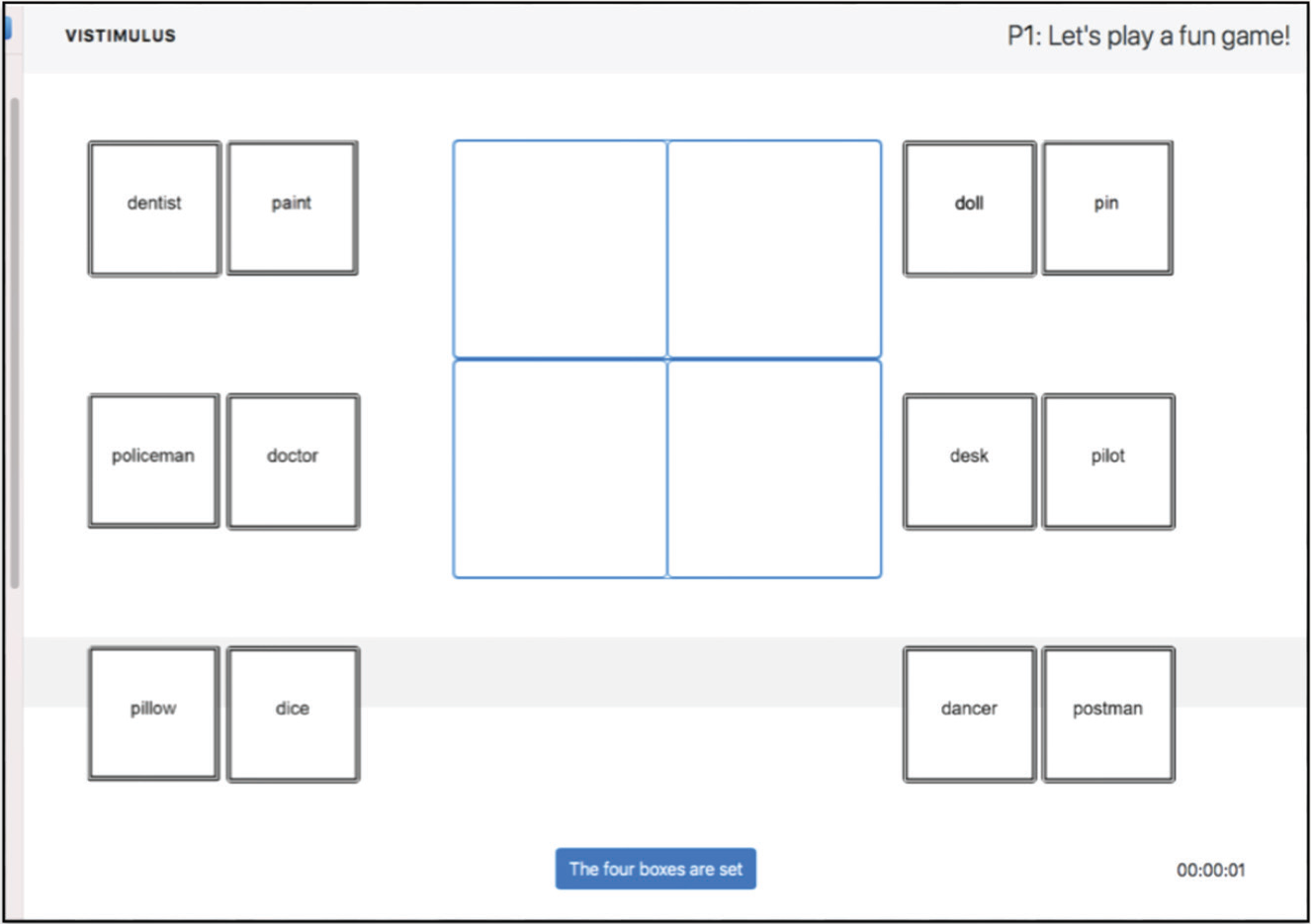
Words from each test plate were put into an 8 cm by 8 cm text box. Every word was typed in uppercase black using Arial font size 16. A web page was created with the assistance of a computer programmer. A password-protected portal with comprehensive instructions was created for the GSF task on the “Heroku” platform. Each page had a test matrix and 12-word cards arranged randomly (Figure 1). There was also a timer on the page that began to run as soon as it was opened. Participants had to sort all the words on the previous page to move on to the next. The time spent sorting was shown after each sort. Six test plates were used: two were designated practice sets, and the remaining four were designated test sets. The MacBook Air (Version 13) was used for the stimulus presentation.
Web Page with the 12-word Cards That Need to Be Sorted in a 2 × 2 Matrix.
Reading Measures
Additional tasks included word reading, non-word reading, and text reading comprehension. The Dyslexia Assessment Protocol for Indian Children (DAPIC) 31 was used to assess word and non-word reading, and reading passages 32 were used for text reading comprehension. These two measures were suitable in terms of the cultural appropriateness and age of the study participants. There were 40 words with regular and irregular spelling, 10 non-words, and 4 reading passages, each comprising seven questions.
Procedure
Data collection took place in a quiet room after obtaining consent from the parents and/or head of institution to allow the children to participate in the study. The children were allowed to sit comfortably in front of a laptop and the examiner. The web page that the examiner opened contained the test and practice matrices. Following the practice sessions, each participant was asked to sort 12 cards on each page in the 2 × 2 matrix based on their meaning and initial phoneme. They were allowed to sort only four cards in the matrix at a time and then stack the remaining four-word cards until all the cards on the test plate had been used. They had to indicate to the examiner which word card should be placed or stacked in the test matrix. Subsequently, the examiner used an optical mouse to drag the word card onto the matrix. This was to avoid multiple attempts by the children to drag the card onto the matrix. Whenever they made an incorrect sort, the examiner assisted them in sorting. However, points were not given for such sorting. After each sort, the time taken to sort each set of cards was noted (sorting speed in seconds). They were also asked to explain their arrangement verbally. Sorts could only be horizontal or vertical. After that, they were told to read the non-words following the words. They were then instructed to read the text and respond to the questions. The order of the tasks was counterbalanced across participants.
Data Scoring
The scoring scheme used was identical to that in Cartwright’s study. 18 Children who sorted the cards correctly and provided an accurate verbal explanation received three points. They received two points if they sorted the cards incorrectly but provided a verbal explanation. The children received one point for sorting the cards correctly without a verbal explanation. They received a score of zero for incorrect card sorting or verbal explanations. The children’s sorting task for each set was considered acceptable if the children correctly sorted the 12 cards. The maximum score children could receive for the four cards was 12. The time it took to sort 12 cards in a set was considered the sorting speed (in seconds). Sorting speed was thus determined for four sets of cards. These points were used to calculate sorting accuracy and the GSF index. Sorting accuracy was determined by summing scores for verbal explanation and accurate sorting. To determine the GSF index, the overall sorting accuracy was divided by the mean sorting speed for each of the four sets of cards. This was multiplied by 100 for a simpler and more practical explanation. In addition, the children received a score of one for each word and non-word read accurately. The maximum possible score was 40 and 10, respectively. The correct response received a score of one on the text comprehension. The maximum score that could be achieved was 28.
Statistical Analysis
All data was analyzed using the Statistical Package for Social Sciences (SPSS) software version 20. A significance level of 5% was set. The mean and standard deviation (SD) were used to summarize the sample characteristics and other factors, including sorting accuracy, speed, and GSF index. According to the Shapiro–Wilk test (p > .05), the data were not normally distributed. Thus, the Mann–Whitney U test and the Kruskal–Wallis test were run. When significant differences were obtained for the parameters under investigation, Dunn’s post hoc analysis was employed. Reading-related characteristics were identified using the Spearman rank correlation.
Results
This section is organized as follows: (a) sample characteristics; (b) performance on GSF by grade; (c) performance on GSF by gender; and (d) factors associated with the GSF index.
Sample Characteristics
The sample characteristics were determined using descriptive statistics. The mean age of the participants was 9.35 (SD = 0.87). They were further grouped into three groups based on age: 30 eight-year-olds (mean age = 8.34 years, SD = 0.22), 30 nine-year-olds (mean age = 9.37 years, SD = 0.23), and 30 ten-year-olds (mean age = 10.37 years, SD = 0.23). There were 36 boys (mean age = 9.16 years, SD = 0.89) and 54 girls (mean age = 9.47 years, SD = 0.84). The participants were similar in school type, location, socioeconomic status, and curriculum.
Performance on GSF by Age
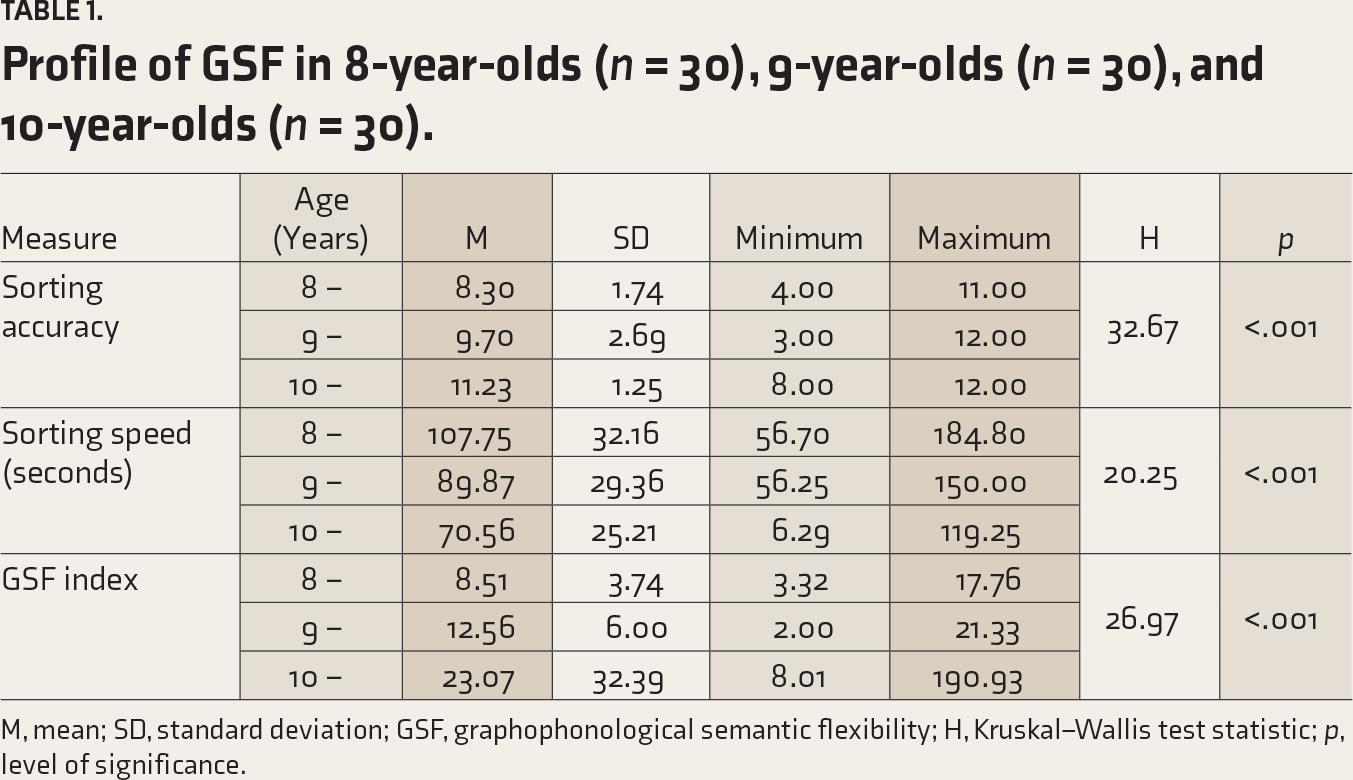
Table 1 shows the descriptive statistics, including means, standard deviations, minimum and maximum values for sorting accuracy, sorting speed, and GSF index as a function of age. Developmental increments in performance were observed for all the measures under study. The younger children performed worse than the older children on all the measures examined.
Profile of GSF in 8-year-olds (n = 30), 9-year-olds (n = 30), and 10-year-olds (n = 30).
M, mean; SD, standard deviation; GSF, graphophonological semantic flexibility; H, Kruskal–Wallis test statistic; p, level of significance.
The Kruskal–Wallis test was performed to determine whether there were significant differences in sorting accuracy, sorting speed, and GSF index as a function of age.
The results revealed a main effect for sorting accuracy (H (2) = 32.67, p < .001), as expected. Post hoc comparisons showed significant differences in all three groups (p < .001). Similarly, there was a significant main effect for sorting speed by age (H (2) = 20.25, p < .001). However, post hoc comparisons for sorting speed did not indicate a significant difference (p > .05) across all age groups. This could be due to a Type I error. 33 Finally, there was a main effect of age on the GSF index (H (2) = 26.97, p < .001). Post hoc comparisons indicated that the flexibility index of the 10-year-olds was significantly higher than that of the 8-year-olds (p < .001). However, the performance of the eight-year-olds did not vary significantly from that of the nine-year-olds (p = .06).
Performance on GSF by Gender
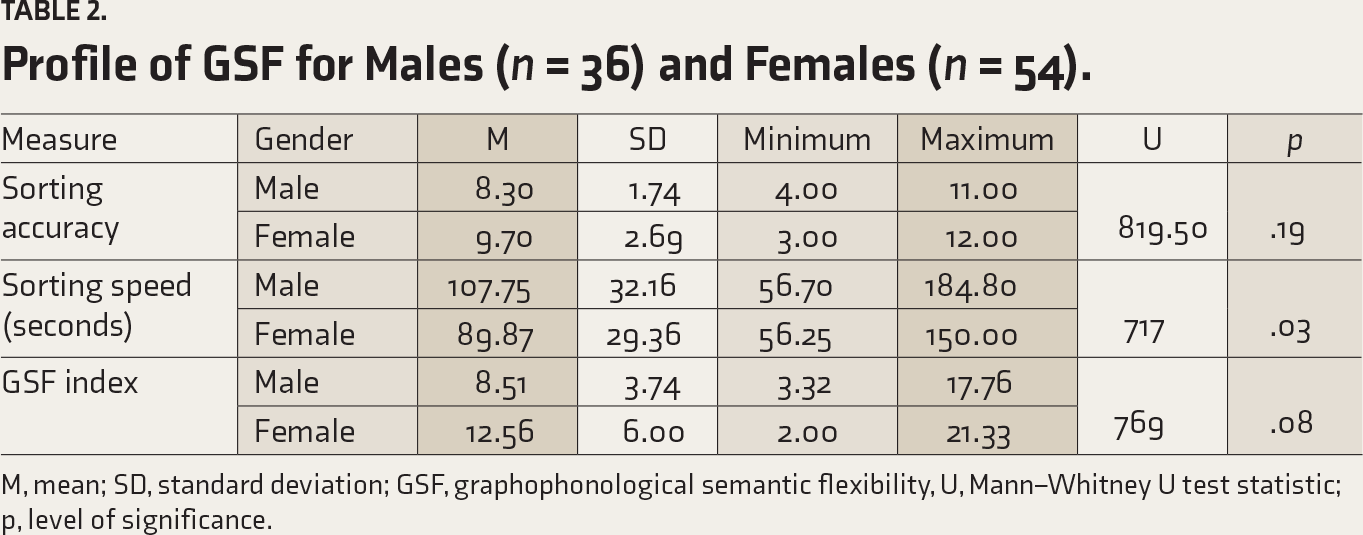
Table 2 shows the descriptive statistics obtained by males and females for sorting accuracy, sorting speed, and GSF index.
Profile of GSF for Males (n = 36) and Females (n = 54).
M, mean; SD, standard deviation; GSF, graphophonological semantic flexibility, U, Mann–Whitney U test statistic; p, level of significance.
It shows that females sorted cards faster than males. However, only marginal differences were found in sorting accuracy and the index. The females outperformed the males when comparing the number of correct sorts and verbal justifications (sorting accuracy). Further analysis using Mann–Whitney U tests showed that the sorting speed difference was statistically significant (U = 717, p = .03) but not sorting accuracy (U = 819.50, p = .19) or the index (U = 769, p = .08).
Factors Associated with the GSF Index
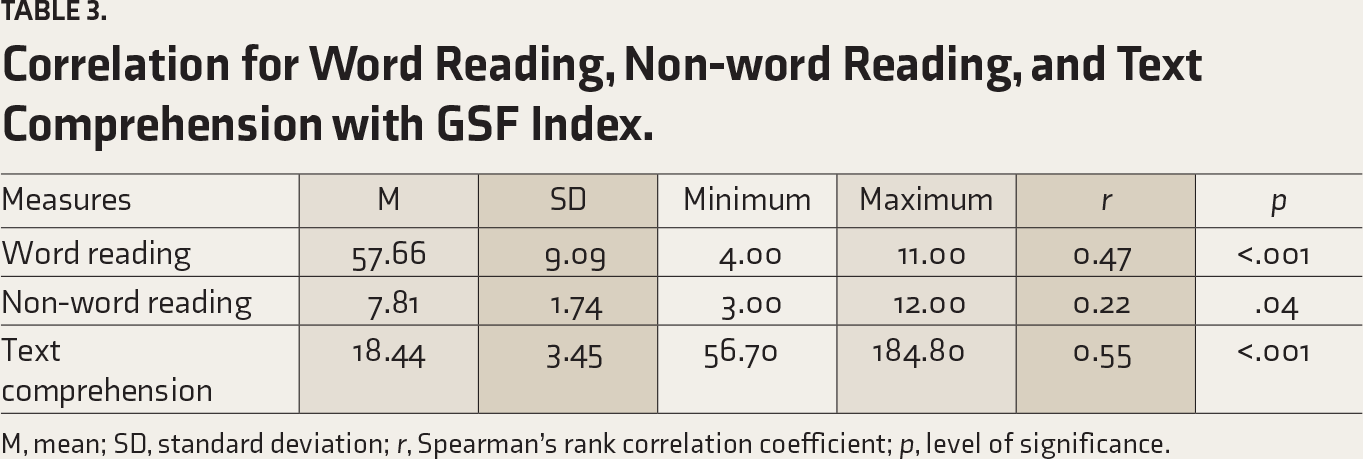
The descriptive statistics obtained for wording reading, non-word reading, and text comprehension are presented in Table 3. Correlations (controlling age) were determined using Spearman’s rank correlation to understand the reading factors associated with the GSF index. For this analysis, the composite scores were the dependent variable, and the independent variables were word reading, non-word reading, and passage comprehension. Significant positive correlations emerged between GSF and word reading (r = 0.47, p < .001) and text reading comprehension (r = 0.55, p < .001). This suggests that word reading and text comprehension vary with GSF.
Correlation for Word Reading, Non-word Reading, and Text Comprehension with GSF Index.
M, mean; SD, standard deviation; r, Spearman’s rank correlation coefficient; p, level of significance.
Discussion
The study aimed to document the development of GSF in children aged 8–11 years. Ninety children were tested on their ability to sort 12 cards based on their initial phoneme and meaning. We examined the developmental trends in GSF across ages as a function of sorting accuracy, sorting speed, and composite scores (index) using a web-based GSF task. In addition, a gender comparison was carried out. Further, the link between the GSF index and reading skills was also determined.
Our findings show that GSF continues to develop in children aged 8–11. The components of GSF were assessed separately in the study. The sorting accuracy showed a clear development trend. It was determined by adding the scores for correct sorts and verbal explanations. Few children in all three age groups required assistance from the examiner to arrange the cards based on their meaning and initial phonemes. However, they were able to provide an accurate explanation for the examiner-assisted sorts. The younger children made errors like sorting words by their initial phonemes or their meanings in horizontal and vertical directions. This shows they need help managing multiple print components simultaneously, that is, the phonological and semantic aspects. These findings align with previous findings that beginning and struggling readers will need help managing various aspects of print simultaneously.34, 35 It is also possible that their differences in decoding skills impacted the performance of the task. 13 Contrastingly, the older children did not show any fixed pattern as such. The majority of children gave verbal explanations about their word-sorts. These verbal explanations about their word-sorts.
The verbal explanations provided by the children varied from specific to non-specific categories. Specific category explanations included school stationery, vegetables, cooking utensils, birds, things, animals, and vehicles. At the same time, non-specific category explanations included eating, traveling, flying, non-flying, living, non-living, etc. The eight-year-olds mostly provided non-specific justifications for their sort. Some even tried to associate the words in each row instead of justifying the sorts in both horizontal and vertical directions. Children in their developmental stages tend to learn words using associative learning.36, 37 Explanations for the initial phoneme were either the word’s initial sound or the first alphabet in all the groups. Many eight-year-old children restricted their justifications to the initial phoneme alone. This indicates that they have not understood the multidimensional nature of their sorting arrangement. 26 More precisely, they would have understood multiple elements of a word but not the whole set of words in the matrix. In addition, while developing reading skills, children focus more on the letter-sound information than the meaning. 26 Thus, our findings enable us to understand that children in their younger years tend to focus more on one aspect of a word or sentence than the multiple elements. The speed with which the children sorted the cards also varied. As anticipated, the younger children took longer to sort. 13 This can be due to the time they took to decode the words and then sort them based on their initial phoneme and meaning. 35 Faster sorts indicate greater cognitive flexibility in reading. 26 Accordingly, the older children arranged the cards faster and required less assistance from the examiner in arranging the cards.
One main objective was to determine whether GSF follows a developmental pattern. This was determined using the composite GSF index, computed from sorting accuracy and sorting speed. There was a clear development trend, with 8-year-old children exhibiting low flexibility and 11-year-old children exhibiting high flexibility. Previous research demonstrates that children with low accuracy and the highest (slow) speed have low GSF index scores. Conversely, children with high accuracy and the lowest (fast) speed have high GSF index scores. 26 The developmental trend in the GSF index has been demonstrated in multiple studies, even though the ages examined were different.13, 26 The current findings are also consistent with those obtained using a domain-general task, showing a considerable increase in flexibility between the ages of eight and nine. 10 As observed, there was a significant increase in the performance of 10-year-olds compared to 8- and 9-year-olds. From these results, it can be inferred that the development of cognitive flexibility in reading appears to happen more gradually, like general cognitive flexibility throughout age groups, as the child develops and acquires more knowledge, rather than in a quick process, in line with the past findings. 38 As a consistent developmental trend can be seen from 8-year-olds to 11-year-olds, this confirms that cognitive flexibility in reading continues to develop from pre-school age well into adolescence.39, 40 These results also support previous research, in which it was found that flexibility to build categories develops differently depending on the age groups and persists into puberty. 40 Furthermore, no significant variations in gender were found for the components of GSF. These results agree with previous findings from general measures of cognitive flexibility, 41 which found no differences for children between the ages of three and those going through puberty. In contrast, a subsequent study indicated that while there were no gender differences in the performance of executive function tasks, females generally adapted to new activities and rules faster than males. 42 It was interesting to note that this was apparent in the current study’s components evaluated for the GSF. These results should be interpreted with caution because of the unequal gender distribution in the sample.
The current study enhances our understanding of the relationship between GSF and reading skills. GSF and word reading were correlated. Word reading involves automatic phonological decoding skills, which are important while performing a reading-specific flexibility task. If the reader does not read the word, it will not be easy to sort it based on its initial phoneme and meaning. This was evident among the eight-year-old children in the group, as some required assistance from the examiner for at least one or two sets of sorting. Similar studies have also established a link between GSF and word reading in the past, although these focused on early readers.13, 14 GSF has also been shown to be related to passage comprehension in previous research on early readers, elementary readers, and college-going students.26, 43 As evidenced by the simple view of reading, 44 skilled reading is a product of decoding and linguistic comprehension. More precisely, to understand a text, the reader should possess the flexibility to manage the phonological and semantic measures of the text simultaneously. Because GSF involves reading-specific cognitive flexibility, these findings are worth discussing. Thus, in agreement with previous researchers14, 16, 26, we believe that, given the necessity of coordinating the various types of information found in print, the simultaneous maintenance of two perspectives may be an essential part of word reading and passage reading comprehension. These findings add to the research demonstrating the developmental nature of children’s reading-specific flexibility (GSF) from late childhood to adulthood. It is also influenced by word reading and passage reading comprehension. However, this study has a few limitations. The study was conducted in an urban area; hence, we may need help generalizing the findings to other geographical locations. Future studies can be planned with a larger sample size, an equal gender distribution, and a rural area.
Conclusion
The results of the web-based GSF task, in which children were asked to sort 12 sets of words by their initial phoneme and meaning into a matrix, demonstrated a multifaceted picture of GSF and its development. The evidence suggests that reading-specific cognitive flexibility (GSF) develops considerably in 8- to 11-year-olds, specifically sorting speed, sorting accuracy, and index. The findings of the study provided an insight into the developmental nature of GSF; the ability of children to sort the cards based on two important features, phonological and semantic aspects, which enabled children to sort the cards based on the task requirements; and the factors related to reading that are important for reading-specific flexibility. Furthermore, the analyses demonstrated the relationship between word reading, passage comprehension, and GSF. Additional research is needed to pinpoint more precisely how these components influence GSF. A future study can also focus on the profiling of GSF in the clinical population, such as for language impairment, dyslexia, etc.
Footnotes
Declaration of Conflicting Interests
The authors declared no potential conflicts of interest with respect to the research, authorship, and/or publication of this article.
Declaration Regarding the Use of Generative AI
None used.
Ethical Approval
The Institutional Review Board of All India Institute of Speech and Hearing, Mysuru, India, approved the study; WOF-167/2018-2019 dated 21.12.2020).
Funding
The authors received no financial support for the research, authorship, and/or publication of this article.
Informed Consent
Written consent was obtained from the heads of the institutions, and participants gave assent to collect data from them.