




Abstract
Background:
It seems that personality and dreams are relatively stable interwoven constructs that show many shared characteristics across cultures. The present study aimed to predict the emotional load and content of dreams using both original constructs and two extracted spectrum factors of adaptive and maladaptive personalities.
Methods:
The cross-sectional study data was collected from 704 Iranian adults using the brief version of the Personality Inventory for DSM-5, the brief version of the Big Five Inventory, Schredl’s Dream Emotions Manual, and the Content Analysis of Dreams Manual. Pearson correlations, hierarchical regressions, exploratory factor analysis, and analysis of variance were used to analyse the data.
Results:
Factor analysis revealed two factors for the adaptive and maladaptive spectrums of personality. Adaptive and maladaptive constructs of personality are almost equally related to both the negative and positive loads of dreams, while the negative load of dreams is more strongly predicted by the maladaptive spectrum factor (R2: 13% vs. 7%, ∆R2: 8% vs. 2%). Negative load is characterized by low agreeableness and high negative affectivity, while positive load is characterized by high agreeableness and low detachment. Compared to most negative dream content such as distress, dreamers with happy content reported higher adaptive traits and lower maladaptive traits.
Conclusions:
The emotional load and content of dreams are significantly related to both specific constructs and spectrum factors of adaptive and maladaptive personalities. Psychologists can refer to personality profiles when analysing the emotional load and content of dreams of adults.
The maladaptive spectrum of personality is more specific to negative dreams. Two unique personality profiles are specific to the negative and positive loads of dreams. Dreamers with happy content have higher adaptive traits and lower maladaptive traits.Key Messages:
Dreaming is a mysterious and strange physiological phenomenon that is still not fully understood, and there is ongoing debate about its definition and the way it is studied.1, 2 While the exact purpose of dreaming is still unknown, some theories suggest that it may help with memory consolidation, problem-solving, and emotional regulation.3–5 Dreams, closely linked to rapid eye movement (REM) sleep, are mental experiences that encompass perceptions, thoughts, and emotions. 2 Dreams are vividly visual, in full color and movement, and rich in shapes and include typical wakefulness categories such as people, objects, animals, faces, places, and events from the dreamer’s past or present. 6
The most important theories of dreams, including the activation, input, and modulation model, activation-synthesis model, reward activation model, neurocognitive model, unlearning theory, psychodynamic model, continuity hypothesis, and threat simulation hypothesis, point to some of the physiological and psychological functions of dreaming, such as development process, anatomical and functional brain maturation, creativity and problem-solving, facilitation of memory storage and offline memory consolidation, reverse learning, catecholamine restoration, emotion regulation, and psychoanalytical functions.2, 6–8 However, both the mechanisms and the functions of dreaming have been mainly of interest from a neurophysiological rather than a psychological perspective. Some psychological factors associated with dreaming include anxiety, depression, anger, paranormal beliefs, alexithymia, daytime mood, somatization, attitude toward dreams, and personality traits.1, 9–18
Dreams reflect human interests and personalities, much like mental activity during wakefulness. Dreams, akin to personality patterns in general, remain relatively stable over time in adulthood and exhibit numerous shared characteristics across cultures.6, 19 The theoretical framework of personality and dreams is a complex and multidimensional topic that involves the study of how personality features may influence an individual’s dreams and dream content. This area of study often draws upon various psychological theories, such as psychoanalysis, cognitive psychology, and personality psychology, to explore the connections between personality and dream experiences. One prominent theory in this area is Freud’s psychoanalytic theory, which suggests that dreams are a manifestation of unconscious desires and conflicts and that personality features can influence the content and symbolism of dreams. Other theories, such as the activation-synthesis model and the continuity hypothesis, also offer insights into the relationship between personality and dreams. 20
So far, several studies have focused on the associations between adaptive personality traits, especially the Big Five factors, and dream issues.10, 13–17 Most of the studies reported significant relations between some personality traits, such as neuroticism, openness, and conscientiousness, and dream issues. To our knowledge, however, few studies aimed to test the associations between maladaptive personality features such as maladaptive traits or personality disorders and dreams. For example, a few studies reported a relationship between borderline personality disorder—but not other personality disorders—and dreaming.21–23 However, we did not find research on the relationship between contemporary trait models for personality disorders such as the DSM-5 trait model and dreams. The DSM-5 trait model covers five maladaptive domains including negative affectivity, antagonism, disinhibition, detachment, and psychoticism. 24 These maladaptive domains are the opposite poles of the Big Five of adaptive personality on a single spectrum. 25
Current Study
It seems that personality and dream are relatively stable interwoven constructs that show many shared characteristics across cultures.6, 19 For many years, research focused on investigating the associations between dream issues and adaptive personality traits. Although several studies reported significant relationships between these constructs,10, 13–17 there are three limitations. First, few studies paid attention to the role of personality disorders in dreaming. Although borderline personality disorder was the target of several studies,21–23 other personality disorders (e.g., schizotypal, narcissistic, and avoidant categories) were largely ignored. Second, the science of maladaptive personality is continuously revised, so recently it has been suggested that the traditional categories of personality disorder (e.g., borderline) can be replaced by dimensional trait models such as the DSM-5 trait model. 24 This can facilitate the relationship between transdiagnostic constructs of personality (e.g., negative affectivity and antagonism) and other mental health problems. Third, adaptive and maladaptive personality features, which are strongly connected constructs, are graded on a single-dimensional spectrum. 25 Personality is also strongly linked to psychopathology through the same spectrum relationships as well as pathoplastic relationships, which means they can influence the presentation or appearance of one another. 26 Therefore, predictive models that include both personality spectrum factors—which cover both adaptive and maladaptive dimensions—are preferable to models that include only one of the dimensions.
Although we do not aim to address the first limitation in the current study, we first aimed to predict both negative and positive emotional loads of dreams by both Big Five constructs of adaptive personality (i.e., emotional stability, openness, extraversion, agreeableness, and conscientiousness) and maladaptive constructs of the DSM-5 trait model (i.e., negative affectivity, antagonism, disinhibition, detachment, and psychoticism). We also aimed to predict dream emotional loads using two extracted spectrum factors of adaptive and maladaptive personalities. We then compared both original constructs and two extracted spectrum factors of adaptive and maladaptive personalities between dreamers with different emotional content such as distress and happy themes.
Material and Methods
Design and Samples
Iranian adults were invited to participate in an online survey from August to October 2023 through personal requests, phone calls, and social mobile applications such as Instagram. We asked only people 16 years of age or older who were not taking both substance abuse and psychiatric medication in the past four weeks to complete the questionnaires. A sample of 704 adults aged 16 to 71 (32.9 ± 8.5 years) from different regions of Iran, including Kermanshah province (N = 331, 47%), Kurdistan province (N = 84, 12%), and other regions (N = 289, 41%), agreed to participate in this cross-sectional study. Most of the subjects were female (n = 422, 60%), single (n = 364, 52%), university educated (n = 601, 85%), and employed (n = 559, 79%). The participants completed the Persian brief version of the Personality Inventory for DSM-5 (PID-5-BF: 25 items), 27 the brief version of the Big Five Inventory (BFI-10: 10 items), 28 Schredl’s Dream Emotions Manual (2 items), 13 and the multiple-option single-item of the Content Analysis of Dreams Manual. 29 PID-5-BF and BFI-10 were used to measure the predictor variables (i.e., constructs of adaptive and maladaptive personalities), whereas the dream scales were used to measure the criterion variables. This study was approved by the Ethics Committee of the Mind GPS Institute of Kermanshah (ID: MGPSI.EA.IR.1402.6) and follows the Declaration of Helsinki.
Self-report Measures
PID-5-BF
Krueger et al. 27 created a 220-item self-report inventory to evaluate personality psychopathology based on the DSM-5 trait model (i.e., Criterion B of the AMPD). The brief form of PID-5 includes 25 items to assess five maladaptive domains: negative affectivity (items 8, 9, 10, 11, and 15), antagonism (items 17, 19, 20, 22, and 25), disinhibition (items 1, 2, 3, 5, and 6), detachment (items 4, 13, 14, 16, and 18), and psychoticism (items 7, 12, 21, 23, and 24). Each item is scored from 0 to 3 (ranging from often false to often true). 27 The validation of PID-5-BF in Iranian populations has been previously reported. 30 In the current study, Cronbach’s alpha for the total scale items was 0.88, ranging from 0.62 (disinhibition) to 0.75 (psychoticism) for all subscales.
BFI-10
This questionnaire assesses the Big Five personality traits using 10 questions. The original creators of the scale chose the questions based on input from experts and empirical analysis to capture the key traits. Each big trait is evaluated with two questions on a 10-item scale. Responses are rated on a 5-point Likert scale from 1 for “totally disagree” to 5 for “totally agree.” The tool demonstrates acceptable reliability, convergent validity, and divergent validity. 28 The questionnaire is valid in Iranian samples.31, 32 In the current study, the total scale items showed a Cronbach’s alpha of 0.75, ranging from 0.44 (emotional stability) to 0.65 (agreeableness) for all subscales.
Schredl’s Dream Emotions Manual
This scale assesses dreams with positive or negative emotional loads. 10 Emotional content intensity is rated on a 4-point Likert scale, ranging from none (score 1), mild (score 2), moderate (score 3), to strong positive or negative emotions (score 4). Previous studies have reported inter-rater reliabilities of 0.82 for negative emotional content and 0.64 for positive emotional content. 33 The scale has been effectively utilized in Iranian populations.11, 12
The Content Analysis of Dreams Manual
The self-report questionnaire was developed by Hall & Van de Castle. The dream content comprises five emotional themes: anger, fear, happy, sad, and distress. Samples were chosen from these categories to specify the type of emotion experienced. Meanwhile, participants were allowed to choose more than one item. Previous reports indicate that the exact agreements for the Hall and Van de Castle system range between 61% and 98%. 29 This scale has recently been effectively used in the Iranian population. 11 Since each person can select multiple emotional contents simultaneously, we added two groups (multiple negative content: N = 215; multiple negative content plus happy: N = 173) to the original five groups with the content of anger (N = 8), fear (N = 52), happy (N = 72), sad (N = 34), and distress (N = 150).
Analytic Plan
In the first step, the mean and standard deviations of all variables and the Pearson correlations between all adaptive and maladaptive personality domains and both negative and positive emotional loads of dreams were reported. Parametric statistical methods were used because the distribution of personality data was normal (skewness and kurtosis between −1 and +1 for all subscales; see
Because we found a strong pattern of intercorrelations for most adaptive and maladaptive personality constructs, which reminds us of the overlap between adaptive and maladaptive personality traits in a hierarchical structure, 34 we decided to conduct a conjoint exploratory factor analysis (EFA) with maximum likelihood estimations on both sets of scales to identify latent personality constructs. With this method, we intended to prevent the effect of collinearity between the predictor variables on the regression results. 35 EFA identified two latent factors of adaptive and maladaptive personalities, the details of which can be seen in the “Results” section. We, therefore, used factor scores from EFA as independent variables, in which the factor scores were alternatively entered as blocks to predict dream emotional loads. We compared R2 and ∆R2 to determine how much additional variance each model was explaining in the outcome. Standardized beta coefficients were also reported to measure the associations of each of the adaptive and maladaptive spectrum factors with dream emotional loads.
In the last step, we wanted to compare the mean scores of adaptive and maladaptive personality domains and spectrum factors across dream emotional contents (i.e., anger, fear, sad, distress, multiple negative, and multiple negative plus happy). Our main focus was on the difference between the personality scores of the happy group and the other content groups. We used analysis of variance (ANOVA) and Tukey post hoc test to compare personality scores between groups. SPSS software was used for all two-tail tests with a significance level equal to or less than 0.05.
Results
Associations Between the Personality Models and Emotional Load of Dreams
Table 1 shows the mean, standard deviation, and associations between both adaptive and maladaptive personality models and positive and negative emotional loads of dreams. In general, both personality models together predicted about 19% and 10% of the variance of negative and positive emotional loads, respectively (all p < .001). Our main focus was on the relative change in R2 values (∆R2). Regarding the negative emotional load of dreams, when BFI-10 was entered in the first block, it had an R2 of 0.15, whereas when PID-5-BF was entered in the first block, the R2 was 0.13 (all p < .001). When BFI-10 was entered in the second block beyond PID-5-BF, the ∆R2 was 0.05, whereas when PID-5-BF was entered in the second block beyond BFI-10, the ∆R2 was 0.04 (all p < .001). Regarding the positive emotional load of dreams, when each of the models was entered in the first block, they had an R2 of 0.07, whereas when each of the models was entered in the second block beyond the other, the ∆R2 was 0.03 (all p < .001).
Table 1 also indicates the correlations and linear regressions for determining all adaptive and maladaptive domains related to both negative and positive emotional loads of dreams. We also report beta coefficients from each of the specific personality constructs, although we caution that, due to multicollinearity, some of these coefficients may not be stable. As can be seen, negative affectivity (β = 0.19, p < .001), agreeableness (β = –0.16, p = .001), and emotional stability (β = –0.14, p = .002) are strong predictors of negative emotional load. Regarding the positive emotional load of dreams, agreeableness (β = –0.17, p = .001), detachment (β = 0.17, p < .001), and antagonism (β = 0.12, p = .006) are the strongest predictors.
Associations Between Both Adaptive and Maladaptive Personality Models and Positive and Negative Emotional Loads of the Dream.
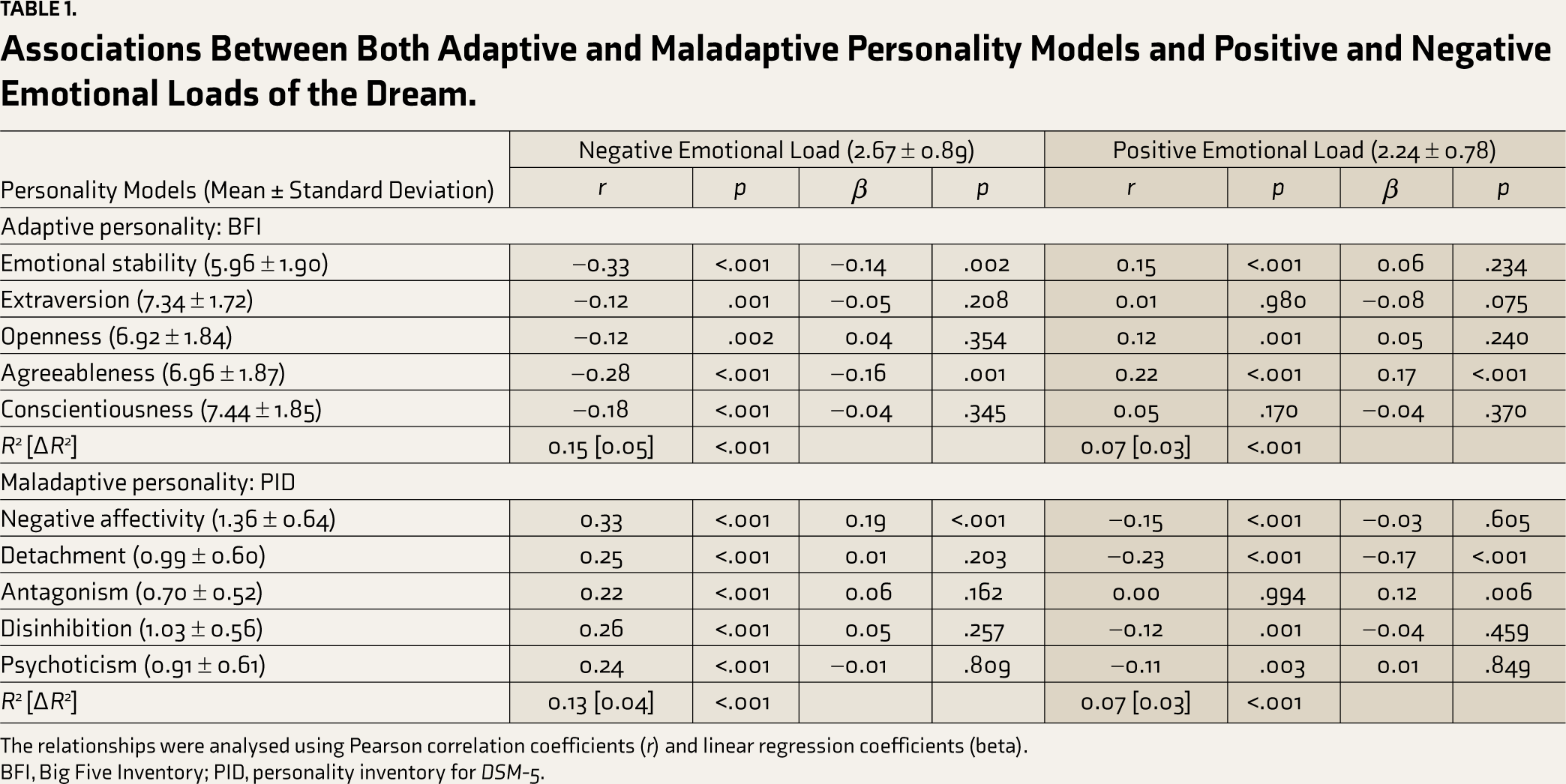
The relationships were analysed using Pearson correlation coefficients (r) and linear regression coefficients (beta).
BFI, Big Five Inventory; PID, personality inventory for DSM-5.
Latent Structure of Personality Spectrum Factors
Supplementary Table S1 shows the intercorrelations between all adaptive and maladaptive personality constructs. We conducted a conjoint EFA with maximum likelihood estimation on both sets of adaptive and maladaptive personality subscales to prevent the effect of collinearity between the predictor variables on the regression results, which can be seen in Table 2. We found two factors with eigenvalues > 1 (3.61 and 1.86) that strongly distinguish adaptive from maladaptive personality structures. The pattern coefficients for rotated factors using the Promax method indicated that all PID-5-BF subscales loaded on the first factor (i.e., maladaptive personality spectrum), whereas all BFI-10 subscales loaded on the second factor (i.e., adaptive personality spectrum). All coefficients were quite strong (about 0.50 and above), and cross-factor coefficients were all weak (|≤0.16|). We concluded that these personality measures could distinguish between adaptive and maladaptive personality spectrum factors, but not between different personality features. We thus retained factor scores from the conjoint model to examine how both spectra are related to the negative and positive emotional loads of dreams.
Latent Structure of Personality Spectrum Factors.
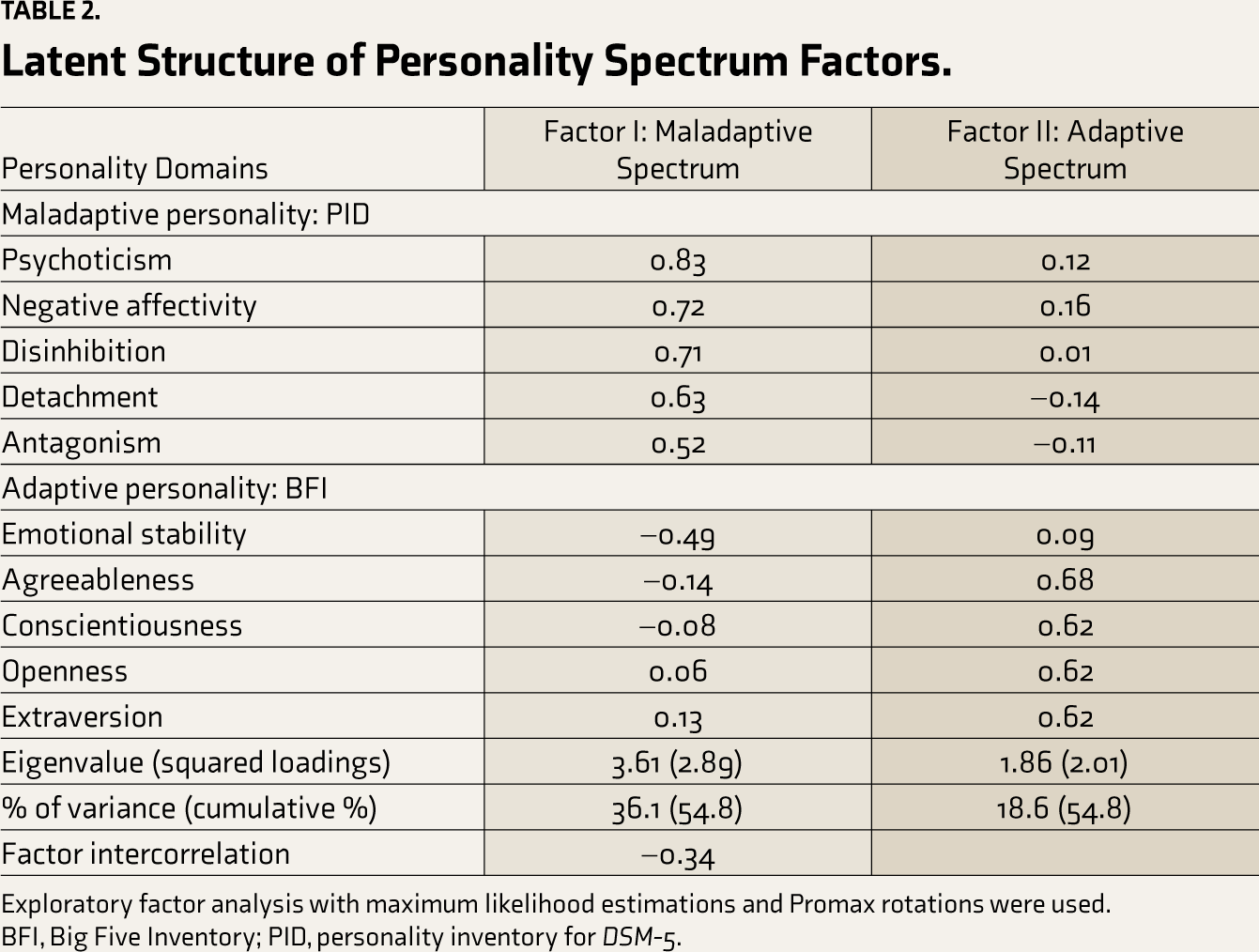
Exploratory factor analysis with maximum likelihood estimations and Promax rotations were used.
BFI, Big Five Inventory; PID, personality inventory for DSM-5.
Associations Between the Spectrum Factors and Emotional Load of Dreams
Table 3 shows the associations of adaptive and maladaptive personality spectrum factors with negative and positive emotional loads of dreams. Regarding the negative emotional load of dreams, when the maladaptive spectrum factor was entered in the first block, it had an R2 of 0.13 (β = 0.30), whereas when the adaptive spectrum factor was entered in the first block, the R2 was 0.07 (β = –0.14) (all p < .001). When the maladaptive spectrum factor was entered in the second block beyond the adaptive spectrum factor, the ∆R2 was 0.08, whereas when the adaptive spectrum factor was entered in the second block beyond the maladaptive spectrum factor, the ∆R2 was 0.02 (all p < .001). Regarding the positive emotional load of dreams, when the maladaptive spectrum factor was entered in the first block, it had an R2 of 0.03 (β = –0.14), whereas when the adaptive spectrum factor was entered in the first block, the R2 was 0.02 (β = 0.10) (all p < .001). When the maladaptive spectrum factor was entered in the second block beyond the adaptive spectrum factor, the ∆R2 was 0.02 (p = 0.001), whereas when the adaptive spectrum factor was entered in the second block beyond the maladaptive spectrum factor, the ∆R2 was 0.01 (p = .015). Both factors together predicted 15% (p < .001) and 4% (p = .001) of the variance of negative and positive emotional loads, respectively.
Associations Between Both Adaptive and Maladaptive Personality Spectrum Factors and Dream Emotional Loads.
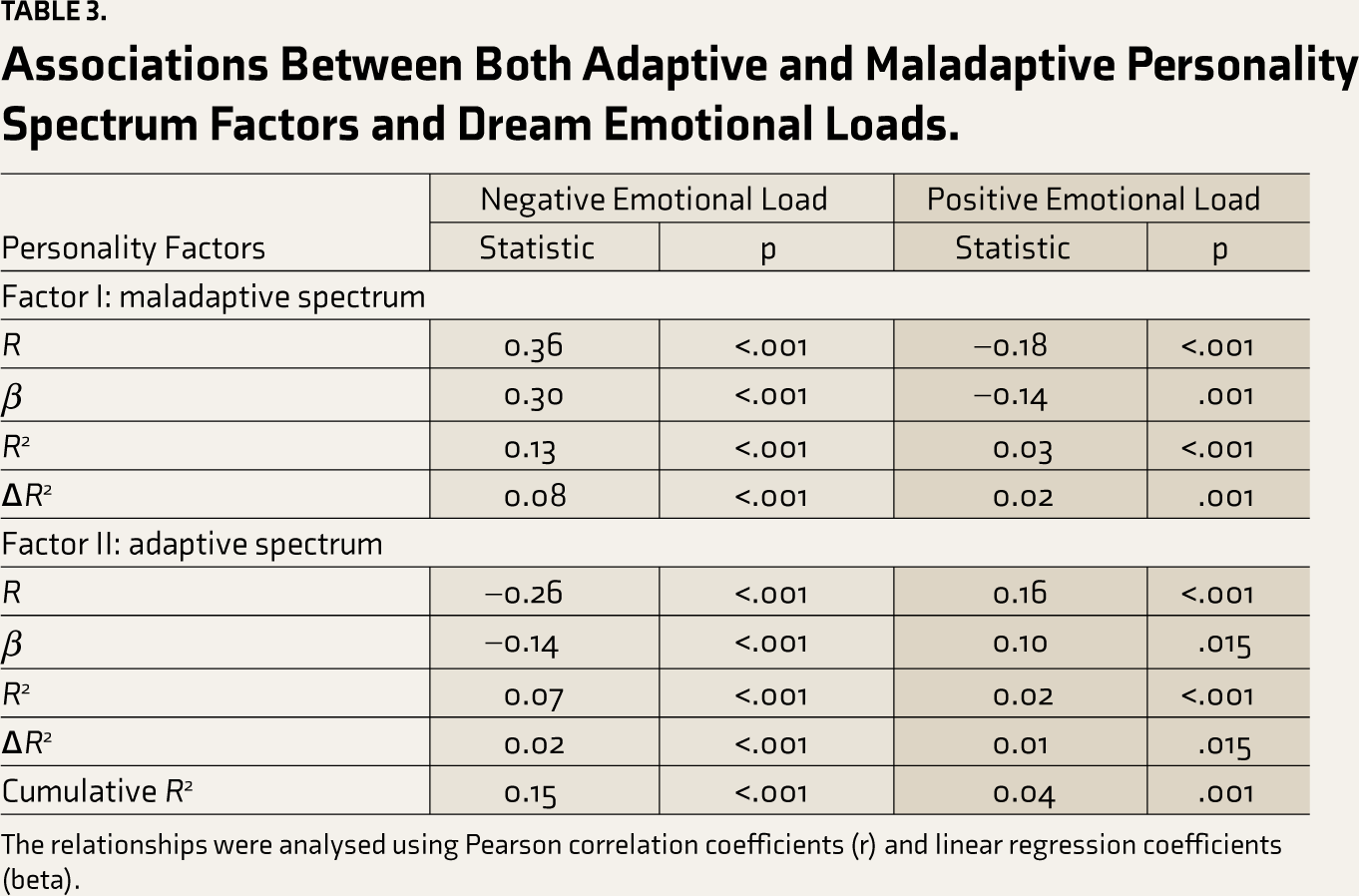
The relationships were analysed using Pearson correlation coefficients (r) and linear regression coefficients (beta).
Comparison of All Personality Constructs Across Dream Emotional Contents
Table 4 indicates the comparison of adaptive and maladaptive personality domains and spectrum factors across dream emotional contents. We compared the mean of all specific personality constructs and both adaptive and maladaptive spectrum factors of groups with negative content (i.e., anger, fear, sad, distress, multiple negative, and multiple negative plus happy) to those with happy content of dreams. Compared to groups with negative emotional content, individuals with happy content reported higher adaptive features (e.g., emotional stability and agreeableness) and lower maladaptive features (e.g., negative affectivity, detachment, and antagonism). Compared to some groups with negative emotional content (e.g., fear and distress), individuals with happy content also reported higher scores on the adaptive personality spectrum and lower scores on the maladaptive spectrum. We found the most personality psychopathology among the group with multiple negative dream contents (all p < .05).
Comparison of Adaptive and Maladaptive Personality Domains and Spectrum Factors Across Dream Emotional Contents.
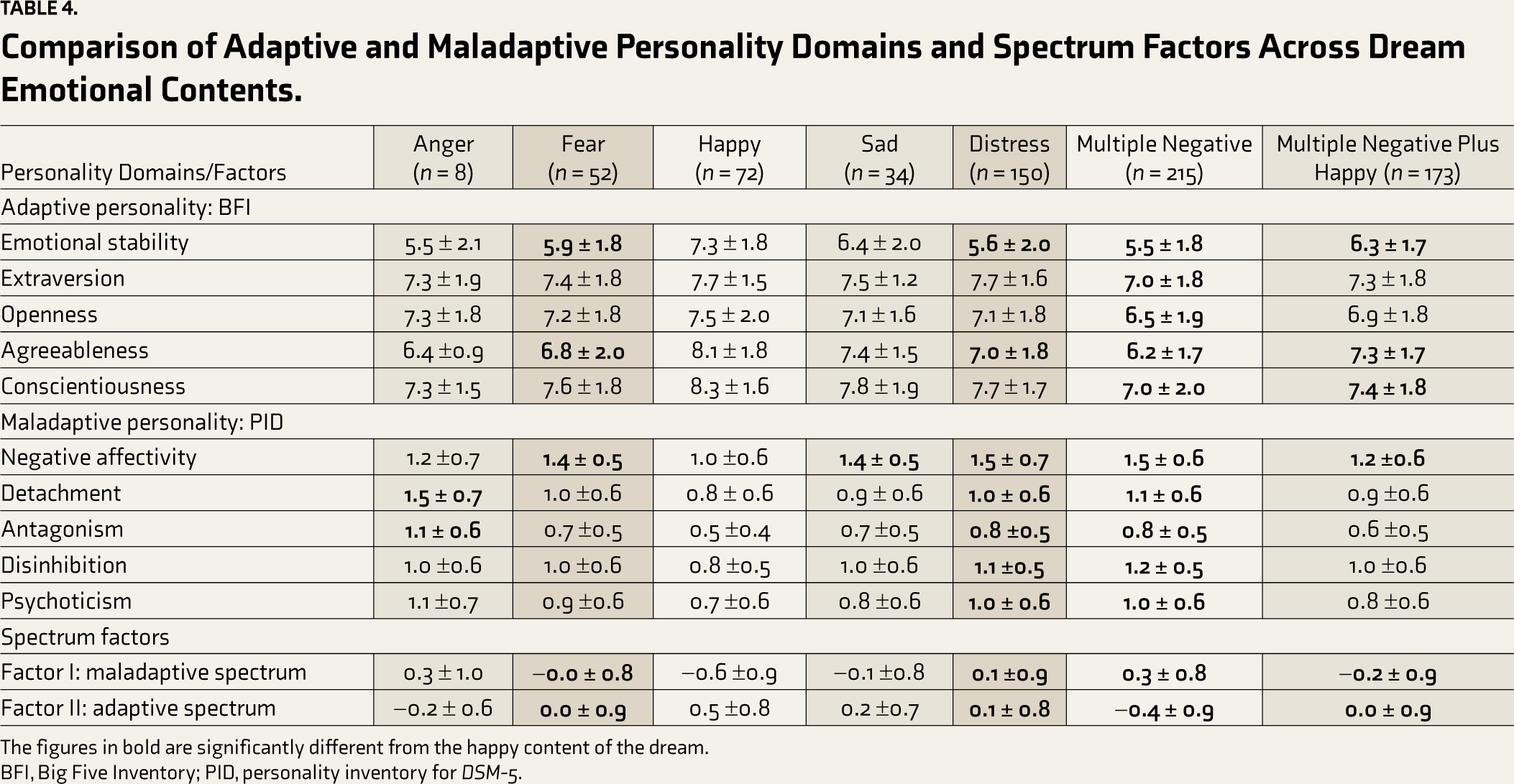
The figures in bold are significantly different from the happy content of the dream.
BFI, Big Five Inventory; PID, personality inventory for DSM-5.
Discussion
The present study aimed to predict the emotional load and content of dreams using both adaptive and maladaptive personality models and two extracted spectrum factors of adaptive and maladaptive personalities. The findings from our study indicate that both BFI-10 and PID-5-BF personality measures significantly predict the negative and positive emotional loads of dreams. These findings are consistent with the results of some studies.10, 13–17, 36 Several factors may contribute to the results obtained in our study. First, it is important to note that the BFI-10 and PID-5-BF measures capture opposite poles of personality. 37 BFI-10 assesses adaptive personality dimensions including extraversion, agreeableness, conscientiousness, openness, and emotional stability, 38 whereas PID-5-BF is based on the DSM-5 framework and assesses specific maladaptive personality traits. 39 The coherence between these two measures in predicting emotional loads suggests that specific personality characteristics influence dream emotions. Second, the modest increase in variance explained when combining the two measures could be due to the shared variance between the personality traits assessed by both instruments. Since there is overlap in the constructs measured by the BFI-10 and PID-5-BF measures, 40 it is expected that the incremental predictive power gained from combining them would be limited.
We found that specific personality traits were strong predictors of the emotional load of dreams. For example, negative affectivity, agreeableness, and emotional stability were the strongest predictors of negative emotional loads. To be more precise, the finding indicates that individuals with higher levels of negative affectivity, which refers to a disposition characterized by negative emotions and emotional instability, 41 are more likely to experience negative emotional loads in their dreams. In explaining this finding, it can be noted that the cited finding aligns with previous research that has shown a relationship between negative affectivity and the recall of negative dream content. 42 Further, agreeableness, which reflects traits such as warmth, empathy, and cooperativeness, 43 was also found to be a protective factor against the negative emotional load of dreams. Emotional stability, characterized by resilience and the ability to manage stress, 44 may also serve as a protective factor against negative emotional loads in dreams. 4 Adaptive personality traits, such as emotional stability and agreeableness, may play a role in modulating and mitigating the intensity of negative emotions experienced during dreaming. For example, individuals with higher emotional stability are better able to regulate their emotions and cope with stress. 45 This can help them to process and manage negative emotions experienced during dreaming more effectively, leading to less intense emotional experiences.
Besides, the present study found that for the positive emotional load of dreams, agreeableness, detachment, and antagonism were the strongest predictors. In clarifying this result, it can be stated that agreeable individuals, who display prosocial and cooperative behaviors, 46 may have a greater tendency to incorporate positive emotional experiences into their dreams. Also, detachment, which refers to a tendency to be emotionally aloof or distant, 47 may be associated with experiencing less positive emotional loads in dreams. 48 Finally, antagonism, characterized by hostility, manipulativeness, and a lack of empathy, 49 may also contribute to the incorporation of positive emotional content in dreams, 50 possibly as a reflection of self-enhancement or grandiosity. 51 However, we originally found a negative bivariate correlation between antagonism and the positive emotional content of dreams, which was probably reversed due to the suppression effect of regression.
The factor analysis revealed two factors that strongly distinguish adaptive from maladaptive personality constructs. The PID-5-BF subscales loaded on the first factor represent maladaptive personality, while the BFI-10 subscales loaded on the second factor represent adaptive personality. The significance of this finding can be understood in the context of existing literature on personality psychology and dream research. PID-5-BF is a widely used instrument for assessing maladaptive personality traits associated with various psychological disorders, such as personality disorders and psychopathology. 27 On the other hand, BFI-10 is a well-established measure of the Big Five of adaptive personality. 28 The finding of two distinct factors aligns with previous research suggesting that personality traits exist on a continuum ranging from adaptive to maladaptive manifestations. 52 It supports the notion that maladaptive personality constructs are differentiated from adaptive personality constructs based on specific trait configurations and elevations in maladaptive traits. 53
The findings of the present study indicate associations between adaptive and maladaptive personality spectrum factors and the emotional load of dreams. In simple terms, the researchers looked at how different personality traits relate to the negative and positive emotions experienced in dreams. When examining the negative emotional load of dreams, the maladaptive spectrum factor showed a stronger relationship compared to the adaptive spectrum factor. Consistent with previous studies,54, 55 this means that maladaptive personality traits have a greater impact on negative emotions in dreams. However, both spectrum factors still contribute to the understanding of negative emotional load in dreams, albeit to a lesser extent. It can be said that maladaptive personality traits are often associated with difficulties in emotional regulation and processing. Individuals with high levels of negative affectivity may experience heightened emotional reactivity and difficulty in managing negative emotions. 56 These emotional tendencies can carry over into dream content, resulting in the manifestation of intense negative emotions during dreams. Similarly, maladaptive personality traits can be associated with specific cognitive biases, such as rumination or negative thinking patterns. 57 These biases can influence the way individuals interpret and process information, including dream content. When negative themes or situations arise in dreams, individuals with maladaptive personality traits may be more prone to interpret them in a negative or threatening manner, leading to the experience of negative emotions. 58
Our findings showed a comparison between adaptive and maladaptive personality traits in the emotional contents of dreams. We compared adaptive and maladaptive traits and spectrum factors between groups with negative (anger, fear, sad, distress, multiple negative emotions, and multiple negative plus happy) and positive (just happy) contents. The results showed that individuals with positive dreams had higher levels of adaptive personality features, such as emotional stability and agreeableness, and lower levels of maladaptive features, such as negative affectivity, detachment, and antagonism, than those with negative dreams. Individuals with positive dreams also had higher scores on the adaptive personality spectrum and lower scores on the maladaptive spectrum compared to some specific types of negative dreams, such as fear and distress. This finding is consistent with that of previous studies.58, 59 There are several potential reasons to explain this finding. First, individuals with positive content in their dreams may have a more optimistic and positive outlook on life in general. 58 This positive mindset may be reflected in their personality traits, such as emotional stability and agreeableness. On the other hand, individuals with negative dreams may be more prone to negative affectivity and detachment, 59 which could be reflected in their personality traits. Additionally, the content of one’s dreams may be influenced by their current emotional state and overall mental well-being. 60 Individuals with higher levels of emotional stability and agreeableness may be more likely to experience positive dreams, while those with lower levels of these traits may be more prone to negative dreams. 61
Strengths and Limitations
To our knowledge, the present research is a pioneering study to test the associations of adaptive and maladaptive personalities with the emotional load and content of dreams. We included a large community sample from different regions of Iran. Uniquely, the predictor variables in the current study covered both adaptive and maladaptive personality constructs. To avoid bias caused by collinearity between overlapping personality traits, we also included adaptive and maladaptive personality spectrum factors in the list of predictors of dreams. We analysed the data with various statistical methods to ensure the validity of the results. However, the current study has some limitations. We collected cross-sectional data; a cross-sectional study, as opposed to a longitudinal design, prevents the understanding of causal relationships between variables. We collected the dream data using two brief self-report scales.13, 29 Because people usually do not remember a large part of their dreams, 62 we recommend the use of more objective measurement techniques (e.g., dream-recording applications, voice recorders, and immediate registration forms) in future studies. We also used brief versions of personality (i.e., BFI-10 and PID-5-BF) to measure adaptive and maladaptive personalities.27, 28 Although these scales have been validated for research in Iran,30–32 we recommend that future studies use full versions to control for possible data bias. Although PID-5-BF is an up-to-date scale for measuring the contemporary maladaptive personality model (i.e., the DSM-5 trait model), using scales to measure earlier categories of personality disorder (e.g., borderline and avoidant) can also provide valuable data for clinicians. We only included eight individuals in the group with angry dream content. Although the present study collected the data from a large sample, it seems that future studies will need larger samples. Finally, future studies will attempt to validate the current results among clinical samples across gender and age subgroups.
Conclusions
The emotional load and content of dreams are significantly related to both specific constructs and spectrum factors of adaptive and maladaptive personalities. However, the maladaptive spectrum of personality is more specific to the negative emotional load and content of dreams. Two unique personality profiles are specific to the negative (low agreeableness and high negative affectivity) and positive (high agreeableness and low detachment) loads of adult dreams. Psychologists can refer to personality profiles when analysing the dreams of adults. Future studies will evaluate the validity of the present findings by taking into account the discussed methodological limitations.
Supplemental Material
Supplemental material for this article is available online.
Footnotes
Acknowledgements
We acknowledge the Mind GPS Institute (Kermanshah) for improving the quality of the scientific content of this work.
Declaration of Conflicting Interests
The authors declared no potential conflicts of interest with respect to the research, authorship, and/or publication of this article.
Declaration Regarding the Use of Generative AI
None used.
Ethical Approval
We received permission from the Ethics Committee of Mind GPS Institute (ID: MGPSI.EA.IR.1402.6).
Funding
The authors received no financial support for the research, authorship, and/or publication of this article.
Patient Consent
We obtained the consent of all participants to participate in the study.
References
Supplementary Material
Please find the following supplemental material available below.
For Open Access articles published under a Creative Commons License, all supplemental material carries the same license as the article it is associated with.
For non-Open Access articles published, all supplemental material carries a non-exclusive license, and permission requests for re-use of supplemental material or any part of supplemental material shall be sent directly to the copyright owner as specified in the copyright notice associated with the article.
