




Abstract
Background:
The P300 is a positive auditory event-related potential appearing around 300 msec post-oddball stimulus onset. Tone and monosyllabic stimuli have been widely used in P300 research, providing valuable insights into auditory perception, phoneme discrimination, language processing, and other cognitive processes. Bi-syllabic minimal pairs may be more challenging for some individuals because they require processing and discrimination of more complex phonemic structures. The aim of the study was to elicit and analyze the auditory event-related potentials for bi-syllabic word stimuli in the Kannada language among individuals with dementia.
Method:
The prospective study was conducted at the Department of Speech Pathology and Audiology. Ten native Kannada language speakers (five male; and five female) diagnosed with dementia, aged 55–70 years, were the participants. The naturally produced and recorded CVCV (Consonant vowel consonant vowel) tokens (/ko:ti/ and /ko:thi/ pair; /a: me/ and /a:ne pair) in Kannada were used in the auditory oddball paradigm.
Results:
The waveforms with positive peak for word (PPW) with clear morphology were used to obtain the latency and amplitude. Mean and Standard deviation (SD) value for the latency of the PPW was 545 ± 38 msec and the amplitude value of PPW was 2.5 ± 1.5 µV.
Conclusion:
The present study showed that when lengthier speech stimulus duration was used, the latency value of auditory event-related potential was higher. The study also showed that PPW is a reliable peak that could be used in the clinical population.
Keywords
The naturally produced and recorded speech stimuli (/ko:ti/ and /ko:thi/ pair; /a: me/ and /a:ne pair) in Kannada were used to record P300 among 55-70-year-old individuals with Dementia. The prominent positive peak for word (PPW) stimuli used with clear morphology was obtained at the mean latency of PPW, 545 ± 38 msec, and the PPW amplitude was 2.5 ± 1.5 μV. When a longer speech stimulus was used, reliable PPW peaks were obtained, and the latency was higher compared to shorter tone or bi-syllable stimuli routinely used.Key Message:
The P300 is an auditory event-related potential, also an objective method for the evaluation of cognition and use of knowledge about the environment.1,2 Around 300 msec post-stimulus, the P300 supports memory, decision-making, and studies on long-term memory, sequential processing, and memory disorders. It emerges in experiments using mostly similar stimuli with occasional “oddball” variations.3,4 The magnitude of P300 is influenced by the likelihood of events occurring and the task’s significance in identifying acoustic stimuli. 5 It changes with stimuli significance and complexity, stronger for complex or prominent ones, mirrors cognitive effort, peaking in tasks demanding more attention, memory, or decision-making. Its sensitivity to task difficulty makes it a gauge for cognitive load. There are two types of P3 responses (P3a and P3b of P300). P3a, a more frontal in scalp distribution, is less affected by attention, 6 and may signal the obtrusiveness of a deviant stimulus placed within a train of homogeneous stimuli, 7 or a preconscious, rapid attention-switch to a deviant.8-11 It does not link to mental/motor responses, can be recorded without direct participation, though attention matters. P3b, more parietal in scalp placement, relies on attention. 10 The P3b is typically recorded at centroparietal scalp locations like electrode site Pz, associated with detecting target stimuli in a task and strengthens with accurate target responses. 12 The P300 response depends on optimal electrode array placement over the midline for maximum amplitude, 13 and greater amplitude is obtained with a lower probability for the rare signal. 14
P300 is impacted by auditory stimuli attributes (loudness, frequency, duration), participant age, and cognitive skills. Age notably affects P300 at central/parietal sites (Cz & Pz) with latency/amplitude changes, weaker at midline (Fz) and lateral electrodes. 15 The P300 latency and age are positively correlated, whereas the amplitude shows negative correlation, especially in individuals aged over 40 years.4,16-18 With age, P300 typically exhibits reduced amplitude and prolonged latency, mirroring neural processing changes. From ages 10 to 90, P300 latency ranges from 300 to 450 msec, with an annual amplitude decline of approximately 0.2 µv. Though some studies highlight increased variability in P300 with age. 19
Tone and monosyllabic stimuli have been widely used in P300, providing insights into auditory perception, phoneme discrimination, language processing, and other cognitive processes.20-25 Studies have looked into the auditory event-related potentials elicited by tonal stimuli, vowels, 26 syllables, 27 or words, 28 indicating that longer stimulus durations result in increased latency and decreased amplitude, variations suggesting distinct processes engaged with tonal and speech stimuli.
Speech-evoked auditory event-related potentials events are vital for audiologists, as they provide direct insights into real-world speech handling, circumventing issues in auditory, linguistic, or cognitive assessments. They map speech processing stages in the auditory system, separating perceptual confusion from recognizing acoustic signal traits and pinpointing aspects of a speech signal not neurologically coded, aiding in rehabilitation and management strategies. 29
P300 was recorded using pairs of Finnish phonemes, matching or not matching a standard syllable, larger responses occurred for syllables differing from the standard, and amplitudes were higher when presented with challenging-to-discriminate phonemes compared to easier ones. 30 In a study, 31 spoken syllables in English as target syllable, embedded in a sequence of distractor syllables were used. P300 response was larger for target syllables than for distractor syllables, while amplitude decreased with increasing task difficulty. 32 Uncertainty in the discrimination of sounds may be reflected in reduced P300 amplitude.3,6,33,34
Minimal pairs, differing by a single phoneme, serve as a test to discriminate similar sounds and assist in diagnosing and treating speech and language disorders. Bi-syllabic minimal pairs, like “candy” and “handy,” showcase this by differing in a single sound (e.g., the initial consonant /k/ versus /h/) while maintaining two syllables. Though bi or monosyllabic minimal pairs can be used to assess an individual’s discrimination, bi-syllabic minimal pairs are more challenging as they require processing and discrimination of more complex phonemic structures. Auditory event-related potentials may provide clinically relevant information including the effects of auditory processing disorders on the neural processing of speech, the effects of background noise and/or listening environment on the neural processing of speech, 31 and teasing out central auditory processing skills in children with multiple impairments. 35
Neurological/psychiatric conditions (e.g., Alzheimer’s, Parkinson’s, schizophrenia) and medications like benzodiazepines and antipsychotics disrupt auditory event-related potential responses. P300 has clinical applications in studying attention, memory, and decision-making in both healthy and affected individuals. It is used to assess language processing, spanning phonological, semantic, and syntactic aspects.
Clinical auditory event-related potential studies often use the auditory oddball task in patients under 70 years old. The hypothesis suggests that individuals over 70 may experience more neural degeneration from aging, which could make oddball task challenging for cognitive resources, potentially hindering the reliable differentiation between patients and unaffected controls.18,36-39 This finding also supports that the P300 latency may be more accurate in the prodromal phase where patients are typically younger than 70 years of age.37,40,41 The P300 latency showed smaller effect size between patients and unaffected controls, comparing P300 latency between mild cognitive impairment (MCI) and Alzheimer’s disease (AD), a notably greater effect size was observed with the secondary Pz electrode.
The prolonged latencies and decreased amplitudes of auditory event-related potentials can be early indicators of cognitive decline and progression of the condition. 42 One study 43 suggests that P300 latency, especially in frontal, central-parietal, and frontotemporal areas, can be a good assessment and diagnostic tool for dementia. These findings stress the significance of evaluating overall cortical activity when addressing neurological issues in older adults. Examining P300 potentials alongside other brain function measures and imaging techniques can offer a more comprehensive understanding of brain function among individuals with dementia.
A meta-analysis, 44 investigated the link between P300 amplitude and AD and explored influencing factors. The study revealed that the P300 amplitude was smaller in subjects with AD compared to healthy controls. The effect size for electrodes was Cz, Fz, Pz in decreasing order. They reported a reduction in P300 amplitude in AD consistent across different brain regions and it may be a biomarker for the early diagnosis of AD. Another study 45 identified significant variations in P300 latency when comparing individuals with AD (440.6 ± 65.2 msec) to controls comprising 20 elderly participants (336.4 ± 36.8 msec).
P300 latency and amplitude were compared between the three groups- AD, vascular dementia (VD), and the controls. 46 Both AD and VD groups had higher P300 latency for rare sounds than controls, without variance between dementia types. Amplitude was lower in AD and VD groups than controls, without variance between dementia types. VD exhibited notably higher P300 differences compared to AD and controls. VD also had significantly lower amplitude compared to AD and controls, whereas AD did not differ significantly from controls in this aspect.
The P3a and P3b subcomponents between the three groups, that is, the AD, MCI and the controls of elderly have been compared. 47 The AD group exhibited significantly higher P3a latency, but lower amplitude than the controls. No differences were found between the AD group with MCI. When values were compared within the group based on the degree, significantly higher P3b amplitude was seen with moderate than mild conditions in both MCI and AD.
P300 latency and amplitude between a group of elderly with AD to the elderly controls were investigated 48 and findings revealed the P300 delay in Cz varied statistically significantly between the groups, with the AD having a larger P300 latency than the controls. The P300 amplitude did not differ.
Comparison of P300 from elderly with AD, elderly with MCI, and control elderly 40 revealed that AD group displayed greater latency than the MCI group, which in turn had higher latency than the controls. The amplitude of the AD group was lower but no amplitude difference was observed between the control and the MCI group.
P3a and P3b were assessed across AD and controls. 37 With respect to latency, compared to the control group, P3a latency of the AD group was larger. P3b amplitude though varied between the groups, with the AD group performing worse than the control group. There were no significant variations in P3b latency though.
P300 latency of elderly with AD and healthy elderly control group were studied. 49 There were significant differences between the groups, with higher latency for AD group from Pz, Fz, and Cz leads when compared to the control group. P300 amplitude was not reported though. A study was conducted with participants 60–74 years and used 2KHz and 1KHz, both presented at 80 dB HL, to find P300 latency increases with age at a rate of 2.85 msec per year between the ages of 60 and 74 years. 50
P300 latency investigated among normal elderly, institutionalized elderly persons with dementia not of the Alzheimer’s types, and elderly people with AD, 51 using stimuli of 1KHz and 500Hz stimuli were between 280 and 350 msec. P300 latency and amplitude at Pz electrode placement were recorded from participants of AD, MCI, and the controls. 52 Significant differences in P300 latency among the groups were found at the Pz electrode, the AD group with highest latency, followed by cognitive involvement and controls. No significant latency differences were seen at Fz and Cz, also no differences in P300 amplitude among the three groups.
A prospective study was conducted among 60 participants which had 11 with Front-Temporal Dementia (FTD), 33 with a probable AD, and 16 controls. 53 FTD had P300 latency between controls and AD group. However, AD group displayed a statistically significant delay in P300 latency compared to both FTD and control groups when directly compared.
Literature also reports P300 latencies were higher and amplitude was lower for verbal stimuli compared to non-verbal stimuli for P300.22-24 While complex speech stimuli have been valuable in studying speech perception and language processing using auditory event-related potentials, there’s a gap in the research above the monosyllable level, especially across native languages. Recognizing this gap, the current study was designed by creating a stimulus involving bi-syllable minimal pair words in the Kannada language.
The aim of the study was to elicit and analyze the auditory event-related potentials for bi-syllabic speech stimuli in the Kannada language among native Kannada speakers with dementia.
Method
The study was conducted at the Department of Speech Pathology and Audiology and is a prospective study for putting forth data on native Kannada speakers with dementia.
Participants
Ten native Kannada language speakers (five male & five female), aged 55–70 years (mean 64 ± 2 years) were recruited from the unit of Geriatrics clinic of the Hospital for the study. The study design used was an observational study with within-group comparison. To facilitate statistical comparisons, a gender distribution that is equal was chosen. Convenient sampling was used with reference to the study. 54
Tools used for assessment of cognitive functioning:
Mini-Mental State Examination (MMSE) Addenbrooke’s Cognitive Examination III in Kannada (ACE III-K)
The participants included were diagnosed with mild Alzheimer’s dementia (Clinical Dementia Rating Scale: CDR = 0.5 or CDR = 1) by experienced geriatric Psychiatrists after comprehensive clinical assessment using clinical symptoms, according to the criteria established by the (American Psychiatry Association [APA] V: Diagnostic and Statistical Manual, Ed 5. Washington, APA Press, 1984), and MMSE. 55 The most popular test for dementia screening is the MMSE, evaluates short-term memory, orientation, writing, and reading skills with a maximum score of 30, where a score of 25 or more is considered normal. A score of 24 or less is abnormal, suggests the possibility of cognitive impairment. ACE III-K, 56 was administered on all the participants to determine the diagnosis of cognitive impairment. It is one of the most sensitive screening tools for the detection of dementia, evaluates short-term memory, orientation, writing, and reading skills (Table 1).
Persons with the same dementia criteria but with any co-morbid conditions like cerebrovascular disease, or another ongoing neurological/psychiatric disease or a non-neurological medical condition, or with history of the use of medication with a substantial impact on cognition, or epilepsy were excluded.
Pure tone auditory thresholds from 250 to 8KHz, at octave frequencies, were established. The thresholds across the frequencies ranged from 5dB HL to 55 dBHL with pure tone average ranging from 40 to 55 dBHL, with air-bone gap (ABG) less than or equal to 10 dBHL for all participants. The speech reception thresholds evaluated using Kannada spondee words correlated with the Puretone average, and they all had a speech discrimination scores within 75%–95% for PB (Phonetically balanced) Kannada word list. (Table 1). All the participants had mild to moderate sloping sensory neural hearing loss with correlating speech discrimination scores. Standard audiological recording procedures were used.
Demographic Details of the Participants.
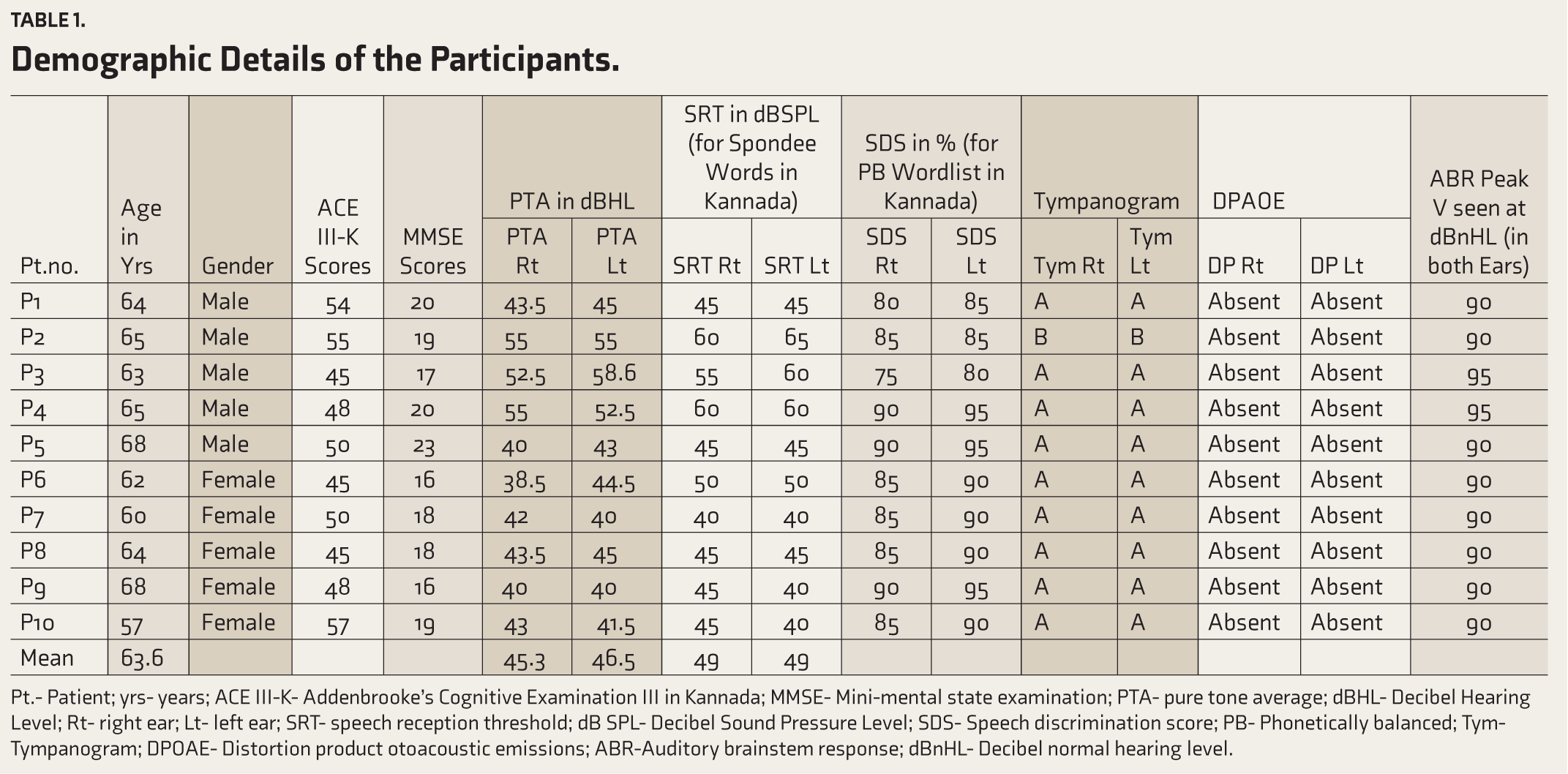
Pt.- Patient; yrs- years; ACE III-K- Addenbrooke’s Cognitive Examination III in Kannada; MMSE- Mini-mental state examination; PTA- pure tone average; dBHL- Decibel Hearing Level; Rt- right ear; Lt- left ear; SRT- speech reception threshold; dB SPL- Decibel Sound Pressure Level; SDS- Speech discrimination score; PB- Phonetically balanced; Tym- Tympanogram; DPOAE- Distortion product otoacoustic emissions; ABR-Auditory brainstem response; dBnHL- Decibel normal hearing level.
Equipment
A two-channel auditory evoked potential system, Intelligent Hearing Systems- Duet Smart EP version 3.54 was used to record latency and amplitude of the auditory event-related potentials for bi-syllabic speech stimuli.
Stimuli
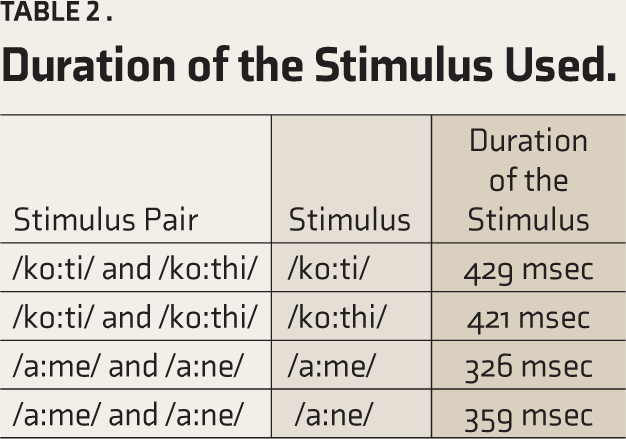
The naturally produced and recorded bi-syllabic words, that is, CVCV tokens (/ko:ti/ and /ko:thi/; /a:me/ and /a:ne/) were incorporated in an “auditory oddball” paradigm with a low-probability C1V1C2V2 token (/ko:ti/ or /a:me/) embedded in a stream of high probability C1V1C3V2 token (/ko:thi/ or /a:ne/). The duration of stimuli used is given in Table 2. The sequence was presented binaurally to each participant at a comfortable loudness level (i.e., the intensity was set at 70% in the auditory evoked potential system which was equivalent to 65 dB SPL) using headset with IR-3A earphones connected to the computer with compatible AEP software.
Duration of the Stimulus Used.
Procedure
The protocol of the study was approved by the Institutional Ethics Committee of the institute where the data was collected. Each participant and his/her responsible relative were informed about the expected duration, details of the procedure. The evaluation was done after the latter provided voluntary written consent in Kannada language.
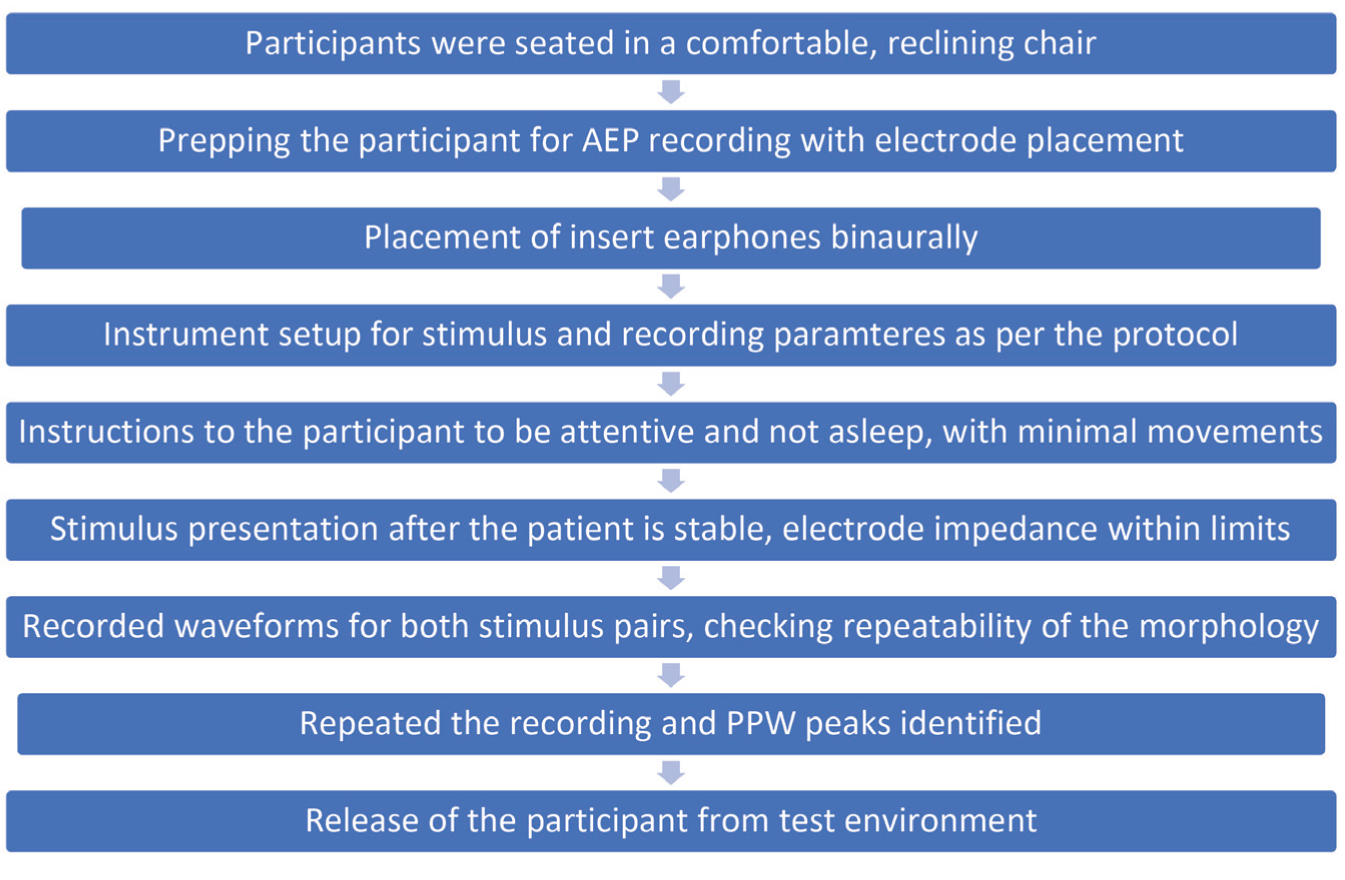
The participants were seated in a comfortable, reclining chair within a sound-treated room and given instructions to focus on the stimuli. They were directed to remain attentive and avoid sleeping. Although no responses to the stimuli were required, staying alert was emphasized. Minimizing eye movements or blinks was encouraged to enhance the quality of the recorded results (Figure 1).
Flow Chart of the Procedure Used for Obtaining PPW.
The passive participation of the participant was considered during the testing. The patient had to be attentive and alert but not required to respond to changes in stimuli of the paradigm presentation. After using the cleaning gel to clean each of the five electrode locations, 10–20 conduction paste was used to place the gold-plated or silver-disk electrodes. Electrode placement was done at Fz and Pz (recording sites), and on the forehead at Fpz (ground) according to the International 10–20 system. 57 Disc electrodes were applied using conducting jelly and ensured the impedance of the electrodes be less than 5 KΩ. To track eye movement, two more electrodes were positioned above and below the right eye to record an electrooculogram (EOG). The impedance measured for each electrode was lower than 5K Ohm and artifact rejection threshold of 250 µV was set. The EEG was amplified and averaged using a filter bandpass of 1–30 Hz. Automatic artifact rejection facility was used. The details of the stimulus and recording parameters used to record auditory event-related potentials using minimal pair bi-syllabic stimuli in Kannada are in Table 3.
Stimulus and Recording Parameters.
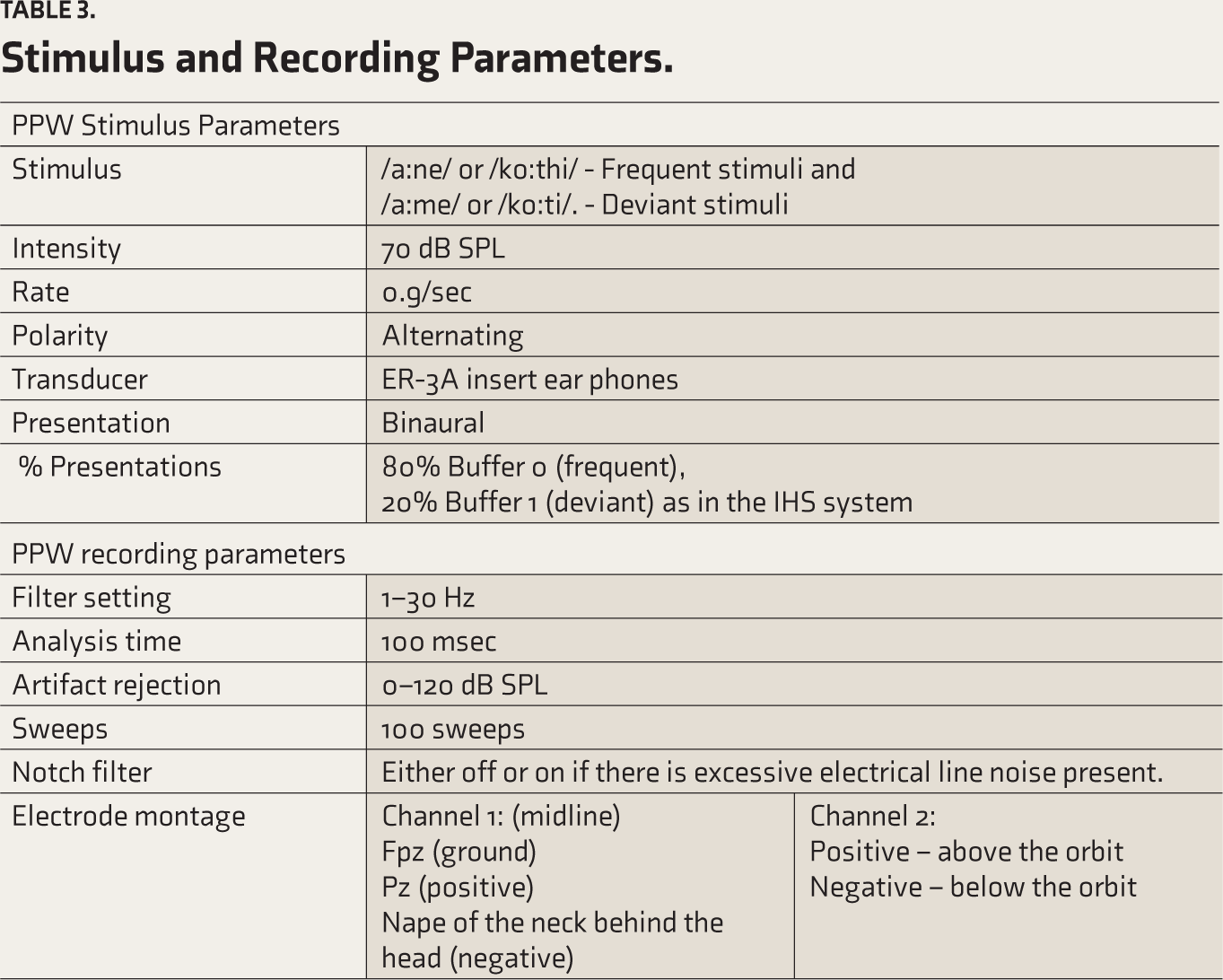
The target stimuli (20%) were low-probability C1V1C2V2 token (/ko:ti/ or /a:me/) and non-target (80%) high probability C1V1C3V2 token (/ko:thi/ or /a:ne/) and the order of occurrence was pseudo-random. The auditory oddball paradigm was applied binaurally at an intensity of 70 dB SPL at a rate of 0.9/second. The sequence of stimuli was presented binaurally to each participant at a comfortable loudness level (i.e., the intensity was set at 70% in the auditory evoked potential system which was equivalent to 65 dB SPL, at least) using headset with IR-3A earphones connected to the computer with compatible AEP software.
Recordings containing eye blinks or movements, excessive muscle activity artifacts were either corrected with pauses while recording or rejected. If more than 15 of the 100 sweeps of a given recording were rejected for any reason, then the data in that condition for that subject was rejected. Thus, each waveform was based on a minimum of 75 sweeps. Once the presentation of the stimuli was completed, the morphology of the recorded waveform was carefully evaluated and marked for the prominent positive peak and termed as the positive peak for the word (PPW).
This PPW with clear morphology was used to obtain the latency and amplitude. The peak was found to be 100–150 msec later from the stimulus duration for the present study. This indicated the increase in duration of the time window for recording and analysis.
Results
The sample size for the study was calculated using the GPower software, using a two-tailed hypothesis design formula with superior design model testing for a duration of two years with an effect size of 80% at 5% level of significance and 1:1 allocation. In this study, PPW was inspected visually for clear morphology, and repeatability of peak. Subsequently from each of these waveforms of each participant, the measures of analysis, that is, latency and amplitude of PPW were made. The latency of the PPW peak was measured from the time of onset of stimulus (in msec) to the appearance of the peak as displayed on the time window as mentioned in the guidelines given by Polich, 16 for P300. For the amplitude, the negative peak-to-positive peak (like N2-P3), in µV was considered.
In the PPW, the average latency for both stimulus pairs (mean and SD values for both the stimulus pairs) was 545 ± 38 msec and the amplitude was 2.5 ± 1.5 µV. The average PPW latency value for
Results of the PPW.
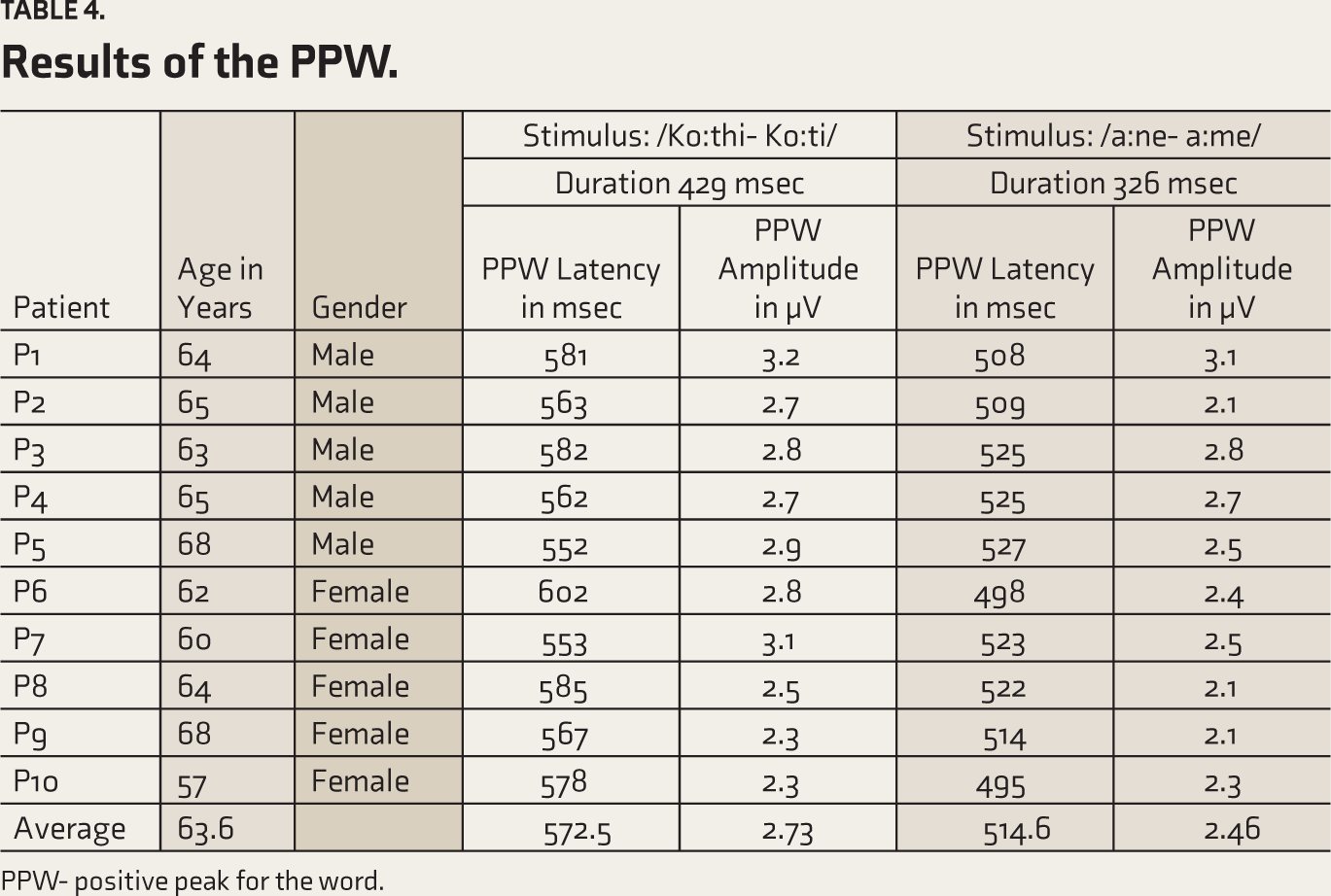
PPW- positive peak for the word.
The variability of demography among the participants was kept minimal with convenient sampling, hence only participants with no co-morbid conditions, similar duration of onset, scores of MMSE and ACE III, within the age group of 60–70 years with Mild Dementia of Alzheimer’s type only were included. The difference among the participants was in terms of gender, male and female participants were included with equal sample size were taken. It was seen that the latency value for PPW varied across the stimulus, the longer stimulus
Discussion
The participant’s method of responding to the stimuli for eliciting PPW, was considered based on the clinical auditory event-related potential studies which employ auditory oddball task and support the hypothesis that individuals above 70 years of age are likely to have more neurodegeneration due to aging process.37,40,41 The cognitive tasks of auditory discrimination is too demanding to produce reliable results.17,18,37,38,39 Due to the high cognitive load at a rapid stimulus rate (0.9/sec), especially for those with dementia, the study recorded evoked potentials without needing participant responses. P300b tends to be more Centro-parietal, so electrodes were placed midline with a parietal Pz position. 15 Hence passive participation and Pz electrode placement were considered to elicit PPW.
The auditory event-related potential waveforms, latency and amplitude recorded were reported 14 to depend on the loudness, frequency, and duration of auditory stimuli along with age and cognitive load of the participant. The auditory event-related potential responses to tone or vowel stimuli, 26 or for syllables, 27 or for words, 28 reported prolonged latency values as well as a decrease in amplitude values, and emphasized on the rare stimuli being difficult to discriminate than the frequent stimuli. That implies more the similarity between the oddball stimuli, better clarity of the waveforms with positive peak can be recorded.
Minimal pairs have conventionally assessed individuals’ capacity to differentiate similar sounds in speech perception tests. Utilizing bi-syllabic minimal pairs in the Kannada language, specifically focusing on the consonant variant in the final syllable, was preferred for recording the PPW. This stimulus choice facilitated clear waveform recordings while posing a cognitively demanding task. It is crucial to conduct further research comparing how the nervous system processes various verbal stimuli. This exploration can significantly contribute to comprehending the diverse alterations that may impact the auditory system.
In contrast to the lab-established norms, where tone stimuli lasting 100–150 msec triggered a P300 positive peak around 300 msec, the current bi-syllabic word stimuli, lasting 330–420 msec, elicited a PPW around 500-msec. Literature does report such increased latency values in healthy controls for verbal stimuli. A study with discrimination paradigm of infrequent from frequent stimuli based on semantic features elicited a positive parietal wave in the 600 msec window frame. It postulated P600 peak seen is an oddball is delayed P300 component elicited in a semantic oddball experiment to more complex stimuli. 58 Similar findings were reported, 59 suggesting that P600 component related to syntactic violation processing is just a delayed P300. It is similar to that recorded in simple oddball tasks as both P600 and P300 are sensitive to the probability manipulations and are similar in their respective scalp distribution of recording. The mean P300 latency recorded with verbal stimuli were significantly higher than that with non-verbal stimuli, while the amplitudes were significantly lower as reported. 22 Similar to literature22,23,24 reports, PPW latencies for lengthy stimulus in this study were higher and amplitude was lower. The average word identification point ranged between 275 and 350 msec after word onset. 60
The latencies of the P300 component are indicative of neural processing speed, while the amplitudes of P300 serve as an index of cognitive resources. 61 The meta-analysis focused on P300 component studies in MCI and AD patients. When they evaluated people with severe impairment along the AD spectrum, they found a more marked prolongation of P300 latency. The P300 amplitudes of the cognitively impaired group were significantly smaller than those of older adults whose cognition was normal for their age. This pattern of P300 latency and waveforms suggested longer processing times, more challenges with categorizing stimuli, and problems with general cognitive function are related. Their results demonstrate the P300 component’s potential as a sensitive early-stage diagnostic marker for cognitive decline, with a focus on its latency. They also suggested that it might serve as an indicator of disease progression, as individuals transitioning from MCI to AD demonstrate more distorted P300 patterns compared to those with stable MCI. A meta-analysis 62 reinforced earlier findings and emphasized that P3 amplitudes tend to be larger during tasks involving easy discrimination, where subjects are more confident in their performance. Conversely, amplitudes decrease when tasks become more challenging. Similarly, P3 latency tends to decrease during easier discrimination tasks and increase during more difficult tasks, aligning with previous studies by Fitzgerald & Picton, 63 Hillyard et al., 33 Picton et al., 64 and Squires et al. 6
Studies involving P300 latency suggest that the shorter latency values correlate with better cognitive performance, particularly on neuropsychological tests that assess the speed at which participants allocate and maintain attentional resources. 65 This observation of increase in P300 latency times aligns with reduced cognitive capability in individuals with dementia. It suggests a slowing down of neural processing speed associated with declining cognitive function.44,66,67,68 However, the variable findings in latency differences have created uncertainty regarding the clinical usefulness of P300 in assessing dementia. 69
P300, which represents activity related to attention and encoding information into working memory, may be produced by the limbic system. 70 A study explored how cholinesterase inhibitors affect P300 in dementia patients. Results after 26 weeks of treatment revealed that AD patients displayed notably shorter P300 latency compared to baseline, suggesting cognitive improvement while on the medication. However, the cholinesterase inhibitors had no significant effect on P300 amplitudes in AD patients. 71 It was, 72 hypothesized that the shorter P300 latency after 26 weeks may indicate an improvement in attention brought on by the cholinesterase inhibitor treatment, since it is well-known that medications that modulate the cholinergic system enhance attention.
P300 peak amplitudes in the participants who were classified as “definitely at risk” (i.e., whose parent was identified through autopsy) may represent a compensatory mechanism, indicating increased neuronal excitability within a cognitive system that had not yet displayed debilitation. 73
The challenge while conducting the present study was the bi-syllable stimuli, being longer required compression, removal of background noise and calibration for IHS evoked response audiometry system (equipment used). For analysis, the main task was to identify the peaks or the prominent PPW distinctly from the wave form. The PPW peaks seen were for
Implications of the Study
The present study showed that when lengthier speech stimulus was used, the latency value of auditory event-related potential was higher in persons with mild dementia. The findings of latency of the auditory event-related potential during speech discrimination task for naturally produced shorter bi-syllable word in this study were similar to the healthy controls as literature reports. 75 This suggests that there may not be yet deficits in the auditory perception in the mild dementia group for bi-syllabic words possibly because of meaningful word stimuli and preserved internal redundancy due to native language advantage. This similarity with healthy controls in electrophysiological findings is reflected in the behavioral audiological tasks of speech discrimination scores being largely unaffected (ranging from 75% to 95% in the participants).
Limitations of the Study
In the present study, the PPW peaks were elicited using the native language stimuli on individuals with mild Alzheimer’s dementia only, however the test can be administered on participants with different types and severities of dementia using their respective native languages. The sample size in this study is low which does not qualify for generalization of the application of PPW as an early indicator of speech discrimination issues. The PPW recording with active participation of the participants in stimuli identification could be compared with passive participation.
Conclusions
It can be thus concluded from the present study that the latency of the auditory event-related potential is a significant feature among individuals with dementia too, and needs to be studied in dementia with varied severities.
Clinical signs might initially appear as subtle deficits in sustained attention and perception, preceding noticeable memory and cognitive impairments. Future research could identify subtle changes in attention, auditory perception, and working memory in individuals at risk for dementia.
Though the literature highlights the functional significance of P300 and other auditory event-related potential waveforms, showcasing their relevance in cognitive disorders,10,76,77 audiologists recognize that these waveforms may reflect the detailed processing of speech sound differences, such as those in minimal pairs. However, their application in assessing cognitive disorders within audiology has been limited due to challenges including requirement of specialized equipment, electrodes needed and software for tasks like oddball paradigms and analysis of stimuli. Most importantly limited normative data complicates their clinical use due to variability in auditory event-related potential responses which adds to the complexity of interpretation. In addition to these factors, the prevalent hearing loss in the affected age group significantly affects stimulus handling and analysis during auditory event-related potential evaluations. Overcoming these challenges might enhance its clinical applicability in understanding cognitive processing related to auditory stimuli.
Footnotes
Acknowledgements
The paper being submitted has not been published, simultaneously submitted, or already accepted for publication elsewhere. The manuscript has been read and approved by all the authors, that the requirements for authorship as stated earlier in this document have been met, and that each author believes that the manuscript represents honest work. We declare that the manuscript, to the best of the author’s knowledge, does not infringe upon any copyright or property right of any third party.
Data Availability Statement
The data is available in the Department of Speech Pathology and Audiology, NIMHANS, Bangalore.
Declaration of Conflicting Interests
The authors declared no potential conflicts of interest with respect to the research, authorship, and/or publication of this article.
Declaration Regarding the Use of Generative AI
None used.
Ethical Approval
The study has been approved by the Institutional Ethics Committee of NIMHANS, Bangalore, India (No. NIMHANS/41st IEC (BS & NS DIV.)/2023, dated 18-04-2023).
Funding
The first author, Dr. A. Srividya, is the awardee of Post-Doctoral Fellowship. This paper is largely an outcome of Post-Doctoral Fellowship sponsored by Indian Council of Social Science Research (ICSSR).
Patient Consent
We have obtained written informed consent from the participants.