




Abstract
Background:
Substance use among adolescents is increasing at an astounding rate globally posing a major threat to the health system and the society. This problem can be tackled if the adolescents are equipped with knowledge and positive attitude towards substance use. This study was an attempt to assess the knowledge and attitude towards substance use based on consumption and its determinants among college students.
Methods:
A community-based cross-sectional study was conducted among 2,170 college students aged 18 years and above in Udupi taluk for two years using a predesigned questionnaire. Factors associated with knowledge and attitude towards substance use were identified using multiple logistic regression.
Results:
The mean age of study participants was 19 ± 1.38 years with 39(1.8%) of them indulging in substance use. Around 434(20%) and 1866(86%) of them had good knowledge and positive attitude towards substance use respectively. Though the substance users had better knowledge as compared to non-users, attitude was better in the non-users. Paternal education, affluent socioeconomic status and usage of substances significantly correlated with knowledge. Gender and substance usage were independent predictors of attitude
Conclusions:
The present study reveals that substance use is low among college students in Udupi taluk. Though knowledge about substance use is better in users as compared to non-users, the attitude is better in non-users. This calls for an urgent need to have health education sessions in the respective colleges with collaborative efforts of parents, teachers, and psychological counsellors to address the ill effects of substance
The prevalence of substance use was 1.8% among the college students Substance users were more knowledgeable about the various aspects of substance use as compared to non-users. However, their attitude towards substance use was negative as compared to non-users.Key Messages:
The World Health Organization (WHO) defines “substance use” as “The use of a substance for a purpose not consistent with legal or medical guidelines which causes sufferers to experience physical and psychological dependency.” 1 It is a major global concern today with nearly 284 million people aged 15 to 64 using illicit drugs annually. 2 In India, this problem is increasing at an alarming rate, with nearly 2.8% of Indians having used cannabis products in the past year. 3 The Ministry of Social Justice and Empowerment, in collaboration with NDDTC at AIIMS in New Delhi, reported that cannabis and opioids rank as the second most commonly abused substances in India, following alcohol. 3
Studies have shown that the highest proportion of substance abuse is prevalent among youth who contribute to one-fifth of the population. 3 College life is a period of transition from the cocoon of parental vigilance and strictures of school life towards freedom. During this period, students may indulge in substance use, often to explore the boundaries and cope with new pressures of life. The stress resulting from societal changes, intense academic competition, increased financial burden on families, a decline in familial bonds, adolescent isolation, peer pressure, and curiosity collectively drive them to experiment with various drugs.4, 5 Addiction gives rise to aggravation of violent crimes, reduced job productivity, and a surge in health care costs.
College students who possess good knowledge and maintain a positive attitude toward substance use tend to have reduced tendency to engage in such behaviors, and they have higher levels of self-confidence in resisting these substances.6, 7 Therefore, a college-based study was undertaken to investigate the students’ knowledge and attitudes regarding substance use, with a focus on the consumption patterns and its determinants.
Material and Methods
A community-based cross-sectional study was carried out over a 2-year period among students attending degree colleges in Udupi taluk, a temple town situated in the coastal region of Karnataka in southern India. Udupi taluk is one of the seven administrative subdivisions (talukas) of the Udupi district. It is home to 20 degree colleges that offer a wide range of courses in disciplines such as arts, science, commerce, law, engineering, medicine, management, and other professional fields. We conducted this study in 12 of these colleges.
The study was reviewed and approved by the institutional ethics committee (reference number IEC 132/2021), before the commencement of the study. The study has been registered with the Clinical Trial Registration of India (CTRI/2021/08/035643).
Considering 28% prevalence of adequate knowledge of substance use based on a previous study by Hansadah and Sonalika in 2018 from Bhubaneshwar, Odisha, and taking into account an absolute precision of 8% and a nonresponse of 20%, the minimum required sample was calculated to be 1928. 8 We recruited students aged 18 years and above who provided consent to participate in the study. We approached 2,900 students but could include 2,170 students in our study.
A pre-designed and pre-tested semi-structured questionnaire, modeled on the 2019 European School Survey Project on Alcohol and other Drugs (ESPAD) questionnaire, was administered to all the eligible candidates in each class. 9 This questionnaire was divided into different sections to capture data on sociodemographic details, as well as knowledge and attitude regarding substance use. The modified BG Prasad scale was used to assess the socioeconomic status of the participants. 10 For the purpose of the study, substance use was defined as the “Use of mind-altering illicit substances, particularly those illegal under The Narcotic Drugs and Psychotropic Substances Act, 1985.” 11 Substances such as cannabis, amphetamine, opium, morphine, heroin, LSD, inhalants, barbiturates, phencyclidine, designer substance, and fentanyl were considered. Although alcohol and tobacco use were not considered as there have been many studies on tobacco and alcohol use in this region, we wanted to focus on other substances.
To evaluate knowledge, questions regarding types, forms, side effects, and legal consequences of substance use were included in the assessment. Each response option was assigned a score of 1 point, resulting in total scores ranging from 0 to 45. A score of 13 or less was considered as “poor knowledge,” a score between 14 and 28 was considered as “average knowledge,” and a score >29 was considered “good knowledge.” Average knowledge and good knowledge were clubbed into a single category, that is, good knowledge. Good knowledge was taken as the reference category for logistic regression.
Five questions on a 3-point Likert scale, namely agree, neutral, and disagree was considered for scoring attitude. A score above zero was considered positive attitude, below zero as negative, and zero as neutral attitude. For logistic regression negative attitude and neutral attitude were clubbed together as a single category, namely negative attitude. Positive attitude was considered as reference category for the same.
The questionnaire was tested for face validity and content validity by experts in the field of substance use. Subsequently, a pilot study involving 227 students was conducted to check for the feasibility of the questionnaire, with all questions deemed valid. For the knowledge dimension, Cronbach’s alpha was found to be 0.64, while for the attitude dimension, it was 0.74.
For the study, purposive sampling was used. A list of all degree colleges in Udupi taluk was compiled by searching University websites. Permissions were obtained from the principals of these colleges to conduct the study. The college coordinators were contacted, and arrangements were made to visit each college for the recruitment of students. Once initiated, all the streams of the selected college were covered over 2–5 visits. All available students in the classroom were invited to participate in the study. The study was briefly explained to them, and they were requested to provide written consent for the study. Those students who chose not to participate were asked to leave the classroom, and it was ensured that the teacher was not present inside the classroom during the activity. Questionnaires were then distributed, and students were given adequate time to complete them. Confidentiality of information and anonymity of the participants were maintained. The principal investigator contact details were shared with the students so that they could come forward and discuss their problems with the investigator, and those students needing professional help were referred to a clinical psychologist.
All the data were entered into a Microsoft Excel worksheet for data cleaning and processing. Analysis was done using Statistical Package for Social Sciences 16 version (SPSS Inc., Chicago, IL). Descriptive statistics in the form of percentages and proportions were used to summarize categorical variables. Associations of knowledge and attitude of substance use with independent variables were evaluated using a logistic regression model to estimate the effects of potential explanatory variables on the risk of substance use. Univariate logistic regression was initially performed to select variables for multivariate logistic regression considering P value < 0.05.
Results
A total of 2,170 college students of Udupi taluk participated in the study. The mean age of study participants was around 19 ± 1.4 years with majority of them being Hindus aged below 20 years. Out of the total participants, 1328 were females (61.2%). Around 889 (41%) and 802 (37%) of students were pursuing BCom and BSc courses respectively. Parental education of more than half the students was above 10th standard. Almost half of the fathers were semiskilled workers while two-third of the mothers were homemakers.
Substance use at any point in their lifetime was reported by 39 participants with a prevalence of 1.8%. Overall, 1475 (80.4% participants had poor knowledge about substance use. Among those who had above good knowledge, the proportion of users, i.e., 13(33.3%) was almost twice as compared to non-users, i.e., 412(19.2%).
Users had better knowledge about the different types of substances as compared to non-users, the most common being cannabis among 1490 (69.9%) non-users and 38(97.4%) users and least being opium among 454 (21.3%) non-users and 18 (46.1%) users. Other substances mentioned by them were Tide pod, Ink of pen, Mushroom, Silicon gums, and Mandrax. 403 (18.9%) non-users responded that they had never heard of any substances.
Both the groups mentioned that the most common form in which these substances were available was cigarettes 1272 (59.7%) and 30 (76.9%) non-users, 76.9%). Few of them mentioned that these substances were also available in the form of brownies, biscuit, herbs, etc.
Knowledge about side effects of substance use with respect to psychiatric, gastrointestinal, renal, neurological, personality manifestations, and memory changes was almost similar among both users and non-users. Maximum knowledge was about psychiatric side effects among 872 (40.9%) non-users and 18 (46.1%) users and least about memory changes among 296 (13.9%) non-users and 3(7.7%) users. Around 1053 (49.4%) of the non-users and 17 (43.6%) users were ignorant about the side effects of substance use.
About 27 (69.2%) users and 1035 (48.6%) non-users were aware of the legal consequences of substance use included penalization, arrest on being caught with substance, and referral to counselling services. Both groups had poor knowledge about the existing law governing substance use in India.
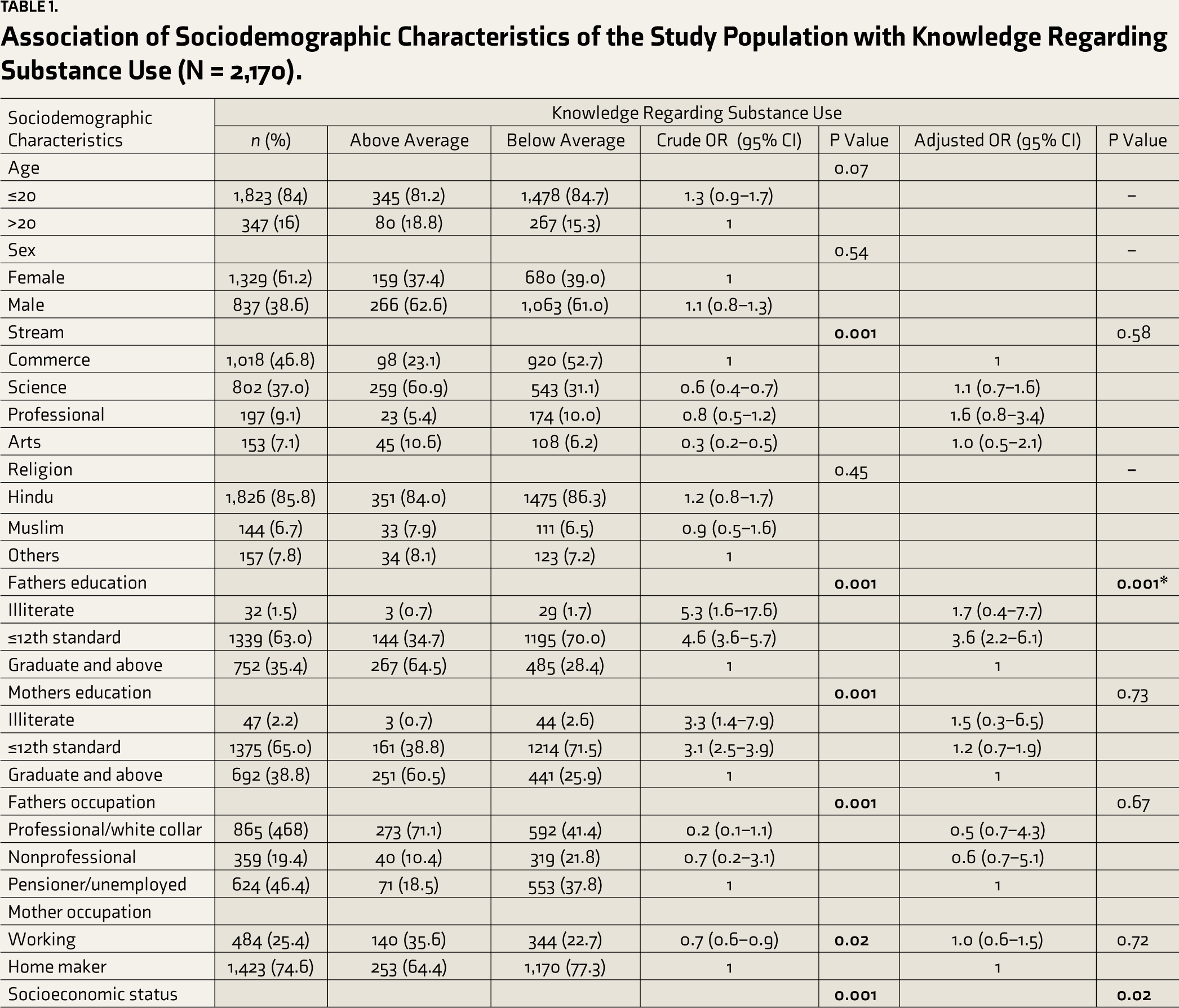
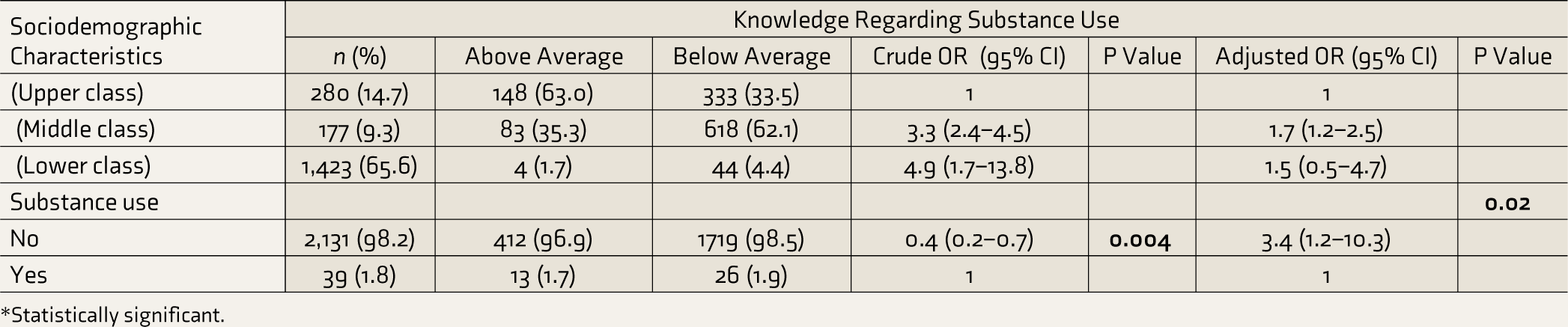
Table 1 depicts the association between sociodemographic factors and knowledge of substance use. On univariate analysis variables like stream, father’s education level, mother’s education level, father’s occupation, mother’s occupation, socioeconomic status, and substance usage were statistically associated with knowledge of substance use. After adjusting for effects of significant variables in univariate analysis, poor knowledge of substance use was significantly more among students whose paternal education was below 12th standard, belonged to middle class, and were substance non-users.
Association of Sociodemographic Characteristics of the Study Population with Knowledge Regarding Substance Use (N = 2,170).
*Statistically significant.
As compared to 268 non-users (12.6%), 18 substance users (48.6%) considered that it was normal for a person to try substances in his youth and that seldom intake of substances was not a problem. Very few participants in both the groups felt that consumption of substances could enhance their performance and that it would be embarrassing if they would not take substances along with their friends. Around 16 users (40%) believed that consumption of substances could relieve stress in contrast to 217 non-users (10.2%). Overall, 1843 non-users (86.5%) and 29 users (74.4%) had a positive attitude towards substance use.
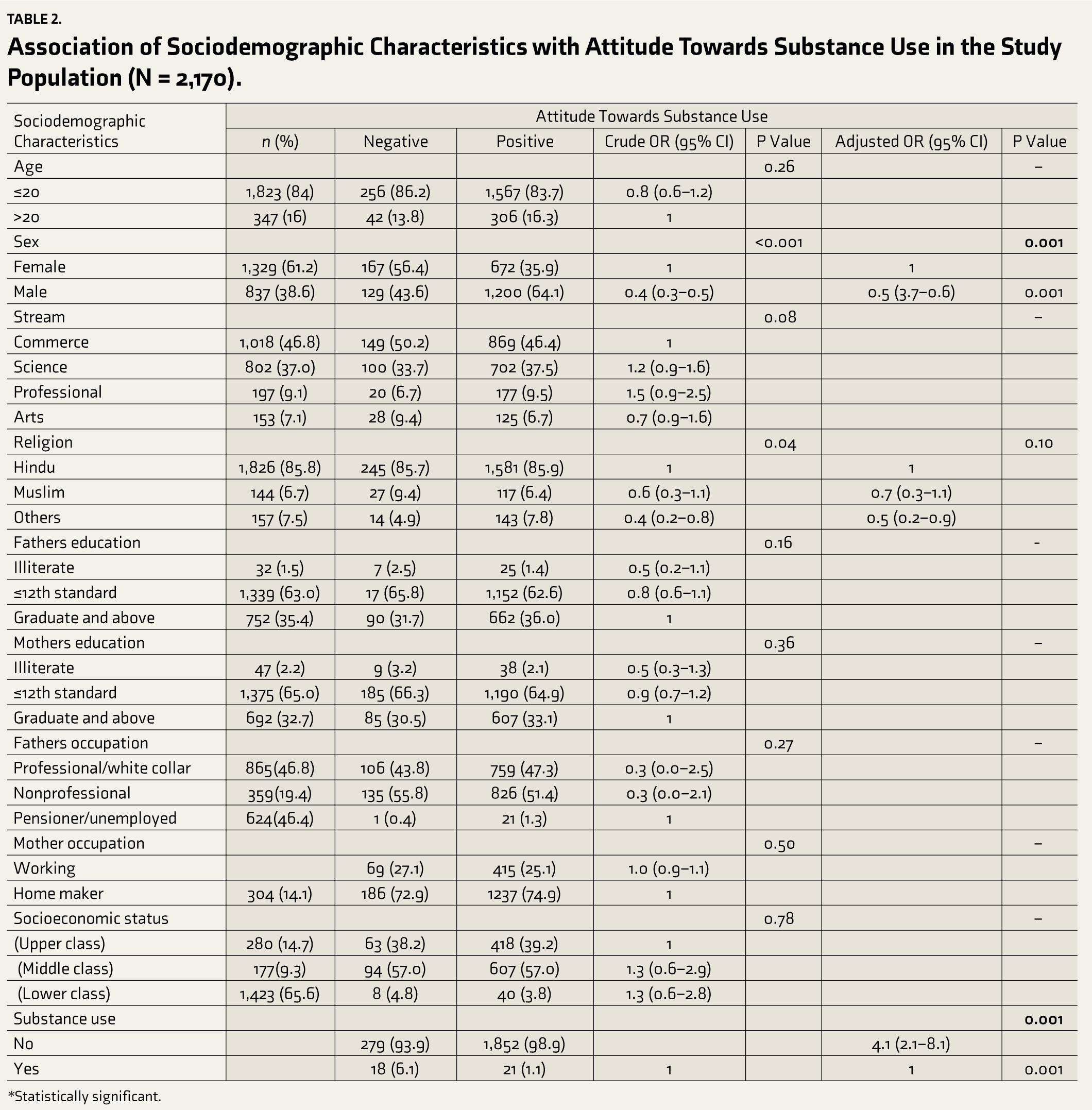
After adjusting for the effect of significant variables, positive attitude was found to be stronger among males and those who did not use substances (Table 2).
Association of Sociodemographic Characteristics with Attitude Towards Substance Use in the Study Population (N = 2,170).
*Statistically significant.
Discussion
Our study assessed knowledge and attitude regarding substance use based on consumption among degree college students. The prevalence of substance use among students was estimated to be 1.8%. This finding aligns the findings of studies carried out by Shetagiri et al. in individuals between 13 and 30 years in rural Bangalore (2.9%), Adibeli et al. among nursing students (2.5%) in Turkey, and Barman et al. among high school students in Patiala where 2.8% of the urban and 5.7% of the rural students were current substance users.12, 13, 14 Higher prevalence of substance use was seen in the studies by Prakash et al., Faizi et al., and Toshniwal et al. among school and college students in Mangalore (8.6%), Aligarh (12.9%), and Vadodara (18%), respectively.15, 16, 17 Studies conducted among secondary school students in Tanzania (6.5%) and West Bengal (15%) showed relatively higher prevalence of substance abuse.18, 19 In contrast, the consumption of substances was very high in studies conducted by Mir et al. and Arora et al. among medical students in Tumkur (31.8%) and Meerut (90%), respectively.20, 21 This marked contrast could probably be because our study was done in a semi-urban/rural setup, characterized by a robust cultural heritage and strong familial ties.
In this study, majority of our study participants were females, similar to the findings of Shetgiri et al. and Adibeli et al. (70.6%), both of which reported a low prevalence of substance use.12, 13 Conversely, studies with a comparatively higher prevalence of substance use, such as those conducted by Barman et al., Prakash et al., and Faizi et al., had more male participants than females.14, 15, 16 This difference in the gender distribution of participants could have contributed to the lower prevalence of substance use observed in our study.
In this study, the mean age of the participants was approximately 19 ± 1.4 years, which is similar to studies conducted by Faizi et al. (2021) in Aligarh, UP and Masibo et al. in Tanzania.16, 18 This contrasts with studies conducted by Shetgiri et al. among adolescents and young adults (aged 13–30 years), Barman et al. (aged 12–16 years), and Prakash et al. (aged 13–17 years) among school children.12, 14, 15 The disparity in findings could be attributed to differences in the study settings for recruiting participants. Our study participants were predominantly Hindus, which reflects the fact that Hinduism is the largest religion in Udupi district. Similar findings were seen in a study conducted by Mir et al. in Tumkur.20
In our study, more than half of the students had parents with an education level above the 10th standard (Fathers: 56.9%, Mothers: 56.8%). Similarly, in the study conducted by Faizi et al., both parents were well-educated. 16 Contrasting findings were observed in a study by Hansadah et al. among adolescents in Orissa, where 52% of fathers had primary education and 54% of mothers were illiterate. 8 This difference could be because Udupi district, where the study was conducted, has an average literacy rate of 83%, much higher than the national average.
In this study, 72.9% of the student’s mothers were homemakers, which is in line with the findings by Adibeli et al. (87%). 13 As these mothers were at home, they could provide the necessary emotional support their child required and be available when their children needed them. This could be one of the reasons for low prevalence of substance use observed in our study.
In the present study, knowledge about substance use was generally found to be poor, with users having better knowledge than the non-users. However, attitude towards substance use was more favorable among the non-users when contrasted with the users. The findings were similar to the study conducted by Hansadah and Sonalika among adolescents in Orissa, where 72% of the participants had inadequate knowledge, and 28% had moderate knowledge about substance use. 8 Also, a study conducted among adolescent boys in four preuniversity colleges in Pune showed that 73% boys had average knowledge, 22% had poor, and 5% of them had good knowledge about drug addiction. 22
In this study, users had better knowledge about types of substances compared to non-users, the most common being cannabis (69.9%, 97.4%) and least being opium (21.3%, 46.1%). In contrast, a study conducted by Priyadarshini et al. in Odisha reported that the substances commonly heard by the study participants were cocaine (91.6%), followed by heroin (75.9), cannabis (72.4 %), and ecstasy (36.9%). 23
In our study, the most common form of substances mentioned by both the groups was cigarettes (59.7%, 76.9%). Approximately one-fourth of the non-users (21.4%) were unaware of the form in which these substances were available. While in the study by Faizi et al. in Aligarh, Uttar Pradesh most common form stated was drinking followed by smoking, injection, powder, and inhalant. 16
In this study, the knowledge about side effects of substance use with respect to psychiatric, gastrointestinal, renal, neurological, personality manifestations, and memory changes was almost similar among both users and non-users. This shows that the students continued using substances ignoring their ill effects. Analogous findings were noticed in a study by Malik et al. in Pakistan done on students above 18 years old, where the awareness about the dangers of substance abuse was higher among non-users (59.4%) as compared to the users. 24 Awareness regarding the harms of substance use was comparatively greater in a study conducted by Azima et al. among medical students in Iran (91%). 25 In contrast, in studies conducted by Adibeli et al. (41.6%) and Adebowale et al. (50%), approximately half the study participants were aware about the side effects of substances.13, 26
In our study, awareness about the legal consequences of substance use was greater in users (69.2%) as compared to non-users (48.6%). In contrast, a greater proportion of users (91.7%) were aware of the legal consequences in a study performed by Arora et al. (2016) on medical students in Meerut. 21 A study conducted among secondary school students in Nigeria showed that only half of the students were aware of the legality of substance use. 26
In the present study, it was seen that father’s education and socioeconomic status were independent predictors of knowledge about substance use. Analogous findings were seen in the study conducted by Begam and Devi in Assam where no association was seen between knowledge score and selected socio-demographic variables like gender, religion, education, and occupation of parents, 27 whereas, in a study conducted by Sharifi et al in Iran among young men and women, participants with age more than 25 years, males, and residents of urban areas were more knowledgeable as compared to their counterparts. 28
In the present study, as compared to non-users (12.6%), substance users (48.6%) considered that it was normal for a person to try substances in his youth. Similar findings were seen in a study by Priyadarshini et al. where 45.3% of dentists were of the same opinion. 23
Overall, both the groups had a positive attitude towards substance use which was proportionately higher among non-users (86.5 %) as compared to users (74.4%). Comparatively lesser proportion of study participants had a positive attitude towards substance use in studies conducted by Treveli and Devi (41%), Divya et al. in Belgaum (67%), and Adebowale et al. in Lagos (58.5%).22, 26, 29
In our study, as compared to females, males had significantly 50% lesser chance of having a positive attitude. Similar findings were seen in a study conducted by Sharifi et al in Iran where the attitude of females toward substance use was significantly better than males. In addition to this their study also reflected that participant aged more than 25 years and residing in urban areas had a significant better attitude towards substance use. 28
This study did have a limitation, which was the use of a self-administered questionnaire. Because of this, it is possible that some students may have been hesitant to admit that they were using substances. Self-reporting of sensitive behaviors like substance use can be influenced by social desirability bias, where respondents may underreport behaviors that are perceived negatively. Therefore, the prevalence of substance use in the study might be underestimated due to this potential reluctance to disclose such information.
Conclusions
The present study reveals that prevalence of substance use among college students in Udupi taluk is relatively low. Overall, knowledge about substance use is poor among these students. Considering the public health importance of substance use, especially among college students, it is imperative to have a targeted approach involving parents, teachers, and psychological counsellors toward these students thereby providing health education regarding substance through individual and group discussions. Schools and colleges should take the responsibility of imparting knowledge about substance use and help students adopt a positive attitude. There should be awareness sessions for students delivered by those recovered from addictions to make them more convincing and relatable. Sessions on substance use and enabling positive environment for their children should be taken up during parents–teachers meetings.
Footnotes
Declaration of Conflicting Interests
The authors declared no potential conflicts of interest with respect to the research, authorship, and/or publication of this article.
Declaration Regarding the Use of Generative AI
None used.
Funding
The authors received no financial support for the research, authorship, and/or publication of this article.