




Abstract
Background:
Phonological awareness has been recognized as a significant predictor of word-decoding skills in alphabetical languages. These languages differ in phonology, orthography, and how they are mapped for word decoding. However, the literature has debated its role in orthographically consistent languages. The present research aims to explore phonological awareness and its contribution to word decoding for early readers of Kannada.
Methods:
The study included 50 typically developing Grade I children learning to read Kannada from schools with Kannada as a medium of instruction. Phonological awareness skills were assessed using developmentally appropriate tasks at different linguistic grain sizes and varied linguistic operations. Word-level reading abilities were evaluated using a pseudoword decoding task.
Results:
The results indicated that the children were sensitive to syllables but not to rhymes and phonemes. A one-way repeated measure of analysis of variance demonstrated a significant main effect of task complexity on the performance across phonological awareness tasks. Pearson’s correlation coefficient revealed a significant positive correlation between the performance on phonological awareness and pseudoword reading. The regression analysis indicated that phonological awareness tasks contributed significantly to word decoding. However, initial and medial syllable stripping evolved as independent and significant contributors to pseudoword decoding in Kannada.
Conclusion:
The present study concludes that phonological awareness at the syllable level emerges early and significantly contributes to word decoding in early readers of Kannada.
The role of phonological awareness in reading has been studied extensively in alphabetical languages and is indicated to play a crucial role. Gaining insights into the foundational processes involved in learning to read is essential in addressing literacy challenges in orthographically transparent languages widely prevalent in India.Key Messages:
Phonological awareness is an explicit skill for recognizing, analyzing, and manipulating spoken words’ sub-lexical structures, such as words, syllables, rimes, and phonemes. Studies have demonstrated a positive relationship between phonological awareness and the word decoding component of reading.1–3 Phonetic or word-decoding uses knowledge of grapheme and phoneme relationships specific to language to convert written words into spoken form. This foundational skill is crucial for fluent reading and reading comprehension.4, 5
Phonological awareness is one of the crucial early literacy skills that has been established as an early predictor of reading development in children learning to read alphabetic languages, such as English, 6 Italian, 7 Finnish, 8 Greek, 9 and some of the non-alphabetic languages such as Chinese, 10 Japanese, 11 and Korean. 12 The research findings are mixed concerning the relative strength of phonological awareness in predicting reading skills across different orthographies and vary with the function of the orthographic consistency of the language. According to the findings from more consistent orthographies, the impact of phonological awareness on word decoding is weaker.13, 14 compared to inconsistent orthographies such as English. 1 However, some studies have witnessed equally strong predictions among more transparent and consistent orthographies, such as Czech, 15 Spanish, and Slovak. 16
Phonological Awareness and Akshara Orthographies
The role of phonological awareness in learning to read Akshara orthographies is equivocal. Bengali, Hindi, Tamil, and Kannada differ from alphabetical languages based on how the spoken unit is mapped onto the written symbols. 17 Akshara writing systems combine features of alphabets (representing individual sounds) and syllabaries (representing syllables), and the written symbol or grapheme is called “Akshara.” Unlike alphabetical script, which represents spoken sounds only at the phoneme level, the “Akshara” simultaneously represents spoken sounds at both phoneme and syllable levels. A perfect example of an Akshara orthography is Kannada, a Dravidian language spoken as an official language in Karnataka. The Kannada orthography has greater consistency in orthography with the phonologic mapping of units.
The studies have investigated the role of phonological awareness in different languages with Akshara orthography, such as Kannada,18–20 Korean, 21 and Thai, 22 and Sinhala, 23 and Bengali 24 Click or tap here to enter text. reported that awareness of syllabic and sub-syllabic information is significant for reading words. In Oriya, 25 another Akshara orthography indicated that only syllable awareness predicted word reading. Nakamura 26 investigated the role of phonological awareness at both phoneme and syllable levels on word decoding in two Akshara orthographies, such as Kannada and Telugu, in children between Grade I and Grade V. The results revealed that the differential contribution of phonological awareness to decoding, where the syllable contribution improved with the grade. However, the role of phonemic awareness faded with the grades. A closer look at the regression analysis indicates that, in Grade I, phoneme awareness contributed significantly more than syllable awareness to word decoding. On the contrary, others posit that phonological awareness is not a crucial skill for acquiring reading in a non-alphabetic script.27, 28
Kannada Nag 29 reported that syllable awareness was strongly associated with reading in early grades, but the association faded at later grades. On the contrary, a poor association of phoneme awareness with reading in early grades has been noted; however, the strength of the association was maximum in Grades III and IV. In the same study, she also investigated the pace of the acquisition of phoneme awareness learning to read Kannada in children from Grades I to III. She also examined the association between phonological awareness at the syllable, rhyme, and phoneme levels with reading. The results indicated that phoneme awareness is slower than syllable and rhyme awareness. Syllable awareness was found to have a more significant association with reading scores in Grade I than phoneme awareness. However, the study included only segmentation and blending tasks, and their causality with reading needed to be investigated.
Further, in a case series analysis of poor readers of Kannada, Nag et al. 30 observed that phonological processing is the most common impairment besides Akshara knowledge, oral language, rapid naming, and visual processing skills in poor readers of Kannada in middle school. In another study, Singh and Sumathi 31 investigated the relative contribution of phonological awareness and oral language to word and non-word decoding skills in children between Grades I and V in Hindi and Marathi. The results indicated that phonological awareness contributed independently to both word and non-word reading.
Context of the Study
The studies concentrating on phonological awareness’s role in Kannada’s emergent readers are limited. The relationship between phonological awareness and reading is known to vary depending on the age at which it is investigated. The first year of schooling is crucial to a child’s overall development, laying the foundation for future academic success, social interactions, and personal growth. Specifically, children must combine the oral language and emergent literacy abilities acquired in preschool with structured and curriculum-based literacy skills. The relationship between phonological awareness and reading may also vary according to the phonological unit and the cognitive requirements to complete the task. The difference in the cognitive requirements for the phonological awareness task could lead to a divergence in the results obtained from different tasks. Hence, measuring phonological awareness using a broad spectrum of tasks to determine the hierarchy of complexity and crucial tasks that predict reading is essential. At the same time, studies in alphasyllabary have suggested the importance of phonological awareness at a larger linguistic grain size, such as the syllable, for reading development in the early years of schooling. However, there needs to be more consensus regarding the type of syllable awareness measure, such as analytical, synthetic, or manipulative, which are good predictors of reading development. The relative contribution of these measures to reading has yet to be thoroughly examined. The first objective of the present study was to profile phonological awareness skills at the end of Grade I in a group of typically developing children learning to read Kannada. The second objective was to compare the performance across the tasks to determine the effect of task complexity. The third objective was to investigate the relationship between phonological awareness and phonetic decoding to determine the crucial measures of phonological awareness that predict phonetic decoding by the end of Grade I.
Methods
The present research incorporated a cross-sectional study design and a convenient sampling method for participant selection. The institutional ethics committee approved the study protocol before its commencement.
Participants
The study included 50 typically developing Grade I children aged 5.6 to 6.6 years (M = 6.4, SD = 0.4) with an equal male-to-female ratio. The children were selected from six urban (76%) and two peri-urban (24%) schools in Dakshina Kannada district, Karnataka, India. All the schools followed a similar curriculum prescribed by the Karnataka state board, and the instruction medium was in Kannada. The children included in the study were chosen based on specific participant selection criteria. The study participants were selected from the lower-middle class according to the modified Kuppuswamy classification of socio-economic status scale for the financial year 2019. 32 All the children had a history of attending two years of Anganwadi (preschool) before they began formal literacy learning in Grade I. The participants with no change in the medium of instruction from preschool to Grade I, regular school attendance, and above-average academic performance according to the class teacher were included in the study. None of the participants were at risk for dyslexia according to teachers scoring the child in Kannada across literacy-related areas such as sound awareness, skill acquisition (reading, writing, and number concepts), communication, motor coordination, and behaviors using the Dyslexia Assessment for Languages of India—Junior Screening Tool. The participants with no significant history of speech, language, hearing, developmental, intellectual, or neurological disorders, according to the parents on the WHO 10-question disability screening checklist, 33 were included. Further, the age-adequate receptive and expressive language participants were ascertained using the standardized norm-referenced language performance test Assessment of Language Development. 34 All the children had adequate Kannada listening comprehension, as one of the researchers assessed using a story comprehension task with finite “Wh” questions.
Measures
The phonological awareness in Kannada was assessed using the test developed by Somashekara et al. 35 This test was specifically designed to evaluate children learning to read Kannada within an educational environment where Kannada is the medium of instruction. In the current study, the research tasks were carefully chosen to focus on different levels of phonological awareness. At the syllable level, the selected tasks included syllable segmentation (SyS), syllable blending (SyB), initial syllable stripping (ISS), medial syllable stripping (MSS), and final syllable stripping (FSS). At the rhyme level, the tasks comprised rhyme oddity (RO) and rhyme production (RP). Finally, at the phoneme level, the tasks encompassed phoneme segmentation (PS), phoneme blending (PB), initial phoneme stripping (IPS), and final phoneme stripping (FPS). The selected assessment tasks were subjected to pilot testing involving 10 children from Grade I. During this preliminary evaluation, a floor effect was detected in the rhyme and phoneme awareness tasks. Consequently, these tasks were excluded from the primary data collection, and only syllable awareness tasks were retained for further data collection. A score of 1 was given for the correct response and 0 for the incorrect response.
Syllable Segmentation (SyS) Task. The participant was asked to repeat the target word once during this task. They were then instructed to break the word and snap a finger against the palm for each syllable. Cronbach’ alpha reliability was 0.92.
Syllable Blending (SyB) Task. In this task, the examiner presented the target word segmented into syllables to the participant. The Cronbach’s alpha reliability was 0.90.
Initial Syllable Stripping (ISS) Task. Here, the participant was instructed to delete the initial sound and say the rest of the word. Cronbach’s alpha reliability was 0.86.
Medial Syllable Stripping (MSS) Task. In this task, the participant was asked to delete the middle sound of the three-syllable word specified by the examiner and say the rest. Cronbach’s alpha reliability was 0.66.
Final Syllable Stripping (FSS) Task. Here, the participants were asked to delete the last sound of the target word and say the rest of the word. Cronbach’s alpha reliability was 0.81.
Pseudoword Reading (PWR) Task. Considering the level of exposure to Aksharas in Grade I, the pseudoword list consisted of five words, each from two- and three-syllable words, with essential consonant–vowel combinations, and five words each from two and three-syllable words with consonant-vowel with ligatures combinations was selected from the original word list. 36 Cronbach’s alpha reliability was 0.78.
Procedure
The data were collected after the winter break, towards the end of the 2019–2020 academic year, spanning the months of January and February 2020. We obtained assent from children and written informed consent from parents. The data were collected in relatively quiet, distraction-free, and well-lit classroom settings within the school premises. The stimuli were presented verbally using a live voice for phonological awareness measures and a written list of pseudowords for reading. All the tasks had trial items to familiarize them before administering the actual test items.
Data Analysis
The data analysis was carried out using the software IBM SPSS Version 17.0. Initially, the raw data were summarized using descriptive statistics into the mean, standard deviation, range of scores on all the measures of phonological awareness, and PWR. The raw data were subjected to a normality test using the Shapiro–Wilk test, and a subsequent logarithmic transformation was carried out to confirm normality. One-way repeated measures of analysis of variance (ANOVA) were carried out to check the main effect of task complexity among syllable awareness tasks. Multiple regression analysis determined the combined strength of syllable awareness measures in predicting PWR skills. Finally, hierarchical regression analysis was employed to determine the unique contribution of syllable awareness measures in explaining variance in PWR ability individually over and above each other.
Results
Initially, the data were subjected to a normality test to check whether the data were normally distributed. The Shapiro–Wilk test revealed significantly skewed data, indicating the scores violate the normal distribution assumption for parametric tests for all the tasks, such as SyS [W(50) = 0.951, p = .03]; SyB [W(50) = 0.946, p = .02]; ISS [W(50) = 0.894, p < .001]; MSS [W(50) = 0.913, p = .001]; FSS [W(50) = 0.848, p < .001]; and PWR [W(50) = 0.904, p = .001]. Subsequently, the raw scores were subjected to the logarithmic transformation to conform to normality. A subsequent test of normality revealed that the scores were normally distributed (p > .05) for all the tasks.
The results of the descriptive analysis of phonological awareness and PWR measures are presented in Table 1. Further, the effect of task complexity among syllable awareness tasks was statistically analyzed by comparing the mean scores between tasks using a one-way repeated measure of ANOVA. The results revealed a significant main effect of task complexity on syllable awareness tasks: F (4, 196) = 42.78, p < .001, (η 2 = 0.46). Bonferroni-corrected pair-wise multiple comparisons were carried out using paired t-tests. The results indicated the performance on SyS (M = 6.2, SD =1.5) was superior than SyB (M = 5.4, SD = 1.3), [t(49) = 2.74, p = .003]; MSS (M = 5.26, SD = 1.56), [t(49) = 3.84, p < .001]; and significantly poorer than ISS (M = 6.9, SD = 1.6) [t(49) = −2.97, p = .004]; and lower than FSS (M = 8.34, SD = 1.6), [t(49) = −8.12, p < .001]. Similarly, the children performed significantly lower in SyB compared to ISS [t(49) = −5.43, p < .001] and FSS [t(49) = −9.13, p < .001]. The performance was similar to MSS [t(49) = 0.81, p = 0.41]. Further, similar results were observed between ISS with MSS [t(49) = 7.58, p < .001] and FSS [t(49) = −5.11), p < .001]. Finally, there was a significant difference between MSS and FSS [t(49) = −9.84, p < .001].
Mean and SD for all the Measures of Phonological Awareness and Pseudoword Reading.
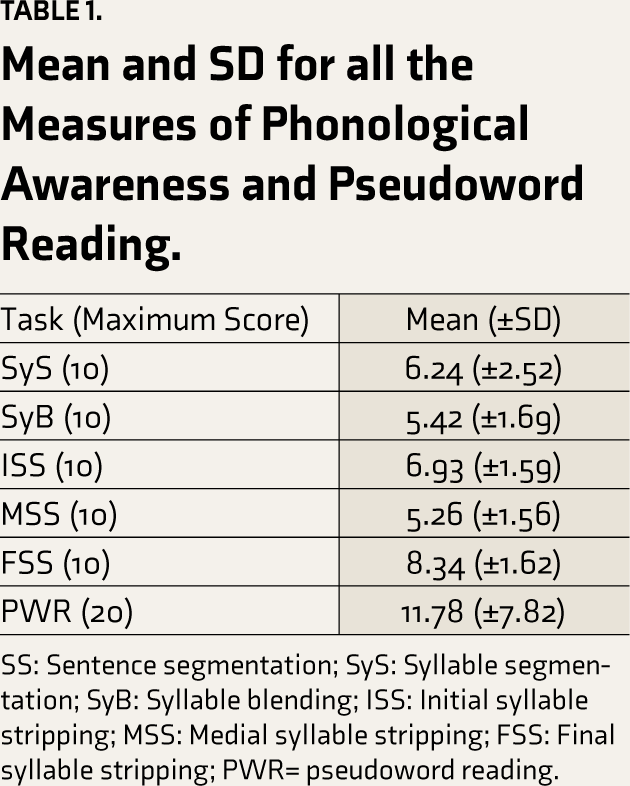
SS: Sentence segmentation; SyS: Syllable segmentation; SyB: Syllable blending; ISS: Initial syllable stripping; MSS: Medial syllable stripping; FSS: Final syllable stripping; PWR= pseudoword reading.
Pearson’s correlation coefficient was calculated to investigate the relationship between phonological awareness and PWR, and the results are shown in Table 2. The results indicated a moderate to high correlation between the tasks at the level of p = .01 or p = .05, except between FSS with SyB and MSS. However, a strong and significant correlation existed between ISS and MSS with PWR measures at p < 0.001.
Results of Correlational Analysis Between Syllable Awareness Skills and Pseudoword Reading.
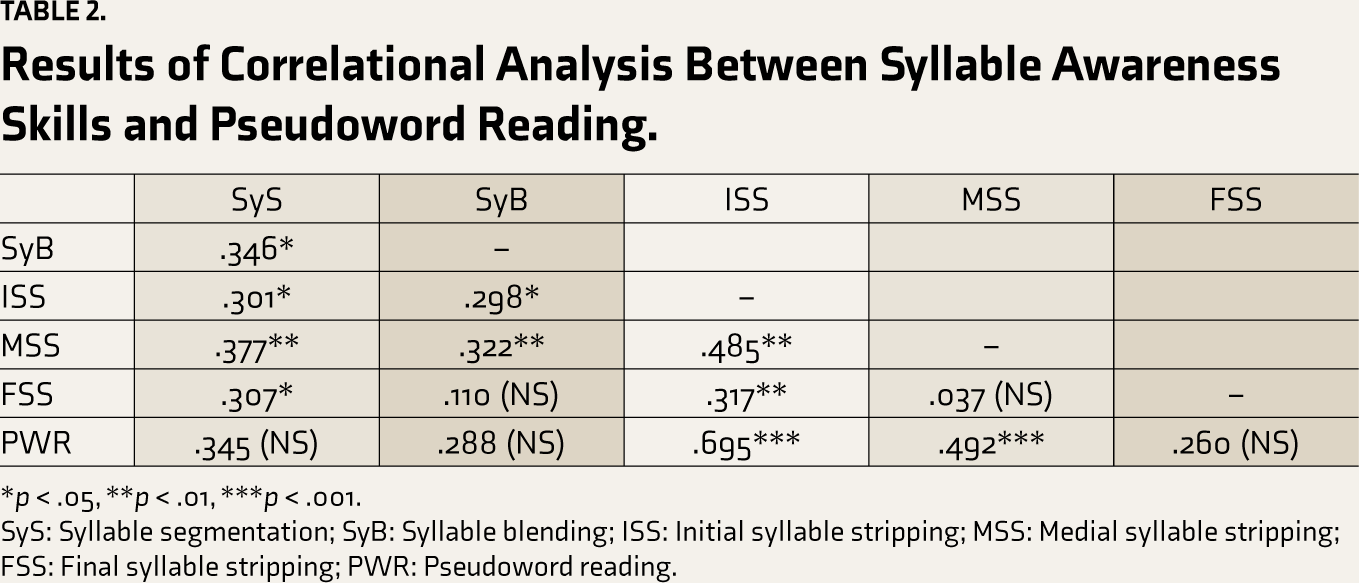
*p < .05, **p < .01, ***p < .001.
SyS: Syllable segmentation; SyB: Syllable blending; ISS: Initial syllable stripping; MSS: Medial syllable stripping; FSS: Final syllable stripping; PWR: Pseudoword reading.
The contribution of syllable awareness to PWR was investigated using linear regression analysis by considering PWR as an outcome measure and syllable awareness tasks as independent variables (predictor variables). Initially, the enter method calculated a total variance by loading all the independent variables into the regression equation. The results revealed that independent variables (syllable awareness measure) together explained a significant variance of 61% in PWR, F(5, 44) = 13.78, p < .001, R2 = 0.61, R2-adjusted = 0.56. Later, a hierarchical regression equation was computed to determine the unique variance separately for each phonological awareness measure. The predictor variables were entered into the regression equation using the forward method, and the hierarchy of variable selection in the regression equation was determined based on the results of the correlation analysis. Initially, the predictor variables with a lower correlation were entered first, followed by those with a higher correlation. The sequence of variable predictor entries hierarchically followed was FSS followed by SyS, SyB, initial syllable deletion, and medial syllable deletion. FSS as a first predictor in model 1 failed to show any significant unique variance in explaining PWR with F(1, 48) = 3.47, p = .69, R2 = 0.06, R2-adjusted = 0.04. The subsequent entry of SyS and SyB with F(2, 47) = 2.54, p = .08, R2 = 0.09, R2-adjusted = 0.05, and F(3, 46) = 1.66, p = .18, R2 = 0.09, R2-adjusted = 0.03 in models 2 and 3, respectively, yielded the similar results by not explaining any significant change in the unique variance explaining PWR. In model 4, the ISS explained considerable variance in PWR with F (4, 45) = 11.47, p < .001, R2 = 0.50, R2-adjusted = 0.42, and R2 change indicating 40% of independent variance above and beyond all the three models with the large effect size of 0.26 by Cohen’s f 2 . Finally, MSS in model 5 also significantly contributed to PWR with an additional variance of 4% with F (5, 44) = 10.66, p < .001, R2 = 0.54, R2-adjusted= 0.49, R2 change indicating extra 4% of independent variance above and beyond all the four models with an effect size of 0.28 as suggested by Cohen’s f 2 .
Discussion
The present study explored phonological awareness and its relationship with phonetic decoding at the end of Grade I in children learning to read Kannada. The present findings suggest that by the end of Grade I, the children displayed sensitivity to phonological information only at the syllable level but not at rhyme and phoneme level. These findings align with previous research indicating that the rate of acquiring syllabic awareness tends to be more rapid. At the same time, the development of heightened sensitivity to sub-syllabic information lags behind syllable-level awareness. 29 On the contrary, better performance on rhyming tasks assessed using oddity and syllable replacement was almost at the ceiling in Grades I and II, as noted by Singh et al. 31 in other Akshara orthographies. These variabilities in task selection can be attributed to the lack of consensus on the task, which significantly predicts word decoding in Akshara orthographies. The psycholinguistic grain size theory suggests that in the early stages of development, children are more attuned to larger phonological units in speech, and over time, they refine their sensitivity to discern smaller units. 37 The phonological awareness undergoes a gradual refinement as it gathers experiences related to encoding and decoding phonological information within the written text.
Moreover, this refinement is further enhanced through heightened exposure to a particular writing system. The prevailing idea across writing systems regarding the progression of phonological awareness is that a developmental continuum exists, moving from larger phonological units to mastery of smaller phonological units. 38 The present research substantiates this concept, revealing that children’s proficiency is more developed in recognizing larger phonological units like syllables. Nevertheless, even by the end of Grade I, their awareness of phonemes has yet to emerge, despite exposure to print through the school curriculum, particularly regarding Akshara knowledge. While decoding demands both syllabic and sub-syllabic phonological awareness, children tend to predominantly develop syllable awareness before encountering written material. In contrast, reading experience influences phoneme awareness development. 39 Nonetheless, phonemic awareness usually takes shape around the third or fourth grade 29 in languages using Akshara orthography.
The results further revealed that the children’s performance across syllable awareness tasks exhibited variability, yet no ceiling or floor effect was observed. The variability in performance can be ascribed to the task’s complexity, a phenomenon documented in previous research. 40 Phonological awareness tasks exhibit multidimensional variability, encompassing factors such as the nature and complexity of cognitive processes in task completion, the demand for speech perception or production, the comprehensiveness of the dimension assessed, and the specific placement of the target sound within the linguistic context. For example, SyB requires the child to retain the individual syllables of the target word in a sequence in working memory and synthesize the word by putting all the syllables together, maintaining the same sequence, and sounding out the word. At the same time, syllable stripping requires the child to retain the stimuli word in working memory, analyze the word to identify the specified syllable within the word, and say the word after deleting the specified syllable. However, in the present study, children found it more accessible, as explicit instruction stated the word’s final positioning. Overall, the results indicated that hierarchically, FSS was the easiest, followed by ISS, SyS, SyB, and MSS. However, the mean performance indicates that MSS and blending were similar in task complexity. Anthony et al. 38 reported the general sequence of development concerning cognitive operation, where children blend phonological information before they can segment.
On the contrary, the present findings indicate that the performance of SyS is superior to that of SyB. Deleting, isolating, and reversing phonological units appear to be the most demanding cognitive operations. 41 However, the present findings indicated that the children performed significantly better in FSS than in segmentation and blending, which was the most straightforward task. While the sequence of acquiring phonological awareness skills in English is extensively studied, these developmental patterns cannot be universally extrapolated to languages. This phenomenon arises due to the intricate interplay of phonological awareness development, significantly impacted by various sociolinguistic elements. These factors encompass the linguistic attributes of the spoken language, the manner and timing of literacy pedagogy, and the specific orthographic characteristics inherent to the languages in question.37, 42 For example, children speaking Turkish, Greek, or Italian exhibit a quicker acquisition of syllable awareness when compared to children speaking French or English.43–45
The findings align with Nag, 29 who reported a strong association between syllable awareness and reading in Grade I. However, the syllable awareness measures included were SyS and SyB. On the contrary, there was no significant association between those measures and reading in the present study; instead, MSS and MSS measures significantly correlated with reading and explained significant variance. This discrepancy can be attributed to the time the association was evaluated during the academic year. She investigated the relationship at the beginning of the academic year, whereas it was determined at the end of Grade I in this study. Regardless, syllable awareness skills are the most vital contributors to pseudoword decoding at the beginning and end of Grade I. The findings indicate that the sensitivity of measures to reading may vary with time. Nonetheless, prior research has observed comparable results, with a robust and consistent correlation in syllable awareness evident throughout the early years of primary education across numerous studies.18, 26
The regression analysis results indicated a significant contribution of phonological awareness to pseudoword decoding. The results also support more transparent and consistent orthographies like Czech, 15 Spanish, and Slovak. 16 Furthermore, the findings are consistent with previous studies conducted in Kannada 29 and other Akshara orthographies, such as Hindi, 31 Thai, 22 Marathi, 31 and Korean 21 . Conversely, some researchers argue that phonological awareness may not be a critical skill for learning to read in non-alphabetic scripts.27, 28 The distinction between alphabetic and alphasyllabary languages lies in how phonological information is encoded into corresponding orthographic representations. Alphabetic scripts encode more discrete phoneme-level information into graphemes, making phoneme awareness crucial for word decoding. 15
In contrast, alphasyllabic scripts encode phonological information at both the syllabic and sub-syllabic levels to graphemic blocks. 20 In alphasyllabary writing systems, where written language is depicted at the syllable level and incorporates clear phoneme indicators, the distinct connection between phonology and orthography during the initial phases of literacy acquisition gives preference to more substantial sub-lexical units. 29 According to Kim et al., 46 more than phonemic information, syllable information is visually more salient, rendering syllable-level awareness more important in alphasyllabic reading. However, the present findings indicated that the early readers of Kannada demonstrated proficiency in syllabic sensitivity. Regarding phonological awareness development, the progression starts from shallower to deeper linguistic units, that is, syllables to phonemes.
Moreover, the Kannada reading curriculum for Grade I focuses on teaching basic Akshara knowledge (vowels and consonants with inherent vowels) and preliminary ligature rules (consonants with vowel diacritics). Phonemic analysis becomes more prominent towards the end of the academic year. As a result, the children’s reading abilities are primarily limited to simple words with a few ligatures. The reading process requires consistent mapping of spoken syllables to corresponding Aksharas, which underscores the importance of syllable awareness in pseudoword decoding. According to Nag et al., 18 reading in alphasyllabaries requires the engagement of phonological processing and the broader language system, similar to what is observed in alphabetic writing systems. In younger children, practical evaluation of phonological processing involves incorporating both syllable and phoneme awareness tasks. Overall, their research suggests that syllable awareness has a more substantial impact on the variance in children’s reading abilities than phoneme awareness. The findings corroborate these notions, as phonological awareness at the syllable level contributed significantly to pseudoword reading in Grade I.
Limitations and Future Directions
The study examined the relationship between phonological awareness and word decoding only at one point of literacy development, which is at the end of Grade I, by employing a cross-sectional study design. Hence, it limits understanding of the dynamics between these skills and subsequent literacy exposure in later grades. Nonetheless, to comprehensively understand the nature and directionality of this relationship, it is best explored using a longitudinal study design. Consequently, future research needs to consider the later grades at different points of the academic year to gain comprehensive insights through the longitudinal study design.
Implications of the Study
The investigation outcomes highlight the significance of phonological awareness in word decoding within the context of Kannada, an orthographically consistent language. Given the robust predictive nature of early phonological awareness skills for reading in orthographically transparent language, they can be a useful part of an assessment battery designed to identify children at risk of developing reading disabilities very early before they experience sustained failure. Moreover, the findings contribute to structuring phonological awareness assessment and training modules based on the task complexity delineated by linguistic units and cognitive operations.
Conclusion
The present study sheds light on phonological awareness and its connection with phonetic decoding among early readers of Kannada. In summary, the children demonstrated a high sensitivity to only syllable awareness by the end of Grade I, even though literacy instructions had already been initiated. The children’s performance in phonological awareness tasks largely depended on the specific linguistic operations involved in completing the tasks. While analytical (segmentation) and synthetic (blending) phonological awareness did not emerge as significant predictors of reading abilities, the ability to manipulate syllables (through deletion) in general, and particularly in the initial and medial positions of words, proved to be crucial predictors of word decoding abilities in Kannada by the end of Grade I. Based on the findings, phonological awareness at the syllable level contributes significantly to learning to read Kannada as early as in Grade I.
Footnotes
Declaration of Conflicting Interests
The authors have no potential conflicts of interest regarding the research, authorship, and publication of this article.
Declaration Regarding the Use of Generative AI
None used.
Ethical Approval
The present research was approved by the Institutional Ethics Committee of Kasturba Medical College, Mangalore (Approval No. IEC KMC MLR 12-18/504).
Funding
The authors received no financial support for the research, authorship and/or publication of this article.
Informed Consent
Assent from children and written informed consent from parents were obtained.