




Abstract
Background:
Adolescence is a phase of many physical and psychological developments. This stage is also vulnerable to the development of mental illness. Anxiety is one of the most prevalent disorders among adolescents, which mostly onsets before puberty. This study aimed to understand the perception on anxiety among adolescents and mental health professionals and develop a comic strip on anxiety.
Methods:
This qualitative study involved focus group discussions (FGDs) among mental health professionals and pre-university college students. The FGD data were analyzed through direct content analysis according to the predetermined broad themes.
Results:
Awareness regarding anxiety was poor among adolescents, and in certain situations they were found to be reluctant to seek professional help. The comic strip on anxiety was developed based on the findings of FGD based on the themes, general awareness, factors responsible, symptoms and coping, management, and barriers to seeking professional help.
Conclusions:
Adolescents perceived mental health as very important for their overall health. The adolescents did not know that they were going through anxiety, but they noticed that they had some mental health issues and wanted to get out of it. The development of comic strip on anxiety for adolescents was an attempt to overcome these barriers.
Two FGDs were conducted with mental health professionals and adolescents to derive the themes for the development of comic strip. The themes include general awareness, factors responsible, symptoms and coping, management, and barriers to seeking professional help. A unique study to develop a comic strip on anxiety for adolescents as a health education strategy to create awareness on anxiety.Key Messages:
Adolescence is one of the most important phases of human development. 1 Many neural changes influenced by certain hormonal changes happen during this phase.2,3 This stage is important for learning to manage emotions and relationships and is also vulnerable to developing many sexual and reproductive health problems, mental illness, and injuries. 1
Adult mental disorders have an onset early in the young age itself. And among these, anxiety and depression begin before puberty and continue to adulthood. 4 Anxiety, at a moderate level, stimulates people to adapt to stressful situations. Anxiety is considered excessive or pathological when it arises in the absence of challenge or stress, particularly when it is out of proportion to the challenge or stress in duration or severity. 5
Anxiety disorders are one of the most prevalent mental health problems among young people, with a 12-month prevalence rate of 24.9%. 6 Most of the functional disorders are likely to develop before 25 years of age, particularly between 11 and 18 years of age. 7 Anxiety not amounting to a psychiatric diagnosis could be situational or a symptom of another psychiatric disorder. 8
By late adolescence or early adulthood, the pure form of anxiety disorder decreases, with an increase in disorders like substance use disorders and depression. 9 A survey among psychiatrists experienced in treating anxiety disorders showed that 45% of patients suffered from symptoms of GAD (generalized anxiety disorder) for ≥2 years before they were correctly diagnosed. 10
Only up to one-third to half of the population affected with anxiety disorders seek help. Interventions to improve help-seeking for depression, anxiety, and general psychological distress include improving mental health literacy, destigmatization, providing information about different services available for seeking professional help, cognitive behavioral therapy, and personalized feedback. 11
According to Gulliver et al., stigma affects help-seeking behavior negatively. Increasing mental health literacy, social support, and encouragement can reduce the stigma regarding professional help-seeking. 12
A 2017 study emphasized the significance of comic books as a tool for health information, as they not just disseminate factual information but also promote “self-awareness, reassurance, empathy, companionship and a means to explore the impact of illness on family relationships.” 13
Several studies have shown that students of all ages can use comics to gain knowledge across topics and make meaning.14,15 A study evaluating the influence of a comic leaflet on preoperative anxiety among children showed that the information on surgical procedure and anesthesia provided in the form of a comic leaflet effectively reduced preoperative anxiety. 16 Logistically, comics are low-tech, involve low cost, are easy to make, and are highly effective in improving mental health literacy. 14
Hence, the present study aimed to understand the perception on anxiety among adolescents and mental health professionals and later develop a comic strip to create awareness about anxiety and its management.
Material and Methods
This qualitative study was conducted from December 2019 to May 2020. A total of 12 students (7 girls and 5 boys) of a pre-university college in Urban Bangalore, aged 15-17, who can read, write, and converse English, were included. They were enrolled using purposive sampling. Informed assent was obtained from all the students before the FGD. Consent form was obtained from the parents. Eight mental health experts who have worked for at least two years in the area of mental health and were willing to consent were included. These included one psychiatrist, two psychologists, two psychiatric social workers, one yoga therapist, and two public health experts. The study was approved by the Institute Ethics Committee under Behavioural Sciences Division, National Institute of Mental Health and Neurosciences, Bengaluru.
Procedure
One focus group discussion (FGD) was conducted among the eight mental health experts and another among the 12 college students in January 2020. Two distinct FGD guides were prepared by the first author for conducting FGD with mental health experts and students. The FGD guide for mental health experts focused on broad areas of anxiety and its prevalence among adolescents, factors influencing it, presenting symptoms, coping, barriers to help-seeking, and its management. The FGD guide for the students focused on awareness about mental health and anxiety, factors influencing, coping mechanism, attitude toward help-seeking, and identifying barriers to help-seeking. The FGDs were conducted by the moderator (the first author) using the FGD guide, and she took help from her batchmates to take notes and for audio recording. The comic strip was developed based on the findings of both the FGDs.
Analysis
Both the FGDs were audio-taped. The data collected were analyzed manually through direct content analysis, in which the transcript of the two groups were first examined separately. The frequency counts were noted and compiled according to the predetermined broad themes listed in the FGD guide. The predetermined broad themes included general awareness on mental health and anxiety, factors leading to anxiety, symptoms and coping, management of anxiety, and barriers to seeking professional help.
Results
There were a total of 12 students (7 girls and 5 boys) included for the FGD, and the average age of the students was 17 years. All of them were studying in second-year pre-university in a private college and were residents of an urban area. All the eight mental health experts involved in the study were working in private health facilities. The findings of the FGD’s among mental health experts and students based on themes and sub-themes presented in Table 1 are described below.
Summary Table of the Findings of the FGDs among Mental Health Experts and Students, Categorized Based on Themes and Sub-Themes.
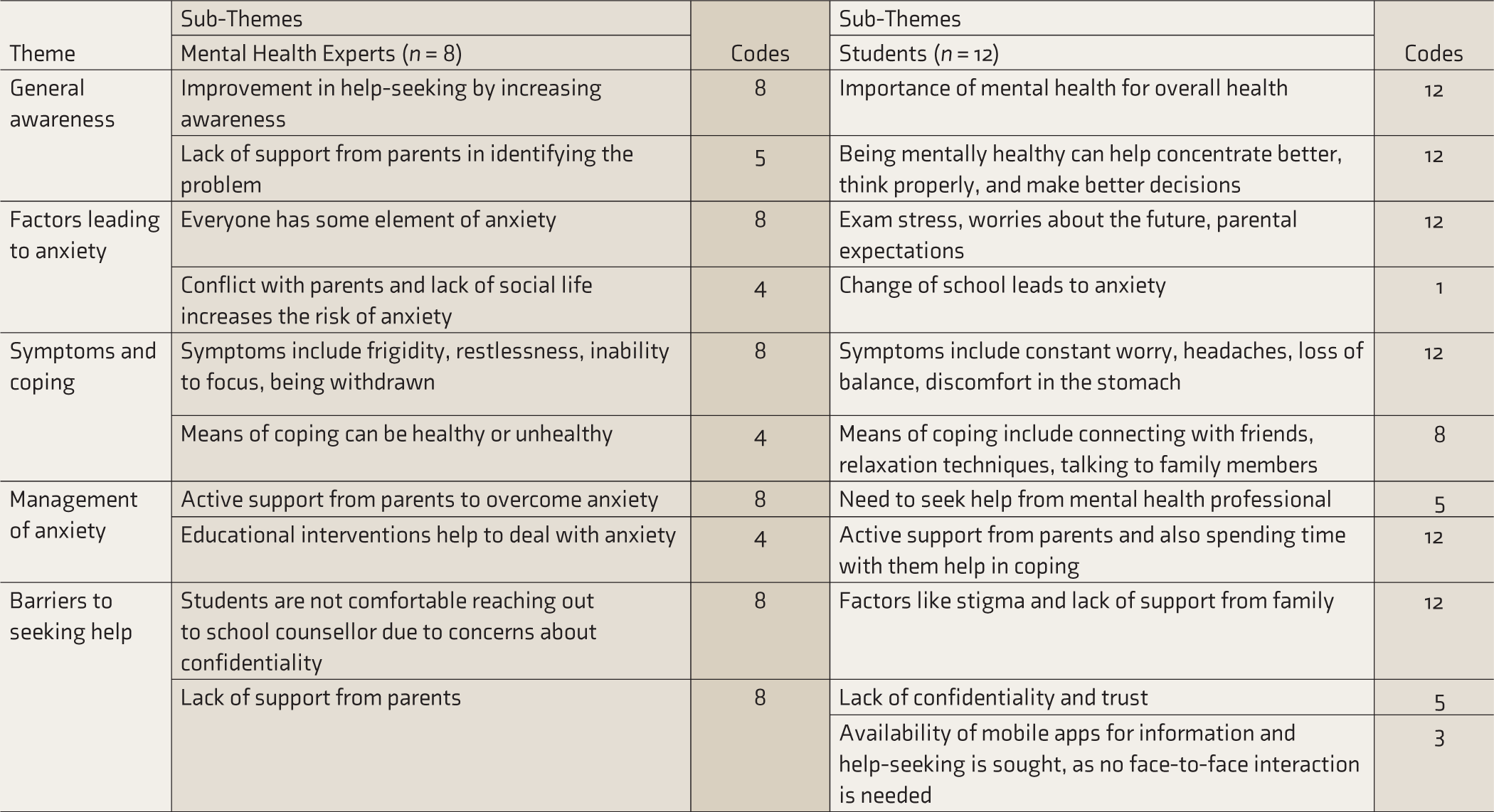
FGDs: focus group discussions.
Theme 1: General Awareness of Mental Health and Anxiety
Mental Health Experts
According to the experts, adolescents know vaguely about mental health and are concerned about the same to some extent. Most of them (n = 8) believed that adolescents are very proactive and will seek help if given proper information. Adolescents do not take it as “anxiety” but realize that they have a problem and want to come out of it. The sample quote is as follows, “Young adults are very proactive and concerned about their mental health. They seek help if they identify there is something unusual with their mental health.” Most of the adolescents who seek treatment usually come after they have had an episode of panic attack, where sometimes they break down in the classroom and then came for help. A few of them (n = 5) opined that when parents do not understand their problems and often say that the problem is in their head, it in turn leads to a conflict in investing in therapies.
Students
Though young people were not clear about the appropriate definition of mental health, they could relate mental health to real-life concepts. According to them (n = 12), “mental health is as important as physical health; both are interrelated.” They opined that when people are mentally healthy, they can concentrate better, think properly, and make better decisions. They believed that yoga helps instill positive mental health. According to them, factors like fear of death, frustration, anger, occurrence of unexpected events, natural disasters, academic pressure, etc., can put someone into some mental health crisis.
Theme 2: Factors Leading to Anxiety Issues
Mental Health Experts
According to the mental health experts, everyone around us has some element of anxiety; it can be in academics, interpersonal relationships, or issues related to self-confidence. The factors that may lead to anxiety issues among adolescents may include a combination of individual vulnerability factors and external factors. Individual vulnerability includes low self-esteem, perfectionist traits, self- criticality, etc. External factors are the nature of parenting, over-protectiveness by the parents, parental pressure, communication challenges at home, lesser social interaction, academic stress, etc. A few of them (n = 4) opined that conflict between parents and children regarding career choices, poor physical health, increased use of electronic gadgets, and increasing trend of homeschooling, which negatively influence young people’s social life, are the other factors leading to anxiety.
Students
As per the opinion of most of the students, the factors that influence them to develop anxiety include exam stress, academic pressure, getting late for school, worries about the future, responsibilities at home, parental expectations, loss of someone, financial concerns, worries about home, and various academic activities. An excerpt from one of them is, “I get worried about exams and results.” One of them opined that a sudden shift from a girls’ school to a co-ed school is a cause of developing anxiety among girls.
Theme 3: Symptoms and Coping
Mental Health Experts
According to the experts, young people do not express their anxiety initially. Most (n = 8) opined that young people with anxiety present symptoms such as frigidity, restlessness, inability to focus on one thing, withdrawal from everything, and so on. Over a while, anxiety becomes severe. In the severe phase, suicidal behavior may occur. The excerpt is as follows “When young adults lose energy to fight with anxiety, suicidal behaviour may occur.” A few (n = 4) opined that coping with anxiety can be either healthy or unhealthy among adolescents. Healthy coping includes sharing problems with family members and reaching out to friends or social media to understand their emotions. The unhealthy coping mechanisms are reluctance to go to school or college, complete withdrawal, binge eating, binge watching, hair pulling, self-harm, and substance abuse.
Students
According to the students, they have experienced anxiety symptoms such as constant worry in both personal and academic life, difficulty staying calm, headaches due to tension, trembling, loss of sense of balance, sweaty palms, dry mouth, and an uncomfortable feeling in the stomach. They (n = 8) handle such situations by connecting with friends, practicing relaxation, talking to family, etc.
Theme 4: Management of Anxiety
Mental Health Experts
A few (n = 4) opined that videos on JPMR (Jacobson’s Progressive Muscle Relaxation) technique available on YouTube are helpful for adolescents. 19 Some of them (n = 5) expressed that android applications like Wysa and Headspace can help young people. Most of them (n = 8) opined that parents should actively work towards making the adolescents get out of their comfort zone. A few (n = 4) opined that various behavioural strategies, relaxation techniques, meditation, and mindfulness would help to cope with anxiety. The excerpts mentioned, “Building resilience among young adults is important to cope with and manage anxiety.” A few (n = 4) expressed that educational resources including videos, printed materials, and programs will help deal with anxiety.
Students
According to some students (n = 5), severe mental health issues should be treated. Some (n = 5) opined that there is no need to go to a mental health professional, and they are not ready to go to a professional even if they had any mental health issues, as stigma regarding mental health is prevailing. The sample excerpt is “I will not be confident to go to a mental health professional if I had anxiety.” For some (n = 4), seeking professional help is difficult due to issues of confidentiality and credibility. According to most students (n = 12), parents being friendly, giving more time to children, expressing more love and care, friends being loyal and empathetic will help them cope with anxiety.
Theme 5: Barriers to Seeking Professional Help
Mental Health Experts
Most mental health experts (n = 8) expressed that young people consider anxiety as a problem and they seek professional help so that they can come out of it. But most of them are uncomfortable going to a school counsellor because they are concerned about confidentiality and credibility. According to most experts (n = 8), very few adolescents are reluctant to seek treatment. Most (n = 8) opined that a person who has gone through a panic attack would definitely reach out for treatment. The excerpt says, “Young adults who go through a panic attack come for treatment in most cases. Those who don’t come for treatment may either be financially dependent on others or children of single parent.”
Students
According to some (n = 6), it is important to consult a mental health professional when a mental health issue is out of control. Most students (n = 12) listed the following barriers to seeking professional help: stigma regarding mental health prevailing in society, the assumption that a good rapport may not be there between the person and the professional, and lack of support from the family. One of the excerpts mentioned says, “The factors like others may create rumour or call me mad, will stop me from not seeking help from professionals.” A few students (n = 3) thought professional aid would not be helpful. A few (n = 3) expressed the need for an app through which they can search for information concerning their personal problems and seek solutions, without any face-to-face interaction, so that anonymity will also be maintained.
The story script was derived based on the themes and sub-themes, with an intention to educate the adolescents on anxiety and its management.
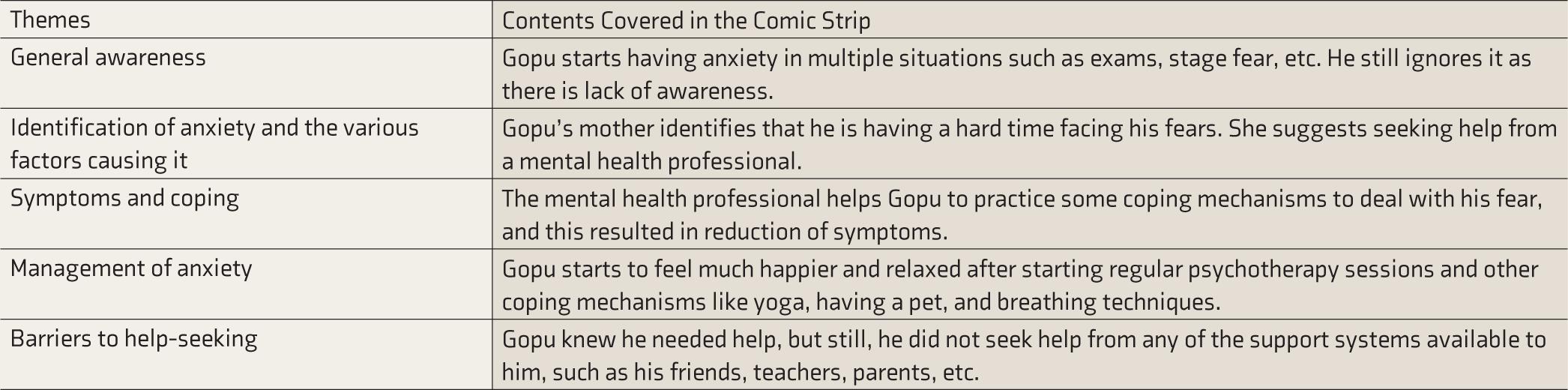
The theme was set as “early identification and mitigation of anxiety of an adolescent boy,” and the subthemes identified were exam anxiety, stage fear, symptoms of anxiety (perspiration, shivering, and intrusive thoughts), help-seeking, the role of a mental health professional, management methods (medication, psychotherapy, and coping strategies like breathing techniques).
Development of the Comic Strip
The script for comic strip was finalized based on the themes and subthemes derived from both the FGDs. Considering the positive effect of relatability in health education materials, an adolescent boy (Gopu) was chosen as the protagonist for the comic. 17 The comic strip was developed incorporating the themes and subthemes, with the help of a professional artist. 18 The details of the content of the comic strip have been explained in Table 2. The comic strip was shown to two people who were not from mental health background whose inputs were incorporated to the final version
Description of Contents and Structure of the Comic Strip with Respect to Various Themes Derived.
Discussion
We found that even though young people are aware that physical and mental health are equally important and interrelated, they still have an ambiguous concept of mental health. Study by Ogorchukwu et al. conducted among adolescents aged 15-19 years supports the same. 20 Young people also understand the importance of consulting a counsellor or a mental health professional in case anybody has some mental health issues. According to mental health experts, very few are reluctant to seek help. Dardas et al. showed that while 67% of adolescents preferred psychotherapy if they had any emotional crisis, 65% opined that they would not seek help from a psychologist in case of emotional problems. 21 The comic strip in this study is an attempt to create awareness on anxiety for early identification and to emphasize the importance of seeking professional help.
We found that factors influencing young people to develop anxiety could be broadly divided into individual vulnerability and external factors. Individual vulnerability includes factors such as low self-esteem, perfectionist traits, self-criticality, and extreme thinking. External factors include the nature of parenting; like overprotective parenting, critical parenting, and communication challenges at home; lesser social interaction; academic stress, and marital discord between parents. Bhatia et al. 9 and Thabrew et al. 22 suggest some additional factors for anxiety among children, such as family dynamics, type of parenting, loss of control over one’s circumstances, and peer pressure.
Adolescents cope with anxiety in both healthy and unhealthy manners. Reuben et al. explain trusting relationships where people can reach out to cope better. 23 In the present study, participants gave special focus to healthy coping mechanisms like yoga, meditation, and having a pet, which were incorporated as a part of the comic strip. 18
The present study indicates that lack of confidentiality and credibility issues resulted in not seeking professional help for anxiety. Adolescents are looking out for better relationships with parents and peers to reach out in case of mental health issues. Financial concerns, stigma, the assumption that they can’t develop a good rapport with the professional, and lack of support from parents or peers are the other barriers. Similar barriers to help-seeking were found by Gulliver et al., where the barriers identified were stigma and embarrassment, poor mental health literacy, concern about the help provider, inaccessibility to the service, and self-reliance. 12
The importance of raising awareness on anxiety and its management among adolescents is attempted in this study by developing a comic strip. A similar attempt has been made by Kapanee et al. in developing a picture book on mental health for adolescents. 15 This method of health education can also help in destigmatizing mental health and promoting help-seeking behavior.
Implications and Future Recommendations
There is a critical need to develop awareness about anxiety and its management among adolescents. The development of a comic strip on anxiety can be useful in improving mental health literacy among adolescents and in sensitizing them to various mental health issues. Further studies are recommended to evaluate the effectiveness of the comic strip in improving awareness among adolescents with regard to anxiety and its management. Such resources can be made available for students through online and social media campaigns.
Limitations
The study focused only on adolescents of a particular age range and all residing in urban Bengaluru, thereby making it difficult to generalize its findings. Therefore, in future studies, the scope can be expanded by including different genders, age groups, and settings—private schools, government schools, etc. Only one round of FGDs could be conducted for mental health experts and students, due to short study duration and lack of permission from the college. This resulted in small sample size, reducing the scope of conducting a detailed study. In the future, the study should include multiple detailed FGDs to explore further. The validation of the comic strip and also the feasibility assessment could not be done due to short study duration and the onset of the COVID-19 pandemic in March 2020. Future studies can be further strengthened by validating the comic strip and conducting a feasibility assessment on its effectiveness. No experts specialized in child and adolescent mental health were included in the FGD group of mental health professionals, making it a major limiting factor in the study. Any future studies planned in this area should include experts specialized in child and adolescent psychiatry and psychology.
Conclusion
Adolescents perceived mental health as very important for their overall health. The adolescents did not know that they were going through anxiety, but they noticed that they had some mental health issues and wanted to get out of it. The factors that resulted in anxiety were academic pressure, exam stress, and parental expectations. The barriers for not seeking professional help included lack of support from parents and family, lack of confidentiality, stigma, financial concerns, and fear of rumors. One of the important strategies to overcome these barriers is health education, and the development of a comic strip on anxiety based on the findings of FGD such as, the importance of professional help-seeking, healthy coping strategies, and overcoming barriers was a unique attempt to improve awareness.
Supplemental Material
Supplemental material for this article is available online.
Supplemental Material
Supplemental material for this article is available online.
Footnotes
Acknowledgements
We thank the college management. We also thank the illustrator for his contributions.
Declaration of Conflicting Interests
The authors declared no potential conflicts of interest with respect to the research, authorship, and/or publication of this article.
Funding
The authors received no financial support for the research, authorship, and/or publication of this article.
References
Supplementary Material
Please find the following supplemental material available below.
For Open Access articles published under a Creative Commons License, all supplemental material carries the same license as the article it is associated with.
For non-Open Access articles published, all supplemental material carries a non-exclusive license, and permission requests for re-use of supplemental material or any part of supplemental material shall be sent directly to the copyright owner as specified in the copyright notice associated with the article.
