



Abstract
Background:
Study tours are known to have an important role in enriching the knowledge of students in all fields. Our study aimed to evaluate the experience of a postgraduate and faculty study tour in the field of mental health.
Methods:
We obtained both quantitative and descriptive feedback from 31 participants who had taken part in the annual study tour conducted in the years 2014–2018 using a specially designed feedback pro forma.
Results:
All the participants reported overall satisfaction with the tour. Learning was enhanced, and most found the tour relevant to their current field of study. They particularly enjoyed the experience of traveling in a peer group without faculty supervision and learning to make decisions as a group. Their chief concerns were about the continuous travel and the limited time allotted to each center.
Conclusions:
A well-planned study tour during training helps trainees in the mental health field improve their knowledge, hone practical skills, and learn life lessons; it promotes bonding with peers and fosters self-directed learning and independence. The limitations were the inability to have direct face-to-face interviews with most participants and the study tour centers being limited to a small geographical area.
A well-planned study tour enhances knowledge and practical skills, promotes bonding with peers, and fosters self- directed learning. All participants are satisfied with the conduct of a well-planned study tour.Key Messages:
To quote St. Augustine: “The world is a book, and those who do not travel read only a page.”
The first field trip was introduced in 1827 by George Shillibeer in London, United Kingdom. 1 Kumar and Watkins 2 define a study tour as “a visit or a series of visits or learning journey(s) to one or more countries or sites by an individual or group with a specific learning goal in mind; participants learn firsthand from the experience of their peers how a challenge was solved, or solution implemented.” A field trip may serve several purposes: provide firsthand experience, spike the learners’ curiosity, expand knowledge of one’s own community, encourage peer and teacher–student social interactions, and promote personal growth. 3
One of the earliest educational tours described is by Nigel Ring, who wrote a detailed report of his study tour to India to understand the needs of leprosy patients in the country. 4 Nabors et al., 5 focusing on data from a national survey of field trip sites in their review, provide several recommendations to make fields trips more effective: good planning, relevance to the classroom curriculum, small groups, interactive nature, adequate safety measures, equipment kept ready in advance, and collecting post-visit feedback. According to Stone and Petrick, 6 while travel has been considered educational, the core belief that learning happens primarily in the classroom continues to hamper the routine inclusion of study tours as an integral part of learning. Nager et al. 7 compiled a report on a 2-week trip to the sites of Holocaust destruction for 134 high school students. Spirituality, hope, faith, and strength were found to have increased after the tour. Gomez-Lanier 8 did something unique in this line by conducting a mixed-methods study (domestic vs. international tours) to explore learning from a chaperoned study tour in the United States. Both groups benefited from their opportunities, with the international group getting more academic gains, which proved the value of cultural immersion.
Study tours have been demonstrated to be effective for students and also contribute to policymaking. In 1965, the British government planned to set up an Addiction Research Unit (ARU) to combat the heroin scrouge. Griffith Edwards, on his 1967 tour to America, 9 kept diary entries that led to several insightful responses in the United Kingdom. We have been unable to find any previous literature showcasing a similar program in the field of mental health. This study aimed to get feedback on the experience of our annual study tour.
Material and Methods
This was a mixed-methods study undertaken at the Department of Psychiatry, Kasturba Medical College, Manipal, a tertiary care center in the southern part of India. The institutional ethics committee approved the study. The study was prospectively registered with CTRI (Reference number: CTRI/2019/08/020520), as per the institutional ethics committee requirements.
Description of the Study Tour Program
The annual study tour program is a unique initiative started by the Department of Psychiatry at Kasturba Medical College, Manipal, Karnataka, India, in 2014, with the aid of the Sri Ram Prasad Sammeta Travel Grant instituted by an alumnus of the institution in fond memory of his father-in-law. The tour would involve postgraduates in psychiatry and psychiatric social work (PSW) and cover different centers related to mental health in five cities in South India over 2 weeks. The centers include those doing community and volunteer work and telepsychiatry; catering to children with special needs, older adults, and destitute women; dealing with alternative medicine and religious affiliations, palliative care, and substance deaddiction programs; the State Mental Health Authority; and suicide helplines, to name a few. The program was started with the aim of widening the scope of learning and better enabling the trainees in their professional careers. In 2017, the program was extended to the faculty in psychiatry and PSW. The selection of the residents is based on a performance appraisal conducted by two faculty members not directly associated with the tour, utilizing the logbook entries of the residents. A group of 5–6 trainees is sent on this tour every year. A detailed itinerary is provided, and the students are given a pre-tour briefing. They are not accompanied by a faculty member during the tour; hence, they are expected to manage travel finances, and so on, on their own. The trainees are expected to keep detailed notes of the tour and submit a report at the end of the tour. Feedback is also collected from the staff at the visited centers regarding the trainees’ involvement and interest.
Participants
All the postgraduates and faculty who had attended the tour in the years 2014–2018 were identified (n = 34). The postgraduates included trainees in both psychiatry (pursuing their masters in psychiatry, MD, or diploma in psychological medicine, DPM) and PSW (pursuing an MPhil in the field).
Tools
A feedback questionnaire with Likert and descriptive items was specially prepared, focusing on the benefits and shortcomings of the experience at each center and the overall program, with adequate scope for descriptions. The feedback pro forma was based on the information gathered from previous studies on field trips and the tools used for the same. All three authors contributed to the preparation of the pro forma; several initial versions were generated and subsequently modified, and the final pro forma was a result of consensus among all three authors. The form contained four items (learning objectives, relevance and importance, delivery of the study tour package, and overall satisfaction) with sub-items to be rated based on a Likert scale: unsatisfactory or not at all (score 1), partially or acceptable (score 2), cannot comment (score 3), good or significant (score 4), and excellent or almost fully (score 5), and descriptions, followed by nine questions that required descriptive answers. Higher scores indicate higher satisfaction. The feedback pro forma used is available from the authors on request.
Procedure
All 34 individuals were contacted for the purpose of this study. Those who were still working in the department were approached directly. The others were initially contacted over email. An explanatory mail regarding the proposed study was sent to all, along with the pro forma, participant information sheet, informed consent form, and a separate consent form for telephonic interviewing. Thirty-one people filled out the feedback form, which included 28 postgraduates and three faculty members. Most participants answered all the questions. Clarifications were sought on the unanswered questions, but the participants said they had nothing further to report. When necessary, their answers were clarified over the telephone, by email, or through face-to-face interviews. All the answers were coded. Informed consent was obtained from all of them. Three did not respond despite repeated emails or phone calls. All three of them had pursued an MPhil in PSW. Of the three, only one was male. Two of them were currently involved in research projects at a different university, while the third was not in contact with their alma mater at all.
Data Analysis
Data were collected primarily using open-ended questions with probes. Data analysis began with reading all the data several times to achieve immersion and get a complete picture, as advocated by Tesch. 10 The content analysis of qualitative data was done using a conventional content analysis method. Following this, reading was done word by word to derive codes by highlighting the exact words from the text that relate to the main themes or concepts. 11 Notes were made of the initial impression, thoughts, and analysis. Continuing in this vein, the labels of codes were derived that reflected more than one key thought. These were taken from the text and formed the initial coding scheme. The relations and links between various codes were noted, leading to grouping several codes together, making meaningful clusters of themes. 12 These large groups of themes were further organized in view of certain links or similarities to smaller categories of themes with underlying sub-themes. The themes were defined, and sub-themes were identified. In preparing the report, meaningful explanations derived from the text were attached to the themes, and representative examples from the text were quoted. 13
Results
All 31 participants completed the feedback form. Two of the three faculty members had an MD degree in psychiatry and more than 6 years of teaching and clinical experience post-MD. The third had an MPhil in PSW, a PhD in the subject, and 2 years of teaching experience. Of the remaining 28, 10 of the trainees were in their second year of MPhil PSW, and the other 18 were in their final year of post-graduation in psychiatry (third year for those pursuing MD and second year for those pursuing DPM). The postgraduates were in the age group of 21–30 years, while the faculty members were in the age group of 30–40 years. The total sample consisted of 14 men and 17 women. The faculty members were all male, while the students included 9 men and 19 women. They belonged to different parts of the country and, hence, had different cultural and linguistic backgrounds. The group that traveled each year consisted of 5–6 members, about 3–4 from psychiatry and 2–3 from PSW. These were selected from a batch of nine postgraduates in psychiatry and four from PSW, which is the annual trainee intake of the departments.
The learning objectives, the relevance of the tour, satisfaction with the study tour package in terms of both the experts the participants met and the logistics of the tour, and overall satisfaction are summarized in Table 1. All the participants agreed that the learning objectives regarding the working of the centers visited were achieved. The experience of the study tour was positively realized by 64%. However, there were some differences among the participants in their potential and ability to use the knowledge gained in their current work settings; 55% felt it could be applied usefully, while 45% were uncertain or felt that it could be applied only partially. Most participants felt the tour was relevant; 50% rated it as excellent and 32% as good. Under the section on the delivery of the study tour package, 28 of the 31 participants concurred that the experts they met and the presentations they attended were good to excellent. Twenty-six participants found the length of the study tour adequate. Most participants (90%) were satisfied with the sites included in the tour. About 83% found the quality of the topics covered significant or almost fully satisfactory, and 12% found them just about acceptable. Nineteen people were happy with the amount of time dedicated to the visits, and 7 rated them as only partially satisfactory. Twenty-eight found their reception at the various centers to be warm and welcoming. About 74% did not feel that there were any unsurmountable language barriers, and 20% found that there were some linguistic difficulties. 80% found the travel arrangements comfortable, and 18% did not comment on it or had some reservations about it. About 77% rated the accommodation facilities as good or excellent; the others did not comment or found them only partially comfortable. Twenty-three people found the restaurants conveniently placed, three did not comment on it, four found the access acceptable, and one rated it unsatisfactory. Twenty-four participants rated the financial aspects in the good to excellent category; four gave them only an acceptable rating. 88% were satisfied with the methods used to achieve the study tour objectives. All the participants rated their overall satisfaction with the tour as good-to-excellent and said that they would recommend it to others.
Learning Objectives, Relevance, Delivery of the Package, and Overall Satisfaction (N = 31).
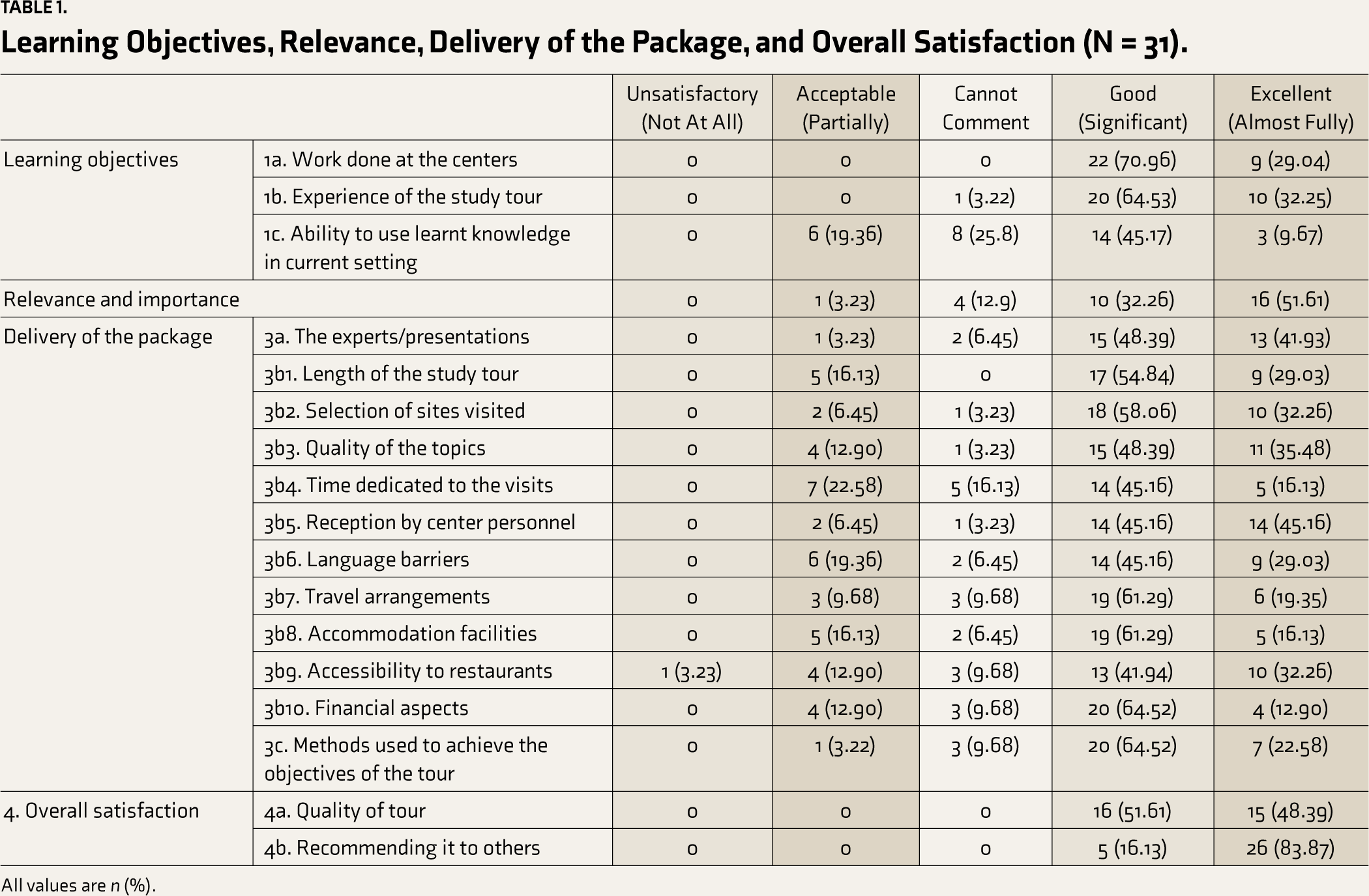
All values are n (%).
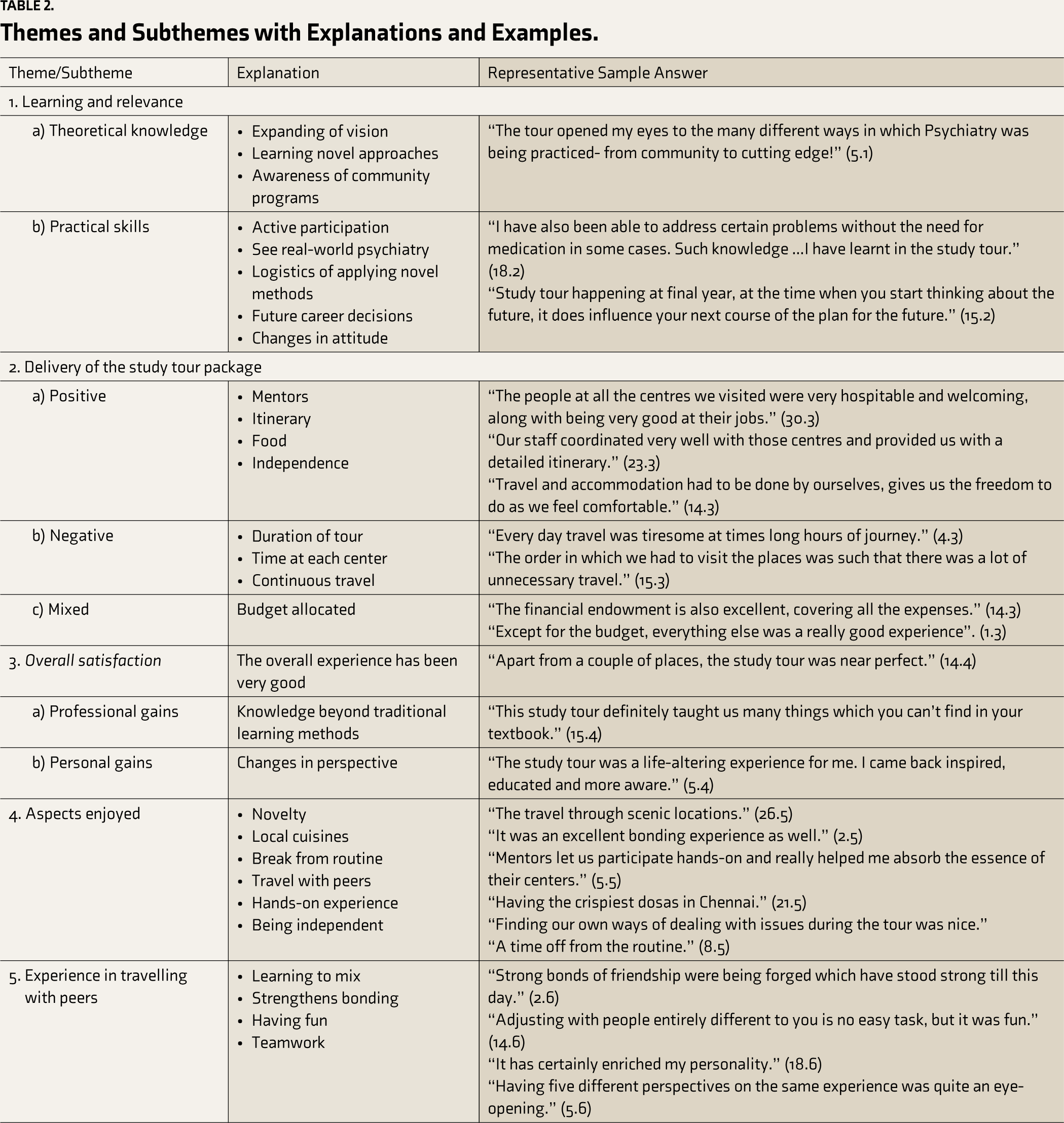
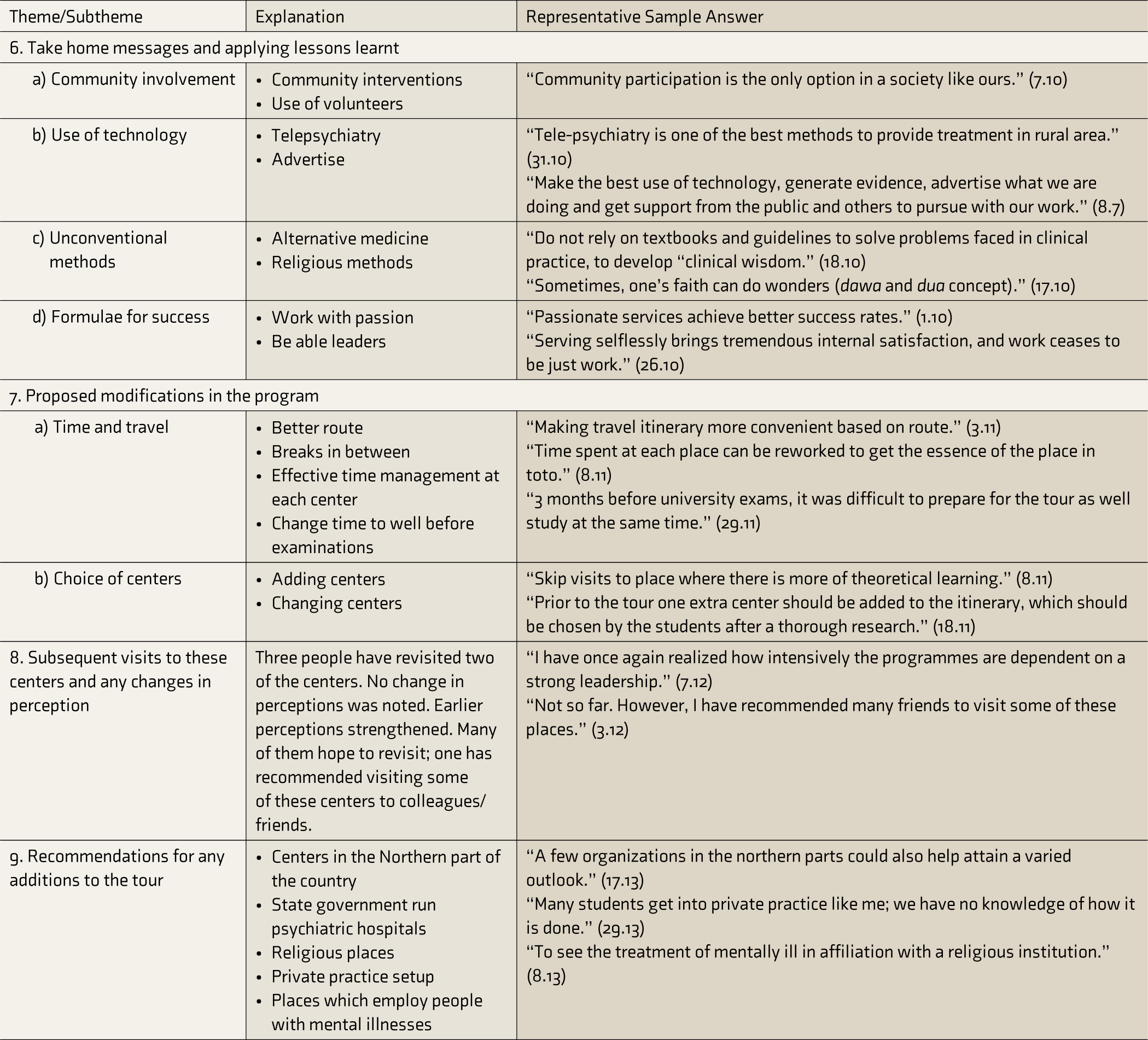
The qualitative analysis revealed several themes (Table 2). The tour was found to impart both theoretical and practical knowledge and was thus reported as highly relevant to their chosen field of study. The participants learned several novel approaches and gained firsthand knowledge, which led to a clearer vision and changes in attitude that influenced later career decisions. Impressions of the study tour package revealed positive, negative, and mixed opinions. The positive aspects included knowledgeable and welcoming mentors, a well-planned itinerary, being allowed to take decisions independently, and sampling the local food at various places. The negative aspects were the long hours of travel and the limited time at each center. The budget allocated elicited mixed responses. The overall satisfaction with the study tour was good. Most participants enjoyed the new mode of learning. The experience of traveling with peers was fraught with anxiety at the beginning but mitigated by the end of the trip with good bonding and having fun in the bargain. The chief take-home messages the participants got from the tour included appreciating the enormous advantages of community involvement in managing mental health problems, learning to put technology to good use, accepting that unconventional methods may often be needed, and imbibing the formulae for successful management of mental health problems. Most of them had some modifications to propose for future study tours, chiefly making the travel less hectic, allowing more time at each center, and adding certain other visits to the tour. Most participants hoped to revisit the study tour sites and wholeheartedly recommended them to friends and colleagues.
Themes and Subthemes with Explanations and Examples.
Discussion
In our center, roughly 50% of students in a particular batch could avail themselves of the privilege of attending this study tour. At the 2012 Australian International Education Conference, Kuys and Thompson-Whiteside presented their reflections on their students’ study tour to Asia (Vietnam, Hong Kong, and Taiwan). 14 The trip was deemed successful since 18% of all the graduating undergraduates had completed an international experience, which was equal to their national average of almost 12%.
All the participants hailed the study tour as a very good initiative. This is in keeping with previous research on the subject. All the participants have learned something in some form from the tour, either as a theoretical expansion of knowledge or in practical aspects, often both. Most participants were made aware of the immense scope of community psychiatry and learned novel methods of dealing with mental illness and the logistics of applying them. It led to a definite broadening of vision, a change in attitude toward treatment methods like therapy and volunteer contribution, and influenced future career trajectories, at least for a few of them. In their current workplaces, only a little more than half were able to apply their knowledge effectively due to the logistics involved at the said establishments. However, they were all certain that it would be useful in their future careers. These results have some similarities to another field trip study in the medical field, on the subject of community medicine. 15 The intervention group that visited the PHC grasped the concepts of PHC work and staffing better than the control group, who learned of them only through lectures. The study by Chang et al. 16 also found encouraging results, where several medical students found that their choices of future specialization and location of practice were greatly influenced by the study tour they had attended. In another study conducted amongst 90 MSc and BSc nursing students from Coimbatore, Malarvizhi et al. 17 ascertained the outcome of experience-based learning (EBL) and found significant knowledge gains in the trainees after the EBL.
The delivery of the study tour package assessed several aspects: the experts they met and their presentations; the logistics of the tour, including the length of the tour; the selection of sites and time spent at each one; their reception by the center personnel; difficulties with language; travel and accommodation arrangements; cuisine; and the budget allocated to the tour. As expected, the reactions to these were positive, negative, and, in some instances, mixed.
Most participants agreed that the centers were well chosen and that the mentors were experts in their field. They were welcomed warmly, and the mentors spent time with them and allowed them hands-on experience at several places. They appreciated that the itinerary was well planned and the glitches were minimal. As English was the language of communication at all the centers and the participants themselves formed a mixed linguistic bunch, they were able to communicate effectively in the different southern states they visited. Most of them enjoyed trying the different cuisines at the local restaurants. The trainees were initially apprehensive about having to make the travel arrangements by themselves and manage the financial and logistical aspects of the actual travel without an accompanying staff member. However, they found that they enjoyed pitting their wits against the problems they faced, smoothing out difficulties, and making decisions themselves; it fostered independence and confidence. Poonruksa 18 found that third-year Mental Health and Psychiatric Nursing students who went on a field trip could prepare well for it when given a free hand: their knowledge improved, and they also learnt teamwork and practiced self-directed learning; the gains reflect some similarities with our study. Friedland et al. 19 analyzed the reactions of a field trip training in ambulatory pediatric “feeding” and “safety.” They found that short-term knowledge gains were significant; the participants wanted to continue to have the opportunity for this learning method. Hence, good planning, pre-tour briefing, and good communications are essential to any study tour’s success.
The negative aspects of the tour mainly centered on the continuous travel, which most found tiring, and the number of centers incorporated, which limited time spent at each center. Most participants deemed the budget allocated sufficient; however, a few felt otherwise. They were all united, however, in the opinion that, though short and restricted to a small geographical area like their parent center, the tour led to a gain in knowledge. Chang et al. 16 adopted a mixed qualitative/quantitative design to ascertain the impact of a one-week domestic field trip among a group of medical students. Most (88.6%) journal entries showed that students picked up insights about border-town life and rural medical practice. The authors concluded that even short field trips could have an impact on medical students’ educational development and future career plans.
Most participants found the overall experience of the tour satisfying. Professionally, they improved their knowledge and acquired skills beyond the traditional methods they had been used to so far. On the personal front, their entire perspective changed, with respect to both their careers and roles as mental health professionals and their colleagues and teamwork. Similar experiences have been reflected by Shalan et al., 20 who described the experience of medical students from America who went on a study tour to see the medical system in Tanzania firsthand. This greatly enhanced their knowledge and was reflected in their future practices. They also forged new bonds, acquired a network of colleagues overseas, and learned about teamwork.
The most enjoyable aspects of the study tour were the novelty of the experience, which was a refreshing break from the monotony of the routine; tasting the local food; traveling with peers without a chaperone; getting hands-on experience; and being trusted to take decisions independently. Many reported concerns regarding the ability to adjust and maintain a harmonious relationship in a group for two weeks, especially when all decisions had to be taken by themselves and several opinions had to be accommodated. To their surprise, almost all of them found themselves enjoying the experience, managing to stay amiable with each other, smoothing out strife, and arranging matters so that a good time was had by all. They started out as colleagues and returned as friends. These findings are similar to those of Boyle et al., 21 who assessed the usefulness of field trips in geography, earth, and environmental sciences in 300 students in the United Kingdom and found that their responses were more positive after the field trip and that any anxiety they expressed before the trip was mitigated by the field experience.
The participants were asked to report the top three take-home messages from the experience. Several themes came up frequently. One was becoming aware of the wonders that community involvement and the help of volunteers can achieve in the field of mental health. Several of them appreciated how useful technology can be if used wisely, especially in relation to using telepsychiatry for advertising mental health services. They learned to think outside the box and that often unconventional methods may be needed, such as combining alternative forms of medicine with regular treatment and roping in religious institutions, to name a few. Most realized that being passionate about what one does and building leadership qualities would lead to success. Study tour researchers in other fields also seem to have found similar themes. Hol et al. 22 published their analysis based on retrospective reviews conducted on the Information Systems Study Group from Australia, who were sent on an educational tour to India, where the participants picked up invaluable skills that could hardly be taught well in a classroom setting.
Regarding modifications, travel was the chief point raised. It was deemed to be tiring, with limited time at each center. A less roundabout route and fewer visits with sufficient breaks in between were recommended. They also suggested adding certain visits and removing from the list those that worked fairly like their parent department. This probably indicates a need for replanning the tour to make it more efficient. One can probably learn from the articles of Kumar and Watkins 2 and Behrendt and Franklin: 23 both stress the intense planning that dictates very close attention to detail, ensuring that the design allocates sufficient time and resources and that the delivery team is committed. The participants are focused on the results expected to be achieved. Despite these concerns, most participants reported looking forward to visiting several of the centers again and recommending their colleagues in other colleges to do so. A couple of them revisited some centers after they had attained their degree, and they found that what they had perceived as trainees continued to hold good, reminding them of the immense benefits they had gained.
The participants were also asked to recommend centers for future study tours. Many of them suggested centers in the northern part of the country to help get a different perspective, to add more religious places that are involved in treating people with mental illnesses, to visit places that employ people with mental illnesses, to obtain a glimpse of private practice setups, and to see state-run psychiatric centers.
The participants reported that maintaining a log and reflecting on it while submitting the reports after the tour helped strengthen all their perceptions and gains. Filling out the feedback form for this study also helped. Riggan et al. 24 probably meant a similar experience when they introduced the concept of meta-travel. This involves reflection, achieved by seeking answers to two important questions while planning a study tour: “a) Who am I/who are we as “study tourists”? b) What do we assume we can learn from travel to another place?” In another study that seems to have been guided by a similar principle, Li et al. 25 analyzed Chinese medical students in Hong Kong who were expected to learn about herbal medicine as part of their curriculum through a field trip. An additional e- learning module for the same was found to enhance learning further.
Our study has certain limitations. We were unable to conduct face-to-face, in-depth interviews with most participants in the study. Since the study tour covered a similar geographical area as the training center to which the participants belonged, certain perceptions that they would have attained had other areas been explored could have been missed.
Conclusion
Our study found that study tours are a very good method of improving knowledge and practical skills, as well as making trainees more independent, fostering self-directed learning, and experiencing teamwork. Good planning is the essence of a successful study tour. Future studies may look at larger sample sizes, use more in-depth interviews with improved interview guides, along with a comprehensive evaluation of the data to generate improved results and conclusions about the utility of field trips in mental health education.
Footnotes
Declaration of Conflicting Interests
The authors declared no potential conflicts of interest with respect to the research, authorship, and/or publication of this article.
Funding
The authors received no financial support for the research, authorship, and/or publication of this article.