




Abstract
Background:
Methodological literature on qualitative research with children and young people suggests that traditional data collection methods can be strengthened through the use of creative and task-based methods. This article discusses the experience of using one such task-based method called the life grid, to explore the experiences of adolescent children who have a parent with psychotic illness, in the Indian context.
Methods:
The life grid was adapted for the present study and used with 24 adolescents aged 15–19 years. Feedback about their experience was collected on a five-point rating scale and via open-ended questions. The researchers’ observations and reflections were noted down as field notes.
Results:
A majority of the adolescents (83%) reported liking the activity. They appreciated the opportunity to use the life grid to generate a holistic perspective of their lives. Difficulties in recalling negative past events and language barriers were some of the challenges in the activity.
Conclusions:
The life grid appears to be an appropriate and useful tool for qualitative research with adolescents in India. This article contributes to ongoing discussions over culturally relevant methodologies and issues among child researchers in India.
Children’s voices need to be given importance, and their voices need to govern the research concerning their lives. Qualitative data collection with children can be challenging, as some children might not easily articulate their experiences. Therefore, there is a need to look at tools such as life grids, to help with the recall and retelling of experiences during data collection with children.Key Messages:
In the last few decades, there has been a paradigm shift in the nature of children’s inclusion in social and behavioral science research. Traditionally, children were viewed as passive victims of their circumstances, and research was aimed at studying the impact of these circumstances on them. 1 Children themselves were often seen as developmentally incompetent to provide information about their lives and needs. Consequently, this data was often collected from their parents or other adults. This dominant conceptualization of children has been challenged by an alternate, social constructionist view, which argues that although children are influenced and constrained by their socio-cultural contexts and the adults surrounding them, they are still active agents in creating and determining their lives.2,3
This new conceptualization of children is aligned with the philosophy of child rights. For instance, Article 12 of the United Nations Convention on the Rights of the Child (UNCRC), 4 often called “the right to be heard,” states that every child has the right to say what they think in all matters affecting them and to have their views taken seriously. 5 Informed by this perspective, there is now a growing commitment to child-centered, participatory approaches in research and for children to be actively included in as many aspects of the research design and process as possible, including being key informants about their own lives. 6 In other words, there is a shift from research “on” children to research “with” children. 7
This interest in capturing children’s experiences and perspectives in their own voices has presented researchers with new challenges. There have been wide discussions on the inherent methodological challenges in research with children and consequently, on innovative methodologies suitable for use with children. 8 Many best-practice models for social science research with children recommend a combination of traditional data collection methods (like interviews or focus group discussions) with creative, visual, or task-centered activities such as drawing and other art forms, maps, photography, guided tours, grouping and ranking activities, stories and vignettes, role plays and dramas, and journals and diaries. 9 Decisions regarding the choice of the method are often made keeping in mind the developmental differences among children of different age groups and the nature of the topic under study. For instance, it has been said that art-based methods, while useful with younger age groups, may be seen as patronizing by older adolescents. 10
This article demonstrates the usefulness of the life grid and discusses the feedback from adolescent participants, the difficulties faced, and their implications.
The Life Grid Approach
The life grid can be described as a visual tool used to create a chronological framework of a person’s life. 11 It involves the use of a chart with several rows and columns—each row indicates a particular age or time-period in the participant’s life, and the columns represent various aspects of their lives that the researcher wishes to study and are central to the research questions. 12 During or after the interview, important information from the interview is condensed into a few words and written on the life grid, either by the participant or by the interviewer. Therefore, the life grid allows the researcher and the participant to co-create a narrative of the participant’s life and visualize changes over a period of time. The life grid was first used in retrospective health research with older adults to facilitate the accurate recall of information spanning several years. 13 However, subsequent studies have adapted the method for use with diverse populations and topics, extending its usefulness beyond improving accuracy of recall. Particularly, the method has been reported to increase participant engagement 14 and to help temporally and visually “anchor” participants’ stories and generate more holistic understandings of their lives. 12
Materials and Methods
Study Setting and Participants
This article is based on a doctoral research study of the experiences of adolescent children who have a parent with psychotic illness. The researchers wished to explore how life grids can be used as a tool for collecting qualitative data from children. This article aimed to understand the experience and feedback of adolescents participating in a life grid interview. The study was conducted in a tertiary mental health care center in urban Bangalore. Parents with schizophrenia or psychosis not otherwise specified (NOS) as per the tenth revision of the International Statistical Classification of Diseases and Related Health Problems (ICD-10) 15 were identified from the in-patient and out-patient settings. Their adolescent children in the age group 15–19 years were recruited through purposive sampling.
For participants under 18 years of age, written parental consent, as well as adolescent assent, was obtained. For participants aged over 18 years, written informed consent was obtained from the adolescent, after oral permission from the parent. The researchers obtained approval from the ethics committee of the institute (NIMHANS Ethics Committee 18th Meeting/2014 Sl No 6 Behavioural Sciences). Twenty-four adolescents participated in the life grid interviews. The study procedures were carried out in the hospital setting. When the adolescent was under 18 years, a parent or guardian stayed in the vicinity during the interview, but without being able to see or hear the participant, so as to ensure privacy.
Life Grid Interview Procedures
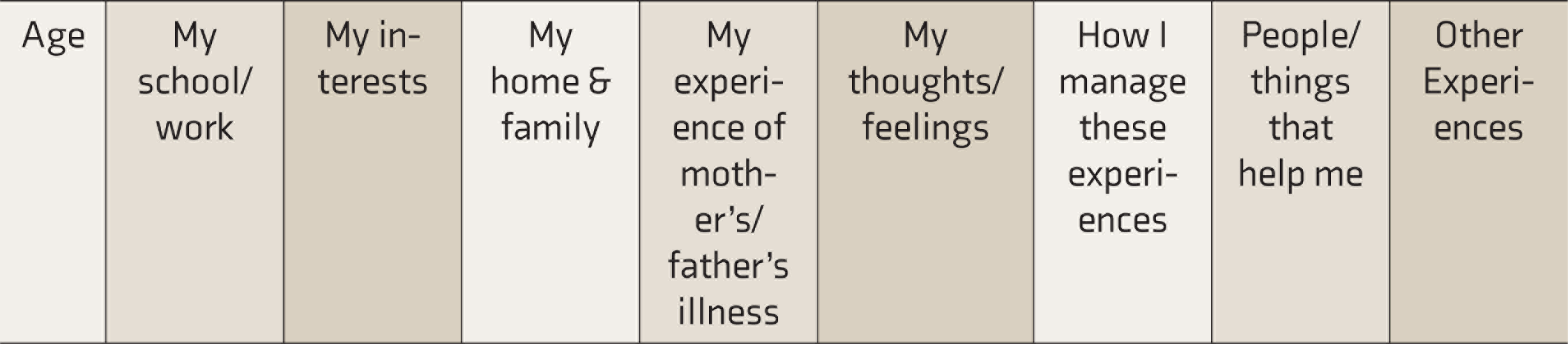
The life grid used in the present study included topics such as school/work, interests, home, and family, in addition to their experiences of the parent’s illness, their ways of managing the experiences, and the resources in their environment. Using the life grid is an innovative method of data collection that guides children’s thought process to generate data for the research process. Table 1 provides a template of the life grid used in the present study.
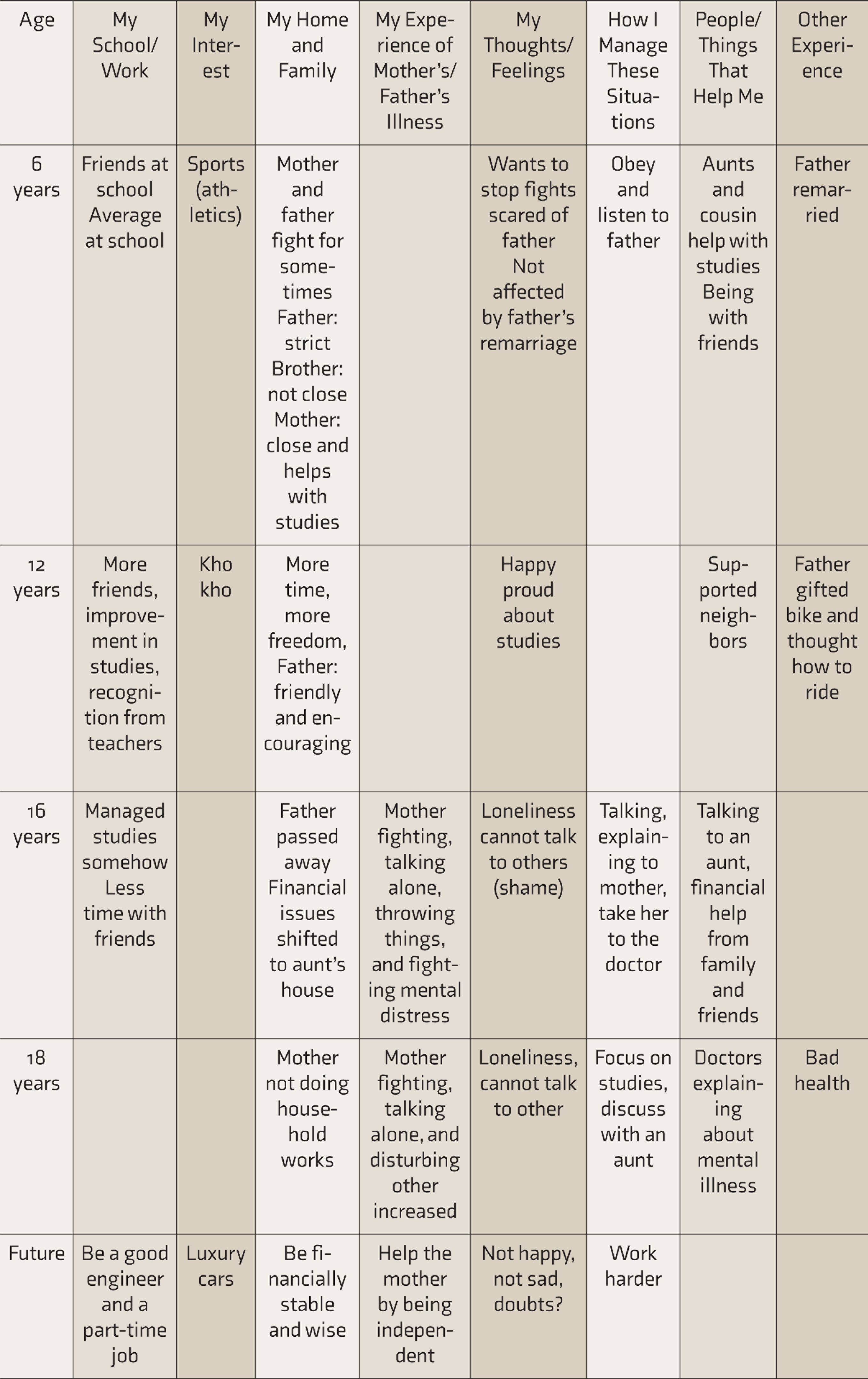
The life grid was accompanied by a topic guide, which provided specific subtopics and prompts for each domain. The broad topics included in the guide are school and work, home and family, experiences of parental mental illness, coping strategies and resources, etc. The life grid provided an overall structure and anchor for the interviews—for each of the topics, questions were asked about the past (their childhood and early adolescent years), the present, and the future, and key words and phrases from the participant’s narrative were written down in the life grid. This way, a narrative was created covering all the topics listed in the topic guide, for various time points in the participant’s life. A completed life grid template from one of the interviews in the study is presented in Table 2. The detailed methodology of the life grid interviews will be published elsewhere.
The duration of the interviews ranged between 25 and 115 minutes, with an average time of about 55 minutes. Four of the interviews were brief, lasting between 25 and 30 minutes, and did not elicit rich information—in three of these cases, the adolescent was not forthcoming with information, and in one case, the interview had to be completed in a hurry due to the participant’s constraints with time. Most of the remaining interviews were sufficiently long and managed to elicit adequate information. Each interview was digitally audio-recorded and later transcribed. Additionally, the researcher maintained descriptive and reflective field-notes of the process.
Adolescents’ Feedback on the Life Grid
At the end of the interview, the adolescents were asked for feedback on the interview process. They were asked to describe their overall experience of completing the life grid, what they liked about the process, and what they disliked about the process. The feedback obtained from the participants was read through and summarized. Finally, they were asked to rate their experience on a five-point rating scale ranging from “disliked a lot” to “liked a lot.” They were explained that their feedback would help the researcher understand if similar interviews could be done with other adolescents and to identify what could be done differently so as to make it more acceptable for them.
Template of the Life Grid Used in the Study
Completed Life Grid from One of the Interviews in the Study
Results
The characteristics of the adolescents, the feedback provided by them regarding the life grid interview, and the challenges in using the life grid approach are described here.
Sociodemographic Information of the Adolescents
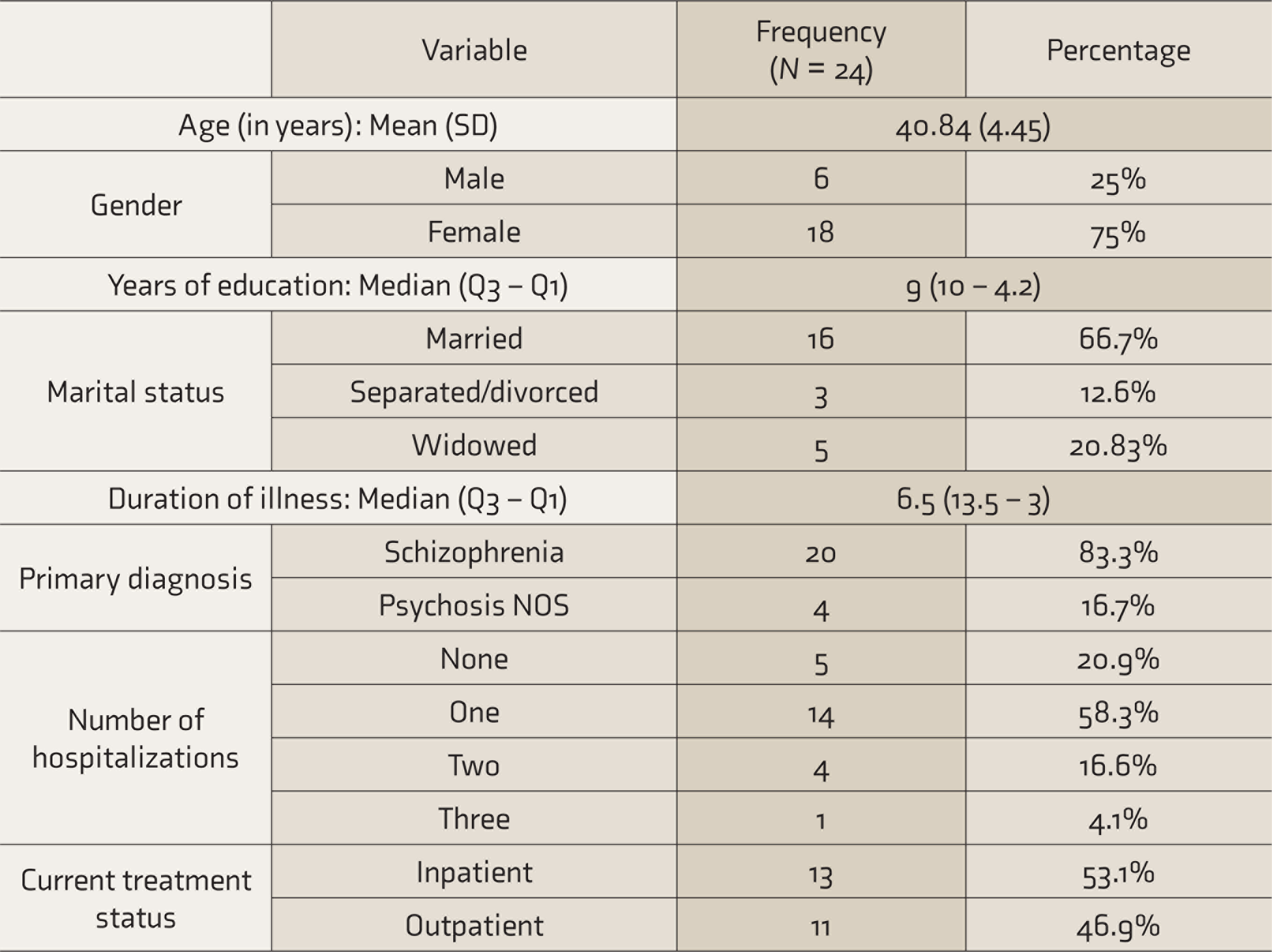
Table 3 describes the characteristics of the adolescents who participated in the interviews. About 54% of the adolescents were female. Their education ranged from class 5 to graduation; 19 of them were still studying while the rest had dropped out or discontinued education. About 43% were living in an urban area, and the rest were from semiurban areas.
Table 3 presents the details of the mental illness of the 24 parents. Their mean (±SD) age was 40.84 (±4.45) years. Three-fourths of the parents were mothers. They had a median of 9 years of education (IQR = 10 – 4.2). A majority of them (66.7%) were currently married, 12.6% were widowed, and 20.83% were separated or divorced. In this sample, all the fathers were in intact marriages, and the parents who were widowed or separated/divorced were all mothers.
A majority of them (83.3%) had a diagnosis of Schizophrenia, and the rest had a diagnosis of psychosis NOS. The median duration of the illness was 6.5 years (IQR = 13.5 – 3.0). Three-fourths of them (74.9%) have had at least one hospitalization for the mental illness. A majority of them (53%) were undergoing in-patient care at the time of their child’s participation in the study.
Adolescent Participants’ Experiences of Using the Life Grid
Participants rated about their liking of life grid activity on a five-point rating scale, about 33% of the 24 adolescents said that they liked the activity a lot, and 50% said that they liked the activity. About 17% said that they were neutral and neither liked nor disliked the activity. The next subsections provide a summary of the adolescents’ feedback about participating in the life grid interview.
What the Adolescents Liked About the Life Grid Interview
The adolescents said that the life grid interview gave them an opportunity to share and ventilate, some adding that they had never spoken about some of these experiences with anyone before. Some adolescents reported that going over their whole life and putting it down on the life grid gave them a deeper understanding of their family and the ill parent. Many of them particularly appreciated the opportunity to talk about positive memories and achievements, and some said that it reminded them of their future goals and gave them hope. The following are quotations from the adolescents illustrating their feedback:
It was nice to see that I have overcome all these situations. I feel like I can do so again in the future. I had not thought about these in a long time. (19/F)
I liked recalling the old memories, remembering my old friends. It also helped me understand about my father. (16/M)
I feel a sense of relief in being able to share these things. It was like talking to a friend. (16/F)
I have never spoken to someone about these things in such detail; I’ve only said these things to you. (17/F)
What the Adolescents Disliked About the Life Grid Interview
One of the main difficulties the adolescents reported was in recalling negative events from the past. Some of them expressed that this made them feel momentarily sad; one of them added that the activity reminded them of past events that they had tried to forget. One of the adolescents expressed that the process was time consuming. Another said that they did not know what to say to some of the questions. Other participants said that there was nothing they disliked about the process. The following are the quotes from adolescents illustrating what they disliked about the interview:
Demographic Details of the Parent with Mental Illness
I could share my feelings with you. I had to recall old things; it was good, but it was also difficult. (19/F)
It was a bit good, but it also made me a bit sad to talk about my mother’s problems. (16/M)
Challenges in the Life Grid Interview
While, in most cases, it was possible to simultaneously fill up the life grid or do the writing during the natural pauses in the interview, sometimes, it was difficult to do so without interrupting the flow of the interview. Many of the children preferred that the researcher write in the life grid, making the activity less participatory; only two participants chose to fill it up themselves. In addition to the adolescent’s language proficiency and comfort, this required the researcher to be proficient in reading and writing the language. Although the researcher tried as far as possible to use the language that the adolescent was most comfortable in, while filling the life grid, this did lead to additional challenges. Within the multilingual context of India, where practitioners and researchers often have speaking, but not writing, skills in multiple languages, this poses a unique challenge.
The adolescents experienced the parental mental illness mainly in the form of disrupted relationships and routines. They had a fragmented understanding of the mental illness in their environment. They tried to find a balance by using engaging and disengaging strategies to negotiate their involvement with the parent and their involvement in their own lives.
Discussion
This study employed life grid interviews to create holistic narratives of the participants’ lives and connect with the experience of parental mental illness, instead of asking them direct questions about the parental mental illness and how it affected their lives. Particularly, talking about parental mental health issues can be quite threatening for children, due to issues of fear, shame, secrecy and stigma, and loyalty to their parents.16,17 There are advantages to using a nondirective, open-ended format, especially in research with children,18,19 but these need to be balanced with the need to cover the topics set out by the researcher. 20 In this regard, the broad topics and prompts within the life grid interview provide direction and structure to the process. The life grid provided a timeline and a visual anchor around which participants could organize their narratives; it provided a way to make connections between important events and form a coherent narrative of their lives. Other studies using the life grid have reported similar experiences with adolescents and young people.21,12
This study is novel in its application of life grids in qualitative data collection with adolescents in the Indian context. Based on this study and the feedback provided by the participants, life grids can be said to be a feasible and useful tool in qualitative interviews with this population. It is important to note that the participants in this study were from urban/semiurban areas, and the adaptation and use of this tool with adolescents from rural settings may need further study. Moreover, the activity can seem intimidating, especially for participants who are not comfortable with reading and/or writing, and allowing an option for the researcher to fill in the life grid can help make the participants more comfortable and better engage in the task.
The feedback provided by the adolescent participants points to other possible applications of life grids. In therapeutic contexts, interviews guided by life grids could be used to build rapport and in assessment and goal setting. They could be used to help children of parents with mental illness (and children affected by other ongoing difficult circumstances) form coherent narratives of their past and present and connect these with their thoughts for the future.
Conclusion
Collecting rich data is one of the challenges in qualitative research, especially in research with children. It requires finding the best interview techniques for a specific age group, keeping in mind the developmental and cultural context. This article sets forth the life grid as a useful tool in conducting qualitative interviews with adolescents in the Indian context. Future qualitative research with children in India could explore the usefulness of this approach in other age groups, settings, and topics.
Footnotes
Declaration of Conflicting Interests
The authors declared no potential conflicts of interest with respect to the research, authorship, and/or publication of this article.
Funding
The first author’s ongoing doctoral research is funded by the Junior Research Fellowship of the University Grants Commission, India (1266/NET.DEC-2012).