




Abstract
In the US and the UK, rapidly growing populations of mixed origins have constituted a key research site for decades. In most European countries, by contrast, the mixed-origin group has remained largely invisible within research on immigration-related inequality and especially so in its quantitative branch. Breaking this pattern, we zoom in on Norwegian-born individuals with one parent born outside of Western Europe and North America, a group constituting about a third of the country's overall mixed-origin population. Drawing on administrative register data and survey data from the Children of Immigrants Longitudinal Study in Norway, we assess their socioeconomic backgrounds, educational aspirations, and subjective experiences, and compare them to individuals with two Norwegian-born parents and two immigrant parents. Our analyses document a contradictory pattern that begs for future research: Mixed-origin individuals largely resemble their majority peers in terms of parental socioeconomic resources, but they lack the educational drive typical of the second generation, in terms of both subjective aspirations and actual educational attainments. In their social orientations and national identification, they are located somewhere in between the minority and the majority, but they experience similar levels of discrimination and non-recognition as those with two immigrant parents. We use these contradictory findings to discuss possible ways forward for a broader research agenda for mixed-origin populations beyond the US and the UK.
Introduction
In North America and the UK, studies of mixed race and multiraciality have long flourished, focusing on identity formations, census classifications, and experiences of racism and discrimination (e.g., Aspinall and Song 2013; Ifekwunigwe 2004; King-O'Riain et al. 2014; Morning 2014; Rocha and Aspinall 2020). At the same time, intermarriage and the rise of ethno-racially mixed families are also part of broader debates in assimilation scholarship. Alba (2020, 6–7), for example, argues that many “mixed majority-minority Americans have everyday experiences, socioeconomic locations, social affiliations, and identities that do not resemble those of minorities,” which he sees as a sign of mainstream expansion (see also Bean and Lee 2012). A related conclusion comes from scholarship on mixed-race families in the UK. Aspinall and Song (2013, 182), for instance, argue that the increase of mixed-race individuals indeed blurs ethno-racial boundaries, though caution against a conclusion that “race” then automatically stops shaping the experiences of individuals of mixed origins (see also Song 2010, 2020).
A striking feature of this literature is the overwhelming dominance of scholarship from the US and the UK. Admittedly, important efforts have been made to study mixed race identity in comparative perspective (King-O'Riain et al., 2014) and whether and how mixed race and ethnicity are categorized in official classifications across the globe (Morning 2014; Rocha and Aspinall, 2020). Empirical assessments of the experiences of mixed-origin individuals in Europe remain limited, however. Notable exceptions include Osanami Törngren's (2022) study from Sweden, Nandi and Spickard's (2014) study from Germany, and Unterreiner's (2017) comparative study from Germany and France—all relatively small-scale and based on qualitative interviews. Additionally, a few studies examine how mixed-origin youth fare in education; for instance, Kalmijn (2015) finds that mixed-origin children lag behind the majority in language test scores in England, Germany, the Netherlands, and Sweden. In a comparative analysis of children of immigrants in the same four countries, Kalter and colleagues also briefly discuss religious and social attitudes among children of mixed origins, attributing the finding that they tend to be less religious and more liberal to patterns of selection into exogamy in the parental generation (Kalter et al., 2019, 315). These valuable contributions notwithstanding, there can be no doubt that we know little about mixed-origin individuals’ experiences, attitudes, and socioeconomic locations in Europe, especially when contrasted with scholarship on second-generation incorporation, where studies of such broad assimilation patterns proliferate (for a recent review, see Drouhot 2024).
Norway epitomizes this broader tendency. While the second generation 1 has received massive attention in research over the past 15 years, only two small-scale qualitative studies of the experiences and identity-constructions among mixed-origin individuals have ever been conducted (Løkken 2020; Sandset 2019). This lack of interest is striking, since the number of individuals of mixed origin in fact is higher than the number of individuals with two foreign-born parents. Probably, mixed-origin individuals have been absent from scholarly attention for two related reasons: First, in Norway's official statistics, individuals are not categorized by ethnic and racial labels but according to their own and their parents’ country of birth. Second, the immigrant-origin population, as it is defined by Statistics Norway, includes only immigrants and individuals born in Norway by two foreign-born parents. By implication, all mixed-origin individuals in Norway are officially defined as part of the majority population, regardless of their ethnic origins or racial appearance. This is similar to most European countries but stands in sharp contrast to the US, where the Census Bureau classifies individuals with both white and non-white ancestries as part of the minority population (Alba 2020, 4).
While it is easy to sympathize with the inclusion of mixed-origin individuals in official definitions of the majority population, research from other contexts begs the question of how they fare in society—compared to their peers with two Norwegian-born and two foreign-born parents—in a broader context of immigration-related inequality. This is what we set out to do in this research note. Drawing on population-wide, individual-level administrative data as well as data from the Children of Immigrants Longitudinal Study in Norway, we center Norwegian-born individuals with one parent born outside of Western Europe and North America, assessing their socioeconomic backgrounds, educational aspirations, and subjective experiences, and compare them to individuals with two Norwegian-born parents and two immigrant parents from the same regional backgrounds. This provides a broad descriptive overview of a group not previously examined using quantitative data. We conclude by discussing a broader research agenda for studying mixed-origin populations in countries where this group has remained invisible for too long.
Theoretical Starting Points
Three bodies of scholarly literature are particularly relevant as theoretical starting points when examining the situation for mixed-origin individuals. The first is the fast-growing field of mixed-race research within the broader umbrella of ethnic and racial studies, often focusing on identity formations, census classifications, and experiences of racism and discrimination among people of mixed origin (Ifekwunigwe 2004; King-O'Riain et al. 2014; Song 2017). Within this literature, people of mixed origin constitute a key lens through which the firmness or flexibility of ethno-racial boundaries can be assessed.
Alba (2020), for example, argues that although children of black/white parents tend to have experiences similar to those of African Americans, “many other mixed majority-minority Americans have everyday experiences, socioeconomic locations, social affiliations, and identities that do not resemble those of minorities,” which he sees as “a sign of growing integration into the mainstream by especially individuals with Asian and Hispanic origins” (Alba 2020, 6–7). Similarly, Bean and Lee (2012, 419) argue that “children of Asian-White and Latino-White couples are much less constrained by strict racial categories,” suggesting their identities will become more like the “symbolic” or “optional” ethnicities characterizing descendants of European immigrants in the US (Gans 1979; Waters 1990). A related conclusion, though with some important reservations, comes from scholarship on mixed-race families in the UK. Aspinall and Song (2013, 182), for instance, argue that the increase of mixed-race individuals indeed blurs ethno-racial boundaries, suggesting that “there is evidence of race losing its fixity, especially in urban cosmopolitan areas where being mixed appears to be regarded as more ordinary than in the past.” However, they caution against an interpretation that “race” then automatically stops being a structural force that shapes the lives and experiences of many individuals of mixed origins (see also Song 2010, 2017, 2020).
A second starting point is assimilation scholarship and its focus on the immigrant second generation, whose outcomes and experiences we will use as a comparative benchmark in our analyses. This literature has been heavily influenced by debates between competing assimilation models drawn from the US experience. While the neo-assimilation paradigm predicted a broad pattern of upward social mobility among descendants of immigrants (Alba and Nee 2003), segmented assimilation scholars warned that the children of some immigrant groups could be at risk of stagnant or even downward assimilation, partly due to racial discrimination (Portes and Zhou 1993; Portes and Rumbaut 2001). A key theme in this literature is how the educational resources and class positions of the parental immigrant generation matter for the educational outcomes of their children. Though children of immigrants often are disadvantaged in terms of parental socio-economic and country-specific cultural resources, they also tend to have certain advantages, particularly in terms of high aspirations and resilience. This immigrant “optimism” (Kao and Tienda 1995) or “immigrant drive” (Portes 2012), is typically attributed to a positive selection of immigrants relative to non-migrants in the home country (Feliciano and Lanuza 2017), as well as social capital in the form of family bonds and community networks, which bolster educational ambition (Lee and Zhou 2015) and buffer against socioeconomically disadvantaged surroundings (Borgen, Borgen and Zachrisson 2025).
At the same time, discrimination against descendants of immigrants who are non-white and Muslim remains prevalent (Quillian and Midtbøen 2021). Field experiments from Norway have documented discrimination rates in hiring that are similar to those in other Western countries (Birkelund, Heggebø and Rogstad 2016; Larsen and Di Stasio 2019; Larsen and Midtbøen 2024; Quillian et al. 2019), surveys show that the second generation reports similar or even higher levels of discrimination than immigrants (Dalen et al. 2024; Midtbøen and Kitterød 2019), and although Norwegian-born children of immigrants partially identify as being Norwegian, they often feel that others do not recognize them as such—a phenomenon labeled as non-recognition and interpreted as a form of social exclusion (Friberg 2021). When setting out to investigate the situation for mixed-origin individuals in Norway, our analytical strategy is thus to compare them with the immigrant second generation, including information about the socioeconomic resources of their parents and their own educational outcomes, as well as survey data on their subjective experiences.
Our third and final starting point is the literature on mixed unions. As intermarriage is often seen as a sign of growing integration into the mainstream, scholars have considered intermarriage as an assimilation outcome and explored what characterizes exogamous union formations (Kalmijn and Van Tubergen 2010). From such studies conducted in the Scandinavian context, we have learned that those who enter exogamous and endogamous unions differ systematically in terms of, for instance, country origins, socioeconomic status, language skills, and preferences for residential location (Dribe and Lundh 2011; Elwert 2020), as well as in religion (Qvist and Qvist 2025) and cultural orientation and knowledge (Dribe and Lundh 2008). Thus, the lives and experiences of mixed-origin individuals are shaped not only by having mixed parents per se, but also by what makes their parents inclined to mix in the first place. This ‘selection into mixing’ shapes the circumstances of mixed-origin children and is a potential driver behind the influence of having a mixed background. Our empirical mapping thus comprises both parental and family characteristics that shape children's circumstances, as well as children's own outcomes and experiences.
Mixed Origin in Norway—a Broad Overview
Norway first became a net immigration country in 1967 when labor migrants from Pakistan, Morocco, Turkey, and India started arriving, followed by subsequent “waves” of different categories of immigrants in the following decades. A 1975 moratorium on unqualified labor migration was quickly followed by a rise in family migration, which has lasted ever since. Refugees and humanitarian immigrants started coming in the 1980s and 1990s, and since 2004, labor migration again became a major source of immigration (Brochmann and Kjeldstadli 2008). Today, immigrants make up more than 16 percent of Norway's population. The two largest groups are Poles and Ukrainians, followed by migrants from Lithuania, Syria, Sweden, and Somalia. Individuals born in Norway by two foreign-born parents constitute another 4 percent of the population. Among the second generation, children of immigrants from Pakistan make up the largest group, followed by Poland, Somalia, and Iraq.
This standard account is a precise description of the country's immigrant population following Statistics Norway's definition. However, if we include individuals with one immigrant parent in the immigrant-origin population, it is clearly insufficient. This group today constitutes 5 percent of the Norwegian-born population and thus outnumber those with two immigrant parents.
Figure 1 provides an overview of the Norwegian population from 1986 to 2024. The gradually expanding light gray and blue fields reflect how immigrants and their children have come to make up a fifth of the population. The red field denotes individuals of mixed origin and, as the figure shows, they have been present throughout the period and constitute a substantial group.
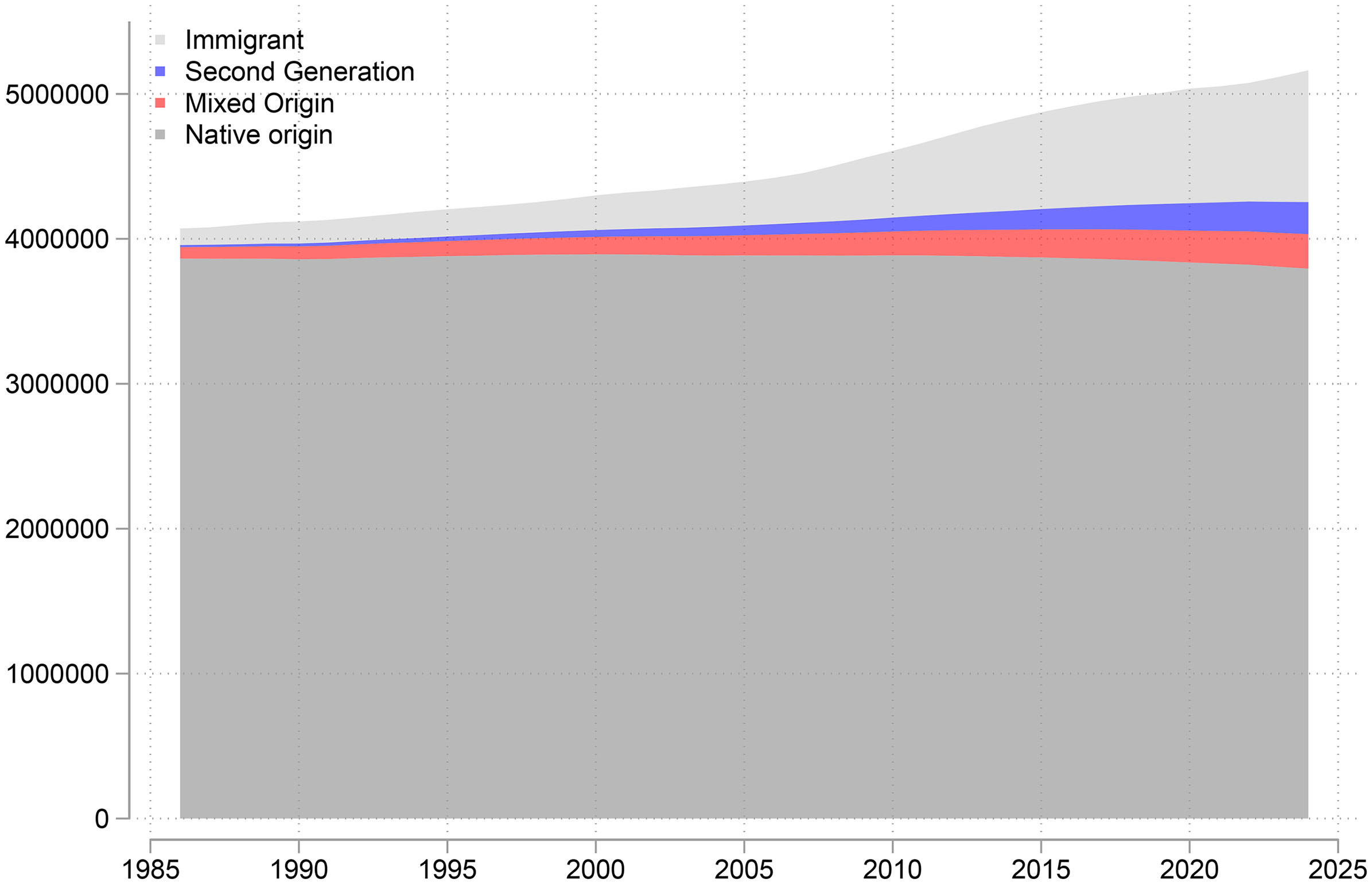
The Norwegian population by origin, 1986–2024, absolute numbers.
Figure 2 shows the second generation and the mixed origin-group over the same period, distinguished by whether their non-Norwegian parents originate from a “Western” or “non-Western” country. 2 As neither race nor ethnicity are measured in Norway and thus not part of the registry data we analyze, we use the world regional background of parents as a proxy for ethnoracial differences vis-a-vis the native-origin majority. 3 The figure shows that, in 1986, the largest group had one Norwegian-born parent and one parent from another Western country. Over the next four decades, the number of Norwegian-born children with at least one immigrant parent more than quadrupled. The two fastest growing groups were individuals with two parents from non-Western countries (dark blue), and individuals with one Norwegian-born parent and one parent from a non-Western country (dark red). In the following analyses, we compare individuals from these two groups with the native-born majority (dark grey field in Figure 1). We focus on children of one or two non-Western immigrants since those with one or two immigrant parents from a Western country (light blue and light red) are indistinguishable from the majority on close to all indicators.
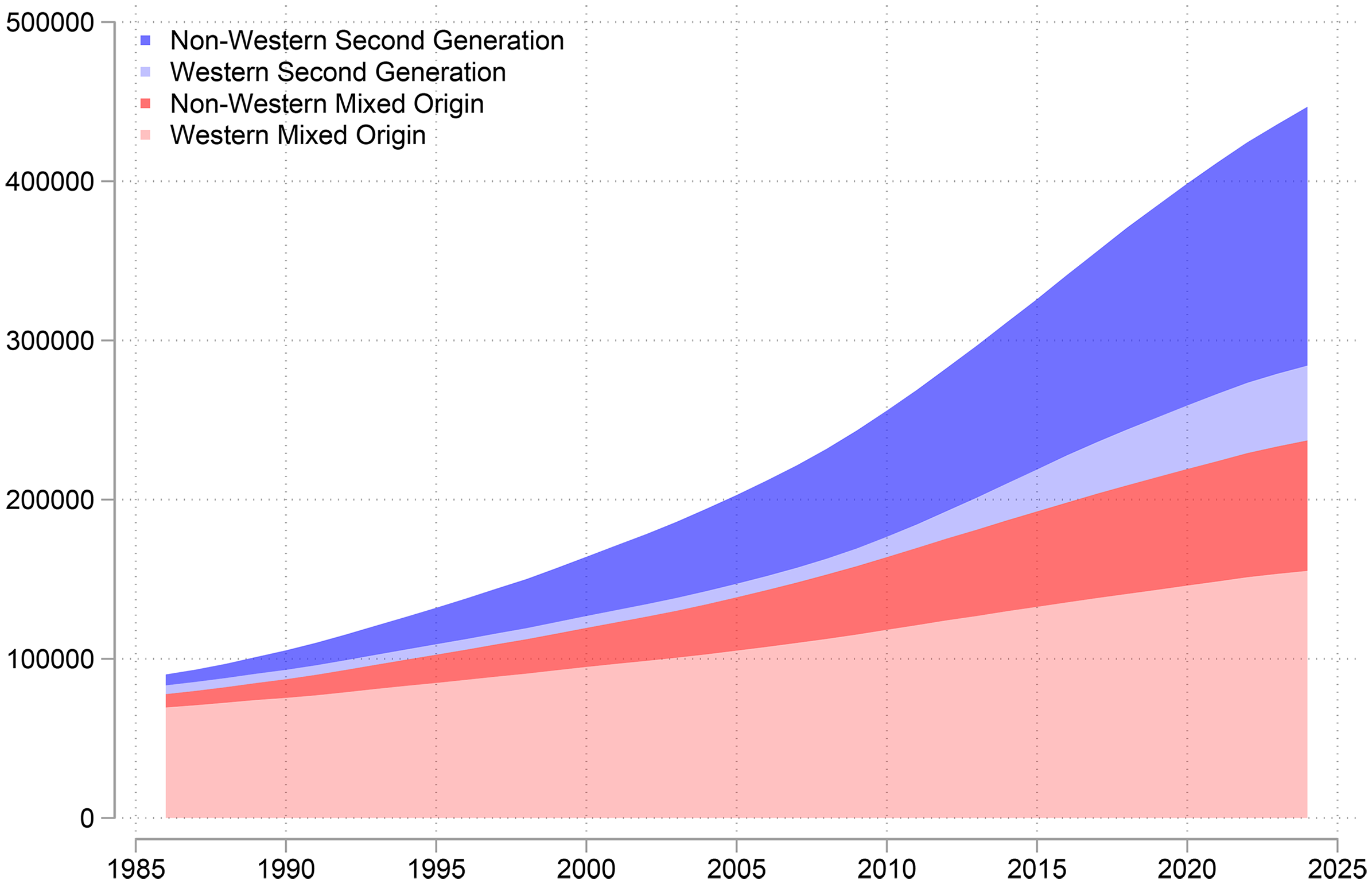
All Norwegian-borns with at least one foreign-born parent, 1986–2024, absolute numbers.
It should be noted that non-Western mixed individuals and the non-Western second generation constitute groups that differ significantly in their composition of origin countries. Figure 3 shows the 22 largest groups of Norwegian-born individuals with at least one parent from a non-Western country. Those with one or two immigrant parents within each group are marked in red and blue, respectively. The largest groups of individuals with two foreign-born parents originate from Pakistan, Somalia, Iraq, Vietnam, Eritrea, and Sri Lanka. By contrast, individuals with mixed origins often have one parent from the Philippines, Thailand, Russia, Turkey, Iran, Chile, Brazil, or Ukraine. This reflects large differences in co-parenting rates between native-born Norwegians and immigrants from different countries. For the present purposes, it suffices to note that when comparing individuals of mixed origin with the second generation, the composition of origin countries differs substantially. It is also worth noting that whereas those with one parent from for instance the Philippines and Thailand tend to have an immigrant mother, those with one parent from the Middle East or Africa more often have an immigrant father. We return to the implications of these differences in the conclusion.
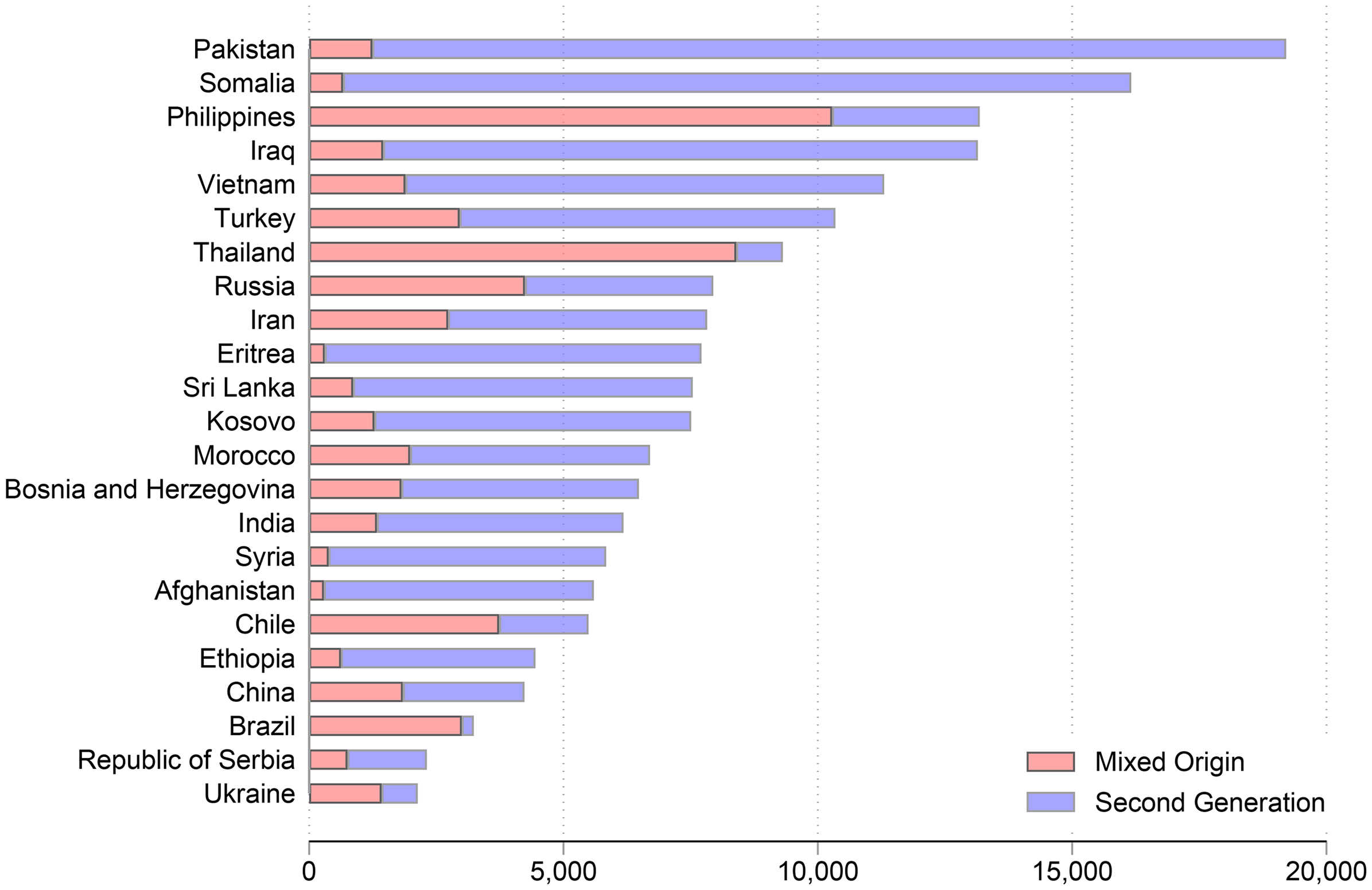
The largest origin-country groups (N > 2000) of Norwegian-born residents in 2022 with at least one parent from a non-Western country.
Data and Measures
Data
We focus on providing a broad overview of socioeconomic and family resources, aspirations, and experiences in the mixed-origin group. Mirroring typical approaches in the study of second-generation incorporation (e.g., Alba and Foner 2015; Drouhot 2024; Portes, Fernández-Kelly and Haller 2009), we focus on their parent's level of education and income rank, family constellations, and their own educational attainments and aspirations for the future, as well as their friendship networks, national identification, and experiences with discrimination and non-recognition. On all measures, we compare the mixed groups to individuals with two foreign-born parents from the same regions (“non-western second generation”) and individuals with two Norwegian-born parents (“native origin”).
Our analyses build on two data sources. For data on demographics, parental education and income, family constellation, secondary school completion, and university-level enrollment, we use population-wide administrative data from Statistics Norway on cohorts born from 1995 to 1999. We combine information from different registers through de-identified personal identification numbers, and we couple information on individuals to information on parents. After conducting list-wise deletion to ensure that all statistics are based on the same individuals, we are left with 247,071 individuals (mixed n = 6530, second generation n = 13,170, native origin n = 227,371).
For data on educational aspirations, social mixing, national identification, and experiences of discrimination and non-recognition, we use the first wave of the Children of Immigrants Longitudinal Study in Norway (CILS-NOR). Conducted in 2016 in the greater Oslo area, the survey targeted adolescents enrolled in their first year of upper secondary schooling, and at the time of the survey (2nd semester), pupils born in 1999 were aged 16. Secondary education is a universal right in Norway, and since practically everyone enrolls for the first year, this represents a good approximation for the full cohort. Students filled out extensive questionnaires during school hours, while those not present were contacted via the school email system, with gift card lotteries to boost participation.
In total, 7627 students participated, constituting 48 percent of the student cohort. 4 Excluding all respondents who have themselves migrated to Norway as well as all respondents born in Norway by one or two parents originating from the EU, Great Britain, North America, Australia, and New Zealand, the subset of the sample we analyze includes a total of 5214 individuals (mixed n = 403, second generation n = 853, native origin n = 3958).
Measures
Parental characteristics were measured using register data. A dichotomous variable indicates whether at least one parent had higher education when the child was 16 years old. Parental income takes values from 1 to 100, calculated as the mean of the mother's and the father's annual combined earnings when the individual is 10–15 years of age, ranked in percentiles within the birth cohort. A dichotomous variable indicates whether the individual lives with both parents at age 16.
Educational attainment was measured using register data. Two dichotomous variables indicate whether individuals (1) had completed secondary education by the age of 21, and (2) were enrolled in higher education by the age of 21.
The remaining outcomes were measured using the CILS-NOR survey. Educational aspirations were measured by a dummy indicating those who, at age 16, aim to complete a master's degree. Friendship networks were measured by asking how many of their friends had immigrant parents (“none of them”; “a few”; “roughly half”; “most of them”; “all of them”) and constructing a dummy indicating those who reported “most of them” or “all of them.” National identification was measured by asking “To what extent do you see yourself as Norwegian?” (“not at all”; “a little”; “partially”; “completely”) and constructing a dummy indicating “completely” or “partially.”
Discrimination was measured using two survey items. Respondents were asked: “People can be treated badly in many different ways. One can, for example, be offended, accused of something one has not done, be denied entry, harassed or subjected to violence. Have you been treated badly over the last six months?” (“yes, often”; “yes, once or a few times”; “no”). Respondents who chose the first or second alternative were asked: “Do you think some of the bad treatment was due to discrimination, i.e., that you were treated badly because you belong to a certain group or have a certain background?” (“yes”; “no”). We constructed a dummy indicating those who were treated badly and thought this was due to discrimination.
Non-recognition is a combined measure of two items; the question about national identification and the follow-up question: “To what extent do you think other people see you as Norwegian?” (same categories). We then constructed a dummy indicating those respondents who reported that others saw them as less Norwegian than what they reported on self-identity.
Operationalizing Mixed Origin—Some Caveats
The way we define and operationalize mixed-origin individuals has implications for both our results and interpretations. First, we define those with one native-origin parent and one immigrant parent as having mixed origin. This means that those with two immigrant parents of different ethnic origins are not considered mixed. This choice is in line with our broader attempt to put native-immigrant mixing on the agenda for integration research but is limited in the sense that it comprises only one dimension of ethnic boundary-crossing.
Second, while the registered birth country of parents and grandparents is used to define mixed origins when exploiting registry data, survey research tends to use children's own reporting of parental origins as the basis of classification. While the operationalization of mixed origin could be prone to reporting bias when using survey data, it might be that self-reporting is better suited to capture children's mixed identities. In the current analyses, it should be noted that the survey data were linked to administrative data, allowing us to use a standardized definition. However, the implications of how mixed origins are defined in the data should be of concern for scholars in this field.
Third, and relatedly, we need information on both parents to know whether children have mixed origin in the registry data. This means that we exclude all children with only one parent registered. These children might, according to research on single-parent households, be particularly vulnerable (Thuen et al. 2015). As we cannot determine whether these children belong to our native, second-generation, or mixed group, we cannot fully evaluate the consequences of excluding them from our analyses.
Results
We organize our results in two main sections. In the first part, we build on the register data, showcasing the mixed-origin group's parental socioeconomic resources and their own educational attainments. In the second part, we build on the survey data and present analyses of their aspirations for higher education, friendship networks, national identifications, and experiences with discrimination and non-recognition.
Part 1: Parental Characteristics and Educational Attainments
We start by examining parental socioeconomic resources among those with mixed origins, compared to their native-origin and second-generation peers. Figure 4 shows the share of each group with at least one parent with higher education, as well as parental income rank. The figure shows that about 50 percent of mixed-origin individuals have at least one parent with higher education. This is more or less identical to their native-origin peers, but more than 20 percentage points higher than among their second-generation peers. Regarding parental income, mixed-origin individuals are less advantaged; their parental income lies between that of the native majority and the second generation.
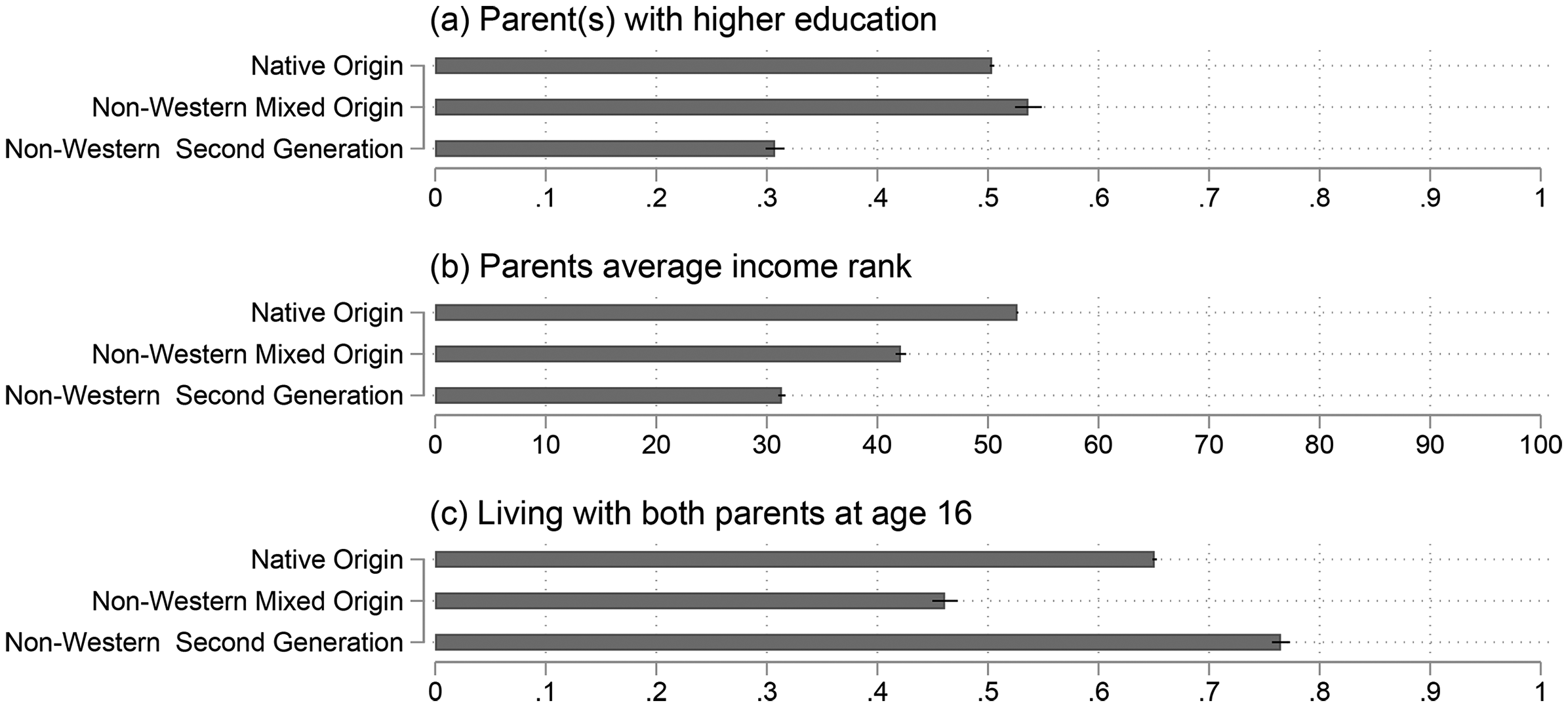
Likelihood of having at least one parent with higher education, average parental income, and likelihood of living with both parents. Measured at age 16, separated by parental origin.
When it comes to family constellations, however, the mixed origin group stands out as particularly vulnerable. The bottom panel of the figure shows that they are much less likely to grow up in intact families compared to both the native majority and the second generation, which is associated with children's wellbeing and educational attainment (Bernardi and Radl 2014). In sum, Figure 4 suggests that individuals of mixed origin have access to more educational resources and grow up in more favorable economic circumstances compared to the second generation, but also that they are considerably less likely to grow up in intact families.
Figure 5 shows rates of upper secondary education completion and enrollment in higher education by age 21. The dark grey columns show baseline results, while the lighter grey columns show results adjusted for parental education and income. There are three main findings: First, mixed-origin individuals are less likely to complete upper secondary education compared to their native-origin peers—despite similar average levels of parental education. They even lag behind the second generation, who are considerably less advantaged in terms of parental education and income. Second, the mixed-origin group also trails behind when it comes to enrollment in higher education, and particularly so when compared to the second generation. Third, differences vis-à-vis the second generation are markedly larger when adjusting for parental education and income rank. Overall, these findings suggest that the mixed-origin group appears to neither benefit fully from their parental educational and economic resources (as do their native-origin peers), nor from immigration-related advantages in adaptation (as their second-generation peers).
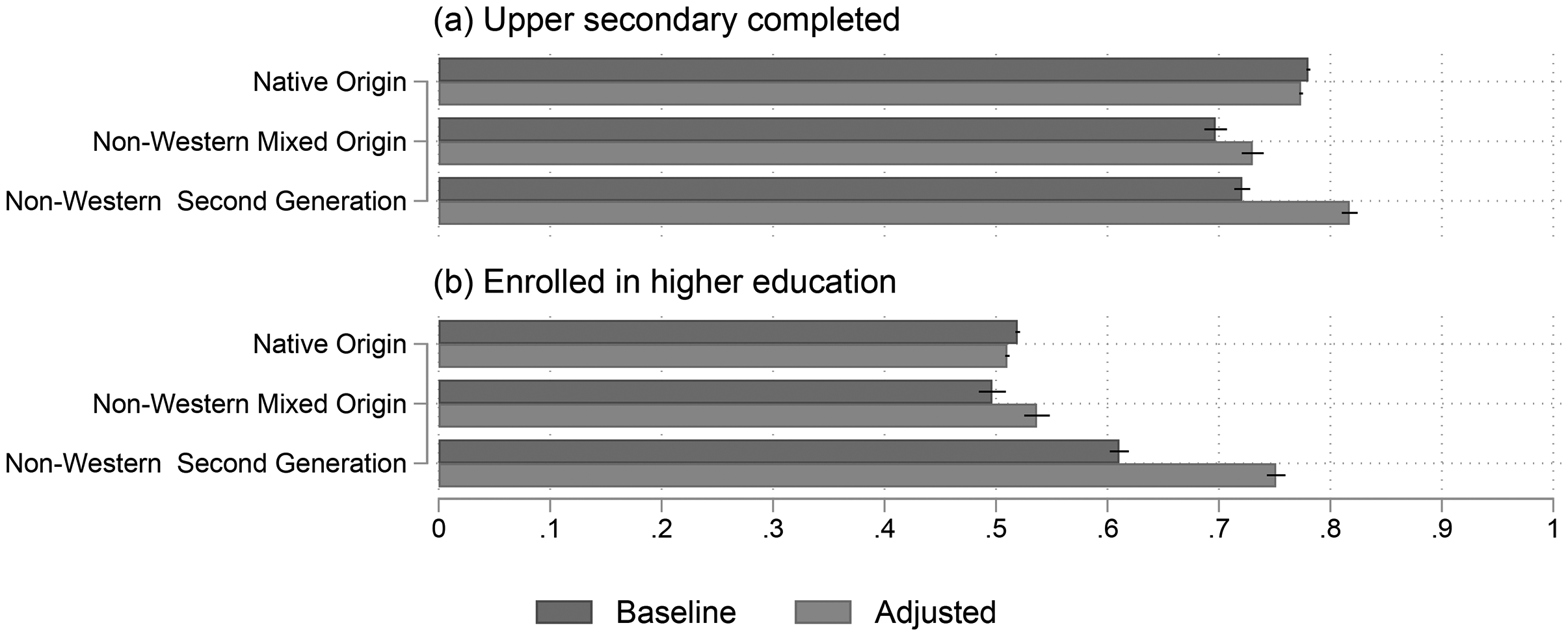
Rates of completion of upper secondary education and enrollment in higher education at age 21, by parental origin.
Part 2: Aspirations and Experiences
We now turn to the survey, where respondents were asked questions about their orientations and experiences. Once again, results paint a contradictory picture of the mixed-origin group, resembling their native-origin peers in some respects and the second-generation in others.
Starting with educational aspirations, Figure 6 shows that mixed-origin individuals are close to their native-origin peers in their aspirations for achieving an MA degree. By contrast, the second generation—although having much fewer resources in terms of parental education—stands out with significantly higher ambitions.
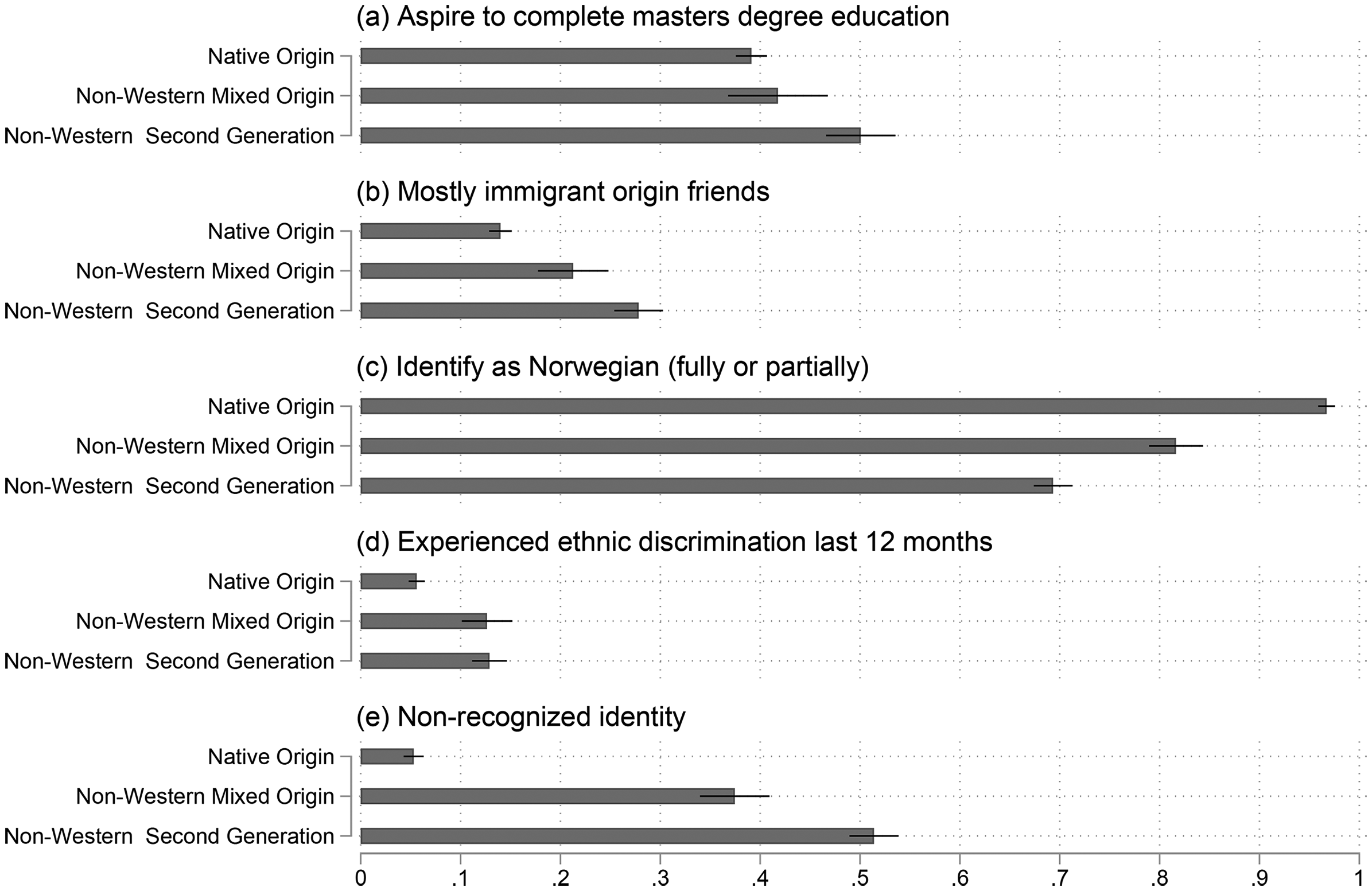
Indicators of educational aspirations, social orientations, national identification, and experiences of discrimination and non-recognition, by parental origin.
Our second measure taps into inter-ethnic friendship ties, which can be interpreted as a “test” of group boundaries. We find the mixed-origin group positioned between the second generation and the native-origin group; a substantial minority (22 percent) reports that they mostly have immigrant-origin friends. This is higher than among native-origin individuals (16 percent), but significantly lower than among the second generation (28 percent).
The third measure shows the percentage of each group who identify as either “partially” or “completely” Norwegian. Again, mixed-origin individuals are positioned between the two comparison groups. Unsurprisingly, practically all native origin respondents identify as Norwegian, whereas the second-generation are more reserved in their national identification. We find the mixed group in between, with 82 percent who partially or completely identify as Norwegian. Combined with our indicator of friendship ties, this result suggests that mixed-origin individuals blur the boundary between minorities and the majority, much like Alba (2020) has documented for many mixed-origin groups in the US.
However, while group boundaries might be blurred in some respects, they may be bright in others. Our fourth and fifth measures are experiences of discrimination and what we call non-recognized identity (see methods section for definition). In contrast to the other measures, we find virtually no difference between the second-generation and the mixed-origin group in experiencing discrimination: 12–13 percent of both groups report having experienced discrimination due to their ethnic background in the past six months. A similar pattern goes for non-recognition. While native-origin respondents overwhelmingly and unsurprisingly report that they both feel Norwegian and are accepted as such by others, almost 40 percent of mixed-origin individuals and around 50 percent among the second generation experience that their Norwegian self-identity is not recognized by others. This points towards an ethnoracial boundary that excludes some people from full-fledged membership in the national community, regardless of having one parent of Norwegian descent.
Conclusion: A Research Agenda for the Study of Mixed Origins Beyond the US and UK
Our brief empirical overview suggests that the Norwegian mixed-origin population is characterized by a number of contradictory features. As both consequences of social mixing and catalysts of changing ethnic boundaries, this is not surprising. However, some of our findings point towards certain vulnerabilities for social exclusion. One is the “mixed-origin mismatch” between parental resources and educational performance. Mixed-origin individuals have lower educational aspirations than the second generation, they are no more likely to complete upper secondary education, and they are significantly less likely to be enrolled in higher education by the age of 21—despite having much more parental socioeconomic resources. The fact that they are significantly less likely to grow up in intact families may possibly be part of this picture.
Another striking pattern is that experiences of discrimination and non-recognition are almost as common in the mixed group as among the second generation, suggesting that phenotype plays an important role in shaping their experiences. This finding echoes conclusions from qualitative studies of mixed-origin individuals in Norway (Løkken 2020; Sandset 2019), the US and the UK (e.g., Ifekwunigwe 2004; Song 2017), and other European countries (Nandi and Spickard 2014; Osanami Törngren 2022; Unterreiner 2017), and questions the implications of official classifications in Europe, which automatically define mixed-origin individuals as part of the majority population.
In sum, individuals of mixed origins appear to face many of the same barriers as those with two immigrant parents, but without the advantages of the so-called “immigrant drive,” characteristic of the second generation. An important question is how such experiences will influence mixed-origin individuals in the long run. The fact that fewer adolescents of mixed origins grow up in intact families should be of particular interest here, as this is not just associated with educational attainments in general; family structure and communal support are also considered vital components of the “immigrant drive” (Portes 2012).
Of course, these broad patterns conceal significant heterogeneity across origin countries and family constellations. This research note nevertheless represents a first step in establishing the group as a relevant category in quantitative research on migration-related inequality. In the following, we discuss some possible paths for a research agenda studying mixed-origin populations in countries where they so far have gone under the radar.
First, there is a pertinent need to acknowledge that people of mixed origin constitute a social category—however diverse—that deserves attention. In countries that do not collect ethno-racial data, definitions of immigrant-origin populations are usually limited to immigrants and native-born individuals with two immigrant parents, leaving the mixed-origin group in the dark. Where individual-level administrative data is available, the group is present but often heavily under-researched. In countries where population statistics rely on surveys, information about mixed-origin individuals is often collected but usually left out of the analyses. Acknowledging this omission and bringing the group into studies of migration-related inequality are fundamental first steps. Yet, identifying who belongs to this category is less than straightforward. As generations pass, societies grow more diverse and people's ancestral roots become more complex, and existing ways of measuring ethnoracial backgrounds become increasingly imprecise (Liebler and Song 2025). This is the case both in countries that use self-reported racial categories, as well as countries that classify people based on their parents’ immigration status. New ways of identifying and measuring mixedness will thus be needed.
A second, more technical yet equally pertinent objective is to tease out the effect of having mixed backgrounds on integration-related outcomes. Broad categories such as ours hide considerable heterogeneity, as the “non-Western second generation” consists largely of individuals with parents from countries where intermarriage rates are low, whereas the “non-Western mixed-origin group” is heavily dominated by a relatively few other origin-countries. Studying the “effect” of being mixed would require taking this into account through detailed comparisons of individuals with one or two parents from the same countries. Studies should also link integration outcomes to various explanatory factors, including parental resources, family structure, psychological adaptations, and discrimination. Furthermore, they should take into consideration the potential heterogeneous impact of such explanatory factors across categories. For instance, while the literature on divorce generally points to its overall adverse consequences for children's life chances, individuals’ responses to divorce vary considerably (Amato 2000), begging the question of whether and how mixed-origin children are influenced by their lower likelihood of growing up in intact families.
Third, whereas we—focusing on relatively young individuals—restricted our analyses to enrollment into tertiary education and subjective experiences at an early age, future studies should include outcomes such as tertiary educational attainments, labor market outcomes, income, and family formation, as well as subjective measures such as identity formation, wellbeing, and attitudes more broadly. It should be noted that causally oriented researchers may be hesitant to study mixed-origin integration outcomes because of the inherent challenge of selection into intermarriage. It is hard to discern whether particular outcomes for mixed-origin individuals should be attributed to growing up as mixed or to (unobserved) characteristics of their exogamous parents. One possible avenue of research would thus be to link scholarship on determinants of intermarriage with studies on outcomes for mixed-origin children.
Fourth, there is a need to explore the role of race and ethnicity in the lives of mixed-origin individuals. Scholarship from the US and the UK suggests that although mixed-origin individuals often find themselves in-between the white majority and established minority groups, race still remains a structural force shaping people's lives (Aspinall and Song 2013; Brunsma 2006; Song 2017, 2020). This does not suggest that all non-white individuals should be assumed to belong to a racialized minority group. Rather, it means that one should take seriously that phenotypical appearance affects how people are viewed and treated, and that the existence of a native-majority parent does not automatically protect against such experiences. How and when race and ethnicity play a role—and how the emergence of mixed-origin populations, in turn, reshape ethno-racial categories—should be of considerable interest in research on migration-related inequality.
Finally, the very fact that mixed-origin individuals have largely gone under the radar in most European countries is in itself a topic for deeper consideration. As Morning (2014) has documented, states classify their inhabitants in a myriad of different ways. Especially in Europe, few countries allow for multiethnic identification—if asking questions about race and ethnicity in censuses at all. Studying how state classification schemes shape the outlook of researchers, as well as how the absence of a mixed category shapes the experiences of mixed individuals on the ground, appears as an important purview for future research.
Footnotes
Acknowledgments
The preparation of this manuscript was supported by funding from the Research Council of Norway (#314249), and by the Research Council of Norway through its Centers of Excellence scheme (#331640). The study exploits survey data from the first wave of the Children of Immigrants Longitudinal Study in Norway (CILS-NOR), as well as administrative data made available by Statistics Norway. We are grateful for comments and input from participants at the Annual Meeting of the American Sociological Association in Montreal, August 11, 2024, at a workshop in Oxford, November 4–5, 2024, organized by Carina Mood through her IntegrateYouth project, and at the IMISCOE conference in Paris, July 4, 2025. Thanks to members of the research group Race, Ethnicity, Migration at the University of Oslo for comments to an earyly version of the manuscript. Special thanks to Ann Morning for her thorough and valuable feedback. We are also grateful for valuable comments from the editor of IMR, Holly Reed, as well as from two anonymous reviewers.

Funding
The authors disclosed receipt of the following financial support for the research, authorship, and/or publication of this article: This work was supported by the Norges Forskningsråd (grant numbers 314249, 331640).
Declaration of Conflicting Interests
The authors declared no potential conflicts of interest with respect to the research, authorship, and/or publication of this article.