




Abstract
A large body of work has demonstrated the substantial intergenerational mobility experienced by children of immigrants, yet the institutional determinants of incorporation are poorly understood. Building on insights from neo-classical assimilation theory, this article analyzes in-depth interviews with 62 high-achieving children of labor immigrants from Pakistan, Turkey, India, and Morocco and investigates how they maneuvered through Norway’s educational system and reached their current positions as medical doctors, lawyers, and business professionals. We show that these children of immigrants from low-income households capitalized on a series of institutional opportunity structures provided by Norway’s egalitarian welfare state, such as a school system with high standardization and low stratification, free higher education, and a cultural and institutional context that supports women’s employment. In line with neo-classical assimilation theory, we argue that the specific institutional structures and cultural beliefs in the Norwegian context shape the strategies and forms of adaptation chosen by ethnic minority groups. However, our analyses suggest the need for careful consideration of how such strategies and adaptations vary across national contexts.
In many countries, children of immigrants experience substantial intergenerational mobility (Heath, Rothon, and Kilpi 2008; Kalter et al. 2019). A large body of work on second-generation upward mobility has identified key factors accounting for this achievement, such as high aspirations (Engzell 2019; Friberg 2019), family support and pressure (Louie 2012), collective mobilization in ethnic communities (Portes, Fernandez-Kelly, and Haller 2009; Shah, Dwyer, and Modood 2010; Lee and Zhou 2015), anticipated discrimination (Li 2018), and immigrant selectivity (Ichou 2014; Feliciano and Lanuza 2017). However, comparative studies of second-generation social mobility show great cross-country variation in how children of immigrants fare in education and work (Heath, Rothon, and Kilpi 2008; Crul, Schneider, and Lelie 2012; Heath and Brinbaum 2014; Alba and Foner 2015; Drouhot and Nee 2019; Kalter et al. 2019). This variation suggests that the lives and opportunities of children of immigrants are deeply influenced by national contexts of incorporation (Crul and Schneider 2010) and begs the question of what role institutional opportunity structures play in shaping mobility patterns among the second generation.
This article examines how high-aspiring children of low-income labor immigrants from countries such as Pakistan, Turkey, and Morocco navigated their way to elite occupational positions in Norway — an egalitarian welfare state characterized by redistributive and generous welfare policies, an egalitarian and open education system, and strong cultural and institutional support for mothers’ employment (Esping-Andersen 1999; Leira 2002; Brochmann and Hagelund 2012). How does this particular institutional context provide opportunity structures for social mobility among the second generation, and how do high-achieving second-generation professionals navigate these opportunity structures on their pathways to success? Our data set consists of 62 in-depth interviews with high-achieving second-generation individuals who have secured positions as lawyers, medical doctors, and business professionals. Informants represent a story of social mobility against the odds in Norway. They encountered high expectations from their families, yet they typically grew up in low-income households with few resources to back up these ambitions. Previous quantitative research has suggested that the Norwegian welfare state provides a distinctive opportunity context for upward social mobility for children of immigrants growing up in low-income households (Hermansen 2017), yet there is a lack of qualitative examinations of how this specific institutional context can create opportunity structures that enable second-generation individuals to ascend the ladders into high-status jobs.
In analyzing key challenges to informants’ steep social mobility and how they navigated these barriers, we build on, and aim at further developing, a neo-assimilationist approach to second-generation incorporation (Alba and Nee 1997, 2003; Drouhot and Nee 2019). The neo-assimilation perspective rests on a premise that the “key to understanding trajectories of incorporation lies in the interplay between the purposive action of immigrants and their descendants and the contexts — that is, the institutional structures, cultural beliefs, and social networks — that shape it” (Alba and Nee 2003, 14). According to Alba and Nee (2003), society’s institutional structure largely shapes the types of strategies immigrant parents and their children develop to pursue their self-interests and achieve social mobility. Building on this proposition and contrasting our findings with research on second-generation mobility in the United States and other European countries (e.g., Noam 2014; Alba and Foner 2015; Lee and Zhou 2015), this article explores how key features of the Norwegian welfare state provide institutional opportunity structures for second-generation social mobility.
In doing so, we offer two main contributions to the literature on second-generation social mobility. First, and empirically, we substantiate a growing consensus in the comparative literature on second-generation incorporation that institutional contexts matter for mobility prospects (Heath, Rothon, and Kilpi 2008; Crul, Schneider, and Lelie 2012; Heath and Brinbaum 2014; Alba and Foner 2015). Moreover, we advance the literature on second-generation mobility by bridging the link between macro-level institutional features and the second generation’s strategies and actions on the ground. Empirically assessing how second-generation individuals navigate their way to the top in the particular institutional context of Norway pinpoints how the pathways to social mobility are closely intertwined with institutional opportunity structures and paves the way for a deeper understanding of the micro/macro link in research on second-generation mobility.
Second, and theoretically, we contribute to the literature on second-generation incorporation by employing a neo-assimilationist approach to study second-generation educational and occupational achievements in a context highly different from the United States, where this theoretical perspective was developed and regularly is employed (e.g., Alba and Nee 1997, 2003; Drouhot and Nee 2019). While we argue that a neo-assimilationist theoretical framework is useful for understanding the actions and strategies of social mobility among ambitious children of low-income migrants in Norway, our analyses demonstrate the need for careful consideration of how such actions and strategies vary across institutional contexts.
To develop these ideas, the article proceeds as follows. We start by outlining key features of the Norwegian context, before specifying the framework of neo-assimilation theory. After presenting our methods and data material, we analyze how informants in the current study navigated from their disadvantaged starting points to their current positions as medical doctors, lawyers, and business professionals, supported by the institutional opportunity structure provided by the Norwegian welfare state. In the conclusion, we build on these insights and propose a revision of the neo-classical theoretical framework to make it more suitable for comparative studies.
Immigration and the Norwegian Welfare State
Over the past five decades, Norway has gradually transformed into a diverse country of immigration (Brochmann and Kjeldstadli 2008). The first substantial group of migrants arrived in the late 1960s from countries such as Pakistan, India, Turkey, and Morocco as part of the broader wave of labor migration to Western Europe and in response to economic growth in Norway (Brochmann and Hagelund 2011). These immigrants were typically low skilled and culturally and religiously foreign to the majority Norwegian population and entered occupations in the lower tiers of the labor market (Bratsberg, Raaum, and Røed 2010).
In 1975, Norway inserted a moratorium on labor migration from non-European countries, yet the country’s diversification continued, due to increased family migration and the entrance of successive groups of refugees (Brochmann and Kjeldstadli 2008). Since the European Union (EU) enlargements in 2004 and 2007, labor migration has reappeared as the main source of migration to Norway, but now primarily from Eastern Europe (Friberg and Midtbøen 2019). By January 1, 2021, immigrants and their children composed close to 19 percent of the Norwegian population. Reflecting changing immigration flows to the country, labor migrants from Poland and Lithuania currently are the two largest immigrant groups while children of Pakistani immigrants are the largest second-generation group. 1
Immigrants to Norway face a generous and redistributive welfare state that contrasts sharply with liberal and conservative welfare regimes characterized by lower levels of state-funded social security and less progressive work/family policies, respectively (Esping-Andersen 1999; Alba and Foner 2015). The combination of a diverse immigrant population, high employment rates for both men and women, strong welfare state institutions, low economic inequality, and high intergenerational mobility among majority natives makes Norway an interesting case for studies of second-generation immigrant incorporation.
While Norway’s overall employment rate is generally high, immigrants have lower participation in employment. Among the immigrant population (aged 20–66), employment rates in 2019 were 71 percent for men and 63 percent for women, compared to 80 and 77 percent for men and women, respectively, in the non-immigrant population (Statistics Norway 2020). There are also large differences in employment between immigrant groups, partly reflecting large group differences in human capital characteristics (Brekke and Mastekaasa 2008). In addition, the female employment rate is very low for some immigrant groups: Among Pakistani immigrants in Norway, for example, women’s employment rates are almost half of those of men (Statistics Norway 2020).
Immigrants’ relatively low labor market participation in Norway has been the subject of major public concern for decades and raised questions about migration’s consequences for the welfare state’s sustainability (Bratsberg, Raaum, and Røed 2010; Brochmann and Hagelund 2011). However, as recently suggested by Hermansen (2017), social-democratic welfare states might have paradoxical effects on immigrant assimilation, creating disincentives to work for the first generation while also providing a beneficial institutional opportunity structure for intergenerational progress.
Indeed, Nordic welfare states are particularly successful in enabling intergenerational social mobility through access to education (Jerrim and Macmillan 2015; Bratberg et al. 2017). The Norwegian educational system is characterized by a high level of standardization (Alba and Foner 2015), with a centralized education system and relatively little variation in quality and learning content across schools. Furthermore, within the Norwegian education system, the separation of pupils into different educational tracks (what is known as “tracking”) does not happen until the age of 16, when pupils apply for upper secondary school and choose between a range of vocational and academic tracks (Reisel, Hermansen, and Kindt 2019). All pupils in Norway have the right to upper secondary education, but admission to schools is based on grades, with some schools, particularly in larger cities, having very competitive admission criteria (Reisel, Hermansen, and Kindt 2019). Additionally, the Norwegian education system offers a range of “second chances” that enable pupils to change tracks (i.e., to qualify for higher education despite having chosen vocational tracks) and to complete their diploma or improve their grades at a later stage (Orr and Hovdhaugen 2014). Higher education is generally public and free of charge, and all students have access to public student loans and stipends (Reisel, Hermansen, and Kindt 2019).
These aspects of the Norwegian educational system appear to provide children of immigrants from low-income families with substantial opportunities for social mobility (Hermansen 2016). Although second-generation pupils achieve somewhat lower grades in secondary school compared to their native majority peers, children of immigrants complete upper secondary school on par with the majority and have higher continuation rates into tertiary education in Norway (Reisel, Hermansen, and Kindt 2019). The second generation is also overrepresented in high-status educational fields such as medicine, law, and economics (Østby and Henriksen 2013). Like elsewhere, children of immigrants in Norway have higher educational aspirations and invest more time doing schoolwork than their majority peers (Friberg 2019), which probably accounts for much of this achievement. Yet there is a pertinent need to explore in detail how the second generation’s strategies and adaptations are shaped by such broader institutional opportunity structures in which their actions are embedded.
Social Mobility in Context
In their influential account of neo-classical assimilation theory, Alba and Nee (2003) stipulate that immigrants and their descendants, like all other people, act purposively to achieve outcomes that are in their own self-interests. Purposive action, in this view, is not seen as individualized rational action per se but as a context-bound form of rationality in which self-interests are sought pragmatically, given the information, cultural norms, and possibilities provided by a particular institutional environment. The degree of openness in the educational system and labor market will, for example, influence whether immigrant parents will encourage their children to embark on careers in the “mainstream” economy or channel them into ethnic niches available through social networks in the ethnic community (Alba and Nee 2003, 41).
Of course, trajectories of social mobility also depend on the social networks and resources available in specific ethnic communities, as well as on the forms of capital that immigrants bring with them from the origin country and develop in a new context (Alba and Nee 2003, 42–47). Social networks can play a crucial role in facilitating second-generation upward mobility through a combination of social control and norms of high achievement (Alba and Nee 2003). At the same time, it is clearly easier for children of immigrants to get rapid access to mainstream society if their parents already have educational credentials and well-paid jobs and are in possession of the knowledge necessary for their children to access crucial institutions such as the educational system (Alba and Nee 2003; Feliciano and Lanuza 2017).
In the United States, the striking educational achievements among second-generation Asian Americans fit well with the neo-assimilationist model of social mobility (Drouhot and Nee 2019). As Lee and Zhou (2015) point out, Asian immigrants in the United States have higher levels of education than the educational average in both the United States and their origin countries, providing them with resources that help boost their children’s achievements in school. Furthermore, many Asian-American communities are characterized by strong social networks with tangible and intangible resources to support the second generation’s educational efforts (Lee and Zhou 2015). Lee and Zhou (2015) identify a very strict success frame in Asian-American communities, where children are expected to consistently get top grades and attain advanced degrees from elite universities in high-status professional fields. This success frame pushes the second generation to high achievement with the backing of the resources of the family and wider ethnic community.
However, the specific strategies ethnic minorities develop to achieve upward social mobility are shaped by the broader institutional context (Drouhot and Nee 2019). For example, in a comparative study of second-generation Chinese parents’ strategies to boost their children’s academic outcomes in the United States and the Netherlands, Noam (2014) found that these strategies were highly dependent on the opportunities, constraints, and institutions of their national context. That the strategies of similar second-generation groups differ between countries is in line with expectations from neo-classical assimilation theory, which suggests that “purposive action by individuals and within close-knit groups cannot be understood apart from the institutional framework within which incentives are structured” (Alba and Nee 2003, 53).
Yet neither the canonical account of neo-assimilation (Alba and Nee 2003) nor later specifications (Drouhot and Nee 2019) spell out which institutional mechanisms create opportunity structures for social mobility, besides the extension of constitutional rights to ethnic and racial minorities in the United States in the 1960s, which increased the cost of discrimination and led to a decline in racist ideologies (if not in discriminatory practices, see Quillian et al. 2017). As most countries in both North America and Western Europe provide all legal residents with such formal rights of equality, this mechanism appears less relevant in understanding why the second generation has strikingly different patterns of mobility across national contexts and how immigrants and their children may develop context-specific strategies to achieve upward social mobility.
The comparative literature on second-generation incorporation (e.g., Crul and Vermeulen 2003; Heath and Cheung 2007; Crul and Schneider 2010; Crul, Schneider, and Lelie 2012; Heath and Brinbaum 2014; Alba and Foner 2015) has come further than neo-classical assimilation theorists in identifying key mechanisms of assimilation at the institutional level. Comparisons of children of Turkish immigrants with low socioeconomic background across several European countries, Crul, Schneider, and Lelie (2012), for example, show that second-generation Turks in Germany entered higher education at significantly lower rates than in Sweden, suggesting that this difference in educational achievement can be attributed to the two countries’ different education systems. While the open, comprehensive, and late-tracking Swedish system allowed children of immigrants to embark on an academic education, the highly stratified German system, characterized by a rigid tracking system occurring at a very early age, tended to channel children of immigrants into vocational tracks (see also Alba and Foner 2015, chap. 8).
Considering such institutional features when studying patterns of second-generation incorporation allows for analyses that embed the actions of children of immigrants in a broader societal context — that is, how micro-level opportunities and actions are shaped by macro-level structures. However, the comparative literature on second-generation incorporation has focused mostly on the importance of systems of lower-level education for mobility prospects (e.g., Crul and Schneider 2010; Crul, Schneider, and Lelie 2012; Heath and Brinbaum 2014), paying far less attention to broader institutional structures, such as systems of higher education, the scope of redistributive policies, and gender equality norms and policies. The role of the gender equality context, in terms of gender equality norms and institutional arrangements supporting gender equality, might have important bearings on second-generation females’ orientation toward work, but is generally overlooked in the comparative literature on second-generation incorporation (see Holland and de Valk 2017 for an important exception). Furthermore, this comparative literature rarely builds on an explicit neo-assimilationist theoretical framework (e.g., Alba and Nee 2003; Drouhot and Nee 2019), resulting in a lack of theorizing of how different institutional opportunity structures influence the strategies and adaptations chosen by immigrants and their children to obtain upward social mobility.
In our view, welfare state arrangements, educational systems, and gender equality contexts constitute institutional structures and cultural beliefs that are likely to shape purposive actions, as proposed by key accounts of neo-classical assimilation (Alba and Nee 2003, 1997; Drouhot and Nee 2019). Zooming in on Norway, a “social democratic” and “women-friendly” welfare state (Esping-Andersen 1999; Leira 2002), we analyze how this institutional context influences the strategies employed by ambitious children of low-income immigrants when navigating the educational system and entering high-status jobs in the labor market.
Methods and Data
The analysis presented here draws on 62 in-depth interviews conducted in 2016–2017 with second-generation individuals of Pakistani, Indian, Moroccan, and Turkish descent who had advanced degrees in medicine, law, and business and finance. All informants were children of first-generation labor migrants arriving in Norway in the early 1970s. Informants mostly grew up in families with low human, cultural, and economic capital. Although informants’ family backgrounds differed, their parents typically had low education levels from their origin country, and while fathers had low-skilled and low-income jobs, mothers either were homemakers or had a weak attachment to the low-skilled segment of the labor market. Many grew up in families who depended on economic welfare benefits.
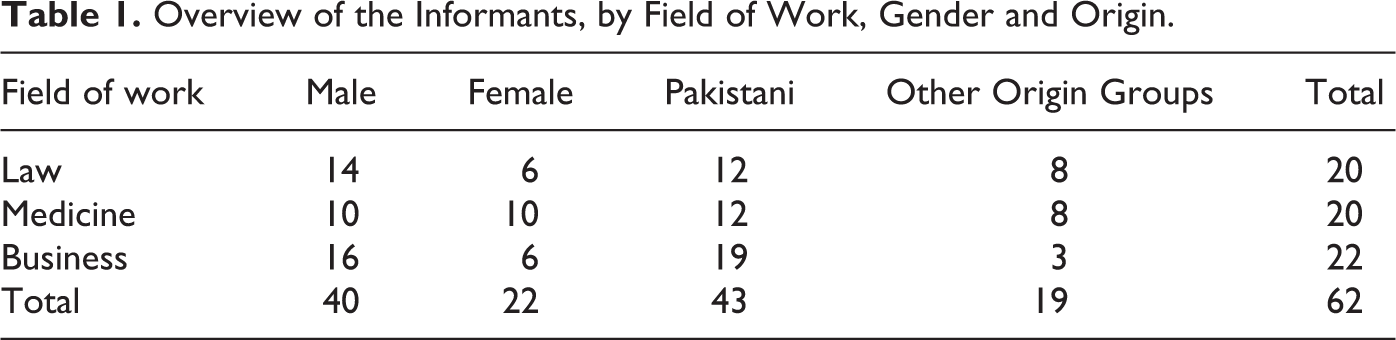
Reflecting the second generation’s demographic composition in Norway, where children of Pakistani immigrants constitute the largest group, the majority of informants originated from Pakistan. Most were born in Norway (N = 46), and are, thus, “true” second-generation individuals, while the rest are of the so-called 1.5 generation, as they either immigrated before school age (N = 11) or came to Norway between the age of 8 and 13 (N = 5). In total, we interviewed 40 men and 22 women. Men in the sample were older (mean = 32 years) than women (mean = 27.6 years), and while only two women had children, nearly half the men were fathers. Most informants lived in Oslo, Norway’s capital city, but our sample includes individuals living in other parts of the country as well. Table 1 gives an overview of informants, separated by field of work, gender, and ethnic origin.
Overview of the Informants, by Field of Work, Gender and Origin.
Several channels were used to recruit informants. We relied on snowball sampling, using our extended networks and recruiting informants to identify individuals who met our sampling criteria. We also went through student organizations and professional networks in Oslo aimed specifically at young individuals of immigrant origin. Lastly, we identified potential informants by searching on company websites and LinkedIn Premium, a social medium where professionals present their resumes and qualifications.
Interviews were conducted face-to-face, with the exception of a few interviews conducted by telephone. Most interviews took place at respondents’ workplaces or quiet cafés, while a few were conducted at our research institute. Face-to-face interviews lasted between one and one and a half hours, while telephone interviews were slightly shorter. All interviews were conducted in Norwegian and transcribed verbatim. Quotes used in the article are translated into English by the authors.
Interviews mapped informants’ individual life trajectories from childhood/adolescence through the educational system and into their current positions in the labor market. We also asked detailed questions about their family situation and reflections around achieving a work-family balance. In the analysis, we tracked informants’ educational and work choices, the context for these choices, and the resources available to them in their educational and work trajectories. In sum, the interview material is well suited to explore the strategies and adaptations developed by high-aspiring children of immigrants to achieve social mobility and how their “purposive actions” were shaped by the institutional opportunity structures in which they were embedded. Contrasted with research on second-generation strategies to achieve upward social mobility in the United States and elsewhere (e.g., Noam 2014; Alba and Foner 2015; Lee and Zhou 2015), our analysis provides a valuable starting point for developing a comparative dimension to neo-assimilation theory.
Navigating to the Top
Second-generation professionals in our study grew up in families who were ambitious and mobile enough to migrate, often with strong aspirations of upward social mobility for their children (Rytter 2013; Schneider, Crul, and Van Praag 2014). The definition of achievement and success that they encountered, what Lee and Zhou (2015) refer to as the “success frame,” defined success as completing higher education, preferably in medicine.
However, in contrast to the success frame described by Lee and Zhou (2015), which defined not only an ambitious outcome (an advanced degree from an elite university) but also the specific route to that outcome through clear expectations of achieving top grades throughout the educational trajectory, second-generation professionals in our study did not encounter specific expectations providing routes to achieving their high ambitions. Furthermore, as children of low-skilled labor migrants, informants did not appear to have had access to the type of ethnic capital described by Lee and Zhou (2015) to help them realize their ambitions of success. In addition to low economic capital, their parents had few resources to supervise or help with schoolwork. While common ideals in ethnic communities appear to have reinforced the expectations of becoming doctors or lawyers, we found few traces of specific collective resources that aided informants in their education achievements, such as private tutoring or the transfer of relevant and reliable knowledge about how to navigate Norway’s educational system.
Thus, the main picture in our study is of second-generation professionals having reached “the top” despite, not because, of their families’ resources. To understand what enabled this steep social climb, we examine what key challenges the second generation faced in reaching their ambitions, how they navigated these challenges, and how features of the Norwegian welfare state provided institutional opportunity structures for social mobility.
Access and Choice: Going to “Bad” Schools
The majority of informants grew up in the capital city of Oslo. As they predominantly grew up in low-income families, they typically lived in less affluent and more immigrant-dense neighborhoods, where they enrolled in the local school. Thus, as is often the case for children of immigrants (Reisel, Hermansen, and Kindt 2019), they started their educational trajectory without ready access to “good schools.” However, while parents’ economic resources and the residential neighborhood determined access to schools at a lower level, at the upper secondary level, informants could apply to any school within the city and compete for admission based on their grades. 2 Still, only about one fourth of second-generation professionals in our sample attended what were considered high-status upper secondary schools.
Those who did attend such “good” upper secondary schools highlighted the advantages of doing so. For instance, one female doctor explained how attending one of the top upper secondary schools had been decisive for her: I came from [an immigrant-dense neighborhood] and wanted a change of scenery. So I applied to a school in the city center and got a lot of bright pupils around me. I think that’s important, because it gives you the motivation to reach a bit further.
A few informants attended private upper secondary schools, which are rare in Norway (Ahola et al. 2014; Reisel, Hermansen, and Kindt 2019). Those who did, noted that this choice was made by their parents, who saw private schools as a better option than public schools. Sending children to private schools can be seen as an attempt by immigrants at a strategic adaptation. A female doctor explained that she was accepted to one of Norway’s top upper secondary schools, but at the last minute, her father was advised by family members that she should enroll in a private school. Although she did not regret attending the private school, in hindsight, she saw that this choice was not necessarily very strategic in a Norwegian context, where the most competitive public schools have the highest status (Ahola et al. 2014): In Pakistan, private schools are elite schools, but it’s not like that in Norway. For me [the public school to which she was originally admitted] is an elite school, it was a school that ranked high…But [after graduating] when I talked to friends who didn’t go to my private school, they said: “Well, you just bought your good grades.”
For the most part, informants appear to have applied to local upper secondary schools out of convenience, and the school choices generally did not appear as strategic. Informants prioritized proximity and easy travel distance over attending high-status schools, which were typically a commute away in the city center. Still, some informants portrayed applying to the local school, with low entry requirements, as a strategic choice. A business professional noted that his grades were good enough to be admitted to the top schools but explained why he preferred to attend the local school: “I’m a little strategic…If you’re good at school and choose a school at a lower level, it’s easier to get good grades because the teachers adjust to the general level of the school.” In similar fashion, as a lawyer explained in hindsight, “the worse the school, the easier it is to get good grades.”
The fact that the majority of second-generation professionals in our study opted for the local upper secondary school, despite having the option of applying to schools with higher status and quality, might reflect a lack of access to information among the second generation and their parents. Apart from knowing about the most prestigious schools, informants did not have much knowledge about the status and quality differences between Oslo schools. To the extent that they received advice about upper secondary schools from family or members of the ethnic community, they often described the information as inaccurate or unhelpful, as in the case of the doctor who went to private school. In sum, then, informants appear to have had little access to cultural knowledge about the implications of different school choices.
Importantly, however, not attending a good school was not that consequential in an educational context where actual quality differences between schools were not substantial and where admission to higher education was solely based on grades. As mentioned, Norway’s educational system is characterized by a high level of standardization, in the sense that the quality of education is generally the same across schools. Of course, there are differences between schools in terms of status, grade averages on national tests, and expected learning outcomes (Reisel, Hermansen, and Kindt 2019). However, variation among schools in Norway’s centralized system is small compared to, for instance, the decentralized system in the United States, which allows for large disparities among schools because school funding is tied to local property tax and, thus, to community wealth (Alba and Foner 2015, 173). Furthermore, the disadvantage of having attended “bad” schools in immigrant-dense areas does not appear as a strong barrier against educational success in Norway, as a recent study has suggested (Hermansen and Birkelund 2015). As entry into higher education is based simply on grades, it becomes irrelevant from which school students graduate.
These characteristics of the Norwegian educational context ensured that informants were not punished for choosing local schools. Pupils and parents did not depend on cultural knowledge about how to navigate educational institutions in the same way as in, for instance, a US context (e.g., Lareau 2015), and they were not required to make strategic school choices to succeed. The lack of strategic considerations in school choices echoes Noam’s (2014) findings that second-generation Chinese parents invested less and were less strategic regarding their children’s education in the Netherlands, where their children’s educational prospects did not depend on parental investments, compared to the United States, where heavy parental investment in education, including strategic choice of residential neighborhood, was decisive for children’s outcomes.
Although the seeming lack of strategic school choices might reflect a lack of knowledge of the Norwegian educational system and economic resources to move to “better” neighborhoods, it can also be understood as purposive action, as described by Alba and Nee (2003). The emphasis on convenience over attending high-status schools reflects informants’ and their parents’ perceptions of their self-interest, given the risks and opportunities in the institutional environment, even though these perceptions might be based on incomplete information (Alba and Nee 2003, 37). In other words, the families satisfice (Simon 1956) and opt for what they see as a “good enough” option to achieve their ambitions.
Power and Possibilities in Late-tracking Systems
At the same time as a high level of standardization makes the choice of school less consequential in Norway, Norway’s relatively late tracking gives wide opportunities to choose the tracks most relevant to pupils’ educational and occupational ambitions. A large body of work has documented that early-tracking systems tend to channel immigrant-origin youth into vocational tracks, often barring them from pursuing higher education (e.g., Crul and Schneider 2010; Heath and Brinbaum 2014; Alba and Foner 2015). In particular, tracking at an early age leaves little time for second-generation youth to catch up with their native-majority peers in terms of language skills or to compensate for fewer family resources (Crul and Schneider 2010). Late-tracking systems like the Norwegian one, by contrast, give individuals more time to develop and define their own aspirations and more time to accumulate the resources necessary to pursue these ambitions (Crul and Schneider 2010; Alba and Foner 2015).
Previous research on second-generation educational pathways has pointed to the powerful role of school advisors in early-tracking systems, where little room is left for parents to influence their children’s educational trajectory and more room is given to stereotyped presumptions about immigrant-origin youth’s abilities and prospects (e.g., Çelik 2015). Even in our highly selected sample of second-generation professionals with high-status educations, one third of informants had stories about being explicitly advised to lower their ambitions and pursue a vocational track, which would not qualify them for higher education. One male doctor, for example, described how he was advised against pursuing higher education: The advisor said I shouldn’t take higher education at all, that I should aim for vocational subjects, even though I had the best grades in school. At that time, I had decided that I would become a doctor. When I told the advisor what I wanted to do, that was the response I got. I was so provoked. I just couldn’t understand why.
Such experiences are not unique among informants, and this finding aligns with previous studies suggesting that ethno-racial stereotypes about the abilities of children of labor immigrants mean that they are often met with low expectations by teachers and school administration (e.g., Çelik 2015). At the same time, given that we studied second-generation professionals with high-status educations, such stereotypical advice was clearly not decisive for their outcomes. Importantly, informants tended to describe the experiences of encountering low and stereotypical expectations as an exception, often coming from school counselors who did not know them very well, rather than as systematic experiences of being underestimated at school.
Although we have argued that informants’ parents did not chart a specific route to a high-status education, parents required at least that their children qualify for higher education and attend an academic track. This clearly articulated final destination (accomplished education at the university level, preferably in medicine) functioned as a resource that helped second-generation informants and their parents navigate the advice they were given, despite having little knowledge about opportunities and barriers in the Norwegian educational system. Furthermore, the fact that these individuals were able to pursue their ambitions is likely testament to an important feature of late-tracking systems: Our findings suggest that at age 16, pupils have often reached a level of maturity and confidence in their abilities, in addition to having developed clear ambitions for the future, enabling them to make educational decisions despite biased advice from teachers and counselors.
Wrong Choices and Low Performance in an Open Educational System
In addition to when tracking occurs, educational systems vary according to their rigidity — that is, the degree to which students can change tracks at a later stage (Alba and Foner 2015, 174). The Norwegian educational system is relatively open and offers a variety of “second chances,” ensuring that individuals are not locked in by earlier educational decisions and keeping the option of pursuing a desired education open (Orr and Hovdhaugen 2014).
Such second-chance options were decisive for many second-generation professionals in our study. Although they completed high-status educations, their pathways to their current positions were often not straightforward. While some informants described themselves as ambitious, high performing, and goal oriented from the beginning, others did not care much for schoolwork and lacked concrete ambitions but pulled themselves together at some point along the way. Some did so in time to improve their grades and graduate upper secondary school with a diploma that ensured entry into the educational track they desired. Others depended on second-chance options to qualify for admission to higher education.
The most striking second-chance stories in our study involved young men who had been involved with criminality and incarcerated before using second-chance options to qualify for admission to a high-status education. One of these men, a lawyer, dropped out of upper secondary school and was eventually arrested. After being released, he decided to get his upper secondary diploma and took the subjects he was missing at a private school. He explained what made him turn to a new path: For me it was basically family. Because when you’re out and young, and only have other youngsters around you who don’t see the importance of certain things, or at least don’t think too many years ahead, it’s really easy to just go along with it. So it was without doubt because of family that I kind of had that pressure on me, that I should take higher education and complete a degree and so on.
Although such dramatic stories of changing pathways are the exception, one third of informants used some sort of second-chance option to achieve their educational credentials. One important second-chance mechanism in the Norwegian educational system is the possibility to (re)take subjects at an upper secondary level at private schools after graduating. This second-chance option allows pupils to take subjects they lack in order to get their upper secondary degree or to improve their grades in subjects they had already taken (Orr and Hovdhaugen 2014). This possibility was crucial for a substantial share of informants, enabling them to compensate for previous low educational performances.
In addition, several informants had taken alternative routes to accomplish a high-status education because they lacked the grades to enter the “standard” route. Such alternative routes included enrolling in private law schools (with low entry requirements) before transferring to a public university, which are the only institutions that can offer law degrees (Strømme and Hansen 2017), or studying medicine at universities in Eastern Europe, which offer medical degrees that are accepted in Norway without the same competitive acceptance criteria. A recent study found that while around one third of the native majority medical doctors in Norway obtained their degree abroad, more than 70 percent of second-generation medical doctors in the country received their degrees from universities abroad, mainly in Eastern Europe (Cools and Schøne 2019). 3
Although many students, irrespective of ethnic background, use these second-chance options, in particular to qualify for extremely competitive medical schools, they may be especially important for the second generation. While second-generation professionals in our study encountered high expectations from their parents, they predominantly grew up in families and ethnic communities lacking key resources to support school achievement. With few family or collective resources, informants were at a disadvantage when it came to school achievement, as is also reflected in research identifying poorer school performance among children of immigrants (Reisel, Hermansen, and Kindt 2019). Thus, second-chance mechanisms in the educational system were important for improving informants’ chances of success, providing them opportunities to meet high admission requirements or obtain a high-status degree through alternative pathways, despite previous poor school performance.
Low-income Families and High-status Education
Even if second-generation students are qualified for admission, embarking on a high-status education, in many national contexts, can be a great financial challenge for the children of low-income immigrants (Alba and Foner 2015). In the United States, for example, elite education requires the means to attend private and extremely costly universities (Hirschman 2016). By contrast, public universities in Norway are free of charge, more competitive, and higher ranked than most private alternatives (Reisel, Hermansen, and Kindt 2019). Still, investing in an education requires the means to tolerate many years of postponed income.
The second-generation professionals in our study mostly grew up in families with limited financial resources, yet to the extent that they described financial challenges in completing higher education, they were limited to (ambitions of) studying abroad at institutions with high admission fees. None of the informants described financial challenges in completing a higher education in Norway. The lack of financial concerns among informants in our study stands in stark contrast to research from the United States, where access to high-status education, among both children of immigrants and all students, depends heavily on parents’ savings (Hirschman 2016).
Although informants’ parents had limited economic resources, such resources were among the few that the parents could contribute. Interviews suggested that parents went a long way to prioritize supporting their children’s education financially with the means that they had. State-funded student loans are widely used among native majority students in Norway (Statistics Norway 2018), but most informants did not rely on student loans and, instead, relied on their parents for financial contributions. Many informants noted that their parents had an explicit wish to support their education economically in any way possible, for instance, by offering to pay for private tutoring or private schools. However, there is little tradition of private tutoring in Norway, and, as already mentioned, public schools and universities, which are free of charge, are generally considered as equal to or better than private alternatives. Thus, the main function of parental financial support was that it allowed second-generation professionals to concentrate on their studies and sheltered them from having to work on the side.
While financial resources might be less decisive for educational success in a Norwegian context than elsewhere, the fact that participants’ parents were able to accumulate the economic resources to offer financial support for their children’s education should be seen in relation to some central characteristics of the Norwegian institutional context. Low-skilled work in Norway is relatively well paid, and the generous welfare state provides an economic safety net that ensures a minimum of economic resources (Brochmann and Hagelund 2012). Together with the system of free higher education, the economic safety offered by the Norwegian welfare state can be vital in enabling the second generation to pursue their educational ambitions (Hermansen 2017).
At Work in a Women-friendly Welfare State
Both women and men in our study described encountering similar educational ambitions and expectations from their families, and we did not find any clear gender differences in the support they received. Further, women and men appeared equally ambitious regarding education and career, and there were no systematic gender differences in their career pathways thus far. This lack of gender differences is worth noting, as the second-generation professionals largely grew up in families with gender complementary roles, where their fathers were responsible for the family’s economic provision while their mothers’ role and responsibility lay primarily in the family. Research, for instance from the UK, identifies such gender complementary roles as an important barrier for second-generation women’s ambitions and work careers (e.g., Dale, Lindley, and Dex 2006).
Of course, as very few women in our study had children, they had not (yet) had to negotiate the potential conflict between work and childcare responsibilities. Still, complementary gender norms did not appear to pose a substantial barrier for second-generation women in our study. In unison, they insisted that they would continue to pursue careers even if/when they became mothers. Furthermore, they held that their parents largely supported their work devotion and did not expect them to withdraw from waged work when they became mothers. For instance, one female lawyer of Pakistani origin articulated clear views and ambitions for her future family life: It’s very important for me not to only identify as a mother. I’m not. I’m primarily me, and I’m a lawyer, in parallel with being a mother and a spouse, and one is no more important than the other. I think it’s a step backwards if you’re suddenly supposed to only be home with the kids while the man is at work. Why can’t he be at home with the kids and then I can go to work?
Equally important, most male informants supported the idea of working mothers. One second-generation man, a business professional, described how he saw a cultural change regarding gender relations: In Pakistan, many women do not work. Here, it’s different; it’s a cultural difference. And of course, when both husband and wife work, it’s hard to take care of the children, the only choice you have is to send them to kindergarten. But it’s really healthy for the kids. Children learn language there, and they make friends. They have different activities.
The quote illustrates how both the cultural and institutional context in Norway — which stands out in international comparison for its strong support for women and mothers’ employment (Aboim 2010) — enabled second-generation women’s dedication to work. The Norwegian cultural context provides a near hegemonic understanding that women should work and that public childcare is good for children. At the same time, the Norwegian welfare state offers strong institutional support for women to combine motherhood and paid work, providing affordable and good quality childcare services and a generous parental leave (Leira 2002). That national institutional and cultural contexts contribute to second-generation females’ employment is underscored by one of the few comparative studies of labor market participation among second-generation mothers. Comparing employment rates among second-generation Turkish mothers in Sweden, Germany, France, and the Netherlands, Holland and de Valk (2017) show that labor market participation is by far highest in Sweden — a welfare state which shares with Norway a strong cultural and institutional support for mothers’ employment.
In line with Nadim’s (2014) study of second-generation women’s labor market attachments in Norway, our findings suggest that the clear break with the parent generation’s gender complementary norms and practices did not appear as a break with their families. Although the family ambitions and encouragement to pursue higher education might not have come with an intention to challenge gender complementary ideals, the strong commitment to work might simply be an “unintended consequence” of a shared mobility project (Alba and Nee 2003, 41). Thus, second-generation women’s educational and work achievements in Norway can represent a shared adaptation to a new context of opportunity, which culturally and institutionally facilitates women’s participation in paid work.
Discussion of Key Findings
This article has shown how high-aspiring children of low-income migrants in Norway made use of a series of institutional opportunity structures for social mobility in their pathways to high-status positions in the labor market, analyzing stories of social mobility “against the odds.” While second-generation individuals in our study grew up in families with high expectations and ambitions on their behalf, they had few resources, in terms of human, economic, or cultural capital, to support them in achieving these ambitions.
The high educational expectations the second-generation professionals encountered — where achievement was defined as a high-status education — were important in defining their motivations and perceptions of self-interest, which, in Alba and Nee’s terminology (2003), gave direction to their purposive actions. At the same time, the actions taken to accomplish their ambitions were shaped by the perceptions of opportunity and constraint in the institutional context and the resources available to them. Further, the possibilities of actually achieving the criteria of success depended on the institutional opportunity structures that facilitate the social mobility of individuals with limited resources, suggesting that the micro-level actions and orientations of second-generation individuals and their parents must be analyzed in the macro-level setting in which these actions and orientations are embedded.
For the majority of second-generation informants in our study, the schools they attended appear to have reflected poor resources, uninformed choices, and convenience, rather than strategic navigation — a finding that stands in stark contrast to the orchestrated collective efforts in boosting second-generation Asian Americans’ educational achievements in the United States (Lee and Zhou 2015). Growing up in low-income families, informants typically lived in immigrant-dense areas without ready access to “good” schools. When they could apply to schools freely, in entering upper secondary school, convenience, not the quality or status of the schools, drove their choices. This behavior might reflect a lack of relevant resources, such as access to information about different schools, a lack of strategic reflection about the implications of different school choices, or a lack of economic resources to move to a neighborhood with better local schools. However, in a Norwegian context, with relatively high and even quality across schools and a system of entry into higher education solely based on grades, school choices are not that consequential. In a context that does not require strategic adaptations to succeed in education, the emphasis on convenience and an easy commute might reflect purposive action in the sense of satisficing (i.e., choosing what one considers good enough; Simon 1956), even though the perceptions of self-interest might be based on incomplete information (Alba and Nee 2003, 37; Noam 2014).
In spite of having limited knowledge about how to navigate the Norwegian school system, informants and their parents had enough knowledge about the basic requirements for entering higher education to enable them to defy biased advice from counselors and to stay on track. At the same time, the Norwegian educational system’s late tracking gave informants and their parents time to develop the ambitions, skills, and confidence to ignore stereotypical advice, in contrast to the German system, where tracking occurs early and the second-generation tends to be channeled into vocational tracks (Crul, Schneider, and Lelie 2012).
Somewhat surprisingly, a substantial share of our high-achieving informants were not particularly ambitious and did not perform well in school, although they had a vague ambition of pursuing higher education. In addition to having few family resources to support educational performance, informants also lacked family expectations that made the path to success tangible, for instance, by emphasizing school achievement and hard work throughout the school trajectory, as seen in the Asian-American success frame described by Lee and Zhou (2015). Still, the somewhat vague family expectations informants did encounter appear to have given direction and to push low-performing informants “on track” at a later point. Equally important, the Norwegian educational system’s range of second-chance options provided informants a chance to qualify for a high-status education when they were more mature and in a better position to make informed choices.
Although parents’ economic resources were limited, they could often offer financial support to the second-generation professionals we studied to aid their educational achievements, and accumulating economic capital to do so appeared as a key family strategy. The egalitarian and redistributive Norwegian welfare state further enabled parents to accumulate some economic capital, despite being in low-income jobs. Parents’ financial support allowed informants to concentrate on their studies, but in a context where (free) public universities generally have the highest status and quality, economic resources might not be the most decisive to ensure educational success. Still, parents’ strategy of accumulating economic capital can be seen as an example of purposive action, guided by a motivation to support their children in achieving success and shaped by cultural beliefs and available resources (Alba and Nee 2003).
Moreover, although informants largely grew up in families with gender-traditional norms and practices, we did not find systematic gender differences in family expectations or support. Furthermore, women in the study challenged gender complementary roles and expressed clear expectations that they would combine motherhood with a career in the future. Second-generation women, thus, appeared to embrace Norway’s cultural norm of gender equality and dual-earner families, a finding in line with recent survey research on second-generation gender attitudes in Norway (Kitterød and Nadim 2020).
Our findings show how the Norwegian context facilitated second-generation women’s dedication to work both culturally, by providing strong norms of gender equality, women’s employment, and public childcare as good for children, and institutionally, through work-family policies supporting dual-earner families. The significance of the national context for second-generation women’s employment is also demonstrated by comparative research which documents that second-generation women’s employment rates are far higher in national contexts supportive of women’s and mothers’ employment, such as Sweden, than in other European countries (Soehl, Fibbi, and Vera-Larrucea 2012; Holland and de Valk 2017). Still, the cultural and institutional context for gender equality and women’s employment represents a central, but under-researched, factor in shaping second-generation women’s pathways. Furthermore, in a context that gives women opportunities largely on par with men, immigrant families from gender traditional contexts can extend their ambitions to daughters, as well as sons, as a shared adaptation to a new context of opportunity.
Conclusion: Toward a Comparative Theory of Neo-assimilation?
Comparative research on the second generation in Europe and the United States has demonstrated the significance of institutional opportunity structures in determining socio-economic outcomes for children of immigrants (Heath and Cheung 2007; Crul and Schneider 2010; Crul, Schneider, and Lelie 2012; Alba and Holdaway 2013; Heath and Brinbaum 2014; Alba and Foner 2015). Within this work, special explanatory value has been given to the structure of primary and secondary systems of education, which stand out as crucial institutional features shaping second-generation educational attainments (Crul, Schneider, and Lelie 2012). However, an institutional approach to the study of second-generation educational attainments must employ both a broader perspective, linking the purposive actions of immigrants and their children to a wider set of institutional mechanisms, and a deeper perspective, examining how the second generation’s strategies and actions on the ground are shaped by the institutional context in which they are embedded.
Second-generation professionals in our study mainly reached success despite, not because, of their families’ resources, and their pathways to the top were not characterized by strategic navigation. Both of these findings stand in contrast to research on second-generation educational achievements in the United States (e.g., Lee and Zhou 2015) and can reflect two interrelated points of significance to our understanding of how micro-level actions are embedded in macro-level structures. First, the Norwegian context provides opportunity structures that effectively compensate for low levels of family and community resources, allowing high-aspiring children of immigrants to succeed in education and work despite lacking economic resources and know-how about how to optimally navigate the educational system. Second, in such a context, there is less need for explicit strategic adaptation. Indeed, the action and choices of the second-generation professionals examined in this study can be understood as forms of bounded rationality, in that their perceptions of self-interest and the means to reach their goals were shaped by the specific institutional context of opportunity.
Overall, then, our findings are in line with key assumptions in the classical account of neo-assimilation (Alba and Nee 2003), insofar as the strategies and adaptations developed by second-generation individuals to achieve social mobility are deeply embedded in the institutional structures and cultural beliefs of society. Despite the merits of this account, Alba and Nee (2003) focused exclusively on the particularities of the US experience, leaving the field with few specifications of how a neo-assimilationist framework for studies of second-generation incorporation could be applied in other contexts or in comparative perspective.
In our view, a neo-classical assimilation framework for comparative studies of second-generation incorporation must broaden the perspective of institutional determinants of social mobility. This broadening includes taking into account the entire educational trajectory, from primary education to the costs of and hierarchies in systems of higher education, as well as examining the roles of welfare policies and the gender equality context, which the comparative literature on welfare regimes has shown to be crucial in shaping opportunities and action (e.g., Esping-Andersen 1999; Leira 2002). Especially for children of labor immigrants, who often grow up with relatively few resources and in families with homemaker mothers, institutional opportunities for accumulating economic capital, overcoming barriers to invest in higher education, and cultural norms of and institutional support for women’s employment seem clearly beneficial for their pathways to upward social mobility.
While neo-classical assimilation theory provides a useful starting point for assessing cross-national differences in the educational attainments and work trajectories of children of immigrants in Europe and North America, more detailed accounts of institutional variation are needed to better understand the strategies and adaptations that the second generation develops to achieve social mobility. We agree with the original proposition of neo-classical assimilation (Alba & Nee 2003) that children of immigrants are likely to invest in education and aim at securing jobs in the mainstream labor market if the opportunities there appear extensive. Yet concrete strategies on how to achieve upward social mobility (e.g., whether children of immigrants must depend on social networks and various forms of capital available in ethnic communities or rather can benefit from resources provided by the state) are shaped by the specific institutional opportunity structure of society. To fully understand such crucial micro/macro links, there is a need for comparative research that carefully examines how the strategies and orientations of immigrants and their children vary across national contexts.
Footnotes
Acknowledgment
Previous versions of this article have been presented at the 2017 annual IMISCOE conference and the 2019 annual meeting of the American Sociological Association. We thank participants at these two conferences, as well as the three reviewers and the journal’s editor, Jamie Winders, for valuable comments and suggestions.
Declaration of Conflicting Interests
The author(s) declared no potential conflicts of interest with respect to the research, authorship, and/or publication of this article.
Funding
The author(s) disclosed receipt of the following financial support for the research, authorship, and/or publication of this article: This article is part of the research project Pathways to Integration: The Second Generation in Education and Work in Norway (PATHWAYS), funded by The Research Council of Norway (grant number 247724). The PATHWAYS project is linked to the comparative project ELITES: Pathways to Success, headed by Maurice Crul and funded by the European Research Council.
