




Abstract
Residential mobility patterns of immigrant and majority groups are key in understanding immigrants’ spatial integration. This article explores the spatial integration dynamics of immigrants from the Former Soviet Union in Tel-Aviv, Israel, as reflected in changing residential mobility behaviour. Unlike previous research, the article investigates the simultaneous effect of the relocations of both immigrants and majority members, with treatment of ethnic and socioeconomic dimensions of residential sorting considered simultaneously. Using a unique data set that spans the period 1997–2008, the analysis reveals a dynamic interplay of both groups’ mobility patterns. Their joint effect decreased residential sorting across both neighbourhood dimensions over time. Despite the decreasing magnitude, residential sorting processes remained active by the end of the research period, delaying the spatial integration of immigrants.
Introduction
Immigrant-receiving societies are concerned with the integration of immigrants who often experience persistent disadvantage and exclusion. Concerns have been raised in many contemporary cities where segregated ethnic neighbourhoods are common (e.g. Musterd, 2016). The formation of social networks with majority members is assumed to be critical in the integration process of immigrants (Hagan, 1998). Considering that vicinity and contact are key in the formation of those networks (Peach, 2010), the academic and political discourse continuously engages with the concept of spatial integration as a representation of physical proximity between minority and majority groups (Murdie and Ghosh, 2010; van Gent and Musterd, 2016). Therefore, there is also interest in residential mobility patterns that lead to immigrants’ spatial integration, or to the opposite pattern of segregation (e.g. Crowder et al., 2006; Kauppinen and van Ham, 2018; South et al., 2008).
This article focuses on immigrants from the Former Soviet Union (FSU) to the Tel-Aviv metropolitan area in Israel. It explores the dynamics of their spatial integration, as reflected in residential relocations through time. FSU immigrants that arrived in Israel during the 1990s formed the largest migration wave to Israel of approximately one million immigrants. As a repatriate migration, it differs in context from contemporary migrations in various aspects. For example, a shared heritage with members of the receiving society, immigrants’ high human capital (Eckstein and Weiss, 2002) and a privileged reception in terms of government absorption policies (Portes and Borocz, 1989). Despite the expectations of easy integration given these circumstances, first-generation FSU immigrants maintained strong transnational links with their places of origin and their acculturation process reflected challenges similar to any other migration (e.g. Remennick, 2002). The advantage in focusing on this immigration wave is the relatively confined period of arrival which enables us to treat it as one cohort. Thus, trends of spatial integration (or segregation) through mobility can be followed at an aggregate level to complement insights from a large body of individual-level research.
Residential mobility patterns which underlie the spatial integration or segregation of immigrants are shaped by various social and economic mechanisms. For example, acculturation and social mobility of immigrants are known to encourage their mobility away from immigrant clusters to places of higher socioeconomic status and larger numbers of majority group members (Massey and Denton, 1985). By the same token, slow acculturation and retention of a foreign cultural identity can be associated with mobility patterns that maintain high segregation levels. Segregation can be persistent because of discriminatory practices that impede the mobility of minorities into integrated settings (Logan and Molotch, 1987) or because of voluntary segregation of socially mobile immigrants (Logan et al., 2002). Spatial integration or segregation are not only dependent on the mobility behaviour of immigrants but also on that of majority members. Negative attitudes of majority members towards immigrants can translate into their flight from or avoidance of places with considerable minority representation (Frey, 1979).
Existent literature demonstrates the separate roles of immigrants and majority members’ residential mobility in producing segregation (e.g. Andersen, 2017; Bolt et al., 2008; South et al., 2005) but little has been done to show how simultaneous mobility flows of both groups shape sorting trends. Additionally, interrelations between socioeconomic and ethnic outcomes of relocations in that context have been overlooked, despite the implied trade-off between them in theory.
In the context of FSU immigrants in Israel, this article seeks to investigate sorting dynamics generated by simultaneous mobility of immigrants and natives, and by their moves across both the socioeconomic and ethnic continuums of the urban hierarchy. We address the following questions: which sorting trends are reflected in residential mobility patterns of FSU immigrants and native Israelis over time? How did distinctive mobility patterns of each group shape these trends? And finally, how do immigrants’ residential mobility patterns in relation to the ethnic dimension interact with patterns concerning the socioeconomic dimension? We address these questions by applying a socio-spatial mobility approach which focuses on outcomes of relocations in terms of neighbourhood ethnic and socioeconomic make-ups. The analysis is applied to a unique database on individuals’ residential relocations within the Tel-Aviv metropolitan area, during the period 1997–2008.
Background
FSU immigrants arrived in Israel in two waves; the first in the 1970s and the second, on which this article focuses, in the 1990s. This wave formed the largest influx of immigrants to Israel, during which approximately one million immigrants arrived. It was triggered by the opening of USSR borders as part of the Glasnost and Perestroika reforms, and hence associated with circumstances of political and economic distress. The largest inflow was in 1990 and 1991, amounting to approximately 30% of total migration, after which numbers fluctuated around 60,000 arrivals per year and significantly decreased after 2000. 1
FSU immigrants predominantly originated from central metropolitan areas such as Moscow, St Petersburg and Kiev, where they belonged to cultural and intellectual elites. The group was eager to preserve its cultural heritage and, on the other hand, to integrate with the local Israeli elite (Epstein and Kheimets, 2000). Its large size has enabled the foundation of cultural institutions, Russian-language media and community organisations to form a ‘cultural enclave’ (Epstein and Kheimets, 2000; Remennick, 2002). FSU immigrants soon formed a distinct ethnic group within Israel’s social and cultural fabric, as reflected in their closed social networks, ethnic information sources, desire to maintain ethnic-cultural continuity, and self-identification (Al-Haj, 2002).
Evidence from other countries suggests that ethnic social networks provide support and information during the adjustment process (Fong and Chan, 2010). The spatial clustering of an immigrant group in urban neighbourhoods nurtures those networks and fosters group cohesion (Peach, 2010). Any initial clustering further attracts more immigrants and consequently, clustering is likely to gradually increase and form an ethnic enclave – a residential area with a high concentration of minority-group members. The changing spatial distribution of FSU immigrants in the Tel-Aviv metropolitan area reflects such clustering. While in 1995 18.3% of the immigrant population lived in neighbourhoods with immigrant components above 25%, in 2008 42% of immigrants lived in such neighbourhoods. 2 In terms of location, immigrants preferred the Tel-Aviv metropolitan area, Israel’s central area. Within the metropolitan area, FSU immigrants have concentrated in cities at the spatial and social outskirts, such as Ashdod, Netanya, Lod, Bat-Yam and Ramla, which are within commuting distance to jobs and where housing prices are cheaper.
Spatial clustering of immigrants is considered an initial strategy to cope with the adjustment period. According to the ‘spatial assimilation’ model (Massey and Denton, 1985), over time, acculturation and social mobility of immigrants are translated into residential moves away from immigrant clusters to areas characterised by higher shares of majority members and higher socioeconomic status. In the case of FSU immigrants, prospects for social mobility were high given their high human capital. Immigrants were highly educated and held a high occupational status before emigrating (Eckstein and Weiss, 2002). After migration, however, the majority have not been able to retain that status and had to initially accept low-skilled jobs (Eckstein and Weiss, 2002; Raijman and Semyonov, 1998). Despite a gradual decrease in unemployment, immigrants’ incomes persistently lagged behind leading groups in Israeli society (Cohen and Haberfeld, 2007; Eckstein and Weiss, 2004). Therefore, the high human capital of this immigration has not been fully translated into economic resources. Prospects of acculturation and social mobility depend also on age at time of migration. Unlike migrant groups in most receiving countries, FSU immigrants were older than Israelis (median age of 36 compared with 30, respectively; CBS, 2004). Older immigrants may find it harder to learn the local language and to integrate in the job market. Together, income and age factors may discourage relocations that promote spatial integration.
Relocation patterns of immigrants have been influenced by governmental absorption policies, housing policies and planning initiatives. Generous benefits granted to Jewish immigrants that apply to the law of return have cushioned the distress associated with the initial adjustment period. These include living and housing allowances, language training programmes, benefits in buying cars and housing, and academic and vocational education. Owing to an envisaged housing crisis, the government intervened in the production of housing (Alterman, 1995; Lipshitz, 1997), including various supply programmes and the quick approval of large developments of over 200 units by newly established housing commissions (Alterman, 1995). Large tracts of public land were designated for construction of projects conforming to accelerated approval procedures, such that new supply was mainly in large, spatially concentrated developments. Although new housing developments were not restricted to immigrants, they have attracted large groups of immigrants who took advantage of housing-acquisition benefits.
Subsidised mortgages for immigrants, which were limited to five years after immigration, provided a strong incentive to buy and resulted in an increasing demand for housing and rising prices; ownership rates among FSU immigrants were high (Benchetrit and Czamanski, 2009). The rush to buy, despite the lack of resources shortly after immigration, has encouraged immigrants to buy low-priced housing (Benchetrit and Czamanski, 2009). As homeownership is known to lower the probability of moving (Clark and Dieleman, 1996), ownership among immigrants may have eventually ‘trapped’ immigrants in low-income immigrant neighbourhoods.
While the spatial assimilation model emphasises the role of economic resources in the relocation of immigrants into integrated advantageous neighbourhoods, the literature points to groups for whom the attainment of such neighbourhoods lags behind others, regardless of resources (Fong and Wilkes, 1999; South et al., 2005). Two alternative models explain this divergence. The ‘place stratification’ model (Logan and Molotch, 1987) emphasises discrimination as a central factor (with a distinction between ‘weak’ and ‘strong’ versions of the model, see Pais et al., 2012). It posits that the practices of market actors pose constraints on residential choices (Clark, 2017). In the context of FSU immigrants in Israel, there is no evidence of such practices. The alternative ‘ethnic community’ model (Logan et al., 2002) is more plausible in this context. It points to the preference of better-off immigrants for living among compatriots as a deterrent of spatial integration.
Spatial integration of immigrants does not only depend on their own residential moves but also on those of majority group members. Negative attitudes towards immigrants can translate into mobility of majority members out of neighbourhoods with a significant minority presence. This has been termed ‘white flight’ in a racial context (Crowder and South, 2008; Frey, 1979) but has also manifested with relation to immigrant segregation (Andersen, 2017; Bolt et al., 2008; Hall and Crowder, 2014; Kauppinen and van Ham, 2018; McAvay, 2018). Similarly, such attitudes can result in avoiding moves into neighbourhoods with high immigrant shares. Both moving behaviours might be relevant in the context of FSU immigrants. Despite the strong sentiments in Israel for receiving Jewish immigrants, the arrival of this diaspora has only been welcomed at a declarative level (Leshem, 1998). Immigrants experienced alienation and were disappointed by their identification as ‘Russians’ (Al-Haj, 2002). Rejection by the Israeli elite has contributed to the formation of the Israeli-Russian community as a separatist enclave (Epstein and Kheimets, 2000). Competition for low-skilled jobs and cheap housing fuelled hostility towards immigrants from the lower strata, a tension which turned ethnic as among these strata a large proportion originated from Africa and Asia (Leshem, 1998).
Altogether, the literature suggests four models of spatial integration which are not necessarily exclusive. Considering the contextual background, a combination of the models may be applicable. We lay several hypotheses regarding the temporal sorting dynamics of immigrants and natives, based on the theories and background: (1) we hypothesise that over time, immigrants’ relocations will reflect decreasing clustering, to some extent. Simultaneously, relocations should reflect a decreasing trend of sorting based on socioeconomic attributes, in accordance with the spatial assimilation model. We base this hypothesis on the assumption that favourable policies mitigated the barriers immigrants faced in translating human capital into economic resources. (2) Given the strong group identity, cultural capital and the large size of the group, we expect that income would not be fully translated into integrated settings, as location within the community should remain advantageous for group members. (3) As for the moving behaviour of majority members, we expect to see moves that reflect negative attitudes towards the ‘Russian’ community (‘flight’ and/or ‘avoidance’). We have no expectations regarding trends in those patterns. Public attitudes towards immigrants are dynamic; a growing prominence of the immigrant group might intensify negative attitudes but, on the other hand, those can weaken with the increasing socioeconomic status of immigrants and familiarisation with their culture.
Research approach
Residential separation between immigrants and natives is reflected in the divergence of their mobility patterns. The nature of this divergence and the factors associated with them are key in analysing spatial integration trajectories. Divergence in groups’ mobility patterns relates to two different neighbourhood attributes: majority/minority composition and socioeconomic status. The mobility patterns of both groups are expected to change over time and their changing divergence can intensify or weaken their spatial sorting. Although several studies pointed to the differences in mobility patterns of immigrants and natives (Andersen, 2017; Bolt et al., 2008; Lersch, 2013; McAvay, 2018), standard research approaches do not quantify the extent of this divergence and how it changes over time to produce trends in sorting.
This article explores sorting dynamics associated with changes in residential mobility patterns over time. The approach builds on a recently introduced methodological framework that defines divergence in mobility patterns between two groups as a measure of spatial sorting, which can be followed over time to expose trends (Modai-Snir and Plaut, 2018). Mobility patterns are represented by the ‘amount’ of change in neighbourhood attributes that is associated with each relocation, termed as ‘socio-spatial mobility’ (Clark and Morrison, 2012; Clark et al., 2014; Modai-Snir and Plaut, 2015, 2018). We focus on moves among neighbourhoods characterised by immigrant and socioeconomic make-ups which are represented by two variables: (1) the percentage of residents who are recent FSU immigrants and (2) the percentage of high-income residents (to be defined in the data section). In line with Modai-Snir and Plaut (2018), we define the ‘amount’ of change in neighbourhood attributes experienced by movers following relocation as the arithmetic difference between origin and destination neighbourhood attribute values (variables 1 and 2):

where

where
The extent of sorting reflected in mobility patterns of both groups is represented in terms of an inter-group ‘differential’, signifying the degree to which one group experiences change in neighbourhood make-up relative to the other group (Modai-Snir and Plaut, 2018). For example, with respect to neighbourhood immigrant shares, the extent to which immigrants gain a larger share of immigrants in their neighbourhood relative to the group of natives, indicates the increase in exposure to own-group members at the expense of exposure to natives. It is expressed by the difference in mean socio-spatial mobility of the two groups:

where
In the context of this article, we suggest an additional measure which accounts for the trade-off between two different dimensions of neighbourhood make-up (for a single sub-group): socioeconomic and majority/minority proportions. The rationale behind this measure is that spatial assimilation involves a move upwards in the socioeconomic hierarchy of neighbourhoods, combined with a move away from minority neighbourhoods. We term the measure an ‘inter-attribute differential’:

where
Data
The database used for this study includes yearly residential relocation records during the period 1997–2008, which represents approximately a decade following initial adjustment. Each record includes selected individual attributes and appended origin and destination neighbourhood characteristics. The database combines two different data sets. The first includes a 50% sample (stratified according to places of origin and random with respect to individual attributes) of all yearly individual moving records within the Tel-Aviv metropolitan area during the specified period. It was processed for this research by the Israeli Central Bureau of Statistics (CBS), based on the Israeli population registry (address changes are reported by movers as required by law). 3 The geographical extent of the metropolitan area is as defined by CBS for the 1995 census. Identification of origins and destinations is based on census tracts which are used as proxies for neighbourhoods. Movers’ attributes include earned income decile, 4 age group (0–18, 19–24, 25–34, 35–44, 45+) and a variable indicating membership of one of two subgroups: (1) FSU immigrants and (2) native-born Israelis. FSU immigrants are referred to as those born in one of the FSU countries and arrived in Israel from 1990 onwards. Native-born Israelis refer to those classified as Jews who were born in Israel. The Arab population is excluded from this analysis, as it is a distinctive minority which operates in a distinctive housing market. Relocations whose origins or destinations were institutions, including temporary caravan sites (which hosted immigrants temporarily) were excluded to ensure that we track relocations that reflect free-market choices. The total number of relocation records is 598,391, of which 184,711 are ascribed to immigrants.
The second data set includes census tract attributes which were processed based on census data available for the years 1995 and 2008 (CBS). Census tract divisions are defined by the CBS for localities with a population over 10,000. Sizes usually range between 3000 and 4000 residents. Localities with fewer than 10,000 inhabitants were considered single neighbourhoods. The study investigates residential mobility patterns regarding two different neighbourhood compositional attributes: (1) ‘neighbourhood percentage of FSU immigrants’, expresses the minority/majority composition; percentages were computed with respect to the total tract population; (2) ‘neighbourhood percentage of high-income residents’ expresses the socioeconomic composition. High-income residents were defined as comprising three top deciles based on national income distributions of each year, respectively; percentages were computed with respect to tract total earning population.
Attributes for inter-census years were linearly interpolated from census values to append origin and destination attributes that correspond to each respective year. Because some tract boundaries changed between the two censuses, we created consistent spatial units by merging tracts. The total number of tracts is 908, after excluding non-residential tracts, tracts with large shares of people living in institutions, temporary residential sites and a few tracts with missing data. For 30 new tracts which have been built between 1995 and 2008 and were missing 1995 attribute values, those were estimated based on data from other sources, if available, or based on 2008 values and predicted growth rates 5 of attribute values through the investigated period.
The examination of residential mobility patterns aims at tracking the gradual integration process at an aggregate level. Time since initial settlement of immigrants is not registered at the individual level, thus we treat the immigrant group as a single-arrival cohort. Because of the relatively bounded period in which FSU immigrants settled, variation in duration of stay is assumed to be rather small. While the increasing size of the immigrant group has caused an increasing availability of concentrated neighbourhoods during the research period, by the beginning of the research period around 70% of all FSU immigrants had already arrived in Israel. The analysis of residential mobility as an event occurring at a specific time-point eliminates the confusion between changing exposure to immigrants because of the group’s growth and changing exposure because of residential mobility.
Given the large sample size (50%) and the large number of observations, statistical significance tests are of no practical importance and are not presented.
Results
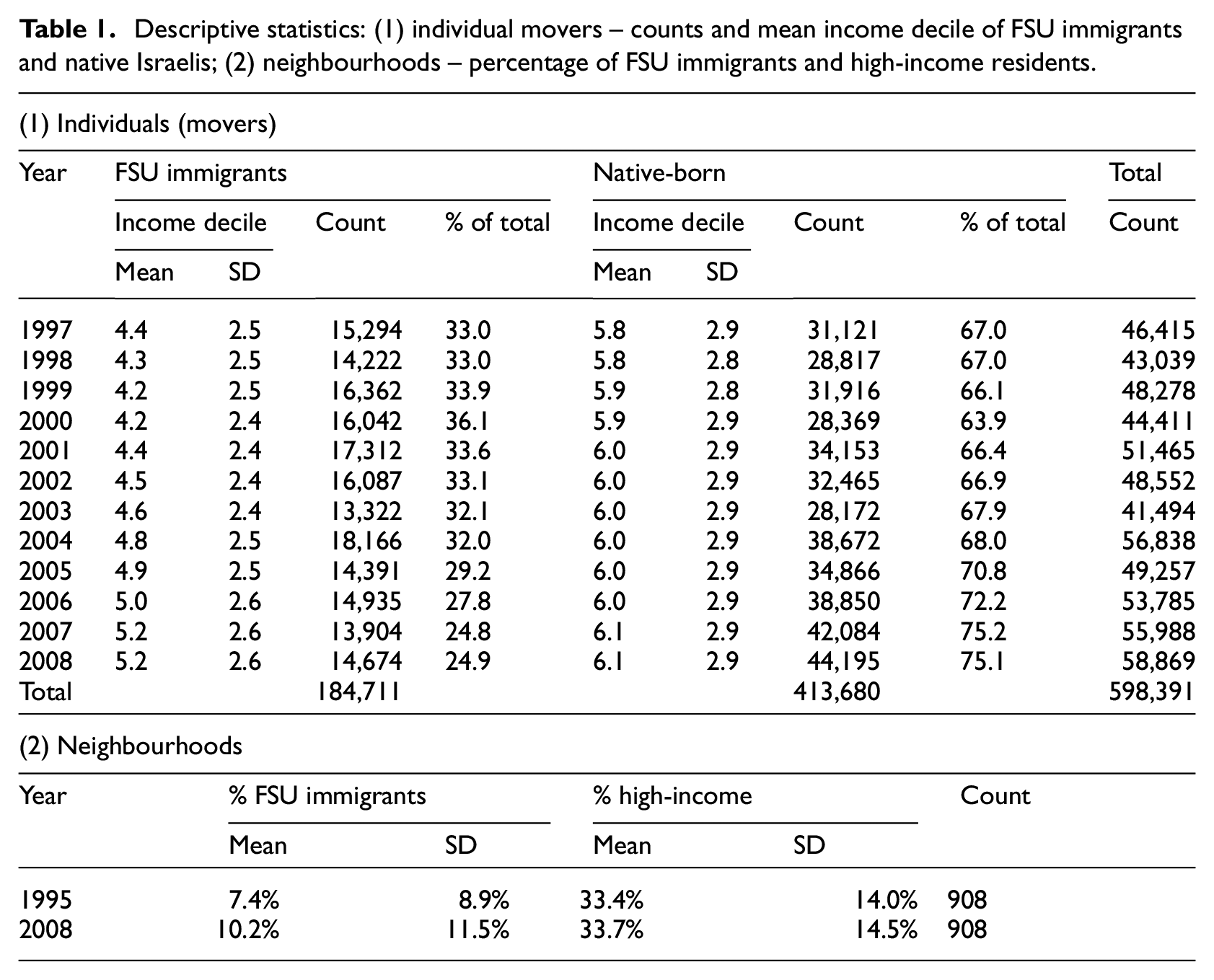
Statistics of movers reveal that FSU immigrants (hereafter ‘immigrants’) were extremely mobile. Immigrants accounted for 8.8% and 11.2% of the total metropolitan population in 1995 and 2008, respectively, but their relocation records accounted for 26% of the total mobility sample (including populations omitted from this study). The share of immigrants’ relocations has decreased over time relative to natives (Table 1), probably reflecting stabilisation following adjustment processes and increasing homeownership. Mean income deciles of immigrant movers are significantly lower than those of natives during the entire period. Mean income deciles of both groups gradually increased but those of immigrants increased at a higher rate. 6 Age distributions of immigrant and native movers also differ substantially; for example, the share of immigrant movers aged 25–34 years was 33.2% compared with around 48.7% among natives, and the share of those aged 45 years and up was 26.5% compared with 11.0% among natives. Mean neighbourhood immigrant shares increased from 7.4% in 1995 to 10.2% in 2008 (Table 1), probably reflecting the continuing flow of immigrants to Israel.
Descriptive statistics: (1) individual movers – counts and mean income decile of FSU immigrants and native Israelis; (2) neighbourhoods – percentage of FSU immigrants and high-income residents.
Mobility patterns of immigrants and natives
The first step in the analysis is to examine average socio-spatial mobility experienced by each group through the research period with respect to each neighbourhood variable: neighbourhood shares of immigrants and of high-income residents. Average socio-spatial mobility of immigrants with respect to neighbourhood immigrant shares (Figure 1, left panel) started at a value of nearly 3 pp in 1997. Relocations of immigrants at that point, were translated, on average, into increasing the exposure to own-group members. This value drastically declined during the first three years and then fluctuated around zero through 2008. 7 Mobility patterns until 2000, therefore, reflected a decreasing tendency of immigrants to concentrate, in line with Hypothesis 1. Values around zero imply that group’s aggregate moves have sustained a fixed level of exposure to own-group members (only negative values would have implied an aggregate tendency towards spatial integration). Regarding the socioeconomic dimension, immigrants’ mobility patterns show a starting point around zero, indicating that in 1997 immigrants’ relocations, on average, were not translated into better neighbourhood socioeconomic positions. However, from this point onwards, average values steadily increased until they stabilised at around 1 pp. 8 At the aggregate level, therefore, relocations have been progressively used to gain more advantageous socio-spatial positions. It should be noticed that in this analysis, neighbourhood outcomes with respect to the two neighbourhood attributes are not linked. While overall immigrants seem to have gradually moved into more integrated and higher-status neighbourhoods, we cannot infer that individual immigrants chose destinations that reflect both changes simultaneously, as suggested by spatial assimilation theory. This link will be addressed later. Attention should be given to ceiling and floor effects concerning immigrants’ relocations. Where people originate in the neighbourhood hierarchy strongly affects their ability to move up or down the hierarchy. For example, immigrants who leave the poorest neighbourhoods are more likely to move upwards, simply because moving down the hierarchy is impossible. The high share of immigrants originating from such neighbourhoods (around 15% in the lowest decile of neighbourhood socioeconomic status, throughout the research period, compared with 6–7% of natives), indicates that this structural constraint alone makes immigrants more prone to move upwards. The same constraint appears in relation to the other neighbourhood attribute. Throughout the research period, more than 30% of immigrant movers originated from the most concentrated neighbourhoods (with more than 30% FSU immigrants). Those movers were the most likely of all immigrants to relocate to less concentrated neighbourhoods.
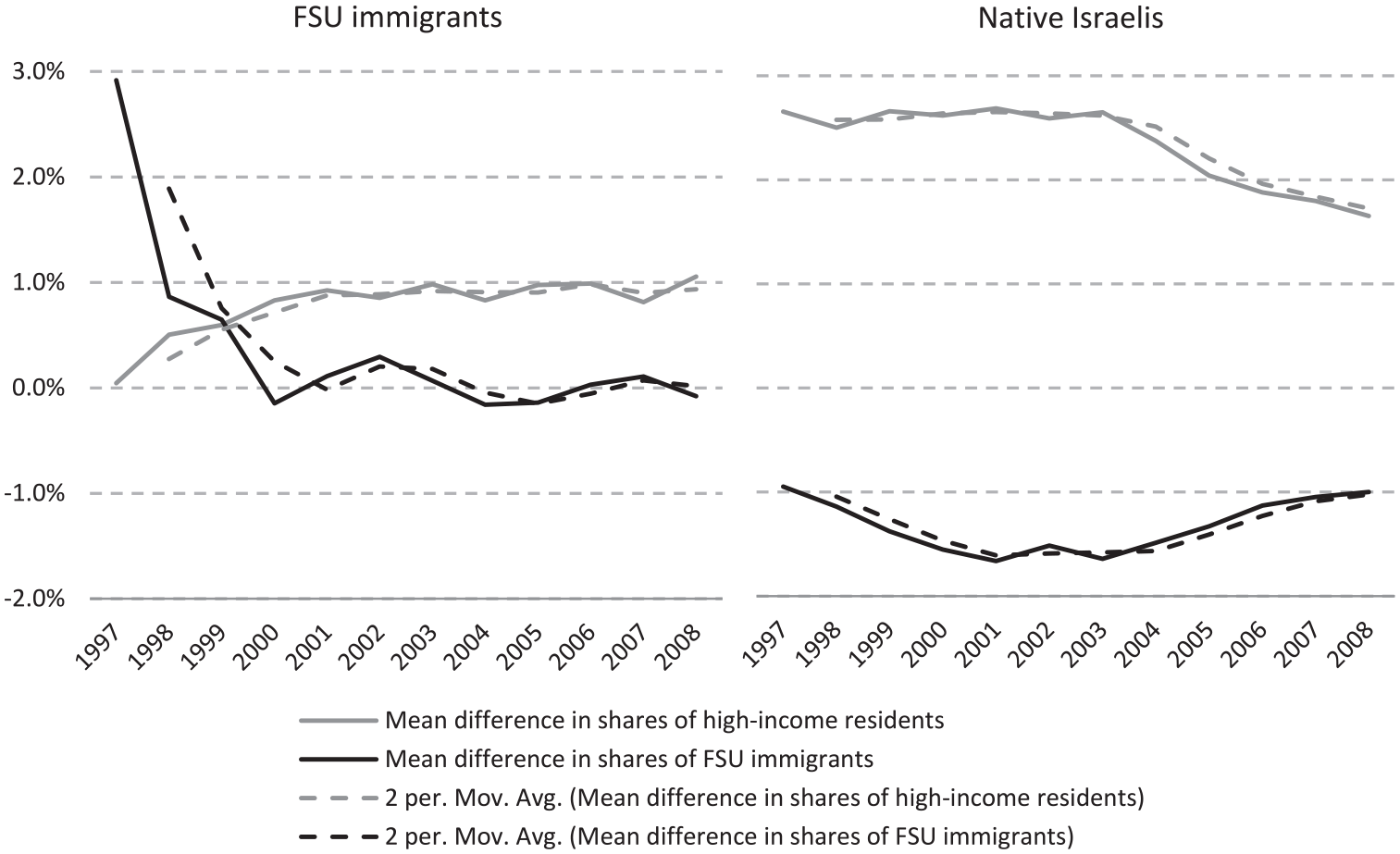
Mean socio-spatial mobility of immigrants and natives with respect to two different neighbourhood attributes: FSU immigrants’ shares and high-income residents’ shares (percentage points). Dashed lines represent two period moving averages.
Natives moved to neighbourhoods with lower shares of immigrants than their origin neighbourhoods throughout the research period (Figure 1, right panel). 9 This pattern most likely reflects negative attitudes towards immigrants, in line with Hypothesis 3. This tendency increased until 2001 and decreased from 2004 onwards. The U-curved pattern hints at a changing intensity of negative attitudes over time (strengthening and then weakening). To better understand trends in the moving behaviour of natives we analysed their flows to and from neighbourhoods in which more than 20% were immigrants. Natives’ flows out of those neighbourhoods gradually increased from a low count of 2345 to a high of 7000 in 2008, which implies increasing flight from immigrant concentrations. Natives’ flows into those neighbourhoods increased from 1993 in 1997 to 5590 in 2008, which indicates decreasing avoidance. It should be noted, however, that the number of neighbourhoods in which immigrant shares exceeded 20% significantly increased during the research period (from 65 to 169). Therefore, both trends may simply indicate the growing pool of high-concentration neighbourhoods.
Regarding the socioeconomic dimension, natives’ mobility was substantially higher than that of immigrants. 10 But while immigrants’ upward mobility remained stable during the later years, that of natives gradually declined from 2004. By the end of the period, average mobility of immigrants with respect to neighbourhood socioeconomic status was still significantly lower than that of natives. Mobility patterns of immigrants and natives indicate that both affected the sorting process. The combined effect of both groups’ mobility patterns on the socio-spatial integration of immigrants will be demonstrated using differential mobility measures.
The divergence in mobility patterns of immigrants and natives
Differential mobility measures quantify the divergence of the mobility patterns of immigrants and natives. They were computed by subtracting the average mobility of immigrants from that of natives with respect to each neighbourhood attribute (equation 3). Differential mobility diminished throughout the research period considering both sorting dimensions (Figure 2), indicating diminishing intensity of both sorting processes. Trend lines of both measures gradually approached zero over time but did not reach it, implying that both processes of socio-spatial differentiation were still ongoing in 2008. With respect to neighbourhood immigrant shares, we expected that compositional differences, in terms of age, had an effect on the diverging mobility behaviour of immigrants and natives. Therefore, we computed differentials for three different age groups (25–34, 35–44, 45+) and found that they were indeed higher for older movers. In 1997, for example, the differential was 4.8 pp for ages 45 and up, compared with 3.6 for ages 25–34. However, decreasing trends in differential mobility were evident across all age groups.
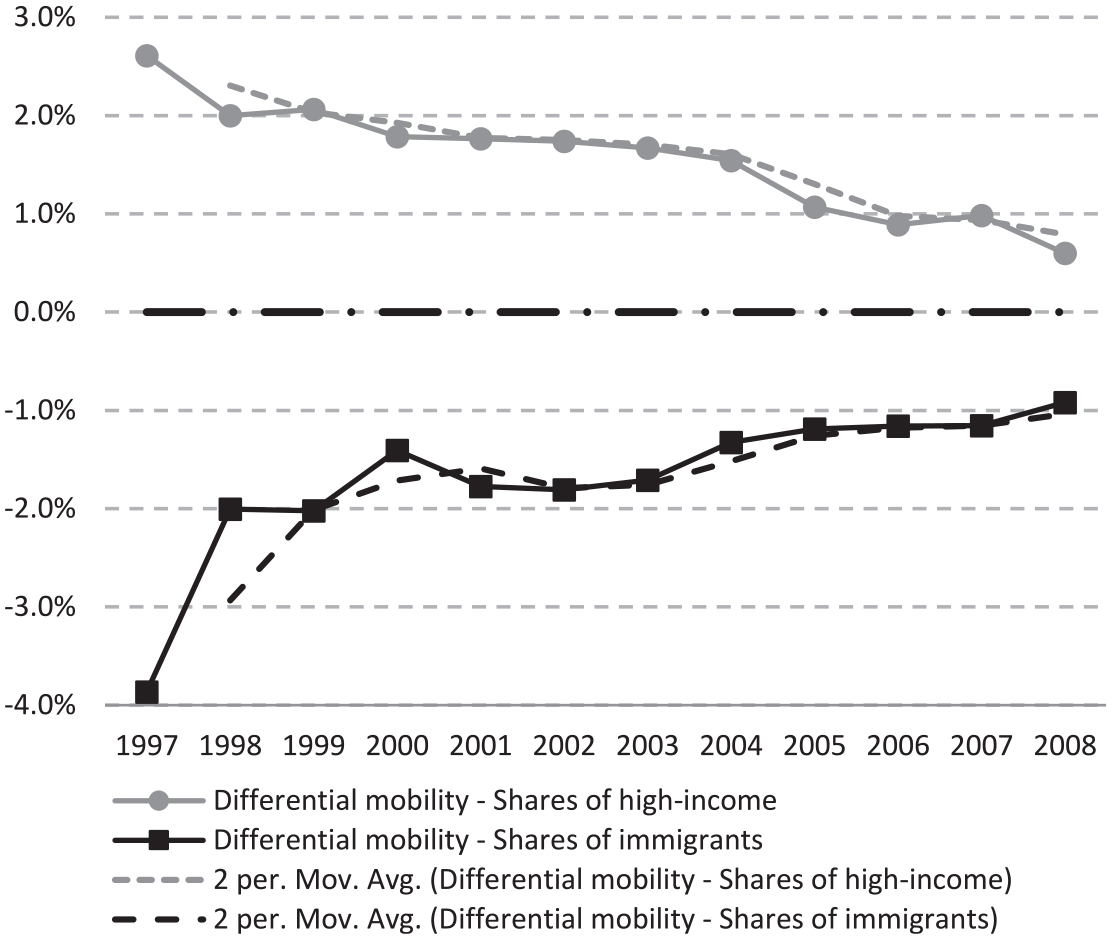
Inter-group differentials (immigrants and natives) regarding neighbourhood shares of immigrants and neighbourhood shares of high-income residents (percentage points). Dashed lines represent two period moving averages.
The significantly lower upgrades in neighbourhood socioeconomic status of immigrants compared with natives may reflect their lower incomes (Table 1). Another possibility is that immigrants’ preferences for living among compatriots impose compromises in terms of neighbourhood socioeconomic status, given that immigrant neighbourhoods are predominantly low income. To examine these alternative explanations, inter-group differentials with respect to neighbourhood shares of high income were computed for each income decile among deciles 4th–7th. 11 This analysis (Figure 3) indicates that immigrants experienced lower upgrades in neighbourhood socioeconomic status than natives with similar incomes. Differentials ranged initially between 1.5 pp and 2 pp but declined over time. Thus, immigrants lagged native Israelis in translating income into better socioeconomic spatial positions, a finding that supports Hypothesis 2. Immigrant neighbourhoods in the Tel-Aviv metropolitan area were predominantly low income. Correlation between the neighbourhood percentage of FSU immigrants and neighbourhood percentage of high-income residents has risen from r1995 = −0.39 in 1995 to r2008 = −0.52 in 2008 (both significant at the 0.01 level), implying that immigrants who wished to live in places with high immigrant shares had to compromise on neighbourhood socioeconomic status. Therefore, immigrants’ choices of a residential neighbourhood involved a trade-off between socioeconomic status and immigrant shares, which has become more important over the years.
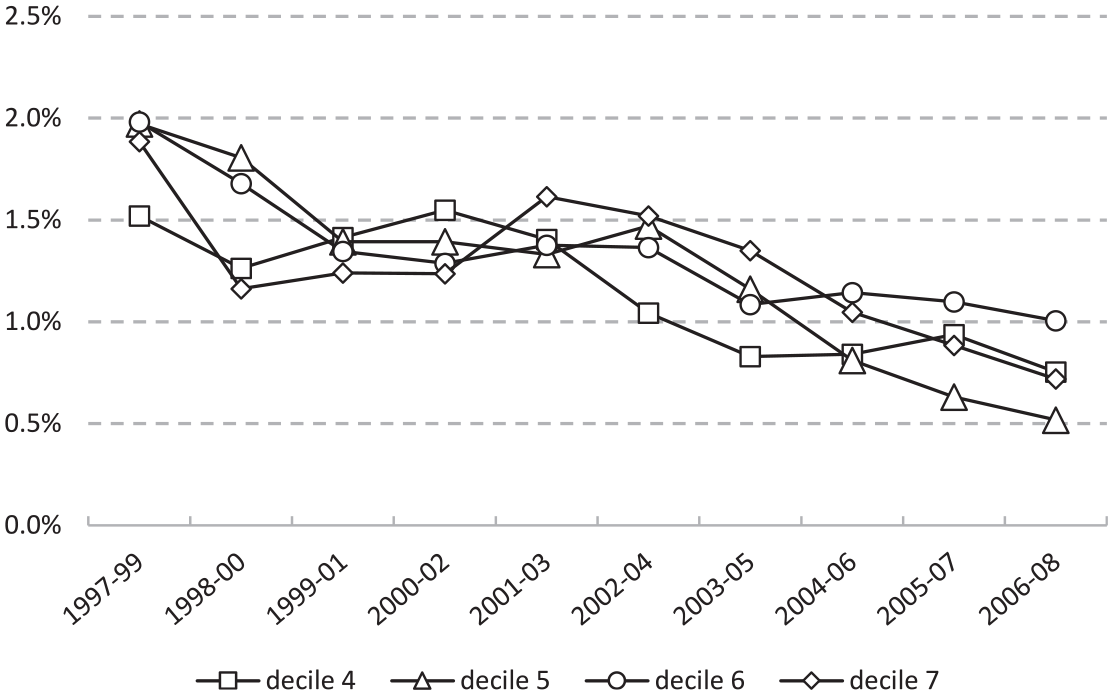
Inter-group differential mobility regarding neighbourhood share of high-income residents, computed for each income decile (percentage points, three-year moving average).
Trade-off between neighbourhood socioeconomic status and neighbourhood immigrant shares is also evident in the analysis of inter-attribute differentials. Positive values reflect an upgrade in socioeconomic status at the expense of neighbourhood immigrant shares, and negative values reflect an opposite trade-off. The nature of the trade-off changed over time such that immigrants switched from gaining higher immigrant shares at the expense of neighbourhood socioeconomic status, to gaining higher socioeconomic status at the expense of higher immigrant shares. This switch is the most extreme among high-income immigrant movers. However, even they started with a negative trade-off. Figure 4 also shows that dramatic changes in mobility patterns occurred for a limited period after which they stabilised. Finally, the trading of neighbourhood immigrant shares for neighbourhood socioeconomic status has drawn a divide between the highest-income immigrants (quintile 5) and the rest. While the former showed average differentials between approximately 5.5 pp and 8 pp, quintiles 1–4 altogether showed differentials ranging between −1 pp and 2 pp.
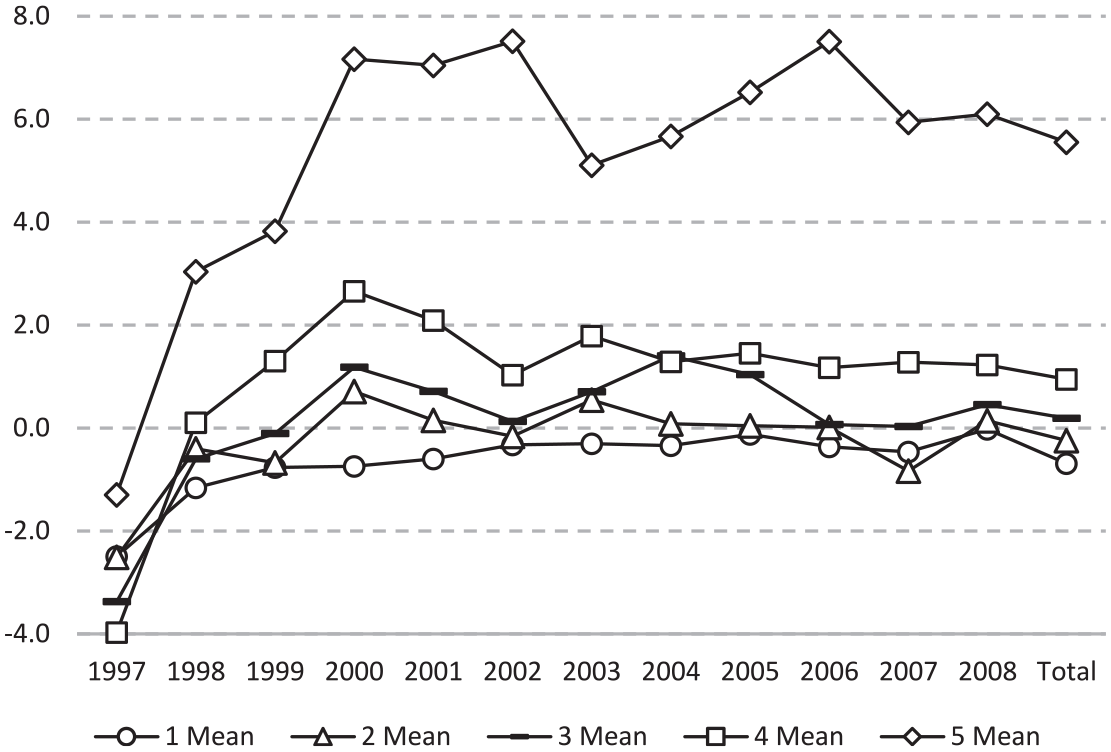
Inter-attribute differential (the change in neighbourhood socioeconomic status relative to the change in neighbourhood immigrant shares) – FSU immigrants, according to movers’ income quintile (percentage points).
Discussion
Immigrants’ segregation levels can persist or change over time, depending on residential mobility patterns of both immigrants and majority members. This article focuses on immigrants from the Former Soviet Union (FSU) who arrived in Israel during the 1990s. The study analyses their mobility patterns and those of native Israelis within the Tel-Aviv metropolitan area through the period 1997–2008 and explores the sorting dynamics reflected in moving behaviour. Our first two hypotheses refer to immigrants’ mobility patterns: (1) taking into consideration the social mobility prospects of immigrants we expected that, to some extent, immigrants would relocate over time to neighbourhoods with higher socioeconomic status and lower shares of immigrants, in line with the spatial assimilation model (Massey and Denton, 1985). (2) On the other hand, given the cultural capital and self-identification of FSU immigrants, we expected to see moves that sustain clustering, in line with the ethnic community model (Logan et al., 2002). We expected, therefore, that a combination of models relating to immigrants’ relocation patterns might apply in this specific case.
The findings reveal that, indeed, both models are applicable to some extent. Immigrants experienced important declines in shares of own-group members combined with increases in shares of high-income residents as a result of relocation. Those trends, however, did not continue throughout the entire period. At the same time, FSU immigrants had a lower tendency to translate resources into advantageous locations. Given that place stratification theory does not hold in this context, it may indicate that immigrants’ preferences for living among compatriots makes them compromise neighbourhood socioeconomic status (since immigrant neighbourhoods are of predominantly low status). This explanation hints at a distinctive version of the ‘ethnic community’ model. While the original model envisages that such preferences of socially mobile immigrants may result in the formation of advantageous ethnic neighbourhoods (Logan et al., 2002), our findings suggest that immigrants may prefer immigrant neighbourhoods even if they do not reflect their own economic status. Immigrants may have paid a ‘premium’ in terms of neighbourhood socioeconomic status in order to live among compatriots. Positive externalities arising from the social and cultural environment in the ‘Russian’ enclave may be perceived as offsetting negative externalities arising from low neighbourhood status. Also, it can be assumed that inconsistency between human capital and income levels moderated negative externalities associated with low neighbourhood status. Apart from these explanations, it is possible that wealth disparities, which were not captured in this analysis, also affected the groups’ divergence in upward socio-spatial mobility.
The analysis shows that the higher the individual income, the greater the preference for neighbourhood status relative to that of immigrant shares, as suggested by the spatial assimilation model. This finding confirms that income is an important factor in gaining exposure to majority members but time since migration is also critical; even among the highest-income immigrants, moving towards spatial assimilation was a matter of time. We believe that the importance of time since migration, irrespective of the income factor, is likely to show in various immigration contexts.
The third hypothesis concerned the moving behaviour of majority members. We expected to find mobility patterns that reflect negative attitudes towards immigrants, as suggested by the ‘white flight’ model (Frey, 1979). The findings indicate a general pattern of spatial separation from immigrants through relocations throughout the research period. However, the magnitude of this pattern increased and later decreased. Complementary analyses revealed that natives’ flight was the dominant pattern through which the spatial separation increased, at least when it comes to the most concentrated neighbourhoods with immigrant shares of 20% and more.
The joint impact of immigrants’ and natives’ moves during the first years reflects the strongest process of spatial sorting. During these years, compositional differences in terms of income and age played an important role. Over time, sorting steadily weakened, driven by different trends manifested by each group. The active continuation of the ethnic sorting process can be attributed exclusively to natives’ spatial behaviour. Socioeconomic sorting has remained an active process throughout the research period, despite the diminishing trend.
By analysing moves across the continuous hierarchy of neighbourhoods we can draw conclusions about overall increases or decreases in sorting but not necessarily about where across the neighbourhood distribution changes occur. Also, while the analysis indicates trends in the extent of sorting, it does not indicate the effect on segregation levels, first, because segregation is not only affected by residential mobility but also by other social and demographic processes; second, because the measure of sorting is not tied to a specific measure of segregation. An additional issue which is not addressed here is the selection into mobility (as our data includes only movers). The willingness to move by income level can differ between immigrants and natives, which can also affect the sorting process. Finally, it should be noted that inter-regional moves (including moves in and out of the metropolitan area) are an important layer of sorting dynamics which might also affect within-metropolitan area dynamics. All these issues merit further investigation in future research.
The analyses presented in this article reveal pronounced group-level trends in sorting that occurred within about a decade. These analyses provide a new account of temporal dynamics of spatial integration. The unique framework enables us to investigate the simultaneous effect of immigrants and majority members’ relocations on the extent of sorting and expose the changing intensity of residential sorting processes over time. The revealed diminishing intensity of sorting is most likely a preliminary phase of spatial integration and should be given further attention in the study of urban integration and segregation dynamics.
Footnotes
Declaration of conflicting interests
The authors declared no potential conflicts of interest with respect to the research, authorship, and/or publication of this article.
Funding
The authors disclosed receipt of the following financial support for the research, authorship, and/or publication of this article: This project has received funding from the European Union’s Horizon 2020 research and innovation programme under the Marie Sklodowska-Curie grant agreement No. 702649; the Azrieli Foundation; the Israel Foundations Trustees Program for the Advancement of Research in the Social Sciences; and the Shlomo Glass and Penny Balaban Fund.
