




Abstract
This article interrogates whether, and if so how, political factors underlie the migration aspirations of US-born citizens—a group of people often assumed to have the privilege and options to relocate elsewhere, typically “voluntarily” and for a mix of economic or social/cultural/lifestyle reasons, rather than being pushed out politically by war, revolution, or violence. Drawing on a unique, nationally-representative panel of 1,764 US-born citizens surveyed in 2014 and 2019, and despite many media suggesting the contrary, we show that the overall prevalence and distribution of Americans’ migration aspirations period actually stayed stable during this volatile time period. Nevertheless, we do uncover evidence that political considerations do shape what aspirations US-born citizens do express, with both weaker national attachment and liberal political ideology consistently raising their odds, and political engagement operating in different directions, depending on panelists’ ideological affiliations and the specific governing regime. We discuss the relevance of these findings for literature on migration aspirations from the Global North, multicausal theories of migration, and the relationship between Hirschman’s classic concepts of loyalty, voice, and exit.
Introduction
As the results of the US Presidential Election came in during the night of November 9, 2016, showing Donald J. Trump winning the Electoral College and becoming the 45th elected President of the United States, Google searches for “leave the country” and “move to Canada” leapt to a new high (McPhate 2016; Google Trends 2024a, 2024b). Commentators then and over the next few years would go on to note “I don’t recognize America anymore” (Gup 2019), to make the “case for fleeing Trump's America” (Kaysen 2018; Edwards 2019), to offer “an exit guide” (Surak 2016) and give advice about “How to move abroad” (Yoon 2019), and to declare that Americans are now “fed up” and “not coming back” (Kjlemgaard 2020; Taylor 2020). Nearly a decade later, media is once again calling attention to a connection between politics and Americans’ aspirations to leave the country, this time quoting not just liberal voters who fear “the country might spiral into authoritarianism should Donald Trump win a second term,” but also conservative ones “deeply concerned” about the country having “gone so far liberal” or “how a Kamala Harris Presidency would handle the war in Gaza and the economy” (Kaysen 2024a; see also Baker 2024; Frank 2024; Sands and Ho 2024; Yeğinsu 2024; Kaysen 2024b).
Indeed, recent elections have reopened a longer conversation about how politics shapes Americans’ aspirations to either stay in or leave the United States. Some news coverage appears simply to pander to the public's fascination with lives of the rich and famous (Kassam and Lee 2018; Frank 2024; Hogg 2024; Smith 2024), leaving much to speculate about how well (or poorly) their experiences reflect the thoughts and behaviors of ordinary Americans. However, even some international relocation industry consultants now report sensing a new level of “exhaustion on both sides of the political spectrum” (Hogg 2024), and cite stable demand for their services not only during the first Trump presidency but well into the subsequent Biden one, too (Parks 2024). Growing political divisiveness, uncertainty, and fear now allegedly animate Americans’ migration aspirations “from both sides of the political spectrum” (Parks 2024; see also McPhate 2016; Blake 2024a, 2024b). One consultant even recently told a reporter that politics seems to be a “determining factor” for many Americans who are considering whether they should make a move abroad (Hogg 2024).
In this article, we put such speculations to a rare empirical test (Motyl 2014), asking: How representative (or not) is this kind of click-bait media coverage about Americans’ growing aspirations to leave the country of wider national public opinion? Further, how much does politics really factor into Americans’ ideas and thoughts about living abroad, compared to other economic or sociocultural factors already known in the literature to influence both Global North emigration aspirations and behavior—such as the desire to live a better lifestyle, to have a meaningful adventure, or to make one's dollar go farther in retirement? And finally, does the relationship between politics and aspirations to live abroad really operate equally on both sides of the hyper-divided political aisle? We draw on a unique and nationally-representative panel survey of 1,764 US-born US citizens that we fielded in 2014 and again in 2019 to explore not only how many and how strongly US-born citizens aspire to live abroad in these two survey years, but also how politics factors into their aspirations after accounting for a range of other demographic, economic, and sociocultural factors first. Importantly, this dataset allows us to model Americans’ migration aspirations across a five-year time period spanning Donald Trump's first and very hotly-contested US Presidential election, paying special attention to the potential roles of three political variables: Americans’ strength of national attachment, their political ideology, and their levels of electoral and nonelectoral political engagement.
A combination of bivariate and multivariate results reveal three key findings. First, and in contrast to some of the high-profile media coverage published under the first Trump Presidency about the “growing trend” (Tolson 2018) or even “horde” of “frantic Americans” (Thompson 2017) wishing to leave the country after the 2016 Presidential election, the relative presence and distribution of Americans’ migration aspirations stayed stable between 2014 and 2019. Not only did a similar proportion of all Americans aspire to live abroad after that election as before, but even when we break down the sample by political ideology, we find that conservatives were no more likely to express migration aspiration before 2016, nor liberals afterward. Additionally, both conservatives who aspired to live abroad in 2014 and liberals who did so in 2019 remained primarily motivated by exploration and adventure, rather than by political disaffection, a pattern consistent with the longstanding literature on Global North lifestyle migration (Benson and O’Reilly 2009, 2016; Croucher 2012, 2015, 2018; Benson 2013, 2014; Marrow and Klekowski von Koppenfels 2020).
Nevertheless, we do uncover some evidence about ways political considerations do factor into what aspirations Americans do express, even after controlling for other factors. Most importantly, weaker national attachment contributes strongly and consistently to higher migration aspirations, and it does so roughly equally, among liberals and conservatives alike, in both survey years. This confirms findings about the key role weak national attachment plays in migration aspirations in other countries, going another step further to show that it works synchronously among opposing political subgroups. By contrast, political ideology and political engagement operate more asynchronously, with liberal ideology being positively associated with higher migration aspirations not only during a (post-2016) conservative but also a (pre-2016) liberal governing regime, and different forms of political engagement (e.g., voting vs. protesting) not only working in opposing directions, but also unequally, depending on Americans’ ideologies and the specific governing regime in power. After reviewing the literatures on migration aspirations from the Global North, multicausal theories of migration, and loyalty, exit, and voice (Hirschman 1970), we present our sample and results, and conclude by discussing the relevance of our findings for the ongoing study of how politics might be expected to shape American emigration aspirations and flows in years ahead.
Why Do Americans Aspire to Emigrate?
In thinking through why Americans aspire to emigrate, we first turn to literature on emigration aspirations and motivations more broadly. Scholars typically characterize the 280 million people who actually cross international borders today, and who now represent just under four percent of the world's population, as falling primarily into one of three types of flows—(1) labor, (2) forced, or (3) reunification—which they assume, respectively to be shaped by economic, political, or family tie motivations (UNDESA 2020). Yet, mobility originating from the Global North, which has been studied less systematically, is often considered to be an exception to these patterns, driven in large part by personal motivations such as a desire for exploration, self-actualization, or personal fulfillment (Benson and O’Reilly 2009, 2016; Scheibelhofer 2018; Suter 2019; Mancinelli 2020; Hayes 2021), a desire to improve one's “lifestyle” (Osbaldiston, Picken and Denny 2020; King et al. 2021), or even a desire to voluntarily advance in one's career (Smith and Favell 2006; Beaverstock 2018) or find “freedom” and more “meaningful work” (Mancinelli 2020; Woldoff and Litchfield 2021). Such distinctive motivations are further reflected in the variety of labels that often get applied to Global North migrants abroad. Many neither self-identify, nor are seen or treated by their host societies and governments, as either “migrants” or “refugees.” Instead, they are often termed “expats,” “corporate transferees,” “Americans living abroad,” “overseas Americans,” “digital nomads,” and more (Klekowski von Koppenfels 2014; Croucher 2018).
However, recent research contests such compartmentalizations, suggesting not only that distinctions between migration flows originating in the Global South versus the Global North are more nuanced than prevailing binaries would suggest, but also that the binary categories frequently used to classify international border-crossers are best viewed as political constructions and “legal fictions” administered in the interest of powerful host countries (Hamlin 2021; also Arar and Fitzgerald 2023; Portes and Rumbaut 2014), rather than accurate descriptors of the reasons why people move. For example, more than 20 years ago Russell King famously identified as faulty the assumption that all labor migrants are “poor, uprooted, marginal and desperate” (2002, 89). More recently, de Haas has built on this point, noting that “we know from empirical research … that intrinsic ‘adventure’ and ‘lifestyle’ motives are not the prerogative of privileged Europeans or North Americans” alone (2021, 19). Instead, de Haas argues that the assumed binary of economic instrumentality on the part of migrants from the Global South versus noneconomic self-actualization on the part of migrants from the Global North is overstated (see also Castles 2010; Luthra, Platt and Salamońska 2018, 290). That is, a dominant focus on utility maximization arguably overlooks the fact that some migrants from the Global South may aspire to and eventually migrate for exploration, too (Olwig 2018; de Haas 2021, 15). Vice versa, migrants from the Global North can aspire to and eventually migrate in search of affordable living and economic risk minimization, in addition to community and personal fulfillment (Hayes 2014; 2018; Bender, Hollstein and Schweppe 2018).
Regardless, comparatively less research has explored how politics factors into these otherwise multicausal processes of migration decision-making in the Global North (Bygnes and Flipo 2017). One useful case in point is Docquier, Peri and Ruyssens’ (2014) insightful analysis of the “economic, policy, cultural, and network factors” that predict people's entry into pools of “potential migrants” (i.e., aspiring migrants), and then also their later entry into actual migration flows. Docquier and colleagues include measures of their respondents’ education levels, plus a variety of measures of respondents’ different origin and destination countries’ wage structures, employment opportunities, geographical distance from each other, and even linguistic, genetic and cultural proximity to each other, but no parallel measures of respondents’ political attitudes or behaviors. Indeed, politics is largely absent from the literature on Global North migration aspirations (e.g., Marrow and Klekowski von Koppenfels 2020). Instead, it features much more prevalently within the literature on refugees and asylum seekers from the Global South, where both the labels applied to these groups and the assumptions made about their underlying motivations effectively distinguish them as more “deserving” than either economic or family-reunification migrants, because they have been “forced” out of their homes and communities due to political factors such as war, violence, and the threat of group-based persecution (Hamlin 2021, 9–10).
To be sure, there are some notable exceptions. In the American case, Canada has long held a special place in the migration imaginaries of US citizens as a place of freedom or refuge (Mindes 2019, 120)—ranging from enslaved Americans seeking freedom in the nineteenth century (Landon 1920; Mathieu 2010) to conscientious objectors and draft resisters during the Vietnam War (Kasinsky 1976; Hagan 2001; Hagan and Hansford-Bowles 2005; Maxwell 2010; Rodgers 2014) to Americans in the early 2000s leaving a new political climate with which they adamantly disagreed (Young 2011; Churchill 2012; Schwab 2017). But even in this case, political motivations among aspiring and actual migrants to Canada coexist with a range of other nonpolitical factors, too—including many Americans’ desires related to academic and corporate advancement, retirement, and adventure (Hardwick 2010; Croucher 2011) and the attraction of Canada's national healthcare system and stricter gun laws (Schwab 2017; Thompson 2017). In large part, most Americans residing in Canada today—as is also the case for Americans residing elsewhere—are not seen or categorized as political dissidents or refugees.
Loyalty, Voice, and Exit: Politics in the Study of Migration Aspirations
While there is very little literature exploring how politics shape migration aspirations or motivations in the Global North, a number of studies from middle- and lower-income countries has shown that political factors do impact migration aspirations there. One study from Mexico, for example, found that when Mexicans feel more strongly attached to the nation (as “Mexicans”), they express lower intention to migrate northward to the United States (Theiss-Morse and Wals 2014). Likewise, surveys conducted in Hong Kong in 1991 and 2021 find that lower national attachment is one of the strongest predictors of emigration intentions (Lam and Fong 2023, 1), just as lower attachment to and identification with “place” predicts a higher commitment to leaving (vs. staying put) in Belgrade, Serbia (Tournois and Rollero 2020). Together, these findings suggest that strong national attachment may be inversely related to expressions of migration aspiration among Americans and other residents of the Global North, too (see also Gustafson 2014; Marrow and Klekowski von Koppenfels 2020; Hagen-Zanker and Hennessy 2021), perhaps because it represents a form of satisfaction with the nation-state or the broader state of things (Colomer 2000; Pfaff and Kim 2003).
Beyond strength of national attachment, studies from the Global South also uncover evidence for additional political factors. Gani and Ward (1995), for instance, found that political instability was positively correlated with professional migrants’ out-migration from Fiji to New Zealand. In Hong Kong, Lam (2002) found that lack of political confidence in one's country's future was positively correlated with a higher propensity to out-migrate (see also Lam and Fong 2023), just as dissatisfaction with a “bleak political environment” has been found to spur Turks (especially those who are better educated) to wish to move elsewhere (Gevrek, Kunt and Ursprung 2021). Still other measures of political discontent, including disapproval of the state, feeling that one lacks influence within the political decision-making process, and distrust and anger at state corruption, have been found to contribute to migration intentions in both the Arab Mediterranean (Etling, Backeberg and Tholen 2020) and European Union (Bygnes and Flipo 2017). Together, these findings suggest that political instability, disaffection, and/or uncertainty can increase migration aspirations—and not only merely among potential refugee groups living under authoritarian regimes (e.g., Colomer 2000; Pfaff and Kim 2003; Yi and Bahk 2022), but perhaps even among some non-refugee or “human capital” migrants, too.
Beyond political attitudes, direct political engagement could also matter, but potentially in the other direction. 1 Albert O. Hirschman (1970) famously theorized that anyone who is dissatisfied with any organization or group has one of two choices: to try to “voice” their opinion (perhaps through a vote, protest, or some other form of direct engagement) in an effort to convince one's leadership into meaningful change, or to “exit” and “leave” the group. By this logic, we might hypothesize that Americans who are politically discontent but who choose to voice their disaffection through higher (either electoral or nonelectoral) domestic political engagement will simultaneously express lower migration aspiration to go somewhere else, if indeed voice and exit represent two “substitutive actions” (Colomer 2000, 425) or “alternative responses” (Pfaff and Kim 2003, 401) to situations of discontent. Indeed, several empirical studies have demonstrated that even in bleak economic and political environments, political engagement remains associated with hope (Bygnes and Flipo 2017, 206).
On the other hand, several scholars have recently critiqued Hirschman's model for envisioning discontented people as having only two discrete and mutually-exclusive choices. Instead, they see greater possibility for simultaneity between voice and exit (Pfaff and Kim 2003; Hoffman 2010), such as when Kirkpatrick views the “resistant exit” of some politically-disaffected exiles as a form of protest or a mode of opposition in and of itself (2017, 91; 2019). Indeed, in later writings, Hirschman (1993) himself began to believe that exit might be able to be complementary with voice (cited in Bygnes and Flipo 2017, 200). Therefore, we view it equally plausible that Americans who are more strongly engaged in domestic politics could express higher aspiration to leave for elsewhere, especially if that aspiration helps to fashion a “credible threat” that makes domestic protest even more effective (Pfaff and Kim 2003; Heins 2020, 6).
Studying Politics from the Point of Origin
Finally, we wish to clarify why we choose to explore the role of politics in Americans’ migration aspirations at the point of origin, rather than during the migration process or retrospectively after some Americans have already moved abroad. Technically, aspiration and behavior are viewed as two separate stages and objects of analysis in the migration literature, with aspiration referring to the basic conviction that leaving a particular place would be better than staying (Carling and Collins 2018, 7) and behavior capturing actual, physical movement, captured either in real time or, more commonly, after migration has occurred. Clearly, aspirations, intentions, and even self-reported likelihoods of migrating do not always translate seamlessly into actual migration behavior (Gardner et al. 1985; de Groot et al. 2011), in that not all people who have a preference to migrate have the ability or resources (whether information, social networks, or money) to do so, resulting in what Carling (2002) calls “involuntary immobility.” Vice versa, other people can migrate without previously expressing an aspiration to do so. whether enticed by an unanticipated job offer or coerced by natural or political disaster (Koikkalainen and Kyle 2016).
Nevertheless, and consistent with the theory of reasoned action (TRA) (Fishbein and Ajzen 1975), in which intentions can be viewed as antecedents to behavior, migration intentions have now been demonstrated to be moderate to strong predictors of actual migration patterns in a variety of country contexts, from the Netherlands to Mexico (Gardner et al. 1985; Creighton 2013; Van Dalen and Henkens 2013; Docquier, Peri and Ruyssen 2014). 2 Plus, even if not all migration aspirations ever come to full fruition, they remain useful for representing something important about people's prospective “hopes, plans, ambitions or goals” Scheibelhofer (2018, 2), which scholars argue include reflections about who people want to be at some future point in life (Carling and Schewel 2018) in ways that often get attached to place-specific images and ideas, too (Benson and O’Reilly 2016). Indeed, a growing scholarly interest in migration aspirations worldwide revives an older strand of research from the 1980s and 1990s that once looked deeply into the microdynamics of migrants’ premigration decision-making process. Viewed from this perspective, premigration considerations about living abroad provide useful insight into how residents of the Global North might be situating and understanding themselves in relation to their home countries and communities, even if not all of them eventually decide to move.
Furthermore, we measure Americans’ migration aspirations at the point of origin because it helps to overcome some of the serious sampling limitations involved in studying Americans’ migration motivations retrospectively, after emigrants have already moved. Largely due to variation in how other countries see, label, and count Americans who have different legal and citizenship statuses (Costanzo and Klekowski von Koppenfels 2013), it is currently difficult, and perhaps even impossible, to generate a representative sample of all US citizens living abroad, as estimates of their numbers vary widely—somewhere between four to nine million (see Fors Marsh 2016; Dashefsky and Woodrow-Lafield 2020; US Department of State 2020; Hoffman 2024). Consequently, without a known population, even the most insightful case studies of Americans living abroad today are affected by some degree of sampling bias, most likely leaning toward the experiences and motivations of Americans who are the most visible, identifiable, and easily accessible, and/or who live in the most densely-concentrated and well-known emigrant communities. Sampling bias most certainly plagues news coverage about Americans living abroad, as journalists routinely fail to specify their methods for locating and selecting their emigrant sources. By contrast, one of the main contributions of the present study is our ability to measure Americans’ migration aspirations in a nationally-representative way, thereby capturing respondents for whom political considerations may both be (or not be) key drivers of their ideas about going abroad.
Hypotheses
Bringing these insights together, we develop and test the following four hypotheses:
First, in line with existing literature on migration aspirations outside the United States, we hypothesize that Americans with weaker levels of national attachment will consistently express stronger migration aspirations. Further, to the degree that national attachment either rises/falls under different governing regimes, if indeed it operates a form of satisfaction with the nation-state or the broader state of things, we expect that such changes will also be directly related to either decreasing/increasing migration aspirations, respectively.
Second, and also in line with existing literature on migration aspirations primarily outside the United States, we hypothesize that Americans with higher levels of political discontent will express higher migration aspirations. One proxy measure of discontent (or at least of dissatisfaction) may be, as just mentioned, weaker national attachment. But we also employ self-identification with the political ideology in opposition to that of the ruling party as a second proxy measure, given Americans have become “hyper-polarized” along both ideological and partisan lines over the last few decades (Dimock et al. 2014; Mason 2018). Put differently, if political discontent is positively related to people's aspirations to “exit,” then Americans who identify as ideologically conservative may be more likely to express migration aspirations in 2014 (under a more liberal Democratic Obama Presidency), while Americans who identify as ideologically liberal may be more likely to express them in 2019 (under a more conservative Republican Trump Presidency). Indeed, Motyl (2014) finds experimental evidence confirming that it was conservative “Romney voters” who were the most likely to threaten to leave in 2012, mid-way through the first and second Democratic Obama presidencies (for similar claims made by prominent conservatives during the Obama years, see also Pitofsky 2020 and Queenan 2010).
Third, drawing on the competing perspectives from the literature on political engagement's relationship to migration aspirations, we propose two hypotheses we consider equally plausible. The first (Hypothesis 3a) is that Americans with higher levels of political engagement may express lower migration aspirations, if wanting to “exit” for elsewhere works substitutively—that is, in opposition to one's commitment to participating in or contributing to domestic life and affairs. Alternatively (Hypothesis 3b), Americans with higher levels of political engagement may express higher migration aspirations if wanting to live elsewhere works complementarily to “voice” in domestic affairs at home. Once again, to the degree that political engagement either rises/falls under different governing regimes, we expect that such changes could also be empirically related to either (3a) lower/(3b) higher migration aspirations, depending on whether their relationship is substitutive or complementary.
Data and Methods
To test these hypotheses, we draw on unique, nationally-representative survey data from two original internet surveys, administered exactly 5 years apart, between July 11 and 13, 2014 and between July 12 and 14, 2019, midway during the second Obama and first Trump presidencies, respectively. These surveys were administered by GfK Custom Research North America (2014) and Ipsos Public Affairs, LLC (2019), which took over GfK, via their web-enabled KnowledgePanel®.
We selected this platform for two reasons. First, while larger face-to-face population-based surveys like the General Social Survey (GSS) or the American National Election Survey (ANES) are certainly ideal for measuring broad social and political attitudes, in 2014 we knew of none that included detailed batteries about Americans’ past and potential emigration aspirations. 3 Second, this online KnowledgePanel® is a true probability sample of US households that is designed to be both representative of the total US adult population (including people without their own internet access) and comparable across both panels and across time, since panelists are purposely recruited into the panel and then complete surveys within it on a rotating basis. Given GfK/Ipsos’ panel selection methodology, we are even able to assuage potential concerns about the KnowledgePanel's® opt-in nature (Chang and Krosnick 2009) by adjusting our results using statistical weights that incorporate probabilities of panelists’ selection and population benchmarks from US Census Current Population Survey reports.
We employ the same selection criteria across both survey years, such that our final samples include 860 US-born US citizens in the 2014 survey and 904 US-born US citizens in the 2019 survey, resulting in a full, pooled sample of 1,764 panelists. 4 Table 1 shows that there are no significant differences between the two samples along a range of factors, including by gender, race, geographic region of residence, educational level, ability to speak at least one language other than English, prior experience living abroad, homeownership status, household structure, prior military service history, political ideology, and recent electoral political engagement. However, a few differences do emerge between them, in that panelists in 2019 reported being slightly older and better off economically than those in 2014, plus to be more likely to have recent immigration ancestry, to own a US passport, to have ever traveled abroad, and to be engaged in nonelectoral politics, yet less strongly attached to the nation and less likely to know other US citizens who have ever lived abroad.
Sample Characteristics.
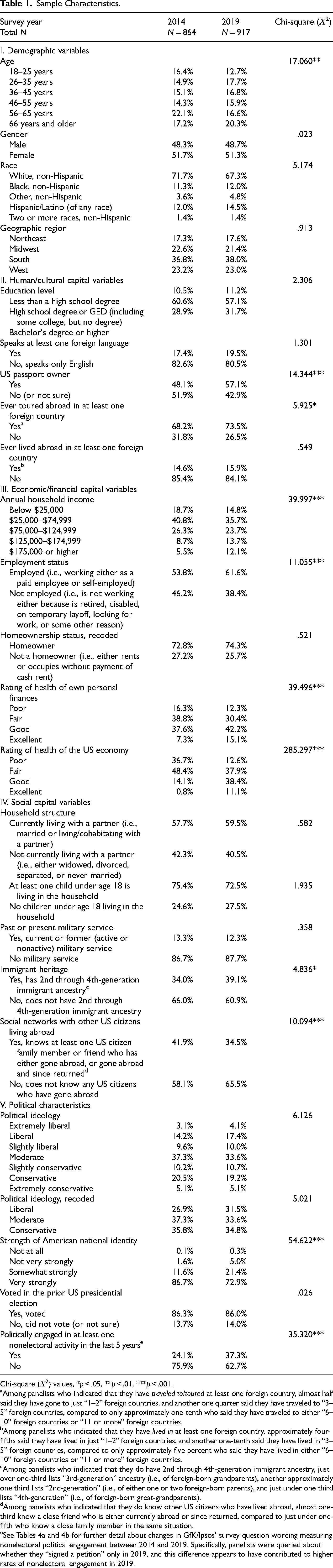
Chi-square (Χ2) values, *p < .05, **p < .01, ***p < .001.
Among panelists who indicated that they have traveled to/toured at least one foreign country, almost half said they have gone to just “1–2” foreign countries, and another one quarter said they have traveled to “3–5” foreign countries, compared to only approximately one-tenth who said they have traveled to either “6–10” foreign countries or “11 or more” foreign countries.
Among panelists who indicated that they have lived in at least one foreign country, approximately four-fifths said they have lived in just “1–2” foreign countries, and another one-tenth said they have lived in “3–5” foreign countries, compared to only approximately five percent who said they have lived in either “6–10” foreign countries or “11 or more” foreign countries.
Among panelists who indicated that they do have 2nd through 4th-generation immigrant ancestry, just over one-third lists “3rd-generation” ancestry (i.e., of foreign-born grandparents), another approximately one third lists “2nd-generation” (i.e., of either one or two foreign-born parents), and just under one third lists “4th-generation” (i.e., of foreign-born great-grandparents).
Among panelists who indicated that they do know other US citizens who have lived abroad, almost one-third know a close friend who is either currently abroad or since returned, compared to just under one-fifth who know a close family member in the same situation.
See Tables 4a and 4b for further detail about changes in GfK/Ipsos’ survey question wording measuring nonelectoral political engagement between 2014 and 2019. Specifically, panelists were queried about whether they “signed a petition” only in 2019, and this difference appears to have contributed to higher rates of nonelectoral engagement in 2019.
Dependent Measures
The two dependent measures used in our multivariate analyses are recoded from a single survey question seeking to measure our panelists’ presence and degree/likelihood of expressing some aspiration to live abroad. In line with the literature on migration aspirations (Canache et al. 2013; Carling and Schewel 2018; Schewel 2019; Marrow and Klekowski von Koppenfels 2020; Carling and Mjelva 2021), we created and fielded aspiration as compound variable intended to capture various aspects (including existence, strength, and likelihood) of migration aspiration, but that would not restrict aspiration to permanent moves, as the 2007–2013 Gallup World Polls did, and which in our view may potentially underestimate the phenomenon (see Docquier, Peri and Ruyssen 2014; OECD 2015; Esipova, Ray and Pugliese 2017; Ray and Esipova 2019; Ray and Pugliese 2024). 5
We then recoded the results into two dichotomous variables: any aspiration and clear aspiration. For any aspiration, we combined everyone who responded “no,” that they have never had any prior or present aspiration (initial aspiration response categories 0–1) into “no aspiration” (coded 0), versus everyone who responded “yes,” that they have some prior or present aspiration (initial aspiration response categories 2–5) into “yes, any aspiration” (coded 1). For clear aspiration, and as a robustness check meant to hone in only on those panelists expressing the strongest/clearest aspiration to live elsewhere, we combined everyone who responded clearly “no,” that they have no past, present, nor realistic future aspiration to live abroad (initial response category 0) into “no clear aspiration” (coded 0), versus everyone who responded clearly “yes,” that they have some prior or present aspiration plus would entertain the idea in the future (initial aspiration response categories 3–5) into “yes, clear aspiration” (coded “1”). In this latter variable, all remaining panelists who had indicated one of two initial aspiration response categories – either 1 “No, I have not but if a special opportunity arose to do so I would consider it,” or 2 “Yes, I have but I do not realistically think it will happen”—were dropped, since we recognize that they may capture competing yes/no aspects of aspiration. 6
After dropping any panelists with missing data, Table 2 shows the results for all three versions of our dependent variable (aspiration, any aspiration, and clear aspiration)—first among all panelists (in Columns 1–2), and then separately among self-identified political liberals (Columns 3–4) versus conservatives (Columns 5–6). Among all panelists, two patterns immediately stand out. First, a much higher percentage of our sample (35.2 percent) considers living abroad than the 2007–2013 World Gallup Polls uncovered in 2011 (10 percent) when it restricted its measure of aspiration to only permanent moves (OECD 2015, 256–257). Second, however, there was no significant change in this proportion between 2014 and 2019—a consistent finding whether we compare our results across the full six detailed response categories of our initial aspiration variable (Χ2 = 4.223, p = NS), across those in our recoded any aspiration dummy (Χ2 = .904, p = NS), or across those in our more restrictively-recoded clear aspiration dummy, too (Χ2 = 1.299, p = NS).
(a) US-Born Citizens’ Migration Aspirations, by Strength of National Attachment, 2014–2019.
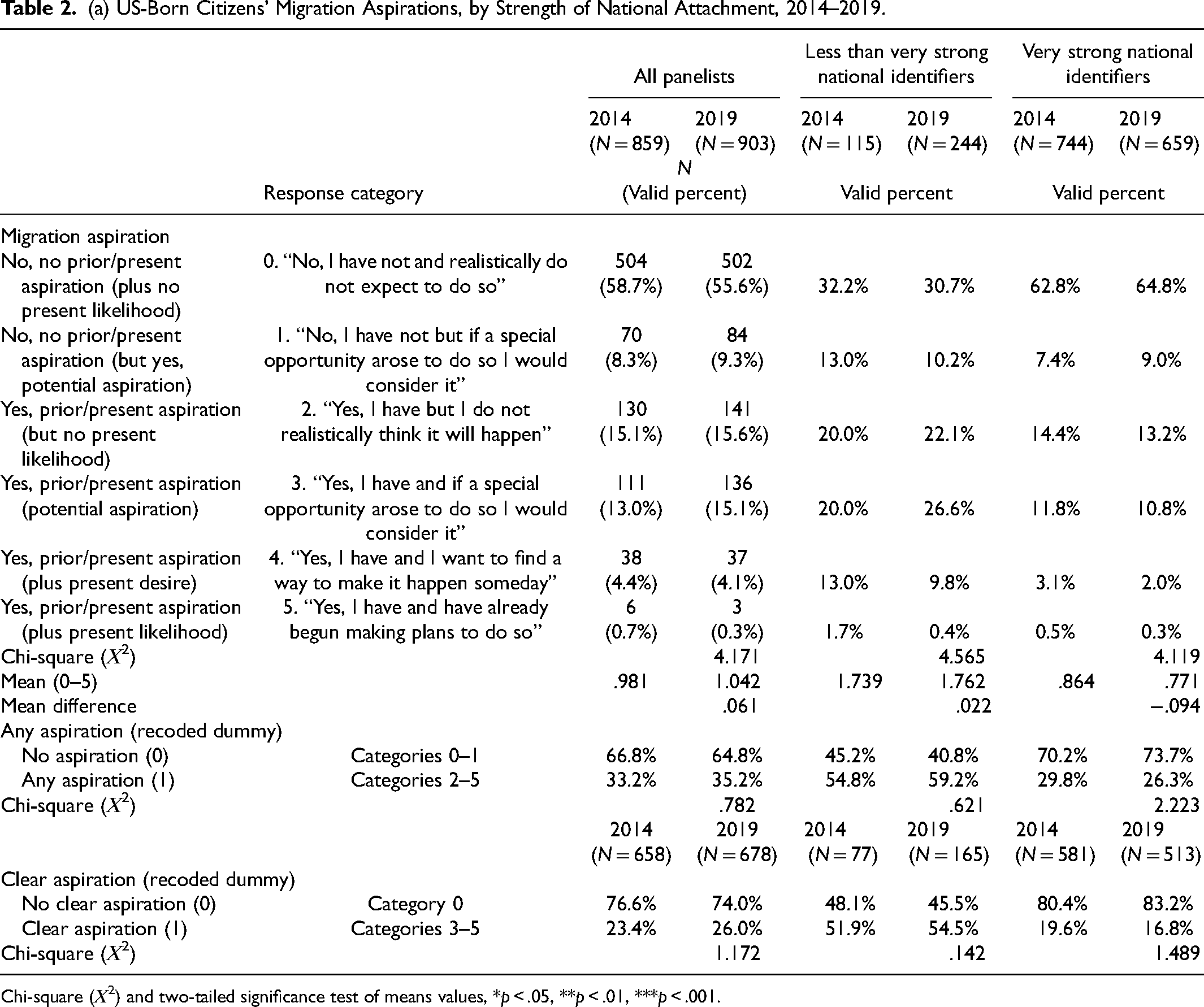
Chi-square (Χ2) and two-tailed significance test of means values, *p < .05, **p < .01, ***p < .001.
(Continued) (b) US-Born Citizens’ Migration Aspirations, by Political Ideology, 2014–2019.
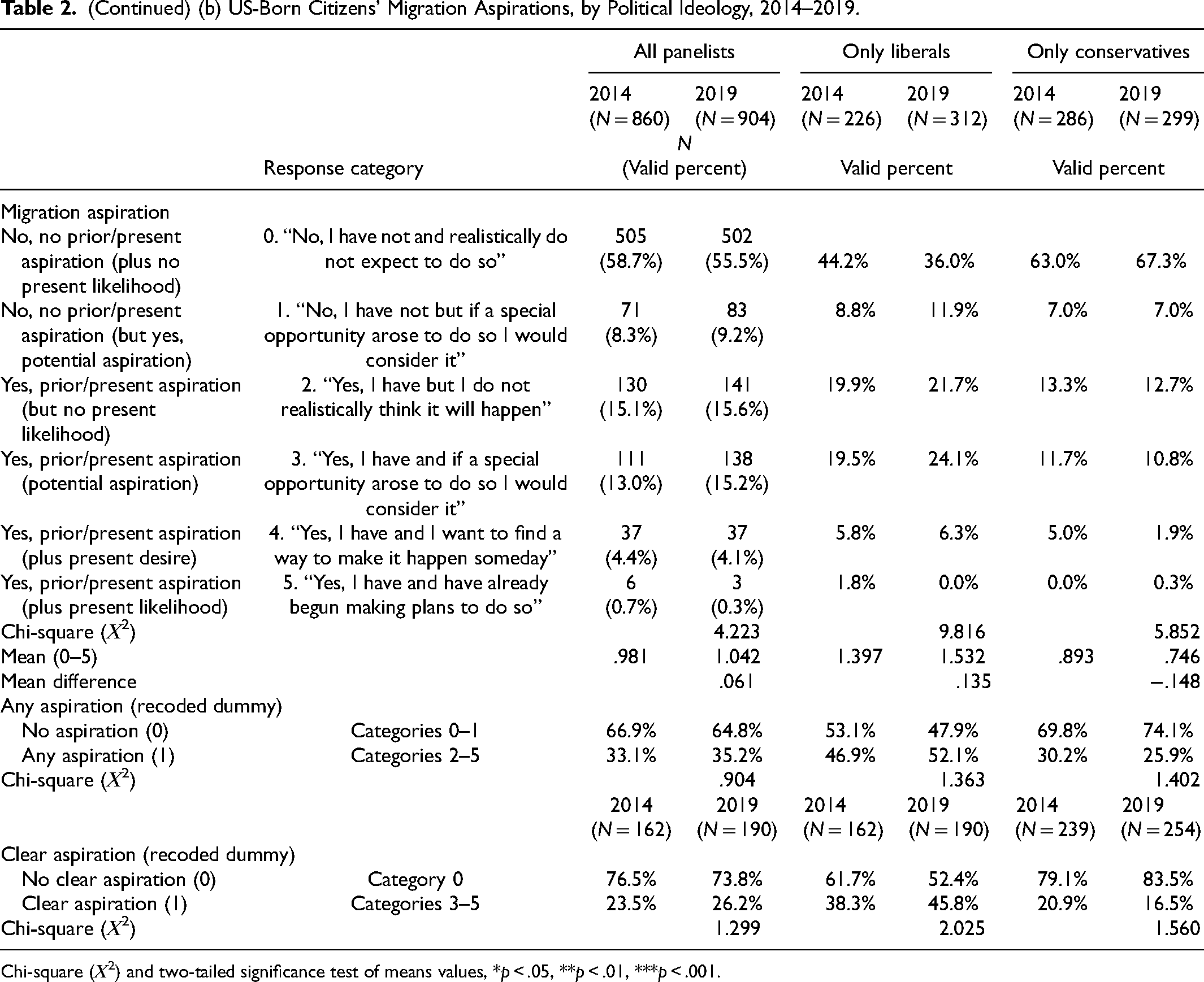
Chi-square (Χ2) and two-tailed significance test of means values, *p < .05, **p < .01, ***p < .001.
At first glance, these results belie off-cited anecdotal reports and media coverage of a “growing trend” (Tolson 2018) or even “horde” of “frantic Americans” (Thompson 2017) either looking to or considering the possibility of leaving the country after Trump's first election. So, we parse the data out further, to explore whether there might have still been an increase in migration aspirations after that election among political liberals, in a way that might support our Hypothesis 2, since research has found, not surprisingly, that liberals were far more likely to be disappointed and frustrated by the election of a conservative candidate who ran for office in the Republican party (Grewal and Cebul 2018; Meyer and Tarrow 2018; Oc, Moore and Bashshur 2018; Gose and Skocpol 2019; Lench et al. 2019; Gilmore 2020), just as conservatives have been shown to have been more disappointed and frustrated by the election of a liberal candidate in the 2012 Presidential election (Motyl 2014).
On one hand, Columns 3–4 in Table 2 reveal that migration aspirations are indeed descriptively higher among panelists in our 2019 sample who self-identify as liberal. But in contradistinction to Hypothesis 2, migration aspirations were higher among liberals even before the 2016 election, and the overall distribution of aspirations by political ideology stayed roughly stable across the two survey years, as indicated by the nonsignifcant Chi-square values in each of the three analyses, first for all panelists (Χ2 = .904, p = NS), and then only for liberals (Χ2 = 1.363, p = NS) and only for conservatives (Χ2 1.402, p = NS).
This is our first indication that while liberal political ideology is associated with Americans’ migration aspirations, ideology does not appear to operate as direct proxy measure for political discontent with a specific governing regime – at least not by itself. Yes, a somewhat higher proportion of liberal aspirants did rank “to leave” as one of their top three motivations in 2019 (60.4 percent) compared to 2014 (49.1 percent), but the change was not large enough to reach statistical significance. Further, both conservative panelists who aspired to live abroad in 2014 as well as liberal ones who did so in 2019 reported that their primary motivation was exploration and adventure, rather than political disaffection (see Tables 3a and 3b). 7 Together, these descriptive results paint an initial picture of American emigration aspirations that remains largely consistent with the literature on “lifestyle migration,” wherein most Global North migrants tend to express strongest and primary motivations for adventure, exploration, self-actualization, and fulfillment (Croucher 2015; Benson and O’Reilly 2016), even as economic or political anxieties can also factor in (Hayes 2014, 2018; Miles 2015). 8
(a) Aspirants’ Motivation Specifically “To Leave,” by Political Ideology, 2014–2019.
Note: These calculations include only panelists who expressed any migration aspiration (i.e., see the original aspiration response categories 2–5 in Table 2).
Chi-square (Χ2) and two-tailed significance test of means values, *p < .05, **p < .01, ***p < .001.
(Continued) (b) Aspirants’ Motivation Specifically “To Explore,” by Political Ideology, 2014–2019.
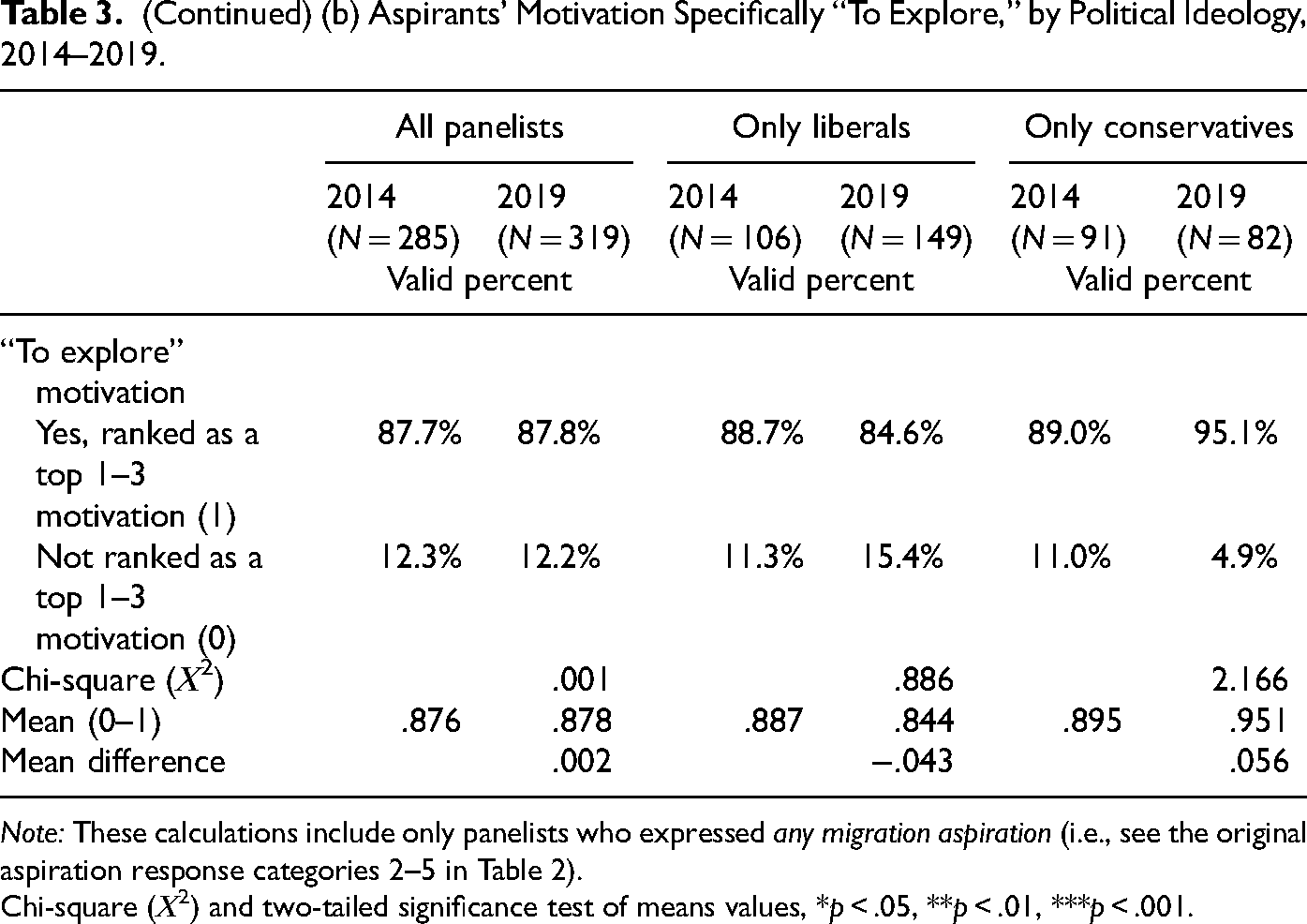
Note: These calculations include only panelists who expressed any migration aspiration (i.e., see the original aspiration response categories 2–5 in Table 2).
Chi-square (Χ2) and two-tailed significance test of means values, *p < .05, **p < .01, ***p < .001.
Independent Political Measures
Nevertheless, we still wish to know how political considerations might contribute to Americans’ migration aspirations, when they arise, and compared to other economic, social, and cultural factors. In this section, we develop a series of multivariate models to explore the unique contributions of strength of national attachment, political ideology, and political engagement to Americans’ odds of expression migration aspirations during this time period, paying special attention to how their roles may have shifted after 2016, or work differently on the ideological right versus left.
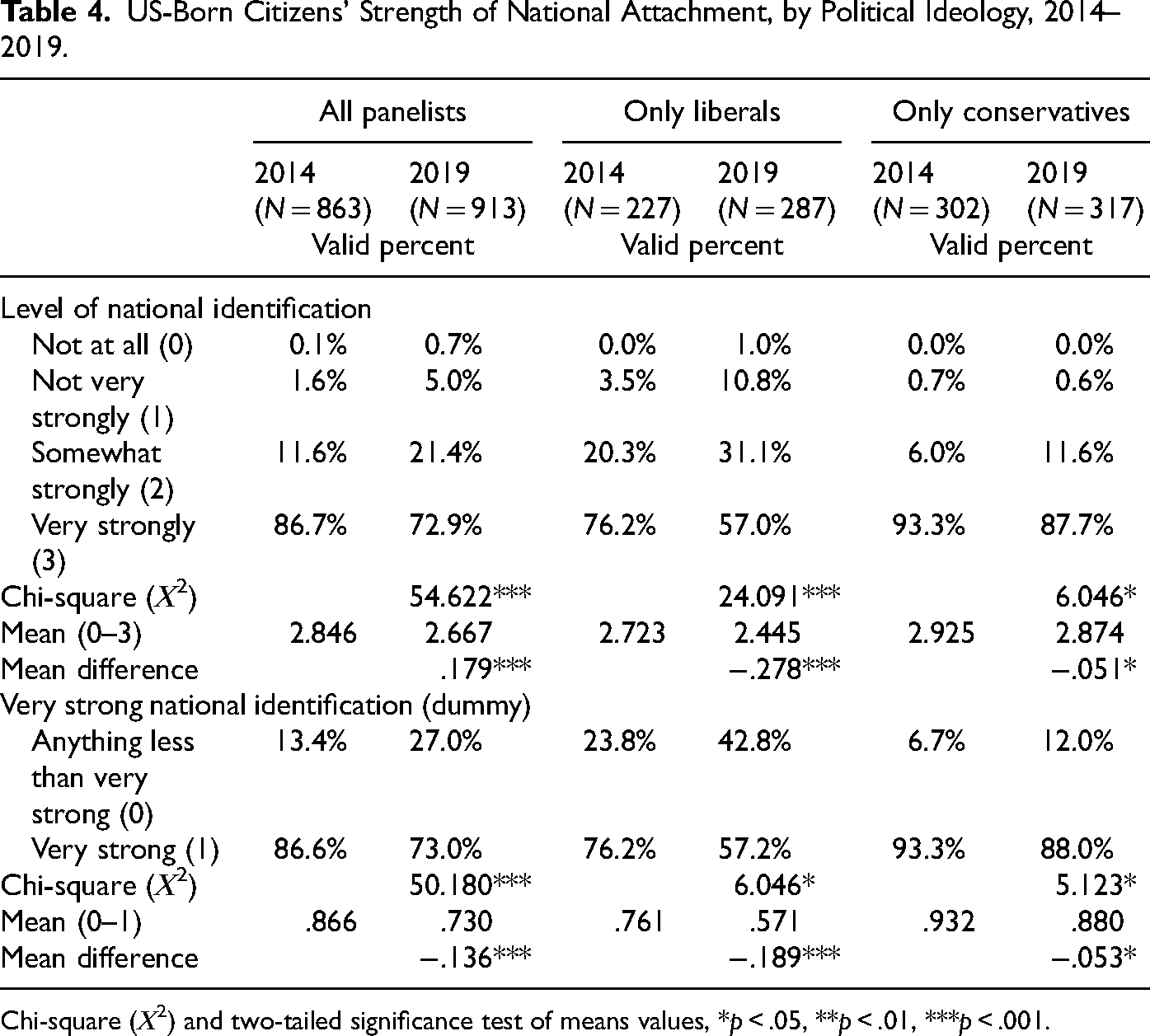
National Attachment: Guided by literature showing that strength of national and other types of “place” attachment are inversely related to migration aspirations and intentions in other national contexts, the first political factor we consider is Americans’ strength of national attachment. Because US-born citizens in general express very high levels of national attachment, 9 we create a dummy for “very strong” American identification (versus anything less than “very strong”) to use in our multivariate models. Regardless of whether we use its original or recoded version, Table 4 shows that strength of national attachment fell between 2014 and 2019, not only in the full sample and among liberals, but even marginally among conservatives, too. That is, just 57.0 percent of liberals identified as “very strongly American” in 2019, a substantial decline from 76.2 percent in 2014 (Χ2 = 24.091, p < .001). But among conservatives, very strong American identification also fell slightly, from 93.3 percent down to 87.7 percent (Χ2 = 6.046, p < .05). These declines in national attachment are consistent with other studies of public opinion during the first Trump Presidency (Citrin et al. 2023), and in keeping with Hypothesis 1, we expect that they will be related to higher odds of expressing migration aspirations among both groups in 2019, especially liberals.
US-Born Citizens’ Strength of National Attachment, by Political Ideology, 2014–2019.
Chi-square (Χ2) and two-tailed significance test of means values, *p < .05, **p < .01, ***p < .001.
Political Ideology and Engagement: Guided by literature showing that that political dissatisfaction and engagement are also related to migration aspirations and intentions in other countries, the second and third political variables we consider are Americans’ political ideology, which we recode down from an initial 7-point scale into a 3-point scale to separate out the conservatives and liberals from moderates in the middle, and Americans’ level of political engagement, which we capture in several ways. First, we create a dummy measuring electoral engagement, based on which panelists self-reported voting in the last US Presidential election (versus did not vote, could not remember, or did not report). Second, drawing on panelists’ responses to a battery of 11 questions offered in each survey year, we also develop a composite measure of their nonelectoral engagement, representing the total number of political activities that panelists reported having participated in over the past year (coded 0–11). Because over 80 percent of our panelists self-report having participated in just two or fewer nonelectoral activities in each survey year, with the large majority of them reporting “none,” we then recoded this composite variable in two ways: first, as a recoded ordinal variable representing whether panelists reported having participated in zero, one to two, or three or more such activities (coded 0–2); and, second, as a recoded dummy representing whether panelists had engaged in any (versus none) of such activities (coded 0 or 1).
For parsimony, we present these results separately for liberals and conservatives (see Tables 5a and 5b). Notably, a very high percentage of both groups (roughly 90 percent) self-reports having voted in the prior US Presidential election in both survey years, with no significant change in electoral engagement occurring among either group over the five-year period in question (Χ2 = .059, p = NS among liberals, and Χ2 = .244, p = NS among conservatives). Differences become more apparent when we turn to nonelectoral engagement, however, where, not surprisingly, there was a significant increase between 2014 and 2019 in the number of liberals who self-reported having attended a political protest or rally (Χ2 = 10.084, p < .001) plus having commented about politics on social media (e.g., Facebook or Twitter) (Χ2 = 14.041, p < .001) in the prior 12 months. By contrast, conservatives pursued different paths, becoming more likely between 2014 and 2019 to self-report having served on a community committee or board (Χ2 = 6.692, p < .01) or having held elected office (3.797, p < . 05) in the prior 12 months. Since our panelists were queried about whether they “signed a petition” only in 2019, we cannot measure change along this variable over time. But a higher proportion of liberals (34.7 percent) reported having signed one in the prior 12 months in 2019 compared to conservatives (20.6 percent).
(a) Liberal US-Born Citizens’ Political Characteristics, 2014–2019.
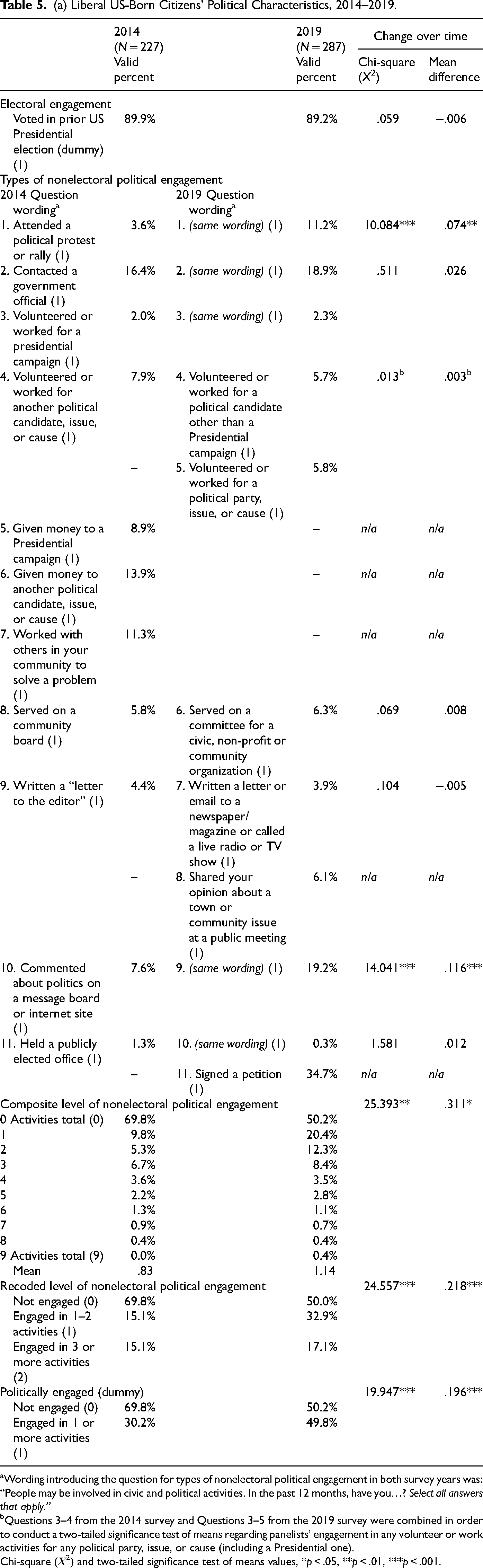
Wording introducing the question for types of nonelectoral political engagement in both survey years was: “People may be involved in civic and political activities. In the past 12 months, have you…? Select all answers that apply.”
Questions 3–4 from the 2014 survey and Questions 3–5 from the 2019 survey were combined in order to conduct a two-tailed significance test of means regarding panelists’ engagement in any volunteer or work activities for any political party, issue, or cause (including a Presidential one).
Chi-square (Χ2) and two-tailed significance test of means values, *p < .05, **p < .01, ***p < .001.
(Continued) (b) Conservative US-Born Citizens’ Political Characteristics, 2014–2019.
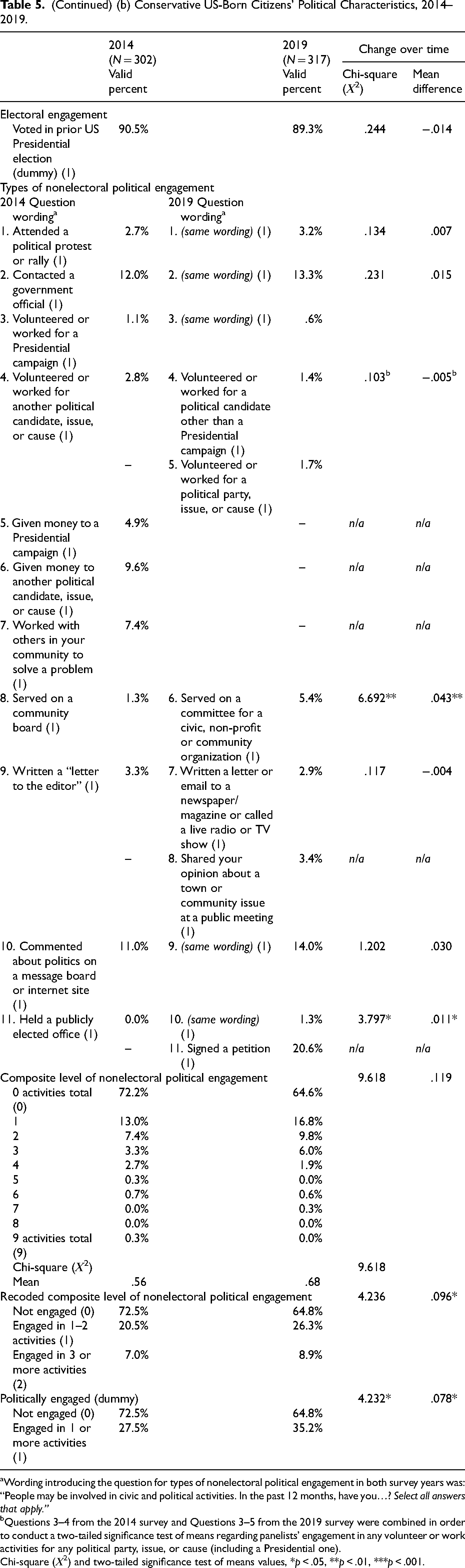
Wording introducing the question for types of nonelectoral political engagement in both survey years was: “People may be involved in civic and political activities. In the past 12 months, have you…? Select all answers that apply.”
Questions 3–4 from the 2014 survey and Questions 3–5 from the 2019 survey were combined in order to conduct a two-tailed significance test of means regarding panelists’ engagement in any volunteer or work activities for any political party, issue, or cause (including a Presidential one).
Chi-square (Χ2) and two-tailed significance test of means values, *p < .05, **p < .01, ***p < .001.
In sum, composite political engagement increased between 2014 and 2019 among both liberal and conservative panelists, and, not surprisingly, the change was larger and more robust among liberals (Andrews, Caren and Browne 2018; Meyer and Tarrow 2018; Fisher and Jasny 2019; Gose and Skocpol 2019; Gilmore 2020). That is, whereas nearly three-quarters of both liberal (69.8 percent) and conservative (72.5 percent) panelists reported being “unengaged” in 2014, parallel figures dropped to just half (50.0 percent) of liberals and two-thirds (64.8 percent) of conservatives by 2019. The increase in engagement among liberals was significant regardless of whether we measure it ordinally (Χ2 = 24.557, p < .001) or as a dummy (Χ2 = 19.947, p < .001). But it was also marginally significant among conservatives when measured as a dummy (Χ2 = 4.232, p < .05).
In keeping with Hypotheses 3a and 3b, we expect that these differential increases in nonelectoral political engagement might be related to either lower (3a) or higher (3b) odds of expressing migration aspirations by 2019, compared to in 2014. Among liberals, who Table 5a shows became significantly more “oppositional” through protest and social media activity over this time period, we suspect this higher engagement in 2019 might work complementarily with higher migration aspiration (3b), perhaps serving as an expression of “resistant exit” during the first Trump presidency (Kirkpatrick 2017; 2019) in a way it did not serve back in 2014. By contrast, among conservatives, we suspect higher engagement in 2019 might work substitutively instead (3a), perhaps serving as a show of greater commitment to their involvement and embeddedness within local community boards and groups.
Controls
Demographic controls: To help isolate these political variables’ unique impacts on Americans’ migration aspirations, we first control for a number of nonpolitical factors that have been used in other studies modeling migration aspirations (Marrow and Klekowski von Koppenfels 2020). We start with age, gender, and race, since age and gender have been shown in prior studies to shape migration aspirations (Coulter 2013; Schewel 2019), and since race operates as a key “dispersive prism” through which Americans consider their identities, opportunities, and senses of belonging both within (Masuoka and Junn 2013; Graeber and Setzler 2021) and outside (Dudziak 1994; Simmons 2008) the nation.
Cultural capital controls: We also control for various “forms of capital” which have been shown to shape both civic and political engagement (Verba, Schlozman and Brady 1995) and migration aspirations and behavior (Gurak and Kritz 2000; Docquier, Peri and Ruyssen 2014; Marrow and Klekowski von Koppenfels 2020; Piguet et al. 2020; Lam and Fong 2023). The first five can be considered measures of cultural capital: an ordinal variable measuring panelists’ highest level of education (less than high school, high school graduate, or 4-year college graduate), two dummies capturing holding a US passport (versus not) and foreign language knowledge (the ability to speak at least one least one foreign language versus only English), and two dummies capturing whether panelists have prior travel/tourism abroad experience (versus none) and prior living abroad experience (versus none). 10
Financial capital controls: Our next five controls are measures of financial capital, including three measures of panelists’ objective financial resources plus two measures of their sense of subjective financial well-being (Van Dalen and Henkens 2013; Docquier, Peri and Ruyssen 2014; Hayes 2014; Theiss-Morse and Wals 2014): a continuous measure of annual pretax median household income; two dummies for currently employed status (versus not employed or not in the labor force) and homeownership (versus not a homeowner); and two ordinal variables to measure panelists’ subjective ratings of the health of their own personal finances and the health of the US economy (ranging from “poor” to “fair” to “good” to “excellent”).
Social capital controls: Finally, we control for four measures of social capital, which can be loosely defined as the resources that derive from individuals’ relationships with others and that can be converted into value (Bourdieu 1986)—here, into potential migration (Docquier, Peri and Ruyssen 2014; Marrow and Klekowski von Koppenfels 2020): a dummy measuring panelists’ 2nd–4th-generation immigrant heritage (versus ancestral heritage that is farther removed); a dummy measuring panelists’ social networks with US citizens who currently live abroad or who have in the past (versus no such networks); and two dummies for household structure—living with partner (versus not) and children under 18 in the household (versus not).
Change over time: Finally, we include a dummy for 2019 survey year (versus 2014), which when used in interaction with national attachment, ideology, or engagement (Mize 2019), allows us to investigate whether the relative contribution of each measure on our panelists’ odds of expression migration aspirations changed in any way between 2014 and 2019.
Multivariate Analysis: How Politics Shapes Aspiration to Exit
Tables 6a and 6b present results from binary logistical regression models predicting whether panelists in our survey expressed, first, either any migration aspiration versus no aspiration, and second, as a robustness check, either clear migration aspiration versus no clear aspiration. Results for both sets of models are presented for the full sample first (in Table 6a), and then separately, between political liberals (see Table 6b, Columns 1–4) and conservatives (see Table 6b, Columns 5–6).
(a) Predictors of US-Born Citizens’ Migration Aspirations, 2014–2019.
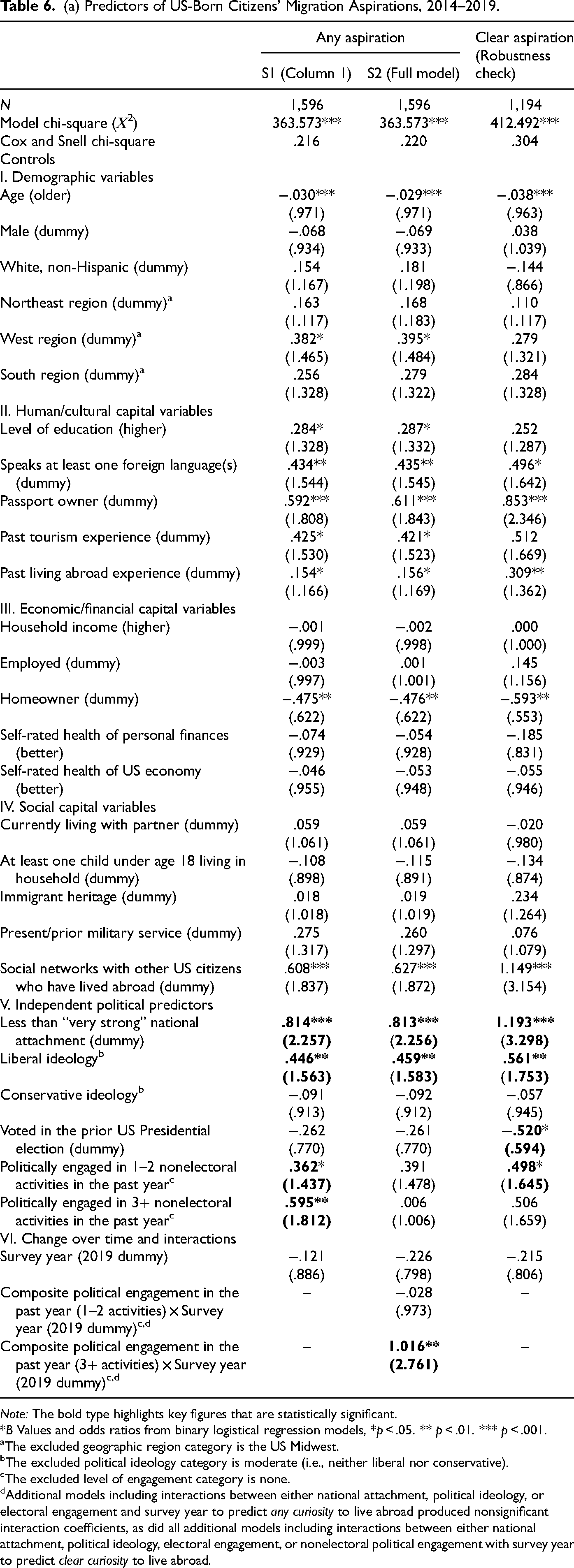
Note: The bold type highlights key figures that are statistically significant.
B Values and odds ratios from binary logistical regression models, *p < .05. ** p < .01. *** p < .001.
The excluded geographic region category is the US Midwest.
The excluded political ideology category is moderate (i.e., neither liberal nor conservative).
The excluded level of engagement category is none.
Additional models including interactions between either national attachment, political ideology, or electoral engagement and survey year to predict any curiosity to live abroad produced nonsignificant interaction coefficients, as did all additional models including interactions between either national attachment, political ideology, electoral engagement, or nonelectoral political engagement with survey year to predict clear curiosity to live abroad.
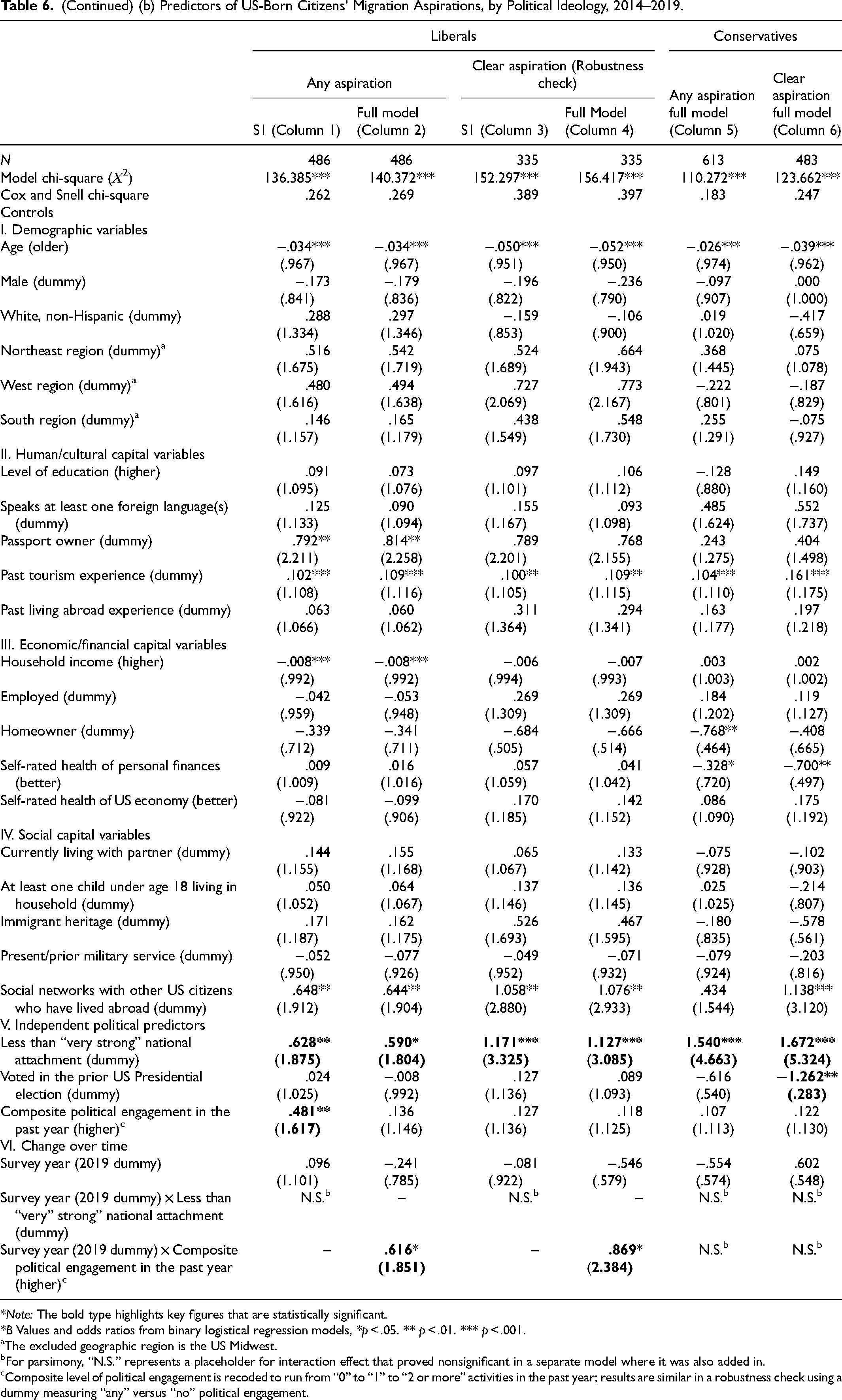
(Continued) (b) Predictors of US-Born Citizens’ Migration Aspirations, by Political Ideology, 2014–2019.
Note: The bold type highlights key figures that are statistically significant.
B Values and odds ratios from binary logistical regression models, *p < .05. ** p < .01. *** p < .001.
The excluded geographic region is the US Midwest.
For parsimony, “N.S.” represents a placeholder for interaction effect that proved nonsignificant in a separate model where it was also added in.
Composite level of political engagement is recoded to run from “0” to “1” to “2 or more” activities in the past year; results are similar in a robustness check using a dummy measuring “any” versus “no” political engagement.
Using the full sample, Table 6a quickly demonstrates, in line with existing literature, that several nonpolitical predictors raise panelists’ odds of expressing migration aspirations, even in the clear aspiration robustness check: being younger, speaking at least one other language in addition to English, owning a US passport, having prior experience living abroad, not being a homeowner, and knowing other Americans with prior experience living abroad. But even considering those factors, so too does being a less than very strong national identifier, being liberal, and being more engaged in nonelectoral politics. A few other predictors contribute to higher odds of expressing any but not also clear aspiration in our robustness check: living in the US West, having more education, and having prior short-term international tourism experience. Vice versa, only one factor (voting) contributes to lower odds of expressing clear aspiration, lending some support to Hypothesis 3a, with electoral engagement appearing to operate substitutively to lower a more serious consideration of emigration.
Finally, most of the interaction effects between survey year and the three political predictors are nonsignificant, indicating that their influences on Americans’ odds of expressing migration aspirations stayed roughly the same across the two survey years. However, one interaction is significant; panelists who are highly politically engaged (in 3 or more activities over the prior year) had significantly greater (2.761) odds of expressing any migration aspiration in 2019 compared to unengaged panelists, versus only 1.812 higher odds than unengaged panelists back in 2014. In other words, nonelectoral political engagement appears to work complementarily with migration aspiration. Not only do panelists who are moderately politically engaged (in 1–2 activities over the prior year) have between 1.437 and 1.645 higher odds of expressing migration aspiration, compared to unengaged panelists. But panelists who highly engaged (in three or more activities over the prior year) have even higher odds, especially by 2019, supporting Hypothesis 3b.
To investigate these results in more detail, Table 6b presents results of multivariate models separately for political liberals versus conservatives (leaving out the self-identified moderates in between). Here, we see that the relationship between weaker national attachment and migration aspiration remains both strong and consistent, among both liberals and conservatives alike, and in both survey years. That is, roughly one-third of liberal panelists in our pooled sample (34.5 percent) feels less than “very strongly” attached to the nation, and compared to their liberals who are very strong identifiers, they have 1.875 higher odds of expressing any aspiration and 3.325 higher odds of expressing clear aspiration (see Columns 1–4). By comparison, fewer conservative panelists in our pooled sample (9.5 percent) express anything weaker than “very strong” national attachment, but those who do also have higher odds of expressing both any (4.663 higher odds) and clear (5.324 higher odds) aspiration, compared to conservatives who are very strong identifiers (see Columns 5–6). These results lend strong support to Hypothesis 1. Nevertheless, nonsignificant coefficients on all of the interactions between survey year and national attachment shown in Columns 1, 3, 5, and 6 demonstrate that impact of weaker national attachment on the odds of expressing aspiration stayed roughly the same under the first Trump administration as it worked under the second Obama one.
By contrast, we see that political engagement continues to operate asynchronously, now varying by panelists’ ideology, too. On one hand, we see that the substitutive impact of higher electoral engagement is concentrated only among conservative panelists in 2019, and in the model predicting clear aspiration (see Column 6), perhaps because they had likely just voted for an ideologically-similar candidate (Trump) in the previous election. We surmise that the strong main association between liberal ideology and migration aspiration shown earlier might potentially explain why we do not also see similar associations between electoral engagement and clear aspiration among liberals back in 2014.
On the other hand, the complementary effect of higher nonelectoral engagement on both any and clear aspiration is now concentrated only among liberal panelists in 2019 (see Columns 2 and 4). One interpretation of this is that, following the contentious 2016 US Presidential election, both liberal and conservative Americans started to feel more “detached” from the polity (Table 4), with one of them—liberals, the group more likely to be affiliated with the losing party and candidate—feeling especially detached (e.g., Lench et al. 2019) and responding by funneling their disenchantment and disapproval into new oppositional forms of politics, such as joining protests, signing petitions, and commenting about politics on social media (Table 5a). Plausibly, this engagement then led liberals to also begin expressing significantly higher aspirations to “exit” and live elsewhere, as symbolic form of “resistant exit” (Kirkpatrick 2017; 2019) intended to complement these other “vocal” activities.
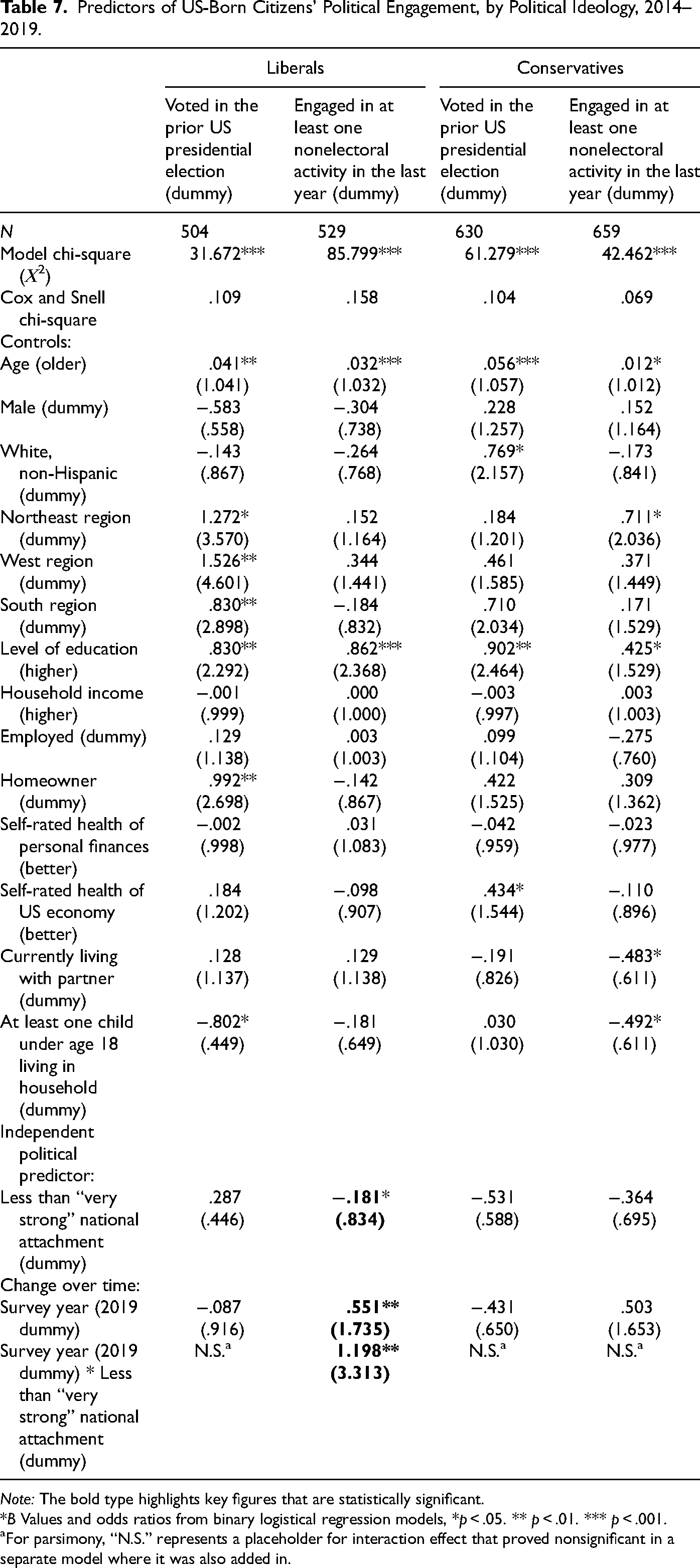
Mediation analysis: To investigate this possibility empirically, we present results from new binary logistical regression models estimating the relationship between strength of national attachment and our panelists’ levels of both electoral and nonelectoral engagement, after controlling for other factors. Table 7 shows that among liberal panelists, weaker national attachment typically yields .834 lower odds of being nonelectorally engaged. However, the 2016 election did activate this group; while all liberals in our sample had 1.735 higher odds of being nonelectorally engaged by 2019, compared to in 2014, those with less than very strong national attachment had especially higher (3.313) odds, compared to liberals who were very strong national identifiers. Results from two Sobel tests for mediation (Preacher and Hayes 2004) provide further confirmation for higher nonelectoral political engagement acting as a mediator to “carry” some of the influence of liberals’ declining national attachment over onto to their rising aspirations to live abroad, even after controlling for the direct effects of weaker national attachment. 11 There is no evidence of similar mediation among conservatives, 12 of course, since conservatives’ decline in national attachment over this period was more marginal (see Table 4), plus not uniquely associated with an increase in their nonelectoral engagement in the first place (see Table 7). Indeed, even though conservatives may have been politically discontent during the Obama era, their levels of national attachment appear to have stayed strong enough to assuage any impact on migration aspiration.
Predictors of US-Born Citizens’ Political Engagement, by Political Ideology, 2014–2019.
Note: The bold type highlights key figures that are statistically significant.
B Values and odds ratios from binary logistical regression models, *p < .05. ** p < .01. *** p < .001.
For parsimony, “N.S.” represents a placeholder for interaction effect that proved nonsignificant in a separate model where it was also added in.
Discussion
Skimming the headlines over the past decade, one might be tempted to think that Americans’ interest in moving abroad is a “growing trend” (Tolson 2018) that has reached “record numbers” (Ray and Esipova 2019; Ray and Pugliese 2024) and is now poised to “surge” (Hoffman 2024) and “skyrocket” (Pitrelli 2024) still further, in the wake of Donald Trump's reelection to a second term on November 5, 2024. 13 However, using a nationally-representative sample, we have shown here that US-born citizens’ aspirations to live abroad, when measured more comprehensively, actually stayed stable between 2014 and 2019—a period in which the United States witnessed deepening political polarization, Trump's first and hotly-contested Presidential election, and the emergence of mass political protest. Indeed, a full two-and-a-half years into Trump's first presidency, for a majority (55.5 percent) of Americans, we find that the idea of living abroad was still not on their radar at all. And while left-leaning panelists in our sample are indeed more likely than conservatives to consider living abroad, not only did liberals continue to rank exploration and adventure as their primary motivations in 2019, but it was also only in rare cases that their considerations appeared very serious, with just 6.3 percent of liberal panelists (and 2.2 percent of their conservative counterparts) reporting wanting to figure out how to make a move abroad happen someday, or having already begun making plans to do so, in that year. In other words, for most Americans, the idea of moving to another country remained only an abstract and potential “consideration” under the first Trump presidency (see Table 2b)—a fact we think gets commonly overlooked in today's rapidly-expanding “selective storytelling” about the connection between Americans’ growing dissatisfaction with the state of US politics and their desire to “willfully emigrate” (Fields 2024).
Most broadly, our study is relevant because it adds migration aspirations into ongoing scholarly reconsiderations of the classic relationship between loyalty, voice, and exit (Hirschman). In its original conception, while loyalty and voice were envisioned as continuous variables, exit was only seen as dichotomous: “One either exits or one does not” (Hirschman 1970, 15–16, cited in Hoffman 2010, 57). Today, however, migration scholars argue that migration is a multi-step process that often begins with earlier pre-migration mental planning (including the imagining of migration) (Koikkalainen and Kyle 2016; Cangià and Zittoun 2020), which “may or may not result in actual mobility” later on (Carling and Schewel 2018, 947; Dinbabo, Badewa and Collins 2021). Accordingly, we argue that, like migration behavior, so too can migration aspirations be simultaneously envisioned as either part of a continuous “exit” response to political dissatisfaction at home, or a meaningful extension of domestic “voice.”
Our study is also relevant to literature on both migration aspirations from the Global North and multicausal theories of migration, not merely because it is among the first to integrate political factors into the combination of instrumental (i.e., economic/material) and expressive (i.e., social/cultural/lifestyle) motivations that are typically attributed to aspiring and actual Global North migrants, but also because it relies on a nationally-representative sample, as opposed to convenience or snowballed ones, to investigate politics’ role in Americans’ premigratory considerations. Consistent with other studies conducted outside the Global North, we confirm that strength of national attachment is inversely related to Americans’ interest in potentially living abroad. But we also go a step further to show that national attachment works strongly and consistently among opposing political subgroups in our sample, across varying political regimes. Vice versa, political ideology and political engagement operate more asynchronously, with liberal ideology being positively associated with higher migration aspirations in general, instead of ideology itself serving as direct measure of political discontent with a specific governing regime. Finally, to the extent political discontent may impact Americans’ migration aspirations, it appears to do so largely via declining levels of national attachment, which we find manifested in oppositional forms of politics (like protest and social media-posting) among liberals only after 2016, as complementary forms of “resistant exit.”
What do these results entail for the near future? First, we surmise that they forebode greater stability in Americans’ migration aspirations than the flurry of immediate post-2024 election headlines are wont to suggest (Blake 2024a, 2024b; Castillo 2024; Jackson 2024; Parks 2024), especially when some allege that American migration aspirations are “about to go into overdrive” (Adamcyk 2024). Instead, our results from 2014 to 2019 suggest that even when Americans do express aspirations to live abroad, such aspiration will likely remain concentrated more toward the realm of possible consideration than imminent intention (see also Alter 2012, 2016; Lange 2016). In addition, our results suggest that even when migration aspirations do emerge, they will not only continue to be motivated largely by social and lifestyle factors other than politics (such as seeing the world or finding a more fulfilling, rewarding, or sustainable lifestyle) but also be stronger among weak national identifiers and political liberals, rather than equally valent from both sides of the political aisle. Indeed, we think it quite unlikely that conservatives’ odds of expressing migration aspirations grew very much during the Biden presidency of 2020–2024, if conservatives’ levels of national attachment also remained high. And conservatives’ odds of expressing migration aspirations may now go down during the second Trump presidency, if their electoral “voice” continues working against potential “exit,” as it did under the first.
By contrast, our results suggest that news coverage focusing on the connection between political discontent and migration aspirations among self-identified liberals, including those who are also members of racial or gender minority groups (e.g., Gill 2019; Greene 2020; Kjlemgaard 2020; Kowitt 2020; West Savali 2020; Baja California News and Expat in Mexico 2021; Miles 2022; Moulson 2024; WeGlobal n.d), may have more traction. It is even likely that concerns about racism, police and political violence, and the health of US democracy became more salient and more strongly connected to migration aspirations among this group between 2020 and 2024, despite rough ideological convergence with a Democratic governing regime. 14 Nevertheless, it remains to be seen whether the complementary relationship that we have uncovered between liberals’ greater nonelectoral political engagement and their migration aspirations in 2019 may have either dissipated during the Biden years, or perhaps will increase again now after 2025. Our results suggest the answers to these questions will hinge on liberals’ strength of national attachment, plus on how they choose to channel such attachment and/or their political frustrations at these different points in time—perhaps through continued oppositional politics, through electoral or other more integrative forms of politics, or through resignation and a new “hunkering down” from the political scene instead Thebault 2024).
Either way, in the years ahead, we think it could be particularly promising to gather more (and more specific) measures of Americans’ political attitudes, orientations, anxieties, and forms of discontent to include within future models of Americans’ migration aspirations. To be sure, ours is one of the first studies to bring politics into the equation at all. But news coverage seems to suggest that, by the early 2020s, Americans have become widely discontent not merely with their ideologically-opposing leaders and parties, but also the state of political polarization, ongoing gridlock in Congress, and an antagonistic political culture more generally. Still other media coverage seems to suggest that Americans have become increasingly anxious about the state of the US economy, the state of US democracy, and preserving their rights and freedoms—whether they be the right to bear arms or to speak freely (from the right) or freedom from discrimination and control over their own reproductive decisions (on the left). Consequently, we think more direct measures of distinctive forms of political distrust and disaffection than we have been able to model here—for example, measures of Americans’ assessments of their national- and even state-level political leadership, measures of Americans’ levels of trust in each other and the government, measures of Americans’ levels of (un)certainty about the future of democracy or distinct political rights, measures of Americans’ opinions about racism, sexism, gun ownership, or the police, or even measures of Americans’ perceptions about specific forms of past or anticipated discrimination—could help to advance our collective understanding of what precisely different groups of people are discontented with and/or uncertain about (or not), and how such considerations be related (or not) to their premigratory considerations about whether to move or to stay, alongside the roles other nonpolitical factors play, too. We leave these ideas for future scholars to pursue.
Footnotes
Acknowledgments
Special thanks to Irene Browne, Margaret Hagerman, Joya Misra, Natasha Kumar Warikoo, Debbie Schildkraut, Cinzia Solari, IMR editors, and four anonymous reviewers for helpful feedback.
Declaration of Conflicting Interests
The authors declared no potential conflicts of interest with respect to the research, authorship, and/or publication of this article.
Funding
The author(s) disclosed receipt of the following financial support for the research, authorship, and/or publication of this article: We gratefully acknowledge several funding sources for the 1st wave of our survey in 2014: the Faculty Research Fund from the Faculty of Social Sciences at University of Kent, the Research Support Fund of the School of Politics and International Relations at the University of Kent, and the 2014 Summer Faculty Fellowship from the Faculty Research Awards Committee at Tufts University.
