




Abstract
Scholars who study the children of immigrants in North America and Western Europe have developed several paradigms to analyze the second generation's ethnicity. The major ones are options, capital, and boundary-making. This article contributes to this literature by exploring the emerging formation of second-generation identity in East Asia. Although the region is known for its self-perceived racial and ethnic homogeneity, an influx of marital immigrants and their bicultural children has transformed its demographic landscape. Through in-depth interviews with 57 adult children from cross-border marriages in Taiwan, this article examines their strategies for identity management under the typologies of majority identity, biculturalism, rescaling, and differentiation. Because of changing receiving contexts as a result of the state's policy of geopolitical multiculturalism, a bicultural identity has increasingly become a likely option for children of Southeast Asian mothers. Ethnic dividends are mostly available for university students with academic capital, but they are not equally accessible to children of PRC-Chinese immigrants. While the boundaries dividing “Taiwanese,” as the mainstream national group, from immigrants and their offspring have shifted and softened in recent years, second-generation children are obliged to become national subjects whose ethnic identity does not conflict with national loyalty and whose patriotic duty is to convert their ethnic capital into transnational networks.
Over the last few decades, several million women from Southeast Asia and Mainland China have taken part in marriage migration to Taiwan, Singapore, Japan, and South Korea. Marital immigration provides women from lower-ranked countries in the global hierarchy with a pathway of spatial hypergamy (Constable 2005) and helps to relieve bride deficits, labor shortages, and masculinity crises in destination societies (Friedman 2015; Kim 2018). Cross-border marriages and the resulting children of mixed heritage have reconstituted the ethnoscape in East Asia, a region characterized by its alleged ethnic homogeneity and restrictive immigration policies. These children are now reaching adulthood, but their identity formation has yet to receive sufficient academic scrutiny.
The existing literature on second-generation immigrants, primarily focused on North America and Western Europe, has elaborated various theoretical approaches. These incorporate views of ethnicity that I characterize as an option, a form of capital, and boundary-making. However, the emerging second generation in Asia evinces a distinct ethnic pattern and thus offers great potential to reconstruct the relevant theories. Due to the restrictive immigration policies in East Asia, most second-generation children have only one immigrant parent, usually their mother. Like interracial marriages, this situation involves increased negotiations with cultural boundaries and ethnic identity for the next generation. The East Asian states have highly intervened in the governance of marriage migrants and their children. These policies and programs implemented variant models of “multiculturalism with adjectives” by coupling multicultural rhetoric with assimilation initiatives (Chung 2020). They also indicate an emerging regime of “geopolitical multiculturalism,” whereby multiculturalism serves the additional purposes of national development and geopolitical interests (Lan 2023a).
This article focuses on Taiwan, where immigrant spouses currently account for about 2.3 percent of the total population. Cross-border marriages increased in Taiwan during the 1990s and peaked in the early 2000s. In 2003, 28.4 percent of newlywed couples consisted of Taiwanese men and foreign women, in the context of declining marriage rates among Taiwanese nationals. According to the latest government statistics, Chinese spouses accounted for 65 percent of the total population of marital immigrants (569,851), while Southeast Asian spouses occupied 17 percent (National Immigration Agency 2023).
The presence of second-generation children becomes significant, given the declining fertility rate in Taiwan. In the peak year of 2003, 13 babies were born to an immigrant mother for every hundred newborns (Ministry of the Interior 2023). In the 2013–2014 academic year, nearly 10 percent (or about 210,000) of all primary and secondary school students had an immigrant parent (40 percent from Vietnam, 37 percent from China, and 12 percent from Indonesia). 1
Drawing on in-depth interviews with 57 adult children of cross-border marriages in Taiwan, this article examines how these members of the second generation navigate the complex landscape of ethnic identity in the current policy context of geopolitical multiculturalism. I demonstrate that the boundaries between natives (Taiwanese) and marital immigrants, along with their children, have softened in recent years, creating space for children of Southeast Asian immigrants to claim their bicultural identity as an option. By contrast, children of Chinese immigrants are not as eligible for such multicultural dividends and thus develop different strategies to cope with the geopolitical stigma associated with their PRC connections. In conclusion, I identify other personal attributes that shape the second generation's divergent inclinations toward identity work.
Ethnicity as an Option, Capital, and Boundary-Making
How does the second generation negotiate and manage ethnic identity, leading to the uneven consequences of cultural assimilation and social mobility? This question has occupied the central debate in North American immigration studies (Portes and Rumbaut 2001; Luthra, Waldinger, and Soehl 2018). However, how ethnicity is conceptualized in this literature requires further discussion. I identify three major conceptual directions: ethnicity as an option, ethnicity as capital, and ethnicity as boundary-making.
First, scholars have argued that ethnic identity can be a symbolic option, especially for the descendants of European immigrants in the United States. Gans (1979) proposed the notion of “symbolic ethnicity” to describe how, in a new stage of acculturation, ethnic identity revolves around the selective use of ethnic symbols connecting, often nostalgically, with the immigrant past. Similarly, Waters (1990) finds that middle-class whites from mixed ethnic backgrounds choose to express and identify their ethnicity, which hardly affects their life chances, in the form of voluntary or optional acts. This emphasis on the symbolic and voluntary dimension of ethnicity has led scholars to explore postmodern practices of ethnic identity, such as the “flexible identity” of Hispanic whites (Vasquez 2010) and even “affiliative ethnic identity” (Jiménez 2010) with an elastic link between ancestry and culture. However, this approach is criticized for overemphasizing self-ascription and conscious choice in the making of ethnic identity (Anagnostou 2009). Studies of racial minorities such as Latinos and Asian Americans indicate that their experience of ethnic identification is closer to something that is enforced than an option (Tuan 1998; Vasquez 2010).
Second, some scholars view ethnicity as a form of capital or a cultural tool for the second generation. Portes and Zhou (1993), in their famous theory of segmented assimilation, identify three different mobility pathways for the second generation of immigrants. Some achieve upward mobility through integration into white society with a diluted ethnic identity. Others become assimilated into urban minority life and face the prospect of downward mobility. Lastly, the trajectory of selective acculturation allows the second generation to achieve class mobility while retaining close social ties and a shared cultural identity with immigrant communities.
Zhou (1997, 2009) further proposes the concept of “ethnic capital” to describe how immigrant families’ social ties with coethnics and the cultural capital provided by ethnic institutions, such as after-school programs, can help their children achieve educational success and economic mobility. Other scholars (Yang 1999; Chen 2008) similarly find that coethnic NGOs and churches can help immigrant parents and children absorb new cultural resources that ease adaptation to larger American society. In addition, transnational connections with their ancestral country can also help the second generation bolster their ethnic identity and bicultural pride (Kibria 2002; Purkayastha 2005; Dhingra 2007). In addition to its cultural or linguistic value, ethnic capital also refers to preferential treatment and instrumental outcomes minority groups receive in education and other arenas through affirmative action policies (Warikoo 2016).
Finally, several scholars have cautioned against taking ethnic groups as self-evident subjects of observation and analysis and urged researchers to examine how ethnic boundaries transform and resolve (Brubaker 2004; Wimmer 2009). This approach to boundary-making has become influential in migration studies, especially with neo-assimilationist theory. In this vein, Alba and Nee (2003, 11) redefine assimilation as “the weakening of ethnic divisions and the corresponding cultural and social differences.” The transformation of ethnic boundaries, including the increase in permeability, may occur through actions initiated by groups on both sides. In particular, the increasing number of mixed Americans out of majority-minority marriages and the fluidity of their self-labeling demonstrate that the mainstream has become increasingly pluralistic and associated with “decategorization” in the sense that social relations are not primarily determined by categorical differences in the ethnonational membership (Alba 2020, 7).
However, critics have argued that even as immigrants and their descendants are integrated into the mainstream, they still face domination and inequality stemming from unequal power dynamics between the majority and minority groups (Jung 2009). It is, therefore, important to investigate how second-generation individuals negotiate ethnicity through everyday boundary work. Zolberg and Woon (1999) identify three processes by which immigrants and natives negotiate the divisions between “them” and “us”: (1) individual boundary crossing, where the boundary does not change even if migrants have accumulated mainstream cultural capital or can pass through identity management; (2) boundary-blurring, in which the boundary itself becomes blurred, and personal positioning is ambiguous, such as with hyphenated identity; and (3) boundary shifting, whereby the boundary changes and repositions the outer group as the inner group.
Existing studies on second-generation immigrants center on the experiences of those in North America and Western Europe, but the emerging second-generation in Asia has its distinct background. First, regarding family patterns, most second-generation Asian children have only one immigrant parent, typically their mother. Because of restrictive immigration policies, especially limitations on family reunification, immigration occurs primarily at the individual level, and the dominant migration pathway is marriage.
Children of transnational marriages face a more complex set of identity options than those with two immigrant parents. Western-centric literature tends to view interracial marriage as a facilitator of cultural integration (De Hart 2015), and hyphenated biracial identities have increasingly become an “ethnic option” for mixed-raced offspring (Waters 1990). However, interracial marriages do not necessarily weaken racial boundaries or the stigma of hybridization (Rodríguez-García 2015). For nonwhite persons of mixed backgrounds, their capacity to “choose” ethnicity is conditioned by internal and external factors such as social class, gender, and the (in)flexibility of ethnic and racial classifications in the larger society (Song 2003). When the minority parent is male, native-born, or nonwhite, such interracial couples are more likely to identify their children as minorities than are those in which the minority spouse is female, foreign-born, or has some white ancestry (Qian 2004). In addition, second-generation individuals with higher socioeconomic status are more able to turn a multicultural background into an asset, while those of lower status experience more discrimination and exclusion (Kalmijn 2015).
In traditional immigration countries such as those in North America and Western Europe, mixed-background people are mostly the offspring of native-born, interethnic/interracial couples (Osanami Törngren, Irastorza, and Rodríguez-García 2021). By contrast, in East Asia, children of mixed heritage were born from cross-border marriages primarily composed of native men and foreign women. The majority of these native fathers have lower educational attainment and socioeconomic status (Constable 2005). Immigrant mothers, who lack kin networks and ethnic capital in the host country and are constrained by gender hierarchy within patriarchal family structures, often find it challenging to negotiate a bicultural upbringing for the next generation (Nakamura 2016; Park 2017; Liu-Farrer 2020).
Secondly, the receiving contexts for marital immigrants in East Asia are governed by ethnonationalism as a state ideology. East Asian societies generally hold to a self-image of racial and ethnocultural homogeneity despite the existence of historically oppressed minority groups. Although host states have recently developed multicultural policies to cope with the changing ethnoscape, these programs are criticized for focusing narrowly on the acculturation of immigrants into the dominant society and exoticizing their foreign culture (Kim 2007; Ahn 2018; Chung 2020). Immigrant mothers are further subject to the gendered mode of “familial citizenship” (Chiu and Yeoh 2021) and “ethnicized maternal citizenship” (Kim 2013). Their access to legal and substantive citizenship in the host country is conditioned on their gendered roles as biological and social reproducers, but these duties simultaneously relegate them to the category of ethnic others.
Finally, coethnic marriages, involving native men and diasporic women in most cases, are also prevalent in this region. Coethnic migrants occupy a liminal position in East Asian citizenship and multiculturalism regimes. Many receiving countries offer more tolerant policies for coethnic immigrants (e.g., nikkeijin in Japan, choseonjok in South Korea, and huaqiao in Taiwan) (Tsuda 2003; Kim 2016). Yet, the intersection of cultural proximity and political distance, such as the reception of PRC Chinese migrants in Taiwan, can stoke concerns in the host society and lead to strict border controls and restrictive citizenship policies (Friedman 2015). Children of coethnic marriages must navigate the ambivalent boundaries along the intersecting lines of citizenship, ethnicity, and nationality.
Drawing on the case of second-generation youth in Taiwan, whose immigrant mothers originate from either Southeast Asia or PRC China, this article explores the following question to engage in the theoretical debate about ethnicity: How do second-generation adult children develop different strategies for identity management? What institutional contexts enable or constrain their conversion of immigrant backgrounds and transnational connections into ethnic capital? What social factors shape their intention and capacity to claim bicultural identity as an option? And, how do these youngsters negotiate the native–immigrant or majority–minority boundaries across social situations?
Background: From Bright to Softened Boundaries
The changing terminology used to describe second-generation children in Taiwan indicates how the ethnonational boundaries have expanded and softened in the past few decades. In the 1990s and 2000s, the Taiwanese government called the children of immigrant mothers “new Taiwanese children” (新台灣之子), a term that carries strong connotations of assimilationism. The official label has recently been changed to “new second generation” (新二代), giving them a group identity and positively affirming their immigrant backgrounds and multicultural heritage (Lan 2019).
It is also important to situate the labels for immigrant children in the broader context of shifting ethnonational boundaries in Taiwan. The “New Taiwanese” identity emerged in the 1990s to mark a distinction from the Chinese identity, while encompassing four major ethnic groups in the island, including Mainlander, Hoklo, Hakka, and Aboriginal people (Wang 2016). The policy of Taiwanization during Chen Shui-bian's administration from 2000 to 2008 further strengthened Taiwanese identification, especially among younger cohorts (Schubert and Damm 2011). The recent waves of marital immigration from Southeast Asia have created new racial and ethnic frontiers in the country. At the same time, the migration of coethnics from the PRC challenges the ambiguous boundary between Taiwanese and mainland Chinese.
Taiwan's regulations on marriage migration in the 1990s and 2000s demonstrate a regime of “reproductive assimilation,” which aimed to manage the potential risk that immigrant motherhood brings to “population quality” through assimilation-oriented projects that monitored childbirth and childrearing (Lan 2019). Driven by multiple social forces, including civil activism and geopolitical trends, the policy regime related to marital immigrants and their children has transformed over the years, making the clear boundaries between natives and immigrants increasingly fuzzy.
NGOs and activist groups in Taiwan have strategically framed their movement's agendas within the mainstream political narratives of democracy, human rights, and multiculturalism (Hsia 2008). In addition, the Taiwanese government has also been pressured by the international community, including the US State Department with its annual Trafficking in Persons Report since 2001, to regulate marriage migration and minimize its association with human trafficking (Cheng and Momesso 2017). As a result, the government has gradually expanded social rights for marital immigrants, including granting easier access to the job market prior to naturalization and directing much funding to social services for immigrants. Political discourses in Taiwan have gradually moved away from a linear view of assimilation toward support for mutual cultural exchange and the idea that Taiwanese society can and should learn from immigrants.
A sea change occurred in 2016 when then-President Tsai Ing-wen promulgated the New Southbound Policy (新南向政策, NSP hereafter) to forge strategic partnerships with sixteen countries in Southeast Asia, South Asia, Australia, and New Zealand. The NSP serves as a developmental and geopolitical strategy to increase Taiwan's regional significance and diversify its economic and geopolitical risks (Hsia 2021). Given the lack of formal diplomacy between Taiwan and Southeast Asian countries, the NSP focuses on enhancing so-called people-centered interactions, such as trade, tourism, and education. Politicians and government officials have used the familial expression “natal-home diplomacy” to instrumentalize Southeast Asian women's roles as “transnational mothers and daughters” and reimagine them as a pool of cultural and social capital (Cheng 2021a).
The new second generation, especially children of Southeast Asian immigrants, are intended beneficiaries in the era of “geopolitical multiculturalism” (Lan 2023a). Both the central and local governments have devoted significant institutional resources to cultivating linguistic skills and cultural knowledge connected to immigrant mothers’ home countries. The Ministry of Education provides grants for the children of immigrants to visit their maternal grandparents during summer vacation and offers fellowships for them to study in Southeast Asia. Various government entities hold summer camps for the new second generation in the region, which include visits to and internships at Taiwanese-owned factories. Additionally, Southeast Asian languages received institutional recognition when incorporated into the mother-tongue language curriculum in all elementary schools in the 2018 academic year. The rest of this article will investigate how members of the new second generation negotiate their identities against these changing policy contexts.
Data and Methods
From August 2019 to January 2024, we conducted in-depth interviews with 57 second-generation young adults in the age range of 20 to 30. All of them had one immigrant parent (mostly their mothers, except for one father) who emigrated to Taiwan via marriage. The semistructured interviews covered a wide range of subjects, including their experiences growing up and acculturating in cross-border families, how their immigrant backgrounds shadowed their interactions with teachers and peers, and how they evaluated relevant policies and programs and navigated their second-generation identity.
We recruited informants through various channels, including personal connections (through the social networks of my research assistants), post-interview respondent referrals, referrals from migrant NGOs working with marital immigrants, and by posting advertisements on appropriate internet forums (PTT and DCARD) to recruit volunteers. We also used purposive sampling to maintain sufficient diversities in our sample (see Table 1). In total, we interviewed 35 women and 22 men. Thirty-seven interviewees have an immigrant parent from Southeast Asia, including 22 from Vietnam, while the remaining 20 have a mother from Mainland China. The subjects’ educational achievements varied. Eight had acquired or were currently working on postgraduate degrees; 24 had graduated from or were currently studying in national universities, which are the higher-ranked institutions in Taiwan; 17 had graduated from or were presently studying in private universities or vocational colleges; and eight had completed high school only.
Characteristics of Second Generation (SG) Interviewees.
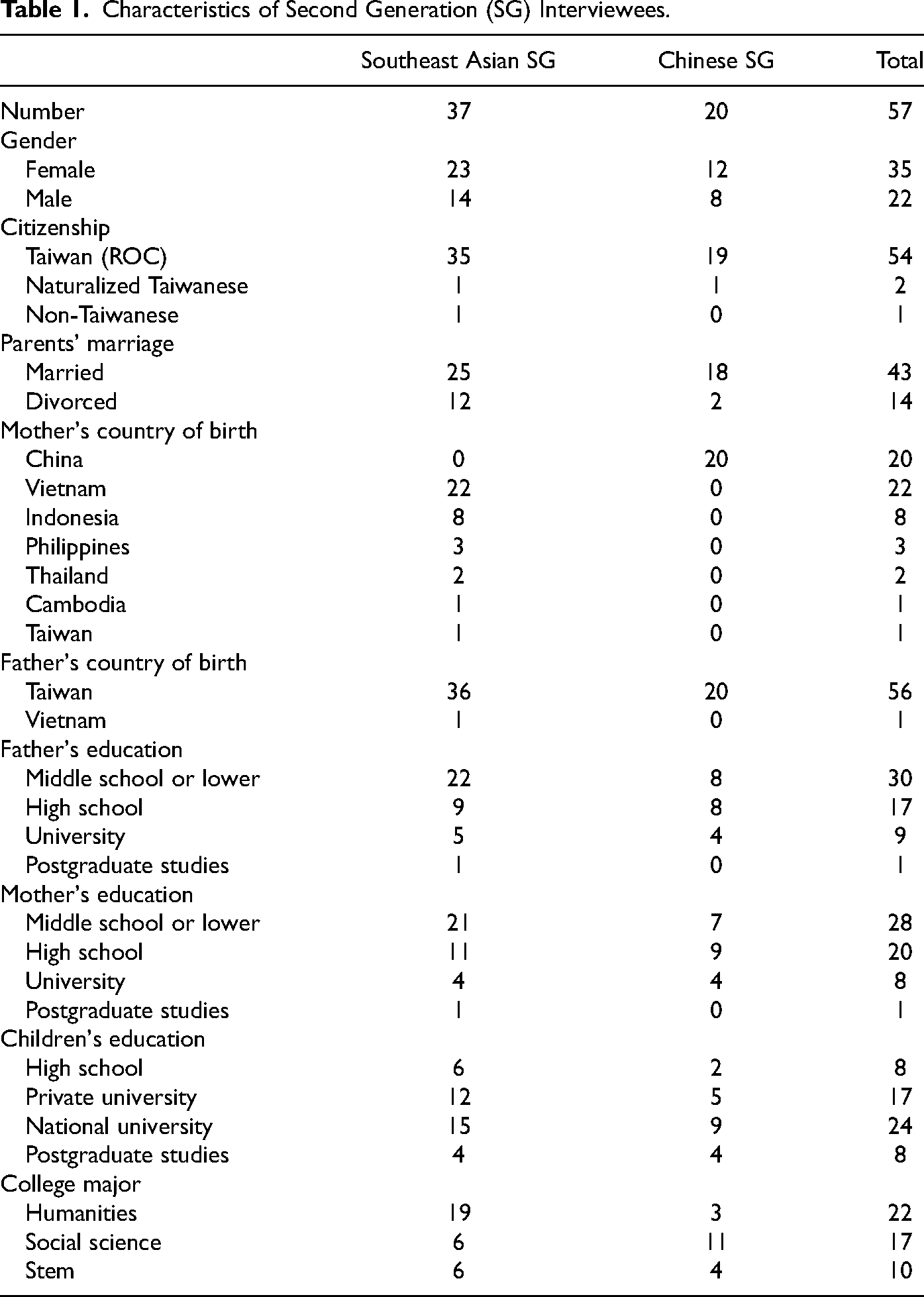
To build better rapport with the informants, I hired two female research assistants of similar age and background (one's mother is Vietnamese, and the other's mother is PRC Chinese) to conduct most of the interviews, except for three that I carried out. We interviewed participants at coffee shops, on campus, and via virtual meetings during the COVID-19 pandemic. The informants were offered a gift card of NT$500 (approximately 17 USD). Interviews usually took one and a half to two hours, with some exceptions lasting as long as three hours. They were conducted in Mandarin Chinese and translated by me into English when quoted. All names that appear in this article are pseudonyms.
All the interviews were audiorecorded and transcribed fully. I started with open coding by indexing the transcripts and tracking emerging themes that became the basis of analytical codes. We later uploaded all the transcripts into MAXQDA and applied the analytical codes to integrate relevant data. The interview questions related to the theme of identity management included: What do you think of the terms “new Taiwanese children” and “new second generation?” Do you use these terms to describe your identity or prefer something else? How would you describe your ethnic identity? Why? Does this (identification) change across contexts or depending on whom you interact with? If so, how is it different? Based on the informants’ narratives in response to these questions, I sorted them into four categories representing different approaches to identity work and labeled them with concepts like majority identity, biculturalism, rescaling, and differentiation. The process of conceptualization was also informed by engaging with the literature on the second generation.
In addition to the interviews, we collected a wide range of resources such as government documents, journalistic coverage, policy reports, public social media posts, and secondary literature to map out the receiving context for immigrants and second-generation children in Taiwan.
Strategies of Identity Management
Based on our interview data, I identify four major strategies of identity management situated in the current policy context of geopolitical multiculturalism. These typologies are Weberian ideal types. Individuals may employ a range of strategies depending on the contingent contexts of their social interactions. Furthermore, the process of identification is fluid and may change over time.
Majority Identity and Boundary Confirmation
The first strategy involves asserting a majority identity as a means of confirming boundaries. Despite recognizing their mothers’ immigrant backgrounds, many informants matter-of-factly described their identity as solely Taiwanese. They did not find it necessary or productive to identify themselves as the new second generation, a category that seemed to separate them from other Taiwanese. In the following quotes, the informants emphasize their similarity to ordinary Taiwanese in terms of birthplace, physical appearance, and cultural affiliation: My mom is Vietnamese, I am Taiwanese, and that's it. After all, I was born and raised in Taiwan, so I think I am Taiwanese. My mother is from somewhere else. I don’t think that affects my identity. It's just that the composition of my parents is different from other people's, ordinary Taiwanese families. I won’t mention [my mom's background] unless people ask. I think it's better to just be like everyone else. Our physical features are not that obvious, right?
Regardless of their mothers’ nationality, the strategy of majority identity was most common among our informants, especially those who grew up in the previous regime of assimilation. Children of earlier cohorts vividly remember the widespread societal suspicion about the so-called new Taiwanese children concerning their academic performance and cultural integration. Several informants had classmates who made fun of them using the social stigma associated with brokered marriages, saying such things as “Your mother is a bought wife!” The elder children in the family, in particular, intimately witnessed their mothers’ struggles in the patriarchal family and society at large before obtaining local citizenship and language fluency. As the studies of mixed-status families have suggested, immigrants’ legal and social precarity can produce a spillover effect on the well-being of citizen children (Chiu and Yeoh 2021). To dissociate themselves from these negative images, children in this group tend to disguise or underplay their immigrant backgrounds and try to efface their ethnic differences. For instance, Chia-How, a law school student and the son of a PRC Chinese immigrant mother said: The term new Taiwanese children is ridiculous! We are just Taiwanese! The weirdest thing is that they make us look like we don't understand Chinese, and are just stupid, cannot do math, and babble incoherently.
Given that the discrimination experienced by marital immigrants has gradually lessened over the last decade, the younger children of Southeast Asian immigrants reported increased concerns about the wide framework of institutional racism, especially about being conflated with or misrecognized as Southeast Asian migrant workers. Classmates mockingly called them walao-a (外勞仔), a derogatory term for guest workers connoting a racialized underclass of permanent foreigners.
Many of our informants drew a boundary between biology-based race and culture-centric ethnicity by asserting that their “mixed” blood ties did not conflict with their “pure” cultural identity as Taiwanese. James, a junior majoring in English and the son of a Vietnamese mother defended himself against the racializing comments of his peers by arguing that, first, birth to an immigrant parent and ethnic socialization are two “independent events.” Second, he had absorbed more cultural knowledge and more closely identified with “our Taiwan” than Taiwanese children born to nonimmigrant parents: I would definitely say that I am Taiwanese, 100 percent Taiwanese. And then I'm probably fifty percent Vietnamese, but these two things do not intersect. They are independent events.
Interviewer: why do you want to emphasize to others that you are 100 percent Taiwanese?
Because they will think that your mother is Vietnamese, so you may not understand our Taiwan, you may not be a Taiwanese, and they will exclude you. … In high school, my classmates called me walan-a [越南仔, a derogatory term for Vietnamese workers]. But in fact, I know more about Taiwanese culture than my classmates.
Compared to their Southeast Asian counterparts, it is even more common for members of the Chinese second generation to obscure their immigrant backgrounds. On the one hand, it is easier for them to do so because PRC Chinese immigrants display no visible phenotypical differences other than exhibiting a mainland accent when speaking Mandarin. On the other hand, they are motivated to conceal their origins because PRC Chinese immigrants and their children are vulnerable to the “geopolitical stigma” (Sadeghi 2016) associated with China as a hostile state or political other.
Yu-Wen, a 25-year-old college graduate and white-collar worker, grew up witnessing the struggle of her PRC immigrant mother — socially isolated, distrusted by her in-laws, and downwardly mobile in the labor market. Yu-Wen rarely mentioned her family background to anyone except for very close friends. Wanting to protect both her mother and herself, she firmly subscribed to a civic model of national identity based on citizenship, social rights, and law-abidingness, rather than an ethnic model of national identity on the grounds of origin and ancestry: If someone asks me, I will say that my mother is Taiwanese because she's become a naturalized citizen. Only that she is originally from China, yes. If people say, ‘your mother is from China,’ I will reply, ‘Yes, but she has a Taiwanese ID card! What are you trying to say?’ [wide-eyed and looking serious] … I don't think it's necessary to separate us. We don't need to be lumped into a particular ethnic group. Here is the new second generation, and there are Taiwanese children. As long as we grow up here, get an ID card here, enjoy the social benefits, and follow the laws here, I am from here.
In sum, asserting a majority identity is still the most common strategy of identity management for both Southeast Asian and Chinese second-generation youth, especially in their interactions with nonimmigrant Taiwanese. Interestingly, those who are least and most sensitive to identity issues are leaning toward this strategy. On the one hand, we often hear assimilative narratives from high school graduates, vocational college students, and university students who major in STEM. 2 These informants had not thought much about the issue of identity until their interviews, and they responded more spontaneously to our questions. On the other hand, those who are more sensitive to identity-based stigmas, such as the students of social science, tend to confirm their majority identity as a reactive measure against institutional racism and the regime of ethnonationalism. Their boundary confirmation strategies, however, take different shapes depending on their mother's country of origin. Those with Southeast Asian backgrounds point to the line between race and ethnicity, while their Chinese second-generation peers differentiate between civic and ethnic models of national identity.
Biculturalism as Boundary Expansion
The second strategy of identity management for the new second generation is to maintain bicultural or hybrid identities as an act of boundary expansion. The ethnonational boundary of citizenship is expanded to include mixed-race or bicultural differences. In other words, the mainstream is no longer perceived as consisting of a singular culture but is evolving into a “composite culture” (Alba and Nee 2003, 13). However, a hyphenated identity does not always indicate a state of boundary blurring, as optimistically predicted by neo-assimilationists. Instead, it involves boundary expansion, as the second generation must primarily identify as national subjects (Taiwanese in this case) and incorporate their maternal culture as a secondary identity.
In Taiwan's current political climate, it has become increasingly common for the Southeast Asian second generation to claim a bicultural identity based on the linkage of blood, food, or language with their mother's homeland. The NSP has created a social milieu in which the second generation feels encouraged to celebrate their bilateral ethnic backgrounds, which then become “something special and cool.”
Several informants who grew up identifying themselves as Taiwanese (majority identity) but shifted to embrace biculturalism, shared comments similar to this one: After I knew about the New Southbound policies, I began to think of it as an advantage. Sometimes, when we go to a new environment, job, or social event, we stand out. Because everyone says who they are and where they live, people aren’t impressed. But when I say, ‘I am half Vietnamese and half Taiwanese,’ everyone is deeply impressed. Then you will be easily remembered.
Among the 57 interviewees in our study, 11 received grants or participated in public or private programs with the aim of empowering the second generation. Eight received college admissions or scholarships based on their second-generation status. Universities provide a supportive environment that recognizes cultural diversity and global exposure, helping to turn cultural and ethnic differences into assets, subjects of envy, or professional advantages (Liu-Farrer 2020). Those who pursue career paths connected to Southeast Asia or that entail multicultural knowledge and experience, such as international business, diplomacy, education, tourism, and the creative industries, have more incentive to display their bicultural identity as a symbolic option, and they enjoy more opportunities to convert their immigrant backgrounds into symbolic or cultural capital in their studies and future careers.
However, only a minority of second-generation children have the chance to cultivate language proficiency and cultural knowledge related to their maternal homeland — a common condition in the earlier assimilation regime. In our Southeast Asian second-generation sample (N = 37), only six subjects grew up speaking their immigrant parent's native language, and seven others began learning it in college. According to a survey of 3,000 second-generation junior high school students and their immigrant mothers (Yang 2017), less than 10 percent of mothers and children “frequently use” their natal language to communicate with their mothers at home, and more than 40 percent of mothers and 50 percent of children said they “almost never” do so. Their husbands and in-laws often discouraged immigrant mothers from teaching their native language. Mothers themselves may also worry about affecting their children's Chinese acquisition or accent (Cheng 2021b).
The informants who could accumulate ethnic capital — such as linguistic capacity and cultural knowledge about their immigrant parent's origin — were those who regularly visited Southeast Asia and those who lived with their divorced mothers in Taiwan. In these cases, the mothers have more autonomy in the family and can place their children in touch with transnational kin networks and local immigrant communities. Shi-Pei is a good example. When she was eight years old, her parents divorced after her father had an extramarital affair, and her mother acquired custody of her and her infant brother. Her mother struggled to raise the baby, so she sent her to live in Vietnam under the care of her grandparents for half a year. Now, Shi-Pei spends two months in Vietnam every summer and has become fluent in Vietnamese. During college, she majored in international business and took formal courses to improve her Vietnamese reading and writing skills. After graduation, she became a “slashie” — doing multiple jobs by converting her ethnic capital into economic opportunities. She currently teaches online Vietnamese language courses and works as a freelance translator. Shi-Pei also has a YouTube channel that introduces Vietnamese culture and investment ideas. In addition, she has received several grants from public and private sources to sponsor activities and special events promoting multiculturalism and immigrant empowerment.
Shi-Pei described her application to college as a turning point in her life. Now that there are multiple venues of admission beyond a single standardized entrance exam, Taiwanese high school students are pressured to cultivate personal attributes like enterprise and global competency and to display these qualities in their college application materials. When her high school teacher encouraged her to showcase her Vietnamese heritage, she saw it as an ethnic option and personal capital that could lead to career opportunities: I showed my biographical essay to my mentor, and I asked him which major I should apply for. The teacher said, ‘Duh, obviously international business. You've got a language advantage, and your mom's got a business, plus you might go back to Vietnam later. Of course you should choose international business!’ That's when it hit me … that was the moment when I started to realize … I had plenty of opportunities, and I could choose. In college, I clarified my goals. I wanted to establish a venture that could go back and forth between Taiwan and Vietnam. Anyway, at this point I've received many resources from my teacher. He knew about my plan to start a business in Vietnam, and he is very supportive and even willing to invest in it.
When asked about her ethnic identity, Shi-Pei described her bicultural affiliation as an integrated whole. Interestingly, she referred to her Taiwanese identity with political remarks related to Taiwan's sovereignty status (ambiguous nationhood under threat by China). She took pride in Taiwan's political freedom, making an unstated comparison with authoritarian China. In contrast, she associated her Vietnamese heritage with familial items such as food, language, and kin networks that she had acquired organically: They don’t conflict with each other; they coexist. I feel just as upset when Taiwan is bullied by foreign countries. Taiwan should be independent (laughs). It's a country with freedom of speech, a very free and environmentally friendly country. At the same time, I happen to have Vietnamese heritage. I speak Vietnamese; my mom is Vietnamese. I've been enjoying Vietnamese cuisine since I was young. I frequently visit Vietnam as well. I believe they can coexist. There's no need to divide my identities. I blend all these things together into a whole.
In contrast, Southeast Asian second-generation adult children who only acquire limited ethnic capital may feel that they are not authentic enough to claim a bicultural identity. For instance, Nancy, a master's student in political science, grew up mainly with her paternal family. Her Vietnamese mother and Taiwanese father divorced when she was seven. Not interacting much with her mother and speaking little Vietnamese, she felt like an imposter in the face of social expectations for her as a “Southbound vanguard.” Nancy said, “I was raised like a Taiwanese child. I didn't live with my mother. Besides the blood relationship, my childhood didn’t really match the shining new second-generation experience.”
To rebuild a link to her maternal culture, Nancy took Vietnamese language courses in college and applied for a travel grant from a for-profit corporation to visit her relatives on the outskirts of Ho Chi Minh City. The summer she spent there enhanced her social ties and cultural familiarity with her mother's country. Seeing the economic prosperity of Ho Chi Minh City, contrasting with the common view in Taiwan that Vietnam is a backward third-world country, also helped to bolster Nancy's confidence to claim a bicultural identity: At that time, when I walked the streets of Vietnam, they all thought that I was Vietnamese, and they thought I looked like them and blended in well. I enjoyed my stay in Vietnam very much, so I began to identify with Vietnam. When the Vietnamese football team won, I felt the same excitement. I felt like identifying with Vietnam. I no longer insist that I am Taiwanese. I have identities and experiences on both sides.
In sum, the state project of geopolitical multiculturalism and a university environment that embraces internationalization and cultural diversity has allowed highly educated Southeast Asian second-generation youth to adopt a strategy of neoliberal multiculturalism. Transnational connections, including the organic process of family upbringing and state-sponsored travel grants, offer fertile grounds for accumulating ethnic capital. The ethnonational boundaries of citizenship expand when adult children of mixed cultural heritage can use their maternal background to gain ethnic capital, thus enhancing their experience of multicultural citizenship.
Rescaling as Boundary Adjustment
Multicultural dividends are not easily accessed by the Chinese second generation because their immigrant mothers are situated in the paradoxical condition of ethnic proximity and political opposition across the Taiwan Strait. Some have responded by asserting a depoliticized “multicultural” legitimacy by using rescaling as a means of boundary adjustment. They creatively resituate their Chinese heritages and connections by adjusting the Taiwanese-Chinese boundary from a national scale to lower scales of province, city, or culture. Some may claim a majority identity in most situations but shift to rescaling in other circumstances for affective or instrumental reasons.
The following three examples demonstrate the similar ways in which these young people attempt to rescale their matrilineal or Chinese identities. These narratives are more common among those who visit China regularly, which often correlates with higher family socioeconomic status, and have strong ties with their maternal grandparents and relatives there: I will tell people that I’m from Shanghai, but I won’t say I am Chinese. I identify with Suzhou more than China as a whole. I look at it in terms of language and culture, because I think language is a code that represents an ethnic group. But China has ideological associations, like the sovereignty issue. I would like to think that Suzhou is different from China. The Chinese government might be a totalitarian dictatorship, but I separate the Chinese people I know from those I don’t know. China in general is different from the part I’m familiar with. To me, Suzhou isn’t even like a part of China. It's a place I like because it is where my childhood memories are. My grandparents were super nice to me back then, and I had nothing to worry about.
In the above statements, these Chinese second-generation youngsters identify with Chinese society on regional levels, such as cities or provinces, instead of China as a whole. Furthermore, they highlight their social and cultural connections to their maternal homeland and downplay the political and ideological dimensions of the People's Republic of China. They also try to dissociate the authoritarian PRC state from their images of mainland Chinese people, which include their kind relatives and warm childhood memories from their mother's hometowns. It is also important to note that this strategy is more likely to succeed if the maternal hometown has a cosmopolitan image (such as Shanghai) or historical-cultural significance (like Suzhou) for Taiwanese people (Lan 2023b).
Children of the Chinese diaspora in Southeast Asia can also use the rescaling strategy to capitalize on their hyphenated identity across different contexts. They may highlight their ancestral Chinese ties when interacting with Taiwanese who harbor prejudices against Southeast Asian migrants, while they may also purposefully display their Southeast Asian identity in other contexts. For instance, Hong-zen's mother is Vietnamese Chinese, and he considers his mother's tongue Cantonese instead of Vietnamese. He described himself as “50 percent Taiwanese and 50 percent Vietnamese Chinese, including 25 percent Vietnamese.” Growing up in Taiwan, he was keenly aware of the prevalent stereotypes about Vietnamese spouses and migrant workers as a racialized underclass. But during high school and college in the NSP era, he also discovered and utilized institutional opportunities, such as fellowships and travel grants, available to new second-generation students. In everyday life, Hong-zen selectively displays his ethnic identity in various interactive contexts. For example, he tries to impress his Taiwanese peers by speaking Cantonese, a language associated with Hong Kong pop culture. Nevertheless, when speaking with “foreigners” (referring to Westerners), he highlights his mother's immigrant background to stimulate interest and conversation: For my ethnic identity, I would say I am Vietnamese Chinese or Huaqiao. Part of the reason I don’t associate myself with Vietnamese is that I might still have a little bit of a stereotype in my heart. … I told my friends that I could speak Cantonese. They had just watched Young and Dangerous [a Hong Kong TV drama], and they felt very interested in Cantonese, so they asked me to teach them how to say this or that. … When I meet a foreigner, I don't know the word ‘new second generation’ in English, so I just talk to him directly, like saying my mom is from Vietnam and so on, and we start chatting.
The creative strategy of rescaling demonstrates the context-specific nature of boundary work and the flexibility of identity management. Coethnic migrants and their children, who occupy a liminal status in the landscape of ethnonationalism, rescale their ethnic identity as an act of boundary adjustment so that they can circumvent geopolitical or socioeconomic stigmas or gain possible advantages related to multiculturalism.
Differentiation as Boundary Contraction
The final kind of identity work involves differentiation as an act of boundary contraction. Despite the increasing recognition of mixed cultural heritages, the majority membership of Taiwanese contract when encountering the one-and-a-half generation, who grew up overseas before returning in their teenage or college years. Although these immigrant children have equipped themselves with sufficient ethnic capital — linguistic skills, cultural knowledge, and transnational connections — during their upbringing overseas, they are overlooked and even excluded in the national project of geopolitical multiculturalism.
Nine subjects in our study fit this profile. Four informants relocated back to Taiwan with their whole family, 3 while five others emigrated via the channels of family reunification. For three of the latter, their parents either divorced or never married; the children lived with their mothers overseas until they moved to Taiwan to live with their fathers or paternal grandparents. The other two informants were stepchildren whose mothers had previously been married; they became naturalized citizens after fulfilling residency requirements in Taiwan. These children struggled with linguistic, cultural, and educational transitions, and some waited for years to acquire citizenship. It is harder for them to disguise their ethnic and cultural differences. They are pressured to stand out and subject to more exclusion or discrimination in everyday life.
Lam's father worked as a manager in a Taiwanese factory in Vietnam and developed a relationship with her mother, an operator in the same factory. He disappeared when Lam was eight years old, and she later discovered that her parents had never married, and her father had another family in Taiwan. Growing up, people in Vietnam called her a “Taiwanese child,” mocking her slanted eyes and wondering why she spoke little Chinese.
A surprise came when she reached 16 — her father invited her to live and study in Taiwan. She decided to go after her high school graduation, as she wanted to know more about her long-absent father and be able to earn more money in Taiwan. The initial years were difficult, Lam recalled. She spoke limited Chinese and had to attend evening language courses for marital immigrants. Having a noticeable accent, she was outed by strangers and labeled with racialized stereotypes in everyday encounters. She described one experience of being excluded: Once in a bakery, someone asked me which country I was from, because she noticed my accent. Before I could say anything, the aunty next to me said, ‘She's a foreigner and a Vietnamese.’ I mumbled to myself, ‘She asked me, not you; why did you answer?’ … Sometimes I say I am Vietnamese, and people ask me if I got married here or am a foreign worker. That is rude. When I told people I was a student, some even said, ‘You’re very cute; you can marry a Taiwanese husband.’
Lam was ambivalent about how to identify herself. She felt “unauthentic” in adopting any identity label. Instead of being a voluntary option, ethnic identification brings social pressure and an emotional toll: At that time I hesitated to say that I was mixed-race because my Chinese wasn’t good. I could be considered Vietnamese, yes, but I couldn't say it out loud. I was not very confident about being Vietnamese, either. I received a lot of reactions like this at that time. I thought it was really impolite. They would ask me why I couldn't speak Chinese very well if my father was Taiwanese, but … I felt a little sad talking about these issues. … I didn’t want to explain who I am to them.
Lam partly fulfilled her wishes by coming to Taiwan. She supported herself during college by working as a translator and selling Vietnamese food online, but her relationship with her father remained very distant. Born out of wedlock, she did not have Taiwanese citizenship and had to register as an overseas Chinese student (僑生). This status excluded her from the opportunities and benefits granted to the second generation. In other words, the one-and-a-half generation occupies the border region of geopolitical multiculturalism. Lacking legal parentage and even ethnic blood ties, this group is allotted the status of permanent foreigners and thus faces a contraction of ethnonational boundaries.
Education policymakers often assume that one-and-a-half children from China face fewer adaptation difficulties than their Southeast Asian counterparts. Given the proximity of language and culture, it might seem easier for the Chinese second generation to cross boundaries, but differentiation may be reinforced for political reasons. Min-yeh grew up in Shanghai with her Taiwanese father, an unsuccessful entrepreneur, and a Chinese mother, a rural-to-urban migrant. The family moved to Taiwan when she was 15 years old. Min-yeh encountered significant challenges in her studies, including the transition between traditional and simplified Chinese, disparities in subject content, especially in history textbooks, and political culture. She was shocked at people's casual discussions on Taiwan's independence and resisted singing the national anthem of the Republic of China (Taiwan).
After enduring painful teenage years filled with bullying and social isolation, Min-yeh was determined to modify her linguistic and social styles and achieve assimilation. She watched many local TV dramas to imitate the Taiwanese accent and carefully avoided terms that might be associated with China. When asked if she ever made friends with mainland Chinese students at university, Min-yeh firmly responded: No. I don’t, deliberately. I took some classes and encountered some mainland Chinese students. They lived very freely and shined brightly. (Lan: What do you mean?) Their presentations involved a lot of Chinese content, Chinese terms, and so on. They were doing their own things and minding nobody. I wouldn't make friends with them because I see my past self in them. I was foolish during that time. I think that I brought the situation upon myself. People wouldn't have disliked me as much if I hadn't been so aggressive back then.
The identity work Min-yeh employed to manage her PRC-Chinese ties is similar to the strategies of “defensive othering” (Schwalbe et al. 2000) or “internalized racism” (Pyke and Dang 2003). Without challenging the exclusionary boundaries imposed by the dominant group, marginalized individuals may respond to racial or ethnic stigmas by seeking assimilation and passing. Furthermore, they may deliberately keep some distance from coethnic migrants; in Min-yeh's case, she differentiates and discredits mainland Chinese students (and also her past self) as being aggressive and clueless.
Discussion and Conclusion
Taking Taiwan as a case study, this article examines the identity management of adult children from cross-border marriages in East Asia. Adopting a boundary-making perspective, it explores how the contested borders between Taiwanese as the mainstream group and immigrants with their children have shifted and softened in receiving contexts. The individual actions of second-generation young people are both constrained and enabled by macro-institutional structures. Taiwan's assimilation regime for marital migrants in the 1990s and 2000s resulted in hidden injuries for their children and prompted them to assert a majority identity as a reactive strategy. By contrast, the New Southbound Policy has recently offered symbolic recognition to the second generation and material opportunities for them to claim bicultural differences as an advantage. Meanwhile, the changing economies and geopolitical circumstances in their immigrant parents’ home countries, namely the rising influence of China and Vietnam in the global economy and political order, have also increased incentives for the second generation to enhance its transnational connections and bicultural identity.
The previous analysis has demonstrated that second-generation youth develop creative strategies for identity work across various social settings and life courses. I summarize why second-generation adult children favor specific strategies to negotiate ethnic boundaries and adjust the scale of their identification. The macrocontexts, including the global geopolitical order and the emerging multicultural policies, create uneven conditions faced by Southeast Asian and PRC Chinese second-generation youth. In addition, personal attributes and experiences of the second generation, including birth order, place of birth, educational achievement, family socioeconomic status, and transnational connections, are also key factors that shape their divergent inclinations toward identity work.
The first and most common strategy, majority identity as an act of boundary confirmation, happens more often to second-generation youth in polarized conditions in terms of exposure to identity-based stigma. Education attainment and college majors mediate their sensitivity to identity politics and racialized stigmas: high school graduates, vocational college students, and university students who major in STEM lean toward majority identity as a spontaneous reaction, while the students of social science tend to confirm their majority identity as a reactive measure. Our study also shows that the older cohort or eldest child who encountered discrimination during their upbringing or witnessed mothers are more motivated to dissociate themselves from the stigma of brokered marriages.
Southeast Asian second-generation adult children, especially those who are highly educated and majoring in the social sciences, lean toward the strategy of biculturalism as an act of boundary expansion. One reason is that university students typically have more access to resources and opportunities related to the NSP. Those who pursue careers connected to Southeast Asia or multiculturalism have even better opportunities to turn their bicultural identities into social, cultural, or symbolic capital.
Due to the geopolitical stigma associated with China, Chinese second-generation youth are largely excluded from claims of multiculturalism. Those with stronger transnational and emotional ties with their maternal families and those with higher family socioeconomic status are prone to rescaling as an act of boundary adjustment so they can position themselves outside the tug-of-war of national identity and even achieve a cosmopolitan identity.
Finally, the one-and-a-half generation (who were born and grew up overseas), including maternal stepchildren, embody more visible differences and have few ethnic options. Although these immigrant children may acquire useful ethnic capital and transnational connections, the receiving state and society tend to differentiate them as an act of boundary contraction. These returned adult children are at a high risk of living as “legally ambiguous” people (Kim, Park, and Shukhertei 2017), and the ethnonational framework of citizenship often impedes their access to further social and cultural integration. In addition, immigrant children who have attained individual success in boundary crossing may differentiate themselves from coethnic migrants by keeping their distance and reproducing racialized stereotypes about the latter.
This study makes a valuable contribution to the existing literature on second-generation identity formation by offering insights drawn from the East Asian context. First, I question the dominant paradigm of assimilation which has been developed based on second-generation experiences in North America. Second-generation youngsters in Asia experience complex, nonlinear pathways of assimilation and incorporation. Intermarriage adds further challenges to the transmission and accumulation of ethnic capital. I propose a typology of boundary work that encompasses variegated strategies for managing second-generation identity. I have developed concepts, including boundary confirmation, expansion, adjustment, and contraction, to illustrate dynamic, context-dependent boundary work adopted by minority individuals. This typology can be applied to other cases in Asia and elsewhere.
Secondly, I foreground the critical role of state projects and geopolitical contexts in shaping the formation of second-generation identity. These macrostructures allow ethnic options for some second-generation youth to embrace a hyphenated identity, but they also exclude others despite the expansion of ethnonational boundaries. The state project of geopolitical multiculturalism requires that the second generation become national subjects whose ethnic differences do not interfere with national loyalty but facilitate the performance of patriotic duty. The boundary approach — analyzing the expansion and contraction of native–immigrant or majority–minority boundaries — demonstrates the dynamic changes of receiving contexts and takes into consideration diplomatic ties and transnational networks that connect the sending and receiving countries.
The multicultural turn in East Asia is likely to expand further and will challenge the meanings and boundaries of citizenship in this region. Future studies are necessary to examine the changing dynamics of ethnic and cultural diversities on multiple levels. For instance, we can examine mesolevel mechanisms, such as NGOs and schools, that mediate the effects of geopolitical impacts and state projects in shaping the microprocesses of incorporation and belonging for immigrants and their children. It is also important to compare the experiences and challenges faced by the second generation across different socioeconomic positions and various home countries of their immigrant parents.
Footnotes
Acknowledgements
ChienPing Liu and Amanda Chen offered valuable assistance with conducting interviews. Chieh Hsu also participated in the early phase of the research. Chung-Hsien Huang and Michael Pederson provided help with references and copyediting. The earlier drafts of this article were presented at the TSRRC Changing Family and Demographic Transition cluster meeting, the Asian Institute at the University of Toronto, Department of East Asian Studies at McGill University, the Fulbright Scholar Conference in Taipei, the Taiwanese Sociological Association 2022 annual meeting, and the International Symposium on Intimacy and Family Life: Multiple Perspectives held by SOAS and National Sun Yat-Sen University. I am grateful for the participants’ comments and suggestions.
Declaration of Conflicting Interests
The author declared no potential conflicts of interest with respect to the research, authorship, and/or publication of this article.
Funding
The author disclosed the receipt of the following financial support for the research, authorship, and/or publication of this article: This work was supported by the Taiwan Social Resilience Research Center, National Taiwan University from the Higher Education Sprout Project by the Ministry of Education in Taiwan (Grant No. 112L900304), National Taiwan University Higher Education Spout Project — Excellence Research Program Core Consortiums (NTU-CC-109L892901), and the Ministry of Technology in Taiwan (MOST 110-2410-H-002 -162 -MY3).

Notes
Correction (June 2024):
This article has been updated with changes to funding statement since its original publication.