



Abstract
In this article, we examine the political socialization process in immigrant families based on the UK Household Longitudinal Study (UKHLS). We find that international migration disrupts the intergenerational transmission of political engagement: associations between voting, political interest, and parent and child socioeconomic status are weaker in immigrant families than in families without a migration background. In particular, the voting behavior of immigrants and their children in particular is only partially explained by standard models of political socialization. In contrast, characteristics specific to the international migration process, including sending country experiences, characteristics of the migration journey, and the pathway to citizenship are critical determinants of voting for immigrant parents, and through political socialization, for their UK-raised children.
Introduction
As of 2019, more than one in four children under the age of 18 years in the United Kingdom has at least one foreign-born parent (Fernandez-Reino and Sumption 2022). When this immigrant “second generation” comes of age, they will form a substantial proportion of the British electorate, making the question of if and how they will participate in political life increasingly important. This young population is incredibly diverse across a variety of dimensions: their parents are postcolonial labor and family reunification migrants, skilled visa holders from across the globe coming for work and study, as well as EU members who (formerly) enjoyed access to the United Kingdom via free movement. Their parents were socialized in dictatorships, former Soviet states, wealthy democracies, and poor ones. While most will have obtained citizenship by the time their children come of age, the naturalization process is not universal, with likely consequences for the transmission of political knowledge and engagement in immigrant families. Finally, immigration introduces greater socioeconomic variability alongside greater variability in political socialization: the families of the foreign born are more likely than the children of UK-born parents to occupy positions at both tails of the educational and income distribution (Fernandez-Reino 2022).
Given the greater heterogeneity in political experience and socioeconomic resources among the foreign born in the United Kingdom, we argue that we should expect the intergenerational transmission of political outcomes in immigrant families to unfold differently than would be expected from standard political socialization frameworks designed for the general population (Neundorf and Smets 2017). Having spent their formative years abroad, immigrant parents lack first-hand political experiences and accumulated everyday exposure to the receiving country political system. Many of them arrive from countries where democracy may be poorly functioning and education systems less developed, disrupting the expected positive associations between educational attainment, political interest and political participation (Kasara and Suryanarayan 2015). Even after migrating, most immigrants will also have spent significant time outside the receiving country polity: naturalization requires money, effort and time, resources which may be in short supply as immigrants seek to establish themselves and their families in the initial period after their arrival. A relative deficit of directly transferable political interest and understanding, as well as a lengthy period outside the polity, may limit political engagement and weaken parent–child political socialization in immigrant families. The upshot is that parental characteristics — such as their educational attainment or their political interest — may be less predictive for the political engagement of the children of immigrants.
In contrast to standard vertical political socialization models that forefront the transmission process from parent to child, we posit that specifically international characteristics of immigrant families related to the migration experience itself (Luthra, Waldinger and Soehl 2018) can help us to understand variation in second generation political engagement. Other scholars have fruitfully incorporated influences specific to international migration in models of immigrant political engagement by including characteristics of the sending country alongside citizenship and generational status to predict voting among Latinos in the United States (Ramakrishnan and Espenshade 2001), demonstrating a positive association between voter turnout rates in the sending country and the voting intention of the foreign born in Europe (Voicu and Comşa 2014), and by examining how access to citizenship shapes civic participation of Muslim immigrants and their descendants in Canada and France (Laxer, Reitz and Simon 2020).
Yet, very few studies to date have applied international models of political engagement specifically to the children of immigrants, and even fewer have examined how the process of international migration might alter the intra-familial political socialization process itself. This is largely due to data restrictions, as it is rare for surveys to contain information on the political engagement of both immigrant parents and their adult children. 1 This study is thus one of the first to examine how the sending country political system, the naturalization process, and sending and receiving country ties exert a direct influence on the political outcomes of the foreign born and their children, and whether they moderate the political socialization process in immigrant families. It is, to the best of our knowledge, the first study to examine these issues with nationally representative data, including direct reports of both parents and children initially observed in their parental household (rather than self-reports of children only), and to focus on the British context.
In the next section, we review standard vertical (parent to child) socialization models of political engagement, and then turn to recent research which examines the relationship between international influences related to migration and the political engagement of the foreign born (for an excellent review of this recent “international” turn in immigrant political studies, see [Druez 2022]). Few of these studies have directly modeled the parent-to-child transmission process in immigrant families. We, therefore, describe how we adjust standard socialization frameworks to incorporate immigration influences, deriving hypotheses which can be directly tested for the first time with a longitudinal dataset that includes self-reports of political engagement of both immigrant parents and their young adult descendants. We next describe our data and measures in more detail, followed by bivariate and multivariate analysis of the correlates of the first, second, and third+ generation (the UK-born children of UK-born parents) political interest and voting behavior. In our conclusion, we explain why voting in particular is more decoupled from political interest and standard socioeconomic factors in immigrant, compared to native families, pointing to the unique features of the British political system, most importantly the stark differences in the access to and incentives of naturalization between Commonwealth, European Union, and third country migrants.
Background
Standard Models of Political Socialisation
The concept of political socialization is well established and covers a wide range of processes. These processes can include formal political messaging in schools, civics classes or the media as well as informal modeling and the transmission of norms, values and behaviors via socialization agents including parents and other family members, religious authority figures, or peers (Niemi and Sobieszek 1977). Although scholars note that political affiliation and attitudes can change across the life course (Kinder 2006), there is general agreement that childhood and young adulthood is a particularly sensitive time to develop political interest and the behavioral habit of civic participation and voting that tends to endure into mid and later adulthood (Fujiwara, Meng and Vogl 2016; Smets 2016).
Because of this sensitivity in early life, parents are prime agents of political socialization, and a large literature examines the transmission process of political interest, affiliation, and behaviors from parent to child. Parents influence the political engagement of their children through two primary channels: “the explicit political characteristics of family life” as well as through their “socio-economic status” (Neundorf and Smets 2017). Classical studies of political socialization relied on psychological models of child development that assumed a unidirectional transmission pattern from parents to children, whereby parents modeled political interest and behaviors such as voting and provided political imagery and attitudes by shaping the conversation, the media content in the household, and direct teaching. These traditional models have been criticized more recently, in particular their need to account for nonnuclear family structures and for bidirectional influence within families, whereby children influence parental political engagement (Terriquez and Kwon 2015; Haegel 2021). Also, and importantly for this study, researchers find that child reports of parental political values are often highly skewed, advising that studies of transmission should ideally include reports of both parents and children (Westholm 1999).
Despite these debates, recent scholarship has seen a resurgence in interest in family socialization (Haegel 2021) and empirical work with longitudinal data in the Great Britain shows that the civic engagement of respondents is higher when their parents are more civically engaged and also when the party preferences of household members align (Fieldhouse and Cutts 2008). Similar work in the United States also demonstrates consistency in the parental transmission of partisanship and political engagement among birth cohorts coming of age in the 1990s and the 1960s (Jennings, Stoker and Bowers 2009).
In addition to these direct channels, parents influence political participation through the intergenerational transmission of socioeconomic resources, namely educational attainment and social class status (Jennings, Stoker and Bowers 2009). Highly educated parents are expected to have children with higher levels of engagement for several reasons (for a review, see [Persson 2015]). First, formal education teaches critical thinking skills, provides background knowledge, and cultivates interest in current affairs; thus highly educated parents are expected to provide a home environment that is more conducive to political participation for their children. Second, parental educational attainment serves as a proxy for usually unobserved background characteristics, including the parents’ own socialization and genetic factors that lead to political engagement. Third, related explanation is that educational attainment is a proxy for achieved social status: higher parental educational attainment leads to a privileged social position that can, in turn, provide the time and financial resources, as well as the incentives (Kasara and Suryanarayan 2015), to engage politically.
Political Socialization in Immigrant Families: International Influences
The direct political transmission and socioeconomic resource models above are largely developed from studies of majority group member citizens. Recent scholarship on international influences of socioeconomic and political outcomes of the foreign born and their children suggest that political socialization in immigrant families may unfold differently for two reasons: the first is because immigrants were socialized in a different political and socioeconomic context and the second is that immigrants (usually) will have spent much of their adult lives outside the receiving country polity. The result is that immigrant parental political interest and behavioral modeling may not directly “translate” to the political environment of their children, immigrant parental education may not serve as a proxy for social status and unobserved characteristics in the same way as for native parents, and finally, the transmission process in immigrant families may be substantially influenced by the naturalization process (or lack thereof) of foreign-born parents.
The transmission of political learning from parent to child as described above is thus likely to be disrupted in nearly all immigrant families. In this section, we outline four related hypotheses reflecting an international perspective on the predictors of political engagement among immigrants and their children. First, we expect a weaker relationship between political interest and engagement among immigrants and their descendants. Second, we anticipate that characteristics of the sending country and its relationship with the United Kingdom will influence the political engagement of parents and their children, whereas the impact of education will be weaker than what is commonly observed among the children of the native born. Finally, we expect naturalization to operate as a moderating variable in the association between political interest and political engagement, and in the intergenerational transmission process in immigrant families.
We begin with the acknowledgement that immigrants will not have absorbed the same political messages as the native born during their own formative years, and are likely to lack familiarity with the political system in the receiving country. Even those who are politically interested and engaged are likely to experience a lengthy period prior to naturalization during which they cannot join a political party or exercise their right to vote. It is therefore not surprising that, on average, both electoral and non-electoral participation is lower among the foreign born than the native born in most receiving countries (Druez 2022).
At the same time, a growing body of research finds that general political interest and trust in government is high among immigrants. For instance, research in France finds higher levels of political interest among immigrants than among natives (Tiberj and Simon 2012), research in the United Kingdom similarly finds higher levels of political interest and trust in government among immigrants than among natives (Maxwell 2010; Heath et al. 2013), and most of the immigrant groups examined in a recent study in Switzerland reported higher levels of social trust than native Swiss (Sanders et al. 2014), despite lower rates of turnout for immigrants in all these countries. Whether this is because immigrants are referring to the sending country when answering questions on political interest, are positively selected on social trust, or because they have “voted with their feet” and thus perceive their new home more favorably when contrasted with the country they left behind, we expect a decoupling of political interest and voting behavior among the foreign born, with a weaker association between the two than observed among natives (H1A). We further expect this decoupling to have intergenerational consequences, as immigrants are less able to express their own political interest (electorally and informally) in a new country context and thus we expect the link between immigrant political interest and their children's political engagement will be weaker in immigrant families than in native families (H1B).
Beyond these general differences between immigrants and native families, a related body of work points to how variation in the sending country environment may drive variation in political engagement among the foreign born, including such variables as exposure to aggregate levels of social trust, prevalent norms of political engagement (including voter turnout) and experiences of repression or political upheaval during the formative years. Studies that specifically examine the relationship between sending country political systems and receiving country political engagement among foreign-born populations test the hypothesis of transferability, that is, that immigrants will transfer political knowledge and behaviors developed in their formative years to new political contexts. In this case, immigrants from well-functioning democracies with strong norms of political participation should have higher participation in the receiving country (Wass et al. 2015, for Finland), and (Bueker 2005; Wals 2011, for the United States), whereas those facing repression will similarly bring a low sense of political efficacy and lower institutional trust, decreasing participation (Bilodeau 2008, for Australia and Canada). We would therefore expect, ceteris parubis, that immigrants and their children from better functioning democracies will have higher levels of political interest and voter turnout (H2A).
This relatively straightforward expected link between sending country democratic functioning and receiving country engagement is complicated, however, in the case of migration to former colonial powers such as the United Kingdom. On the one hand, the lasting detrimental impact of colonization on economic development and political stability means that many former colonies have poor democratic functioning, with lower levels of both political interest and political participation associated with autocratic regimes. On the other hand, previous colonization often results in linguistic, educational, economic, and political ties between sending and receiving countries that generates migration flows and creates a privileged pathway to political participation in the receiving state.
In the UK case, immigrants from the Commonwealth, including from poorly functioning democracies in the Caribbean, South Asia, and Africa, are immediately eligible to vote in local and general elections if they have legal leave to enter or remain in the United Kingdom. Given that postcolonial immigrants are also among the most established immigrant groups in the United Kingdom, existing ethnic networks and institutions are already well formed and experienced at linking newer arrivals to the British political system (Akhtar and Peace 2018). Migrants from the (former) Commonwealth are also more likely to be familiar with the British system and English language, which should positively affect their ability to participate in the political process. As related work from Belgium has shown, language capabilities and familiarity with institutions promote political participation among former colonial immigrants (Jacobs, Phalet and Swyngedouw 2004). Immigrants and their children from former colonies, therefore, are also expected to have higher levels of political interest and voting than immigrants and their children from other countries (H2B).
The immigrant experience, of being raised in one context and then raising one's own family in another, does not only influence direct channels of political transmission, but it also influences indirect channels by altering general patterns of socioeconomic intergenerational mobility. Research in the United States (Feliciano and Lanuza 2017), France (Ichou 2014), and Italy (Brunori, Luijkx and Triventi 2020) consistently finds a weaker association between parental and child educational attainment, which can be partially explained by the fact that absolute levels of educational attainment do not have the same meaning in terms of relative social standing across different sending countries. Applied to the case of political engagement, international migration disrupts all of the channels by which socioeconomic status is expected to shape the political socialization process: the background knowledge acquired in sending country school systems is unlikely to translate directly to the receiving country, the absolute level of education of immigrant parents, particularly those from less meritocratic or weaker educational systems, may be a weaker indicator of their own social background or genetic endowment, and finally due to general difficulties in transferring skills and widespread occupational downgrading among the foreign born (Demireva and Fellini 2018), parental educational attainment is likely to be a weaker indicator of their achieved social status in the receiving country. We, therefore, expect that the relationship between parental education and the political engagement of their children will be weaker in immigrant families than in families with native-born parents (H3).
At the individual level, we also anticipate that the naturalization process (or lack thereof) of immigrant parents should influence their own political engagement, with consequences for the home environment they provide for their children. The 2002 Nationality, Immigration and Asylum Act set forth several requirements that aligned British naturalization policy with increasingly assimilationist constructions throughout Europe (Byrne 2017), including a basic level of English proficiency, a period of political learning culminating in a “Life in the UK” test meant to assure basic political and social understanding of “British values” and participation in an official citizenship ceremony that includes an Oath of Allegiance and a Pledge to the United Kingdom. Whether this process actually increases political engagement among immigrants is contested in the United Kingdom (Bartram 2019; Donnaloja 2020); it does however at the least ensure a baseline familiarity with the British system and models political engagement within the family — the naturalization of one family member often coincides with the naturalization of the entire family (Soehl, Waldinger and Luthra 2020).
Beyond the direct learning and intra-familial modeling that the naturalization process offers, previous research posits other mechanisms linking naturalization to the degree and the type of political engagement for immigrants (Hainmueller, Hangartner and Pietrantuono 2017) that are likely to translate to the intergenerational socialization process. The first mechanism is economic: citizens are fully eligible for public sector employment, the labor market sector where ethnic inequalities are generally lower; citizenship may also be a positive signal to employers and thus ease the job search and bargaining for higher wages in the private sector. Although evidence for the causal impact of naturalization on economic outcomes is mixed (OECD 2011), most studies find that citizens generally earn more, increasing their social standing in the receiving country and the resources available for political transmission in the home. A second mechanism is via social networks — acquiring citizenship may change the time horizon for receiving country social investments for the foreign born, leading to increased interaction with majority group members and institutions (Bevelander and Veenman 2006; OECD 2011), with knock-on effects on the political home environment for their children. Finally, naturalization is expected to strengthen identification with the receiving country (Andreouli and Howarth 2013; Aptekar 2016) which should also lead to a stronger commitment to transmit receiving country political alignment and encourage civic participation among one's children. Thus, we expect that immigrant parent and second-generation political interest and voting behavior will be higher when the immigrant parent has naturalized (H4A). We also expect the relationship between parental political interest and the political engagement of their children to be stronger in families where the parent has naturalized than in families without a British citizen parent (H4B).
Data, Sample, and Measures
Data
This study uses the first 11 years (2010/11–2019/20) of Understanding Society data (2021) — a nationally representative panel survey of around 40,000 UK households (or 100,000 individuals). Understanding Society provides a unique opportunity for the analysis of political socialization processes of the second generation for three reasons. First, it includes a relatively large sample of immigrants and their descendants: in Wave 1, Understanding Society included a boost sample of around 5,000 respondents originating from five main sending countries/regions: India, Pakistan, Bangladesh, the Caribbean, and Africa; and in Wave 6, it included another Immigrant and Ethnic Minority Boost (IEMB) of around 5,000 respondents. Second, because interviews are conducted with all adult members of the household, Understanding Society includes self-reported measures of both first generation immigrants and their adult (16 plus) children. Third, because household members are followed for further interviews after they leave the original sample household, we obtain parent and child self-reports for those who have aged into their own households.
Samples and Dependent Variables
The main second generation sample includes all young adults observed in their parents’ household and followed over time. Understanding Society includes 1,502 second generation young adults (aged 16 to 30), who provided political participation information following the addition of the IEMB sample (Waves 6–11, 2014/15–2019/20), and whose parents were also observed in at least one wave at which their political participation information was collected. Our definition of second generation includes those who were either born in the United Kingdom or arrived in the United Kingdom by the age of five years (1.5 generation), and have at least one foreign-born parent who arrived in the United Kingdom as an adult (aged 18 or older). In households where we observe two or more second-generation siblings, we include all siblings, and in the regression models, we cluster standard errors at the (parental) household level to account for the correlation of the sibling's measures. We restrict to respondents with nonzero design weight and non-missing lower layer super output area indicators (LSOA, a geographic area comprising on average 1,500 residents) living in Great Britain, with a known parental country of birth which reduces our sample to 1,171 respondents with parents originating from 81 countries.
To capture political involvement of the second generation, we use two indicators: (a) political interest (measured by the question “How interested would you say you are in politics?”, with responses “very interested,” “fairly interested,” “not very interested,” and “not at all interested” and (b) voting in the past general election (measured by the question “Did you vote in this (past) year's general election?” coded as 1 — yes, 0 — no). Political interest is modeled using ordinal logistic regression, and voting using binomial logistic regression. For cases where the outcome measure has been collected more than once, we take the most recent value.
We further restrict the sample to those with non-missing political interest information provided by themselves and non-missing political interest information provided by their parents, which results in our analytical sample being reduced to 1,118. The voting sample is smaller, n = 452, because the questions on voting were only asked for half of the survey respondents, in fewer waves, and because, for this outcome, we restrict the sample only to those eligible to vote (aged 18 and above).
Our analysis also includes, for comparative purposes, models of parent political engagement and models of political engagement for children (third+ generation) of native-born British parents. Details of these samples are found in the Supplementary Material.
All samples are restricted to respondents with valid responses on the dependent variable of interest, and weighted with design weights [f_psnenui_li] from Wave 6, when sample weights were “recalibrated” to provide estimates that are representative of the UK population after the IEMB was added. Missing values for all independent variables are imputed using chained equations (Royston and White 2011) with the MI suite of commands in Stata 16. All analyses have also been conducted on listwise deleted samples, as well as with and without weights, and the primary results are robust and available from the authors on request.
Covariates
We include self-reported measures of both parents and children as covariates. For parent measures, we include information from the mother, except in instances where the mother is UK born or not observed (20 percent); in these cases, father's reports are used instead. We include an indicator of the sex of the reporting parent in all models. 2
Sending Country Characteristics: To measure the characteristics of sending countries relevant for the political socialization process, we used the Freedom House and Polity scale available from the Quality of Government Standard Dataset. This is a composite scale of the Freedom House and Polity scale measures which has been shown to perform better in terms of validity and reliability than its constituent parts (Hadenius and Teorell 2005). We used polity scale data from the 10 years of parental adolescence (when parents were eight to 18 years old). 3
To account for the colonial ties and special rights of Commonwealth citizens (e.g., the right to vote in general elections), as well as to account for the privileged status of EU citizens, we include indicators for whether the foreign-born parent originated from a former British colony, an EU country subject to free movement at the time of the parental migration, or an “other” residual category comprised of immigrants from 32 other countries. In models of parental voting behavior, which are restricted only to the parent sample that is eligible to vote, we further refine this country of origin measure to interact with citizenship status, delineating those parents who are Commonwealth citizens but not naturalized British citizens (0), those of Commonwealth origins who are naturalized UK citizens (1), UK citizens of EU origins (2), and those who are UK citizens from an “other” country (3).
Parental Political Engagement and Socioeconomic Status: To examine the direct association between parent and child political engagement, we use parental reports of political interest and voting in general election measures identical to those for the second generation described above. To reduce the likelihood of reverse causality (Terriquez and Kwon 2015), and because we are interested in socialization processes occurring during formative years, we measure parental variables at the wave closest to the child's 14th birthday. We also examine socioeconomic transmission, via the inclusion of both immigrant parents (below secondary, secondary, and having at least some tertiary education) and second-generation children (GCSE or lower, A-level, degree, or still in education) level of education.
Parental Migration Experience: To account for parental migration experience, we measure the proportion of the immigrant parent's life spent in the United Kingdom and parental citizenship. The proportion of life spent in the United Kingdom is computed based on parental age closest to the child's 14th birthday minus parental age at the time of arrival to the United Kingdom. Parental citizenship status is coded as (a) two noncitizen foreign-born parents, (b) at least one UK citizen parent, or (c) one UK-born parent.
Individual and Local-Level Controls: We include controls for gender and age of respondent, as well as whether the individual reported experiencing discrimination in the previous year. Discrimination is entered as a dichotomous variable where 1 = reporting (a) physical or verbal abuse or (b) fear of being in public spaces due to ethnicity, religion or nationality in the previous year. Local-level controls include measures of the percentage of people with degree level education in the LSOA, the proportion of co-nationals in the LSOA, 4 and the average turnout from previous general elections (2010, 2015, 2017, and 2019) from the Electoral Commission at the constituency level (approximately 70,000 voters).
Sample Description
Table 1 shows weighted estimates of dependent and independent variables in the second and third+ generation samples. The distribution of independent variables is based on the samples used in the models of political interest. The equivalent distribution in the samples used for the models of voting follows similar patterns (not shown here).
Sample Description.
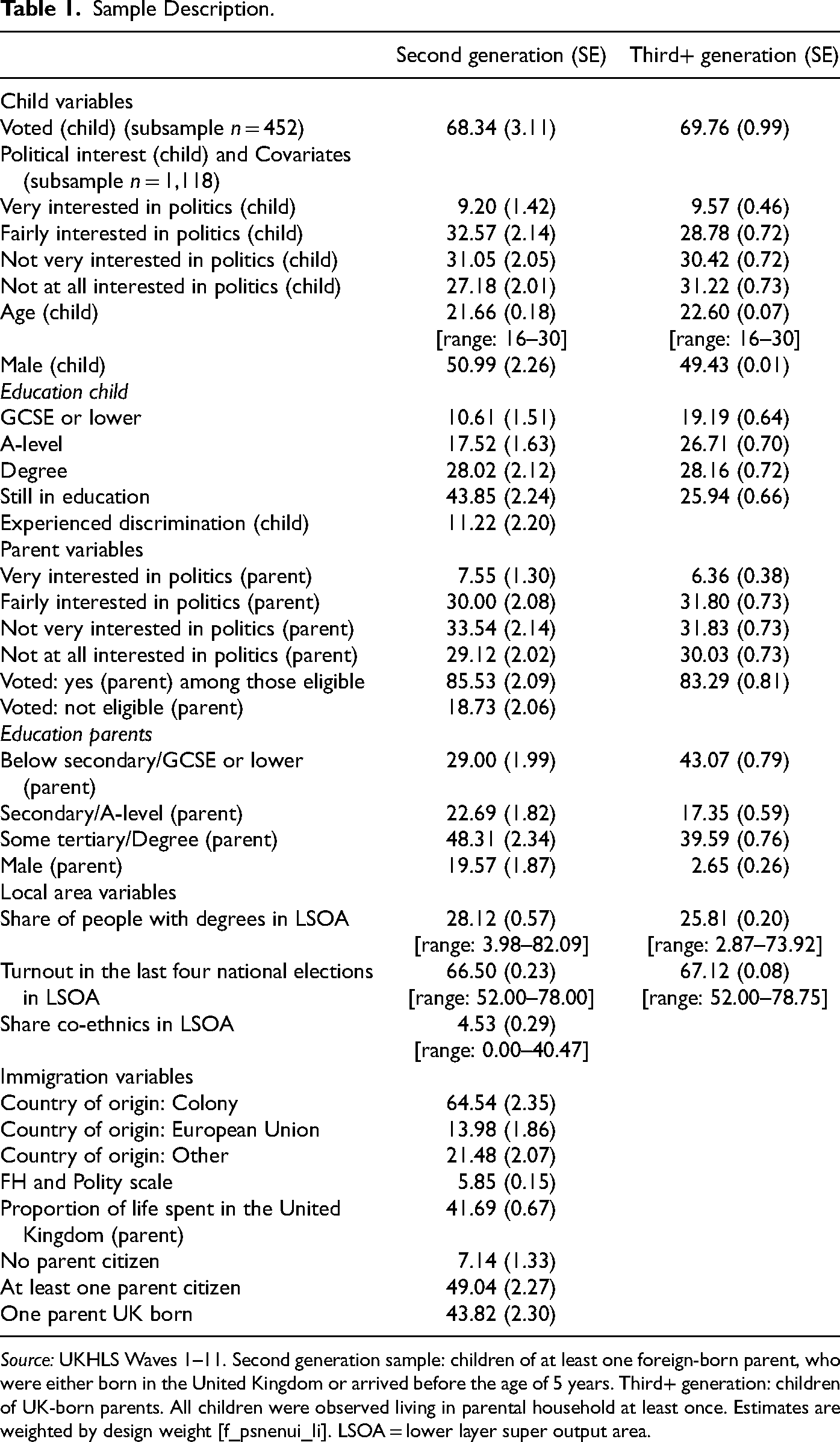
Source: UKHLS Waves 1–11. Second generation sample: children of at least one foreign-born parent, who were either born in the United Kingdom or arrived before the age of 5 years. Third+ generation: children of UK-born parents. All children were observed living in parental household at least once. Estimates are weighted by design weight [f_psnenui_li]. LSOA = lower layer super output area.
In terms of both political interest and voting in general elections, there is no sign of second generation young people lagging behind their third+ generation counterparts. In terms of reported interest in politics, 42 percent of second generation young people and 38 percent of their third+ generation counterparts report being very or fairly interested, with an identical proportion (38 percent) of their parents declaring the same. Voting reports show similar levels between the second and third+ generation British, with 68 percent of young second generation declaring that they voted in the last general election when compared to 70 percent of young third+ generation. In the parental sample, 86 percent of eligible foreign-born parents declare voting in the past general election compared to 83 percent of UK-born parents. The finding that the second generation has comparable political engagement with the third+ generation aligns with previous research on ethnic minorities in the United Kingdom (e.g., Heath et al. 2013), however, the political engagement of the immigrant sample is higher than expected. Given that the turnout in the UK's past three general elections was between 50 percent and 60 percent for those under the age of 44 years and between 75 percent and 85 percent for those under the age of 65 years and older (British Election Study 2021), our sample seems to overrepresent people who are more engaged in politics, which may be the result of only including parents and their young adult children, or the known tendency to overreport voting, which we are not able to correct for. At any rate, these initial findings run counter to our expectations of lower political engagement among the foreign born and their children.
These similarities in political engagement among the second and third+ generations, however, conceal differences in their socioeconomic and political environments while growing up. Among the second generation, about one in five young people grew up in a household where at least one parent was ineligible to vote. This potential disadvantage however may be offset by the advantaged educational profile of immigrant families: more recent skill-based restrictions on third-country migration, combined with relatively positively selected migration from the European Union (Wadsworth et al. 2016), means that the children of immigrants are nearly 10 percentage points more likely to have a university-educated parent than the third+ generation. This relative advantage appears to be passed on intergenerationally: although both samples are restricted in age from 16 to 30, 70 percent of the second generation sample either already have a degree or are still in school, when compared to only 54 percent of the third+ generation.
We also observe substantial heterogeneity within the second generation sample. Parents in our second generation sample originate from 81 countries, with a correspondingly wide range of established democracies, flawed democracies and autocratic countries, as shown in Figure 1. Although the majority of our second generation sample have immigrant parents from a former colony, nearly one in seven have a parent from the European Union and a further one in five are from another third country. In terms of migration history, seven percent of the second generation grew up in a household with no citizen present, while 44 percent can be considered 2.5 generation members, as they have a UK-born parent. On average, foreign-born parents of our second generation children spent about 42 percent of their life in the United Kingdom.
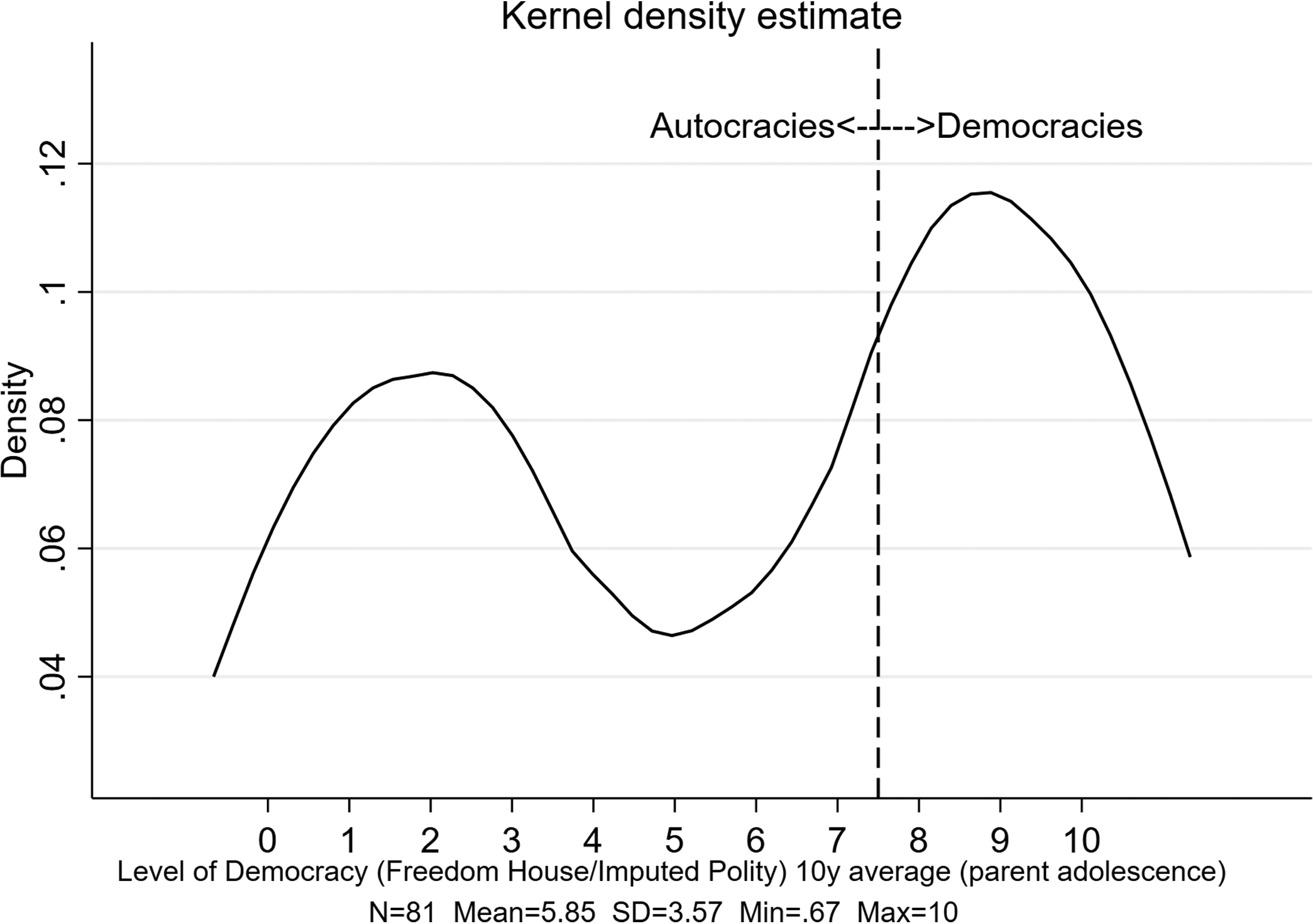
Distribution of Freedom House and Polity scale of origin countries in our immigrant parent sample.
Bivariate Relationships
Table 2 shows bivariate correlations between parent and child characteristics in the second generation sample, and comparison bivariate table for the third+generation sample are found in the Supplementary Material. We see immediately how international migration disrupts political engagement and its intergenerational transmission: country of origin characteristics, namely the degree of democratic functioning (polity score) and whether it was a former colony, European Union, or other, are more strongly related toh foreign born political participation than educational attainment, although not always in the way we expected. On the one hand, we see a positive association between the stability of democracy and political interest although the correlation is quite weak (.05). On the other hand, due to the prevalence of poorly functioning democracies and autocracies among former colonies, the relationship between the condition of democracy measure and both citizenship acquisition (−.145) and voting (−.174) is negative, whereas the relationship between the former colony and voting (.365) and citizenship acquisition (.344) is strongly positive. This condition of postcolonial migration in the United Kingdom similarly affects the association between education and political engagement for immigrant parents, as more highly educated immigrants, with higher levels of political interest, are less likely to come from former colonies: the association between education and voting is therefore negative (−0.168) but positive for political interest (0.20). For comparison, among the parents of the third+ generation (see Supplemental Table A1 in the Supplementary Material), both political interest and voting are positively related to each other and to having higher education. These initial bivariate relationships already suggest that the sending country characteristics generate a decoupling of the association between voting and political interest (H1A) and voting and education (H3).
Correlations Between Dependent Variables, Individual Characteristics, and Country of Origin Characteristics. Sample of Second Generation Children.
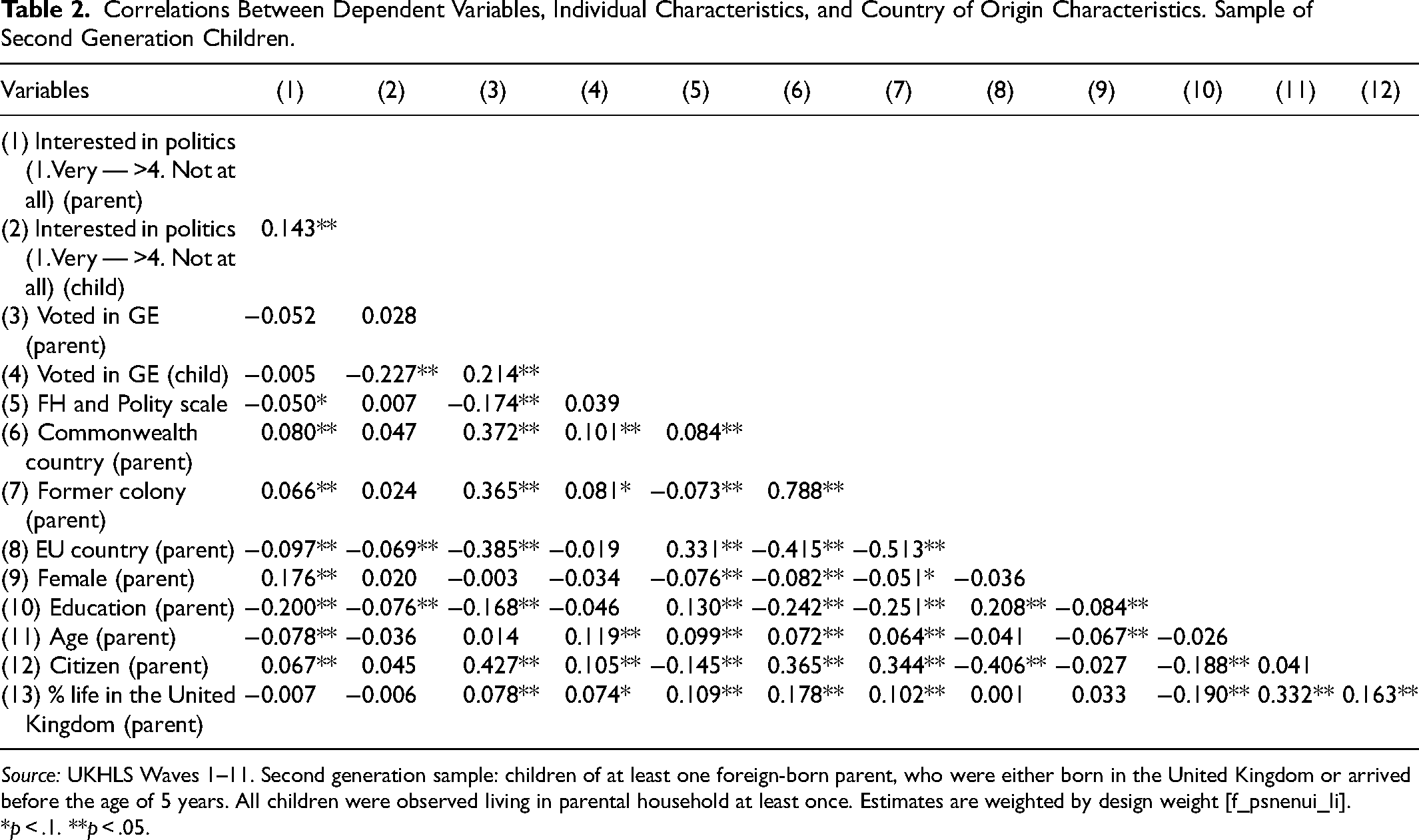
Source: UKHLS Waves 1–11. Second generation sample: children of at least one foreign-born parent, who were either born in the United Kingdom or arrived before the age of 5 years. All children were observed living in parental household at least once. Estimates are weighted by design weight [f_psnenui_li].
*p < .1. **p < .05.
This disruption continues in the intergenerational transmission of political engagement for the second generation. As we anticipated, we see a less positive relationship between parental education and political engagement (H3), as well as a weaker relationship between parental political interest and children's voting (H1B) in the second generation sample than what is commonly documented among the general population, as well as in our own comparative third+ generation sample. In contrast to the consistent correlations between parent and child observed in the third+ generation, there is only a weak positive correlation between parental education and child's political interest (.076) and no correlation with the child's voting for the second generation. The correlation between parent and child's political interest is also much weaker among the second generation. Only the parent–child correlation in voting behavior is similarly strong in both second and third+ generation samples.
To examine potential confounders in these relationships, and to test for moderation effects of parental naturalization as posited in hypotheses H4A and H4B, we next turn to multivariate analysis.
Multivariate Analysis
Parental Political Engagement: Foreign and Native Born
We begin by examining whether the associations between sending country characteristics and parental political participation outcomes hold after controlling for potential individual and local-level confounders. Figures 2 and 3 show the results for immigrant voting behavior and political interest, respectively, reporting average marginal effects of all variables from the selected stepwise models (the precise estimates from all tested models are included in the Supplemental Tables A2).
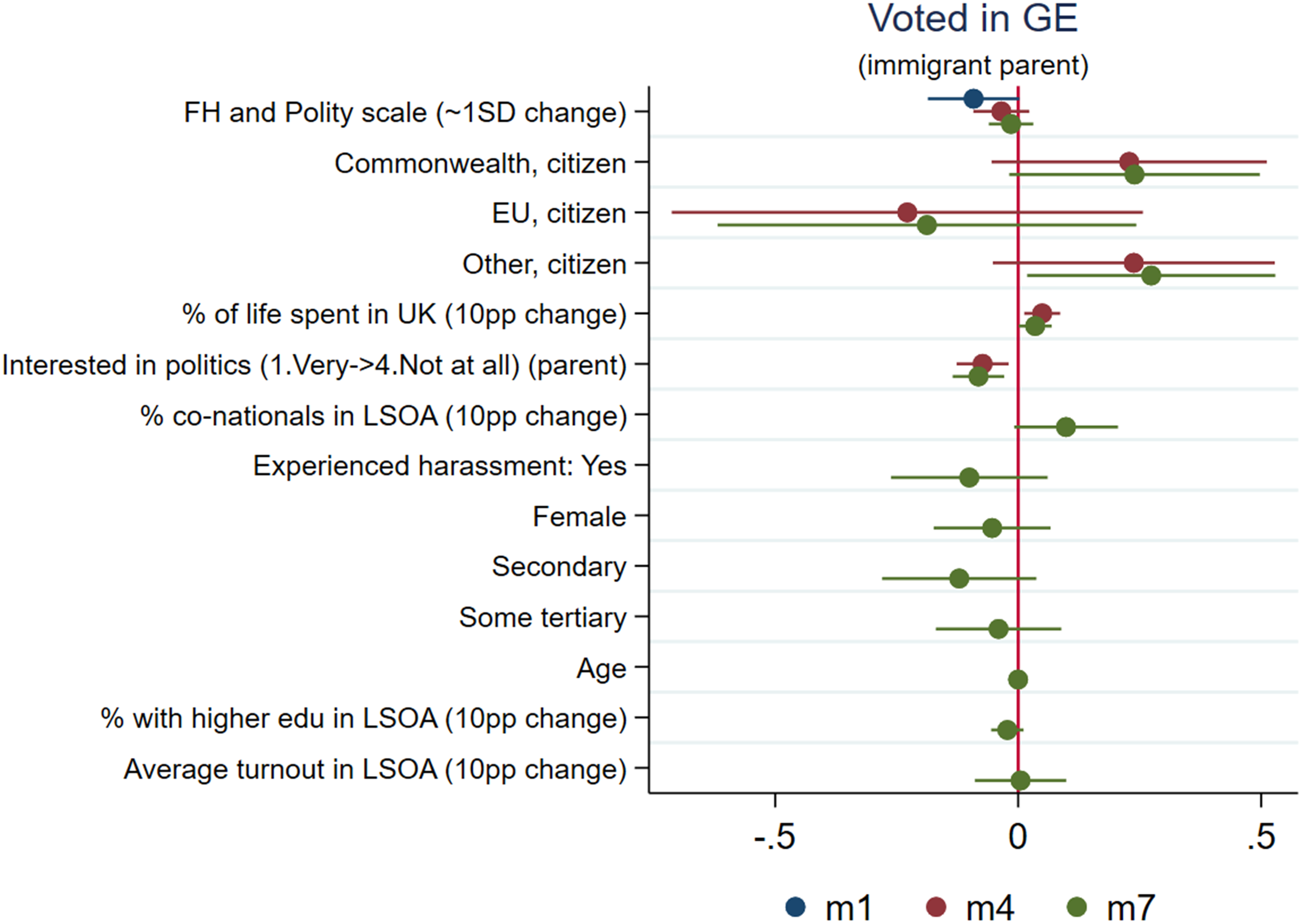
Average marginal effects: Logistic models of immigrant parent voting.
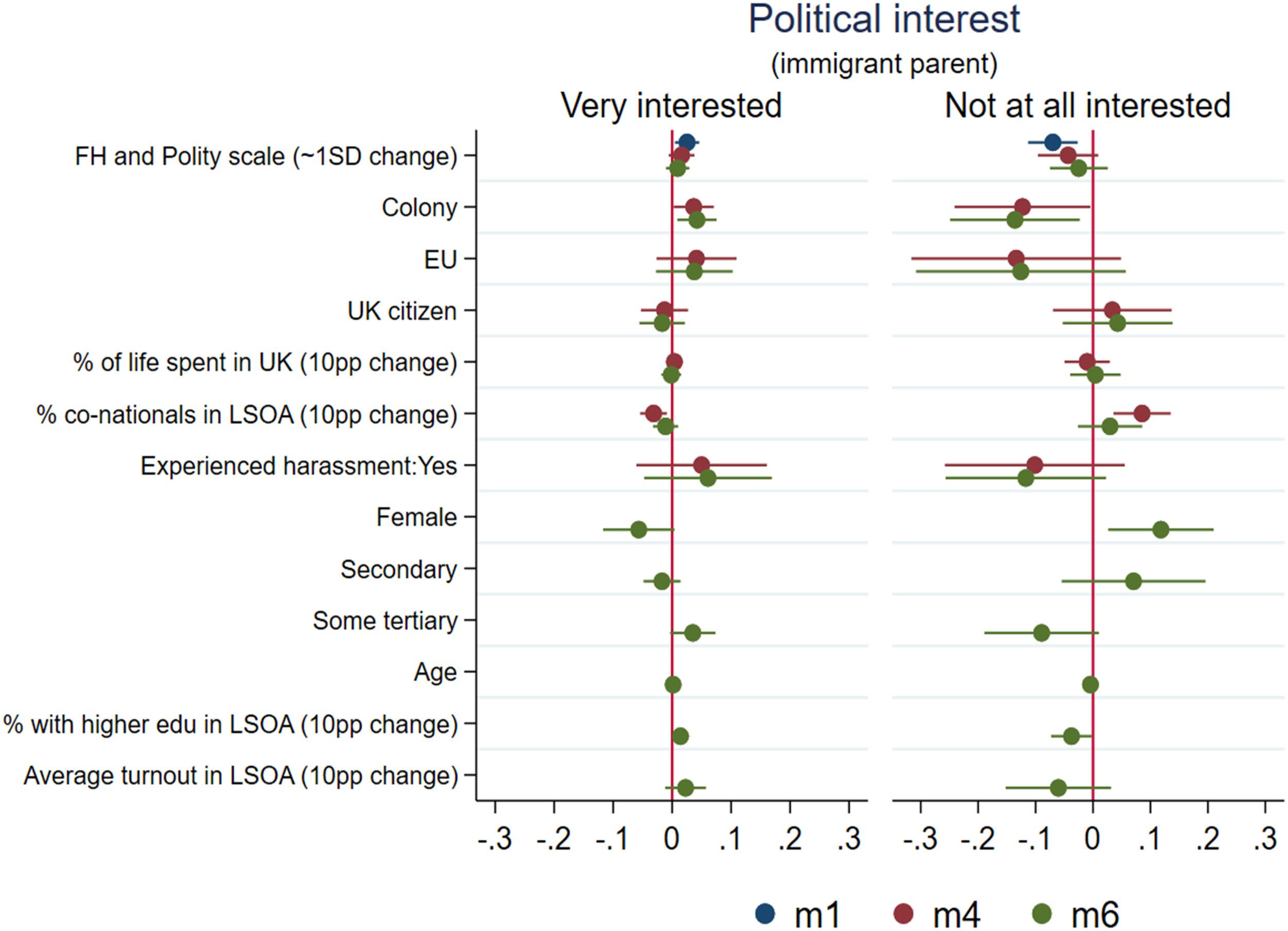
Average marginal effects: Ordinal logistic regression models of immigrant parent political interest.
As already observed in the correlations, we see the countervailing effects of sending country democratic functioning and sending country colonial ties on immigrant voting: although one standard deviation increase in democratic functioning is associated with a nine percentage point decrease in the expected probability of voting in the bivariate model, this negative association is reduced by two-thirds and becomes statistically insignificant after we adjust for the fact that immigrants from better-performing democracies are more recent arrivals and less likely to be from former colonies. Although sending country democratic functioning has no independent association with voting (contrary to H2A), the relationship of the sending country with the United Kingdom does: naturalized immigrants from the European Union are substantially less likely to vote than those of former colonial origins, whether naturalized or not (consistent with H2B). Among former colonial migrants, naturalization also increases voting: Commonwealth naturalized citizens are 24 percentage points more likely to vote than those who did not naturalize, net of other individual and local-level characteristics (in support of H4A).
Beyond these international influences, however, very little of the variation in the voting of immigrants is explained by any of the variables in the model, including standard demographic variables such as age, sex, and education. This is in direct contrast to the nonimmigrant parent sample (see Supplemental Tables A4 and A5), which demonstrates the expected positive relationships between education, age and voting. Political interest is similarly less strongly associated with voting among immigrant parents than among native-born parents (as expected by H1A), with an eight percentage point increase in the likelihood of voting for those who are very rather than fairly interested in politics, when compared to an 11 percentage point increase among the native born.
Clearly, the predictors of electoral participation are different among the foreign born. This interpretation is further supported by the estimated associations between voting and both individual and local-level controls: whereas local-level measures of the proportion with degree level education and previous voter turnout are both positively associated with voting for the third+ generation parents, the only variables that are associated with voting for the foreign born are time spent in the United Kingdom and living among co-ethnics (significant only at the 0.1 level). Sending country ties to the United Kingdom, acquiring British citizenship, time spent in the receiving country and exposure to other same-origin nationals, rather than general resources such as education (H3), age, and local-level turnout, are stronger predictors of voting among immigrants.
Turning to Figure 3 (and corresponding Supplemental Table A3 in the Supplementary Material), we see further support for the importance of international influences when looking at the political interest of the foreign born. First, immigrants from sending countries with higher democratic functioning (H2A) have higher political interest in the initial models controlling for other sending country characteristics, although this association diminishes with the addition of local-level controls and is primarily accounted for by higher levels of individual education among those from better functioning democracies. We also see the expected positive association between former colonial status (H2B) and political interest, an association that becomes larger and statistically significant after we adjust for local and individual characteristics.
For the rest of the variables, however, the relationship with political interest diverges from that of voting for the foreign born, and the associations are more similar to the UK born. First, there is no association between time spent in the United Kingdom or citizenship status (H4A) and political interest, in contrast to voting behaviour. Second, tertiary education is positively associated with political interest for the immigrant sample, although the size of the marginal effect is approximately half that of the UK-born parent sample (H3). The lack of alignment in predictors of political interest and voting among immigrants is further evidenced by coefficients with opposite signs for local area controls: immigrants living among a lower proportion of co-ethnics, and in areas with higher proportions of highly educated neighbors, are more likely to be politically interested, at the same time immigrants in these types of communities are less likely to vote.
Young People Political Engagement: Second and Third+ Generation
We saw in the discussion of the first generation results that immigrant parents experience patterns of political engagement that strongly diverge from native-born parents; we now turn to the central research question of our article to examine whether this divergence also manifests in a different pattern of intergenerational transmission. Figure 4 (and corresponding Supplemental Table A6 in the Supplementary Material) shows the results of multivariate regressions of voting in the last general election and Figure 5 (and corresponding Supplemental Table A7 in the Supplementary Material) the results of political interest for the second generation.
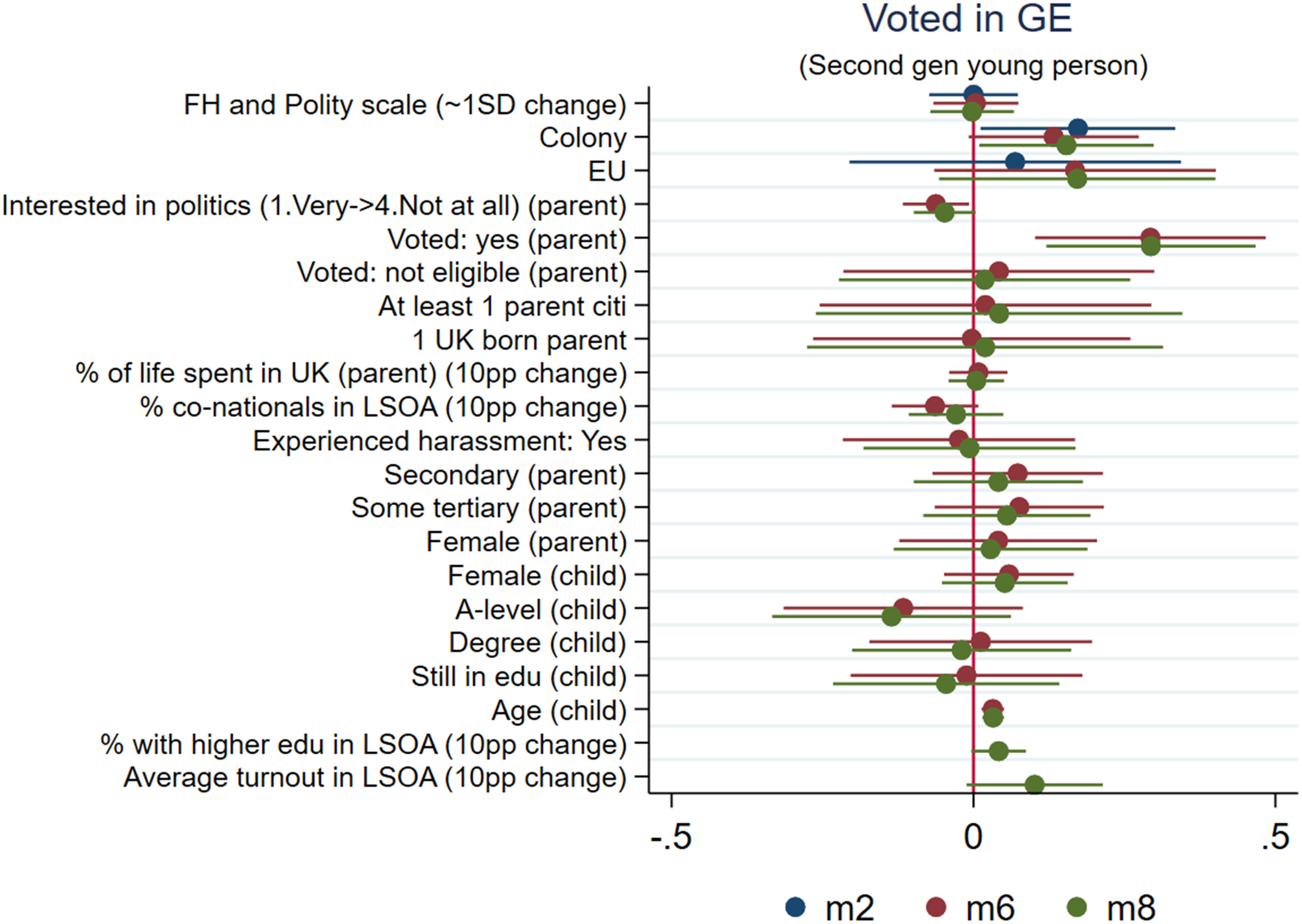
Average marginal effects: Logistic models of second generation young person voting.
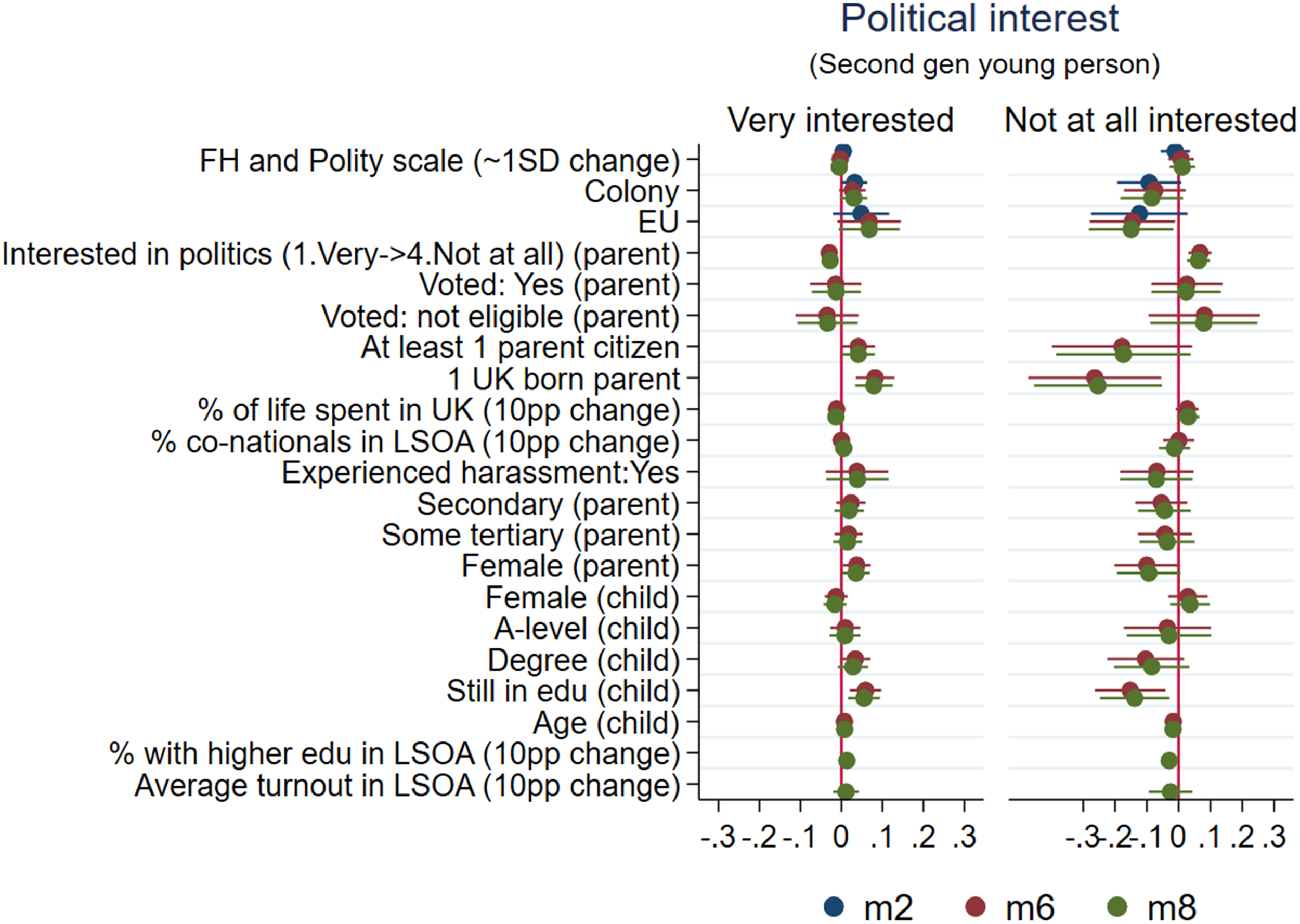
Average marginal effects: Ordinal logistic regression models of second generation young person political interest.
Starting with voting (Figure 4/Supplemental Table A6), we see that the negative association we observed between sending country democratic functioning and voting no longer holds in any of the models for the second generation (contrary to H2A); however, having parents from a former colony continues to be a strong influence (in support of H2B). Even after the full range of individual and local area controls, having a parent from a former colony increases the expected probability of voting by 13 percentage points. This is nearly half of the size of the intergenerational association in voting: having a parent who voted is associated with a 29 percentage point increase in the expected probability of voting for second-generation youth.
Beyond the direct transmission of political engagement, however, parental characteristics had no association with second generation voting. As expected in H3, parental education has no association with second generation voting; neither did the respondent's own educational attainment. This contrasts strongly with the substantial link between parental and own education and voting observed in the third+ generation sample (see Supplemental Table A8).
Although socioeconomic influences do not operate in second generation families in the same way as in families with UK-born parents, the direct transmission of political engagement is similar across both groups: parents who were politically interested or who voted themselves are more likely to have children who vote, and the association is similar in size for both third+ generation and second generation families. This is contrary to our expectation in hypothesis H1B – while the association between political interest and voting is disrupted for the foreign born (H1A), the intergenerational transmission process is maintained. Beyond anticipating a weaker association between parental political engagement and child political engagement, we also expected that parental naturalization would increase political engagement in the second generation (H4A) and strengthen the link between immigrant parents and UK-born children (H4B). Although naturalized immigrants vote more than Commonwealth foreign nationals, and through this channel increase the voting of their children, there is no residual effect of parental citizenship on voting for the second generation and the association between parental political interest and child voting does not differ by parental citizenship status (see interaction results in Supplemental Table A10).
Turning to second generation political interest (Figure 5/Supplemental Table A7), we see again that there is a positive association between political interest and a parent from a former colony, but no association with the overall sending country democratic functioning. Also in line with the results for voting, parental education has no association with political interest for the second generation, and only those second generation youth currently enrolled in school (overwhelmingly university students) are more politically interested than those with the lowest levels of education. This is in direct contrast to the third+ generation sample, where both parental education and own education are strongly and consistently associated with higher levels of political interest.
Direct transmission of political interest is also similar to direct transmission of voting, with the second generation displaying similarly positive relationships between parental interest and child interest as the third+ generation. Unlike the third+ generation, however, parental voting has no association with second generation political interest. Instead, having a UK citizen or UK-born parent is associated with stronger interest; this suggests that it is the naturalization decision, rather than voting, that is influential for political interest whereas the opposite was true for second generation voting (H4A). However parental citizenship does not moderate the association between parent and child political interest (H4B), and the interactions between parental political interest and UK citizenship/UK parent are not statistically significant (see Supplemental Table A11).
In sum, we see a substantial disruption of the usual economic and local area correlates of political engagement among the foreign born, finding instead that international influences, such as former colonial ties and time spent in the receiving country determine immigrant voting. Moreover, political interest and voting operate more independently for immigrants than for the third+ generation, displaying a weaker direct association with one another in multivariate models as well as weaker associations with different controls at the individual and local levels. Parental international influences also continue to impact the children of immigrants: former colonial ties, rather than parental education, influence the political engagement of the second generation.
At the same time, we did not observe the expected disruption in the direct intergenerational transmission of political interest and voting behavior: second generation young adults who had parents who voted or expressed political interest were more likely to display these characteristics themselves, and these associations were only slightly weaker than those observed among the third+ generation. We also anticipated a more substantial influence of parental naturalization: while children who had a parent who naturalized did report higher levels of political interest overall, parents who had naturalized did not transmit their interest at a higher rate than those parents who remained foreign nationals.
Discussion and Conclusions
This article provides novel insights into the political transmission process of the children of the foreign born in the UK. First, we demonstrate that previously underexamined international characteristics of immigrant parents — namely the stability of democracy and the former colonial ties of their sending countries, as well as their individual immigration and naturalization trajectories, matter both for their own and their children's political engagement (H2A and H2B). The international characteristics significantly affect parental political engagement and shape the engagement of their children both directly as well as via parental political interest and voting behaviors. Second, we show how migration disrupts standard processes of political engagement and intergenerational transmission for immigrants and their children. Unlike what we observe among the third+ generation, political interest and voting are much more independently determined among the foreign born (H1A), and to a less consistent extent among the second generation (H1B). Particularly the voting behavior of immigrant parents and their children is largely decoupled from traditional socioeconomic predictors of electoral participation, most importantly parental education (H3), but also local area resources. Patterns of political interest for immigrants and their children more closely follow patterns observed among the third+ generation, yet these relationships are still weaker than what we and others find in the general third+ generation British population. Our article thus supports related work which demonstrates how migration influences educational intergenerational mobility (Ichou 2014; Luthra and Soehl 2015), showing the consequences of this disruption for political engagement.
Seeking to understand the different processes underlying political interest and voting for the foreign born and their children, the international perspective offers helpful insights. We see that being socialized in a better-performing democracy has a positive influence on political interest among the foreign born, largely explained by their more advantaged individual characteristics and living in more advantaged areas. The sending country political socialization explanation does not hold for voting, however, because it is offset by an equally important international influence, namely the historic relationship between the United Kingdom and former colonies, which results in the privileged voting rights that immigrants from Commonwealth countries enjoy. These privileged voting rights have been in place since 1918 (Johnston 2021), and thus British political parties, in particular the labor party, have well-established means of targeted recruitment of minority voters, especially in high ethnic concentration areas with minority candidates (Purdam 2016).
The naturalization decisions of immigrant parents also influence their own voting behavior, and the political interest of their children. Commonwealth citizens who naturalize are more likely to vote than those who do not. The children of immigrants who have at least one naturalized or UK-born parent are more likely to be both politically interested, and, through the mechanism of increased parental voting, more likely to vote themselves (H4A). Our hypothesis H4B, that immigrants who naturalized would exhibit a stronger relationship between their political interest and their children's outcomes, however, was not substantiated, as immigrant parent and second generation political engagement is strongly associated regardless of parental naturalization status.
Taken together, these findings point to the importance of examining immigrants and their descendants’ political behavior from an international perspective that explicitly takes the immigration process into account. As we have shown, both “generalised” country-level characteristics such as quality of democracy as well as context-specific ones such as postcolonial ties, play an important role in explaining the political participation of both immigrants and their children.
The crucial role of the privileged access to voting rights among immigrants from former colonies, which translates into a higher turnout of both the first and second generations has potentially important policy implications. It suggests that decreasing barriers to citizenship and promoting voter registration among immigrants can greatly enhance the political integration of immigrants and their descendants. The fact that children of immigrants with a naturalized parent tend to have higher political interest suggests that accessing citizenship might promote political engagement beyond voting. Accessing citizenship might be particularly important for the political integration of immigrants from less democratic countries, who, on average, report lower levels of political interest.
While our study thus provides important new information on political transmission in the United Kingdom, it is not without its limitations. The first is that, despite the very large longitudinal sample we use, the number of adult children of immigrants who aged out of their parental household remains insufficient to examine detailed differences in transmission by sending country, gender or ethnicity. In order to maintain the largest sample possible, we used multiple imputation to avoid losing cases missing information on one of our control variables, yet this method increases uncertainty in our point estimates due to higher between-imputation variability. As the second generation in the United Kingdom, especially those from European origins, remains quite young, we cannot compare the second generation to their parents’ outcomes at the same age of observation. Finally, as with most observational studies, the relationships we observe are interpreted as associations, rather than causal effects.
These difficulties aside, across Europe, new longitudinal datasets with immigrant/ethnic minority subsamples are emerging which will allow researchers to examine political engagement from self-reports of both parents and children, and to assess whether the disruption we observe in the British context can be observed in other postcolonial (France and the Netherlands) as well as newer immigrant-receiving states (Finland and Ireland). Given the increasingly diverse electorate in many Western democracies, it is important to expand the standard models of political participation and intergenerational transmission to allow for international influences, and to see how their impact varies across different migration and political regimes.
Supplemental Material
sj-docx-1-mrx-10.1177_01979183221134277 - Supplemental material for Socialization Disrupted: The Intergenerational Transmission of Political Engagement in Immigrant Families
Supplemental material, sj-docx-1-mrx-10.1177_01979183221134277 for Socialization Disrupted: The Intergenerational Transmission of Political Engagement in Immigrant Families by Magda Borkowska and Renee Luthra in International Migration Review
Supplemental Material
sj-docx-2-mrx-10.1177_01979183221134277 - Supplemental material for Socialization Disrupted: The Intergenerational Transmission of Political Engagement in Immigrant Families
Supplemental material, sj-docx-2-mrx-10.1177_01979183221134277 for Socialization Disrupted: The Intergenerational Transmission of Political Engagement in Immigrant Families by Magda Borkowska and Renee Luthra in International Migration Review
Supplemental Material
sj-docx-3-mrx-10.1177_01979183221134277 - Supplemental material for Socialization Disrupted: The Intergenerational Transmission of Political Engagement in Immigrant Families
Supplemental material, sj-docx-3-mrx-10.1177_01979183221134277 for Socialization Disrupted: The Intergenerational Transmission of Political Engagement in Immigrant Families by Magda Borkowska and Renee Luthra in International Migration Review
Footnotes
Declaration of Conflicting Interests
The author(s) declared no potential conflicts of interest with respect to the research, authorship, and/or publication of this article.
Funding
The author(s) disclosed receipt of the following financial support for the research, authorship, and/or publication of this article: This work was supported by the Economic and Social Research Council (grant number ES/S012486/1).

Supplemental Material
Supplemental material for this article is available online.
Notes
References
Supplementary Material
Please find the following supplemental material available below.
For Open Access articles published under a Creative Commons License, all supplemental material carries the same license as the article it is associated with.
For non-Open Access articles published, all supplemental material carries a non-exclusive license, and permission requests for re-use of supplemental material or any part of supplemental material shall be sent directly to the copyright owner as specified in the copyright notice associated with the article.
