




Abstract
This article analyzes the impact of (un)happiness on the international migration decision. It uses a rich longitudinal household-level database, the Polish Social Diagnosis, to identify migration intentions, as well as subsequent actual migration, allowing us to overcome the issue of reverse causality present in previous studies of the nexus between happiness and migration. In addition, we assess the role of individual and household levels of happiness on migration behaviors and find that unhappy individuals from unhappy households are significantly more likely to declare their intentions to migrate abroad. In terms of actual migration, however, the unhappiness push significantly affects the odds of international migration only for selected subgroups, such as women and employed individuals. For other individuals, the unhappiness-induced migration plans remain mostly unrealized. Our article shows that push and pull factors, including happiness, might exert heterogenous effects on migration intentions and actual realizations. As a consequence, migration scholars should be careful when drawing conclusions on the determinants of actual migration behaviors by looking at determinants of migration intentions.
Introduction
Which factors drive international migration? While traditional studies have largely focused on the role of observable monetary incentives and labor-market opportunities, such as wage and unemployment differentials (Jennissen 2003; Ortega and Peri 2013), a growing number of studies have shifted attention to the role played by subjective factors, such as perceived quality of life, well-being, and happiness (Simpson 2013; Cai et al. 2014; Ivlevs 2014; Otrachshenko and Popova 2014; Ivlevs 2015). In fact, observable measures of the push and pull factors that shape individuals’ migration intentions and actual moves often fail to capture the complexity of the non-monetary and subjective factors that influence these processes (Cai et al. 2014; Grimes and Wesselbaum 2019). In this regard, measures of individuals’ subjective well-being can be important complements to traditional determinants of migration such as income levels, as they might capture many unobserved determinants of the migration decision.
This article contributes to recent research on the role of happiness as a driver of international migration (e.g., Ivlevs 2015; Nikolova and Graham 2015), as well as on the nexus between migration intentions and actual behaviors (e.g., Gardner et al. 1985; Van Dalen and Henkens 2008). In particular, we address the following research questions: Are immigrants more or less happy than those who stay put? Which dimension of happiness — individual, household, or relative 1 — matters for migration intentions and decisions? Does happiness affect migration intentions, as shown in previous studies (Cai et al. 2014; Ivlevs 2015), as well as actual migration moves? Does happiness affect migration behaviors of different sub-groups defined by gender, educational level, employment status, and so on in a heterogeneous way? We are able to explore these questions in a dynamic setting, using the Polish Social Diagnosis dataset — a rich longitudinal dataset on individuals and households which covers a representative sample of the Polish population from 2007 to 2015 (Czapiński and Panek 2015). The focus on Poland is particularly interesting, as it has represented the largest immigrant-sending country in the European Union (EU) in the post-accession period (i.e., after 2004; Bahna 2016). Between May 1, 2004, and January 1, 2007, at least 1 million Poles (4 percent of the total working-age population) emigrated from Poland (Okólski 2012), and this process of intensive migration was sustained in later years, with profound impacts on sending and host economies and societies (Barrell, FitzGerald, and Riley 2010; Coniglio and Brzozowski 2018).
Our results show that unhappier individuals had a higher probability of declaring international migration intentions. Moreover, other household members’ unhappiness also mattered for individuals’ migration intention. Additionally, we find evidence that those who intended to migrate abroad were the least happy within a given household. Results are identical when using an alternative measure of subjective well-being (life satisfaction). Interestingly, we find that while the “unhappiness push” had a strong impact on migration intentions, it also had a significant effect on actual migration up to two years after the interview for women and employed individuals. 2 Therefore, this article shows that although an individual’s relative and absolute happiness levels are important determinants of migration intentions, the effect of happiness on actual international migration is heterogeneous. In other words, unhappiness is not necessarily a significant predictor of actual migration for a relatively large part of the sending-country population.
The analysis presented here is novel in several respects. First, our panel approach offers a substantial methodological advantage and novelty, compared to previous studies that relied on cross-sectional data (e.g., Cai et al. 2014; Ivlevs 2015). 3 In cross-sectional studies, it is not possible to rule out that the intention to migrate affects individuals’ happiness, as future migrants might already anticipate psychological and material costs associated with international migration (Van Dalen and Henkens 2008). Cross-sectional studies’ contemporaneous measurement of happiness and migration intentions also increases the risk of endogeneity, due to unobserved factors that jointly affect the two variables (Ivlevs, Nikolova, and Graham 2018), or priming effects, due to the emotional spillovers that one survey question might generate on answers to other questions (Sgroi et al. 2010). The panel dimension of our analysis allows us to investigate the role of individual and household levels of happiness on both the ex-ante migration intention and the ex-post actual migration decision up to two years after the interview. Therefore, only datasets — like ours — that trace changes in happiness and location over time allow researchers to causally assess the relationship between happiness and migration (Nikolova and Graham 2015).
Second, our approach identifies the gaps between intentions to migrate and actual migration. As we show, the factors shaping individual intentions to migrate, such as happiness, might differ substantially from those affecting actual moves (O’Connell 1997; Gardner et al. 1985). This contribution suggests that migration scholars should exercise caution in using migration intentions as predictors of actual migration flows or proxies for outmigration pressures in developing countries (Docquier, Peri, and Ruyssen 2014; Tjaden, Auer, and Laczko 2019).
Third, our article explicitly investigates the role of other household members’ happiness in individuals’ migration intentions and realizations. Although the role played by other individuals in shaping a given person’s migration decisions has been systematically investigated in empirical studies (Mincer 1978; Taylor 1987; Konseiga 2006; Delpierre 2012) and discussed within conceptual frameworks (Dustmann and Görlach 2016), this article is the first to consider and measure the impacts of household members’ subjective well-being on international migration decisions of other members. Finally, this article contributes to the literature on the role of subjective well-being in international migration by highlighting a heterogeneous effect of the unhappiness push on different population sub-groups. Some groups, such as women and employed individuals, we find, are significantly more likely to migrate abroad due to changes in subjective well-being than others. This latter finding both adds new knowledge on the complex dynamic of international migration decisions and can inform the design of international migration policies by host and home countries.
To develop these contributions, this article’s structure is as follows. Second section critically reviews the relevant literature on subjective well-being and studies on happiness and international migration. Third section presents the methodology, the dataset used in the analysis, and the main hypotheses. Fourth section discusses the empirical results, while fifth section offers some concluding remarks and outlines this article’s contribution and limitations.
Review of Literature on Subjective Well-being and International Migration
Studies on happiness started with the pioneering research of Richard Easterlin (1974), who demonstrated that while in cross-country comparisons, there is a weak positive correlation between levels of income and happiness, when considering growth rates between countries, this correlation disappears, as “long-term growth in GDP is not necessarily accompanied by growing happiness” (Easterlin 2016, 15). This phenomenon, known as the “Easterlin paradox,” has put into question income’s validity as the ultimate measure of individuals’ success and inspired an intense wave of research on the linkage between income and happiness, which is still vibrant today (e.g., Graham 2009; Veenhoven and Vergunst 2014; Kwahar and Iyortsuun 2018).
A key issue in the literature on the economics of happiness has been the question of measurement (Easterlin 1974). Easterlin understood happiness as one of the “evaluative measures of self-reported feelings of well-being,” and as also including life satisfaction (Easterlin 2016, 3). As subjective well-being has received increased attention from other disciplines (e.g., sociology, political science, business studies), the interdisciplinary area of happiness studies has grown substantially, leading several authors to claim that a “happiness turn” is taking place in the social sciences (Kullenberg and Nelhans 2015). In this literature on happiness, three distinctive dimensions of subjective well-being have been proposed and employed: cognitive, related to individual’s life evaluation; eudaimonic, capturing personal goal orientation and accomplishment; and hedonic, emphasizing contemporary emotions and affect balance (Tsurumi et al. 2020). In this article, we rely on two frequently used metrics of subjective well-being: happiness (a hedonic dimension of well-being) and life satisfaction (a cognitive dimension of well-being). 4
Within the overall field of happiness studies, the topic of international migration has attracted increased attention (Simpson 2013; Hendriks 2015), although the relationship between international migration and happiness (or alternatively: migration and subjective well-being) is still relatively under-investigated. Most analyses of international migrants’ subjective well-being indicate that migrants are, on average, less happy than representatives of the receiving society (Simpson 2013; Kushnirovich and Sherman 2018). The most obvious explanation for this occurrence is the change of reference group associated with migration. According to Bartram (2013a; 2013b), international migrants change the reference group to which they compare themselves: from the home-country population to the host-country society. The effect of changing the point of reference is especially visible when it comes to material consumption possibilities (Simpson 2013). Thus, even if international migration leads to an increase in individual’s income (as compared to home country), the fact that international migrants compare their current situation to a wealthier reference group (natives) can lead to a drop in happiness.
Another strand of literature investigates the effect of individual subjective well-being in origin countries, assessing how unhappiness can drive migration intentions. One important contribution in this literature is the theoretical model developed by Grimes and Wesselbaum (2019), in which rational agents consider their location choice by comparing several potential destinations. In this framework, the relative level of subjective well-being (i.e., standard deviation from a mean in a given location) matters for migration decisions, as less happy individuals (i.e., individuals whose happiness level is below the national mean) have greater incentives to move. The model also predicts that cross-country happiness gaps (i.e., differences in the absolute level of happiness between origin and destinations) matter for migration decisions, as individuals tend to move from countries with low mean levels of happiness to destinations with high average levels of happiness. Using panel data estimates on bilateral migration flows between 102 origin and 14 destination countries from 2006 to 2013, Grimes and Wesselbaum (2019) demonstrate that the origin country’s unhappiness level can be a very important push factor for potential international migrants, while the destination country’s happiness level can constitute a powerful pull factor. Moreover, they convincingly show that mean and standard deviations of happiness constitute more powerful predictors of bilateral migration flows between countries than do income levels, confirming the importance of subjective well-being measures for analyses of migration movements.
This macro-level analysis on the linkage between happiness and international migration is connected to another interesting research problem: as people in poorer countries are less happy on average than people in wealthier ones (Polgreen and Simpson 2011) and if the predictions of Grimes and Wesselbaum’s (2019) model are correct, then international migration can contribute to narrowing the happiness gap between poorer and wealthier economies. Yet, the problem of the happiness gap and international migration’s role in it has not been addressed yet in empirical studies.
Happiness studies also draw on microeconomic approaches (e.g., Ivlevs 2015). A number of empirical papers based on individual-level data treat a person’s happiness as an independent variable and the migration propensity or decision as the dependent variable, lending some support to theoretical predictions concerning the existence of an “unhappiness push” (Ivlevs 2015; Ruyssen and Salomone 2018). Cai et al. (2014), for example, using the Gallup World Poll database, demonstrate that individuals with higher measures of subjective well-being also have lower migration intentions. Ruyssen and Salomone (2018) take the analysis a step further, using as dependent variable information on active preparation to migrate (i.e., applying for a visa) in addition to individuals’ migration intentions. Their results partially support those of Cai et al. (2014): higher levels of individuals’ subjective well-being are negatively associated with migration intentions. However, when it comes to preparedness to migrate, individuals’ subjective well-being has no significant effect, a result which is consistent with our analysis on actual migration. In the case of Central and Eastern Europe (CEE), Otrachshenko and Popova (2014) find that persons with lower life satisfaction scores are more inclined to declare migration plans, both internal and international. Moreover, they show that life dissatisfaction matters more for migration intentions for individuals from CEE countries than from non-CEE countries.
Although these studies expand knowledge on the links between happiness and migration, their findings are largely based on cross-sectional data and on migration intentions as proxies for individuals’ actual migration. Yet, some authors remain very skeptical of using intentions as reliable predictors of international moves. Constant and Massey (2002, 23), for instance, argue that “intentions are notoriously unreliable as guides to eventual [migration] behaviour.” In fact, across migration studies, there is little compelling evidence that either migration intentions or migration preparations actually materialize in an actual migration decision in the future (Lu 1999; Van Dalen and Henkens 2008; Kley and Mulder 2010). Therefore, we need more in-depth analyses which compare individuals’ migration intentions with their actual migration decisions. Our approach attempts just that, relying on a longitudinal dataset that allows us to assess the different roles played by happiness and other determinants of international migration in two sequential steps of the dynamic migration process: intentions to migrate and actual migration decisions.
Consequently, our study adds to the literature investigating the linkage between happiness and migration in origin countries by focusing on Polish society. This focus is motivated not only by availability of data which enable us to compare migration intentions and actual migration decisions but also by the importance and magnitude of contemporary migration processes in Poland. Poland is a large CEE economy with rich migration traditions dating back to the nineteenth century (Zubair and Brzozowski 2018) and intense emigration throughout the twentieth century, including not only economic migrations but also involuntary or forced moves (King and Okólski 2019). The most recent migration from Poland (and other CEE countries) started with the EU’s eastward enlargements in 2004 and 2007 and was facilitated by the gradual introduction of freedom of movement for new EU citizens (Kaczmarczyk and Okólski 2008). This migration flow was mostly driven by large disparities in the GDP per capita between the sending EU-10 CEE 5 countries and the receiving EU-15 countries (Próchniak 2019). The number of EU-10 CEE nationals in EU-15 countries had risen by 2.2 million between 2003 and 2008, out of whom approximately 1.3 million were Polish (Górny and Kaczmarczyk 2019). As indicated by Kaczmarczyk and Okólski (2008), this post-accession migration from Poland differs from flows seen during the country’s 1990s socio-economic transformation, more frequently including young, tertiary-educated migrants from urban areas. Iglicka (2010) and White (2014) have both suggested that many of those young migrants had very little professional experience in the Polish labor market before migration and were affected by the over-qualification problem 6 connected to Poland’s boom in higher education in the early 2000s. As a result, many young migrants have viewed Poland’s post-accession migration as a way to overcome the Polish labor market’s deficiencies, including the job mismatch problem (Coniglio and Brzozowski 2018). Yet, as stressed by Fihel and Grabowska-Lusińska (2014), the strategies of labor migrants going from Poland to EU-15 countries were varied, ranging from abandoning jobs in Poland and undertaking longer-term employment in Western Europe to back-and-forth temporary moves (liquid migration, as proposed by Engbersen, Snel, and de Boom 2010).
Thus, the relationship between Poland’s labor market situation and international migration is not straightforward. Although some individuals left Poland because of poor economic prospects, many others moved abroad only for temporary stays, as is reflected in our sample. Moreover, despite Poland’s economic boom, the twenty-first century’s second decade was still marked by a substantial increase in the number of Poles temporarily residing abroad, 7 from 2.06 million in 2011 to 2.46 million in 2018 (GUS 2019).
Methodology, Data and Main Hypotheses
Methodology
Building on the literature discussed above, this section presents our methodological framework and main hypotheses. Our starting point is the individual’s migration decision, which is generally preceded by a migration intention, and is motivated by the desire and expectation to enhance his/her own quality of life or that of his/her family. 8 Defining Uit as the utility of an individual i at time t residing in the home location, E[U’it+2] as the expected utility derived in an intended host destination, and E[γ’] as the expected migration costs, an individual will consider to move if E[U’it+2] > (Uit + E[γ’]). Our first hypothesis (H1) is that both the current level of happiness and the one expected at destination affect the migration intention and its actual realization. In particular, the current level of unhappiness might be considered a push factor in the migration decision. An individual might expect that his/her happiness, or the happiness of his/her household, would increase as a consequence of migration. The probability of observing positive intentions to migrate (IMit) can be written as Pr(IMit = 1|Xit) = Pr(E[U’it+1] − Uit − E[γ’] > 0), where Xit is a set of individual and household characteristics. Migration’s expected costs might be very different from the true ones, as individuals tend to ignore the existence of some barriers or constraints to the actual move (European Commission 2018).
Our underlying hypothesis is based on the existence of bounded rationality in migration choices related to incomplete information on migration costs (i.e., hidden or unanticipated costs), as well as potential migrants’ limited information-processing capacity (i.e., individuals’ inability to anticipate the role of barriers to migration). In the context of Polish migration, Brunarska (2019) analyzes 150 face-to-face interviews on bounded rationality in migration destination choice, revealing that the boundedness of rationality among Polish migrants in their destination choice may manifest itself in different forms. Some individuals, defined by the author as one-step decision-makers, base their decisions on accidentally appearing opportunities without considering alternative potential destinations. Others, however, limited their set of potential destinations as a consequence of cultural constraints or heuristic behaviors, while the great majority of individuals made a decision about where to migrate on a spontaneous or not fully informed base. In the context of our analytical framework, it is, thus, likely that these true costs of migration are larger than the expected ones, γ T > E[γ’], particularly when considering migration to a foreign destination.
It is also important to note that expressing an intention to migrate is a “cheap” aspiration compared to concrete and costly actions needed to actually migrate. Matching survey data on migration intentions with actual migration flows reveals that the former are more than four times larger than the latter (Esipova, Ray, and Pugliese 2017). This discrepancy is the focus of our second hypothesis (H2). We, thus, expect that the probability of observing actual migration (AMit), which can be written as Pr(AMit = 1|Xit) = Pr(E[U’it+2] − Uit − γ T >0), will be lower, ceteris paribus, than that of observing migration intentions.
We also investigate a third hypothesis (H3), which posits that the effects of unhappiness on migration intentions and actual realization are heterogeneous across individuals on the basis of socio-demographic characteristics such as age, gender, education, or employment status. Our hypothesis is that some of these characteristics also moderate the effect of the unhappiness push. For instance, we expect that the effect of unhappiness on the actual ability to migrate will be larger, the larger are individual and household financial and relational resources. An individual who is currently employed, a likely signal of higher skills and competence, and is dissatisfied with his/her working conditions might be more likely to react to this unhappiness push by relocating geographically. A similar effect to the one just described might also apply to individuals who are part of richer families or have relatives already living abroad. Also, the level of local development, as proxied by regional GDP per capita, might soften the unhappiness push as individuals might have access to a wide range of opportunities and, thus, not need to migrate internationally to improve their socio-economic status. Additionally, we expect that women might react differently to unhappiness, as a large bulk of evidence shows important gender differences in behavioral traits and social preferences that affect individual labor market outcomes, including mobility (Shurchkov and Eckel 2018).
Consequently, in the empirical analysis, we estimate the effect of unhappiness on, respectively, the intention to migrate and actual migration (in the subsequent two years), using panel logit models specified as follows:


where the dependent variables,
Measuring Migration Intentions and Realization: The Social Diagnosis (SD) Project
This article uses data from the Social Diagnosis (SD) project — a longitudinal household survey carried out in Poland every two years between 2000 and 2015 (i.e., eight waves in total). The SD study includes detailed information on each household’s and individual members’ economic situation (e.g., income, savings) and non-economic situation (e.g., education, mental well-being, aspirations, cultural participation, etc.), as the SD project aimed to make a comprehensive analysis of Poles’ living conditions and quality of life. The survey was intended to be fully representative of Polish society (Czapiński and Panek 2015), one of Europe’s most important migrant-sending countries during the considered period. 10 Two questionnaires were administered: i) the household questionnaire, which collected a large set of socio-economic information for the whole household, including their current and past locations, and which allows us to determine all individuals’ migration history, and ii) Individual Questionnaires, which collected additional information on all household members aged 16 and up who were available at the time of the survey.
The unit of analysis here is individual-level data, to which we link a set of information derived from the household-level survey. The number of individual respondents 11 included in the SD project changed from 6,614 in 2000 to 26,307 in 2013 and 22,200 in 2015. The number of households included in the survey also changed from 3,005 in 2000 to 12,352 in 2013 and 11,740 in 2015. The cross-waves survival rates of households and individuals were rather high, given the survey’s bi-annual nature. On average more than 70 percent of respondents were re-interviewed from one wave to the next. 12 We employ data for the period, 2007–2015, as only these five waves (2007, 2009, 2011, 2013, and 2015) included details of household members’ past migration experience and future migration declarations (i.e., migration intentions). Descriptive statistics are given in Table 1, which provides information on key variables by each wave.
Descriptive Statistics.
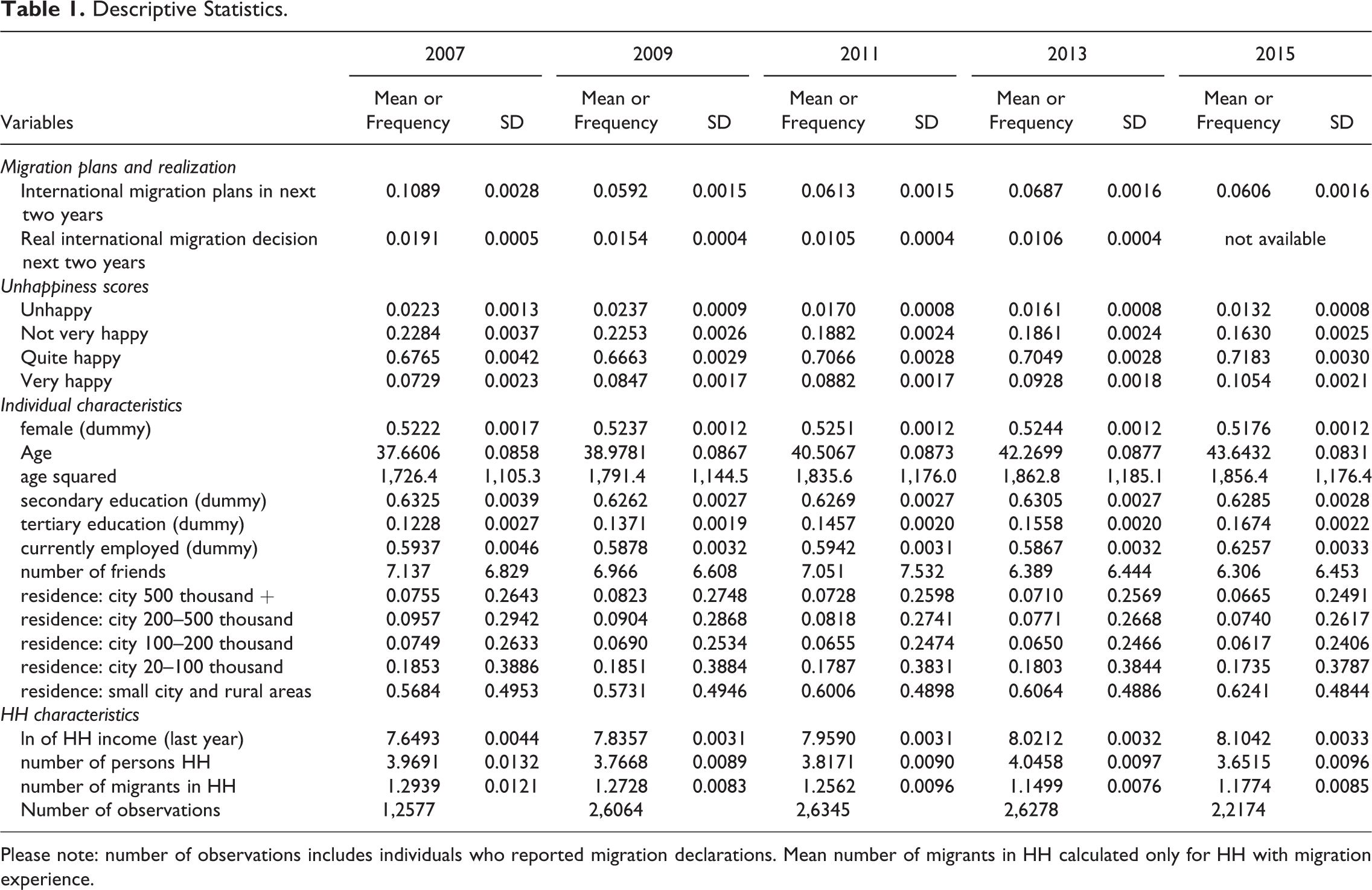
Please note: number of observations includes individuals who reported migration declarations. Mean number of migrants in HH calculated only for HH with migration experience.
In our analysis, we consider two key dependent variables: migration intentions and actual migration decision. In each wave under study, individuals were asked about their intention to migrate abroad in the upcoming two years, including the intended destination country, expected length of stay, and migration motive. 13 Migration intentions are coded as a dummy variable which is equal to 1 when the individual declared at the time of the survey (time t) that he/she intended to migrate abroad in the coming two years.
The SD survey’s panel dimension allows us to define the location of all individuals belonging to a household that is observed for two or more waves. For each individual interviewed at time t (i.e., for which we have detailed socio-economic information including happiness and well-being ones) — conditional on the household being included in the SD survey at t + 2, we know: i) future intentions to migrate as stated at t (migration intentions) 14 and ii) actual migration at t + 2 or further waves if the household continued to be included in the SD survey. More precisely, our dependent variable actual migration is constructed as follows:
- takes the value 1 if a person was interviewed (and present in the household) in the year t and either was interviewed also in year t + 2 and reported a migration experience between the two waves (i.e., return migrant) or was still temporarily absent due to international migration at t + 2 (and consequently, another household member provided this information);
- takes the value 0 if a person was interviewed (and present in the household) at time t and there was no temporary or permanent international migration between the two waves [t; t+ 2] as declared by the same individual (if interviewed at t + 2) or by other household members (in case this individual was not interviewed at t + 2 for temporary absence for reasons other than international migration). In other words, our international migration measurement for all individuals surveyed in the SD dataset is measured ex post.
In the case of migration intentions, the highest values are observed in 2007, the peak of post-accession migration from Poland, when 10.9 percent of respondents declared willingness to migrate. Yet international migration’s actual magnitude was much smaller. In 2007–2009, only 1.9 percent of persons, less than 20 percent of the number of individuals who declared the intention to migrate, realized this plan. The share of international migrants varied from 1.05 to 1.91 percent, depending on the wave considered, while the share of persons who declared migration intentions fell in 2009 to 5.92 percent (probably due to the Eurozone financial crisis) and stabilized at approximately 6 percent for 2011–2015 waves. Moreover, the correlation coefficient between individuals’ migration intentions and actual migration decision, albeit significant, is positive but relatively low, ranging from 0.216 to 0.249 in the considered period. Thus, already, a first look at the data shows that migration intentions are relatively weak predictors of actual migration decisions, which partially confirms the claims of Constant and Massey (2002) and does not support the findings of Gardner and associates (1985) and Van Dalen and Henkes (2008). Yet, it must be stressed that in the case of Gardner and associates (1985), the adopted definition of migration intentions and subsequent migration realizations was very broad, including both internal and international destinations. 15 Also, in Van Dalen and Henkes (2008), operationalization of individuals’ migration intentions was problematic, as the question which allowed them to identify intentions did not specify the timeline (“near future”), 16 while the migration realizations were tracked over a two-year period. In our case, migration intention is limited to international destinations only, as stated directly by a respondent as a binary choice (yes/no) within the specified timeframe (within two years), and its realization is verified in the same period.
Main Covariates
Our main covariate of interest is unhappiness. We introduce individual levels of unhappiness, including a variable measuring different levels of subjective well-being (from 1 equal to “most happy” to 4 “most unhappy”). The rich set of information contained in the SD survey allowed us to consider an alternative measure of subjective well-being, life-satisfaction, as well. 17 A novel element of our analysis is that it considers measures of not only an individual’s subjective well-being but also that of the household. We, thus, include in some specifications the level of household unhappiness dispersion (the ratio of standard deviation of unhappiness within the household and its mean), 18 as well as a variable on the relative unhappiness of individuals within the household, measured as the ratio between individual and household unhappiness indicators. A higher level of relative unhappiness means that the interviewed individual was relatively unhappier than the average household member. By jointly including these two variables, we test if the household’s subjective well-being affects international migration intentions and/or realizations. In particular, we test whether (intended and/or actual) migrants i) are affected by other family members’ unhappiness; ii) are more likely to belong to “unhappy” families; and iii) have the highest levels of unhappiness within the household (self-selection based on happiness within the household).
We also test for the heterogeneous effects of unhappiness across different population sub-groups, as Hypothesis 3 is that the “unhappiness push” might have different effects on the two dependent variables, intentions and actual realization, depending on individual conditions (e.g., marital status, employment status, household income, regional income, other international migrants in the household) or socio-demographic characteristics (e.g., gender, age, education). In fact, individual conditions and characteristics directly affect the propensity to migrate, as these factors shape individuals’ ability to seek and benefit from opportunities in locations that are different from the current one (see below).
One possible concern when using contemporaneous measures of subjective well-being and migration intentions is related to potential reverse causality (Berlinschi and Harutyunyan 2018). In fact, individuals often tend to minimize the “distance” between their beliefs or attitudes and actions (Festinger 1957). If an individual intends to migrate, he/she might be induced to adjust his/her beliefs and to start feeling uncomfortable or unhappy with life in a current location. Identification of origin and outcome might be difficult in this way, as the nexus between happiness and intentions to migrate goes both ways. The strategy that we use to minimize this potential identification threat is lagged measures of unhappiness.
At the individual level, we control for gender, marital status, age, age squared, formal education level, and employment status. We expect female, older, and married individuals to be less inclined to migrate internationally. We include age squared to test for the existence of a non-linear effect of age. Those individuals who are currently employed are also, ceteris paribus, expected to have lower migration intentions and to be less likely to become migrants in future years. We include the educational level variable to test for the self-selection process of potential and actual migrants. Whether migrants are positively or negatively self-selected will depend upon Poland’s relative skill premium vis-à-vis potential destination countries. At short geographical distances, as between Mexico and the United States, studies often observe a non-monotonic relationship where both low- and high-skilled individuals have a higher propensity to migrate (Chiquiar and Hanson 2005).
We also control for household income (measured with one-year lag) and expect a negative relationship between family income and propensity to migrate. Our specification also includes a variable measuring the number of household members who are currently migrants in foreign destinations (number of migrants in the household). This variable is expected to be strongly associated with both intentions and actual migration. In fact, migrants already abroad reduce monetary and non-monetary migration costs for other household members, as demonstrated by several studies (see Carrington, Detragiache, and Vishwanath 1996; Munshi 2003). We include in our specification the average GDP per capita of the region in which the household is located; the sub-national administrative level employed is that of the Polish “voivodeship.” 19 Finally, we introduce a set of individual-level control variables related to location (city size and a dummy for Eastern Poland), the size of household, and the size of social networks (the self-declared number of friends). 20
Empirical Analysis and Discussion
Empirical Results
In the first step of our empirical analysis, we investigated the determinants of migration intentions; the results of our empirical exercise are displayed in Table 2. The baseline model (column 1) includes the unhappiness score as the main independent variables and is estimated with fixed effects. 21 We find that unhappy individuals exhibited higher propensity to migrate abroad than did happy ones and that this effect is rather strong (odds ratio at 1.307).
The Unhappiness Push: Determinants of International Migration Intentions.
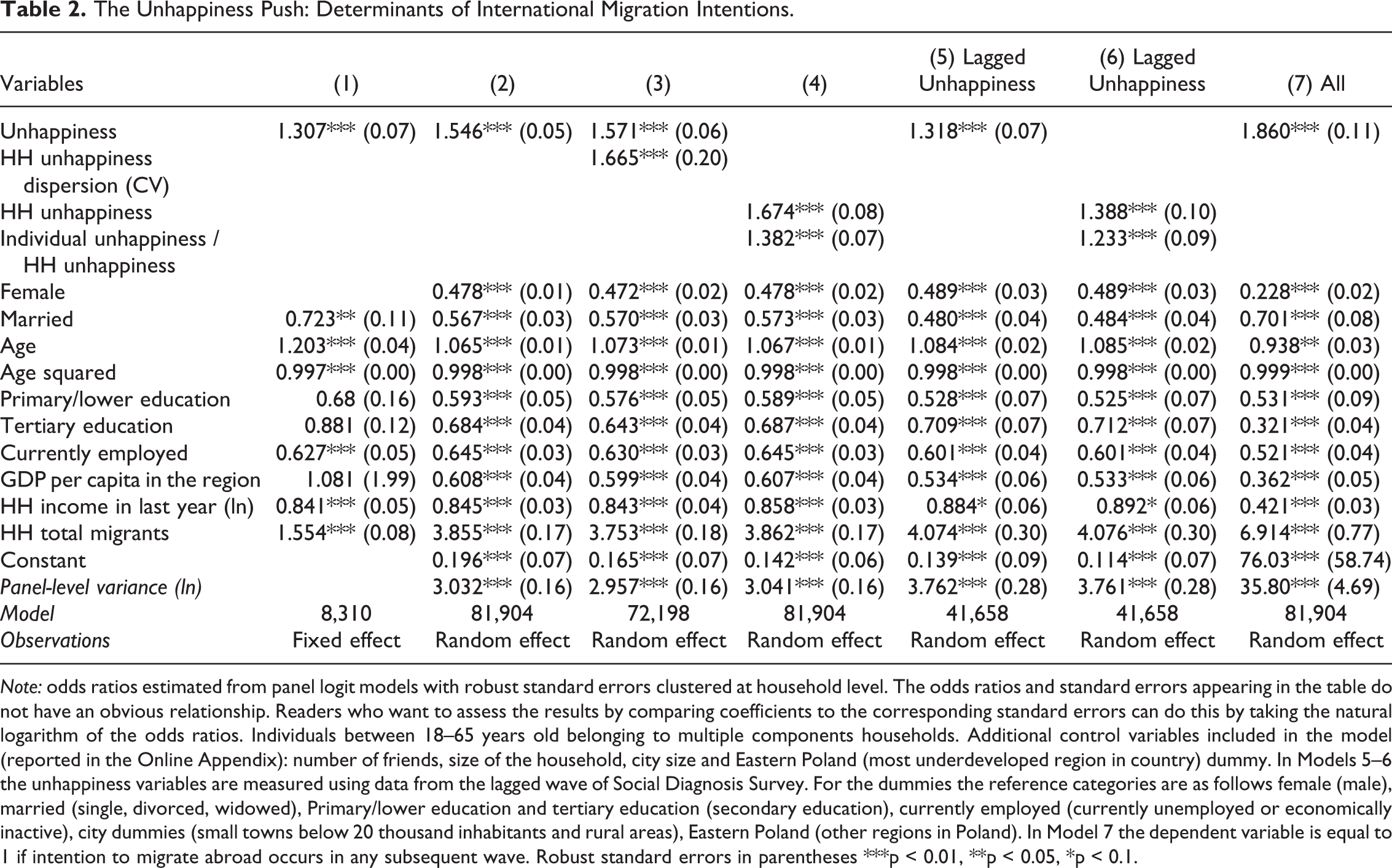
Note: odds ratios estimated from panel logit models with robust standard errors clustered at household level. The odds ratios and standard errors appearing in the table do not have an obvious relationship. Readers who want to assess the results by comparing coefficients to the corresponding standard errors can do this by taking the natural logarithm of the odds ratios. Individuals between 18–65 years old belonging to multiple components households. Additional control variables included in the model (reported in the Online Appendix): number of friends, size of the household, city size and Eastern Poland (most underdeveloped region in country) dummy. In Models 5–6 the unhappiness variables are measured using data from the lagged wave of Social Diagnosis Survey. For the dummies the reference categories are as follows female (male), married (single, divorced, widowed), Primary/lower education and tertiary education (secondary education), currently employed (currently unemployed or economically inactive), city dummies (small towns below 20 thousand inhabitants and rural areas), Eastern Poland (other regions in Poland). In Model 7 the dependent variable is equal to 1 if intention to migrate abroad occurs in any subsequent wave. Robust standard errors in parentheses ***p < 0.01, **p < 0.05, *p < 0.1.
The following six models (columns 2–7) are estimated with random-effect logit models with robust standard errors clustered at the household level to analyze the effects of time-invariant characteristics on our dependent variable. In the case of model 2, the effect of individual levels of unhappiness impacts significantly (at 1 percent level) on migration intentions, and this effect is strong (odds ratio at 1.546). In the specification reported in column 3, we add the dispersion of household unhappiness, which once again affects migration intention in a positive and significant way. In model 4, we add measures of relative unhappiness of individuals within the household and of mean household unhappiness, both of which have a positive and significant effect on migration intentions. These results confirm that measures of household happiness are important factors in shaping individual intentions to migrate: individuals expressing a willingness to move abroad were more likely to be “drawn” from unhappy households and to be themselves the relatively unhappier ones.
As discussed in the previous section, employing contemporaneous measures of intention to migrate and happiness (or other measures of subjective well-being) is risky, as we cannot rule out potential reverse causality. In fact, the happiness indicator might well be affected by the intention to migrate. One reason for reverse causality is related to “priming effects” in surveys collecting data on subjective well-being (Sgroi et al. 2010). 22 Individuals asked about their level of satisfaction with respect to one dimension of quality of life might not be able to distance themselves from the emotions generated by previous questions and/or recent events and might, thus, provide a biased or unstable assessment of their subjective well-being. In the SD survey, the question related to general assessment of happiness and life satisfaction has always been asked before that on the intention to migrate abroad. This order is partly reassuring vis-à-vis potential reverse causality, but we cannot test the existence of this bias by using a different order in the sequence of these questions. To deal with this problem, we include model specifications (columns 5 and 6) where we measure individual and household unhappiness levels in the previous wave (lagged unhappiness). Our strategy exploits the fact that it is less likely that lagged happiness indicators will be strongly affected by future intentions to migrate while these lagged indicators will still be highly correlated with future measures of happiness. 23 Interestingly, the odds ratio of the coefficient for lagged unhappiness has a very similar value (column 5 — odds ratio at 1.318) as the one on contemporary unhappiness (column 1). A comparable effect is found in column 6, where we include lagged mean household unhappiness and relative unhappiness of individuals within the household, and the results are similar to the model in column 4, where the contemporary measures have been employed.
In the model reported in column 7, we specify our dependent variable as a dummy which is equal to 1 if the intention to migrate abroad is expressed in any SD wave; in other words, we consider both future and current intentions. The effect of unhappiness is also positive and highly significant: the probability of positive intentions to migrate increases from 8.5 percent for individuals with the lowest level of unhappiness to 13.4 percent for the highest level of unhappiness, keeping all other covariates at average values.
In terms of the other covariates included in the model (see column 2), we find that women were less likely to declare migration intentions than men, keeping other variables at mean values. Married individuals were less likely to intend to migrate than were singles. Age is positively related to migration intention; we find a non-linear relationship, with a peak at age 20. The propensity to migrate was significantly higher for individuals with secondary education (the baseline group in our estimates) compared to those with tertiary education and those with primary or no education. Individuals who were employed at the time of survey were less likely to declare intentions to migrate. Most results for traditional individual characteristics (i.e., age, gender, and education) are largely consistent with previous studies on migration intentions (e.g., Ivlevs 2014, 2015). One relevant difference relates to the role of formal education: while Cai and associates (2014) and Ruyssen and Salomone (2018) find persons with tertiary education most likely to declare intention, in our case the individuals with secondary education are more likely to do so. A possible explanation for this outcome is the fact that higher education grants a premium on Polish labor market performance, including a significant increase in the employment probability (cf., Boarini and Strauss 2010), as compared to secondary education, thus lowering tertiary-educated individuals’ intentions to migrate.
In the baseline model, we also included control variables related to the place where the household resided. As expected, a higher mean GDP per capita of the region was negatively related to outmigration intentions. An increase of one standard deviation from mean GDP per capita in our sample is associated with a −6.4 percent decline in the probability of declaring an intention to migrate abroad, with all other explanatory variables at average values. The importance of household income is confirmed by our analysis: members of the most affluent households were less likely to plan migration. On the other hand, the existence of at least one migrant in the household significantly and strongly increased migration intentions. 24 To sum up the analysis reported above, we find evidence of an unhappiness push factor of intention to migrate abroad.
Given the availability of longitudinal panel data, we can further investigate whether this push was sufficiently strong to translate into actual migration. The results of our analysis of the role of individual- and household-level happiness in the actual migration decision in the subsequent period (up to two years after the survey) are shown in Table 3. We use the same specifications discussed above for migration intentions. In columns 1 and 2, we report the odds ratios computed from, respectively, a fixed-effect and a random-effect baseline specification where we include individual scores of unhappiness. We do not find evidence of statistically significant effects of individuals’ unhappiness on the odds of observing actual migration abroad in the two years following the survey. In other words, our results do not support the hypothesis that actual migrants are more likely to be the unhappy ones. Our estimates suggest that similar results hold when we consider household-level and relative measures of unhappiness (columns 3 and 4). Note that when we consider the lagged measure of unhappiness, measured in the previous wave of our longitudinal panel (i.e., from two to four years before the migration move materialized), we also do not find significant effects (see columns 5 and 6). Similarly, if we specify our dependent variable as migration realization in any subsequent period, we do not find evidence of a different propensity to migrate driven by individual unhappiness (see model 7). The results reported in Table 3 show that happiness is not a strong determinant of actual migration moves. Thus, our results suggest that although unhappiness (both individual and household) impacts the willingness/intention to move abroad, 25 the unhappiness push does not significantly shape effective migration behaviors on the average individual in our sample.
Determinants of Actual International Migration: The Weak Effect of Unhappiness.
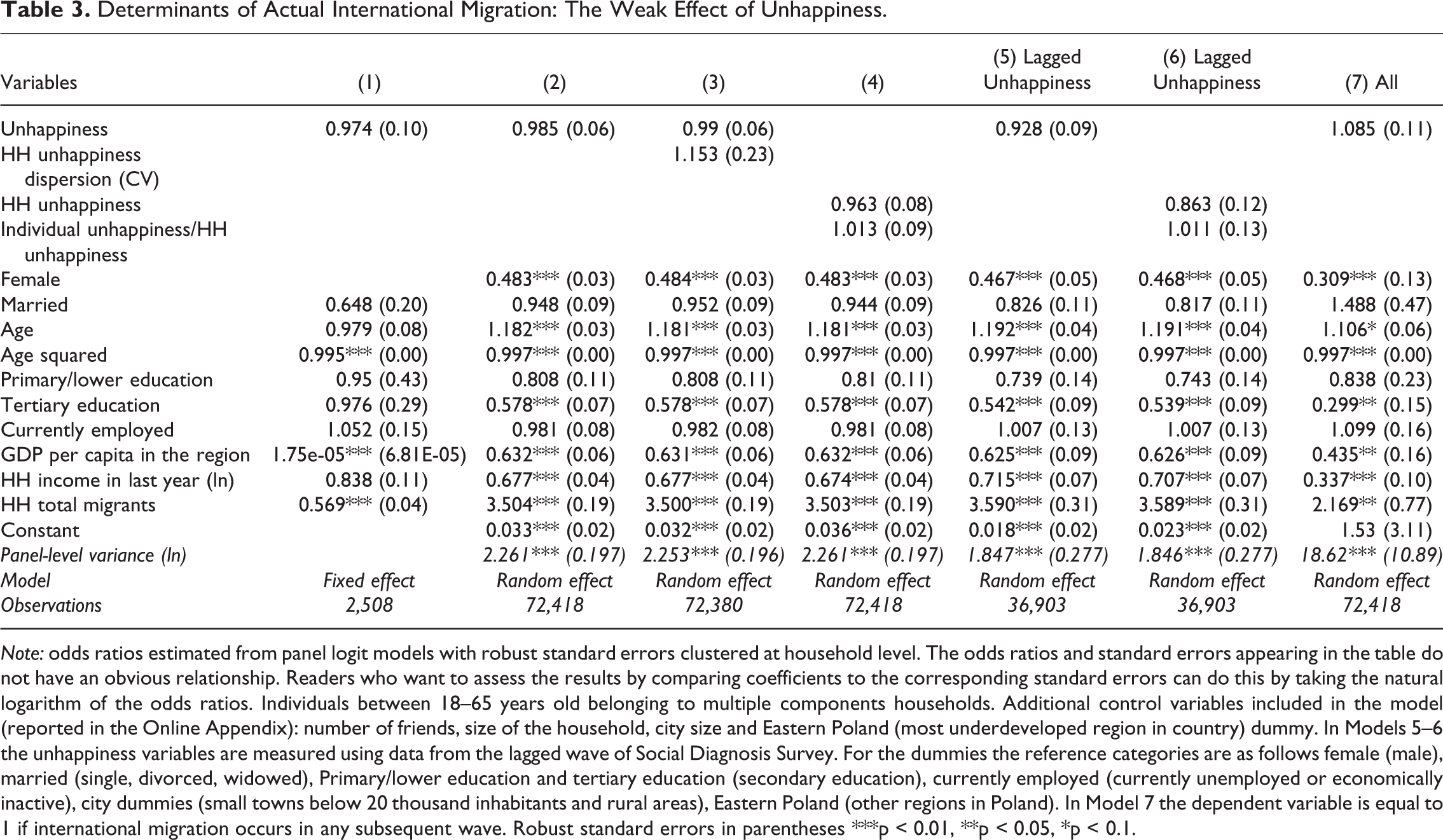
Note: odds ratios estimated from panel logit models with robust standard errors clustered at household level. The odds ratios and standard errors appearing in the table do not have an obvious relationship. Readers who want to assess the results by comparing coefficients to the corresponding standard errors can do this by taking the natural logarithm of the odds ratios. Individuals between 18–65 years old belonging to multiple components households. Additional control variables included in the model (reported in the Online Appendix): number of friends, size of the household, city size and Eastern Poland (most underdeveloped region in country) dummy. In Models 5–6 the unhappiness variables are measured using data from the lagged wave of Social Diagnosis Survey. For the dummies the reference categories are as follows female (male), married (single, divorced, widowed), Primary/lower education and tertiary education (secondary education), currently employed (currently unemployed or economically inactive), city dummies (small towns below 20 thousand inhabitants and rural areas), Eastern Poland (other regions in Poland). In Model 7 the dependent variable is equal to 1 if international migration occurs in any subsequent wave. Robust standard errors in parentheses ***p < 0.01, **p < 0.05, *p < 0.1.
Turning our attention to the other covariates included in the specifications reported in Table 3, some interesting differences emerge compared to our analysis of intentions to migrate (Table 2). First, while married individuals had lower intentions to migrate abroad, as has been found in cross-sectional studies such as Cai et al. (2014) and Ruyssen and Salomone (2018), we do not find a significant association of marital status with actual migration. The fixed effects estimates reported in Table 3 confirm as well that changes in marital status also produce similar effects. The fact that marital status differently affects the intention to migrate, compared to actual migration, is a novel finding in the migration literature, as few studies comparing intentions and realizations have investigated individuals’ marital status (Gardner et al. 1985; Van Dalen and Henkes 2008). A potential explanation might be that migration’s psychic cost is generally higher for married individuals, as their migration is likely to involve in a complex way several household members; hence, this variable is negatively associated with migration plans, as found in existing studies on the intention to migrate (Cai et al. 2014; Ruyssen and Salomone 2018). On the other hand, empirical studies based on actual migration moves show that marriage significantly increases the hazard of internal or international migration (Jang, Casterline, and Snyder 2014). In fact, change in marital status can motivate changes in residence out of necessity or as a consequence of different family constraints, aspirations, and/or opportunities — for instance, a need to build a house or purchase an apartment in the home country (Grigolini 2005).
The second interesting finding is that employed individuals were less likely to intend to migrate, in contrast to the case of actual migration, where the estimated coefficients are positive although not statistically significant. This result might be explained by the fact that on average, migrants are positively self-selected (Chiswick 1999), and those who leave are usually more successful in economic terms than the average non-movers. The evidence on positive self-selection is confirmed for recent waves of Polish international migrants by Dustmann, Frattini, and Rosso (2015). The result is also consistent with recent evidence showing a significantly higher propensity to migrate abroad among individuals who are employed but unsatisfied with their working conditions (see Villarreal [2016] on Mexican migration). This intuition is confirmed by our analysis, as employed individuals dissatisfied with their current working conditions — often because they are overqualified — show a substantially larger propensity to migrate abroad (see also Table 4). The magnitude of Poland’s over-qualification problem during the post-accession migration was substantial (Iglicka 2010; White 2014; Coniglio and Brzozowski 2018). Our study confirms that the malfunctioning of origin-country labor markets might give rise to a strong positive self-selection of migrants — a trend that will not necessarily be captured using measures of migration pressure derived from intentions.
The Heterogeneous Effects of Unhappiness on International Migration Intentions and Realizations.
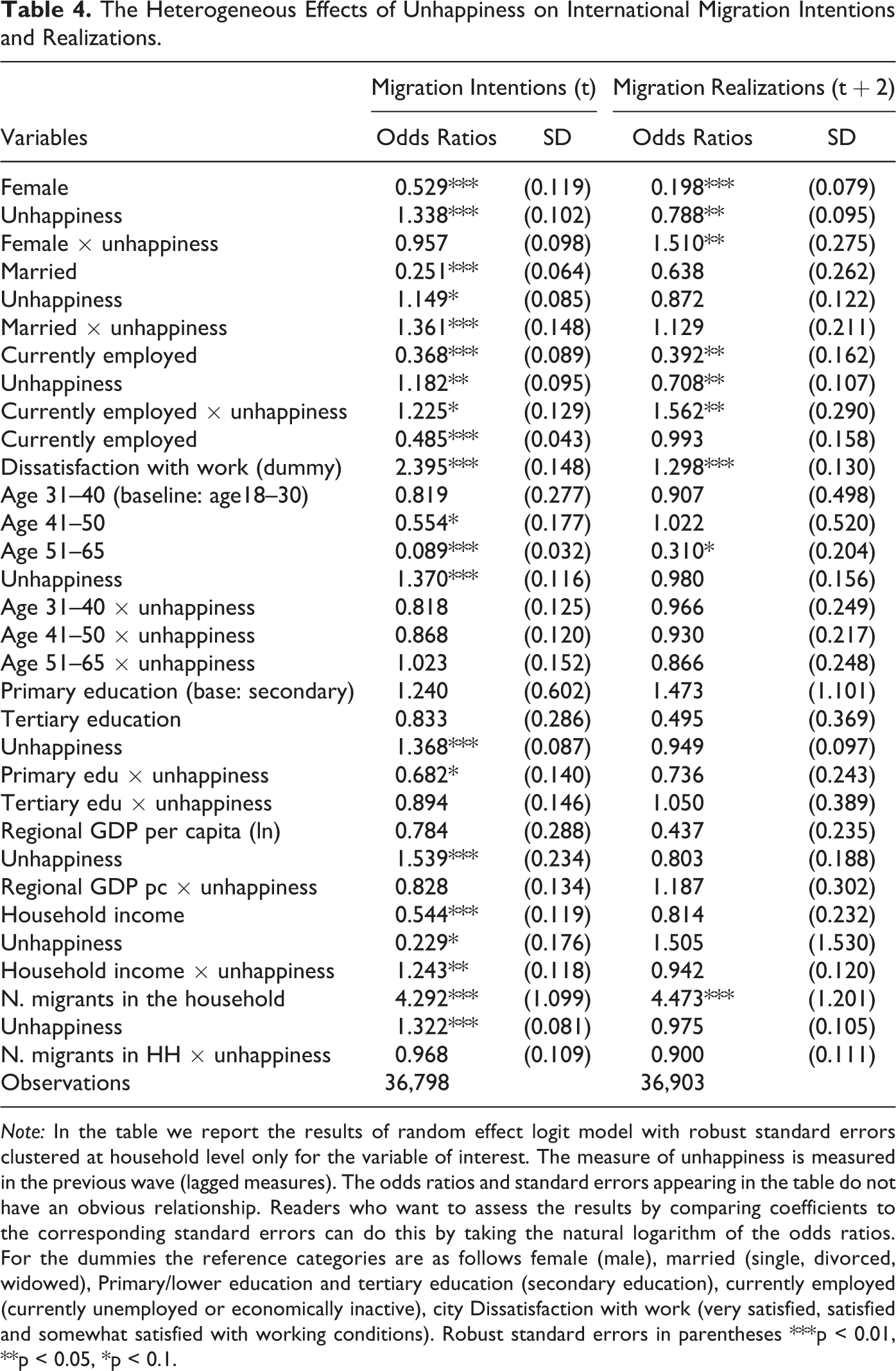
Note: In the table we report the results of random effect logit model with robust standard errors clustered at household level only for the variable of interest. The measure of unhappiness is measured in the previous wave (lagged measures). The odds ratios and standard errors appearing in the table do not have an obvious relationship. Readers who want to assess the results by comparing coefficients to the corresponding standard errors can do this by taking the natural logarithm of the odds ratios. For the dummies the reference categories are as follows female (male), married (single, divorced, widowed), Primary/lower education and tertiary education (secondary education), currently employed (currently unemployed or economically inactive), city Dissatisfaction with work (very satisfied, satisfied and somewhat satisfied with working conditions). Robust standard errors in parentheses ***p < 0.01, **p < 0.05, *p < 0.1.
An additional explanation for employment’s heterogenous impact on intentions and migration realizations might be related to the fact that although unemployed Poles have higher intentions to migrate, Polish individuals move with “a job in their hands” rather than to find a job. For instance, a recent study on immigrants in Netherlands showed that almost 74 percent of Poles had employment in their home country before migrating, while only 11 percent of them were unemployed (Lubbers and Gijsberts 2016). 26 Hence, willingness to migrate and actual opportunities to do so might diverge significantly for unemployed people who find it difficult to enter the job market in a foreign country. The results in Table 3 also confirm that individuals residing in wealthier regions were less likely to move. When considering household characteristics, we find a negative association between household income and migration. Finally, as in the case of migration intentions, “migration experience” within the household played a strong role in the migration decision: having at least one migrant in the household strongly increased the individual propensity to migrate internationally.
The Heterogeneous Effect of Unhappiness on International Migration
The results reported above of a strong effect of unhappiness on migration intentions but not on actual migration mask some important heterogeneity, which is explored in the last step of our analysis. In particular, we test whether the unhappiness push has heterogeneous effects across the population on both migration intentions and realizations, reporting results in Table 4. Women had a significantly lower propensity to declare intentions to migrate and lower odds ratio of actual migration. The effect of unhappiness did not seem to differ across genders when looking at intentions, but, when analyzing migration realizations, we find that unhappiness had a stronger effect on women, thus closing the large observed gender gap in the propensity to migrate. At the highest level of unhappiness, women had a slightly higher probability of international migration than men (1.29 percent versus 1.26 percent). On the contrary, keeping the level of unhappiness at the lowest level and all other variables at mean values, the probability of international migration for men was 2.3 percent against 0.8 percent for women. This result on the heterogeneous role of unhappiness complements the findings of other recent studies on the non-economic determinants of female migration, such as gender discrimination (Ferrant and Tuccio 2015; Ruyssen and Salomone 2018), or, more generally, on gendered differences in behavioral traits and social preferences that affect labor market outcomes (Shurchkov and Eckel 2018). The issue of gender, however, deserves further in-depth investigation in future studies on migration intentions and realizations.
While married individuals were less likely to intend to migrate, the effect of unhappiness was stronger for them. At average values for other covariates, the probability of declaring the intention to migrate increased by +136.5 percent (from 4 percent to 9.4 percent) for married individuals moving from the lowest to the highest level of unhappiness, compared to +28.3 percent for unmarried individuals (from 8 percent to 10.3 percent). No differences related to marital status were found when considering migration realizations.
Interestingly, we find that individuals who were employed and who reported high levels of unhappiness in the previous wave were significantly more likely to migrate in the subsequent two years. The probability of migration rose from 1.27 percent to 1.65 percent, with other variables at average levels, when unhappiness level shifted from the lowest (very happy) to the highest (unhappy) values. Unhappy individuals who were not employed were less likely to migrate, although they were more likely to express their intention to do so. This finding suggests that the unhappiness push for unemployed individuals is not enough to generate actual migration, as these individuals might lack the financial and human resources necessary to undertake costly and risky international mobility.
A key mechanism explaining the relationship between unhappiness and international migration might be related to dissatisfaction with current working conditions, as suggested by Villarreal (2016), who shows that the selection of Mexican migrants to the United States can also be driven by the over-qualification problem. The odds ratios associated with a dummy variable equal to one when employed individuals declared dissatisfaction with current working conditions was, respectively, 2.395 and 1.298 for migration intention and realization. The effect of unhappiness on international migration intentions, but not on realizations, was positive only for households with high income. Again, this heterogeneous effect based on household income might be interpreted as an indication that unrealized migration aspirations might be due to limited financial resources. Finally, we do not find evidence of heterogeneous effects of unhappiness when considering individuals’ age and education.
Conclusion
In this article, we have analyzed the impact of individual and household subjective well-being on the ex-ante international migration intentions and ex-post actual migration decisions among a sample of Polish residents and households. Our results show that unhappier persons were more likely to intend to migrate abroad but that this individual unhappiness did not mean that intentions materialized into actual migration in subsequent years. We also show that the average level of (un)happiness within a household and individuals’ relative position in terms of subjective well-being within the family had a significant impact on migration intentions but that the effect of unhappiness on actual migration was found only for some sub-groups such as women and currently employed individuals.
Our results confirm the role of unhappiness as a determinant of international migration process but challenge previous studies (Cai et al. 2014; Otrachshenko and Popova 2014; Ivlevs 2015; Ruyssen and Salomone 2018) in at least two dimensions. First, we find that the factors shaping individuals’ intention to migrate internationally might diverge substantially from determinants of real migration decision. Such inconsistencies between intentions and realizations in individual migration behavior have so been far found in studies on internal mobility (Lu 1999). The few studies comparing international migration intentions and realizations have sought explanations for these discrepancies mostly in severe legal obstacles for individuals from developing economies (Gardner et al. 1985) or in the deteriorated health status of a person who expressed willingness to move (Van Dalen and Henkens 2008). In our study, as legal barriers to international migration were of little concern, we argue that the failed realization of migration intentions often lies in the differences between the ex-ante expected costs and benefits of international migration and the “true” ones that depend also on factors, such as job opportunities in intended destinations, that are out of the control of those who wish to migrate. Such specific and often large discrepancies between intentions and realizations can be only identified by tracking individuals over time, using longitudinal data, as we have done in this article. Our results suggest that migration scholars should exercise caution when inferring or forecasting international migration flows using intentions and their determinants, as in Tjaden, Auer, and Laczko (2019).
The second challenge to the existing migration literature is related to our finding of highly heterogeneous effects of unhappiness on international migration. The fact that unhappiness influenced actual international migration only under certain conditions (i.e., employment status) or for certain demographic groups (i.e., women) suggests that macroeconomic analyses of international migration (e.g., Grimes and Wesselbaum 2019) based on bilateral flows between home and host countries may not capture some potentially fundamental differences across the home-country population. People respond in complex, often divergent ways to the same push and pull factors (Constant and Massey 2002). More research using micro-level data can help shed light on these potential asymmetric and heterogeneous reactions to monetary and non-monetary determinants of migration.
Does international migration, though, reduce cross-country differences in happiness? Our finding that migrants were relatively unhappier than non-migrants (and were largely drawn from unhappier households) adds another important piece for testing the Grimes and Wesselbaum (2019) hypothesis of a convergence in happiness between major origin and host countries. While more evidence is accumulating on the relationship between happiness and migration for migrants and natives (e.g., Betz and Simpson 2013; Kushnirovich and Sherman 2018), we still know very little about what happens to the level of happiness of household members left behind. Similarly, it would be interesting to investigate the effect of return migration on happiness for the returnee and his/her family. Both such studies would complement this article’s findings and push research toward a more comprehensive assessment of the interplay between mobility and subjective well-being and provide evidence on international migration’s role in affecting the international happiness gap.
Finally, we should mention this article’s limitations. The first is the possibility of over-generalization. We rely on large-scale survey data from a single country, Poland. Although Poland is an interesting case study, given its importance as a major migrant-sending country in the considered period, it is important to investigate the nexus between happiness and migration in other countries and to analyze the role of context-specific features in shaping migration behaviors. The second limitation is the obvious time lag between the time of the survey and the time when the migration decision was made. In this article, we were able to identify the migration decision occurring between waves (two-year intervals). Admittedly, the migration decision might be affected by factors that arise after respondents participated in the survey but about which we have limited information. Moreover, individuals’ happiness can change abruptly. Thus, we run a risk of not capturing an unexpected change of happiness level which might influence migration decision. 27 This kind of limitation, however, will remain problematic for most migration studies, even in the case of longitudinal data with higher frequency.
Notwithstanding these limitations, we believe that this article significantly contributes to knowledge on the determinants of international migration, using the perspective of an important sending country, Poland, which, during the period under study, became an integral part of the EU. Moreover, our inclusion of a longitudinal perspective allows us to track individuals’ international migration decisions over time, taking into the account not only their individual socio-economic characteristics but also, in line with new economics of labor migration theory, their households’ characteristics — an approach which remains relatively novel in migration studies, due to data limitation.
Supplemental Material
Supplemental Material, sj-doc-1-mrx-10.1177_01979183211004835 - International Migration and the (Un)happiness Push: Evidence from Polish Longitudinal Data
Supplemental Material, sj-doc-1-mrx-10.1177_01979183211004835 for International Migration and the (Un)happiness Push: Evidence from Polish Longitudinal Data by Jan Brzozowski and Nicola Coniglio in International Migration Review
Footnotes
Declaration of Conflicting Interests
The author(s) declared no potential conflicts of interest with respect to the research, authorship, and/or publication of this article.
Funding
The author(s) disclosed receipt of the following financial support for the research, authorship, and/or publication of this article: This research has been supported by the European Union’s Horizon 2020 research and innovation programme under grant agreement No 870649, project Future Migration Scenarios for Europe (FUME).

Supplemental Material
The supplemental material for this article is available online.
Notes
References
Supplementary Material
Please find the following supplemental material available below.
For Open Access articles published under a Creative Commons License, all supplemental material carries the same license as the article it is associated with.
For non-Open Access articles published, all supplemental material carries a non-exclusive license, and permission requests for re-use of supplemental material or any part of supplemental material shall be sent directly to the copyright owner as specified in the copyright notice associated with the article.
